Inside America’s Deadliest Railroad Job – 9,703 Workers Killed in One Year
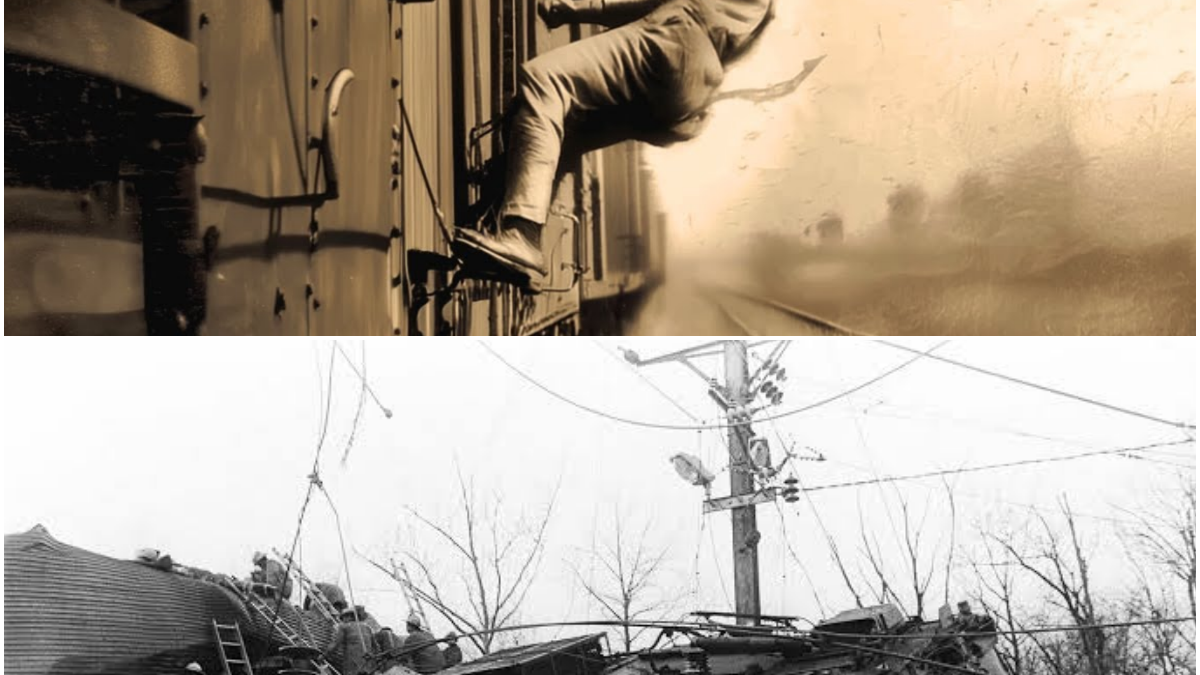
Inside America’s Deadliest Railroad Job – 9,703 Workers Killed in One Year
It’s the year 1905, somewhere near Altoona, Pennsylvania, and a freight train is cutting through the thick fog as its iron wheels spark and the coal smoke burns the lungs.
A brakeman lunges for the side ladder.
His glove slips on the wet steel, and the ballast cracks under his boots as the cars surge past.
The whole world turns into a blur of motion and noise.

By the end of the year, rail accidents killed 9,703 people and injured 86,008 others.
What kept men alive was not the rulebook.
It was a private code.
Was it discipline, or was it defiance?
Was it a skill, or was it pure luck?
If stories like this move you, please like, subscribe, and tell me in the comments which disasters to explore next.
Your support makes these detailed stories possible.
Thank you for being here.
Now, let’s begin.
The freight yard does not wait for a man to feel ready.
It moves, it shoves, it takes what it can.
In the first decade of the 1900s, railroad companies printed rulebooks thick as hymnals, full of clean instructions that assumed daylight, good equipment, and calm men.
Out here, the work arrived at night in sleet with broken grab irons and orders shouted over steam and clanging couplers.
The air tasted of hot oil.
Brakemen learned quickly that the official rules were written to protect schedules, not bodies.
They watched foremen praise speed, then write carelessness when someone vanished under a wheel.
Between 1902 and 1911, ICC accident bulletins tallied 33,761 railroad employees killed and 403,259 injured, a slaughter hidden inside routine.
So, the older hands taught a different curriculum, low-voiced and practical.
Do not believe the lantern light.
It lies in fog.
Do not put a knee where slack can snap shut.
Do not trust a promise that the cars are still unless you’ve proven it yourself.
If a man asked why, they did not argue.
They pointed to the trackside crosses and the empty chairs.
And what exactly caused so many of these deaths?
Faulty machines or a system that demanded motion at any cost?
Safety appliances existed on paper and in law, but enforcement was uneven, and worn couplers, bad ladders, and hurried switching kept creating the same trap.
Yet, even the best equipment could not fix a rush signal, a tired step, or a moment of overconfidence.
And that is why the verdict never sits cleanly in one place.
In 1905, writers could state the risk plainly, one trainman killed for every 133 employed, and one injured for every nine.
The numbers were not a warning to the companies.
They were the price of doing business.
That is why brakemen trusted the unwritten rules, because they were born from mistakes that never made it into the rulebook.
And the first rule began where every shift began, at the side of a moving car with a ladder that could turn a man into debris.
The most dangerous second on a freight train is the second you decide to grab on.
In the early 1900s, a brakeman was expected to mount a moving car as if it were a simple step.
Even when the ladder was wet, the grab iron was loose, and the ground beside the rail dropped into darkness.
He heard the flanges sing on a curve, felt the slack surge like a kick, and knew that if his hand slipped, the train would not notice.
This is why the first unwritten rule was plain, never trust the ladder.
A rung could be polished smooth by years of boots, or glazed with frost in 1 hour, and the company could still call it fit.
The reports would say, “Fell from train.”
And move on.
How many men died because the ladder failed?
And how many died because the schedule demanded that they use it anyway?
A statistician for the Interstate Commerce Commission tracked what the men already felt.
In 1905, falling from trains and overhead obstructions killed 39 employees per every 100,000 employed, and injured 451 per 100,000.
These were not spectacular wreck totals.
They were the quiet, repeating kind that happened one man at time.
The causes could be ordinary and still be fatal.
A sudden shove while switching could snatch a shoulder out of line.
A lantern could throw false shadows, so a boot landed on air.
Yet, railroads had begun fitting safer equipment, and by 1905, the ICC data showed 87% of equipment in interstate commerce carried the train brake.
The machines improved, but the pressure to hurry stayed brutal.
So, the older brakemen taught a method, not a motto.
Grip high, not wide.
Commit only when your body is square to the car, and your next foothold is already chosen.
Because once you survive the ladder, the next trap is not in your hands at all.
It is down at the stirrup and brake platform, where one careless foot placement can turn a close call into a disappearance.
And those wheels are always waiting right below.
The grab iron is behind you, and now the fight is under your boots.
On freight cars in the early 1900s, the ironwork meant to hold a man could just as easily guide him into the wheels.
A stirrup bent inward, a step slick with oil, a brake platform warped by winter, and a brakeman’s foot would land wrong, then vanish at night.
In accident narratives, the language is cold and brief.
Slipped, lost footing, fell under cars.
The old hands taught a rule that sounded superstitious.
Place your feet only where you can get them back.
Never let your toe point toward the rail.
Never step where slack action can fold two cars together and make your leg the buffer.
If you must move, move like the train is already trying to take a piece of you.
Was this carnage caused by faulty gear, or by the relentless demand to work faster than the equipment could safely allow?
In 1901, death rates for American trainmen were still measured in brutal fractions.
Fatalities from coupling alone ran about one in every thousand, and deaths tied to braking work, including falls from cars and strikes from overhead obstructions, stood around two per thousand.
All causes combined reached roughly seven per thousand, a toll that did not require a headline wreck.
The railroads could argue that new safety appliances were spreading, and that men who ignored instructions made their own luck.
The men on the ground had a different explanation.
Worn steps, uneven ballast, poor lighting, and the constant shove to keep moving.
The verdict sits between them, because a rotten step can start the fall, but hurry decides whether you test it at all.
So, the rule became a ritual.
Before any move, you glance down, you feel for the rung, you choose an exit.
You do not trust what you cannot see, and you do not step where you cannot jump.
Because once your feet are committed, the next battlefield rises above your head.
The roof walk is waiting in darkness, and it does not forgive a single patch of ice.
Up on the roof, the wind does not care how steady your hands are.
Brakemen climbed onto running boards that were never meant to feel like a walkway, only a narrow strip of wood and iron above a moving world.
Coal soot glazed the surface, cinders stung the eyes, and winter turned every step into glass.
One loose board, one patch of frost, and a man did not fall so much as vanish.
The older hands passed down a rule that sounded harsh because it had to be.
Treat every roof walk like it is already broken, and never step where you cannot drop away from the wheels.
Keep three points of contact, keep your body low, and if you feel the car sway, you stop moving before the train decides your direction.
By the year ending June 30th, 1904, the Interstate Commerce Commission recorded 3,632 railroad employees killed, not in one famous wreck, but across a country built on constant motion.
Many of those deaths came from the ordinary work that never made the front page, the climb, the reach, the misstep.
And what truly caused these roof falls?
Was it rotten equipment, or was it the pressure to keep moving when a cautious man should have waited?
The numbers show how common the pattern became.
In 1904, accidents grouped as falling from trains and striking overhead obstructions killed 50 employees per 100,000 employed, and injured 508 per 100,000.
That danger followed men directly onto the tops of cars, where low bridges, tunnels, and hidden structures could take a life in an instant.
Railroads could argue that improved appliances and better discipline were steadily reducing the toll, and they were not entirely wrong.
But the men knew another truth.
Clearance was uneven, inspections were imperfect, and a hurried order could push you onto the roof at the worst possible moment.
The verdict remained split, because the roof walk might be sound on paper, yet lethal in practice.
So, the rule hardened into instinct.
You test the board before trusting it.
You keep your weight centered, and you never let pride persuade you to hurry across a car you cannot fully see.
Because the next enemy is not ice or wood at all.
It is the air itself.
When fog rolls in, distance collapses, speed becomes a guess, and a simple move can turn into a fatal misjudgment.
The fog makes the railroad feel quiet, and that is when it becomes most deceitful.
On freight lines then, a brakeman could lose his sense of speed in an instant.
Headlights turned into pale halos, lantern beams died in smoke, and the sound of wheels seemed farther away than it was.
Men misjudged a step or a gap, and the train finished the mistake.
The older vets taught a rule that was blunt because it had to be.
If you cannot see the end of the car, you move as if the train is faster than it looks, and you give every switch more room than you think you need.
In fog, you trust distance, not bravado.
By 1905, collisions and derailments killed 1,064 people, and injured 11,949.
Those totals do not pin every death on weather, but fog and smoke often hide behind the phrases failed to observe, misunderstood, ran past signals.
So, what caused these crashes?
Was it nature or the choices railroads made about signals, speed, and fatigue?
The Park Avenue tunnel crash on January 8th, 1902 showed what poor visibility can do in a confined place.
In that dark, smoky bore beneath Manhattan, an express missed signals and struck the rear of a backed-up commuter train, killing 15 and leaving many more burned and bloodied.
The arguments over blame was loud, but the lesson for men was simple.
When sight fails, you slow down, you verify, you wait.
Railroads could point to technology, better block systems, rules, and a disciplined crew.
Yet, the same records also show the human limit.
A man cannot see a signal he cannot see, and a schedule can tempt him to pretend otherwise.
The verdict stays open because fog begins the deception, but pressure decides whether it becomes disaster.
For a brakeman, the fog rule ends with a warning.
When the air turns white and the world shrinks, your life depends on the touch of the engineer up front, and the next lesson is learning which one will save you and which one will not.
You can do everything right on the cars and still die because of the man on the throttle.
Brakemen learned engineers the way sailors learned weather.
Some handled the freight like a steady hand on a rudder, easing slack, respecting signals, and giving the crew time to finish a move.
Others drove as if the train were an argument to be won.
The unwritten rule was simple, and it was spoken quietly.
Learn which engineers make the railroad dangerous.
A bad one starts too hard, breaks too late, and snaps slack so violently that a man working the side of a car gets jerked off balance.
Another rolls through a yard like the track is always clear and forces everyone behind him to hurry.
By September 1906, block signals covered 48,743 miles of American railroad with 6,827 miles of that being automatic.
The companies could point to those improvements and claim the system was becoming safer.
But, what does a signal matter if a tired or reckless crew member treats it like a suggestion?
The record shows how schedule pressure and aggressive handling could turn into disaster.
On September 27th, 1903, the Southern Railway’s fast mail, remembered as the old 97, left the rails outside Danville, Virginia, killing 11 people.
Arguments over cause followed: speed, track conditions, judgment.
But, working men heard the lesson underneath.
A railroad can build rules, yet a single mindset can still outrun them.
So, brakemen developed their own tests.
They listened to how the train took power, whether the slack ran in gentle or slammed like a hammer.
They watched how an engineer approached a stop, whether he drifted in with control or lunged and yanked the whole consist.
They also noted the ones who played games with starts and stops, the kind that made a crewman feel small and made the cars feel alive.
Was the engineer the true danger?
Or was he only the final link in a chain of fatigue, poor supervision, and impossible expectations?
That is why the best brakemen saved their pride for later.
If an order felt wrong, they delayed it with a safer excuse, or they refused it outright when refusal was the only way to go home.
The next rule came immediately after that decision, because once you choose to distrust the engineer, you must decide whether to step between cars at all and whether the train has truly gone still.
The space between two freight cars looks harmless until it closes like a trap.
In the early 1900s, brakemen were ordered to couple and uncouple in yards where every sound meant motion.
Steel on steel shouted signals, a locomotive breathing nearby.
They stepped into that narrow corridor with grease underfoot and slack action waiting in the drawbars, knowing the cars could drift an inch and turn into a vice.
The unwritten rule was not bravado, it was a transaction.
You do not go between cars until you have bought stillness with your own proof.
The brake set, the engine eased, the movement dead, and an escape path already chosen.
If you cannot guarantee that, you stay out even if a foreman calls it stubbornness.
And what caused so many men to be crushed here?
Bad machinery or the culture of hurry that turned a careful pause into a punishable delay?
By 1906, the railways reported 298 employees killed and 3,884 injured in coupling and uncoupling accidents.
Those numbers were not the result of one spectacular wreck.
They were the daily tally of bodies caught in routine work that rarely reached the public eye.
Railroads could point to safety laws and newer equipment, arguing that injuries came from workers taking chances they were told not to take.
The men answered with their own explanation.
Worn couplers that did not meet cleanly, uneven track that made cars roll when they should have held, and signals lost in steam and darkness.
The verdict remains uneasy because a defective coupler can start the danger, but pressure decides whether a man steps into it before it is safe.
So, brakemen developed habits that bordered on ritual.
They never trusted the word easy.
They watched the slack.
They listened for the faint click that meant a car was still creeping.
They also learned to read people as much as machines, because a careless engineer or a distracted switchman could sell you movement while you were paying for stillness.
By that same fiscal year, trainmen as a class were reported at 2,310 killed and 34,989 injured across railroad work.
The numbers were a reminder that even outside the narrow gap between cars, danger surrounded them at every step.
And once you understand that, the next rule becomes obvious.
Even if the train is perfectly still, you still cannot trust the coupling itself, because a bad knuckle or a mismatched drawbar can fail then force a man to choose between doing it fast or doing it alive.
A coupler looks like a simple piece of iron until it turns the space between cars into a killing zone.
Railroads sold the public a vision of progress, but the men in the yards learned that standard and safe were not the same thing.
Even as automatic couplers spread, mismatched hardware, worn knuckles, and misaligned drawbars still forced a brakeman to lean in close, right where motion becomes a vice.
In 1890, the danger was already measurable in cold arithmetic.
That year, 369 railroad employees were killed and 7,841 were injured while coupling and uncoupling cars.
Those numbers were not about spectacular wrecks.
They were about hands, sleeves, and bodies caught during routine work.
The old hands turned that history into a rule you could live by.
Assume the coupler will fail.
Assume the knuckle will not lock.
Assume the cars will roll when they should be still, and do not put any part of yourself where steel can close.
If the job requires you to just reach in, you find another way, or you wait until you have absolute control.
Was this slaughter caused by crude technology or by a system that kept men working inside the hazard because every minute of delay cost money?
The official investigations admitted something uglier than bad luck.
In the early 1890s, a federal report noted there were 44 different kinds of couplers and nine kinds of train brakes in actual use, meaning safety could change from car to car even within the same train.
A railroad could claim a worker should recognize the difference, but a man working in darkness and storm could not inspect every joint like a machinist.
By 1900, federal safety appliance requirements were fully effective, and the promise was clear.
Fewer men would need to go between cars at all.
Yet, the verdict never settles neatly because rules and equipment can reduce risk while leaving the daily pressure untouched.
Brakemen still faced rushed orders, rough handling, and cars that were good enough until the instant they were not.
So, the coupler rule became a mindset.
You distrust the hardware.
You distrust the timing, and you never confuse routine with safety.
And once you stop trusting the coupler, you start watching the next silent betrayer, the handbrake, because one bad wheel and one surge of slack can throw a man off a roof walk before anyone even realizes he’s gone.
The train does not need to derail to kill you.
It only needs to stop obeying the engineer.
By the turn of the century, air brakes were sold as the great safeguard, a way to stop a long freight from the cab.
The Westinghouse company later stated that by 1905, more than 2 million rail cars and 89,000 locomotives were equipped with its automatic brake.
Brakemen knew control could disappear anyway.
A hose could part, a valve could stick, or ice could slow the air until the brakes came on late and uneven, and the cars shoved like dead weight coming alive.
The rule was immediate.
If the air goes wrong, move your body first, then solve the problem.
What causes a runaway when the system is meant to be fail-safe?
Broken equipment or choices made under pressure?
On a January night in 1900 in Ashley, Pennsylvania, newspapers described a runaway on the Central Railroad of New Jersey, followed by a dynamite explosion that killed five men.
Steel did not have to splinter.
It only had to move.
The companies could argue that mishandling was usually to blame.
A test skipped, a valve cut out, a signal misunderstood.
The men answered that maintenance was uneven, trains were heavy, and the same schedule pressure that rushed a coupling rushed the brake test.
The verdict stays unsettled because a weak part can start the chain, but decisions decide whether it ends.
So, brakemen built habits around the air.
They listened for the hiss that did not belong, watched for delayed response, and kept away from places where an emergency application could throw slack forward and crush a man between cars.
They also learned discipline at every stop.
Before anyone stepped down to work, they checked that the brakes were set and holding, and they treated a drifting car as a warning that the train could betray them.
And once you fear the air, you start to fear the yard itself.
Where cars roll on grades, orders overlap, and the next movement can arrive before you can even see it coming.
In a switching yard, the danger is not only speed, it is uncertainty.
Freight cars drifted and slammed in half-light, while men read hand signals through smoke and winter breath.
A brakeman listened for the soft roll that meant a cut of cars was still moving, even when everyone swore it had stopped.
The air carried coal dust, hot oil, and the sharp crack of knuckles taking a hit.
The unwritten rule was simple, and it sounded cruel because it was earned.
In a yard, you either commit cleanly or you abandon early, because hesitation puts your body where steel is about to be.
A half step forward becomes a full step into the pinch.
The accident bulletins of that era made the scale plain.
In July, August, and September of 1907, there were 1,339 killed and 21,724 injured in railroad accidents reported.
And even the prominent crashes alone involved 141 deaths and 641 injuries.
Numbers like that did not come only from spectacular collisions.
They came from endless smaller calamities that piled up in yards, depots, and sidings.
So, what truly caused the yard to be so lethal?
Careless men, or a system that forced men to work inside moving machinery?
The railroads could argue that discipline was the cure.
That a careful brakeman would stay clear, follow the rules, and live.
The men saw the other side.
The yard was built on hurry, poor lighting, mixed equipment, uneven grades, and the constant pressure to clear tracks for the next movement.
The verdict stays open, because one careless step can begin the fall, but the environment decides how fast the punishment arrives.
Older brakemen taught their apprentices to read the yard like terrain.
Watch the slack, not the lantern.
Keep your shoulders squared to an escape route.
Never stand where two cars can drift together and close the space without warning.
They also warned about the most deceptive moment of all, the pause before movement resumes.
A cut of cars looks dead, then a locomotive nudges, and the whole line breathes forward.
A man who hesitates at that instant becomes the obstacle, and beyond the yard waits a colder truth.
On the main line, there is no time to negotiate with momentum, and the next rule is learning to fear grades and speed, because a freight train that starts to run cannot be argued back into obedience.
The rails feel calm until the grade begins, and then the train reminds you who is truly in command.
In the first decade of the 1900s, brakemen feared the main line for a reason no rulebook could soften.
A freight could roll steady on level track, then start down a descent and turn into something heavier than the cruise control.
The rule was blunt, never argue with momentum.
You plan your escape before you move, and you keep clear of any place where slack and steel can close.
On a dark downgrade, the rear brakeman reads the train by feel, the tug of slack, the sway of cars, the hiss of air.
If anything sounds wrong, he backs off first at once.
In October 1908 near Scappoose, Oregon, a crew learned a lesson in seconds.
Brakes failed on a 12% grade, and a locomotive and gravel car slid for a quarter of a mile, gaining speed with every foot.
13 men rode the car, and when it left the track at a curve, six were killed and seven were badly injured.
What caused that ride to become a slaughter?
Worn equipment, slick rail, or decisions made too late to matter?
Even the account leaves the verdict unsettled.
One story blamed rain and slippery track, while another said the track was dry and the brakes simply would not hold.
The engineer tried to check the movement with air brakes, but the car kept running until the coupling pin broke and it rolled over.
For brakemen on big road freights, that uncertainty was the true terror, because it meant the same hill could be safe on Monday and fatal on Tuesday.
In the end, gravity does not testify.
It only collects.
That is why veterans respected grades like predators.
Quiet until they strike, and why they watched every curve as if it were already too close.
And when a shift stretches on, respect turns into fatigue, and fatigue turns into shortcuts.
The next rule is about exhaustion, because the railroad punishes a tired mistake faster than any foreman ever could.
A brakeman can survive steel and weather, then loses life to a single slow thought.
Fatigue rode every freight like an extra car, invisible, heavy, and always pulling.
Men were called in the night, worked through dawn, then climbed again when their eyes felt gritty and their hands stopped noticing cold.
The railroads talked about discipline, but exhaustion has its own rules, and it never asks permission.
In 1903 alone, accident data compiled from Interstate Commerce Commission bulletins counted 3,520 railroad employees killed and 42,568 injured.
Some died in headline collisions, but countless others were lost to smaller errors, missed footing, wrong handholds, a pause that came 1 second too late.
When you’re tired, the train does not have to surprise you.
It only has to keep moving.
So, the veterans taught a rule that sounded like insubordination.
If you feel your focus thinning, you slow down.
You double-check.
You refuse the rush to move, and you accept the anger that follows.
A man can recover from a foreman’s insult, but he cannot recover from the wheels.
And what really causes the fatal mistake?
The worker’s weakness, or a system that treats human sleep like an inconvenience?
Congress eventually admitted the hazard in writing.
In 1907, the Hours of Service Act set maximum work limits for crews connected with train movement at 16 consecutive hours in a 24-hour period, and for dispatching and train order work at 9 to 13 hours in a 24-hour period.
The law was a response to what everyone already knew.
A man pushed beyond his limit becomes a danger to himself and everyone nearby.
But limits on paper did not erase pressure in the field.
Trains still had to run, crews still had to clear yards, and a tired man could still be ordered onto a roof walk in freezing rain, or told to step between cars to make it quick.
The verdict stays open, because fatigue can begin inside one body, yet it is often manufactured by the way the work is demanded.
That is why the smartest brakemen watched their own minds as closely as they watched the track.
And once you start doing that, you notice another threat walking beside you.
The coworker whose judgment is not dulled by exhaustion, but by drink, and whose mistake can drag everyone down with him.
The danger is not always steel and weather.
Sometimes it is the man working beside you.
Back then, railroad labor ran on long nights, and the saloon sat close enough to the yards that its fumes followed crews onto the job.
A brakeman might smell whiskey on a breath in the caboose, then watch a hand signal turn sloppy at the exact moment a cut of cars began to roll.
The unwritten rule was quiet and absolute.
If a coworker is unsteady, you widen your distance, you simplify the move, and you refuse any shortcut that puts you between cars or under a roof walk.
It starts small, a laugh at the wrong time, a boot scraping ballast, a man stepping too close to a rolling wheel because he thinks the cars are still.
Then the engine nudges, slack runs, and the harmless mistake becomes a closing space.
At the end of 1900, reportable steam railway accidents killed 2,550 employees and injured 39,643.
While 249 passengers were killed, those totals are not proof of one villain.
They were the background hum of a system that broke men.
What causes the drunk mistake?
The bottle, or the work that makes the bottle feel like relief?
Companies threatened dismissal for intoxication, and some foremen enforced it after close calls.
Yet, in remote terminals and night yards, supervision could be thin, and a worker might be tolerated longer than he should have been.
The verdict stays uneasy, because drink can pull the trigger, but the workplace decides how often the gun is loaded.
On paper, the cause might be filed as carelessness or misunderstood signals, and the problem stayed unnamed.
So, veterans watched for signs and built their own defenses.
If a brakeman miscounted cars, stumbled on level ground, or could not hold a lantern steady, they demanded repeated signals and kept their bodies out of pinch points.
Because the railroad punishes confusion instantly.
When disaster begins to unfold, the next rule is the hardest one to follow.
You abandon the job itself and choose whether pride is worth the wheels.
A wreck does not begin with the crash.
It begins with the first moment you sense the train is no longer behaving.
An experienced brakeman could sense disaster before he could see it.
Slack moved in the wrong rhythm, a cut of cars drifted when it should have held, a brake line hissed too long, or a signal came late.
The temptation was to fix it fast, to prove yourself, to finish the move before anyone noticed the mistake.
The older vets taught a rule that sounded like surrender.
When the wreck starts, you abandon the task and save your body first.
Pride is useless beneath steel.
Halfway through a bad movement, a man has a choice.
He can step deeper between cars to set it right, or he can back out and take the punishment of being called timid.
Which is truly the more honorable decision?
The numbers from that era show how often the choice ended badly.
In 1906, accidents from coupling and uncoupling killed 298 employees and injured 3,884 and collisions killed 311 and injured 2,265.
Those counts were not only about equipment, they were about men staying in danger zones a second too long while trying to correct a problem.
The railroads could argue that a trained man should be able to handle abnormal situations and that leaving the job unfinished creates new hazards.
The brakemen answered with their own logic.
A moving train can turn any correction into a trap and the moment the movement becomes abnormal, your margin disappears.
The verdict stays open because an abandoned task can create risk, yet a stubborn rescue attempt can create death.
So, the survivors developed a cold instinct.
If slack runs hard, you get clear.
If a car rolls, you step away, not in.
If an engine surges against a signal, you move your feet first and ask questions later.
You do not try to out-muscle steel.
And when you practice that rule long enough, you begin to see the final truth behind all the others.
Even the smartest brakeman can do everything right then die anyway because the railroad does not promise safety.
It only offers chances.
The last rule is the one nobody wants to say out loud.
A brakeman could follow every hard-earned lesson and still find death waiting in a place he’d stepped a hundred times before.
In 1907, the railroads were already threaded across the nation like arteries and the work was still measured in bodies.
That year, 4,534 railroad men were killed and 87,634 were injured from night yards, rolling ladders, bad footing, sudden slack, and the quiet moment when a man believed the danger had passed.
The companies promised that better equipment and stronger rules would tame the risk and some of it did.
Yet danger simply changed its shape because a machine can be improved while the pace remains unforgiving and the human body stays the same.
So, what truly kept a brakeman alive?
The code passed down in whispers or the simple mercy of a shift that did not turn against him?
A brakeman heard figures like that and understood something colder than fear.
The railroad could survive almost anything, but the man on the side ladder could not.
That is why the last rule was never written on a card and never spoken loudly.
You respect every instruction you have been taught, but you never confuse experience with protection.
A veteran might go years without a serious mishap then loses balance in rain or get caught by a movement that began with a misunderstood signal.
He might do everything right and still be paired with a mistake he did not make.
In the end, survival was a discipline and it was also a gamble.
The unwritten rules did not make a brakeman safe, they only improved his odds.
And the question that haunts every rail line at night still waits for you when you hear a freight pass and imagine a man clinging to its side.
Were these men masters of their craft or casualties of an industry that could not slow down?








