The Deadliest Empires in American Industry – Carnegie, Rockefeller, Ford & Vanderbilt
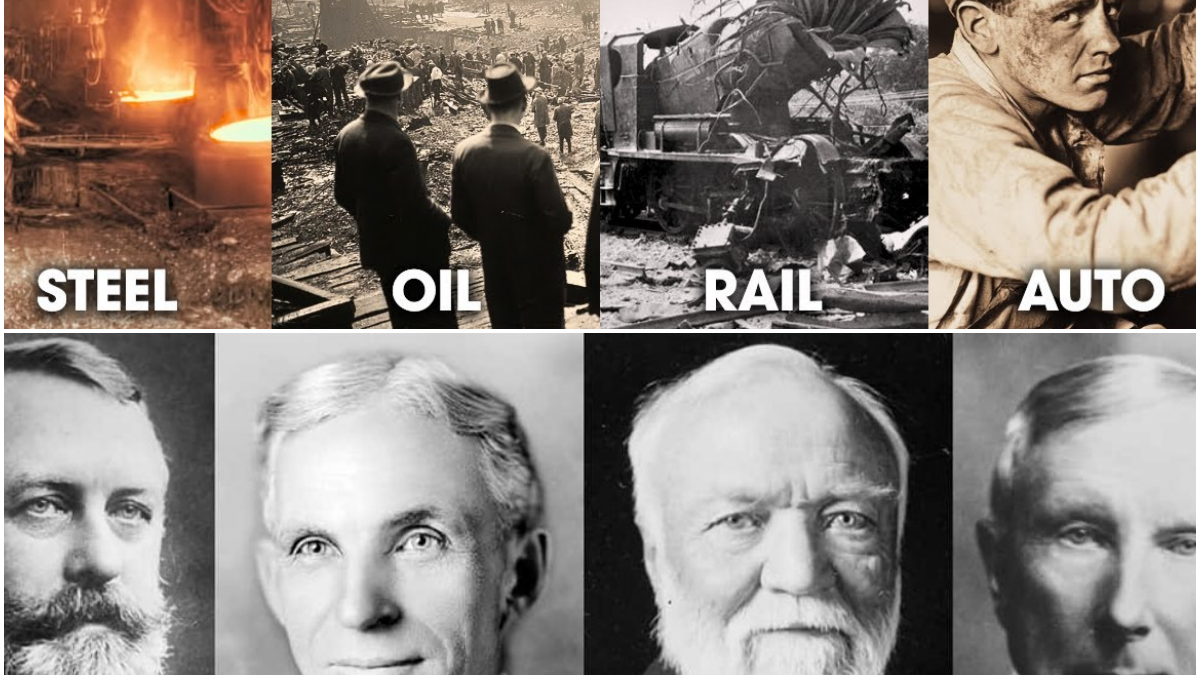
The Deadliest Empires in American Industry – Carnegie, Rockefeller, Ford & Vanderbilt
They built monuments out of steel, rail, oil, and automobiles and called it the American miracle.
But inside those empires, catastrophe wasn’t a headline.
It was a cost of doing business.

A furnace breakout that turned a shop floor into a river of fire.
A railyard mistake that ripped iron apart like paper.
A refinery flash that made the sky burn.
A factory system that prized speed over safety until something snapped.
Carnegie, Vanderbilt, Rockefeller, Ford.
Four names synonymous with power.
This extended documentary asks the darker question their biographies avoid.
Were these disasters the tragic exception or the predictable engine of the empire itself?
We begin by stepping into the dangerous Rockefeller refineries where men worked inside a cloud of fumes and one spark could turn a shift into a funeral.
In the 1880s, Rockefeller’s refineries powered a nation that was growing faster than its own understanding of danger.
These were places where open fires burned beside rivers of oil, where vapors gathered in the shadows, and where one wrong move could turn an ordinary shift into a race for survival.
The headlines celebrated progress, but the men inside those yards lived with a fear the public never saw.
Their work built an empire, yet the risks they carried were quietly pushed aside.
If the world had witnessed the true conditions inside those early refineries, would anyone have stepped through the gates?
Before we begin, if stories like this move you, consider subscribing to our channel to help preserve the forgotten sacrifices of those who built our world.
Now, let us step inside Rockefeller’s 1880s refineries and see why these places became some of the most dangerous work sites in American history.
The refineries that fed Rockefeller’s empire in the 1880s were sprawling improvised landscapes built for output first and safety last.
Workers stepped into yards crowded with crude storage pits.
Timber walkways, iron stills, and engines that ran hot from dawn to dusk.
The noise never ceased.
Stills clattered, pumps rattled, and belts snapped against pulleys until every man felt the tension of the place settle into his bones.
Fire lived at the center of the process, and everyone understood that without constant heat, oil did not move.
What few appreciated was how quickly that same heat could turn the entire yard into a furnace.
The danger began with the machinery itself.
Many of the engines and pumps had been bought secondhand or modified on site by mechanics who did the best they could with the parts available.
Pressure gauges were unreliable, and valves often leaked long before anyone noticed.
Oil dripped onto planks where men walked, creating slick paths that turned every hurried step into a gamble.
When the sun climbed, the heat rising from the stills mixed with the afternoon air until a haze settled around the buildings.
Workers could feel it cling to their skin, a reminder that the entire operation ran on volatility.
Even the way the refineries were laid out added to the danger.
Tanks sat close together to save space, forming tight corridors where vapors accumulated.
Some of the earliest tanks were simple wooden structures banded with iron hoops.
They swelled in the summer and shrank in the winter, leaving cracks that allowed fumes to seep into the open.
In rainstorms, runoff carried thin layers of oil across the ground.
On hot days, the odor grew strong enough to sting the eyes.
Every man who worked near the tanks learned to breathe shallowly, as if that alone could keep the danger at a distance.
Inside the still houses, the atmosphere was even more oppressive.
Stills boiled crude oil to separate it into usable products.
But maintaining the right temperature was a delicate task.
If the fire burned too hot, the pressure climbed toward levels that frightened even seasoned refiners.
If it burned too low, the batch spoiled and hours of labor were wasted.
Workers monitored the process constantly, but the tools of the time made precision nearly impossible.
A single misjudgment could send a column of flame shooting from a vent or cause a sudden bang inside the still that sent men scrambling for exits.
The constant tension affected everyone.
Some workers came home with headaches from breathing the fumes.
Others developed coughs after weeks spent near open gooits where residues hardened in the sun.
The pay was steady which mattered in an era when stability was rare.
Yet even those who needed the income admitted privately that the refineries felt unpredictable, as if the entire place shifted under the weight of risk.
They continued their work because opportunity was precious, but they did so with the unspoken understanding that every shift carried a possibility they preferred not to name.
The most unsettling danger inside Rockefeller’s 1880s refineries was the kind men could not see.
Crude oil released vapors as easily as water gave off steam, and those vapors spread through the yards with a quiet persistence that unsettled anyone who paid attention.
Workers spoke of moments when the air suddenly felt heavier, when a faint shimmer hovered near the ground or drifted around a building corner.
These were signs that gases had pulled in a place where the wind did not reach.
No alarm sounded.
No warning was posted.
A man might walk into a pocket of fumes without realizing he’d stepped into something that could ignite from a single spark.
The chemistry behind these vapors was poorly understood at the time.
Refiners knew crude contained lighter fractions, but they lacked accurate instruments to measure concentrations or track how vapors moved.
Heat accelerated the process, and by midday, the air above settling ponds and pump sheds often carried a thin, invisible fog.
Workers learned to judge danger by smell, yet smell was unreliable.
Some fumes were strong and sharp, while others carried almost no odor at all.
A few men claimed they felt a slight sting in the nose before the worst pockets formed.
But others felt nothing until their eyes watered.
Even seasoned workers admitted they could not predict when or where vapors would gather.
These hidden threats made ordinary tasks feel perilous.
Something as simple as striking a match to light a pipe became an act requiring caution.
Supervisors discouraged smoking, but enforcement was inconsistent.
Some men lit lanterns by habit, unaware that the flame might ignite a nearby gas cloud.
A single candle knocked from a shelf could set off a fireball that raced along the ground before anyone could react.
The stories circulated of entire sheds erupting in seconds, leaving behind blackened timber and the faint smell of burned oil long after the flames died out.
Ventilation offered little protection.
Many refinery buildings were constructed quickly with gaps between boards and crude openings for air flow.
These were enough to let wind pass through, but not enough to guarantee that vapors remained dispersed.
In the early evenings, when temperatures dropped and the air settled, fumes often sank and collected in hollows, trenches, or low storage areas where men stack tools and equipment.
Lantern light would flicker strangely in these zones, hinting at something suspended in the atmosphere.
Workers sometimes paused when they saw that telltale shimmer, choosing another path, even if it meant a longer route.
The unpredictability of the vapors created a quiet tension that shaped every shift.
New hires learned quickly to follow the instincts of older men, watching where they hesitated or which corners they avoided after certain tasks.
The refinery itself seemed to breathe, exhaling danger at random intervals.
Some days passed without incident, and the air felt clean enough to work without worry.
Other days brought a sense of unease that lingered from dawn to dusk.
Those who spent years in these yards spoke of a constant awareness that settled into their minds, a habit of listening for changes in the tone of a flame or the faint movement of air against their skin.
The workers did not have scientific terms for these hazards.
They only knew the air could betray them, and that made every step inside the refinery feel like a small wager against misfortune.
They accepted the risk because the job offered steady wages.
But they never forgot that one unseen cloud could turn a quiet moment into disaster.
When fire took hold inside an 1880s refinery, it moved with a speed that defied belief.
Workers described flash fires as living things, silent one moment and roaring the next, racing along planks, oil films, and vapor paths faster than a man could turn to flee.
There was no warning, no rising crescendo of heat, only a sudden streak of light that cut across the yard.
Some men said the flames felt as if they traveled without touching the ground.
Others insisted they saw them move like windblown cloth.
However they appeared, flash fires left almost no time to react, and outrunning one was nearly impossible.
The conditions that produced these fires were common.
Refining required open flames beneath stills, heated coils, and lamps for night work.
The smallest spark could land in a slick of refined product, which ignited far more readily than crude.
A spilled cup of kerosene could ignite with a breath, sending tendrils of blue and yellow flames stretching outward in every direction.
When the ground was dry, the fire raced even faster, skimming over boards and climbing wooden platforms with ease.
Men who survived such incidents remembered the sudden blast of heat at their backs and the frantic scramble to reach a path the flames had not yet claimed.
Inside the still houses, the danger was even more dramatic.
If a vent released a puff of vapor at the wrong moment, flames could erupt with enough force to push doors open or blow out windows.
Workers near these flares had to react instantly, ducking behind machinery or rolling across the floor to escape the heat.
The fire often disappeared as fast as it came, leaving behind charred splinters or darkened walls.
But in those few seconds, the threat to life was severe.
Clothing ignited quickly, and even a brief exposure could cause deep burns.
The layout of the refineries helped the fires spread.
Narrow passages and elevated walkways created channels where flames could travel in straight lines, trapping workers between heat on one side and obstacles on the other.
Some men kept mental maps of escape routes, memorizing which ladders led to open ground and which paths deadended at storage tanks.
It was a habit born from necessity, not training.
No official fire plan existed in most refineries.
Survival depended on knowing the yard as thoroughly as one knew the inside of their own home.
Night shifts brought an added challenge.
Darkness made it difficult to judge the behavior of a fire once it started.
Flames reflected off wet surfaces, creating illusions of movement that confused even experienced workers.
Lantern light made shadows dance, and a small flare could appear larger or smaller than it truly was.
This uncertainty led to deadly hesitation.
A man who underestimated the fire might step toward it, not away from it.
Another who overestimated it might flee in a direction that offered no safe exit.
The men who worked in these conditions rarely spoke openly about their fears, but their actions revealed the truth.
Many walked with deliberate care, gauging each surface before placing their weight on it.
Others avoided certain tasks unless absolutely necessary.
They knew that a refinery was not a place where one could rely on reflexes alone.
When fire appeared, instinct was often slower than the flames themselves.
Only preparation and caution gave a man a chance, and even then, every shift felt like a test of whether those precautions would be enough.
The storage tanks that held the lifeblood of Rockefeller’s refining empire were far from the engineered vessels we imagine today.
In the 1880s, many tanks were simple cylinders made of thin boilerplate or wooden staves reinforced with iron hoops.
They were designed quickly and erected cheaply.
Their purpose focused on capacity rather than durability.
Heat, pressure, and age worked against them, and workers understood that any tank on the property could turn unreliable without notice.
Some men said they listened for faint creeks as they walked past, convinced that the metal whispered its warnings long before catastrophe struck.
Pressure changes posed the greatest threat.
Crude and refined products expanded when warmed by the sun, and tanks swelled visibly on hot days.
Rivets strained, seams flexed, and iron plates booed outward like the ribs of an overworked animal.
Leaf valves existed, but many were crude in design or prone to clogging.
A stuck valve meant pressure had nowhere to go.
When this happened, the tank often distorted at the top first, forming a shallow dome that signaled trouble.
By the time workers noticed the bulge, the entire structure was already close to failing.
Leaks were an early sign that a tank was weakening.
Oil seeping along a seam might appear harmless at first, forming a thin trail down the metal, but these leaks tended to worsen quickly.
As pressure built inside, the small opening widened.
A sudden spray of product could erupt, coating the ground and nearby equipment.
If the tank was filled with a more volatile fraction such as Napa, the danger increased dramatically.
Vapors from the spray drifted into low spaces where they collected unseen.
A spark near such a cloud could trigger an explosion that tore apart the tank and set fire to anything nearby.
When failure came, it often came abruptly.
Workers recalled tanks collapsing with a noise that resembled a giant sheet of iron being torn in half.
A wall of liquid surged outward, knocking men off their feet and sweeping across yards in heavy wave.
Wooden platforms splintered under the force and smaller structures were flattened.
The sudden release of product created an immediate fire hazard as it spread across the ground.
Men who survived the initial collapse sometimes found themselves trapped between flooding oil and open flames.
Structural fatigue added another layer of unpredictability.
Seasonal temperature swings caused metal to contract and expand, weakening seams over time.
Frost could make iron brittle, while summer heat made it pliable.
Repeated stress cycles created hidden fractures that were impossible to detect with the tools of the era.
A tank that had stood for years without trouble might suddenly give way after a minor jolt or a spike in internal pressure.
Workers feared tanks during storms, especially lightning, even at a distance, made nerves tighten.
A strike on a vent pipe or catwalk was enough to send vibrations through the structure, sometimes triggering a failure at the weakest point.
The men who worked around these tanks did not discuss the danger openly, but they moved with a certain caution when passing too close.
They kept their distance from tanks that groaned or showed fresh stains along the seaMs. They learned to read the subtle signs of distress, even when supervisors insisted things were safe.
The refineries may have been symbols of progress to the public, but to those who walk the yards each day, the tanks standing silently under the sun were reminders of how thin the line was between routine work and a sudden, overwhelming disaster.
Among the constant threats inside an 1880s refinery, few unsettled workers more than the valves and fittings that controlled the flow of oil.
These components were simple devices made from cast iron or brass, tightened by hand and subjected to enormous stress every hour of the day.
Over time, heat warped threads, vibration loosened joints, and corrosion ate at metal that was rarely inspected closely.
A valve that worked perfectly in the morning could begin to seep by afternoon.
These small leaks seemed harmless at first, but they signaled a slow breakdown that could escalate without warning.
Most leaks appeared as tiny beads of oil forming along a seam or packing nut.
Temperature changes caused metal to expand and contract, working the fittings loose.
When the pressure inside a line surged, the bead grew into a thin stream.
Workers carried rags to wipe these spots, but wiping did nothing to solve the problem.
The leaking product soaked into boards, dripped onto machinery, and pulled under pipes.
Each drop added fuel to an environment already thick with potential ignition points.
Men grew uneasy when they heard the faint hiss of escaping vapors, a sound their supervisors often dismissed as part of normal operations.
As production increased, so did strain on the aging equipment.
Lines carrying refined products were especially troublesome.
Kerosen, gasoline fractions, and NAFTA placed enormous pressure on valves not built for such volatility.
The fittings heated quickly as oil rushed through them, sometimes enough to warm the surface to the touch.
Workers avoided placing their hands on these pipes without caution.
A sudden pressure spike could cause a valve to snap open or rupture outright, sending a high spray into the air.
If the product atomized, it created a vapor cloud more dangerous than the liquid itself.
Repair work was risky.
Mechanics tightened fittings with simple wrenches, leaning into the metal while hoping the valve held.
Some had to replace packing while the line remained active, working quickly to avoid losing control of the flow.
The tools were basic and replacement parts were not always available.
Improvised fixes became common.
A strip of metal, a piece of cloth, or a handmade gasket might serve as a temporary seal.
These makeshift repairs held only as long as conditions remained stable.
When pressure fluctuated, the seal often failed.
Workers learned to step back after a repair, giving themselves a moment to determine whether the fix would hold.
The danger worsened in extreme weather.
Cold stiffened the metal and made valves harder to turn.
Heat softened gaskets and expanded pipes until fittings strained.
Rain seeped into cracks and carried residues into threads that already struggled to maintain a tight seal.
The constant cycle of moisture and temperature left valves unpredictable.
A line that operated smoothly in moderate conditions could turn hazardous when the weather shifted even slightly.
Men who worked around the valves developed a habit of scanning them constantly, checking for fresh drips or dark stains spreading along the metal.
They listened for changes in the sound of the lines, knowing that a subtle shift might signal rising pressure.
What troubled them most was the sense that the entire system operated like a giant clock whose hands moved towards an unknown hour.
Every leak, every hiss, every trembling fitting felt like a tick growing louder.
The refinery relied on these valves to function.
Yet, these same valves carried the threat of failure that could trigger a chain of events no one could stop.
Night was the refinery’s most unpredictable hour.
When the sun went down and temperatures began to shift, the stills that purified crude oil demanded even closer attention.
These towering iron vessels relied on steady, controlled heat to separate the various fractions within the crude.
But in the 1880s, temperature regulation relied on experience rather than precision.
Fire crews managed the flames by sight, not by instruments, feeding wood or coal beneath the stills until the metal glowed faintly in the dark.
The margin between proper heating and dangerous overheating was narrow, and workers knew that crossing it after midnight could bring consequences no one wished to face.
Inside the still houses, the atmosphere felt heavier at night.
The heat rising from the vessels met the cool air outside, forming pockets of shifting pressure.
Workers kept watch as the stills grown softly, a reminder of the forces trapped inside.
They checked gauges whose needles quivered unpredictably and tapped the metal walls to judge whether the temperature had climbed too far.
Many of these tasks relied on judgment shaped by years of experience.
A new hand could only watch and learn, hoping he would recognize the subtle signs before trouble announced itself.
When a still overheated, the first warning was often a change in sound.
The low hum deepened into a muted rumble, as if something inside the vessel had begun to roll.
Workers felt the vibration through the floorboards.
The internal pressure rose quickly, creating tension the structure was never designed to withstand.
Relief valves sometimes sputtered in response, releasing brief bursts of vapor that hissed into the air.
If those valves failed to open, pressure continued to climb.
Men near the stills would exchange glances, silently acknowledging that the situation had entered dangerous ground.
The fear of a rupture haunted every shift.
If the internal temperature passed a critical point, the liquid inside could boil violently, forcing vapors outward with explosive force.
The top of the still might lift or split, sending a surge of scalding product outward.
The resulting blast carried enough strength to shatter windows and ignite anything flammable nearby.
A full rupture meant more than fire.
It meant iron fragments flying through the dark and boiling oil cascading across the floor, turning walkways into streams of flame.
Workers stayed alert for another sign of overheating the smell.
When the crude inside began to vaporize too quickly, a sharper, almost metallic odor seeped into the still house.
It clung to clothing and made the breath feel heavier.
Men who recognized that smell stepped back instinctively, knowing what it meant.
The next moments could decide whether the shift continued or ended abruptly in chaos.
What troubled workers most was how quickly a stable process could shift into crisis.
A minor fluctuation in the fire, an unnoticed clog in a pipe, or a sudden drop in outside temperature could push the still beyond safe limits.
And once the process accelerated, there was little anyone could do to halt it.
Workers could reduce the fire or open vents, but these measures only bought time.
The still either stabilized or it did not.
Night after night, men stood watch in these conditions, knowing that one misstep could turn the quiet hours into disaster.
They remained at their posts because the work demanded it, trusting their instincts more than the crude tools at their disposal.
But in the dim light of the still houses, illuminated only by lantern glow and the dull shine of heated metal, every man understood the truth.
Overheating was not merely a mechanical failure.
It was a moment when the refinery reminded them how little control they truly had.
When fire broke out in an 1880s refinery, the men on site had almost no real defense against it.
[snorts] Firefighting during this era remained primitive.
A patchwork of local volunteers, limited equipment, and improvised methods that struggled against even small industrial blazes.
Refineries with their open tanks, heated stills and flowing streams of oil produced fires unlike anything most town brigades had ever encountered.
Once flames took hold, the men were forced into a desperate contest they rarely won.
The fire did not merely burn.
It spread, leapt, and fed upon materials that intensified heat far beyond what water alone could fight.
Most refineries kept only basic tools on hand.
Barrels of sand, leather fire buckets, and a few handp pumped engines served as their first line of defense.
These tools worked well enough for simple structure fires.
But petroleum offered a challenge entirely different.
When oil caught fire, water often worsened the situation.
The liquid spread across the surface, carrying the flames with it.
Workers who tried to douse an oil blaze quickly realized their efforts, only pushed the fire outward in a widening arc.
Sand helped to smother small patches, but anything larger overwhelmed their supply within minutes.
Volunteer fire brigades typically arrived with horsedrawn pump wagons.
But even these units lacked specialized equipment.
Their hoses cracked in extreme heat and their pumps struggled to maintain steady pressure.
A large refinery fire radiated enough heat to drive crews back before they reached effective range.
Some attempts to fight the flames involved creating fire breaks, tearing down nearby structures to prevent the blaze from spreading.
These decisions were made in haste, often by supervisors with no formal firefighting training.
The work was frantic, exhausting, and rarely successful.
Another obstacle was the layout of the refineries themselves.
Tanks, still houses, and sheds stood close together, leaving narrow lanes that trapped heat and chneled smoke.
Flame columns rising from ruptured tanks produced gusts that pushed anyone nearby off balance.
Men tasked with battling these fires found themselves navigating choking vapors and shifting debris.
The smoke carried a harsh chemical edge that burned the lungs, forcing crews to work in short bursts before retreating to breathe.
Some collapsed after inhaling too much, weakened long before the fire reached them.
One of the most feared scenarios was the ignition of surface oil.
When a spill ignited, it created moving sheets of flame that flowed across the ground.
These fiery currents moved unpredictably, advancing with the wind or the slope of the land.
Firefighters could only try to steer them, using sand or debris to redirect their path.
But controlling a fire that moved like a liquid proved nearly impossible.
When multiple spills ignited simultaneously, the scene resembled a battlefield of shifting fire lines.
Crews often abandoned the fight and focused instead on rescuing trapped workers or protecting nearby neighborhoods.
In the aftermath, the ruins told the story of how little protection existed.
Charred tank shells, collapsed pump houses, and blackened patches of ground stretched across the yard.
The surviving workers surveyed the wreckage knowing that no team, no tool, and no tactic available to them could truly match the scale of the danger they faced.
Firefighting in the refinery era depended more on courage than capability, and the men who rushed toward the flames understood the grim odds.
Each blaze confirmed what they already knew.
Once fire claimed an oil refinery, control shifted decisively, and human hands could do little more than witness the destruction unfold.
When an explosion struck an 1880s refinery, it rarely ended with a single blast.
These facilities operated as tightly connected systems where every tank, pipe, and still depended on the next.
A failure in one corner of the yard sent shock waves through the entire operation.
Workers understood this intimately.
They spoke of explosions not as isolated events, but as chains, each link setting off another.
A ruptured tank hurled iron fragments into nearby structures.
A burning shed ignited lines running overhead.
A collapsed walkway funneled flames towards storage areas.
Once the chain reaction began, it gained strength with each new point of failure.
The source of the initial blast varied.
Stills under pressure, volatile vapor pockets or leaking tanks could all trigger sudden eruptions.
When one of these ignited, the sound carried across the entire refinery, followed by a heavy blast of heat.
Men staggered under the force, their ears ringing, their vision clouded by debris.
In the seconds after the explosion, dust and vapor filled the air so thickly that it became difficult to see more than a few feet.
Workers felt their way through darkness, hearing the distant clatter of collapsing structures, but unable to determine where danger moved next.
What made chain reactions so devastating was how quickly they spread.
The shock wave from a single explosion could buckle the legs of a nearby storage tank.
If that tank held refined product or lighter fractions, its failure added more fuel to the growing inferno.
Flames from ruptured tanks reached extraordinary heights, driven upward by currents of superheated air.
Heat radiated outward with enough intensity to ignite wooden buildings simply by proximity.
Even tanks that did not rupture immediately often softened under the heat, their seams weakening until they too joined the catastrophic sequence.
Pipelines contributed to the destruction.
Many were elevated on simple timber supports running across the yard in long exposed stretches.
When fire reached these lines, the metal heated quickly.
Pressure inside the pipes built to dangerous levels.
Some lines burst outright, projecting arcs of burning fuel into the air.
Others sagged and split open, spilling product that ignited as soon as it touched open flame.
These ruptures fed the growing chaos, creating new fire paths that moved unpredictably through the refinery.
The men caught in these events faced impossible decisions.
Escape routes that seemed clear moments earlier vanished as flames spread across walkways or as falling debris blocked passages.
Heat waves forced workers to retreat even when they knew others were trapped nearby.
Some tried to reach valves to cut product flow, but the rising temperatures made metal too hot to touch.
Others attempted to create fire brakes by pushing barrels or dragging debris, but the chain reaction moved too quickly.
The refinery shifted around them like a collapsing maze.
The aftermath of such events left behind twisted metal, cratered earth, and long trails of burned residue leading from one structure to the next.
Investigators rarely found a single cause.
Instead, they found evidence of multiple failures merging into one overwhelming disaster.
Workers who survived spoke of these explosions with quiet reverence, aware that the chain reactions were beyond human control once they began.
In a place built upon volatile materials and fragile systems, one spark or pressure surge could set off a sequence that no amount of strength or skill could halt.
For the men who worked inside Rockefeller’s 1880s refineries, the greatest fear during an emergency was discovering that the path they trusted no longer existed.
These facilities were built rapidly, expanded in uneven stages, and modified whenever production demanded it.
Walkways shifted.
Sheds appeared where open ground once stood, and equipment crowded areas once used as passages.
In calm conditions, the maze could be navigated with routine ease.
But when smoke thickened the air and flames rose around them, workers found that the refinery became almost unrecognizable.
Escape routes vanished in seconds, transforming familiar paths into deadly traps.
The first obstacle came from visibility.
Smoke from burning oil carried a dense black quality that clung to the air.
It rolled low across the ground and then climbed, filling entire structures so completely that lantern light failed to cut through it.
Workers caught in the smoke found themselves choking disoriented and unsure of direction.
They held their arms outstretched to feel for walls, only to discover that heat forced them back.
The roaring of flames made it difficult to hear shouted warnings.
With each passing second, the world shrank into a confusion of darkness, noise, and suffocating fumes.
Structural collapse compounded the danger.
Catwalks built from aging timber, warped under heat, sagged, and fell without notice.
Roof beams cracked as flames weakened them.
When these structures collapsed, they blocked key exits, and scattered debris across escape paths.
Men who ran toward an opening might find it suddenly covered by burning fragments.
Others attempting to cross a platform might feel it shift underfoot, forcing them to retreat.
The refinery that workers knew during routine operations became a shifting landscape that moved against them as the fire advanced.
Another hazard came from the layout of storage yards.
Tanks, barrels, and wooden crates filled open areas, creating narrow corridors with few alternate routes.
When heat reached these items, they swelled or ignited, turning simple obstacles into burning barriers.
Workers attempting to squeeze between them risked being trapped if the item shifted or exploded.
The tight spacing also channeled fire, directing flames through the narrow spaces with an intensity that surprised even experienced hands.
Some tried to crawl beneath the smoke, but the ground often carried thin layers of burning product that made this impossible.
Even the wind played a role.
A sudden gust could push flames sideways, cutting off an exit that had been safe moments earlier.
Shifting air currents drove smoke in unpredictable directions, often forcing workers into areas where visibility was worse.
Men moving in groups sometimes became separated in these conditions, each forced to choose a direction with no assurance of what lay ahead.
Those who made it out often admitted that they escaped less by plan than by chance.
What weighed most heavily on the workers was the knowledge that no map or drill prepared them for these moments.
The refinery was not designed with emergency evacuation in mind.
Escape routes were simply the familiar paths men used during daily work, and those paths failed quickly under fire.
In quieter times, workers jokingly claimed they could run the yard blindfolded.
But when disaster struck, the refinery betrayed every assumption they held about its layout.
The stories that emerged afterward carried the same refrain.
The problem was not the fire alone.
It was the sudden realization that the place they depended on for their livelihood became without warning a maze with no clear exit.
In those moments, survival relied entirely on instinct, luck, and the small pockets of space the flames had not yet claimed.
By the end of the 19th century, Rockefeller’s empire stood as a symbol of American progress.
But the men who refined his oil paid a cost that seldom reached the public eye.
Their work fueled lamps, powered engines, and helped shape a growing industrial nation.
Yet the dangers they endured remained largely unacknowledged.
These workers faced conditions that blended physical strain, chemical exposure, and constant uncertainty.
To them, the refinery was not merely a workplace.
It was a testing ground where each shift demanded focus, endurance, and a tolerance for risks that few outside the industry understood.
The physical toll appeared slowly.
Men who spent years near heating stills and open fires often carried burns on their arms or scars from accidents they learned to accept as routine.
Exposure to crude vapors caused chronic headaches and a persistent tightness in the chest.
Others recalled coughing fits that lasted through the night after long shifts spent near ponds where residues thickened under the sun.
Medical understanding was limited and many symptoms went untreated or unexplained.
Workers attributed their ailments to age or weather, rarely considering that the refinery itself was shaping their health.
The psychological burden was just as heavy.
The constant awareness of danger created a tension that settled into the mind and never fully left.
Men learned to read subtle changes in the environment, noting shifts in heat, sound, and smell.
They recognized danger before it revealed itself openly, reacting to hints that others might dismiss.
This heightened vigilance became second nature, but it also wore on them.
Each day brought a quiet fear that something might go wrong, a fear carried silently because voicing it brought little comfort.
Despite the risks, many workers remained because the wages offered stability in a society where economic uncertainty was common.
Industrial jobs was scarce in some areas and refinery work provided a steady income for families who depended on it.
The sense of camaraderie among the workers also played a role.
Men supported each other during difficult tasks, shared knowledge gained through experience, and looked out for newcomers who did not yet understand the hazards.
This bond softened the harshest aspects of the job, creating a community built on mutual respect and shared struggle.
Accidents left a lasting impact on these tight-knit groups.
When a man was injured or lost, the absence echoed across the yard.
Workers spoke quietly among themselves, reviewing what had happened and wondering whether it could have been prevented.
They carried the memory of these events long after the physical ruins were cleared away.
Some continued working out of necessity, returning to tasks that reminded them daily of how fragile the boundary was between routine and catastrophe.
In later years, safety standards improved and the industry developed equipment that reduced many of the dangers these early workers faced.
But those changes came long after countless men had endured conditions that would shock modern observers.
Their contributions built the foundation upon which the modern petroleum industry rests.
They accepted risks because opportunity demanded it, pushing forward even when the hazards seemed overwhelming.
The legacy of those workers lives not in polished corporate histories, but in the stories carried quietly through generations.
Their hardships, sacrifices, and resilience reveal the true cost of progress during an era defined by ambition and uncertainty.
They built an empire from fire and crude, knowing each day carried risks they could not fully control.
And through their labor, the nation advanced, often forgetting the men who faced danger so that others could prosper.
In the 1870s, American steel was rising faster than any forge could contain.
And inside Andrew Carnegy’s mills, men stepped into a world that cared nothing for their survival.
Few today realize how violent those furnaces truly were.
Heat that warped iron tools, slag eruptions that blinded entire crews, and shifts so long they stole a man’s judgment before they stole his life.
These workers were not reckless.
They were simply trapped in the only opportunity they had.
And the deeper you look into these mills, the more one question lingers.
How did any man walk out alive?
Before we begin, if stories like this move you, consider subscribing to our channel to help preserve the forgotten sacrifices of those who built our world.
Now, let us step inside Carnegie steel mills and see why survival was never guaranteed.
In the early 1870s, the United States was entering a transformation that would reshape every railroad, bridge, and skyline.
Steel had become the backbone of modern ambition, and Andrew Carneg’s mills were the beating heart of that ambition.
But inside those mills, the future did not feel bright.
It felt like standing inside a storm of heat, noise, and danger that never let up.
Men walked toward the furnaces, knowing the air itself could blister their lungs.
Yet they kept going because these mills offered the only steady wages most would ever see.
The open half furnace dominated every inch of the shop floor.
Workers described it as standing in front of a sunrise that never ended.
A constant sheet of orange glare that blurred vision and soaked through every layer of clothing.
Temperatures around the furnaces could soar above 2,000° enough to warp steel tools left too close.
Even experienced workers lost focus in that heat.
And losing focus in Carnegiey’s mill meant stepping one foot too far into a place where accidents did not give second chances.
Carnegie’s rapidly expanding empire demanded unbelievable production speeds.
His mills ran day and night powered by crews that had already been on their feet for 12 hours or more.
When the nation demanded bridges, rails, or beams, the pressure rolled downhill onto the men who fed the furnaces and skimmed the slag.
The rush to keep the furnaces charged meant no moment to breathe.
No paws to recover and no room for caution.
A single slip of a shovel could scatter molten metal across the floor, and the men closest to the eruption rarely survived.
The mill floors were cluttered with hazards most workers could not see until it was too late.
Pools of water collected unnoticed beneath layers of dust, and if even a small amount made contact with molten steel, the result was an explosion of steam that launched metal across the room with the force of artillery.
Contemporary reports described entire crews being knocked unconscious, burned or killed outright when these eruptions struck.
There were no shields, no barriers, and no distance between the men and the danger.
Noise filled every corner of the mill.
The roar of the furnace, the clatter of gears, and the pounding of hammers created a constant wall of sound that masked warning signs.
A crack in the furnace lining, a leaking crucible, or a failing hoist could disappear beneath the noise until the moment it failed completely.
When it did, workers had seconds to react, and most never had the chance.
There was a grim understanding among the men that the mill did not care who they were or what they hoped to become.
It consumed strength, time, and often life itself.
For many, the job ended either in injury or in a quiet resignation that came too late to undo the toll.
The fire never stopped.
The heat never eased.
And the risks were waiting every hour of every shift.
Most men who stepped into Carnegie’s mills in the 1870s did not do so because they were brave.
They did it because they had no other options.
The aftermath of the Civil War had left entire communities broken, wages depressed, and labor in constant overupp.
Immigrants arrived by the thousands from Scotland, Ireland, Italy, and Eastern Europe, escaping hunger, only to find themselves facing another kind of hardship.
The millowners knew this.
Carnegie knew it better than anyone.
He offered steady pay.
And for men who had families to feed, that promise outweighed any fear.
In towns like Bradock, Homestead, and Pittsburgh’s river valleys, the mills dominated life.
Their smoke stacks covered the sky, their hiring lines stretched around blocks, and their wages, though modest, were more predictable than the temporary work found elsewhere.
A laborer earning a dollar or two a day could not turn away from a mill position that paid more, even if it meant standing within reach of molten steel.
Poverty pressed from one side, and opportunity, however dangerous, pulled from the other.
Many workers came from rural backgrounds, where long hours and physical hardship were familiar.
But nothing in farmwork prepared them for the intensity of industrial steel making.
Men who had spent years behind plows or axes found themselves stunned by the relentless heat and the pace.
The transition was brutal.
Yet they endured it because failing to endure meant losing the only wage paying position available.
Companies were quick to replace anyone who hesitated and the message spread quickly.
If you could not bear the heat, someone else would take your place by morning.
Community pressure added another layer.
The mill-shaped identity in these towns.
To be a steel worker meant you were contributing to something vast and important.
The railroads depended on you.
The new skyscrapers depended on you.
And the nation’s growth seemed to rise from your efforts.
Men carried pride in that role even as the hazards multiplied around them.
Pride for many was easier to bear than shame and leaving the job could be seen as weakness.
There was also the powerful influence of technological awe.
Steelmaking in the 19th century was seen as a marvel.
The open hearth was not yet understood as a killer of men, but rather as a triumph of American industry.
Workers believed they were part of a force reshaping the future, standing at the edge of a new era.
That belief held them in place even when accidents claimed their friends or neighbors.
Fatalities were seen as tragic but inevitable, the cost of progress in a world hungry for steel.
On payday, the dangers felt distant.
A few dollars in hand meant food on the table, coal for the stove, and rent paid on cramped Miltown houses.
These small victories renewed the will to endure another shift.
The next morning, workers lined up again, boots scuffed, gloves worn thin, ready to enter a place they knew could end their lives without warning.
In the end, men walked into that world because survival outside the mill was harder still.
The open half furnace stood at the center of Carnegie’s early steel empire.
A massive rectangular chamber fired by gas flames that curled across its ceiling like living creatures.
To the men who worked beside it, the furnace was not simply hot.
It was unpredictable.
Its behavior shifted with every charge of iron, every change in temperature, every breath of air drawn through its flu.
Even experienced workers knew that treating it casually was an invitation to disaster.
The process itself demanded absolute precision.
Iron, scrap metal, and flux materials were shoveled into the furnace to melt and refine into usable steel.
It was a delicate balance of chemistry and timing, one that depended on the workers’s eyes and instincts rather than scientific instruments.
In an era before modern temperature gauges or automated controls, the men had to judge the molten bath by color, brightness, and movement.
A wrong interpretation could allow impurities to accumulate until the furnace reacted violently.
Carnegie’s pursuit of greater output only amplified these dangers.
The furnaces were pushed to their limits, fed quickly, tapped quickly, and rarely permitted to cool.
Each cycle strained the refractory lining that separated the molten steel from the outside world.
As the lining wore thin, cracks would form deep inside the walls, invisible at first.
Days later, without warning, molten metal could burst through a weak point and spill across the shop floor in a glowing sheet that moved faster than any man could run.
The fumes drifting from the open hearth carried their own threats.
Carbon monoxide seeped through the mill in waves, colorless and scentless, yet strong enough to drop a worker where he stood.
Men learned to recognize dizziness as the only warning they would ever receive.
Some collapsed near the furnace doors, where the heat made rescue nearly impossible.
Others staggered away just in time, breathing in the cold night air outside the mill until their vision steadied.
Then there was the skimming of slag, a task that required astonishing courage.
Workers used long poles to rake impurities from the top of the molten bath, leaning dangerously close to the furnace opening.
A slip of the pole or a sudden surge within the furnace could send sparks and molten fragments shooting outward like shrapnel.
Injuries were common.
The scars on the arms and faces of steel workers were so widespread they were almost a badge of the trade.
Every shift brought new variables.
A furnace overheated by a careless charge.
A gas valve sticking half open.
A crane operator misjudging the angle of a ladle.
The uncertainty kept men on edge, and fatigue made those edges sharper still.
Even the smallest mistake could ripple through the system, turning a routine task into a catastrophe.
The open hearth was the technological frontier of its time, but it was also a trap that offered no margin for error.
It demanded total attention, total obedience, and total sacrifice from the men who fed it.
And in return, it gave them the constant reminder that one moment of miscalculation could be their last.
Molten steel did not behave like a calm liquid.
It moved with a life of its own, shifting, rolling, and expanding with heat that few men could comprehend.
In Carnegie’s 1870s mills, where temperatures pushed beyond 2,000°, that molten mass could transform from a controlled pore into a lethal eruption in seconds.
Workers understood that once the steel left the furnace, the danger multiplied.
Out on the mill floor, it was free to react with anything in its path, and many did not survive those reactions.
One of the most feared events was a breakout.
This occurred when a ladle intended to carry tons of molten steel failed under the immense weight and heat.
Cracks often began deep within the ladle’s lining where a worker’s eye could not detect them.
As steel poured in, pressure built until the lining collapsed, and the metal escaped violently.
Breakouts produced waves of molten steel that spread across the floor faster than a man could move.
Shoes and clothing ignited instantly.
Steel rails warped.
The floor itself sometimes burned through.
Just as deadly were the interactions between molten metal and moisture.
Even a single hidden puddle of water could be enough to trigger an explosion.
When steel met water, the sudden conversion to steam hurled liquid metal skyward like a shell burst.
Men described it as hearing a muffled roar followed by a blinding flash.
Shrapnel from these eruptions did not come in the form of iron fragments, but fragments of freshly solidifying steel, razor sharp and still burning.
Survivors often carried the marks for life.
Another hazard lurked in slag, the rocky byproducts skimmed from the surface of molten steel.
While cooler than the steel itself, slag remained dangerously hot and unpredictable.
When dumped into slag pits outside the mill, the piles hissed and cracked.
Occasionally, chemical pockets trapped inside the mass ignited violently.
Workers tasked with tending these pits knew to stand back, but sometimes the reaction was delayed until they had moved on.
Unexpected detonations rattled windows half a mile away.
Transporting molten steel created its own perils.
Overhead, cranes swung ladles across the mill with little margin for error.
A miscommunication between crane operator and floor crew, a faulty break, or a slipping gear could cause a ladle to sway or collide with another structure.
When the giant vessel jerked, even slightly, the metal inside sloshed like liquid fire.
If it splashed over the top, the fallout was catastrophic.
Some mills lost entire crews in accidents that began with nothing more than a sudden jolt.
The men who worked closest to the paws carried a particular burden.
Their job required them to stand inches from the stream of metal as it flowed from furnace to molds.
The radiant heat could scorch skin through heavy gloves.
One stumble, one loose board beneath their boots, one shift of the ladle, and they would fall into the path of something no human body could withstand.
Death was instantaneous.
To the steel itself, the men were merely obstacles.
It obeyed only heat, pressure, and chemistry.
When it turned violent, nothing could stop it.
The shift clock inside Carnegiey’s mills did not match the natural rhythms of human life.
12 hours was the standard, but 12 hours in a steel mill felt closer to a test of endurance than a working day.
These shifts blurred into each other so completely that men often lost track of what day it was.
Exhaustion set in long before a worker reached the halfway point, and by the final hours, the mind was no longer reliable.
Fatigue was not a background inconvenience.
It was the hidden force behind countless tragedies.
Most mills operated on a two shift rotation day and night with workers alternating every other week.
The sudden switches from sunlight to darkness and back again disrupted sleep cycles until rest became something men talked about rather than experienced.
Rooms in Miltown boarding houses were shared by rotating workers, leaving no quiet place to sleep.
Trains rattled nearby.
Whistles sounded at irregular hours.
Even on their days off, workers rarely felt recovered.
This exhaustion made simple tasks treacherous.
A tired man might misjudge the distance between himself and a moving machine.
He might fail to notice a glowing coal on the walkway or forget to step back during a pour.
Many accidents recorded in the 1870s were attributed not to faulty equipment, but to inattention.
The reports rarely acknowledged that no man could maintain perfect focus while standing in extreme heat for half a day at a time.
The body responded to these stresses in predictable ways.
Eyes dried out from the furnace glare.
Hands shook from constant exertion.
Muscles cramped during the final hours of a shift, making precise movements difficult.
Even breathing felt hard.
Workers inhaled a mixture of dust, smoke, and metal fumes that irritated the lungs.
By the end of a 12-hour stretch, men coughed heavily and spoke in short, strained sentences.
Some collapsed as soon as they stepped outside the mill doors, the sudden cool air closing their throats and making them dizzy.
Night shifts were especially dangerous.
Darkness outside made the heat inside feel more unreal.
Lamps flickered over the mill floor, casting shadows that moved and distorted the environment.
A worker might think he saw someone in his path when no one was there.
Or worse, failed to notice a real person stepping into danger.
Supervisors frequently noted the increased risk during night hours, yet production never slowed.
The mills operated continuously because shutting a furnace down meant losing valuable heat and time.
The mental toll reached beyond the mill itself.
Families noticed how the shifts changed men.
Many returned home with a hollow stare, unable to hold a conversation or play with their children.
Their minds were still trapped inside the noise and glare of the mill, replaying the day’s hazards.
Accidents haunted them.
The pace haunted them.
And the knowledge that they would return in a few hours haunted them even more.
12-hour shifts did not simply tire workers.
They stripped away awareness, clarity, and caution, leaving men vulnerable in a place that demanded all three.
Fatigue became one of the deadliest forces in Carnegiey’s mills, claiming lives not with fire or steel, but with the slow erosion of the human mind.
Long before workplace safety laws existed, the machinery inside Carneg’s mills operated without guards, barriers, or emergency stops.
These machines were designed for output, not protection.
They moved with mechanical certainty and had no ability to sense when a human being had stepped too close.
The men understood this.
They knew that once a machine was in motion, it did not slow for hesitation or fear.
It kept going and anything in its path paid the price.
Rolling mills posed one of the earliest and most consistent dangers.
These massive cylinders pressed red hot metal into shape, pulling it forward with tremendous force.
A worker’s task was to guide the metal into the rollers using long tongs.
But if the tongs slipped or the worker misjudged his distance, the rollers could catch them instead.
The machinery grabbed anything it touched.
Gloves, sleeves, and even the edge of a coat could be pulled in before a man had time to react.
Contemporary accounts described workers vanishing into the rollers in seconds.
It was not uncommon for men to stand back from the machine and quietly observe the scars on its frame, knowing they marked where others had been caught.
Cranes and hoists introduced another set of dangers.
Heavy steel beams, tools, and ladles hung from chains overhead, moving across the shop with little more than shouted instructions guiding them.
The operators relied on instinct rather than instrumentation.
A slight miscalculation could swing a load into a worker’s path, and by the time he realized what was happening, the momentum was too great to escape.
There are recorded cases of men being pinned against columns or struck by beams that weighed several tons.
Even when the equipment functioned perfectly, the unpredictable environment around it made every lift a gamble.
The steam-powered equipment was equally unforgiving.
Engines hissed, gears rotated at high speed, and belts whipped across ceilings to transfer power throughout the building.
These belts, known as line shafts, were exposed.
They spun constantly inches above workers heads and along the walls.
If a man reached too high, or if a loose piece of clothing fluttered upward, the shaft could entangle him instantly.
Many lost arms or fingers before they could even shout.
The lack of lighting made these hazards worse.
Dim illumination and clouds of dust often hid moving parts until they were inches away.
Even the basic tools carried their own risks.
Sledgehammers rebounded unpredictably.
Iron hooks slipped under load.
Wagons carrying heavy ingots rolled downhill if chocks were placed carelessly.
It was a world where every object had potential to injure, and every task demanded full concentration.
Supervisors rarely slowed production to accommodate safety.
The belief was simple.
Machines were investments.
Workers were replaceable.
Instead of safeguards, mills relied on speed and repetition.
Men were expected to learn through experience, even if that experience came in the form of witnessing another’s injury.
A posted notice might warn against a particular hazard, but it never came with structural changes to prevent the hazard from occurring again.
In Carnegiey’s mills, the machines were relentless.
They consumed energy, metal, and motion without pause.
And when human beings stepped too close, they consumed them as well.
In the 1870s, the idea of workplace medical care barely existed.
And inside Carnegy’s mills, it was even more distant.
When accidents happened, men did not expect doctors to rush in or ambulances to arrive.
They expected their co-workers to carry them outside.
Pray the injuries were survivable and hope the nearest physician was not already overwhelmed.
The mills were built for production, not recovery.
The absence of organized medical support turned minor wounds into major ones, and major injuries into fatalities.
Burns were the most common injury.
Even brief contact with slag or molten metal could destroy skin and muscle in an instant.
With no sterile bandages, workers wrapped burns in whatever material they could find, often using scraps of cloth soaked in water.
These improvised dressings trapped dirt and bacteria, turning clean burns into infected wounds within days.
Infection, in an era before antibiotics, was often a death sentence.
Some men lasted weeks, others only days.
Families knew that if a husband returned home with a serious burn, the likelihood of survival was slim.
Crush injuries were equally devastating.
When machinery caught a hand or arm, the damage was immediate and irreversible.
The lack of trained medical personnel meant amputations were performed hastily, if at all, and seldom under proper conditions.
Sometimes the injured man was placed in a wagon and taken to a small neighborhood doctor who had only basic tools.
Other times, co-workers tied a belt above the wound to slow bleeding, carried the man to his home, and left the rest to chance.
Many workers died from shock or blood loss before reaching help.
Carnegie’s mills had no infirmaries or on-site surgeons.
Some mills kept small first aid boxes, but they contained little more than salves, gores, and crude splints.
These supplies were meant for minor cuts or bruises, not the catastrophic injuries common inside steel works.
Mill rarely kept track of who was hurt, and accidents were often emitted from official records.
A man’s fate depended entirely on the men standing beside him, not on any system the company had put in place.
The environment itself sabotaged recovery.
Workers lived in cramped Miltown housing where sanitation was poor and disease spread easily.
Open sewers, contaminated water, and humidity created perfect conditions for infection.
Even small wounds could fester.
Families lack the means to pay hospital fees, and many avoided hospitals altogether because the outcomes were often no better than staying home.
In some cases, community members pulled money to cover a doctor’s visit.
But these efforts were inconsistent and seldom enough.
Broken bones, another frequent injury, often healed incorrectly.
With no x-rays and limited professional intervention, fractures were set by feel.
Limbs healed crooked, hands lost mobility, and backs stiffened permanently.
For a steel worker, disability meant the end of employment.
There were no compensation laws or disability protections in place.
Men who could no longer work simply faded from the workforce, relying on family charity or moving to poorer conditions in search of odd jobs.
The mills forged steel with astonishing efficiency, but they offered almost nothing to repair the damage done to the humans inside them.
When accidents occurred, survival depended not on medicine or infrastructure, but on faith, fortune, and the resilience of the injured.
In a place built on fire and force, first aid was little more than an afterthought.
In Carnegiey’s 1870s mills, accidents did not echo through this community in the way we might imagine.
They did not halt production or prompt investigations.
Most did not even leave a note in the company ledger.
When a man was killed during a shift, the mill absorbed the loss with a quietness that was almost ritual.
Work stopped only long enough to remove the body, and within minutes, the machinery roared again.
That silence was not accidental.
It was part of the system.
Officially, millowner spoke about safety in broad optimistic terms, calling accidents unfortunate but inevitable.
Unofficially, the company culture discouraged discussion.
Workers learned quickly that speaking openly about dangers marked them as troublemakers.
It threatened their livelihood.
And in a town dominated by a single employer, losing one’s job meant immediate hardship.
So men kept their concerns private.
They warned each other quietly, pointed at scorch marks on the floor, or nodded toward machines that had already claimed lives.
These whispered warnings were the only safety training many workers ever received.
The newspapers in industrial towns rarely covered mill fatalities with depth.
A brief notice might appear, usually no more than a sentence.
John Kelly, a worker at the steel works, was killed in an accident yesterday.
There was seldom mention of circumstances, nor any inquiry into responsibility.
In communities dependent on mill wages, challenging the mills publicly risked economic retaliation.
Families often grieved in private, comforted by neighbors who understood the precariousness of their situation.
The silence extended to the workforce itself.
Men returning from the night shift seldom told their families what they had witnessed.
They believed that sharing those details would only burden their wives and children.
Instead, they carried the memory alone, adding it to a growing mental weight that never lifted.
It was common for men to speak in vague terms about a rough night or trouble at the furnace.
The details were left unspoken, partly from trauma, partly from futility.
Everyone knew the mills would not change.
Supervisors played a crucial role in maintaining this quiet.
Their duty was production, and they were judged on output, not safety.
Recognizing too many hazards risked slowing the pace.
So many look the other way unless the accident directly affected their shift’s numbers.
Some foremen believed that speaking frankly about dangers would make men hesitant, slowing the rhythm of work.
They believed silence was the only way to maintain momentum.
There was also a cultural layer to this quiet.
Many workers were immigrants and silence was a form of resilience.
In their home countries, laborers were used to dangerous conditions and little institutional support.
Complaints had rarely changed anything.
Endurance was the expected response.
Inside Carnegie’s Mills, this mindset became part of the atmosphere.
The danger was understood.
The losses were absorbed.
The work continued.
The quiet was not denial.
It was a survival mechanism.
If men allowed themselves to dwell on the deaths around them, they would lose the focus needed to stay alive.
So, they buried the stories, buried the fear, and stepped back into the fire each day.
In a world where danger was constant, silence became the only shield they could afford.
By the 1870s, Andrew Carnegie had embraced a philosophy that defined the era of industrial expansion, efficiency above all else.
In his mind, steel was the material that would carry America into the future, and any hesitation in production threatened both progress and profit.
This belief shaped every decision inside his mills.
The push for lower costs, faster output, and relentless competition created conditions where human life ranked far below the demands of machinery and the expectations of investors.
Carnegie was not alone in this mindset.
Industrial America was built on a framework that rewarded speed, volume, and aggressive cost control.
Steel was measured not in the number of men it took to produce it, but in the tons poured each week.
Mill managers were selected for their ability to reduce expenses, minimize downtime, and meet ambitious quotas.
These incentives made safety improvements seem like obstacles.
A guardrail slowed a worker by seconds.
A break in the shift risked cooling the furnace.
A medical room cost money to staff.
Each of these considerations cut against the flow of efficiency.
Wages reflected this imbalance.
Workers earned only a small fraction of the value they produced.
And even that pay was subject to deductions for tools, housing, or missed hours.
Carnegie’s early mills adopted the sliding scale wage system, tying laborers incomes to the fluctuating price of steel.
When prices fell, wages dropped.
When prices rose, wages sometimes climbed, but rarely enough to match the danger.
The system transferred financial risk from owners to workers, while the mills themselves carried none of the burden of accidents or injuries.
Corporate strategies further deepened the divide.
Carnegie’s managers were known for their willingness to cut corners if it meant meeting production targets.
Furnaces were pushed past recommended limits.
Machinery was repaired only when it failed, and mill conditions deteriorated as output increased.
The idea of slowing production to fix a hazard was almost unthinkable.
Steel customers cared little about the means of production, only the speed of delivery.
That expectation trickled downward, adding pressure to every shift.
The imbalance of power ensured that workers had few avenues to demand change.
Early labor unions existed, but the steel industry fought them aggressively.
Organizers were fired, blacklisted, or threatened.
Immigrant workers feared losing their only source of income.
And native-born workers feared being replaced by newcomers willing to accept lower wages.
This division kept the workforce fractured and vulnerable.
Without unity, there was no leverage.
Without leverage, there were no reforMs. The mills were also shaped by Carnegiey’s belief in what he called the gospel of wealth.
A philosophy arguing that those who controlled capital were morally obligated to use their fortunes for the greater good.
But this obligation applied only after wealth was accumulated.
Inside the mills, accumulation came first, and it came through unending production.
Carnegie invested heavily in libraries and public institutions.
Yet, the workers producing the steel that funded these projects labored under conditions that remained unchanged.
The brutal truth was simple.
The mills operated as they did because the economic structure rewarded every shortcut and punished every pause.
As long as steel flowed and profits grew, the cost in human lives remained an accepted part of doing business.
By the end of the 19th century, Carnegie steel had shaped the nation in ways no one could ignore.
Towers rose where wooden buildings once stood.
Railroads spanned continents, carrying freight and people farther than earlier generations ever imagined.
Bridges stretched across rivers with confidence and permanence.
The strength of American steel became a symbol of the country’s emergence as an industrial power.
Yet the men who produced that steel paid a price that rarely appeared in the story of national progress.
Many workers did not live long enough to see the structures they helped build.
Those who survived carried physical reminders of their labor.
Missing fingers, burn scars, limps, and chronic breathing problems were so common among steel workers that they became part of the community’s landscape.
Children grew up recognizing these injuries as normal signs of adulthood.
A man who returned home unmarked after years in the mills was almost an oddity.
The mills themselves changed the culture of the towns around them.
Generations learned to orient their days around shift whistles, train deliveries, and furnace taps.
Entire neighborhoods lived in the shadow of the stacks, their windows coated with soot, and their streets filled with workers walking to and from the mill gates.
The mills created work, but they also created a world where danger seeped into every household.
Families waited anxiously for the sound of footsteps at the end of a shift, knowing that sometimes the door would remain closed.
Even after men left the mills, the experience never left them.
Respiratory disease, chronic pain, and fatigue followed them into old age.
Doctors in industrial towns reported patterns of illness directly tied to steel making, though few had the means to document them thoroughly.
At the time, medicine understood little about long-term exposure to metal fumes or constant heat.
The slow decline of the body was often blamed on aging, not on years spent beside an open hearth furnace.
Yet, the legacy of the mills cannot be told as only a story of suffering.
Those workers laid the literal foundation for the modern United States.
Their labor powered the nation’s transformation from a rural agrarian society into an industrial titan.
Every railroad spike, girder, and beam carried the silent imprint of the men who poured, hammered, and shaped the steel.
Their contributions were profound, even if their names were forgotten.
As the 20th century approached, reform movements began to push for safer conditions.
New technologies reduced some of the risks.
Unions gained strength and safety regulations finally emerged.
But these changes came decades too late for the men of the 1870s.
Their sacrifices were woven into the early history of American industry.
A history that often celebrated innovation while ignoring the human beings who made that innovation possible.
The steel they forged still stands today in old bridges, aging rail lines, and the frames of long surviving buildings.
Those structures endure as monuments to progress, but also as memorials to the invisible cost paid by thousands of workers.
Their legacy lives in the strength of the nation they helped build, and in the quiet acknowledgement that such strength came at a price no one should have been asked to pay.
In Vanderbilt’s rail yards, disaster was not a rare event.
It was an expected part of the workday.
Boilers swelled with silent pressure.
Switch leads vanished in clouds of steam.
And loose freight cars drifted like silent weapons.
Men stepped into danger because the system allowed no alternative.
Records from the air are read like casualty reports from a forgotten war.
How could an industry so vital to America tolerate workplaces where catastrophe waited at every turn?
Before we begin, if stories like this matter to you, consider subscribing to help preserve the forgotten history of the workers who built our world.
Now, let us step inside the rail yards that carried the Vanderbilt name, where danger waited in every direction.
The Grand Central Yards in 1882 formed one of the busiest rail centers in the country.
A place where movement never paused long enough for workers to feel safe.
Tracks wound through tight corridors and steam clouds drifted across the ground thick enough to erase entire locomotives from view.
Switchmen worked in this confusion every day, stepping between cars, lining switches, and reading signals that could vanish in an instant.
In such a setting, routine tasks often carried the same uncertainty as disaster.
Newspapers that year reported several fatalities among the switch crews.
These were not dramatic events.
They unfolded in seconds, usually without warning.
A man would step onto a track believing it was clear, only for a locomotive to emerge through the steam before he had time to react.
Others were caught between cars that shifted unexpectedly when slack tightened.
The environment offered no forgiveness.
A single misjudgment or even perfect judgment obscured by poor visibility could decide a man’s fate.
The layout of the yards added to the danger.
Lines converged and crossed in ways that left workers surrounded by moving equipment.
Sound provided little guidance.
The constant clatter of couplers, the hiss of escaping steam, and the echo of engines against masonry walls distorted direction.
Many switchmen relied on the faint vibration under their feet to sense where a locomotive might be, but even that could mislead them when several trains moved at once.
Inquests into the deaths reached the same conclusion repeatedly.
The men had acted with reasonable care, yet the conditions overwhelmed them.
No safety barriers separated workers from danger.
No formal signaling system protected them from trains reversing through steam.
The job demanded complete awareness, but the environment allowed only fragments of perception.
The fatalities of 1882 revealed a harsh truth.
In the Grand Central Yards, disaster was not an interruption to the work.
It was built into the work itself.
The Albany yards were crowded with freight.
The morning Thomas B.
McManus began his shift in 1887.
He worked as a breakman on a line where Lincoln pin coupling still governed every movement.
These devices required men to step into the narrow space between rolling cars with nothing more than timing and nerve to protect them.
The slightest misalignment could turn the job into a trap.
In those moments, experience meant little compared to the momentum of the equipment.
McManus had performed the task countless times.
Cruz described him as steady and attentive, the kind of worker who knew the yard’s rhythMs. On the day he died, he attempted to pull a stubborn coupling pin while two freight cars drifted together at low speed.
The motion appeared harmless, but low speed in a railard was never safe.
As he leaned in to free the pin, the slack in the line tightened faster than expected.
The space closed before he had time to react.
Witness accounts in local papers painted a grim picture.
The force struck him with no warning, leaving nearby crewmen no chance to intervene.
The design of the coupling gave him nothing to grasp and nowhere to move.
Once the car shifted, the hazard became unavoidable.
Yard workers understood that link and pin systems failed without hesitation, and those who handled them had little room for error.
The inquest noted the dangerous nature of the task, but offered no recommendation beyond acknowledging the risks.
At the time, the system was still considered essential to operations.
McManus’s death became another entry in a growing list of coupling fatalities that plagued the yards.
His loss echoed through the crews who continued the same work the next day, knowing the same danger waited for them.
The Grand Central Yards in 1884 were dense with steam, noise, and constant motion.
Engines moved through narrow corridors where visibility changed from clear to blind in a matter of steps.
Workers depended on lantern signals to coordinate movements, but steam drifting from idling locomotives could swallow those lights instantly.
In this environment, reversing a locomotive was among the most hazardous tasks.
The backup collision that year revealed how easily routine operations could turn disastrous.
The incident began when a yard engine started a reverse move along one of the switching leads.
Such maneuvers relied on a spotter walking ahead.
Yet even the most attentive crew could be overcome by the environment.
Newspapers recorded that heavy steam lingered across the tracks that morning.
Sound was distorted by brick walls and nearby engines, and the sharp clang of couplers masked approaching movement.
Workers farther down the line were performing routine repairs, unaware that a locomotive was backing toward them.
Witnesses later explained that the crew ahead did not see the engine until it emerged through the steam only moments before impact.
The engineer had no reliable signals to guide him.
The spotter’s warnings were lost in the noise, and by the time the figures of the workers appeared, the stopping distance had already disappeared.
The collision unfolded in seconds, leaving no time for anyone to scatter.
The inquest acknowledged that no individual had acted carelessly.
Instead, the yard itself created conditions that overwhelmed even experienced workers.
Tracks twisted between buildings that blocked sight lines, and steam created pockets of near blindness.
Reversing locomotives moved quietly compared to forward motions, reducing the warnings men depended on.
The 1884 collision became a stark example of how Grand Central’s environment turned simple movements into life-threatening events, showing that the greatest danger often came from machinery workers never saw approaching.
Engine number 173 began its morning run in 1880 with nothing unusual to mark the start of the day.
The locomotive had been heated, inspected in the limited ways the era allowed, and sent onto the Hudson division with the expectation that it would perform like dozens of others.
Yet, boilers of that time carried hidden dangers.
Internal corrosion, metal fatigue, and fluctuating water levels created conditions that could turn a routine assignment into a deadly blast.
The crew working aboard number 173 faced these risks every time they stepped into the cab.
The explosion occurred shortly after departure.
Witnesses described a sudden roar followed by a violent cloud of steam and debris.
Boilers failed with enormous force and when number 173 ruptured, the blast scattered iron fragments across the right of way.
Workers nearby reported that the engine seemed to disintegrate in front of them.
The crew had no chance to escape.
Steam consumed the cab before anyone could react, and fragments of the boiler were hurled far beyond the rails.
Investigations into the failure pointed to weaknesses that would have been invisible from the outside.
Boiler plates thinned over time, and inspections relied largely on sight and sound.
There were no modern pressure relief systems, and gauges often misread the true internal conditions.
If water levels dipped too low, the overheated metal weakened rapidly.
If pressure rose too high, the iron shell could no longer contain it.
In the case of number 173, a combination of fatigue and internal corrosion likely pushed the boiler past its breaking point.
The explosion reminded crews across the division that even a well-run locomotive could hide lethal flaws.
It exposed the harsh truth that firemen and engineers worked inches away from machinery capable of catastrophic failure, often with no warning at all.
The West Albany Yards in 1891 operated on a slope that appeared slight but carried real danger.
Freight cars depended on handbrekes, wheelchocks, and the attention of crews to remain stationary.
When even one component failed, gravity took control.
That year, a line of cars broke free and began rolling down the grade with increasing speed.
Workers nearby heard the rumble too late.
The event began during a standard separation of cars for repair work.
A brake chain loosened on one of the cars positioned on the incline.
Once the chain slipped, the car moved slowly at first, then gained momentum as it pulled additional cars behind it.
No one expected a runaway in that moment, and the drifting steam from shop locomotives masked the early signs of movement.
By the time warnings were shouted, the cars were already accelerating.
Newspaper accounts described the chaos that followed.
Workers attempted to scramble clear, but the yard’s tight layout left limited room to escape.
Tracks were closely spaced, equipment littered the walkways, and visibility was compromised by the constant haze of smoke.
The runaway cars struck a group of men before they could reach safety.
The impact was severe, and several workers were killed instantly.
The investigation focused on the brake system and the hazardous incline, but broader issues received little attention.
Car brakes wore out quickly under heavy use, yet replacements were often delayed.
The incline was known to create risks, but redesigning the yard was considered impractical.
As a result, the conditions that caused the disaster persisted long after the event.
The runaway incident demonstrated how quickly control could be lost in a yard shaped by aging equipment and constant pressure.
It showed that even experienced crews had little defense against forces set in motion by a single mechanical failure.
Night work in the railards required a careful balance of instinct and limited visibility.
Workers depended on lantern signals to guide movements.
Yet fog, steam, and smoke often made those signals disappear.
In 1887, a breakman at a New York central yard misread a lantern in heavy mist and stepped directly into the path of an oncoming engine.
His death illustrated how fragile communication became under the conditions common to Gilded Age rail operations.
The incident occurred during a night shift when several crews were moving cars between sidings.
Steam from idling locomotives drifted across the tracks and mixed with cool air, creating dense pockets of fog.
The brakeman attempted to cross a line he believed was clear.
A lantern signal seen only faintly suggested the engine ahead was stationary.
That interpretation proved fatal.
The engine was already moving and the steam cloud concealed both sound and motion.
Witnesses explained that visibility shrank without warning.
One moment the track appeared open and the next it vanished behind a curtain of vapor.
Lanterns were easily mistaken for lights positioned farther away and their dim glow could be distorted by moisture in the air.
The breakman had seconds to make his decision, and the environment gave him a little information to rely on.
The engineer saw the man only when it was too late to stop.
Reversing the locomotive required time, and the yard’s cramped layout offered no room for evasive action.
The breakman was struck before the crew could react.
The inquest recognized the visibility hazards, but concluded that nightwork remained essential.
No improved lighting systems existed, and lanterns remained the only option.
The fatality underscored a harsh truth.
Even skilled workers face life-threatening uncertainty when steam and darkness combined to erase the signals they depended upon.
Round houses were vital to rail operations.
Yet, their design made them among the most dangerous structures in any yard.
Engines entered with hot fireboxes, oil soaked floors surrounded every stall, and roof vents carried sparks that sometimes drifted back onto the building.
In 1892, a fire swept through the West Albany Roundhouse.
So rapidly that workers struggled to escape.
The event showed how easily these facilities could transform from repair centers into death traps.
The fire began near one of the service pits where a locomotive was being prepared for inspection.
Newspapers reported that an oil soaked rag ignited, possibly from a stray ember.
Flames spread across wooden walkways and crept toward the stored fuel supplies.
Workers attempted to contain the fire with buckets, but the heat intensified too quickly.
The curved structure of the roundhouse acted like a funnel, drawing flames upward and sending smoke into every adjoining stall.
Engines inside the building made evacuation difficult.
Some locomotives sat cold and could not be moved, blocking escape routes.
Others were partially disassembled, leaving crews with no safeway to reposition them.
The fire grew hotter as it reached additional fuel reserves.
Dense smoke filled the interior, reducing visibility to almost nothing.
Workers described stumbling toward the doors while disoriented by the thick fumes.
Several men were trapped temporarily when collapsing beams blocked parts of the exit.
Rescuers struggled to reach them through the heavy smoke.
Although many eventually escaped, the speed and intensity of the fire left lasting fear among the crews.
The structure was damaged extensively, and the recovery process revealed how quickly combustible materials allowed flames to travel.
The roundhouse fire demonstrated the inherent vulnerabilities in facilities built from wood and saturated with oil.
It exposed the dangerous reality that workers inside had little protection once flames began to spread, leaving survival largely to chance.
Maintenance crews often worked beneath trestles they believed were stable.
In 1889, a small trestle at the Spoiton Dwville yard collapsed while a repair crew was still underneath, sending debris and rail ties onto the men below.
The event illustrated how vulnerable older wooden structures had become after decades of constant strain.
The trestle served a lightly used track, but even minimal traffic placed repeated pressure on its aging supports.
Weathering weakened the beams, and moisture from the nearby river accelerated decay.
Workers were assigned to replace key sections while the structure remained partially active.
This arrangement was common in the era.
Taking a trestle fully out of service was considered impractical because it disrupted yard operations.
On the morning of the collapse, the crew was removing deteriorated timbers when the structure shifted unexpectedly.
Witnesses said a low vibration traveled through the beams moments before failure.
The weight of the remaining sections proved too much and the trestle gave way.
Heavy timbers and iron fittings fell into the work area with no time for the men below to escape.
The investigation revealed that internal rot had gone deeper than expected.
Inspections often relied on outward appearance, and damaged wood could appear sound on the surface while compromised inside.
Load calculations of the time were rudimentary, and crews depended largely on experience to judge whether a structure could withstand repairs conducted beneath it.
The collapse emphasized how unpredictable deteriorating infrastructure could be.
Even skilled workers who followed standard procedures had little control over hidden structural failures.
The trestle’s sudden break showed that aged materials, constant vibration, and rushed maintenance practices combined to create life-threatening conditions.
For the crews who continued working similar jobs, the incident became a reminder that the structures they repaired could fail at any moment, regardless of their apparent stability.
In the final year, before automatic couplers were required by law, a New York Central breakman was killed while attempting to guide a link and pin into place between two freight cars.
His death, reported in multiple newspapers in 1893, became one of the last reminders of how dangerous the old coupling system truly was.
Thousands of workers had suffered similar injuries.
Yet, widespread reform came only after decades of pressure.
The brakeman attempted to align the coupler while the cars drifted together at slow speed.
Slow movement still carried immense danger.
The man positioned himself between the cars, holding the pin in one hand while signaling the engineer with the other.
The coupler jolted slightly out of alignment.
The drift continued a moment longer than expected, and the narrow space closed before he could retreat.
The impact was immediate, leaving him with no chance of survival.
News accounts highlighted the tragedy as further proof that the Lincoln pin system needed to be eliminated.
The mechanism required men to place their bodies in situations where the slightest misjudgment or even a routine jolt could crush them instantly.
Automatic couplers had already been invented, yet adoption lagged due to cost and logistical challenges.
Many railroads waited until legislation forced the transition.
The fatality underscored the difficult reality of the era.
Workers bore the risks created by outdated equipment, and improvements often arrived only after enough deaths accumulated to demand change.
The new law took effect soon after, finally requiring railroads to replace the hazardous couplings.
The 1893 accident served as a closing chapter for one of the deadliest practices in railroad history, highlighting the gap between technological progress and the protections workers desperately needed.
The New York Central’s 1885 annual casualty ledger listed the year’s injuries and deaths with the precision of an accountant’s record.
Each entry contained only brief details, a name, a location, and a cause.
Yet behind every line was a story of a worker who had stepped into a yard shaped by danger.
The ledger revealed the sheer scale of harm within Vanderbilt’s empire, where hundreds of cases were recorded in a single year.
The ledger included fatalities among switchmen, breakmen, firemen, shop workers, and maintenance crews.
Many entries referenced common causes such as crushed limbs, coupling accidents, falls from moving cars, and collisions during switching.
The repetition of phrases reflected a workplace where the same dangers resurfaced continually.
Nothing in the document elaborated on the conditions surrounding each incident, but the patterns made the environment unmistakable.
One entry noted the death of a worker during switching operations near a crowded yard lead.
Another described injuries from a boiler related event.
Others referenced workers struck during low visibility conditions or crushed between cars.
These accounts lacked detail.
Yet the collective weight of the list told the true story.
The ledger functioned less as a memorial than a tally of operational loss, reducing lives to figures within a corporate report.
The document demonstrated how normalized the dangers had become.
Rather than signaling a failure that demanded immediate action, the numbers were accepted as part of the cost of maintaining a vast rail system.
Safety reforms progressed slowly, and many improvements came only after repeated tragedies made inaction impossible.
To modern readers, the ledger stands as one of the clearest windows into the human cost of Gilded Age railroading.
It captures a world where worker deaths were routine, expected, and quietly absorbed into the machinery of industry.
Most people think of Ford’s Model T assembly lines as symbols of progress, clean efficiency, and American innovation.
But the truth behind those moving belts is far darker than the photographs suggest.
Men were pushed to keep pace with machines that never slowed.
And one moment of hesitation could change a life forever.
America celebrates the Model T for reshaping the century, yet rarely acknowledges the human cost buried inside its success.
These workers lived with dangers few outsiders understood.
So, how did a system built for speed become one of the most unforgiving workplaces in industrial history?
Before we begin, if stories like this move you, consider subscribing so we can keep preserving the lives that shaped our past.
Now, let us step back in time and walk beside the men who stood on that assembly line.
The Model T assembly line looked simple at first glance.
A moving track, rows of stations, and a steady rhythm that seemed manageable to anyone watching from a distance.
But the moment a worker stepped into that rhythm, he learned that the line controlled everything, including the pace of his own body.
The belt moved at a fixed speed that never changed.
And this speed determined how fast every man had to work.
If someone fell behind, the parts kept arriving, piling pressure on his hands, arms, and nerves.
There was no pause on the line, and that was the first danger men discovered.
Many of these workers had never handled industrial machinery before.
Ford needed bodies more than experience, and the company hired thousands of men who had been farmers, laborers, clerks, and immigrants searching for a foothold.
The machines did not care who they were or what they knew.
Inexperience meant slow hands, and slow hands were punished by the pace of the belt.
Training was brief and often informal.
A foreman might demonstrate a station once, then move on, leaving the newcomer to learn under the constant pressure of the moving line.
Mistakes were not classroom errors.
They were moments where a part slipped, a wrench jammed, or a glove caught on a rotating fixture.
Speed was everything, and Ford measured success in seconds.
A man who hesitated risked being struck by moving body panels or crowded by parts, arriving faster than he could handle.
Some learned to match the tempo quickly, but others struggled, and fear became part of the workday.
They felt it every time the belt moved a few inches forward.
The noise added another layer of danger.
The clang of metal, the scrape of tools, and the grind of gears drowned out warnings.
If a man called for help or shouted a caution to the next station, the sound vanished under the mechanical roar.
Workers grew used to communicating with nods, gestures, or not at all, which made accidents more likely.
Fatigue sharpened the hazards even further.
12-hour shifts on the early lines left men drained by midday, and their reactions slowed as the hours passed.
A tired worker might misjudge a movement or reach too close to an unguarded pulley.
The line never cared how exhausted he felt.
It demanded the same pace from morning to night.
Men quickly realized that the line’s greatest threat was not one dramatic event.
It was the accumulation of small risks that followed them throughout the day.
A loose bolt, a slick patch of oil, a misaligned panel, or a tool left too close to the moving track could create a moment that ended with an injury.
Some accidents were minor, but others were severe enough to remove a worker from the line permanently.
A crushed hand, a torn arm, or a broken wrist meant a return home with no job and no compensation.
The company replaced injured workers as easily as replacing parts.
This was the quiet truth behind the Model T’s success.
Every car that rolled off the line represented a day where men worked at a pace set by machines, not by human limits.
And for many, that pace was already far beyond what their bodies could safely endure.
The early Model T factories were built around a single promise, that motion would solve every problem.
Ford believed that keeping every component moving would eliminate wasted time, but it also created an environment where hesitation carried its own risks.
The line was not only fast, it was relentless, and the spaces between stations became corridors where danger traveled freely.
Workers stood shoulderto-shoulder in tight rows.
Each man focused on a narrow task.
The closeness meant that a mistake did not stay with one person.
If a man shifted unexpectedly or stepped backward to avoid a part, he could collide with the worker behind him.
These sudden impacts caused tools to slip, parts to fall, and hands to move into places they were never meant to be.
The floor itself added another layer of hazard.
Oil dripped from fittings, grease collected around bearings, and shards of metal gathered near cutting stations.
Men learned to plant their feet carefully, but a small misstep could send someone sliding across the floor with a wrench in hand.
A fall in such a cramped environment often resulted in more than a bruise.
Moving conveyors carried not just parts but risk.
A fender or wheelhub approached at a predictable tempo, but the weight behind each object made it less forgiving.
When a component arrived out of alignment, it could strike a worker’s hands or torso before he registered the danger.
These blows were rarely fatal, but often disabling, and they built a quiet record of injuries that spread through the factory community.
Many stations involved repetitive twisting or overhead motions that stressed muscles long before the shift ended.
These movements weaken joints and tendons, leaving men prone to sudden strains.
A sharp pain could cause a worker to lose his grip on a part or tool, sending it tumbling into the path of the belt.
The next man in line faced the consequences of that dropped object, not the one who lost it.
Ventilation provided little relief from the heat radiating off the machinery.
Air circulated poorly, and in the summer months, the temperature near the ovens and compressors pushed well past comfort.
Heat reduced focus and blurred concentration increased the likelihood of errors.
A fainting worker did not simply collapse.
He fell among humming motors and rotating shafts that left no room for recovery.
Even clothing created hazards.
Loose sleeves, aprons, and gloves caught on protruding bolts or small rotating fixtures.
A quick tug could pull a worker toward a machine before he reacted.
Foreman warned men to keep fabric tight to the body, but the clothing of the era was not designed for such environments.
Some workers tried to improvise personal protection, but the tools were limited.
Leather gloves stiffened when soaked in oil.
Goggles fogged in the heat and were often discarded.
Ear protection did not exist, and constant noise wore down judgment.
A tired mind misread signals, and misread signals caused real harm.
Throughout the factory, the sense of risk was not always spoken aloud, but every man felt it.
The assembly line rewarded precision and punished missteps, and the environment itself narrowed the margin for error.
Here, danger came not from a single machine, but from the crowded, shifting world that surrounded every worker who stepped onto the floor.
One of the most overlooked dangers inside Ford’s factories came from the machines that powered the line itself.
Long shafts rotated across the ceiling, turning belts that dropped down to individual stations.
These belts transferred force to drills, grinders, and riveters, and every one of them carried enough strength to tear through anything caught in its path.
Workers often felt the vibration of these shafts through the floorboards.
The constant hum was a reminder that the entire building depended on a single mechanical heartbeat.
If a belt slipped or snapped, it lashed through the air with a force that stunned anyone nearby.
Men learned to keep their distance from the overhead movement, yet they could never fully escape it.
Motor housings, gear boxes, and transmission drums heated throughout the day.
These surfaces grew hot enough to burn skin, and crowded stations meant elbows and hands brushed against them more often than anyone liked to admit.
New workers discovered this hazard the hard way.
A moment of distraction could leave a blistered arm and a long day still ahead.
Riveting stations presented another set of dangers.
Compressed air powered the tools, and each strike delivered a violent shock through the worker’s wrist.
Hours of constant impact weakened bones and ligaments.
If a rivet placement slipped, the gun could jerk sideways, sending the metal fastener flying across the station.
These small projectiles carried surprising speed and often struck eyes, cheeks, or exposed arMs. Metal shavings collected near the grinding wheels.
When sparks flew, they carried fragments of steel that settled on clothing and hair.
A careless brush of the hand to wipe sweat could force one of these shards deeper into the skin.
Men left the factory with fine cuts across their forearms and necks.
Small wounds that stung long after the shift ended.
The factory lighting also worked against the workers.
Electric lamps cast harsh glare on reflective metal surfaces.
Shadows gathered beneath the conveyors and behind large fixtures, hiding gaps, bolts, and moving parts.
A worker reaching for a component might misjudge a shadowed space and place his hand directly against a rotating fixture.
These accidents were quick and unforgiving.
Noise from the compressors made communication nearly impossible near the power stations.
Pressure valves hissed unpredictably, and their sudden burst startled workers who were already concentrating on precise movements.
A momentary flinch could send a hand into moving gears or cause a heavy part to slip from a tired grip.
There were also risks tied to the maintenance routines.
When mechanics worked on the belts or gears during short breaks, they moved fast.
A tool left on a catwalk could drop unexpectedly onto the workers below.
Even a small wrench became dangerous when falling from height.
Few men looked up during their tasks, and fewer expected anything to fall from above.
Dust and metal particles settled on the machines, forming a fine layer that coated surfaces.
Workers wiped them away with bare hands or sleeves, unaware that repeated exposure caused skin irritation and respiratory issues.
Coughing became common in certain sections of the line, especially in areas where grinding and cutting took place.
All of these hazards combined to create an environment where awareness was as important as skill.
The machines that made mass production possible also filled the factory with risks that never appeared in the photographs of gleaming cars.
In this world, danger lived inside the moving parts that powered the modern age.
Long before injuries appeared on the surface, the assembly line worked on a man’s mind.
The repetition was unlike anything most workers had ever faced.
A single motion repeated hundreds of times each hour narrowed their world to a few square feet of floor and a task that never changed.
Many came from farms or trades where the work shifted with the day.
On the line, variety disappeared.
The body adjusted, but the mind strained against the sameness.
Some men described losing their sense of time as if the hours blended into one unbroken stream of identical movements.
This mental fog made accidents more likely because the line demanded focus even when the mind pleaded for rest.
Turnover became one of the earliest signs that the job was wearing men down.
In the early years, Ford struggled to keep workers longer than a few months.
Men arrived confident, collected their pay, and left once the routine wore them thin.
Foremen watched them come and go, aware that the line consumed people faster than the company expected.
The pace punished hesitation, and the monotony punished endurance.
A worker who lost concentration for even a moment could misplace a part or strike the wrong surface.
These mistakes were not simple corrections.
They caused jams, delays, or alignment failures that spread down the line.
When the mistake reached the next station, the worker there dealt with the consequences.
Some men tried to keep their minds active by counting movements or marking small milestones through the day.
Others whispered to themselves to maintain rhythm.
A few sang under their breath, but the noise of the factory swallowed their voices.
No matter what method they chose, the pressure always returned, pressing against their thoughts with the weight of thousands of identical motions.
Fatigue took on a different form in this environment.
It was not only the heaviness of tired limbs, but the quiet mental erosion that came from hours of unbroken focus.
When the brain drifted, even slightly, hands moved without precision.
A loose bolt, a crooked bracket, or a rushed placement could place the next worker at risk.
Foreman noticed the signs.
A man who blinked too often or stared at the line without moving hinted that his mind was slipping.
Supervisors urged them to keep pace, but there was no solution besides endurance.
Breaks were short, and stepping away from the line meant someone else carried an extra burden.
Some workers reported headaches by midday.
The combination of noise, heat, and tension weighed on their senses.
Others struggled to sleep at night, still feeling the rhythm of the conveyor in their bones.
The line followed them home as if the machinery continued its work inside their minds.
To outsiders, these strains were invisible.
Photographs showed workers smiling beside new cars.
Newspapers celebrated efficiency.
Few noted the quiet psychological cost paid by the men who stood in the same spot for hours, matching their lives to the rhythm of machinery.
In a world that valued speed and output, the inner toll rarely made it into the record.
Yet this unseen burden affected every worker who stayed long enough to feel the grind settle into their thoughts.
The assembly line demanded more than strength.
It demanded a steady mind, sharpened against monotony and pressure in a place where losing focus could be as dangerous as any exposed gear.
The conveyor belt was the backbone of Ford’s production system, but it also carried some of the most unpredictable dangers inside the factory.
When the line ran smoothly, it created a steady rhythm that workers learned to anticipate.
When it faltered, even briefly, it produced moments of chaos that could injure a man before he understood what had gone wrong.
Jams were among the earliest and most common hazards.
A single part placed a fraction of an inch off its mark could lodge itself against a bracket or guide rail.
When this happened, the parts behind it pressed forward, building pressure until something gave.
Sometimes the jam released with a sudden burst, sending metal pieces forward with surprising force.
Drop components created another level of risk.
Workers often handled large body sections, axles, and engine parts that shifted weight when lifted or rotated.
If a man lost his grip on a piece, the falling object did not simply land at his feet.
It often bounced off the moving belt and struck nearby workers.
These collisions caused bruises, fractures, and deep cuts that lingered long after the shift ended.
The conveyors themselves did not always maintain perfect speed.
Minor mechanical issues caused surges where the belt moved slightly faster for a moment.
Workers relied on timing for every step, and even a small shift in speed could disrupt their movements.
A man leaning forward at the wrong instant faced the risk of being pulled too close to a fixture or pinched between components.
Chain-driven sections created their own set of dangers.
If a link slipped or caught, the belt jerked sharply.
Tools dropped from startled hands.
Parts shifted unexpectedly.
A worker reaching into a cradle for a component might find his fingers caught as the cradle lurched forward.
These incidents happened in seconds and left little room for reaction.
Certain parts of the line required workers to guide heavy pieces into place.
The slightest resistance from the conveyor made these tasks hazardous.
If a piece resisted alignment, the neck surge from the belt forced it into position with enough force to crush a man’s hand between metal surfaces.
Foreman warned workers to stay alert, but the line’s motion was not always predictable.
The noise from the conveyor hid many warning signs.
A bearing beginning to seize or a chain rubbing against a guide rail produced sounds that blended into the constant mechanical roar.
By the time workers sense something was wrong, the failure had already begun.
When a section of the line malfunctioned, men at multiple stations faced the consequences, not just those closest to the fault.
Breakdowns required quick intervention from maintenance crews who worked inches from moving machinery.
They loosened bolts, shifted rails, or reset components while the line slowed, but often did not stop.
These hurried repairs placed them in close contact with heavy moving parts.
A slight misjudgment left them exposed to pinches, knocks, and crushing forces.
Even the act of clearing debris became dangerous.
Metal scraps, wire ends, and packaging materials sometimes slipped onto the belt.
Workers reached in to remove them before they caused a jam, but this meant placing hands near rollers and pinch points.
A single miscalculated reach risked losing fingers to the hidden gears beneath the belt.
To the public, the conveyor symbolized efficiency and progress.
To the men who worked beside it, it was a complex and unpredictable system that demanded constant vigilance.
Its motion kept American industry moving, but it also created a world where any shift in speed, alignment, or load could place a man in immediate danger.
Long before safety regulations existed, the air inside Ford’s factories carried threats that workers could neither see nor avoid.
Paint stations, fuel handling areas, and cleaning sections filled the building with fumes that clung to clothing and settled in the lungs.
Men learned to live with the smell of chemicals, but their bodies paid the price.
One breath at a time.
Paint crews faced some of the worst conditions.
Early automotive paint contained heavy solvents that evaporated quickly, filling the air with vapors that caused dizziness and burning eyes.
Painters applied coats by hand, standing in small rooms where the fog of chemicals thickened after each application.
Ventilation was inadequate, so workers inhaled these fumes throughout the day.
Prima application added another layer of exposure.
The compounds contained lead which adhered to the skin and collected under fingernails.
Washing it off required harsh soaps that cracked the hands, leaving workers with abrasions that stung long after they returned home.
Lead dust settled on the floors and men walking through the area tracked it throughout the factory.
Fuel testing created its own hazards.
Workers poured gasoline into tanks and checked for leaks while surrounded by open vapors.
Small spills evaporated instantly, releasing fumes that caused headaches within minutes.
A single spark from a tool or static discharge could ignite these vapors, and a few near misses were recorded by foremen who understood how close disaster had come.
Degreasing stations used cleaners strong enough to strip metal surfaces.
These chemicals produced sharp odor that irritated the throat and caused persistent coughing.
Men leaned over vats to dip parts, and the fumes rose directly into their faces.
Prolonged exposure led to stomach sickness, tremors, and chest tightness that many workers mistook for fatigue.
Dust from grinding and polishing collected in the air and settled in the lungs.
Workers who spent years at these stations often developed chronic coughs.
They could feel the grit scratch the inside of their throats.
The fine particles did not leave the body easily and the effects worsened with age.
Rubber components introduced another set of chemical dangers.
Heating and molding rubber released sulfur fumes that irritated the airways.
Workers near these sections often felt their eyes water without warning.
Some developed rashes from handling unccured pieces, and the smell of burning rubber lingered on their skin even after washing.
Cleaning cloths soaked in solvents were stored in open bins that released vapors throughout the day.
When these cloths were moved or disturbed, a fresh wave of odor filled the air.
Workers grew accustomed to the smell, but their bodies did not.
Many reported nausea during long shifts, especially in the hotter months when evaporation increased.
Few men understood the long-term consequences of these exposures.
They only knew that certain parts of the factory made their vision blur or their hands tremble.
Some felt laded after hours of breathing fumes.
Others went home with pounding headaches that returned every workday.
These hazards were not dramatic, and they did not produce the sudden injuries seen on the line.
Instead, they settled quietly into the lives of the workers.
The chemicals they inhaled and handled each day created a slow erosion of health that left its mark long after their time at the factory ended.
Fire was one of the most feared dangers inside the Model T factories.
The combination of oil soaked floors, wooden structures, open flames, and flammable vapors created conditions where a minor spark could escalate within seconds.
Workers knew that if a fire ignited, escape routes might vanish before the alarm reached the far end of the building.
Many areas relied on open flame for heating or soldering, torches and lamps burned near oily parts, and cloth rags saturated with solvent.
A dropped ember or a careless brush of a tool could ignite these materials instantly.
Men kept watch on their surroundings, aware that one oversight could place an entire section of the factory at risk.
Electrical wiring created another set of hazards.
Early wiring was unshielded and often exposed to heat, moisture, and constant vibration from the machinery below.
Insulation cracked over time, revealing copper that sparked when it touched metal surfaces.
A short circuit could set nearby debris ablaze before anyone noticed the smoke rising.
Fuel storage was a constant concern.
Barrels of gasoline and kerosene sat stacked in corners or lined along walls near testing stations.
Workers transferred fuel by hand using metal funnels and cans.
Any slip caused spills that pulled on the floor, creating invisible hazards that could ignite with a single spark from a tool striking the ground.
Ventilation systems did little to reduce these risks.
Airflow currents sometimes pushed fumes toward ignition sources instead of away from them.
Painters and testers worked only a few yards from heating units that glowed red throughout the day.
Even a small draft could carry vapor to a flame with catastrophic results.
Some sections used steam powered equipment that operated under high pressure.
Valves released bursts of hot vapor that scolded skin instantly.
If a pipe weakened or a joint loosened, the escaping steam could hit with enough force to knock a man backward.
These failures occurred without warning, and the noise often blended into the surrounding machinery long enough for the danger to go unnoticed.
Structural hazards added to the worry.
The weight of heavy machinery, parts, and storage racks strained floors and catwalks.
Boards loosened under constant vibration.
A misstep on a weakened plank could send a man crashing to the level below.
Falling tools followed him, turning a simple accident into something far more serious.
Fire drills existed in theory, but in practice they were difficult to execute.
The noise of the factory drowned out shouted warnings, and the layout of the building funneled workers into narrow corridors.
If an emergency occurred, hundreds of men moved at once, creating bottlenecks that slowed their escape.
Some sections had only one exit.
Oil created a final source of risk.
It coated floors, stairs, and ladders.
In low light, workers could not always see where the slick patches began.
A slip near the hot pipe or electrical panel brought danger that had nothing to do with the machines themselves.
The building’s conditions created a hidden layer of threat.
Every man understood that the factory held more hazards than those visible on the line.
Fires, explosions, steam bursts, and structural failures reminded them that danger came from every direction.
The factory produced cars for a growing nation.
But inside its walls, the environment itself was always one mistake away from turning deadly.
The assembly line’s dangers were not limited to physical harm.
The economic pressure placed on workers created its own form of risk, one that shaped decisions on the floor and pushed men to take chances they otherwise would have avoided.
When Ford introduced the famous $5 day, the wage drew thousands to the factory gates.
But few understood the demands tied to earning it.
Immigrant workers formed a large portion of the labor force.
Many spoke limited English, and misunderstandings at the line created situations where instructions were misread and safety cues ignored.
A foreman’s brief warning often meant little to someone who could not decipher the words.
These men learned their stations through observation, a method that left gaps in knowledge that became dangerous during fast-paced shifts.
The promise of higher pay came with strict requirements.
Ford monitored attendance, productivity, and behavior with unusual intensity.
Missing a day could place a man at risk of losing the job entirely.
Injuries carried their own economic threat.
A hurt worker who missed time forfeited earnings, which pushed many to return before they healed.
This pressure created a cycle where men worked through pain, weakening their focus and increasing the likelihood of further harm.
Foreman enforced speed and discipline with few compromises.
They watched for hesitation and questioned anyone who struggled to keep pace.
A man who appeared slow risked reassignment to more demanding sections or dismissal.
This constant surveillance pushed workers to move faster than comfort allowed, and the fear of losing wages kept them from reporting hazards.
New arrivals often took the jobs considered most taxing.
Positions near machinery with the highest injury rates rotated through fresh faces who needed work immediately.
Many had families who depended on their pay, so they accepted assignments that seasoned workers avoided.
Their inexperience placed them at risk before they even understood the rhythm of the line.
Housing added another form of strain.
Many workers lived in crowded boarding houses where rest was scarce.
They returned to the factory the next day with only a few hours of sleep.
Fatigue became a quiet threat that altered judgment at crucial moments.
A tired mind struggled with precision, and precision was the only thing that kept hands clear of moving parts.
Workers who tried to voice concerns often discovered the limits of their influence.
Suggestions to improve safety rarely reached management.
Foreman prioritized production numbers above anything else.
When men requested adjustments to their stations, they were told to adapt.
The silence around these issues built frustration and pushed workers into corners where risk became a routine part of their day.
Turnover exposed the strain more clearly than anything else.
Despite the promise of good pay, thousands left the factory after only a short time.
They called the work exhausting, relentless, and unforgiving.
Their departures forced the company to hire constantly, bringing in another wave of inexperienced workers who repeated the same errors and faced the same dangers.
The $5 day became one of the most celebrated innovations in American labor history.
Yet inside the factory, it served as a reminder that higher wages did not erase the hazards of the line.
For many, the pay kept them tied to a job that demanded more from their bodies and minds than they had ever imagined.
The cost of staying often felt as heavy as the fear of leaving.
When injuries occurred on the Model T line, the real hardship often began after the machine stopped.
Factories of the early 20th century were not equipped with modern medical stations.
Most plants had only a small first aid room.
Staffed by a single nurse or attendant who did what they could with limited supplies.
A worker with a cut or burn received basic treatment before being sent back to the line.
Bandages wrapped quickly and gloves pulled over injured hands hid wounds that should have been rested.
The pressure to return immediately was strong because every minute away from the line slowed production and invited questions from supervisors.
More serious injuries created a harsher reality.
A crushed finger or broken wrist meant a trip to the local hospital, usually arranged by a foreman who stayed long enough to sign a few papers.
Once the worker was admitted, the company’s involvement often ended.
Bills accumulated and the family bore the cost unless the injury was severe enough to provoke rare company support.
Hospitals lacked specialized care for industrial injuries.
Doctors stitched deep cuts and spinted fractures, but long-term rehabilitation was almost unknown.
If a joint stiffened or a nerve failed to recover, the worker faced permanent limitations.
Many returned home with hands that no longer gripped properly or arms that lacked their former strength.
Compensation laws were minimal.
A man unable to work received no steady income and savings vanished quickly.
The family absorbed the financial blow while the injured worker struggled with the guilt of being unable to provide.
Some took temporary jobs far below their previous wages just to keep food on the table.
The psychological impact lingered.
Men who once thought themselves strong found their confidence shaken.
Injuries changed how they viewed the world.
A father who could no longer lift his child or repair a loose board on the porch carried a weight that medicine could not treat.
These quiet burdens rarely appeared in company records, but they shaped lives across entire communities.
Many workers tried to hide injuries from their families.
They came home with sleeves pulled over swollen wrists or gloves concealing cuts.
They hoped rest would bring recovery, but tomorrow’s shift always arrived too soon.
The effort to appear strong often worsened the damage.
Children noticed the changes.
They saw fathers wse while turning doorork knobs or picking up simple objects.
Wives noticed the new silences at the dinner table and the longer pauses before a man reached for his cup.
The injury followed him home in ways that no bandage could disguise.
The factory rarely acknowledged these personal costs.
Injured workers were quickly replaced and production continued.
To management, the line functioned as long as every station stayed filled.
The individual stories behind each injury faded into the background of a system built on efficiency.
Communities, however, remembered.
Neighbors helped where they could.
Delivering meals or sharing work among families hit hardest.
Their support softened the blow, but it could not restore a man’s health or erase the fear that another injury might come with the next shift.
For many workers, the aftermath of injury revealed the full truth of the assembly line.
The machines caused the damage, but the burden of recovery belonged entirely to the men who stood beside them.
Each injury became a reminder that behind every car leaving the factory was a life forever changed.
By the time the Model T era reached its height, the dangers inside Ford’s factories had become impossible to overlook.
Injuries accumulated, turnover remained high, and newspapers began to question the human cost behind the company’s celebrated efficiency.
What had once been praised as a modern breakthrough slowly revealed the strain it placed on the people who kept it moving.
Public pressure grew as stories of factory accidents reached communities across the country.
Families spoke of fathers and brothers who returned home wrapped in bandages or carrying arms that would never straighten again.
These stories created a broader understanding that something inside the factories needed to change.
Americans admired progress, but not at the cost of the workers who fueled it.
Ford, aware of the growing criticism, made early attempts to address safety.
Guards appeared around some belts and pulleys, though not nearly enough to eliminate the risks.
Training programs expanded and Foreman received instructions to guide new workers more carefully.
These improvements helped, but they could not fully counter the pace of the assembly line or the pressure imposed by strict production targets.
The company’s efforts, limited as they were, influenced other industries.
Manufacturers across the country studied Ford’s methods and the hazards that came with them.
[clears throat] As they adopted similar systems, they also recognized the need to protect their workers.
This shift marked the beginning of a slow movement towards safer industrial environments.
Lawmakers took notice as well.
Reports of injuries and the strain of long hours pushed state governments to consider new regulations.
Some regions introduced early compensation laws that offered limited support to injured workers.
Others mandated safety inspections or required protective equipment in factories where machinery dominated the work.
These reforms did not arrive quickly and they were far from complete.
Many workers continued to face dangers daily, especially in older plants where modernization lagged.
Still, the idea that employers bore responsibility for worker safety gained traction.
This shift in thinking represented one of the most significant changes brought about by the Model T era.
Unions also gained strength during this period.
As workers recognized the shared challenges of factory life, they began organizing to demand safer conditions and fair treatment.
Their efforts met resistance from companies that feared losing control, but persistent pressure eventually led to better support for workers injured on the job.
The movement reflected a growing belief that progress should not rely on silent suffering.
Ford’s assembly lines changed the world by making cars affordable for millions.
Yet, their influence extended far beyond the vehicles they produced.
They forced the nation to confront the realities of industrial labor and to acknowledge that mass production carried a human cost.
The lessons learned inside those factories shaped safety standards, labor rights, and workplace expectations for generations.
Today, the Model T stands as a symbol of innovation.
But its legacy includes the men who endured its dangers.
Their experiences, recorded through injuries, hardships, and quiet perseverance, laid the groundwork for protections that workers now rely on.
The assembly line built cars that transformed America.
But it also pushed the country to rethink how progress should value the people who make it possible.








