After Saving A Baby Bigfoot, The Man Was Surrounded By The Tribe – What Happened Next Shocked Everyone
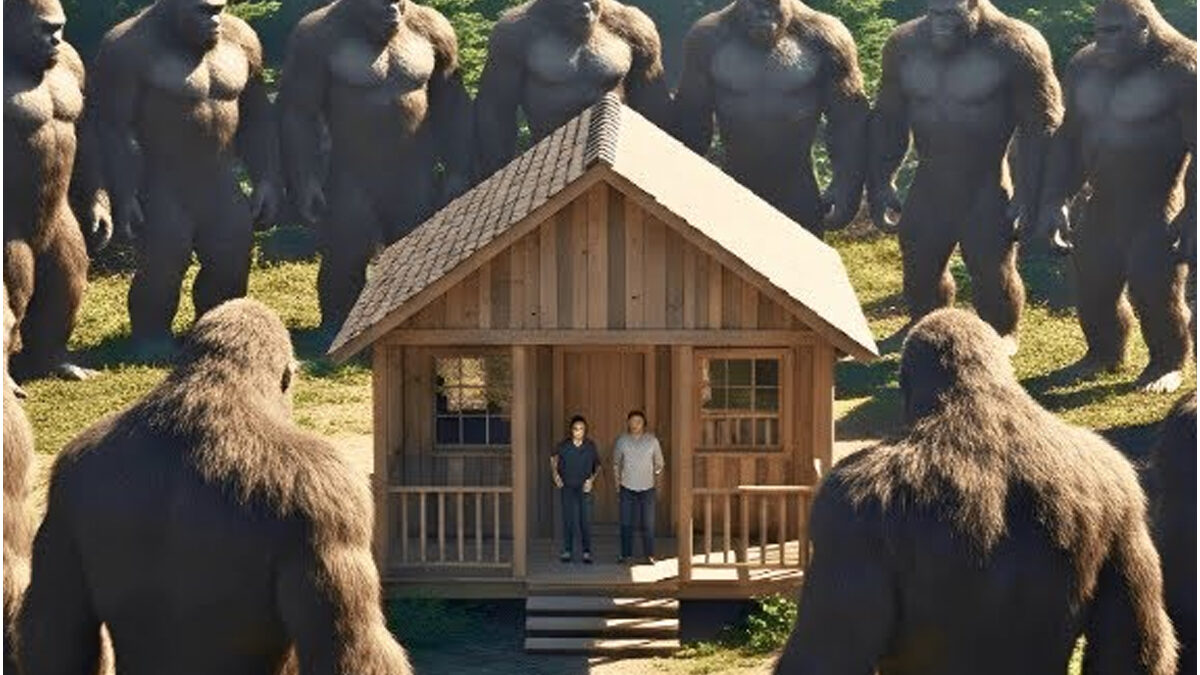
After Saving A Baby Bigfoot, The Man Was Surrounded By The Tribe – What Happened Next Shocked Everyone
Have you ever wondered what kind of person Bigfoot would save?
Not a soldier, not a scientist, but a quiet woodsman, a lonely child, a mother who once laughed at the idea of monsters.
Because in a small town on the edge of the Wallawa Witman forest, Bigfoot didn’t run from people.
They chose them.

The truth few people know is this.
Bigfoot isn’t just hiding from mankind.
They’re watching.
And when they see someone live with gentleness, when someone cuts open a trap or lowers a rifle or listens to the wind instead of shouting over it, the forest remembers.
Walter Grant was no hero.
Just a divorced woodworker with tired hands and a quiet heart.
But in 1981, he freed a young Bigfoot caught in wire and never spoke a word.
That silence earned him something no camera ever could.
Over the next 20 years, a shoe was returned to a child.
A woman led out of the woods by a soft hand, a hunter given a second chance.
No fame, no roar, just silent acts of kindness, both human and not.
I’ve spent years collecting these testimonies, and what I found wasn’t a monster story.
It was a reminder.
Mercy is real, and sometimes it has fur.
If you’re watching this, where are you watching from?
How far can this story travel?
From this quiet forest to your quiet heart.
Tap like if this moved you.
Subscribe if you believe kindness deserves witnesses.
And together, let’s build a community that listens even to the woods.
From Oregon with all our warmest regards.
1981, early October.
Joseph, Oregon.
The hemlock leaves had browned and dried, curling like quiet prayers across the patchy earth outside Walter Grant’s mobile home.
They layered the dry soil in brittle whispers, making no protest beneath worn boots.
There wasn’t much out here, not since the sawmill cut back shifts, and the younger men left for Bend or Boise.
Walter had stayed, 44, with a shoulder that clicked each time he raised the axe.
He lived alone in a tinwalled home that smelled of oil, pine, and dust.
No television, no telephone, just an AM radio.
He turned low after supper, its static hum often louder than the talk.
Each evening after finishing day labor at the Whitmore Mill.
He would walk the perimeter of a long abandoned ranch where the wire fencing sagged like tired men.
Walter had a quiet contract with the place.
In exchange for clearing brush and checking fence lines, the owners let him harvest firewood along the edge.
It was honest, if slow.
That afternoon, the light was gold and low, slanting in through the branches like it had traveled years just to touch the organ dirt.
Walter dragged a gloved hand along the rusted wire.
Eyes scanning for splits, for snags, for something useful he could salvage for the next week’s cut.
Then came the sound.
A faint metallic screech, not repeated, not wind, not animal.
He stopped, listened.
10 ft ahead, part of the fence shivered once, then stilled.
He squinted, moved forward slowly, boots silent in the leaf carpet.
A shape lay tangled in the wire, half hidden by undergrowth.
At first he thought it was a deer, but the limbs too long, the chest too broad, and the eyes locked on his wide and unblinking.
It was young, Bigfoot, no doubt, but not like the legends, not a beast out of some liquor soaked story.
This one bled real shallow cuts across its thigh where the barbs dug in.
Its fur, dark and coarse, caught the dying light in silver wisps.
It didn’t growl.
It didn’t flail.
It just watched him, breath shallow, chest heaving.
Walter stared back, every muscle still.
He could have run, could have yelled, could have gone for the old 3030 hanging in the truck, but he didn’t.
He knelt slow, deliberate.
One gloved hand raised just slightly, palm open.
No sudden movements, no noise.
The creature flinched as he reached for the fence.
The barbed wire clung tight.
Walter pulled a multi-tool from his back pocket, snipped one twist, then another.
The young Bigfoot’s leg dropped free with a soft thud.
It pulled back, but didn’t bolt.
Didn’t rise.
He didn’t speak.
What would he say?
They stayed there, facing each other.
The creature blinked once.
Something passed between them.
Not fear, recognition.
Maybe even a strange kind of apology.
Walter stayed a moment longer, then stood, wiped the tool on his jeans, and turned back toward the fence line.
He didn’t look back.
That night, the radio crackled with a weak signal from Pendleton.
He turned the knob until the voices vanished, and only the hiss remained.
The darkness outside pressed soft against the windows.
Something about it felt watchful.
The next morning, de clung to everything like breath on cold glass.
Walter stepped onto the front pallet of his trailer to find a battered aluminum kettle, his own, but cleaner than he’d seen it in years.
It sat square on the top step, filled to the brim with fresh creek water.
He hadn’t fetched it.
No raccoon would carry a kettle.
No neighbor came this far.
He scanned the yard.
No prince, just the packed earth around the steps, smoothed perfectly, as if someone had dragged a flat stone over it.
He crouched, brushing the surface with two fingers.
Not a single treadmark.
Not boot, not paw, not barefoot.
Later that afternoon, he walked the fence line again.
The spot from the day before lay undisturbed.
No blood, no broken twigs, just a quiet hum in the air, like a memory trying to repeat itself.
He paused near a mossy post, laid his hand on the wire.
The sun dipped orange and low.
Somewhere deeper in the trees, something moved.
Not hurried, not threatening, just passing through.
He stayed longer than usual.
The forest had a way of holding still when it wanted to say something.
Walter didn’t know what exactly had passed between them.
But he knew one thing.
It had been seen, not just by him, but by something older.
Something that understood silence not as absence, but as respect.
The next few evenings he worked as usual.
The air cooled.
Wood smoke drifted in faint ribbons through the low brush.
He left nothing out, spoke to no one.
But each morning something small changed.
A knot of twine placed neatly on the railing.
A sprig of cedar bound in a way he hadn’t seen before.
None of it threatening.
All of it deliberate.
He never saw the creature again that season.
But the fence was never broken, and the woods never felt alone.
By late October, snow dusted the higher ridges.
Walter chopped the last of the winter cords, his arm aching with each swing.
He worked without distraction, without words.
He began listening more than he spoke.
The world narrowed to what mattered.
Warmth, stillness, and the subtle way something in the trees remembered him, and beneath it all, the quiet understanding.
Silence and kindness weren’t just gestures.
They were language, and the forest had heard.
1983, early spring, damp and low lit.
The fog hadn’t yet lifted from the back end of Walawa County, and the mountain slept behind a curtain of gray.
There was a gentle dripping from the pine eaves of the rental duplex Dana called home, where a patch of muddy creek ribboned through the back lot, carving its slow, sleepy line through the sedge.
She’d always meant to plant something there, maybe blueberries, but life had a way of pulling her sideways.
Single mothers didn’t get to plant things.
They made eggs, folded laundry, and waited for the rent check to clear.
It was early when Mason called out, not in fear, but with the kind of wideeyed certainty six-year-olds are gifted with.
Dana had been stirring milk into his cereal when she heard the back door creek.
Her first instinct was a coyote, maybe a raccoon, nosing through the trash bins again.
But his voice stopped her cold.
Mom, he brought it back.
She stepped out onto the back porch in socked feet, damp wood chilling her toes.
Mason was standing near the creek bed, holding a single blue tennis shoe in both hands.
The left one, the one they couldn’t find last night after he tripped in the brush behind the house.
He hadn’t cried, just limped inside on one foot, shrugging like it didn’t matter.
Now he was quiet, studying the shoe like it had changed form in the night.
Where’d you get that?
Dana’s voice tried to sound casual.
It landed just slightly off.
Mason didn’t answer at first.
His gaze drifted behind her, back toward the edge of trees, past the wire fence.
There was still mist clinging to the trunks, moving slow like smoke that had forgotten how to rise.
Then he said it almost too soft to catch.
The big man, he gave it back.
Dana froze.
Her breath caught halfway in her throat.
She took two slow steps toward him, crouching to his level, trying to see his face.
What man, Mason?
Did someone come here?
He shook his head.
Not like that.
Not like people man.
He was tall, like taller than the roof, but nice.
Not scary.
He held it like this.
He mimicked a gentle hand out, palms open, a part of her stomach twisted.
She tried to keep her voice from rising.
“Did he touch you?”
“No,” Mason said.
“He just looked at me like like he knew I dropped it.”
Dana stood quickly, her eyes scanning the tree line.
Her body moved before her brain caught up, grabbing Mason’s wrist and pulling him close inside, locking the door, calling to no one because no one else was there.
She pulled the blinds, checked the back latch twice.
Her hands moved with the memory of some old training she never had.
Her heart thutdded louder than the quiet house.
The boy didn’t resist.
He sat back at the table and started spooning cereal as if nothing had happened.
Dana didn’t go to work that day.
The diner could manage without her.
They usually did.
By midm morning, the fog began to thin, just enough that she could see down the gravel road.
That’s when the knock came.
Not frantic, not urgent, just two solid taps on the front door.
She didn’t answer right away.
She waited, holding Mason behind her.
The second knock didn’t come.
Then the voice, low and sandpapered.
Don’t call the sheriff.
She opened the door just enough to see Walter Grant.
His face was unreadable, lined like old tree bark.
He didn’t look at her fully, just past her into the home, then down at the porch floor.
There was mud on his boots.
The smell of pine and steel clung to his jacket.
I didn’t say you were going to, he added.
Dina stared.
What the hell’s going on?
He didn’t answer.
Just looked at the boy sitting quietly at the table, spoon clinking in rhythm.
Then Walter nodded once, turned, and walked back down the road.
His form disappearing into the early haze like it had never quite been real.
That night, Dana couldn’t sleep.
She lay awake long after Mason’s breathing settled into the soft rhythms of childhood.
The creek outside was louder in the dark, pulling old leaves downstream like small secrets.
She stepped onto the back porch in slippers, coat wrapped tight.
The mist had risen again.
She glanced down.
The left shoe sat neatly on the welcome mat again, but she had brought it inside.
She picked it up slowly, held it in both hands.
A faint smear of something dark crossed the toe.
Mud, maybe, or something older.
When she turned to go back in, something in the mud caught her eye.
A footprint, but only half of one.
Not human, not shoe.
Broad at the heel, but stopping short at the arch as if the rest had been deliberately wiped clean.
Her breath caught again.
She didn’t call for help, didn’t scream, just stepped back inside and locked the door quietly behind her.
That next morning at the diner, things moved slower than usual.
The coffee tasted a little off.
The radio buzzed through static.
Dana wiped down the same counter twice, her thoughts drifting.
Walter came in late, sat at the bar, ordered nothing.
She brought him a cup anyway, black hot.
He sipped it once, eyes never leaving the window.
Did you know?
She finally asked, voice low.
He didn’t turn.
Doesn’t matter if I did.
Is it dangerous?
Not if you’re quiet.
Not if you’re kind.
Mason ran in moments later, cheeks pink from the cold, eyes wide.
Mom,” he whispered too loudly.
He left something else.
Outside, behind the diner, just past the tree line, where no child should have been alone, there were three small knocks etched into the bark of an old birch tree, horizontal, evenly spaced, fresh.
Walter stood, left a few crumpled bills on the counter, and walked out.
No goodbyes, no explanations.
Dana watched him disappear again into the morning fog, this time slower.
She wasn’t sure if she felt safer or not.
That night, the sound returned.
Dull, distant, a rhythmic knocking deep in the woods.
Not wind, not branch, something older, like a memory trying to speak.
And Dana, alone in her small rental with her boy, asleep in the next room, didn’t turn on the radio.
She sat by the window listening.
The knock returned, then another, always three.
She didn’t sleep that night either, but she wasn’t afraid.
She just listened.
In 1987, Summer boiled the edges of the forest until the leaves curled and the creek near Hemlock Ridge ran in whispers.
Leroy Tilden hadn’t spoken to another person in 3 weeks.
The old man had built his cabin by hand back in 75, buried it deep enough into the timberland that no one found it unless they meant to.
And no one ever meant to.
He liked it that way.
67 years old, lean in the way a man gets after enough years of solitude with a gate that looked part limp, part habit.
He didn’t hide from the world out of fear.
He’d walked away from it step by step after realizing nothing he’d built in town could fix the thing he broke a long time ago.
Morning started early.
Coffee boiled in a steel pot blackened from the fire.
Salt pork and eggs if he felt like eating.
He’d sit on the stoop with his boots untied, letting the light filter through a dozen layers of pine before it hit his eyes.
The wind had a way of curling through the moss like it remembered where it had been.
Out here, every sound mattered.
The whip of a bird’s wing, the crack of a branch under something too heavy to be dear.
He listened the way a man listens when he knows the earth still keeps a ledger of sins.
That week, something had changed.
Small at first.
A faint lattice of woven grass strung between two saplings tucked chest high, hidden unless you were walking the old elk trail at dusk.
He didn’t touch it, just studied it.
Someone or something had braided the strands together like a net, but not to trap, to mark, to signal.
Leroy tilted his head, trying to place the logic behind it.
There was none.
That’s what made it feel sacred.
And sacred didn’t mean holy.
It meant older than his own voice.
The next day, he tested a theory.
Dragging an old butcher’s table out behind the cabin, he laid a fresh piece of venison on it.
Half a flank carved clean that morning from a dough he found dead.
Ribs collapsed.
No sign of scavenger.
He didn’t add salt, didn’t wrap it, just placed it in the open.
Then he waited.
He didn’t wait outside.
That wasn’t the point.
The offering wasn’t a challenge.
It was a whisper.
All that mattered was whether it would be heard.
By morning, he found it had been touched.
Not eaten, not dragged away, but repositioned.
The cut sat square in the center of the table now, no longer angled.
The blood had been dabbed away, as if cleaned with leaves or damp moss.
The bone at the edge he rotated just so.
Not art, intention.
[snorts] Message returned.
Leroy stared at it for a long time, long enough for the sun to rise through the ridge and cast a stripe of gold across the table’s wood grain.
Then he sat beside it, not across, like he would at breakfast.
Not demanding, present.
He thought about speaking aloud, maybe an old prayer, but it felt wrong.
He didn’t come out here to be forgiven.
He came out here because he needed to feel the weight of his own choices.
30 years ago, he’d led a hunt that went too far.
Not after deer, not bear, after something they couldn’t name, though the younger men called it a prize.
They didn’t find it, but they left traps in the underbrush and shotgun shells in the creek.
One morning, he returned and saw a prince beside his own.
Large, human- shaped, but different, like something had stood over his sleeping bag and didn’t strike, just watched.
He’d left town that winter.
Now, decades later, in this clearing surrounded by silent trees, he finally said what he’d never said aloud.
I was wrong,” he murmured.
“You didn’t touch us.
We trespassed.
I knew it.”
His voice carried only a few feet, just enough for the trees to remember.
That night, he walked further than usual.
South Ridge, no flashlight, only moonlight fractured through the canopy.
The air was thicker there.
He moved with his hands loose by his sides, boots silent over the pine mulch.
No animals stirred.
The whole forest held its breath.
Then he lost the trail.
It happened all at once.
One step and the world shifted.
No path, no markers, just green on green, endless and soft.
He turned around, then again, but each turn only brought more trees.
No wind, no stars.
He exhaled calm, sat against the nearest trunk, closed his eyes, and waited.
The hum came low, not from a throat, not mechanical.
A sound like distant thunder, remembering how to sing.
It echoed through the moss, through the bones in his legs, not into his ears, but into his chest.
It wasn’t a warning.
It wasn’t sorrow.
It was acknowledgment.
When he opened his eyes, he was back on the trail.
Just like that.
No sign of having walked off it.
His bootprints continuous.
The trees ahead familiar again.
And something new waited at the base of a rock outcrop near his cabin.
A perfect ring of twigs woven tight, placed upright like a crown.
Inside it, the same cut of venison, untouched, he didn’t sleep that night.
He sat on the porch with his rifle leaning against the door frame, not out of fear, but ritual.
The way you light a candle, not because you’re cold, but because someone should see the flame.
Near midnight, he heard the hum again, fainter this time, more like breath than sound.
When dawn came, he took the venison and buried it.
Not waste, respect.
From then on, he noticed things.
The knots in the trees were shaped different in the northeast corner of the forest.
A path he swore he’d cleared was covered in soft moss again by morning, and the birds never sang near the hemlock border.
Not out of silence, but difference, he told no one.
He had no one to tell.
But in late August, when the rains returned, he found a single polished stone placed near his rain barrel, dark green, veained with a streak of red clay.
He picked it up, warm to the touch, not a rock from the area, not from this elevation.
He held it a while, then set it on the window sill above his bed.
Leroy didn’t speak to the forest again.
He didn’t need to.
But some nights, when the wind ran low and the cabin settled into its own breathing, he’d hear something just past the treeine.
A shuffle, then stillness, then the weight of being seen, and he understood.
Not all debts are paid with words.
Some are answered in how gently the world lets you grow old.
The leaves had started their final descent, thick and gold like fallen light, covering the backyard of the old wooden house on the edge of Joseph, Oregon.
The air carried the weight of late autumn, a certain ache in the wind that whispered between the siding boards.
It was quiet, but not dead quiet.
Just the kind that held its breath.
The kind that waited for something to be said and hoped no one would say it.
Jenny stood behind the house, not crying in the way most people understood crying.
Her face wasn’t twisted.
Her voice wasn’t loud.
It was the kind of crying that came from somewhere deeper, like a well had cracked just slightly and let the silence leak out.
She was 19, but the world had already pressed hard against her.
Nothing had turned out like she thought.
School had folded.
The boy had left.
And her mother’s last postcard was 6 months old now.
Jenny had come back here because it was the only place she could fall apart without having to explain the noise.
The backyard hadn’t changed.
Still sloped gently toward the woods where the forest line began its hush of fur and hemlock.
Her grandmother kept bird feeders even though she couldn’t see the birds anymore.
Jenny had pretended to help with breakfast that morning, but left halfway through washing the dishes.
She didn’t want to talk.
Not about jobs, not about plans, not about how it felt to come home and not know who you were anymore.
She sat down beside the old clothesline pole, knees drawn up, chin resting on denim.
The wind moved around her without touching.
Her hands were cold, but she didn’t notice.
Then something shifted in the corner of her eye.
Not movement, stillness, intentional.
Her breath caught.
A large hand was pressed against the trunk of the cedar tree nearest her.
Long fingers spread across the gray bark like it was feeling for a pulse.
The hand didn’t move.
Neither did the figure it belonged to.
Almost hidden behind the tree, but not hiding.
Tall, covered in fur, the color of earth after Reay.
But it was the posture that held her, neither defensive nor imposing, just present.
The head was slightly bowed, like it understood something had broken inside her, and came not to fix it, but to witness it.
Jenny didn’t scream, didn’t flinch.
Her heartbeat raced, yes, but she couldn’t tell if it was from fear or something else.
Something like recognition.
The moment lasted too long to be chance.
Then, just before the figure melted back into the treeine, something fell softly onto her lap.
A frond of fresh fern, still green, still damp with mourning.
She stared at it, hands trembling now.
Her breath shook out of her as the wind changed again, warm for a second.
She held the fern gently, fingers curling around the stem like it might vanish.
She didn’t speak of it.
Not immediately, not even when her grandmother called her in for supper and asked what she’d been doing out there so long.
Jenny just shrugged and said, “Thinking.”
And tucked the fern inside the worn notebook she kept in her duffel.
But that night she couldn’t sleep.
Her mind kept circling back to that hand.
The way it rested, the stillness of it, like a hymn with no words.
Sometime past midnight, she climbed down the stairs and walked a few blocks to town.
She didn’t know why.
Her feet moved first.
Her thoughts caught up later.
The diner was closed.
The library was dark, but the hardware store had one light on in the back, and she remembered what Walter Grant used to say when she was little.
“You can always knock if it’s important.”
She did,” he answered with sleep in his eyes and a flannel shirt half buttoned.
His face looked like it had forgotten how to smile, but he let her in without a word.
Jenny didn’t explain right away.
She sat on the stool near the tool bench while he poured two mugs of coffee and said nothing.
Then she finally asked, “Have you ever seen something that looked at you like it already knew?”
Walter didn’t react.
He just set the mug down beside her.
I think something came to me today,” she whispered.
“But not like a dream.”
Walter sat across from her and nodded once, slow and careful.
“You didn’t scream,” he asked.
She shook her head.
“Then it wasn’t a mistake,” he said, eyes steady.
“You were meant to see it,” Jenny didn’t know what to say after that.
So she just stayed a few more minutes listening to the old fan hum and the slow tick of the wall clock, then walked back in the direction of home.
Her grandmother was up early the next morning, sitting in the rocker by the stove like she always did.
A thin quilt wrapped around her shoulders.
The room smelled like apples and wood smoke.
Jenny made them both tea.
When the silence stretched too long, her grandmother cleared her throat.
Voice grally with age.
“The woods were different when I was your age,” Jenny looked up.
“They helped people back then,” the old woman said, not looking at her.
“You couldn’t always see them, but sometimes when it got real bad, they showed up.”
“Jenny said nothing, but her hand went instinctively to the notebook in her pocket.”
The grandmother took a deep breath.
In 39 I was 10.
I got lost out past Hemlock line.
Took a wrong turn by the quarry.
Was out there all night, cold, scared.
But then I heard humming like a lullabi but made of wind.
And when I woke up, someone had left me a rope.
Jenny leaned forward.
A rope?
The old woman nodded.
A braided cord simple, made of grass and bark, but tight like it was meant to hold something together.
She stood slowly, joints cracking, and shuffled to the wooden trunk by the hearth.
From it she lifted a small tin box.
Inside was the rope, frayed, now faded, but unmistakable, thick, uneven, woven by hand, or something like a hand.
Jenny stared.
Her grandmother placed it in her palm.
It’s yours now.
I figured someday it might come back around.
Jenny turned it over.
The pattern, uneven, looping, primitive, was identical to something she’d seen in the fern stem veins the day before.
Her skin tingled.
She didn’t ask any more questions.
She didn’t have to.
Outside, the wind moved the branches just slightly, and the yellow leaves fell a little slower than usual, as if something wanted her to notice their shape before they touched the ground.
1994.
The fog sat low over hemlock line, hanging in the air like breath too tired to rise.
The cold wasn’t sharp yet.
It was the kind that soaked in slow that made your joints ache before you realized the season had shifted.
Sheriff Reading pulled off the county road in a truck that hadn’t been washed in months.
Tires crunching over gravel and frostbitten leaves.
He cut the engine and just sat for a while, fingers resting on the steering wheel, knuckles pale.
He hadn’t been out here since ‘ 89, since the boy went missing, since the report he’d written with words that felt dishonest even as he typed them.
5 years, five winters.
And still the dreams returned.
Boots in the mud, the echo of a child’s laugh, then silence so wide it cracked something inside him.
He carried the case in the back of his head like a bruise he pressed sometimes just to make sure it still hurt.
It always did.
The trail hadn’t changed.
If anything, it had grown tighter like the forest wanted to close the door behind him.
Reading walked slow, breath fogging in front of his face.
Boots pressing down soft into earth still soaked from yesterday’s rain.
He carried a faded piece of cloth in his pocket, red and unraveling at the edges.
A child’s scarf, the one they found snagged on a branch near here all those years ago.
Too clean, too carefully placed.
That was what bothered him.
That and the fact there were no other signs, no drag marks, no prints, no sounds.
He reached the bend where the land sloped downward toward the hollow, where the boy had last been seen.
The air felt heavier here.
Trees leaned closer.
The ground dipped in a way that didn’t quite match the map.
He crouched near the rotted stump, fingers grazing the damp moss.
He was looking for nothing and everything, for a reason to believe the impossible parts of the story weren’t madness, for an answer that could settle the hum that lived behind his ribs.
Then he saw it.
A figure massive, upright, just beyond the second row of trunks, half shrouded in mist, not moving, not hiding, just standing still as stone, with eyes locked to his.
Reading’s breath caught.
He didn’t move.
The air between them pulled tight.
Then the figure stepped back, not running, not afraid, just retreating like it knew this wasn’t the moment.
Not yet.
Reading stayed frozen, heart hammering like a warning bell.
Then his eyes dropped.
Something had been left on the ground just a few feet away.
He stepped forward slow, every cell on edge.
It was the same scarf, but it wasn’t.
This one was newer, unraveled the same way, but clean, not dirty from five winters buried in weather.
And beside it, a child’s knit mitten, blue, the kind with the loop you pull through your sleeve so you don’t lose it.
His knees buckled.
He dropped to the ground, breath coming shallow, chest tight, with something too old to name.
He hadn’t cried in years.
Not when his marriage died.
Not when his father passed.
Not when he’d walked into that home and told the boy’s mother they’d stopped searching.
But here in the middle of the forest, with no sound but wind and memory, the tears came hot and sudden, he wept into his hands, breath ragged, body shaking, and the forest did not interrupt.
When he finally rose, it was near dusk.
He turned back toward the path, legs trembling with the weight of what he had seen.
Then he noticed no footprints.
Not his, not anyone’s.
The ground where he’d knelt had been wiped smooth, like someone had taken a wide palm and erased the story before it could be reread.
Even the scarf and mitten were gone.
Panic flared.
He turned in place.
Nothing.
No trace.
He stumbled back to the truck in a fog heavier than before.
Not the kind that clings to trees.
The kind that lives behind your eyes when something you believed was buried chooses to rise.
That night he sat in his office long after the phone stopped ringing.
Files scattered across the desk.
Maps, notes, photos, paper ghosts.
The boy’s file was thin.
Too thin.
He opened it again anyway.
Flipped to the photo the mother had given him.
Mason, 6 years old, gaptothed smile, holding a red scarf in one hand and a stick shaped like a sword in the other.
The humming came low like memory.
Not real, not in the room, but inside him somewhere the badge couldn’t reach.
He reached for his pen, not to rewrite the file.
He didn’t dare, but he wrote something on a new page.
Quietly, slowly, he was taken.
But not by man, not by beast, by something that does not wish to be understood.
Then he folded the paper and slid it into an envelope, sealed it, locked it in the bottom drawer.
No return address.
He’d go back again someday.
He knew it.
But next time he wouldn’t bring a gun.
And when the time came, he wouldn’t bring a camera either.
Some stories weren’t meant to be solved, only honored.
Outside the window, the wind picked up, shaking the bare trees along the ridge.
A low creek echoed down from the hills.
Sheriff Reading closed his eyes and listened just long enough to remember what silence sounded like before he ever tried to explain it.
The rain had stopped the night before, but the earth still held it like a memory.
Mason pulled his hood over his ears, boots thick with creek mud, and hiked the western edge of hemlock line without telling his mother where he was headed.
He told himself it wasn’t about proving anything, but it was.
He was 19 now, legally a man.
But in this town, manhood didn’t come with birthdays.
It came with calloused hands, with blood on your sleeve, and meat hanging from a hook.
And Mason, for all the things he’d done right, had never taken down a deer.
He held the rifle close to his ribs, barrel tilted down.
He’d borrowed it from Ray Parker without asking.
Knew where the man kept it behind the workshop door.
He hadn’t even loaded it yet.
He just needed to feel the weight of it, like intention could be forged from steel.
The forest smelled like moss and iron.
Sunlight flickered through branches and strips, too soft to cut through the fog, still curled around the bases of the trees.
His breath clouded in front of him, then disappeared into the stillness.
Everything around him felt paused.
He spotted the dough in the clearing just past the old fence line.
She was small, thin from the wet spring.
Ears twitched, but she didn’t run.
Mason raised the rifle slowly, hands shaking more from the pressure inside than the cold outside.
He looked through the scope.
The reticle hovered just behind the shoulder, and then it moved into his peripheral vision.
A large shape, upright, motionless.
It wasn’t the size that made him freeze.
It was the head tilt.
Slow, measured, not aggressive, not warning, just watching.
Then came the smallest motion, a side to side shake of the head.
No, not that way.
Mason blinked, lowered the gun a few inches.
His heart thutdded once in his throat.
Then he saw her.
Not the upright one.
Another to his left, closer, kneeling in a way that didn’t seem possible for something that size.
A female by the look of her, older with fur graying at the edges.
She was placing something at the base of a tree.
It looked like a root bundle.
Red threads curled like veins through it.
The dough had wandered off by now.
The older one didn’t look up, didn’t try to speak, just stood slowly, backing away without a sound.
The route remained.
Not an offering, not a warning, something in between.
Mason lowered the rifle fully.
His breath felt caught somewhere in his ribs.
He turned in place, trying to find his bearings, but the forest had shifted just slightly, like it had pulled him inward without his knowing.
The light changed, too, dimmer, more golden.
Then came the sound.
It was low, not a voice.
A hum deep, vibrating through the trunks, through his chest.
It didn’t speak words.
It pressed into the base of his spine and said something older than language.
His body responded before he could name the feeling.
He dropped the rifle.
It landed soft in the moss.
He knelt beside the root bundle, hand hovering above it.
The air felt charged around it.
He didn’t touch it, just stared.
His own breath mirrored the rhythm of the hum, which faded slowly like fog retreating.
When he finally walked back out of the woods, it was dusk.
He followed no trail, but his feet knew the way.
Dana was waiting on the porch when he returned, arms crossed, jaw tight, but eyes soft.
She didn’t scold.
Didn’t ask what he was thinking.
Just opened the screen door and let him inside.
Dinner was already cold on the table.
Later that night, after the plates were stacked and the lights were off, she knocked on his door.
Not loud, just once.
He opened it without speaking.
I need to tell you something, she said.
He sat on the edge of the bed, still in the same muddy jeans.
She stayed standing, couldn’t meet his eyes.
I think Walter might be your father.
The words didn’t land right away.
They hung there slow as smoke.
Mason didn’t react, just blinked once.
Why now?
Because I saw what you left at the door.
He hadn’t left anything.
She stepped aside.
Two wooden clips sat side by side on the welcome mat, carved, hand whittleled, notched with patterns he didn’t recognize.
He hadn’t placed them there, but he knew what they meant.
No traps.
Not here.
He walked past her barefoot into the cold night, stared at the clips, picked one up.
The wood was warm in his hand.
Dana sat on the porch steps, arms wrapped around herself.
“You’ve seen them, too,” Mason said, not asking.
She nodded.
“I think they’ve been watching since I was small,” he whispered.
“They have,” she said.
“The hum came again, fainter this time, carried on a wind that didn’t move the trees.
And Mason finally understood that being a man wasn’t about the kill.
It was about the choice not to.
He never hunted again.
2001.
The heat came earlier than expected.
Summer rolled through Joseph like it forgot to knock, pressing thick against the hillsides and wilting the ferns before the solstice even arrived.
Dana, now 50, didn’t hear the storm warnings on the radio that morning.
She’d left the little cabin behind just after dawn, taking the old trail she used to walk with Mason when he was a boy.
She wasn’t chasing anything, just trying to clear the ache in her chest that had been building all month.
It came and went with the seasons now.
Waves of fatigue that had no name.
And this morning, her legs gave out before noon.
She didn’t fall hard, just slowed down, sat on a boulder near hemlock line with sweat beating on her neck and a pulse that didn’t want to settle.
She drank the last of her water, then closed her eyes, telling herself she’d rest for just a minute.
But the minutes folded over one another, and the forest swam at the edges of her vision.
By the time she tried to stand, her knees buckled.
Her throat tightened.
There was no signal out here, no one coming.
She called out once softly, stupidly, but even she didn’t believe it would matter.
The silence after was enormous.
Then something moved.
Branches shifted behind her.
Not cracking, just parting.
A sound too clean for a bear.
Too fluid for a person.
Dana stayed still.
She didn’t turn.
Breath shallow now.
Heart loud in her ears.
And then the scent hit her.
Not musky, not animal, earth, sap, and something warm and hard to name, like crushed wild flowers and damp cedar bark.
She heard the shift of weight behind her, the pad of bare steps against the moss.
Not threatening, slow, measured.
And then the softest sound, like damp fabric unrolling.
Something cool and wet touched the side of her neck.
She flinched, but only slightly.
The hand, if that’s what it was, held a wad of forest pulp, ground bark and leaves, and water pressed into a thick cloth, and now gently placed at the base of her throat.
Not forceful, not desperate, just offered.
Dana’s eyes filled, not from fear, but something else.
A wave of recognition, old and deep, curling up from her bones.
She turned barely, catching a glimpse over her shoulder.
It was the female, tall, broad, fur matted from humidity, eyes dark, but not blank.
They never looked directly at each other.
The female kept her gaze off center, never holding eye contact, as if obeying some unwritten code, as if she knew that full attention could break something fragile.
The pulp was tucked gently under Dana’s scarf, fingers so large they brushed her collarbone.
Then the shape moved back three steps and stood still.
Dana couldn’t speak even if she wanted to.
A few moments passed like that.
The forest swaying softly, sweat cooling, breath returning.
Then the female made a single sweeping gesture, not toward herself, but toward the edge of the trail, toward somewhere else.
And Dana understood.
They weren’t just helping.
They were guiding.
She stood slowly, knees trembling, but holding.
Her body wanted to collapse, but her feet began to move.
Each step forward felt like threading a needle she couldn’t see.
The trees around her shimmerred faintly in the heat.
Her vision pulsed, but she followed.
Not once did she look back.
At the end of the ridge, the trees opened and Walter was there, older now, 64, leaner, paler, sitting on a log, as if he had been waiting his whole life for this exact moment.
When he saw her, he didn’t stand.
He just nodded once.
That same quiet nod she remembered from decades earlier when he’d warned her not to call the sheriff.
She dropped to her knees in front of him, legs gone numb from shock and relief.
Her hands curled into the dirt.
The female figure didn’t follow them into the clearing.
She stayed at the edge of the woods, watching but not intruding.
Dana didn’t ask how Walter knew she’d be there.
She didn’t ask why the forest had carried her back to him.
There was only one question left now.
“Is it true?”
She asked, voicebreaking.
Walter looked at her for a long time, then gave her the smallest smile.
“The kind that doesn’t lift your face, only your chest.”
“It’s always been true,” he said.
Dana nodded.
She didn’t cry.
She didn’t have to.
Something else cracked instead.
The distance, the years, the weight of a boy raised in halftruths and silence.
Walter reached for her hand.
His touch was weathered and still strong.
They sat together until the shadows deepened and the air cooled.
The birds returned, chirping low and cautious.
Then, without a sound, another figure entered the clearing, taller now, broader.
The same eyes from years ago.
It was the young one, no longer a child caught in a wire fence, now fully grown.
The male stopped 3 ft from them.
He raised one hand, palm facing outward.
Then he stepped forward and laid it gently on Dana’s shoulder.
Then on Walters, no words, no sound.
And then he stepped back into the trees.
The pulse of it stayed in the air long after he was gone.
By the time Dana and Walter stood.
The night had begun to settle, but something else drew their eyes now.
At the far side of the clearing, fresh markings on the trees, painted not by hand, but cut with intention.
Fluorescent orange.
A line of logging tape fluttered in the breeze, caught on a branch like a wound not yet dressed.
Walter walked over, jaw tight.
He reached out and tore the tape down, balded in his fist.
They’re marking hemlock line, he said.
Dana stared at the spot.
The forest beyond it looked the same, but it wasn’t.
Not anymore.
They’ll come with saws, she whispered, unless someone stops them.
They didn’t speak for a long time, but when they finally walked back down the ridge side by side, their path was marked by something else.
Not tracks, not tape, but pairs of smooth stones placed carefully in the bends of the trail.
Always in twos, not warnings, reminders of what waited here, of what remembered, of what would not forget.
The last leaves of autumn in 2003 lay like rusted coins along the forest floor.
Hemlock line stood silent, unmoved by the changing season.
The trees, those ancient witnesses, bore no expression, but there was a stillness in them that felt ceremonial.
Walter Grant, now 66, sat on the edge of his porch, elbows on his knees, the breath in his chest a little slower than it used to be.
The nights had grown colder.
The radio hadn’t worked in a week, and the mornings came with a stiffness that made him pause before moving.
He didn’t mind.
He had long made peace with quiet endings.
That evening, the air turned glassy, not just cold, but clear, in the way a pond freezes when it’s still enough to remember the sky.
He hadn’t planned to walk the ridge, but something in his ribs achd until he stood, wrapped his coat tight, and followed the old path without a flashlight.
He walked slow, the kind of slow that says goodbye to each step.
Leaves crackled beneath his boots.
The wind didn’t speak, but then halfway to the southern bend, he heard it, a cry, thin, far off, but unmistakably pained.
He froze, turned his ear toward the sound, waited.
Then it came again, softer this time, but pleading.
Not human, but close.
Walter’s hands didn’t hesitate.
He moved faster than his body wanted to.
Branches snapping against his arMs. The sound led him past the edge of the mapped trail where trees grew denser and the sky disappeared.
That’s where he saw her.
The young female lay twisted in the undergrowth.
One leg caught in a steel cable, rusted, forgotten, but still strong.
The metal bit into the fur above her ankle, and the blood pulled slow and dark.
Her eyes found him wide and wet, not wild with fear, but wide with something else.
Shame, pain, hope.
Walter dropped to his knees, hands trembling as he pulled his old knife from his belt.
She didn’t flinch, didn’t resist.
He cut fast, then gentler, then slower, still, working the coil loose until it unspooled like a snake retreating.
The instant it released, she pulled her leg close, panting, but not fleeing.
He reached into his coat for the handkerchief he always carried, pressed it gently around the wound, using a second cloth to tie it tight.
The trees shifted.
He looked up and saw them.
Dozens.
They stepped into view without sound, forming a wide arc around him.
Adult figures, tall and unmoving, lined the clearing in silence.
Not circling, framing, creating space.
Each stood an equal distance apart, as if obeying a law too old for men to remember.
Walter stayed crouched.
The young female whimpered once, and one of the elders stepped forward, not fast, not menacing, just to retrieve her.
A hand gently rested on Walter’s shoulder as the older one passed.
A hand with fingers long and padded, scarred from time.
It didn’t push.
It didn’t pull.
Just touched him once like a blessing.
And then they all stepped back, parted slowly, creating an opening toward the trail, toward home.
Walter walked through the corridor they made, the soft earth holding no echo.
By the time he reached his porch, the moon had fully risen.
He sat down, breath unsteady.
His hands trembled, not from cold, but from something else, something that couldn’t be named.
At midnight, he opened the door again.
There on the top steps sat a bundle, a small clay bowl filled with water clear enough to see the bottom.
Next to it, a cluster of sweetg grass braided tightly, and between them a shattered steel trap twisted beyond repair.
He bent down slowly, touching the braid with both hands.
It was warm.
Then came the fourth item, a small knot of faded wool, red.
Walter lifted it carefully.
It was the same yarn the boy had worn in 1989, but no longer a mystery, just a message.
Behind him, soft footsteps crossed the gravel.
Sheriff Reading stood at the edge of the clearing, no longer in uniform, just a man with his arms crossed, eyes sunken deep with time.
He’d seen it.
All of it.
They didn’t speak.
They didn’t need to.
The sheriff stepped forward, knelt beside the bowl.
He saw the trap, the braid, the wool, and then his shoulders sagged.
He nodded once, eyes brimming.
No one heard him.
Walter said quietly, “Not that boy.
Nature took him, and they carried the sorrow longer than we ever did.”
Sheriff Reading wiped at his face, lips tight.
He didn’t ask how Walter knew.
He didn’t ask how they found him.
He only whispered, “Thank you,” and placed a flat palm over the broken metal.
When he stood again, he left behind his badge, laid it gently on the step beside the water, and then walked into the dark.
Walter sat for a long time after, watching the trees, listening to the silence that was never truly empty.
He knew this was the end, the end of questions, the end of hiding, not from the town, from himself.
At dawn, he stepped out one last time.
The clearing glowed.
Leaves had been swept in a circle.
At the center, a ring of dried grass and ferns.
Inside it, a single polished stone, smooth, white, shaped like a tooth.
Beside it, another braid, longer this time, interwoven with bark and silverthreaded moss.
Walter sat inside the ring, back straight, hands folded, and waited.
They came just before the sun broke the ridge.
Not in secrecy, not in spectacle, just in presence.
The eldest among them stepped forward and placed one hand gently on Walter’s chest, and he closed his eyes.
They did not bury him.
They carried him into the trees, and the forest held him.
Sometimes the deepest truths are the ones whispered between the trees, never shouted, never written in books, just quietly passed down in the hush of falling leaves, in the silence after a knock that never comes again.
There’s something sacred in the unspoken, something eternal in the way kindness travels unnoticed through generations, through wounds and winters and hands that reach across fear.
This story, like all stories worth remembering, wasn’t about monsters.
It was never about danger hiding in the forest.
It was about the people who chose not to turn away, who paused instead of reacting, who listened when there was nothing but stillness.
And in that pause, in that silence, they found something larger than themselves.
Something that didn’t need words or proof or praise.
Because sometimes what’s most human isn’t human at all.
The forest doesn’t measure worth the way the world does.
It doesn’t care about what you own or what you’ve lost or the things you wish you’d done differently.
What it sees, what it responds to is intention.
The small moments, a hand unclenched, a weapon lowered, a voice softened, mercy extended even when no one’s watching.
That’s the currency the wild honors.
That’s what it remembers.
And maybe in the end, that’s the only thing that ever really mattered.
Some lives ripple outward like water in a still pond.
The effect isn’t always immediate.
It doesn’t shout.
It echoes quietly, slowly until one day someone you’ve never met is saved by the kindness you gave freely to another.
That’s the truth this story leaves behind.
That every small act of grace has weight.
That being good, quietly, consistently, without reward, will always matter.
Even if the world doesn’t see it, especially if the world doesn’t see it.
There’s a kind of peace in knowing that not everything needs to be explained.
That some bonds live beyond language.
That some debts are repaid not in gold or justice, but in the gentle return of mercy passed from hand to hand, generation to generation, species to species.
In a world that rushes to label, to control, to fear what it doesn’t understand, choosing gentleness is radical and it is powerful.
This was a story about how gentleness survives.
About how silence can carry more truth than a thousand words.
About how those who disappear into the woods aren’t always lost.
They may just be finally found by something older than civilization.
Something more enduring than grief, something that listens, something that waits, and maybe, just maybe, something that forgives.
Thank you for walking this path with us.
If this story stirred something in you, if it reminded you of someone you miss or someone you still hope to become, we’d love to hear your thoughts in the comments below.
Your voice helps others feel less alone.
And if you haven’t yet, consider subscribing to the channel and turning on notifications.
We’re just getting started.
And there are still so many stories waiting in the trees.
Until then, be kind, be still, and keep listening.
The forest remembers and so do we








