A Woman Opens Her Door To A Freezing Bigfoot Family – Their Next Move Will Change Everything
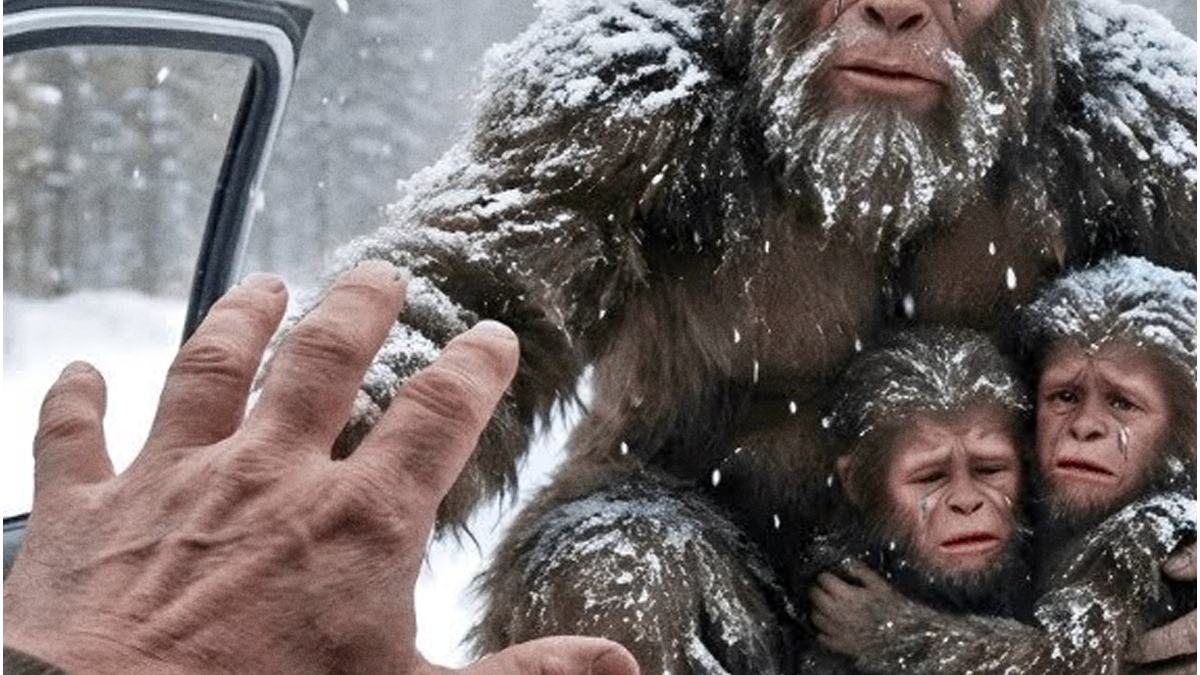
A Woman Opens Her Door To A Freezing Bigfoot Family – Their Next Move Will Change Everything
Would you believe an accident took away her only daughter, but also opened up an encounter no one dared to imagine.
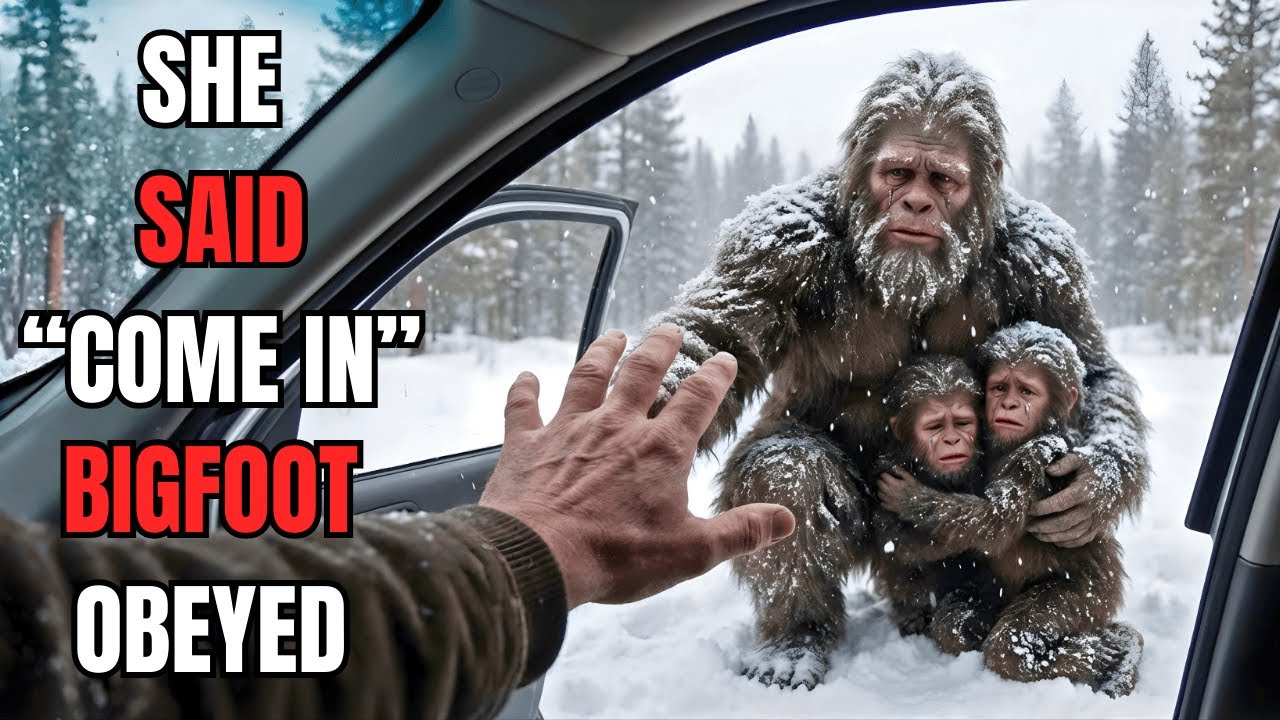
And 5 years later, at the very same deadly curve, came face-to-face with a dying Bigfoot mother and her two children.
What she saw that day shattered everything she thought she knew.
The creature’s eyes, wide, terrified, pleading, held the same grief she saw in her own reflection for years.
A monster?
No.
It was a mother, just like her, begging someone, anyone, to save what was left of her family.
This isn’t a tale of horror.
It’s a story of healing, of two mothers from two different worlds holding onto life in the same frozen silence.
Of a woman who once failed to protect her child, choosing this time to fight for beings no one believed deserved saving.
You’ll see how they survived together, how trust was built in the deep forest, how silence became song, and how a deadly curve once took a life, but later became the place that gave it back.
And if you’ve ever lost something, if you’ve ever looked at the woods and wondered what’s watching from behind the trees, this story will stay with you.
Now, I have a question for you, dear viewer.
Where in the world are you watching from right now?
What’s your name?
And how far could a story like this reach if we let it?
I’d love to send my warmest hello straight to you.
If this touched something in your heart, please consider liking this video and subscribing to join a growing community that believes Bigfoot stories aren’t just about monsters.
They’re about what makes us human.
The road ran quiet that morning.
Lake Roosevelt to the left, still and silver like a coin under glass.
Nadine Carvers old Ford pickup hummed low as it took the curve just past mile marker 18.
The heater wheezed against the cold.
On the passenger seat, wrapped in paper from the hardware store, sat a bouquet of sunflowers, faded yellow, stems too long for the plastic wrap, drooping a little like they knew where they were going.
The tape deck clicked softly as her daughter’s voice spilled through the cab, not loud, not even a full song, just that whisper of a lullaby, clipped by age and the hum of old cassette tape.
Molly Ann’s voice, 5 years gone, but still warm enough to make Nadine’s fingers twitch on the steering wheel.
She didn’t look at the flowers.
She didn’t touch the volume.
She just drove, one hand loose at 10:00, the other resting on her thigh, thumb brushing against denim.
The same road, same day, 5 years to the minute.
Every February, she came.
No matter the ice, no matter how raw the wind cut across the dam.
Nobody waited for her in town anymore.
The classroom had been packed up.
The marriage dissolved like a frost on warm stone.
Matthew, her ex, had moved to Nevada and never called again, not even on anniversaries, not even the first year.
Mile 27 sat on a bend no engineer would ever be proud of, the kind of curve that didn’t forgive.
To the right, a steep cut of pine forest climbing sharp and wild.
To the left, a sudden drop-off into a low, moss-choked ravine where metal guardrails twisted like old ribbon and snow clung to the shade all spring.
Her tires hit black ice before she saw it.
Just a whisper of slip, enough to make her breath catch.
The truck fishtailed slightly, rear end sliding, and for a moment, just a moment, her vision clouded with a scream, a child’s scream, metal shrieking, a flash of white cloth, the bitter taste of seatbelt nylon on her tongue.
The doctor’s voice, “We did everything we could.”
The truck slowed.
Her boot hit the brake too hard, and it jolted to a stop just shy of the curve.
She sat still.
Then she exhaled like something heavy had peeled off her ribs.
It took her a full minute to open the door.
The cold hit first.
Then, the quiet.
The kind of stillness only late winter could shape, when the sky is clear but nothing dares to move.
She walked with slow, practiced steps, boots crunching softly.
She knew where the cross was, the little wooden one she’d carved herself from old fencing.
She’d set it 5 ft from the guardrail, just where the embankment began.
The snow around it was packed from years of return.
No one else ever left flowers, just her.
She crouched and set the sunflowers at the base, brushing away some frost.
Her fingers lingered at the crossbar.
The name was fading.
Molly Ann Carver.
No date, no message, just the name.
She closed her eyes.
The wind moved around her, gentle but sharp enough to sting the cracks in her lips.
Somewhere far down the ridge, a crow called once.
Then, something caught her eye.
To the left of the cross, just off the ice-patched shoulder, the snow dipped unnaturally.
A trail, a wide one.
Nadine straightened slowly, looked closer.
The prints were enormous, bigger than any boot she’d ever seen, five-toed and deep, each one pressed like a fist into the crusted snow.
Not just one set, several, and blood.
A faint smear ran in a broken line from the guardrail down the slope, red against white, thick, dark, too much for a deer, too smooth to be a scrape from a car bumper.
She stepped to the edge.
There, half-buried near the base of the broken rail, was a curved piece of metal, twisted, black with rust, cold and sharp like it had been there forever.
Her breath caught again.
It looked familiar.
No, not just familiar, the same kind of scrap they’d pulled from her fender after the crash, the same jagged teeth, same oily stain.
Something about the curve of this place, this cursed bend, didn’t just take her daughter, it was still taking.
She followed the blood.
Her boots sank into deeper snow as she moved off the road, down past the embankment where the slope dipped hard and the tree line thickened into Douglas fir and alder.
She didn’t have a weapon, didn’t carry anything more than keys and a half-used lip balm in her coat pocket.
But something in her chest pulled her forward.
The first thing she saw was a foot, massive, covered in coarse, dark brown fur, twisted slightly to the side like it had buckled beneath too much weight.
Then the leg, the torso, the head, a body, 7 ft long, broad shoulders, arms longer than any humans.
The face, not human, but not beast.
The eyes were open, staring up at the canopy, fixed, glassy.
The snow had settled on the chest.
Steam no longer rose from its mouth.
Nadine stopped, breath in her throat.
The smell was thick, earth, blood, something wild and heavy.
Then, movement, just 10 yards ahead, half behind a fallen tree, another figure knelt, bent, pulling, straining.
A second creature, similar in shape, but smaller, female, maybe.
And beside her, two tiny ones huddled.
One barely moved.
The female, Mora, locked eyes with her, and Nadine felt something crack open inside, because in those eyes was the same look she’d seen in the mirror 5 years ago.
Raw, hollow, refusing to cry because the body couldn’t take one more thing.
Mora shifted.
She placed one arm across the tiny bodies, shielding them as if preparing for another loss.
Her movements were slow, jagged.
She was injured.
The little ones, Bracken and Flicker, trembled.
The smaller one, Flicker, wheezed with every breath.
Its fur clumped around the mouth, sticky with red.
Nadine didn’t move, couldn’t.
She was standing inside a mirror.
Two mothers, two tragedies, one patch of cursed earth.
Then Mora did something that Nadine would never forget.
She crawled forward, not to fight, not to flee, but to push her body between Nadine and her children.
And then she collapsed right at Nadine’s feet.
Her chest heaved once, twice, then her gaze rose again, desperate.
It wasn’t a challenge, it was a plea, a silence louder than any scream.
Nadine looked down at the snow, at the prints, at the smear of blood that could have been hers in another life, at this family.
And for a brief moment, she felt the weight of something she hadn’t felt in 5 years, purpose, a terrible, dangerous, irreversible purpose.
The wind picked up.
The sun dipped lower behind the ridge, casting shadows that stretched long and blue across the slope.
Nadine took one step back, then another.
She turned, walked to the truck, opened the door, grabbed the emergency blanket behind the seat, yanked the bungee cords from the toolbox.
Her hands didn’t shake.
When she returned, the mother hadn’t moved, but her eyes hadn’t left her.
Nadine crouched, wrapped the blanket around the two small bodies.
“I don’t know what I’m doing.”
She whispered, her voice cracking as she lifted Flicker into her arMs. The little body was warm, too light, too limp.
She looked down at Mora.
“I couldn’t save mine.”
She said.
“But maybe” she didn’t finish.
There wasn’t time.
She hauled the body of the mother, heavier than anything she’d ever lifted, by looping a cord around her chest and dragging inch by inch toward the truck.
Her boots slipped.
Her breath burned.
But she didn’t stop.
She pushed the little ones into the back first, then climbed in and pulled.
Mora rolled like stone.
It took her 20 minutes, and when she slammed the tailgate shut and slid behind the wheel, she realized she was crying.
Not because of fear, but because for the first time in half a decade, someone had looked at her like she could save them.
She turned the key.
The engine caught.
She put the truck in gear and drove back toward the main road, back toward whatever the hell came next, not knowing the worst of it still waited on the curve behind her, not knowing the road ahead would offer no safety.
Only this, a trembling baby creature in her coat, a mother bleeding in the bed, and a heart that had started beating again without asking for permission.
The engine trembled beneath her hands.
The dashboard rattled with every bump as the tires rolled off the snowy shoulder and gripped what was left of the road.
Nadine didn’t blink.
Her eyes locked on the streaks of gray ahead, barely catching the reflection of her headlights on snow-matted branches.
The cab had warmed, but her breath still fogged the glass in short bursts, uneven, shallow.
The baby lay across her lap, barely stirring.
His small body bundled in her coat.
His chest rose so faintly it made her stomach lurch.
Behind her, in the truck bed, the weight of the mother shifted with the turn.
Dead weight, or nearly.
She’d thrown a blanket over all of them, even Bracken, though the bigger one had hissed low when she got too close.
Not a real threat, more like a warning that his world had collapsed too fast.
Nadine didn’t know where she was driving.
She didn’t know what she was doing, but she knew she couldn’t leave them there.
Her foot eased off the gas as the sky turned that deep, hardening blue just before true dark.
The kind of cold that took shape, that built itself bone by bone until it pressed against your skin like judgment.
For a second, just a second, she wanted to turn around, drive them back to the slope, pretend she hadn’t seen the footprints, the blood, the eyes, pretend none of it happened, that it was the cold playing tricks, the grief taking a new form.
But then, her fingers twitched on the steering wheel.
She remembered a night long ago.
Molly Ann in the bath, maybe 6 years old, playing with that plastic dolphin she’d named Mr. Blue.
The water had gone cold.
She hadn’t wanted to get out.
And she’d asked, “If an animal was hurt, would you help it even if it was big and scary?”
Nadine had laughed then, or tried to.
She was folding towels and only half listening.
She said something like, “Of course, sweetheart.
That’s what good people do.”
But now the answer sat heavier than any truth she’d ever faced.
She gripped the wheel tighter.
From the truck bed, a thump.
The sound was dull, but distinct.
She looked in the rearview.
The shape back there had moved, just a little.
Bracken was up.
His silhouette blocked part of the blanket.
A thick head, shoulders hunched.
He wasn’t attacking.
He was watching.
The baby whimpered in her coat.
A low, wheezy sound.
She tightened her arms around him.
Then a shift.
From the truck bed, a new movement, slow, weighted.
The mother, Mora, was dragging herself closer to the rear window.
Not fully conscious, but trying.
Nadine didn’t break, didn’t speak.
She just drove.
Snow had started again.
Not hard, but fine and quick like ash.
It danced in the headlights.
Then the road curved again, left this time, and ahead, an oncoming truck, big, headlights bright.
A logging rig hauling long beams stacked in an iron cradle.
No time.
The road narrowed.
To the left, a drop.
To the right, snowbank and pine.
She could swerve, but not with this weight, not with Mora in the back, not with Flicker in her lap.
She gritted her teeth, heart hammering.
The sound of the other truck grew louder.
She held the wheel dead center.
Let it pass.
The driver saw her, must have seen her, because the logging rig jolted right, its tires kicking up snow like smoke.
It roared past inches from her mirror.
Flicker stirred, but didn’t cry.
Behind her, Mora shifted again, and Nadine swore the weight of the truck changed.
It tilted, but then it corrected.
The bed stopped sliding, and Nadine felt it like a ripple through her spine.
She looked back.
Mora’s massive arm was braced against the metal siding, her body half-lifted, wedged.
She had planted herself, somehow, at the exact angle to stabilize the truck’s shift.
Nadine’s throat tightened.
Bigfoot, yes, but not just an animal, not some monster from the woods.
A mother, a protector, a being who understood instinct the same way Nadine did when her daughter had run toward traffic for a balloon.
She didn’t remember the rest of that stretch, just the blur of trees, the taste of adrenaline, the smell of blood and wet fur.
By the time she turned off the main road, the sky had darkened.
Only one place came to mind.
She hadn’t thought about him in years, but if there was one person in the entire county who wouldn’t call the sheriff, who wouldn’t grab a rifle, who might actually believe her, it was Caleb Rowan, the old ranger, retired, pushed out some said, for drinking.
Others whispered he saw something back in ’72 that made him stop going into the woods.
Either way, he still had the cabin, still lived near the North Ridge.
And if anyone had seen these creatures before, it was him.
She pulled onto the old service road, narrow, hard-packed, more ruts than gravel.
The trees closed in like ribs around a lung.
She drove slow, careful.
Flicker had stopped making noise, still breathing, but barely.
At the end of the road, the cabin appeared like a shadow cut from the woods themselves.
No porch light, just the orange flicker of a wood stove inside.
She parked.
The engine clicked as it cooled.
The snow kept falling.
She stepped out, didn’t even close the door, just grabbed Flicker, wrapped tight, and made her way to the door.
Each step dragged.
Her boots cracked through the frozen top layer.
At the cabin door, she hesitated, knocked once, then twice.
No answer.
She raised her hand to knock again.
The door opened.
He stood there in a flannel shirt, suspenders loose, white beard thick, eyes sharp as broken glass.
He looked at her, then past her, to the truck, to the shape in the back.
He didn’t blink, just stepped aside.
“I knew one day,” he said, voice low and rasped, “someone would bring them here without a bullet hole.”
Nadine couldn’t speak.
She stepped inside.
The warmth hit her like a wave.
The smell of cedar smoke and old blankets.
Flicker let out a soft sound.
Caleb shut the door, locked it.
She turned to him.
“I didn’t know where else to go.”
He nodded.
“We’ll get them warm first.”
Then he walked past her, grabbed a thick wool quilt, and headed for the truck without another word.
Nadine sank into the nearest chair.
She didn’t cry, didn’t collapse.
She just sat, holding the baby tight, while outside, a man who’d once been called crazy walked into the snow and started pulling miracles out of the bed of a pickup truck.
She didn’t know what tomorrow held, didn’t know what laws she’d broken, but she knew this.
Something had changed.
The road back didn’t exist anymore, and whatever came next, she was already in it.
The wind pressed against the wooden walls of the cabin.
A long groan that came and went like breath through rotted boards.
Inside, the heat from the stove had chased off the worst of the cold, but the air still felt thick, holding onto the scent of wet fur, old books, and pine smoke.
Nadine stood by the window, her body stiff, eyes locked on the snow fall outside, though she wasn’t really watching it.
Behind her, Flicker lay bundled near the fire, his breathing still ragged, chest rising with effort like a swimmer caught under waves.
Bracken crouched close, eyes darting between Nadine and the door as if unsure whether to trust the space or bolt through it.
Mora hadn’t moved much.
Caleb had laid her on a stack of thick wool blankets in the corner, limbs awkwardly folded.
One arm protectively across her belly like muscle memory refused to surrender.
Caleb didn’t speak right away.
He moved with an old man’s quiet efficiency, filling a kettle, setting jars on the table.
His movements were deliberate, almost ritualistic.
A tin of dried yarrow, something in a dark blue bottle.
He didn’t need to ask what happened.
He’d already seen enough to know more than Nadine could say.
Finally, his voice came low and certain, like he was narrating a memory he’d never told anyone out loud.
“I first saw her in ’74, not up close.
Ridge above Devil’s Wash.
I was on patrol.
She was carrying something big, dead weight.
Maybe food, maybe one of her own.”
Nadine turned from the window.
“Her?”
He nodded, pouring water over the herbs.
“She’s older now, slower, but it’s her.
The eyes.
You never forget those eyes.”
She glanced at Mora, the bruising along her ribs, the dried blood in her fur, the weariness in every inch of her.
“You’ve seen her more than once?”
“I kept quiet about it, even back then.
Once told a biologist I’d seen something, he laughed in my face, said I must have been drinking again.
After that, I just stopped talking, but I kept watching.
She’s part of a line, I think, a family, a people.
They’re not like us, but they’re not beasts, either.”
Nadine crossed to the fire, sat down slowly on the floor beside Flicker.
She touched his arm gently.
It twitched, but didn’t pull away.
“I can’t lose him,” she whispered.
“I couldn’t save my girl.
I need to save this one.”
Caleb lowered himself to the floor with a soft grunt.
He watched her for a long moment, then handed her a cup of warm herbal water.
“There’s an old story,” he said, “passed down from some of the Salish elders.
They talked about a group called those who keep the path, folks who protected beings like this, not just from people, but from time, from being forgotten, from becoming myths.”
She sipped the water.
It was bitter, but grounding.
Her hands shook.
“I didn’t believe any of this, you know, not until today.”
Caleb smiled, not unkindly.
“That’s how belief works.
You don’t need it until you do.”
Bracken let out a soft grunt.
Mora stirred.
Nadine turned quickly, afraid it was a seizure or worse, but then a sound, low, almost subsonic, a vibration that wasn’t quite a hum.
Mora’s mouth barely moved.
Her throat pulsed.
It wasn’t speech, but it wasn’t animal, either.
Nadine leaned closer.
The pattern was rhythmic, a rise and fall, gentle, deliberate, and her heart stilled because it sounded like a lullaby.
Not exactly, but close.
The way a mother might sing to her children if her language had never been written down.
And somewhere in the back of Nadine’s mind, the tape of Molly Ann hummed in echo.
A tiny child’s voice humming her made-up tune from the bathtub.
Notes uneven, pure.
Two mothers, two languages, one grief, one bond.
Flicker stirred, curled tighter into Nadine’s coat.
She brushed his forehead gently, whispering, “Don’t die on me.
Please, just let me save this one.”
Caleb added wood to the fire.
The crackle grew louder.
Sparks danced in the chimney.
“I’ve heard that sound before,” he said, “twice.
Once when I found one of their young caught in a wire snare, its leg half torn.
The mother came, didn’t attack, just sat beside it and made that sound.
The young one died by morning.
She stayed until the snow covered it.”
Nadine closed her eyes.
“I can’t let that happen again.”
For a while, they sat in silence.
Only the fire moved.
Then Caleb stood.
He crossed to an old wooden shelf and pulled down a map, laid it across the table, smoothing it flat with palms that had once traced every inch of that wilderness with compass and boot.
“They’ll need to go back,” he said.
“Eventually.
They can’t stay here.
Not with folks like Royd Henderson sniffing around.”
Nadine looked up.
“Who?”
“Royd’s a forestry contractor, claims he’s tracking timber erosion, but he’s really hunting something he doesn’t understand.
Been setting up cameras, offering money to hunters for anything unusual.
If he finds them, he won’t ask questions.
He’ll bring proof, DNA, bone, whatever sells.”
Nadine swallowed hard.
“What happens if the government finds out?”
Caleb’s face darkened.
“They’ll take them, lock them up, study them until they stop breathing.
And you, you’ll be labeled as unstable, or worse, complicit, harboring a nonhuman entity.
There aren’t laws for this kind of thing, just cold men in colder suits.”
The fire popped.
Nadine flinched.
“So, what do we do?”
Caleb leaned over the map, pointed to a valley northeast of Coalville.
“There’s an old cabin, mine from back in the ’60s.
Deep woods, no roads.
Closest ranger station is 12 miles out.
No trails on any current survey map.
It’s as close to invisible as you’ll get.”
She stood slowly.
“You want me to take them there?”
“I can’t,” Caleb said, “not anymore.
I’m too old, too slow, but you, you still have fight in you, and the trust.
That’s rarer than anything.”
Nadine stared down at the map.
Her hand rested on the old pine ridgeline.
Her breathing was shallow again.
“I don’t know if I’m strong enough.
I couldn’t even keep my daughter alive.”
Caleb stepped closer.
“Some debts,” he said, “can only be paid by keeping another life breathing.”
The words didn’t hit all at once.
They settled into her like heat into frost.
Nadine turned toward the fire.
Flicker had shifted closer to her knees.
Bracken had settled against his mother, and Mora, still bleeding, still battered, had closed her eyes, but her face had softened.
Something about that moment felt holy, like grace was trying to find a way back her life.
She didn’t move for a while, but when she did, she crossed to her bag, pulled out a worn photo album.
She sat down and opened it.
The first picture was of Molly Ann in rain boots three sizes too big, holding a worm and grinning like she’d won a prize.
Nadine looked at it a long time, then she wept.
Not quietly, not prettily.
She let it break through her in waves, five years worth of held-back storMs. Caleb didn’t interrupt, just set a hand on her shoulder and left her there, crumpled over a book of memories with a creature that wasn’t human lying inches away, and a fire that burned like it knew how to keep watch.
And when the tears passed, Nadine whispered something only the flames could hear.
“I’ll do it.
I’ll take them home.”
But home now was a word that would never mean what it used to, and maybe that was the point.
The lantern cast a low amber glow across the cabin walls, catching dust in the air like tiny stars caught in orbit.
Nadine sat at the worn table, her elbows propped on an old US Forest Service map laid flat beneath her hands.
Caleb stood beside her, pointing with a stubby pencil toward a swath of green deep inside the Coalville National Forest.
No marked trails, no fire roads, just dense old growth stretching into the blue shadows where no one bothered to look anymore.
Mora slept in the far corner, a slow, steady rhythm returning to her breath.
The worst of her bleeding had stopped.
Bracken sat cross-legged at her feet, watchful, silent.
Flicker curled near the fire like a child too sick to dream, but alive.
“They can’t stay here,” Caleb said, voice low and steady.
“The longer they’re near people, the more scent they carry.
The little one’s already starting to smell like your coat.”
Nadine didn’t look up.
She traced the ridgelines with her fingertip.
“What happens if we wait?”
“They lose the edge,” he said, “forget what it means to stay hidden, what to run from, how to disappear.”
She looked toward the fire.
Flicker had stirred, his face half hidden in fur.
“He’s barely alive.”
“He’ll make it,” Caleb replied, “if you keep him moving, if they get somewhere safe, somewhere wild enough to strip away the scent of all this.”
Nadine exhaled through her nose.
Her breath trembled.
She didn’t want to do this, but wanting had nothing to do with it anymore.
The map folded slowly beneath her hands.
“You said there’s a cabin.”
“Old fire watch post.
I built it myself back when the service thought someone ought to keep an eye on that stretch.
No one goes out there now, even elk skirt it.
You’ll have privacy.
Water nearby?
Shelter if you need it.”
She nodded, the decision already settling into her spine like cold stone.
“How long?”
“Six months, maybe more.
Depends on how quick they take to it.”
Bracken shifted.
His head tilted slightly, as if sensing the shape of the conversation.
“They’ll need someone close by,” Caleb said, “but not in their faces, somewhere near, but not among them.
Close enough to teach, far enough to make them forget your touch.”
She turned her face toward the window.
The snow outside had slowed to a lazy drift.
Shadows pooled beneath the trees like oil.
“Can they really learn?”
She asked.
“They’re smart,” Caleb said, “smarter than some people I’ve met, but it has to be instinct again.
You can’t talk it into them.
You have to make them feel the world’s sharp edges, teach them to flinch when they smell metal, to vanish when they hear a voice, to run at the sound of radio static.”
The thought made her stomach turn.
“I’m not a trainer.”
“You’re a mother,” he said.
“That’s harder.”
She didn’t answer.
In the silence that followed, a knock echoed on the door, sharp, purposeful.
Nadine froze.
Caleb moved slower, placing his hand just above the rifle near the fireplace.
Then the door creaked open and a woman stepped inside, hair wet from snow, coat heavy with field gear.
“Relax,” she said, pulling back her hood.
“It’s me.”
Caleb muttered something under his breath and stepped back.
“Marisol Vega,” he said, like the name tasted like rust.
“Still stalking ghosts?
Still hoping they’ll stop hiding?”
She said, her eyes sweeping across the room.
She spotted Mora, then Flicker, and her expression shifted.
Not to surprise, but awe.
And something sharper, ambition.
“Oh my god.”
Nadine stepped between her and the fire.
“They’re recovering.
Don’t get close.”
Marisol raised her hands.
“I’m not here to poke and prod.
I just want to help.”
“You want to document,” Caleb said.
“That’s not the same thing.”
She turned to him, jaw tight.
“I’ve spent 20 years following scraps, prints in mud, hair samples dismissed by every lab.
Now they’re real, and you want to bury them back in the trees like they’re shameful.”
“They don’t need your thesis,” Caleb snapped.
“They need silence.
They need time.
They need to unlearn every smell and sound that’ll get them killed the second a man like Roy Henderson picks up a trail.”
Marisol stared him down, then shifted her gaze back to Nadine.
“You’re taking them?”
Nadine hesitated.
“I am.”
She didn’t explain more.
She didn’t have to.
Marisol’s eyes narrowed, then softened.
“If that’s the plan, then let me offer what I can.
I know the forest.
I know behavioral patterns.
I know how to track and how to vanish.”
Caleb scoffed.
“You also know how to turn a creature into a paper and a paycheck.”
“I don’t want fame,” she said, “not anymore.
I just want them to live.”
The silence was heavy, but not final.
Nadine looked down at Flicker, the small rise of his chest, the way his fingers had curled slightly tighter around the said.
Marisol nodded once.
The days that followed moved fast.
Supplies packed into duffels, blankets, rope, field knives, bottles marked with Caleb’s illegible labels, a hand-drawn map, edges scorched to keep from fraying.
Bracken began to follow Nadine at a cautious distance, still protective, but no longer afraid.
Flicker leaned into her touch without hesitation.
Mora, slower to heal, watched everything with a gaze that seemed to carry the weight of generations.
It was on the third day, while testing scent drills near the edge of the cabin’s tree line, that Nadine saw it happen.
She’d hung a strip of metal chain from a branch and lit a small fire nearby, enough smoke to warn, but not overwhelm.
Bracken stepped forward, sniffed, then recoiled fast, dragging Flicker with him.
Mora didn’t move.
She only watched.
Nadine met her eyes.
She swore she saw approval.
That night, under a sky thick with stars and quiet pine smoke, Nadine sat by the fire.
Caleb leaned beside her, picking his teeth with a twig.
“You really think they’ll make it?”
She asked.
“If they don’t,” he said, “it won’t be their fault.”
She stared at the fire a long time.
Then she whispered, almost to herself, “What if I fail again?”
He didn’t answer right away.
Then finally, “You won’t, because this time you know the stakes, and because this time you’re not alone.”
Later, long after everyone else had slept, Nadine opened Molly Ann’s photo album again.
She traced the edge of a picture taken on the last good day, a picnic by the lake, hair in the wind, jelly smeared on her cheeks.
She closed the book.
She didn’t cry this time.
Instead, she stood, crossed the cabin.
She looked down at Mora, still curled protectively around her sons, and then she whispered as quiet as breath, “I’ll get you home.”
She didn’t mean the cabin.
She meant something bigger, something wilder, and somewhere far past the line where language ends.
Mora understood.
The road into Coalville blurred beneath a film of melting snow and pine needles, the kind that clung to the tires like memory.
The forest had changed since February.
What had once been stiff and gray with frost now leaned green and heavy with the scent of thaw.
Spring was pushing through the skin of the land, budding alder branches, slick trails of fresh meltwater winding down from the ridges like veins through an ancient body.
Nadine drove slow, following Caleb’s map, though by now she knew every turn by instinct.
The trail had narrowed days ago into something barely wide enough for her truck to squeeze through.
Now they were down to crawling speed, tree limbs brushing both mirrors, engine humming low like it, too, was holding its breath.
Behind her, a second shape moved through the trees.
Mora walked with the steady gait of someone who remembered the forest well, but hadn’t seen it in years.
Her body was thinner than it had been.
Her fur, patchy in spots where the infection had burned away chunks of skin, had started to regrow.
She kept close, not out of fear, but watchfulness.
Beside her, Bracken stalked the undergrowth with quick, soundless steps.
Flicker trotted clumsily behind his brother, still favoring his right side where the ribs had healed soft.
They didn’t need the truck anymore, not since the second week.
That was the first time Bracken refused to climb back into the bed after a stop.
He had stood still, firm, chest rising like he was drawing breath from the entire hillside.
Nadine had tried to coax him with soft words, then with food, then by simply waiting.
Eventually, she understood, so she stepped back and drove ahead, slowly.
He followed.
The others followed him.
It had been that way ever since.
The cabin appeared like a smudge between the pines, tilted slightly, edges softened by moss and time.
One window had caved in, its pane covered crudely with plywood.
The door hung loose on rusted hinges.
It wasn’t much, but it was shelter.
And no one had set foot near it in decades.
Nadine parked, cut the engine, and sat there for a moment, her hand still on the wheel.
She watched the forest close in behind her through the mirror.
They were already moving past the tree line, Bracken first, Flicker trailing him like a shadow, Mora bringing up the rear.
No one waited for her.
She got out.
The air felt different here, denser, wilder.
Every step seemed to press into a kind of silence she hadn’t known in years, not the silence of grief or distance.
This was the kind of quiet that listened back.
She left the truck unlocked.
The keys stayed in her coat pocket.
Inside the cabin, it smelled of damp wood and something faintly metallic, rusted tools, maybe, or the memory of old blood from some long-gone coyote sheltering from snow.
The floor creaked, but held.
There was no stove, only a stone hearth blackened from use, a rain-stained mattress curled in one corner, and a single wooden chair missing a leg.
She began clearing it that afternoon.
Bracken watched from a distance as she swept the floor with pine branches.
Flicker wandered closer, but ran when she dropped a box of kindling too loud.
Mora stood at the edge of the clearing until the sun began to tilt gold behind the ridge.
Then she stepped forward and placed her hand against the cabin wall.
Not the door, not the window, just the wood itself.
As if remembering, the first nights were quiet, tense, but not hostile.
Nadine made a camp nearby, just a canvas lean-to under a half-rotted spruce.
Her sleeping bag lined with Mylar, her gear bundled in waterproof bins.
She cooked small meals over a single-burner stove, never anything that smelled too strong, always turned off the radio before it clicked.
They didn’t come near her fire, but they didn’t leave, either.
Sometimes, in the hours between dusk and real dark, she’d catch glimpses, Bracken crouching on a limb above the trail, Flicker’s eyes glinting behind a cedar trunk, Mora sitting still, legs folded beneath her, watching stars blink awake.
And then, the singing began.
It was quiet, almost imperceptible, a series of low, pulsing tones, like breath shaped into song, Mora’s voice.
Each night, the same rhythm.
Each night, Flicker curled closer to her side.
Nadine began humming, too.
Not the same song, but her own.
The one Molly Ann had made up in the bathtub.
No lyrics, just the shape of a tune no one else knew.
On the fifth night, Flicker hummed back.
Training started small.
She’d hang food in the trees.
Jerky knotted in canvas, raw fish sealed in bark, smoked rabbit wrapped in cedar.
Not gifts, not bribes, just tests.
Bracken figured it first.
He climbed with a confidence that startled her.
Silent, quick, efficient.
Not brute strength, strategy.
Flicker watched him, tried to copy, fell, tried again.
They didn’t like the sound she made at first.
Metal buzz.
She’d brought a set of old tools, hammer, chains, a piece of steel rebar.
She struck them against rocks, against the truck bumper, against each other.
Flicker flinched.
Bracken ran.
Mora stayed.
Eyes fixed, chest still.
She understood what Nadine was doing, so she helped.
When Nadine clanged the chain against the tree, Mora would grunt low, then push the boys behind a bush, curling her body around them like a wall.
After a week, she didn’t have to.
They dropped flat the moment they heard the sound.
It became a rhythm.
Teach, withdraw, wait, reinforce.
Make the world feel dangerous again.
Smoke drills followed.
She lit damp pine needles, watched as the scent curled low to the ground.
Mora wrinkled her nose.
Bracken retreated.
Flicker choked once, then scrambled to higher ground.
Success.
They were learning.
Every day Nadine kept her distance just a little more.
Every night she went to sleep with Molly Ann’s voice in her head and the quiet breathing woods just beyond the fire.
One evening in the lull between the last sun and full dark, the woods snapped.
Not wind, not animals, voices.
Laughing, rough, male.
She dropped low behind her lean-to, heart jackhammering.
Three men, flashlights, beer cans.
One of them cocked a rifle for show.
She couldn’t see their faces, just shadows weaving through the trail like they owned it.
Bracken was already gone.
Flicker nowhere in sight.
Mora remained, crouched low near the cabin, unmoving.
The men passed without seeing them.
But not by much.
Nadine didn’t sleep that night.
The next morning she packed everything she didn’t want found into the old root cellar beneath the cabin, covered the hatch with pine needles, dug new runoff trenches by hand to make the cabin look abandoned.
If they came back, she’d burn the cash, lead them away.
No one was dying this time.
And if it had to be her, so be it.
Later that week, while foraging along a stream, she slipped.
Her foot hit moss-slick rock and she went down hard, slamming her side against a boulder.
The pain was immediate, sharp and deep.
The bear came out of nowhere, big, black, wet from the river.
It didn’t charge, not at first.
Just stood across the rocks, sniffing, considering.
She couldn’t run, couldn’t even get up.
Then, a growl, low, behind her.
Mora.
The bear turned its head.
Mora stepped forward once, twice, arms wide.
The bear hesitated, snorted, then backed away.
Nadine wept as the pain reached her ribs.
Mora didn’t leave until the bear had vanished into the trees.
When Nadine finally sat up, shaking and bruised, Mora crouched beside her.
Not touching, not making a sound, just there.
And that, somehow, was enough.
That night, as stars spilled like salt across the sky, Nadine opened her journal and wrote one word she hadn’t dared in years, family.
But she didn’t underline it, didn’t circle it, just let it sit there, like a seed.
The forest in midsummer felt older than time.
Green pressed in from all sides, thick with heat and life.
Birds called through the canopy, frogs clicked near creek beds, and wind moved only in patches, like something alive that refused to touch every tree at once.
The cabin had begun to disappear behind curtains of fern and ivy, as if the forest had decided it could stay a little longer, but not forever.
Nadine moved quietly through the underbrush, her boots barely breaking the surface of the earth.
She carried no pack, no tools, just her breath and the slow rhythm of someone who had lived in the trees long enough to know they didn’t like to be surprised.
Ahead, the clearing opened like a held breath.
Bracken stood at the edge, eyes fixed on a flicker of movement beyond the trail.
He’d grown taller, shoulders broader, posture more assured.
But he still scanned for Mora before stepping forward.
Flicker followed him, smaller but faster now.
His gait lighter, less cautious.
Mora waited further back, nearly still.
Nadine had watched her pull farther away over the past weeks.
Not in resentment, in something deeper.
An instinct that whispered it was time.
She no longer hovered, no longer corrected.
She just watched.
And when Nadine nodded, Mora nodded back.
They had learned, and now came the moment to prove it.
Marisol’s steps were louder than Nadine’s.
On purpose.
She wasn’t trying to be silent.
She was trying to be noticed.
Her boots cracked dry pine needles.
She shifted her weight deliberately.
She carried a metal flask with gasoline-soaked cotton sealed tight in a side pouch.
A radio clipped to her belt murmured static just loud enough to crawl into the trees.
Her jacket smelled of truck grease and cigarettes, and her footsteps dragged in the rhythm of someone unfamiliar with the weight of danger.
She was pretending to be a stranger.
That was the point.
The Bigfoots didn’t know it was her, and Nadine wasn’t allowed to help.
She watched from the ridge, heart pounding against her ribs like it had all those years ago when she got the call about the accident.
That same helplessness, that same breathless ache.
The first test came quick.
Bracken heard the static and froze.
His eyes flicked toward Flicker, then toward the sound.
His chest rose, then dropped.
He didn’t move.
Flicker did neither, but his head tilted, just slightly, curious.
Then the sound of Marisol stepping into the clearing broke the stillness.
Flicker turned his head, moved a fraction toward the source.
Nadine held her breath.
Her hands dug into the soft moss beside her, fingernails pressing into earth.
Please stay.
Please remember.
Flicker leaned forward, almost stepping.
Nadine’s throat tightened.
The woods pulsed with waiting.
Mora made no sound, but her body shifted.
She stepped forward from the ferns, moving slowly, deliberately, until she reached Flicker and laid her arm across his chest.
Not roughly, not even firmly, just enough to hold him still.
She crouched low, pulling both her sons close.
Her eyes stayed open, trained on the sound.
And they didn’t move again, not when Marisol passed just 50 ft away, not when her radio buzzed louder, not even when the wind changed direction and brought the full weight of her scent across the clearing.
They stayed hidden, perfectly still.
When the footsteps faded and the radio melted into silence, Mora didn’t let go.
Not yet.
Not until long minutes had passed and the birds began calling again.
Only then did she ease her grip and pull her hand back.
Bracken rose first, his head low, his arms tight against his body.
Flicker waited until Mora nodded, then he followed.
And from her place on the ridge, Nadine let out the breath she’d been holding.
They had passed.
But the forest didn’t release them yet.
The test had worked.
But something lingered.
Marisol had looped back wide, circling near the creek to avoid doubling her scent trail.
The plan was to exit clean.
No contact, no confusion.
But the forest didn’t care about plans.
It gave them a trap instead, somewhere near the lower slope.
Her boot hit a buried coil of metal.
It snapped with a hiss and a sharp metallic crack.
The sound bounced through the trees like a shot.
Marisol cried out, not loud, but enough.
The breath she’d been holding broke into a hiss of pain.
The trap hadn’t broken bone, but it had closed on her ankle, hard and rusted.
A snare meant for something bigger.
She dropped to one knee, jaw clenched, teeth gritted.
She was trying not to scream.
Nadine was already moving, but carefully, quietly.
She stayed above the sound, out of sight.
And below, in the shadow of the clearing, Bracken’s head jerked toward the noise.
Flicker stood with him, eyes wide.
That sound, it was familiar.
Pain, human, wrong.
Nadine saw it happen in an instant.
Bracken took a step forward.
Nadine’s mouth opened, but she didn’t speak.
She couldn’t.
This was their moment, their test.
And it was Bracken’s instinct to protect.
He’d watched Nadine treat wounds, wrap bandages, soothe Mora back from the edge of fever.
He remembered kindness.
He remembered the shape of help.
But now that kindness might kill him.
Mora moved, not with force, but with certainty.
She reached out, not angrily, not desperate, just sure.
She gripped Bracken’s arm and pulled him back, holding his gaze the way only a mother could.
She didn’t speak, but her body did.
Not this time.
Bracken hesitated, then backed away.
Mara’s hand lingered on his chest for a second longer, just to make sure.
And when the moment passed, when the tension dropped like a bird leaving a branch, Nadine exhaled again.
Marisol cursed under her breath and finally pried the trap open.
Her pants were torn, her shin bleeding, but the bone held.
She wrapped it quickly, limping as she moved uphill toward the rendezvous point.
She didn’t look back.
By nightfall, the cabin looked like it had been abandoned for months.
Nadine had removed every trace of her presence, stuffed gear into sealed buckets, buried them beneath stone and soil.
Her lean-to was already taken down.
The fire ring scattered, footprints brushed away, all of it fading into the skin of the forest like she’d never been there at all.
Mara stood by the edge of the clearing, Bracken beside her.
Flicker curled low in the underbrush, head resting on one paw.
They didn’t come closer, but they didn’t leave either.
Nadine sat on a stump just beyond the line of trees, the one she always used when the days were dry.
She didn’t speak, didn’t wave.
She just sat there, arms resting on her knees, eyes reflecting the orange light of the last sunset before fall would turn everything again.
Mara stepped forward once, then stopped.
Nadine lifted her hand, not high, just to her chest, a silent signal.
Mara didn’t move right away, but eventually, slowly, she returned the gesture.
Her palm pressed over her heart, and then she turned.
The boys followed.
No sounds, no rustling, just three shadows slipping back into the trees.
That night Nadine didn’t sleep.
She lay beneath the stars, listening to the wind pass over the ridge, and she wondered what Molly Ann would have thought of all this.
Would she have understood?
Would she have been proud?
Or maybe, maybe it was never about understanding.
Maybe it was just about choosing to care, to step toward the pain instead of around it.
The next morning, the clearing was empty.
The cabin stood like it had before, silent, watching.
But the forest had changed, and so had she.
The trees had started turning, not fast, not all at once, but the signs were there.
Edges of yellow creeping into the crowns of the birch, a few red fingers reaching out through the maple.
The air was crisp in the mornings, soft with the scent of damp moss and something faintly sweet, like the last warm breath of summer exhaled into the woods.
The sky above Coalville had taken on that thin, high blue that meant the season was changing whether you were ready or not.
Nadine had been watching the signs for days now.
Mara had wandered further at night, sometimes not returning until sunrise.
Bracken had stopped glancing back every time he crossed into deeper brush.
And Flicker.
Flicker no longer waited for permission before chasing birds or rolling in leaves.
It was time.
The plan was quiet.
No ceremony, no speech, just a morning like any other, except everything in her chest felt like it had come loose and was sliding toward a cliff she couldn’t stop.
She loaded the truck at dawn.
No tools, no food, just herself, a folded blanket, and something small in her pocket she hadn’t touched in months.
Mara arrived first.
She stood just inside the tree line, one hand resting against a low-hanging pine branch.
She didn’t move when Nadine looked at her, didn’t blink, just waited.
Bracken appeared next, carrying nothing but a piece of tree bark he’d scratched lines into, shapes Nadine had seen him copy from her notebooks.
He dropped it in the bed of the truck without looking at her.
Flicker came last.
His fur was fuller now, the patch along his ribs no longer bare.
He climbed into the truck bed with a kind of confidence that hadn’t existed when she first wrapped him in her coat.
Nadine climbed into the driver’s seat.
The keys clicked in her palm like old bones.
The engine turned over with a familiar growl.
She didn’t say goodbye.
The drive down the ridge was slow, the truck heavier than it looked, not in weight, in memory.
The forest peeled away in layers, first pine, then fir, then the scrubby edge where sunlight poured through like water.
The trail gave way to gravel, gravel to road.
They didn’t speak.
They didn’t have to.
The sun rose behind them, casting long shadows ahead, three shapes stretching out across the dirt like echoes of what they used to be.
Mara walked behind the truck, Bracken beside her.
Flicker ran ahead, doubling back, weaving between the trees like he was already part of them again.
And Nadine drove, eyes forward, heart clawing at the space between her ribs.
Mile 27 came into view just past noon.
The curve was still there, just as sharp, just as blind.
The old wooden cross still stood, weather-worn, leaning slightly to the left.
Its base wrapped in creeping ivy.
The bark from the pine nearby had grown around the base of the original sunflower she’d planted that first year.
It had never bloomed again, but the stalk still stood.
She parked the truck off the road, careful to keep the tires from leaving too deep a mark.
The woods were quiet, not empty, just listening.
Mara approached first.
She didn’t look at the cross, not yet.
She walked to the edge of the guardrail and stood still, staring down the slope where the road curved and the world had ended once.
Her breath steamed gently.
Bracken and Flicker joined her.
Nadine stayed back.
She reached into her coat pocket and pulled out the carved figure she’d made the night before.
It wasn’t perfect, but it was enough.
Three small shapes hunched together, fur etched with a dull blade, a sunflower clutched in the smallest one’s hands.
She walked over to the cross, placed it on the ground beside the flowers that had long since dried and scattered.
Then she knelt.
Her hand rested on the wood.
She didn’t speak, didn’t cry.
She just let the silence do what it needed to do.
Mara stepped beside her, looked down at the wooden figure.
Her fingers brushed against it, light as wind.
She turned to Nadine.
Their eyes met, and then Mara looked past her into the trees.
A sound rose in the distance, not human, not mechanical, a call, long, deep, not mournful, calling, welcoming.
Flicker’s ears perked.
He turned toward it, uncertain.
Bracken moved first.
His body tensed, then relaxed, then moved, running toward the tree line fast and sure.
Flicker chased after him without hesitation.
Mara stayed a moment longer, her hand lifted to her chest, pressed gently.
Nadine stood, mirrored the motion.
Neither of them smiled, but something passed between them, something whole.
Then Mara turned and walked.
Her sons waited at the edge of the forest, half hidden.
Another call sounded, closer.
Mara joined them, and the three figures melted into the trees, swallowed by shadow and green and memory.
Nadine didn’t move for a long time.
The wind shifted.
She looked down at the carved figure again, then up at the sky.
The clouds were soft, the light kind.
She didn’t feel finished, but she didn’t feel broken either.
Not today, not anymore.
The sunlight hit different this year.
It wasn’t that it was warmer, though it was, or brighter, though the skies had cleared for days now.
It was the way the light landed, like it had finally made peace with the ground.
No fight left in it, no sharp edges, just a soft weight draped over the pines, over the hood of Nadine’s truck, over the guardrail at mile 27.
It was early June, and the road was dry.
Her hands didn’t tremble when she turned off the ignition this time.
There were no sunflowers today, not because she’d forgotten.
She’d brought dozens, but they were in the back of the truck, not to be placed yet.
She wasn’t ready to kneel, not yet.
She got out slowly, stretching her legs.
The earth was firm beneath her boots.
No snow, no mud, just sun-warmed gravel and the distant sound of a bird she hadn’t heard since childhood.
Western Tanager, maybe, or something rarer.
She’d started working again, not in a classroom.
That part of her life had closed gently, like a book she’d finished reading more out of necessity than interest.
These days, she spent her hours at the wildlife rehabilitation center outside of Republic, feeding owls, tending to foxes hit by trucks, logging bird calls.
It wasn’t dramatic.
It didn’t make sense to anyone who hadn’t been through what she had, but it made sense to her.
There was a three-legged shepherd mix named Tuck who followed her around the center like a shadow.
He was old, grizzled, smarter than any man she’d ever dated.
She didn’t keep him on a leash anymore.
He didn’t need one.
He stayed in the truck now, head poking out the half-lowered window, watching her with the patient eyes of something that had survived its own storm.
She knelt beside the old cross, ran her fingers along the wood.
Someone, not her, had left a smooth stone near its base, pale and flat and warm to the touch.
No writing on it, no sign it had come from any hiker or roadside visitor, just placed quietly.
She smiled, then stood, stretching her back with a small groan, and looked out over the trees.
They hadn’t changed.
The slope was the same.
The curve was the same.
The place where time had cracked still stood as stubborn as it had that night 5 years ago, except it didn’t feel like it was hers anymore.
Not entirely.
She stepped away from the cross, walking toward the pine where she’d left the truck parked.
That’s when she saw it.
At first, she thought it was just bark.
A strange discoloration at the base of the tree, but when she crouched, when she got closer, her breath caught in her chest.
It was a carving, crude, shallow, bitten into the wood like it had been done with teeth instead of a blade.
A sunflower, not perfect, crooked and uneven, but unmistakably what it meant to be.
She brushed her fingertips over it, closed her eyes.
They had come back, at least one of them, maybe all three.
She couldn’t be sure, would never be sure, but the carving was real, and the message inside it louder than any howl.
We remember.
We understand.
You are still part of us.
She didn’t cry.
She’d done enough of that, but she did let herself sit down against the base of the tree, knees bent, hands resting in her lap.
She pulled a thermos from her coat pocket, black coffee, still hot.
She poured a bit onto the ground, not for tradition, not even for grief, just because it felt right.
And then she spoke, out loud, not too loud, just enough for the woods to hold the sound.
I did my best.
She didn’t say anything else.
There wasn’t much left to say.
The road was quiet, not empty, no road is ever truly empty, but still enough that her voice stayed unchallenged.
A single car passed after some time, slow and steady.
The driver didn’t look at her, just kept going.
She stayed another hour, maybe more.
The sun rose higher, light catching in her silver streaked hair.
Her shoulders were broader now, her hands more weathered, but something in her posture had softened, like the bracing had finally come loose.
She stood, brushing dirt from her jeans, and walked back to the truck.
Tuck wagged his tail once.
She opened the passenger door, reached into the glove box, and pulled out the cassette.
It was the same one, the same tape she hadn’t dared play since last year.
She slid it into the deck.
Molly Ann’s voice filled the cab, that small wobbly tune, that half-hummed lullaby she’d invented in the backseat years ago, legs kicking against the upholstery, her voice rising and falling like she didn’t care whether anyone was listening.
Nadine closed her eyes, let the sound fill every quiet space inside her.
When the tape clicked softly and rewound itself, she didn’t press play again.
She turned the key.
The engine started clean.
As she pulled out from mile 27, her eyes flicked to the tree line.
Nothing moved, no shadows, no signs, but she knew they were there, or had been, or would be again.
Further down the road, just past where the trees started to thin, she felt it, that sensation, the one that said you’re not alone.
She didn’t turn around, didn’t need to.
She slowed slightly, just in case.
She didn’t see them right away, but then, between the trunks, behind the second rise, they stepped out.
Three figures, tall, silent, still.
Mora stood at the center, her fur catching the sun in dull streaks of gold and brown.
She looked stronger now, healed, rooted.
Bracken beside her, near full grown, his chest held high, a thin scar running beneath one eye, his gaze sharp, unwavering.
And Flicker, no longer small, no longer sick, stepped forward just slightly, his head tilted, watching.
Nadine pulled the truck to the side of the road and got out.
She didn’t cross the shoulder.
She didn’t wave.
She just stood, heart thudding so loud it made her ears ring.
Mora lifted her hand, pressed it to her chest.
Bracken followed, then Flicker.
Nadine nodded.
Her hand moved to her own chest, slow, steady.
The moment held like a breath before thunder.
Then, like mist pulling back from the ridge, they turned.
One by one, they stepped into the forest, gone.
No branches snapped.
No footprints lingered.
They didn’t vanish like magic.
They just moved as if they belonged there, always had, and the forest let them in.
She stood there until the breeze changed, then got back into the truck, put the tape back on, let Molly Ann hum her home.
This time, she sang along.
Sometimes, the wild teaches us things we forget in the noise of our everyday lives, not through words, not even through clear answers, but through presence, raw, patient, and unspoken.
Out there, where the pines whisper their ancient songs and time slows just enough for us to breathe, we are reminded of something deeper than logic, something older than language.
It isn’t always loud.
In fact, it rarely is.
It might be the silence after a storm, or the steady heartbeat of the forest as dawn breaks.
It might be a single footprint where no human could have walked, or the echo of your own laughter returning from the trees as if something out there was listening.
And maybe that’s the point.
Maybe kindness doesn’t need recognition.
Maybe love, in its truest form, doesn’t ask for applause.
It simply is.
It waits quietly.
It remembers.
It returns when we least expect it, shaped like forgiveness or healing, or a second chance we thought we’d never get.
We live in a world that moves too fast, that rushes to define, to label, to explain away mystery, but not everything is meant to be solved.
Some truths are meant to be felt.
Some stories exist to make us pause, to feel small in the best possible way, to remind us that grace often walks in shadows, that mercy may wear the face of a stranger, and that the deepest connections are often the ones we never fully understand.
So, if you’ve ever carried a grief no one saw, if you’ve ever waited for a sign that you were not alone, if you’ve ever whispered into the dark and hoped something out there was listening, this story was for you.
Let it be known, there is power in gentleness.
There is redemption in choosing to care, even when no one’s watching.
And in a world so full of noise, fear, and forgetting, choosing kindness again and again is an act of quiet rebellion.
If this story reached you in any small way, if it stirred something, reminded you of someone, or simply gave you a moment to breathe, we’d love to know.
Share your thoughts in the comments.
Tell us where you’re watching from, what part of the story stayed with you, or what kindness has meant in your own life.
And if you’d like to be part of this growing circle of listeners, people who still believe in gentleness, in mystery, in the sacred hum of the forest, consider subscribing to the channel.
It helps more than you know.
Like, comment, and share with someone who might need this story today.
From our hearts to yours, thank you for being here.
We’ll see you in the next story.
Mhm.








