A Sasquatch Carried Its Injured Mate to My Cabin – Then I Discovered What Had Hurt Her
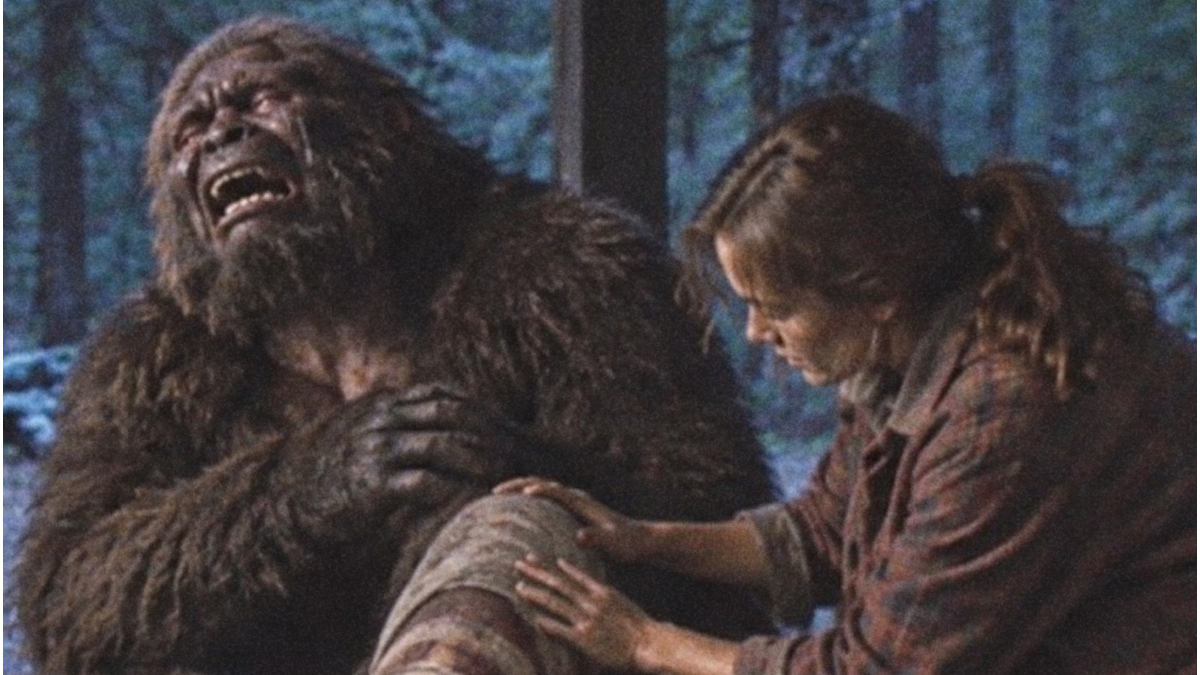
A Sasquatch Carried Its Injured Mate to My Cabin – Then I Discovered What Had Hurt Her
The thing that woke me was not a sound I could name.
It was weight.
A pressure on the porch boards outside my front door that registered in my sleep the way a grizzly in the yard registers.
Not as a specific noise, but as a change in the air, a shift in the fundamental quiet of a place that is never truly silent at 3 in the morning.

I had been living alone on Potato Creek for 11 years by then, and I knew every sound that cabin made, every creek of the log walls as they contracted in the cold, every rattle of the stove pipe in a wind change.
What I heard on the night of September 14th, 2011 was not any of those things.
The porch boards were old spruce, 2 in thick, and they groaned like they were thinking about giving up.
If this is the kind of story you have been waiting for, subscribe now and hit the bell so you do not miss what comes next.
Every account on this channel is told by the people.
I sat up in my bunk with my hand already on the rifle I keep leaning against the bed frame.
My fingers found the stock in the dark the way they always have without having to think about it.
I sat there for 10 seconds, maybe 15, listening.
Whatever was on that porch was not moving.
It was simply standing there.
And then under the sound of the boards, under that weight, I heard something else.
A low, repetitive sound that I can only describe as a breath repeated too many times in a row.
Rhythmic and urgent, almost like someone counts to manage pain.
It came from the porch and it also came from something lower, closer to the ground.
And after another few seconds, I understood that there were two things out there.
One standing, one on the boards.
If you are the kind of person who has never lived alone in a truly remote place, you may not understand what I mean when I say that fear and curiosity arrive at the same moment in a situation like that, and they are equal in their urgency, and which one wins determines everything.
I have been charged by grizzlies twice.
I have had a black bear destroy my wall tent on a guiding trip and come back two nights running for the remainder of my dry goods.
I once spent a night in a snowstorm on the Icha Plateau in October with nothing but what I was carrying when the weather moved in, which was not enough.
I know fear in the specific and practical sense.
And I know that the opposite of fear in the wilderness is not bravery.
It is just information.
You do not have enough yet, so you get more.
I pulled on my wool socks and my overshirt and I picked up the rifle and I walked to the front door.
I did not turn on a light.
I stood at the door for a count of 30 and listened.
The boards held their weight.
The rhythmic breathing continued coming from lower down.
And now that I was at the door, I could also smell what was on the other side of it.
And that smell is what my hands remember more than anything else.
Musky and deep animal and warm, like the inside of a den in late spring.
A concentrated earthiness that was not rot and was not filth, but was alive in a manner I cannot adequately describe without sounding foolish.
It was the smell of something big that had been moving hard through cold timber.
I opened the door.
Before I tell you what I saw, I want to be honest about something.
I am 63 years old.
I was 44 the night this happened.
I have spent the better part of my adult life in the back country of the Chill Cotton.
First as a wrangler for an outfitter out of Anaheim Lake, then running my own guiding operation for 17 years, hunting, fishing, leading horseback trips into the Icha Ilgate’s range and into the western slopes of Tweedsmir.
I have seen things in this country that do not make it into the brochures.
I know what lives in these mountains.
I know how it moves and what it sounds like and what it leaves behind.
So when I tell you what I saw when I opened that door, I am not telling you a story I embellished over the years until it grew into something dramatic.
I am telling you exactly what was there.
There were two of them.
If you want to keep listening, and I hope you do, because what happened over the next 3 weeks rearranged the furniture in my understanding of this country and of myself.
Please stay with me.
This is the account of something that has never left me and something I have never told anyone in full until now.
My name is Connie Ward.
I have lived in the Chilcottton country of British Columbia for 38 years.
I came here from Cam Loops in the summer of 1985, 25 years old with a wrangler certificate and a job offer from a man named Dale Cooper who ran horse trips out of the Anaheim Lake area.
I had grown up riding in the Thompson Nicola, but nothing in the dry interior ranching country where I came from prepared me for what the Chill Coine is.
The plateau itself is something you have to experience to understand.
It sits at roughly 1,000 m elevation and runs west from the Fraser River for about 350 km until it breaks into the coast mountains above Bellacula.
And inside that distance, the country transitions from open grassland and lodgepole pine through dense boreal forest to subopine meadow and finally to peaks that hold snow in August.
It is large in the way that makes other large places feel manageable by comparison.
The chill cotton does not feel manageable.
It feels indifferent, not hostile.
Indifferent, which is different, and in some ways harder to carry.
I rode for Dale Cooper for six years and then went out on my own in 1991 guiding hunters primarily with some fishing clients in the summer for variety.
I built my operation slowly.
I had a string of 12 horses at peak, a spike camp at about 1,700 meters up on the plateau and a base camp on Potato Creek that over the years became less a camp and more a permanent residence.
By the early 2000s, I was spending 10 months a year there.
I had a satellite phone and later a satellite internet connection that worked well enough to send emails and I drove into Williams Lake roughly once a month for supplies.
That drive is about 3 hours on Highway 20 if the weather cooperates, which in the Chill Cotton it often does not.
I never married.
I came close once in 1994 with a man named Glenn Harris who guided out of Alexis Creek and who was the right person in most ways except that he wanted to eventually leave the country and I understood by then that I was not going to leave.
We parted without damage.
I kept in touch with his family for years after.
Beyond Glenn, there was no one serious.
The Chilcotine is an effective filter for that kind of thing.
My cabin on Potato Creek sits about 32 km off Highway 20 on a dirt road that is one of those roads the province grades twice a year if you are lucky and not at all if you are not.
The creek is a tributary of the Chillcottton River and my cabin is roughly 800 m from the bank set back into a stand of mature spruce and lodgepole pine that shelters it from the weather coming off the plateau.
I built it in two stages.
The original one room structure went up in 93 with help from a Tillcottton man named Henry Lasiss who had been logging in the area and knew every tree worth cutting on that drainage.
Henry and I worked together for six seasons before he moved his family to Williams Lake and I still consider him one of the most capable people I have known.
The second stage, a lean to edition with a proper mud room and a cold room for meat went on in 2002.
By the time of what I am describing, the cabin was solid enough that it had weathered three of the worst winters the plateau had seen in recent memory and come through without a leak or a shift in the foundation.
I keep the cabin well-maintained because I live in it alone and because there is no one to call.
The nearest neighbor in any direction is a cattle operation on the upper Chilcottton River about 22 kilometers by road.
And the Palmers who run it are good people, but they are not close by anyone’s definition of the word.
When something breaks, I fix it.
When I am hurt, I assess the damage and decide whether it is a drive to Williams Lake problem or a handle it here problem.
I have stitched my own lacerations twice.
I set my own broken finger after a horse rolled on my hand in 2006.
I am not telling you this to make myself sound exceptional.
I am telling you because the skills I had from three decades of that kind of self-reliance are the only reason I was able to do what I did on the nights that followed the one I am describing.
I also need to tell you about the years before September of 2011 because the night I opened that door was not the beginning.
It was the culmination of something that had been building for the better part of 3 years.
The first thing I found was tracks.
The summer of 2008, I was riding a circuit of my trap lines.
I have a registered trap line in the Chilcotine held since 1994, one of the last independent operations not absorbed into larger territory holdings.
Checking the lines before my fall guiding season opened.
I rode up a game trail that parallels Potato Creek for about 6 km before it climbs toward the plateau, a trail I had ridden hundreds of times.
At a place where the trail crossed a muddy seep fed by a subsurface spring about 4 km up from the cabin, I saw a prince in the mud that stopped me.
My horse, a grey mare named Ditch, who had been in this country longer than most of my clients had been hunting, stopped before I asked her to.
She stood there with her ears cocked forward and her nostrils flaring, and she did not want to go closer.
That was the first thing I noticed, actually.
Ditch’s reluctance.
She was not a horse that spooked easy.
She had stood quiet while a bull moose came through camp at 30 meters.
And while a grizzly bluff charged us on the plateau above Timberline, she looked at those prints and planted her feet.
I got off and led her around wide of the seep and tied her to a spruce and went back alone to look.
Two prints side by side pressed into the mud where something had been standing.
They were shaped like a human foot, heel, arch, ball, five toes.
But the scale was entirely wrong.
The longest one measured 51 cm from heel to the tip of the longest toe.
I know that because I pulled the measuring tape from my vest pocket and laid it alongside.
And I checked the measurement twice because I did not believe what I was seeing the first time.
The width at the ball of the foot was 22 cm.
The depth of the impression in mud that I could press three fingers into without hitting resistance was 4 cm at the heel, and something that sinks 4 cm into that mud is not a light animal.
I had measured grizzly tracks in softer ground that did not go that deep.
The stride from one print to the other, measuring heel to heel of the two adjacent prints was just over a meter and a half.
I stood there in the September light with the tape measure in my hand and I went through what I knew.
There are no human feet that size.
There are no bears that walk by pedily with a stride that close together.
When a bear walks on two legs, it rocks its hips and produces a wider track placement.
I had found moose tracks here before, and moose tracks are cloven and elongated.
Nothing could mistake them for a human foot.
Whatever had stood at this seep had stood.
The way a person stands, weight distributed evenly, toes forward, and it was very large.
I did not tell anyone.
There was no one in particular to tell.
I went home, wrote it in the notebook I keep for field observations.
I have kept that habit since my first year guiding a daily log of conditions, animal sign, weather, and I kept riding the country looking for more.
I found more, not immediately.
September and October of 2008 pass without additional sign.
And I put the tracks at the seep into the category of unresolved puzzles and left them there.
But in the spring of 2009, when the snow was melting off the lower elevations and the game trails were soft again, I found two more sets of prints.
One in a sandy bank along the creek itself roughly two kilometers below my cabin where the bank undercut a root system and created a kind of overhang.
The prints there were smaller the same shape but the longest measured 43 cm and the depth was proportionately less a second individual lighter or younger or both.
The spring and summer of 2009 were active.
I found disturbed ground at a kill site.
A moose calf partially consumed.
The carcass handled in a way I could not account for.
The bones were not cracked the way a bear cracks them, driving the skull into the ground to get at the brain.
They were separated at the joints cleanly, as if someone who understood the structure of the animal had worked deliberately through it.
Several of the long bones were wedged into the base of a spruce tree nearby, stacked rather than scattered, which is not a scavenging pattern I had seen in this country from any species I knew.
That gave me a headache I sat with for a long time.
In June of 2009, I found what I still consider the most significant piece of evidence from those years before the night at the cabin.
I was on a 5-day horseback trip with two clients from Alberta, a father and son after mule deer, and we were camped in the open timber at the base of the Itcher Range.
The second morning I rode out ahead of my clients to glass a basin.
I knew held dear in early summer, and I took a route through a section of old spruce, the kind of timber that does not get much direct light and holds its moisture, that I had not ridden in perhaps 2 years.
About 3 km from camp, in a small clearing where a blowown had opened the canopy maybe a decade before, I found a structure.
It was not a debris pile.
It was not a random accumulation of fallen wood.
It was a constructed thing.
Six spruce trees, each roughly 10 cm in diameter, had been pushed over or broken off at about 2 m height and bent toward a central point, their tops leaning together like the frame of a tepee that someone had abandoned before adding the cover.
The bases of these trees were not cut.
They had been pushed, which is apparent because the wood at the break is twisted and splintered the way green wood tears when you apply lateral force rather than cut clean the way an axe or saw cuts.
At the center of the structure, the ground had been cleared of debris and was packed flat the way ground gets packed when weight sits on it repeatedly.
Wedged between two of the angled trees at about chest height if I were standing inside the structure were several large flat pieces of inner bark from a dead spruce nearby not blown there placed there tucked between the poles so they stayed flat against the interior.
I sat on my horse for a long time looking at that.
Then I made a decision that I secondgued for weeks afterward.
I did not take my clients anywhere near that clearing.
I changed my route, told them the basin I had been heading for was showing less sign than I expected, and took them 3 km south to a second drainage I knew equally well.
We got one of them a very good buck 2 days later, and they were happy.
And I never mentioned what I had found in that old spruce stand.
Some things you find in this country you protect.
By the summer of 2010, I had 23 log entries describing sign that I was running out of conventional explanations for tracks.
Six separate occasions.
The structure in the spruce stand, which I revisited twice and found slightly altered both times.
The bark pieces rearranged, new material added.
A section of dead fall on the creek trail that had been moved, a log I could not have moved myself, probably 300 kg, shifted off the trail and laid parallel to the bank.
Repeated episodes of my horse corral being inspected in the night, not disturbed or broken, but inspected.
The rails sniffed in the ground around the post printed with tracks much larger than a deer hoof and sounds in the evening from the timber across the creek that were not owls and were not coyotes and were not any species with a documented range in the chilcotten.
A low extended call that dropped in frequency as it faded like a voice running out of breath and once from farther away up on the plateau an answering call.
By the fall of 2010, I had stopped rationalizing.
I did not need a name for what was in this country that siloten have a name for it.
And the people who have lived in this territory for thousands of years are not in the habit of inventing stories about things that do not exist.
I had heard those stories carefully and without much comment from the people telling them at community events in Alexis Creek over the years.
I was a guest in that conversation and I listened accordingly.
But by the fall of 2010, what I was holding in my field notebook had moved from hearsay to documentation.
I want to be precise about something because precision matters when you are describing what I am describing.
I was not afraid of what was in the timber around my cabin.
By the second year of finding sign, I had developed something that might be called a working relationship with an absence.
I knew roughly where to look.
I knew the trails most likely to show prints.
I knew that whatever was producing this sign, there were at least two of them, the larger set of tracks and the smaller, and that they operated in a territory that overlapped significantly with my own.
They knew I was there.
I knew they were there.
And for two full years, that was all there was to it.
What changed was September 14th, 2011 at 3:15 in the morning when I opened my front door and they stopped being an absence.
The one standing on my porch was the larger of the two.
I understood that immediately, not because I had a scale to compare against, but because the size of it in the narrow cone of light from my headlamp was simply outside anything that my nervous system had a prior category for.
It was upright, fully bipedal, standing maybe a meter and a half from my door, and it was tall enough that I did not need to look up at a sharp angle to find its face.
But I was looking up.
My own height is 5’9.
Whatever was standing on my porch had a shoulder height of perhaps 5 1/2 ft and a full standing height that I estimated later, measuring against the door frame at between 7 and 8 ft.
His body was broad through the chest.
It made the porch feel like a smaller space than I had always experienced it.
The hair covering it was dark and not black, but a deep chestnut that in the lamp light looked almost sable.
And it was dense and long through the shoulders and chest, shorter and closer on the face, which was the feature I fixed on because a face is what you look for when you are trying to understand what you are dealing with.
The face was not a bare face.
It was not a face I could map onto anything I had seen alive or in any photograph.
The brow was heavy, overhanging eyes that were set deeper than human eyes are set.
And those eyes caught the beam of my headlamp and reflected it back in a flat copper colored flash.
The way eyes reflect at night, but with a quality I associated with large mammals in torch light.
The nose was broad and flat.
The jaw was heavy.
But what I remember most, what I have remembered most in the years since is the expression.
There was one an expression I read after a moment’s uncertainty as the look a person gets when they are out of options and they know it.
It did not reach for me.
It did not make a sound at first.
It simply stood there and let me look at it and it looked back and then it shifted its weight and turned its body slightly, angling toward the thing on the porch boards at its feet.
The one on the ground was the smaller of the two.
Smaller is relative and my first estimate was that it was still close to six feet in length when extended but it was not extended.
It was curled on its side and that curl was not the natural position of a sleeping animal.
It was the posture of an animal in pain.
The body was drawn in on itself.
The upper body hunched and the lower legs extended outward at an angle that looked wrong even in the first second.
And as the lamp swept down toward it, I saw the reason.
On its left lower leg, below what would be a knee in a human, and above the ankle, there was something clamped in place that did not belong to the body, a trap.
My stomach moved in a way I do not have good language for.
A steel leg hole trap is not a subtle device.
The one on the leg of the animal on my porch had a jaw spread of roughly 22 cm, which puts it in the range of a number four or number four and a half coil spring.
The kind of trap legally used in British Columbia for beaver and otter with specific restrictions, but also commonly used illegally for larger predators by trappers working far enough from any oversight to feel comfortable about it.
This was a coilspring model, not a conno bear, and his steel jaws were closed on the lower leg of the female.
And I understood within a few seconds that this was the female, the smaller track, the one I had been reading in the mud and sand for 3 years, below what would be her mid calf.
The leg between the jaws and the ground was swollen.
And even in the September cold, swelling, that visible means it had been there long enough to become a problem.
The male, I’m going to use that word because it is the closest approximation, though I want to be clear that I am not applying a classification to what these beings are.
The male looked at me.
I looked at him and then I looked at her and then I looked back at him and I said out loud to an 8-foot being on my porch in the middle of the night, “I’m going to help her.
Give me a minute.”
I do not know why I said it.
I do not know if he understood any of it, but he stood back.
He stepped to the side of the porch toward the rail and he stood there and he watched, and that was all the answer I needed.
I went inside and I lit the propane lantern and carried it to the door and set it on the porch boards a few feet from her.
And I went back inside and got the first aid kit from the cabinet above the washing basin and the set of tools I keep hanging by the cold room door.
Specifically, I needed two things.
A pry bar and a pair of vice grips.
Every trapper in this country knows how to open a trap that is closed on something it was not supposed to close on.
You have to compress the springs, which in a heavyduty coil spring model requires both springs compressed at the same time, and then hold them compressed while the jaws open and the leg comes free.
With a small trap and a calm animal, one person can manage it.
With a number four and an animal the size of the one on my porch, I was going to have to be methodical.
She had not moved much since I came outside.
The male had not moved from his position at the porch rail.
I crouched beside her, the lantern to my left, and I got my first clear look at the injury.
The trap had been on the leg for at least 2 days, possibly longer.
The tissue around the jaws was deeply bruised.
The skin on both sides of the jaw contact points was araided and weeping slightly.
And the distal leg below the trap between the jaws and the foot was swollen to roughly 1 and 1/2 times what I estimated the normal diameter should have been.
The foot itself was cold to the touch, which I did not like.
A cold extremity distal to a constriction means the blood supply is compromised.
I put my hand gently on her lower leg below the trap.
Her response was immediate and violent.
Not a strike, not an attempt to bite or claw, but a full body flinch that rattled the porch boards and brought the mail off the rail and onto the boards in one step.
He made a sound low and carrying directed at me, and it landed in my chest before it reached my ears.
I froze.
I kept my hands still.
I looked at her and then at him and I said still out loud because talking was the only tool I had.
I know I have to touch it to get it off.
I know it hurts.
She made a sound back to him.
It was quieter than his had been shorter and he stopped moving.
I do not know what the exchange was.
I only know that after it he returned to the rail and she put her head back down on the porch boards and I kept working.
Getting a loaded coil spring trap off a leg that is swollen around it is a miserable piece of work under the best circumstances and these were not the best circumstances.
I needed to fit the jaws of the vice grips around each spring plate and compress them enough to release the tension.
Then used the pry bar on the jaws themselves to hold them open while the leg came out.
The problem was access.
Her leg was folded slightly under her body and I needed it extended and every time I tried to straighten it gently, she tensed which compressed the swollen tissue further against the trap and made things worse.
I’m going to skip ahead in time slightly here to say that the process took 40 minutes.
40 minutes of careful, slow, careful again work in lantern light on a spruce porch with a being I had never seen before lying in front of me and a being the size of a small truck standing 5 ft away watching every move I made.
I will come back to what happened in those 40 minutes in more detail because several things happened that I need to describe.
But I want you to know before I do that the trap came off.
That is the first fact.
The leg was not broken.
That is the second.
She could bear weight on it after a fashion by the time the sun came up that morning.
Those are the three facts that held everything together for what came after.
The first thing I needed to do before the trap and before anything else was get the lantern positioned correctly.
The porch gets very little ambient light at 3:00 in the morning in September.
The nearest artificial light of any kind is a long way from my cabin, and the moon that night was a thin crescent that had already set.
I had the propane lantern, and I had my headlamp, and I had the hand torch I keep in the mudroom, and I arranged them so that I had working light on the leg without blinding her with direct beam.
She watched me move the lights with those deep set eyes that caught the lantern flame and held it.
Her eyes were brown, very dark brown, almost as dark as the pupils surrounding them, so that the iris was visible only when the light hit them straight on.
They were larger than human eyes set wider apart under that heavy brow.
And when they were open and tracking me, they moved with a precision and a focus that told me with more certainty than the tracks or the structure in the spruce stand or any other evidence I had accumulated that I was working on an animal that understood what I was doing.
Not just responding to stimuli, understanding, following the sequence of actions with the same focused attention that you see in a person watching a procedure being performed, tracking the logic of each step.
I tried twice to straighten the leg and was met with the full body flinch both times.
On the third try, I changed my approach.
I put my left hand flat on her upper leg above the trap and held it there without pressure for about 30 seconds before applying any.
When I finally did apply slight downward pressure, not to move the leg just to make contact, she tensed but did not flinch.
I waited.
The tension went out of her.
I applied a little more pressure.
She let me.
We worked backward from there.
By the time I had her leg extended enough to get access to both springs, we had been in contact for about 12 minutes, and she had stopped watching me and closed her eyes, which I chose to read as a very cautious form of trust.
The male had not moved from the rail.
He was watching the leg, watching my hands, watching my face.
At one point, he made a sound softer than the warning he had issued, sustained at a single pitch.
And she answered him.
It happened several times during the procedure.
I came to understand it by the end of that 40 minutes as check-in and confirmation.
He was asking and she was answering.
And what she was answering seemed to be something along the lines of still here, still managing.
Getting the first spring compressed required both hands and the vice grips locked in position.
I had done this before.
When you trap in the chilcatine, you occasionally find your trap closed on something that does not need to be in it.
And you learn the procedure, but never on a trap that had been closed long enough to have the springs resist from rust and cold.
The first spring took three attempts before the vice grip seated properly, and I could apply enough torque to compress it.
When it seated and the spring gave, she went completely rigid for about 3 seconds.
Every muscle in her body locked and then she breathed out in a long shuddering release.
I held the compressed spring and waited for the rigidity to pass before going for the second one.
The second spring was worse because my hands were tired and the angle was worse, but also because the compression of the first spring had shifted.
The trap’s position on the leg and the jaw on the medial side was pressing harder against the swollen tissue.
I could see the tissue blanching around the jaw edge, going pale and then dark in cycles as the pressure varied.
I worked as fast as I responsibly could.
The male made a sharp vocalization when the second spring resisted, and I had to reposition my grip.
I looked up at him and said, “Almost.”
And I do not know what he made of that, but he went quiet.
When both springs were compressed and the jaws were free to move, I wedged the pry bar between the upper jaw and the leg and levered slowly, not quickly, never quickly, because a quick movement jolts and a jolted jaw can close again before you get the limb clear.
The jaw came up, her leg dropped free of the lower jaw.
I held everything in place with the pry bar while I used my other hand to move her foot clear of the trap.
Then I released the pry bar and the trap snapped shut on empty air with a crack that made the male step forward two paces and me flinch back one.
She moved not away from me.
She did not pull back.
She extended the freed leg slowly, a careful exploration, and held it out at an angle and looked at it.
I looked at it too.
The tissue damage was significant but not catastrophic.
The skin was araided in two parallel strips where the jaw edges had rested and both strips had been weeping as serum and blood mixture that had dried and then reopened with the movement.
So they were bleeding lightly now.
The swelling extended from about 8 cm above the trap contact points to the ankle and the lower leg and foot were still cooler than they should have been.
But the foot moved when she flexed it, which meant the tendons had not been severed, and there was no sound or feel of crepitus, no grinding of broken bone when I put my hand very carefully along the shaft of the lower leg.
I sat back on my heels on the porch boards, and I thought through what I had available.
Antibiotic ointment, which I keep in the first aid kit because infections in this country can move fast and the drive to town is long.
Gauze and cloth bandaging, clean water, ibuprofen that I obviously could not administer.
I had veterinary grade wounds spray, the kind you use on horses in the tac shed 20 m from the cabin, a broadspectctrum antimicrobial in an aerosol.
And I had a tube of veterinary grade drawing salve that I have used on horses for deep puncture wounds and deep bruising.
I also had iodine solution in a squeeze bottle.
I looked at her and then at him and I said, “I need to go to the shed.
I’m coming back.”
I stood slowly and walked across the yard to the tax shed and I did not run and I did not look back.
And when I came back to the porch with the wound spray and the drawing salve and a clean cloth and the iodine, they were both exactly where I had left them.
Cleaning the araided tissue took another 20 minutes.
She flinched from the iodine, which I expected, and I stopped and waited each time and went back to it.
I applied the wound spray, which she seemed indifferent to, and then the drawing salve in a thin layer over the worst of the bruised tissue.
And I wrapped the leg loosely with gauze, more to keep the salve in place than for structural support.
There was nothing I could do about the compromised circulation except wait and watch for signs of it returning.
I finished the last wrap just as the sky began going from black to dark blue in the east above the plateau.
And I sat back on the porch boards and I looked at both of them.
He was still at the rail.
She was still on the boards.
And for the first time since I had opened the door, all three of us were still.
I said, “You are welcome to stay.”
I do not know why I keep repeating things I said out loud during this account.
I suppose it is because the speaking of things felt important that night, even if the words themselves were not understood.
She needs to keep that leg still for a few days.
You’re both welcome to stay.”
He looked at me for a long time.
Then he stepped off the porch silently, which had no right to be possible for something his size, one foot finding the top step and the other the ground without a sound, and he went into the timber on the south side of the clearing.
Not far, maybe 30 meters.
I could hear him moving through the lower branches of the spruce for about a minute and then nothing.
She remained on the porch.
She put her head down on her folded arMs. And yes, the position of her upper body was analogous to a person resting their head on their arms, and I had to look away from it for a moment, and she did not appear to sleep, but she did become still in a posture that read as rest.
I went inside and put on the kettle and sat at the table and did not sleep and did not think particularly clearly for about an hour.
Then I got up and I wrote everything in the field notebook in as much detail as I could while it was all still exact in my mind.
I wrote until the light was good enough to see the yard clearly and then I went back to the porch.
She was still there.
The bandage was intact.
The lower leg was marginally warmer to the touch than it had been, which I took as encouraging.
I brought out a bowl of water, the enamel one I use for hand washing, and set it near her.
She looked at it and then at me, and then she drank from it in long, deliberate pulls.
I went back inside and cut up the two roast potatoes I had boiled the previous evening and had not eaten, and some leftover elk steak from two days before, and I carried the plate out.
I had no idea what they ate in the way of plant material, but I knew from the moose calf kill in 2009 that they ate meat.
She took the elk off the plate first in two pieces and then the potatoes.
She did not take food from my hand.
She waited until I set the plate down and stepped back and then she ate.
The morning of the 15th was clear and cold.
The kind of September morning the Chill Coaten does reliably.
Hard blue sky, frost on the porch rails, the aspens along the creek already going yellow at the tops.
I had not slept.
I was operating on adrenaline and the particular heightened clarity that comes from a night of sustained attention.
The same clarity I remembered from the long watches during difficult guidings when the weather was bad and the horses needed checking every few hours.
She was still on the porch when the light came up enough to see clearly.
She had shifted position during the night.
She was sitting now, upper body upright, the injured leg extended in front of her, and she was watching the treeine across the creek with an alertness that suggested she had been awake the full night, too.
I brought out more water and the remainder of the previous day’s food, which was not much.
I was going to need to think about protein.
I had 3/4 of an elk in the cold room from a hunt two weeks prior, and whatever she and the male needed nutritionally, I was fairly confident that elk was going to be on the list.
I examined the leg in the morning light.
The bandage had stayed in place.
The lower leg was warmer than it had been at dawn, which told me the circulation was recovering slowly, but moving in the right direction.
The araided tissue showed no signs of infection, no heat or additional redness beyond the injury itself.
I changed the bandage, cleaning the wounds again with diluted iodine, applying more drawing salve, rewrapping with fresh gauze.
She sat through this the way she had sat through the initial treatment, tense but still with occasional pauses where I waited for her muscles to unlock before continuing.
By the time I was done, she was watching my hands with what I can only call interest.
The same focus tracking I had noticed the night before, but now without the pain response underneath it.
She was studying the process.
The male appeared at the treeine midm morning.
He had not gone far.
I could hear him periodically throughout the night.
A sound like large branches displaced and then settling, but never a crashing movement.
Never a sound that felt aggressive.
He appeared at the edge of the spruce stand and stood there and she made a vocalization toward him short and modulated and he came forward not to the porch.
He stopped about 10 m from the bottom porch step and stood there for a minute looking at her leg and then he looked at me and then he went back to the treeine.
That pattern held for the first two days.
He stayed close but did not approach the cabin.
She remained on or immediately near the porch.
She would occasionally test the leg, stand, take a few steps, stop, and the limp was severe, but she was weightbearing, which was the important thing.
A bone fracture under the jaws of a number four trap would have prevented weightbearing entirely.
The tendon and soft tissue damage was significant, but the body has a way with soft tissue if you give it time and keep the infection out.
On the third day, she moved off the porch, not far.
She settled on the ground to the right of the porch steps, where a flat route from the large spruce beside the cabin created a natural seat, and she sat there in the sun for most of the day.
I brought water and food out to that spot without comment.
The male came forward that afternoon to within about 5 m of her position.
He sat down.
I watched them through the kitchen window without making it obvious that I was watching.
And they stayed that way for perhaps two hours, occasionally vocalizing to each other in those low modulated exchanges that I had stopped trying to decode and started simply noting the rhythm of how often, how long, what seemed to prompt a response.
It had the quality of conversation, not in the linguistic sense I could pin down, but in the back and forth temporal structure that conversation has.
On the third evening, I did something I had not done in two nights.
I built a fire in the yard.
I have a stone fire ring about 8 meters from the porch, the kind of thing you build in the chill cotton because fire in the yard on a clear evening is one of the better ways to spend an hour.
I built it with dry spruce and some of the birch I keep split and stacked in the woodshed.
And I fed it slowly until it was a good steady fire.
And I sat in my camp chair beside it with a mug of tea and my field notebook.
And I worked on my notes.
He came out of the trees before the light was fully gone.
He did not come to the fire.
He came to a spot about 15 m away.
And he sat down, sat properly, wait on his hunches, and he looked at the fire.
I looked at him.
He was in better light than he had been on the porch that first night.
And I used the chance to look carefully at the things I had not been able to see clearly when I was working on her leg in lantern light.
The face again was the feature that occupied me most.
The brow was heavy and it shadowed the eyes and the eyes were set deep under it.
And the effect was that you were always looking for the eyes, leaning slightly to find them.
The way you lean to see something in a shadow.
When you found them, when the light hit them at the right angle, they were amber.
Dark.
Amber, the color of spruce sap dried to a translucent shell on the outside of a wound in the bark.
They caught the fire light and held it.
He sat by that fire for an hour.
He did not move much.
He occasionally looked at me and then looked back at the fire.
And once he looked towards where she was resting near the porch, and once he looked up at the sky, the way you do when you are checking for weather.
I am cautious about projecting.
But that is what it looked like.
I sat in my camp chair and I did not speak and I did not move except to add wood to the fire.
And when I added wood, he watched me do it.
On the fourth morning, I went back to the trap.
I had left it on the porch where it had come off her leg.
It was a standard coil spring leg hold, as I said, number four, and it was in reasonable condition, not old enough to be rusted through, not new enough to still have retail markings.
The chain was attached at the swivel and about 30 cm long with a drag hook at the end rather than a staked set.
A drag hook is used on larger animals specifically so the animal cannot anchor itself and pull against a stationary point.
It drags the trap along with it which tires the animal out and reduces the tissue damage from fighting a fixed stake.
It also means the animal can move.
She had moved she had moved far enough to reach my cabin which implied that she or the male or both of them had covered significant distance with that trap attached to her leg.
The trap had no identifying marks that would tie it definitively to a registered trap line.
Registered trap lines in BC have a specific number system and licensed trappers are required to mark their traps under provincial regulations.
This trap had no numbers, no license tag, nothing but a manufacturing mark on the spring plate that I recognize as a standard commercially available model sold by agricultural and hunting supply stores across the province.
It had been set without the legally required identification, which could mean several things.
It was set by someone who did not have a registered trap line in this area, or it was set by someone who had a trap line but was running sets in areas outside their registered territory, or it was set by someone who did not want it traced back to them if something inconvenient ended up in it.
There are registered trap lines in the country around Potato Creek.
Two actually that are joined my own territory on the east and north sides.
The eastern one is held by a man named Roy Sadler who has been running it since the late 90s and who I have had nothing but straightforward dealings with.
The northern one had changed hands twice in the previous 5 years, most recently to a man I had met exactly once at a meeting of the Chillcottton Trappers Association in Williams Lake in 2010.
His name was Barrett Phillips and he had bought the territory from the estate of the previous holder, a man who had retired to the coast and then died.
Phillips was from somewhere in the interior, merit maybe, and he struck me as the kind of person who had acquired a trap line as a business asset rather than a livelihood.
He knew the regulations well enough to discuss them at the meeting, but he talked about the territory and numbers, harvest quotas, fur prices, operational costs rather than in the way people talk about country they have spent time in the trap’s drag hook rather than a stake told me something.
Legal beaver and otter sets in BC are typically staked or submerged in a way designed to drown the animal quickly, minimizing what the regulations call injury time.
A drag set on dry land is a different tool with a different purpose.
And the location where she had been caught, wherever that was, was not a beaver pond.
There was no water on her when she arrived at my porch.
Whatever she had walked through or been dragged through before the male carried her was dry ground.
I put the trap in the cold room.
I thought about it for the rest of the day.
What was growing in the yard around my cabin during those first days was something I did not have a word for at the time and am not certain I have one for now.
The three of us had established without discussion and without anything I could call explicit agreement a kind of daily pattern.
She rested near the cabin.
He ranged in the timber, but was present most of the time, visible or audible.
I went about the tasks of the day in the splitting wood, checking the generator, doing the maintenance work that a cabin like mine always requires, and did not make any more direct approach to either of them than they invited.
When she wanted water or food, she did something with her posture that I learned to read as attentiveness toward the cabin, a subtle forward orientation, and I brought things out.
The male came to the fire each of the first three evenings, and sat at his distance, and watched it, and I sat at mine, and did not push.
On the fifth day, she walked to the creek on her own.
I watched from the kitchen window.
The limp was severe, but she was using the leg.
She went to the bank and drank, and she stood in the shallows for perhaps 10 minutes.
Cold water is good for the kind of swelling she was managing.
And then she came back.
That evening the male brought her something.
He came out of the timber with it in one hand, and I was close enough to the porch to see what it was before he set it down near where she was sitting.
It was a section of bark, not spruce bark, which is what the trees around my cabin produce.
This was smooth inner bark, pale and fibrous, and it had been stripped from something in the deeper timber.
He set it near her, and she picked it up and stripped a section of the inner layer free and chewed it.
She did it with the matter-of-act efficiency of someone taking a medication they have taken many times before.
I stood on the porch and watched and then went inside and consulted the one book I owned that covered medicinal plants of BC.
A paperback I had picked up years ago out of curiosity.
Smooth bark, pale inner layer.
The most likely candidate based on what I could see at that distance was trembling aspen populace trimmides.
The inner bark of trembling aspen contains salicin which the body metabolizes to salicylic acid.
The same base compound as aspirin.
It is documented in traditional silk cotton and other First Nations medicinal practice as an analesic and anti-inflammatory.
He had gone into the timber and found her pain relief.
I stood in my kitchen holding that paperback and I felt something rearrange itself in my chest that had been sitting in a fixed position for years.
I had spent three years accumulating evidence that something intelligent was sharing this country with me.
The bark was not evidence.
The bark was a different kind of knowing.
By the end of the first week, she was walking without a pronounced limp on flat ground.
The araided tissue was healing cleanly.
I was changing the bandage daily, and the wound showed good granulation.
No sign of infection.
The swelling in the lower leg had reduced by roughly half.
She was eating well.
I was working through my elk at a rate that was going to require resupply sooner than I had planned.
But that was a logistics problem I could solve.
It was during the second week that I began to understand the scope of what had happened to her.
Not the injury itself, but the cause of it.
And the cause required me to make a decision I had not been prepared to make.
On the ninth day, I went looking for where she had been trapped.
I had thought about this for several days before I did it.
Finding the set would tell me who had put it there and where on the landscape illegal or unregistered trapping was happening.
If it was on my registered territory, I had a regulatory obligation.
If it was outside my territory, but on crown land, which most of the chill cotton is, I had a choice.
I could report to the BC Trapping Regulation Service, which would start a process I could not control and could not stop once it started, or I could address it myself.
I took ditch.
She had been turned out in the pasture paddic all week, watching the situation near the cabin with clear distrust from the far fence.
When I caught her that morning and saddled her, she was reluctant to leave the paddic and stayed reluctant for the first half kilometer, but she settled into her working mind by the time we reached the game trail along the creek.
I tracked backward from the cabin.
The male had left Prince in several places between the timber and the porch on the night of the 14th, and those prince told me a general direction.
He had come from the south side of the creek upstream from the higher ground above the creek drainage.
I followed the creek trail south and then took the cutoff that climbs to the plateau bench land and I worked slowly looking at the ground.
I found the first sign of her passage about 4 km from the cabin.
The drag mark was visible in a stretch of soft soil on the trail.
The chain leaving a line where it had scraped through the surface vegetation.
It was intermittent.
She had been lifting the leg or the terrain had changed, but it was there.
I followed it off the main trail into the spruce stand on the west side of the bench.
The set was in a game trail that ran through the timber about half a kilometer off the main trail in a place where a natural funnel between two deadfalls narrowed the walking route to about 3 m wide.
It was the kind of set location you choose when you want to maximize the chance of an animal stepping in a specific spot.
The set had been staked, not a drag hook.
The one she was wearing when she came to my porch was a different trap, which told me this was a second trap from a series.
Whoever had set this had run multiple traps through the area.
The stake was still in the ground.
The chain from the stake trap extending to a loop of cable that had been cut cut, not broken.
The ends were clean.
Which told me that when she stepped into this trap, the male had freed her from the stake before the two of them made for the cabin.
He had cut the cable with something, and looking at the cut end, it had been done with a stone tool.
The cut was ragged and slightly crushed at the edges, the way stone cutting works.
He had cut her free.
He had then carried her, or helped her travel through four kilometers of timber, with one trap still attached, and a second trap’s worth of injury already on the leg.
I sat on ditch and I looked at that stake set and I thought about what an animal did with a problem like that.
You have a mate who is caught.
You have two traps, not one.
You get one of them off the chain by cutting the cable because cutting the cable is within your capacity.
The other one you cannot open on your own.
The coil spring design requires simultaneous compression of both springs, which requires two-handed tool work of a specific kind.
So you carry her toward the thing in the landscape that might be able to do what you cannot.
My cabin.
I had been in this country for 11 years.
They had been watching me for at least three.
And on the night of September 14, he had decided for whatever reason and through whatever process of decision-making that I was the closest thing in his landscape to a solution.
I rode another 2 km through the timber and found three more sets.
All of them on game trails, all without identification marks, all using the same commercially available coil spring model.
One had a Martin in it, dead.
The animal had been caught for long enough that it had succumbed.
I removed that trap in the animal and kept moving.
I found no other animals in the remaining sets, which I pulled and piled near a distinctive double trunk spruce, planning to come back for them with the packor.
On the ride back, I went through what I knew about Barrett Phillips and his registered territory.
His territory boundary on the map put him about 8 kilometers north of where I was riding.
And the Chilcottton trapping regulation branch, which is part of the Ministry of Forest, Lands, and Natural Resource Operations, requires licensed trappers to trap only within their registered territory.
The game trails I had been finding sets on were within my registered territory, not his.
Running sets outside your registered territory is a regulatory violation that can cost you your license.
But reporting it meant a process, an investigation, ministry officers into the country, questions about what I had found and where, possibly questions about what else had been going on in the area.
I thought about those questions and what my honest answers would be.
And I thought about her on the porch that first night, and about the bark he had brought her, and about the fire on the third evening, and the amber eyes that held the flame.
By the time I rode back to the cabin, I had made my decision.
I was not going to report it, not to the trapping branch, not to anyone.
What I was going to do was pull every unregistered set from my territory, which I had the right to do under the provincial trapping regulations governing my own registered territory.
And then I was going to drive to Williams Lake.
She was in the yard when I unsaddled ditch and turned her out.
She stood when she heard the horse tracking the sound.
And when I walked past, she watched me with those dark eyes and then looked back toward the timber.
The male was at the treeine.
He had been there when I left that morning, and he was still there.
He watched me unsaddle the horse and carry the saddle to the tack shed and come back out.
I stopped at the porch steps and looked at him across the yard, and I said, “I found the traps.
I got them.
I’m going to deal with the person who set them.”
He did not respond in any way I could read as acknowledgement, but he did not look away, and I held the eye contact until I was the one who looked away first, which took longer than I expected.
I drove to Williams Lake 3 days later on the 12th day of their stay.
I had pulled all 11 sets I found in my territory.
They were in the bed of the truck under a tarp, and I drove the three-hour gravel and pavement road into town without particularly enjoying the drive.
Williams Lake is the hub of the Chilcottton, the place where the country comes to shop and see doctors and do the business that requires a town of a certain size.
I went to the hardware store and the grocery for my resupply.
I bought more elk roast than I normally would and did not think too hard about why.
And then I drove to a specific address on a secondary road east of town and I knocked on a door.
Barrett Phillips answered it.
He was in his early 50s, medium height, the kind of physical condition that comes from desk work with occasional outdoor excursions.
He looked at me and then at the truck in his driveway and then back at me.
I introduced myself and reminded him we had met at the Trappers Association meeting.
He remembered me or said he did.
I asked if I could come in for a few minutes.
I sat at his kitchen table.
He and I am aware of the irony given the instruction in the master prompt I was given.
But this is where the conversation happened.
And I told him that I had found a series of unmarked, unidentified traps inside my registered territory.
I laid four of them on the table between us.
I told him I could not confirm whose they were, but that the style and placement were consistent with recent activity in an area where I had not run sets in the previous two years.
I told him that one of those sets had injured an animal severely enough to require intervention and that I had removed all sets I found and would be taking the matter to the ministry if any further sets appeared in my territory.
I said all of this in the same tone I use when I am telling a client that the weather is going to force a route change.
Factual, not particularly warm.
He was quiet for a while.
Then he said he did not know anything about traps in my territory.
I looked at him for a moment and then I said that was good to hear and that I trusted we understood each other and I left.
I do not know what he believed or what he did after I drove away.
I know that no more unregistered sets appeared in my territory that fall or in any subsequent season.
She began walking longer distances on the 13th day, not just to the creek and back, but along the south side of the clearing into the lower edge of the spruce stand, picking her way through carefully and coming back.
The bandage was off by then.
The wounds had closed and I had stopped covering them, letting the air at the healing tissue.
She was still favoring the leg on rough or uneven ground, but on the flat of the yard, she moved almost normally.
On the 14th day, I watched her and the male move together through the clearing for the first time, side by side, and the difference in scale between them was something you absorb in your body rather than just your eyes.
He was easily a third again her height, the width of his shoulders twice hers, and yet the way they moved alongside each other had the same ease and familiarity as any two beings who have covered a lot of ground together.
It was during those middle days that the exchange of gifts began in earnest.
The bark he had brought for her analesic was the first.
After that, things appeared near the porch with a regularity that made clear they were intentional.
A piece of flint, sharpedged and clearly napped, worked, shaped, the flaking marks deliberate, left on the top porch step.
A bundle of dried plants tied with a strip of inner bark, which I identified as yarrow, historically used across multiple First Nations traditions for wound cleaning and as an antimicrobial application.
Three fish cleaned and laid on a piece of bark near the fire ring, the largest of bull trout of maybe 2 kg, the kind you find in the colder upper reaches of the chilcotten drainage.
He had been fishing the creek while she rested.
I left things in return, leftover food, obviously, but also other things.
A piece of canvas, heavy grade, folded and left near the spot where he sat by the fire.
I did not know if it was wanted or useful, but it was an offering.
A length of good parachute cord which I had in quantity.
I did not expect these things to be taken necessarily.
They were taken.
On the 17th day, something happened at the fire that I have not described to anyone in the 13 years since.
Not because I was keeping it secret, but because I did not have language for it that felt accurate.
I was sitting at the fire in the evening the way I had been doing.
He came out of the trees and sat at his distance.
She came and sat beside him, which was the first time she had come to the fire and the first time both of them had been added together.
They sat and I sat and the fire was between us.
At some point during that hour, he picked up a stick, a spruce stick roughly 2 cm in diameter and about 40 cm long that happened to be lying near where he was sitting.
He held it in one hand and looked at it for a moment and then he tapped it against the ground.
A single tap.
And then after a pause, two taps, he looked at me.
I had a stick in my hand from where I had been feeding the fire.
And I tapped it against the ground once.
He tapped twice.
I tapped twice.
He tapped three times.
I felt something go very quiet inside me.
The professional and methodical part of my brain going offline for a moment, replaced by something older.
I tapped three times.
He tapped four.
I tapped four.
We did this until he set the stick down.
He set it down deliberately, not dropped it.
And then he looked at the fire and did not pick it up again.
I do not know what it was.
I know what it felt like.
It felt like two people who do not share a language discovering that they share a number system and both of them understanding what that implies.
The night of the 20th day was different.
I woke at 2 in the morning to silence that was different in quality from the usual silence.
I lay in my bunk and listened and understood without being able to explain how that the yard was empty.
I lay there for about 10 minutes and then got up and looked out the kitchen window.
The yard was indeed empty.
The clearing was still the fire ring cold, the spruce stand dark and without motion.
I went back to bed.
In the morning, the yard was still empty, and it stayed empty.
And they did not come back that day or the next.
They were gone.
Whatever had drawn them here had been resolved, and the country had called them back, and they had gone.
I spent the next several days doing the kind of work you put off when other things take over.
Splitting wood, checking the pasture fence, servicing the generator.
I worked hard, and I did not let myself think too much about the yard or the fire ring or the porch boards where she had spent her first three nights.
That kind of thinking is not productive when you live alone in a remote place.
And I have learned over the years to channel it into physical work and then let it settle.
But something had settled differently than I expected.
Two weeks after they left, I found tracks again at the seep on the trail 4 km up.
The same place I had found the first tracks in 2008.
Two sets, the large and the smaller, pressed clearly into the September mud.
The larger set showed a normal gate, full pressure, confident.
The smaller set showed a gate with a slight asymmetry in the left print.
A faint extra depth at the heel, a reduced pushoff from the ball of the foot that told me the leg was still healing but functional.
They had come back through, not to the cabin, to the country.
They had come back to the country.
I crouched at those prints for a long time.
Then I got back on ditch and rode home.
The years since 2011 have been quieter than that fall, but they have not been empty.
Sign along the creek trail has been consistent, appearing in the soft ground each spring and again in fall when the mud returns.
The structure in the spruce stand, the one I found in 2009, has been modified several times over the years, expanded, additional material added.
All of it suggesting use rather than abandonment.
I have found three more sets of tracks on the plateau bench land, at least two of which show the asymmetric gate pattern that has become identifiable to me.
The leg that was in the trap walks differently than it did before, slightly but measurably.
Once in the fall of 2014, I was riding the Creek Trail at dusk and I looked up the slope to the east and I saw two figures standing in the open at the timber line about 300 m above me.
They were upright.
They were watching me ride.
I stopped and we looked at each other across that distance for long enough that the light changed the slope going from gold to gray.
Then I touched my heels to ditch and moved on down the trail.
And when I looked back a minute later, the slope was empty.
The trap is still in my cold room.
I have not thrown it out, and I do not know exactly why.
It sits on the shelf next to a jar of the drawing salve I used on her leg, which still has one application left in it, and a piece of the canvas I left by the fire ring that was returned to me set back on the porch one morning during the third week.
And I am not sure whether it was returned because they had no use for it or because they wanted me to have it back.
I have thought about that question occasionally over the past 13 years without arriving at a conclusion.
What I know is this.
Something in this country made a decision about me.
It made that decision over years of observation, years of watching me work this land and move through it and come back to my cabin at the end of each day.
And when the moment came that required an act of trust toward a human being, whatever decision had been reached was sufficient.
It carried its mate to my door.
It stood back while I worked.
It sat at my fire for 17 evenings, and it counted with me in the dark.
I did not report the trap to the ministry.
I did not report what happened in September of 2011 to anyone.
The field notebook is locked in my desk and this account which I am giving now for the first time is the complete and accurate record of what happened and I have told it as precisely as I know how.
The Chilcatine is a country that keeps its own council.
It has been doing that for a long time, longer than Highway 20 and the grazing permits and the registered trap lines and all the administrative mechanisms by which we organize our relationship to it.
There are things in this country that predate all of that that predate the people who came with the mechanisms and in some ways predate the people who were here before us.
I do not know what those things are in any scientific sense.
I know what they are in the sense of having watched them carry someone they loved through four kilometers of cold timber in the dark and set her down on the boards of a stranger’s porch because the stranger was the only option and the stranger had been watched long enough to trust.
That is enough for me at least in the years I have left in this country.
That is enough.
The aspens along the creek turned gold 3 weeks after they left in 2011.
I sat on the porch in the evenings and watched the color come on and thought about what had happened and what it meant.
And I came to the conclusion that it did not need to mean anything beyond what it was.
Two beings in trouble.
A person who happened to have the skills and the equipment to address that trouble.
An exchange of trust in both directions.
A period of fire and proximity and counting and bark medicine.
And then the country taking back what belongs to it as it always does, as it always will.
Some evenings when the light is right and the wind is off the plateau, I hear the sound I have been hearing since 2008.
The low extended call that drops in frequency as it fades.
Sometimes one, sometimes two.
I have stopped trying to determine exactly where it comes from.
It comes from the country.
That is enough to know.
I am 63 years old.
I have been in this country longer than most of the lodge pole pine that shades my cabin has been a tree.
I am going to be in it for as long as I am upright and the knees hold.
And after that I will leave it to whatever is here after me, including the things in this drainage that have never asked permission to be here and do not intend to start.
If you live in a remote place, a truly remote, not the edge of a suburb, but the kind of place where the nearest light you did not make yourself is a long way and a long road away.
You already understand something that I am not going to be able to adequately convey to someone who does not.
The country teaches you over years.
It teaches you what is true about the land and what is true about yourself.
And sometimes, if you have been paying attention long enough, it teaches you what is true about the things in the land that do not appear in any registry or any research paper or any public discussion of what exists in these mountains.
They are there.
They have always been there.
And sometimes when the stakes are high enough, they decide you are worth the risk of being seen.
I have been thinking in the years since about what it cost him to carry her to my door.
Not physically.
Physically, I imagine he was capable of carrying her twice as far without distress given the size of him.
I mean, what it cost in other terMs. The decision to enter human proximity, to step onto the boards of a building, to stand on a lit porch and allow himself to be looked at by a species that has never, to my knowledge, responded to his kind with anything other than fear or the desire to capture and study.
He had watched me for years.
He had concluded something on the basis of those years of watching.
And then he tested that conclusion under the worst possible circumstances with his mate in pain in the dark in the cold and a stranger at the door with a rifle in her hands.
He was right about me.
I want to say that plainly.
Whatever he decided in those years of observation, he was right.
I did not panic.
I did not reach for the satellite phone.
I set down the rifle and I got the tools and I worked the trap off her leg in 40 minutes in the cold dark and I spent the next 3 weeks feeding them elk and not asking for anything and not taking any photographs and not telling anyone.
He was right about me and I am glad he was.
And I have spent 13 years trying to be worthy of being right about.
The creek runs below the cabin all year in the hard winters.
It goes quiet under the ice, reduced to a murmur you can only hear if you press your ear to the frozen surface, but it keeps running.
The cold does not stop.
It only quiets it.
And in the spring, when the ice breaks, it comes up again, fullvoiced and strong.
I think about that sometimes in January when the cabin settles in the freeze and the country goes as silent as it gets.
And I think about what else is still out there in the cold timber and the bench land above.
Quiet but not stopped.
Still there.
Still carrying whatever they carry.
Still counting in whatever way they count the long years of this country and the things that live in it that we have not found adequate names for yet.
My name is Connie Ward.
I have lived on Potato Creek in the Chillcottton country of British Columbia for 38 years.
And this is the truest thing I have ever put into words.








