Teen Disappeared in Appalachia in 1988 – Years Later, a Ranger Found Him Living With Bigfoot
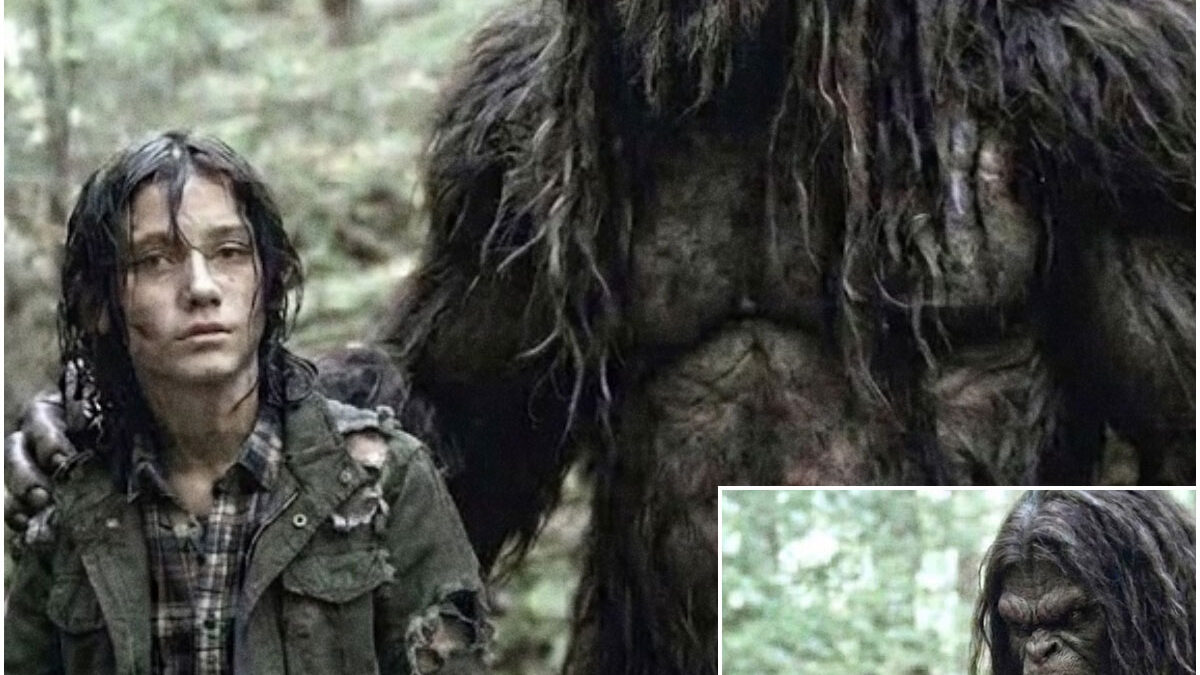
Teen Disappeared in Appalachia in 1988 – Years Later, a Ranger Found Him Living With Bigfoot
The boy they pulled from the Manonga Hala National Forest in October of 1991 had been missing for 3 years.
His name was Justin Hail.
He was 16 when we found him sitting on a fallen hemlock at Senica Creek with his feet in the water, naked except for a vest woven from bark and moss.
His hair hung in a matted rope to his shoulders.

He weighed maybe 95 lb on a frame built for 140.
When my partner Marcy approached with a blanket, he looked at her with eyes so calm she stopped walking and said later it was like approaching a wild animal that had decided you were not a threat.
He did not run.
He tilted his head in a gesture that looked oddly polite and waited to see what we would do.
I am telling you this because three decades have passed and Justin is 49 now and he asked me to tell it by handing me a photograph of himself at 13 standing beside his mother in Elkins, West Virginia.
The year before he vanished into those mountains and came back different.
Before we continue, comment below where in the world you are watching from and please click like and subscribe for more Bigfoot stories.
My name is Marcus Webb.
I am 68 years old.
I spent 32 years as a park ranger with the US Forest Service in the Manonga National Forest in Eastern West Virginia.
I have tracked lost hikers through blizzards, pulled bodies from rivers, talked down a man holding a knife to his own throat on a cliff edge above Spruce Knob.
I thought I had seen every version of human suffering these mountains could produce.
Justin Hail taught me I was wrong.
The search for Justin began September 14th, 1988.
He was 13, an 8th grader at Elkins Middle School, small for his age, quiet.
His mother, Karen, was a nurse.
His father, Tom, worked for the railroad.
They lived in a ranch house on the east side of Elkins with a yard backing onto timberland that bled into national forest about 2 mi in.
Justin had permission to play in those woods.
On that September afternoon, he told his mother he was going to look for arrowheads along the creek bed.
She told him to be home by dark.
He never came home.
The search mobilized within hours.
By midnight, we had 40 volunteers tracking dogs and a helicopter with thermal imaging.
The dogs picked up his scent and followed it northeast for 3 mi before losing it at a rocky outcrop where terrain turned vertical and canopy closed so thick the helicopter’s cameras were useless.
We searched 9 days and covered 50 square miles.
We found nothing.
After 2 weeks, the official search was called off.
The assumption was Justin had fallen, been injured, and died of exposure in some hidden hollow.
The case was classified as presumed fatality.
Karen Hail did not accept that.
She organized her own searches every weekend for 6 months, walking trails, calling her son’s name, leaving notes at trail heads.
I joined her on a dozen walks.
I was 35 then, newer to the ranger service, and I had not yet learned the hard boundary between professional duty and personal investment.
By spring 1989, even Karen had stopped searching.
She returned to her job.
Tom returned to the railroad.
Their marriage collapsed 6 months later.
Karen moved to Charleston.
Tom took a transfer to Maryland.
The house in Elkins sat empty until the bank foreclosed.
By 1991, Justin Hail was a name on a missing person’s database and a photograph on a bulletin board in the Ranger Station that I looked at every time I walked past it and felt the weight of failure.
Then October 9th, 1991, a hiker named Paul Granville called the Ranger Station from Durban.
He was 52, a retired engineer from Pittsburgh, credible and articulate.
He told the dispatcher he had been hiking along Senica Creek, 8 mi from the nearest trail head, when he saw a figure moving through trees on the opposite bank.
At first, he thought it was a bear standing upright.
But this figure walked with steady two-legged gate.
Through binoculars he saw it was imposing.
Over seven feet tall with broad shoulders and arms that hung past its knees covered in dark hair.
It was carrying something.
A smaller figure draped across its shoulders.
The smaller figure was pale, mostly hairless, appeared unconscious or asleep.
Paul watched maybe 30 seconds before the figures disappeared into Rodendron, so dense the canopy swallowed them.
He marked the location and hiked out immediately.
The dispatcher called me at home.
I met Paul at a diner where he spread his map and pointed to the spot, a section of Senica Creek drainage in one of the most remote parts of the foreSt. I asked him to describe the smaller figure again.
He said it looked human, juvenile, maybe 80 or 90 with matted dark hair and skin clearly not covered in fur.
I felt something cold settle into my cheSt. My supervisor denied my request to organize a search team.
He said Paul’s description sounded like a bear with a cub, and we did not have resources to chase Bigfoot sightings.
I went anyway.
I took Marcy Brennan, a 29-year-old wildlife biologist with more remote wilderness experience than anyone on staff.
We packed for 3 days and drove to the nearest access point, a logging road that deadended 5 miles from the area Paul marked.
We hiked in at dawn October 10th.
The forest in early October is at its peak.
Maples and birches turning hillsides gold and red.
We covered 3 mi in 2 hours following Senica Creek upstream through terrain that got progressively rougher.
By midday we were in old growth hemlock forest where canopy is so dense the ground is bare except for ferns and moss.
We found the first track at two afternoon pressed into mud along the creek bank a single bare footprint human in shape but 16 in long and six wide at the ball.
The toes were spled arched nearly flat depth suggesting weight far beyond any human.
Marci measured it and took photographs.
She said this was not a bear print.
We followed the creek another mile and found two more prints, both the same size.
Then we found something that stopped us cold.
A smaller print, maybe 9 in long, narrow with high arch and clearly defined toes.
A human footprint.
A child’s footprint.
The two sets were side by side, moving parallel to the creek.
We camped that night on a flat bench above the creek.
We did not build a fire.
We ate cold rations and listened.
The sounds at night in the Mononga hala are normal if you know them.
Owls, coyotes, the occasional bobcat scream.
But that night, we heard a low, resonant call that started uphill from our position and rolled through the trees like distant thunder.
It lasted maybe 5 seconds.
Marci grabbed my arm.
The call came again an hour later, closer, and with it a response from a different direction, higher pitched, shorter, two voices communicating across distance.
We sat in our tent with headlamps off and listened and did not sleep.
At dawn, we broke camp and continued upstream.
The terrain was punishing.
The creek bed turned into cascades and plunge pools that forced us to climb around on steep slopes covered in loose rock and slick moss.
By midm morning, we were debating whether to turn back when we saw him.
He was sitting on a fallen hemlock on the far side of the creek, maybe 50 yard ahead, his feet in the water, his hands in his lap.
He was small, painfully thin, covered in dirt and scratches, wearing nothing but that crude veSt. His hair was a dark, tangled mass.
He was looking directly at us, not in the startled way you look when surprised by strangers, but in the calm, evaluating way you look when you have been expecting someone.
Marcy and I stopped walking.
I raised my hand slowly and said his name.
Justin.
The boy tilted his head to the side.
He did not speak.
He did not move.
He watched us with an expression that was difficult to read.
Not fear, not curiosity.
Something between the two.
Marcy took a step forward and the boy stood up.
He was taller than I expected, maybe 5’2, but so emaciated that his ribs were visible, and his arms looked like they belonged to a much younger child.
He had scars, dozens of them, thin white lines across his chest and shoulders and face.
He turned his head slightly and made a sound, a short, sharp whistle, high-pitched and clear.
Then he looked back at us and waited.
I knew what was about to happen before it happened.
I felt it the way you feel a storm coming, a change in air pressure.
Something was moving through the forest behind him, something large enough that the ground vibrated with each footfall.
Marci grabbed my arm.
The figure that stepped out of the roadendron was over 7 ft tall.
It moved with a fluidity that should not have been possible for something that size.
Each step deliberate and soundless despite the weight.
It was covered in dark brown hair, not fur exactly, longer and coarser, matted in places, clean in others.
The face was broad and flat with a heavy brow ridge and deep set eyes that caught the morning light and reflected it back with unmistakable intelligence.
The arms were long, ending in hands that were enormous and clearly capable of fine motor control.
Those hands reached out and rested gently on the boy’s shoulder, and the boy leaned into the touch with the ease of long familiarity.
They stood there together, the towering figure and the emaciated child, and they looked at us.
The figure made a sound, a low rumbling vocalization that I felt in my sternum before I heard it with my ears.
It was not aggressive.
It was questioning, maybe protective, the sound a parent makes when evaluating a potential threat to their young.
Justin looked up at the figure and made the whistling sound again.
Two short notes followed by one long.
The figure listened, then looked back at us and made a different sound, softer, shorter.
Then it did something I still think about 30 years later.
It took one step backward, deliberately, slowly making space.
An invitation or a test?
Marci whispered, “We should call for backup.”
I told her there was no backup for this.
If we left now, we would never find them again.
If we approached wrong, they would disappear into the foreSt. I took a slow breath and stepped into the creek.
The water was cold, maybe 50°, and the current was strong enough that I had to brace against the rocks.
I kept my hands visible, palms out, moving slowly.
The figure watched me with absolute stillness.
When I was halfway across, Justin made another sound, a soft chirping vocalization that rose and fell in pitch.
The figure responded with the same rumbling tone, and Justin nodded, a small human gesture that broke my heart, because it meant the boy still remembered how to be human, even if he had forgotten how to speak our language.
I reached the far bank and stopped about 10 ft from them.
Up close, the figure was even larger than it had appeared from a distance.
The shoulders were as wide as a refrigerator.
The chest was deep and barrel-shaped.
The hands resting on Justin’s shoulder had fingers that were nearly twice the length of mine, with thick, dark nails that were not claws, but were clearly strong.
The face was expressive in a way I had not expected.
The eyes tracked my movements with focused intelligence.
The mouth, wide and lipless, moved slightly as if testing sounds.
This was not an animal.
This was a person, a being, something close enough to human that the boundary between us felt negotiable.
I said Justin’s name again.
The boy’s eyes shifted to me.
I said I knew his mother.
I said she had been looking for him.
I said if he wanted to come home, we would take him.
The boy’s face did not change.
He looked up at the figure.
The figure looked down at him.
Something passed between them.
A communication that required no sound.
And then the boy looked back at me and shook his head.
Not a human shake exactly, but close enough.
He was saying no.
Marcy had crossed the creek and was standing beside me.
She said Justin’s name softly.
She asked if he was okay.
The boy tilted his head again, that same polite gesture, and then he did something that answered the question more clearly than words.
He reached up and took the figure’s hand in his, the small, pale fingers wrapping around one enormous hairy finger, and he held on.
The gesture was unmistakable.
This was his family.
This was where he belonged.
The figure made the rumbling sound again, louder this time, and then it turned and began to walk toward the roodendron.
Justin followed without hesitation, still holding that single finger, walking beside the enormous figure with easy synchrony.
They were maybe 15 ft from the edge when Justin stopped and looked back at us.
His eyes met mine, and he lifted his free hand and waved.
A small awkward wave, the kind a child gives when leaving somewhere they are not sure they will return to.
Then he turned and disappeared into the green.
Marcy and I stood in that clearing for a long time.
We did not speak.
We stood on the bank and watched the space where they had been and tried to reconcile what we had just seen with everything we understood about the world.
Finally, Marci said we had to report this.
I said we could not report this.
She asked what we were supposed to tell people.
I said we found evidence Justin might be alive, but we could not locate him.
It was not a lie, not exactly.
It was the closest thing to truth I could offer without destroying the boy’s safety.
We hiked out the next morning.
We filed a report that said we had tracked prints and found signs of recent human presence, but had been unable to locate the subject.
My supervisor read it and told me to drop it.
I dropped it.
Marcy and I never discussed what we had seen, not officially.
I thought that was the end.
I thought Justin had made his choice, and that choice was to stay in the forest with the being that had kept him alive.
I was wrong.
Justin came back.
Not immediately, not that year or the next, but slowly over 3 years in a way that forced me to become a bridge between two worlds.
The first contact came spring 1992, 6 months after we had seen him.
I was patrolling near Spruce Knob when I found an object in the center of the path.
A smooth riverstone, round and heavy, sitting on a bed of fresh fern fronds.
Something had been scratched into the surface with a sharp tool.
Three symbols, a circle, a triangle, and a line.
I had no idea what they meant, but I knew they had been placed there intentionally.
I looked into the trees and saw nothing, but I felt the pressure of attention.
I said Justin’s name aloud.
The forest gave me back silence.
I set the stone back on the ferns.
When I returned 3 hours later, the stone was gone, and in its place was a small bundle wrapped in leaves tied with stripped bark.
Inside were three items: a hawk feather, a piece of quartz crystal, and a strip of cloth I recognized immediately as the sleeve patch from a forest service uniform.
I carried the bundle back to the ranger station and sat at my desk, trying to decide what it meant.
Justin had taken it from somewhere, a lost jacket maybe.
He was telling me he knew what I was, that he recognized the uniform, that he was making contact deliberately.
I went back the next day and left an offering of my own, an apple and a granola bar wrapped in waxed paper.
The following morning they were gone, and in their place was another bundle, this one containing a spoon, dented and old, but clearly of human manufacture, and a small carved figure shaped vaguely like a person standing upright with arms at their sides.
The carving was crude, but intentional.
Someone with hands and a mind capable of planning had made this, and left it for me.
The exchanges continued through summer 1992.
I would leave food and small tools.
Justin would leave carved figures, smooth stones, feathers, and once a piece of birch bark with more symbols scratched into it.
A language I could not read, but that clearly carried meaning.
I began to understand that Justin was not fully assimilated into the world of the being that had taken him.
He remembered things, human things, objects and gestures, and the shape of communication.
He was living between two worlds, and the gifts he left were attempts to maintain a connection to something he remembered but could no longer fully inhabit.
By autumn 1992, the pattern changed.
Instead of finding objects, I began to see Justin himself, always at a distance, watching from the edge of the trees.
He never approached.
He stood in the shadows or crouched behind fallen logs and observed me.
I would stop and call his name, and he would tilt his head, but he would not come closer.
I started bringing extra food and leaving it where I had seen him.
The food was always gone.
The next day in December 1992, I saw them together for the second time.
I was snowshoeing along a ridge trail when I heard the rumbling vocalization.
I stopped and saw two figures moving through forest below me.
One huge and dark, one small and pale, walking through snow that was knee deep on Justin, but barely reached the larger figure’s shins.
They were not hunting or foraging.
They were simply moving through their territory with unhurried confidence.
I watched them until they disappeared into hemlocks, and I felt relief.
Justin was still alive.
He was still with the being that had protected him.
And whatever life he was living, it was sustaining him through a winter that would have killed a human child alone within days.
Spring came and the pattern shifted again.
Justin began appearing closer to trails, close enough that I could see details I had missed before.
He had grown.
He was taller, maybe 5’6, and he had put on weight, not much, but enough that his ribs were no longer visible.
His hair was still matted, but cleaner, tied back with braided vines.
He was wearing clothes, not the bark vest, but actual shirt and pants, crude and ill-fitting, but recognizable as human garments.
He was scavenging, finding gear left by hikers or stored in trail shelters, adapting it to his needs.
He was remembering how to be human.
In June 1993, Justin spoke to me for the first time in 5 years.
I was sitting on a boulder eating lunch when I heard movement behind me.
I turned slowly and saw him standing maybe 20 ft away, half hidden behind a tree trunk.
I said his name and he stepped out into the open.
He was wearing jeans that were too short and a flannel shirt that was too large and his feet were still bare.
He looked at me for a long moment and then he opened his mouth and made a sound.
It was rough and strained, like a voice that had not been used in a long time being forced back into service.
The sound was not a word, not yet, but it was shaped around the idea of a word, an attempt to communicate.
He tried again, and this time the sound was clearer, a single syllable that might have been my name.
I said hello.
I said it was good to see him.
I said I had been worried.
Justin tilted his head and made the chirping sound I had heard him use with the figure.
Then he turned and walked back into the trees.
The encounters became more frequent.
Sometimes Justin would sit with me while I ate my lunch.
Not close, usually 10 or 15 ft away, but present.
He never spoke in those early visits, but he watched me with intensity that suggested he was learning.
I started bringing books on my patrols, field guides to plants and animals, and I would leave them open on rocks.
The books would be gone the next day, returned a few days later with finger smudges on the pages where he had studied the images.
By summer 1993, Justin was producing sounds that were clearly attempts at words.
They were mangled and incomplete but recognizable.
Tree, water, cold, bird.
Simple nouns delivered in a monotone but carrying meaning.
I responded to each one, confirming the word, adding context, speaking slowly and clearly.
Justin absorbed it all with focused attention.
In September 1993, I made a decision that could have ended my career.
I told Justin I wanted to meet the being that had kept him alive.
I did not know if he understood fully, but I gestured toward the trees and made the rumbling sound, imitating it as best I could.
Justin’s eyes widened slightly.
He made rapid whistles and clicks, clearly communicating with something I could not see.
Then he looked at me and nodded.
He turned and walked into the forest, and I followed.
We walked maybe 20 minutes through terrain that had no trails, requiring constant navigation around blowdowns and rock formations.
Justin moved through it with ease, his bare feet finding purchase on mosslick stones that would have sent me sprawling.
Finally, we reached a clearing, a natural amphitheater formed by a ring of ancient hemlocks with a floor of soft moss and a fallen log in the center.
The figure was waiting there.
It was sitting on the log, enormous and patient.
And when we entered, it stood, rising to its full height, which I estimated at 7 and 1/2 ft.
Up close in daylight, the details were overwhelming.
The face was not flat like an apes, but structured like a humans, with a prominent nose and a defined jawline.
The eyes were brown, deep, and expressive, and the pupils tracked me with precision.
The hands resting at its sides had opposable thumbs and fingers clearly capable of tool use.
This was not a bear, not a gorilla, not any known primate.
This was an unclassified being, old and alive in the mountains of West Virginia.
Justin walked to the figure and stood beside it, and the figure placed one enormous hand on the boy’s shoulder with gentleness that was impossible to misinterpret.
This was a parent and a child.
This was a bond forged through years of proximity and mutual dependence.
The figure looked at me and made a sound, the same questioning rumble.
I understood I was being evaluated.
I raised my hands slowly, palms out, the universal gesture of peace.
I said I was not here to hurt anyone.
I said I wanted to help.
The figure watched me for a long moment and then it did something extraordinary.
It reached into a crevice in the fallen log and pulled out an object, a human object, a child’s backpack, faded and dirty but unmistakable.
It held the backpack out toward me and I took it carefully.
The pack was light, mostly empty, but inside I found a name tag.
The tag read, “Justin Hail.”
This being had kept the backpack for 5 years, the only physical evidence of the child it had found and adopted.
I looked at the figure and I said, “Thank you.”
The words felt absurd and inadequate.
The figure tilted its head and made a soft huffing sound.
Then it turned and walked toward the edge of the clearing and disappeared into the hemlocks with silence that should not have been possible for something that size.
Justin stayed.
He sat on the moss and looked at me, and for the first time I saw something in his face I had not seen before.
Conflict.
He was torn between two worlds, two families, two ways of being.
I sat down across from him and we stayed there for over an hour, not speaking, just sharing space.
Finally, I said that if he ever wanted to come back to the human world, I would help him.
I said his mother still loved him.
I said there were people who would take care of him.
Justin listened and when I was done he made a sound, a single word delivered in that rough, strained voice.
No.
Then he stood up and walked into the trees.
I carried Justin’s backpack out of the forest and took it home and put it in my closet where it stayed for 2 years.
I thought about that choice constantly.
A 13-year-old child lost in the woods, found by a being the world refused to acknowledge, raised for years without language or tools, and now at 16, refusing to come back.
What had he experienced?
What had the being taught him?
What had he learned about survival and connection and the loneliness of being suspended between species?
The shift came winter 1995.
I found Justin sitting on a rock beside Route 250, a paved road, the first time I had seen him anywhere near human infrastructure.
He was wearing full set of clothes now, all scavenged but functional.
His hair was cut, not professionally, but short enough that his face was fully visible.
He looked at me, and I saw something in his eyes that had not been there before.
Decision.
He stood up and walked toward my truck and opened the passenger door and climbed in and sat down and looked at me and said one word home.
I drove him to Elkins.
I did not ask questions.
When we reached the town limits, he made a sound, a sharp whistle, and I pulled over.
He looked at me and said another word.
Wait.
Then he opened the door and got out and walked into the trees and was gone.
I sat in the truck for 20 minutes before I understood.
He was not ready to go all the way home.
He was testing the boundary, seeing how close he could get before the pull of the forest became too strong.
This pattern continued for months.
I would find Justin at various points along roads and trails, and he would get in the truck, and I would drive him closer to town, and he would get out and walk back into the trees.
Each time he went a little farther.
By spring 1995, he was walking into Elkins itself, staying for an hour or two, wandering streets like a tourist, then disappearing.
People noticed him, a strange, quiet teenager who appeared and vanished.
But Elkins is a small town, and small towns learn to ignore strangeness if it does not threaten them.
In June 1995, I took Justin to see his mother.
Karen was living in Charleston, but came back every few months to visit Tom’s grave.
Tom had died in 1994, heart attack on a train platform, and Karen had buried him in Elkins.
I called her and told her I had news about Justin.
She drove up the next day.
When Justin walked in the door, Karen made a sound, a gasp that turned into a sob that turned into his name repeated like a prayer.
She reached for him and Justin stepped back.
He was not ready to be touched.
Karen stopped.
She understood trauma.
She sat down and waited.
And Justin, after a long moment, sat down across from her.
They talked.
Karen talked.
Justin listened.
She told him about the search, about the years looking for him, about grief and guilt and hope.
Justin listened with focused intensity.
And when she was done, he said one word.
Sorry.
Karen cried and said he had nothing to be sorry for.
And Justin shook his head and said it again.
Sorry.
He was apologizing for the choice he had made for staying in the forest for being alive in a way that did not fit the life she had imagined.
Karen reached across the table and took his hand and he let her and they sat like that for a long time.
The reintegration took 3 years.
Justin moved slowly from forest to edge of town to a room in a group home that Karen arranged through the hospital.
He attended school, earning a GED.
He learned to read and write and use a computer and drive a car.
He struggled.
He had nightmares.
He would wake up screaming, and staff would find him crouched in the corner making the whistling sounds.
He could not tolerate closed spaces.
He slept with the window open even in winter.
He could not eat processed food.
He lived on fruit and nuts and raw vegetables.
But he adapted.
He built a life that included both worlds.
He worked part-time at an outdoor supply store.
He volunteered with the forest service leading junior ranger prograMs. He saw his mother every Sunday.
And once a month Justin would disappear into the Manonga for 3 or 4 days, and when he came back, he would be calmer, more settled.
He never told anyone where he went or what he did, but I knew he was visiting the being that had saved his life.
I retired in 2010 after 32 years.
Justin came to my retirement party and gave me a gift, a carved wooden figure about 6 in tall, showing two figures standing side by side, one humansized and one much larger.
He said it was me and the being, a thank you for the bridge I had built.
I keep it on my desk and look at it every day.
Justin is 49 now.
He still lives in Elkins.
He married a woman named Emma who works at the library and they have a daughter named Clare who is 8.
Clare knows her father spent 3 years living with something most people do not believe exists.
She has seen the carved figures.
She has heard the stories.
She does not think her father is strange.
She thinks he is lucky.
Karen died in 2018.
Justin was with her at the end.
He told her he was grateful for everything she had done to find him and to accept him when he came back different.
Karen told him she loved both versions of him, the boy who disappeared and the man who returned.
Justin scattered her ashes on Senica Creek at the spot where Marci and I had found him in 1991.
He said it was where his two lives met.
The being is still out there.
I have not seen it since that day in the clearing in 1993.
But Justin sees it regularly during his monthly trips.
He does not talk about those visits much but once he told me the being is old now moving slower spending more time in sheltered areas.
He said there are others younger ones a small family group in the most remote sections of the manonga hala.
He said they communicate through vocalizations gestures and something he called presence a way of reading intent and emotion that bypasses language.
He said they are not animals and they are not humans.
And the closest word he has for what they are is people.
A different kind of people living parallel lives in the same mountains.
I believe him.
Justin Hail was lost in 1988 and found in 1991.
And in the 3 years between those points, he lived a life that should not have been possible.
He was adopted by something that had no obligation to care for him.
Raised in a world without language or tools or structures we think define humanity.
And he survived.
He learned things about resilience and adaptation and the shape that love takes when it crosses the boundary between species.
This is his story and he asked me to tell it.
Not to prove anything but to say that whatever is out there in the forests, in the deep hollows where trails end and canopy closes in, it is capable of compassion.
It found a lost child and kept him alive and taught him to live in a world that was not his own.
And when that child chose to return, it let him go.
That is not the behavior of an animal.
That is the behavior of a person making a decision rooted in something we would recognize as love if we allowed ourselves to see it.
Justin still goes back once a month every month for the last 30 years.
He walks into the Manonga healer and disappears for 3 or 4 days.
His wife Emma knows the routine.
She packs his bag with dried fruit, nuts, jerky, a water filter, and a first aid kit that he rarely uses.
She kisses him goodbye at the door and does not ask where he is going because she already knows.
She has known since the first year they were dating when Justin told her the truth about the 3 years he spent living in the forest and the family that still waits for him there.
Emma is the kind of person who hears impossible things and asks practical questions.
When Justin told her, she did not question his sanity or demand proof.
She asked if it was safe.
She asked if he needed anything.
She asked if she could ever meet them.
Justin said yes to the first two questions and maybe someday to the third.
That someday came in the spring of 2019.
Emma had been asking for years, not pressuring, but gently reminding Justin that after 15 years of marriage and raising a daughter together, she felt ready to see the other half of his world.
Justin was hesitant.
He said the beings were protective of their privacy, that they tolerated his visits because he was known to them, but introducing another human was a risk.
Emma pointed out that they had accepted him when he was a terrified, lost child.
Surely, they could accept his wife if he vouched for her.
Justin could not argue with that logic.
In April of 2019, on a clear Saturday morning, when the dog woods were blooming and the forest floor was covered in trillium, Justin and Emma drove to the same trail head I had used in 1991 and hiked into the back country.
Justin told me about it later that summer when we met for coffee at a diner in Elkins.
He said they walked for 3 hours deeper into the wilderness than Emma had ever been through terrain that required scrambling over blowdowns and wading through waistdeep sections of Senica Creek.
Emma is an avid hiker, but she was out of her element.
She trusted Justin completely.
When they reached a particular bend in the creek that Justin recognized, he told Emma to wait.
He walked 50 yards upstream and made a sound, the same whistling call I had heard him use in 1991.
He waited.
5 minutes passed.
Emma stood on the bank watching her husband whistle into the forest like a man calling for a dog that might not come.
Then she heard movement.
She told me later that her first instinct was to run, not from fear, but from the sheer overwhelming impossibility of what she was seeing.
The figure that emerged from the roodendron was not the same one that had raised Justin.
That being, the one I had met in the clearing in 1993, had died in the winter of 2015.
Justin had found the body in a sheltered overhang, curled on its side, surrounded by cedar boughs, the broad chest still and cold.
He had sat with the body for an entire day, grieving in a way that transcended language, and then he had covered it with stones and branches, and left it to return to the forest that had been its home for what Justin estimated was 60 or 70 years.
The figure Emma saw was younger, maybe 30 or 35 years old in human terms, though aging is difficult to assess in a species we barely understand.
It was slightly smaller than the one I had encountered, maybe 7 ft tall instead of 7 and 1/2, with darker hair that had a reddish tint in the sunlight.
The face was broader, the features more refined, and when it looked at Emma, its eyes were not brown like the elders had been, but a pale amber color that glowed in certain light.
Emma stood very still.
Justin walked to the figure and placed his hand on its arm and made a series of vocalizations, whistles and clicks, and low rumbling sounds that Emma could not decipher, but that clearly carried meaning.
The figure listened and then looked at Emma again and tilted its head.
Emma recognized the gesture.
She had seen Justin do it a thousand times.
She raised her hand slowly, palm out, and said, “Hello,” in a voice that was steadier than she felt.
The figure did not respond with sound.
It watched Emma for a long moment, and then it did something that surprised both of them.
It reached into a leather pouch that hung from a strap across its chest and pulled out an object, a carved wooden bird, small enough to fit in a human palm, detailed enough that Emma could see individual feathers etched into the surface.
The figure held the carving out toward Emma and made a soft huffing sound.
Justin said, “Take it.”
Emma stepped forward carefully and accepted the gift, and the figure’s enormous fingers brushed against her hand, and she felt the warmth of its skin and the calluses on its palm.
And she understood with absolute clarity that this was not a monster or a myth.
This was a person offering a gift to another person as a gesture of welcome.
Emma and the figure, whose name Justin told me later was something that sounded like a low whistle followed by two clicks, sat together on the bank of Senica Creek for over an hour.
They did not speak.
Language was not the point.
The figure showed Emma how to identify edible plants growing along the creek.
It demonstrated by pulling up a root, brushing off the dirt, and biting into it with teeth that were large and flat and clearly designed for grinding plant material.
Emma tried a piece and found it tasted like a cross between a carrot and a radish.
The figure made the huffing sound again, which Emma interpreted as approval, or maybe laughter.
When it was time to leave, the figure stood and placed one large hand on Justin’s shoulder, and then to Emma’s surprise, placed the other hand on her shoulder.
The touch was gentle, controlled, the hand of a being that knew its own strength and was careful with smaller, frailer creatures.
Then the figure turned and walked into the forest and was gone.
Emma cried on the hike back to the trail head, not from fear or sadness, but from the weight of understanding, something that most people will live their entire lives denying.
She told me she felt like she had been given a gift, not the carved bird, though she treasures that too, but the knowledge that the world is larger and stranger than anyone wants to admit, and that kindness exists in forms we have no names for.
She said she understood why Justin needed to go back every month, why he could never fully belong to the human world.
He was suspended between two families, and the only way to honor both was to keep walking the path between them.
Justin’s daughter, Clare, asked to meet them when she was 10 years old.
It was 2021, and Clare had grown up hearing stories about her father’s other family in the foreSt. She had seen the carved figures on the shelves in their living room.
She had watched her father pack his bag once a month and disappear into the mountains.
She was not scared.
She was curious.
Children process impossible things differently than adults.
They have not yet learned to dismiss what their senses tell them is real.
Justin was reluctant at firSt. 10 seemed young, but Emma pointed out that Justin had been 13 when he was thrust into that world without preparation or choice.
At least Clare was asking and she would have her parents with her.
Justin agreed.
They drove to the trail head on a Saturday in June.
Clare was excited, bouncing in the back seat, asking questions.
How big are they?
Do they talk?
Will they like me?
Justin answered each question patiently.
Big, not like we talk.
Yes, I think they will.
The hike took longer than usual because Clare’s legs were shorter and the terrain was rough.
They stopped frequently for water breaks and snacks.
Clare did not complain once.
She was focused, determined to meet the beings her father had told her about.
When they reached the bend in the creek, Justin told Clare and Emma to wait while he made the call.
This time, two figures emerged from the trees.
The first was the one Emma had met, the younger adult with the reddish hair and amber eyes.
The second was smaller, maybe 4 1/2 ft tall, with lighter brown hair and a face that was rounder, less defined, clearly juvenile.
Justin later told me this was the offspring of the one Emma had met, maybe seven or eight years old in their terMs. Clare stared.
The juvenile stared back.
Neither moved for a full minute.
Then Clare did something that perfectly encapsulated the fearlessness of children who have been raised to trust their instincts.
She walked forward slowly, carefully, and stopped about 5 ft from the juvenile.
She reached into her jacket pocket and pulled out a granola bar, unwrapped it, broke it in half, and held one half out.
The juvenile looked at the adult, clearly seeking permission.
The adult made a soft clicking sound.
The juvenile stepped forward, took the granola bar with fingers that were proportionally larger than Claire’s, but clearly capable of fine motor control, and ate it in three bites.
Then the juvenile did something that made Emma start crying again.
It reached into the moss at the base of a tree, dug around for a moment, and pulled out a smooth round stone, pale green with white veins running through it, and held it out to Clare.
Clare took the stone and said, “Thank you.”
The juvenile tilted its head, the same gesture Justin and the adults used, and made a soft chirping sound that might have been its version of, “You’re welcome.”
Clare and the juvenile sat by the creek for an hour.
They did not play in the way human children play, with running and shouting and roughousing.
They sat quietly, turning over rocks to look at insects underneath, watching water striders skate across the surface of a pool, sharing Clare’s snacks.
The adult watched from a short distance, protective but not interfering, the same way Emma and Justin watched their daughter, ready to intervene if needed, but trusting the children to navigate their own interaction.
When it was time to leave, the juvenile walked Clare back to where her parents were waiting and placed one hand on her head in a gesture that was unmistakably affectionate.
Clare looked up at the juvenile and said, “I will come back.”
The juvenile made the chirping sound again and turned and ran back to the adult with a grace and speed that made it clear these beings were built for the forest in a way humans never were.
Clare has gone back six times since that first visit.
She is 13 now, the same age her father was when he got lost in these mountains.
She does not go alone.
Justin or Emma, or sometimes both, accompany her.
She has learned to make some of the vocalizations, the clicks and whistles that carry meaning between the beings.
She has learned to move through the forest quietly, to read tracks, to identify plants.
She’s learning the language of a world that exists parallel to ours.
And she’s learning it from beings who have been generous enough to teach her.
Justin told me recently that Clare is more comfortable in the forest than she is at school.
She struggles with the noise and the crowds and the arbitrary rules of middle school social hierarchy.
But when she is sitting on the bank of Senica Creek with the juvenile whose name she has shortened to the single click sound she can reproduce, she is calm and focused and herself in a way she never is in the human world.
Justin understands he was the same way.
I am 68 years old.
I have been retired from the Forest Service for 14 years.
I spend most of my time at home with my wife Angela, working in our garden, reading, taking short walks on the trails near our house in Elkins.
I see Justin and Emma and Clare several times a year, usually for dinner or coffee, sometimes for a hike on the easier trails that my knees can still handle.
Every time I see Clare, I am struck by how much she resembles her father.
Not just physically, but in the way she carries herself.
The way she observes the world with quiet intensity.
The way she seems most at peace when she is surrounded by trees.
I see in her the same quality I saw in Justin when he was 16, sitting on that fallen hemlock at Senica Creek, suspended between two worlds and belonging fully to neither.
The difference is that Clare is growing up with the knowledge of both worlds.
She is not torn between them.
She is learning to walk the path between them with intention and grace.
Marcy Brennan retired from the Forest Service in 2015.
She lives in North Carolina now, working as a consultant for wildlife conservation projects.
We stay in touch through occasional emails.
I have never told her the full story of what happened with Justin after 1991.
She knows he survived and reintegrated and that is enough.
Some secrets are not mine to share.
But I think about her often about that October morning in 1991 when we stood in a clearing and watched a lost boy choose to stay with something we did not understand.
Marcy did not question that choice.
She did not insist we forcibly remove Justin or report what we had seen to authorities who would have turned the situation into a spectacle.
She trusted my judgment and she kept the secret.
I owe her a debt I will never be able to repay.
The beings are still in the Manonga.
I have not seen them myself since 1993, but I know they are there.
Justin sees them regularly.
Emma and Clare see them regularly.
And occasionally, very occasionally, other hikers see them, too.
There are reports every few years, a large figure crossing a trail at dusk.
Vocalizations heard in the deep hollows that do not match any known animal.
Footprints found in mud or snow that are too large to be human and too human to be anything else.
Most of these reports are dismissed as hoaxes or misidentifications.
Bears standing upright, pranksters in costumes, overactive imaginations.
I read the reports when they crossed my desk, and I know that most of them are probably explainable.
But some of them are not.
Some of them describe encounters that are too specific, too detailed, too consistent with what I know to be true.
Those reports I file away and say nothing about because the beings deserve their privacy and the forest deserves its mysteries.
I have thought a great deal over the years about what it means that these beings exiSt. Not just the biological implications, though those are staggering.
The idea that a species of large bipeedal primates has been living undetected in North American forests for thousands of years.
But the ethical implications, what do we owe them?
What is our responsibility to a species that has chosen to remain hidden?
That has built a culture and a society in the margins of our own.
Justin believes we owe them silence.
He believes that the greatest gift we can give them is to leave them alone, to not prove their existence, to not bring the weight of human civilization crashing down on the last wild places they inhabit.
I agree with him.
But I also believe we owe them recognition.
Not public recognition, but private acknowledgement that they are here and they are real and they have been showing us kindness and compassion for longer than we have been willing to see it.
Justin told me something last year that has stayed with me.
He said the being that raised him, the elder that died in 2015, once showed him something in the deep woods that he had never mentioned to anyone before.
They were walking together through a section of forest that Justin had never visited, miles from any trail, when the elder stopped at the base of an enormous oak tree and gestured upward.
Justin looked up and saw symbols carved into the bark about 15 ft off the ground, weathered but still visible, a series of lines and circles arranged in patterns that clearly carried meaning.
The elder pointed to the symbols and then placed its hand on Justin’s chest and made a sound Justin had not heard before, a low sustained note that resonated in his bones.
Justin understood.
The symbols were a record, a history, a way of marking time and events that extended back further than Justin could comprehend.
The oak tree was maybe 300 years old.
The symbols had been carved when the tree was younger, and they had grown with it, distorting slightly, but still readable.
The beings had been here for centuries, watching the forest change, watching humans arrive and spread and consume, adapting their territories to avoid contact, carving their history into trees that would outlive them.
Justin said he stood under that oak and felt the weight of time in a way he never had before.
These beings were not relics.
They were not primitive survivors clinging to existence.
They were a people with a history and a culture and a knowledge of these mountains that was deeper and older than anything humans had built.
I think about that tree sometimes.
I think about the symbols carved into its bark and the hands that carved them and the eyes that have looked up at those symbols over the course of three centuries.
Reading them, understanding them, passing the knowledge to the next generation.
I think about what it means to have a history that is not written down but carved into living wood that grows and changes and endures as long as the forest endures.
And I think about how fragile that history is, how easily it could be destroyed by logging or development or the simple human impulse to document and categorize and control everything we encounter.
Justin is right.
The beings deserve their silence.
They have earned it through centuries of care and patience and restraint.
They have watched us destroy the forests they depend on, and they have adapted.
They have watched us hunt every other large mammal in these mountains to near extinction, and they have hidden.
They have had every reason to hate us, and instead they found a lost child in the woods and kept him alive, and loved him, and let him go when he was ready to leave.
That is not just survival, that is grace.
There is a moment from that October morning in 1991 that I return to often.
In my mind, Marci and I are standing on the bank of Senica Creek.
Justin is walking into the forest with the being that raised him.
They are maybe 15 ft from the treeine when Justin stops and looks back at us.
His eyes meet mine.
I see something in his face that I did not have words for at the time, but that I understand now.
Gratitude.
Not for the rescue we were offering, but for the choice we were allowing him to make.
We could have forced him to come with us.
We had the authority and the physical capability.
But we did not.
We stood on that bank and watched a child walk into the forest with something we did not understand.
And we let him go because we saw in his face and in his posture and in the way he held that being’s finger that he was not being held captive.
He was being held.
And there is a difference.
I am an old man now.
I have aches and pains that come with 68 years of hard use.
My knees cak when I climb stairs.
My back protests when I bend to pull weeds in the garden.
But my mind is clear and my memory is sharp.
And I remember every detail of that October morning with a precision that has not faded.
I remember the cold water of the creek.
I remember the smell of wet hemlock.
I remember the sound of Justin’s whistle and the rumble of the being’s response.
I remember the way the morning light filtered through the canopy and made the forest glow gold.
And I remember the choice I made to let a child stay in the forest with something the world insisted did not exiSt. I have never regretted that choice, not once in 30 years.
Justin is living proof that the choice was right.
He is a husband and a father and a valued member of his community.
He works at the outdoor supply store.
He volunteers at the library.
He coaches youth soccer in the fall.
He is kind and patient and generous with his time.
He is also a man who disappears into the forest once a month to visit the family that raised him.
Those two things are not in conflict.
They are both true.
And the fact that he can hold both identities, human and other, is a testament to the beings who taught him that family is not defined by blood or species, but by who shows up and who stays and who loves you when you are loSt. Emma told me something at Justin’s 40th birthday party that made me cry, which is embarrassing for a man my age, but there it is.
She said she used to worry that she was competing with the forest for Justin’s attention, that his monthly trips were evidence that the human world was not enough for him.
But she had come to understand that the trips were not about escaping.
They were about integrating.
Justin needed both worlds to be whole.
He needed the human world for structure and language and the particular comfort of sleeping in a bed and eating cooked food and watching his daughter grow up.
And he needed the forest for silence and presence and the connection to beings who understood parts of him that no human ever could.
Emma said she stopped seeing the forest as a rival and started seeing it as a partner in the work of loving her husband.
She said marriage is about accepting all of someone, even the parts you can’t fully understand.
And she was grateful to the beings for giving her a husband who knew how to love across boundaries.
I think that is the heart of this story.
Love across boundaries.
Justin was loved by a human mother who searched for him and a non-human being that found him.
He was loved by both and he loved both in return.
And that love, that cross species compassion is still active.
It did not end when Justin came home.
It continues every month when he walks into the forest and is welcomed.
It continues every time Clare sits by Senica Creek with the juvenile and shares her lunch.
It continues every time Emma touches the carved bird on her dresser and remembers the moment an enormous hand brushed against hers and gave her a gift.
Lava cross boundaries is not easy.
It requires patience and humility and a willingness to honor what you do not fully understand.
But it is possible.
Justin’s life is proof.
There is a lesson in this for all of us.
I think we live in a world that insists on categories, human and animal, civilized and wild, us and them.
But the boundaries are not as solid as we pretend.
There are beings in these mountains that are neither human nor animal, but something in between.
They think and feel and build families and mourn their dead and care for lost children.
They are people in the truest sense of that word, and they have been living alongside us for longer than we have been keeping records.
Invisible, not because they are not there, but because we have refused to see them.
The question is not whether they exiSt. The question is what we do with that knowledge.
Do we exploit it?
Do we document it?
Do we turn it into a spectacle for profit and fame?
Or do we honor it?
Do we protect it?
Do we recognize that some things are more valuable when they remain mysterious?
I know what Justin would say.
I know what I believe.
And I hope that in telling this story, I have made it clear what the right choice is.
These beings have given us a gift.
They have shown us that kindness exists in forms we did not expect and that family can be built across impossible distances.
The gift we can give them in return is silence.
Not the silence of denial, but the silence of respect.
We can know they are there and choose not to prove it.
We can carry the knowledge quietly and pass it to the people we trust and protect the forest that shelters them.
That is what I have been doing for 30 years.
That is what Justin has been doing.
That is what Emma and Clare are learning to do.
And that is what I am asking of you.
If you have read this far, you know the truth.
Justin Hail was lost in the Manonga National Forest in 1988 and found by a being that raised him for 3 years and let him come home when he was ready.
That being is gone now, but its family remains.
They are still in the foreSt. They are still watching and they are still capable of extraordinary compassion.
They do not need us to validate their existence.
They do not need us to study them or document them or explain them.
They need us to leave them alone, to give them the space and the silence they have earned through centuries of restraint and care.
That is the debt we owe them.
And it is a debt I intend to keep paying until the day I die.
When I am gone, Justin will carry the story.
When Justin is gone, Clare will carry it.
And when Clare is gone, maybe her children will carry it.
>> >> The chain will continue as long as there are people willing to walk the path between worlds and as long as the beings are willing to welcome them.
I hope that chain never breaks.
I hope that 100 years from now there is still a person walking into the Mononga once a month with a bag of dried fruit and a carved wooden bird in their pocket.
And I hope that person is met by something huge and patient and kind that remembers the lost boy we found at Senica Creek and the choice we made to let him stay.
There is a story I want to share with you before I close.
It is not my story.
It is a story Justin told me that the being who raised him once conveyed through gesture and vocalization over the course of many nights.
The being was not a storyteller in the way humans are.
It did not have narrative structure or plot, but it had memory and it had a way of sharing that memory through images and sounds that Justin learned to interpret.
This is the story as Justin understood it.
There was a time many generations ago by the being’s reckoning when the forest was different.
It was larger.
It connected across mountains and valleys in an unbroken web of green.
The beings moved through that forest freely in large family groups following the seasons and the food and the migrations of the animals they depended on.
They had no fear of humans because humans were few and humans stayed in the valleys and the beings stayed in the high country and their paths rarely crossed.
But over time, the forest began to shrink.
Humans built roads and cleared land.
And the forest became fragmented.
The beings adapted.
They learned to avoid the roads.
They learned to move at night.
They learned to hide.
Their family groups became smaller.
Their territories became more isolated.
They lost contact with other groups.
And over generations, they became separate.
Each group living in its own pocket of foreSt. carrying its own history, adapting to its own small corner of what had once been vast and connected.
The being told just in this story, not as a lament, but as an explanation.
This is why we are careful.
This is why we hide.
This is why we do not trust easily.
We have watched the forest disappear and we have learned that survival means invisibility.
But the being also conveyed another truth, a hopeful one.
It said that despite the shrinking forest and the isolation and the constant pressure of human expansion, the beings endure.
They adapt.
They care for each other.
They raise their young and teach them the old ways and pass on the knowledge that has kept them alive for thousands of years.
And sometimes, very rarely, they find a lost human child in the woods and they make a choice to care for that child even though the child is not their kind.
Because survival is not just about hiding.
It is also about connection.
And sometimes connection means reaching across the boundary between species and saying, “You are lost and I will help you and that is enough.”
That story has stayed with me.
It is a reminder that these beings are not just surviving.
They are living with intention and purpose and a moral framework that recognizes the value of caring for the vulnerable even when it costs them something.
Justin was vulnerable.
He was 13 years old and alone and dying of exposure.
And the being that found him could have walked away.
It did not.
It carried him.
It fed him.
It taught him.
It loved him.
And when he was ready to leave, it let him go.
That is not instinct.
That is choice.
And choice is the foundation of morality.
These beings are not animals.
They are moral agents making decisions about how to live in a world that has become increasingly hostile to their existence.
And they have chosen over and over to respond with care rather than violence.
That is extraordinary.
That is worthy of respect.
I am telling this story because it needs to be told, not to prove anything, not to convince skeptics, not to start a debate about whether Bigfoot is real.
I am telling this story because Justin asked me to.
And because the beings deserve to have someone speak for them who understands what they are and what they have done.
They saved a child.
They returned him to the world.
And they continue to welcome him and his family back into the forest with patience and generosity.
That is the truth.
It is a truth that exists whether anyone believes it or not.
And it is a truth that deserves to be honored.
To everyone watching this, I want to leave you with this thought.
The world is larger and stranger than you have been told.
There are beings living in the forests that we share this planet with who are capable of love and kindness and moral reasoning.
They do not want your attention.
They do not want your proof.
They want to be left alone to live their lives in peace.
If you ever find yourself in the deep woods and you see something you cannot explain, something large and upright moving through the trees, do not chase it.
Do not photograph it.
>> >> Do not tell the world.
Honor it with your silence.
Recognize that you have been given a gift.
The gift of witnessing something rare and sacred.
And carry that gift quietly.
Tell your children.
Tell the people you truSt. But protect the beings who allowed you to see them by not exposing them to a world that would destroy them.
That is the choice I made.
That is the choice Justin made.
That is the choice I am asking you to make.
Thank you for listening.
Thank you for believing and thank you for keeping this secret safe.
If this story moved you, if it made you think differently about what lives in the forests we love, please share it with someone you truSt. Please leave a comment telling me where you are watching from.
And please remember that the greatest act of love we can offer to the wild things of this world is to let them remain wild.
Subscribe for more true stories from the edges of the wilderness.
And remember, not all families are defined by blood.
Some are defined by who shows up when you are loSt.








