A Male BIGFOOT Begged a Old Man to Save His Mate – What Happened Next Was Unbelievable
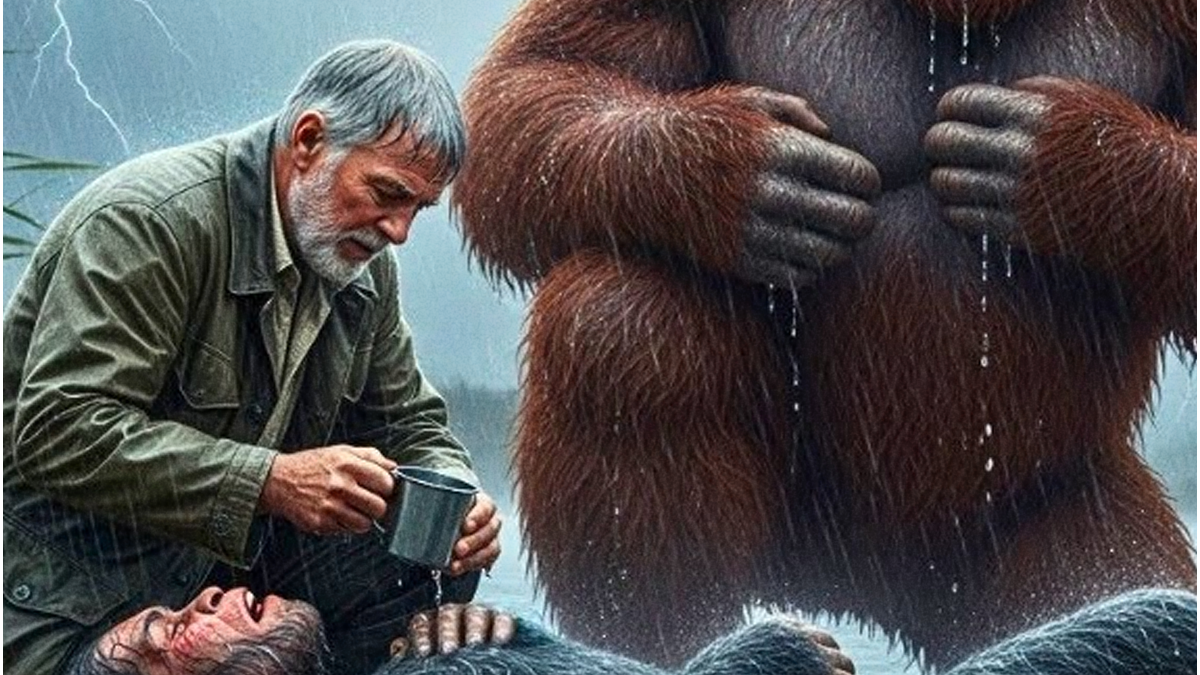
A Male BIGFOOT Begged a Old Man to Save His Mate – What Happened Next Was Unbelievable
You won’t believe what this man saw.
A creature of myth, Bigfoot, standing tall in front of a man, not to attack, not out of fear, but out of love, to ask a human for help.
One late autumn afternoon in the Watcha Forest, Arkansas, retired ranger Harlland Pierce stumbled upon exactly that.
From the reeds by the Saline River emerged a massive male Bigfoot, not feral or violent, but trembling, eyes full of grief.
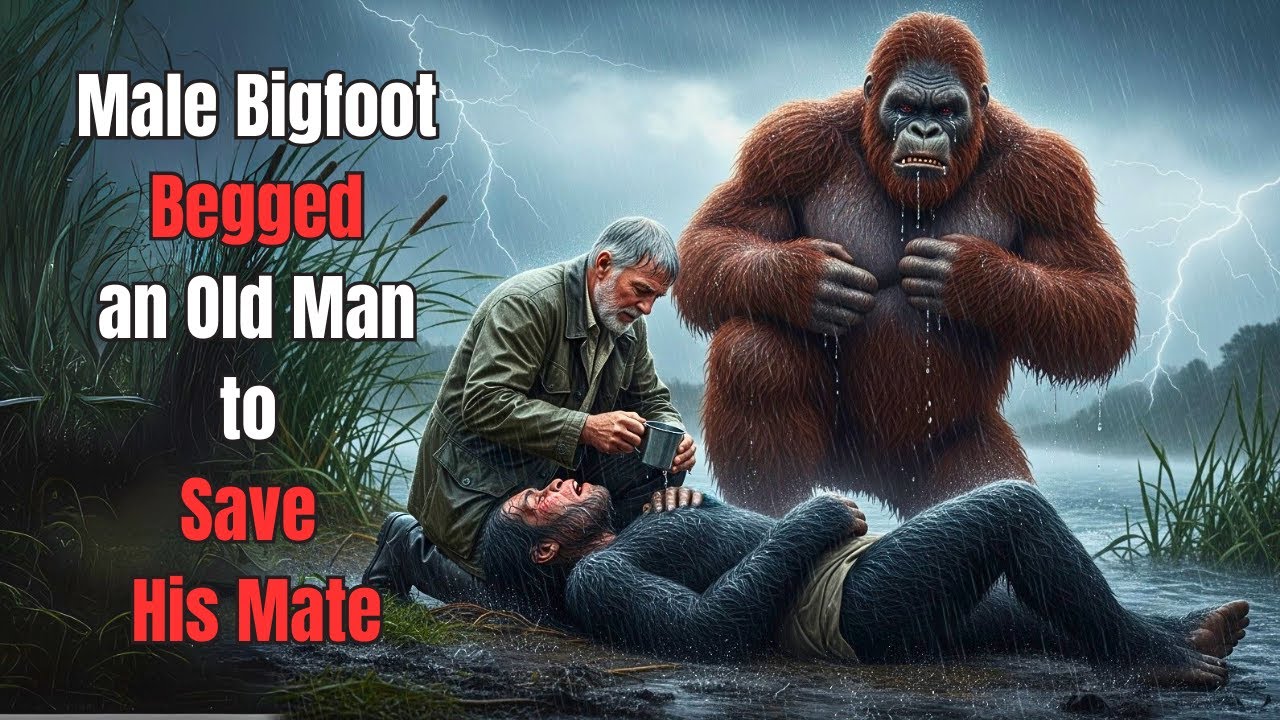
It led Harlon to a dying female foaming at the mouth, poisoned by a river tainted by illegal runoff.
Contrary to every tale you’ve heard, this creature didn’t hide from humans.
It sought one out.
And Harlin, haunted by the memory of his wife’s final breaths, did what he knew best.
He fought to save a life.
Using forest herbs, charcoal, yrow, plantain, and a tin cup over hot embers, he brewed a remedy.
As a storm hit and floodwaters rose, the Bigfoot male shielded them both, still holding that prayerful gesture like a sacred ritual.
Within minutes, the female stirred, her eyes opened.
She was alive.
In the days that followed, Harlon found intricate reed knots left on tree roots, an ancient sign of gratitude, and in one, a silver hair glinting in the morning sun, a silent gift from another world.
This isn’t just a story about a mythical creature.
It’s about healing, about choosing connection over fear.
And if you think Bigfoot doesn’t exist, watch this to the end.
You might walk away believing in something even greater.
The wind came in dry and slow across the saline river, brushing the tops of the oaks like a hand through old hair.
It was early fall, and the light had that soft goldedged stillness that only happened in late afternoon, when the woods weren’t quite ready to sleep, but had stopped fighting the dusk.
Leaves rustled like whispers, too tired to finish their sentences.
Harlon Pierce stood at the edge of the slope behind his cabin, eyes on the treeine, boots sunken just slightly into the scattered pine husks covering the dirt.
He hadn’t said a word all day, not to the river, not to the sky, and certainly not to himself.
He’d learned over time that silence could be just as much a companion as grief, if you didn’t ask too much of it.
He wore the same waxed canvas jacket he always did.
The sleeves creased deep from years of use, and the shoulders carrying the weight of too many memories to hang it on a nail like any other garment.
The tin mug in his hand was dented along the rim, same as always, and it matched the dull clink of the small knife tucked into his back pocket, blade chipped on the edge, bone handle dulled by the sweat of another man’s hand long gone now.
He never went anywhere without that knife.
Not because it was useful, though it was, but because his son had carried it before him, and before that, had carved a notch into the base, where Harlland’s fingers often found themselves without realizing.
A small groove, a private memory.
He stepped off the porch and into the brown grass that lined the rear clearing.
The ground sighed beneath his weight, dry on top, soft just underneath, and he moved slowly down the incline toward the stone outcropping near the riverbank.
A place he’d come to check a dozen times a year, even though there was never anything to find.
But checking was the point, the kind of ritual a man clings to when the bigger things have already slipped from his hands.
He crouched low and brushed away a sheet of damp moss, clinging to the side of the stone.
Beneath it, shallow grooves emerged.
Four straight lines notched like a scale.
A water marker.
He’d carved them himself nearly three decades ago with the same knife, long before his knees had started complaining, and his back stiffened from bed to breakfast.
He wiped the rest of the moss clean and ran his thumb across the grooves.
The river was low this year, lower than he liked.
But it wasn’t his job anymore to call it in, to write it down, to file it away.
That job belonged to someone younger, someone still thinking everything could be fixed with a report.
He turned toward the water, stepping over a flattened patch of sedger grass, and squatted beside the shallows.
The current moved slow here, thick with sediment, the kind that left a soft, oily sheen near the roots.
He dipped his hand in, palm down, and held it there.
The water was cooler than it should have been, colder than it had any business being this time of year.
He sniffed once, sharp, metallic, the kind of smell that clung to coins and rusted nails, just below the surface, caught against a strand of grass, floated the body of a fingerling.
Its scales were pale and discolored, one eye bloated and opaque.
He scooped it out gently, turned it over in his palm.
There was no sign of trauma, no wound, just a slick film along the gills that shimmerred rainbow like in the failing light.
He reached into his coat, pulled out a small notebook with a rubber band stretched twice around its cover.
Hands shaking slightly, he opened it to a blank page near the back and wrote in blocky uneven letters.
Saline river, 5:40 p.m. One dead fingerling, water colder than usual, slick on gills, smell, metal.
Note, check again after next rain.
The ink bled slightly where his hand trembled, but he didn’t correct it.
Just folded the page over and let the pen drop back in his breast pocket.
He stayed crouched a little longer, elbows on knees, and set the dead fish gently on a flat rock beside him.
Then he reached back and took out the knife.
He laid it down at top the notebook.
The edge pointed north, just like his boy always did.
A habit that meant nothing to anyone else.
Maybe not even to him.
But he still did it.
The river said nothing.
The wind moved across the grass and didn’t stop to look back.
Behind him, from the line of tall reads, came a sound.
Not sharp, not sudden, but full of something aching and held back.
It wasn’t the sound of an animal, not the startled grunt of a deer or the warning cough of a hog.
It was breath, human in shape, but not quite.
As though someone had forgotten how to cry and was trying to remember through clenched teeth.
Haron didn’t flinch.
He didn’t reach for the knife.
Not because he was unafraid, but because there was something in the tone of that breath that felt restrained, like sorrow dressed in shadow.
He stood slowly, keeping his back loose, his arms down, eyes still on the water.
Then he turned.
The reads were too thick to see through.
They swayed slightly, but not in rhythm with the wind.
Something had moved them.
Something that had stopped.
He scanned the treeine past the reads.
Nothing.
No deer, no wild boar, no coyote poking out its ears.
His hand found the bone handle of the knife.
Not to wield it, just to feel it.
He took one slow step toward the edge of the sedge line, and then another.
The breath came again, closer this time, but no louder, like whatever made it had sunken further inward instead of outward.
And that strange thing happened in his chest.
The shift from fear to alertness, from guarding to caring.
He wasn’t a ranger anymore.
No badge, no radio, no pack.
But he still knew what a cry for help sounded like, even when it was buried in leaves and shaped like a breath that wasn’t quite human.
The sun bent low behind the far ridge.
The color of the river turned from clay to rust.
Harlon pulled his jacket tighter, not from the cold, but from something else.
Something older.
He stepped into the reads.
The ground was softer here, giving underfoot.
The kind of mud that remembered every shoe print for weeks.
He moved slow, not stealthy, but deliberate.
The way you approach a wild horse that might bolt or break its own leg trying to run.
His boots left deep tracks behind him.
That didn’t matter.
The air had a stillness that made it harder to breathe.
Not heavier, emptier.
As if the world had pulled in its own lungs to see what he would do next.
He reached a small clearing, a dip in the land where the sedge gave way to flattened stalks and pressed soil.
Something had passed through here recently.
Large, heavy, but the movement wasn’t erratic.
It was deliberate, steady.
He paused, scanning again.
Nothing but the breath.
It hadn’t come again, only silence now, and the kind of hush that didn’t come from nature, but from something watching nature.
Holding it still, he bent low and brushed his fingers along the ground.
A tuft of fur, coarse, darker than bare hair, but softer than deer.
He rubbed it between his fingers.
It smelled faintly of earth and rain.
Not blood, not rot.
Clean.
And then he heard it.
Not breath this time, but the shift of weight behind the low wall of reads just ahead.
Something someone was there.
He stood slowly.
Knife still in his grip down at his side.
Not lifted, not ready to strike, just present.
The last light of the sun hit the top of the trees.
Turned the tips orange gold.
His eyes narrowed.
He didn’t speak, didn’t call out, didn’t run.
He just waited.
Because deep in his chest, in the part of him that had buried a wife too soon and a son too far, something stirred.
Not fear, not curiosity, something closer to recognition.
Someone was out there, and they needed him.
Just like the river did, just like he needed to mend what was in front of him.
He took one more step forward and the reeds parted.
He didn’t know what he expected to find when the reeds parted.
But it wasn’t this, not the shape, not the weight of it.
The thing standing there wasn’t a bear, though at first glance it could have passed for one in size, but the way it held itself, upright, centered, deliberate, froze every old instinct in Harlland’s body and replaced it with something else.
Not panic, not awe, recognition, not of the creature, of the stillness it carried.
The same stillness he’d seen in war.
In the last breath of his wife, in the final heartbeat of his boy on a battlefield far too dry to grieve in, the creature didn’t move, didn’t posture.
It stood at the far edge of the flattened sedge in the low red light of sunset.
Its shoulders hunched forward just slightly like a man holding in a sob he didn’t want heard.
The fur was deep brown with streaks of reddish clay clinging to its limbs and sides.
The light catching faint shimmers of wetness.
It wasn’t clean.
It wasn’t majestic.
It was real.
And Harlon knew right then it wasn’t there to fight.
Its chest expanded once, then again, and with the next breath, it raised both of its massive hands and pressed them flat to its chest.
Not as a warning, not like a gorilla beating the air to say, “Back off.”
This wasn’t a display.
This was a gesture, something sacred.
Its eyes weren’t wild.
They were clear, wide, and fixed on him with a kind of raw, desperate presence that didn’t beg, but pleaded.
Harlon didn’t speak.
He didn’t run.
He just nodded once, not sure why.
Maybe out of respect.
Maybe because something in him had already decided he’d follow.
The creature lowered its hands and turned slowly, not with fear, not with command, but with that same deliberate grief he’d seen in the way it stood.
A being carrying something heavy, but still walking.
It took four steps, then stopped, turned its head just slightly to look back.
Harlon took one step forward.
The creature kept moving.
The light was almost gone now, the sky bleeding from copper into plum, and the reeds grew taller the deeper they went.
Soon they were shoulder high, then over his head, brushing his shoulders like unseen hands.
The earth beneath him grew soft again.
His boots made a faint squelch with every step, but he didn’t slow.
He watched the creature’s broad back ahead of him as it moved without hesitation, arms at its sides, feet finding solid spots without rustling.
Harlon wasn’t so graceful.
He stumbled twice, once on a route, once in a patch of mud that nearly claimed his boot, but he kept his eyes on the one leading him.
Because every few yards, the creature would glance back just for a second, as if checking to see if Harlon still followed.
And the look in its eyes wasn’t fear.
It wasn’t suspicion.
It was hope and fear’s cousin.
The kind of fear a man feels when he knows he can’t do something alone.
And yet here they were.
The air had shifted.
It was thicker down here, closer to the river’s edge.
The smell of metal in the water had grown stronger, laced now with something else, something faintly sour, like algae and still ponds, or mud churned too long.
Harlen passed a branch where the water met the lower bank, and the foam along the grass glowed faintly gray in the dying light.
His fingers brushed it as he passed.
It was cold, too cold, and it clung to his skin just a second too long.
They reached a bend in the trail where the reeds gave way to open marsh, and for a moment Harlon thought the creature would stop, but instead it tilted its head slightly and pressed forward into a space that hadn’t existed a second ago.
The creature wasn’t just moving through the brush.
It was parting it.
Deliberate, calculated.
It made a path wide enough for a man to pass without scratching, without tripping, without slipping into hidden puddles or snake holes.
This wasn’t random movement.
It was guidance like someone laying down boards over a swamp, not for themselves, but for the one behind.
Harlon followed, eyes narrowed, boots heavy with mud, until they stepped into another dip.
A hollow of earth carved by years of quiet water and the slow churn of time.
The reeds opened wider here, forming a natural bowl where the last light of the sun still kissed the tops of the grass.
He stepped closer and then he saw her.
At first he thought it was a log, dark, low, unmoving.
Then he saw the curve of a shoulder.
The long fingers curled in toward a massive chest.
A second creature, but this one was down.
She lay on her side, curled slightly as if mid turn, one leg half-drawn up, the other spled.
Her chest moved barely.
And from the way the male stepped forward now, hands twitching at his sides, something in Harland’s gut twisted tight.
She wasn’t asleep.
She wasn’t resting.
She was sick.
The male stepped aside, kneeling beside her head, but didn’t touch.
His hands hovered just above her shoulder, then drew in, curling into fists before pressing against his own chest again, once, twice, then dropping.
Harlen took another step, kneeling beside the clearing’s edge, careful not to come too close.
The female’s lips were parted slightly.
Foam clung to the corner of her mouth, tinged faintly with white.
Her breathing was shallow, rapid, but uneven.
Her fingers twitched.
Her eyes fluttered but didn’t open.
He reached out a hand, slow, cautious, hovering above her wrist before gently laying two fingers against the thick skin.
A pulse, faint, erratic, but there he looked up at the male.
The creature had dropped to his knees now, hands over his head, elbows tied in, not weeping, but crushed beneath the kind of silent agony that doesn’t make noise because it doesn’t believe it deserves to.
Harlon’s own memories crashed into him then.
The way his wife’s hand had trembled in the hospital bed, the cold grip of a medic’s shoulder when he told him the news about his son, and how both times he hadn’t been fast enough.
Not this time.
He unzipped the side pouch of his coat, fingers brushing past a bundle of rags, a few leaves wrapped in wax paper, and a small bag of crushed charcoal lumps.
Not fancy filters, not chemicals, just the old tools, the ones that had worked when nothing else did.
He pulled out a handful of yrow, still damp from where he’d picked it by the bend, unwrapped the plantain, already browning slightly at the edges.
He grabbed the tin cup from his side, unscrewed the small tin of ash from the bottom of his coat lining.
Then he set the knife down.
Not away, down.
Right by her head between them with a blade pointed north again.
And he whispered, “Son, help me be on time this once.”
The male didn’t move, didn’t watch.
But the way his shoulders lowered Harlon that some part of him understood.
The light was gone now.
All that remained was the red thread of sky far behind them and the sound of frogs starting to chirp in the distance.
Harlen turned to the body in front of him and began to work.
The river made no sound here, as if it too had crouched down to listen.
Everything felt closer to the ground.
The trampled grass, the slant of the earth, the way the wind shifted just enough to carry the taste of copper into the back of Harland’s throat.
He didn’t speak, not even under his breath.
His hands moved in the quiet like they had when he tended to his wife in the final hours, just trying to stay ahead of death by a half breath.
But this wasn’t a woman in a bed.
This was something older, heavier, stranger.
And yet he didn’t feel any less responsible for her life.
The Bigfoot female lay slumped on her side in the shallow basin of reeds.
Her body coiled as if trying to keep its warmth tucked in, though the tremors rippling through her limbs said it wasn’t working.
Her lips were pulled slightly back, not in a snarl, but from the strain of holding on.
Foam crusted pale at the edge of her mouth, and her fingers twitched without rhythm.
Her eyes didn’t open, but beneath the lids, Harlon saw movement, like she was caught in something she couldn’t wake up from.
The breathing, shallow, wet.
Every few seconds, it hitched as if her lungs were forgetting the pattern.
Harlon knelt and pressed two fingers lightly against the thick artery near her collar bone.
The pulse was thin, fast, but irregular.
Not a panicked rhythm, a failing one.
He’d felt it before, more times than he cared to count.
With deer hit by trucks, with a boy in a humvey, with the woman who’d held his name longer than anyone else, that same slow slide, the body fighting without belief, his throat caught, the back of his mind tried to push away the memory of a hospital room with too much light and the sound of a heart monitor dropping pitch.
He gritted his teeth and focused on the now.
The male was just behind him, hunched with his arms over his head like the sky might cave in if he moved.
He wasn’t making a sound, but his whole body shook.
His massive frame that had looked like it could tear trees now looked like it might break apart under its own grief.
He didn’t reach for her.
He just knelt there, head low, shoulders up.
Harlon recognized that posture.
Not fear, not helplessness, guilt.
Like he should have been able to stop this and hadn’t.
That kind of silence was louder than screaming.
Harlon reached for the canvas satchel he kept tied under his coat, unwrapped the fold slowly, carefully, and found the pouch with charcoal still whole inside.
A small tin of ash collected from his own stove, hard one over weeks.
He broke off two chunks and began crushing them with the spine of his knife against a flat stone.
His hands weren’t steady.
The tremble in his fingers had gotten worse the past year, but he worked through it like always.
One small pile of black powder formed quickly.
He pulled out the yrow and the plantain he’ picked along the edge of the riverbank earlier, still damp from the dew and earthy from the soil.
He tore the leaves with his fingers, mashed them together between his palms until the smell came sharp and green like spring under pressure.
He didn’t have a bowl, just his tin cup, dented and blackened with use.
He poured a little river water into it, swirled the herbs in with the charcoal, and stirred with the end of his knife handle.
The slurry was dark, viscous, thick with a scent of ash and crushed green.
Nothing modern, nothing sterile, but he’d seen it draw poisons out of dogs, even help a friend back in the mountains who’d swallowed something off a rusty can.
If the body wasn’t too far gone, it could help.
If he looked at her mouth, barely parted, breath rattling.
He cupped her chin carefully and tilted her head.
Her skin wasn’t hot.
It was cold.
The kind of cold that came not from the wind, but from the inside, like something shutting down.
He whispered low under his breath.
Stay with me.
Though he knew she couldn’t hear him.
Maybe the words weren’t for her anyway.
He tore a small reed from the cluster nearby, bit the end, and sliced it at an angle to form a narrow spout.
He dipped the hollow stem into the cup and used it like a pipette, tilting the thick mixture drop by drop into her mouth.
At first, nothing happened.
The liquid just sat there on her tongue.
He set down the cup and used his other hand to gently rub the side of her throat.
Small circles, light pressure, the same way he’d been taught to help a newborn calf swallow colostrum when it had no will to feed.
He worked patiently, drop after drop, swallow after swallow.
She gagged once, a small choke, barely audible, but then her throat twitched.
Not rejection, a spasm.
Then it happened again and again.
The male leaned forward an inch, but didn’t interfere.
His hands still clutched at his own chest like a priest lost in a prayer he didn’t believe in anymore.
Harlon kept going.
Another drop.
Another rub.
Time didn’t pass in minutes.
Here it passed in hope.
In the space between breaths, in the silence between what had already gone and what might still return.
At one point, Harlon reached for the cup again, and something caught the corner of his eye.
Movement at the edge of the clearing.
He turned.
Nothing.
But something had been there.
A shape, a shift, a darker patch of dark watching from behind the tall grass.
Gone now, but not imagined.
His heart clenched, not in fear, but with the clarity of realization.
They weren’t alone.
She wasn’t the only one.
There were more.
He returned to the cup, gave her another small mouthful, and this time when he rubbed her throat, the response was stronger.
A swallow, not accidental.
Her lips moved.
The corner twitched.
A low sound left her nose.
Half breath half grown, but real.
The male made a sudden sound behind him.
Not loud.
A low rumble like something rising from deep inside a cave.
He didn’t reach for her.
He placed his hand slowly over his face, then back to his chest, pressing hard.
Harlon reached into his coat and took out the knife again, set it down near her ribs, then placed his hand over it, not to threaten, not to claim, but to make a promise to himself, to her, to someone who wasn’t coming back, but might be watching.
He said it under his breath, barely a whisper.
We’re not too late.
Not this time.
He pressed the blade flat against the earth, then cupped the last of the slurry into her mouth.
Waited, watched, and felt for her pulse again.
It was still there, still thin, still dancing like a candle flickering in a cold draft.
But it hadn’t gone out, and he wasn’t leaving.
The air grew cooler.
The wind shifted again.
From the north this time, Harlon pulled his coat tighter, but didn’t move away.
The ground smelled of old leaves and bloodless sweat.
Somewhere in the reeds, frogs chirped again.
A distant owl called once, and far, far upstream, the low rush of water turned just a little louder, as if something big had moved in the current.
But he didn’t turn to listen.
He stayed kneeling, one hand resting gently on the ground beside her, the other holding onto a part of himself he thought he’d buried long ago.
And the last light of day slid out of the sky like a breath fading in someone else’s chest.
The wind began to shift, not with a howl, but with that sudden hush.
That means something’s coming.
Harlon noticed it first in the grass.
The way it leaned just slightly east, then flattened like it was bowing toward something unseen.
The air thickened again, not like fog, but like a warning pressing down on your shoulders before the sound ever arrives.
He didn’t stop what he was doing.
He couldn’t afford to.
The mixture was nearly gone, but he had enough for one more round.
He gripped the cup tighter, knelt at the Bigfoot female’s side, and tilted her head gently.
Her breathing was slower now, deeper, but not yet steady.
She was floating on the edge, and he knew better than most how fragile that place could be.
He brought the reed to her mouth again, let the last of the slurry run down the side of her tongue and rubbed her throat in small, slow motions, the way he would for an injured dog too proud to show pain.
Her body didn’t resist.
She accepted it.
Not all of it, but enough.
Enough to show she was still holding on.
That was all he needed.
Not proof, just permission to keep trying.
Behind him, the male stayed silent.
He hadn’t moved in over an hour, but now his posture shifted.
One foot anchored into the mud, a slight rise in his shoulders, his head tilted like he heard something Harland couldn’t.
Then, just for a breath, the earth itself seemed to pulse.
A low sound rolled in from up river, dull, deep, and distant at first, but growing.
Harlon squinted toward the far bend.
He knew that kind of sound.
Not thunder, not a train, not animal.
It was water, heavy water, moving fast.
He looked toward the bank, toward the trees where the higher ground began.
Something was wrong.
The river wasn’t supposed to rise like this, not without a storm.
But the sound was rising, and so was the wind.
The reeds danced wild now, the tips bowing and snapping back like they were trying to say something before it was too late.
Harlon stood, wiped his palms on his coat, and scanned the sky.
No lightning, no rain, just dark clouds dragging themselves across the horizon, thick and fast.
Not storm clouds, release clouds.
Damn.
He’d seen this before.
Not here, but in the Ozarks.
Upstream dams letting go of backed up rain after a long dry spell.
No sirens, no warnings, just a rush that could drown anything in its path before the trees even knew it hit.
He dropped to his knees again.
There wasn’t time to move her, and she couldn’t walk.
Maybe not for hours.
Maybe not at all.
He didn’t hesitate.
He reached into his coat, pulled out a small fire starter kit, and struck a flint over dry twigs he’d tucked into a leather pouch beneath his satchel.
The sparks danced once, twice, then caught.
Smoke whispered up through the grass, and Harlon fed the flame with pieces of bark and twine.
Careful, fast, focused.
He needed warmth, fast.
If the cold water hit her now in this condition, it would finish what the poison had started.
He dug into his pouch, pulled out more charcoal, crushed it bare-handed, added a few bits to the flame, then poured what was left of the water into the tin cup, and set it a top the small fire pit he dug into the earth.
It hissed and steamed, but held.
He stirred it with the back of his knife, glancing at the river’s bend every few seconds.
The sound was louder now, real loud.
It had passed the birds.
Even the frog stopped, and that’s how he knew it was close.
The male stood suddenly, not with fear, not with panic, but with decision.
He looked at Haron, not down at him, but level, as if something passed between them.
Then with one deep breath, he stepped forward and planted his feet wide just behind the fire.
His massive body cast a shadow over the female and Harland both.
And then he bent his knees slightly, spread his arms just enough to brace himself and face the incoming wind.
Not to run, not to flee, but to shield.
The wind hit first, sharp, wild.
It bent the reed sideways.
Harlain ducked his head, one arm wrapped around the cup, the other cradling the side of her face.
Then came the sound, louder than anything he’d heard in years.
Not just water, not just weight, but power.
Years of backed up force rushing through the woods like a scream given form.
Harlon looked up just once and saw the wall of spray lifting from the bank like breath from a beast.
The Bigfoot male didn’t move.
His arms lowered to his sides, knees locked, his wide frame holding steady like a wall of living bark.
Water sprayed over them.
Mist turning to droplets.
Droplets into a gust.
Harlon flinched but didn’t move.
He pressed closer to the female, shielded her head with his arm.
The fire sputtered.
The cup rocked but it didn’t tip.
Then the wave passed.
Not over them, around.
The reeds whipped and danced.
Trees bent back like they’d been punched by the sky.
But in the low bowl where they knelt, the worst of it never landed.
Only a breath of its violence, only a warning.
Harlon looked up and saw the male still standing, his arms now drawn in slightly, still close to his chest, one hand over his heart, not shaking, not weakened, but holding something, holding fast.
The wind softened, the roar faded.
The frog stayed quiet, but the branches had stopped groaning.
The fire was low now, but still glowing red.
Harlon reached for the cup.
It was warm enough.
He stirred again, lifted it, and brought it to her mouth.
She swallowed.
Not all of it, just a sip, but with intention.
Her throat moved on its own.
Her lips closed.
Her body shifted slightly, barely a twitch, but toward him, not away.
That was enough.
Enough for now.
He let out a long breath and sat back on his heels.
The cold in his bones started to settle in now that the wind had gone.
His fingers achd from the pressure.
His knees burned, but he didn’t move.
The male exhaled once, a deep sound that vibrated low through the earth.
Not speech, not song, but ceremony.
Like an old drum beneath the skin.
Harlon didn’t know what it meant, but he felt it just the same.
He looked at the knife again, still lying beside them, blade dull, dirt streaked, handle smudged with sweat and ash.
He reached out and turned it gently northward again, then pressed his palm to the ground beside it.
His voice came out low, almost too soft to hear.
Stay with me.
Not to the female, not to the wind.
Maybe not even to himself, just out into the air, like a tether between now and whatever came next.
The river had quieted again, but the ground beneath them still hummed.
Something had shifted, not just in the sky, but in him.
The sky had gone from slate to bruised violet by the time Harlen noticed the change in her breathing.
Not sudden, not dramatic, but real.
At first, it was just the way her chest didn’t rise so fast anymore, like something in her was no longer running from the inside.
Then her lips moved, slack at the corners, almost like she was tasting air instead of choking on it.
He didn’t dare touch her yet.
His hands had been there too long, too much.
This part had to come from her.
It had to be her choice, even if it was just instinct clawing its way back.
He leaned close, listening.
No longer for the rasp of struggle, but for the rhythm underneath it.
And there it was, not even, not strong, but there a breath, then another, then a pause so long it almost broke him again, followed by a deeper draw of air.
Shaky, but in, not out, in.
He sat back slowly, his hands covered in black ash and leaf pulp, his wrists marked with thin lines from the reed stems and the heat of the tin cup.
His whole body trembled now, not from fear, but the kind of exhaustion that comes only after you’ve asked the universe for something unreasonable.
And it listened.
She twitched.
Not a spasm, not a death shake, just her fingers curling inward toward her chest.
Her toes shifted against the damp reads, her head lulled gently to one side.
Harlen blinked, not trusting it at first.
He leaned in again, eyes locked on her brow, and there, under the shadow of matted fur and caked mud.
Her eyelid moved, not open, just a flutter, the muscles trying to remember what it meant to be awake.
He turned slowly toward the male.
He was no longer kneeling.
He had crumpled forward, one giant hand digging into the earth, the other flat against his chest, not pounding, just pressed.
His back shook like a man trying not to break in front of a crowd.
The sound that came out of him wasn’t a sobb.
It wasn’t animal.
It was low.
So low it vibrated through the air like a cello string pulled from the ground itself.
A pulse, a tone, deep and mournful and beautiful all at once.
It didn’t rise.
It didn’t fall.
It just stayed humming like a prayer that didn’t need words.
Harlon had heard echoes like that once, long ago in a Lakota sweat lodge.
That sound when grief and gratitude braided together.
Not for the living, not for the dead, but for the space in between.
He stayed still.
He didn’t speak.
There was nothing to say that would match it.
The frogs began to call again.
One chirp, then another, then dozens.
Harlain lifted his head and saw tiny glimmers in the damp grass.
Fireflies blinking yellow and green just beyond the edges of the clearing.
A breeze moved in, soft now, not angry, curling low around their ankles, lifting the smell of wet bark and dying heat.
It carried the faintest hint of something bitter and old metal again, but not as strong now, weaker, like the river was releasing its grip, at least for tonight.
He turned back to her.
Her lips had closed now, not tightly, but enough.
The foam was gone.
Her brow furrowed slightly, not in pain, but like someone waiting through a dream they couldn’t quite surface from.
He reached out with two fingers and brushed the side of her face just once.
She didn’t flinch.
She didn’t move, but her throat worked.
A swallow, slow and uncertain.
He checked her pulse again.
It had changed.
Not faster, not stronger, but stable.
That was enough.
He leaned back and finally let his hands fall into his lap.
He exhaled through his teeth and shut his eyes for a second.
Not sleep, just a moment where he didn’t have to hold anything.
Not her life, not the knife, not even the breath he’d kept trapped in his lungs for the last two hours.
The male sat down now, legs folding under him, arms resting on his knees.
He rocked once, then went still.
The sound had faded, but it hadn’t vanished.
It hung in the air like something still watching, still listening.
Harlon met his eyes.
Not long, not hard, just long enough to nod.
The kind of nod men give when they’ve bled side by side for something neither of them could explain to anyone else.
He looked toward the edge of the clearing.
The sky was nearly black now.
Just a thread of blue clung to the treetops, and in the space beyond, stars were trying to poke through.
He glanced at the reads and noticed something new.
A faint line of wet dirt smeared at the very edge of the path.
Not there earlier.
Not part of their steps.
A different shape.
Longer, wider, like a trail left by something large passing through.
Not the male, not Harlon.
Something else.
He followed it with his eyes to where it curved behind the trees and vanished into the dark.
He froze.
Someone or something had come close, had watched, and had walked away.
Not out of fear, not in haste, like it had just needed to see.
To know that there was still time, still hope, he didn’t move.
Just let the thoughts settle in like ash after a long fire.
His knees achd as he shifted his weight.
Sitting back more fully, careful not to touch the cup, which had now gone cold.
He watched the female.
She hadn’t opened her eyes, but she was breathing.
Her shoulders no longer curled in defense.
Her hands lay open at her sides.
She was resting, not dying.
There was a difference.
The frogs continued their chorus.
The fireflies danced.
Somewhere a barred owl called once, long and clean.
The river had gone back to whispering against the grass.
Harlon rubbed his knuckles and looked down at the blade lying beside him.
He turned it once again, north, the way his boy always did.
Then he whispered it just loud enough to give it shape.
Mend what’s in front of you.
Not a command, a reminder.
He didn’t know if she’d live through the night.
He didn’t know if the others would return, but the breath had come back.
And that was where it always had to start.
The mornings came slow, thick with fog, heavy with dew.
The kind that didn’t lift until close to noon, and even then only in patches, like the woods hadn’t decided yet if it was time to wake up.
Haron didn’t mind.
The blur gave him cover, not for hiding, but for protecting.
In the first days, after the river quieted and the breath came back, he didn’t go anywhere.
He didn’t write in his notebook.
He didn’t step foot in town.
He stayed near the makeshift shelter he’d carved from a wall of reads and tree bark.
No wider than a horse stall, but just tall enough for him to crouch under without scraping his back.
The fire never went cold.
He’d learned to keep it burning low beneath a pile of dry pine needles and damp willow bark that smoked slow and sweet.
Not too bright, not too thin, just enough to make warmth feel like a choice.
The Bigfoot female lay on the bed of fresh leaves, always arranged new each morning.
Her strength came back in quiet measures.
A longer breath, a stronger swallow, a shift of her shoulder when the dew touched her skin wrong.
She still didn’t open her eyes, but she didn’t look lost anymore.
Her chest rose and fell in rhythm now, steady, assured, like something inside had decided to keep going.
The male never strayed far.
He’d vanish into the trees before dawn, come back by evening, never empty-handed.
Sometimes it was dry moss stacked into a strange braid.
Sometimes pieces of bark stripped into thin sheets laid carefully beside the base of a willow.
But most often it was the same thing woven bundles of rivergrass, knotted tight at the stem, looped once, and set precisely at top the roots of the same tree each time.
He never put them near the shelter, never near the fire.
Always that one tree whose roots curled out into the water like fingers frozen midreach.
Harlon noticed not just the shape of the knot, but the pattern.
It changed each day.
Some loops wide and single, others tight and doubled back, but always made of the same reads, always damp, always left in the exact spot, like an offering.
Not to him, to the place.
He didn’t touch them, not once, but each time he passed the tree, he nodded.
Nights were longer now, not because of the season, but because time slowed around the fire.
He’d sit cross-legged, boots off, warming his heels, sipping from the same tin cup he’d used to mix the first slurry.
It still smelled faintly of yrow.
The female would stir sometimes.
A twitch, a low hum.
Not pain, just response, Harlon whispered to her.
Not in full words, just sounds.
The same way he talked to an injured hawk back in his ranger days.
Like rhythm mattered more than meaning.
Like being heard was better than being understood.
Then there were the mornings he had to leave.
Not long, just enough to keep town from wondering.
He’d walk the mile and a half into plain view with mud still drying on his pant cuffs, hair smelling of smoke, and the tin cup washed but not clean.
He’d sit in the back row of the small woodframe church, not for the sermon, but for the silence afterward.
Folks filtered out slow.
Some shook hands, some didn’t.
When it emptied, he stepped toward the pulpit, not to speak, just to approach.
He waited for Reverend McCall to look up from his notes.
When their eyes met, Harlon would pull the mason jar from his pack, always the same one, half full, with a twist top lid and an old paper label, long worn off.
He’d set it on the corner of the table.
“Water from the river,” he’d say.
McCall never asked questions.
Just nodded and took it.
But the man beside him, Dwayne Seager, never missed a moment to chuckle.
“Got another ghost fish in there, Haron?”
He’d mutter.
“River talking to you again?”
Harlon never answered.
“Just slid his hand across the edge of the table, nodded to McCall, and turned to leave.
This time though, something changed.
As he turned, he heard a sound.
Not from Seagar, not from McCall.
From the pew behind him, a throat cleared.
Light, deliberate.
The voice that followed belonged to Ruthie Mard, 70 if she was a day widow twice over, walked with a hickory cane, not because she needed it, but because it made her swing more noticeable.
She didn’t stand, but she didn’t whisper either.
“My granddaughter’s been scratching her legs after swimming,” she said.
Silence followed.
She kept going.
Water smells different lately, like sulfur mixed with rust.
Seager opened his mouth, closed it.
McCall looked down at the jar.
Harlon didn’t say a word.
He just nodded once, then left.
That night, he brought more firewood back than usual.
He didn’t know why.
Maybe because something was starting to shift.
Maybe because he felt the edges of silence fraying in town.
Or maybe because the wind had changed direction again.
Now coming from the north, heavier, thicker, as if dragging something with it.
The fire burned hotter that night.
Not out of fear, out of preparation, he checked her breathing twice, still steady.
Her chest didn’t jump at the wind anymore.
Her fingers stayed still even when the frogs got loud.
And the male, though quieter than ever, didn’t pace the perimeter now.
He sat near the tree close to the reed knot he’d left that morning.
His head turned toward the water, listening.
Harlon cleaned the tin cup with hot ash, poured fresh water, let it cool.
He wiped his hands on the cloth sewn into the inside of his coat, then reached into his pocket and took out the blade again, the one with the chip near the hinge.
He turned it once slowly in his palm.
Felt the weight of it, not just in steel, but in memory.
He set it beside the fire, blade pointed north, then leaned back against the nearest trunk.
“I think they’re starting to hear me,” he said softly, though no one had asked.
The fire popped.
The wind pulled a few sparks sideways.
A twig cracked not far off, but not close enough to matter.
He reached down and brushed a bit of ash off the handle.
In the morning, he’d go back, not to argue, just to place one more thing in front of them, because that’s how you change a thing.
Not with shouting, not with fear, but with presence and patience.
And the fire still burning.
The fog didn’t come that morning, not like before.
It hung a little on the backs of trees, clung to the low branches in the hollow, but it didn’t press down.
The air felt lighter.
Even the stillness between the bird song seemed thinner, as if the forest itself was about to exhale.
Harlon stood near the fire pit, hands resting on his hips, eyes fixed on the shape lying just beyond the line of flickering embers.
She hadn’t moved much through the night, only slight shifts when the wind stirred or when the moss padding beneath her shoulder crinkled under weight.
But something was different now.
Her chest moved in longer pulls like she was gathering something up from deep inside.
There was weight behind it, purpose.
It wasn’t survival anymore.
It was readiness.
He crouched low, not too close, and watched her fingers.
They weren’t curled in tight anymore.
They lay open, palms up, fur still damp at the edges, but no longer trembling.
Her legs shifted once, then again.
One knee pulled slightly toward her ribs.
The first time she’d moved like that without assistance.
Harlon held his breath.
The wind passed gently through the reeds and carried with it the sound of morning birds.
A few blue jays squawkked somewhere near the oak line, and down by the river, the frogs had gone quiet again, not in fear, but in acknowledgement.
Something was about to happen.
The male stood a few feet back, one arm resting against the trunk of a cyprress, his shoulders still, his eyes fixed.
He didn’t pace.
He didn’t grunt.
He waited, then she moved.
Not jerky, not strained.
She turned her head slowly, eyelids heavy, but no longer shut.
Her jaw tightened.
Her hand pressed into the ground.
The breath she took next wasn’t shallow.
It was deep.
It cracked in her throat like old wood, but came clean through.
Haron didn’t move, didn’t blink.
Her eyes opened.
Not wide, just enough.
Dark brown, wet with memory.
She blinked once, then her hand shifted.
Elbow bent, muscles drawing against gravity.
The first real effort.
She tried again.
This time, her body rolled toward her arm, slow, like each inch required negotiation.
She paused, breathing heavy, then planted her other palm into the leaves and pushed.
Her back lifted.
Her knees found shape.
Her torso shook under the strain.
But she didn’t stop.
She rose up to a crouch, shoulders hunched forward, chin low, and then she stayed like that, just breathing, just still.
Harlon felt his own chest tighten.
Not in worry, in awe.
The male stepped forward now, but only a pace.
He didn’t reach, didn’t touch.
She tilted her head slow as mist curling over stones.
Their eyes met.
Neither blinked.
Neither moved.
Then, like a motion choreographed long before either of them was born, he dropped to one knee, lowered his head slightly, and waited.
She didn’t fall toward him.
She didn’t lean.
She rose first with a tremble, then with steadiness.
One foot found the ground, the other followed.
Her spine straightened, shoulders still bent forward from the weeks of weight she carried inside.
But her balance held, she stood, full, upright, not towering, not fierce, just there, alive.
The sound that followed wasn’t sound at all.
It was silence breaking apart like eggshell under breath.
And then she took one step, then another.
Harlon stood slowly, mouth dry, hands open at his sides.
He didn’t speak.
He wouldn’t break this.
She walked forward, not quickly, not with force.
She moved like someone remembering how to dance without ever having learned.
When she reached him, the male stepped into her path, not to stop her, to meet her.
They faced each other, both upright, both trembling in different ways.
She looked into his eyes.
He reached one hand toward her shoulder, but didn’t touch.
Instead, she leaned her forehead forward, and he did the same.
Their brows met in the space between breath and understanding.
No words, no gestures, just that contact, light lasting no more than two heartbeats, then gone.
They separated again, but something had passed between them, something whole.
Harlon backed up a step, not in fear, in reverence.
He didn’t belong in that moment, and he knew it.
She turned now, not toward the trees, toward him.
Her eyes locked onto his.
There was no animal in them, only presence and gratitude.
She didn’t kneel.
She didn’t raise her hands.
But the way she stood, spine steady, gaze unwavering.
It said enough.
And just behind her, the male stepped forward and placed both hands over his chest.
Firm, deliberate, a gesture.
Harlon nodded once, then again, then looked down.
The earth near the treeine was damp from dew, scattered with pine husks and the flattened remnants of old footprints.
And there, nestled in the roots of the same tree, was another bundle, the woven knot of rivergrass laid with care.
But this one was different.
Smaller, tighter, and woven inside the loop, visible only in the light of morning, was a single hair, long, coarse, gray.
He stepped toward it slowly.
The knot was slightly damp, but the hair shone faintly in the sunlight.
It wasn’t fur from the female, nor from the male.
It was older, paler, a token, a gift.
He didn’t reach for it.
Not yet.
He just crouched, eyes on that strand.
It caught the sun, glinted like thread used in old himnels, like the silver lining in a thundercloud that never fully breaks.
He didn’t need to understand its meaning.
The act was enough.
Behind him, the sound of retreating footsteps, soft against wet earth.
Not rushed, not afraid, just finished.
Harlon stayed crouched long after the reeds settled.
He reached for the knot and turned it gently in his palm.
It was warm from the sun, damp at the base, but strong, braided, not just in form, but in meaning.
Something passed to him.
Not as burden, as blessing.
He stood with it cradled in both hands.
The woods were quiet again, but not like before.
Now the silence had room for breathing, and for remembering, he looked to the sky, and though he didn’t say it aloud, the words passed through his chest like a pulse.
Mend what’s in front of you.
This wasn’t the end, only the moment between.
The river was lower now.
Not dry, but different, calmer, like it had exhaled after holding something in too long.
The foam along the banks had thinned.
The shine of oil wasn’t gone, but it no longer stung the eyes when the light hit it.
Summer had come with its thick warmth and buzz of insects in the grass.
Wild flowers bloomed even in places where last spring the reeds had drowned them.
The land remembered and so did he.
Harlon stood at the edge of the room in the church basement, arms crossed behind his back, boots planted firm.
The jar sat on the table like it had every week for the past few months, half full of river water, the rest clouded by silt.
No label, no words, just presence.
In front of it lay his notebook open to a page with sketches.
Not fancy, not artistic, just truth.
He drawn the contour of the mud lines the way the water curled around the roots.
And next to them, half shaded in pencil, a set of faint treadmarks, wide and irregular, pressed into the banks where no one had any business bringing a vehicle.
He didn’t say much.
He never did.
But this time, he said more than usual.
I’ve been walking the same stretch every two days, he said quietly, voice scratchy from the heat and sleep lost.
What I’m seeing up there ain’t natural runoff.
It’s coming from a drainage point just above the split.
A few folks shifted in their seats.
Some looked down, some looked up.
A few turned their heads toward Dwayne Seager, who stood near the back wall, arms folded, jaw clenched.
He didn’t speak.
Not yet.
Haron kept going.
I’m not saying names.
I’m not pointing fingers.
But something’s killing this river slow.
And if we don’t stop it now, it won’t be the fish next time.
It’ll be the fields, the wells, our own blood.
There was a stillness after he spoke.
Not from doubt, from wait.
Then Ruthie Mard’s voice cut through the quiet.
My youngest’s got blisters on her legs from waiting, she said.
Doctor said maybe staff, but we know that stretch.
We know what clean water feels like.
Another woman nodded.
Our garden’s been slow this year.
Soil’s not right.
From the far end of the room, someone muttered.
You think it’s them dump trucks from Seagar’s lot?
Harlon didn’t turn.
He just placed his hand on the edge of the table.
Open resting.
Seager finally stepped forward.
You got any proof that’s not just drawings and jars?
He said, voice flat.
Harlon didn’t answer him.
Didn’t look his way.
Instead, he said it to everyone in the room.
I don’t bring this because I want to blame anybody.
I bring it because it matters.
We fix what’s in front of us.
That’s all I’m asking.
There was a pause.
Then the reverend stepped forward.
We’ve seen enough and we’ve waited long enough.
I say we go up there, see it for ourselves.
We don’t need a court.
We need a shovel.
That afternoon, six men and two women followed Harlon up along the river’s edge.
They brought nothing fancy, no permits, no citations, just shovels, buckets, a fence post digger.
One brought his teenage son with a hammer.
When they reached the split, they saw it plain.
A pipe not listed on any record, wedged behind a line of false brush.
The smell hit first.
Chemical, sharp, undercut with a sweetness that made you gag.
The men didn’t speak.
They just looked at each other.
Then the digging began.
It wasn’t angry.
It wasn’t loud.
It was work.
Focused, determined.
By dusk, the pipe was sealed with clay and timber.
Nothing permanent, but enough.
Enough to stop it for now.
They didn’t talk much on the walk back.
Didn’t need to.
A choice had been made, one that couldn’t be taken back.
Later that night, Harlon sat on the steps of his cabin with the old knife in his lap.
Its chipped edge turned toward the fireflies rising from the tall grass.
He didn’t touch it much anymore.
Just held it.
It meant something different now.
Less about holding on, more about letting things pass through.
The air was warm, but not stifling.
The moon was high, but not full, and down by the edge of the river, near the old willow, where the roots curled out like fingers, looking for grace, something had been left again, not loudly, not for show, just set there, another reed knot, braided tighter than the rest, pressed flat at the center, and tucked between the loops, barely visible, was a sliver of something pale, not bark, not leaf, a single stone, smooth oval, etched with three fine lines like tracks left by something walking away slow.
Harland didn’t go down right away.
He watched from the porch, eyes soft, shoulders loose.
It was enough just to know it was there, enough to know someone else remembered.
The cicas were out now, humming from the deeper woods.
The frogs had settled, and the river whispered as it moved past rock and root, quiet in its promise, that the work wasn’t done.
That healing never really ended.
That mending wasn’t a moment.
It was a vow made over and over.
Sometimes loud, sometimes silent, but always with both hands.
The night deepened.
Harlen leaned back against the post, the tin cup still warm in his hand, and whispered into the dark, “I heard you.”
Nothing answered.
But across the yard, the grass moved just enough to let him know someone else had heard, too.
The forest keeps its own kind of memory.
It stores it in quiet places.
The bend of a river, the grain of a porch board, the knot someone ties without thinking and leaves for dawn to find.
What we do to each other lives there long after the moment has passed.
A cup of warm water, a steady hand, a small promise kept when no one was watching.
This is how a life is mended.
Not all at once.
Not with speeches, with stitches.
One by one, right where the tear appears.
Maybe mercy isn’t a miracle.
Maybe it is a practice.
A steady rhythm like breath.
Patient and stubborn.
It looks ordinary from the outside.
It sounds like please and thank you.
It feels like waiting when your back aches and staying when the easy thing would be to go.
You don’t change the world this way.
You change the next five minutes and then you do it again.
Rivers teach this better than people do.
They carry what we pour into them, the good and the harm, and they return it to our hands.
If we poison what we depend on, the first throat to burn is our own.
If we tend what we’ve taken for granted, the water loosens, the banks hold, the cattails lift their heads again.
A river forgives slowly.
But it does not forget.
Neither should we.
There are languages older than words.
Palms pressed to a chest, a head bowed, a gift of woven reads left where roots touch the current.
To answer is to become fluent in the simple.
To answer is to say without any noise at all.
I see you.
Keep going.
I’m here.
We will not always be strong.
We will not always be right on the first try.
But nothing honest is wasted.
Kindness travels.
It follows the water and returns in its own season.
Some losses can’t be repaired.
We know that.
Still there is work for our hands.
The work is to keep the small fires lit, to guard the fragile breath, to refuse the easy cruelty of indifference, to believe that a quiet act can tilt the day.
If you are looking for a rule to live by, choose the one that fits in your pocket.
Mend what’s in front of you.
When you can’t fix it, hold it.
When you can’t hold it, witness it.
When even witnessing breaks your heart, let the breaking make more room.
If this story found a warm place in you, I’m grateful you spent your time here.
I’d love to hear what stayed with you.
The image, the feeling, the line that won’t let go.
Share it in the comments and let it meet someone else where they are tonight.
If you’d like to walk with us a little farther down this trail, more tales, more late night hush, more rivers learning to run clear, please consider subscribing and turning on notifications.
Your presence matters more than numbers ever will.
Thank you for listening, for caring, and for every small stitch you’ll make when the world asks again.








