A Lonely Rancher Found Two Orphaned Children Hiding in His Barn – What They Told Him Changed…
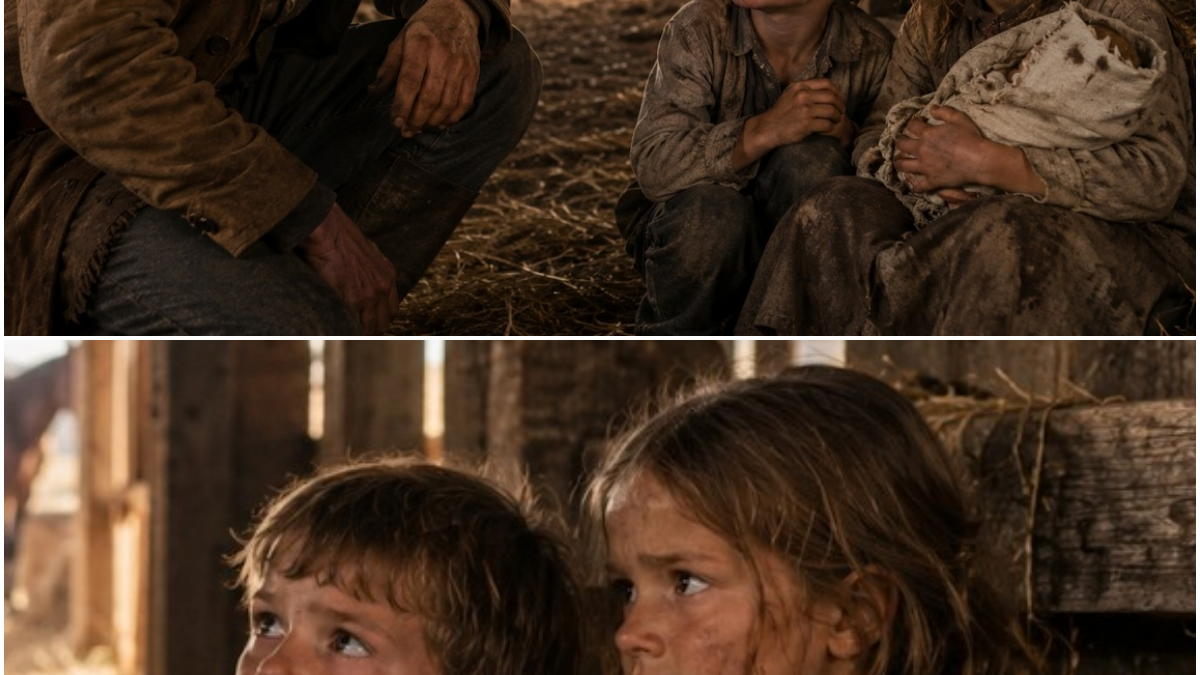
A Lonely Rancher Found Two Orphaned Children Hiding in His Barn – What They Told Him Changed…
The barn was dark when the children found it.
Not the friendly dark of evening, the kind that settles over a place with warmth and the promise of rest.
This was the thick, pressing dark of a building that had been empty too long.
Dust in the rafters, mice in the straw, the particular silence of a space that had forgotten what it was to hold living things.

Lucas Brennan, 11 years old, pushed the loose board wider and helped his sister through the gap.
Emma was seven.
She was shivering.
She had been shivering for two days.
“Keep low.”
Lucas whispered.
“Don’t make a sound.”
Emma nodded.
She was good at not making sounds.
She had learned it in the two weeks since their mother died.
First the coughing, then the blood, then the stillness that Lucas wouldn’t let her look at for too long.
She had learned to be quiet while Lucas dug the grave.
She had learned to be quiet while they walked the 12 miles from their homestead to Rawlins, hiding from wagon roads, moving at night.
She had learned to be quiet while Lucas told her that everything would be all right, even though his voice had the flat quality of a boy who had stopped believing his own words.
The barn smelled of old hay and leather and something else, something living.
Horses, maybe.
Lucas couldn’t see them in the dark, but he could hear them shifting in the stalls beyond the wall.
The sound should have comforted him.
It didn’t.
Horses meant people.
People meant questions, and questions meant Silas Vance.
He found a corner behind a stack of grain sacks and pulled Emma close.
She was hot.
Not the good heat of exertion, but the dry, dangerous heat of fever.
Lucas pressed his palm to her forehead and felt his stomach clench.
Their mother had been hot like this at the end.
“Lucas.”
Emma whispered.
“Shh.
I’m thirsty.
I know.
In the morning, we’ll find water in the morning.
Will he find us?
Lucas didn’t answer.
He didn’t need to.
They both knew that Silas Vance had men looking for them, men who had been to the homestead, who had found the grave, who had followed their trail as far as the river before losing it in the rocks.
Vance wanted the land.
More than that, he wanted what Emma carried around her neck on a leather cord, their mother’s wedding ring, the proof that Silas Vance’s sister had married beneath her station to a homesteader named Thomas Brennan, and that [clears throat] the children were therefore legitimate heirs to property Vance had already sold to the railroad.
The ring was everything.
Lucas understood this even if Emma didn’t.
Without it, they were orphans with no claim.
With it, they were a problem that Silas Vance needed to make disappear.
Sleep, Lucas said.
I’ll watch.
Emma curled against him, her small body radiating heat into the September cold.
Lucas sat with his back to the sacks and listened to the horses breathe and tried not to think about how hungry he was, or how scared, or how very alone two children could feel in a barn that was bigger than their whole house had been.
Outside, the wind moved through the cottonwoods.
A coyote called far off.
The night was enormous and indifferent, and Lucas Brennan, 11 years old, held his sister and waited for morning.
He did not hear the man enter.
The first thing he knew was the strike of a match, one sharp sound, then light blooming in the darkness like a star falling.
Lucas went rigid.
He pushed Emma behind him and reached for the only weapon he had, a rusted hay fork leaning against the sacks.
The man stood in the doorway silhouetted against the gray of early dawn.
He was tall, broad-shouldered, his face hidden by the shadow of a wide-brimmed hat.
He held the match at shoulder height, and in its flickering light Lucas saw that his clothes were plain, denim trousers, a canvas coat worn at the elbows, boots that had walked many miles.
Not a rich man, not Silas Vance’s kind of man, but still a man, still someone who could send them back.
“Easy,” the man said.
His voice was low, gravelly, the voice of someone who didn’t use it often.
“I’m not going to hurt you.”
Lucas held the hayfork higher.
“Stay back.”
The man looked at the fork.
He looked at Lucas’s face.
Then he looked past him to where Emma was pressed against the sacks, her eyes wide and bright with fever.
“How long have you been in here?”
The man asked.
“None of your business.”
“Your sister’s sick.”
“She’s fine.”
The man was quiet for a moment.
The match burned down to his fingers, and he shook it out.
In the returning darkness, Lucas heard him move, slow steps across the dirt floor, not toward them but to the wall where a lantern hung.
The strike of a flint.
Light again, softer [clears throat] this time, filling the barn with a warm amber glow.
The man’s face became visible.
He was older than Lucas had thought, maybe 40, with deep lines around his eyes and a beard that was more gray than brown.
His eyes were the color of river stones, pale and steady.
He looked at Emma the way Lucas’s father had looked at their mother when she was ill, with a kind of helpless attention, as if willing health into her through sheer focus.
“She “She a doctor,” the man said.
“We don’t need nothing,” Lucas said.
“We’ll be gone by noon.”
The man set the lantern on a barrel.
He didn’t come closer.
He just stood there, his hands loose at his sides, and looked at Lucas with an expression that was not quite pity and not quite recognition, but something in between.
>> [clears throat] >> “My name’s Jonah Cade,” he said.
“This is my barn, my ranch.
You’re on Bar Seven land, about 15 mi north of Rawlins.”
Lucas felt a chill that had nothing to do with the morning cold.
He had heard of Jonah Cade.
Everyone in the territory had heard of Jonah Cade.
The Bar Seven was one of the biggest spreads in Wyoming.
Cade ran thousands of head, employed two dozen men, had built the new schoolhouse in Rawlins with his own money.
This man was not a drifting cowboy.
He was a millionaire in work clothes.
“Then you can afford to let us go,” Lucas said.
Jonah Cade almost smiled.
It was a sad movement, barely there.
“I could afford a lot of things,” he said.
“Doesn’t mean I’ve done them.”
He looked at Emma again.
“What’s her name?”
“None of your business.”
“She’s burning up.”
“If it’s typhoid, she’ll be dead in 3 days without medicine.
If it’s pneumonia, maybe less.”
“I’m not asking you to trust me.
I’m asking you to let me help her.”
Lucas’s arms were shaking.
The hay fork was heavy.
He thought about Emma’s breathing, which had grown thin and fast in the night.
He thought about their mother’s breathing at the end.
“A man who gives you his word and keeps it,” Lucas said slowly, “that’s the only kind worth trusting.”
Jonah met his eyes.
“Your pa?”
“Dead.”
“Your ma?”
“Dead.”
“I’m sorry.”
Lucas didn’t want his sorry.
He wanted to be left alone to figure this out the way he had figured out everything since the coughing started, but Emma made a small sound behind him.
A whimper.
The kind she made when the fever dreams came.
And Lucas felt something crack in his chest, a fault line he had been holding together by will alone.
“One condition.”
Lucas said.
“Name it.”
“You don’t send for nobody.
Not the sheriff, not the marshal, not nobody from town.
Nobody knows we’re here.”
Jonah was quiet for a long moment.
Then he said, “You running from someone?”
Lucas didn’t answer.
“All right.”
Jonah said, “I won’t send for nobody.
Not until you tell me different.
My word on it.”
He extended his hand.
Lucas looked at it.
Big, scarred, the hand of a man who worked with rope and iron and living animals.
Not the hand of a man who spent his days in offices and courtrooMs. Lucas set down the hay fork.
He didn’t take the hand.
But he stepped aside, and that was enough.
Jonah Cade crossed to Emma and knelt.
He touched her forehead with the back of his fingers the way a parent checks a child.
His face didn’t change.
But something moved behind his eyes, a shadow, a memory.
“She’s high.”
He said.
“I’m going to carry her to the house.
You can come or you can stay, but I’m not leaving her in this barn.”
He gathered Emma in his arms as if she weighed nothing.
She stirred, her eyes fluttering open, and looked up at him with the confused trust of a child in fever.
“You’re big.”
She whispered.
“Yes.”
“Are you an angel?”
Jonah’s throat moved.
“No, child.
Just a man.”
He carried her out into the dawn.
Lucas followed because there was nothing else to do, and because for the first time in 2 weeks, someone else was carrying the weight.
If you’ve ever watched a child try to hold a family together with nothing but pride and silence, stay with this story.
Watch it through to the end.
Hit that subscribe button and tell me in the comments what city you’re watching from.
Let’s see how far Lucas and Emma’s story travels.
The Bar 7 house was bigger than Lucas had expected and emptier.
It was a two-story frame building with a wrap-around porch and windows that faced east toward the rising sun.
But the curtains were drawn.
The paint was peeling.
The porch swing hung crooked on one chain.
And the flower beds that must have been intended once were now overgrown with sage and rabbit brush.
It was the house of a man who had stopped caring for things that couldn’t care for themselves.
Jonah carried Emma through the front door and up a staircase that creaked under his boots.
Lucas followed, cataloging everything.
The dust on the banister, the silence of the rooms, the way Jonah moved through the house as if he were visiting it himself rather than living in it.
The room Jonah chose was at the end of the hall.
It had a small bed with a patchwork quilt, a window with faded curtains, and a shelf with three books and a china doll.
Lucas stopped in the doorway.
The doll was dusty.
The books were children’s books.
>> [clears throat] >> This had been a child’s room.
Jonah laid Emma on the bed and pulled the quilt over her.
He turned to Lucas.
“There’s a pump in the kitchen.
Bring water, cold as you can get it.”
Lucas went.
The kitchen was downstairs at the back of the house.
It was a good kitchen.
Big iron stove, oak table, shelves of dishes.
But like everything else, it had the quality of a place that had been left mid-sentence.
A coffee cup sat on the counter, the dregs dried to black.
A newspaper from June lay open on the table.
The calendar on the wall still showed March.
Lucas pumped water into a basin and carried it upstairs.
Jonah was wetting a cloth and pressing it to Emma’s forehead.
He worked with the efficiency of someone who had done this before.
“How long she’d been like this?”
Jonah asked.
“Two days, maybe three.
It started after we crossed the river.”
“Where’d you come from?”
Lucas was quiet.
Jonah didn’t press.
He just kept working, changing the cloth, checking Emma’s pulse, murmuring to her when she stirred.
Lucas watched from the doorway, his arms crossed, his body a line of tension.
“You’re not what I expected.”
Lucas said finally.
“What did you expect?”
“A rich man, someone who’d call the sheriff first thing.”
Jonah wrung out the cloth.
“I used to be married.”
He said.
The words came out flat, practiced, the way people speak of things they’ve rehearsed in private.
“My wife died 6 years ago in childbirth.
We had a daughter, May.
She would have been 12.”
He paused.
“May got diphtheria 2 years after her mother died.
I sat with her in this room for three nights.
I changed her cloths.
I held her hand.
I told her stories she was too sick to hear.”
He looked at Lucas.
“I never told her I loved her, not at the end.
I was too angry.
I blamed her for her mother’s death and I never forgave her for it.
And then she was gone and there was no one left to forgive.”
Lucas didn’t know what to say.
He had never heard a grown man speak this way.
Without pride, without performance, as if the words were being pulled from him by something he couldn’t control.
“Why are you telling me this?”
Lucas asked.
“Because you’re carrying your sister the way I carried my daughter.”
Jonah said.
“And because you need to know that I understand what it costs.”
Emma stirred.
Her eyes opened, unfocused, and found Lucas.
“Lucas.”
She said.
Her voice was thin.
“I’m cold.”
“I’m here.”
“Are we safe?”
Lucas looked at Jonah.
Jonah looked back at him, steady and waiting.
“For now.”
Lucas said.
“Rest.”
Emma closed her eyes.
Jonah changed the cloth again.
“I need to ride to Rollins,” he said.
“There’s a doctor there, Dr. Hanley.
He’s honest.”
“You promised?”
Lucas said.
“No sheriff, no marshal.”
“I promised.
Dr. Hanley’s not the law, he’s a healer.
He’ll come without questions and he’ll leave without them, too.”
Lucas wanted to refuse.
Every instinct said to refuse.
But Emma’s breathing was too fast and her skin was too hot.
And Lucas was 11 years old and he had reached the end of what he could do alone.
“One hour,” Lucas said.
“If you’re not back in one hour, we’re gone.”
Jonah stood.
He was a big man and for a moment his shadow filled the room.
“One hour,” he agreed.
Then he paused at the door.
“The barn’s just a building until someone needs it to be more.
You needed it last night.
Let this house be more today.”
He left.
Lucas heard his boots on the stairs, then the front door, then the pound of a horse’s hooves fading into distance.
Lucas sat on the edge of Emma’s bed and took her hand.
It was small and hot and dry.
He thought about their father, who had died in a branding accident when Lucas was nine.
He thought about their mother, who had coughed blood into a rag for 3 weeks before finally stopping.
He thought about Silas Vance, who had come to the homestead the day after the burial with a paper and a smile and a wagon to take them to an orphanage in Cheyenne.
“We’ll figure it out,” Lucas whispered to Emma.
“Same as always.”
But his voice cracked on the last word and he realized he was crying.
He hadn’t cried since his father’s funeral.
He had thought he was done with it, but sitting in a dead child’s room holding his sister’s burning hand, Lucas Brennan wept for everything he had lost and everything he was still losing.
Jonah returned in 52 minutes.
He brought Dr. Henley, a thin man with kind eyes and a bag that smelled of camphor and alcohol.
The doctor examined Emma, listened to her chest, felt her pulse, and his face went grave.
“Typhoid,” he said.
“Early stage, but moving fast.
She needs quinine sulfate.
I have some, but not enough for a full course.
I’ll need to send to Denver.”
“How long?”
Jonah asked.
“10 days by rail.
Maybe less if I pay extra.”
“Pay extra.”
Dr. Henley looked at Jonah, then at Lucas, then back at Jonah.
He didn’t ask questions.
Good doctors in frontier towns learn not to.
“I’ll need to stay until her fever breaks or worsens,” Dr. Henley said.
“I can sleep in the bunkhouse.”
“You’ll sleep in the house,” Jonah said.
“There’s a room at the end of the hall.
It’s clean.”
Lucas watched this exchange with the careful attention of a boy who had learned to read adults the way other children read books.
He saw the way Jonah spoke, not as a man giving orders, but as a man who had decided something and was simply informing the world of his decision.
He saw the way Dr. Henley accepted, not out of fear, but out of trust.
And he saw for the first time that Jonah Cade was not what he appeared to be, a rich man in work clothes, a lonely man who had built a life around absence.
“Jonah,” Lucas said.
It was the first time he had used the man’s name.
Jonah turned.
“Thank you.”
Jonah nodded, but he didn’t smile.
“Don’t thank me yet,” he said.
“The hard part’s still coming.”
The hard part came 3 days later.
Emma’s fever had stabilized, but not broken.
Dr. Henley was administering the quinine in careful doses, watching for the rash that would signal the disease’s turn toward death or recovery.
Lucas had not left her side except to eat the meals Jonah brought.
Simple food, bread and beans and coffee, served without ceremony.
Jonah spent those days working the ranch as if nothing had changed.
But Lucas saw him check the barn door latch three times each night.
He saw him pause at the door of May’s room, his hand on the frame, not entering.
He saw him sit on the porch after dark, rolling a cigarette he never lit, looking at the stars with the expression of a man who had stopped expecting answers from the sky.
On the third evening, Silas Vance arrived.
He came with two men in a wagon.
He rode a black horse that was too fine for Wyoming dust.
He dismounted in the yard and looked at the house with the assessing gaze of a man who calculated the value of everything he saw.
Jonah met him on the porch.
Lucas watched from Emma’s window, his heart hammering.
“Jonah Cade,” Vance said.
His voice [clears throat] carried the smoothness of politics and courts.
“I heard you had visitors.”
“Who told you that?”
“People talk.
A man in my position hears things.”
Vance smiled.
It was a good smile, practiced, the kind that had won him elections.
“I’m looking for two children, a boy and a girl, orphans from the Brandon place, 12 miles west.
Their mother’s dead.
Poor woman.
I’m their legal guardian.
I have the papers.”
“I haven’t seen any children,” Jonah said.
“Mind if we look around?”
“Yes.”
The smile flickered.
“I beg your pardon.”
“This is private property.
You have no warrant, no lawman with you, just two hired men in a wagon.”
Jonah’s voice was level, quiet, the same voice he had used with Lucas in the barn.
“If you have legal guardianship, file a complaint with the sheriff.
He’ll come with a proper warrant.
Until then, you’re trespassing.”
Vance’s eyes narrowed.
He was not used to being refused.
These are desperate children, Cade.
The boy’s unstable.
He attacked one of my men.
The girl’s sick.
They need care that a bachelor rancher can’t provide.
They’re not here, Jonah said.
Then you won’t mind if I check the barn.
I mind very much.
The two hired men shifted.
Their hands moved toward their belts, not drawing, but ready.
Jonah didn’t move.
He just stood on his porch, his hands loose at his sides, and looked at Vance with the stillness of a man who had nothing left to lose.
You’re making a mistake, Vance said softly.
I have friends in Cheyenne, friends who decide where the railroad runs, where the water rights go, where the grazing leases are granted.
He paused.
The Bar Seven is a big spread.
It would be a shame to see it shrink.
Threats don’t scare me, Vance.
They should.
Vance mounted his horse.
I’ll be back with the sheriff, with papers that you can’t ignore.
He looked at the house, and for a moment Lucas thought he saw him, thought those cold eyes found the window where Lucas stood.
But Vance only smiled and turned his horse.
48 hours, he said, then this becomes official.
They rode away.
Jonah stood on the porch.
Want to see what happens next?
Go to the comment section and click the link in the pinned comment.
It’s the very first comment you’ll see.
The story continues exactly where this video ends.
I’ll see you there.








