A Forest Ranger Saved a Baby Bigfoot – Before Sunrise, Its Family Came for Him
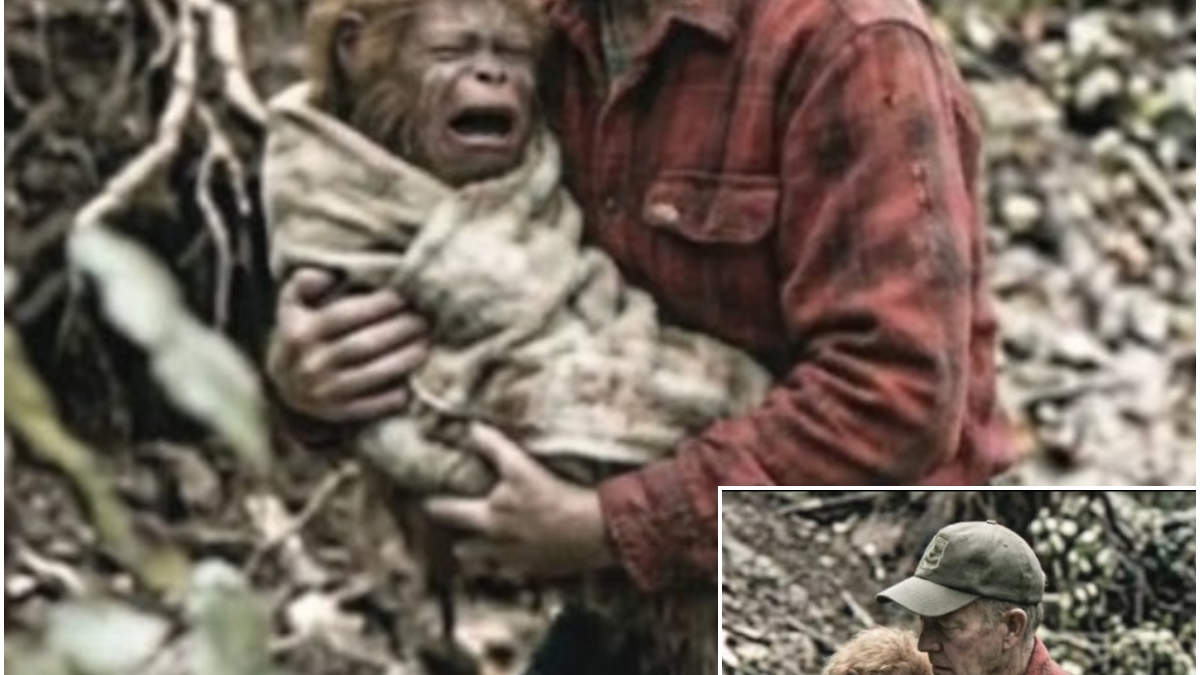
A Forest Ranger Saved a Baby Bigfoot – Before Sunrise, Its Family Came for Him
Bigfoot was pinned under a slab of sandstone the size of a kitchen table when I found it.
A young one, small as a six-year-old child, half drowned in flood water that was still rising, crying in a voice that had words in it somewhere.
And I was the only human being on that side of the Red River Gorge who knew it was there.
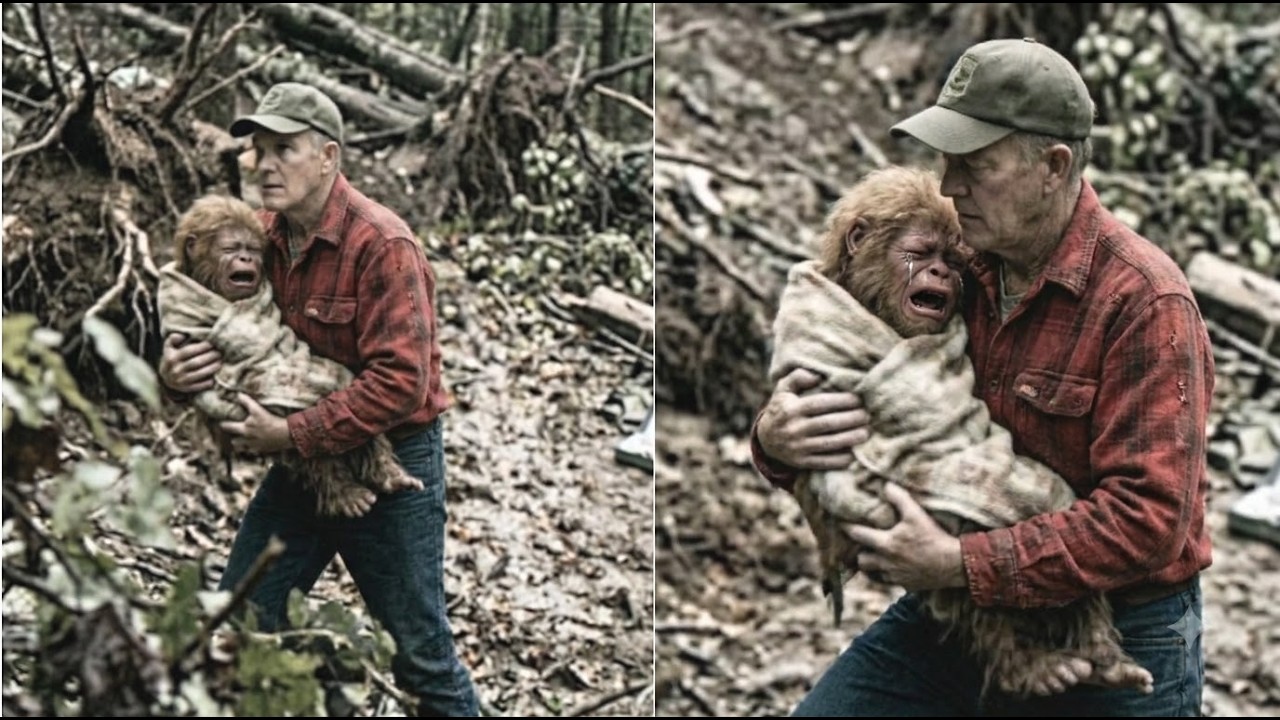
I was a forest ranger in Kentucky with 26 years of service behind me and a book of federal regulations in my truck.
And in the space of one night, I broke nearly every rule in that book.
I falsified a trail closure.
Government equipment left the Gladi barn in my truck bed without a signature.
Medical supplies that were never mine left a locked cabinet in my hands.
And I lied on an official report and let it stand 28 years.
I did all of it to free a child that the world says doesn’t exist.
And I did it knowing that its family was on the cliff line above me the whole time, watching every move I made, deciding what I was before sunrise.
They came down.
What happened in that rock shelter in the dark is the reason I am telling you this now.
My name is Vernon Brooks.
I was born in Powell County, Kentucky in 1944 in a farmhouse off the snaky hollow road outside Stanton.
And except for two years in the army, I have never lived more than 20 miles from the spot where I was born.
My father raised burly tobacco and kept a few beef cattle on a hillside farm that fought him every year of his life.
And my mother kept the books for a hardware store in town and canned enough every August to carry six people through the winter.
I was the second of four.
I came up quiet, the kind of boy who would rather sit on a creek bank than talk.
And my father used to tell people I could wear out a pair of boots without wearing out a sentence.
He meant it as a compliment and I took it as one.
I went to work for the forest service in the spring of 1971 when I was 26 and I spent my whole career in the Daniel Boone National Forest, most of it out of the Stanton Ranger District which in those years covered the country around the Red River Gorge.
If you have never seen the gorge, I don’t have the words to hand it to you, but I will try.
It is a canyon country cut down through sandstone and shale over millions of years, and the hard caprock has weathered into more than 100 natural stone arches, the biggest concentration of them east of the Rocky Mountains.
There are cliff lines that run for miles, 200 ft of sheer rock with hemlock and rodendron packed at the base.
And under those cliffs, the weather has hollowed out rock shelters, some big enough to park a school bus in, dry as a barn loft in a week of rain.
People have sheltered under that rock for 12,000 years.
The archaeologists have proven that much.
What else has been sheltering under it is the subject of this story.
My district ran through Powell and Wolf and Meny counties, and my work was the ordinary work of a ranger in Hill Country.
I marked timber and walked boundary lines.
My days went to maintaining trail heads and cleaned up after careless campers and hauled the occasional lost hiker out of clifty wilderness, which is 13,000 acres of the roughest ground in the eastern half of the state, set aside by Congress in 1985 and left alone since.
I knew that country the way you know the rooms of your own house with the lights off.
Where Swift Camp Creek ran green and where it ran brown after rain.
Which rock shelters stayed dry and which ones wept all winter.
I knew where the copperheads den and where the big timber rattlers came out on the ledges in June to warm themselves.
And I gave both their room.
I married a Stanton girl named Wanda in 1968, 2 years before I signed on with the service.
And we had one son, Carl, born in 1970.
Wanda taught third grade at the elementary school in town for 31 years.
And she understood from the first month of our marriage, that I needed the woods, the same as some men need a congregation.
She packed my lunch in a black metal box every working morning of my career.
And she never once asked me to take a desk.
A man doesn’t get a woman like that twice.
I want her in this story early because she is in the end of it, too.
And the end of it is the part I have waited longest to tell.
For most of my first decade in uniform, I would have told you flat out that the biggest thing living in the gorge was a black bear.
And in those years, even the bears were scarce, still working their way back into eastern Kentucky from Virginia and West Virginia after being hunted out generations before.
Anybody who claimed there was more up in those cliffs than bears and bobcats had been drinking or wanted to sell you a bumper sticker, that was my honest position, and I held it the way a man holds any position he has never had reason to test.
The testing came slow, spread across years.
And I want to lay those years out plain because without them, you won’t understand why I did what I did in March of 1997, and why I did it alone.
The first crack came in October of 1979.
I was camped by myself up Glatty Creek doing a two-day timber stand exam, and in the middle of the night the hollow went quiet in a manner I had never heard in 8 years of sleeping on that ground.
Every night sound I knew, the barred owls, the mice working the leaf litter, the wind in the hemlock tops, all of it stopped at once, the way talk stops in a store when a stranger walks in.
I lay in my bag and listened to nothing for a long while.
And then from up toward the cliff line came a call that I couldn’t fit into any box I owned.
It started lower than any hound, climbed through a range no hound could reach, held at the top for a full breath, and came back down in a run of knocks, wood on wood, deep and spaced and patient.
Then the quiet again.
I didn’t sleep.
In the morning, I told myself it had been a bobcat because a bobcat is what a countryman blames when he can’t name what he heard.
And I wrote nothing in my report because there was no line on the form for it.
5 years went by before the second crack.
In the summer of 1984, I was working a boundary up Swift Camp Creek in laurel so thick you crawl more than walk, and I came out into a seep where a spring kept the mud soft all season, and pressed into that mud was a barefoot track 16 in long, five toes, a clean arch, no claw marks anywhere ahead of it, and a bear leaves claw marks the way a man leaves fingerprints.
The print had sunk near 2 in into ground that barely took my boot heel, and I weighed 210 lb that summer with my pack on.
I stood over it a long time.
Then I did what I still can’t fully defend as a trained federal employee.
I stepped back out of that seat the way I had come, and I didn’t cast it, measure it, or photograph it.
Some part of me understood, without deciding anything that this wasn’t a discovery.
It was a confidence, and confidences aren’t for forMs. After the track, I began to see what I had been walking past for years.
Green saplings twisted off at 9 and 10 ft.
The wood rung apart like a dish rag at a height no bear reaches and no ice storm selects.
Flat stones turned over along the creek in lines too regular for flood work.
Once back in a hemlock flat above Wildcat Creek, a lean of long poles set against a low cliff and woven through with cut boughs.
The ground inside pressed flat, and hanging in it a smell I have never met anywhere else.
Heavy and warm and earthy, like the inside of a den and a wet plowed field at the same time.
It wasn’t foul.
People always expect it to be foul.
It was the smell of a big warm body that lived outdoors and belonged there.
And before this story is over, I would come to know that smell the way I know wood smoke.
I also began to listen differently to the old people.
There was a man named Chester Hall who ran a little store and bait shop out toward Na, born in 1909, who had logged and trapped that country before the government ever owned an acre of it.
Chester didn’t talk foolishness and didn’t suffer it.
But twice over the years, sitting by his stove, he told me in a lowered voice about what his own grandfather had called the cliff people.
He told me the old families never camped under certain arches, never let their dogs run certain hollows after dark, and never spoke of why in front of strangers.
He told me his grandfather had traded with them, leaving apples and saltfish on a certain flat rock and finding jins singh and chestnuts in their place, back when the chestnuts still stood.
All of that I had filed under superstition.
After the summer of 84, I took it out of that file and put it somewhere more respectful, and I started paying attention to which hollows Chester wouldn’t name.
I will be plain about what I did with all of this, which was nothing.
For 13 more years, I did nothing.
And I have come to believe that nothing was the right thing, and that it is the reason everything after happened the way it did.
I didn’t hunt them with cameras.
Nobody at the university in Lexington ever got a call from me.
I didn’t so much as tell Wonder, and I told Wonder everything else in my life, down to the price of fence wire.
What I did was let them be.
I walked my district, and when I crossed their sign, I stepped around it, and once a season or so, without ever admitting what I was doing, I would leave the better half of my lunch on a flat rock up Swift Camp Creek, and not look back.
Sometimes it was gone the next week, and sometimes the coons got it, I suppose, but a man tells himself what he needs to.
19 years I wore that badge before the flood and by the end of them I understood that I wasn’t the keeper of that wilderness.
I was a neighbor in it and the quietest neighbors were the ones who had been there longest.
Now I have to tell you about the rain because the rain is where the story turns and everything about it can be checked.
On the last day of February and the first day of March 1997, a storm system stalled over Kentucky and let down more water than anybody living had seen fall in one stretch.
Louisville took over 10 in in a day and a half.
The Ohio River rose to its worst flood since ‘ 64.
Down our way, the Red River and the Kentucky River came up out of their banks.
The governor called out the guard and whole towns along the Kentucky, Frankfurt and Battyville among them had water in the streets.
In the gorge itself, the creeks turned into brown freight trains.
Swift Camp Creek, which you can wade across on a dry August day without topping your boots, was running 8 and 10 ft deep through the narrows and moving logs the size of telephone poles.
The mountain parkway had slides on it.
Route 715 was closed.
Where the river had taken the shoulder.
It was the hardest water I saw in 35 years of service, and I spent the first days of March doing what every ranger in the district was doing, which was damage assessment, one man to a truck, spread thin over a drowned country.
Those first days of March, I saw things a Kentucky Ranger sees once in a career.
Cattle standing on barn roofs down in the bottoms along the red.
A house trailer wrapped around a bridge pier at Clay City like tinfoil.
The guard running boats down streets in Battyville where I had bought chainsaw files the month before.
Up in the gorge the damage was quieter but stranger.
Whole hemlock flats combed flat in one direction by water that had no business reaching them.
Gravel bars moved a/4 mile.
Trails I had maintained for two decades simply gone, like the country had been picked up, shaken, and set back down slightly wrong.
I logged it all with a clipboard and a camera, one drowned hollow at a time, and I remember thinking the evening of March 3rd, that the flood had rearranged everything in that wilderness but its secrets.
I was one morning away from learning it had rearranged those, too.
On the morning of March 4th, I drew the Swift Camp Creek Trail, or what was left of it.
The rain had quit the day before, and the creeks had crested and started down, but the ground was letting go everywhere.
Slopes so soaked that whole hillside slumped like wet cake.
My job was to walk the trail corridor, log the blowdowns and wash outs and slides, and radio in anything that made the trail a hazard to the public.
Not that the public had any business out there that week.
I parked at the trail head off Route 7:15, a little after 7:00 in the morning, signed out on the radio, shouldered my pack, and went in alone.
The woods were dripping and gray and loud with water, every side drain roaring, and the creek below the trail was still high enough that I could feel it in the ground, a steady shudder coming up through my boots.
2 mi in past the mouth of Wildcat Creek, I found the slide.
A section of cliff line maybe 80 ft wide had let go sometime in the night.
The whole face peeling off the sandstone above and coming down through the hemlocks, and the debris field ran from the base of the cliff clear down to the creek, a chaos of broken rock and torn trees and orange mud.
I had seen slides before.
I stood at the edge of this one making notes for my report.
Slabs the size of truck beds, root balls 12 ft across.
And I was reaching for my radio to call in the trail as impassible when I heard the crying.
I want to be careful here because this is the moment my life divided.
And I have gone over it 10,000 times.
It wasn’t any animal distress call I knew.
And by then I knew them all.
the scream of a rabbit, the ball of a bear cub, the squall of a bobcat.
It came from down in the debris field toward the creek, and it had a shape to it, three notes, rising, breaking, falling, over and over, with breath drawn raggedly in between.
And under the fear in it, there was a reaching, the sound a young thing makes when it isn’t just hurt, but calling for somebody in particular.
Every hair on my body stood up.
I put the radio back on my belt without keying it.
And that small motion, looking back, was the first rule I broke because procedure said, “Report the slide and stay off it.”
And I was already climbing down into it instead.
It took me 10 minutes of picking through wet rock to find the source.
And when I found it, I stopped like I had walked into a wall.
Down near the toe of the slide, where the debris ran into the flood line, a slab of sandstone as big as a kitchen table, had come to rest at a shallow angle against a shattered hemlock trunk, and pinned beneath the low edge of it in a pocket of mud and brown water, was a young one.
I had spent 13 years halfbelieving, and there is no halfbelieving left in you when you are standing 20 ft from the fact.
It was the size of a six-year-old child, but built heavier, covered in dark hair the color of wet walnut hulls, plastered flat with mud.
Its right leg was caught from the knee down between the slab and the trunk.
It had dug at the mud around its leg until its fingers bled.
And the water in the pocket where it lay, was rising off the creek an inch at a time, already up over its hip.
And the crying I had heard from the trail was coming out of a face that I will be seeing on the day I die.
Because it was a face that is what took my legs out from under me.
Not a muzzle, not a snout, a broad, flat, mud streaked face with a heavy little brow and a wide mouth.
And set in it two dark eyes that found mine the second I came around the rock and didn’t let go.
There was a person behind those eyes.
Fear and pain and exhaustion.
And then as I stood there frozen with my breath gone, one more thing that finished me, the hope.
It looked at me, a grown man in a green uniform, the very shape its kind had spent their whole history avoiding, and it stopped crying, and it reached its free hand toward me through the air, fingers spread, the plainest gesture there is in any language on this earth.
Help me.
I have asked myself many times what I thought standing there about the rules, about the phone calls a discovery like that deserved, about the scientists and the agencies and the history books.
The honest answer is that I thought about none of it.
I thought about the water coming up.
I dropped my pack, got down in the mud beside that child, and put my shoulder against a slab of stone that must have weighed a ton and a half, and I heaved until the edges of my sight went gray, and the slab didn’t move a quarter of an inch.
The young one watched me strain, and when I fell back, gasping, it made a small sound, two notes, low, and laid its free hand on my forearm, light as a bird landing.
Its palm was leather.
The heat of it went through my wet sleeve like a stove coal.
We looked at each other, that child and I, both of us understanding at the same time that my back wasn’t going to be enough.
And that was when I heard from the top of the cliff line above the slide, deep and rolling, and close enough to feel in my chest the call from 1979.
I didn’t see anything on the cliff.
The rim was a ragged gray line against a gray sky, hemlock tops and broken rock, and nothing along it moved.
But the call came again, and this time it was answered.
From farther down the ridge, a second voice deeper, and I stood in that debris field with flood water in my boots, and understood several things at once, in the wordless manner you understand things when they arrive too fast for thought.
They were up there.
Likely they had been up there since the slide came down in the night.
They couldn’t get to their child, and I believed I could see why, for the slide was still moving, wet rock ticking and shifting, mud letting go in sheets, and a body, the weight Chester’s grandfather had described, would set the whole face running again, and bury the little one for good.
A 180 lb man was near the limit of what that slope would hold.
They knew it.
I have wondered since how long they had stood on that rim, doing the arithmetic of it, and what it cost them to keep still.
So there it was, laid out in front of me, plainer than any test a man ever sat for, a trapped child, a rising creek, and a family on the rim that couldn’t come down.
And one middle-aged ranger with a government radio on his belt that could have a district crew, a helicopter, and half the state police at that slide inside 3 hours.
I knew exactly what the radio would bring.
It would bring rescue.
And right behind the rescue, it would bring the end of every quiet thing in that wilderness.
Cameras, cages, a federal file with a specimen number in it.
I had spent 26 years watching what happens to a rare thing once the world learns where it lives.
And I looked up at that empty rim.
And I looked down at that child with the water at its ribs.
And I made the decision I would make again this morning.
Nobody was coming to that slide but me.
What I did next is on the record, and the record is a lie, and I am the one who put it there.
I climbed back up to the trail, keyed the radio, and reported the Swift Camp Creek Trail closed by a major slide at the 2-mile mark, unstable and dangerous, recommending no entry by personnel until an engineer could assess it, which in the flood chaos of that week meant days.
Dispatch logged it without a question.
Every word of it was true, and the use I put it to was false as a lead nickel, because what I had just done was hang a no trespassing sign on that child for the only people who might have stumbled onto it.
Then I told dispatch I was returning to the Glatty work center for equipment to flag the closure, which was half true, and I went down that trail at a dead jog, with my heart going like a fence stapler, doing sums in my head the whole way.
The creek had crested the evening before.
It was falling, but the pocket where the child lay sat below a bend that pulled, and rain was called for again after midnight.
I figured I had until the small hours before the water question answered itself, one way or the other.
The drive to Glatty took 20 minutes.
The work center was a mad house that week.
Crews in and out hauling sores and culvert pipe.
And nobody looked twice at one more ranger loading a truck.
I took a high lift jack, a two-tonon comealong with a spare cable, a pry bar, a chainsaw, timber cribbing blocks, two wool blankets, a coil of rope, and a canvas tarp.
And I signed for none of it.
Then I did the thing that shames me most, and that I would still do again.
The old wildlife station kept a locked cabinet of veterinary supplies for injured raptors and deer.
And I had a key from a thorn rescue 2 years before that I had never turned back in.
I took a bottle of antiseptic wash, a suture kit, rolled gauze, cotton wading, and a sack of oral rehydration salts meant for calves.
I stood in front of that open cabinet for a second with my hands full of stolen government property, a Baptist deacon’s son, 53 years old, and the thought came to me, clear as a bell, that my father would have whipped me for the stealing, and then helped me carry it.
Then I shut the cabinet and went.
By noon, I was back at the slide with 60 lb of gear, and the water in the pocket had gained maybe 2 in up over the child’s waist where it lay twisted, and the child was shivering now in long rolling waves, which frightened me worse than the water, because March Creek water in Kentucky runs in the 40s, and shock and cold kill quicker than drowning.
It saw me come down through the rocks, and it made the two note sound again.
And I heard from the rim a single short call come down like a stone dropped in a well.
I chose to take that as leave to work.
I want to tell you what the work was hour by hour.
Because people imagine a rescue is one great heave, and it isn’t.
It is arithmetic and cribbing and patience and it is talking the whole time which I did a river of quiet nothing words.
Easy now easy I have got you hold still for me the words you give a colicky horse and whether the child took the meaning or only the tone it held still and it watched everything I did with those dark eyes and missed none of it.
The slab couldn’t be lifted, so it had to be raised, which is a different thing.
I built a crib of blocks in the mud under the high side, set the jack, and took the weight a click at a time, blocking as I went, a half inch, another, the stone groaning, wet rock ticking all around us on the slope.
And the whole time I felt the cliff at my back, the way you feel a man standing behind your chair.
Twice the debris above me shifted and ran.
Small slides of mud and gravel hissing down within a few yards.
And both times a call came off the rim, sharp and short, before I myself had heard the rock move.
They were watching the slope for me.
It took me until near 4 in the afternoon to raise that slab 3 in, and three was enough.
The leg came free, and when I saw what the stone had done to it, the lower leg swollen tight and dark, a wound along the shin laid open to the bone, I understood that getting the child loose had been the easy half of the night.
The child couldn’t stand, and the pocket it had lain in all night was a death trap with rain coming, so before anything else, I had to move it, and moving it meant putting my hands on it, all the way on it, and lifting.
I got the tarp under it as gently as 40 years of handling hurt livestock had taught me, wrapped both wool blankets around it, worked my arms beneath its shoulders and its good leg, and stood up with it against my chest.
It weighed maybe 90 lb, dense as green oak, and the heat coming off it through the wet blankets was like carrying a wood stove.
It made one sound when the bad leg swung high and short, and then it pressed its face into the front of my coat, and gripped a fistful of my shirt with a hand of four fingers and a thumb, and that grip didn’t let go of me for the next 9 hours.
And there are nights I can still feel it.
There was a rock shelter a/4 mile down the trail on the uphill side, 30 ft deep, dry as an attic, one I had eaten a 100 lunches in over the years, and that was where I carried the child, resting four times, talking the whole way.
The rim followed us.
I never saw them once, but twice a call moved along the cliff line above and ahead of me, handing us down the hollow, as section men used to hand a signal down a rail line, and by the second one, I had quit being afraid of it, and begun to lean on it.
Inside the shelter, I laid the child on the tarp against the back wall, built a fire with down hemlock, dry wood being the one thing a rock shelter always has, and set water to warm in my canteen cup.
Then I unwrapped the leg and went to work by fire light and headlamp, and I will spare you most of it.”
I washed the wound with warm water and the antiseptic, picked the grit out with tweezers from the suture kit while the child dug its fingers into the top and shook and never once tried to stop me.
Packed and wrapped the shin in gauze and cotton and splined the whole lower leg with two straight lengths of hickory I cut and shaved smooth, bound up with the rolled bandage.
Whether the bone was cracked, I couldn’t say, though the swelling argued it.
I mixed the calf salts into warm water and offered the cup.
And the child drank it down and held the cup out for more.
And that small thing, the holding out of the cup, undid me worse than the wound had.
Full dark came on while I worked.
And with the dark, the rain came back softer than the storm, but steady, hissing on the cliff, and pouring off the drip line at the mouth of the shelter in a silver curtain lit by my fire.
And it was some while into that rain, with the child dozing against the back wall and my hands finally still, that I understood we were no longer alone in the hollow.
There was no sound over the rain and the creek.
What there was was the smell, the warm den and plowed field smell off the structure at Wildcat Creek, arriving all at once, thick enough to taste, and the child’s eyes came open, and it lifted its head, and it sent out into the dark past the fire the three note cry I had first heard from the trail, and from the blackness beyond the drip line, close, no more than 40 ft, something answered it low and soft and unbearably gentle.
The sound a mother makes across a dark house.
I hear you.
I am here.
I want to be honest about the next minute because it was the worst fear of my life.
Worse than anything the army showed me.
And it didn’t come from any threat they made.
It came from the arithmetic.
I was a man alone in a hole in a cliff between a family of them and their injured child past midnight, miles from another human being.
and nobody on this earth knew where I was because I had lied to the only people who might have.
If they judged me wrong, I would simply never come home and Wander would spend the rest of her life not knowing, and every choice I had made since morning had built that box around me with my own hands.
The fire snapped once, and I flinched like a boy.
I sat very still beside the fire.
My hands stayed on my knees where they could be seen.
I looked down and not out, the way you stand with a strange dog.
And I waited to learn what I was to them.
And the child, God keep it, answered the question for me.
It reached over, took hold of my sleeve, and pulled my hand across onto its chest, and held it there, and looked out at the dark, and made a sound I hadn’t heard from it before, level and calm.
There is no interpreter for their tongue, and there never has been.
But I know what I believe.
I believe it told them.
What came through the curtain of rain and fire light, bent low under 12 ft of overhang, was the mother.
I say mother because there is no mistaking a mother in any kind there is.
When she comes to her own hurt child.
She was 7 ft and better, wider through the shoulders than any doorway in my house, hair near black and silvered along the arms, and the rain steamed off her in the fire light.
And she filled that rock shelter the way a horse fills a stall, and I sat by the fire with my handheld prisoner on her child’s chest, and didn’t breathe.
She looked at the child, at the splint, at the wrappings, at the fire, at the cup, and last of all at me.
And being looked at by her was like standing water, while a well Witcher walks over you, weighed to the bottom.
Every day of my 53 years, turned over and read.
I should tell you what the hours before she came had been, because they weren’t all woundashing and dread.
I should say, too, that somewhere around 9 that night, the child’s shivering eased, and it grew restless with hunger, and everything I had was a squashed peanut butter sandwich, an apple, and a sleeve of soda crackers I had carried up off the truck seat that morning.
The apple I cut in slices, and it took each slice from my fingers, careful as a communion, and it ate the sandwich in two bites, and then sat looking at the wax paper, turning it over, holding it up to the fire light, working out what it was.
The crackers it didn’t care for, and it handed them back to me.
Handed them, mind you, pressed them into my palm, and folded my fingers over them, which is a thing you aren’t prepared for.
The first time a wild being does it to you.
Afterward, it lay watching the fire, and its eyes would go from the flames to my face and back.
And once it reached out and touched the badge on my coat, one finger, gentle, tracing the shape of it, and I have never been able to wear a badge since without feeling that finger.
By the time the smell rolled in out of the rain, we weren’t a ranger and a specimen in that hole in the rock.
I don’t have a word for what we were.
Kin comes closest and falls short.
Time quit meaning much.
The fire popped and the rain poured off the drip line, and she stood over the two of us and read me, and I made myself sit for it, hand on her child’s chest, eyes down, still as a stump.
Behind her, out past the silver curtain, I could hear others now or feel them, a weight of presence in the dark hollow, and once a young voice out there made a questioning sound, and was answered by a third voice, older and hushed.
The whole family had come down off that rim in the night over ground that had been too dangerous by day, and they had come to a fire, which everything in their history must have told them to run from.
And they had come, because the child was there, and I understood, sitting in the middle of it, that I was watching the same thing that would have happened in my own house, in any house, on any night, since the beginning of houses, the family gathering to the hurt one.
There is nothing on this earth more ordinary and nothing bigger.
At last she moved, and what she did first wasn’t about me at all.
She knelt, and the ground of that shelter carried her weight up through my knees, and she bent over the child, and put her face down against its face, and breathed on it, long, slow breaths.
And the child loosed my shirt at last and took hold of her instead, both hands full of the hair of her arm, and made a small worn out sound, and stopped shaking.
She stayed that way a long while.
Then she turned her head, still bent low, and her eyes came to me from 2 ft away, close enough that I could see the fire light standing in them, and she looked at the splint on the leg and back at me.
And she reached out one hand, a hand that could have closed around my skull like a peach, and held it toward me in the air, open, palm up, and waited.
And I am an old man now, and I have had 28 years to study on what that open hand was asking, and that night I had only fire light and instinct.
I lifted my own hand off the child’s chest, and I laid it in hers.
Her hand closed around mine, the whole of it, wrist and all, and didn’t crush it.
It held it the way you hold an egg, firm enough that it can’t fall, easy enough that it can’t break, and heat poured out of that grip and up my arm.
And she looked at me over our joined hands, and she made a sound.
Three notes, low, soft, falling, aimed at me, and nothing else in this world.
And though there is no dictionary for it and never will be, a man knows thanks when it is laid on him.
I have been thanked by supervisors and senators aids and lost hiker’s mothers, and none of it in 50 years has weighed an ounce against those three notes in that fire light.
Then she let my hand go, laid it back on my knee as carefully as she had taken it up, and turned to the work of the night, which was her child.
And I put another stick on the fire and became what I remained until near dawn.
A neighbor sitting up with the family of a sick young one, keeping the stove going.
Two more came in under the drip line as the night wore once she had shown them it was allowed.
A big male, gray through the shoulders and down the chest, who stationed himself at the mouth of the shelter, with his back to us and his face to the dark, and never once in all those hours turned around to look at the fire, standing his watch.
And a half-grown one, longerlegged than the child, who couldn’t make itself be still, and who worked its way around the fire light an inch at an hour until it was close enough to study me, and then studied me.
my boots, my radio, the fold of my hat with its head cocked until its mother made a low note and it retreated a yard and started over.
Sister, I decided, or near enough.
Sometime past 3:00 in the morning, the rain slacked off to a drip, and the mother crushed something between her palms, leaves, and inner bark of something she had brought in with her, worked it into a wet green wad, and then, watching me the whole time, lifted the edge of my gauze with two fingers, and packed her pus in against the wound, and pressed the wrapping back down, and looked at me until I nodded.
We split the difference, her medicine and mine, under one bandage, and her pus smelled sharp and green over the woods.
I have thought about that bandage every day of my life since.
They left in the gray before sunrise.
There was no signal I caught, but all at once the watchman turned from the mouth of the shelter, and the young one went to its mother, and the mother gathered the child up off the top, blankets and splint and all, easy as a woman lifting a sleeping baby off a couch.
I got to my feet, stiff as a gate hinge, and I did the only thing I could think to do, which was to hold out the sack with the rest of the rehydration salts and the last rolls of gauze.
She took the sack.
She looked at me one last time over the head of her child, the longest look of the night.
And then she was gone through the drip line with the others behind her, and the sound of them going up that flooded hollow was no sound at all.
And I stood alone in a rock shelter at first light with a dying fire, an empty cup, two missing blankets, and the whole rest of my life to figure out what had just been done to me.
What I did first was cover my tracks, and I was thorough about it in the manner of a man who has decided to bury a thing rather than dig it up.
I put out the fire and packed the ashes down under leaf litter.
The jack and the comealong and the cribbing, went back up to the truck in two trips before full light.
I walked the debris field once more, and satisfied myself that the pocket where the child had lain looked like flood rack and nothing else.
That afternoon, I filed my damage assessment listing the slide, the washouts, and 11 blowdowns, recommending the trail stay closed pending stabilization.
And I wrote it dry as a seed catalog, and it went into the file with a hundred other flood reports that nobody would ever read twice.
The blankets I signed off as flood damaged and disposed.
The jack I cleaned and hung back on its pegs.
In a week the district had bigger troubles than one closed trail, and the water went down, and the mud dried, and the world rolled on into spring the way it does, with no idea what it had rolled past.
Two loose ends wouldn’t lie flat, no matter how I smoothed them, and I had better tell them both, because a confession with the hard parts left out is just bragging.
The first was the veterinary cabinet which I had told myself all spring would never be missed and which was missed because the government misses everything eventually except what matters.
The wildlife station ran an inventory that June and the missing supplies turned up on a discrepancy sheet and a biologist named Doris Simmons, sharp as attack and new to the district, walked it over to my office because my name was on the old key log.
I sat across a desk from that young woman and told her I had used the items on an injured deer I found in the flood, which was against policy, and that I would take whatever paper came with that.
She studied me a good while.
Then she wrote it up exactly as I told it, a policy violation, a letter in my file.
And as she gathered her folder, she told me, not looking up, that whatever it had been, she hoped it lived.
I said it did.
That is one of the 10 sentences in this story I would want read back at the gates because it was true and it was the whole truth and it was a lie.
All three at once.
And Doris Simmons knew it and she let it stand.
There are more people like her scattered through the agencies than you would guess.
Quiet ones.
They know what the woods are worth.
The second loose end wore a trooper’s hat.
In April, a Kentucky state police detective named Floyd Jenkins came out to Gladi asking questions on behalf of an insurance company because a man from Ohio had claimed his camper trailer washed away in the flood near the mouth of Swift Camp Creek, and the adjusters wanted to know the condition of the area, and Jenkins had pulled every report with that creek’s name on it, mine included.
He was a thorough man and a courteous one, and he sat in the district office with my closure report on his knee and asked me why I had recommended no personnel entry on a slide I had walked myself alone twice in one day, according to the dispatch log.
I hadn’t thought about the dispatch log.
I looked at that man and he looked at me and I told him the slope had still been moving and I hadn’t been willing to put a crew on ground.
I would only risk myself on,” which was true, and which didn’t answer the question under his question, and we both knew it.
He held my eye a moment longer than comfort allows.
Then he closed the folder and thanked me for my time.
And at the door he stopped and without turning around he told me his own grandfather had run a store at Narda in the 30s and that the old man had kept certain opinions about certain hollows that the family had learned not to laugh at.
And then he wished me a good morning and was gone.
I never heard another word about it.
Kentucky is like that down under the surface.
Half the county knows in the way you know a thing you have agreed all your life not to know.
I went back to the rock shelter the first week of May when the trail officially reopened telling myself I was checking my own work.
The top I had left folded on a dry ledge at the back was where I had left it but not how.
It had been unfolded and refolded in a different pattern into thirds instead of halves and set square in the middle of the ledge.
And on top of it, holding it down, were the two hickory splint boards I had shaved that night, cleaned the bandage windings gone, laid crossed one over the other, and I stood in front of that little arrangement for a long while with my hat in my hands.
It was a message plain as print.
The splint had come off.
The leg had healed enough to take it off.
They knew I would come back, and they had wanted me to find the news waiting.
I sat on the ledge beside those crossed boards, and I let go of a weight I had been carrying for 2 months without admitting it, the fear that I had splined that leg wrong, and lamed a child for life.
Then I did something my raising made natural.
I left the tarp for them, and on it I set what I had brought in my pack on the chance.
A sack of apples, a jar of wander sorghum, and the wool socks off my own feet.
And if you want to know why socks, I couldn’t tell you then, and can’t now, except that it was March cold up in those cliffs at night, and a man gives what he has.
I carried those boards home.
They are in the barn today, wrapped in that same tarp, and my son will find them when I am gone, along with a letter that explains them, which he has been told not to open early, and being my son, hasn’t.
The trade, as I came to call it in my own head, ran for years after, and it ran on their terms, and their calendar, never mine.
I would leave things at the shelter ledge.
Never often, never much.
Apples in the fall.
Sorghum, once a horse blanket the winter of 98 when the ice storms came.
And sometimes what I left stayed a month untouched, and sometimes it was gone in 3 days, and now and again there would be something waiting in its place.
A double handful of chestnuts once, which stopped me cold because the blight took the American chestnut out of Kentucky before I was born.
And yet there they were, real fresh in their hulls, which means that somewhere back in those thousands of acres of cliff and hollow, a few old survivors still stand and bear, and their kind knows where every one of them is, and mine doesn’t.
And I have chosen to find that arrangement correct.
Another time there was a turtle shell waiting on the ledge, cleaned out and polished smooth as a doornob.
Another time laid in a spiral on the top, the shed skin of a big timber rattler, and make of that what you like.
I never showed one of those gifts to a living soul while I served.
Chester Hall, when I finally told him the whole of it, the summer before he died, 91 years old and sharp to the last, laughed until he coughed, and told me his grandfather had gotten the chestnuts, too, and that I had been adopted, was the word he used, and that it was a bigger honor than the government pension.
I saw the child twice more in my life, and both times were given to me, not taken.
The first came in October of 1999, 2 years and a half after the flood, on an evening I had no reason to expect anything at all.
I was up on the rough trail country marking hazard trees, and I came around a cliff corner into a little bench of open woods, and 40 yards across it, standing in the broom sedge in flat evening light, were the mother and the child, waiting, facing my direction, still as two stumps.
And I knew in my bones they had heard me coming for half an hour and had chosen to be seen.
The child had grown a foot.
It stood past 5t now, filled out through the chest, and it was bearing weight square on the right leg.
And while I watched, the mother put her hand on its shoulder and turned it a little as a mother turns a bashful child to face company, showing me, “Look whole, because of you.”
The child looked at me across that bench, and then it raised one hand, palm out, and held it, and I raised mine, and we stood that way, the three of us, while the light went red on the cliffs.
And then they turned into the timber and were gone.
And I sat down on a log and wept like I hadn’t wept since my father’s funeral, from the plain size of being shown.
The second time was the spring of 2005, the year before I retired, and it is the sighting I hold closest.
I had gone up Swift Camp Creek on a Sunday, off the clock, out of uniform.
An old man’s slow walk to the slide, which by then was healing over the way slides do, saplings coming up through the rubble, the raw rock going gray.
I sat down on a boulder at the toe of it, in the very pocket where the water had been rising.
8 years before, and I ate my lunch there, which had become a custom of mine, a kind of standing appointment I kept without knowing if anyone else kept it.
That day, someone did.
It came down the far side of the debris field alone, grown now, 7 ft or near it, moving over that broken ground light as smoke, and it crossed to within 20 ft of my boulder, closer than any of them had ever come in daylight.
And it stopped and we looked at each other, the ranger and the child.
Both of us changed out of all recognition, and neither of us fooled for a second.
It favored the right leg, just barely, a hitch you would only catch if you had built the splint yourself.
Then it crouched and set down on a flat rock between us, what it had carried in its left hand the whole way, and straightened, and gave me the palm, and went back up the rocks, and out of my sight, and out of my life.
For I never saw it again.
On the rock was a hickory stick, green cut, shaved clean of bark, straight as a rifle barrel, the very make and length of the two splint boards I had shaved by firelight in that shelter.
It had made me one.
I am 81 years old, and that stick has stood by my kitchen door for 20 years, and I have walked out to the mailbox on it every morning since my knees went.
And the neighbor women think it is a nice cane my son whittleled and I let them.
I retired in the spring of 2006 at 62 with 35 years of service, a bad shoulder from the jack handle that I never reported, and a plaque that says I gave my career to the protection of the Daniel Boone National Forest, which is truer than the man who engraved it will ever know.
At the dinner, my supervisor told the room that Vernon Brooks knew more about what lived in the Red River Gorge than any man alive.
And everybody clapped, and Wander squeezed my hand under the table, because by then she knew, and she alone.
I had told her in 1999, the night after the bench, because I came home with my eyes cried red, and she took one look and set down her dish towel, and I was done hiding.
She listened to the whole of it at the kitchen table until 2:00 in the morning.
And when I finished, she was quiet a spell.
And then she asked me one question, the rightest question anybody has ever asked about any of it.
She asked what the little one’s voice was like.
Not what it was, what its voice was like.
I married better than I deserved.
Wanda kept it with me for 20 years and never told a soul.
And she died in the fall of 2020 in her own bed with Carl and me beside her and near the end when the medicine had her drifting.
She told me out of a long silence to be sure and take the sorghum up before the cold set in.
Those were among the last things she said.
She had been keeping the appointment in her head all those years, same as me.
I took the sorghum up that November, a widowerower of two months, on a cane in a cold hollow, and set the jar on the ledge, and I told the empty shelter she was gone out loud, feeling like a fool, and I went home.
When I got back up there in April, the jar was empty and clean, and beside it waited under a stone, was laid a sprig of pine, green, cut fresh.
I have heard every explanation a skeptic could offer for every piece of this story, and I can argue most of them respectably, but I have never once tried to argue that Pinesprig, and I never will.
Some things you don’t hand to the arguers.
Some things you just keep.
People will ask, the few who ever hear this, why I never told, why a man who held proof in his two arms chose a closed trail and 40 years of silence.
I will answer it straight.
I have watched what finding does.
The jinseng got dug out of every hollow that ever got named in a magazine.
And the arches in the gorge went from secrets to postcards to places where you wait in line.
And I counted what the coming cost.
A discovery is a door that never shuts again.
The morning I stood in that debris field with the radio in my hand.
I was holding the door knob to the last closed door in Kentucky.
And I set the radio down and I have been certain ever since that it was the finest work of my career.
They were never mine to reveal.
It was never my secret.
It was theirs.
I was allowed inside it for one night because a child was drowning and I was the man on that trail and the only honest repayment of a trust like that is keeping it.
There was one season when the keeping nearly slipped out of my hands, and I owe you that part, too.
In the summer of 2003, 3 years before I retired, a graduate student out of a university in Ohio, got a permit to run a black bear study in the Clifty Wilderness.
Bears being well established again in the gorge by then, and his method was bait stations and film trail cameras, and the permit map crossed the mouth of the hollow below my rock shelter by a/4 mile.
I found the first camera myself on a routine patrol, strapped to a white oak at knee height, aimed up a game trail that I knew for a fact was theirs, because I had been stepping around 16-in prince on it for 6 years.
My heart went downhill fast in front of that little camera box, doing a new kind of arithmetic.
I couldn’t pull the permit without a reason, and any reason I invented would draw more eyes, not fewer.
Touching his equipment meant committing about my fourth federal offense of the decade myself.
What I could do was what a ranger does best, which is be helpful.
And I have never been so helpful to a researcher in my life.
I introduced myself.
I carried his batteries.
Where the bears were, I told him true, and I wasn’t lying, for I took him to every honest bear crossing on that side of the wilderness.
The kind of data a young man builds a thesis on, and every one of those stations sat a ridge, or better, away from the hollows that weren’t mine to show.
When he asked about the game trail by the white oak, I told him the truth as far as it went, that I had patrolled that hollow for years, and never once documented a bear on it.
And he moved the camera to a beach flat where I had seen a SA with three cubs in May, and inside a month he had film of her for his thesis.
He finished in two seasons with a fine study.
And he wrote me a thank you letter, and he never knew.
And if he someday hears this and does the figuring, I hope he will weigh what he got against what he missed and call it fair.
I have wondered whether I wronged him.
I have decided I didn’t.
It wouldn’t have made his name.
It would have unmade a people.
That isn’t a trade any thesis is worth.
I did my own studying in those years quiet at the Stanton Library and later on Carl’s computer because a man who has held one of them in his arms wants to know what he held.
I read what the wildlife biology says about large mammals in the eastern forests, about home ranges and winter denning, and how many pounds of mast a big body needs to see March.
The rock shelter digs in the gorge came next.
The ones that found squash seeds and woven slippers thousands of years old in that dry dust.
And I sat with the thought that people have been living under that rock since before Egypt, and that every one of those generations had neighbors.
And I read the old county histories, the ones nobody checks out, and found the same thread Chester had handed me, spelled different ways.
A line in a settler’s letter from the 1840s about the hairy folk of the cliffs that the Shauny had warned about.
A newspaper squib from Battyville, 1897, about a wild man seen by a timber crew that the editor ran as a joke.
It is all there, thin as a seam of coal, running under two centuries of paper.
Nobody mined it because nobody believed the seam was real.
I had stopped needing to believe, belief is for things you haven’t carried.
What I concluded, for whatever an old rers’s conclusions are worth, is that the gorge is near the only country left in Kentucky that could hide them.
And it hides them by being what it is.
13,000 acres of wilderness where no wheel is allowed inside a national forest of 700,000 acres.
All of it stood on end so that 10 mi on a map is a day and a half on foot.
Hundreds of dry hidden rock shelters warm out of the wind.
Half of them unreachable without rope.
Water everywhere.
Acorns and hickory nuts by the ton in a mast year.
Pawpaw in the bottoms and back in there somewhere.
Chestnuts the blight never found.
A black bear can live a whole life in there and be seen four times.
A people smarter than bears and raised from birth to treat my kind as weather could live there a thousand years has I would say is I want to set down what Chester Hall told me the summer before he died because he was the last of the ones who had it from before the government came.
And when a man like that goes, a library burns.
We sat on the porch of his store two evenings that August, him 91, and running the register still, and once he understood that I wasn’t asking out of curiosity, that I had been inside it myself, he opened up the whole ledger.
His grandfather had settled below the cliffs in the 1870s, and the trading rock had come down to him from a family already there, along with the rules, which Chester recited to me like scripture, because to him it near enough was, “Never follow, never watch the rock.
Don’t bring another soul, not kin, not clergy, no meat in warm weather, and never take the first gift offered after a death in either family, but always the second.”
That last one stood the hair up on my arms, sitting on that porch, because of the pineprig that was still 5 years ahead of me, waiting.
When it came, I left it lie a weak and went back, and it lay there still, and I took it.
And if you think an old man is stitching his life together out of coincidence, you are welcome to, and you weren’t there.
Chester told me the trading stopped for his family in the 1930s when the logging railroads cut the last big timber out of the gorges and the quiet went out of the country for 30 years and his father judged that the cliff people had drawn back into the deepest rock to wait and that it wasn’t for men to pester them there.
He told me the old families never doubted they would outlast the sawmills and they did.
And he told me one thing more, leaning close over the checkerboard, that I have saved for near the end of this telling because it belongs there.
He told me his grandmother, as a girl in the 1890s, had been lost in a January storm hunting a strayed milk cow, and had been found at the foot of the cliffs the next morning, asleep and warm under a pile of broom sedge and leaves that no storm builds, with big bare tracks all around her in the snow, and that she never spoke of it in company, but that every Christmas Eve of her long life she carried a basket of cornbread and apples up to a certain rock and her husband never once asked her where she was going.
Kindness answering kindness back and forth across a hundred years under all the history that got written down.
That is the true ledger of those cliffs.
I am one line of it.
My son Carl knows the whole of it now.
I told him the year after his mother passed, sitting in the barn with the splint boards unwrapped on the workbench between us.
Because a secret this size has to be handed on warm, not found cold in a letter.
And I learned that watching Chester do it for me.
Carl is 55, an electrician in Winchester, and he heard me out the way Wonder had without one interruption, and when I finished, he picked up one of the boards, and turned it over in his hands a long while, and then he asked me to show him the shelter while my knees could still make the walk.
We went up the next October, slow, half a day for what I used to do in 2 hours.
And I showed him the ledge, and we left Apples and Sorghum together, father and son.
And coming down, he walked ahead of me on the trail, and I watched his head turning, reading the cliff line, the way I have read it for 50 years, and I knew the appointment would be kept after me.
That is as close to peace as a man my age gets on the subject of his own funeral.
He asked me on that walk whether I thought they remembered me all these years on, or whether I had long since faded back into the general run of my kind, one more green truck on a gravel road.
I told him what I believe, which is that they don’t remember the way we do, in stories we polish, but in something steadier, the way ground remembers a spring.
The proof of it is small and quiet.
And it has come to me a piece at a time across the years.
Never asked for, never announced, the same as everything else they ever gave me.
And I will lay the pieces out for you now and let you weigh them yourself because it is enough for me.
Every jar comes back clean.
The second gift is always there to take.
And four years ago, the last time I made the full walk up before my knees closed that door, there was a young one’s track in the soft ground below the ledge, a print no longer than my hand, toes spled, pressed deep beside a grown ones, and the grown one’s right foot.
I measured it twice, bore off just slightly on the outside edge.
The print of a walker with an old hitch in that leg, favoring it yet healed these 20 odd years, but marked the way we are all marked by the knights.
Somebody sat up with us.
It has children now.
It brings them to the rock.
Whatever I am in their tongue, a sound, a smell, a story for the little ones under some dry cliff on a winter night, I am in it somewhere.
The same as they are in mine, and neither of us needs the others name for it.
Doris Simmons crossed my path once more, and the crossing deserves telling.
She came to my retirement dinner in 2006, 12 years into a career that had carried her up to the forest supervisor’s office in Winchester, and after the plaques and the cake, she found me by the coffee earn, and she stood there stirring a cup she never drank, and she asked me, quiet, under the noise of the room, whether the deer had had any thorns since.
I looked at that woman a long moment.
Then I told her there was a whole family of them doing fine back where nobody would ever count them.
And she nodded once like you nod at the end of church.
And she touched my arm and walked off and we never spoke of it again.
She retired herself a few years back.
Somewhere in Kentucky tonight, there is a sharp retired biologist who has known one true corner of this story since June of 1997 and has kept it folded away for love of the same woods I love.
I hope she hears this.
She will know which sentence is hers.
People ask what I never did, and the never list matters as much as the rest.
I never photographed them, though I carried a government camera on my hip for 35 years and had them in front of me in good light more than once.
I never cast a track, never kept a hair from the blankets, never marked a map, never wrote a private page, never breathed a word within a mile of anybody holding a recorder until this one.
Made now because I am 81 and the last keeper of the where and the where dies with me either way.
What I am leaving is the what and the why.
And I have gone back through every sentence of this account weighing it on one scale only whether it could ever be bent into a map and what could be.
I burned before I began.
You could search those cliffs for 10 years with what I have given you and find pawpaws and copperheads and the best sunsets in the state.
Good.
Go do that.
It will be the finest failure of your life.
I have thought a great deal in the slow years since Wonder Went about what that night actually was under the rules I broke and the reports I bent.
The government would call it misconduct.
And by the book it was, and I signed the book of my own free will in 1971, and I don’t sneer at it.
That book kept those forests standing.
The book is why there was a wilderness left for any of this to happen in.
But a book is written for the country a man expects to walk through.
And no book ever printed had a page for a drowning child of another people and a family stranded on a rim.
And when the country and the book part ways, a man finds out in about 4 seconds which one he actually serves.
I found out at 9 on the morning of March 4th, 1997 with a radio in my hand.
And I have never once in 28 years of turning it over wished I had keyed that microphone.
Every other regret of my life I will carry to the grave and argue with on the way.
Not that one.
That one sits in me, quiet as the shelter itself.
And I think about the open hand, hers held out over her hurt child in the firelight, waiting for mine.
I have had a long time to study on why she did it.
A being that strong, that hidden, that schooled by 10,000 years to give my kind nothing, offering her open hand to a man of the exact tribe that had flooded her woods with roads and rifles and noise.
What I believe now is that it was the plainest thing in the world.
I believe she did it because it needed doing because her child had chosen me first and she wasn’t too proud to second the motion because gratitude that stays inside the chest is only halfborn in her kind the same as mine.
And I believe this is an old man’s belief and I claim no more for it.
That she knew what she was doing to me when she did it.
That she knew a man who has been held like an egg by a hand like that can never afterward be entirely the same size he was and that this was the payment, the only coin they deal in.
Not the chestnuts, not the cane, the hand.
She made me bigger than I had been.
And then she trusted me to spend the rest of my life fitting the new size.
And I have tried, Lord, I have tried.
Whether I have managed it is for whoever measures such things to say, but the trying has made a good life.
So here it is, the whole of it, told at last by an old widowerower in Powell County, Kentucky, with a hickory cane by the kitchen door, and two shaved boards wrapped in a tarp in the barn, and a pineprig pressed flat in the family Bible between the births and the deaths, which is where it belongs.
I broke every rule that mattered and kept the only one that mattered more.
And somewhere up in those cliffs tonight, in some dry room in the rock, with the winter coming on, there is a family lying warm together.
That would be short one member if a quiet ranger had walked his trail 10 minutes faster or slower on a flooded March morning.
The one I carried is grown, and its children have stood at the trading rock.
And the water that nearly took it has gone down the red and the Kentucky and the Ohio, and out to the sea, and come back as rain 100 times since, and the cliffs haven’t moved, and the arrangement holds.
I am not asking you to believe me.
Belief is your own to spend.
I am asking you the thing the whole story has been walking toward.
The thing Chester asked me, and I asked Carl, the only thing that was ever really asked of anybody in it, if the woods ever hand you a secret of this size, and you would be surprised how often they are still handing them out to the quiet ones, keep it the way you would keep a child out of flood water with both arms, with your whole weight, without counting the cost, and without ever once expecting the world to thank you.
The world won’t know, the mountain will.
That has been enough for me for 28 years.
And I find coming to the end of the telling that it is enough for a life.








