A Dying Bigfoot Used Its Last Breath to Warn Me – What I Learned Was Unbelievable
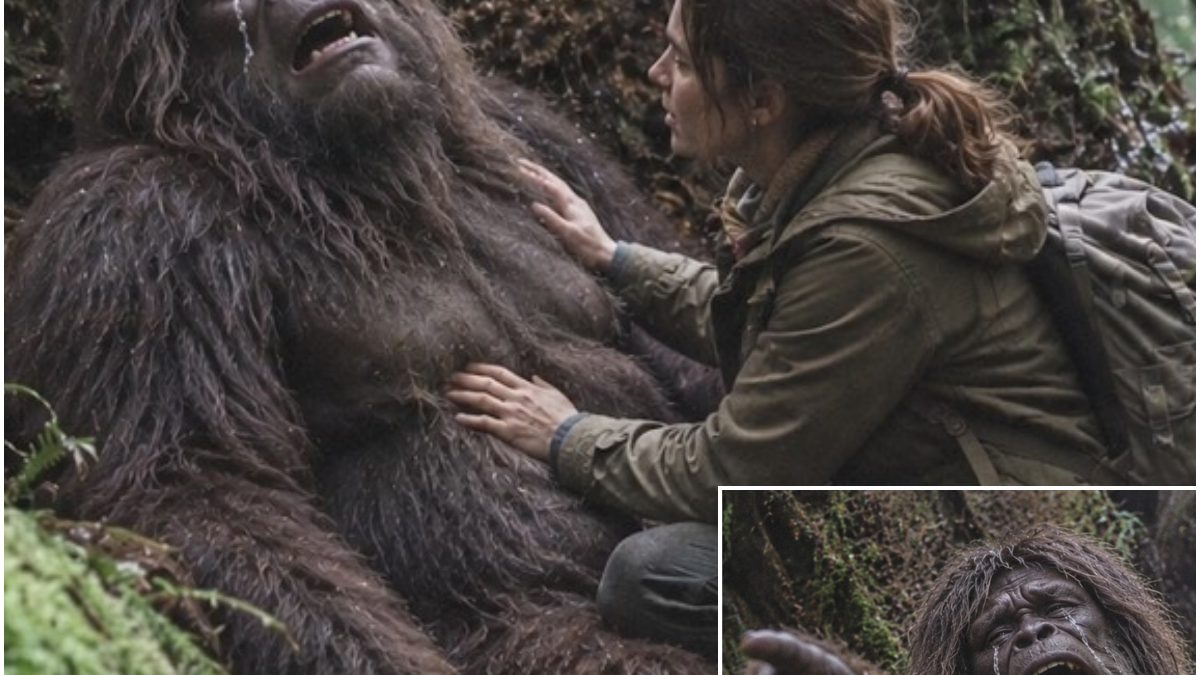
A Dying Bigfoot Used Its Last Breath to Warn Me – What I Learned Was Unbelievable
The morning I found the Bigfoot dying on the ridge above Hazel Creek, I did not know right away what I was looking at.
That sounds strange, I realize, given that what I was looking at was enormous and upright and breathing.
But the mind runs through its inventory fast when it encounters something that breaks every known category.

Trying each familiar label and discarding it until the only option left is the one it has been avoiding.
So I went through bear first, then some hiker in serious trouble, then a trick of the September light filtering through hemlock canopy.
By the time I had closed to 30 ft and all of those explanations had failed, the decision about whether to run was no longer relevant.
I was already there, and whatever was lying on that mossy bench against the root mass had already noticed me and was looking back with eyes that were not the eyes of a bear, not the eyes of anything I had a name for, but were absolutely and unambiguously aware.
I kept that morning inside myself for 31 years.
I did not tell my husband until 2009.
I never told my daughter at all.
Not because I thought she couldn’t handle it, but because the secret carried a weight that I did not want to put on anyone who hadn’t earned the right to hold it by being present when the trust was extended.
And the trust was extended in a specific way toward me on a specific morning in September of 1993.
And honoring it meant keeping it until the time was right.
I am 71 years old now, and the time is right.
Before we go any further, I want to say something to the people who found their way to this channel.
If you are here because you have always understood in some part of yourself that sits below the level of argument that what lives in the old mountains is not fully accounted for by any map or field guide or scientific consensus, then you already know why someone carries a story for 31 years rather than hand it to a world that would misuse it.
Subscribe and stay.
There are more accounts like this one, and they deserve to be heard in a place built to receive them.
My name is Betty Lewis.
I was born in July of 1952 in Bryson City, North Carolina, which is the county seat of Swain County, and sits in a bend of the Takasigi River about a mile and a half from the southern boundary of the Great Smoky Mountains National Park.
My father, Garland Lewis, worked for the county road department for 33 years, grading and maintaining the mountain roads that washed out every spring and froze every winter and kept the road crew in permanent employment.
My mother, Edna, worked at the dime store on Main Street 4 days a week and ran our household with the focused efficiency of someone who understood that efficiency was not optional when there were three children and one income.
My brother Dale was 6 years older than me and largely grown before I was formed enough to know him well.
My sister Mildred was 3 years younger and is still in Bryson City today, running a fabric shop on Everett Street that she and her husband built from a small alterations business in the 1990s.
I tell you about Bryson City and Swain County because the geography of where you grow up is not background, it is formation.
Swain County is among the smallest counties in North Carolina by population and among the largest by the percentage of its land that is federally managed.
The national park alone covers over half the county.
Add the Nahala National Forest on the south end and the Cherokee lands to the west and what you have is a place where the developed world and the wild world share borders along every ridge and down every drainage.
And the children who grow up there understand by the time they are old enough to understand anything that there is far more country beyond the paved road than on it.
I was climbing ridges behind our house before I was in first grade.
I was fishing Hazel Creek with my father before I knew what a national park was, using the boat he kept at the Fontana Lake Marina to cross the water and reach the trail.
He had an understanding with a fellow who held a seasonal NPS permit for non-motorized access on the lake.
And we went across three or four times a year, spring and fall mostly, when the trout were running in the creek.
Those trips were among the most important experiences of my childhood, though I could not have told you so at the time.
What I knew was that when we crossed the lake and the boat touched the far shore and we started up the trail through the hemlocks, the world changed.
The sound changed, the smell changed, the quality of the air changed.
Everything about the Hazel Creek drainage was older and denser and quieter than anything on our side of the water.
And I found that I breathed differently in it, slower and fuller, the way you breathe when you have arrived somewhere you were meant to arrive.
By the time I was 14, I knew the lower section of the Hazel Creek Trail, as well as any grown person in Bryson City.
By 16, I had walked as far as the old Proctor settlement, and back in a day, 8 miles each way over terrain that rises and dips and crosses the creek seven times on foot bridges and twice more on rock fords where the water runs low in August.
Proctor is a ghost town now and was already mostly ghost in my childhood.
The TVA built Fontana Dam in the mid 1940s, completing it in 1945.
And the reservoir that backed up behind it covered the road that had connected the Hazel Creek community to the outside world.
The families who had farmed and logged there for generations had to leave.
Some of the buildings were salvaged, moved to higher ground, or dismantled for their materials.
Others were simply left where they stood and the water rose around them and they slowly gave way to rot and weather.
By 1970, when I was old enough to walk far enough to reach Proctor, what remained was the ghost of a place.
Stone foundations in the timber, a chimney standing alone where the cabin around it had long since fallen, concrete footings for a building whose purpose no one local could agree on, and most remarkably, the Calhoun family cemetery on a rise above the creek, fenced in rusting iron and still legible in its carved dates, proof that people had lived and died and been laid down in this ground before the park decided it was federal land.
My father knew the history.
He was born in 1926 and had cousins who worked the old pre- park timber operations in the Hazel Creek drainage before the cutting rights were bought out and the families relocated.
He did not romanticize what had been lost.
But he did not pretend it had not happened.
And he made sure I understood that the country we were hiking through on our fishing trips was not empty land that the park service had invented.
It was country with a history with people whose grandchildren still lived in Bryson City and bought groceries at the same store we did.
I mention all of this because the relationship I had with the Smokies was not the relationship of a visitor.
It was the relationship of a person who grew up on the edge of something vast and understood through accumulated years rather than through any formal instruction that the vast thing was not fully knowable and was not interested in being fully known.
The mountains had their terms and you worked within them or you had a bad time.
That understanding is what made me good at my job and it is what kept me alive and unharmed on the morning in September of 1993 that I am here to tell you about.
I joined the National Park Service in 1979, the summer I was 26 years old and had decided that the computer programming courses I had been taking at Western Carolina University were not going to lead me anywhere I wanted to go.
I had spent 2 years in those courses at my mother’s urging because she wanted me to have a career that would outlast my knees and she was not wrong about the knees.
But I could not make myself care about the work, and I had learned early that I was not built for indifference.
I left the university without finishing the degree, drove to the park’s south district office in Cherokee, and applied for a seasonal trail maintenance position.
The woman who interviewed me asked why I wanted the job.
I told her I had been hiking those trails since I was old enough to walk them, and I thought I could do the work better than most people who would apply.
She looked at me for a long moment and asked if I was prepared to spend days at a time in the back country with limited access to emergency services.
I told her I had grown up a mile and a half from where we were sitting and had been doing exactly that since childhood.
She hired me.
The seasonal work became a permanent appointment in the following spring.
I worked as a trail crew member for eight years under a crew chief named Clyde Dodson who had been doing backcountry maintenance in the Smokies for 24 years and who had opinions about trail drainage and erosion control that he was prepared to defend at considerable length against anyone who challenged them and who was usually right.
Clyde was a compact, deliberate man from Mon County who moved through difficult terrain with the unhurried precision of someone who has long since stopped needing to prove anything to the mountains.
He taught me what school had not.
How to read a hillside for its failure points.
How to pack a mule load so that nothing shifted on a switchback.
How to find water in a drainage that looked dry from the trail but held it underground if you knew where to dig.
He also taught me the thing that matters most in the back country, which is how to be still.
Not how to wait, how to actually be still.
There is a difference.
Waiting is active.
Stillness is something you fall into.
And when you find it in the right place at the right time, the forest begins to show you what it usually keeps private.
By 1987, I had become crew supervisor for the North Carolina side of the park, responsible for the maintenance of approximately 212 mi of trail across the most remote drainages the Smokies contained.
I oversaw a rotating crew of 8 to 12 workers, planned the maintenance schedules 3 months at a time, coordinated with the NPS district office in Okanoli, and made the field calls that determined when weather or terrain was too dangerous for the work to continue.
I also went into the field myself for the more complex assessments, the ones that required someone with long institutional knowledge of specific drainages because the details that make the difference between a sound repair and a failed one are often not visible in a report or a photograph.
You have to walk the ground.
In September of 1993, I was 41 years old.
I had been in the park for 14 years and knew the North Carolina back country as well as anyone alive.
My husband, Gerald, who worked for the county utilities department and who had the patience of a man who had spent 20 years married to someone who was gone for days at a time, was home in Bryson City with our daughter Charlotte, who was 15 and had inherited neither my love of the back country nor my mother’s patience for school work, but had developed a genuine facility for art that we were beginning to understand was not a hobby at all.
The household was steady.
The work was steady.
I had been doing the job long enough that the unusual moments were infrequent, and the routine was deep and satisfying in the way that any craft satisfies when you have been at it long enough to stop thinking about the mechanics and simply do the thing well.
The Hazel Creek trip in the second week of September was a standard maintenance assessment.
Three days, two crew members covering the 12mi length of the Hazel Creek Trail from the Fontana Lake access at Proctctor up to the trail junction near the Hazel Creek backcount campsites and back.
We were checking the bridge structures, noting winter damage that would need repair teams in spring, clearing blowdowns from the previous August storm that had not been fully addressed in the summer maintenance cycle, and doing a preliminary assessment of the creek bank erosion above campsite 83 that the seasonal rangers had flagged in their summer reports.
My two crew members were Bobby Ferris, who had been with the park crew for six years and was one of the most reliable trail workers I had supervised, a man from Graham County who could read a slope the way a doctor reads a face, and Doug Treadway, who was in his second season and still learning, but learning quickly.
Both were solid in the back country, competent with the tools, and accustomed to the rhythms of a multi-day maintenance trip without the kind of complaint that makes difficult work harder.
We took the NPS ferry across Fontana Lake on the morning of September 12th, a Saturday.
The lake in September is a different body of water than the lake in July.
The tourist activity is winding down.
The water has dropped from its summer level to expose pale bands of shoreline clay.
And the surrounding ridges show the first faint color change in the sourwood trees.
A deep rust at the tips of the branches that runs ahead of the main fall color by 2 or 3 weeks.
The morning was clear and cool around 54° when we loaded our gear onto the small flatbottomed ferry that the park uses to serve the backcountry campsites along the northshore of the lake.
The ferryman was a seasonal employee named Pete, who had been making that crossing for going on 12 years, and who knew by the weight distribution of our packs that we were maintenance crew rather than recreational hikers.
The crossing takes about 20 minutes.
When the far shore came up and the bow touched the gravel at the Proctor Landing, I felt the familiar shift that I had been feeling since childhood, that change in the quality of attention the Hazel Creek drainage requires of you.
The hemlocks were dense above the landing, their flat needles absorbing the morning light and turning it green.
The creek ran clear and low in its late season channel, 30 ft wide at Proctor and thinning as you moved up.
The old Calhoun house stood at the edge of the clearing in its familiar state of managed deterioration.
The NPS having stabilized the structure enough to prevent collapse without attempting restoration.
We moved up the trail at the measured pace of people who had a long three days ahead of them and no reason to rush.
The hemlock canopy was thick enough on the lower section that the morning light reached the trail floor filtered and diffuse, the kind of light that makes the moss on the roots look lit from within.
The air was damp with the previous night’s dew, and the permanent moisture that comes off a mountain creek, and it smelled of bark, and the faint sweetness of the Carolina silverbell trees that grew in the understory along the lower section, and the rich earthiness of the rotodendran thicket that pressed in on both sides of the trail, where the light broke through enough for them.
We found the first blowdown about a mile up from Proctctor, a tulip popppler that had come down across the trail in August and been roughly cleared by a volunteer crew, but left a section of the trunk still blocking the full width of the path.
Bobby had the crosscut saw out before I had finished assessing the work needed.
We cleared it in 40 minutes, treated the cut faces, moved the sections to the downslope side of the trail.
Doug found a second smaller blowdown a/4 mile on a red maple that had barely touched the treadway and needed only the overhanging branches cut back.
By midday, we had covered 4 miles and reached campsite 83, where we stopped for lunch on the flat ground beside the creek and checked the sight’s fire ring and bear cable system, both in good condition.
The second day was the harder day in terms of terrain.
Above campsite 83, the trail begins to gain elevation more seriously, climbing in switchbacks through stands of old growth oak and hickory before descending into the next creek drainage and rising again.
The upper section of the Hazel Creek drainage is the most remote part of the trail, rarely seen by anyone who is not specifically going there.
The last time any significant number of human beings had a reason to be that far up was during the logging operations that ended when the park was established in the early 1930s and the forest had been recovering and thickening since then with a patience and completeness that reminded you every time you walk through it how long the work of nature takes and how steadily it proceeds.
60 years of recovery had produced something that was beginning to approximate old growth in its density and its layering, even where the original old growth had been cut.
The second night we camped at a flat site I had used many times over the years off the main trail on a bench above the creek where a seat produced a small reliable water source and the hemlock canopy was dense enough to provide reasonable shelter in light rain.
Bobby cooked the evening meal on the camp stove.
A proper beef stew from dehydrated supplies that he had been making on these trips for years, and that was considerably better than what most people managed in the back country.
We went through our notes for the next day.
I had planned to send Bobby and Doug to assess the foot bridge on a side drainage that the district office had flagged as a priority while I covered the remaining section of the main trail assessment on my own and met them back at 83 by early afternoon.
This was not unusual.
I regularly worked solo sections of assessments when the terrain was familiar and the crew had more ground to cover than could be managed together efficiently.
On the morning of September 14th, I left the camp at first light just after 6:00.
Bobby and Doug would be moving an hour behind me and heading east toward the side drainage.
The main trail section I needed to cover was 2 mi uptrail, and I planned to extend the assessment onto a short loop over the ridge that I had been meaning to document for two seasons, but had not had time to reach.
The loop was not on any current maintenance schedule.
It ran over an unnamed ridge through a stand of old hemlock and rejoined the main trail about a mile below campsite 83.
I had hiked it once before in the fall of ‘ 91 and had noted at the time that it needed a drainage swale at the lowest point and some treadway work on the upper switchback.
Two years later, I still hadn’t gotten crews in there, and I wanted to update the assessment so I could make the case for putting it in the next season’s schedule.
The September morning in the upper Hazel Creek drainage is a specific thing I cannot fully reproduce in description.
The temperature was 49° when I left camp.
The hemlocks above the creek were releasing dew from their needles in a fine continuous drip that you could hear but not see.
A sound like the ghost of last night’s rain still working its way down.
The creek itself was low enough that I could hear the individual stones the current was working over.
A higher, more complex sound than the smooth rushing of the spring runoff creek.
A wood thrush was singing in the lower canopy, its notes bending and spiraling in the way that had always made me stop walking when I heard it.
That particular improbable beauty that seems too elaborate for so small a bird.
I stopped for about 30 seconds to listen, which is the kind of thing you can only do when you are not behind schedule, and on a morning like that one, I was not behind schedule.
I left the main trail at the junction I had marked in my field notebook the previous fall, picking up a faint use trail that angled up the north slope of the ridge.
The used trail was barely there at that point in the season.
The summer’s growth of fern and trout lily having softened its edges considerably, but the line of it was still readable in the angle of the ground and the slightly more compacted soil where the trail tread had built up over decades of foot traffic.
I followed it up through mixed hardwood for about a/4 mile and then the slope tilted more steeply and the hardwood gave way to hemlock and the quality of the world changed.
A hemlock grove in the Smokies in September has a particular quality of silence that is different from any other silence these mountains produce.
Hemlocks absorb sound in the way that water absorbs heat gradually and completely so that after you have walked into a stand of mature hemlocks and the last sounds of the creek and the wind in the hardwood canopy have been damped away.
What remains is not quiet, but a quality of thickness, as if the air between the trunks has a texture to it.
The light is dim and green and directionless.
Your footsteps on the needle carpeted ground make almost no sound.
You begin after a while to hear things you would not have heard on the main trail.
The drip of resin from a branch 40 ft up, the small rearrangement of a squirrel in the upper canopy 200 ft away, and eventually on that particular morning, a sound I had never heard in 30 years of walking these mountains.
The smell came first.
I was perhaps 100 yards into the hemlock stand, moving up slope on the used trail at a steady pace when it hit me.
I have tried many times over the years to describe that smell precisely, and I always arrive at the same inadequate place.
It was animal and warm and organic with a richness to it that had nothing rotten in it.
Nothing wrong, just an intensity that had no equivalent in anything I had encountered before in the field.
Not bear.
Bear has a sour edge to it, a faint rancidity that is distinctive and that I know from 30 years of working bear country.
This had no sour edge.
This was warmer than bare, deeper, more complex, a smell that seemed to come from something alive at depth, a richness the word musk does not capture, because musk implies thin and directional, and this was pervasive.
It filled the entire volume of air in the hemlock stand, as far as I could tell, in every direction.
I slowed without deciding to slow.
The body makes these adjustments faster than the conscious mind can authorize them.
And the body in mountain country has been calibrated by years of experience to distinguish between stimuli that require speed and stimuli that require its opposite.
This required stillness.
I went still and I listened.
The hemlock grove was quiet, more quiet than it had been before the smell arrived, which was itself a piece of information.
Forest animals do not produce silence around themselves.
Silence is what other animals produce in response to something they have assessed as worth being quiet near.
[clears throat] The wood thrush I had heard from the main trail had stopped.
The small sounds of squirrel activity in the canopy had stopped.
What remained was the drip of resin and the distant sound of the creek far below.
And underneath those sounds, a low, slow vibration I felt before I heard it, working its way through the ground and into my boot soles and upward through my legs into my chest.
I stood still for 3 or 4 minutes, breathing slowly through my mouth to reduce my noise profile and to take in as much of the smell as I could, which sounds like an odd thing to do, but which was automatic at that point.
The same information gathering I would have done with any unusual sign.
Then I heard the breathing.
It was to my left ups slope from a direction where the used trail crossed a small bench of flat ground maybe 30 yard above me.
The breathing was slow and effortful.
Each inhale drawn in with a wet congested quality that I associated with respiratory distress, and it was far too loud and too deep to belong to any animal I could name.
Each exhale was followed by a brief pause and then that subsonic vibration resuming in the ground as if the breath and the vibration were connected.
One the surface expression and the other the deeper frequency of the same process.
I moved up slope carefully one foot at a time using the hemlock roots as footholds where the soil was loose on the steep sections.
Keeping my center of gravity low and my movement as quiet as the terrain allowed.
The smell intensified as I climbed.
By the time I could see the edge of the bench through the trunks, it was strong enough that I could taste it on the back of my tongue.
I came around the base of a hemlock that was nearly 4 ft in diameter, a tree that had been growing on this ridge for several hundred years, and I stopped.
It was on its side against a massive root mass, where the hemlock’s base had heaved the ground into a low wall of exposed wood and stone.
One arm was extended along the ground, palm down, the fingers spled slightly.
The other arm was drawn in against its body.
Even in the position it occupied, I could see it was enormous.
The legs were long, far longer than a human’s atroportional scale, and the body mass was impossible to estimate precisely because it was partially folded at the hip.
But the word massive is not adequate.
The shoulder and chest were wide enough that the space they occupied simply read as wrong.
When measured against any reference my experience provided, the hair covering the body was dark, a near black brown, so deep in the dim hemlock light that it read as black, dense, and close lying across the shoulders and chest, and thinner on the face.
The face was turned slightly toward the open space above the bench, where the canopy broke, and a narrow strip of sky was visible.
The brow was heavy, projecting forward over deep set eyes that were brown and reflective.
The jaw was wide, the nose broad and flat, the mouth closed.
The overall impression was of a face that occupied the territory between human and not human without belonging completely to either side.
And what was in the expression on that face?
What I saw with absolute clarity from the moment I rounded the hemlock trunk was pain and awareness and a patience, the particular stillness of a being that is not confused about its situation and has moved past the acute stages of fear into a quieter place.
The eyes found me immediately when I appeared around the trunk.
They did not widen.
They did not show the alarm that would have sent any healthy large animal out of there in a controlled panic.
They simply tracked to me and held the way a person’s eyes hold when they have been waiting for someone and the waiting is now over.
I stood at the base of the hemlock and I did not move.
The breathing continued, the vibration continued.
The smell was very strong.
My radio was on my pack strap and I closed my hand around it and held it there and I stood with it in my hand and did not press the transmit button.
And the reason I did not press it is not something I can reduce to a single rational explanation.
Part of it was professional.
I did not know what I was dealing with and I had been in the field long enough to know that calling in a situation before you understand it is often worse than taking a moment to understand it first.
Part of it was something less articulable, a feeling in the chest that the transmit button was not what this moment required.
I set the radio back and I sat down on my pack cross-legged at a distance of about 20 ft, not advancing, not retreating.
20 ft and I sat down.
The being on the bench watched me sit.
The labored breathing did not change.
The vibration continued its slow subsonic pulse.
I looked at it and it looked at me and the hemlock grove held us both in its green dimness and the September morning moved around us without reference to what we were doing.
I sat there for a long time long enough to study the injuries without moving any closer because the injuries were apparent even at 20 ft.
The right side of the chest where the dense dark hair had matted and darkened with dried blood told me something had happened to the ribs on that side.
The right leg was positioned at an angle the hip joint should not have allowed, suggesting a break or a displacement at some point between the hip socket and the knee.
When the being shifted slightly during an exhale, the leg moved with the body and confirmed the joint was not working as it should.
Most telling was the breathing itself, that wet congested quality to each inhale, the crackling underneath the main breath sounds at the end of each exhale.
I had heard that sound once before from a man in the late stages of pneumonia who died in the Bryson City Hospital on a November night in 1984.
This was not pneumonia.
This was the sound of something collapsed or compressed inside the chest.
A space where air was mixing with what shouldn’t be there.
I understood sitting on my pack in the hemlock grove that I was watching something that had hours rather than days.
I said quietly, “I see you.”
My voice in the hemlock silence was startling even to me, and I watched the being’s eyes register the sound, not the alarm of an animal hearing a human voice, a more considered attention.
The vibration in its chest shifted fractionally and then settled back to its previous rhythm.
I talked after that, not constantly, in the way you talk to someone who is going through something hard and for whom the sound of a calm voice is itself a form of presence.
I told it that I was not going to hurt it.
I told it that I had been in these mountains for a long time and had come to understand them as well as a person can.
I do not know what it understood of the words.
I believe it understood the tone.
The breathing over the first hour I sat there stabilized into something slightly less labored, and the being shifted once very slowly and at obvious cost to a position that gave me a better angle on its face as if it were orienting toward me.
I took this for what I believed it was and stayed where I was and kept talking.
It was about 40 minutes into the sitting when it made the first gesture.
The extended arm moved, not much.
The movement was small and controlled, as if it had calculated how much effort it could afford for the purpose, and had allocated only what was necessary.
The hand, broad and thick-fingered with blunt nails that were not claws, oriented itself toward the upper slope northeast of the bench, not a human point, not the index finger extended, and the rest curled.
The whole hand oriented, the palm faced up slope, the fingers loosely spread, the entire limb angled in a direction the way a compass needle points in a direction.
It held this position for perhaps 4 seconds and then lowered back to the ground with a visible effort that cost something because the breathing deepened for a few inhales afterward.
I looked up the slope in the direction the hand had indicated.
Dense hemlock, unbroken canopy, the ridge climbing steeply to what I thought might be the crest some 300 ft above.
Nothing in particular that I could identify.
When I looked back, it was watching me with the same focused attention, but now there was a quality to the attention that I can only describe as questioning, not demanding, not urgent yet, simply waiting to see if I had understood.
I had not fully understood.
Not yet.
Over the next hour, it gestured twice more.
The second gesture was more sustained, holding the orientation for nearly 10 seconds before the arm lowered.
Each time ups slope to the northeast.
Each time the same measured quality to the movement, deliberate and controlled, each one costing something in energy the being did not have in abundance.
The third gesture was different.
The third time it pushed itself partially upright, using the good arm against the root mass, rotating toward the northeast slope, bringing the upper body up off the ground despite the cost to the damaged chest.
The breath sounds during this movement were ragged in a way they had not been before.
A wet labored quality that told me the cost of the effort had opened a new injury inside.
The being vocalized, not the low subsonic vibration I had been feeling through the ground since I arrived.
A note that broke to the surface of audible sound, sustained and complex.
A long note that started deep and climbed through several distinct registers before descending.
A sound that I felt at once in my back teeth and in some interior part of my chest that had no anatomical name I knew.
The note lasted perhaps 8 seconds.
Then it sank back against the root mass, the arm going down, the breathing that followed more labored and wet than it had been all morning.
I understood that it would not make that effort again.
It had used a significant portion of what it had left to make that sound, to lift that arm, to orient toward that slope.
Whatever was up the northeast ridge was not something it was communicating.
Incidentally, it was the thing it most needed to communicate, and it had driven to the bottom of its resources to make sure I had received the message.
I looked up the slope, dense hemlock, the ridge crest invisible above the canopy, nothing I could see or name, and then I looked at what was lying in front of me, and I understood the truth.
I had been approaching for an hour without quite arriving at.
The being was not in panic.
It was not in the wild confusion of an animal that has been mortally injured and is spending its last energy on distress and flight.
It was calm, focused.
It was doing one specific thing as well as it could manage, which was pointing me up that slope with a repetition and a persistence that had cost it more than I could afford to ignore.
I stood.
I said, “I will go look.
I will come back.”
I had no way to know if those words landed as words or only as intention.
I watched the eyes and what I saw in them was something I had seen in people.
Relief, not complete relief.
Not the resolution of a crisis because the crisis was not over and would not be over in any way that left the being in front of me intact.
Something smaller.
The specific relief that comes when you have been trying to reach someone and they have finally reached back.
I picked up my pack and started for the slope.
The slope above the bench was steeper than it had looked from below.
I went up it the way Clyde Dodson had taught me to approach any uncertain slope, weight low, hands on the hemlock roots where they offered purchase, eyes reading the next 6 ft of ground before committing to any step.
The soil was wet from a seep that ran down the face of the slope in a dark trickle barely visible through the moss, and the roots were slick where the water ran over them.
I was breathing hard by the time I reached the upper section where the slope steepened further and the soil gave way to exposed rock.
The ledge that crossed the rock face was 18 in at its widest.
It ran roughly northeast along the face for about 40 ft before the rock ended and the slope softened back into soil and timber.
The moss coating the ledge was thick and saturated.
The kind of growth that takes decades to establish on a rock face, and that looks solid from a distance, but has no grip whatsoever underfoot.
I moved along the ledge carefully, testing each step, using hand holds in the rock face where cracks offered them.
About 20 ft along the ledge, the moss was gone.
Not worn away gradually by foot traffic, but stripped, scraped from the rock in a 4-foot section where something had lost its footing, and the impact had ra the surface clean.
The exposed limestone below the scraped section was pale and raw, a fresh scar in the weathered gray of the face, sharp at its edges.
Below the scar, on the ledge itself, and on the slope below it, the rock was dark, not uniformly dark.
Dark in the specific pattern that fresh blood makes when it contacts stone and begins to dry.
I stood at the scarp section for a long moment.
The amount of blood was substantial, not a laceration.
Something that had bled freely from the inside, which was consistent with the internal injury I had estimated from the breath sounds below.
Whatever had come across this ledge had put a foot into that moss, and the moss had given way, and the fall had begun here.
I moved on along the ledge and off its far end, working up through the last section of rock to the ridge crest.
The crest was narrower than I had expected, a spine of granite about 6 ft wide at the broadest point, with drops on both sides into Hemlock and Rodendron.
To the north, the view opened over Swain County into the blue ridgeeline of the Cowi Mountains.
To the south, the canopy of the Hazel Creek drainage was a solid green below me, broken only where the creek itself showed between the trees as a pale thread.
September in the Smokies from above has a quality I have tried to describe to people who have not seen it and always failed.
It requires a particular clarity of air that the summer humidity robs and that only comes back in September after the first significant cold front.
And the effect it has on the distance is to compress the mountains into layers of color rather than layers of space.
Each ridge distinct and separate, a quality of paint rather than geography.
On another day, I would have stayed on that crest for 10 minutes to look at it.
I did not stay.
I turned northeast along the ridge crest and followed it toward where the granite softened into soil, and the soil became a broad heath bald, an open area of roodendrin and mountain laurel that spread across the highest point of the ridge, with the scrub form trees growing so low and dense that the bald looked from a distance like a ruffled green carpet laid over the summit.
I heard the sound before I reached the bald.
I was still in the hemlock fringe below the bald’s lower edge when it came to me on the light northwest breeze.
Thin and intermittent, a sound that started and stopped with no apparent pattern, its source somewhere ahead of me in the road.
I stopped walking and listened through two or three cycles of it.
Not bird song, the wrong quality, the wrong relationship between the sound and the silence around it.
The wrong sense of breath in it.
The closest comparison I can give you is that it had the structure of distress.
The quality of a sound produced not because the producer intends to produce it, but because the alternative is worse.
It was very small and it was coming from inside the roodendron.
I know Rodendron bald country.
Anyone who has hiked the high smokeokies knows what the roodendron thickets look like from the outside, which is to say they look like something you do not go into willingly.
The branches interlock horizontally at every height from the ground up to 10 or 12 ft.
And the growth is so dense that light barely reaches the interior and sound is muffled within 2 ft of entering.
People have gotten genuinely lost in these thickets.
Disoriented in the interior by the featureless green maze of branches and unable to find the way out without a compass.
They are called laurel hells in the local tradition which is not hyperbole.
The thicket at the northwest edge of the bald was particularly dense.
I walked its exterior for about 50 ft, looking for any obvious opening before I dropped to my hands and knees and looked at the ground level where the lowest branches were just high enough to allow entry if you were willing to crawl.
There was a slight depression in the soil at one point, a faint trough worn into the ground that suggested repeated passage, and I oriented myself toward that and started crawling.
The interior of the roodendron thicket was not what I had expected from the outside.
The floor was level and relatively clear of small branches, the main growth being concentrated in the interlocked canopy overhead.
There was light inside, indirect and greenish, but sufficient to see by, filtered through layers of roodendran leaf.
The air was still and held a faint warmth that was warmer than the outside air despite the shade, and the floor was not bare soil.
It was layered, dried ferns first, old and brown, serving as a base, and over them fresher material, moss and leaf duff, and sections of bark that had been arranged rather than scattered, pressed into a rough oval that was clearly not the result of weather or accident.
Someone had made this space.
Someone had gathered and arranged these materials with clear intention over what appeared to be more than one visit.
Building a padded sheltered floor in the most concealed location on this ridge.
I saw the eyes before I fully registered what I was looking at.
Two points of amber light in the interior darkness of the far side of the thicket, reflecting what light there was with an intensity that went through me before my thinking brain had caught up.
Then the form they belong to became visible, pressed into the far wall of the roodendron, arms wrapped around its own body, head slightly lowered, a shape that was both entirely alien and entirely comprehensible in the specific way that all young things are comprehensible regardless of their species.
It was smaller than the being on the bench below, much smaller by comparison, though still considerably larger than any human child.
It was covered in the same dense dark hair, close- lying across the shoulders and arms, and its proportions matched what I had observed on the adult.
The longer arms, the broad hands, the wide facial structure with the pronounced brow.
But the scale was different, and the difference on scale made details visible that the adults mass had obscured at 20 ft.
The hands were large for the body, but not yet to the proportion they would eventually reach.
The brow was prominent, but not as deeply shadowed as the adults.
And the eyes, the amber eyes that had caught the light when I entered, were not the eyes of a frightened animal.
They were the eyes of a being that was processing what it was looking at, assessing me with a focused intelligence that the fear underneath it could not entirely obscure.
It was frightened.
It was also paying close attention.
I stopped moving.
I was on my hands and knees about 12 ft from the far wall, and I stayed there, breathing steadily and doing nothing else.
The roodendron rustled slightly behind me from the wind outside, and the young one pressed harder against the back wall.
I kept still.
We stayed in those positions for what I estimated was 20 minutes, maybe longer.
The light through the canopy shifted slightly as the morning advanced.
The sound from outside, the wind and the roodendran and the distant sound of the creek far below moved around us and through us and did not require a response from either of us.
I looked at the amber eyes and the amber eyes looked back and the fear in them was real and present and did not disappear, but it also did not escalate.
It held at the level it had arrived at, and I understood that as long as I did not advance and did not make sounds that the young one could not categorize, the fear would hold at that level and not push into panic.
I reached slowly into my pack, slowly enough that each movement was visible and deliberate and containable.
I had eaten my breakfast before leaving camp and carried my lunch in the top pocket of the pack, the way I always did on solo assessment days, so I could eat without stopping if the terrain was demanding.
I had a ham and cheese sandwich and waxed paper, two hard-boiled eggs, a bruised apple from the bottom of the pack that had been there since the ferry crossing, a small bag of trail mix, and half a block of cheddar that I had planned to have with crackers for my afternoon break.
I took out the trail mix and set it on the floor in front of me.
Then I backed up carefully until I was against the opposite wall of the thicket as far as I could get from the young one while remaining inside.
And then I sat and I waited.
4 minutes passed.
Six.
The amber eyes were on the trail mix bag the entire time, tracking it with an attention that told me the assessment was ongoing and had not reached a conclusion.
Then one of the long-fingered hands reached out from the body slowly and with a hesitation that stopped twice before completing the movement and took the bag.
The sound of the zipper being investigated was followed by a period of silence and then the rustle of the bag being explored from the inside, and by the time I could not hear the trail mix anymore, the distance between us had closed by about 2 ft, though neither of us had moved.
I gave it the sandwich next.
Then one of the eggs, which examined thoroughly before consuming it in two bites, that suggested a mouth proportioned differently than mine.
The apple went last.
By the time the apple was gone, the trembling I had observed when I first entered the thicket had reduced noticeably, and the amber eyes were watching me with an attention that was no longer purely assessment.
I cannot put a precise name to what had shifted in the expression.
The closest I can come is that it was the quality a person’s face takes on when they have decided to provisionally extend a tolerance they had not been offering before.
The specific face of suspension of judgment.
I left the young one the block of cheddar.
I tore it in half and placed both halves in the center of the floor.
Then I said as quietly and as calmly as I could manage, “I have to go back down.
I will come back.”
The words were not the point.
The tone was the point.
The amber eyes registered the sound and held their position without the alarm that had accompanied my entrance, and I backed out of the thicket the way I had come in, on my hands and knees, slowly, trying not to let the branches snap back any harder than I could help.
I was out of the thicket and on the heath balled for about 2 minutes before the fact of what I had just seen fully arrived in my body, the way large facts sometimes take time to travel from the mind to wherever they actually live.
I sat on the rock of the ridge crest and looked at my hands which were shaking and I let them shake until they stopped and then I started back down the slope.
The bench looked the same from above as it had looked when I left it.
The hemlock trunks were the same.
The carpet of needles on the ground was the same.
The quality of green silence was exactly as I had left it.
The root mass where the being had been was not the same.
When I had gone up the slope, the breathing had been audible from the edge of the bench.
When I came back to the bench, there was no breathing.
I stood at the edge of the bench for a full minute before I walked to the root mass.
I already knew what I would find.
The breathing I had been hearing for the past 2 and 1/2 hours had a quality that I recognized in retrospect, a slowing and a deepening that I had attributed to the effort of the vocalization, but that was more likely the approaching end of what that breathing was sustaining.
When I knelt beside the root mass, the being’s chest was still.
The eyes were open.
They were not tracking.
The amber brown of the iris caught the hemlock light in the same reflective way it had when it was alive, but the attention had gone out of it.
I sat down beside the root mass, not at the 20 ft distance I had maintained all morning, at about 3 ft, where I could see the face clearly, and where the specific quality of what had just ended was fully present without the mediating distance I no longer needed.
I stayed for a long time, an hour, I think.
Though I did not look at my watch, I was aware that Bobby and Doug would be finishing their bridge assessment and heading back toward campsite 83 and that I was going to need to account for my afternoon without telling the truth.
I was aware that it was getting on toward midafter afternoon and the light under the hemlock canopy was shifting toward the lower angle that comes by 3:00 in September in these mountains.
I was aware of the radio on my packstrap, unused, and of the official report I would need to file in 2 days when we were back in Bryson City.
None of that was the reason I sat there.
I sat there because of the morning, because for 3 hours, a being that should not have existed according to every framework I had been given, had looked at me with a wear eyes, and used what it had left to point me up a slope.
And I had gone, and I had found what the pointing was about, and I had stayed with what I found, until the fear in those amber eyes had reduced.
And now I was sitting beside the one who had pointed me there, and the sitting was the only thing I had left to offer.
Before I left, I did something I had not planned.
I took the red bandana I always wore, tied around my left wrist, and I wrapped it around one of the hemlock roots near where the body lay, and I tied it, not tightly, loosely enough that it could be taken if someone wanted to take it.
I could not have articulated the full reasoning, a marker in part, a way of saying, “I was here.
I saw this.
This mattered.”
I tied the bandana to the root, and then I picked up my pack and I climbed back up the slope.
The young one was still in the roodendran thicket.
The amber eyes were visible before I had fully entered.
The cheddar I had left was gone.
I crawled in the full 12 ft, and I sat with my back against the thicket wall, and I did not try to give it anything else or make any more movements.
I just sat in the same way I had sat on the bench below, present and still, and not leaving.
We were in the thicket together for about 40 minutes.
In that time, the young one moved twice, each time incrementally smaller shifts toward the center of the space and away from the back wall without ever coming within 6 ft of me.
The amber eyes remained on me the entire time, assessing and reassessing.
Near the end of the 40 minutes, it made a sound, short, low, aspirated, a brief vocalization that rose fractionally at the end in a pattern that in any language I knew would have been the shape of a question.
I answered it the way I had been answering things all day, with the most honest sentence I could construct.
I don’t know what comes next, but you are not alone right now.
Then I backed out of the thicket for the last time, and I descended the slope.
On the trail back to campsite 83, the early evening light was coming through the hemlock canopy at the angle that turns everything amber and horizontal.
The September light that the Smokies hold briefly between mid-after afternoon and dark.
And it was beautiful in the way that things are beautiful when you are full to capacity, and the beauty does not require any response from you except to register it.
I walked in it, and I did not try to make it mean anything beyond itself.
Bobby and Doug were already at the campsite when I arrived, the camp stove going, and the smell of the evening meal in the air.
Bobby looked at me the way experienced trail crew look at a crew chief who has been out longer than expected, which was a look that asked the question without committing to asking it in case the answer was something that needed to stay a crew chief matter.
I told him I had covered my section and run a bit long on the upper loop assessment, but had good notes.
He nodded and handed me a cup of coffee, and that was the end of it.
I ate that evening without tasting much of it.
I wrote my field notes by headlamp.
The legitimate ones.
And I wrote nothing about the bench or the slope or the roodendron thicket.
When I put the notebook away and zipped the tent, I lay in my sleeping bag in the dark, listening to the creek below the camp and thinking about what the morning would show.
I was back on the trail before 5, before Bobby and Doug were awake, before the sky had more than a suggestion of light in it over the eastern ridge.
I had my headlamp and my pack and no clear plan beyond the need to go back.
The bench was empty, not just of breathing and attention, and the terrible weight of what had been lying there, empty entirely.
The root mass where the body had been was clear.
The moss around it was pressed in the shape of what had lain there, and it would keep that impression for some weeks, but the body itself was gone.
I stood on the bench in the pale early light and looked at the moss impression and I accepted what it told me.
The family had come.
The same forest that had given me no warning of their coming and no sound of their leaving had absorbed the whole transaction in the dark hours and left no trace that I could use to know anything more than that they had been there and were.
Not anymore.
What was still there was the bandana.
I untied it from the hemlock route and put it in my jacket pocket.
It is in a dresser drawer in my house in Bryson City today, next to a piece of obsidian that I will get to shortly, and it is still red, though faded, and the cotton has gone soft from 30 years of occasional handling.
I climbed the slope one more time.
The roodendron thicket on the heath bald was empty.
The nest in the floor of the thicket was still there, the layered ferns and moss still compressed in their oval, still holding the warmth smell of recent occupation.
But the young one was gone.
I sat in the thicket for a few minutes in the way you sit in a room that someone has just left.
Feeling the shape of the absence.
Then I backed out and walked down the ridge and joined the trail and was back at campsite 83 before Bobby and Doug had their boots on.
We hiked out the next day, the full 12 mi to Proctor.
Took the ferry back across the lake in the late morning.
I filed my maintenance assessment on Monday morning when I was back in the district office.
A clean report covering treadway conditions, bridge status, campsite infrastructure, erosion assessment.
I listed the items that needed attention and recommended the upper loop trail for the spring maintenance schedule.
I noted nothing unusual.
The report is probably still in a filing cabinet somewhere in the NPS archives, exactly as I wrote it, and every word of it is factually accurate with respect to the trail conditions I assessed.
What I carried home from Hazel Creek that September was not the kind of cargo that goes in a pack.
It traveled in a different compartment, one without zippers or straps, and it was heavier than anything I had physically carried, and it grew heavier rather than lighter in the weeks that followed, because understanding what I had seen took more time than seeing it, and the understanding once it arrived was not something I could put down.
I went back to the Hazel Creek drainage the following spring on a scheduled maintenance trip.
I found no sign on the bench above the use trail.
The moss impression from the body had grown back.
The hemlock roots were bare.
I climbed the slope and walked the ledge and examined the scrape section of rock where the moss had been torn away and found that the exposed limestone had already begun to be colonized by new growth, a thin green film at the edges of the scar that would in a few years be indistinguishable from the surrounding face.
In the fall of 1995, working a different section of trail near the ridge system that forms the north boundary of the Hazel Creek whed, I found a set of tracks in the soft earth of a creek bank that stopped me the way the first one had stopped me 2 years earlier.
Two sets, different sizes, both bipeedal, both shaped like a human foot, both pressed deep enough into the bank to suggest a weight that no human foot carries.
The larger set had a stride length that I measured with the tape I carried in my pack kit, 4 feet 10 in.
I wrote it in my notebook, made a rough sketch of the print shape, and moved on with the work.
On a morning in October of 1998, I came over a high ridge on a trail assessment that had taken me off my usual route into a section of old growth timber I had visited only once before.
In the late 1980s, I was moving quietly through second growth hemlock below the old growth when I heard them.
Not saw, heard.
Two separate vocalizations, each lasting several seconds, alternating in a call and response pattern that moved across the drainage in front of me and then up the far ridge.
The sounds were deep and complex and entirely unlike anything the natural history of these mountains produces in the documented record.
And I stood still in the hemlock fringe for perhaps five minutes while they continued and then fell silent.
I had heard sounds like those once before on the bench above Hazel Creek, and the recognition was immediate and physical, a cold clarity in the chest that was the opposite of fear.
I also found on that same trip a structure, not an elaborate one, a collection of branches, 12 to 15 of them, bent and interlocked in a configuration that sheltered a flattened area of ground about 6 ft across.
It was set into a hillside with the slope serving as a back wall, the branches forming a roof and sides that shed rain and broke the wind.
It had been there long enough that the cut ends of the branches had dried to gray, and the floor of the enclosed space had collected a season’s worth of fallen hemlock needles.
Someone had made it, someone with hands capable of bending branches of that diameter, and a spatial understanding of how to make a structure that the weather could not easily undo.
I did not photograph it.
I documented it in my private notebook with a sketch of its construction.
Then I walked around it and left it as I found it and went on with my work.
The private notebook has never been part of any NPS filing.
It is in the same dresser drawer as the bandana.
And next to the bandanna is the piece of obsidian I mentioned, which I found in a gap between two hemlock roots on the Hazel Creek bench in the fall of 2001, the last time I visited the exact site.
The obsidian is roughly triangular, about the size of my palm, with a worked edge on one side that is clearly the product of intention, produced by pressure flaking rather than percussion, a technique that requires fine motor control and patience, and an understanding of the material’s fracture properties.
The napper who produced it knew what they were doing.
The edge is still sharp enough to cut paper.
I put the piece of obsidian in my jacket pocket and walked out of the Hazel Creek drainage for the last time.
I was 49 years old.
I had eight more years with the NPS before I retired.
I spent those 8 years in the same work I had always done.
I went into the field regularly.
I never went back to the bench specifically, but I walked many of the ridges near it, and I paid attention to what those ridges offered, and I kept what I found in my private notebook.
Gerald understood it the first time.
31 years of carrying this alone and it took four minutes to put down.
The Smokies are still out there and whatever walks in those drainages is still walking in them.
The next time you are in the back country and the forest goes quiet, remember that quiet is not emptiness.
You are not the only one doing the watching.








