A Boy Shared His Blanket With A Baby Bigfoot In A Storm – What Happened Next Changed Everything
Can you believe Bigfoot is real?
And the first thing it touched wasn’t a weapon, but a warm woolen blanket.
In the remote forests above the little town of Richwood, West Virginia, a 10-year-old boy named Wyatt Cole once did something no one expected.
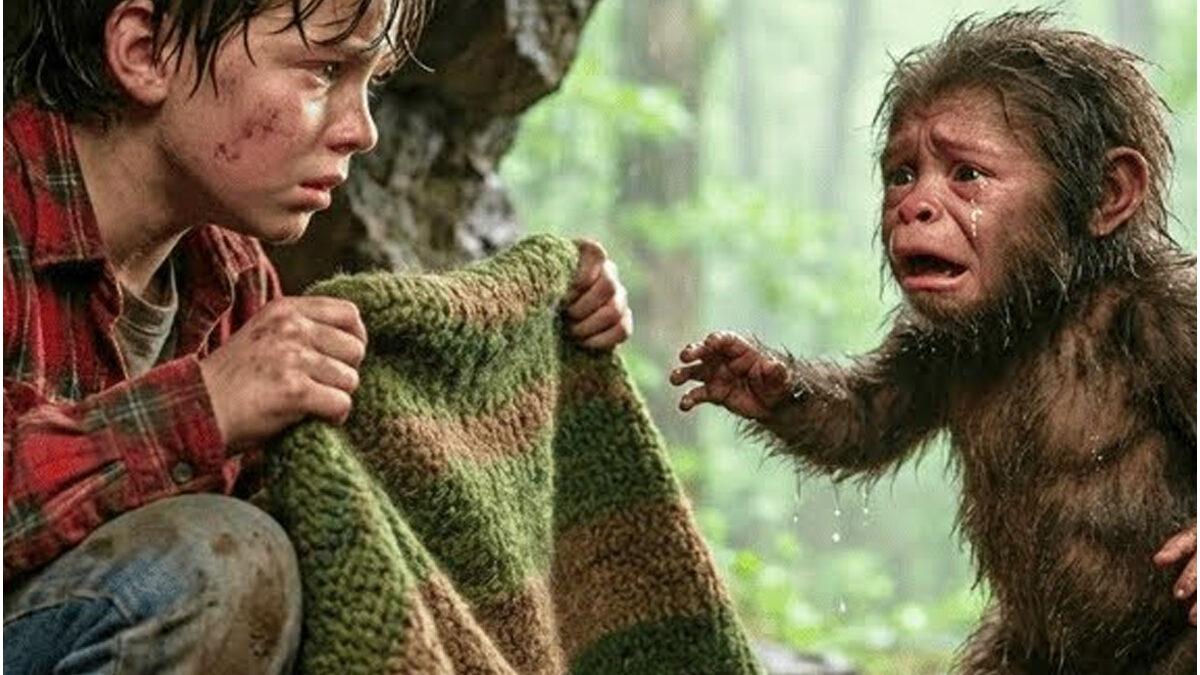
When a storm split the Appalachian sky open, and he found a frightened baby Bigfoot shivering in the dark, he didn’t run.

He opened his moss green wool blanket and offered it warmth.
That small act of kindness sparked a secret friendship between two worlds.
Through seasons of danger, loss, and impossible choices, the Bigfoot clan saved Wyatt’s family.
And years later, Wyatt, grown into a biologist, protected them in return.
Their bond became a promise passed from generation to generation.
A reminder that even in the wildest places on earth, compassion leaves a trail that never disappears.
And now, dear friends watching this, I want to know where are you tuning in from?
What’s your name?
How far can this story travel?
Across towns, across countries, across hearts that still believe kindness matters.
Before we continue deeper into this world of mystery, loyalty, and the hidden guardians of the forest, allow me to send you my warmest greetings.
If this tale touches you, if you believe in building a community that protects the wild and honors the legends who protect us back, then gently tap like and consider subscribing so our Bigfoot loving family can keep growing, one believer at a time.
The air had been heavy all day.
Like the world was holding its breath.
It was the end of August, just before school started again.
Though Wyatt Cole didn’t care much for school.
He was 10 years old and already suspicious of anything too loud, too structured, or too full of other kids.
He liked quiet.
He liked trees.
He liked the way the mountain breathed differently from one hour to the next.
And today, it was breathing faSt. Above the cabin, clouds had been building since dawn.
Harlon Cole, Wyatt’s grandfather, kept glancing at the horizon from the porch like he could read the storm’s mood just by looking.
He’d been a lumber man in his younger years.
Big hands, slow voice, and eyes that had seen a little too much.
Now he mostly fixed things around the cabin and taught Wyatt what the forest taught him.
It wasn’t the kind of knowledge you got from books.
It came from dirt under the nails and silence held long enough to hear what animals say when they think no one’s listening.
Harlon had said it before breakfast that the birds were flying low and the trees had gone still.
Something about that stillness crawled into Wyatt’s skin.
Even the squirrels had gone quiet.
No chatter, no chasing, just waiting.
“You stay close this afternoon,” Harlon had said.
Half a warning, half a habit.
Storms got teeth, but by then Wyatt had already planned to sneak out after lunch.
There was a patch of chanterels up near Spruce Run on the slope past the hollow where the blackberries grew fat.
He wanted to bring some back, cook them the way his mother used to, at least how he remembered.
She died 6 years ago, and the memory was patchy, like sunlight through fog.
His father had left soon after, gone to some city job that paid bills but cost everything else.
So Wyatt stayed here in this cabin smelling of pine smoke and iron tools, raised by the one person who had never left him.
And the forest, always the foreSt. He’d wrapped his grandmother’s moss brown knit blanket into his pack.
He took it everywhere, even in summer.
It wasn’t superstition, just comfort, like carrying a voice that no longer spoke.
When the first boom of thunder cracked the ridge, Wyatt was already deep past the pine line.
The air had turned syrupy thick, the kind that made your shirt stick and your skin itch.
Above the canopy, the sky was an ugly violet gray.
Too quiet, too late to turn back.
He quickened his steps, cutting across the ridgeel line, boots slloshing through patches of damp moss.
He thought he had more time, but the mountain didn’t care what boys thought.
The wind picked up like someone exhaled from the top of the ridge.
Leaves whipped sideways, birds scattered.
Then the rain came fast, mean sideways.
Wyatt slipped once, then again, knees scraped, palms muddy.
The blanket was wet within seconds.
He tried to keep it dry under his jacket, but everything clung cold and heavy.
He darted toward Bear Hollow, a shallow stone cave tucked in beneath a ledge.
He and Harlon had named it that years ago, even though they’d never seen a bear there.
It was more of a joke than a warning.
Now it was his only shelter.
The hollow was darker than he remembered.
The rock was slick, and the air inside was colder than outside.
He curled into the curve of the wall, pulling the wet blanket around him, shivering.
His breath fogged the air in front of his face.
Lightning flashed.
Thunder followed almost immediately, rattling the stones.
Then, beneath the roar of rain, something else.
A sound soft, uneven, like crying.
Not an animal, not a coyote, not a raccoon.
This was smaller, sharper.
A whimper trying not to be heard.
Wyatt froze, his breath caught in his throat, heart pounding so loud he could feel it behind his eyes.
He turned toward the sound just at the edge of the cave mouth, lit only when lightning blinked, and then he saw it.
A shape, small, hunched, shivering, standing on two legs, covered in wet, tangled fur, dark brown, almost black.
It couldn’t have been taller than a toddler.
But it wasn’t a toddler.
Its face, when the lightning cracked again, wasn’t animal.
Not really.
No snout, no muzzle, just a flat face with a wide forehead, high cheeks, a mouth too human, and eyes enormous, shiny and black, blinking fast from fear, not rain.
It held its arms up, not in threat, but in panic, covering its ears from the thunder, shaking.
It was scared.
So was Wyatt.
But something strange happened.
His fear didn’t make him run.
It made him remember.
He thought of the night his mother died when no one could explain it right.
When he curled on the floor with the same blanket and tried not to make a sound.
This creature, whatever it was, looked like that.
Why?
It didn’t move.
Didn’t breathe.
Then slowly, like talking to a deer or a skittish dog, he pulled the wet blanket open.
Just a few inches, he whispered barely over the wind, “It’s okay.
I won’t hurt you.”
The creature didn’t understand the words, but maybe it understood the tone or the gesture.
Or maybe it was just cold and desperate.
It sniffed once, loud and sharp, like testing the air, then crept forward in tiny steps, wet fur dripping, why it held still.
It crawled closer, then sat beside him the way a child would.
It didn’t speak, just curled up, leaned slightly into Wyatt’s shoulder, and shook.
Its hand brushed his accidentally.
Longer fingers, rough skin, thick knuckles, but the touch was careful, scared.
Wyatt didn’t flinch.
He shared the blanket.
What little of it wasn’t soaked.
For a while, they sat like that.
Boy and something not quite boy.
Sharing warmth, sharing silence, both afraid of storms louder than themselves.
Then a sound rolled in from deep in the foreSt. Not thunder, not wind.
A deep, resonant hum, low, melodic, like a call stretched over miles.
The creature’s ears twitched.
Its posture changed from fear to focus.
It listened, then looked at Wyatt.
There was something in its eyes now, recognition.
Not of Wyatt, maybe, but of what had happened between them.
A silent thank you.
Then it stood, clumsy, faSt. It paused just long enough to press its hand against Wyatt’s shoulder.
Then it ran into the storm.
Wyatt watched the shape vanish into rain.
Where it had crouched, something remained.
A small braid of wet grass and wild flowers twisted together like a child’s bracelet.
Left not by accident, a sign.
He didn’t understand it fully.
Not yet.
But he understood enough.
He wasn’t alone in the woods.
Not really.
And someone something had trusted him.
That night, as the storm raged over the ridge and thunder shook the cabin windows, Harlon sat in his chair by the wood stove, watching Wyatt dry off.
He asked gently, “You make it okay out there.”
Wyatt nodded.
“See anything worth telling?”
A long pause.
Wyatt thought of the blanket, the hand, the eyes.
He thought of the grass braid and the warmth in the cave.
He shook his head.
They ate just trees.
But his voice caught slightly on the lie.
He knew then that this story would be his own, at least for now.
And something inside him had shifted.
A tether had formed, soft, strong, invisible as a root pushing through stone.
Outside the rain slowed, and in the far dark of the forest, beyond what men could hear, something watched from the trees, waiting, remembering, just like him.
The next morning broke slow, like the mountain was still shaking off the memory of the storm.
The air was washed clean, crisp around the edges.
Sunlight filtered through mist hanging low over richwood, and everything, roof shingles, porch railings, every pine needle, wore a thin coat of water.
Wyatt sat on the edge of the porch, his bare feet cold against the wood, hands wrapped around a chipped mug of hot cocoa.
Harlon’s radio played something faint and blue from inside, but the boy wasn’t listening.
His eyes were on the tree line.
The trees had returned to their rhythm.
Birds chattered again, and somewhere down the hollow, a woodpecker knocked like it was catching up on lost time.
He hadn’t told Harlon about the creature, about the blanket, about the hand that had touched his shoulder in the dark like it had known what loneliness was.
There had been a dozen moments during dinner where he almost did.
AlmoSt. But the words dried up before they left his mouth.
Not because he didn’t trust Harlon, but because something told him that the minute he shared it out loud, something delicate would shatter.
Some things were meant to stay between the trees.
After breakfast, Wyatt slipped out quietly.
A red apple tucked into his hoodie pocket.
He knew the one he wanted, the biggest, ripest fruit from the old tree his grandmother had planted decades ago, back when she was still alive, and the world felt rounder somehow.
The tree only gave a few good apples each year now.
But Wyatt believed each one still held some piece of her, like her hands had never fully let go.
He hiked alone, following the same path he’d taken the day before.
The woods were still damp, the trails soft and dark.
The blanket stayed behind this time.
He needed both hands free.
When he reached Bear Hollow, the wind tugged at his sleeves.
The cave looked the same, unmoved by the storm, unmoved by what had happened inside.
But he wasn’t the same.
Wyatt stepped to the edge, crouched, and gently set the apple on the flat stone just outside the opening.
His voice quiet.
For you, I guess.
I hope you’re okay.
He stood, hesitated, then backed away a few steps.
Watched.
Nothing moved.
Just wind and wet branches swaying.
He turned and walked home, heart dragging behind him, unsure what he hoped would happen.
The next morning he returned.
The apple was gone.
No stem, no core, no scraps on the ground.
In its place, three acorns, perfect hole, had been arranged in a neat triangle on the stone.
They hadn’t fallen there.
They’d been placed carefully, purposely.
Wyatt stood still for a long moment, the way one might at a grave or an altar.
Something old stirred beneath his skin, a feeling not yet named.
It wasn’t fear.
It was recognition.
He knelt and traced the edge of one acorn with his finger, then looked up.
The sun was climbing, cutting shadows in new directions.
The forest was speaking, just not in words.
He followed.
Beyond the clearing, the soil showed signs of movement.
Large footprints, wide set, toes distinct and deep in the soft mud, led through the underbrush toward the slope behind the ridge.
Wyatt moved slow, silent, the way Harlon had taught him when tracking deer.
His breath caught when the trail narrowed and disappeared into a narrow crease between two fallen logs.
On the other side, the land dipped suddenly into a shallow hidden ravine.
A stream ran there, quiet and glassy, rimmed with mosscovered rocks.
Overhead, limbs twisted into a kind of canopy, softening the light until the whole place felt like it was underwater.
He almost missed them.
Tiny braided tassels hung from the lower branches, made of dried grass, bark strips, leaves twisted into loops.
They swayed gently even though there was no wind.
Dozens of them, maybe more.
Some high, some low, some new, green and bright.
Others old and faded.
They weren’t decoration.
They weren’t debris.
They were messages.
And Wyatt had no idea how to read them.
Across the stream, movement.
He stepped back, heart lurching.
There, half hidden behind a thicket, was the creature again, smaller than he remembered, but only just, standing partially upright, its head tilted in that same curious angle he’d seen in the cave.
Its fur was drier now, a dark chestnut brown with leaves caught in the tangles.
Eyes still huge, still dark, watched him slowly.
Wyatt raised his hand, palm open.
Then, just like yesterday, he pressed his fingers to his chest, then held his hand out.
“I don’t have food,” he whispered, unsure why he whispered.
“Just me.”
The creature mimicked him, palm to chest, hand out, head tilted.
Then it stepped forward.
Just one pace.
That was enough.
Wyatt’s knees felt shaky, but he didn’t move.
He waited.
The stream bubbled gently between them.
Nothing rushed, nothing chased.
They just stood looking.
A woodpecker called high above.
The moment held.
That night, back at the cabin, Harlon sat on the porch with a pipe he didn’t light anymore.
Just chewed out of habit.
He stared at the hills like he was listening to something Wyatt couldn’t hear.
Funny thing, the old man said, voice quiet.
You live long enough out here and the woods start telling you things.
Not with words, not with sound, just knowing.
Wyatt looked up from where he sat on the step below.
“You believe in monsters?”
He asked.
Haron didn’t laugh, didn’t scoff, just took the pipe out of his mouth and tapped it against the rail.
“I believe in neighbors,” he said.
“Some of them don’t want to be seen.
Some of them are better that way.”
The next day in town, Wyatt heard voices he didn’t like.
Men with bellies over their belts and boots that scuffed the diner floor too loud.
“Saw something big up near Spruce Run,” one said, slurping his coffee.
“Couldn’t have been a bear.
Thing had a scream like a dying pig.”
“Should take a camcorder up there,” another grinned.
“Sell it to one of those crypted shows.
National network eats that crap up.”
Martha Lane, who ran the diner, wiped her hands on her apron and shook her head.
“Boys,” she said, not kindly.
“Some things been here longer than us, and they’ll be here long after.
You don’t poke old bones with sharp sticks,” they laughed.
But Wyatt watched the way she said it, the way she looked past the window toward the hills, like she knew more than she ever planned to say.
Back home, the woods felt tighter, quieter.
He didn’t return to the hollow for 2 days.
He was afraid, not of the creature, but of what others might do.
Guns, traps, words sharpened into cruelty.
When he finally did go back, there was a new braid hanging low on the entrance branch.
This one finer than the others, woven with green threads, tiny bits of bark tucked between loops, a sign.
He stepped closer, heart racing inside the hollow, nothing.
But the flat stone had been cleaned.
Someone had brushed the pine needles off.
A small stick sat beside a pebble arranged like a pointing hand.
Wyatt followed the direction.
A faint trail through the ferns.
He walked.
10 minutes in.
The smell of water and moss thickened.
He reached the stream again.
The creature, Micah, he’d begun calling it in his mind for reasons he didn’t understand, stood in the open this time.
No hiding.
Micah held something.
A mushroom chanterel, bright orange.
He walked to the edge of the stream and set it down, then backed away.
Wyatt understood.
It was a gift.
He stepped forward and picked it up, nodding.
I brought something too, he said, pulling a small drawing from his jacket pocket.
It was crude.
A sketch of the stream, the trees, the braids.
He’d worked on it all morning.
He laid it gently on a rock.
Micah moved back, cautious, then stepped forward to sniff it.
They stood there.
Two beings who had no shared language, but every shared reason to try.
The trees swayed.
Somewhere in the distance, a hawk cried.
Wyatt looked into Mika’s eyes and felt something deep shift again, like roots growing just beneath the skin.
Back at the diner that week, the talk got louder.
More people claimed to hear things.
Someone had found a footprint and taken a photo.
I say we go up there, one man said.
Make a weekend of it.
Catch us a monster.
Wyatt dropped his spoon in his cereal that night.
He knew the line was thinning between myth and man, between wonder and violence.
But then Haron, that evening on the porch said softly, “If you ever find something wild, something good, don’t show it off.
Don’t explain it.
Just protect it.
Best things in this life never fit inside a picture.”
Wyatt nodded quietly as the sun slid down behind the pines.
In the dark, something moved past the edge of the property.
Just a shadow.
But Wyatt knew they were still watching, still remembering, still answering when called with kindness.
And from that night on, the forest was never just trees again.
It was someone else’s home, too.
And he’d been led inside.
By the second week of December, the forest around Richwood had gone still again.
But this time, it wasn’t storm stillness.
It was cold stillness.
The kind that crept into your lungs and made each breath feel like pulling on brittle glass.
Frost lined every branch, every window pane, every fence post from town all the way up to Harlon Cole’s cabin.
The old man had started keeping the wood stove going through the night, something he hadn’t done in years.
And every morning, Wyatt would wake up before the sun, find the inside of the windows coated with ice, and feel that quiet tension in the house.
The kind that told him something wasn’t quite right.
Harlland’s cough had changed.
It wasn’t just clearing his throat anymore, or the ragged sound after too much time outside.
It came deep, pulled up from somewhere near the bones, and stuck around longer than it should have.
There were mornings when Wyatt would find his grandfather sitting by the fire, hunched forward with his hands braced on his knees, a line of blood on the handkerchief that he tried to fold quick before the boy could see.
But Wyatt saw, and what he didn’t see, he felt.
They went into town to see Doc Mallerie the week before Christmas.
Haron insisted on walking, though it took them twice as long.
The old doctor pressed his cold stethoscope to Harlland’s back.
Listened longer than usual, then took a long breath of his own before speaking.
He didn’t sugarcoat it, never had.
“Your lungs are holding more water than they should,” he said, voice low but steady.
“And I’d guess some scarring, too.
Maybe worse.
We could do a chest film, but I reckon we already know how that’s going to look.”
Harlon didn’t flinch.
“I ain’t got much use for machines, Doc.”
Doc Mallerie nodded once, then turned to Wyatt.
There was an old remedy, he said carefully, as if remembering something from a long drawer in his mind.
Native folk used to talk about it.
Grows up near the high cliffs above Little Elk Fork.
Steep country.
Vines of it wrap around the rocks.
Some kind of mountain route.
Smells like licorice.
Tastes like hell.
But they said it could cut the edge off lung rot.
Problem is, that trail’s a damn death trap this time of year.
Wyatt listened without blinking.
What’s it look like?
The doctor reached for a notepad, drew a rough sketch, twisted root, long, thin leaves.
Don’t get any ideas, son.
Ain’t no place for a boy up there, especially not in snow.
But ideas were already forming, strong ones.
Back home that night, Wyatt helped Haron into bed.
The old man winced more than usual, jaw tight, but his voice was light.
You’d think after 68 years I’d be used to my own bones betraying me.
Wyatt smoothed out the blanket.
You always bounce back.
Harlon looked at him, something knowing behind his eyes.
Don’t lie for my sake, boy.
Truth still the truth whether we say it or not.
Later, as the fire dimmed and the wind hissed against the cabin walls, Wyatt lay awake staring at the ceiling.
He thought of the doctor’s sketch, thought of the high cliffs above Little Elk Fork, and thought of Micah.
He didn’t know why the creature came into his mind then.
Maybe it was the way it had looked at him that day near the stream, like it understood more than it could say.
Maybe it was the strange gentleness in its hands.
Maybe it was just the way everything felt connected out here, like the line between man and beast was thinner than people thought.
Wyatt made his choice before dawn.
He left a note on the table.
Just one sentence.
Gone to get the root.
He stuffed the sketch into his coat pocket, grabbed a thermos of hot water, the flint knife Harlon had given him last year, and the blanket.
Always the blanket.
The woods felt different in the early morning snow.
Sound moved strange.
His boots crunched hard through the crusted surface, breath pluming like smoke.
The climb was harder than he’d expected.
The rocks were slick with ice, some buried under powder, others jagged and waiting.
At one point, he slipped and slid down a slope, landing hard against a stump.
He bit his lip to keep from crying out.
No one could hear him anyway.
By noon, his legs achd, arms trembled, his gloves were soaked.
He could see the cliffs now rising ahead like the spine of some sleeping giant.
The trail narrowed.
One misstep and he’d be tumbling into a ravine, but he kept going.
Harlon needed him to.
He reached the base of the cliff just as clouds began to gather again.
The air smelled like coming snow.
He pulled himself up over a rock ledge, fingernails bleeding beneath his gloves, and collapsed in the crook of a boulder.
His whole body trembled.
He was running out of warmth.
He unwrapped the blanket, pressed it around his shoulders, but it was damp from his pack.
His fingers curled around the sketch in his pocket, now smudged and wet.
He stared at it, willing it to mean something more than paper.
The wind shifted.
He didn’t hear footsteps.
Not exactly, just presence.
The way the woods went quiet when something approached.
When he looked up, Mika was standing a few feet away, taller than before, maybe 4 feet now, broader.
Its fur had grown thick for the cold.
Bits of ice clung to its shoulders, but its eyes still huge, still watching.
Hadn’t changed.
Wyatt didn’t speak.
He just held out the drawing.
Micah stepped forward, head low, nostrils flaring.
It sniffed the sketch, then looked back up the cliff.
Its gaze hardened.
Then it made a deep humming sound, one that pulsed low in Wyatt’s cheSt. From the trees behind, something stirred.
Another figure emerged, larger, massive, a mountain of fur with silver streaking its back.
This one didn’t hesitate.
It walked with the weight of knowledge, with the slow purpose of something that remembered what mountains had forgotten.
It carried a bundle in one arm, twisted roots tied together with a cord of woven bark.
It stopped in front of Wyatt, held the bundle out, then placed its free hand against its own chest, then gently against Wyatt’s.
A gesture, not just a gift, a vow, Wyatt swallowed hard.
“Thank you,” he whispered.
“They didn’t speak.
They didn’t need to.”
He took the bundle, cradled it like it might break, then just as carefully pulled the blanket from his shoulders, and laid it on the stone between them.
A trade, not of equal things, but of equal meaning.
By the time he made it back to the cabin, the sun had dropped low, and the snow had started.
His fingers were numb.
His face wind burned, but his legs still carried him through the door.
Harlon was dozing in the chair by the stove.
Wyatt hung the bundle near the heat, careful not to burn it.
Then he boiled water, added the roots, and waited.
The smell filled the room, earthy, sharp, strange.
He brought the cup to Haron.
Woke him gently.
The old man blinked, looked at the steam, then at Wyatt.
Where’d you find it?
Wyatt didn’t lie.
Someone gave it to me.
Harlon took the cup, sipped, grimaced.
Tastes like feet.
But he drank it all.
That night he slept through.
No coughing fits, no gasping, just steady breath, and the soft rise and fall of his chest beneath the old quilt.
In the morning, he was still tired.
But something in his face had shifted.
Less weight, more time.
They didn’t speak of it again.
Not the tea, not the trip, not the giant with the silver fur.
But later that week, as snow drifted against the windows and birds settled near the eaves, Harlon said softly, “Running from the world, don’t keep it from finding you.
But sometimes, sometimes the woods give you back more than you expect.”
Wyatt stood at the window, watching a line of fresh prints melt into the snow.
He didn’t know when he’d see Ma again, but he knew it wasn’t over.
The forest had changed him.
And somewhere in the deep cold, something was still watching, still waiting, still remembering.
By early April, the cold had started peeling away from the hills like old paint.
Snow melted into the roots of things, seeping down into the soil, waking whatever had slept in silence.
The creeks ran higher, louder.
Trees pushed tiny green fists through their bark.
And along the slopes outside Richwood, West Virginia, the scent of mud and wood smoke filled the air like an old song coming back around.
Wyatt Cole knew the mountain wasn’t just waking.
It was warning.
Something had shifted in the way the birds moved.
The way deer stayed deeper in the hollows.
Even the quiet wasn’t the same.
Not long ago, he could sit still in Bear Hollow and hear the breath of the forest like a living, steady heartbeat.
Now there was a tension beneath it, a kind of holding back.
Then came the sound, not thunder, not wind, chainsaws, distant, but growing, echoing across the ridges like a threat whispered through gritted teeth.
Wyatt dropped the bundle of kindling in his arms and stood frozen on the slope just below the cabin.
The sharp, unnatural drone bit into the air, far off, but too close to be safe.
That night, Harlon sat on the porch, wrapped in his thickest flannel, and a wool blanket draped over his knees.
He didn’t say much, but when Wyatt told him what he’d heard.
The old man’s jaw tightened just slightly.
They said it might happen, he muttered.
County signed a contract last fall.
Some new access road behind Evan Reed’s property.
Probably started clearing for it.
Where?
Wyatt asked even though he already knew.
East edge of Spruce Run, Harlon replied.
Too close to where it shouldn’t be.
They didn’t speak for a while after that.
Just sat in the amber porch light listening to Spring get louder.
2 days later, Wyatt rode his bike down into town.
It was a Saturday.
The diner was full.
Locals eating biscuits, eggs, fried baloney.
Steam fogged the windows.
Coffee poured like it always had, but the talk was different now.
Evan Reed sat in the corner booth, arms spread across the back rest like he owned the place.
His voice carried just enough.
Going to be good for the town, he said.
New work, some real money coming in.
Ain’t like we’re clear-cutting.
Just taking what we need.
Martha Lane topped off a few mugs, not saying much, but her eyes flicked toward Wyatt when Evan laughed.
There was no humor in it.
Evan kept talking.
We used to do this all the time.
Back when Harlon and I ran the saws together.
Place was full of mills.
Now folks act like trees are holy ground.
Wyatt clenched his jaw.
The last time Haron had touched a saw was 20 years ago.
And it hadn’t ended clean.
The next day, Wyatt went back to Bear Hollow.
He carried nothing with him except the choked weight in his cheSt. The trail was softer now, lined with moss, coming back to life.
When he reached the clearing, he stopped cold.
The hollow wasn’t empty.
Micah was there, taller now, almost as tall as Wyatt himself.
Its fur was thicker, darker in places, and dusted with bits of bark and pollen.
But its presence hadn’t changed.
The way it stood, calm and watchful, hands loose at its sides, like it was always waiting for the right moment.
They didn’t touch, but they didn’t need to.
Micah stepped aside slowly, revealing something behind him, thick branches arranged deliberately across a narrow trail that led deeper into the woods.
It wasn’t random.
Each branch had been wedged into others, making a kind of gate, almost like a barrier.
On top.
Woven grass and bark strips twisted into long streamers.
Symbols, maybe warnings or boundaries.
Micah looked at Wyatt, then at the wall of limbs, then back again.
A message clear as anything.
They didn’t want people coming closer.
That night, Wyatt told Haron what he’d seen.
The old man didn’t question how he knew.
He just sat quiet, eyes on the fire.
I used to think there wasn’t a price, Haron said finally.
Back when I was young.
Thought you could take and take and the mountain would just keep giving.
But it don’t work like that.
It never did.
The next morning, there was a problem at the site.
Evan Reed’s crew showed up to a mess.
The fuel tanks had been drained.
One of the chainsaws was up in a tree 20 ft high, balanced across a branch like it had been placed there by a crane.
But there were no tracks, no signs of struggle, no damage, just rearrangement.
Silent and clean.
Evan blamed kids.
Said someone was trying to spook them, but the look on his face said something else.
Wyatt heard about it in town.
The rumors spreading faSt. Some folks laughed it off.
Others shook their heads like they knew better.
One man said he saw a shadow moving through the fog that morning.
Too tall for a man, too quiet for a bear.
Martha Lane served him pie and said nothing.
Later that week, Wyatt returned to the clearing near the site.
The forest there felt charged, like walking into a room after an argument you didn’t witness, but could feel in the air.
That’s when he saw Ma again.
This time, the young creature wasn’t alone.
Behind him, deeper in the brush, another figure moved.
Larger, broader, moving slow and deliberate.
Wyatt couldn’t see the face, just the bulk of it, but it didn’t come closer.
Micah stepped forward, held a large branch in his hands, snapped it in two, and dropped the halves on the path in front of Wyatt.
Then he lifted his arms, mimicking a chopping motion, then paused.
He looked up, eyes steady, then turned and walked back into the trees.
Wyatt stood there long after the sound of leaves stopped moving.
A warning, not of violence, of sorrow.
He went home and wrote it down in his notebook.
Every gesture, every look, every silent plea, but silence didn’t stop people like Evan.
That weekend, the crew pushed past the boundary markers.
They cleared a new section near the ridge, and that’s when it happened.
No one got hurt.
Not really.
But one of the machines, an old yellow feller buncher, tipped over on a slope that had been dry the day before.
No rain, no mud, just shifted.
Evan’s boots slipped, too.
He barely caught himself.
Later, he found something in the dirt.
A footprint, huge, deeper than any boot, five toes, clear as daylight.
He said it was a prank.
Said someone was playing games, but his voice shook just a little.
That night at the diner, he told the story too loud.
“If I catch the bastard making these hoaxes, I swear I’ll string him up like an old deer mount.”
Someone laughed, but Wyatt didn’t.
He sat near the back, listening, heart tight.
Martha Lane wiped her hands, then looked over her glasses at Evan.
“Not everything in these hills is meant for you to catch,” she said.
Some things just are, and maybe we should be grateful for that.
The room went quiet for a beat too long.
Evan didn’t reply.
Later that night, Wyatt walked the trail up past the hollow.
He carried his notebook in one hand, a flashlight in the other, but he didn’t turn it on.
The moon was enough.
When he reached the gate of limbs, he paused.
There, resting on the topmost branch, was a braid, fresh, twined from wild grass, soft and green, still damp with dew.
He touched it gently, then turned away, heading home beneath the whispering trees.
The line between their world and his was still holding, but it was thinning, and not everyone wanted to keep it intact.
By late June, the days had turned long and slow and golden, and richwood settled into the kind of stillness that only came with a summer that had fully stretched its limbs.
Cicas buzzed in the tall grass like little generators, and the river glinted with the lazy shimmer of heat.
Down by the baseball field, old men in cut off jeans sat on overturned buckets, casting lines into the water without really caring if anything bit.
It was the season for bare feet on cool floors, for open screen doors, and for news that arrived not in envelopes, but in the tight voices of neighbors who didn’t quite know how to celebrate something that might mean goodbye.
Wyatt had gotten the letter 3 days ago.
A full scholarship to a science academy near Charleston.
Room, board, books, all covered.
His science teacher, Mr. Kent had helped him apply back in February without saying much.
Said a brain like Wyatt’s shouldn’t go to waste digging potatoes or filing receipts at the gas station.
Wyatt hadn’t told anyone except Haron until the envelope showed up.
And now it wasn’t a secret anymore.
Folks in town nodded at him differently now.
They meant well, but it all carried that same gentle finality, like people patting the hood of an old truck before it was hauled off for parts.
Even Haron, who should have been proud, didn’t say much.
He just looked at Wyatt with that tired softness that never left his eyes anymore, as if he could already see the boy walking away before his feet had even moved.
“You got to go,” he’d said that night on the porch.
“Don’t end up like me, thinking you’re doing good by staying put, only to wake up 40 years later wondering what else you could have been.”
But Wyatt didn’t want to be anything else.
Not yet.
Especially not with what he knew was still out there deep in the woods waiting.
Still, the days ticked forward like a metronome.
He couldn’t stop.
That week, his aunt pulled into the gravel drive in her pale blue station wagon.
The backseat door swung open and out came Lena, 6 years old and wild with summer energy.
Blonde curls, a missing front tooth, and a pink backpack she wore even in the house.
She’d be staying for 2 weeks.
Her mom said she needed fresh air, like it was some kind of medicine.
At first, Wyatt didn’t know what to do with her.
She talked too loud, ran everywhere, asked why the toaster was broken, like it was the end of the world.
But she liked the river, so he took her there.
That afternoon was hot and sharp with a smell of wet stone.
The river ran faster than usual.
Recent storms upstream had raised the current.
Still, Lena laughed as she chased minnows, bare feet slipping on the rocks.
Wyatt sat on a large flat boulder near the bend, letting the sun heat his back.
He watched her, half smiling, half tired.
She didn’t see the moss, her feet shot out.
She landed with a yelp, hands scraping on the rocks.
Then she slid, just a few feet, but enough.
The current grabbed her legs, sucked her in, spun her.
Wyatt jumped down, scrambling, yelling her name.
She was in the middle now, arms flailing, coughing, panicked.
He waited in fast, water up to his waist, then chest, cold, fast, stronger than he remembered.
He reached for her, just missed.
She screamed, and it tore something open in him.
He dove.
For a second, the world was only water and limbs and panic.
His fingers brushed her arm, slipped, caught again, but the current yanked them apart like a cruel hand.
She went under.
Wyatt gasped to the surface, eyes burning, spinning.
“Lena,” he cried, voice raw.
And then something broke the tree line, a blur, brown and fast and wrong-sized.
He turned in time to see an arm, a long muscled arm covered in fur, reach into the water like it knew the exact spot.
It lifted her, held her up, dripping and sputtering like lifting a kitten from a puddle.
She coughed, alive, crying.
Wyatt stood frozen, waist deep, water rushing past his hips.
Ma, taller than ever now, over six feet, shoulders like tree trunks, wet fur clinging to its chest, eyes locked on Wyatt, not scared, not angry, just certain.
It stepped from the shallows, set Lena gently down on the gravel.
She sat blinking, clutching her knees.
Micah looked at Wyatt one last time, then turned and vanished back into the woods without a sound.
By the time Wyatt reached Lena, she was shaking and cold, but breathing.
He wrapped his arms around her, heart slamming against his ribs.
He didn’t even notice the figure standing far up the hill, leaning against a cane.
Harlon had followed.
Maybe he’d felt it.
Maybe he’d just known.
He watched the scene quietly, a hand over his chest like trying to steady something deep inside.
Later, when asked who saved her, he simply said, “The river’s got a guardian sometimes.”
That night, Wyatt didn’t sleep.
He sat by the window, sketchbook open, trying to draw what he couldn’t say.
A hand in water, a girl in the air, a shadow in the trees.
The next morning, he went to Bear Hollow alone.
No braid on the branch, no sign of Micah.
He sat on the stone slab and waited, not for answers, just for quiet.
He reached into his pocket, pulled out a small object, a pocketk knife, cheap, old, the one he’d carried since he was eight.
A Christmas gift from Haron, the blade chipped, the handle worn smooth by years of fingers and dirt and time.
He laid it on the stone.
Then he reached into his bag and took out the sketchbook, set it beside the knife.
He tore a page from the back, wrote, “I’ll come back.
I promise.”
Folded it, waited it with a small stone, then stood.
No ceremony, no tears, just a leaving.
That evening, the bus came, the kind with cracked vinyl seats and a soft hiss every time the brakes caught.
Wyatt stepped on without a word.
Haron didn’t follow him up, just stood on the porch, hands in his pockets.
The trees waved gently behind them.
The next day, Wyatt’s aunt took Lena back home.
The cabin was quiet again.
Too quiet, but not untouched.
Because that night, when Harlon stepped outside just before dusk, he noticed something.
The knife was gone.
So was the sketchbook.
In their place, braided from fresh grass and river reads, hung a new strand, looped once around the edge of the stone, then tied with a perfect knot.
Harlon didn’t touch it, just looked at it for a long time, then turned back inside.
A week passed, then two.
The wood softened again, as if folding over the memory of what had happened.
But for anyone watching close enough, for anyone who knew where to look, something had changed.
Because now, every so often, the braid on the stone would be replaced.
Some days a wild flower tucked into the loop.
Other days, a pebble painted with a stripe of mud.
No rhythm, no pattern, just presence, just proof that someone was still there, waiting, remembering, and holding a place until the boy came home.
It had been 16 years since Wyatt Cole last stood on the road that curled like a question mark into the heart of Richwood.
The town hadn’t changed much.
It just looked smaller now.
The diner still leaned into the corner of Maine like it was tired of holding itself up.
The gas station sign buzzed faintly in the early light, one tube flickering between prices.
The school still had the same dull red roof, though the fence looked newer.
But something else had shifted in the bones of the place, not in what was built, but in what had disappeared.
Some of the storefronts were boarded now.
A barber shop, the old bookstore, the post office window where Harlon used to argue about stamps, gone.
The people too.
Not gone like dead.
Gone like somewhere else.
Moved, faded, drifted.
The kind of loss you didn’t notice all at once, but slowly like a tree leaning until it finally falls.
Wyatt parked his truck just outside the diner.
The windows were fogged.
A coffee pot sat steaming behind the counter.
Inside, Martha Lane was still behind it, older, thinner, but with the same sharp eyes that always knew more than they said.
She looked up when he walked in.
“Paused just a beat, and then nodded like the space between them had never stretched as wide as it had.”
“Told him’d be back,” she said, pouring coffee before he asked.
“Didn’t know it’ take you this long.”
Wyatt sat down, wrapped his fingers around the mug.
Didn’t know it would either.
They didn’t speak for a while.
The coffee was hot.
The air was soft.
Through the window, the ridges of spruce runs stretched under a layer of low cloud like a secret still breathing.
Wyatt was 35 now.
A field biologist by title, but only on paper.
His boots were more worn than they should be, his shoulders broader, face lined in the way that comes from years spent listening to wind through trees more than people.
He’d worked in Wyoming, Montana, the Aderondax, but everywhere he went, he carried the shape of richwood in his chest, tucked under the ribs, especially one part of it, the woods that began just beyond the last power line, and the thing that lived beyond them.
He came back with a grant proposal folded in his duffel and a state permit clipped to a clipboard in the passenger seat.
Official language, conservation, land protection, all of it wrapped in soft words that hid the urgency underneath.
Developers were circling again.
New interest, new logging bids.
Wyatt knew the signals, and he knew if he didn’t return now, the choice might get made without him.
The cabin was still standing, dustier.
The porch boards creaked worse than before, but the roof held.
The air smelled the same when he pushed the door open.
Pine, tobacco, the faint trace of something warm and gone.
Harlland’s cane still leaned by the hearth.
He’d passed 3 years ago in his sleep.
No struggle, just a slow breath out.
Wyatt had flown in for the funeral, stood under the old walnut tree behind the church, hands in his pockets while the pastor tried to say something true.
But the mountain didn’t need speeches.
It just needed someone to listen.
Then Wyatt had left again too faSt. Maybe out of fear.
Maybe out of guilt.
Maybe because he wasn’t ready to face what was still waiting out there.
Now he was back for real this time.
The first place he went wasn’t the ranger station.
It was bare hollow.
He hiked there without meaning to.
Muscle memory.
The trail had narrowed over the years, choked with ferns and fallen branches.
But he found it.
Every turn, every bend, the creek still whispering in the same voice.
When he reached the mouth of the hollow, his heart caught.
The stone was still there.
So was the blanket.
Folded, dry, not mild, dude.
No animal nest, no leaf rot.
Someone had cared for it.
Wyatt stepped forward slowly.
Breath held like it might shatter if he moved too faSt. He touched the wool, still rough, still warm under the sun.
He sat down beside it, not speaking, not daring to.
He stayed there for hours.
Nothing came, but something had been there recently.
Above him, hanging from one of the low branches, were three new braids, intricate, tighter than the old ones.
One had a feather tied in.
Another a smooth riverstone painted with two stripes.
Not art, not accident.
A language still being written long after he’d left.
Wyatt felt a burn rise behind his eyes.
He blinked it back, whispered, “I’m sorry.”
And he meant it.
The next few days, he did what he came to do.
Took soil samples, checked stream health, documented bird calls.
But all of it, he knew, was just pretext.
What he was really looking for couldn’t be listed on a report.
On the fifth day, he found a footprint.
It wasn’t old, still damp, pressed into river mud like a signature.
He crouched beside it, touched the edge.
The size of a dinner plate, clear toe separation.
Not a bear, no claws, no drag, just purpose.
He looked up.
The hairs on the back of his neck already rising.
He didn’t raise his camera, didn’t take measurements.
He just sat down, folded his hands in his lap, and waited, but nothing came.
That night, he lit a fire in the cabin for the first time in years.
The place breathed around him like it remembered.
He took out the photos he hadn’t shown anyone, the ones from that summer, the last day before he left.
A photo of the sketchbook, a photo of Lena, now grown, and one photo he’d taken in secret with a disposable camera of the braid left on the stone, the only proof he had.
He pulled it from the envelope, then slowly, deliberately tore it in half and fed it to the flames.
The next morning, he walked the western trail.
Halfway up the ridge, he saw it.
A figure far away, broad shoulders, thick limbs, standing still among the birch trees.
Not hiding, just present.
He didn’t move toward it, didn’t wave.
He simply stopped.
Let the silence stretch, then nodded.
The figure shifted slightly, an acknowledgment, and stepped back into the trees as if it had only come to see if he still knew how to be quiet.
Later that week, he found the trap.
Metal teeth, rusted but set, tucked behind a fallen log.
Not meant for rabbits, meant for something bigger.
Nearby boot tracks, not from town, out of state, deep treads.
That same day, a stranger showed up at the diner.
Asking questions, video gear in his Jeep, claims of a new show, Wilderness Mysteries.
Martha Lane didn’t say much.
Just poured his coffee, wiped the counter.
But when Wyatt came in that night, she pulled him aside.
“They’re sniffing too close,” she said.
“Somebody needs to close the gate before they walk through it.”
Wyatt nodded.
That night, he hiked back up to the hollow, placed three riverstones in a line near the entrance.
A message, “Old and simple.
We see you.”
He didn’t know who would find it firSt. The ones who hunted, or the ones who remembered what it meant to be hunted.
But either way, the message would be read.
And maybe that was enough for now because the wood still held their breath.
And Wyatt, the boy who left, now the man returned, knew this wasn’t the end of anything.
Just another season starting.
Somewhere behind bark and shadow, something watched, and it waited.
But not alone anymore.
The first raindrop hit Wyatt’s windshield like a warning.
Sharp, cold, and too early.
It was late October, and the day had started mild, gray in the usual way, with low clouds hanging over Richwood like a wet dish towel.
But by afternoon, the pressure had dropped, and the wind had begun twisting the treetops in odd directions.
At the ranger station, they were already throwing words around.
Flash flood, runoff pressure, mountain choke points, words that didn’t feel urgent until they did.
Wyatt had heard the same tone back in Montana once before a sudden thaw sent an entire logging road into the ravine below.
But this was worse.
This wasn’t melt water or snow melt or runoff.
This was a storm being built from the ground up.
Something old and heavy with a smell of bad memory.
By 400 p.m. emergency alerts had gone out across Nicholas County.
Locals grumbled.
Most folks were used to wet seasons, to flooded creeks and fallen trees, but this wasn’t usual.
Not with how fast the rivers were rising.
Not with the radar lit up like spilled paint.
Wyatt stood at the edge of the overlook above little Elk Fork, rain peppering the brim of his cap, his jacket already soaked through.
He scanned the valley with binoculars.
Below, the water clawed at the banks like it wanted more room.
But that wasn’t the real problem.
It was the jam.
A massive pileup of logs, rock, and stormfall had collected at a choke point just upstream of the main fork, half submerged, packed tight.
A natural dam, and it was growing.
If it gave way too fast, the surge would head straight for town.
No warning, no breaks.
And they didn’t have the equipment to clear it.
Not here.
Not now.
The old access roads were washed out and the power lines were down in half the county.
Wyatt radioed it in, voice tight.
Then he went silent, eyes fixed on the log pile like it might decide on its own what to do.
He knew that shape, the way the trees were wedged, the angle of the flow.
He’d seen enough slides to recognize when the mountain was holding its breath.
He also knew they didn’t have long.
By dusk, the storm came down in sheets.
The kind that moved sideways, turned your headlights into milk.
Wind howled through the hollows, ripped leaves from the last stubborn branches, and turned them into frantic spirals.
Thunder rolled like boots across the roof of the world.
Somewhere near Bear Hollow, a tree cracked in half and fell into the dark, and still the dam held.
Wyatt hiked up alone just before midnight, headlamp cutting narrow slices through the rain.
He knew where the pressure point was.
He knew where the river twisted, where the slope buckled just enough to cheat gravity.
But he wasn’t going to fix it.
He wasn’t strong enough, and he didn’t have gear.
Still, he went because he had to see it because he needed to know if it came to it, how much time they’d have before the valley filled like a drowned cup.
He reached the ridge above the jam.
The wind knocked sideways.
Rain slashed.
He steadied himself against a slick tree trunk, blinking into the storm.
And then he saw them.
Not one.
Several tall, dark figures moving across the ridge lower to the river.
Massive measured.
They didn’t run.
They worked.
One stood waist deep in the torrent, hands wrapped around a beam of driftwood, using it to lever another log aside.
Two more moved in unison, shoulder tosh shoulder, heaving a clump of branches out of the water like it weighed nothing.
Another stood farther back, arms spread, steadying part of the structure with a thick log jammed crosswise.
The dam wasn’t being broken.
It was being reshaped, controlled.
Wyatt stared, breath shallow, rain forgotten.
And then he saw him.
Micah, older now, towering, still recognizable beneath the storm matted fur.
The human-like face said in solemn focus, he moved with purpose, shoulder banded in muscle, working alongside the others without hesitation.
He looked up once, caught Wyatt’s eyes across the distance, held it, didn’t flinch, didn’t hide, then turned back to the task.
Wyatt moved down the slope, drawn by instinct more than logic.
Boots sinking in the soft mud, water lapping at his calves as he waited into the edge of the current.
He couldn’t reach the core of the jam, not safely, but he found the outer rim where a large branch had turned sideways, threatening to slip loose.
He braced it, pressed his full weight into it.
It wasn’t enough.
Then he felt a second force join his.
A hand massive, wet, covered in mud and fur.
Mika.
Together they pushed.
The log slid back into place, locking in tighter.
Wyatt gasped, soaked and shaking.
Micah looked at him.
Water running down his face in sheets.
No words, just breath, just a moment.
Behind them, another surge of water hit the structure, but it held, shifted slightly, released a slow trickle through a lower point.
Not a break, a bleed, a way for the pressure to escape.
A plan.
The others moved in sync, repositioning supports, guiding the flow.
They weren’t stopping the flood.
They were guiding it.
Wyatt stood back, chest heaving, watching them work.
Quiet, coordinated, intentional.
And then out of the dark, came a wheezing breath, a cough.
Footsteps.
Harlon, old, soaked, leaning hard on a walking stick.
Eyes full of something too deep to name.
He had followed, had climbed, had come one last time.
He didn’t speak.
He just stepped forward, hands trembling, and braced himself beside Wyatt.
Together, all three of them, man, creature, grandfather, held the last timber into place.
The current shifted again.
The water eased.
Downstream, the river bent away from town, saved, not by steel, not by orders, but by hands that remembered how to hold.
The rain didn’t stop, but the wind softened.
The clouds began to break.
Stars blinked through one by one.
Harlon leaned heavily on Wyatt’s shoulder as they made their way back to the cabin.
His breath was shallow, his gate slow.
By dawn, he was resting in his chair by the fire, wrapped in his old wool blanket, a cup of tea cooling on the table beside him.
He didn’t wake again.
His face was peaceful, his chest still, as if he had given back the last of what the mountain had given him.
And now the debt was settled.
Wyatt sat beside him, silent for a long time.
The house creaked in the wind.
Somewhere far off, a low, steady sound rolled through the woods.
A long echoing call.
Not a cry, not sorrow, recognition.
Wyatt stood, stepped outside, and looked toward the trees.
The forest shimmerred in the pale gold of a stormwashed morning.
He thought of the logs, of the hands, of the wordless trust shared in the dark.
He thought of what came next.
Not just reports or grants, not just fences or boundaries, but stories.
The ones that don’t get written down, the ones passed by fire light, by riverbank, by quiet steps through trees.
And then he nodded because something ancient had returned to balance.
Not fixed, not finished, just held long enough for the next soul to take its turn.
It was early morning when Wyatt opened the back door to the cabin and let the cold rush in.
The kind of chill that cut straight through wool.
The rain had finally stopped.
The clouds broke open in streaks, revealing a washed out sky so pale it looked like old milk.
Everything outside shimmerred with that strange sacred silence that comes after a storm has spared you.
Harlland’s chair sat empty now.
No fire crackled, no hum of the old kettle, just the faint creek of floorboards as Wyatt moved around with a stillness of his own, as if any sudden sound might stir grief too heavy to hold all at once.
He hadn’t touched anything.
Not the blanket, not the mug still resting on the side table.
Grief has its own rhythm.
It doesn’t ask permission and doesn’t knock.
It just moves in.
And in that little wooden cabin, the absence of Haron was louder than any thunderstorm Richwood had ever seen.
Wyatt stepped out onto the porch.
The world was dripping alive, shining in pieces.
The river still ran high, but its roar had softened.
Down in the distance, you could hear chainsaws from town, cleanup crews tackling the storm’s leftovers.
He knew folks would be telling stories about last night for years, maybe decades, about the water that nearly swallowed Richwood, about how somehow it didn’t.
But there were parts of the story no one else knew, parts he wasn’t even sure how to explain.
He looked toward the ridge, toward the trees, toward where it happened, and he felt that old pull again.
The one Harland used to talk about in whispers when the fire got low and the wind moaned through the eaves.
The one that doesn’t come from fear or faith, but something older, something bone deep.
He packed slow, just enough for a day or two, left a note in case someone came by.
Then he locked the door behind him.
Not because he needed to, but because Harlon always did.
Said it was about respect.
Said the mountain watched who came and who went.
The trail was still muddy, slick with pine needles and broken twigs.
The air smelled like wet bark and earth, like the forest was breathing through its skin.
Wy, it moved with care, boots steady, eyes alert.
And as the trees swallowed him whole, something inside him settled.
It wasn’t just about finding them again.
It was about what came next.
He didn’t have a plan, just a direction, a knowing.
By midday, the sun warmed the mossy stones near the river bend, the same bend where, not long ago the water tried to break loose, and just beyond that curve, in the shadow of a leaning spruce, he saw movement.
He froze, not out of fear, but out of reverence, because there she was, not Mea, her, older, wider shoulders, a different way of standing, eyes more knowing, less curious, more weathered, the matriarch.
She stood half in shadow, half in light, with one arm draped low, like she’d been waiting a long time and wasn’t in any hurry.
Wyatt didn’t move, didn’t speak.
She didn’t either.
The wind shifted.
Something passed between them.
Not language, not thought, just memory.
Shared, accepted.
He took a step forward.
She didn’t back away.
Closer.
Now, he could see the lines of mud along her arm.
The leaves still caught in her fur.
The silent strength that didn’t need proving.
Her face looked older than he remembered.
Less wild, but somehow more alive.
Behind her, two younger ones watched.
Teenage maybe.
One was the reddish one from before.
He’d seen him working near the dam.
The other smaller, lankier, eyes wide with a kind of nervous energy.
They studied him the way deer study wind.
Wyatt nodded, slow and soft.
The matriarch stepped aside.
He followed, not out of courage, out of truSt. The walk wasn’t long, but the forest bent differently the deeper they went.
Like it remembered footsteps.
Like it chose what to show.
And when they reached the clearing, a ring of stone and moss and light so pure it looked touched by some old god.
He saw them, all of them, gathered, more than he expected, more than he could count.
No one moved.
He didn’t need to be told this was ceremony, a burial, maybe a farewell.
They were standing around something, someone.
It was hard to see at first, but then the shapes made sense.
The woven leaves, the cedar branches.
The body laid gently across a cradle of earth.
Wyatt stepped closer.
It was the old one, the elder from years ago, the one Harlon had seen first, the one who’d vanished during the wildfire.
His hands folded across his chest, his mouth just barely open, peaceful, returned.
Wyatt looked around.
No one cried, no one prayed.
They just were still present.
And then, like a breath shared across every chest in that circle, the sound began.
Low, vibrating.
A hum, not mournful, not joyful, but full.
He didn’t know what it meant, but he felt it.
Felt it in his ribs, in his throat, in his hands, like the mountain was singing itself whole again.
He stood in that clearing for what might have been minutes or hours.
Time didn’t work right in places like this.
Then slowly the group began to step away one by one vanishing into the trees like mist until only Mika remained.
He approached Wyatt slow and deliberate.
They stood face to face.
So close Wyatt could see the white scars near his left collarbone.
Micah raised his hand.
Not fast, not threatening, just held it up, palm outward, fingers spread, and Wyatt without hesitation mirrored it.
Their hands didn’t touch.
They didn’t need to.
Then Mika turned and walked into the foreSt. Wyatt didn’t follow.
He didn’t have to.
Some journeys weren’t meant to be shared step for step.
They were meant to be witnessed.
He walked back as the sun sank low, casting gold across the canopy.
When he reached the ridge, the wind had picked up again, curling around the trees like a voice half remembered.
He stood there for a long time watching the forest breathe until the last light drained from the sky.
Back in town, life had already returned to normal in the way small towns do.
Kids played near puddles.
A local reporter scribbled notes about miraculous top soil absorption.
Folks passed rumors.
Some said a lightning strike saved the dam.
Others swore it was God.
Wyatt didn’t correct them.
Some truths aren’t meant to be argued with.
Some truths aren’t even meant to be said out loud.
He kept the cabin, repaired the window that rattled too much in the wind, built a shelf for Harland’s harmonica, though he never learned to play it.
And every week he walked to the ridge, not to look for them, but to let them know he remembered.
One morning, just before winter, he found something resting near the porch.
A small carved totem worn smooth by hands, not his, shaped like a tree.
A hand, a ripple of water.
No message.
But none was needed.
Because some things don’t end.
They echo.
They carry.
Like the hush before a storm or the hush after one.
Like a breath held by the mountain.
And the warmth that stays behind long after the fire’s gone out.
In every corner of our world, there exists a quiet magic born of compassion and mutual respect.
An unspoken bond that ties us not only to one another but to the very earth beneath our feet.
When we pause long enough to listen to the ancient rhythms of nature, we discover that our true strength lies in gentleness.
Our greatest courage in understanding and our deepest wisdom in recognizing that no being, human or otherwise, stands alone.
Life’s most profound lessons often emerge in the silence between heartbeats, in the soft exchange of trust that needs no words, and in the simple grace of offering help when no one else is watching.
We are, each of us, stewards of a vast tapestry woven from countless acts of kindness, a fragile leaf carried downstream to nourish new growth, a helping hand extended to the faintest voice, a decision to protect rather than to conquer.
When we choose empathy over indifference, generosity over self-interest, we become part of something far greater than ourselves.
In that space, the line between you and me, blurs, and we remember that every life, regardless of shape, size, or story.
Seek safety, warmth, and belonging.
Let this be our guiding light.
The belief that genuine understanding can bridge any divide and that even the smallest gesture of goodwill ripples outward, carrying hope into unexplored corners.
May we find comfort in knowing that compassion is not a finite resource but a living force that grows when shared.
And may we carry forward the memory of how a single act of trust offered when least expected can transform a moment of fear into a promise of connection, reaffirming our shared pledge to honor the precious gift of life.
Thank you for joining this journey, for letting your heart open to the echoes of these woods and for believing in the promise of kindness.
If this story moved you, we’d love to hear your thoughts.
Please leave a comment below, share your own reflections, and let us know how acts of compassion have shaped your world.
If you haven’t already, make sure to hit that subscribe button and turn on notifications so you won’t miss our next adventure into the extraordinary moments that bind us all.
Together, let’s keep the conversation going, celebrate empathy and action, and continue to explore the enduring power of human connection.








