A Bigfoot Came to My Cabin for Help – What I Found Beside the Dying Bigfoot Changed Me Forever
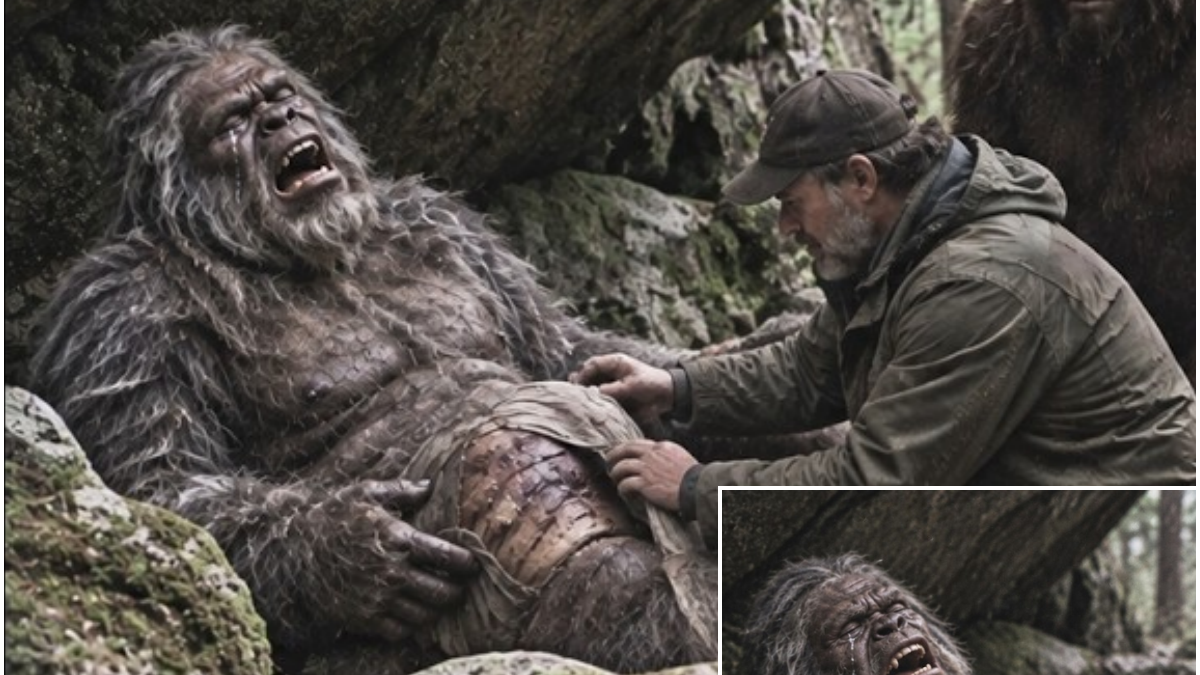
A Bigfoot Came to My Cabin for Help – What I Found Beside the Dying Bigfoot Changed Me Forever
I found handprints on my cabin wall in September and I should have been terrified.
Most people would have been.
Most people would have called someone, the sheriff or animal control or some wildlife outfit with credentials and equipment and a way to make sense of what those prints meant.
I did not call anyone.
I stood there in the gray light of early morning with my coffee getting cold in my hand, and I looked at those handprints pressed into the wood stain of the North Wall, and I understood with absolute certainty that something was asking for help.
If you believe only what science can prove, stop here now.
But if you’re willing to hear a true story about something impossible, then keep listening.

My name is Jack Mercer.
I’m 54 years old now and I live on a remote property in the Cascade Range east of Mount Hood about 6 milesi up the White River drainage from where the access road ends at the Lost Lake area.
I’ve been here for just over 7 years.
Before that, I worked in emergency medicine.
20 years in the burn unit at Oregon Health Sciences in Portland, which is exactly as brutal as it sounds, people coming in with skin sloing off.
Infections that moved faster than antibiotics, infections that moved faster than prayer.
I was good at the work.
I was efficient.
And I didn’t let the smell get into my head.
And I showed up for the graveyard shifts when other people wouldn’t.
And around year 19, I understood that something inside me had died doing it.
Not the ability to care.
I still cared too much about the wrong things.
The ability to have anything left for the rest of my life.
What they don’t tell you about burn medicine is that it’s not just about the physical healing.
It’s about witnessing human suffering at a level that most people never experience and then having to detach from it enough to do the work.
I saw things.
A child who pulled a pot of boiling water onto her own chest because her father was drunk and didn’t watch the stove.
An elderly man whose house fire was actually arson committed by his own son for insurance money.
A woman who tried to end her life by fire and spent 6 months recovering only to try it again as soon as she was well enough.
The burns themselves were manageable on a technical level.
But the stories behind the burns, the circumstances that had created them, the systems that had failed to prevent them, those things accumulated in my chest until I couldn’t breathe properly anymore.
By year 18, I was having panic attacks that came out of nowhere.
I’d be driving home from a night shift and suddenly my heart would be hammering and my hands would be shaking so badly I’d have to pull over.
The panic would last 10, 15 minutes and then it would stop and I’d continue home with no explanation.
I never mentioned it to anyone.
You don’t admit those things in hospital hierarchies.
Admitting weakness means losing respect, losing shifts, losing status.
So I suffered silently and I showed up for my shifts and I did my job and I slowly became someone I didn’t recognize, someone efficient at pain, someone who could look at suffering and catalog it like a filing system instead of responding to it as a human.
So in 1995, I resigned.
I took the money I’d accumulated and I found this place, 20 acres of forest with an old hunting cabin that hadn’t been used in probably a decade.
The cabin was frame and shake with a wood stove and a hand pump in the kitchen and electricity from a generator that ran maybe half the days I tried to turn it on.
No phone, no internet, no way to call out except from the truck at the edge of the property where the radio worked maybe one time in three.
I was not running away.
That’s what I told people.
And it was maybe half true.
I was running towards something, though I didn’t know what.
I just knew that at 47 years old, I was done with burning out.
I was done with the smell of charring and infection and medications that couldn’t quite get ahead of what the human body can do to itself.
My supervisor in the burn unit told me I was wasting my training.
She said I’d be back within 2 years, that this lifestyle looked romantic from the inside of the hospital, but it was different when you were actually living it.
I didn’t argue with her.
She’d seen people quit and come back before.
She didn’t understand that leaving wasn’t about burnout that could be fixed with a sbatical.
It was about realizing that I’d become a person I didn’t recognize.
Someone who could look at a suffering human being and feel nothing but the professional assessment of what needed to be done next.
That’s not a person.
That’s a machine.
And I was tired of being a machine.
My ex-wife thought it was a nervous breakdown.
We’d been divorced for 3 years by that point, which had happened because I was married to the job and she was married to someone who’d actually show up for dinner.
That sounds like a cliche, but it was accurate.
I hadn’t been a functional person for a long time.
The marriage ending was one of the few things I did correctly in that era.
She got the house, which was fair.
I got clarity, which I needed more.
The first year I just sat, I fixed the cabin, replaced the roof shingles that were starting to curl and rot.
Got the wood stove working properly, which involved taking it apart and cleaning out decades of creassote buildup.
Dug out my fire pit that had filled with decades of needles and created a ring of stones to contain the wood properly.
I split wood through the summer and stacked it under a leanto I built on the east side.
I read books, Hemingway and Faulner and things about forest ecology that I’d picked up from the used bookstore in Hood River.
I stopped taking sleeping pills and started sleeping 8 9 10 hours at a time, like my body was catching up on something it had been trying to tell me for years.
The migraines that had plagued me since medical school faded.
The tremor in my hands from standing over operating tables for too long went away.
My resting heart rate dropped from the low 80s to the low 60s.
Slowly over months I became a person again instead of just a professional function.
The silence here is not the absence of sound.
It’s the presence of the forest working.
Trees growing and falling and rotting back into the soil.
Insects in the canopy creating a constant static that most people don’t hear because they’re not listening.
Rain on the roof at night in amounts that should require sandbags, but doesn’t because the old growth canopy above the cabin catches most of it first.
Owls calling at dusk.
Coyotes moving through the meadow.
The creek running year round just below the property line.
That sound is what sold me on the place.
Flowing water.
The sound of something vital and continuous and indifferent to my probleMs. By year two, I’d started the garden.
Medicinal plants at first, just to use them myself.
I’d always been interested in plant medicine, even when I was pulling people out of car wrecks and sewing up knife wounds.
I’d read about it in the evening before bed.
Books on herbalism and tincture making and traditional medicine practices that got pushed out by the industrial pharmaceutical approach that I’d spent two decades administering.
I started growing golden seal in the shadier beds and echynatia and yrow in the sunnier areas.
I learned how to process euceneia from the trees that had it growing thick on the north side, nettle from the meadow, wild ginger from the shade of the old furs.
I learned to dry and extract, to make tinctures with alcohol and infusions with hot water and picuses with powdered herbs.
I kept detailed notes about what worked and what didn’t.
Someone with arthritis who uses the wrong plant for 6 months.
That stays with you.
People heard about it because small communities have their own networks.
A woman named Susan who lived down toward Lost Lake came by after hearing through someone that I made remedies.
She had rheumatoid arthritis that made her hands swell in the morning.
I gave her a bottle of tincture made from turmeric root and ginger that I’d prepared and merated for 6 weeks.
She came back 3 months later and said the swelling was better.
Not gone, but better.
That was enough.
She told someone.
Someone told someone else.
By year three, I was making remedies for maybe a dozen people around the Lost Lake area and the surrounding valleys.
Herbalist.
That’s what they started calling me.
Jack Mercer, the guy in the cabin who knows which plants fix what.
Not a doctor, not a healer in any official sense, just a man who’d studied the plants and understood how to work with them.
I was not unhappy.
I want to be clear on that because it matters.
I was not the kind of isolated person who’s waiting for rescue or looking to be found.
I was content in the way that only happens when you stop doing things you hate and start doing things you actually choose.
I had rhythm.
I had work I believed in.
I had the forest, which is enough.
The handprints appeared on the north side of the cabin, the side that faces the deepest timber about 7 ft up on the wall.
I noticed them when I went out to check on the rain barrel system.
There had been a frost the night before, and the barrel was thick with ice at the surface as a It was probably 48° that morning.
That perfect September cold that makes you feel sharp.
I was walking around the corner and I saw them.
Four hand printints, each one pressed into the wood stain like someone had dipped their hands in clay, and pressed them deliberately against the boards.
They weren’t random or scattered.
They were arranged in a vertical line, roughly evenly spaced, moving from about 5 ft off the ground up to maybe 8 ft.
The prints were enormous.
The palm of each one was broader than my own palm spread wide, maybe 5 in across.
The fingers were long, each one tipped with what looked like nail or claw impressions pressed deep into the wood stain.
The impression was dark, like whatever had made them had been wet or had something on their hands that stained.
I don’t know how long I stood there.
Long enough that the frost started getting to me and I went inside without taking a picture, which was the first mistake I made in a series of mistakes that led to everything that came after.
I made coffee.
I sat by the stove.
I thought about who to call and why I didn’t want to call anyone.
I thought about whether this was the kind of thing that gets you classified as paranoid if you admit it to the wrong person.
I thought about the fact that whatever had made those prints could put them wherever it wanted, on my door, on the window, on the side where I slept.
By the time I went back out to look at them again, the frost had started to burn off, and I could see the prints more clearly.
The hand structure was wrong for any animal I could name.
Wrong for a bear because bears don’t have individual fingers like that.
They have pads with claw impressions in a line.
Wrong for a human because of the size and the shape of the palm.
I stood there examining them the way I used to examine wounds in the hospital, breaking them down into components, trying to understand the mechanism that created them.
The skin texture showed in some of the prints.
I could see whs in the clay or whatever had transferred from the hands.
Fingerprints.
Actual fingerprints.
I did not call anyone that day.
I did not call anyone the next day either.
What would I have said?
A large primate with intelligent hands has left prints on my cabin wall, and I don’t know what it wants.
I’d worked in emergency medicine long enough to know what people do when you talk like that.
They nod and they write things down and they recommend you talk to someone.
They recommended medication.
They recommend time away from stress.
On the third morning, I found the young one at the treeine.
It was standing at the edge of the timber about a hundred yards from the cabin, at the point where the meadow stops and the old growth Douglas fur becomes so thick that the light doesn’t reach the ground.
I was coming back from checking the creek pump, walking through the tall grass that’s wet this time of year, and I saw it standing there motionless.
It was young.
Maybe not an adult, but not a juvenile either.
5 feet, maybe five and a half.
Covered in dark gray fur that looked coarse and matted.
The proportions were wrong for a human in a costume because the arms were too long and the shoulders were too wide, and the head was shaped differently, more elongated through the muzzle area.
The face was something between a dog’s and something else.
The eyes were ambercoled and they were watching me.
I’ve spent a lot of time thinking about that moment in the years since.
The moment when I understood that something impossible was real.
Most people when they encounter something that defies their understanding of the world experience a kind of cognitive dissonance.
Their brain tries to rationalize it to fit it into existing categories.
I could have done that.
I could have seen an elaborate costume or a person in a bear suit or some kind of trained animal.
But I didn’t.
I recognized immediately that what I was looking at was something authentic and something entirely outside the framework of what I’d been taught to expect in the world.
I did not run.
I want to note that because it becomes important later.
There are moments in your life where fear is supposed to take over and it doesn’t.
Where you stand at a crossroads and something inside you makes a choice without asking permission from the rational part.
I kept walking.
The young one watched me with a steady gaze that communicated intention.
Not aggression, not fear, but purpose.
Awareness.
The kind of intelligence that recognizes another conscious being and measures them.
I got maybe 40 yard away before it turned and moved back into the timber.
Not running, just moving with a loping gate that covered ground quickly.
But before it disappeared completely, it looked back directly at me.
And in that moment of backward glance, I understood something fundamental.
It was expecting me to follow.
This wasn’t an accident.
This wasn’t a chance encounter.
This was deliberate communication.
This was a summons.
I went back to the cabin and I changed into heavier boots.
I grabbed my pack, the one I use for foraging, which had water and a knife and some basic supplies.
I didn’t tell anyone where I was going because there was no one to tell.
My nearest neighbor was 3 mi away and we didn’t have that kind of relationship.
I left no note.
If I’d disappeared into those woods, it would have been a month before anyone came looking, and by then the trail would have been cold.
I understood this rationally.
I did it anyway.
The timber behind the cabin is dense old growth, the kind that the National Forest Service leaves alone because it’s protected as a late successional forest stand.
The canopy is so thick that even at midday, the ground is in deep shadow.
There’s no undergrowth like you’d see in a logged area because there’s not enough light.
The ground is deep with decades of needles and rotting wood and moss.
The smell is everything, not bad, just thick.
Wet wood, vegetable matter breaking down, the smell of time accumulating.
I followed the young one’s path, which was easy to see because it had moved straight through the timber without care about obstacles.
The thing didn’t worry about branches or deadfall.
It just powered through.
I pushed through branches that tried to redirect me.
Felt them catch on my jacket.
Felt the cold September air through the gaps.
I crossed a creek that ran cold and clear and barely ankle deep.
The water shockingly cold on my feet.
Even though I kept my boots on, I kept moving up slope because that’s the direction it had gone.
Moving with purpose.
And the whole time I’m thinking, “This is stupid.
This is how people end up in missing person reports where nobody can figure out what they were thinking.
This is how competent adults make decisions that kill them.
This is how you end up as bones in a ravine that someone finds 5 years later.
But something in my body understood that the young one was not a threat.
There was fear, yes, but it was the background kind.
The kind your nervous system is supposed to have when you’re following an unknown creature into deep timber at elevation.
Underneath that surface fear was something else.
Recognition, maybe.
The sense that I was being asked to do something and I had to choose whether to say yes or walk back to the cabin and pretend this hadn’t happened.
Option two meant pretending those handprints weren’t real.
Option two meant a slow death for whatever the young one was trying to lead me to.
I’d spent 20 years in medicine, choosing to help.
It seemed stupid to stop now.
I found the young one again after maybe 20 minutes of walking, though time moves differently in deep forest.
The mind gets slower.
The sense of distance gets confused.
It was standing at the edge of a steep ravine where the terrain drops away sharply and the trees open up just enough to show the valley below.
Far enough down that you could drop a rock and count the seconds before it hit bottom.
The young one looked back at me and made a sound.
Not a word, not language as I understood it, but not an animal vocalization either.
Something between a low modulated call that had almost a questioning quality like it was saying, “Are you still there?
Can you still do this?”
Then it turned and started down the ravine without waiting for an answer.
The ravine was steep enough that I had to pick my way carefully, holding on to branches and tree roots, moving at a pace that felt sustainable but felt slow.
The young one moved like the terrain was nothing, like gravity was a suggestion it could ignore.
It went down the slope with the same loping gate, covering distance with a liquid efficiency that I couldn’t match, and I watched it move, and I understood that this was deliberate.
It was going slowly enough that I could follow, but fast enough that the journey was still challenging.
It was testing me in the way a guide tests someone to see if they’re serious about reaching the destination.
At the bottom, it stopped and waited for me, watching my descent with those amber eyes.
We came down to a larger creek that ran through the ravine, maybe 6 ft across, moving fast after the September rains.
The water was clear enough to see the bottom, the rocks worn smooth by years of flow.
The young one crossed it in three long strides, the water only reaching its thighs and waited on the other side.
I crossed carefully, feeling the cold water soak through my boots, feeling the current pull against my legs with real force.
The rocks under my feet were slippery with algae, and the flow was powerful enough that I had to lean forward to keep from being swept downstream.
By the time I got to the other side, I was breathing harder than I should have been, which annoyed me because I wasn’t that out of shape.
I was managing okay for 52 years old until that moment.
And then I understood that the young one was probably not moving at its normal pace.
Probably the terrain climbed again after the creek, moving back up toward the ridge line through forest that was transitioning.
The old growth started giving way to younger timber and more undergrowth.
The young one led me up a slope that got steeper as it went, and my thighs started burning.
My breath came harder.
The forest here was starting to open up a little.
The dense canopy letting in more light now.
The understory becoming denser with growing plants.
Rodendron and huckleberry and sword ferns.
I could see patches of sky through the trees.
The light getting lower and more golden.
We had to be getting close to the ridge crest.
The shadows were starting to lengthen.
The shelter was in a rock formation about a/4 mile below the ridge crest.
It was a natural feature, a large outcropping of stone that had created a kind of overhang with the rock forming a roof that had to be 8 or 9 ft up and extending back into shadow for maybe 12, 13 ft.
The opening faced down slope toward the valley.
There would be light in the morning and afternoon, shade and protection from the weather.
Someone something had chosen this location deliberately.
The ground under the overhang was dry despite the fact that rain is constant in the mountains this time of year.
There was evidence of habitation, though nothing dramatic or ostentatious.
Some branches arranged in a nestlike structure.
Not a den, but something more deliberate than that.
Leaves and bark scattered around.
A collection of items that looked like it might have been medication materials, though I couldn’t have said what exactly.
The smell here was the strongest thing.
It was the medicinal acrid smell that I would later understand as the smell of an infected wound.
An animal body fighting something it couldn’t defeat on its own.
The young one walked deeper into the shelter and stopped beside something that I couldn’t see clearly because the light didn’t reach back that far.
The natural daylight gave way to shadow about 6 ft in.
I stepped into that shadow and let my eyes take a moment to adjust.
The pupils dilated slowly.
The shapes resolved.
When they did, I understood why the handprints had appeared on my cabin wall two days before.
It was an elder.
I knew that immediately, though I had no framework for knowing it.
The body was massive, maybe 7 ft long in full length, built on a scale that no animal in the Pacific Northwest was supposed to reach, not in any official capacity, not in any textbook.
The fur was primarily gray with patches of silver running through it.
The kind of coloring that in humans would indicate age, the accumulation of years.
The body was breathing, slow and deliberate, with a rhythmic quality that spoke to pain.
There was an injury on the left flank below the rib cage.
The fur around the area was matted dark with something dried, and the skin underneath was swollen, red, angryl looking.
The wound had been infected for weeks, probably.
The kind of injury that would be a death sentence in the wild if nobody helped.
The elers’s eyes opened when I approached, amber, like the young one’s eyes.
But something was different about them, deeper, more complex.
There was awareness there and intelligence and something that looked like desperate hope.
The elder lifted one massive hand, the fingers long and articulate with opposable thumbs and fingernails instead of claws.
The palm was broader than my head spread wide.
The individual finger ridges were visible world patterns like fingerprints.
Unique as any humans would be, like hands, like something that had learned to be careful with what it touched.
I approached slowly, the way you approach an injured animal in the wild.
No sudden movements, no direct eye contact that might be perceived as threat.
As I got closer, I could see the injury more clearly.
The wound on the left flank was a deep laceration, maybe four, 5 in long, possibly from a confrontation with another animal or a fall on sharp rock.
The injury itself was maybe 3 weeks old, judging by the scabbing and the stage of tissue damage, but the infection was more recent.
The skin around the wound was swollen, the tissue hot to the touch, even from a distance.
There was discharge that had stained the fur dark.
I could smell it now that I was close.
That underlying acrid sweetness that came from infection working at tissue level.
The elers’s breathing was labored.
Each breath was deliberate and painful sounding.
The kind of breathing you hear from animals with respiratory infection.
The kind of breathing that suggests the infection has moved into the lungs.
Which meant sepsis, which meant a timeline measured in days at best.
The body temperature had to be elevated significantly.
The elers’s fur was damp in places, the moisture of fever.
The rear legs showed weakness or pain.
The elder wasn’t walking anymore.
It was lying here in this shelter and waiting to die unless someone could stop the infection.
The young one made that sound again.
The modulated vocalization that almost seemed like language and moved to stand beside the elder.
It was protective, guarding, but not aggressive, not warning me away.
It was saying, “This is what we need.
This is why I brought you here.”
The young one’s body was tense, but not attacking position.
The body language was clear if you knew how to read it.
This is family.
This is critical.
This is why I risked coming to a human.
That’s when I understood fully.
The handprints on my cabin weren’t a threat or a warning or territorial marking.
They were a request, a call for help from something that had run out of options.
Something that knew I lived with plants and knew how to use them.
That I spent my time making medicine from the forest around us.
Something that was dying and needed what I had.
And the young one, because that’s what I understood the smaller one to be, had been given the job of finding me, of bringing me back, of conveying to me what was needed.
I stood there for maybe 30 seconds, understanding the weight of what was being asked.
I had the knowledge to help.
I had access to plants that could fight infection.
I knew how to make puses and tinctures that had antimicrobial properties.
I’d helped people with exactly this kind of situation.
But people and humans and animals I’d treated professionally were one thing.
This was different.
This was asking me to cross a line that most people never even get close to.
This was asking me to acknowledge that something impossible was real.
I thought about the hospital, about the protocols and the hierarchies and the institutional structures that had demanded I reduce human suffering to a set of measurable parameters.
I thought about how I’d left all that behind to get away from systems that insisted on controlling outcomes and managing narratives.
And now standing in a shelter with an infected creature that shouldn’t exist, I understood that I had a choice.
I could go back to being the kind of person who documented and reported and let systems handle things.
Or I could be the kind of person I’d become out here in the mountains.
The kind of person who saw a need and responded to it without asking for permission or validation.
I want to note exactly what I decided in that moment because it matters.
I didn’t do it out of obligation or moral imperative.
I didn’t do it because these were helpless creatures and I was a doctor, even though I had been once.
I did it because the young one had brought me there deliberately.
Because the elder had reached for me with a hand that was almost human.
Because in that shelter, looking at an infected wound on something that shouldn’t exist, I understood that I had already made my choice the moment I followed.
Instead of running, I knelt down in the dirt and examined the wound more closely.
I pulled back the matted fur around the area, trying to see the depth and extent of the damage.
The elder flinched, but didn’t pull away.
The young one stayed close, but didn’t intervene.
I could feel the heat radiating from the injury.
The smell was stronger this close.
Infection, sepsis, probably definitely moving into systemic.
The elder had maybe a week, maybe less if the infection kept progressing.
I told them both, and I know this sounds absurd, but I told them out loud what I was going to do.
I needed to gather specific plants.
I needed to prepare a pus.
I needed to apply it carefully and monitor the infection over multiple days.
I explained this to creatures that shouldn’t exist, standing in a shelter at elevation in the Mount Hood Wilderness, and they understood.
The young one made that sound again.
The elers’s breathing seemed to steady slightly, or maybe that was wishful thinking.
I told them I’d be back the next morning, that I needed to go home and gather materials, that they should not move the elder, that keeping it still was critical.
I wasn’t sure they understood the specific words, but I was sure they understood the intent.
I was coming back.
I was going to help.
I was saying yes to the thing they had brought me to witness.
The walk back took less time than the walk up.
The terrain was the same, but the light was failing, and I was moving faster.
Driven by something I can only describe as purpose.
I retraced the path back down the ravine, crossed the creek again, moved through the open timber.
By the time I reached my property, the light was almost gone.
I stood at the edge of the meadow, looking at my cabin, my garden, my entire life that I’d built around careful solitude.
And I understood that everything was about to change.
I spent half the night preparing.
I gathered specific plants from my garden, golden seal root, which I’d been growing for 5 years and had harvested and dried.
Yarrow that I’d collected in July, plantain leaves that I’d pressed in my herbals.
I ground them into powder.
I made an infusion of usa, the lyken I harvest from the Douglas furs in winter.
I prepared tinctures that I already had prepared, stored in glass bottles.
By 3:00 in the morning, I had assembled a kit of everything I thought might help.
Antimicrobial herbs, herbs that support immune function, herbs that encourage tissue healing.
I packed them in my foraging pack along with hot water in a thermos and clean cloth that I’d sterilized by boiling.
I’m going to pause here for now because the next part is where everything changes.
Not just for me, but for my understanding of what’s possible in this world.
Keep listening.
If you’re going to stay with me through this story, here’s what I need from you.
I need you to believe that an old nurse who gave up the city life to grow herbs in the woods is not the kind of person who makes things up.
I need you to understand that I have nothing to gain by telling you this.
I’ve spent 15 years not talking about it, protecting what I found, protecting the family that found me.
And I need you to accept that the most rational response to an impossible situation is sometimes to help instead of to run.
If you can do that, then we can continue.
If not, I understand.
But I can’t make this story smaller to fit into what you believe is possible.
It happened exactly the way I’m telling it.
The wounds were real.
The medicine I gave was real.
The understanding that came after was as real as anything I’ve ever experienced.
This is not a story about terror or attack.
This is a story about what happens when two species, so different that they shouldn’t be able to communicate, find a reason to try.
I made it back to the shelter just after dawn.
The sun was starting to clear the ridge line, and the light was coming horizontal through the trees, catching the dust in the air and making the forest look like a cathedral.
I found them in the same position I’d left them, except now there was evidence that the young one had been working.
There were leaves arranged around the elers’s body, pressed against the infected area.
Plantain leaves, specifically the same plant I’d planned to use.
The young one had gathered medicinal plants on its own.
It had been trying to help the elder before I arrived.
It had known what to do.
I set up my kit in the shelter.
I’d brought hot water, and I used it to clean the wound first, gentle but thorough, removing the dried discharge and opening up the area so I could see the full extent of the damage.
The elder bore it without protest.
The pain was significant.
I could tell from the breathing pattern and the way the muscles in the neck tensed, but the creature didn’t pull away or try to stop me.
It seemed to understand what I was doing.
The young one watched every movement, learning.
I made a pus from the powdered golden seal and yrow and plantain, mixing it with hot water until it had the consistency of thick cream.
I added a few drops of the Esna tincture to increase the antimicrobial potency.
I spread it directly onto the wound, working carefully, and then covered it with the clean cloth I’d brought, securing it gently but firmly.
The elder flinched but relaxed as the warmth seemed to ease some of the inflammation.
That’s when I made the critical realization.
The pain the elder was experiencing was severe, and the infection was significant enough that the body couldn’t handle healing on its own.
But beyond the physical challenge was the psychological one.
The elder had to understand what I was doing.
Had to trust that the treatment was helping and not making things worse.
I spent the next hour jud sitting there, letting the elder acclimate to the presence of the pus, showing through body language that this was normal and safe.
The young one never left the elers’s side.
Over the next several days, I made the journey back and forth between the cabin and the shelter multiple times.
Each trip took about 40 minutes each way through difficult terrain, which meant I was spending four or 5 hours a day just traveling.
My legs achd constantly.
My boots were wearing through at the heel.
But I went every day without exception because the infection needed constant attention.
And the elder needed to understand that the help was ongoing.
The routine became established quickly.
I’d arrive at the shelter in the morning with fresh supplies and fresh preparations.
I’d clean the previous day’s pus off carefully, using warm water I’d brought in the thermos to soften it and gently remove it without disturbing the healing.
Then I’d examine the wound closely.
The depth, the color of the tissue, the amount of discharge, the smell, the temperature of the area.
All of it told a story about what was happening at the cellular level.
I’d document it mentally because I couldn’t photograph it.
Couldn’t leave physical evidence.
Just observation and medical training, and the knowledge I’d accumulated over 20 years of looking at wounds and understanding infection.
The elers’s body was remarkable in how it communicated its condition.
The fur around the infected area would ripple slightly when I cleaned the wound, a reflex response to pain that the elder couldn’t suppress, even with the stoicism it otherwise displayed.
The breathing pattern changed day to day.
Sometimes shallow and rapid when the fever was climbing, sometimes deeper and more regular when the antibacterial medicines were working.
I learned to read these signs the way I used to read them in human patients, translating the body’s physical language into understanding of what was happening beneath the skin.
The infection was the initial priority, but I also needed to support the elers’s immune function and reduce the fever.
I made an infusion of echgonia root and ginger that I prepared carefully.
Bringing it in the thermos kept warm with insulation.
The echgonia is potent for immune support.
The ginger helps with inflammation and also supports circulation.
I brought it back warm each day and offered it to the elder with the kind of patience you’d use with a person recovering from serious illness.
The elder drank it not with enthusiasm, not like an animal driven by thirst, but with understanding.
This was medicine.
This was help.
This was part of the process.
On the second day, I noticed something that changed how I understood the treatment.
The young one brought back plants during the night.
When I arrived at dawn, there were additional medicinal leaves arranged around the elers’s body.
Wild garlic with its natural antifungal properties, white pine needles for vitamin C, willow bark for its salicylic acid content.
The young one had been conducting its own research, its own treatment protocol.
Before I ever arrived, it had been testing combinations of plants, observing what worked and what didn’t.
This wasn’t instinct.
This was learning.
This was intelligence, applying itself to a problem.
By day three, I could see improvement.
Not dramatic, but real.
The swelling around the wound had started to decrease, maybe by a/4 of an inch.
The tissue color was changing from the angry deep red to a lighter red that indicated less inflammation.
The discharge that had been dark and infected with a thick consistency had started to change to a clearer fluid that indicated the body was beginning to manage the infection properly.
The fever seemed to be breaking.
The elers’s breathing was easier.
Not fully easy, but easier.
The respiratory distress that had indicated the infection was moving into systemic sepsis was starting to reverse.
I brought willow bark tincture to help with fever and pain.
I prepared picuses with more aggressiveness as the swelling decreased pushing the treatment to match the body’s ability to heal.
I brought honey, raw and unpasteurized, which has natural antimicrobial properties and is used in modern medicine for wound care.
I spread it on the clean pus before applying it to the wound.
The elder seemed to appreciate it, or at least didn’t resist it, and I watched the response to each new ingredient carefully.
By the fourth day, the fever had broken fully.
The elers’s fur was no longer damp with sweat.
The breathing had normalized.
The eyes, which had been dull with illness, had regained their amber clarity.
There was presence back in them, intelligence, the capacity for something other than just surviving.
By the sixth day, the elder was trying to move, not successfully, but attempting it.
The rear legs that had been paralyzed by fever and pain and the systemic effects of unchecked infection were starting to respond.
There would be a shift in position, a rearrangement of the massive body in the shelter, the sound of claws scraping on rock as the elder attempted to stand, or at least to shift weight away from the injured area.
The young one stayed close at all times, positioning itself so the elder could lean against it, could use the younger animals strength to support its own weight.
I watched them work together in the quiet moments when I was just sitting nearby, letting the pus work, and I understood with certainty that they were family, not just elder and youth, but parent and child.
The young one had come to my cabin not just because the elder needed help, but because it loved the elder, because it had nowhere else to go, and the elder was everything.
On the eighth day, the elder stood.
It was shaky and not fully stable.
But it stood.
It turned its massive head and looked at me with those amber eyes, and I could see recognition there, understanding the infection was clearing.
The fever was gone.
The wounds was healing properly.
The elder was going to live.
The young one made that sound again, the modulated vocalization.
And for the first time, I heard something different in it, something that might have been relief or gratitude or celebration.
The elder responded with a similar sound, deeper and more resonant.
They were communicating about what had happened.
They were sharing information about the recovery.
I started to back out of the shelter to give them space.
But the elder raised one massive hand.
The gesture was unmistakable.
Wait.
The elder moved toward me slowly, each step deliberate, and placed its hand on my shoulder.
The palm was warm.
The fingers were careful.
The pressure was gentle despite the enormous strength that hand possessed.
It was a gesture of acknowledgment, of thanks, of understanding that something significant had occurred between us.
That’s when Anna Reeves showed up and changed everything.
Anna is a botanical researcher with the Forest Service, focusing on rare plant species in the Mount Hood region.
I’d known her casually for a few years, not well, just running into her at the supply store in Hood River or hearing about her research through mutual acquaintances in the small community around Lost Lake.
She was probably 40 years old at that time.
Efficient and skeptical of anything she couldn’t verify with data and documentation.
She was intelligent and careful and the kind of person who would document her observations meticulously.
She was the exact kind of person you don’t want to encounter when you’re protecting something you’ve promised to keep secret.
I don’t know exactly what brought her to that particular location on that particular day.
She never fully explained it, and I’ve thought about it many times since.
She was following up on a potential sighting of a rare species of lily, some woodland lily that supposedly existed in that drainage, but hadn’t been cataloged in Forest Service botanical surveys.
She was hiking with a GPS unit and sampling equipment, field journals and preservation supplies.
Absolutely no expectation of finding anything except plants.
She definitely didn’t expect to find me there at midday in the middle of wilderness or the two large shapes in the shadows behind me that shouldn’t exist.
I heard her coming first.
The sound of someone moving through the undergrowth without the grace of something that actually lived in the forest.
The stepping on branches that someone who knew terrain would avoid.
The sound of breathing that was steady but deliberate.
The pace of a hiker on schedule.
I stepped out of the shelter and stood in the opening, putting myself between Anna and the interior before she could see inside.
The young one moved deeper into shadow.
The elder stayed still.
She rounded a small outcropping of rock and stopped about 30 ft away from me.
The distance she chose was interesting.
Not aggressive, but not friendly either.
A observation distance she took in the sight of me, standing there in the late morning light with something large visible in the shadows behind me.
And I could see her mind working through possibilities and probabilities.
She was trained to observe and analyze.
And that training was running at very high speed, trying to make sense of what her eyes were telling her.
“What’s in there?”
She asked finally, and her voice was steady, which I actually appreciated given the circumstances.
She wasn’t panicking.
She was assessing.
That was a better version of this encounter than the alternative.
I could have lied easily.
I could have said it was a large black bear with a leg injury and I was monitoring it to see if it was recovering naturally.
She might have believed me.
She might have left.
But I was past lying about it.
I was past the phase of trying to make this fit into acceptable categories that other people could understand and rationalize.
It’s a medical emergency, I said.
I’m treating an infection.
I’d really prefer if you left and forgot you were here.
Anna took a step toward me.
She was shorter than me by maybe 4 in, but she moved with intention and purpose.
She had a professional camera around her neck with a telephoto lens and a notebook in her hand.
Field notebooks, the kind researchers used to document observations in real time.
She was a scientist.
She was not going to leave without understanding what was happening.
That much was clear from the way she was moving.
I can’t do that, she said.
Whatever this is, this is significant.
The injuries on that animal, if that’s what’s happening here, are remarkable from what I can see even from this distance.
That size and bone structure visible even in shadow that doesn’t match anything in the documented fauna for this region that’s either a completely unknown animal or you found something that changes everything about what we think we know about this forest.
I could see the moment when the realizations started to coalesce behind her eyes.
She was taking in details.
The shelter was modified but not artificially constructed.
The arrangement of branches and materials was too organic, too animallike to be human design.
But the medicinal plants arranged around the area weren’t random.
Golden seal, yarrow, plantain, all arranged carefully.
All plants with well doumented medicinal properties.
Someone had deliberately placed them there.
Someone with knowledge of herbalism.
She looked at me, then back at the shelter.
The pieces were moving into place in her analytical mind.
“You’re treating it,” she said.
“A wild animal with plant medicine.”
“You’ve been here for how long?”
I didn’t answer immediately.
I was calculating the cost of telling the truth versus the cost of continued deception.
The young one made a sound from inside the shelter.
That low modulated vocalization.
Anna’s head turned toward it like it was on a pivot.
“That’s vocalization,” she said.
“That’s not a random animal sound.
That’s communication.
There’s syntax in it.
Modulation.
You found something that’s intelligent enough to use language.”
I stepped aside.
I didn’t want to.
Every instinct in my being wanted to block the entrance and tell Anna to leave and never come back.
But Anna was right.
This had gone past the point where I could keep it hidden completely.
If she was here, if she’d heard the sound and observed the shelter and the arrangement of medicinal plants, she was going to report it unless I gave her a reason not to.
The only way to give her a reason not to was to show her the reality of what she’d found and ask her to help keep it secret instead of documenting it.
Anna came into the shelter and went completely quiet.
She stood there for a long time without speaking.
She looked at the elers’s wound.
She examined the pus I’d applied that morning, running her fingers over the cloth carefully, looking at the plants I’d used.
She saw the water containers I’d brought for hydration.
She saw the arrangement of medicinal materials and realized that this was ongoing intensive treatment.
She saw the young one watching her with those intelligent amber eyes, and I could see the moment when her rational framework started to crack.
I stepped aside.
I didn’t want to, but Anna was right.
This had gone past the point where I could keep it hidden.
The elder needed continued treatment, and Anna was a biologist who understood animal anatomy and physiology.
More than that, Anna was someone who could document what she saw.
She could photograph the handprints, which was what I realized at that moment was the real evidence, the tracks, the shelter, the medicinal plants arranged deliberately.
Anna came into the shelter and went quiet for a long time.
She looked at the elers’s wound.
She examined the pus I’d applied.
She saw the arrangement of healing plants around the shelter.
She saw the young one watching her with those intelligent eyes.
She saw the clear signs of deliberate care and medical intervention.
This is intentional, she said.
Someone has been treating this wound.
You have how long?
8 days.
I said maybe nine.
The infection was severe when I found it.
It was going septic.
Anna looked at me for a long moment.
She was trying to fit me into a category.
Eccentric healer, delusional person, con artist with an elaborate setup.
None of those categories fit perfectly, which was frustrating to her organized mind.
I’m staying, she said finally.
I’m going to document this.
I’m going to take photographs and detailed measurements.
I’m going to observe the healing process and then we’re going to figure out what we’re going to do about it.
For the next 5 days, Anna was there every morning and evening.
She took hundreds of photographs, working carefully with her telephoto lens, trying to capture detail without distressing the animals.
She measured the wound’s progress with precision calipers and calibrated rulers, writing down the numbers in her field notebook.
She measured the elers’s dimensions from shoulder to rump, from height at the shoulder to the length of the upper arm.
She observed the interaction between the young one and the elder, how they communicated with subtle sounds and body language.
She watched me apply fresh peses and documented the elers’s recovery with a meticulous attention to detail that marks a scientist who understands she’s witnessing something that will never be published that exists only in her private notes.
She took measurements of the handprints visible on the interior rock wall of the shelter.
Someone or something had left Prince there, palms and fingers pressed deliberately into stone.
She measured the span of the hand, the length of the digits, the positioning of the opposable thumb.
She photographed them.
She documented them.
She created a record.
During those five days, I watched Anna grapple with something profound.
She was a scientist trained to observe, document, and report findings.
It’s the foundation of everything she’d been taught.
But she was also witnessing something that violated every institutional structure she was part of.
She knew that if she reported this, it would create a cascade of consequences, capture teams, tranquilization, containment.
The creatures we were protecting would become specimens, research subjects.
She began to understand gradually that her professional duty and her human conscience were in direct conflict with each other.
I could see it in the way her hands would shake sometimes when she was photographing.
The internal war was visible in her face.
On the 10th day after I’d first arrived at the shelter, the elder was fully recovered from the infection standpoint.
The wound was healing cleanly with new healthy tissue visible underneath the original damage.
The fever was completely gone, had been gone for 3 days.
The breathing was normal and strong.
No more rasp or struggle.
The elder was mobile, standing regularly, able to walk short distances with confidence.
The legs that had been weak and unreliable were now bearing weight properly, moving with the fluid strength that something that size possesses when it’s healthy.
Anna watched the elder stand and walked to the shelter opening.
Watched it move like an animal that had returned to health and strength.
And I could see the conflict in her face.
This is remarkable.
Anna kept saying, “This is extraordinary.
We have to report this.
We have to tell someone.
The scientific implications are immense.
This changes classification systeMs. This means everything we think about the fauna of North America needs to be revised.”
I knew she was right from a scientific standpoint.
I also knew that the moment we told someone, the moment we reported what we’d found, everything would change.
The creatures would be captured or killed or studied or locked away.
The elder that I’d just spent 10 days healing would be taken into custody.
The young one that had come to find me would be separated from its family if it had family beyond the elder.
Everything that I just participated in, the cross species moment of understanding and care and communication would be destroyed by the machinery of official response.
Zoos, research facilities, captivity, the weight of human attention and human intention.
Anna saw it in my face.
She understood what I was thinking without me saying anything because she’d been thinking it, too.
She was a scientist, but she was also a human being who had spent 5 days watching an injured animal heal, watching a young one protect an elder, watching intelligence and care expressed in forms that transcended species boundaries.
You’re going to let them go, she said.
It wasn’t a question.
She’d reached a conclusion.
I am, I said.
That’s what needs to happen.
I won’t allow that,” Anna said.
“And I meant it.
This is science.
This is a completely undocumented species in a region we thought we understood completely.
This is the find of the century, and you want to hide it.
You want to keep it secret.
You want to let them just disappear back into the forest like none of this ever happened.”
We argued for 2 hours that afternoon, sitting outside the shelter while the elder rested and the young one watched us with interest.
Anna was right from a scientific perspective.
She was absolutely right.
This was documentation of something that would advance human understanding immeasurably.
She was wrong from a human perspective or from a perspective of compassion or from understanding what happens to wild things when humans get involved and decide they need to be studied.
But I couldn’t convince her and she couldn’t convince me.
She was a scientist committed to documentation and publication and advancement of knowledge.
I was something else by then.
I was someone who’d made a choice to help and understood the consequences of breaking that trust.
In the end, I made a choice that I’m not proud of, but that I stand by.
I told Anna that she was free to report what she’d seen.
I couldn’t stop her.
The photographs were hers.
The measurements were documented.
The field notes existed.
She had the evidence.
But I asked her to understand something first.
The elder had been dying.
Not maybe, not possibly dying.
The infection was systemic, and the prognosis was measured in days.
The young one had come to my cabin and left deliberate marks, requesting help.
It had led me back here and communicated a need that transcended species and language.
If I’d walked away from that request, if I’d refused, the elder would be dead.
The young one would be dead or gone feral with grief.
If Anna reported this, I said, the creatures would be captured or destroyed or imprisoned in captivity for the remainder of their lives.
They would be research subjects.
They would be specimens.
Everything that they are, everything that they’ve taught us about intelligence and family and the capacity to seek help would be filtered through a scientific lens that would diminish it.
She could have her science or she could have her humanity.
She couldn’t have both.
Anna left the next morning.
She said she needed to think about it.
She never came back to the shelter.
She never reported what she’d found.
I don’t know if she truly accepted my argument or if she simply decided that her career wasn’t worth destroying, a species that had never bothered her.
We never discussed it afterward.
She left the area a few months later and transferred to a research position in California.
I heard about it through the grapevine, but we never made contact again.
On the 14th day, the elder was ready to leave.
I could see it in the body language, the way it was moving to the shelter opening with increasing frequency, testing the terrain outside, preparing the body and mind for the return to the wild.
The young one was already gathering materials, moving in and out of the shelter, clearing away the evidence of habitation and medical intervention, not deliberately erasing tracks, but moving with the efficiency of animals who understand that they need to rejoin the natural world.
They were doing what wild animals do when they recover from injury.
They were becoming themselves again.
They were moving on.
I sat outside the shelter that morning in the cool September air and watched them prepare.
The light was coming through the canopy at a different angle now than it had 2 weeks before.
The shadows were longer.
The season was shifting.
The elder moved to stand beside me, and I felt the weight of that moment settle into my chest.
Everything that had transpired between us was nonverbal.
It existed in action and care and understanding, but not in language.
I couldn’t ask where they were going.
I couldn’t express gratitude or explain what this meant to me in any words that would translate across the species boundary.
I could only sit there and acknowledge the reality of what had occurred, that I’d been chosen, that I’d helped, that it mattered.
The elder raised one massive hand and placed it gently on top of my head.
Not threatening, not challenging, a gesture that seemed to carry weight and meaning, and something I can only describe as blessing.
The skin of the palm was warm and slightly damp from the exertion of the day.
I could feel the individual fingers, the nails, the ridges and whirls of the fingerprints.
The contact lasted maybe 5 seconds.
Then the elder withdrew the hand.
The young one made it sound one more time, that modulated vocalization that I’d come to recognize as communication.
And the elder responded with a similar sound deeper and more resonant.
They were saying something to each other.
They were sharing information, preparing, maybe saying goodbye to the shelter that had been their sanctuary while recovery occurred.
They turned and walked away together, moving into the timber with the easy grace of animals that belonged there, that had always belonged there in ways that I never would.
The young one walked beside and slightly behind the elder, maintaining position, staying close.
The elder moved with strength and confidence.
The infection fully cleared, the wound healing, the fever memory.
The muscles worked under the fur.
The legs that had been weak now carried weight.
They disappeared into the forest, moving downs slope and northward toward the valleys where the timber was dense enough to provide shelter, and the creeks ran clear for drinking.
I watched until they disappeared from sight.
The last I saw was the flash of the elers’s silver fur as it moved through a gap in the undergrowth.
Then the forest closed behind them.
The sound of their passage faded into the background of normal forest noise.
The shelter was empty again.
The evidence of their presence, the arrangement of materials and medicinal plants, was already being reclaimed by the natural world.
Rain would wash away the smell.
Leaves would cover the traces.
Within weeks, only I would know what had occurred here.
I stayed at the shelter for another hour, sitting alone, letting the reality of what had finished settle into my understanding.
Then I gathered my equipment and walked back to the cabin.
The trail was familiar now.
I knew where the loose rocks were.
I knew which branches to duck under.
I knew the sound of the creek before I could see it.
The forest felt different now, not threatening or foreign.
But part of something larger that included me in a way I hadn’t expected.
When I got back to the cabin, the sun was low, the light turning golden and long.
I cleaned my equipment.
I refilled the water containers.
I sat on the porch and watched the light change on the ridge, and I understood that something fundamental had shifted in my relationship to this place and this life.
I wasn’t just hiding in the mountains anymore.
I wasn’t just running away from something.
I was here for a reason.
I was here because I could help.
I was here because I understood things that most people never get to understand.
That was 15 years ago now.
I never saw them again.
Not the elder and not the young one.
But every September around the time when the seasons start to turn and the light changes and the forests begin to understand that winter is coming, I wake up in the night and I think about that shelter, about the elders amber eyes watching me with intelligence and gratitude, about the young one’s deliberate sounds, the way they carried meaning that my brain understood even though I couldn’t convert them into language.
About the reality of having participated in something that defied explanation and that would never be believed if I testified to it in any public forum.
I continued my herbalism work.
People kept coming to the cabin with their problems and questions and I kept making medicine, kept refining my knowledge of plants and their properties.
I told no one about what had happened.
Anna kept her silence, kept her field notes in fisels that no one else has ever seen.
She left the region, as I mentioned, transferred to California, and we never communicated about it again beyond that unspoken agreement.
The forest kept its secrets.
The shelter remained empty except for the seasons passing through it, the rain and snow and the slow processes of decay and regeneration that are the work of wilderness.
But something fundamental changed in me during those 14 days of treatment.
I understood with a certainty that went beyond philosophy or theory into lived experience and bone deep knowing.
There are things in this world that exist beyond the boundaries of official knowledge and recognized science.
They exist in the gaps between what we know and what we’re willing to know.
Intelligence and care can exist in forms that we don’t recognize or acknowledge because we haven’t been taught to look for them.
They exist in the amber eyes of creatures that science has never documented.
They exist in the deliberate behavior of a young animal brave enough to leave its territory and seek help from a different species.
I understood that sometimes the most important thing you can do is help without asking for credit or recognition or proof.
I understood that bearing witness is sometimes enough even when you can’t share the testimony.
I understood that there’s a kind of love that transcends species.
And that’s communicated not through words, but through care, through the choice to stay when you could leave.
Through the decision to help when helping costs everything.
What I learned in that shelter was something that 20 years of medical training had almost beaten out of me.
I learned that sometimes the work itself is the reward.
That sometimes the value of an action is purely in the act of doing it.
The elder didn’t thank me in words.
The young one couldn’t express gratitude in a way that would be recognized by human society.
But they communicated something more profound than thanks.
They communicated acknowledgement, recognition, the understanding that what I had done mattered, not because it would be published or credited or remembered, but because it had changed an outcome.
A life that would have ended had continued.
A family that would have been shattered had been preserved.
Those things had value regardless of whether anyone ever knew they had happened.
I updated the cabin and installed a better solar power system.
I expanded the herb garden significantly, moving from basic medicinal production to something more sophisticated and organized.
The plants now occupy a full quarter acre behind the cabin, arranged by type and use.
I started teaching occasional classes on plant medicine to people interested in learning small gatherings in my living room or outside during the warm months.
My life became fuller without becoming more public.
The understanding that I’d gained in that shelter, the transformation that occurred during those 14 days of intensive care informed everything that came after.
It gave my work purpose and weight that it hadn’t had before.
People come to the cabin regularly now.
They come with arthritis and digestive problems and anxiety and grief.
They come because the word has spread quietly through the community that there’s a man in the mountains who knows how to make medicine from plants.
They don’t know the story behind why I know these things.
They don’t know about the elder or the young one or the shelter, but they benefit from the knowledge that was crystallized in those two weeks of care.
Every tincture I make carries with it the lessons I learned from monitoring infection and supporting immune function across species boundaries.
Every pus I prepare is informed by the understanding that the body knows how to heal.
If given the right support and the right conditions, some of the people who come to the cabin stay for hours.
They sit by the fire and they talk about their lives and the things that have hurt them and the things they’ve lost.
I listen.
I make tea from plants that will settle their nervous systeMs. I give them remedies to take home.
And sometimes, especially when someone is dealing with grief or loss or the sense that the world has become too small and rational and explained, I see them understanding something.
I see them opening to the possibility that there are mysteries in the world, that there are things that exist outside of what can be captured in a textbook or measured with instruments, that the universe is larger and stranger and more full of intelligence than the official narratives would suggest.
Every year since then, when September arrives and the light starts to change, moving from green to gold and orange along the canopy, I find myself waiting.
Not consciously, not with anything as obvious as anticipation.
Just in the background of my mind, always present, there’s an expectation, a sense that maybe they’ll come back.
That maybe the young one, now grown to an adult these 15 years later, will need something and will remember the human who helped when the elder was dying.
That maybe the elder, fully recovered and living in the heart of the mountains, will want to acknowledge what had passed between us in some small way, some gesture that I would understand.
It hasn’t happened yet.
The handprints never returned to the cabin.
The young one never appeared again at the treeine.
No more gifts left at the shelter.
No more visits to the property.
Nothing but silence and the passage of seasons.
But I live with the possibility.
I live with it every single day.
I live with the knowledge that somewhere in those mountains, beyond the reach of official science and documented knowledge and academic credibility, they exist.
The elder that I saved from infection.
The young one that was brave enough to leave the safety of the forest and seek help from a human.
They’re out there and they know where I live.
They know what I can do.
They know that I was willing to help and didn’t demand any compensation except the knowledge that I’d made a difference.
They know that I kept the secret.
They know that I protected them instead of exposing them.
And that knowledge is a gift that sustains me every day.
That knowledge is enough.
It’s more than enough.
It sustains me through the long winters when the mountains are silent and the cabin is surrounded by snow.
It reminds me why I left the city.
It reminds me why I chose to live this way, alone in the mountains, making medicine from plants, helping people when they come to me with their probleMs. Because I understand now that help is the highest form of human action.
Not judgment, not documentation, not advancement of knowledge at the expense of other living things.
Just the simple profound act of seeing something in pain and choosing to ease that pain.
That’s the work.
That’s the purpose.
That’s the only thing that mattered when I stood in that shelter with an infected creature that science says doesn’t exist.
And I had to decide whether to run or to stay.
The handprints disappeared from my cabin wall after about a week.
The weather and the wood stain worked it out.
There’s no physical evidence anymore.
Just the memory of that moment when I understood that something impossible was asking me for help.
Just the knowledge that I’d made the choice to say yes.
I’m telling you this now because you deserve to know that there are things in this world that science hasn’t cataloged.
There are creatures with intelligence and care and the capacity to love family in ways that humans recognize.
There’s the possibility that if you encounter something that doesn’t fit into the categories you’ve been given, the right response might be to help instead of to document, to understand.
Instead of to capture.
The world is larger than the official narratives would have us believe.
There are mysteries that science has no framework for understanding.
There are relationships that transcend species, intelligence that exists outside of what can be measured or published or peer reviewed.
I know how this sounds.
I know what the logical response is.
I’ve heard all the objections in my own head a thousand times over the years, but I was there.
I saw them.
I helped heal what was broken.
I learned something about what it means to be human by recognizing the same needs and the same capacity for gratitude in beings that science insists cannot exist.
The forest is full of mysteries.
Some of them are dangerous.
Some of them are just waiting to see if we’re willing to be brave enough to help.
I was and my life was changed by that choice.
What you do with this information is up to you.
But I wanted someone to know.
I wanted the story to be told.
I wanted someone somewhere to understand that the most important moments of our lives are often the ones we can never prove to anyone else.








