42 Tons of Explosives: How a Single Blast Killed 1,000+ in a Sleeping City
42 Tons of Explosives: How a Single Blast Killed 1,000+ in a Sleeping City
August 7th, 1956.
Cari, Colombia.
The night suddenly splits open with a white flash, then a wall of heat that turns glass into shrapnel.
Men shout, but the sound is swallowed by a roar that keeps rising with smoke thick as cement and streets tilting under your feet.
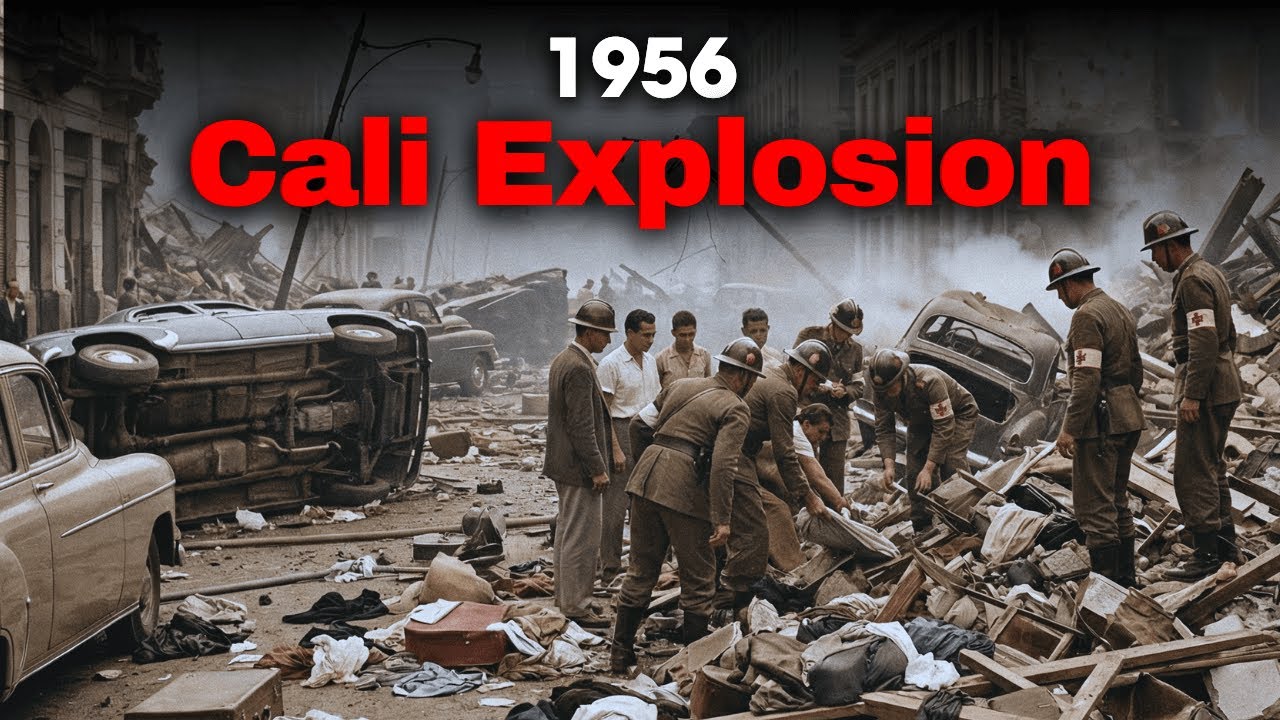
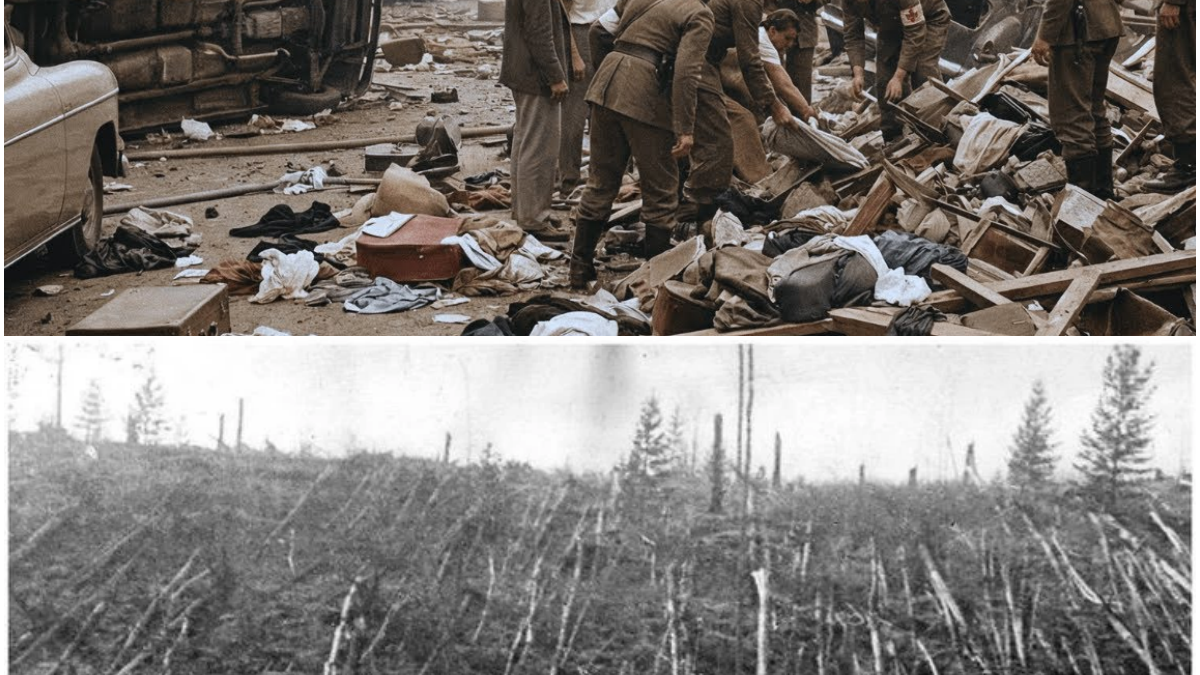
People run blind while coughing, their palms outstretched and faces cut by flying grit.
Seven army trucks with more than 40 tons of dynamite instantly vanish into a single heartbeat.
By morning, it will not look like an accident.
It will look like war.
Was this a tragedy?
Or was it negligence, fate, or someone’s decision?
Now, let’s go back in time to the hours before Cali ignited.
It starts long before the flash with engines laboring under weight that no city street should ever carry.
On the afternoon of August 6th, 1956, government trucks came down from the port of Buenav Ventura, breaking a roughly 430 m hall toward Bogatar with a stop in Cali.
The cargo was not food or fuel.
It was dynamite packed in 1,053 boxes intended for public works and road building far from these crowded blocks.
To the men on the road, it was a shipment with papers and signatures, a routine duty under military escort.
But in mid-50s Colombia, routine could still mean dirt roads, hot breaks, and long delays, and every delay kept heat in the engines and fatigue in the drivers.
By early evening, the convoy was guided toward the old Pacific Railroad Station area.
A hard-edged district of warehouses, workshops, and tightly packed housing.
Nearby military quarters made the location feel guarded, and the trucks were left to sit, their loads resting there behind wooden sides and canvas.
The boxes were meant to tear rock for highways and bridges in the interior to carve new routes through mountains that had resisted men for centuries.
Yet, dynamite does not know the difference between a hillside and a home.
It only answers to heat, shock, and ignition wherever it is stacked.
Some later argued this pause was practical, that moving explosive cargo through the city after dark invited risk and confusion.
Others pointed to a colder truth, that stopping inside a living city simply transferred danger from the road to the people who had no say in it.
And what does safe mean when more than 40 tons of blasting power is parked within earshot of sleeping families?
A sentry can watch a street corner, but can he watch a spark, a careless hand, a sudden fault in a machine?
As the night deepened, Cali carried on in ordinary sounds, a radio fading, a dog barking, a door closing against the heat.
The trucks waited in the dark, silent, indistinguishable from any other freight at rest, except for what they held.
The questions begin here, not at the moment of destruction, but at the moment of decision.
Why was this cargo allowed to bed down in a district jammed with people and buildings instead of being kept far outside the city limits?
One grounded explanation is simple human judgment under pressure, tired drivers, limited secure space, and the belief that proximity to military facilities reduced the odds of interference.
Another possibility is plain negligence, a chain of small shortcuts that no single person felt responsible for until the chain tightened around an entire city.
Before dawn, the convoy’s purpose, its paperwork, even its destination would stop mattering.
All that would matter was that the trucks were there and that Cali had been asked to sleep beside them without being told.
Because once deadly cargo is parked in the heart of a city, the countdown does not always announce itself.
It just begins.
It is never the explosion itself that decides a city’s fate first.
It is where the danger is allowed to wait.
Late that August evening, the convoy steered into the Pacific Station District, a place built for freight and hard work.
But ringed by homes close enough to hear a truck idle.
The street lights are thin, the air smells of oil and warm iron, and the night feels ordinary to everyone who does not know what is parked nearby.
Soldiers step down, boots scraping grit, checking straps and tarps by touch.
A few men stand guard with rifles that can stop a thief, but cannot stop friction inside a crate or a spark beneath an engine.
Around them, Cali keeps breathing.
Shopkeepers latch doors, a late bus groans past, and families settle into sleep behind plaster walls that look solid until pressure finds them.
This is the moment the future disaster takes shape, not with a bang, but with paperwork and routine.
The load is treated like cargo, not like a threat with a radius.
In the years after the Cali explosion, survivors would speak about distance, not politics, as if the city itself was measured in steps.
How many steps separated a sleeping child from a decision made in a uniform?
The stakes were always mathematical, even if nobody wrote the equation down.
The blast that would follow would wipe out 41 city blocks, and the dead would be counted somewhere in the thousands, depending on whose list you trust and what was never found.
Yet on this night, the numbers are invisible.
What you can see is a row of trucks sitting still, their weight pressing into the road, their engines cooling, their shadows falling across doorways.
A half mile away, the city’s heart beats in the dark, a clinic with a night nurse, a boarding house full of laborers, a row of wooden roofs patched with tin.
If something goes wrong here, who hears the warning first, and who has time to run tonight?
One explanation for the stop is control, keeping the shipment near military quarters where it can be watched, where strangers can be challenged, where orders can be enforced.
Another explanation is convenience dressed up as caution.
A decision made because the city offered space, light, and the false comfort of being close to authority.
Either way, the risk shifts from the men assigned to transport it to the people who did not sign anything.
When you park danger in a living neighborhood, you make everyone a participant without asking.
Past midnight, the watch changes.
Voices lower and the district grows quiet enough to hear distant music and a dog’s nails on stone.
Heat bleeds out of metal.
Dust settles and a thin mist clings to the street.
Nothing looks dramatic, and that is the most frightening detail.
A catastrophe does not always announce itself.
Sometimes it simply sits there, patient, in the center of a city that has gone to sleep.
At 10:07 a.m., the city does not wake up.
It ruptures.
A red column surges into the dark, followed by a pressure wave that slaps the air out of lungs and turns windows into knives.
The smoke climbs fast and heavy, and the ground seems to jump as if the street itself is trying to throw people off their feet.
In those first seconds, nobody understands what they are seeing.
Some think it is an earthquake.
Others swear it is an attack because the light is too violent and the sound is too deep to belong to anything ordinary.
The nearest blocks become a confusion of falling brick, splintering beams and twisting metal.
A man runs toward a doorway that is no longer there, and a woman calls a name that the roar keeps swallowing.
What matters now is not what the trucks were meant to do, but what they have become.
A contemporary report described the load as more than 30 tons of high explosives.
Enough power to make the night look like a furnace and the skyline look wounded.
Then comes the part that makes this disaster feel endless.
The way the blast keeps arriving in waves.
A single detonation can become a chain and a chain can feel like the city is being hit again and again.
Each impact arriving before the mind can accept the last.
Halfway down the street, people are already bleeding and still cannot tell where the danger is.
If you cannot see through the smoke, how do you decide whether to run or to stay or to dig someone out with bare hands?
This is where the questions about cause begin to claw for attention even while the rubble is still settling.
One grounded explanation is heat and mechanical failure.
An engine or electrical system that sparked where it should not have, igniting a load that was never meant to sit in a crowded district overnight.
Another explanation equally plausible and just as damning is mishandling.
A careless act with a weapon, a struck surface, a rule ignored for one second too long.
There were also whispers of sabotage.
But in the chaos of Lavolencia, rumor could travel faster than proof, and the verdict has never been sealed beyond doubt.
Whatever the trigger, the effect is immediate and indiscriminate.
Roofs slump, walls peel away, and the air fills with powdered plaster that coats tongues and eyes, making every breath feel like swallowing dust from the ground itself.
People stumble through streets that no longer look familiar because landmarks are erased in a blink.
In doorways, in alleys, on sidewalks, the injured gather in the open, instinctively afraid of collapsing walls, instinctively drawn toward any space that still feels like air.
And then the scale becomes impossible to deny.
Before the night is even over, reports speak of more than 1,000 dead and thousands more injured.
A toll so large it cannot fit inside any single building, any single list, any single prayer.
The city’s first responders, priests, neighbors, anyone who can still stand move toward the noise because there is nowhere else to go.
They will soon learn that the blast was only the opening wound, and that what follows, fire, collapse, and the hunt for the missing, will tighten the pressure even further.
It is not one blast that destroys a city.
It is the way the next one answers before the first has finished speaking.
The first detonation hits like a hammer, and then the rest of the load responds as if the earth itself has been primed.
The district becomes a single expanding furnace bright enough to turn night into a harsh trembling daylight.
Seven military trucks do not explode as seven separate events in the minds of witnesses.
They merge into one continuous violence, a rolling roar that shreds roofs, slaps doors from their hinges, and drives dust through every crack of every wall.
Where the convoy had been, the street is no longer a street.
The air turns gritty and hot, thick with powdered brick and smoke.
In minutes, the old station area is unrecognizable.
Whole stretches of downtown are flattened, and the blast footprint spreads until it has consumed over 40 city blocks, block after block, turning into a jagged field of beams and broken stone.
People a kilometer away feel the impact like a fist in the chest.
They run toward the glow, then stop short when they realize the glow is not a fire in one building.
It is the neighborhood itself burning.
This is where the disaster stops being personal and becomes civic.
Streets are blocked by rubble.
Water lines are ruptured.
And reaching the injured turns into a fight against collapsing masonry.
What is a man supposed to do when the city’s center has been ripped apart and the only tools in his hands are his fingers and a borrowed flashlight?
Do you dig where you hear a voice, or do you run when the walls keep shifting above you?
The dead are not counted in that first hour.
They are felt.
The living step over shattered glass that crunches like ice, and they call names into dust that answers with coughing, not words.
Some survivors later said they heard smaller pops after the main blast, like ammunition cooking off in the heat.
Others insisted the sound came from collapsing structures, timbers snapping, and roofs caving in.
The cause, even here, remains a contested thread.
One grounded explanation is that the initial ignition set off a sympathetic detonation, a chain reaction across tightly packed explosives that left no time for intervention.
Another explanation holds that the storage and positioning amplified the effect.
Trucks parked close enough that one failure became an instant multiplier.
Either way, the verdict points back to the same hard truth, that explosive power in a dense district does not forgive errors, and it does not allow partial consequences.
As the smoke rises, the city’s landmarks vanish behind a moving wall of gray.
In the open spaces that remain, stunned survivors gather, blinking through grit, their faces stre with blood and dust.
And while the first fires still burn, a new pressure arrives quietly.
Somewhere under that rubble, people are still alive, and the clock that matters now is measured in breaths.
The blast ends, but the city keeps collapsing.
In the darkness after the flash, fires begin to move with purpose, licking through broken storefronts and cracked homes where lamps have toppled and fuel has spilled.
The air tastes of smoke and lime dust, and every breath scratches the throat as if the lungs are being sanded from the inside.
A shock wave that can level blocks also breaks the systems that fight fire.
Water manes split, hydrants fail, and hoses run dry just when flame becomes the next enemy.
By the time the first organized crews arrive, they find streets choked with debris, beams angled like spears, bricks piled high enough to force detours.
The center of the city has become a maze, and a maze is a gift to fire.
Some men try to form bucket lines, passing water from hand to hand with the stubborn faith that effort alone can replace infrastructure.
Others drag the injured out into open plazas, believing the sky is safer than any wall that might still fall.
The numbers begin to harden into reality.
Early reports speak of over a thousand dead in part because so many bodies are buried under collapsed stone or burned beyond recognition.
Thousands more are injured and the streets fill with people who do not know where the nearest functioning hospital still stands.
Halfway through the night, a terrible question spreads from mouth to mouth.
If the center can vanish in seconds, what else is about to fail?
Gas lines, power lines, buildings already cracked and leaning, ready to drop without warning.
This is how a single blast becomes a chain of disasters.
Fire does not need an explosion to kill.
It only needs a city that cannot stop it.
In the ruins, rescues begin with hands and end with exhaustion.
Men pull up beams that refuse to move, and they listen for tapping under the rubble, then freeze when the rubble shifts back, threatening to crush the very people they are trying to reach.
A grounded explanation for why the fire spread so fast is structural damage, ruptured pipes, broken electrical lines, and open flames from homes and businesses igniting whatever remains exposed.
Another possibility, no less plausible, is that the district’s density and materials, wood, tar, paper, fuel, made flame inevitable once the blast tore everything open.
Neither explanation changes the cruelty of the scene.
The disaster has created conditions where the right response is impossible because the tools of response were buried at the same time as the victiMs. In the streets, the wounded are laid on doors pulled from hinges and on sheets grabbed from beds.
The living try to comfort strangers because families cannot find each other and the normal map of the city has been erased.
Somewhere near the crater, a new fear settles in.
If there were seven trucks and they all detonated, then the biggest danger is over.
But the city cannot trust that idea yet.
In the smoke and confusion, people imagine more explosives, more blasts, more death waiting behind the next wall of dust.
And that fear becomes its own pressure, driving people into the open, into the roads, into the night, while the fires keep moving one block at a time.
The first instinct after the blast is not bravery.
It is flight.
When the roar finally fades, the city fills with a different sound.
Footsteps, shouting, crying, the frantic call of names that never receive an answer.
People spill into the streets half-dressed, faces gray with dust, hair [snorts] singed, hands trembling as they search for light in a darkness made thicker by smoke.
In the streets of Cali, crowds do what crowds always do in catastrophe.
They move away from the unknown.
But the unknown is everywhere because the center is broken and the air itself feels unstable.
Some run toward the river banks and open ground, believing distance is the only medicine.
Others run toward churches and plazas, places that once meant safety, now crowded with the injured and the terrified.
The panic spreads faster than any official word.
A man shouts that another convoy is coming.
Another says the city’s under attack, and a third swears he heard more explosions in the distance, not realizing the sound is masonry collapsing and fuel igniting.
This is how fear multiplies.
Even a slammed door becomes a gunshot in the mind, and even a flickering street lamp becomes a warning sign.
The scale of what happened is already beyond comprehension.
More than 40 tons of dynamite has turned the district into ruin, and within hours, the death toll will be described in the thousands.
It’s just an unbelievably tragic situation on the ground.
But in the streets, the numbers do not matter yet.
What matters is the next second, the next breath, the next corner.
Halfway through the night, the city confronts a question that splits neighbor from neighbor.
Do you go back into the rubble to look for someone you love?
Or do you stay out because the walls keep shifting and the fires keep growing?
Many choose both, returning and retreating again and again, trapped between hope and survival.
A father steps into a collapsed doorway, listens for a child, then backs out when the roof groans above him.
The danger is not only falling stone.
In the open streets, people are cut by glass, crushed in crowds, burned by embers carried on the wind.
Injuries that would be survivable on a normal night become fatal when help cannot reach you.
A grounded explanation for this chaos is simple.
Communication fails when the center fails.
Power lines are down, roads are blocked, and the authorities are hit by the same shock as everyone else, leaving rumor to fill the space where guidance should be.
Another explanation is psychological.
The fear of a second blast is rational when nobody can confirm what actually exploded.
When you do not know the boundaries of danger, every direction feels wrong.
The city becomes a moving tide of people pushing outward from the crater, then circling back as they realize there is nowhere to go.
Families are separated in the crush.
Hands slip from hands.
And in the smoke, even a familiar face can disappear at arms length.
By dawn, the open spaces will be filled with makeshift camps.
The injured laid in rows, the living staring back toward the broken center as if looking at an enemy.
The blast has already shattered buildings.
Now it begins to shatter trust in streets in authority and in the belief that ordinary knights stay ordinary.
And as the panic wave spreads, it carries the city into its next pressure point because the wounded are still piling up and there are not enough doors left standing to serve as stretchers.
The city’s next battle is fought under white sheets and flickering lights.
Within minutes, the wounded begin to arrive in waves, carried on doors ripped from hinges, supported by strangers, stumbling in on their own legs while leaving blood on every step.
Dust coats their eyelashes, turns sweat into paste on their faces, and makes every cough sound wet and dangerous.
Clinics that were built for routine injuries, a broken arm, a factory cut, a fevered child are suddenly forced to triage a catastrophe.
Hallways fill, waiting rooms overflow, and the smell of smoke follows the injured inside as if it has chosen them.
Doctors and nurses work with what they have.
Bandages, morphine, needles, and bare hands.
But the city has just been struck with a disaster large enough to create thousands of casualties.
And no hospital in a mid-century city is designed to absorb that in a single night.
Some accounts describe at least 5,000 people are injured.
Others place the figure far higher because the wounded include not only those crushed by debris, but also those burned, cut, blinded, and poisoned by smoke.
Even the numbers feel like rubble, shifting as new bodies arrive and new lists are started.
Halfway through the night, a question surfaces in every crowded room.
When there are too many bleeding men and not enough beds, who gets treated first?
The man who is screaming or the man who is silent?
Triage becomes a cold kind of mercy.
The loudest pain is not always the deadliest, and the quietest injuries can hide internal bleeding that ends a life before anyone notices.
Outside, the streets are still unstable.
Ambulances, where they exist, cannot move easily through blocked roads, and some buildings near medical centers are cracked, making the staff fear that even the hospitals may not be safe.
A grounded explanation for this collapse of care is infrastructure.
Roads clogged with rubble, power interrupted, water disrupted, and communication failing all at once.
Another explanation is scale.
The disaster is simply larger than any plan, larger than any stockpile, larger than the number of trained hands available in a single city.
The injuries themselves reveal the violence of the blast.
Shrapnel is not always metal.
It is glass, stone, splinters of wood driven into flesh.
Burns come in layers, scorched skin, blistered hands, faces darkened by heat and smoke.
There are also the injuries that cannot be bandaged.
Men arrive shaking, eyes wide, unable to stop repeating what they saw.
And some can only point toward the center of the city as if words have failed.
In overcrowded wards, strangers become family.
A man holds pressure on another man’s wound because no nurse can reach them yet.
A woman wipes soot from a child’s face and keeps wiping as if she can erase what happened.
Meanwhile, the death toll continues to climb.
Estimates that begin around 1300 will be challenged by the sheer number of missing, pushing some later.
Counts toward 4,000 because bodies can vanish under collapsed stone or be consumed in fires that leave little to identify.
As morning approaches, the hospitals are no longer just places of healing.
They become proof that the city has crossed a line.
Because when a community runs out of room for its wounded, it is not only buildings that have fallen.
It is the idea that help will arrive in time.
And outside those crowded doors, the next pressure is already tightening.
The rubble is still shifting.
And somewhere beneath it, voices are still calling out, growing weaker by the hour.
The smoke lifts just enough to reveal a city folded, stacked, and crushed into itself.
In the first hours, the wreckage looks like one continuous surface of brick, timber, and twisted iron.
Doorways open into nothing, and familiar streets end in dead corners.
Men arrive carrying crowbars, shovels, and rope.
Soldiers who had guarded the convoy work shoulderto-shoulder with dock workers and shopkeepers because there is no time to sort uniforms from neighbors.
They dig by sound as much as sight.
A cough beneath rubble, a faint tap on stone, a thin cry that fades when dust is swallowed.
The trucks were not just seven vehicles parked overnight.
They were part of a larger movement of explosives described by some accounts as a caravan of 10.
And the paperwork speaks in cold logistics.
1,053 boxes of dynamite stacked like ordinary freight.
Those numbers feel unreal when you’re kneeling in grit, scraping it away from a hand that is still warm.
Every box was built to break rock in the mountains.
Yet here the rock is the city, and it is burying people alive.
Halfway through the search, the same question tightens the chest.
When you hear a voice under a leaning wall, do you pull harder and risk the wall falling?
Or do you pull slowly and risk the voice going silent?
The ruins have moods.
A beam that holds for an hour can suddenly shift, and a wall that seems stable can collapse with a soft groan that gives no warning.
Small fires smolder under the debris, heating pockets of air and turning some voids into ovens.
In certain places, the dust is so thick, men tie cloth over their mouths, then cough anyway.
Lungs burning as if they are breathing powdered brick.
By the end of the first day, the work becomes organized in the simplest way.
One team listens, one team clears, one team carries.
Stretches are scarce, so doors and tabletop boards become lifelines, and every trip to open ground feels like climbing out of a mine.
Time marks the horror.
After 3 days of searching, reports spoke of close to 500 bodies recovered.
And even that number did not feel like an answer.
It felt like the start of a longer tally.
A grounded explanation for the deadly pace is physical reality.
The debris is layered and heavy, and streets are choked, slowing both rescuers and equipment.
Another explanation is structural.
Tightly packed buildings collapse into each other, creating traps that hand tools cannot quickly undo.
Even when someone is pulled free, the danger does not stop.
The injured are carried over unstable ground toward clinics already overflowing, while secondary collapses keep stealing time.
What the rescuers are really fighting is uncertainty.
They cannot know which pocket hides a living voice and which pocket hides silence.
So they keep digging for anyone listening because stopping would mean accepting that the ruins have won.
When the rescue work slows, the city learns the loudest part of the disaster is over and the quietest part is beginning.
In the devastated streets of Cali, names travel from mouth to mouth like prayers.
Lists appear on walls and in church courtyards, written in shaky handwriting, then rewritten as new rumors arrive and old hopes collapse.
The blast zone is not a single point.
It is a wide scar.
News reels and observers described roughly two square miles of devastation.
And within that scar, whole blocks are reduced to a low horizon of stone and charred wood.
Six districts are repeatedly named in the aftermath.
San Nicholas, El Pvenia, Elooo, El Pilotto, Fatima, and Horge Isaacs.
Each neighborhood has its own missing, and each missing person leaves a hole no official count can fill.
Families moved through shelters and hospitals asking the same questions.
Was he taken to a clinic?
Was she carried to a plaza?
Did anyone see them after the flash?
Halfway through that search comes the question nobody wants to say aloud.
When there is no body and no witness, do you keep waiting for a knock at the door?
Or do you begin preparing a funeral without remains?
The injured complicate every list.
Some estimates placed the wounded reaching as high as 12,000.
Meaning countless people were moved, treated, or relocated without records, and some never returned to the streets where their families looked.
A grounded explanation for the missing is administrative collapse.
Roads blocked, power disrupted, and hospitals overwhelmed, so names are lost as quickly as they are spoken.
Another explanation is physical.
Fire and collapse can erase evidence, burying bodies deep or consuming what might have identified them.
In makeshift morgs, identification becomes a second disaster.
Dust and burns change faces, papers are gone, and clothing is torn away, so relatives search for small signs, a ring, a scar, a familiar shoe, anything that can turn an unknown body back into a person.
Grief turns sharp when questions shift from where to why.
Why were explosives stored inside a living district?
Why were families allowed to sleep within reach of a cargo that should have been kept far from homes?
Rumor rushes in where certainty cannot.
Some insist it was an accident.
Some insist it was sabotage.
And some insist it was simple carelessness.
But the tragedy refuses to give a clean answer that would let the living rest.
As the days pass, silence becomes its own presence.
A house that should be filled with a voice stays empty.
A workplace chair stays unused and a mother keeps listening for footsteps that never come.
The missing haunt the city’s sense of safety.
A disaster that can erase people without leaving a trace teachers a final lesson.
That what is lost may never be fully found.
And what happened may never be fully explained.
Not in a lifetime.
Rumor arrives faster than relief.
And in a shattered city, rumor feels like truth.
In the hours after the blast, men stand in streets staring at a crater where a working district used to be.
They keep asking the same thing.
How could this happen without someone meaning it to happen?
They know the hard facts.
Those seven army trucks carried more than 40 tons of dynamite vanished in a heartbeat and about 41 city blocks were broken open like dry clay.
But causes a different kind of wreckage.
It has no clean edges and everyone reaches for a story that can hold what they saw.
Some point to negligence, a convoy parked too close to homes, guards too tired, procedures too loose, and the belief that a uniform can tame explosives.
In that explanation, the villain is ordinary, routine done carelessly, then defended as necessary.
Others reach for sabotage because the 1950s in Colombia are already scarred by political violence.
It feels easier to accept an enemy than to accept that chance alone can erase a city.
In that explanation, the villain is intent.
Someone lights the match, then disappears into the dark.
A third thread blames mishandling.
A weapon discharged, a careless strike against metal, a cigarette where it never belonged.
One small act that becomes a chain reaction.
That story is comforting in its simplicity.
It keeps the blame small.
One person, one mistake.
Halfway through the night, the question turns sharper.
If it was sabotage, who was the target?
The army, the city, or the fear itself?
The rumors multiply because the evidence is buried.
The center is still too hot in places to enter safely, and the men closest to the trucks are dead or badly injured.
Witnesses disagree, not because they are lying, but because shock scrambles memory.
One man swears he heard a shot.
Another swears he smelled fuel first.
Another insist the first sound was a crack.
Authorities try to restore order, but order is hard to sell when rooftops are gone.
Each denial feeds the whisper because people assume the truth must be worse than what is admitted.
In the days that follow, fear changes shape.
People scan strangers, flinch at distant thunder, and distrust any truck that rattles by after dark.
The city also begins to demand accountability.
If the cause was mechanical, why was the load not kept outside the urban core?
If it was mishandling, why was discipline so thin?
If it was deliberate, why were defenses so easy to bypass?
No verdict can be sealed quickly because grief is too loud and proof is too scarce.
Yet, the rumors accomplish something real.
They turn private mourning into public pressure.
And as that pressure rises, it climbs past the rubble and toward the men in offices and uniforMs. The next fight will not be in the streets.
It will be over responsibility and over whether anyone powerful will answer for a city left asleep beside a bomb.
It is one thing for a district to be shattered.
It is another for the state to arrive and feel the city’s stare.
By the next morning, Cali is no longer a local emergency.
It is a national crisis.
Orders and pleas by radio, and each message carries more fear than the last.
Officials step into streets coated with ash and powdered plaster.
Near the center, they find a crater that’s beyond the imagination.
A scar that makes the event feel intentional, even when no one can prove it.
Crowds gather at the cordons, faces gray, eyes hot with anger.
Soldiers form lines, not against an invading force, but against panic that could ignite another disaster.
In the mid 1950s, Colombia is already strained by unrest, and the public’s trust is thin.
People do not only ask what happened, they ask who decided this risk belonged to them.
One response is control.
Roads are blocked, civilians are pushed toward open plazas, and officials try to keep the city from stampeding itself.
Another response is relief.
Temporary clinics are organized, supplies are requested from outside, and bodies are moved fast because heat and time can turn grief into sickness.
But aid does not answer the deeper demand.
The city wants a chain of responsibility, not a speech.
Halfway through the response, one question begins to follow every uniform.
If a shipment could carve a crater like this, why was it left where families slept?
A grounded explanation is logistics under strain, limited secure space, exhausted drivers, and the belief that proximity to military oversight reduced risk.
Another explanation is bureaucratic drift.
Small approvals that seemed harmless until they combined into catastrophe.
The government faces a second conflict.
What to say while facts are still buried?
Admit uncertainty and you feed rumor, claim certainty, and you gamble your credibility.
Investigators request root decisions, guard rosters, maintenance notes, and the order that justified the overnight stop.
Some records exist, some are incomplete, and some become strangely hard to find once blame has a direction.
Even the injury count will not hold still.
The totals continue to rise as victims are pulled from delayed collapses and carried in from the blast’s outer edges.
Behind closed doors, the cause is argued in three lanes: mechanical failure, mishandling, sabotage.
Each lane points toward a different failure, and each failure threatens a different institution.
No verdict can calm the streets yet because every possible verdict creates a new crisis.
If it was an accident, the state looks careless.
If it was sabotage, the state looks exposed.
Reporters photograph the ruins and the images travel beyond the valley.
In offices far away, officials read the same headlines and realize this is now their test too publicly.
And now the pressure shifts from rubble to paperwork.
The next fight will be over.
What the files reveal, what witnesses dare to say, and what the investigation cannot prove.
The city wanted an answer, but the ruins offered only questions.
In the weeks after the blast, officials promised clarity, and families demanded it.
They wanted a single cause they could name, and a single person who would carry the weight.
Investigators walked the perimeter where the old station had stood, now gone, as if it had been erased.
Reports from the time claimed that 320 soldiers had been sleeping inside that barracks and that only two were accounted for afterward.
A detail that turned grief into fury.
Paperwork was gathered, roots were reconstructed, and guard schedules were questioned.
But a disaster that happens in seconds leaves evidence that burns, shatters, and vanishes.
The crater became a symbol that refused to behave like an accident.
One widely reported measurement described it as roughly 190 ft across.
A wound so wide it made every explanation sound too small.
Three theories fought for dominance, mechanical failure, careless handling, or deliberate ignition.
Each had a path that could be grounded in reality, and each left gaps that could not be filled with certainty.
One explanation focused on heat and machinery.
That an overheated vehicle, a fault in wiring, or a hot exhaust set off the first ignition.
Another pointed to human error, a single reckless act near volatile cargo, turning a quiet street into a fuse.
Then came the darker whisper, sabotage.
In an era already marked by political fear, some found it easier to believe in a hidden attacker than to accept that official decisions could be this dangerous.
Halfway through the inquiry, a question kept resurfacing in different words.
If the verdict is never proven, is that because the truth is complex or because the truth is inconvenient?
The investigation ran into the same obstacle again and again, the scene was destroyed and witnesses were shattered.
Men who survived were traumatized.
Men who knew the details were dead and memories collided with rumor until even honest testimony sounded uncertain.
Officials spoke carefully because every statement carried risk.
If they declared it an accident, they admitted negligence.
And if they declared it sabotage, they admitted vulnerability.
Behind that caution was a quieter pressure.
Responsibility.
Decisions had been made about where to stop, where to park, and what counted as safe, and those decisions now had a crater for a signature.
Families did not ask for technical language.
They asked why a living district was treated like a storage yard, and why the danger was allowed to sit close enough to turn sleep into a death sentence.
The result was a verdict that never fully satisfied anyone.
Theories were discussed, blame was hinted at, and the city was left holding a tragedy that refused to become a simple story.
And while the arguments continued, another reality pushed forward with its own force.
The ruins could not stay ruins forever, and the next pressure was already forming, rebuilding a city that now feared what normal could hide.
It does not end when the fires go out.
It ends when a city decides it will live again.
In the days after the blast, Cali became a place of open air mourning, bodies laid out, names called into crowds, and prayers spoken over rubble.
Reporters described three square miles of devastation, a wound so wide that no single neighborhood could pretend it was untouched.
To keep disease from spreading in the heat, the dead were processed quickly, and some were buried without the dignity of identification.
In the central cemetery, accounts speak of 3,725 skulls and body parts placed into a single communal grave, a number that reads like an inventory until you remember each fragment belonged to someone who had a home.
Rebuilding began with basics, clearing streets, restoring water, and making the center passable again.
The work was loud and exhausting.
Carts hauling broken brick, sores cutting fallen beams, and men laboring under dust that still carried the taste of smoke.
In the late 1950s, the hardest reconstruction was not masonry.
It was confidence.
Who would reopen a shop on a street that had swallowed the past?
And who would sleep through the night without listening for another roar?
Halfway through that first season, the city faced a question that was both economic and spiritual.
Do you preserve the ruins as proof, or do you erase them quickly so people can breathe again?
Officials spoke of recovery, but families spoke of absence.
Some wanted memorials, others wanted silence, and many wanted both, because remembrance without healing felt like punishment, and healing without remembrance felt like betrayal.
A grounded explanation for the city’s push to rebuild quickly is survival.
Markets had to reopen, wages had to return, and shelter had to be found for the displaced, or the blast would keep killing through hunger and despair.
Another explanation is political pressure.
When faith in leadership is shaken, visible reconstruction becomes a public argument, brick by brick, that the state is still capable of order.
In 1957, city leaders organized the first Califair as a deliberate counterweight to grief.
It lasted 40 days, long enough to pull commerce back into the streets and give families a reason to gather in daylight, even if the music sounded strange in a city still counting its missing.
Yet resilience did not erase the fear.
Every fireworks crack, every slammed door, every backfiring engine could still turn heads and tighten throats because trauma teaches the body to expect repetition.
Across the rebuilt blocks, small markers began to appear.
Crosses, plaques, corners where people stopped, touched stone, and looked toward the old blast zone.
The city learned to carry two realities at once.
The need to move forward and the need to remember what forward cost.
And as Cali lifted itself from the rubble, another pressure remained unresolved.
The story would not be complete until the tragedy became more than ruins and rumor, until it became a warning that could reach beyond this valley.
The final damage is not the crater.
It is what the crater teaches a city to fear.
Years after the blast, people in Cali could still point to the place where the ground was torn open and lower their voices without meaning to.
Streets were rebuilt, storefronts returned, and traffic resumed.
But memory does not follow construction schedules.
In the decades that followed, the events numbers remained contested and emotionally charged.
Not because the city forgot, but because the disaster made certainty hard.
Records were scattered, bodies were lost, and the difference between what was known and what was suspected became part of the wound.
What did not change was the scale of what the city endured.
A shipment meant for rock and road work became a force that leveled entire blocks, broke the city’s infrastructure, and overwhelmed every system designed to keep people safe.
Halfway through the story’s legacy, the question becomes bigger than the original cause.
If a single chain of decisions can place so much destructive power beside homes, how many other catastrophes are sitting quietly inside normal routines?
The explanations still circle the same three lanes: mechanical failure, mishandling, sabotage.
Each remains plausible and each remains incomplete because the moment that mattered most was consumed in flame and pressure.
Mechanical failure fits the physical logic of vehicles, heat, wiring, friction, and the unforgiving nature of explosives.
Mishandling fits the human logic of fatigue, shortcuts, and one mistake amplified by proximity.
Sabotage fits the political atmosphere of the time when violence was not rare and fear had a ready audience.
Yet, proof for intent is harder than grief, and grief can make any shadow look like an enemy.
The city’s deeper lesson was not only about dynamite.
It was about the way institutions manage risk and the way ordinary people pay for those choices.
In the years after, Calli’s rebuilding became part of its identity.
A public refusal to be defined solely by a night of destruction.
The fairgrounds filled again, businesses reopened, and neighborhoods reshaped themselves around absence.
But the cost was carried privately.
Survivors described a lasting jump at sudden noise, a reluctance to sleep near industrial yards, and a quiet distrust of cargo that arrives with guards and authority.
Children who were not yet born at the time still grew up hearing the story in fragments.
The sound, the light, the night that turned into dust.
In that way, the event became inherited memory, passed along like a warning.
The scar also shaped how the city talked about responsibility.
Even without a single clean verdict, the questions endured.
Where was the cargo placed?
Who decided it?
And why were civilians left exposed to danger they never agreed to live beside?
That is where the story ends.
Not with a perfect explanation, but with a clear moral weight.
Catastrophes of this scale are rarely born in a single.
Second, they are built slowly through choices that feel acceptable until the moment they become irreversible.
And if this can happen in the heart of a city with guards nearby and paperwork in order, then the last question is the one that should keep any viewer awake.
Are disasters like this rare?
Or are they waiting hidden inside the shortcuts we call normal?








