Life in a 1900s American Logging Camp
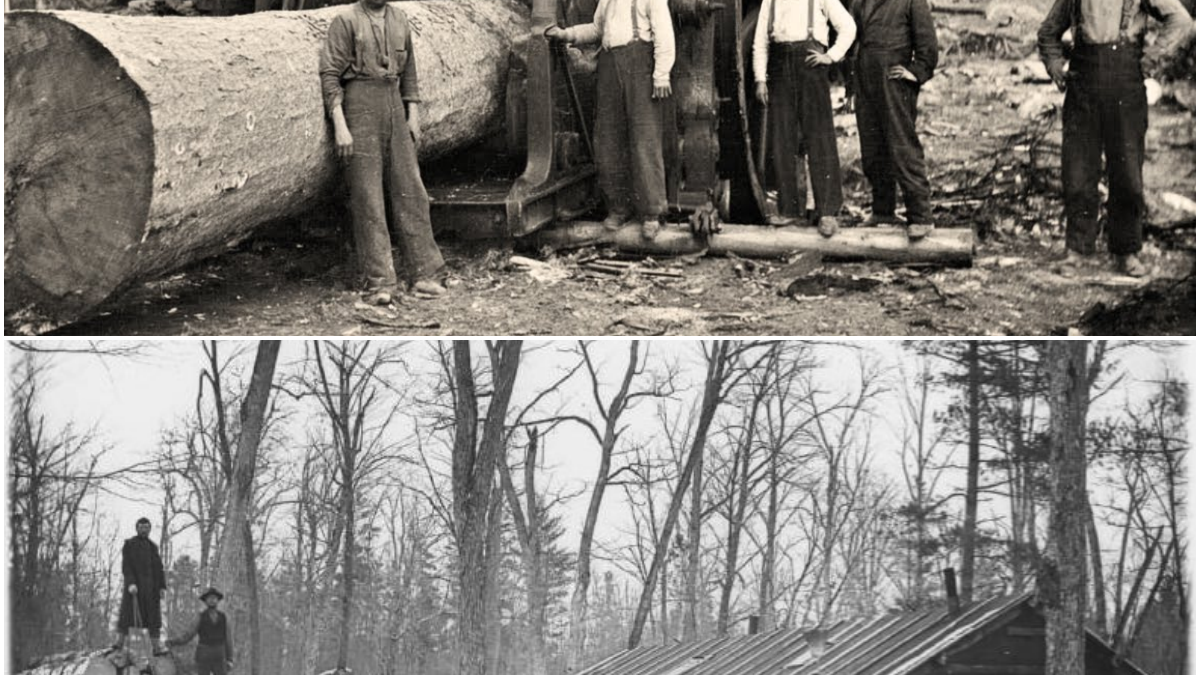
Life in a 1900s American Logging Camp
It’s the year 1908, just before dawn and deep in a Michigan pine camp.
The men’s frozen breath hangs in the air as their iron spikes bite into the bark.
The crack of splitting timber drowning out the shouted warnings.
Between 1870 and 1910, logging claimed more lives per capita than coal mining, with injury rates exceeding 30% annually in some camps.

This is the story of the American logger, one of the highest paid men in the woods, because the job demanded payment in blood.
Was this inevitable or was it designed?
If stories like this move you, please like, subscribe, and tell me in the comments which industries to explore next.
Your support makes these detailed stories possible.
Now, let’s enter the camps where axes swing before dawn, where rivers run with timber and blood, and where survival was never guaranteed.
The American logger wasn’t just well paid by accident.
Between the 1870s and the early 1900s, timber drove the nation’s expansion like coal powered its engines, only louder, faster, and far more visible.
Railroads needed ties, cities needed lumber, paper mills needed pulp, shipyards needed masts.
The forests of Michigan, Wisconsin, Minnesota, and the Pacific Northwest became industrial sacrifice zones, stripped at a pace that still staggers historians today.
A logging camp wasn’t a town.
It was a seasonal labor prison dropped into wilderness, miles from the nearest doctor, accessible only by ruted track or river.
Men lived in bunk houses that slept 40, ate in mesh halls that served before sunrise, and worked 12-hour days 6 days a week.
There was no such thing as a shift change, only exhaustion deep enough to make mistakes inevitable.
And mistakes in the woods didn’t result in paperwork.
They resulted in death.
To understand why logging became a mechanized slaughter, you have to see it in three parts.
First, the woods themselves, where felling and skidding turned every tree into a potential weapon.
Second, the river drives, where spring melt transformed logs into floating freight cars piloted by men in spiked boots.
Third, the sawmills, where industrial machinery met human flesh in rooms too loud for warnings and too fast for second chances.
Each stage had its own logic of danger.
But together, they formed a system that didn’t just tolerate death.
It required it.
By 1910, the US Census Bureau estimated that logging and lumberm milling killed roughly 3,000 workers annually.
How many went unrecorded?
That number remains unknown.
Buried in camp ledgers, unmarked graves, and rivers that never gave up their dead.
The killing started with the simplest task, dropping a tree.
In the winter of 1895, a seasoned faller could read lean, wind load, and rot with a glance.
But reading wasn’t enough when you were working against quotas, racing daylight, and standing on snow compacted ground that offered no traction for a fast retreat.
A tree doesn’t fall cleanly.
It twists, splits, or kicks back, depending on internal tension invisible to the human eye.
Widowmakers hung in every stand.
Dead branches trapped in canopies, shaken loose by the impact of a neighboring tree hitting ground.
They fell without warning, silent except for the last second of air displacement.
Men called them that because they made wives, not because anyone had time to look up.
Then came limming, the process of stripping branches from a downed trunk.
An axe or saw blade glancing off frozen wood could take a leg in one stroke.
Bucking cutting the trunk into manageable lengths meant working next to timber under compression.
When a log shifted or a cut release stored energy, the wood could snap like a spring-loaded trap.
Legs got pinned.
Ribs got crushed.
There was no reversing it.
Skidding and hauling turned physics into a daily gamble.
Logs weighing multiple tons were dragged by horse teams over iced roads built to maximize speed.
A snapped chain became a whip.
A runaway log became a battering ram with no brakes.
What happens when a team panics and a load breaks free on a slope?
The men in its path had about 2 seconds to decide whether to jump left or right, and the ground didn’t always cooperate.
By 1907, Michigan alone reported over 400 logging deaths in a single year.
That’s more than one per day.
And it only counted men whose bodies were recovered and whose employers bothered to file reports.
The woods didn’t spike in danger.
They stayed lethal season after season because speed mattered more than survival.
April 10th, 1894.
New era, Michigan.
The Staples and Coal logging locomotive pulls timber along narrow gauge track cut through Pine Forest.
Eight men ride the cars behind the engine, most of them sawers and buckers, heading to the next cutting site.
The morning is cold, the track still slick with frost.
Ahead, a pine tree has fallen across the rails during the night, its trunk thick enough that the crew hadn’t seen it until the locomotive was already committed to the curve.
The engine hits the tree at speed.
Metal shrieks against wood.
The locomotive lurches, tips, and rolls sideways into the drainage ditch running parallel to the track.
The boiler, still under full pressure, ruptures on impact.
Superheated steam explodes outward in a white cloud.
The men closest to the engine don’t have time to jump.
Steam at 200° F doesn’t burn like fire.
It scolds instantly.
Searing lungs and skin on contact.
Those who breathe it in collapse where they stand, airways destroyed.
Those caught by the direct blaster are blinded, their skin peeling away in sheets.
Eight men die.
One survives with injuries severe enough to leave him incapacitated.
The locomotive itself is destroyed.
Its boiler ruptured beyond repair.
Camp records later note the deaths in a single entry, listing names and wages owed.
No investigation follows.
No regulatory body examines the track maintenance or the visibility conditions.
The tree is cleared, the wreckage hauled away, and a replacement crew arrives within the week.
Logging operations resume as if nothing had interrupted them.
Because in the economic calculus of the timber industry, eight dead men represented less disruption than a single day of loss production.
The new era disaster didn’t change anything because it wasn’t exceptional.
Across Michigan, Wisconsin, and Minnesota during the 1890s, logging camps reported deaths with the same bureaucratic brevity used for equipment losses.
A man crushed by a log was noted the same way a broken saw blade might be.
An entry in a ledger, a line crossed through a payroll sheet, a bunk emptied by nightfall.
The danger never spiked.
It was structural, built into every economic incentive that governed camp operations.
Loggers worked on peacework, paid by the boardfoot or the chord, which meant speed directly determined income.
Slow meant poverty, fast meant risk.
What choice did that leave?
A man with a family in debts didn’t have the luxury of caution.
Weather imposed its own deadlines.
Winter logging depended on frozen ground and ice roads to move timber.
Lose two weeks to a Thor.
And the entire season’s profit margin collapsed.
Camp bosses pushed quotas higher, hours longer, and rest shorter.
Exhaustion became the baseline condition.
Mistakes weren’t anomalies.
They were inevitable outputs of a system designed to extract maximum labor at minimum cost.
Medical infrastructure didn’t exist in any meaningful sense.
A broken leg 20 m from the nearest town meant improvised splints and a wagon ride that could take all day.
Infections killed as often as trauma.
Even minor injuries, a deep cut or a crushed hand became life-threatening without access to clean bandages or antibiotics that wouldn’t exist for another 30 years.
The official numbers were always lower than reality.
Transient workers, men without families or fixed addresses, died unrecorded.
Bodies lost to rivers or buried in unmarked camp graves never appeared in state reports.
How many men vanished into the woods and simply stopped existing in any official capacity.
By some estimates, actual logging deaths exceeded reported figures by 40% or more.
The woods kept their secrets and the companies had no reason to tell them.
If you survived the woods, the river still had its claim.
Spring melt turned every major waterway in the Great Lakes region into a timber highway.
And by late March, camps emptied as men transitioned from felling to driving.
The job was simple in concept.
Push millions of board feet downstream to collection booms near the mills.
In practice, it meant dancing on rolling logs in freezing water, armed with nothing but spiked boots and a pike pole.
River drivers earned top wages, sometimes double what a camp laborer made, because the work combined every dangerous element of logging into a single, chaotic environment.
The logs themselves were unstable platforms, spinning unpredictably with current and contact.
The water was cold enough to kill in minutes, and the volume, the sheer mass of timber moving through narrow channels, created conditions where one mistake cascaded into catastrophe.
Drives operated under brutal time pressure.
Mills downstream needed steady supply and delays cost money.
So drivers worked in all weather, often in fog so thick they couldn’t see the opposite bank.
They worked during high water when currents ran fast enough to carry a man miles before he could reach shore.
They worked through exhaustion because stopping meant logs piling up and piles meant jaMs. Jams were the nightmare.
When logs wedged against rocks or bridge pilings, the entire drive stalled.
Timber backed up for hundreds of yards, creating a floating mass under constant pressure from upstream flow.
Breaking a jam required men to walk out onto that unstable surface, find the key logs holding the structure, and pry them loose with pike poles.
What happens when thousands of tons of timber suddenly release?
The men standing on top rarely had time to process the question before the answer arrived.
By 1905, a Wisconsin alone reported an average of 12 drownings per season among river crews, and those were only the bodies recovered within state jurisdiction.
A river drive began with organized chaos.
Logs stored in rollways along the riverbank throughout winter were released all at once, tumbling into the water in waves that sent spray 50 ft into the air.
From that moment, the drive became a moving problem that required constant human intervention to prevent catastrophe.
Drivers worked in crews of 20 to 40 men stationed at intervals along the route.
Their sole job to keep timber flowing.
The mechanics were deceptively simple.
Logs floated, current pushed them downstream, and gravity did the rest.
But rivers don’t flow in straight lines.
They bend, shallow out, split around islands, and narrow at bridge supports.
Every irregularity became a potential choke point where logs could snag, pile up, and stop the entire operation.
Cold fog and spring melt made everything worse.
High water meant faster currents, but also submerged rocks that could catch logs and anchor them in place.
Low visibility meant drivers couldn’t see jams, forming until they were already standing on top of them.
How do you navigate a river you can’t see while standing on a surface designed to roll?
The boots were the only advantage.
Cked boots fitted with steel spikes an inch long, bit into wet bark just enough to provide purchase.
But grip was relative.
A log spinning in current could throw a man off balance in half a second.
A log rolling over could trap a foot, drag a driver underwater, and hold him there until he drowned or the current swept him loose.
Pike poles gave drivers reach, but not leverage.
A 12T pole with a steel hook could pry logs apart or push them into faster current, but only if the driver had stable footing.
The moment he slipped, the pole became useless weight.
Drop it and you had nothing.
Keep it and it dragged you under.
In 1903, the Sagenor River Drive alone recorded 18 deaths, most from drowning after men lost footing and went into the water still holding their tools.
June 26th, 1905.
Jim falls on the Chipoa River in Wisconsin.
The Chippoa Lumber and Boom Company crew has been working a jam about 20 yard above the bridge since dawn.
Logs have stacked and wedged against the pilings, backing up timber for hundreds of feet upstream.
The sound is constant, a low grinding punctuated by sharp cracks when individual logs splinter under the weight pressing from behind.
Ferdinand Miller stands on the head end of the jam, testing his footing with each step.
At 50 years old, he’s been a river driver long enough to know the sound a jam makes before it lets go.
But knowledge doesn’t guarantee survival.
He works a pike pole into the gap between two massive pine logs, trying to pry them apart without destabilizing the entire structure.
It’s delicate work that requires split-second timing and luck that runs out eventually for everyone.
The jam doesn’t give warning.
A section breaks loose all at once, logs exploding forward as weeks of stored pressure releases in seconds.
Miller tries to ride it, jumping from log to log toward the bridge, but the surface is spinning too fast.
His spiked boots catch a knot.
He loses balance, goes into the water, still holding his pike pole.
The current is strong below the bridge, and the freed logs are moving faster than a man can swim, even without boots and wool clothing pulling him under.
Miller surfaces once, arms flailing, then goes down again.
That’s the last anyone sees of him alive.
The crew searches the riverbank for hours, dragging hooks through the shallows, checking every eddy and backwater where a body might collect.
They find nothing.
His body’s never recovered.
The Chipawa Herald records his death in its June 27th edition under the headline, “Another life lost.”
The word another tells its own story about how common these deaths had become.
The physics of a log jam are simple, but the violence they produce is absolute.
When timber piles against an obstacle, whether a bridge piling, a rock outcrop, or a riverbend, the logs at the front stop moving.
The logs behind them don’t.
Current keeps pushing, adding pressure with every second that passes.
What builds isn’t just a pile.
It’s a dam made of floating wood.
And the water behind it starts to rise.
That rising water stores energy.
Think of it as a compressed spring, invisible, but growing stronger as the jam holds.
The logs themselves are under tension, wedged against each other at angles that create friction points.
Remove the right log, the one holding the structure in place, and the entire mass releases at once.
The water surge arrives first, a wave that can reach 6 ft high in narrow channels.
Then come the logs, thousands of them, accelerating from zero to lethal speed in seconds.
A man standing on a jam when it breaks has no leverage and no traction.
The surface beneath him is already moving before his brain registers the shift.
Spiked boots designed to grip stationary logs become anchors when the wood starts to roll.
Jump too early and you land on unstable timber.
Jump too late and you go into the water under a moving freight train made of pine.
The cold matters as much as the impact.
Rivers in spring melt rarely exceed 50° F.
A man in wool clothing weighed down by boots and tools has perhaps 3 minutes of functional mobility before hypothermia begins shutting down motor control.
That assumes he surfaces.
Many didn’t.
Between 1880 and 1910, drowning accounted for roughly half of all river drive fatalities, a rate that made driving statistically deadlier than coal mining in the same period.
The men knew this.
They took the jobs anyway because the pay was high and the alternative was worse.
The forest and the river were open air.
The mill was a machine room built to eat mistakes.
By the time logs reached the sawmill, they’d already survived felling, skidding, and the drive.
The men who worked them had survived the same.
But survival in the woods didn’t prepare anyone for industrial machinery operating at speeds the human eye couldn’t track in rooms so loud that warnings became invisible.
A sawmill in 1900 was organized chaos contained under one roof.
Logs entered on carriages, massive platforms that fed timber into spinning blades at controlled speeds.
The head rig, the primary saw, could be a circular blade 6 ft across or a band saw running on wheels taller than a man.
Either way, it moved fast enough that contact meant amputation or worse.
And the noise it produced, a constant high-pitched scream, made verbal communication impossible.
Workers read lips.
They learned hand signals.
They developed instincts for when something was about to go wrong, a vibration in the floor or a change in the saw’s pitch.
But instinct only worked if you had time to react, and mills were designed for speed, not safety.
Production quotas demanded continuous operation.
Stopping the machinery to clear debris or adjust a misaligned log cost money, so workers improvised, reaching into spaces they shouldn’t while equipment stayed live.
The floors were always wet.
Sawdust mixed with water and created a surface like ice, especially near the cutting stations where spray from the blade kept everything slick.
Men wore boots with no tread because traction didn’t exist anyway.
One wrong step, one moment of imbalance, and you were within reach of moving parts that didn’t distinguish between wood and flesh.
Exposed belts ran from floor to ceiling, transferring power from steam engines to sores, conveyors, and rollers.
Get a sleeve caught and the belt pulled you in before you could process what was happening.
By 1907, industrial accidents in lumber mills killed an estimated 1,200 workers annually nationwide, a rate that made milling nearly as deadly as the woods themselves.
The danger in a sawmill started at ground level and escalated with every step deeper into the building.
Wet planks fresh from the saw carried a film of water and sawdust that turned walkways into skating rinks.
Men moved carefully, but careful didn’t matter when you were carrying a 60lb board or guiding timber onto a carriage.
Slipping wasn’t a hypothetical risk.
It was a daily occurrence.
The question was whether you slipped toward open floor or toward machinery.
Exposed belts and line shafts ran everywhere, transferring power from the steam engine to individual stations.
These belts moved at speeds exceeding 30 ft pers, fast enough that a loose shirt sleeve or a strand of hair could catch and pull a man into the mechanism before anyone nearby could react.
What happens when a human body meets a belt running at that speed?
The belt doesn’t stop.
It keeps moving and whatever it catches gets dragged into the pulley system or wrapped around the shaft until someone shuts down the engine.
Carriage kickback turned timber into projectiles.
When a log hit the saw at the wrong angle or encountered a knot the blade couldn’t cut cleanly, the wood could reverse direction in an instant.
A plank weighing 30 lb launched backward at 20 mph carried enough force to shatter bone or crush a skull.
Workers near the head rig learned to watch the saw’s behavior the way it sounded when it hit dense wood.
But watching didn’t guarantee avoidance.
The signature nightmare was the saw itself.
Circular blades ran at speeds approaching 10,000 ft per minute at the rim.
Band saws moved slower but covered more surface area.
Either way, contact meant immediate and irreversible damage.
A hand brushing the blade didn’t get cut.
It got erased.
Fingers, hands, entire forearms could vanish in the time it took to register pain.
In 1906, the state of Washington alone recorded 487 sawmill injuries serious enough to require medical intervention.
And that number didn’t include minor cuts, burns, or incidents that went unreported.
July 21st, 1903.
Woolitch, Maine.
Samuel Morrison, a 45-year-old farmer, works alongside Charles Wright at a portable sawmill powered by horses.
They’re cutting cordwood, routine work Morrison has done countless times before.
The day is nearly finished.
Just a few more logs to process before they can shut down the operation and go home.
The saw blade hums its steady note, a sound so constant it becomes background noise.
Morrison feeds a length of wood into the spinning blade.
The saw hits a hitch, a knot or irregularity hidden inside the timber.
The blade doesn’t cut cleanly.
Instead, it catches and the wood kicks back instantly.
One end whipping upward with force multiplied by the saw’s momentum.
The board strikes Morrison’s right arm at the elbow.
The impact is catastrophic.
Bone shatters, tissue tears.
The joint is mangled beyond any hope of repair.
Morrison doesn’t scream.
He staggers backward, clutching the ruined arm.
Blood already soaking through his sleeve.
Wright runs for help.
Dr. Marsh arrives from Bath, takes one look, and knows the arm can’t be saved.
They rush Morrison to Maine General Hospital in Portland, a journey measured in hours, not minutes.
Surgeons perform the amputation the next day.
Morrison survives, but his life is fundamentally altered.
He can’t farm anymore, can’t do the physical labor that supported his wife and six children.
Within 2 years, he’s working as a night watchman at a shoe factory, a job he’ll hold for the next 30 years, sleeping during the day because the sawmill took his arm and his livelihood in a single afternoon.
He sued Wright for $5,000.
After 3 years of litigation, a judge awarded him 736 bucks.
The official numbers were never complete, but they painted a clear picture.
Between 1880 and 1910, logging and lumberm milling killed an estimated 50,000 American workers.
That’s more than 1,600 deaths per year, sustained across three decades in an industry that employed roughly 600,000 men at its peak.
For context, coal mining during the same period killed about 2,000 annually from a workforce three times larger.
Logging was statistically deadlier, and the gap widened when you counted injuries that didn’t result in immediate death.
A bunk house empties in ways that leave marks.
A bed sits made, blankets tucked, because the man who slept there last night, isn’t coming back tonight.
His possessions, what few he carried, get divided among the crew or shipped to a family that might not even know he’s dead yet.
No formal notification system existed.
A foreman might write a letter.
More often, he just crossed a name off the payroll and moved on.
Camp ledgers recorded deaths with the same brevity used for equipment losses.
Died of injuries sustained in woods, drowned during River Drive, caught in saw machinery.
The entries rarely included details about how it happened or what might have prevented it.
Why would they?
The companies weren’t liable.
No workers compensation laws existed until Wisconsin passed the first in 1911.
And even then, coverage was limited and enforcement weak.
Pay envelopes delivered to widows became grim routine.
A man killed on a Tuesday got paid through Monday.
Anything beyond that required a lawsuit the family couldn’t afford.
The Morrison case, 3 years of litigation for just over $700, wasn’t unusual.
It was typical.
Most families never pursued legal action because they lacked resources, time, or faith that courts would rule in their favor against employers with deep pockets and political connections.
The undercount was systematic.
Remote camps operated outside any regulatory oversight.
Men died miles from witnesses, their bodies buried in unmarked graves or lost to rivers that never gave them up.
How many transient workers simply vanished?
The census data doesn’t capture them.
And the company records had no incentive to.
The system wasn’t broken.
It was designed exactly as intended, optimized for profit extraction at human cost.
Logging companies operated under a simple economic logic.
Timber had value.
Workers were replaceable and safety measures reduced speed.
Every decision flowed from that calculus.
Rush to beat weather windows.
Push quotas higher.
Pay by the piece to incentivize risk-taking.
The deaths weren’t accidents in the sense of being unforeseeable.
They were predictable outcomes of deliberate choices.
Weather imposed brutal deadlines that companies refused to acknowledge with realistic schedules.
Winter logging depended on frozen ground, lose 2 weeks to a January Thor, and the season’s profit margin collapsed.
So, crews worked longer hours, pushed harder, ignored warning signs that equipment or conditions had become unsafe.
What choice did a foreman have when his boss demanded quotota regardless of ice storms or equipment failures?
Peacework guaranteed that safety and income existed in direct opposition.
A faller paid by the tree had no financial incentive to spend extra time checking for widowmakers or assessing lean angles carefully.
Speed meant money.
Caution meant poverty.
The fastest workers earned twice what the cautious ones did and the fast workers died at higher rates.
Companies knew this.
They structured payment that way intentionally because it transferred risk from employer to employee while maximizing output.
Regulation barely existed.
No federal workplace safety laws governed logging until decades later.
State level inspections were rare, penalties minimal, and enforcement sporadic.
Even when laws existed on paper, remote camps operated beyond any practical oversight.
Who was going to inspect a logging operation 40 mi from the nearest town, accessible only by seasonal roads?
The companies police themselves, which meant they didn’t.
Safety technology existed, but remained largely unimplemented.
Saw guards, belt shields, emergency shut offs, these weren’t exotic inventions.
Mills in Europe had begun installing them by the 1890s.
American companies called them expensive and unnecessary.
The real reason, they slowed production.
A guarded saw required workers to position lumber more carefully.
A shielded belt meant stopping the machine to clear jams instead of reaching in while it ran.
Change came slowly, driven less by moral awakening than by economic pressure and political necessity.
Wisconsin passed the first workers compensation law in 1911, establishing the principle that employers bore financial responsibility for workplace injuries regardless of fault.
Other states followed all the way through the 1920s, creating a patchwork system that at least acknowledged workers as something other than disposable inputs.
The laws didn’t prevent deaths, they just made them cost money.
Unions gained traction in lumber camps during the same period, though progress was violent and contested.
The industrial workers of the world organized loggers across the Pacific Northwest, demanding 8-hour days, safer conditions, and compensation for injuries.
Companies responded with blacklists, firings, and in some cases, armed strike breakers.
The 1917 Everett massacre left seven dead.
Five of them loggers shot by deputies while attempting to organize.
Safety improvements came not from goodwill, but from strikes that shut down production until demands were met.
Mechanization changed the math more than regulation ever did.
Chainsaws introduced commercially in the 20s reduced felling crews and made the work faster but not necessarily safer.
Log loaders replaced river drives entirely by the 50s, eliminating drowning as a primary cause of death.
Sawmills automated gradually, installing guards and shields not out of concern for workers, but because machines were expensive and damaged equipment cost more than injured men.
The truth is, logging didn’t become safe.
It became less visible.
Machines replaced bodies, and the workforce shrank even as timber output increased.
Fewer men meant fewer deaths in absolute terMs. But the per capita risk remains staggering.
Modern logging still ranks among the most dangerous occupations in America with a fatality rate of 136 per 100,000 workers as of 2016, more than 30 times the national average.
The camps are gone.
The river drives are history.
The old sawmills have been replaced by automated facilities where computer controlled blades process timber at speeds that would have been unimaginable in 1900.
But the fundamental logic hasn’t changed.
Timber has value and someone still pays in blood to extract it.








