How 100,000 Oil Workers Ended Up in Refinery Death Traps
How 100,000 Oil Workers Ended Up in Refinery Death Traps
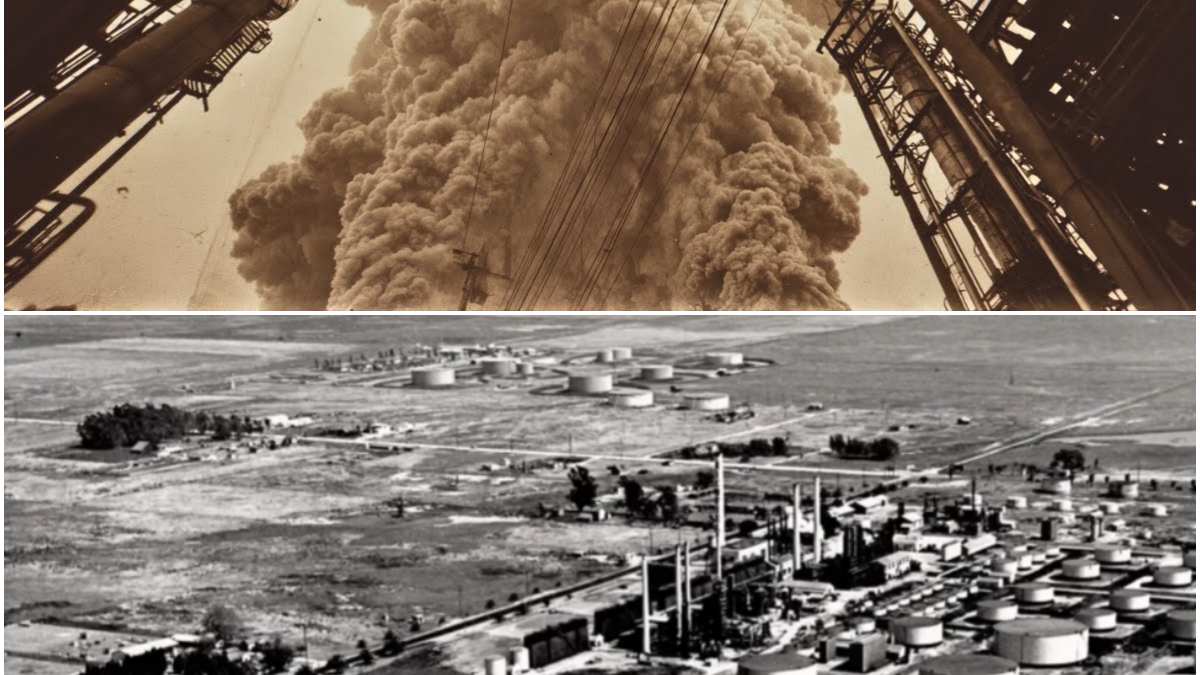
In 1913 at the Bayway refinery in New Jersey, a pipe rack howls like a kettle when suddenly the night explodes into an orange light.
Men stagger across the shaky grating, coughing on oily smoke as heat pours off the still house and a vapor cloud ignites above their heads.
Someone screams for the valve.
Someone else is already on fire.
And in the confusion, eight are dead.
44 are burned.
This was not an accident.
It was the job.
Was it bad luck or built-in design?
Were these men unlucky or expendable?
If stories like this matter to you, please like and subscribe and tell me in the comments which disasters you want covered next.
Your support keeps these detailed stories alive.
Thank you for being here.
Now, let’s follow the chain of failures, and you can decide for yourself what really killed them.
At first light, the refinery wakes like a city of steel veins, and every walkway smells faintly of fuel.
Men step onto narrow grating, palms on hot railings, listening for the wrong sound, a hiss where there should be silence.
In the early 1900s, many plants grew in patches.
New units bolted beside old ones until the whole place became a maze.
Towers, stills, and pipe racks crowded together so tightly that one missed turn could put a worker in a dead end of heat and shadow.
The danger did not always announce itself as flame.
Gasoline vapor can ignite when it sits in air between about 1.4 and 7.6%.
And it can be 3 to four times heavier than air, so it sinks and pools in low spots where boots have to land.
That is how an ordinary platform becomes a trap without warning.
A gasket seeps.
A flange weeps.
A drain is left cracked open.
It does not need to spray.
It only needs time.
Halfway through a shift, who could tell the difference between a normal refinary odor and the exact mixture that could explode?
Men trusted habit and instinct, but habit is a blunt tool in a plant that changes by the hour.
Inside the crude unit, the work revolved around sustained heat with feed heated to roughly 600 to 750° F before fractions were drawn off and cooled.
At those temperatures, a loss of containment could throw hot liquid and vapor into the same space where workers carried lanterns, struck tools, and climbed ladders.
When fires followed, investigators often pointed to an ignition source because the physics is plain.
But the verdict stayed open.
Was it one careless moment, or a layout that placed vapor and flame too close together?
The refinery demanded speed, and speed punished caution.
Most wore little more than wool shirts and leather gloves, protection that meant nothing once vapor lit in a heartbeat.
By the time a man sensed trouble, the maze had already chosen its path, and the next lesson waited at the fireboxes beneath the stills.
At the heart of the early refinery, the danger began with a simple promise.
Heat will turn crude into profit, and profit will outrun fear.
Men walked past brick fireboxes where burners roared under iron stills, a direct fired setup common by 1910, as plants were built fast and expanded faster.
The logic was brutally straightforward.
Crude was warmed until lighter fractions lifted and condensed, and the whole process relied on open flame sitting inches from liquids that could become fuel the moment they escaped their pipes.
Men judged heat by brick color, by blistering paint.
Here is what made it treacherous even before anything went wrong.
Gasoline’s flash point is about -45° F, meaning it can give off ignitable vapor in temperatures colder than an early morning shift.
A thin sheen on a step could breathe fumes for hours without looking like anything at all.
So, when a valve stem leaked or a sight glass cracked, the question was never whether there was fuel in the air.
It was whether the plant would provide the spark.
And how could it not?
Workers carried lanterns, struck wrenches, and stepped through drafts that pushed vapor toward the burners.
Investigators often blamed carelessness.
A dropped tool, a lit cigarette, a foreman who rushed a lineup.
Yet, a grounded explanation sits beneath the blame.
Direct fired units created permanent ignition sources, and early ventilation was often little more than open air and hope.
In 1921, the Whiting event showed what that design could unleash.
Eight dead, 44 injured, and a fire that moved faster than shouted warnings.
A refinery could survive that day and still keep the same flames burning under the next run.
Because even after the smoke cleared, the job demanded the same routine.
Climb above the heaters, open the valves, trust the gaskets, and pray the wind did not carry vapor into the fire again.
And as soon as heat was introduced, a new enemy began forming in the shadows.
The invisible cloud that could turn a whole unit into one breath away from detonation before anyone even smelled danger.
The most dangerous thing in an early refinery was the one you could not see.
A low, drifting blanket of vapor that moved like weather.
It slipped under handrails, pulled in valve pits, and crept along the ground until it found something hot enough to wake it.
By the 1920s, refineries were moving enormous volumes through lines that never truly rested, and the smallest leak could feed a cloud for minutes before anyone understood what was happening.
One barrel meant 42 gallons of liquid, and a thin spill from a drain or sampling point could spread into a wide sheen across grating and dirt, quietly breathing into the air.
What made it murderous was not just the fuel, it was the setting.
Air already carries the one ingredient fire demands, about 21% oxygen, and a refinery provided endless places for vapor to gather.
Sumps, trenches, basement, even the hollow spaces beneath wooden walkways.
A man might stand in clean air while his boots hovered over a pocket that could ignite in an instant.
Halfway through a shift, how do you fight something that can run ahead of your eyes and ears?
Workers learn to read clues instead.
A faint sweet odor.
A shimmer on water, a dog barking and refusing to cross a yard, but those signs arrived late and sometimes not at all.
After an explosion, the argument often narrowed to one spark.
A lantern was blamed or an electrical contact or a tool strike, and each is a grounded explanation because ignition sources were everywhere in those plants.
Yet, the verdict stayed open.
Was the spark the true cause?
Or was the real cause the decision to let vapor roam through a layout built with pockets and dead air?
When the cloud finally caught, it did not burn like a campfire.
It flashed, pressurizing faster than a man could turn his head.
Then the flame chased the vapor back through the paths it had already taken, along ditches, under platforms, around corners, into places where men had no exits.
That is why the refinery felt calm right up until it became violent.
And as workers hurried to isolate the leak, they reached for the smallest object with the largest consequences, the valve that could stop the flow or fail and decide whether the next sound was silence or an explosion.
One valve wheel turns and the whole unit seems to hold its breath.
Around 1911, refinery work was less about machines and more about judgment.
Hands on hot metal, eyes on wavering needles, ears tuned for a change in pitch.
A single lineup could mean opening one path while sealing another, and the difference between the two might be nothing more than a tag gone missing, or a foreman’s shouted instruction swallowed by steam.
A valve is supposed to be control, but it can become a trap.
A stem packing dries out, a seat fails to seal, or a bypass is cracked open just for a moment, and suddenly the product is where it should never be, drifting toward heat, pooling in low spaces, soaking into wood, rope, and clothing.
What made those leaks so dangerous is that refined fuel does not stay politely inside a pipe.
Motor gasoline is a mixture with a boiling range that can begin around 122 to 158° F at the lighter end and climb to roughly 365 to 374° at the heavier end, meaning parts of it want to become vapor long before a man senses alarm.
Halfway through a shift, how many times can someone spin a wheel and tell himself it is only a minor seep, only a faint odor, only a little lost product?
The plant rewarded speed, and speed made temporary decisions permanent.
After a blast, the story often narrowed to one action, a valve opened too far, a drain left unclosed, a line mistakenly connected.
Those are grounded explanations because misalignment and leakage are real, ordinary failure points, but the verdict never felt complete.
Was it one man’s mistake or a system that demanded he gamble with every turn?
The cruel part is how little energy it takes for the wrong atmosphere to become lethal.
Gasoline’s auto ignition temperature is often listed around 495° F.
So, a heated surface or a hot section of equipment could be enough even without a visible flame.
So, the refinery taught men to fear small sounds, a hiss, a spit, a wet tapping behind insulation.
And when that sound came from a valve that would not seat, they had only seconds to decide whether to tighten, isolate, or run.
Because the next step in the chain was always the same.
Pressure rising inside the still, looking for a weak seam to split.
The still house sounded alive, a low boil, a steady roar, and metal ticking as it expanded under heat.
Back then, many refineries cooked crude in batteries of stills heated by open fireboxes, relying on gauges and a worker’s instinct to keep pressure from turning violent.
When everything ran smoothly, it felt almost ordinary.
Valves cracked, condensers dripping, burners breathing in rhythm.
But pressure is patient.
If a line fouled with residue, if a vent path narrowed, if a condenser failed to pull vapor back into liquid, the inside of the still could climb beyond what rivets and joints were meant to hold.
The grounded explanation is simple.
Trapped vapor expands, and expansion looks for the weakest seam.
On July 8th, 1921, newspapers reported a fire starting in three batteries of high-press stills at a Standard Oil refinery near Chicago.
At least five men were burned to death and 27 more were injured.
A single unit did not merely burn.
It multiplied danger by standing shoulderto-shoulder with the next.
Halfway through a shift.
What does a man do when the gauge needle trembles?
The burner heat stays high and the smell in the air turns sharper by the minute.
He can throttle back.
He can crack a drain.
He can call for a shutdown.
But each choice costs time.
And time is what the refinery steals first.
After disasters like this, blame often settled on one decision.
A valve left wrong.
A foreman who pushed the run.
A crew that missed warning signs.
Yet the verdict never fully closes because the same scene repeats.
Direct heat below, volatile product above, cramped spacing between them, and men caught in the narrow middle.
Even when flame began in the stillhouse, it rarely stayed there.
Hot oil ran downhill, vapors rolled outward, and the fire hunted whatever fuel it could reach next.
And just beyond the still stood the quiet giants, the tank farm, waiting for one ember to turn a refinary fire into something the whole town could see from miles away and feel it in windows.
A refinery fire becomes something else the moment it reaches the tanks.
Because the fuel is no longer in pipes, it is stored in towers that breathe.
In the 1920s, tank farms sat just beyond the processing units, like a second city.
Rows of riveted steel holding product in quantities too large to picture on a night shift.
One tank might contain thousands of barrels, and one barrel is 42 gall, a quiet kind of arithmetic that turns a leak into a lake.
The men who worked these yards climbed narrow ladders, walked curved roofs, and listened for the soft gulping sound of venting, the tank exhaling vapor back into the air.
The hazard was not only fire, it was heat and time.
A rim seal seeped, a vent line clogged, a roof drain failed, and vapor found the lowest place to gather, right where a man’s boots landed and his lantern swung.
Halfway through a shift, what do you do when you smell fuel near a tank that is already warm to the touch, but the gauge is read normal and the foreman says, “Keep moving.”
You can call it in and risk being branded slow, or you can trust the numbers and step closer to what might already be forming above the liquid line.
When a tank ignited, crews could fight flame at the surface and still lose the war underneath.
If water collected at the bottom, heat could drive it toward 212° F.
And when it flashed to steam, it could expand about 1,900 times in volume, heaving burning oil over the rim in a sudden boil over.
The grounded explanation is simple.
Trapped water turns violent when it is superheated, but the verdict stays open in the aftermath.
Was it poor drainage, bad firefighting tactics, or a design that never accounted for what happens after hours of heating?
Men learned that the safest distance was often farther than the yard allowed.
Heat bent ladders, smoke hid exits, and the ground itself became slick with runoff.
A path that looked open until fire chased it.
And even if no one touched a flame, the tank farm could still ignite without warning.
Because the next threat did not need a match.
It only needed the sky, the wind, and a single charged spark.
A single crackle in the air can do what a thousand careful hands cannot prevent.
It can choose the moment everything burns.
In the 1920s, refineries and tankyards learned an ugly truth.
You could ban cigarettes, police lanterns, and still lose to a spark that came from nowhere visible.
Vapor did not care whether the ignition was careless or accidental.
It only cared that the air had turned flammable.
Lightning made that randomness terrifyingly literal.
On April 7th, 1926, a bolt struck the St.
San Louis Abyspo Tank Farm in California just after 7:30 a.m. and several reservoirs ignited at once.
4 days later, 14 of the site’s 19 steel tanks were destroyed, and an estimated 6 million barrels of oil had burned or spilled, a black tide of loss written across the hills.
The grounded explanation is simple.
Lightning can superheat air to tens of thousands of degrees, and the current seeks metal, vents, and roof fittings that lead straight into vapor space.
Yet, the verdict stays open afterward, because a strike is only the trigger.
The deeper question is, why so much fuel sat with so little separation and so few ways to smother the first flame?
Halfway through a shift, how does a worker argue with weather when the sky itself becomes an ignition source?
He can watch the horizon, count the seconds between flash and thunder, and still be ordered to keep valves turning as wind drives fumes into corners.
Static carried the same cruelty, quieter but decisive.
A hose dragged over steel, a belt slipping on a pulley, a boot scuffing dry ground, charge builds until it jumps, and the refinery learns again that almost safe is not safe at all.
When the spark lands, fire does not politely stay put.
It runs along vapor, climbs ladders, and turns roofs into chimneys, forcing men to choose between heat behind them and darkness ahead.
And when the storm finally passes, the most dangerous hours are often the next ones.
The night shift, when fatigue thickens, shadows hide leaks, and the refinery has to keep still breathing.
Night falls and the refinery does not sleep.
It simply grows harder to read.
In those days, many plants ran around the clock, and the darkest hours brought a different kind of danger.
Thin crews, tired eyes, and more work than there were men to watch it.
Lanterns and fixed lights cut tunnels through the black, but everything outside those circles became guesswork.
Wet steel, open pits, and pipes that disappeared into shadow.
The air changed at night, too.
Cooler temperatures can keep vapor hugging the ground.
And a breeze can push it under platforms where no one thinks to look.
A worker might smell fuel, then lose the scent’s windshifts.
And in that moment, the mind does what it does under fatigue.
It decides the threat has passed.
Halfway through a shift, how many warnings can a man ignore before one becomes the last?
The whistle of a small leak sounds like steam.
The shimmer of a spill looks like rainwater.
And a foreman who has seen a 100 false alarms learns to treat the 101st the same way.
Numbers tell the story of why this is lethal.
Human performance drops when sleep is disrupted.
Reaction time slows and judgment narrows.
And in a place where a second matters, that narrowing can be fatal.
Add in the refinery’s own math.
21% oxygen in the air, fuel vapor seeking the right mix, and ignition sources that stay hot long after the day crew leaves.
After an explosion or fire, the reports often search for a single cause, a light, a switch, a tool strike.
Those are grounded explanations because the night shift uses more artificial light and more improvised repairs, but the verdict stays open because darkness is not a cause by itself.
It is a force multiplier.
It turns small errors into invisible ones.
And the worst part is what night does to rescue.
Smoke hides roots.
Fewer hands mean slower response.
And a man down in a trench can be only a few yards away and still unheard over the roar of burners.
When dawn finally comes, survivors do not talk about heroics.
They talk about the moment they realize the plant had been building danger for hours.
And now, as the dayshift arrives, the most perilous work begins.
Sending men into vessels and pits to fix what the night revealed.
Climbing inside the refinery’s lungs where air itself can run out.
In September 1921, at Philadelphia’s Point Breeze Refinery, a pipe in a set of vertical pressure stills ruptured, and the Nafta it carried exploded, killing 12 workers in the space of a breath.
The flames did not begin with a grand catastrophe.
They began with one failure in one line at the exact moment men were close enough to be claimed by it.
By that point in the early 20th century, the refinery was no longer just cooking crude.
It was chasing gasoline.
Gasoline revenue had surpassed kerosene in 1914.
And by 1919, the volume of gasoline sold had overtaken kerosene, too, pushing plants toward hotter runs, higher pressures, and equipment that demanded constant attention.
That attention fell on maintenance crews, the men sent to tighten, scrape, drain, and enter spaces everyone else avoided.
They opened manways, lowered themselves into the belly of vessels, and worked by feel because residue clung to metal, valves stuck, and lines that looked quiet could still be alive with trapped product.
Halfway through a shift, what does a worker trust when the unit is declared safe, but the smell still hangs in the steel and the walls still radiate yesterday’s heat?
A job meant to prevent disaster can become the perfect setup for it.
Because opening the system invites air in, and air turns lingering fuel into a threat that can ignite.
After a blast, the explanations come fast and confident.
Corrosion, metal fatigue from repeated heating and cooling, over pressure in a line that could not vent.
Any one of these can be grounded, and still the verdict stays open.
Because the deeper cause may be the pace, the way production made maintenance hurried, improvised, and too often performed beside active equipment.
The cruel truth is that a refinery punishes stillness as much as motion.
If you shut down too long, you lose money.
If you rush back too soon, you gamble with lives, and the men in between are the ones sent inside the beast to make it possible again.
And when something goes wrong, it does not end with the workers.
It calls in the next group to step into the heat.
Because the moment a refinery burns, the fight belongs to the fire brigade.
And sometimes the rescue becomes the second disaster.
The sirens arrive and the refinery does not flinch.
On September 13th, 1919, a tank fire at Standard Oil’s Greenpoint campus in Brooklyn erupted into a sprawling inferno across roughly 20 acres.
More than 1,000 firemen fought it and about 300 were treated for burns and minor injuries.
A reminder that the first responders were often pulled into the same trap as the workers.
A refinery blaze is not a house fire scaled up.
It is fuel stored in volume, venting heat and vapor as it burns.
When a tank lights, the radiant heat can make nearby valves and lines fail in sequence, and the ground itself becomes a moving hazard as oil runs, finds drains, and ignites in places nobody expects.
Reports after such fires often hunted for a single starting point, a tank that ignited too quickly, a delay in the alarm, an ignition source that no one could name.
The grounded explanation is that once vapor and oxygen meet inside a yard filled with flammables, almost any spark can do the rest.
But the verdict stays open when the scene is chaos and the evidence burns away.
Halfway through the fight, what does courage even mean when every step forward might put you above a hidden pocket of fuel?
Men hauled hose lines toward a wall of heat, climbed ladders that softened under exposure, and worked blind in smoke that smelled like hot metal and solvent.
The equipment itself could betray them.
In 1924, seven Pittsburgh firemen died at the Atlantic Refining Company when a fire involved a tank holding about 10,000 gallons of oil and a ladder failed at the worst possible second.
The rescue became the disaster, not because the men lacked skill, but because the refinery changed the rules faster than muscle and training could keep up.
Afterward, officials could point to bad footing, a broken ladder, a sudden release, and each explanation is plausible.
Yet, the deeper question remains unresolved.
Why were men forced so close to a hazard that could multiply without warning?
In a place where one failure could create 10 more.
When the last flames finally shrink, the refinery is never truly safe.
It is only quieter.
And next come the days that prove whether these were isolated tragedies or repeating patterns written into real blasts and real names.
The sky can be clear and the refinery can still be one strike away from ruin today.
On June 11th, 1879, lightning hit Atlantic Refining Point Breeze Works on the Squeal Kill, and the fire that followed devoured 25,000 cases of petroleum stored at the docks.
Five foreign ships burned with it and six more were towed away before the flames could climb aboard.
One flash turned an industrial shoreline into a furnace and smoke carried the warning across Philadelphia.
The grounded explanation is not mysterious.
Lightning seeks tall conductors and tanks, piping and loading rigs offer ready paths.
But the verdict stays open after the ashes because the deeper question is why so much fuel was staged so tightly together with so little separation between storage, shipping, and the men moving it.
Decades later, the danger only multiplied as the new century turned.
The refinery did not merely store oil.
It processed volatile fractions, added new chemicals, and demanded that workers stay close to hazards they could not fully sense.
If fire was the loud killer, what do you call the one that arrives without flames?
In the fall of 1924 at the Bayway refinery in New Jersey, a new gasoline additive was produced inside a building workers came to call the looney gas room.
Of 49 men assigned there, 32 were hospitalized and five died after severe poisoning.
The numbers read like a wartime report, yet it was paid out in shifts in ordinary days that ended in delirium.
Investigators could blame poor ventilation, careless handling, or an unfamiliar process, and each is plausible.
Still, the verdict stays open because the same pressure runs beneath both stories.
Expand output, cut delays, accept risk, then call it unfortunate when bodies appear.
These were not isolated flukes.
They were signals written in fire and in fumes and in men who survived long enough to describe what it felt like to work where danger was routine.
And next come the voices that followed the smoke home.
The workers and families explaining what the refinery took even when it did not explode.
A refinery disaster does not end when the flames shrink.
It follows the survivors into daylight.
In the 1920s, after the headlines faded, men returned with bandaged hands and blistered faces, and they tried to speak about what had happened in plain language.
Some described the moment vapor caught, how the air itself seemed to ignite, not like a torch, but like a sudden wall that erased distance.
Others spoke of sound first, the thump that hit the chest, then the roar, then the silence where shouted names should have been.
The numbers of survival were harsh.
Severe burns were measured in percentages of the body, and once the skin was gone, infection became the next killer.
Weeks after the event that newspapers called over.
Even when men lived, they often carried scars that tightened their hands and lungs that never fully recovered from smoke and fumes.
Halfway through recovery, what does a man do with fear when his job is the same place that tried to kill him?
Many had families depending on the paycheck, and in refinery towns, the work was not simply employment.
It was the center of the local economy, the one gate everyone passed through.
You could see the cost in small statistics that never felt small.
A single major fire could send hundreds for treatment.
And a blast could injure dozens in minutes, numbers that meant crowded clinics, burned clothing cut away, and spouses waiting for a name on a list.
In places where tank farms burned for days, entire neighborhoods watched smoke stain the sky, knowing that someone inside that black plume had been a neighbor at breakfast.
The grounded explanations offered afterward often sounded clean compared to the human mess.
A pipe failed, a valve leaked, a spark found vapor, and each is plausible.
Yet survivors spoke about the conditions that made those causes inevitable.
Rushed lineups, worn gaskets, heat that numbed attention and the constant pressure to keep units running.
Some testimonies were quiet, told at kitchen tables.
Others surfaced in union meetings, in coroner’s rooms, in the clipped sentences of men who did not want pity, only acknowledgement.
And as the injured tried to rebuild their lives, another struggle took shape behind the scenes.
Not against flame, but against the story the company would tell.
Because when profit is at stake, the next battle is often over blame.
The fire is out, and the second battle begins over whose fault it will be.
Back in the early 1900s, when a refinery lost men, management often moved quickly to restore production and control the narrative.
The plant could not afford to look unstable.
Not to investors, not to insurers, not to the town that depended on the pay envelopes.
So the language of disaster hardened into familiar phrases, unavoidable, an unfortunate occurrence.
A man violated procedure, even when procedure was barely written down.
Numbers made the stakes clear.
A single major incident could kill a dozen and injure scores.
And it could also halt units that produced thousands of barrels a day.
Each barrel 42 gallons of product that represented revenue slipping away.
The pressure to restart did not erase grief.
It simply competed with it and too often it won.
Halfway through the aftermath, who gets to define what happened?
The people who were burned or the people who signed the checks?
Survivors could speak, but the dead could not.
And that imbalance shaped every investigation.
The grounded explanations offered in reports were often plausible in isolation.
Corrosion could weaken a line, overheating could raise pressure, a spark could ignite vapor, and any of these could start a chain.
But the verdict stayed open because the same report sometimes ignored the deeper causes that were harder to price.
Overcrowded layouts, deferred maintenance, missing tags, rush startups, and the quiet rule that shutdowns were last resorts.
Witness statements could be softened, timelines could be cleaned, and blame could settle on the lowest rung because it was the easiest place to leave it.
A foreman might be scolded, a crew might be retrained, but the unit would return to service with the same heat beneath it and the same vapor above it.
The town felt the distortion immediately.
Widows received condolences that sounded official, and men returned to work hearing rumors that did not match what they saw with their own eyes.
In places where multiple incidents occurred across a few years, the pattern became impossible to ignore, the refinery promised improvement, then demanded speed, then mourned again.
Yet even this pressure did not hold forever.
Sometimes a disaster became too large to smooth over, too many dead, too many injuries, too public to bury in paperwork.
And when that breaking point arrived, it did not come quietly.
It came in one day.
One chain of failures and one fire so visible that the industry could no longer pretend the trap was accidental.
On a hot Sunday in September 1915, the danger escaped the refinery fence line and rolled straight into a town.
A rail car of Casing Head Gasoline, a natural fuel meant to be taken to a nearby refinery, sat at the Santa Fe depot in Ardmore, Oklahoma.
As the day warmed, pressure built, a pop-off valve began releasing gas, and vapor poured downhill into low streets and doorways.
People could not see it, but they could feel the air turn strange, heavy, sharp, as if the town itself had been dipped in solvent.
Then a company representative climbed up and removed the dome from the top of the car and the release grew larger, faster, more confident.
Midway through the afternoon, Ardmore detonated, and 43 people were killed.
The grounded explanation is brutally plain.
A volatile product expanded with heat.
The vapor collected where it could not disperse, and an ignition source, still unidentified, finally met the right mixture.
But who truly caused it?
The man who lifted the dome, the railroad that left the car in place, or an industry that treated explosive vapor like a manageable inconvenience.
When the source of ignition is unknown, can any single verdict satisfy the dead?
Afterward, blame hardened into paperwork.
More than 1,700 claims were filed and $125 million was paid, not as a confession, but as a price placed on shattered bodies, ruined storefronts, and a downtown scraped roar by force.
What made this a breaking point was its visibility.
Refinery hazards had long killed behind gates in still houses and tankyards.
But here, the same physics turned city blocks into the casualty list, and the public could not look away.
New rules followed for shipping and handling natural gasoline, and companies changed methods because the alternative had been written in smoke over a main street.
Yet, even as regulations tightened, refineries kept running, and the same pressures returned.
Production versus caution, speed versus certainty.
Because the final question was never whether petroleum could explode.
It was whether the system would change before the next disaster demanded payment again.
When the smoke finally thinned, the refinery looked almost peaceful.
Steel towers standing like monuments to a war no one wanted to name.
Companies promised progress in the language of modernity.
Better vents, tighter procedures, improved firefighting, new training, and rules for handling volatile products that had proven too eager to escape.
Some changes were real, and they mattered.
Plants began adopting more systematic safety practices.
And as the decades moved on, detection, ventilation, and protective gear improved, not out of kindness, but because loss had become too expensive to tolerate.
A single barrel held 42 gallons, and when thousands of barrels burned, the cost reached beyond the graveyard into balance sheets.
Yet, the refinery’s most dangerous feature survived every reform, the constant demand to keep running.
Shutdowns meant lost output and lost output meant pressure to resume.
Sometimes before every line was proven safe.
That pressure shaped decisions more than any manual could.
And it is why disasters kept repeating even after the lessons were supposedly learned.
Halfway through the story, a hard question remains.
Did safety improve because lives were valued or because bodies finally threaten profits?
The verdict stays open because both forces often move together and neither brings back the dead.
Numbers only sharpen the dilemma.
The early decades saw repeated incidents that killed in dozens and injured in scores.
While later eras brought fewer headline catastrophes, but still produced an ongoing toll of burns, poisonings, and sudden failures.
Each incident was different in detail yet familiar in shape.
Vapor, ignition, heat, crowding, and the human habit of trusting routine until routine breaks.
What never changed was the worker’s position in the chain.
He stood closest to the leaks, climbed highest over the flames, entered the tightest spaces, and carried home the fear without calling it fear.
In refinery towns, men spoke in short sentences about a bad day, then went back the next morning because the alternative was hunger.
And that is the final trap.
A refinery can be made safer, but as long as speed and output remain sacred, someone will always be asked to take the risk that makes the numbers look good.
Because somewhere in some plant, a whistle is starting again.
A thin hiss in a line that should be sealed, and a tired man is stepping toward it, not knowing whether this is another false alarm or the beginning of the next name you’ll hear when the sky turns black.








