‘You’re Not Tired, Sir, You’re Drugged,’ the Maid’s Little Girl Said Calmly
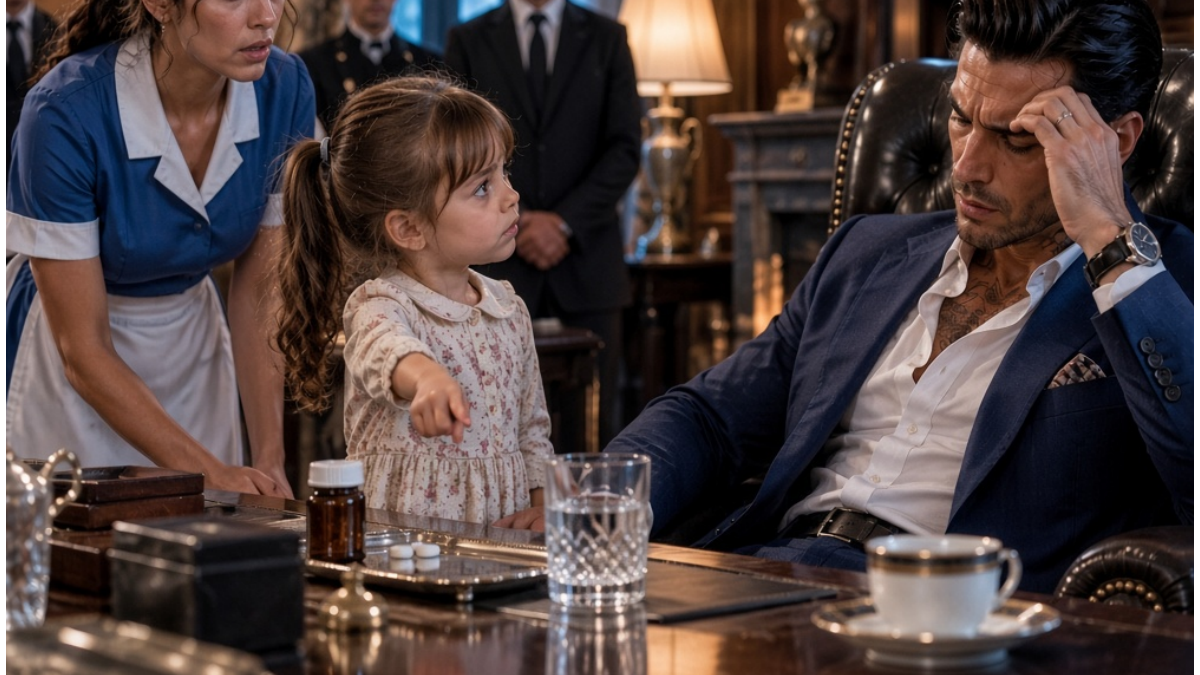
Don’t drink that, sir. Sophia Bellini’s small hand closed around Alessandro Moretti’s sleeve just as the black crystal glass reached his mouth.
No one moved. The lawyer seated across from him stopped breathing mid-sentence. Aleandro’s assistant froze with a folder halfopen in his hands.
Near the window, Victoria Romano turned from the afternoon light, her expression registering surprise, but nothing more.
Alisandre looked first at the child gripping his sleeve, then at the glass. In his house, people did not touch him without permission.
They certainly did not interrupt him in front of his inner circle. Sophia seemed to remember that a second too late.
Her fingers released the expensive fabric immediately, but she did not step away. She was 9 years old, small even for her age, wearing the navy cardigan her mother made her put on whenever she helped carry linens through the mansion.
Her dark hair was clipped behind one ear with a faded blue barret. She looked terrified now, but not of Aleandro.
Her eyes stayed fixed on the drink. You’re not tired, sir,” she whispered. “Someone’s been making you tired.”
The room became so quiet that Alisandro could hear the faint hum of the air conditioner behind the bookcase.
His gaze shifted to Victoria. She had been part of his life long enough to recognize the danger in silence.
But she did not rush to fill it. That was one of the things he trusted about her.
She knew when speaking too quickly made innocent people look guilty. Sophia, Elena Bellini said from the doorway, her face draining of color.
She had been carrying folded towels when she saw where her daughter had gone. Come here right now.
Sophia did not move. Aleandro lowered the glass but kept it in his hand. Why did you say that?
Elena stepped into the room. Mr. Moretti, I’m so sorry. She doesn’t understand what she’s saying.
Victoria raised a hand gently. Elena, it’s all right. She’s frightened. Let her explain. The kindness in Victoria’s voice made Sophia look at her, confused, perhaps because she had expected to be removed immediately.
Alessandro noticed that, too. Tell me, he said. Sophia swallowed. It happens after that drink.
One of the attorneys shifted in his chair. Aleandros eyes hardened. What happens? You change.
A faint crease appeared between Victoria’s brows. Change how, sweetheart? Sophia looked back at Aleandro.
You forget things you don’t usually forget. You get angry at things that didn’t make you angry before.
Sometimes you ask the same question twice. Aleandro’s grip tightened slightly around the glass. And you know what I usually forget?
No, sir. I know what you usually remember. Something in the answer landed differently than an accusation would have.
Aleandro set the glass down. He had built his life around people who claimed certainty.
Men came into his office every week, certain they knew who was loyal, certain they knew where money had gone, certain they knew which threat mattered.
Children rarely had the luxury of certainty. They noticed what happened and hoped an adult would care.
“How long have you been watching me?” He asked. Sophia’s cheeks colored. I wasn’t watching you like spying.
I help mom in the hall after school. Your afternoon meetings are usually at the same time.
Usually, Aleandro repeated 3:10 or 3:15. Unless your car comes back late. His assistant looked up sharply.
The attorneys exchanged a glance. Aleandro did not. And the drink? Usually before 3:30. Victoria stepped closer, but her tone remained calm.
Allesandro. Children are very good at patterns, but patterns can mean many things. You’ve been exhausted for months.
Everyone here knows that. I know, Sophia said quickly. That’s why I wrote it down instead of guessing.
She reached into the pocket of her cardigan and pulled out a small spiral notebook, the kind sold in packs for school children.
Elena closed her eyes for half a second as though she had just realized exactly how far this had gone.
Allesandro held out his hand. Sophia gave him the notebook. The first pages contained ordinary things, a spelling list, a reminder about a library book, a crude sketch of what looked like one of the mansion’s garden statues.
Then the entries changed. Dates, times, short observations written in uneven pencil. Monday, Mr. Moretti asked Mr. Russo twice if the shipment had arrived.
Wednesday, he dropped his pen after the black glass and stared at it before picking it up.
Friday, he yelled at the man with the gray tie, then asked mom later why the man had left early.
Aleandro turned another page. Tuesday, after the afternoon drink, Mr. Moretti asked who put his father’s watch on his wriSt. His thumb stopped against the paper.
The watch was there now, beneath the cuff of his shirt, gold, heavy, old-fashioned. His father had worn it until the day he died.
Alessandro had taken it from the bedside table at the hospital and put it on his own wrist before leaving.
He had worn it every day for almost two decades. He remembered Tuesday, not the whole afternoon.
That was the problem. He remembered standing beside the windows. He remembered Victoria telling him to cancel dinner.
He remembered feeling irritated because someone had moved papers on his desk. And he remembered looking down at the watch and experiencing for one strange second the sensation that it belonged to somebody else.
He had told himself he was tired. Everyone had told him he was tired. This doesn’t prove someone put anything in your drink, Victoria said.
She did not sound defensive. If anything, she sounded protective, but it does prove she’s been worried about you longer than any of us realized.
She turned to Sophia. You should have told your mother. I did. Elena looked at her daughter.
She said Mr. Moretti didn’t seem like himself. I told her adults get tired. There was shame in her voice now.
And Alessandro disliked it. She had no reason to be ashamed for choosing the most ordinary explanation.
Ordinary explanations were how life worked until suddenly they were not. He looked again at Sophia’s notes.
Why today? He asked. Why stop me today instead of yesterday? Sophia glanced at the black glass.
Because it was wrong. What was wrong? She pointed but did not touch it. The scratch.
Aleandro looked at the gold rim. A hairline mark was visible near one side. The result of the glass being dropped years earlier.
He had never noticed it. Mom polishes that one. Sophia said. The scratch usually faces your chair when it’s put down because the tray comes from that side.
Today it was facing the window. One of the attorneys exhaled through his nose. Not quite a laugh, more like disbelief.
Aleandro turned his attention to him until the man looked away. “Anything else?” Aleandro asked.
Sophia hesitated. The water bottle was already open. His assistant frowned. “They’re open before service sometimes.”
“I know,” Sophia said. “But this one was wet under the cap.” Alisandre looked at the bottle beside the glass.
A small ring of moisture darkened the wooden coaster beneath it. Nothing about that proved anything either.
That was what made the moment unsettling. There was no dramatic piece of evidence, no powder floating in the drink, no stranger running from the room, only a child listing ordinary details until the ordinary began to feel unfamiliar.
3 hours earlier, the Moretti mansion had been running exactly the way Aleandro preferred, quietly, efficiently, predictably.
Predictability had kept him alive longer than Charm ever could. At 48, he trusted systems more than promises.
The front gates opened only after two checks. Visitors were logged twice. Staff moved through restricted floors with individual cards.
His office had its own access record and cameras covering both approaches. People called that paranoia when they lived in houses where betrayal caused embarrassment instead of blood.
Alessandro called it maintenance. Yet over the previous two months, he had begun encountering small failures in the one system he could not replace himself.
A name disappeared halfway through a sentence. A meeting he was certain had been moved turned out never to have changed.
He once accused his assistant of withholding a document only to find it in the locked drawer where Aleandro himself kept confidential papers.
The moments never lasted long. That almost made them worse. If he had collapsed, someone would have called a hospital.
If he had forgotten entire days, even he would have been forced to admit something was wrong.
Instead, he suffered little fractures that healed before anyone could examine them. His private physician, Dr. Alio Rinaldi, had performed routine tests and found nothing alarming.
Stress, he said. Sleep deprivation, too much caffeine, too much responsibility. Victoria had agreed, though she never pushed Alessandro hard enough to provoke him.
She simply began arranging fewer evening meetings and having meals brought upstairs when he worked late.
Sometimes she replaced his whiskey with water without mentioning it. Once after he forgot the same appointment twice, she sat across from him in his bedroom and said, “You are allowed to be human, Alejandro.”
He had nearly laughed. In his experience, powerful men were allowed to be human only in private and usually for less than 5 minutes.
Still, he trusted her. Victoria had known him before the mansion, before the tailored suits, before men lowered their voices when he entered restaurants.
She knew where his anger came from and which memories not to touch. If someone had told him that morning that a 9-year-old housekeeper’s daughter would make him question the people closest to him before dinner, he would have dismissed the idea without finishing his coffee.
Sophia had been easier to overlook. She came to the mansion after school because Elena could not always arrange child care.
She sat in the kitchen doing homework, occasionally helping fold towels or carry light supplies.
Allesandro knew her name because she once corrected him when he called her Sophia instead of Sophia.
She had done it politely without smiling, and he remembered thinking she possessed the strange courage of children who had not yet learned which adults they were supposed to fear.
Over time, Sophia learned the mansion the way children learn any place where they spend enough afternoons.
She knew the west stair squeaked on the fourth step. She knew the old service bell near the second floor made two dull chimes when the side door opened.
She knew the chef hummed when nervous. She knew Aleandro’s assistant walked faster when lawyers were waiting.
She knew her mother used lavender soap before taking clean glasses upstairs. And she knew that shortly after Alisandro drank from the black crystal glass in the afternoon, something often changed.
At first, she noticed because he became louder. Then because he became quieter. One day, he stood outside his own office holding a key in his hand and stared at the lock as though he had forgotten why he was there.
Another afternoon, he asked Elena whether his father was coming for dinner. Elena assumed he meant one of the older family advisers and answered carefully.
Allesandro corrected himself a few seconds later and walked away. Sophia knew his father was dead because she had seen the portrait with the dates underneath.
She wrote the incident down, not because she thought someone was poisoning him. That idea came later.
She wrote because things that changed bothered her and writing them down stopped her from wondering whether she had imagined them.
Now back in the office, Aleandro closed the notebook and looked around the room. Nothing had changed physically.
His attorneys were still seated. Victoria was still near the windows. Elena stood behind Sophia with both hands clenched around the folded towel she had forgotten she was carrying.
The glass remained on the desk, black crystal catching a thin line of sunlight. Yet the room no longer felt like the same room.
Aleandro pressed the intercom. Marco, his security chief answered immediately. Yes, sir. Come to my office.
Bring an evidence bag. Don’t send anyone else. Victoria looked at him. You’re taking this seriously.
I take unexplained changes seriously. Good. Her answer came without hesitation. Then test it properly.
Not here. Not through anyone who has handled your medical care. Use an outside laboratory.
Aleandro studied her face. There was concern there. Maybe fear, but fear for whom was impossible to read.
That was my intention. Victoria gave Sophia a small, reassuring smile. You did the right thing, telling him what you saw.
Sophia looked surprised. Elena looked even more so. Aleandro noticed both reactions and stored them away without interpretation.
Marco arrived carrying a sealed evidence kit. Allesandre watched him photograph the glass, bottle, coaster, and the position of everything on the desk before touching any of it.
He ordered the office locked after the items were removed and told everyone present that the matter was not to be discussed.
Then he gave Sophia back her notebook. Keep it with you. Am I in trouble?
She asked. No. Is my mom? The question came faster. Aleandro glanced at Elena. No one is in trouble because of what you told me.
He meant it when he said it. At that moment at least, Sophia nodded and followed her mother toward the door.
Before leaving, she turned back. “Sir, what?” “If the test says there’s nothing in it, that doesn’t mean I lied.”
Aleandro held her gaze. “No, it means the test says there’s nothing in it.” Sophia seemed satisfied by the distinction.
She left. Victoria stayed long enough to tell Alessandro she would cancel his evening dinner if he wanted, then thought better of it when she saw his expression.
Or perhaps I should stop trying to manage your schedule. For the first time that afternoon, the corner of his mouth almost moved.
Perhaps. When she left, Allesandre waited until the door closed, then called Marco back. Access records.
This room today start 2 hours before I arrived. Marco returned several minutes later with a tablet.
There’s one entry that doesn’t make sense. Aleandro took it. The office had been open 12 minutes before his arrival.
The card belonged to a household employee. For a second, the name meant nothing. Then Aleandro remembered the woman standing behind Sophia with towels pressed against her cheSt. He read the line again.
Elena Bellini. Access granted. Allesandro looked toward the doorway through which mother and daughter had just disappeared.
The first useful fact in the investigation did not point toward Victoria, the doctor, or an unknown enemy.
It pointed toward the mother of the little girl who had stopped him from drinking.
Aleandro did not call Elena back into the office. He did not send security to the kitchen, and he did not tell Sophia that the first record they checked had placed her mother near the very glass she had warned him about.
Instead, he stared at the access log until the letters stopped looking like a name and became what they actually were, a piece of data that could be true, false, incomplete, or deliberately misleading.
Years ago, he would have treated the record as certainty. Someone’s card opened a restricted door.
Therefore, that person had opened it. Experience had taught him that systems were only as honest as the people who understood how they worked.
“Where is Elena now?” He asked. Marco checked his phone. “Kitchen level. She hasn’t left the property.”
“Don’t approach her.” Marco looked surprised. “Sir, you heard me. I want her movements from 2:30 until 3:15.
Cameras, staff, witnesses, laundry logs, deliveries.” Quietly, Marco hesitated. If she used her card. A card used her name.
That is all we know. Allesandro handed the tablet back and Marco. Nobody asked Sophia anything without her mother present.
The security chief nodded and left. Allesandro remained alone for several minutes, looking at the empty place where the glass had been.
Suspicion was easy. Evidence was harder. He had watched men destroy families, partnerships, even themselves because they confused those two things.
He was not going to make the same mistake simply because the person under suspicion worked in his house.
When Victoria returned 20 minutes later, she found him reviewing the mansion staffing records. “I thought everyone had been dismissed,” she said.
“They were.” “Then why do you look like someone just handed you another problem?” Alesandro turned the tablet toward him before remembering she could not read it from where she stood.
He did not correct the movement. Someone entered my office before I arrived. Victoria’s face changed, but only with concentration.
Who? Elena’s card. The answer hit her more visibly than Sophia’s accusation had. Elena. That’s what the system says.
Victoria shook her head almost immediately. That doesn’t make sense. Why? Because she knows the rules.
Because she has worked here for years. Because if she wanted to put something in your drink, using her own access card would be an absurd way to do it.
Allesandre leaned back. People do absurd things. Yes, usually when they panic. Elena doesn’t strike me as someone who panics.
You defended Sophia earlier. Now you’re defending her mother. I’m defending the idea that an access log is not a confession.
Victoria moved closer to the desk. You told Marco to test the glass independently. Give Elena the same courtesy.
Verify before you decide what the record means. Alisandre watched her. If she was part of whatever was happening, she was making a dangerous choice by arguing for the person the evidence currently implicated.
If she was innocent, her reaction was exactly what he would expect from someone thinking clearly.
That was the problem with reasonable behavior. It rarely revealed which side a person was on.
I am verifying, he said. Good. Victoria turned to leave, then stopped. And Allesandro, what?
Do not let Sophia see her mother questioned like a criminal, unless you have something stronger than a card number.
He said nothing. Victoria left without waiting for an answer. Alisandre looked at the closed door and wondered whether the advice had been compassion, calculation, or both.
The first contradiction appeared less than an hour later. At 2:46, the exact minute Elena’s access credential opened the second floor office corridor.
Elena Bellini appeared on a camera outside the basement laundry room carrying a basket of pressed sheets.
The image was grainy but unmistakable. Her face was visible. Her uniform was visible. She entered the laundry room and did not come out for 9 minutes.
Two other employees independently remembered her there because a dryer had jammed and Elena helped remove a twisted sheet from the drum.
Marco placed the still image beside the access record on Aleandro’s desk. She couldn’t have been upstairs, he said.
Not unless she learned to be in two places at once. Who can duplicate these cards?
Aleandro asked. In theory, security administration. In practice, they’re encrypted. You can’t copy one with a cheap reader.
That wasn’t my question. Marco’s jaw tightened. Three people have administrative access. Me, my deputy, and the systems contractor.
Aleandro looked toward him. And old cards destroyed when replacements are issued. Always. That’s the procedure.
Procedures are descriptions of what people are supposed to do. Allesandro tapped the log. I’m interested in what happened.
Marco opened the credential history. Elena had reported a damaged card 4 months earlier after the plastic casing split near the chip.
A replacement had been issued the same afternoon. The database listed the first card as deactivated, but the disposal field was blank.
No destruction date, no employee initials, no confirmation. Marco stared at the missing entry longer than Aleandro did.
That should be there. Yet it isn’t. I’ll find out who handled it. Quietly, Allesandre looked again at the time stamp.
Someone had either cloned Elena’s credential or found an old card that should no longer have worked.
Both possibilities were bad. The second was worse because it meant the weakness had existed inside the mansion for months.
When Elena was finally brought in, it was not to an interrogation room, but to the smaller sitting room beside the kitchen, where Sophia was doing homework under the watch of one of Elena’s friends.
Aleandro came alone. Elena stood as soon as he entered. Sir, sit. She remained standing until he did.
Sophia watched both adults, pencil motionless above a worksheet. Alessandro did not mention the access log immediately.
Did you enter my office corridor this afternoon? No, sir. Did you lend anyone your access card?
Never. Have you lost one? Elena frowned. My old one broke months ago. Security replaced it.
Sophia looked up. The one with tape on it? Elena turned toward her. Yes. You kept it in the drawer near the pantry before you gave it back.
Elena’s expression tightened. For one day, then I returned it. Allesandre looked at Sophia. Do you remember to whom?
She shook her head. A man from security. Not Mr. Marco. That narrowed little. Several employees fit the description.
Aleandro changed direction. Sophia, yesterday you wrote that someone bringing water smelled different. Elena closed her eyes briefly.
Sophia, it’s all right. Aleandro said. Tell me exactly what you noticed. Sophia shifted in her chair.
Mom smells like lavender after she washes the glasses. The person upstairs smelled like roses.
Elena stared at her. You never told me that. I didn’t know it mattered. Aleandro asked.
Did you see the person? Not their face. I was coming around the corner and they went into the office hall.
Woman. I think so. Because of the perfume. Because of the shoes. What shoes? Heels?
Not very high. Aleandro thought of Victoria’s heels crossing his office floor, then immediately rejected the leap.
Half the women who worked upstairs wore them. He looked at Elena who uses rose perfume in the house.
Elena considered the question. Several people. Mrs. Romano sometimes. Clara in guest services. Marta used to but she changed brands because the chef complained.
Maybe others. Sophia added quietly. It wasn’t Mrs. Romano’s normal perfume. Alisandro looked at her.
You know that? She hugs mom on holidays. Elena gave her daughter a look that might have been embarrassment if the situation were different.
Aleandro almost asked whether Sophia cataloged the smell of every adult she met but stopped himself.
The observation was not proof. It was not even necessarily useful. That made it safer.
Was there anything else? Sophia shook her head. Just the smell in the shoes. Good.
He stood. Elena rose too. Mr. Moretti, am I suspected of something? Alisandro could have avoided the question.
Instead, he said, “Your access credential was used near my office.” The blood left her face.
Sophia’s pencil dropped, but I wasn’t there. I know. Elena stared at him. You know, we checked before we came to you.
The fear in her expression did not disappear. It changed shape. Then someone used my card.
Someone used your identity. Aleandro corrected. Sophia looked from him to her mother. Because of me?
No. But if I hadn’t said anything, then I would still have a problem. I simply wouldn’t know about it.
He looked at Elena. Until we understand how your old credential remained usable, neither of you discusses this with anyone.
Elena nodded. Sophia did not. What if the person asks, “Then you know nothing.” Sophia frowned.
But I do know something. Allesandro studied her for a moment, then practiced the most difficult skill in this house.
What? Knowing something and not proving it to everybody, she seemed unconvinced, but Elena placed a hand gently over hers before she could answer.
By evening, the investigation had gained facts, but lost certainty. The rose perfume pointed nowhere specific.
Elena’s credential implicated a card rather than Elena. The missing destruction record could indicate negligence or intentional theft.
Marco’s deputy remembered processing several damaged cards the week Elena’s was replaced, but could not recall hers individually.
The outside contractor insisted deactivated credentials should never have opened a secured door. Yet, a systems report revealed something Marco had not known.
During a software migration 3 months earlier, a batch of old credential identifiers had temporarily been restored from backup.
Most were automatically blocked again. A handful had remained active until the next audit. Elena’s original card was among them.
“So, someone didn’t need to hack anything,” Allesandro said. Marco looked furious. They only needed the physical card, which was supposed to be destroyed.
Yes. And wasn’t apparently not. Alessandro closed the report. This was the first meaningful shape the threat had taken.
Whoever had used Elena’s credential did not require extraordinary technical skill. They required familiarity with the house, access to discarded security materials, and confidence that a domestic employees name on a log would either be ignored or blamed on her.
It was clever precisely because it was ordinary. Later, when Aleandro passed the kitchen, he saw Sophia sitting alone with her notebook closed beside her homework.
“Why aren’t you writing?” He asked. She looked at the cover. “I thought maybe I shouldn’t anymore because of your mother’s card.”
“Because every time I notice something, somebody gets in trouble.” Alisandro leaned against the doorway.
Your mother didn’t get in trouble. She looked scared. He had no useful answer to that.
Elena had been scared. A person could be innocent and still understand how easily a system could decide otherwise.
Sophia picked at the edge of her eraser. What if I’m wrong about the drink?
Then you’re wrong. Would you be angry? No, really. I have people around me who are paid very well and are wrong all the time.
Sophia considered that. Do you tell them frequently? For the first time since the office incident, she smiled.
It lasted only a second. Then footsteps approached and one of Aleandro’s assistants appeared carrying a secure envelope.
The preliminary lab report came in. Aleandro took it upstairs before opening it. The analysis had been performed by a laboratory with no connection to Dr. Raldi or the Moretti household.
He read the first page once, then again more slowly. No unexpected sedatives, no common tranquilizers, no detectable concentration of the substances the lab had screened for.
Nothing in the remaining liquid established that Alessandro had been drugged. Marco stood across the desk waiting.
Victoria, summoned because she had been present when the glass was sealed, read the conclusion over Aleandro’s shoulder.
She did not look relieved in a triumphant way. She simply exhaled. That’s good, she said.
Aleandro did not answer. Downstairs, Sophia waited because Elena had told her the results were coming.
When Allesandro finally entered the kitchen, she searched his face before he spoke. They didn’t find anything, he said.
Sophia looked at the floor. Oh, that does not mean you lied. She looked up quickly, remembering his promise.
It means the test didn’t find anything. So maybe I was wrong. Maybe. He refused to rescue her from the possibility.
That mattered, too. Sophia nodded slowly and closed the notebook with both hands. Upstairs, the black crystal glass sat sealed inside an evidence locker, clean enough to make every suspicion look foolish.
For the first time since Sophia had stopped his hand, Aleandro had something more dangerous than proof.
He had a reasonable explanation for almost everything. The clean laboratory report should have ended the matter.
That was what any reasonable person in Aleandro Moretti’s position was supposed to conclude. A child had noticed changes in an exhausted man, connected them to a glass he used every afternoon, and frightened herself into believing the drink was responsible.
The glass had been sealed. The remaining liquid had been analyzed by an independent laboratory.
Nothing unexpected had been found. Elena’s old access credential had turned out to be part of a flawed security migration rather than proof that she had entered the office.
Even the rose perfume led nowhere. By breakfast the following morning, the mansion had almost returned to its normal rhythm.
Staff crossed polished floors with trays and laundry baskets. Security shifts changed at the gates.
Phones rang inside administrative offices. The machinery of Alessandro’s life kept moving, and normality began doing what normality did best, making yesterday’s fear look embarrassing.
Sophia sat in the kitchen with her notebook buried beneath a mathematics workbook. She had not written in it since hearing the test result.
Elena did not tell her to stop, but she did not encourage her either. Her daughter had been carrying a kind of responsibility no 9-year-old should have carried, and part of Elena clearly hoped a negative test would let Sophia put it down.
Upstairs, Allesandro tried to do the same. He had three calls before noon, two contract reviews, and a meeting concerning the port expansion.
Halfway through the second call, he paused while looking at a familiar name on a page and could not remember why it mattered.
The blankness lasted perhaps 3 seconds, four at moSt. Then the memory returned. The man owned warehouses near the eastern docks.
Aleandro continued speaking without allowing anyone on the call to hear what had happened. Afterward, he remained at his desk with the receiver still in his hand.
Stress, he thought. Sleep deprivation, too much caffeine, too much responsibility. Dr. Raldi’s explanations sounded more persuasive now that a laboratory had failed to find anything in the glass.
They also made Aleandro angry, though he was no longer certain whether the anger came from pride or fear.
At 11:30, Victoria entered carrying coffee in a folder. She had abandoned the habit of bringing him water without asking.
“I assume this is still permitted,” she said, holding up the coffee. “Depends. Did you personally interrogate the beans?”
Twice. They refused legal representation. “It was the first joke either of them had made since Sophia interrupted the meeting, and for a moment, the tension in the room loosened.
Victoria placed the cup on the far side of the desk and sat down. How do you feel?”
Like everyone keeps asking me how I feel. That is usually what happens when someone thinks he may have been drugged and wasn’t.
Victoria watched him carefully. We don’t know that. Allesandre looked at her. The test was negative.
The test showed nothing unusual in that sample. That is not the same sentence. He said nothing.
Victoria rested one hand on the folder. I don’t want you frightening yourself and I don’t want a child frightened either, but I also don’t want us becoming stupid because one test gave us permission to relax.
It was exactly the kind of thing Alessandro himself might have said. That bothered him more than reassurance would have.
What do you suggest? He asked. You already had Dr. Raldi examine you. Have another physician review his findings independently.
If they agree you are exhausted, then perhaps we accept the boring answer. And if they don’t, then we stopped calling it exhaustion.
Her logic gave Aleandro no obvious reason to distrust her. He almost wished it did.
Suspicion was easier when people behaved badly. That afternoon, Aleandro asked his attorney, Daniel Russo, to bring him every medical record generated during the previous 6 months.
Russo arrived carrying a secure digital archive and two paper folders from Dr. Raldi’s office.
“You’re reopening the medical question?” He asked. “I’m changing it.” Allesandro set the laboratory report aside.
We keep asking what was in the glass? Russo waited. Wrong question. Maybe. If nothing was in that glass, then what explains everything else?
They began with dates rather than diagnosis. Alessandro’s calendar was one of the most carefully maintained documents in the house.
Meetings, calls, departures, arrivals, even private appointments were logged because people around him needed to know where he was without asking him every 10 minutes.
Dr. Rinaldi’s reports looked ordinary at firSt. Blood pressure, complaints of poor sleep, irritability, short-term memory disruption, recommendations to reduce workload.
On paper, the progression seemed almost embarrassingly straightforward. A powerful middle-aged man under chronic stress began showing signs of fatigue and cognitive strain.
Russo read two reports and leaned back. This is what he told you. Yes, and some of it happened.
Yes. Aleandro did not need to pretend otherwise. He had forgotten things. He had become angry without understanding why.
He had experienced moments when familiar objects seemed oddly distant. If there was a conspiracy, it was parasitic on something real enough to be convincing.
Russo opened a report dated 6 weeks earlier. Private examination. 3:00 in the afternoon. Allesandro looked at the page.
Something in him tightened. Read the date. Russo did. Alessandro turned toward his computer and opened his calendar.
At 3 that afternoon, he had been in the downstairs conference room reviewing environmental documents with Russo and two outside attorneys.
The meeting had lasted from shortly after 2 until nearly 5. Russo stared at the screen.
I was there. So was I. Could Raldi have seen you before the meeting and entered the wrong time?
Possible. Russo picked up his phone. I can ask his office for the appointment log.
Aleandro stopped him. Not yet. He read the report again. It described him as unusually fatigued, confused about the date, and unable to recall the names of two scheduled visitors.
Do you remember me being confused that day? Russo hesitated. You were irritated. That is not unusual.
No. Did I forget who you were? Not unless you hit it exceptionally well. Aleandro opened more records.
Another examination supposedly occurred on a Thursday morning. His calendar showed no medical appointment, but that meant little.
Rinaldi frequently stopped by the mansion without being formally scheduled. A third report matched an actual visit.
A fourth was vague enough to have occurred almost any time. Nothing yet proved fraud.
It proved paperwork was imperfect, which was hardly a revelation. When Raldi finally received Alessandro’s call, his explanation came easily.
My assistant enters final reports in blocks. He said, “Sometimes the electronic system records the documentation time rather than the examination time.
If you are asking whether every time stamp reflects the precise minute I was sitting in front of you, probably not.
The report says 3:00 in the afternoon, then I likely saw you earlier. When silence lasted only long enough for Raldi to search his memory without appearing evasive, I would need the raw schedule.
Alessandro, I see dozens of patients with you especially. Some visits are informal. 10 minutes in your office, a conversation after dinner.
You call me at night. I document what matters medically. Did you examine me that day?
If there is a report, yes. Rinaldi sounded more offended than frightened. You asked me to keep an accurate record because you were concerned about your symptoMs. That was true.
Aleandro had asked for documentation after forgetting an important meeting. Then send Daniel the raw appointment logs.
Aleandro said, “Of course.” Rinaldi lowered his voice. “Is this because of the child?” “This is because I’m checking my own records.”
“Good. Check them. But be careful about turning clerical mistakes into explanations simply because the real explanation frightens you.
Alessandro’s expression hardened. And what is the real explanation? You are under stress severe enough to affect sleep, judgment, and memory.
I told you that before anyone mentioned poisoning. The doctor did not retreat. You may dislike that answer.
Disliking it does not make it false. When the call ended, Russo looked at Aleandro.
He has a point. I know that was becoming the most irritating phrase in the entire investigation.
By evening, certainty had moved farther away instead of closer. The glass had tested clean.
Elena had an alibi. The access card anomaly had a technical explanation. Dr. Raldi’s inconsistent time stamp had a plausible administrative explanation.
Aleandro began to understand how dangerous a weak suspicion could become once a man with power decided to feed it.
He could investigate anyone in the house. He could search accounts, phones, rooms, histories. Given enough scrutiny, everyone would eventually look suspicious.
That did not mean everyone was guilty. Downstairs, Sophia was sitting at the kitchen table while Elena prepared vegetables for dinner.
Her notebook remained closed. Aleandro stopped in the doorway. You haven’t written anything today. Sophia looked embarrassed.
Nothing happened. Nothing. Nothing weird. Elena glanced at him, then went back to cutting carrots.
Allesandre walked in. That sounds useful. Sophia shook her head. The test said I was wrong.
The test said the glass didn’t contain what we tested for. That’s basically wrong. Not necessarily.
Mom says I shouldn’t try to make things fit. Elena immediately looked up. I said, “Sometimes when we’re worried, we notice the things that agree with us and forget the ones that don’t.”
Alesandro considered that your mother is right. Sophia’s face fell slightly. So, I should stop.
No, you should notice the things that prove you wrong, too. She stared at him.
He pulled out the chair across from her and sat. If you believe something, the dangerous part is not finding evidence for it.
The dangerous part is deciding every piece of evidence must support it. Sophia looked toward Elena, perhaps checking whether this was another adult way of telling her she had imagined everything.
“So, what am I supposed to do?” She asked. “Write what happens, not what you think it means.”
Sophia slowly pulled the notebook from beneath her workbook. Allesandro noticed a page near the back covered in fractions.
You use this for homework? I ran out of paper. He nodded at the page.
Did you finish? Mostly. Mostly means no. She turned the book around. One problem had been crossed out repeatedly.
Aleandro read it, took the pencil, and showed her where she had reversed the denominator.
Sophia stared at the corrected answer, then at him. You knew that faSt. I did go to school.
I thought you had people for math. Elena made a sound that might have been a cough hiding a laugh.
Alessandro handed the pencil back. Finish your homework, he stood, then noticed Sophia had opened the notebook to a page from several weeks earlier.
There was an entry about him correcting one of her mathematics problems at the kitchen table.
Nothing remarkable. She had written it because on the same day, she had overheard someone upstairs saying he was too confused to finish a conversation.
Alessandro stopped. “What date is that?” Sophia read it aloud. He knew the date immediately.
Russo had shown him a medical report from that evening. Dr. Raldi described Alessandro as disoriented, struggling to concentrate, repeatedly losing track of simple questions.
Yet, less than 2 hours after the documented examination, Allesandro had sat in this kitchen and walked Sophia through fractions without difficulty.
That did not prove the report false. Symptoms could come and go. Fatigue could improve, but it gave Allesandro a new way to look at the problem.
Not whether Sophia’s notebook proved someone was drugging him. Whether the official record of his decline matched the life other people had actually witnessed.
Russo returned after dinner when Dr. Raldi’s office finally transmitted what it described as the complete appointment history.
Alessandro and Russo compared it with the medical reports one line at a time. The first inconsistency could be dismissed.
The second might be clerical. The third was harder. A report described an in-person neurological assessment on a Monday for which there was no visit.
No entry at the gate, no physician vehicle on exterior cameras, no call from Raldi’s registered office number, and no appointment in either calendar.
Russo checked again. Maybe he came with someone else. Then he still had to enter the property.
They moved to the next questionable report. Same problem. Medical notes existed. The corresponding appointment did not.
Another report contained detailed observations about Allesandro’s speech, posture, and orientation on a morning when Alessandro had been outside the state until early afternoon.
Russo sat back slowly. “That’s not a timestamp error,” Aleandro said nothing. Someone wrote an examination that couldn’t have happened or documented observations from another time without saying so.
“Yes,” Russo opened the raw file metadata. The reports had not all been written on the dates printed at the top.
Several were created days later, then assigned earlier examination dates. That could still have an innocent explanation if Raldi documented visits late, but two reports referred to meetings that did not exist anywhere else.
Alessandro felt something settle inside him. Not certainty yet, but direction. The clean glass no longer mattered as much.
Maybe Sophia had been wrong about the drink. Maybe the glass was only where her attention had landed because the changes often happened around the same time.
But someone had been constructing a medical history in which Alessandro Moretti appeared more impaired, more confused, and more consistently unstable than the records of his actual movements could support.
He turned back to the first disputed report. Stop asking Raldi for explanations. Russo looked at him.
What do you want instead? Alessandro closed the folder. Everything. Original appointment logs, drafts, file creation dates, billing records, messages between his office and this house.
No summaries. Russo nodded slowly. “You think the medical record is the real evidence?” Allessandre looked toward the kitchen floor below them, where a 9-year-old girl had spent weeks writing down what happened because she did not trust herself to remember it perfectly.
“I think someone else has been writing things down, too.” The raw records arrived in pieces because no single system inside Dr. Raldi’s practice stored the full history Alisandra wanted.
Appointment schedules came from one server, billing records from another, pharmacy authorizations from a third.
Daniel Russo spent most of the morning building a timeline across three screens while Alessandro worked through the original medical reports with a yellow pencil, marking every place where the official version of his decline depended on an event no one could independently verify.
The deeper they went, the less the problem looked like sloppy documentation. One examination had supposedly occurred while Alessandro was in a conference call with attorneys.
Another described his balance and coordination on a morning when gate records showed Raldi never entered the property.
A third claimed Alessandro had been unable to remember the month. Yet an hour later, he had signed a shipping amendment containing handwritten corrections to three dates buried in the appendix.
None of these contradictions proved he had been perfectly healthy. They proved something narrower and more disturbing.
Someone had been selecting the moments that made him look weak and arranging them into a clean medical story.
Russo leaned back from the screens. If I showed this to another doctor without context, they’d think you’d been deteriorating steadily.
That’s what concerns me. Because you weren’t? Aleandro looked toward the window. I was having episodes.
I still am, but not like this. He tapped the reports. This makes it look continuous.
Russo nodded slowly. Continuous is easier to use. Alisandre looked at him. Russo did not elaborate.
He did not need to. Continuous decline could justify decisions, restrictions, oversight, questions about competence, a scattered collection of strange afternoons could not.
Aleandro closed the folder. Find every delivery connected to my care, supplements, prescriptions, anything ordered through Raldi’s office or build to the house.
Russo glanced at the stack already covering the desk. That could be dozens. Then start with the dates of the questionable reports.
Before Russo could answer, Marco knocked and entered holding a tablet. We found something on the second floor camera archive.
Allesandro stood. What? Maybe nothing. Maybe not. The footage itself was ordinary enough to be maddening.
At 2:38 in the afternoon on the day Elena’s old credential had been used, the hallway camera showed an empty corridor.
At 2:39, a maid crossed carrying folded linens. At 240, the image showed the service door near the stairwell opening briefly, though whoever entered remained mostly outside the camera’s angle.
At 2:41, the screen froze when the picture resumed. 7 minutes had vanished. Marco replayed the sequence.
The system logged a corrupted file. Natural corruption? Aleandro asked. It happens. How often? Marco’s mouth tightened.
Not often on this camera. How often? Twice in the last year. Both under a minute.
Allesandre watched the freeze again. This is seven. Yes. Russo moved closer to the monitor.
Can it be restored? Maybe partially. The primary file was overwritten during automatic compression, but there are fragments in the buffer.
Aleandro looked at Marco. Do it without using the contractor who manages the system. Already started.
That answer earned the security chief the first approving glance Alessandro had given him in two days.
They listened to the audio track. Next, the camera image failed, but the microphone had recorded several seconds longer.
A faint metallic chime sounded twice before the signal cut. Aleandro recognized it only because Sophia had described it.
The old service bell beside the stairwell. Marco frowned. That means someone came through the side door.
Before the camera stopped, Allesandro said, “Yes, using which credential?” Marco checked the log. Elena’s old card registered upstairs at 241.
The service door doesn’t require a card from inside the staff corridor, so whoever came through could already have been in the house,” Russo pointed at the time, or they entered through a route the main system barely tracks.
Marco zoomed the final intact frame. Near the far edge of a glass fronted cabinet, a distorted reflection appeared, part of a shoulder, one hand, perhaps the outline of a tray.
The image was too blurred to identify a face. Marco enhanced it until the pixels broke into blocks.
A metallic flash appeared on one finger. Ring?” Russo asked. “Could be,” Marco said. “Could also be the tray catching light.”
Aleandro leaned closer. He had spent most of his life being told that people saw what they wanted to see.
Now he understood the inverse danger. “Once suspicion entered a room, every blur looked like a confession.
“Save the original before anyone enhances it again,” he said. “And no one calls that a ring in writing.”
Marco nodded. “Understood. We have a missing seven minutes, a service door opening, and an old credential used afterward.
That is what we know. He stepped away from the screen. Nothing more. The restraint irritated Marco, but Allesandro preferred irritation to certainty built on bad evidence.
By late afternoon, Russo had found the first delivery that matched one of the disputed medical dates.
A small shipment from a private wellness pharmacy had arrived at the mansion 3 weeks earlier.
The invoice listed vitamins, electrolyte packets, and a compounded sleep aid prescribed through Raldi’s office.
Nothing illegal, nothing inherently suspicious. The recorded delivery time was 4:15. Allesandre was reviewing the invoice when Sophia appeared at the open office door with Elena behind her.
Elena looked apologetic. She says, “This matters.” Sophia held her notebook against her cheSt. Aleandro gestured for them to come in.
“What matters?” Sophia opened to a page near the middle. The truck came earlier. Russo looked at her.
Which truck? The medicine truck. Aleandro’s eyes moved to the invoice. How do you know what time it came?
I heard it. Marco, still near the monitor, glanced toward Aleandro as if to ask whether they were really going to build a case from another sound.
Sophia saw the look. It makes a bad noise when it turns near the gate, like metal scraping.
Elena confirmed it reluctantly. The delivery van from that company has a damaged panel. You can hear it from the kitchen if the windows are open.
What time? Allesandro asked. Sophia pointed to her note. 350 2. Russo compared it with the invoice.
23 minutes earlier than the delivery record. Maybe the driver wrote the wrong time. Elena said quickly.
That happens. Aleandro nodded. Yes. He looked at Sophia. Did you see the driver? No.
Did you see anyone receive the package? No. Then all we know is that you heard what you think was the truck at 352.
Sophia seemed disappointed by the phrasing, but that’s what happened. Then that is enough to write down.
Alessandro turned to Marco. Gate sensors. The outer gate recorded vehicle weight and opening time independently from security badges.
It took less than 10 minutes to find the relevant entry. At 351, the gate had opened for a commercial vehicle matching the delivery company’s weight class.
At 3:54, it closed. The official delivery receipt still said 4:15. Russo looked at Aleandro.
Now we have a timestamp discrepancy that didn’t come from Sophia’s notebook. We have two clocks disagreeing, Allesandro said.
Find out why. Marco pulled the delivery intake log. The package had been signed for electronically, but the signature field displayed only an employee code rather than a handwritten name.
The code belonged to household administration, not medical staff. Who used that code? Allesandro asked.
Marco checked. Shared terminal. Of course, it is. Every system that was supposed to create accountability seemed to contain one convenient corner where responsibility dissolved.
The next problem was the paper receipt. Elena remembered seeing it beneath the delivery box because the driver had handed over a duplicate slip.
Sophia remembered it, too. More importantly, she had written the exact time beside it in pencil when she heard the truck because the mismatch bothered her.
“Where is it now?” Russo asked. Sophia looked toward her mother. Elena thought for a moment.
Sophia gave it to me after Mr. Moretti started asking about the deliveries. I put it in the clear envelope with the other papers from the kitchen.
Allesandro turned to Russo. You have that envelope. Russo opened his leather case and removed a transparent evidence sleeve.
The label showed the correct date. The kitchen inventory note was inside. A photocopy of the delivery invoice was inside.
The duplicate receipt was not. Russo frowned. I sealed this myself. Was it in there when you sealed it?
Aleandro asked. I thought so. Thought? Russo’s face hardened. I did not inventory each sheet individually.
Elena handed me a stack. I put the stack inside. Allesandre looked at Elena. Did you watch him?
Nosir. Sophia. She shook her head. Marco took the envelope and examined the closure. It had not been cut or torn.
The adhesive strip, however, could have been opened carefully and recealed. Who had access to Russo’s case?
Marco asked. For most of yesterday, me. Russo paused. My assistant carried it from the car.
It was in the conference room during lunch, then in my office. Inside the mansion for several hours.
Aleandro felt the room change. Until that moment, everything they had discovered concerned events that occurred before Sophia stopped him from drinking.
Old access cards, old reports, old delivery times. If the receipt had been removed after the investigation began, then the situation was no longer about reconstructing the paSt. Someone might be watching what they collected in the present.
Nobody accuses anyone, Aleandro said. We don’t even know the paper was in the envelope.
Sophia opened her notebook quickly. I wrote on it. I know. I can show you.
She flipped through the pages, then stopped. Her fingers moved backward, forward again. Elena looked over her shoulder.
What is it? Sophia did not answer. She turned three more pages faster now. Alessandro saw the color leave her face.
Sophia, it was here. What was the page? She held the notebook open. A thin, ragged edge ran close to the spiral binding.
One sheet had been torn out so neatly that it was easy to miss unless someone knew where to look.
Sophia touched the remaining strip with one finger. I wrote the truck time here and the perfume and the receipt.
Elena took the notebook, staring at the missing page. Did you tear this out? No.
Could it have fallen? Marco asked. Sophia shook her head immediately. It was attached. Aleandro asked the question he did not want to ask.
Where has the notebook been since yesterday? With me? Always. Sophia thought. Mostly. That means no.
She looked frightened now. I left it in the kitchen when mom made me shower.
Then this morning it was in my backpack. Who was in the kitchen? Everybody, Elena whispered.
Staff came and went there all day. Cooks, cleaners, assistants, guards asking for coffee, drivers passing through the service corridor.
The notebook was not protected evidence. Until that moment, no adult had treated it as something worth stealing.
Alisandre looked at the torn edge, then at the empty evidence sleeve, then toward the hallway beyond the office.
The same house that had seemed secure because every entrance was monitored suddenly felt full of invisible doors.
Sophia, he said, keeping his voice even. From now on, you do not investigate anything.
You do not follow anyone. You do not ask questions about the glass, the deliveries, the doctor, or the cameras.
If you notice something, you tell your mother. That’s all. But someone took my page.
Exactly. So, I was right. No. Alisandro crouched so he was looking at her rather than down at her.
It means someone took your page. We do not know why. Sophia’s eyes were wet, but she held his gaze.
They know I noticed. That was the first conclusion Alisandro could not dismiss. He stood and looked at Marco, “Change her mother’s access card quietly, put a camera on the kitchen entrances, but nothing obvious.
And review every person who knew Russo was collecting records.” Marco nodded. “What about Sophia?”
She remains a child. Aleandro’s tone sharpened. “Anyone on this staff forgets that they answer to me.”
After Elena led her daughter downstairs, Russo remained beside the desk. “You think the receipt and notebook page were taken deliberately?”
Alisandre looked at the evidence sleeve. I think two items describing the same delivery are missing.
That is not the same thing. No. And if someone did take them, Aleandro turned toward the dark monitor displaying the 7-minute gap.
Until now, they had been searching for evidence of something that might have happened weeks ago.
Now, an unknown person had possibly touched the investigation itself. Then, we’ve been asking who altered the record, he said.
We should also be asking who already knows. We noticed. By the next morning, Alessandro had reduced the investigation to four people who knew enough to understand what mattered and disciplined them with a rule he should have imposed from the beginning.
Nobody received the whole picture. Marco would handle access records and physical security. Daniel Russo would handle medical, financial, and legal documents.
Allesandre would keep the cross connections to himself. Victoria would be told only what she needed to know for ordinary household and business operations.
Dr. Rinaldi would be told nothing unless a question required his direct answer. Most importantly, Sophia and Elena would no longer be allowed anywhere near the mechanics of the investigation.
That decision created the first argument Elena had ever had with Alessandro. She stood in the smaller library with her hands clasped tightly in front of her and listened while he explained that Sophia should stop keeping investigative notes, stop paying attention to staff movements, and stop carrying information between adults.
When he finished, Elena did not thank him. She was never investigating for you, she said.
She was afraid something was happening to you. Allesandro accepted the correction. Then she should be allowed to stop being afraid.
Elena looked toward the hallway where Sophia was doing homework under the supervision of another staff member.
You cannot promise her that. No. Aleandro hesitated, then did something that came less naturally than giving an order.
I owe you an apology. Elena’s expression changed. Sir, your name appeared on the access record.
I investigated you before I told you. You investigated everyone. That does not make it right.
She studied him cautiously. In Aleandro’s world, apologies often concealed demands. Elena seemed to be waiting for his.
None came. You had a reason to check, she finally said. I had a reason to verify.
That is different from having a reason to suspect you. Elena lowered her eyes. People like me learn not to expect that distinction.
The sentence struck harder because she did not say it bitterly. It was simply an observation, the kind Sophia might have written down.
Alisandre looked at the doorway through which employees had moved around him for years. He knew their schedules, salaries, responsibilities, even which relatives depended on them.
He had believed that meant he understood the system he controlled. It had never occurred to him that the same system looked completely different from the other side.
An old access card carrying Elena’s name had been useful to whoever took it precisely because everyone knew whose version of events would carry more weight if the record were questioned.
The card was not only a security weakness, it was a social assumption turned into a tool.
Your original credential was mishandled after replacement, Allesandro said. We confirmed that. Elena looked up.
So whoever used it knew where old cards went or had access to someone who did.
And Sophia’s page. We don’t know. He refused to say more. Before leaving, Elena asked, “Do you still think someone is making you sick?”
Aleandro considered the question. “I think someone wants a record that says I am getting worse.”
“That isn’t the same thing.” “No,” he looked toward the medical files on the table.
“It may be more useful.” Russo found the document shortly afternoon. It had not been hidden.
That was what made it dangerous. It sat inside an estate planning archive alongside ordinary succession agreements, tax structures, insurance instructions, and emergency authorizations.
Alessandro had signed hundreds of papers over the years that determined what would happen if he died, became unreachable, entered surgery, or lost the ability to make decisions for himself.
Powerful men prepared for death because death was respectable. Incapacity was harder. Incapacity meant remaining alive while other people decided whether your judgment still counted.
Russo placed a document on the desk and turned it toward him. This was drafted 8 months ago.
Alessandro recognized the first page. Emergency continuity authorization. You remember signing it? I remember discussing it.
That is not what I asked. Aleandro looked at the signature. It appeared to be his.
No, I don’t remember the signing. Russo did not react. After the previous weeks, forgotten paperwork could mean almost anything.
The agreement does not transfer ownership. He said it temporarily reallocates signing authority if you are medically unable to perform specific duties.
To whom Russo opened the schedule. There were several names. Victoria Romano, Daniel Russo, a senior financial adviser named Carlo Ventresca.
Two trustees controlling corporate assets. Certain powers required joint approval. Others could be exercised separately.
Aleandro read every line twice. So Victoria does not take everything. No, you’re included. Yes, Carlo benefits too.
Administratively, yes. Russo sat opposite him. This is why we don’t decide the answer firSt. If someone wanted you declared incapable, there are several people whose authority increases.
Aleandro turned another page. The medical trigger required confirmation from two qualified physicians that he could not reliably understand or manage specified affairs.
Dr. After Raldi was listed as a preferred evaluating physician, though not the only one.
Beneath that was a witness certification. Rinaldi’s name appeared again. Aleandro felt something cold and exact settle into place.
Not proof, structure. The false medical report suddenly had a possible destination. A man did not need to die for control to change hands.
He only needed to become medically questionable enough that lawyers, doctors, partners, and family members began acting for his protection.
If that happened gradually, each decision could appear reasonable. Fewer meetings, restricted access to accounts, documents signed by others, travel discouraged, authority shared temporarily.
Temporary arrangements had a habit of becoming permanent once everyone learned to function without the person they were supposedly protecting.
Who asked for this agreement? Aleandro said. Russo opened the correspondence history. The original recommendation came from the estate team after your surgery scare last year who pushed it to completion.
That is less clear. Several people had exchanged drafts. Victoria had commented on emergency access.
Carlo had asked about continuity of port operations. Russo himself had corrected the legal language.
Dr. Raldi had reviewed the medical standard. There was no single suspicious requeSt. The document had grown the way many dangerous things grew through ordinary emails sent by reasonable people.
Can it be activated now? Alessandro asked. Not legitimately without medical findings. And if someone had a folder full of reports saying I was steadily deteriorating.
Russo did not answer immediately. It would not be automatic, but it would make the argument easier.
Aleandro opened one of Raldi’s disputed assessments and placed it beside the authorization. Confusion, memory, impairment, irritability, difficulty maintaining focus.
Repeated episodes. The phrases that had seemed like medical language now looked like keys cut for a particular lock.
“Money?” Aleandro asked. Russo had already anticipated the question. He slid over a second file.
The private wellness pharmacy that supplied several products to the mansion had been paid through a consulting vendor called North Bridge Health Coordination.
The amounts were small by Moretti standards. So small, in fact, that no one had looked closely.
Ownership layered. How layered? One operating company, one holding company, one management entity. Who controls the last one?
Russo pointed to a name. Alessandro read it. The holding company had historical ties to an investment account managed through Victoria’s office.
Not Victoria personally. Not yet. Her office. That proves she approved expenses. Russo said before Aleandro could speak.
She approves dozens of household vendors. It does not prove she owns this one, created it, or knew what it was being used for.
But it connects. So do I. Russo tapped the incapacity agreement. So does Carlo. So does Raldi.
If we start treating proximity as guilt, we’ll convict the entire house before dinner. Aleandro closed the file.
That was precisely what whoever designed this might be counting on. A conspiracy did not need to hide every connection.
It only needed to create enough connections that none of them meant anything by themselves.
That evening, Alessandro sat alone in his office and wrote two questions on a sheet of paper.
The first was the question that had controlled the investigation from the beginning. Who is trying to drug me?
He drew a line through it. Beneath it, he wrote a second. Who benefits if everyone believes I can no longer trust my own mind?
The change was small, but it reorganized everything. The clean glass no longer disproved the larger pattern.
The missing notebook page no longer had to contain the secret ingredient. Dr. Rinaldi’s false reports no longer needed to hide a poisoning attempt.
Even Alesandre’s real symptoms could serve the plan without being fully manufactured. Whoever was behind it did not require him unconscious.
They required uncertainty, enough missed names, enough exhausted afternoons, enough official language describing confusion, and eventually Aleandro himself would become the most convincing witness against Alessandro Moretti.
He thought back to Victoria, telling him he was allowed to be human, to Raldi, warning him that fear could make him reject an unpleasant diagnosis.
To Russo repeatedly insisting that suspicion was not evidence. All three statements could be true even if one of the people saying them was using that truth against him.
That was the elegance of the problem. Lies were easier to detect. A lie had edges.
This was built from fragments of truth arranged toward a conclusion. Aleandro had been tired.
He had forgotten things. He had been angry. Sophia had seen it. Elena had seen it.
His staff had seen it. All a patient adversary needed to do was make those moments appear more frequent, more documented, and more medically meaningful than they really were.
What matters is what happens when the details finally begin pointing in the same direction.
Alessandro folded the paper once and placed it in the locked drawer beneath his desk.
The investigation had spent days chasing the past, and the past was proving too easy to edit.
Records could be altered. Receipts could disappear. Access logs could borrow someone else’s name. Medical notes could be written after the fact.
He needed evidence that did not exist yet. Evidence the person behind this could not prepare for because they did not know it was coming.
Russo understood immediately when Aleandro called him back upstairs. You want to create a situation?
I want whoever is watching me to believe the situation they built is working. Meaning Alessandro leaned back, allowing his face to take on the exhaustion everyone had already learned to recognize.
Tomorrow I become worse. Russo studied him. That carries risk. Everything does. If the wrong people believe you, they could act faster than we’re ready for.
Good. That is not necessarily good. It is if they act where we can see them.
Russo looked toward the locked drawer. And if nobody does, then we learn something. What?
Alessandro’s expression remained still. That we have been watching the wrong people. He stood and walked to the window.
Far below, Sophia crossed the kitchen courtyard beside Elena, carrying her school bag with both hands.
She had started this without meaning to. A child had noticed that a powerful man changed after a familiar routine, and every adult around her had initially tried to explain the pattern away.
Allesandre would not make the opposite mistake now. He would not force every fact into Sophia’s theory merely because she had been brave enough to speak.
The glass might have been innocent. The symptoms might have been partly real. Victoria might still be exactly what she appeared to be.
A woman trying to protect a man too proud to admit he was aging. Dr. Raldi might be guilty only of falsifying paperwork to make sloppy care look professional.
Carlo might be irrelevant. Russo might be standing beside him because he was loyal or because the best place to watch an investigation was from inside it.
Aleandro no longer needed to choose. Not yet. Tomorrow he would give the house what someone had been preparing it to see.
A man losing control. And then he would watch who reached for it. The next morning, Alessandro Moretti began losing control on purpose.
He did it carefully because weakness performed too perfectly would look like theater, and he had spent too many years reading liars to underestimate the people now reading him.
At breakfast, he asked his assistant whether the port auditors had arrived, received the answer, waited six minutes, then asked the same question again.
During a conference call, he stopped halfway through a sentence, and stared at a contract as if he had forgotten the point he was making.
When Carlo Ventresca corrected a date, Alessandro frowned at him longer than necessary before nodding as though the correction had taken effort to understand.
By noon, the story was beginning to travel through the house without anyone being told to carry it.
Allesandre was worse today. He looked pale. He seemed distracted. He had repeated himself. A man who had spent decades controlling information now discovered how quickly concern moved when people believed it was forbidden gossip.
Victoria noticed before lunch. She entered his office with a folder, watched him sign the first page, then saw his pen pause above the second.
“You already signed that one,” she said gently. Aleandro looked down. The first page carried his signature.
The second did not. He let embarrassment pass across his face anyway. Did I? Victoria did not answer immediately.
She pulled the papers toward herself and compared them. No, I’m sorry. I was looking at the wrong line.
It was a small rescue, almost instinctive, and it irritated Alessandro because it gave him nothing.
If she wanted him to doubt himself, she had just missed an easy opportunity. If she cared about him, she had acted exactly as someone caring would act.
You should go home, she said. This is my home. Then leave this room and sit somewhere that doesn’t contain six telephones and people waiting to ask you for decisions.
Alessandro rubbed his temple. Maybe later. Victoria studied him. You said that yesterday. Did I?
The question was deliberate. Victoria’s face changed for only a fraction of a second. Not with satisfaction, but something closer to worry.
She sat down across from him. Aleandro, look at me. He did. Do you know what day it is?
He allowed irritation to sharpen his voice. Don’t patronize me. I’m not. Then stop testing me.
I asked one question and I gave you an answer. No, you gave me anger.
She leaned back, which tells me you’re frightened. Alisandre let silence grow. Victoria lowered her tone.
Call Raldi. No. Call another doctor then. I said, “No.” “Fine,” she stood. “But I am not going to pretend this is normal because you dislike the alternative.”
After she left, Aleandro remained still until he was certain she was gone. Then he looked toward the inner door connecting his office to the private records room.
Daniel Russo and Luca Ferraro, Alessandro Consilier, were waiting inside. Only the three of them knew the decline was being exaggerated.
Russo stepped out firSt. She pushed you toward an independent doctor. Yes, not Raldi, she said.
Either one. Luca folded his arMs. That helps her if she is innocent and helps her if she wants to look innocent, Allesandro said.
Russo exhaled. We can do this all day. Exactly. So, we stop interpreting behavior and create behavior we can measure.
The bait looked almost disappointingly ordinary. A sealed envelope marked with a shipping company’s legal name, placed slightly off center on Aleandro’s desk beneath a paper weight.
Inside was a fabricated route amendment describing a supposedly confidential transfer of port access to a new warehouse operator.
The details were false, but credible enough that anyone monitoring Aleandro’s business decisions might believe the document mattered.
The envelope carried a thin wax seal impressed with Aleandro’s private stamp. Beneath the wax, Russo had placed an almost invisible line of clear forensic powder that would transfer to skin or gloves.
A secondary camera, disconnected from the mansion’s main security network, had been hidden inside a bookshelf.
A pressure sensor beneath the envelope would log any movement. The plan was simple. Allesandre would appear distracted enough to leave sensitive material exposed.
Then wait. Sophia knew nothing about it. When she asked at lunch why security officers kept moving equipment upstairs, Elena answered that they were fixing cameras.
Alisandro did not correct her. Later, Sophia saw him crossing the kitchen and started toward him with the notebook in her hand.
He stopped before she could speak. If it’s about the investigation, tell your mother. Sophia looked disappointed.
It’s not. I wanted to show you my science grade. Aleandro glanced at the paper.
You got an A. I know. Then why do you need me to tell you?
Because you said people should check things for a second. Despite everything, Alessandro almost smiled.
He looked at the grade again, confirmed. Sophia tucked the paper away. Are you still pretending not to feel good?
The question hit hard enough that he immediately checked the hallway. Empty. Why would you ask that?
Because yesterday you corrected Mr. Russo when he said Wednesday, and today you asked what day it was.
Aleandro crouched slightly so his voice would not carry. You notice that? Sophia nodded. I notice things.
Yes, I’m beginning to understand the inconvenience. Her expression brightened, thinking he was joking. Then he became serious.
You cannot tell anyone what you just told me. Not even mom. You can tell your mother that I asked you not to discuss my health, nothing else.
Sophia frowned. So, you are pretending. Sophia. Okay. She lowered her voice. But you’re bad at it.
Apparently, not with adults. She considered that, then walked back to the kitchen. Alisandre watched her go with an uneasiness that had nothing to do with the trap upstairs.
Children saw inconsistency because they had not yet learned which inconsistencies were polite to ignore.
He could protect Sophia from cameras and evidence rooms, protecting her from what she naturally noticed would be harder.
The envelope moved at 8:17 that evening. Allesandre was in the downstairs dining room with three business associates when a silent alert reached the secure phone in Russo’s pocket.
Neither man reacted visibly. They finished dinner. Aleandro even allowed himself to lose track of a question and asked for it to be repeated.
12 minutes later, Luca slipped away. By the time Aleandro entered the private records room, the secondary camera feed was waiting.
A man approached the desk wearing dark maintenance gloves and the navy jacket used by senior household staff.
He did not open the envelope. He did not break the seal. He lifted one corner, examined the wax, checked the edge as though looking for tampering, then replaced the document almost exactly where it had been.
The pressure sensor registered less than 9 seconds of contact. The camera caught his face when he turned.
Pro Valley, 59 years old, household logistics supervisor, employed by Alessandro for 17 years. Pro had coordinated repairs after storms, moved confidential deliveries without opening them, managed staff entrances during funerals, weddings, and business gatherings.
He was one of those men whose usefulness depended on being everywhere without becoming memorable.
Bring him in, Aleandro said. Marco’s security team stopped Pro near the service garage 20 minutes later.
No shouting, no restraints in front of the staff. He was taken to a private room and asked why he had entered Aleandro’s office.
Pro denied it once. Russo placed a still image from the hidden camera on the table.
Pro stared at his own face for several seconds, then removed his glasses and rubbed both eyes.
I didn’t steal anything. We didn’t say you did. Aleandro replied. Petro looked at him.
Then what do you want? Why did you touch the envelope? Because Dr. Rinaldi asked me to check it.
Alessandro said nothing. Pro continued increasingly defensive. He called this afternoon. He said, “You had been hiding documents and moving papers because you were confused.
He was worried you might destroy something important and later blame the staff. He asked me to see whether anything unusual had been left out.”
Russo’s voice stayed neutral. Why would a physician call a household logistics supervisor about legal documents?
Because I’ve worked here longer than half the people upstairs. Because I know what belongs where.
Did he tell you to open it? No. Photograph it? No. Move it? No, he said only check whether it had been disturbed.
Pro looked at Aleandro now, humiliation mixing with anger. I thought he was trying to protect you.
Why didn’t you tell me? Aleandro asked. Pro gave a short, bitter laugh. Because the doctor told me you might not understand why he was asking.
The room went quiet. That was the power of the story being built around Aleandro.
Once people believed his judgment was unreliable, secrecy could be reframed as protection. Pro had broken a rule, entered a restricted office, and touched a confidential document while believing obedience to a doctor justified it.
He had become useful to someone without necessarily being part of anything. How did Rinaldi know there was an envelope on my desk?
Aleandro asked. Pietro looked confused. He didn’t say there was an envelope. He said to check whether you left anything important unsecured.
Russo and Aleandro exchanged a glance. The trap had caught a man, but not the man they wanted.
Worse, it had revealed how easily Raldi’s medical authority could move staff without formal instructions.
Pro was sent home under suspension pending review, not arrested, and Alessandro ordered Marco to preserve his phone records before anyone contacted Raldi.
The second alert arrived less than an hour later from the mansion’s private network monitor.
One device had connected to the secure office access point at 8:13, 4 minutes before pro touched the envelope.
The device identifier belonged to Victoria Romano’s primary phone. Russo stared at the log. Where is she?
Marco checked the schedule. Charity foundation dinner downtown. Started at 7:30. Allesandro felt the old instinct rise immediately.
Move faSt. Close doors. Confront. He suppressed it. Verify. Marco made three calls. The event was public enough that verification took minutes.
Victoria had entered through the main ballroom shortly after 7. She had been photographed beside the foundation director at 7:42.
At 8:11, 2 minutes before her phone connected to Alisandro’s office network. She was visible on a live stream standing on stage while an auction item was announced.
At 8:19, she was still there. No reasonable route put her at the mansion. Russo replayed the time sequence.
Her phone was here. She was not, Marco said. Could the device identifier be spoofed?
Possible, but difficult on this network. More likely the physical phone connected. Alisandre looked at Marco.
Which phone did she have at the charity event? They pulled images from the live stream.
Victoria stood beneath bright ballroom lights holding a small black clutch. In one photograph, a phone was visible in her hand.
Marco zoomed in. That’s not her primary. How do you know? Different case. She has two registered devices, personal and business.
He checked the network record again. The one that connected here was the business phone.
Russo leaned toward the screen, so she left it in the mansion. Or someone made sure it remained here.
Aleandro called Victoria’s personal number. She answered over music and applause. If this is about tomorrow’s meeting, I already moved it.
Where is your other phone? He asked. A pause. My work phone? Yes. I thought it was in my office.
Why? When did you last use it? This afternoon, Allesandre, what happened? Nothing. That is obviously not true.
He ended the call. Marco searched Victoria’s office with a witness present. Her business phone was not on the desk, in the drawers, or inside the charger dock.
They found it 17 minutes later inside a decorative cabinet in a small sitting room on the second floor, less than 30 ft from Aleandro’s office.
The phone had no reason to be there. Victoria denied placing it there. Security footage covering the sitting room entrance contained no clear view because staff had moved floral arrangements through the corridor for an event earlier in the week, partially blocking the camera angle.
The device had connected automatically when someone powered it on. No message needed to be sent.
No file needed to be opened. Its mere presence created a trail tying Victoria to the mansion at precisely the moment Aleandro’s bait was touched.
He stood in the darkened office after midnight with Russo and Marco, staring at the phone sealed inside an evidence bag.
The trap had been designed to expose a watcher. Instead, it had shown him something worse.
Pro had entered under Raldi’s instruction. Victoria’s device had appeared without Victoria. Elena’s old credential had been used without Elena.
Medical reports described examinations that might never have occurred. Everywhere Allesandro looked, names were separating from the people they belonged to.
Someone was not simply hiding behind one identity. Someone was moving through the mansion by borrowing other people’s access, authority, devices, and credibility like masks.
And if Alessandro arrested the first name that appeared on a record, he would be doing exactly what the system had been prepared to make him do.
By dawn, Allesandro had stopped treating the evidence as a trail and started treating it as a language.
Elena’s old credential had spoken with Elena’s name, while Elena stood somewhere else. Victoria’s business phone had appeared near Alessandro’s office while Victoria stood on a stage across town.
Dr. Raldi’s reports described examinations that could not be matched to visits. Pro had entered a restricted room because a physician convinced him that secrecy was part of Alessandro’s care.
Each piece of evidence pointed toward a person, then separated from that person under scrutiny.
Someone understood exactly how institutions assigned truSt. A card, said Elena. A phone, said Victoria.
A medical report said Raldi, an employee, said he was following orders. None of those statements were necessarily lies.
They were incomplete truths, and incomplete truths were becoming more dangerous than forged ones. Daniel Russo arrived before breakfast with the financial records Aleandro had requested.
He placed three folders on the desk and did not sit. Northbridge Health Coordination is real, he said.
It has employees, tax filings, contracts, and a registered office. That sounds disappointing. It gets better.
Russo opened the first folder. Northbridge paid the private pharmacy that had supplied Alessandro’s compounded sleep aid, supplements, and several wellness products.
Northbridge itself was owned by a holding company registered two states away. That holding company was managed by another entity whose administrative fees had been paid through an investment account overseen by Victoria’s office.
Allesandre read the names carefully. Overseen is not owned. Correct. Could her staff have approved those payments without her personally seeing them?
Yes. Could she have approved them without knowing the ownership structure? Also, yes. Russo opened the second folder.
But this is where it gets harder. One transfer into the management entity had originated from an account that required Victoria’s authorization above a certain amount.
The transfer sat just below that threshold, then another, then another. Each payment individually could have been routine.
Together, they suggested someone understood where scrutiny began and had deliberately stayed beneath it. Who created North Bridge?
Alessandro asked a corporate services attorney who specializes in private medical management companies connected to Raldi indirectly.
His practice has referred clients there connected to Carlo. His investment group used the same attorney for unrelated structures.
Allesandre looked up. So everyone remains connected to everything. That is the architecture. Russo slid the third folder across the desk.
But now we have something that narrows it. Inside were archived emails from Victoria’s administrative office recovered from a backup server after Russo’s team obtained authorization to preserve records.
Most were ordinary scheduling, invoices, property management, charity events. One exchange from 7 months earlier referred to continuity planning and asked whether medical documentation would be sufficient to activate temporary decision authority if Aleandro became intermittently impaired rather than permanently incapacitated.
The sender was a junior administrator. The recipient was Victoria. Her response was only four words.
Ask Daniel what qualifies. Russo tapped the page. That message came to me. I answered with the legal standard.
Nothing improper. Aleandro read Victoria’s reply again. It shows she was thinking about the incapacity agreement.
So were you. You signed it. Maybe. Russo looked at him. Aleandro corrected himself. I approved it.
Whether I remember the signing is another question. Exactly. Russo closed the folder. This still doesn’t tell us whether Victoria was planning against you or doing her job.
Dr. Raldi gave them the first real break by making the mistake people make when they believe the truth is more dangerous than a partial confession.
Alessandro summoned him to the mansion under the pretense of another assessment. Raldi arrived carrying a medical bag and the controlled impatience of a man who had already decided his patient was becoming difficult.
He found Aleandro in the small study rather than the office with Russo seated near the fireplace and an independent physician waiting silently beside him.
Rinaldi stopped when he saw the second doctor. What is this? Aleandro gestured toward the chair, an opportunity to correct the record.
Rinaldi remained standing. If this is another interrogation about clerical timestamps, Russo placed three medical reports on the table.
These examinations did not occur when the documents say they occurred. I already explained that.
Then explain this one. Russo pushed forward the report from the morning Aleandro had been out of state.
It described gate eye response, speech latency, and confusion. Rinaldi read it without touching the paper.
I could have entered observations from a previous encounter. You dated them as a new assessment.
That may have been an administrative shortcut. Russo produced the raw metadata. You created the file 3 days later.
Doctors document late all the time. Did you examine Alessandro that morning? Silence. Aleandro watched the doctor’s eyes move toward the independent physician, then toward the door.
No, Raldi said. The room changed. Russo did not rush. Did you examine him on the date listed here?
He placed down a second report. Not formally. Yet, you wrote that he was unable to state the correct month.
He had been showing memory probleMs. That is not what I asked. Raldi sat at laSt. You want this to sound worse than it was.
Allesandrere’s voice stayed quiet. Then make it sound exactly as it was. Rinaldi looked at him for a long time.
Victoria was worried. There it was, the first name offered voluntarily. About what? Alessandro asked.
About you. About the episodes. About what would happen if you deteriorated quickly and refused to acknowledge it.
So you created examinations. I documented a pattern by inventing specific encounters. Rinaldi’s face tightened.
I formalized observations that had already occurred. Russo leaned forward, at whose request Raldi rubbed both hands over his knees.
Victoria asked me whether the records were complete enough to protect everyone if your condition worsened.
Protect everyone from what? From you making irreversible decisions while impaired. From people later claiming we ignored obvious signs.
Alessandro felt anger rise but kept it contained. Did she ask you to falsify reports?
Not in those words. In what words? She said there were things everyone had seen that weren’t being captured in the medical file, and you decided to manufacture visits.
I decided the record should reflect what I believed was happening. The independent physician finally spoke.
Did you prescribe anything that could produce the episodes Mr. Moretti described? Rinaldi looked offended.
No. Compounded sleep aids, low dose, intermittent sedatives, nothing outside normal therapeutic use. Any medication delivered through Northbridge?
At that name, Raldi’s expression shifted. Not fear, exactly. Recognition. They coordinate specialty orders. Who introduced them?
Russo asked. Victoria’s office, I think, or household administration. Did you know the ownership structure?
No. Aleandro watched him. Did you know someone was altering delivery records? No. Did you know my old access logs were being manipulated?
No. Did you place Victoria’s business phone inside the second floor sitting room? Rinaldi stared at him.
What? The confusion looked genuine, which made it useless. Aleandro moved to the question that mattered.
Did you ever put something in my afternoon drink? Absolutely not. Did you ever instruct anyone to?
No. Did Victoria? Not that I know of. Raldi’s voice cracked for the first time.
Alessandro, I falsified documentation. I will answer for that. But I did not poison you.
It was not exoneration. It was a boundary. Alessandro believed only that Raldi wanted him to believe it.
After the doctor left under supervision, Russo spread the confession across the larger pattern. We can prove he falsified records.
Yes, we can prove Victoria discussed incapacity planning. Yes, we can connect her office financially to the vendor network.
Yes, but we still cannot prove she ordered any substance administered to you. Stole Elena’s old card, moved her own phone, or removed Sophia’s page.
Aleandro knew the case had finally become stronger and less satisfying at the same time.
The deeper they dug, the more likely it seemed that several people had crossed separate lines for different reasons.
Rinaldi had falsified records because he convinced himself the conclusion justified the paperwork. Pro had violated a restricted office because he believed a doctor outranked Aleandro’s privacy.
An administrator might have processed vendor payments without understanding them. Someone else could have exploited all of those weaknesses.
A conspiracy did not require every participant to understand the conspiracy. Sometimes it required only one person who knew how to use other people’s ordinary compromises.
That afternoon, Sophia provided the smallest clue in the entire case. And for once, Aleandro nearly missed its importance.
She was in the laundry room with Elena when Russo brought printed stills from the damaged corridor footage downstairs.
He wanted Elena to identify uniforms and household objects visible in the background. Sophia was told not to participate.
She sat several feet away coloring a worksheet until one photograph slid from Russo’s hand and landed near her shoe.
It showed the blurred reflection from the glass cabinet. Sophia picked it up to return it, then stopped.
“That scratches towels,” she said. Elena looked over. “What?” Sophia pointed to the metallic blur on the reflected hand.
“That ring?” Russo crouched beside her. You can tell that’s a ring. I think so.
Aleandro, who had entered moments earlier, said, “You were told not to investigate.” I wasn’t.
It fell by me. He could not argue with that. Why do you think it scratches towels?
Sophia looked at Elena. The square one. Mom complained because the corner catches the linen when misses.
Romano takes clean napkins. Elena’s expression changed. “Sophia, is that true?” Aleandro asked. Elena hesitated.
Victoria wears a ring with a raised square setting. It has caught fabric before. Russo immediately took the photograph away from Sophia.
This is not identification. I know, Allesandro said. Sophia looked annoyed. Then why did you ask?
Because knowing where to look is different from knowing what happened. He sent Marco to collect public photographs, event images, and internal security stills showing Victoria’s jewelry over the previous 6 months.
The ring appeared repeatedly, platinum, square dark stone. One corner slightly elevated from a repair to the setting.
A jeweler’s receipt from the household expense files confirmed the repair date. The enhanced corridor reflection remained too poor to establish ownership conclusively, but its proportions were consistent.
More importantly, the day of the missing seven minutes, Victoria had been photographed wearing that ring at breakfast and again at dinner.
The clue did not prove she had carried the glass. It removed another layer of distance between her and the event.
Russo’s financial team found the stronger connection that evening. One Northbridge management entity had received funds through an account Victoria could authorize without secondary approval.
The description on the transfer referred to private continuity services. Russo compared the dates. The payments began 11 days before Raldi’s first questionable medical report.
They increased shortly before the incapacity agreement was circulated for final signatures. Then they stopped the week Sophia interrupted Allesandre with the glass.
That timing is difficult to call coincidence, Russo said. Difficult is not impossible. No. Can Victoria explain the payments?
Probably. Whether the explanation survives documents is another matter. Allesandre looked toward the doorway. Bring her tomorrow.
Russo remained still. There’s one more thing. He opened a laptop and displayed an archived email recovered from a deleted drafts folder associated with Victoria’s administrative account.
The message had never been sent. No recipient was entered. It appeared to be notes for a later communication.
Most of the text concerned scheduling, trustees, medical review, and temporary signatures. Then Allesandre reached the final paragraph.
The wording was clinical, almost boring. That made it worse. When the transfer is triggered, access must change immediately.
He cannot be permitted to reverse decisions during a lucid interval. Everyone must understand that resistance will be presented as another symptom.
Allesandro read the sentence again. Russo said nothing. Beneath it was one final line. The day control transfers, there can be no hesitation.
Aleandro leaned back slowly. For the first time since Sophia touched his sleeve, the evidence did not merely describe what had already happened.
It described the logic of what someone expected to happen next. By 10 the next morning, the long conference room on the second floor looked less like a place for family business and more like a room prepared to decide whether Aleandro Moretti still belonged at the head of his own life.
The blinds were half closed against the morning glare. Two independent physicians sat at one end of the table beside Daniel Russo.
Carlo Ventresca had arrived early and spent most of the time pretending to read financial statements.
Marco stood near the door with two security officers positioned outside, not inside. Victoria Romano entered laSt. She wore a charcoal suit instead of the softer colors she usually chose for private meetings, and she carried a leather folder under one arm.
When she saw the doctors, she did not stop. When she saw Raldi’s empty chair, she did only for a moment.
“Where is Alio?” She asked. Russo answered before Alisandro could. “He will not be attending.”
Victoria placed her folder on the table. Why? Professional conflict. She looked at Aleandro. What happened?
Aleandro was seated at the head of the table, but he had deliberately left several documents misaligned in front of him.
He had not shaved as closely as usual. His tie was slightly loose. Nothing theatrical, just enough to preserve the story everyone had been hearing for weeks.
“Sit,” he said. Victoria remained standing. “Is this a medical review?” Among other things, then Raldi should be here.
No. The single word made her study him more carefully. Finally, she sat. Russo began by explaining that the meeting would document Alessandre’s present capacity, review the continuity agreement, and resolve questions about whether temporary authority should be activated.
Carlo looked uncomfortable. Victoria did not. She folded her hands on the table and listened with the posture of someone who had expected this conversation eventually.
When Russo finished, she turned toward Allesandro. Did you ask for this? Does that matter?
Very much. Why? Because if you requested it, then you understand why we’re here. If someone else forced it on you, that is a different problem.
Alisandro allowed a small pause. And if I don’t remember, Carlo shifted in his chair.
One physician looked toward the other. Victoria’s face softened. Then that is exactly why we need to be careful.
It was an excellent answer. Aleandro almost admired it. She did not grab authority. She did not rush toward the document.
She spoke about caution, process, protection. If he had entered the room believing she loved him and feared for his health, every word would have confirmed it.
“Tell them what you’ve seen,” Russo said. Victoria looked at him. “Are you representing Alessandro or conducting an examination?”
“Neither. I’m asking you to describe your concerns.” Victoria turned toward the physicians. He has been forgetting meetings, repeating questions, misplacing documents, becoming angry when corrected.
He accused staff of moving things he later found where he had left them. He has had moments when familiar information seemed unfamiliar.
His doctor documented the same pattern. She paused. And recently he has become suspicious that people close to him are manipulating him.
Alessandro kept his expression still. Suspicion is a symptom now. It can be depending on the context.
Convenient. That response is part of the problem. Victoria’s voice remained controlled. You hear concern as an attack, and you hear disagreement as impairment.
No, I hear a man I care about becoming frightened because he cannot rely on his own memory.
She looked toward the physicians. A child in the house noticed some of these episodes and began writing them down.
Alessandro took that notebook as evidence someone was drugging him. A glass was tested. Nothing was found.
An employes access card appeared in a log and it turned out she wasn’t there.
His own security systems produced conflicting information. At some point, we have to consider the possibility that the pattern is not a conspiracy.
The pattern may be Aleandro trying to explain symptoms he does not want to accept.
The room remained quiet. It was the strongest version of her defense because nearly every sentence contains something true.
Allesandro had forgotten things. Sophia had kept notes. The first glass had tested clean. Elena’s access card had appeared without Elena.
If Victoria wanted to portray him as a man building elaborate meaning from contradictions. The investigation itself had given her material.
One of the independent physicians, Dr. Helen Mercer, opened a folder. Mr. Moretti completed a neurological and cognitive assessment yesterday under observation.
We also reviewed laboratory work, sleep history, medication records, and prior medical documentation. Victoria looked surprised.
Yesterday. Aleandro said nothing. Mercer continued. He shows fatigue and elevated stress. There are also indications that some reported episodes may have been associated with medication timing, sleep disruption, or other transient factors.
What we did not find is evidence supporting a continuous progressive cognitive decline of the severity described in several prior reports.
Victoria’s eyes shifted to Russo. Several reports, Dr. Raldi’s, Russo said. Some of them document examinations that did not occur.
For the first time, Victoria’s composure showed a fracture. Not panic, a recalculation. That is a serious accusation.
It is also an admission, Russo replied. Raldi acknowledged creating reports that formalized observations from other occasions.
Victoria looked at Aleandro. He admitted that. Yes. Why? He says he believed the record needed to reflect what was happening.
Victoria leaned back. That sounds like Alio. It also sounds unethical. You asked him to do it.
The words came from Alessandro. Victoria’s eyes met his. I asked him to keep a complete medical record.
He says you told him things people had seen were not being captured. They weren’t.
So, he invented visits. If he invented visits, that was his decision. Her answer came faster now.
I did not tell a physician to falsify a medical record. Russo slid a printed email across the table.
Victoria glanced down, her own message asking whether documentation would be sufficient if Aleandro became intermittently impaired rather than permanently incapacitated.
She read it once. This is continuity planning. Yes. Something Allesandro’s own estate team required.
Yes. Then why are you presenting it like a confession? Russo did not answer. Victoria looked around the table and understood the tactic.
Because you don’t have one. She turned to Alisandro. You have fragments. You have a doctor who protected himself by blaming the person who asked him to document your symptoMs. You have a company my office paid.
You have a phone someone moved. You have a child’s memory of a ring and a distorted reflection.
And you have decided they all point to me because I am the person closest enough to make the story feel complete.
The observation landed harder than anyone expected because it was precisely the danger Alisandro had tried to avoid.
He let it sit. Then he nodded. You’re right. Carlo looked at him sharply. Victoria’s expression changed.
Aleandro continued, “None of those things alone proves what I believe they might prove, so we stopped asking them to.”
Russo opened a second file. North Bridge Health Coordination received payments through an account administered by your office.
Victoria barely looked at it. My office administers dozens of accounts. The transfers were kept below the threshold requiring secondary approval.
Then asked the administrator who processed them. We did. Russo placed another document beside the firSt. She says the amounts were supplied in instructions bearing your authorization code.
Victoria looked at the page. Codes can be copied. Aleandro said, “Yes, we learned that from Elena’s access card.”
Victoria’s eyes narrowed. Russo continued. So, we did not rely on the code. We obtained the vendor onboarding archive.
The initial Northbridge services request was uploaded from a device registered to your business office on a day you were physically present there.
That proves my office created a vendor. Correct. Still not a crime. No. Russo added a third document.
The service description, however, includes private continuity support, medication coordination, capacity documentation, and emergency transition logistics.
Victoria read the paragraph slowly. That language is broad because private health management is broad.
Also true. Russo placed the next page on the table. Then we found the draft.
The unscent message appeared before her. When the transfer is triggered, access must change immediately.
He cannot be permitted to reverse decisions during a lucid interval. Everyone must understand that resistance will be presented as another symptom.
Victoria did not touch the paper. No one in the room moved. Allesandre watched her face, but this time he did not try to interpret tiny muscles or pauses.
The words were enough to require explanation. That was never sent. Victoria said, “We know.”
Then you do not know who it was intended for. Correct. You don’t even know whether I wrote it.
The metadata places it in your account, which you just established can be compromised. Allesandro almost smiled at the irony.
That is why we kept going. Marco stepped forward and placed a sealed evidence bag on the table.
Inside was Victoria’s business phone. She stared at it. You already know I was across town when that appeared upstairs.
Yes, Allesandro said. Which is why it helped you. Helped me. If we had reacted quickly, we would have accused you of being here when you couldn’t have been.
Your absence would have discredited the rest of the investigation. Victoria’s face hardened. So now evidence that clears me is evidence against me.
No, evidence that clears you clears you. The question is, who moved your phone? Marco placed a printed access map beside the device.
The phone was powered on in the second floor sitting room. The person who placed it there came through the service corridor during a camera obstruction.
We couldn’t identify the face, but we recovered handling residue from the inner case after removing the outer cover.
Victoria looked at him. Handling residue skin cell material from the seam beneath the case.
Yours expected another partial profile not sufficient by itself for identification. She exhaled impatiently. Then why mention it?
Marco set down a second report. Because the same partial profile was recovered from the plastic housing of Elena Bellini’s old access card after we found it in a box of discarded security materials in the administrative storage room.
Victoria went still. Not dramatically, just still. Russo spoke next. The storage room is not public.
Entry requires administrative access. We reviewed the old logs rather than the current system. Your office badge entered that room twice during the week.
Elena’s card should have been destroyed. Victoria looked toward Carlo. My staff used that badge for document runs.
They did, Russo said. We interviewed them separately. Both visits were made by you. She did not answer.
Alessandro noticed Carlo staring at her now. No longer at the documents. Still not enough, Victoria said finally.
No, Alessandro agreed. So we looked at the thing Sophia actually noticed firSt. Victoria’s eyes moved toward him.
The glass. The pattern. Mercer opened the medication timeline. The compounded sleep aid Raldi prescribed had not contained an illegal poison.
The remaining liquid in the black glass had been clean because that particular drink was clean.
But they’s production records showed that earlier batches delivered through Northbridge contained a dosage different from the prescription Raldi claimed to have authorized.
Not lethal, not even spectacular enough to increase sedation, impair short-term memory, and worsen confusion in a tired person if taken repeatedly.
The pharmacy technician who altered the formulation had documented receiving revised instructions through North Bridg’s secure portal.
Those instructions used credentials associated with Raldi’s practice. Rinaldi denied sending them. Investigators had preserved the server logs.
The login originated from an administrative network connected to the Moretti household during two of the changes.
Not Victoria’s phone, not Elena’s card, not a borrowed identity, a fixed administrative terminal used primarily by Victoria and her senior assistant.
The assistant had been on vacation during one change and in the hospital with her mother during the other.
Victoria stared at the report for a long time. You expect me to believe nobody else could use that terminal?
No. Allesandre said, “I expect investigators to determine who did.” That answer seemed to anger her more than an accusation would have.
Then why am I here? Because this meeting was never your trial. Aleandro leaned forward.
It was the room you expected me to fail in. Victoria looked at the continuity agreement lying near Russo’s hand and seemed to understand at last that nobody intended to force a confession from her.
There would be no shouting, no threat, no demand that she explain everything in one dramatic sentence.
Alisandro had spent his life in rooms where fear produced fast answers and bad truth.
This time the evidence would leave with people whose authority did not depend on his anger.
Russo pushed the agreement away from the center of the table. The incapacity process is suspended.
Dr. Mercer and her colleague have documented that the current medical threshold is not met.
The disputed reports are preserved. All related financial and digital records are under legal hold.
Victoria looked at Aleandro. You think I wanted your life? No, he said. That would have been simpler.
You think I wanted your money? Not exactly. He looked at the draft message. I think someone wanted my decisions to stop counting while I was still alive to watch it happen.
Her jaw tightened. And Sophia gave you that idea. Sophia gave me a reason to look.
He glanced toward the closed door. Sophia was not in the room. He had refused every suggestion that she be brought in to repeat what she remembered.
She is nine. She is not responsible for proving what adults did. The notebook was a warning, not a prosecution.
Victoria’s eyes lowered to the evidence. You built all of this because a child thought you looked tired after a drink.
No, we built it because independent records kept disagreeing with the story everyone was being asked to accept.
Marco opened the conference room door. Two investigators from the financial crimes unit waited outside with another pair of officials assigned to medical and document fraud.
Aleandro had made the calls before the meeting began. No one reached for Victoria. No one needed to.
Russo informed her that access to Moretti controlled financial systems was suspended pending investigation and that relevant devices would be preserved under legal process.
Rinaldi’s professional conduct would be referred separately. North Bridg’s records had already been secured. Victoria looked at the people beyond the door, then back at Allesandro.
After everything, this is how you end it. I’m not ending anything. You called them into your house because I finally understood the problem with handling everything inside my house.
She held his gaze for several seconds. Then she gathered nothing from the table. Her folder remained unopened beside her chair.
When she stood, the polished calm she had carried into the room was still there, but it no longer controlled the meaning of what anyone saw.
The investigators escorted her out to answer questions elsewhere. Carlo remained seated. Marco stared at the closed door.
Russo began collecting the documents in the precise order they had been introduced. Allesandro did not feel victorious.
For weeks, he had imagined that identifying the person behind the pattern would restore the world to something recognizable.
Instead, he saw how many ordinary systems had made the pattern possible. A doctor willing to improve a record after the fact, employees trained to obey authority without asking why, shared administrative credentials, old access cards nobody bothered to destroy, staff whose testimony could be discounted because of their position, and a man powerful enough to assume that if something important happened in his own house, someone important would tell him.
He looked toward the empty chair near the far side of the table, the one Sophia had never been asked to occupy.
That was when the worst part became clear. Victoria, if the investigation proved what the evidence now suggested, had not succeeded because she understood Alisandro better than everyone else.
She had succeeded for as long as she did because she understood his house. She knew whose voice would be trusted, whose mistake would be excused, whose records would be accepted, and whose observations would be treated as childish noise.
Alisandro had spent decades building a fortress against enemies. No wall in it had been designed to protect him from the possibility that the person everyone ignored might be the first person telling the truth.
The investigation did not end the day Victoria walked out of the conference room, and Alisandro discovered that truth was less satisfying when it arrived through procedure instead of revenge.
For the next several weeks, the mansion became a place where every system had to explain itself.
Devices were imaged and preserved. Administrative accounts were frozen. Northbridge Health Coordination surrendered billing records, portal logs, internal messages, and pharmacy instructions.
Dr. Raldi retained counsel and stopped answering questions except through formal channels. Victoria did the same.
The evidence did not produce one theatrical confession that tied every loose thread into a perfect knot.
Real wrongdoing rarely offered that courtesy. Instead, the picture hardened piece by piece. Investigators confirmed that Rinaldi had created medical documentation for examinations that had not occurred as described.
They confirmed that dosage instructions associated with Alessandro’s compounded medication had been altered after leaving the doctor’s ordinary prescribing workflow.
They traced those changes through Northbridge and back to administrative access inside the Moretti household.
They established that Victoria had authorized the vendor structure, participated directly in discussions about Alessandro’s possible incapacity, and accessed the storage area containing Elena’s discarded credential before it was later used near Aleandro’s office.
Digital analysis also showed that her business phone had been powered on from inside the mansion while she attended the charity event, and records from the sitting room corridor narrowed the remaining possibilities enough that investigators stopped treating its placement as an accident.
None of those facts alone told the whole story. Together, they destroyed the version in which Alessandro’s declining health had simply been observed by concerned people doing their beSt. Victoria was removed from every financial, administrative, and legal position connected to Moretti assets while the case moved through the appropriate channels.
Rinaldi lost his role as Alesandre’s physician immediately and faced separate professional review over falsified documentation and the misuse of his medical authority.
The incapacity agreement was suspended, then invalidated in the form that had been prepared around the disputed records.
Petro Valley was ultimately cleared of participating in the larger scheme, though Alessandro required him to complete a security review before returning to work.
Pro had violated a boundary, but he had done so because a doctor convinced him that violating Alessandro’s privacy was an act of care.
That distinction did not excuse the choice. It explained how easily ordinary people could be turned into useful pieces when authorities spoke with the right voice.
Elena’s name was formally cleared from the access incident. Allesandro insisted that the finding be written into the employment and security record rather than left as something everyone merely understood.
He had learned how long a false implication could survive after the truth became obvious.
The question of the original glass remained less dramatic than Sophia had imagined and more disturbing than Alessandro had hoped.
The sample she stopped him from drinking was clean. Investigators never found evidence that the specific black crystal glass in her hand that afternoon contained the altered medication.
The earlier pharmacy records, however, established that Aleandro had received improperly adjusted compounded doses during the same period in which his most severe episodes occurred.
Whether those doses had always been administered through the afternoon water was never proven. They could have reached him through other drinks, capsules, or routine medication packets prepared elsewhere in the house.
Alessandro refused to allow anyone to rewrite Sophia’s warning into something more precise simply because the final story sounded better that way.
She had not identified a chemical. She had not solved a poisoning. She had noticed that his condition changed around a routine, that records did not match behavior, and that adults were accepting changes without asking enough questions.
She had been right about the part she actually knew. That mattered to him because the investigation had taught him how quickly people improved memories once they knew the outcome.
He did not want Sophia turned into a legend who had somehow understood everything from the beginning.
Legends were another kind of distortion. She had been a child paying attention. That was enough.
When Russo suggested preserving her notebook with the legal files, Allesandro refused. The missing page had already been photographed from other sources as much as possible, and the notebook contained spelling words, mathematics problems, drawings, and private thoughts that belong to Sophia rather than to investigators.
Evidence doesn’t get to own her childhood, he said. Russo looked at him for a moment, then closed the evidence request without argument.
The household changed more slowly than the security system. Aleandro could replace cameras in a week.
Changing what people believed they were allowed to say took longer. He abolished shared administrative credentials and required every restricted action to carry an individual identity.
Old cards were destroyed under dual verification. Medical deliveries could no longer be accepted or modified through household administration without separate confirmation from an independent provider.
More important to Elena and the rest of the staff, Aleandro created a protected reporting procedure that allowed employees to raise concerns without going through the manager, adviser, doctor, or supervisor involved in the complaint.
At the first staff meeting announcing the changes, the room was uncomfortable. Many employees expected Aleandro to give a speech about loyalty.
He did not. He stood at the front beside Marco and said, “If something is wrong, I do not care whether the person telling me has worked here 20 years or 20 minutes.
I care whether what they saw can be checked.” Then he looked toward Elena. And nobody loses hours, pay, housing, or employment because they reported something in good faith and turned out to be mistaken.
That final phrase mattered almost as much as protection for people who were correct. Fear did not come only from retaliation for exposing wrongdoing.
It came from the possibility of being wrong in front of someone powerful. Elena understood that immediately.
Later, when the room had emptied, she told Alessandro. Sophia thought telling you the wrong thing might cost me my job.
Alisandro looked toward the door through which the employees had gone. Did you think that too?
Elena did not answer right away. Before all this, she said yes. There was no accusation in her voice.
That made the answer worse. Alessandro had expected loyalty from people who had also learned to fear the consequences of inconveniencing him.
He could not fix that with one policy or one generous raise. He could only begin removing the reasons they had learned it.
Sophia, meanwhile, returned with remarkable speed to being nine. Once adults stopped asking her what she had seen, she stopped volunteering theories.
She complained about homework, traded snacks with the cook’s niece, forgot her cardigan in three different rooms, and became deeply concerned about a science project involving bean plants that appeared determined to die despite her supervision.
Allesandro saw her less often because Elena no longer needed to keep her close while investigators moved through the house.
But whenever Sophia appeared in his doorway, she waited for permission before entering. One afternoon, she found him reviewing the replacement security procedures while technicians installed tamper seals on bottled water and individual medication containers.
Sophia examined the new system with the serious expression she usually reserved for mathematics. That’s a lot of stickers, she said.
They are security seals. They look like stickers. Expensive stickers. She inspected a numbered seal on a water bottle, then looked at the guard posted outside.
So, you have gates, cameras, guards, lawyers, and now you finally learned to check your drink like a kid on a field trip.
Aleandro stared at her from the hallway. Elena whispered, “Sophia.” The girl immediately looked guilty.
Allesandro tried to maintain his expression and failed. “It was not a large laugh, but it surprised everyone, including him.”
“Apparently,” he said. “My education was incomplete.” Sophia nodded as if this confirmed something she had long suspected and went back to the kitchen.
The joke traveled through the household before dinner, stripped of everything frightening that had made it possible.
Aleandro allowed it. Houses where nobody laughed at the man in charge were houses where important things remained unsaid.
Weeks later, when the black crystal glass was released from evidence, Marco asked what Aleandro wanted done with it.
Destroying it would have been easy. Throwing it away might even have felt symbolic. Allesandro kept it instead, though not in a dramatic display case and not on his desk.
He placed it on an ordinary shelf in the small library beside several objects nobody else would recognize as important.
His father’s old fountain pen, a chipped chest piece from childhood, a photograph with the corner torn away.
The glass did not remind him that Victoria had betrayed him. Betrayal was too simple a lesson.
It reminded him how close he had come to accepting a story about himself because everyone with credentials, authority, and proximity had repeated versions of it.
It reminded him that a clean laboratory result could be true without making the larger danger false.
It reminded him that Elena’s name could appear in a system without Elena being present, that a doctor could write something official without it being accurate, and that a child could be mistaken about one detail while still seeing a pattern adults had trained themselves not to see.
Most of all, it reminded him that listening was not the same as believing blindly.
Sophia had saved him because he finally did neither of the easy things. He had not dismissed her, and he had not treated her notebook as gospel.
He had checked. On a rainy evening near the end of autumn, Aleandro passed the kitchen and saw Sophia sitting at the table with a new notebook beside her homework.
He had given it to her without ceremony earlier that week after discovering the old one had nearly run out of pages.
The cover was blue, close to the color of the hair clip she had worn the afternoon she stopped him from drinking.
Elena was preparing dinner at the stove. The windows had fogged along the edges, and the entire room smelled of tomatoes, garlic, and warm bread.
For once, nothing in the mansion seemed to be waiting behind something else. Aleandro paused at the doorway.
“What are you writing?” Sophia covered the page with one hand. “Private? That sounds suspicious.”
She looked up. “You said people should have privacy. I regret teaching you that.” Elena smiled without turning around.
Sophia finished a sentence, closed the notebook, and pushed her pencil behind her ear. Aleandro nodded toward it.
“Anything unusual today?” She thought seriously, scanning the room as if reviewing evidence. “No, nothing.”
“Mom burned one piece of bread.” Elena turned from the stove. “I did not burn it.”
Sophia looked at Allesandro. “See, we already have conflicting testimony.” Elena pointed a wooden spoon toward her daughter and Alisandro felt the beginning of another smile.
Then Sophia became serious again. No sir, nothing unusual. Aleandro looked around the kitchen. Elena cooking.
Rain on the glass. Homework scattered across the table. A glass of milk beside Sophia’s hand.
Ordinary sounds from people who no longer lowered their voices when he passed the doorway.
For most of his life, Alessandro had treated ordinary days as empty space between important events.
Now he understood their value differently. “Good,” he said. “That may be the best thing I’ve heard all week.”
Sophia reopened her notebook. Aleandro continued down the hallway without asking what she wrote next.
“What makes this case unsettling is not simply that someone close to Aleandro may have wanted control over his life.
It is that the plan could only work because closeness already carried authority. Victoria did not need to arrive as an obvious enemy.
She already knew his routines, his weaknesses, his medical history, his habits, and the people around him.
Trust gave her access long before suspicion gave anyone a reason to examine that access.
That is what makes trust such an effective weapon. Human beings do not evaluate familiar people the same way they evaluate strangers.
With strangers, uncertainty creates caution. With people we know well, uncertainty often produces explanation. A missed detail becomes forgetfulness.
An uncomfortable question becomes concern. A contradiction becomes stress. Familiarity does not merely lower suspicion.
It provides a ready-made story capable of absorbing behavior that would appear alarming if it came from someone outside the circle.
Allesandre’s first vulnerability was therefore not physical. It was interpretive. When he became tired, irritable, or confused, the people closest to him already possessed a reasonable explanation.
He worked too much. He slept too little. He carried enormous responsibility. Those explanations were plausible because they were partly true.
That matters. Manipulation is often strongest when it does not require creating an entirely false reality.
It only requires controlling which true details receive attention. The medical records deepen that effect because professional authority can reinforce personal truSt. A concern expressed by a partner or adviser may remain an opinion.
Put similar language into a physician’s report and it begins to look objective. Once Raldi documented a pattern of deterioration, the interpretation no longer depended on memory or emotion alone.
It had paperwork. The danger was not merely dishonesty. It was the conversion of a subjective narrative into something that looked institutionally verified.
This helps explain why Aleandro did not immediately reject what was happening. He actually had experienced troubling episodes.
He had forgotten things. He had reacted badly. He had doubted his own recollection. When a person knows that at least part of the accusation against his memory is accurate.
Defending himself becomes psychologically complicated. Every mistake can feel like confirmation. Every objection can be interpreted as denial.
The person under pressure slowly loses the ability to use confidence as evidence. That mechanism appears in many forms of coercive control.
The target does not need to be convinced that every accusation is true. It is enough to make certainty feel irresponsible.
Once someone begins thinking, “Maybe I really did forget.” The next question becomes harder. What else might I be wrong about?
From there, dependence can grow naturally. The person who appears most willing to help interpret reality can become the same person shaping that reality.
Victoria’s apparent concern was especially effective because care and control can look nearly identical from the outside.
Scheduling fewer meetings may protect someone who is exhausted. Taking responsibility for difficult decisions may be generous.
Encouraging medical evaluation may be sensible. Even preparing continuity documents can be responsible planning. None of those actions is inherently sinister.
Their meaning depends on intent, context, and the accumulation of surrounding behavior. That ambiguity is exactly what makes trust-based manipulation difficult to detect.
People often imagine betrayal as a sudden revelation, a hidden affair, a stolen account, a recorded conversation, a confession.
But long-term betrayal usually survives through ordinary actions that remain individually defensible. The person involved rarely needs every step to look innocent forever.
Each step only needs to look reasonable at the moment it happens. By the time the pattern becomes visible, the target may already have participated in legitimizing parts of it.
Aleandro had signed documents. He had accepted Raldi as his physician. He had allowed Victoria administrative authority.
He had tolerated shared systems because they were efficient. None of those decisions was foolish in isolation.
Trust is necessary for any complicated life to function. A person with employees, advisers, doctors, and business partners cannot personally verify every action.
The weakness appears when trusted relationships become the substitute for verification rather than the reason verification can operate safely.
That distinction matters because the lesson is not that people should trust no one. Constant suspicion is not protection.
It is another form of imprisonment. Allesandro could have reacted to Sophia’s warning by accusing everyone, searching every room, firing employees, and interpreting every inconsistency as proof.
That would not have made him safer. It might have helped the person manipulating him by making his behavior appear even more unstable.
Instead, the turning point came when he separated listening from believing. He took Sophia seriously without declaring her theory correct.
He investigated Elena’s access record without deciding Elena was guilty. He examined Victoria’s connections without treating proximity as proof.
He allowed negative evidence to remain negative. The clean glass did not become secretly contaminated simply because the larger suspicion persisted.
That discipline prevented the investigation from becoming another machine for manufacturing the conclusion someone wanted.
Trust is often discussed as though it were a feeling, but in practical terms, it is also a distribution of power.
We give trusted people passwords, keys, private information, medical influence, emotional access, and the ability to explain our behavior to others.
The closer the relationship, the more permissions accumulate without being formally named. Betrayal becomes devastating because the betrayer does not need to break through defenses built against strangers.
They are already standing behind them. That is also why outsiders may miss what is happening.
A trusted person often has social credibility equal to or greater than the target. If Aleandro appeared confused and Victoria appeared calm, observers naturally treated calmness as reliability.
If Raldi had medical credentials and Sophia had a school notebook, adults instinctively knew which document looked more authoritative.
The imbalance was not created by evidence. It existed before anyone examined the evidence. Sophia disrupted that hierarchy because she did not initially interpret what she saw through the same relationships.
She noticed sequence, repetition, sound, timing, and changes in routine. Her observations were limited, sometimes incomplete, and occasionally pointed toward the wrong explanation.
That was precisely why they were useful. She had not built a theory sophisticated enough to protect itself.
She could say that something changed without needing to explain why the change must fit everyone’s existing assumptions.
The frightening part is how easily those observations could have disappeared if Sophia had been slightly less persistent.
If Elena had been slightly more afraid of losing her job, or if Allesandro had been slightly more embarrassed by the negative laboratory result, the pattern might have remained fragmented.
None of those possibilities requires stupidity or cowardice. They require ordinary people responding to social pressure in ordinary ways.
Trust based manipulation survives because challenging it carries a coSt. To question someone close to you is not merely to examine evidence.
It risks damaging a relationship that may be central to your life. To question a doctor may mean admitting that medical care has been unreliable.
To question a longtime adviser may destabilize business decisions. To question your own household means accepting that the place designed to protect you may also contain the mechanism harming you.
For that reason, victims of betrayal often remain uncertain longer than outsiders think they should.
After the truth becomes visible, warning signs look obvious because the ending has reorganized them.
Before the ending, those same signs compete with years of ordinary experience. A strange phone location competes with hundreds of normal calls.
An irregular payment competes with thousands of legitimate transactions. One disturbing comment competes with years of apparent loyalty.
There is also a psychological advantage enjoyed by anyone willing to cross boundaries gradually. The first compromise makes the second easier to explain.
A doctor adjusts a record because he believes it reflects the larger truth. An employee enters a room because a physician says it is necessary.
An administrator processes payments because authorization appears valid. Each person may understand only one piece.
The organizer does not need universal loyalty. They need predictable obedience. That is one of the colder implications of this story.
Harm does not always require a room full of villains. It can be assembled from professionals protecting reputations, employees following instructions, managers trusting established procedures, and individuals avoiding uncomfortable questions.
A single determined person can exploit those tendencies because ordinary institutions are designed around cooperation.
Most systems assume that people using legitimate authority are doing so for legitimate reasons. The emotional damage of such betrayal extends beyond discovering who acted against you.
It changes the meaning of previous memories. Moments once understood as care become uncertain. Advice that seemed protective has to be reconsidered.
Acts of kindness may remain genuine, calculated, or some mixture of both. The victim cannot simply identify one false event and remove it.
The past itself becomes unstable because trust was woven through too much of it. That may be the deepest injury Aleandro faces after the investigation.
He can replace cards, secure accounts, change doctors, and restrict access. None of those measures answers the more personal question.
How do you continue trusting people after learning that trust itself created the opening? There is no perfect safeguard.
Human relationships cannot function like evidence lockers. Every meaningful bond requires some degree of vulnerability.
The only workable answer is therefore not total suspicion but accountable truSt. Trust that allows questions.
Trust that survives verification. Trust that does not demand silence as proof of loyalty. The people closest to us should not become exempt from scrutiny simply because scrutiny feels emotionally uncomfortable.
At the same time, doubt should not become a weapon used against every relationship. The difficult balance lies between those extremes.
That is why the most important moment in this story may not be the exposure of the scheme.
It may be the moment Alisandre learns to ask a different question. Not who do I trust, but what can be checked?
The first question depends heavily on instinct, history, affection, status, and fear. The second allows trust to remain human without requiring it to become blind.








