“Your Coffee Smells Bad.”—The Maid’s 3-Year-Old Warned Him… The Mafia Boss’s Face Turned Ice-Cold
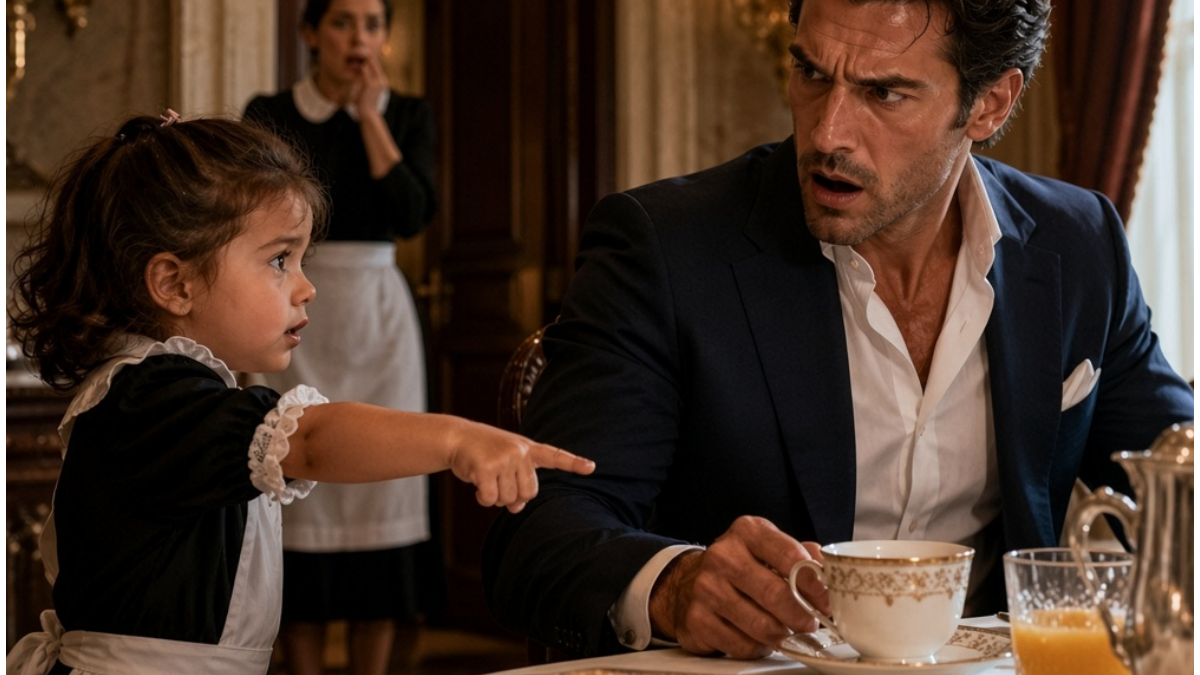
“Don’t drink that.” Luca Viscari stopped with the espresso almost touching his lips. The warning had come from somewhere behind him, soft enough that another man might have mistaken it for the scrape of a chair or the hiss of the coffee machine.
But Luca had survived too long by ignoring small things. He turned slowly. A little girl stood in the doorway between the kitchen and the laundry corridor, barefoot on the cold stone, dark curls tangled from sleep, both arms wrapped around a faded stuffed fox.
She could not have been more than 3 years old. Luca had never seen her before, and children did not simply appear inside the Viscari estate.
Every visitor passed two gates. Every employee was screened. Every delivery was inspected. Yet the strangest part was not that a child had somehow entered his house.
It was the way she looked at the cup in his hand, not at Luca, whose name could empty a restaurant when spoken too loudly, not at the armed guard visible through the service doorway, at the coffee.
Her expression carried a seriousness no 3-year-old should have needed. “What did you say?” Luca asked.
The girl tightened her grip on the fox. “Don’t drink it.” The kitchen seemed to hold its breath.
Behind Luca, someone at the stove shifted too quickly and bumped a metal spoon against the counter.
Luca heard it but did not turn. His attention remained on the child. He had come downstairs nearly 2 hours earlier than usual after a call from the harbor dragged him out of bed before dawn.
Two Viscari freight containers had been pulled for unexplained inspection. A port official who had accepted their money for years had suddenly become unreachable.
One of Luca’s men had spotted a Carbone lieutenant watching the South Docks from a parked sedan.
None of those details amounted to war, but together they had kept Luca awake. He had entered the kitchen thinking about Silvio Carbone, routes, leverage, and retaliation.
Habit had carried him toward the small white cup waiting on the marble island. Only now did another detail rise through the fog of routine.
The espresso should not have been there. The household knew Luca’s schedule. His coffee was prepared at the same time every morning, never early because he hated it sitting even for a minute.
Today, he had come downstairs unexpectedly, yet the cup had been waiting as though someone knew he would arrive.
Luca lowered it. Fast footsteps sounded from the laundry corridor. A woman rushed through the doorway and stopped when she saw him.
Elena Marquez, housekeeper, eight months on staff, quiet, punctual, almost invisible. Luca knew the basics of everyone employed under his roof, even if he rarely spoke to them.
Elena usually kept her eyes lowered and finished work without attracting attention. Now, every trace of color had left her face.
“Mr. Viscari, I’m sorry. She wasn’t supposed to come out. My neighbor watches her while I work, but she got sick last night and I couldn’t find anyone else.
I thought I could keep Mia in the laundry room until my shift ended.” She hurried toward the child and placed herself between Mia and Luca.
“We’ll leave right now.” Luca set the cup on the counter. “No.” Elena went still.
“Sir, I understand if you want to fire me.” “I’m not talking about your job.”
Luca looked past her at Mia. “I’m talking about why your daughter just stopped me from drinking my coffee.”
Elena opened her mouth, but Mia answered firSt. “It smells bad.” Luca crouched until he was closer to her height.
The movement made Elena visibly tense, though Luca kept his hands where the child could see them.
“Bad how?” Mia buried half her face in the stuffed fox. “Funny.” “Like burnt coffee?”
She shook her head. “Like Daddy’s medicine.” Elena’s expression changed so sharply that Luca noticed before she could hide it.
There it was, not confusion, not embarrassment, but fear. Luca straightened. “What medicine?” Elena reached for Mia.
“She was very young when her father was sick. Children connect things that aren’t connected.”
“Maybe.” Luca picked up his phone. “Jonas, kitchen, bring the contamination case. Lock the service corridor.
He ended the call without waiting for a reply. The young cook standing near the stove stared down at his hands.
Luca saw a thin sheen of sweat at his temples despite the cool room. You, Luca said.
The cook looked up. Sir? Your name? Owen Price. Did you make this? Luca pointed toward the espresso.
Yes, sir. Why? Owen blinked. Because you always have one in the morning. At this hour?
Silence. Owen glanced toward the clock. That one glance told Luca more than the answer would have.
Jonas Vale entered less than a minute later carrying a hard black case. He was broad-shouldered, gray beginning at his temples, his shirt only half-buttoned beneath a dark jacket.
He had worked security for the Vescari family long enough that Luca did not have to repeat himself.
One look at the untouched cup, Elena, Mia, and the cook was enough. Jonas placed the case on the counter and opened it.
Inside were field screens for common sedatives, industrial contaminants, toxins, and synthetic additives. They could not identify every dangerous compound, but they could tell them whether the coffee contained something that did not belong.
Jonas pulled on gloves, took a sample, mixed it with a reagent, then slid the vial into a handheld reader.
Nobody spoke while it processed. Mia pressed herself against Elena’s legs. Owen wiped both palms on his apron.
Luca watched him. How long have you worked here? Almost 4 months. Who hired you?
The staffing office. Who recommended you? I don’t know. I applied through an agency. Jonas’s device sounded.
He looked at the display and then at Luca. Synthetic contaminant. The screen can’t tell us exactly what it is, but it isn’t from the beans, water, normal cleaning products, or anything cataloged in the kitchen.
Elena closed her eyes. Owen stepped backward. Jonas turned before he reached the door. One of the guards outside blocked the exit.
Luca did not raise his voice. Tell me what you put in my coffee. Nothing.
Luca stared at him. Owen’s face began to collapse under the silence. I didn’t. You made a cup 2 hours before my normal schedule.
A child smelled something in it. The field screen confirms a chemical contaminant. You can continue lying if you want, but every second you waste makes whatever explanation you eventually give less useful.
Owen looked from Luca to Jonas and understood that nobody in the room was going to rescue him from his own answer.
His shoulders dropped. Four drops. Elena pulled me a closer. Luca said, “Four drops of what?”
I don’t know. Try again. I swear I don’t know. They told me it was medication.
Owen’s breathing had become shallow. A man approached me after I got the job. He knew I owed money.
He knew my sister had lost her apartment. He said I could make more in a week than I make here in a month.
All I had to do was add four drops to your espresso every morning. Who?
I never got his name. Where do you get the liquid? A locker at Central Station.
Every Monday there’s a vial and cash inside. The key is taped under a bench near the East Concourse.
I never see anyone. How long? Owen hesitated. Luca’s expression hardened. How long? 11 mornings.
The number landed harder than Luca expected. 11 mornings meant this was not an attempt designed to stop his heart over breakfaSt. He thought back over the last week and a half.
The headache he blamed on lack of sleep. The brief dizziness after standing during a meeting.
The strange fatigue that had made him reread the same financial page twice the previous evening.
He had dismissed every symptom because none had been dramatic enough to deserve attention. That was exactly the point.
Whoever planned this did not want Luca Vescari dead in a kitchen full of witnesses.
They wanted him ill. A failing liver, an irregular heartbeat, weakness that developed slowly enough for doctors to construct a natural explanation around it.
Perhaps months from now, men who feared him would attend his funeral and talk about the tragedy of a healthy man struck down by disease.
Luca looked at Owen. “You believed someone paid you that much money because they wanted me relaxed?”
Owen’s eyes filled. “They said it would make you tired, easier in negotiations. I told myself that was all.”
“You told yourself what you needed to hear.” Owen started begging. Luca turned away. “Secure him.
No one speaks to him without Jonas present. Recover the locker, the remaining vials, and every camera angle within three blocks of the station.”
Jonas signaled two guards who removed Owen through the service hall. “Get this cup to the lab,” Luca continued.
“Full toxicology. Take blood from me and compare whatever metabolites they find. Quietly.” Jonas nodded.
“Nobody outside this room needs to know what we found.” When the door closed, Luca looked back at Elena and Mia.
The little girl had climbed into her mother’s arMs. Her head rested on Elena’s shoulder, but her eyes were still on the coffee.
Luca found that more unsettling than Owen’s confession. She recognized something than Owen’s confession. She recognized something, he said.
Elena shook her head. “A smell, that’s all.” “A smell connected to her father’s medicine.
She was barely two when he was sick. You keep telling me she was young as though that makes memory impossible.”
Elena’s jaw tightened. “It makes memory unreliable. Then why did you look terrified the moment she mentioned it?”
Elena said nothing. Luca pulled out one of the chairs near the breakfast table and gestured toward it.
“Sit. I want to take my daughter home.” “You will after we talk. You said you weren’t firing me.”
“I’m not. Then why can’t we leave?” Luca glanced at the cup. “Because your daughter saw danger in my kitchen before my security chief, my my or I did.
10 minutes later we proved she was right. That earns her mother a conversation. Elena sat reluctantly, keeping Mia in her lap.
The child’s attention drifted from the adults to the stuffed fox’s bent ear. Luca sat opposite them.
“What happened to her father?” Elena looked down. “He got sick.” “What kind of illness?”
“Doctors never agreed.” “How long?” “Months.” Luca waited. Elena clearly wanted silence to end the questioning.
It did not. “What were the symptoms?” “Fatigue, nausea, tremors, eventually organ probleMs.” Jonas, who had remained near the counter, looked toward Luca.
The description was too close to the pattern they were already considering. Luca asked, “And the medicine Mia remembers?”
Elena’s hand moved slowly through her daughter’s hair. “A private doctor brought drops to the house, supplements, he said, something to help with the symptoMs.”
“Did they have a smell?” Elena’s face tightened. “Very faint, chemical. I barely noticed it.”
“Mia did.” “She hated the bottle.” “Did your husband die?” Elena looked up, anger flashing through the fear.
“Yes.” “I’m sorry.” “Are you?” “Yes.” Luca’s answer was simple enough that it disarmed her for a moment.
“But I still need the truth.” Elena looked toward Mia. “Not in front of her.”
Luca nodded to Jonas. “Take her into the breakfast room. Find something she can eat.”
Mia immediately wrapped both arms around Elena. “No.” Jonas crouched at a safe distance. “We have apple juice.”
Mia eyed him suspiciously. “And bananas?” “Probably.” “How many?” Jonas looked toward the pantry as though estimating ammunition.
“More than one.” “That’s not how counting works.” Luca almost smiled. Jonas sighed. “At least five.”
Mia considered this, then allowed Elena to set her down. “Captain comes, naturally.” Jonas said.
Mia followed him into the next room, holding the fox by one paw. Elena watched until the door closed.
Luca waited before speaking. “Now tell me what you were protecting her from.” Elena looked at him for several long seconds.
“Her father’s name was Daniel.” “Daniel Marquez?” “Not exactly.” “What does that mean?” “It means Marquez was one of the names I used after he died.”
Luca’s attention sharpened. “You changed your identity.” “More than once.” “Why?” Elena’s breathing slowed as though she had reached a decision she had postponed for years.
“Because Daniel didn’t die from an illness.” Luca said nothing. “He was an accountant. He found something in records belonging to people who could not afford to let him walk away with what he knew.”
“After that, he started getting sick. Slowly enough that every doctor saw disease instead of murder.”
Luca glanced once toward the espresso. “And the drops?” Elena’s eyes followed his. “They were part of it.”
“Who gave them to him?” “A man pretending to help.” “Who sent him?” Elena did not answer.
Luca leaned forward. “11 days ago somebody started doing the same thing to me. Your daughter recognized the smell because she watched it happen before.
That makes whatever you know part of what is happening in my house right now.”
Elena’s fear remained, but underneath it Luca saw something harder beginning to surface. Not panic, decision.
“You think the poison is the dangerous part?” She said quietly. “It isn’t.” “Then what is?”
“The person who can get close enough to use it.” Luca’s eyes narrowed. Elena looked toward the closed door where had disappeared with Jonah, then back at him.
“There’s something you need to understand before I give you a name.” “I did not end up working in this house by accident.”
Luca became completely still. Elena continued. “Each word measured now. I came here because of what Daniel found before he died.”
“I came here because I believed one person in this city might be strong enough to use it.”
“But I couldn’t approach you until I knew who around you was safe.” “Safe from whom?”
Elena swallowed. “From the people who killed my husband.” “And Mia knew the smell because of them.”
“Yes.” Luca waited. “Then tell me why.” Elena looked at the untouched cup cooling on the marble island.
“Because the man who killed her father used the same smell to hide what he was doing.”
Elena did not look away from the cold espresso when she finally gave Luca the name, “Silvio Carbone.”
Nothing in the kitchen moved. Luca had expected a rival, but hearing Carbone confirmed tightened something in his cheSt. For nearly a decade, the Viscari and Carbone organizations had existed in a careful balance.
They controlled different pieces of the city, negotiated when their interests crossed, and understood that an open war would cost both sides more than either could gain.
During the last 6 months, however, that balance had begun to shift. Viscari freight had been delayed without explanation.
Contractors who had always cooperated had suddenly grown difficult. A customs supervisor had vanished from his usual channels.
Luca had interpreted the pattern as pressure at the edges of his territory. Now a poisoned cup suggested Carbone had already crossed the line.
“Daniel worked for him?” Luca asked. Elena nodded. “Not knowingly at firSt. He thought he had been hired by a private logistics company.
The offices were real. The contracts were real. The salary was almost three times what he had been making.
Mia was on the way. Our rent had gone up, and we were living from one paycheck to the next.
Daniel thought somebody had finally noticed how good he was.” Her voice softened for an instant.
“He was a forensic accountant. Numbers were the one thing he trusted completely. If a company moved money through 20 different accounts, Daniel could usually tell why.
If one transaction didn’t fit the pattern, he could see it when nobody else could.
That was what Carbone wanted from him until it became the thing Carbone needed to destroy.
Daniel learned within months that the company was tied to Carbone, but by then the organization knew everything about him.
Where Elena worked, which clinic she used during pregnancy, the address of Daniel’s parents, even the route he took home.
Nobody threatened him. They simply made sure he understood that leaving would create questions about everyone he loved.
Daniel stayed and told Elena as little as possible. Then one night, while reconciling freight expenses, he found a ledger filed under the wrong client code.
The mistake was tiny. Someone had placed one encrypted archive where another should have been.
Daniel opened it because one total was off by less than a thousand dollars. “That was enough,” Elena said.
He pulled one thread and found a whole system behind it. The ledger contained payments disguised as consulting fees, maintenance contracts, inspection costs, and shipping insurance.
Daniel traced them to judges, customs officers, police contacts, port managers, and city officials. Other accounts purchased warehouses that officially stood empty while private shipments moved through them at night.
Still others paid people inside rival organizations. Luca interrupted. “Informants?” “Some, but Daniel said those weren’t what scared him moSt. Informants sold information when they needed money.
These people were different. Some had been placed years earlier and were paid even when they did nothing.
Their job was to become trusted, move upward, and wait. When Carbone needed a contract delayed, a route exposed, a disagreement encouraged, or a security decision changed, one of those people would act.
Daniel called them sleepers.” Luca’s eyes narrowed. “Did he identify them?” “Not all of them.”
He copied what he could before the archive vanished from the system. After that, he started building his own map in secret.
Elena pressed her hands together. “He never told me. I only knew he was coming home later, sleeping less, checking the street before he opened our apartment door.
Then he got sick. It began with exhaustion. Daniel stopped running in the mornings because he said his legs felt heavy.
Then came nausea, headaches, shaking in his hands, and long stretches when he could not focus.
Doctors ordered blood tests and scans. One suspected an autoimmune disorder. Another thought the problem was neurological.
Every new theory explained part of the decline, but never all of it. Carbone responded like a generous employer.
He paid for specialists and told Daniel not to worry about work. He sent meals to the apartment and eventually arranged a private physician to visit the house.
“His name was Mercer,” Elena said. “At least that’s what he called himself. He carried an expensive bag, had medical credentials that looked real, and spoke like a man accustomed to people believing him.
He brought little amber bottles of clear drops, supplements, he said, something to help Daniel sleep and settle his stomach.”
Luca thought of Mia standing in the laundry doorway. “The smell.” Elena nodded. “Very faint.
I barely noticed it unless I was close. Mia noticed immediately. She was not even two, but every time Mercer opened the bottle, she cried.
Sometimes she would hide behind the couch. I asked him about it once. He said one of the stabilizers had a chemical odor, and children were more sensitive to it.
That explanation was reasonable enough, so I accepted it. Daniel deteriorated for nearly 7 months.
By the end, he needed help crossing the apartment. His skin changed color. His hands shook too badly to hold a glass.
Carbone continued sending flowers. Mercer continued bringing drops. Three nights before Daniel died, he made me put our phones outside the bedroom and unplug the television,” Elena said.
“I thought the medication was affecting his mind. Then he told me what he had found.
He said the sickness wasn’t random. He believed somebody had been giving him small amounts of something for months, so every symptom would look like disease.
He had finally connected several supply records to Mercer.” Luca asked, “Why didn’t he go to the police?”
Elena gave him a tired look. “He showed me three names from the ledger, a police commander, a judge, an assistant prosecutor, all being paid through Carbone channels.
Daniel said he had no idea which office was clean and which phone call would reach Carbone before it reached anyone who could protect us.
Instead, he made Elena memorize the location of a storage box at a train station two counties away.
Inside was an encrypted drive containing everything he had copied. He gave her one instruction.
If he died, she was to take Mia, recover the drive, and leave without returning home.
Daniel died three mornings later. The hospital recorded complications from an unidentified degenerative illness. No autopsy looked for the compound Daniel suspected because nobody had asked the right question.
The day after the funeral, Carbone came to see me, Elena said. Not one of his men, him.
He sat in Daniel’s chair and told me how much he respected my husband. He offered to pay Mia’s school expenses until she turned 18.
He talked gently, but he watched my face the entire time. He wasn’t comforting a widow.
He was trying to find out whether Daniel had told me anything before he died.
Elena had thanked him, told him Daniel never discussed work, and even cried when Carbone spoke about the tragedy.
“I think the tears convinced him,” she said. They were real. They just weren’t for the reason he thought.
As soon as his car left the block, Elena packed clothes for Mia and herself.
She never returned to the apartment. For almost 3 years, Elena moved whenever the smallest detail felt wrong.
She used Daniel’s mother’s surname, then another variation after a man appeared outside Mia’s daycare asking whether Elena still called herself Serrano.
She avoided credit cards, kept no permanent address longer than necessary, and never told landlords more than they needed to know.
In another city, she came home from work and discovered that nothing had been stolen, but the mattress had been lifted and replaced upside down.
Whoever entered had been searching, and Elena understood exactly what they wanted, the drive. She stopped storing it anywhere connected to her home and moved it between rented lockers and hidden caches using instructions Daniel had prepared before his death.
“I could open part of it,” she said. “Daniel left a lower encryption layer with records he knew I might need to prove what happened.
Companies, properties, payments, Carbone’s laundering network. But the deeper files were locked differently. I spent years learning enough to recover fragments.”
Luca asked, “Why not give the drive to someone outside the city?” “Who?” Elena replied.
“A reporter who might call the police before publishing? A lawyer who could be bought?
A federal office I couldn’t verify? Daniel’s files showed me how many respectable people Carbone already owned.
I had one copy of evidence worth killing for and a child who depended on me.
Guessing wrong once was enough.” Eventually, Elena managed to recover an index listing 12 sleeper records tied to organizations Carbone considered strategically important.
Some were marked inactive, others had been terminated or transferred. Several remained active. Most identities were still buried behind stronger encryption, but one entry stopped Elena completely.
“Vez Circle, active.” “Initiated 17 years earlier.” “Vescari,” Luca said. “That was my interpretation.” “17 years?”
“Yes.” Luca’s eyes hardened. 17 years was not merely a date, it was the year Enzo Vescari died in the study upstairs.
Elena saw the connection register in his face. “Daniel never wrote that your father was murdered.
I need you to understand that. The index proves only that a Carbone sleeper was operating somewhere inside your organization at approximately that time.
And you thought I could use this evidence?” “Eventually. Yet you spent eight months cleaning rooms instead of bringing it to me.”
Elena did not flinch. “Because the sleeper was still marked active.” Luca said nothing. “I had no idea whether that person was one of your guards, one of your advisers, someone managing your appointments, someone screening your mail, someone deciding which employee requests ever reached you.
Imagine I applied for a private meeting on my first week here. Imagine the person reading that request was Carbon’s sleeper.
Mia and I could disappear before you ever learned my name. Luca could not argue with the logic.
So, you came inside deliberately and watched us? Yes. Jonas? Everyone. Including me. Especially you.
Luca almost admired the answer. What were you waiting for? Elena looked toward the breakfast room door where Mia’s voice could faintly be heard asking Jonas whether apple juice counted as fruit.
A way to reach you without announcing myself to the wrong person. I thought I had more time.
Then Mia walked into the kitchen. By noon, Luca had made his decision. Elena would retrieve the drive, but she would not be followed in any way she could detect.
Jonas positioned surveillance far enough from the storage site to watch the surrounding roads without compromising the location itself.
Elena took Mia with her because she refused to leave her daughter behind while the estate still contained an unidentified sleeper.
Two hours later, they returned with a black solid-state drive small enough to hide inside a coat pocket.
Daniel had protected it with layered encryption and a second authentication sequence Elena had memorized rather than written down.
Jonas connected it to an isolated computer in a windowless room beneath the east wing, physically disconnected from every estate network.
Luca stood behind him while Elena entered the first passphrase. Directories filled the screen. Shell companies, property records, coded transfers, names of officials, freight routes, medical suppliers.
Daniel had built a private archive while his own body was failing. Elena navigated to the sleeper index.
12 abbreviated entries appeared. Luca ignored the others and found Vestricle immediately. Status: active, initiated 17 years earlier.
Identity: encrypted. Jonas leaned closer. No name. Not in the section I can open, Elena said.
Daniel must have separated identities from the index. Jonas scrolled downward. Beneath the entry sat a short transaction note attached to a Zurich shell account and a code name Luca had never seen before.
Jonas read it once, then again. The steward. Luca stared at the word. A steward was not someone who attacked a house from outside.
A steward was entrusted with what happened inside it. Someone allowed to manage routines, people, schedules, access.
Someone who did not need to break through a gate because the gate already opened for him.
Upstairs, staff crossed familiar hallways. Guards changed positions. Phones rang in offices. The estate looked exactly as it had the day before.
Luca understood that nothing about it could be viewed the same way again. For 8 months, Elena had been afraid to approach him because Daniel’s last evidence said the enemy was already somewhere within reach.
Looking at the screen, Luca could no longer tell her she had been too cautious.
Luca stayed in the underground operations room after Elena took Mia upstairs to reSt. The isolated monitor still displayed the line Daniel Marquez had preserved before his death.
Vest circle. Active. Initiated 17 years earlier. The steward. Luca had spent most of his adult life believing danger announced itself through movement.
A strange vehicle outside a gate. A new face in a familiar restaurant. Money shifting into an account where it did not belong.
Now he was being asked to consider the opposite possibility, that the most dangerous person in his world had survived precisely by becoming ordinary.
Jonas stood beside the terminal while two analysts copied the accessible portions of Daniel’s drive onto encrypted storage and began sorting records by date.
“We start with function, not names.” He said. “If we decide who the steward is before we know what the steward actually did, every piece of evidence will become whatever we want it to be.”
Luca looked at the code name again. “What do we know?” Jonas brought up the fragments attached to the sleeper entry.
Daniel had recovered references to household staffing, medical logistics, and financial scheduling. No complete instructions survived, but the same three categories appeared often enough to suggest long-term influence over them.
The sleeper did not necessarily hire employees personally or administer medicine directly. A recommendation could be enough.
A vendor introduced to the right office. A physician placed on an approved liSt. A financial meeting delayed until arrival gained an advantage.
Small decisions made by people who believed they were choosing freely. Jonas built a list of everyone who had meaningful access to at least two of those categories during the relevant years.
Then he narrowed it to those who had touched all three. Six names remained. Victor Hale, the attorney responsible for several Vescari trusts.
Thomas Wrenzie, former household administrator. Dr. Leonard Shaw, who had treated Enzo and several senior family members.
Rosa Cadenaio, the long-time payroll controller. Jonas Vale, and Adrian Bellini. Luca read the final name twice.
You included yourself. Jonas did not look offended. I had security access to household schedules when your father was alive.
Later I controlled far more. If I remove myself because you trust me, we may as well stop now.
Luca’s eyes stayed on Adrian’s name. Adrian Bellini had been part of the Vescari family before Luca understood what the word family meant.
He and Enzo had built businesses together when both men were young enough to believe bruises disappeared overnight.
Adrian taught Luca to drive after Enzo refused, claiming his son treated every machine as though it had personally insulted him.
When Luca’s mother died, Adrian sat outside his bedroom until dawn because Luca would not let anyone enter.
17 years ago, Adrian was the man who found Enzo collapsed beside the desk in his study.
Luca had arrived to flashing ambulance lights in a hallway full of frightened men. Adrian met him halfway up the stairs, gripped both his shoulders, and told him to breathe.
A cerebral hemorrhage, the doctors concluded. Sudden, catastrophic. Nothing anyone could have predicted. Three days later, Adrian stood beside Luca at the funeral.
Three weeks later, when several captains began testing whether a 22-year-old could control what his father left behind, Adrian took the chair beside Luca at the first major meeting and made his loyalty public before anyone could challenge it.
Luca had never forgotten that. He had built much of his adult understanding of loyalty around that moment.
“Adrian saved the organization after my father died,” Luca said. “Maybe,” Jonas replied, “or he helped stabilize an organization he needed to remain inside.”
Luca turned sharply. Jonas held his gaze. “I’m not accusing him. I’m telling you why history cannot clear anyone.”
The sentence irritated Luca because it was correct. He walked to the far side of the room and looked through the glass wall into the empty secondary office.
17 years earlier, Enzo’s death had changed the estate overnight. Before it, the house had been loud.
Enzo entertained constantly, argued over dinner, left doors open, and trusted familiarity more than security protocols.
Luca responded to losing him by reversing almost everything. He replaced staff, added cameras, rebuilt access systems, reduced the number of people allowed near him, and turned his father’s home into a fortress.
People called it paranoia until three separate attempts on Luca’s life failed because of those precautions.
Yet, Daniel’s index suggested the original threat had never needed to breach a wall. It had already been invited inside.
Luca looked back at the six names. “Investigate everyone equally, including Adrian?” Jonas asked. Luca took 1 second too long to answer.
“Including Adrian.” The toxicology results arrived before noon. The compound in Luca’s coffee was still being fully identified, but the laboratory confirmed that it had been delivered in a faintly scented stabilizing solution similar to the type Elena described from Daniel’s medication.
More importantly, Luca’s blood contained metabolites consistent with repeated low-level exposure. The doctors believed the amount accumulated over 11 days explained the headaches and brief dizziness he had ignored, but they expected no permanent damage now that the dosing had stopped.
Another few weeks could have produced liver stress, abnormal cardiac rhythms, and symptoms easily mistaken for an aggressive illness.
Luca found Elena in a west sitting room after receiving the report. She was reviewing printed records from Daniel’s drive while Mia sat on the carpet with a plastic tea set a staff member had discovered in storage.
When Luca entered, Mia looked up immediately. Coffee man. Elena closed her eyes. Mia. Luca stopped beside the rug.
I’ve had worse titles. Mia lifted a tiny pink cup toward him. This one is safe.
How do you know? There’s nothing in it. That is a strong security system. She nodded seriously and returned to pouring imaginary tea into Captain’s cup.
Luca told Elena the laboratory had confirmed repeated exposure and that the carrier solution likely explained what Mia had smelled.
Elena looked at her daughter for a long moment. Daniel never got that chance, she said.
By the time we knew poisoning was even a possibility, everyone already had a medical explanation for why he was dying.
Luca understood the warning beneath the sentence. Early evidence was useful only if they acted before the enemy adapted.
He told her about the six suspects without giving every name. Elena did not ask for them.
You don’t want to know? Luca asked. Not until I need to. She closed Daniel’s notebook.
If the sleeper realizes I can identify the investigation, Mia becomes leverage again. Information is not automatically safer because I have it.
Luca considered that. You spent eight months watching my people. Did anyone worry you? Several people.
Useful. You employ armed men for a living. I would be concerned if nobody worried me.
Luca almost smiled. Jonas? If Jonas is the steward, we’re already dead and haven’t noticed.
From the rug, Mia held up a brown stuffed bear someone had apparently added to the tea party.
That’s Mr. Jonas. Luca looked at the bear. Why? He looks like everybody stole something.
Elena covered her mouth. Luca stared at Mia. You have known him for one day.
I’m good at looking. Luca could not argue with the evidence. Later that afternoon, the investigation produced its first meaningful financial connection.
Owen Price had entered the estate through Harrow Domestic Placement, an agency used for temporary household staff.
Harrow appeared independent, but one of its parent companies had received investment from a Family Services Foundation.
That foundation, in turn, had been seeded years earlier by a charitable trust established after Enzo’s death.
Luca recognized the trust instantly. It paid medical expenses for retired employees and tuition for children whose parents had died while working for the family.
Adrian Bellini had created it in Enzo’s memory. Jonas placed the ownership chain on the screen.
This does not prove Adrian selected Owen. The trust holds investments through managers. Harrow is several layers removed.
Then why show me? Because we investigate connections before deciding whether they matter. Elena entered with one of Daniel’s handwritten transcription pages and stopped when she saw Adrian’s name.
Bellini. Luca turned. You know it? Daniel wrote it once. The room changed immediately. Elena saw Luca’s reaction and raised a hand.
Once. With a question mark. Do not turn that into more than it is. She opened the notebook to a copied fragment.
Bellini trust cross-check steward channel. Daniel had written it while trying to trace Zurich-linked transactions.
If Daniel knew Adrian was the sleeper, he would not have written a question, Elena said.
He was checking a financial path. Jonas nodded. Agreed. Luca read the line repeatedly. Harrow connected to a trust Adrian had created.
Daniel had independently flagged the same truSt. Neither fact proved betrayal. Together they made ignorance harder to justify.
Luca invited Adrian to breakfast the following morning without mentioning any of it. Adrian arrived carrying a paper bag from an old coffee roaster Enzo had loved and complained that modern shops roasted beans as if they were trying to punish them.
He was 63 now, silver at the temples, still elegantly dressed even before 9:00 in the morning.
And he moved through the estate without waiting for anyone to tell him where to go.
He had been doing that longer than most of the staff had been alive. Luca introduced Elena only as someone assisting with a confidential financial review.
Adrian greeted her warmly, then noticed Mia sitting at the far end of the kitchen with Captain.
And who is this? Mia looked him over. Mia. I’m Adrian. I know. Elena looked at her daughter.
How? Mia pointed at Luca. He said it yesterday. Adrian laughed. Then I should be careful.
Apparently people discuss me when I’m not here. Luca watched his face. Nothing. No tension.
No curiosity beyond what the situation naturally invited. They ate breakfast while Adrian discussed the recent trouble at the harbor and advised Luca not to overreact to Carbone’s pressure.
“Silvia wants you angry.” He said. “Angry men spend money proving they are not afraid.
Let him wonder whether you even noticed.” It was exactly the kind of counsel Adrian had given for years.
Patient, rational, profitable. Luca suddenly found himself asking how many times such advice had benefited Carbone without appearing to.
He hated the question. Adrian poured himself more coffee and looked toward the old white cups.
“Your father once threw one of those across a restaurant because they served you instant coffee.”
Luca remembered. He had been 14. Enzo had made such a scene that the owner apologized to the entire dining room.
Adrian laughed at the memory. He could forgive a man for losing money faster than he could forgive bad coffee.
Apparently he had unusual priorities. Luca said. Adrian’s smile paused for a fraction of a second.
Perhaps Luca imagined it. That was the problem now. Once suspicion entered a familiar face, every blink wanted to become evidence.
Luca refused to let it. After breakfast, Adrian left through the front hall. Mia watched from the kitchen doorway.
He’s nice, she said. Luca looked down at her. You think so? Maybe. That is less confident.
Mia frowned, searching for words. His mouth smiles before the rest of him. Luca stared at her.
Elena immediately said, That is not evidence. I know. And he did. A child’s discomfort could not convict a man of 17 years of betrayal.
Still, Luca remembered the sentence after Adrian’s car disappeared through the gates. That afternoon, Jonas found something better.
Daniel Zurik records contained a payment from a Carbone Link Shell account made 3 days before Enzo’s death.
The money traveled through two intermediaries before reaching an investment fund connected to a medical supply company that had provided specialized products to Dr. Leonard Shaw’s practice.
Shaw remained a suspect. But the funds administrator was Peter Orsini, a financial consultant who had handled private investments for Adrian Bellini for years.
Again, nothing direct. Again, Adrian’s name appeared near the same financial architecture without sitting openly at its center.
Jonas placed the staffing records, Daniel’s question about the Bellini trust, and the old Zurich transfer beside one another.
We can spend months tracing dead companies, he said, or we can make the steward move.
Luca looked at him. Jonas placed six folders on the table. Six suspects. Six different pieces of false information about your condition.
Something important enough that Carbone would react if his person passes it on. Each version unique.
Elena understood firSt. You tagged the leak. Jonas nodded. Victor Hale would hear that Luca planned to leave the country for treatment.
Thomas Renzi would hear that his liver was failing. Dr. Shaw would hear that toxicology had found nothing and Luca feared a hereditary disease.
Rosa Cataneo would hear that Luca was preparing succession changes. Jonas would receive and document a fifth version of his own.
Luca looked at Adrian’s folder. And him? Jonas waited. Luca remembered the hand on his shoulder at Enzo’s funeral, the driving lessons, the advice.
17 years of trust that suddenly felt like a locked room. “Tell Adrian the doctors think my heart is failing,” Luca said.
“Tell him I may have 30 days before I’m too sick to lead.” Jonas studied him.
“If Carbone reacts to that exact detail?” Luca closed Adrian’s file. “Then we stop asking the past to tell us who the steward is.
We let the steward tell us himself.” For the next 3 days, Luca became a sick man without actually becoming one.
The laboratory had confirmed that the contaminant in his blood was leaving his system and that no permanent damage was expected.
But that truth remained inside the underground operations room. Everywhere else, Luca allowed carefully chosen weaknesses to appear.
He ended one meeting 20 minutes early and let a lieutenant see him press two fingers against his temple.
At a warehouse inspection, he paused halfway up a metal staircase and gripped the railing until Jonas quietly asked whether he needed to sit down.
During lunch with two captains, he left most of his food untouched. Nothing dramatic enough to look staged, only small failures in a man whose reputation had been built on never showing any.
Rumor responded faster than any official announcement could have. By the second afternoon, a supplier who normally waited patiently for payment began asking whether contracts should be guaranteed beyond the current quarter.
A rival delayed a routine settlement, apparently curious whether Luca had enough strength to enforce it.
Men who had known him for years started watching his face when they thought he was not looking.
Luca discovered that pretending to be weak created a form of danger all its own.
He He almost feel the city recalculating around him. The poison had been designed to do exactly this, only slowly enough that nobody would recognize the hand behind it.
Owen Price remained in the kitchen under constant surveillance, preparing the same espresso every morning and adding four drops from a vial retrieved through the dead drop system.
Jonas photographed each preparation, sealed the contaminated cup as evidence, then replaced it with clean coffee before Luca entered.
To anyone watching patterns from inside the estate, nothing had changed. Luca still stood at the east window at the same hour and drank from the same white porcelain cup.
The only difference was that now the ritual belonged to him again. While the performance unfolded, Jonas delivered the six lies.
Victor Hale, the attorney, was told privately that Luca intended to travel overseas for treatment before the end of the month.
Thomas Renzi heard that tests suggested severe liver failure. Dr. Leonard Shaw was told the opposite.
Toxicology had found nothing suspicious, and Luca’s doctors were considering a hereditary neurological disorder. Rosa Cadanio learned that Luca was preparing emergency succession documents because his condition might prevent him from managing finances.
Jonas created a fifth version for himself, documenting that Luca’s kidneys were deteriorating, then allowed only two monitored security officers to hear it.
Adrian received the sixth lie in the study where Enzo Viscari had died. Luca chose the room deliberately, then regretted the choice the moment Adrian entered.
Late afternoon sunlight cut across the bookshelves and the heavy wooden desk. The furniture had changed little in 17 years.
Luca could still remember paramedics moving through that doorway while Adrian stood beside him telling him to breathe.
Now Adrian placed a paper bag of coffee beans on the desk and looked at Luca with genuine concern, or something indistinguishable from it.
“You look worse.” He said. “You always know how to improve a man’s afternoon.” Adrian ignored the joke.
“What are the doctors saying?” Luca waited just long enough to make the answer difficult.
“My heart.” Adrian’s face tightened. What about it? Irregular rhythm, progressive damage. They think whatever is happening has been developing quietly.
Luca looked toward the window instead of at him. They’re giving me around 30 days before I’m too sick to run things normally.
Adrian sat down. For several seconds he said nothing. Luca had known him almost his entire life and silence from Adrian was unusual enough to feel meaningful.
Then the older man leaned forward. Who knows? Jonas, the doctors, you. Adrian nodded slowly.
Keep it that way. Luca looked at him. That is your medical advice? It is my survival advice.
The moment Carbone believes you are dying, every agreement tied to your name becomes negotiable.
Every man who fears what you might do next starts imagining what happens when you are gone.
Adrian rubbed one hand over his jaw. Do not give them a month to organize around your funeral.
It was good advice. That made it worse. Adrian had been giving Luca good advice for 17 years.
Luca could not tell whether wisdom had always been wisdom or whether some part of it had been carefully angled toward another man’s interests.
Adrian reached across the desk and rested a hand briefly on Luca’s forearm. We will handle this.
The words pulled Luca backward through time. After Enzo’s funeral, Adrian had used almost the same sentence.
We will handle this. You are not alone. Luca looked at the hand touching his sleeve and wondered how many betrayals could hide inside gestures that had once kept a young man standing.
You’re staring at me, Adrian said. I’m tired. Then for once in your life, behave like a human being and sleep.
Adrian stood, pushed the coffee beans toward him, and forced a small smile. Your father would be furious if bad coffee was the last thing you tasted.
Luca’s expression did not change. Adrian’s smile disappeared. Poor choice of words. Very. Enzo would have laughed.
Enzo who at terrible things. One of the reasons people loved him. Adrian left a few minutes later.
Luca stayed alone in the study listening to his footsteps disappear down the hall and wishing with a force that surprised him that nothing would come of the lie he had just planted.
The first day produced nothing. Jonas’s team watched every suspect without changing their normal routines.
Victor Hale made several calls concerning property transactions but said nothing about treatment overseas. Thomas Renzi played golf with two retired Vescari employees and complained about his back more than he discussed Luca.
Dr. Shaw accessed old Vescari medical records, which was exactly what a physician might reasonably do after hearing that a hereditary illness was suspected.
Rosa Cattaneo quietly began preparing contingency documents an action so responsible that Luca felt almost guilty for using her.
Jonas’s assigned kidney failure story went nowhere. Adrian called Luca once to ask whether he had eaten and once to insist that a cardiologist in Boston should be consulted.
No message appeared on the Carbone channels identified in Daniel’s drive. By the second evening, Luca found himself irritated by his own relief.
If Adrian’s lie remained inside the estate, one part of the nightmare might still be wrong.
Elena found him in the kitchen staring at a clean espresso that Jonas had already tested twice.
“You know that one won’t kill you.” She said. Luca picked it up. “I know.”
“Then why are you looking at it like it owes you money?” “I’m thinking.” “That usually looks less hostile.”
He took a sip. Elena sat across from him with one of Daniel’s notebooks. “Nothing from Adrian?”
Luca’s eyes narrowed. “I didn’t tell you which version he got.” “You didn’t need to.
He’s the one you’re waiting on.” Luca set the cup down. “I want him cleared.”
“Of course you do. You say that as though it proves something.” “It proves you’re human.”
Elena closed the notebook. “You keep treating suspicion as if it is already a betrayal.
It isn’t. You are testing information because the evidence forced you to. If Adrian is innocent, the test gives him a chance to remain innocent.
Luca looked toward the dark window. And if he isn’t, then your trust did not cause what he chose to do.
Before Luca could answer, Mia wandered in wearing socks that did not match and carrying Captain by one leg.
She climbed onto a chair and looked at Luca’s cup. Safe? Safe. Did Mr. Jonas check?
Twice. Mia nodded approvingly. He likes checking things. That is an understatement. She looked at Elena.
Can I have toast? Elena stood. You already had toaSt. That was old toaSt. Luca glanced at her.
How old? Like an hour. Tragic. Mia gave him a serious look. You don’t understand toaSt. Luca decided that was probably true.
For a few minutes, the investigation disappeared beneath the ordinary problem of whether a second breakfast was justified.
Then Jonas entered the kitchen carrying a tablet, and the expression on his face ended before Elena finished opening the bread.
“We have something,” he said. Luca rose. “Which one?” Jonas looked at him. Heart. The intercepted message had traveled through an encrypted carbon-linked channel shortly after midnight.
Daniel’s archive had contained enough historical keys and routing patterns for Jonas’s analysts to recognize the structure even though the sender remained hidden behind temporary devices.
The message contained no names. It did not need them. Heart confirms timetable. 30 days at moSt. Prepare second phase.
Luca read the words on the operations room screen without speaking. Elena stood behind him.
Jonas remained at the terminal. Only Adrian had been told both that Luca’s heart was failing and that he had approximately 30 days before losing control of the organization.
Could he have repeated it to someone without knowing who they were? Elena asked. “Possible,” Jonas said.
“We traced his movements after the meeting. He went from the estate to his office, stayed there for 2 hours, then drove home.
Four calls. One to a restaurant, one to a sister, one to Luca’s physician’s office, and one to Peter Orsini.
Luca recognized the name immediately. Orsini was Adrian’s long-time financial consultant, the same man whose firm administered the investment structure that appeared near the old Zurich transaction made before Enzo’s death.
Jonas brought up the call log. Less than 2 minutes. Content? Luca asked. Not yet.
Then we still don’t know Adrian sent the message. Jonas studied him. No. We know the exact false information given only to Adrian reached a Carbone channel within hours.
Luca looked at him. That is not the same sentence. I know. Elena watched the exchange carefully.
Luca was not denying evidence. He was forcing it to become strong enough to survive what he would have to do with it.
Jonas opened another file. There’s more. Daniel’s records contained a Zurich-linked transfer dated 3 days before Enzo’s death.
Analysts had previously traced it through a medical supply fund tied indirectly to Dr. Shaw.
Now they had recovered the administrator behind the transaction, Peter Orsini’s firm. Years later, the same firm had created a private investment vehicle for Adrian.
Still indirect, still not proof that Adrian ordered Enzo’s death, but the same names kept appearing in the same architecture.
Owen’s staffing pipeline connected through the Bellini charitable network. Daniel independently flagged that trust while researching the steward.
The controlled heart story reached Carbone. And the old Zurich channel touched Adrian’s financial advisor days before Enzo died.
Jonas laid the printed records side by side. Any one of these could have an innocent explanation.
Luca looked at the papers. Two? Possibly. Three? Jonas did not answer immediately. At some point, coincidence stops being the most reasonable explanation.
Luca stared at Adrian’s photograph on the suspect board. He remembered being 14 in a warehouse parking lot while Adrian laughed as Luca stalled the car for the fifth time.
He remembered his mother’s funeral, his father’s funeral, Adrian sitting beside him at tables full of men waiting for Luca to fail.
None of those memories vanished because of a message on a screen. That was what made the truth harder, not easier.
“No arreSt.” Luca said. Jonas’s eyes narrowed. “Not yet?” “Not yet. If Adrian is the steward, he has spent 17 years believing he understands how I think.”
“The moment we confront him, Carbone knows the sleeper is burned. We lose the network behind him.”
Elena said, “So, what do you do?” Luca looked again at the intercepted message. Heart confirms timetable, 30 days at moSt. He folded the printout and slipped it into his jacket.
“We give him what he expects.” Jonas understood. “You keep getting sick.” “Exactly. Owen keeps making the coffee.
I keep drinking the clean replacement. Meetings get shorter. Appearances disappear. Adrian watches the mechanism turn exactly on schedule.”
Luca’s gaze returned to the photograph. “We do not pull the steward out of the wall yet.
We let him believe the house still belongs to him. For four more days.” Luca continued performing the illness Adrian expected to see.
He canceled an evening meeting with two shipping partners, arrived late to another, and once allowed a captain to watch him brace both hands against a conference table as though a wave of dizziness had caught him without warning.
The rumors sharpened accordingly. A few people became more protective. Others became more ambitious. Luca had always understood that power attracted loyalty and fear in unequal proportions.
Now, he was watching what happened when fear began to weaken. Adrian remained attentive without becoming intrusive.
He called every morning, sent the name of another cardiologist, and twice offered to take work off Luca’s hands.
Nothing in his behavior looked like betrayal. That was what made it so corrosive. Each kindness now came with two possible explanations, and Luca had begun to understand why Elena once threw away soup brought by a neighbor.
Suspicion did not merely make dangerous people harder to truSt. It made ordinary life harder to interpret.
One evening he found Elena in the West Library with Daniel’s notebook open across her lap while Mia slept beside her under a blanket.
Captain rested beneath the child’s chin. Luca had intended to ask about a group of account codes, but instead he stood in the doorway long enough that Elena looked up and closed the notebook.
“Adrian again?” She asked. Luca answered, “You say that too confidently. You make the same face every time his name is involved.”
He sat opposite her. “What face?” “The one that says you want evidence to apologize.”
Luca looked toward the dark television screen. “He taught me to drive. My father refused because he said I treated a clutch like an enemy confession.
Adrian took me to an empty warehouse lot and let me ruin his car for half a day.
When my mother died, I locked myself in my room. He sat outside the door until sunrise without asking me to open it.
When my father died, half the men around us were deciding whether I was too young to lead.
Adrian sat beside me before any of them chose a side.” He paused. “You know what that did?”
Elena nodded. “It told them you weren’t alone. It told me the same thing.” Luca leaned back.
“If he is the steward, then I spent 17 years asking the man who helped destroy my family how to protect it.”
Elena looked down at Mia before answering. “After Daniel died, I made the opposite mistake.”
“What mistake?” “I decided trust itself had killed him. Not Carbone, not Mercer. TruSt.” She closed her hands around the notebook.
“I stopped making friends. I never let co-workers know where Mia went to daycare. I moved if a landlord became too curious.
Once a woman in the apartment next to ours brought soup because Mia had a fever.
She was kind. She had done nothing wrong. I threw it away after she left because I could not make myself believe kindness was just kindness anymore.”
Luca said nothing. Elena continued, “For a while that kept us alive. Then I realized I had built a life where nobody could betray us because nobody was allowed close enough to matter.
It was safe in one sense and unbearable in another.” Luca’s gaze moved to Mia.
“And you came here anyway because running forever was still letting Carbone decide what our lives looked like.”
She held his eyes. “You keep treating suspicion as if it cancels love. It doesn’t.
If Adrian is innocent, evidence can clear him. If he is guilty, your loyalty did not create his choice.
The only thing that would make your trust dangerous now is refusing to revise it because the truth hurts.
Luca looked at her for a long moment. “Daniel talk like that?” “No. Daniel used spreadsheets.
More efficient. Much more irritating. If there has ever been one person in your life who taught you that trust should be earned by what someone repeatedly does, not simply assumed because of what they say, tell me who they were in the comments.
Sometimes the people who change us most are the ones who quietly prove, over time, that we were safe to believe them.”
Mia woke before the silence between Luca and Elena could become uncomfortable. She sat up with her hair flattened on one side and announced that Captain required tea immediately.
Elena offered to take her upstairs. Mia refused on the grounds that Captain had a difficult night.
An argument nobody understood but everybody apparently had to respect. Within minutes, a plastic tea set appeared from beneath the side table.
Mia placed Captain in the largest chair, then arranged a stuffed bear opposite him. The bear had arrived the previous day after Jonas returned from a security meeting carrying a shopping bag he claimed had been put in his car by mistake.
Mia had named it Suspicious Bear before he finished denying responsibility. She pointed at it now.
“That’s Mr. Jonas.” Luca looked at the toy. “Why?” “Because he thinks everybody stole something.”
Elena bit her lip. Luca said, “That is unfair.” “It’s true.” Mia searched the remaining toys, then selected a wooden lion with one painted eye partly scratched away and placed it beside the bear.
That’s you. Luca looked at the lion. Why am I missing an eye? Because you only look at scary things.
The answer landed harder than Mia could know. She pushed a tiny cup into Luca’s hand before he could respond.
You need tea. Is it safe? I checked. How? I looked. Luca glanced at Elena.
Apparently your daughter has simplified my entire security department. Mia poured imaginary tea into Captain’s cup.
He gets two sugars. There is nothing in the cup. That’s why it’s safe. Luca laughed before he could stop himself.
The sound was brief but real, and Elena looked at him with the startled expression of someone hearing a room make a noise it had forgotten.
For the next 10 minutes, Luca Vescari sat on the floor of his own library while a three-year-old assigned jobs to stuffed animals and informed him that suspicious bear could not sit next to Captain because he asks too many questions.
Nothing about the scene belonged in the life Luca had constructed. No strategy, no leverage, no outcome to control.
He found himself enjoying it precisely because it achieved nothing. When Mia became absorbed in rearranging the tea party, Elena lowered her voice.
You look different down there. Humiliated? Human. Dangerous accusation. You’ll survive. Luca looked at Mia.
I used to think peace was the 5 minutes each morning when nobody spoke to me.
Elena followed his gaze. Maybe silence is just easier to control. He knew she was right and disliked how quickly that had become familiar.
The investigation moved again before dawn. Jonas called Luca and Elena to the operations room where several newly reconstructed financial records covered the main screen.
Daniel’s drive had included transaction signatures that analysts previously could not place. By comparing them against old pharmaceutical distribution licenses, they finally identified a company called Northstar Therapeutics.
Northstar had existed for less than 3 years, then dissolved without explanation. During that period, it supplied specialized compounds to several private practices, including Dr. Leonard Shaw’s clinic.
Jonas enlarged the ownership structure. Northstar was financed through a medical acquisition fund administered by Peter Orsini’s firm.
Luca’s jaw tightened. Again. Again. Jonas brought up another record. The fund’s original collateral came partly from the Bellini Charitable TruSt. Elena looked at Luca.
The connection was still not direct proof. Adrian had established the trust, but professional managers handled many of its investments.
Yet, the same network kept circling him. Owen Staffing Agency, Daniel’s question about the Bellini Trust, the controlled heart leak, Orsini, the Zurich transaction, now a medical supplier connected to Enzo’s physician.
Luca asked, “What exactly did Northstar send Shaw?” We don’t know yet. Most purchase logs were destroyed when the company dissolved.
We found one archived customs declaration for laboratory stabilizers and several restricted compounds, but the product codes are incomplete.
Find them. Working on it. Jonas hesitated, then added, “There’s another issue. A junior analyst named Caleb had requested one archived Zurich transaction through a retired bank clerk instead of the secured channel Jonas established.
The clerk provided the record, then mentioned over lunch that Luca’s people were digging through old Bellini era accounts.
The person she told was Samuel Cortez, an accountant who had once received help from Adrian during a tax investigation.”
“How long ago?” Luca asked. “Yesterday afternoon.” “And you’re telling me now?” “We only discovered the conversation because Cortez’s name appeared in a communication sweep this morning.”
Luca’s anger turned cold. “Does Adrian know?” “We have to assume he might.” Elena looked at the screen.
“Then the trap may already be over.” Jonas shook his head. “Not necessarily. If Adrian hears someone is reviewing old records.
He still has to determine why. Luca understood before Jonas finished. He’ll test us. If he’s as careful as we think.
The test arrived that same morning. Adrian sent a routine report concerning a Vescari warehouse lease near the West River.
Buried among ordinary insurance figures was a false increase attributed to a new environmental inspection requirement.
The requirement did not exiSt. It was subtle enough that anyone reading normally would pass over it.
Jonas’s financial team, however, had been instructed to verify every detail connected to Adrian’s work.
One investigator called a city contact to ask about the supposed inspection. The city contact sent a clarification to a Vescari administrative office.
The administrator, unaware of the secret investigation, forwarded the correction to Adrian because his name appeared on the original report.
By noon, Adrian knew that Luca’s people were not merely reading his documents. They were checking them externally.
Adrian sat alone in his office with the clarification message open on his screen and reconstructed the previous week.
Luca’s sudden illness, the claim that his heart was failing, unusual secrecy at the estate, old Zurich records being requested, questions about financial structures associated with Enzo’s era.
Now a fabricated detail had been challenged within hours. Adrian had spent 17 years studying Luca Vescari closely enough to know the difference between routine caution and a hunt.
He closed the report and removed a second phone from a concealed drawer. Across the city, Luca was reaching the same conclusion from the other direction.
“He knows we’re looking.” Jonas said. Luca stood before the suspect board with Adrian’s photograph at the center.
Elena was beside him. “Then surveillance doubles.” Luca replied. “No one approaches him.” Jonas looked at him.
“If we wait, he can destroy evidence. If we confront him, Carbone knows exactly what we have.
He may already know enough.” Luca stared at the old photograph, remembering the same easy face beside Enzo at birthdays, funerals, dinners, and business meetings.
Not everything. In Adrian’s office, the encrypted phone connected. Silvio Carbone answered without greeting. Adrian did not waste time explaining what had gone wrong.
He knows. Silence filled the line for several seconds. Carbone finally asked, “How much?” Enough to be watching me.
Can you control it? Adrian looked through the window at the city below. For 17 years, his value had come from patience, for moving only when movement could be disguised as something else.
That time was gone. No. Carbone’s reply was quiet. Then stop waiting. Adrian closed his eyes for 1 second.
When he opened them, whatever remained of the uncle, advisor, and old family friend had disappeared behind the decision he had always known might eventually be required.
Across the city, Luca stood in the underground room, unaware that the mechanism they had built to expose the steward had just reached its final turn.
The first power fluctuation came at 2:43 in the morning. Luca was awake before the hallway lights finished dimming.
For the last four nights, sleep had never carried him deeply enough to forget that Adrian Bellini now knew he was being watched.
Luca was standing in the study, reading the same page of a financial report for the third time, when the lamps flickered again and the secure radio on his desk came alive with Jonas’s voice.
South access, vehicle approaching without a transponder. Luca closed the report. Stop it at the outer barrier.
A second voice broke across the channel before Jonas could answer. Impact. South gate hit.
Repeat, south gate hit. Luca opened the cabinet concealed behind the bookcase and removed the compact rifle stored there.
The estate alarm began in stages, each tone identifying a different threat zone. South perimeter, east service road.
Then a communications warning as several external cameras filled with static. Someone was not probing the house.
Someone had planned a coordinated breach. Luca reached the central staircase as the main power failed completely.
Darkness swallowed the marble hall for 2 seconds before emergency strips glowed along the floor and the generators restored half the interior lighting.
Gunfire erupted outside. Three sharp shots followed by a sustained burst from the east garden.
A window shattered somewhere beyond the gallery. Jonas appeared from the security corridor wearing body armor over a black shirt, radio pressed to one ear.
South barrier took a breach vehicle. Two more moving on the east road. We have drone interference over the north cameras.
Numbers? At least 20 outside, maybe more. Another detonation shook the house. Luca looked toward the guest wing.
Elena and Mia? Parker and Lewis are moving them to the lower shelter. Luca caught Jonas’s arm.
Verify with eyes. Cameras show an escort leaving the guest corridor. I said eyes. Jonas heard the difference and keyed another team.
Physical confirmation on Elena and Mia. Now. They separated at the bottom of the stairs.
Jonas headed toward the operations center while Luca moved to the front defense point where three guards were already positioning behind reinforced interior doors.
The Vescaria estate had been designed to look like a residence and survive like something else.
Exterior shutters dropped over vulnerable windows. Hallway doors locked into independent sections. Steel barriers rose behind the service entrances.
Luca had spent 17 years adding systems Enzo would have mocked as excessive. Tonight every one of them bought time.
The attackers hit hard from the south then shifted fire toward the east wall as if expecting the estate to thin its defenses.
Luca watched security feeds from a protected monitor while gunfire flashed among the hedges where he drank coffee every morning.
Something about the assault bothered him almost immediately. The men outside were dangerous, but their movements were strangely wasteful.
One team fired continuously from behind a stone wall without trying to advance. Another vehicle rammed an outer barrier, stopped, and became cover rather than attempting a deeper breach.
The drones were loud enough to draw attention, but carried no visible payload. Carbone was patient by nature.
He did not burn money and men merely to create noise unless the noise itself had value.
Luca keyed Jonas. They’re not trying to take the house. Jonas answered through static. They’re certainly spending enough ammunition.
Look at their movement. They keep us facing outward. A pause. You think this is diversion?
I think the real objective is already inside. Luca turned toward the guest wing. Where is that physical confirmation?
Silence answered firSt. Elena woke to Mia screaming and fists pounding against the door. She was out of bed before she understood the alarm pattern.
Moving on the reflexes 3 years of running had carved into her. She pulled the emergency bag from beneath the dresser, pushed shoes toward Mia, and grabbed Captain from the pillow where the stuffed fox had fallen during sleep.
Put these on, sweetheart. What’s happening? We’re going somewhere safe. The door opened and two men in Vestgari security uniforms entered.
Both carried rifles and wore the correct shoulder patches. The taller man identified himself as Parker.
Mr. Veil ordered immediate evacuation. East corridor may be compromised. Elena recognized the name, but not the face.
That alone meant little. The security staff was large and she had not memorized every night rotation.
Another burst of gunfire sounded outside. Mia flinched and buried her face against Elena’s hip.
Elena lifted her, slung the emergency bag over one shoulder, and followed the guards into the service passage.
They moved away from the main hall and toward the reinforced stairwell leading to the lower shelter.
Emergency lighting painted the concrete walls in strips of dull red. The second guard remained behind Elena rather than beside her.
She noticed. She also noticed that neither man used the short radio confirmations Jonas’s teams normally exchanged at every secure doorway.
Still, gunfire was getting closer and urgency made every inconsistency easier to excuse. They descended one flight.
The hardened shelter was two levels lower. Parker opened a fire door on the landing instead of continuing down.
Elena stopped. The shelter is below us. Main route is blocked. There isn’t another shelter entrance through there.
Parker’s expression did not change. There is an emergency access route. Elena’s pulse quickened. Jonas had personally shown her the shelter after Daniel’s drive came into the house.
He had pointed out every usable entrance because he knew she would never trust a room she could not escape.
There was no access route on this level. She took one step backward. The second man shifted closer.
Call Jonas, Elena said. Confirm it with him. Parker’s hand tightened around his rifle. We don’t have time.
Then make time. Mia felt the tension and clutched Elena’s neck. Parker looked toward the corridor behind them, then smiled slightly.
Mrs. Serrano, please don’t make this harder than it needs to be. The old surname struck Elena harder than the gunfire outside.
Serrano was the name Carbone knew. She had never used it as an employee in this house.
Luca and Jonas had learned it only after the poisoning. Nobody else should have been addressing her by it in a stairwell.
Elena moved instantly. She drove her heel backward into the second man’s knee and threw her shoulder into Parker.
Using Mia’s weight against her chest to keep the child shielded, the second guard cursed and grabbed for Elena’s emergency bag.
Run, Mia. Elena set her down and shoved her toward the stairs. Mia managed three steps before Parker caught the back of her sweatshirt.
She screamed and swung Captain at his face. The fox struck his cheek and fell through the gap beside the railing, landing on the level below.
Captain! Mia lunged toward it. Elena clawed at Parker’s wriSt. The second guard hit her beneath the ribs with his forearm, hard enough to empty her lungs but not knock her unconscious.
She dropped to one knee. Alive, Parker snapped. Carbone said both alive. That was all the confirmation Elena needed.
She kicked again, but the second man locked one arm around her shoulders while Parker pulled a plastic restraint around her wrists.
Mia was sobbing now, reaching toward the fox below. Elena forced herself to stop struggling long enough to make her daughter look at her.
Mia, look at Mommy. The child turned. Stay with me. Whatever happens, stay close to me.
Parker opened the fire door using an electronic override. Beyond it, a narrow maintenance passage led toward the west side of the property.
A door that should have sealed automatically during lockdown opened when he entered another authorization code.
Real codes. Real access. Elena understood what that meant before they reached the outside. Adrian had not merely warned Carbone.
He had given him a door. A dark utility van waited behind the maintenance wall with its lights off.
Gunfire continued on the opposite side of the estate. Every burst pulling attention farther from them.
Elena and Mia were pushed inside. The door slammed, and the van moved before anyone outside the corridor knew the house had already been breached.
The assault began collapsing less than 15 minutes later. One of Carbone’s vehicles reversed from the south approach and was disabled before reaching the public road.
The east team withdrew almost simultaneously, abandoning weapons and two wounded men without making another serious attempt to penetrate the residence.
Drone interference vanished. The sudden retreat confirmed what Luca already feared. He stood in the central hall amid broken glass and shouted reports, listening as Jonas’s people counted injuries and cleared corridors.
The attackers had inflicted damage, but not enough to justify what Carbone had spent. Guest wing.
Luca said into the radio. Status? No response. Jonas appeared from the security corridor with a tablet in his hand.
The escort credentialed as Parker and Lewis. Where are they? Jonas was already checking. His face changed.
Parker called in sick yesterday. Lewis is on north perimeter. Luca stared at him. Then who did the cameras show?
Jonas pulled up the footage. Two men in correct Vas Cari uniforms walked Elena and Mia into the west stairwell.
Their faces were partly hidden by helmets and low lighting. During the generator transition, the camera feed dropped for 6 seconds.
When it returned, the landing was empty. Jonas opened the electronic access log. One maintenance door had been released during lockdown using a master emergency override.
The authorization belonged to Adrian Bellini. Luca did not speak. The last part of him still asking for another explanation went silent.
He and Jonas ran toward the west stairwell with two guards behind them. The lower shelter door was locked.
Jonas entered the code and pulled it open. Empty beds, emergency water, medical supplies. No Elena, no Mia.
Luca turned back toward the stairs. Something gray lay on the landing below the railing.
He walked down and picked it up. Captain. One ear flattened from years of Mia holding it.
One seam stretched where Elena had once hidden an encryption key inside. Dust clung to the fabric.
Luca brushed it away with his thumb. He remembered Mia in the library telling him that the lion only looked at scary things.
He remembered her standing barefoot in the kitchen and seeing what every adult around her had missed.
Jonas came down behind him. They used Adrian’s override. Luca tucked the fox against his cheSt. He opened the house for them.
His phone vibrated. Unknown number. One photograph appeared. Elena sat against a concrete wall with her wrists bound.
Blood along one cheek. Mia was pressed into her side, face buried against her mother.
Both were alive. A message followed. The drive for them. Wait for instructions. Jonas read over Luca’s shoulder.
They’ll expect us to negotiate. Luca looked at the photograph for several seconds, then put the phone away.
Good. Good? It means they need Elena alive because they think she controls the encryption.
Jonas nodded. That gives us time. Not much. Luca turned toward the stairs. Lock the estate.
Reconstruct every credential used tonight. Pull every property from Daniel’s files connected to Carbon warehouses, factories, storage sites, abandoned land.
Cross-reference travel time from here. And Adrian? Luca stopped. For 17 years, Adrian Bellini had entered the estate through the front door, sat at Luca’s table, advised him in the study, and placed a hand on his shoulder whenever grief made the world unstable.
Tonight, he had opened a different door for men who took a woman and child from Luca’s protection.
“Don’t call him,” Luca said. “Don’t let him know we understand how much he gave them.”
Jonas studied him. “If Carbon offers a trade?” Luca looked down at the faded fox in his hand.
Every conflict he had fought before tonight had involved money, territory, leverage, reputation, or the name his father left behind.
All of them had once seemed large enough to justify almost anything. None of them felt large now.
“There will be no trade.” “Then what are we doing?” Luca placed Captain inside his jacket over his heart.
“We find them before Carbon realizes the mistake he made.” “What mistake?” Luca looked toward the operations wing.
“He thinks he took my leverage. He gave me something worth risking all of it for.”
Elena knew they were near the river before the van stopped. Cold air pushed through a gap around the rear doors, carrying the smell of wet concrete, diesel, and stagnant water.
And beneath the tires, she could feel the change from paved road to broken industrial ground.
Mia had cried herself quiet sometime during the drive. Now, she sat pressed against Elena’s side, both fists locked into the fabric of her shirt, asking for Captain in a whisper every few minutes.
Elena’s wrists were bound in front of her. The men who had taken them had searched her clothing, emptied the emergency bag, and removed everything they thought might hold an encryption key.
They had found nothing because the real advantage was not something Elena carried anymore. The van doors opened onto a dead processing complex beside the river.
Three long concrete buildings gathered around a rusted loading yard. No company sign remained. Several upper windows had been covered with steel sheets.
A generator throbbed somewhere inside. Elena had seen dozens of properties like this in Daniel’s files.
Places legally abandoned but quietly maintained through shell companies so they could be used when legitimate addresses became inconvenient.
The false guards marched them through a side entrance and into a windowless office where a broken desk stood against one wall and two plastic chairs had been placed under a hanging work light.
Elena was tied to one chair. Mia refused the other and climbed into her mother’s lap instead, squeezing herself between Elena’s bound arms and cheSt. They were left alone for nearly 20 minutes.
Elena spent every second studying what she could. Exposed electrical conduit, a floor drain, a faded stencil on the wall behind the desk, partly painted over.
An old industrial lot designation beginning with two letters and ending in a number she could not fully see.
She memorized it anyway. When the door opened, Silvio Carbone entered alone. He looked almost exactly as Elena remembered him from Daniel’s funeral.
Silver hair combed back, charcoal coat, measured movements, the calm of a man accustomed to other people becoming nervous before he did.
Mia stiffened. Carbone looked at her firSt. “You’ve grown.” Elena’s voice sharpened. “Don’t speak to her.”
His attention shifted to Elena. “Three years and you still lead with anger. Three years and you’re still afraid of a dead accountant.”
A faint irritation crossed his face. He pulled the second chair closer and sat. “Where is the drive?”
“Somewhere you can’t reach.” “Luca has it.” Elena said nothing. “That is why you went into his house.”
“You already know that. I know you gave him something. I need to know what he opened.”
Elena leaned back as far as the restraints allowed. “Enough.” Carbone’s expression remained controlled. “Daniel was clever, but he was not reckless.
He would have separated the material. Identity files behind stronger encryption, authentication layers, possibly a timed release.
Elena watched his eyes. The fact that he was asking told her what he did not know.
Possibly. You have the key. No. Then you know how to obtain it. Maybe. Carbone leaned closer.
Do not mistake your usefulness for safety. Elena looked down at Mia, then back at him.
And don’t mistake keeping us alive for generosity. If you knew you could open Daniel’s files without me, we would already be dead.
That means I still have something you need. The generator hummed through the wall. For several seconds neither spoke.
Elena decided to increase the uncertainty. Daniel designed a dead man release. Carbone’s eyes narrowed.
Explain. If the full archive is opened incorrectly, or if the authentication sequence fails too many times, copies move to locations you do not control.
It was only partly true. Daniel had discussed such a system, but Elena had never confirmed whether he completed it.
Carbone could not know that. Where? He asked. You killed the only man who could answer that with certainty.
Elena almost smiled. That was short-sighted. Mia hid her face against Elena’s shoulder. Carbone stood.
The loss of control was small, but Elena saw it. Luca will trade. Maybe. He will if he understands the alternative.
Elena’s voice became quieter. You don’t understand him as well as Adrian thinks you do.
At the sound of that name, Carbone stopped at the door. He did not deny anything.
Adrian understands Luca better than anyone alive. That’s what makes him dangerous. That is what made him useful.
Carbone left without another word. An hour later, Adrian Bellini came in carrying a bottle of water.
Without Luca beside him, he looked different to Elena. Not because his face had changed, but because she no longer had to interpret it through the warmth he performed inside the estate.
Mia recognized him instantly. The smiling man, She whispered. Adrian paused. Elena saw the words land.
He set the water on the desk. Children remember unusual details. Children remember what adults excuse, Elena said.
Adrian sat across from her. You were careful. Eight months inside the house without approaching Luca directly.
You noticed me too late. Yes. He did not argue. That happens when someone does her job well enough to become invisible.
Elena stared at him. How long have you worked for Carbone? Longer than the index on Daniel’s drive suggests.
How long? Adrian folded his hands. 21 years. Elena felt Mia move against her. Before Luca inherited anything.
Before Luca finished school. Before Enzo died. Adrian’s expression changed by less than a breath.
Elena saw it. So Daniel was right. Daniel was right about many things. That was his problem.
You people keep saying that like curiosity is a capital offense. In certain businesses it is.
Elena’s disgust showed. Adrian looked toward Mia and lowered his voice. You should convince Silvio you can deliver the authentication sequence.
Why? Because uncertainty is keeping you alive. That almost sounds like concern. Call it practicality.
You sat at Luca’s table for 21 years. You helped raise him. Adrian looked tired for the first time.
Those facts are not mutually exclusive with what I did. You expect me to believe you cared about him while betraying him?
Believe whatever helps you understand the situation. Hatred is not required for betrayal. People like simple explanations because simple explanations let them imagine they would recognize danger.
I did not spend 21 years pretending to hate the Visconti family. I liked Enzo.
I cared about Luca. My work for Silvio existed beside that. Elena stared at him.
That should make you ashamed, not sophisticated. Adrian accepted the blow without reaction. My job was not to destroy Luca.
It was to influence him, delay a decision, recommend a vendor, encourage patience when conflict benefited Carbone, discourage a partnership, help the right employee enter the right office.
Small movements. If you push a powerful man too hard, he notices. If you move him 1° at a time, he often believes the direction was his.
Elena understood then why the steward was such an accurate code name. Adrian had not broken into the Vescari house.
He had helped manage it. “Owen?” She asked. A staffing channel created years ago. I did not select him personally.
“Daniel?” Silvio handled Daniel. “Meaning you knew?” Eventually. “And you did nothing?” Adrian looked toward the door.
There are decisions that become difficult to reverse once enough years are behind them. “No.
There are decisions you keep making because reversing them would force you to admit what you became.”
Adrian’s eyes returned to hers. Elena pushed further. “Daniel left a reference to the first Vescari correction.
Same period your sleeper record became active.” Silence. “What happened to Enzo?” She asked. Adrian’s jaw tightened.
“Your husband found records he was never meant to see.” “That isn’t an answer.” “It is the answer you need.”
“Did Carbone kill him?” Adrian stood. “Ask Luca what happens when a man discovers financial channels that were supposed to remain invisible.”
Elena felt cold move through her. “Daniel wasn’t the firSt.” Adrian said nothing. That silence was enough.
Elena looked at Mia, then back at him. “Get her out.” Adrian’s face hardened. “I can’t.”
“You can. You still have access. You brought Carbone into Luca’s home. You can get one child out of this building.”
“You do not understand what would happen.” “I understand exactly.” “For once, you would choose a person instead of a position.”
Adrian looked at Mia. The child glared back at him through swollen eyes. For one moment, the old man seemed to age in front of them.
Then the door opened behind him and one of Carbone’s guards appeared. Whatever possibility had crossed Adrian’s face vanished.
He picked up the untouched water bottle and placed it within Elena’s reach. Keep Silvio uncertain, he said.
It is the only protection I can give you. Then it isn’t protection. Adrian laughed.
At the estate, Daniel’s drive had become a map rather than evidence. Jonas’s analysts projected every Carbone-linked property within within driving distance of the Viscari house.
Warehouses, truck depots, shuttered factories, storage yards, and industrial buildings whose ownership disappeared behind dissolved corporations.
Luca stood over the central display while traffic feeds reconstructed the escape route. The utility van used in the kidnapping appeared on one camera 6 miles north of the estate, then vanished beneath an elevated freight road where three routes split.
One led downtown, another west, and the third toward the river flats. They needed a site already prepared, Luca said.
Carbone sent the trade message too quickly to be moving them around indefinitely. Jonas narrowed the property list using travel time and Daniel’s notes.
Four river sites remained. Two were too distant. One had been demolished. The last was an abandoned processing plant, officially closed 14 years earlier, but still receiving utility payments through a Carbone shell company.
An analyst enlarged the hostage photograph sent to Luca. Metadata had been stripped, but behind Elena’s shoulder was part of a faded wall stencil.
The analyst overlaid an old inspection photograph from Daniel’s property archive. Same lettering, same spacing, same damaged paint.
That’s the building, Jonas said. Luca stared at the overhead plan. Road access from the eaSt. Dead rail spur to the north.
Loading dock along the river. An old service channel beneath the western platform. He expects me on the road, Luca said, or calling to negotiate.”
Jonas nodded. “Then we do neither.” Before the teams moved, another analyst called them to a second terminal.
A damaged audio file buried inside Daniel’s records had finally been reconstructed. Daniel’s voice emerged through static, weak and interrupted by coughing.
Stewart channel confirmed, “Bellini, associated funds touch first Vescari correction. Reference appears before Enzo event.
Cannot prove mechanism. Need original authorization. If correct, Carbone placement predates Luca succession.” The recording ended.
Luca removed the headphones slowly. Adrian’s connection to Enzo’s death was no longer a fear invented by coincidence.
It still was not a confession, but the dead accountant had traced the same path years earlier.
Jonas watched him. “If Adrian is inside the building and runs during extraction, Luca looked at the facility plan.
Let him. Carbone? Same.” Jonas studied him, surprised. Luca pointed toward the room where Elena and Mia were likely being held.
“We are not going there to settle 17 years. We are bringing them home. If catching either man risks the hostages, they walk.”
Jonas nodded once and began issuing orders. Less than an hour later, dark boats moved upriver with their lights off.
At the processing plant, Mia sat in Elena’s lap listening to the generator vibrate through the wall.
“Mommy?” “Yes?” “Is Luca coming?” Elena had spent 3 years refusing promises she could not guarantee.
This time she answered without evidence. “Yes.” Mia looked up. “How do you know?” Elena held her tighter.
“I don’t.” She kissed her forehead. “I trust him.” Far out on the black river, the engines of Luca’s boats went silent.
The river carried them the last 200 yards in silence. Luca’s lead boat drifted beneath the shadow of the abandoned loading platform with its engine dead, while Jonas crouched in the bow and counted distance through the dark.
Two more boats followed far enough behind that no single guard could see the full approach.
Daniel’s old property plans had shown a maintenance channel beneath the western dock, half hidden by concrete supports and rusted machinery, and the years had not erased it.
Luca climbed first, boots finding a corroded ladder slick with river water. Jonas followed, then the rest of the entry team.
Thermal surveillance had shown two guards covering the eastern road, another pair near the rail spur, and almost nothing on the river side.
Carbone expected headlights, negotiations, or a desperate man arriving where he had been told. He did not expect Luca beneath the building before the trade instructions had even come.
The first guard on the loading dock never reached his radio. The second turned when Jonas was already behind him.
Within 3 minutes, the river entrance belonged to them. Luca touched the shape of Captain beneath his jacket once and moved forward.
They reached the electrical room using Daniel’s maintenance drawings, and instead of cutting power, Jonas’s technician isolated the interior alarm loop and fed several security cameras old images of empty corridors.
It bought less than 2 minutes, but 2 minutes inside a defended building could become the difference between a hostage and a body.
The team split at the first junction. Jonas took the southern corridor toward the room where the hostage photograph had likely been taken.
Luca pushed toward the central processing hall with four men. A Carbone guard stepped through a side door and froze when he saw them.
The exchange was over before he could shout, but the suppressed shots still echoed against the steel walls.
Another guard heard it. The quiet operation ended instantly. Gunfire snapped from an upper walkway.
Luca’s team moved behind rusted conveyor housings while bullets struck steel and sent sparks into the darkness.
Jonas’s voice came over the radio. South corridor compromised. Moving through maintenance bypass. Luca looked at the old floor plan taped inside his forearm guard and found the same bypass Daniel had marked years earlier.
A dead man who had never met him was still opening doors. Keep going, Luca said.
Mia firSt. They advanced by sections rather than speed, one team forcing the upper gunman back while another crossed beneath him.
Luca refused to let urgency become stupidity. Every door mattered only if it moved them toward Elena and Mia.
Then Jonas’s voice returned, louder this time, breathing hard. “Found the child.” Luca stopped. The words reached some place in him the gunfire had not.
“Status?” “Alive. No visible injuries.” Behind Jonas, Luca could hear Mia crying. “Mommy’s still there.”
She shouted. “The smiling man took Mommy.” Luca closed his eyes for 1 second. “Adrian, get Mia outside.”
He ordered. “River extraction.” “She’s refusing.” “Jonas.” “I know.” The channel cut. Luca looked toward the central hall.
If Adrian had separated Mia from Elena, it meant Elena still had value. Carbone still believed she controlled something he needed.
That gave Luca one advantage and one terrible limitation. He could not afford to make Carbone feel cornered too early.
Elena heard the building change before she understood what was happening. The first sounds were distant, muffled by concrete.
Then came a rapid series of shots, shouted orders, and the heavy clang of a steel door being forced somewhere beyond the room.
Mia had been taken from her 10 minutes earlier after Carbone decided a frightened child made negotiations unnecessarily emotional.
Elena had fought until Adrian himself told the guards not to hurt her. That small restraint had not made her grateful.
Now she sat bound to a chair in the central processing hall beneath an industrial lamp while Carbone stood near a loading door speaking urgently into a radio.
Adrian remained several feet behind her, pistol in hand. “Your riverside is compromised.” A voice reported through Carbone’s radio.
Carbone looked toward Adrian. “He came early.” Adrian’s face was unreadable. Luca has never liked being given instructions.
Carbone’s calm finally showed a crack. “You told me he would negotiate.” “I told you he would prioritize the woman and child.
That is what negotiation is. Not to him. Another burst of gunfire erupted beyond the conveyor line.
Carbone crossed to Elena and cut the nylon cord securing her to the chair, leaving the plastic restraint around one wriSt. He pulled her upright and pressed a pistol against her ribs.
You’re coming with me. Elena looked toward Adrian. Still choosing the next one? Adrian’s jaw tightened.
Not now. There’s always a not now with you. Carbone shoved her toward the main aisle.
They had taken only a few steps when movement appeared beyond the rusted machinery. Luca stepped into view with his rifle raised.
He stopped the instant he saw Elena against Carbone. Adrian moved to the opposite side, pistol low but ready.
For a moment, the building seemed to hold only four people and 21 years of decisions.
Let her go, Luca said. Carbone smiled faintly. You arrived without the drive. I came for Elena and Mia.
Then you came without anything I want. You’re wrong. Luca’s eyes shifted toward Adrian. I brought a question.
Adrian did not move. This is not the time. It’s the only time you’re going to get.
Luca’s voice remained level. My father, was it you? Carbone tightened his hold on Elena.
Luca, if you want her alive, quiet. Luca never looked away from Adrian. Daniel Marquez traced the first Viscari correction to Bellini.
Associated money before Enzo died. You were already inside the family. So answer me. Adrian’s face seemed to age under the industrial light.
Enzo found a Zurich account. Luca’s rifle did not waver. Go on. He asked me to meet him in the study because he believed I could explain it.
He still believed the discrepancy had an innocent source. Adrian looked at him directly. He poured two drinks.
Then he walked to the window to take a call. Luca felt the room disappear around the memory of that study.
What did you do? I put the compound in his glass.” Elena watched Luca’s expression become frighteningly empty.
Adrian continued because silence had become worse. Shaw already knew what medical event to expect.
Enzo collapsed within the hour. The hemorrhage looked catastrophic and natural. Luca’s voice dropped. “You stood beside me at his funeral.”
“Yes.” “You helped me take his place.” “Yes.” “You told me I wasn’t alone.” Adrian’s eyes lowered.
“I know.” Luca’s finger tightened against the rifle. “And all those years you told yourself you cared about me.”
“I did care.” “Don’t. It doesn’t excuse anything.” Adrian swallowed. “But it is true.” Luca stared at him with something colder than rage.
“No. It is the story you told yourself so you could keep doing the next thing.”
Adrian flinched because the sentence had come from the same place Elena had attacked earlier.
Carbone felt control slipping and pulled Elena backward. “Enough.” Adrian raised his pistol. Whether at Luca or to restore order, Elena could not tell.
She saw the motion firSt. “Luca.” Adrian fired. Luca moved. The shot struck the steel frame beside him.
Luca answered once. Adrian staggered backward into a rusted machine, dropped his weapon, and slid to the floor.
He looked toward Luca as though trying to find the boy he had known inside the man standing there.
“Small betrayals.” Adrian whispered, breath failing. “Become easier to name something else.” Luca kept the rifle trained on him.
“They were still betrayals.” Adrian’s eyes closed. He did not open them again. Carbone used the moment exactly as Luca knew he would.
He shoved Elena sideways and ran toward the eastern loading yard. A guard on the upper catwalk fired down, forcing Luca behind a support column.
Elena hit the floor, rolled beneath a conveyor housing, and covered her head as rounds struck steel above her.
Luca returned fire. The guard disappeared from the railing. “Elena.” Luca crossed to her, cut the remaining restraint from her wrist, and pulled her upright.
Mia is safe. Elena grabbed his sleeve. Jonas found her? She’s outside. Relief nearly folded her in half, then she heard an engine trying to start beyond the loading doors.
Carbone? Elena looked past Luca. Go. He followed her eyes. Carbone was moving across the yard toward a utility vehicle parked near the far wall.
Beyond it, stairs led down to a secondary river dock. Luca had imagined this pursuit for most of his adult life without ever knowing Carbone’s face would be at the end of it.
Enzo’s killer lay dead behind him, but Carbone had ordered the placement, protected Adrian, poisoned Daniel, poisoned Luca, and taken Elena and Mia.
The distance between them was shrinking. Go. Elena repeated. I’m fine. Luca started toward the doors.
Two Carbone gunmen emerged from behind a service truck and opened fire. Luca pulled Elena behind a concrete column as bullets struck the doorway.
His men answered from the western flank. One attacker dropped. The other retreated toward the yard.
Carbone abandoned the utility vehicle and ran for the dock stairs. Luca saw the opening appear.
40 yards. A clear lane once the last gunman moved. He could catch him. Then a single shot cracked from the side corridor.
Elena jerked against Luca. For 1 second she remained standing, more surprised than hurt. Then her knees gave way.
Luca caught her before she struck the floor. Blood spread rapidly beneath her jacket high on the left side of her cheSt. Elena.
She looked down and pressed a hand against the wound. Go. Luca lowered her to the concrete.
No. Luca, he’s getting away. Carbone was already descending the dock stairs. Luca could see him through the open loading doors.
Every instinct built over 17 years screamed to move. Elena gripped his sleeve with weakening fingers.
You waited your whole life. Luca looked at Carbone, then back at her for the wrong thing.
He dropped the rifle beside him and pressed both hands around Elena’s wound. Medical team, central loading hall, now.
Elena gasped as he increased pressure. Carbone. Jonas can have him. You wanted this. I want you alive.
Outside, Carbone reached the secondary dock and jumped into a small launch. He turned the ignition.
Nothing happened. He tried again. The engine coughed and died. During the assault planning, Jonas had ordered the outer river team to disable every vessel at the property except their own.
Carbone looked up just as Jonas emerged from behind the dock structure with two Vescari men.
Hands where I can see them. Carbone raised his pistol instead. Three rifles leveled at him.
For the first time in decades, there was no subordinate left to absorb the consequence of his decision.
He looked toward the river, then back at Jonas, and slowly released the weapon. It hit the dock.
On your knees. Carbone obeyed. Luca never saw it. He was bent over Elena while her breathing became shallow.
Look at me. Her eyelids fluttered. Mia? Safe. Promise? I saw Jonas’s team confirm it.
Luca leaned closer. She still needs that pink bicycle you promised her. Elena almost laughed and winced instead.
She told you? She tells me everything. Apparently, I have no privacy. Good. You haven’t taken her to school yet.
You haven’t watched her lose her first tooth. You haven’t explained why Captain has more travel history than most adults.
You are not leaving those jobs to me because I will do them badly. Elena’s eyes began to close.
Luca. Stay awake. Tired. Be tired in the hospital. He touched her cheek with a blood-covered hand.
You told me a safe place and an empty place can look the same when nobody is allowed inside.
You put people inside mine. You don’t get to vanish now. The medical team rushed through the loading doors with a stretcher.
They pushed Luca aside just far enough to work, cut Elena’s jacket open, started oxygen, and called out a high chest wound with major blood loss.
Jonas entered moments later, face streaked with grime. Carbone is alive, secured. Luca barely looked up.
Mia, at the extraction point, safe. One medic ordered them to move. Luca climbed into the armored medical vehicle with Elena.
At the river staging area, Mia saw the stretcher through the open rear doors and broke free from a guard before Jonas caught her.
Mommy. Luca stepped down and knelt in front of her. Captain was clutched in her arms again.
Your mom is hurt, he said. He would not lie. The doctors are taking her to help her.
Mia’s face crumpled. Is she dying? Luca held both her shoulders. She is alive and we are staying with her.
Mia threw herself against him. He lifted her and carried her into the vehicle. As the convoy pulled away from the river, the processing plant shrank behind them with Carbone in restraints, Adrian dead inside, and the machinery of 21 years finally exposed to daylight.
None of it felt like victory. Luca sat beside Elena’s stretcher with Mia pressed against him and watched the monitor above Elena’s head trace each heartbeat as if the entire world had been reduced to one green line.
The hospital doors took Elena away before sunrise fully reached the city. Luca was stopped outside the operating room because there was nothing more he could do.
That fact nearly broke him. He had spent his life believing every danger could be answered with preparation, leverage, force, money, patience, or enough information.
There was no strategy for a closed surgical door. Jonas arrived after transferring Carbone into guarded custody and securing the evidence recovered from the facility.
He found Luca seated beneath fluorescent lights with dried blood on his hands, Mia asleep against his chest, and Captain trapped between them.
Carbone is secured, Jonas said quietly. The clean federal contacts from Daniel’s files are being activated.
We have the drive, the facility records, Adrian’s financial links, and enough material to start dismantling the network.
Luca nodded without looking up. Adrian? Confirmed dead. Another nod. Neither man spoke about Enzo, not yet.
The operating room light remained on through the first hour, then the second. Mia woke once and asked when Elena was coming back.
Luca told her the doctors were still helping her and nothing more. Near the end of the third hour, the doors finally opened.
A surgeon stepped into the corridor, removed his mask, and looked toward them. Luca stood so quickly, Mia stirred in his arMs. He could read nothing in the man’s face.
Mr. Viscari? Luca held Mia tighter. Tell me. The surgeon looked from Luca to the sleeping child in his arms before speaking.
The bullet missed the major vessels. It fractured part of the upper rib and caused severe bleeding, but it did not enter the heart or spinal canal.
We repaired the damage. She lost a lot of blood, and the next several hours still matter, but she survived the operation.
Luca had faced men with guns pointed at him, and listened to doctors pronounce his father dead without feeling the kind of weakness that moved through his legs now.
He sat before they could fail him. Mia woke against his chest and immediately searched his face.
Mommy? Luca crouched so they were eye level. She made it through surgery. Mia stared at him, trying to translate adult language into the only answer that mattered.
Is she coming back? Luca swallowed. Yes, she’s coming back. Mia wrapped both arms around his neck and crushed Captain between them.
Luca held her until her breathing slowed. Jonah stood nearby and turned toward the window, allowing the moment to belong to them.
Elena remained unconscious most of that day. Luca refused to leave the hospital. Mia refused to leave Luca unless she was allowed to see her mother firSt. And when a nurse finally let her stand at the bedside for 1 minute, she became completely silent.
Elena looked smaller beneath white blankets than she had while facing Carbone with a gun against her ribs.
Mia placed Captain beside her hand. “He can stay until you wake up,” she whispered.
Then she looked at Luca. “But only until she wakes up.” “Understood.” Near midnight, Elena’s fingers moved.
Luca was sitting beside the bed reading a report he had not absorbed when the monitor changed slightly and her eyes opened.
At first she looked through him, then memory returned. Her lips moved without sound. Luca leaned closer.
“Mia?” He guessed. Elena nodded. “Sleeping down the hall.” “Safe.” Her eyes closed with relief, then reopened.
“Carbone?” “Alive.” “In custody.” “Adrian?” Luca paused. “Dead.” Elena studied his face. “Your father?” Luca nodded.
“He admitted it.” She understood what that answer had cost him. “I’m sorry.” Luca looked toward the dark hospital window.
For 17 years he had imagined that knowing the truth about Enzo would settle something inside him.
Instead, certainty felt strangely smaller than the years he had sacrificed to finding it. Adrian was dead.
Enzo was still gone. No explanation could return one afternoon, one argument, one ordinary dinner.
Luca looked back at Elena. “I had a clear path to Carbone.” “I know.” “And I stayed.
I know that, too.” “I thought I would regret it.” Elena’s voice was weak. “Do you?”
Luca answered without hesitation. “No.” Her fingers shifted against the blanket until they touched his hand.
“Good.” He almost smiled. “You nearly died and you’re still giving instructions.” “Someone has to.”
“Apparently, recovery was slower than rescue.” There were no alarms, no maps, no single decision that changed everything.
Elena’s progress came in inches, sitting upright without becoming dizzy, walking six steps with a therapist, eating a full meal, sleeping through a night without waking from pain.
Mia celebrated every improvement as though Elena had broken a world record. When Elena walked the length of the corridor for the first time, Mia announced to three nurses that her mother was basically running.
Luca learned that hospitals contained people entirely unimpressed by the Viscari name. A physical therapist ordered him to stop hovering while Elena practiced standing.
If she falls, I’m catching her, Luca said. If she falls, she learns how to recover safely, the therapist replied.
Sit. Elena laughed until her ribs hurt. Luca sat. During the hours Elena slept, Mia became his responsibility in ways no security briefing had prepared him for.
He learned that brushing a three-year-old’s hair could become a negotiation involving tears, accusations, and six different hair ties.
His first attempt produced two uneven sections pointing in opposite directions. Mia studied herself in the mirror and frowned.
I look like electricity. Luca crossed his arMs. You look fine. No, I look shocked.
Elena laughed so hard when she saw it that the nurse threatened to remove Luca from the room.
He improved, slowly. Jonas performed worse. He arrived one afternoon with a stuffed bear almost as large as Mia and claimed somebody had accidentally left it in his car.
Mia named it Suspicious Bear before he finished the explanation. Outside the hospital, Daniel’s evidence began doing what he had died trying to make possible.
The records seized from the river facility confirmed shell companies, bribery channels, illegal property transfers, and payments Daniel’s drive had only partially exposed.
Copies went through multiple clean legal channels so no single official could quietly bury the case.
Arrests followed, but not in one dramatic sweep. A port supervisor cooperated. A judge was suspended pending investigation.
Two Carbone financial managers disappeared before warrants reached them. Several cases would take years. The important change was that the network could no longer pretend it did not exiSt. Carbone remained detained under charges supported by evidence far beyond anything Luca could privately manipulate even if he wanted to.
His organization began splitting within days. Some lieutenants tried to seize territory. Others ran. Businesses that depended on Carbone’s protection discovered that protection had become a liability.
Luca could have expanded into the vacuum. Every instinct he had developed since age 22 told him to move before someone else did.
Instead, he sat in Elena’s hospital room one evening while Mia colored beside the window and looked at a list of properties his captains wanted to acquire.
More territory meant more rivals. More rivals meant more armed men. More armed men meant more nights like the one that brought Elena here.
He had spent 17 years believing danger was simply the cost of power. Now he wondered whether danger had become the product itself.
“What are you thinking?” Elena asked. Luca folded the report. “That I don’t want Mia learning which hallway is safest when people start shooting.”
Elena did not answer. She did not need to. The next morning Luca instructed Jonas and the attorneys to begin separating Vescari’s legitimate shipping, construction, warehousing, and property operations from the businesses that depended on bribery, hidden weapons, violent enforcement, or favors that could never survive daylight.
It was not redemption and Luca did not pretend otherwise. He could not erase decades with a signature.
Some captains objected. Two walked away. One accused Luca of becoming weak. Luca let him finish.
“I spent half my life building a fortress because I thought danger proved I had something worth protecting,” he told Jonas afterward.
“Maybe danger was just a bad business model.” Jonas looked at him. “You realize legitimate executives still have enemies?
Quarterly reports?” “Worse. Committees.” Luca considered that. “Perhaps we should keep one gun.” Elena returned to the estate 7 weeks after the shooting.
She walked slowly up the front steps and refused Luca’s offer to carry her, despite the fact that halfway up she clearly regretted the refusal.
Mia ran ahead shouting that Captain remembered the house. The staff greeted Elena differently now.
For 8 months she had survived by being almost invisible. Now everyone knew at least part of what she had carried through those halls, and the attention made her uncomfortable.
She lasted 3 days before Luca found an open suitcase on the guest room bed.
“Where are you going?” He asked. Elena folded one of Mia’s sweaters. “I don’t know yet.
Excellent plan.” “It’s more planning than I used to have.” She kept folding. “The reason I came here is over.
Daniel’s evidence is public enough that Carbone can’t hunt us the way he did. I need to build a life that belongs to Mia and me.”
Luca stood inside the doorway. “You have one here.” Elena looked at him. “Do I?”
The question stopped him. “I’m not your housekeeper anymore. I can’t stay because I’m grateful, and I can’t raise Mia in a house where I always wonder whether we are guests who forgot to leave.”
Luca stepped farther into the room. “Then don’t stay as a gueSt.” Elena waited. “And don’t stay as an employee.
No uniform, no obligation, no debt because you saved my life or because I helped save yours.”
“Then what am I staying as?” Luca almost answered too quickly. He had spent his life solving uncertainty by defining it before it could define him.
This time he resisted. “Elena.” She stared at him. “That is not a category.” “I know.
You hate things without categories. I’m adjusting.” A small smile appeared. Luca continued. “You once told me a safe place can become an empty place if nobody is allowed inside.
This house was empty long before you arrived. I don’t want it empty again, but if you leave, I won’t stop you.
I’m not turning protection into another prison.” Elena looked at the half-packed suitcase. “And if I stay, we figure it out without pretending we already know what it has to become.
That may be the least Luca Vescari sentence you’ve ever said. I’m having a difficult year.
She laughed. Luca left without asking for an answer. The suitcase remained open through the afternoon.
By the next morning it was empty. What followed was not dramatic, which was precisely why it mattered.
Elena continued physical therapy. Mia started preschool. Luca discovered school forms ask questions that made criminal intelligence look simple.
Elena began working with the legitimate side of the Vescari logistics companies using the financial knowledge she had developed while decoding Daniel’s records because she wanted work that belonged to her, not because Luca needed to invent a place for her.
They ate dinner in the kitchen more often than the formal dining room. Elena learned to leave her phone in another room without checking it every 5 minutes.
Luca learned to ask questions without making them sound like interrogations. Mia got the pink bicycle Elena had promised and drove it directly into a hedge on the first afternoon.
She emerged unharmed and furious at the hedge. Jonas attended the next practice wearing body armor beneath his jacket until Elena threatened to photograph him and send it to every guard on staff.
The house still had cameras. Guards still watched the gates. Luca still noticed exits before furniture.
Elena still woke from nightmares occasionally and checked that Mia was breathing. Healing did not erase old instincts.
It simply stopped allowing them to make every decision. Almost a year after Mia stopped Luca from drinking the poisoned espresso, morning light filled the same kitchen.
The stone counters, steel appliances, and tall east window were unchanged. Everything that mattered was different.
Elena sat at the island reading a school email while Mia colored beside her. Captain leaned against the fruit bowl, one paw repaired and the same flattened ear hanging to the side.
Luca stood at the espresso machine and made his own coffee. He still kept the old white porcelain cups.
He still watched what went into them. Some habits deserve to survive for the right reasons.
He carried the espresso toward the window when Mia looked up. Wait. Luca stopped. What?
She climbed down from the stool and held out both hands. Inspection. Elena hid a smile behind her mug.
Luca handed over the cup with exaggerated seriousness. Mia leaned close and sniffed once, then again, narrowing her eyes like an expert whose reputation depended on the verdict.
Well? Luca asked. Mia returned it. Smells boring. Luca took the cup. That’s the idea.
She climbed back onto the stool and resumed coloring. Luca moved toward the window, but the five silent minutes that once defined peace no longer existed.
Elena joined him with her tea. A moment later, Mia dropped a purple crayon, crawled beneath the island to retrieve it, then emerged with the expression of someone who had remembered an urgent administrative issue.
Luca? Yes. Lilly at school says I should call you my dad because you do dad things.
Luca lowered the cup. Elena remained perfectly still. Mia continued, and when people ask who you are, saying Luca takes too long because then they ask why you live here and She frowned.
Can I just call you dad? Luca had negotiated with armed men, hostile attorneys, politicians, and people who wanted him dead.
None of those conversations had prepared him for this one. He crouched until he was level with her.
You can call me whatever feels true. Mia considered that for about 2 seconds. Okay, Dad.
Then she returned to her drawing. Luca stayed crouched, unable to answer. Elena looked toward the window and politely pretended her eyes had not filled.
Mia pushed a green crayon into Luca’s hand. You do the tree. I’m drinking coffee.
You have another hand. Elena laughed. Luca sat beside Mia and colored the tree. Later, after she ran upstairs looking for a scarf she wanted to put on Captain, Luca returned to the east window with the same cup.
Elena came beside him and slipped her hand into his. For 17 years, Luca Viscari had stood there alone because he believed peace meant nobody being close enough to hurt him.
Now crayons covered part of the counter. A pink bicycle leaned badly against the garage wall, and somewhere upstairs a child was probably reorganizing the household around the wardrobe needs of a stuffed fox.
Mia came running back into the kitchen, wedged herself between Luca and Elena, and demanded help tying the scarf.
Luca set the coffee down. The morning continued around him, loud, inconvenient, unguarded, and alive.
For the first time, he understood that safety had never meant keeping everyone outside the door.
It meant learning who was worth opening it for. What makes this story unsettling is not simply that a sophisticated poisoning scheme was exposed.
It is how little of the discovery depended on the systems designed to detect danger.
Security procedures existed, guards existed, background checks existed, medical tests existed. Powerful people were surrounded by professionals whose entire purpose was to notice threats.
Yet the first meaningful warning came from a child who happened to be standing in the wrong kitchen on the right morning.
That detail matters because Mia was never supposed to be there. Her presence depended on an ordinary disruption.
Childcare failed. Elena had no alternative, and a routine that had held for months suddenly changed.
If that small domestic problem had not occurred on that particular morning, Luca might have lifted the same cup and continued a pattern already underway.
Nothing about the conspiracy itself required the attackers to make an obvious mistake. Chance is often uncomfortable in stories about justice because we prefer causes that reassure us.
We want crimes exposed because investigators are persistent, institutions work, technology detects danger, or guilty people eventually become careless.
Those explanations allow us to believe that enough competence can make truth inevitable. Here, truth was not inevitable.
It entered through an unplanned doorway because circumstances placed one unusually observant child where nobody expected her to be.
Even Mia’s warning depended on coincidence layered on coincidence. She did not understand chemistry. She did not know that anyone was attempting murder.
She recognized a sensory detail connected to an earlier trauma. Something the adults around Daniel had once dismissed as a child reacting to medicine.
Years later, that same memory became useful only because the new threat happened to share a similar carrier odor.
A slightly different formulation could have left her with nothing to recognize. That does not diminish her attention.
It makes the situation more disturbing. She noticed what others missed, but noticing alone was not enough.
She needed to be present, awake, close enough to smell the cup, willing to speak, and heard by an adult powerful enough to stop before drinking.
Remove any one of those conditions and the entire outcome could have changed. Justice began not with certainty, but with a narrow chain of fortunate circumstances.
Luca’s decision to listen was another point where luck could easily have failed. Adults dismiss children constantly, usually for understandable reasons.
Children misunderstand things. They use imprecise language. They connect memories in ways that do not always make sense.
A different adult might have smiled, thanked Mia, and continued the morning. Luca happened to be suspicious enough to stop.
His temperament, shaped by years of danger, turned a vague warning into an investigation. The troubling part is that his extensive security did not create the discovery.
It only became useful after the discovery had already happened. The contamination equipment confirmed something was wrong, but no one had planned to test the coffee that morning.
The guards could lock the house down, but they had not identified the threat. Technology validated the warning.
It did not generate it. The crucial first step still came from an accidental witness.
This distinction matters beyond fiction because institutions often appear strongest after a problem has been named.
Once there is a suspicious sample, laboratories know what to examine. Once there is a suspect, investigators know which records to retrieve.
Once there is a financial trail, analysts can reconstruct transactions. The difficult stage is frequently earlier, recognizing that the ordinary event deserves investigation at all.
Before that threshold, dangerous patterns can remain indistinguishable from routine. Daniel’s death illustrates the same problem from another direction.
His deterioration produced symptoms that belong to familiar medical categories. Each symptom could be explained without requiring murder.
A slow poisoning succeeds partly because it borrows the appearance of ordinary illness. No single doctor needed to be incompetent for the larger truth to remain invisible.
Everyone could perform a reasonable task within a limited frame while the frame itself remained wrong.
That is one reason chance becomes so powerful in cases built around hidden patterns. Expertise operates on questions, but somebody still has to ask the right question.
If the question is, “What disease is causing these symptoms?” Medicine follows one path. If the question becomes, “Could someone be causing these symptoms deliberately?”
The same evidence can suddenly mean something different. The facts may not change at all.
Only the frame through which they are examined changes. In Luca’s case, the frame changed because Mia disrupted it.
Until she spoke, the coffee belonged to ritual. After she spoke, it became evidence. Until the contamination screen reacted, Owen was simply another employee.
Afterward, his nervousness acquired meaning. Until Daniel’s files were opened, old financial relationships looked like historical business.
Once the investigation began, those same records became part of a concealed architecture. Chance did not create the evidence.
It changed when people knew to look. This is where the idea of justice becomes uncomfortable.
We often speak as though truth has a natural tendency to surface. It does not.
Evidence can sit untouched. Patterns can exist without being recognized. Witnesses can remain silent because they do not understand what they saw.
Files can remain encrypted. Medical results can be technically accurate while pointing toward the wrong conclusion.
A case can contain everything needed for discovery and still remain undiscovered. The random nature of the breakthrough also raises a difficult counterfactual.
How many similar situations never receive their equivalent of Mia? Not every concealed crime contains an accidental witness.
Not every victim leaves behind organized records. Not every child remembers a smell. Not every suspicious person has access to independent testing.
Some events remain officially ordinary because nothing interrupts the story everyone already believes. The absence of discovery is not evidence that there was nothing to discover.
That does not mean competence is meaningless. Once Luca takes the warning seriously, disciplined investigation matters enormously.
Controlled information leaks identify the internal source. Financial tracing narrows old connections. Daniel’s records help locate property.
Security planning makes the rescue possible. Chance opens the door, but competence determines what happens afterward.
The unsettling point is that competence never receives the opportunity to act unless something first breaks through the assumptions protecting the hidden crime.
There is also a moral temptation to make luck feel deserved. We like to believe good people are rewarded with fortunate timing, while bad plans eventually collapse under their own weight.
That interpretation is comforting and usually unsupported. Elena did not receive a lucky break because she had suffered enough.
Luca was not warned because some invisible balance demanded fairness. The child care failure, the remembered odor, and the early morning encounter were simply events whose combination happened to matter.
Accepting that randomness is difficult because it removes the promise that survival reflects superior judgment.
Daniel was intelligent and careful, yet he died. Luca was heavily protected, yet poison reached his daily cup.
Elena spent years anticipating danger, yet her daughter’s unplanned presence accomplished what deliberate strategy had not yet achieved.
Intelligence improves probabilities. Preparation improves probabilities. Neither eliminates the enormous role timing can play when people are operating with incomplete information.
This also changes how we think about missed warning signs. After an outcome becomes known, the path toward it looks cleaner than it felt in real time.
We can point backward and identify every moment that seemed significant. Before the breakthrough, those same moments competed with thousands of ordinary details.
A headache is usually a headache. A nervous employee may simply be nervous. A strange smell can be nothing.
Hindsight turns coincidence into a line that reality never presented so neatly. The danger is assuming that because this story ended with exposure, hidden systems are naturally fragile.
Carbone’s network survived precisely because it was designed to absorb ordinary scrutiny. Payments were separated.
Roles were compartmentalized. The person carrying out one task did not necessarily know who designed it.
The slow poison imitated illness. The sleeper’s influence looked like trusted advice. None of those mechanisms collapsed because they were inherently unstable.
They collapsed because an unpredictable variable entered the system. Unpredictable variables are impossible to build a justice system around.
No institution can rely on a child appearing unexpectedly. A criminal forgetting one detail. A witness taking the wrong road.
Or a document surviving where somebody failed to destroy it. Yet history is filled with cases opened by exactly those kinds of moments.
A misplaced object. An accidental photograph. An unexpected conversation. A routine traffic stop. Chance repeatedly exposes the distance between what systems can detect and what reality happens to reveal.
The reasonable response is not to romanticize coincidence, but to reduce how much depends on it.
Systems become stronger when they can reconsider assumptions, connect information across disciplines, preserve evidence before its significance is obvious, and create safe ways for uncertain observations to be reported.
A warning does not have to be proven before it is examined. Sometimes the ability to investigate something that sounds improbable is precisely what prevents improbable harm from remaining invisible.
Still, no amount of procedure can remove chance entirely. Human beings live inside incomplete stories.
We never know which ordinary detail will become important later. That uncertainty is part of what gives this case its lingering tension.
The cup looked ordinary until it did not. The child seemed out of place until her presence became the most important fact in the house.
The smallest interruption in a routine became the point where an invisible plan finally touched something it could not predict.
Perhaps that is why the story remains disturbing even after the conspiracy is exposed. The ending can provide accountability, survival, and a future, but it cannot retroactively make the discovery inevitable.
The uncomfortable truth remains that everything might have continued if one ordinary morning had unfolded as planned.
A child was not supposed to be in that kitchen. She was there anyway. Sometimes the distance between an undiscovered crime and the truth is no larger than that.








