You Want Me To Put My Mouth WHERE?“ – The Shocked Giant Bride Asked But The Rich Cowboy Grabbed And
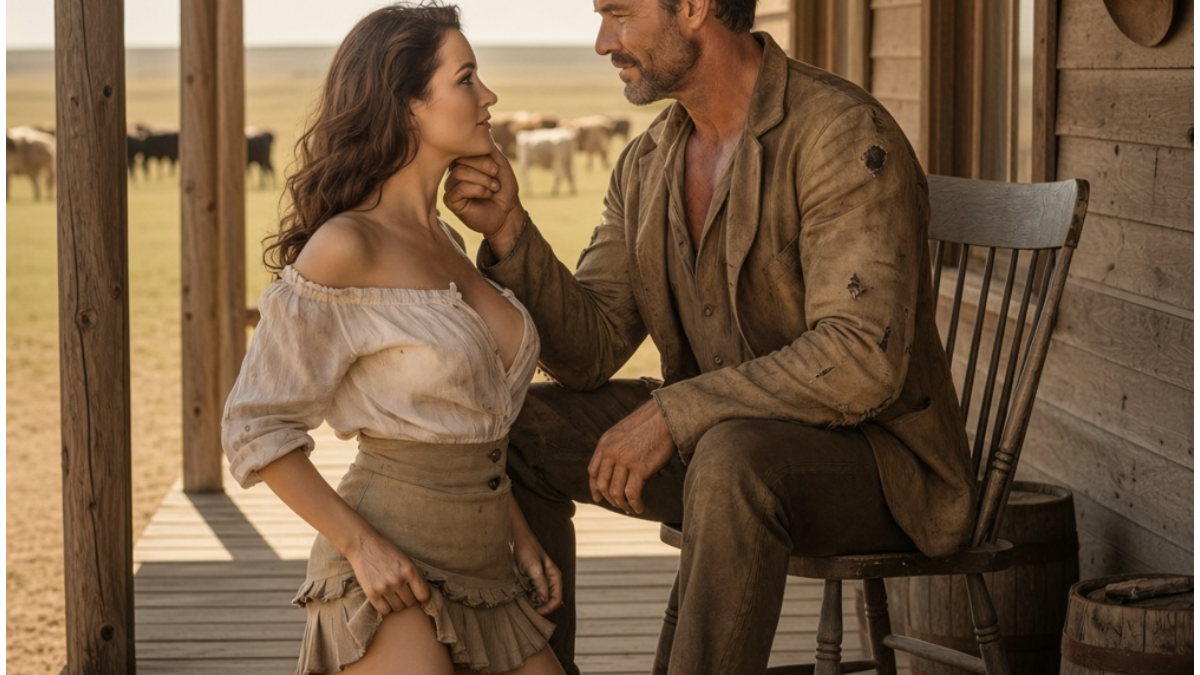
The wind in the Wyoming territory did not just blow, it scoured. It was a living, breathing malice that hunted for cracks in the siding of the train station, screaming like a banshee through the eaves.
It carried the taste of ancient dust and dried sage, grinding against the glass of the solitary window where the station master sat, watching the iron tracks vanish into the gray horizon.
It was late in the year 1887. The morning air was sharp enough to freeze breath in the lungs.
Yet the sun beat down with a deceptive, glaring brightness that offered no warmth. When the train whistle finally cut through the howling gale, it sounded thin and desperate, a mechanical cry for help in a land that swallowed sound whole.
The brakes squealed, metal shrieking against metal, and the heavy locomotive shuddered to a halt alongside the wooden platform.
Steam hissed, momentarily obscuring the view before dissipating into the dry air. Ingrid Sorenson stepped down from the passenger car.
She did not step down lightly, nor did she descend with the fluttering grace of the ladies in the fashion plates she had seen in store windows back eaSt. She had to duck her head significantly to clear the door frame, a reflexive motion born of years of hitting her forehead on lintels built for smaller people.
As her boot hit the wooden planks of the platform, the wood groaned under her solid weight.
She was a giant. There was no other word the world had ever offered her, so she used it on herself before they could.
She stood nearly 6 ft and 4 in tall, with shoulders that could span a doorway, and hands that were as broad and calloused as a blacksmith’s.
Her hair was the color of pale wheat, tucked severely under a plain bonnet that looked comically small on her head, and her dress was a patchwork of gray wool, mended so many times the original fabric was a mystery.
The silence that followed her exit was immediate. A porter loading trunks paused, a crate halfway to his shoulder, his mouth hanging slightly open.
Two women waiting for the westbound train stopped their chatter, their eyes widening as they took in the sheer verticality of the woman standing amidst the swirling duSt. Ingrid felt the stares like physical touches.
They prickled against her skin, hot and familiar. She gripped the handle of her battered carpet bag until her knuckles turned white, keeping her gaze fixed on the worn planks of the platform.
“Let them look,” she thought, though the old shame burned in her gut. “Let them count the inches.
It changes nothing.” She was 24 years old, but she felt as ancient as the hills rising in the distance.
Her mind flickered back, unbidden, to the cramped mining town in Pennsylvania she had left behind.
The memory smelled of coal dust and stale whiskey. She saw her father, a man small in stature but large in cruelty, slumped over a table in a dimly lit saloon.
She remembered the way the local men would jeer when she walked past the mine entrance to bring her father his pail.
“Look at the giant girl,” they would shout. “That is not a woman. That is an ox in a skirt.”
She remembered the neighbors whispering that no man would ever want a wife who could look him in the eye without tilting her head back, a wife whose hands were bigger than his own, and most painfully, she remembered the scratch of the pen on paper just 3 weeks ago.
Her father had not even looked at her. He had signed the paper trading her to a stranger in the Wyoming territory for enough money to clear his gambling debts at the company store.
“You are eating me out of house and home, Ingrid,” he had slurred. “At least this way you are useful.”
Useful. That was the ceiling of her ambition now. Standing on the wind-swept platform, Ingrid reached into her pocket and touched the folded letter.
The paper was soft from being read a hundred times. It was from Calder Ward.
The handwriting was jagged and firm, the words polite but utterly devoid of warmth. He had promised a respectable home.
He had promised safety. He had promised that he required a wife to manage his household.
He had said nothing of love, and she had expected none. But now, the terror seized her.
He had not seen her. The arrangement had been made through a broker who dealt in mail-order matches for the desperate.
What if Calder Ward took one look at the towering reality of her and sent her back?
What if he laughed? 50 yd away, leaning against the side of a high-wheeled buggy, Calder Ward watched the train unload.
He was a man cut from the same hard cloth as the territory itself. He stood well over 6 ft, lean and ropy with muscle earned from a lifetime in the saddle.
His coat was of good quality, heavy wool with a shearling collar, but it was dusted with the omnipresent grit of the plains.
His hat brim was pulled low, shading eyes that were the color of flint and just as hard.
He had been expecting a woman. He had been expecting someone perhaps a little plain, perhaps a little worn by life.
Why else would a woman agree to come all this way to marry a stranger?
But he had expected a woman who looked like the women he knew. When Ingrid stepped off the train, Calder felt a jolt of genuine shock that nearly broke his composure.
She was immense. It was not just her height, though she was nearly eye-to-eye with him even from this distance.
It was the solidity of her. She looked like she could lift a calf under each arm and walk a mile without winding.
He stiffened, his hand tightening on the leather reins he held loosely in his gloved fingers.
His inner thoughts churned, a mixture of defensiveness and sudden, cold disappointment. “Great God in heaven,” he thought, his jaw tightening.
“I asked for a wife, not a hand to break horses.” The town gossip had already been vicious.
They whispered that Calder Ward, the rich widower, only wanted a new wife to warm his bed or breed him heirs because he was too proud to be alone.
He had ignored them, telling himself he needed a partner to help survive this cursed drought.
He had told himself he wanted a strong woman. But looking at Ingrid, his prejudice flared.
She looked unnatural to him. He wondered, with a flash of uncharitable cruelty, if she was some kind of sideshow attraction his money had bought.
He felt a sudden, defensive anger, anger at the broker, anger at himself for his desperation, and anger at this stranger for being so undeniably, shockingly different.
He took a breath, forced his face into a mask of controlled calm, and pushed off the buggy.
He walked toward the platform, his boots thudding heavily in the dirt. He was a man used to commanding men and cattle.
He would not let a woman see him rattled. Ingrid saw him coming. He moved with a predator’s grace, long strides eating up the distance.
He was handsome in a severe, sharp-edged way, and the fine cut of his clothes marked him as the wealthy rancher the letter had promised.
As he stepped onto the platform, the sheer size of him made the space feel even smaller.
For the first time in her life, Ingrid did not feel like a monster looming over a victim.
She felt merely large in the presence of someone else who was large. He stopped 3 ft from her.
He touched the brim of his hat, a gesture that was polite but mechanical. “Miss Sorenson,” he said.
His voice was a deep rumble, like thunder trapped in a canyon. “Mr. Ward,” Ingrid replied.
Her voice shook, and she hated it. She instinctively hunched her shoulders, bending her neck to lower her head, trying to fold herself into a smaller shape.
It was a habit she had practiced since she was 12. “I am I am here.”
Calder looked at her, taking in the patched dress, the anxiety in her large, pale eyes, and the way she was trying to shrink.
He saw the shame radiating off her, and it made him pause. “I can see that,” he said.
The silence stretched, filled only by the wind whistling through the station eaves. “I apologize,” Ingrid blurted out, her face heating.
“I am I am bigger than you thought. I am sure of it.” Calder looked at the way her hands were twisting the fabric of her skirt.
He heard the apology in her voice for her very existence. He had intended to be cold, to maintain a businesslike distance, but the raw vulnerability in her tone struck something in him.
He remembered the empty house waiting for him, the work that never ended, the cattle dying of thirSt. “I do not need a delicate woman, Miss Sorenson,” Calder said.
The words came out sharper than he intended, a clumsy attempt at reassurance that sounded more like a command.
“This is a hard country. It kills delicate things. I need someone strong on the ranch.”
It was not a compliment, exactly. It was a statement of utility. But to Ingrid, who had been called a beast of burden and a freak, the acknowledgement that her strength might have a purpose was a balm she had not expected.
“I am strong,” she whispered. “Good,” Calder said. He reached for her carpet bag. “The buggy is this way.”
The ride from the station was an exercise in endurance. The buggy was well sprung, a sign of Calder’s wealth, but the road was nothing more than two ruts carved into the hard-packed earth.
Ingrid sat beside him, careful to keep her elbows tucked in so she would not brush against his coat.
The landscape unfolding around them was terrifyingly vaSt. There were no trees, save for the occasional skeletal cottonwood clinging to life along the banks of a miserable, thin creek.
The hills rolled on forever, brown and yellow and gray, baking under the pale sky.
To the west, jagged mountains rose up, their peaks capped in white snow that looked a thousand miles away.
Dust kicked up by the horses’ hooves swirled around the buggy, stinging Ingrid’s eyes and coating her tongue with grit.
She realized, with a sinking feeling in her stomach, that there was nowhere to hide here.
The land was open. It would either kill her, as Calder had said, or it would finally give her a place to stand up straight.
“We have to pass through Ward’s Crossing to get to the ranch,” Calder said after a long silence.
He did not look at her, keeping his eyes on the horses’ ears. “It is not much of a town.”
He was right. Ward’s Crossing was a collection of weathered wooden buildings huddled together against the wind, looking as if they might blow away at any moment.
But as they rolled down the main street, the town felt intensely alive with judgment.
People paused in their work as the fine buggy passed. A shopkeeper sweeping his stoop stopped, his broom suspended in midair.
Two women in bonnets carrying baskets turned their heads, their whispers clearly visible even if the words were lost to the wind.
Ingrid stared straight ahead, her chin trembling slightly. She saw a group of young cowboys lounging on the porch of the saloon.
They were dusty, rough-looking men with cigarettes dangling from their lips. As the buggy passed them, one of the cowboys nudged his friend.
“Look at the size of her,” the man said, not bothering to lower his voice.
“That is not a bride. That is a draft horse in a bonnet. Reckon Ward needs a ladder to kiss her,” another joked, followed by a crude, low laugh.
“Or maybe he just needs her to pull the plow.” Calder heard it. His jaw tightened until a muscle jumped in his cheek.
He snapped the reins, urging the horses a little faster, his knuckles white under the leather gloves.
He did not look at Ingrid, but he felt a wave of hot irritation. He told himself it was anger at the disrespect shown to him.
Calder Ward was a man of consequence here. But beneath that, he felt a strange, prickly defense of the woman beside him.
“Ignore them,” Calder said, his voice hard. “They are fools with nothing better to do than flap their jaws.
I am used to it,” Ingrid said quietly. And that was the saddest thing she could have said.
Calder pulled the buggy up in front of the general store. “I need to pick up supplies before we head out.
Wire and flour. You can wait here.” “I I would like to stretch my legs,” Ingrid said, terrified of being left alone in the buggy as a spectacle for the cowboys.
“Suit yourself,” Calder grunted. He helped her down, though she barely needed the assistance.
As they walked into the store, the bell above the door chimed cheerfully, a stark contrast to the sudden silence that fell over the room.
The interior smelled of coffee beans, leather, and sawduSt. Three women were standing by the fabric bolts in the back, and two older men were playing checkers near the stove.
Every pair of eyes fixed on Ingrid. She felt the familiar burning sensation on her neck.
She tried to make herself invisible, stepping behind Calder’s tall frame, hunching her shoulders forward.
“Afternoon, Mr. Ward,” the storekeeper said, his eyes darting to Ingrid and then back to Calder with a smirk he tried to hide.
“This the new lady?” “This is Miss Sorenson,” Calder said, his voice challenging anyone to correct him.
“My betrothed.” From the back of the store, one of the women, a sharp-faced dressmaker with a mouth like a prune, whispered loudly to her companion.
“Well, I hope she brought her own sheets. I do not have enough muslin in the whole store to cover a bed that size.”
“Desperate,” the other woman muttered. “He must be desperate. It is a circus trick. That is what it is.”
Ingrid stood frozen. She pretended to be examining a jar of peppermint sticks on the counter, but her reflection in the glass showed a face drained of blood.
Every word cut like a knife. Circus trick, monster, desperate. Calder turned to look at her.
He saw the way she was standing, curled in on herself, hiding behind his shadow, her giant frame trembling with the effort of disappearing.
A complicated knot of emotion twisted in his cheSt. He felt guilt, sharp and biting.
He had brought her here. He had had his own reservations. Yes, but to see the town pecking at her like chickens at a wounded beetle made him furious.
And yet, he was also angry at her. Why did she cower? She was bigger than any of them.
Why did she let them make her small? He slammed his hand down on the counter, making the jar of peppermints jump.
“Load the flour and the wire, heavy gauge,” Calder barked at the storekeeper. “And be quick about it.
I have a ranch to run, not a social club to attend.” The storekeeper jumped, the smirk vanishing.
“Yes, sir, Mr. Ward. Right away.” Calder turned on his heel and walked out, not waiting for Ingrid.
She hurried after him, ducking her head as she passed through the door, escaping the suffocating air of the store.
The last stretch toward the ranch was brutal. The wind had kicked up a notch, turning the air into a haze of brown grit.
The sun was setting, casting long, brutal shadows across the hills. “It has been dry for 2 years,” Calder said suddenly, his voice fighting the wind.
He sounded like he was explaining a war strategy. “The creek is low. We are losing cattle to the heat and the thirSt. I have had to let three hands go.”
Ingrid looked at the dry earth passing beneath the wheels. “Is that why you sent for me?
Because you let the hands go?” Calder glanced at her. Her directness surprised him. “Partly,” he admitted.
“A ranch this size cannot run without a household, and I I cannot be everywhere at once.
I need everyone to work hard. There is no room for passengers.” Ingrid looked at his profile, the sharp nose, the set jaw.
He was a hard man in a hard land. “I can work like any man,” Ingrid said.
Her voice was steady now. “I can lift 100 lb of grain. I can swing an axe.
I do not tire easily.” Calder looked at her hands, resting on her lap. They were not the soft hands of a lady.
They were broad, strong, and capable. For the first time all day, the knot in his chest loosened slightly.
“I believe you,” he said, and he meant it. They arrived at the ranch as twilight settled over the plains.
The main house was a sprawling two-story structure made of whitewashed timber, standing stark against the darkening sky.
A large barn and several outbuildings formed a perimeter, with corrals stretching out behind them.
A man walked out from the barn as the buggy pulled up. He was older, with a beard like steel wool and a face that looked like weathered leather.
“Evening, boss,” the man said. “Jonah.” Calder nodded. “This is Miss Sorenson.” Jonah looked up at Ingrid as she climbed down.
He blinked once, taking in her height, but his expression remained impassive. He touched his hat.
“Ma’am.” Ingrid felt a rush of gratitude for his lack of mockery. “Good evening, Mr. Jonah.”
“Just Jonah, ma’am.” “Where is Seth?” Calder asked, looking around. “Here, boss.” A younger cowboy sauntered out of the shadows of the barn.
He was handsome in a slick, oily way, with a smile that did not reach his eyes.
He leaned against a post, chewing on a toothpick. His eyes raked over Ingrid, starting at her boots and traveling slowly, insolently, up to her hips, her chest, and finally, her face.
It was not a look of curiosity. It was a look of appraisal, like one might look at a prize heifer, but with a nasty, humid undercurrent.
“Well, now,” Seth drawled, “you did not say you were bringing back the whole mountain range, boss.”
Ingrid’s skin crawled. She felt dirty just being in his line of sight. “Watch your mouth, Seth,” Calder said, his voice dropping an octave.
Seth grinned, unrepentant. He looked Ingrid in the eye and winked. “Just admiring the view.
Hello there, big Inga.” Ingrid flinched at the nickname. Calder frowned, a dark look passing over his face.
He stepped between Seth and Ingrid, breaking the line of sight. He did not say anything more.
He was tired, and he needed Seth’s riding ability for the roundup tomorrow. But the silence was a warning.
“Jonah, take the horses,” Calder said. “Miss Sorenson needs to get settled.” He led her up the porch steps and into the house.
The interior was spacious, with high ceilings and sturdy furniture, but the air felt stale, as if the house had been holding its breath for a long time.
There was no clutter, no softness. It was a house where people slept and ate, not where they lived.
In the front room, dominating the space above the cold fireplace, hung a portrait. It was an oil painting, slightly faded.
It showed a petite woman with dark curls and a delicate heart-shaped face holding a toddler on her lap.
The woman looked fragile, beautiful, and utterly unlike Ingrid. Calder saw Ingrid looking at it.
He stopped, his body going rigid. “That was Sarah,” he said stiffly. “And my son, Thomas.”
Ingrid looked at the smallness of the woman in the painting. “They are beautiful.”
“They died,” Calder said, the words falling like stones. “Five years ago, a blizzard came out of nowhere.
I I was not here.” He did not elaborate. He did not say that he blamed himself every day for being away on a cattle drive, for not being there to keep the fire lit, for letting the cold seep into the house and take them.
But the grief in the room was so thick Ingrid could taste it. It was a physical weight pressing against the walls.
“I am sorry,” she whispered. Calder turned away abruptly. “Your room is at the top of the stairs, the first door on the left.
We rise at 4:00.” He left her there, standing in the shadow of his dead wife, feeling larger and clumsier than she ever had in her life.
That night, Ingrid lay awake in the spare bedroom. The bed was sturdy, thank heavens, but the sheets were cold.
Outside, the wind had not ceased. It hammered against the walls of the ranch house, rattling the windowpane in its frame.
It sounded like the land was trying to break in, to scour the house clean of life.
She could feel the emptiness of the house around her. She could feel the ghost of the small, beautiful woman downstairs, and the cold, closed-off heart of the man down the hall.
She lifted her hand in the darkness and touched the cheap brass ring on her finger, a placeholder until the wedding tomorrow.
“He does not want you,” a voice in her head whispered. “You are a giant.
You are a joke.” Ingrid closed her eyes tight against the tears that threatened to fall.
She thought of the mining town, of her father’s drunken rage, of the hopeless gray future that had awaited her there.
“No,” she whispered to the empty room. “I am here. I have a roof. I have work.”
She curled her large body into a ball, trying to preserve her warmth against the Wyoming chill.
“Survival first,” she told herself, listening to the wind howl. “Dreams are for people who can afford them.”
The dawn broke not with a gentle light, but with a gray, iron resolve. The wind had died down only slightly, leaving a silence that felt heavy and expectant.
Inside the ranch house, the air was cold enough to see one’s breath. Ingrid sat at the long wooden table in the kitchen, her hands wrapped around a tin mug of coffee that was black as tar and twice as bitter.
Across from her, Calder Ward ate with the efficiency of a machine. He did not slouch, and he did not make small talk.
“We have a great deal to do before we ride into town,” Calder said, slicing a piece of cured ham with precision.
“I expect the household to be run with order. Meals at 5:00, noon, and 6:00.
The laundry is done on Mondays. The chickens and the garden, what is left of it, are your concern.”
Ingrid nodded, keeping her eyes on her coffee. She had hoped, foolishly, for a good morning that carried some warmth.
She had hoped he might ask how she slept in the strange, empty room with the wind battering the walls, but Calder was a man of business, and she was, she reminded herself, a transaction.
“We will ride to town at 2:00,” Calder continued, finally looking up. His eyes were cool, assessing.
“The pastor has agreed to a short ceremony. We will be back before supper. Until then, there is work to be done.
I cannot afford to lose half a day, even for a wedding.” “I understand,” Ingrid said.
Her voice was steady, though her chest ached. “I will not keep you from your work, Mr. Ward.”
“Ingrid.” “Calder.” He corrected her. Though the tone was not intimate, “If you are to be my wife, you should use my name.”
He stood up, put on his hat, and walked out the door without looking back.
Ingrid sat alone in the silence, swallowing the last of the bitter coffee. She told herself not to be a fool.
She had been sold for a debt. She had a roof over her head and food on the table.
To expect kindness on top of that was greed. She rose, her chair scraping loudly against the floorboards, and went to find work.
The ranch was a hive of activity, but it was a desperate, grinding kind of activity.
The drought had turned the earth into concrete. The air smelled of dust and dry sage.
Ingrid found Jonah, the foreman, near the water trough. He was struggling to lift a heavy oak barrel filled with water onto the back of a wagon.
He was a strong man, but age had stiffened his back, and the barrel was slipping from his grip.
Without a word, Ingrid stepped forward. She did not ask for permission. She simply reached out, her large hands gripping the iron rim of the barrel.
With a grunt of exertion that came from her diaphragm, she hoisted the barrel, taking the weight that Jonah was losing.
“Together,” she said. Jonah’s eyes widened, but he nodded. “On three, one, two, three.” They heaved.
The barrel slammed onto the wagon bed with a heavy thud, water sloshing over the sides to stain the thirsty duSt. Jonah straightened up, wiping sweat from his forehead with a dirty bandana.
He looked at the barrel, then up at Ingrid. She stood a full head taller than him, breathing heavily, but not winded.
“That is 100 lb of water, ma’am,” Jonah said. “It is heavy.” Ingrid agreed, wiping her hands on her apron.
“But it is loaded.” She did not stop there. For the next 4 hours, Ingrid Sorenson worked as she had never worked before.
She hauled sacks of grain that two men usually carried between them. She held fence posts steady while the hammer rang against the wood, her grip unyielding even as the vibrations rattled her bones.
She moved with a silent, terrifying intensity. The other hands watched her. At first, there were snickers.
She saw Seth, the young cowboy with the oily smile, leaning against a rail, whispering to a companion.
They pointed at her patched dress, stretched tight across her broad shoulders, and laughed.
But as the morning wore on, the laughter died down, replaced by a stunned silence.
They had expected a woman who would faint at the sight of a blister. Instead, they saw a woman who could match them pound for pound.
The sun rose higher, turning the sky into a sheet of white-hot tin. The heat was blistering.
It radiated off the ground, baking the soles of Ingrid’s boots. Her hands, calloused as they were, began to blister and bleed from the rough wood and rusty wire.
She did not stop. She wrapped her palms in scraps of cloth torn from her petticoat and kept working.
She was desperate. She needed to prove that she was not just a mouth to feed.
She needed to prove she was not a freak, but a machine that could earn its keep.
From the shadow of the barn, Calder watched her. He saw her lift a feed sack onto her shoulder with a grimace of effort, her jaw set in a hard line.
He saw the sweat soaking the back of her dress. He saw the blood seeping through the rags on her hands.
He had expected her to retreat to the house after an hour. He had expected to find her weeping in the kitchen.
Instead, she was out here in the dirt, doing the work of two men, asking for no quarter.
Something inside Calder, a hard knot of cynicism that had lived in his chest since the blizzard took his family, softened just a fraction.
It was not affection, not yet, but it was respect. He tipped his hat brim lower and turned back to his horse, but the image of her determination stayed with him.
At 2:00, they rode into Ward’s Crossing. The town seemed even more hostile than the day before.
The news of the wedding had spread, and it seemed everyone had an opinion. As Calder helped Ingrid down from the buggy in front of the small, white-steepled church, she could feel the weight of the stares.
“I hear he bought her by the pound,” a woman whispered loudly from the boardwalk.
“Reckon he’s just looking for a broodmare to replace the one he lost,” a man muttered.
“Desperate times, desperate measures.” Ingrid kept her head high, but her insides were churning. Broodmare, freak, giant.
The words were like stones thrown at a glass window. She glanced at Calder, but his face was a mask of stone.
He offered her his arm, and she took it. His muscles were tense under the fine wool of his coat.
The church was stuffy and smelled of beeswax and judgment. The ceremony was not a celebration.
It was a formality. The pastor, a thin man with spectacles that slid down his nose, mumbled through the service as if he were reading a grocery liSt. “Do you, Calder Ward, take this woman?”
There were people in the pews, not friends, just curious onlookers who had come to see the spectacle.
When Ingrid said, “I do.” Her voice was low and resonant, filling the small space.
A titter of laughter rippled through the back row. Calder turned to her. For a moment, she saw a flicker of apology in his eyes.
Or perhaps it was just fatigue. He slid a gold band onto her finger. It was simple, thick, and sturdy.
It fit perfectly. “I pronounce you man and wife.” The pastor said, closing his Bible with a snap.
“You may kiss the bride.” It was the moment Ingrid had dreaded. She stood so tall.
Would he have to reach up? Would he resent the spectacle? Calder did not hesitate.
He stepped in close, his hand coming up to cup her jaw, his thumb brushing her cheekbone.
He tilted her head back slightly, not with force, but with guidance. He kissed her.
It was not a passionate kiss. It was dry and brief, a seal on a contract.
But his lips were warm, and for a split second, the cruelty of the town fell away.
Then he pulled back, and the cold reality rushed back in. They walked out into the blinding sunlight as a married couple, but they felt like two strangers chained together.
The reception at the ranch was a bleak affair. There was no music, no dancing.
Jonah had roasted a side of beef, and there were barrels of whiskey for the hands, a tradition Calder maintained even in lean times.
Ingrid stood on the porch, holding a plate of food she could not eat. The sun had set, painting the sky in bruised purples and reds.
The hands were gathered near the bunkhouse, drinking heavily. The laughter was getting louder, sharper.
Seth was holding court. He was drunk, his face flushed, swaying slightly as he gestured with a bottle.
“I am telling you.” Seth said, his voice carrying clearly across the yard. “It is like bedding a grizzly bear.
A man would get lost in all that acre.” The men roared with laughter. Ingrid froze, her grip on the porch railing tightening until the wood creaked.
“And imagine the mouth on her.” Seth continued, his voice dropping to a lewd, conspiratorial growl that still cut through the evening air.
“With a jaw that size, she could swallow a man whole. Probably chew him up and spit him out if he does not please her.
Maybe that is what the boss likes.” Another hand jeered. “Something big enough to handle him.”
“Handle him?” Seth spat. “She would crush him. It ain’t natural. A woman like that, she is built for hauling rocks, not pleasing a man.
Unless she puts that big mouth to work doing things a lady ain’t supposed to do.”
Ingrid felt the blood drain from her face. The vulgarity was specific, vile, and terrifying.
She knew little of the mechanics of marriage. Her mother had died young, and her father had only spoken of women as or burdens, but she understood the tone.
They were reducing her to a piece of meat, a grotesque curiosity. Suddenly, the laughter was cut short.
“That is enough.” Calder’s voice cracked like a whip. He strode out of the shadows near the barn, snatching the bottle from Seth’s hand and hurling it into the duSt. The glass shattered with a violence that made the men jump.
“You speak of my wife again with that filth in your mouth, and you will be walking to the next territory.”
Calder snarled. He was shaking with rage. “Get to the bunkhouse, all of you. Now.”
The men scrambled, sobering up instantly under the fury of their boss. Seth glared at Calder, wiping his mouth, but he turned and slunk away.
Calder stood there for a moment, his chest heaving. He turned and looked at the porch.
He saw Ingrid standing there, pale as a ghost in the moonlight. He knew she had heard.
He walked toward her, his boots heavy on the steps. “Ingrid.” He began, his voice rough.
“I will go upstairs.” She said, cutting him off. Her voice was brittle. She turned and fled into the house before he could see the tears welling in her eyes.
The bedroom was quiet, save for the crackle of a small fire Calder had ordered lit.
Ingrid stood by the window, still in her wedding dress. She was trembling. The door opened and closed softly.
Calder entered. He had taken off his coat and his gun belt. He looked tired, the lines around his eyes deep and dark.
“Ingrid.” He said again. “What Seth said, he was drunk. He is a fool.” “He said what everyone thinks.”
Ingrid whispered, not turning around. “That I am a monster? That I am unnatural?” Calder sighed, running a hand through his dark hair.
He was deeply attracted to her. He had felt it when he kissed her in the church, the surprising softness of her lips, the strength radiating from her.
But he was also drowning in guilt. He felt he had dragged her into a pit of vipers.
“You are not a monster.” Calder said. He walked closer, stopping a few feet behind her.
“You are my wife.” The word hung in the air. Wife. It carried expectations, duties.
Calder felt the heavy silence. He knew he needed to bridge the gap between them.
He wanted to comfort her, but he also wanted her. It had been years since he had touched a woman with anything other than grief.
He wanted to show her that he did not see her as a monster, but as a woman.
“Ingrid.” He said gently. “Turn around.” She turned slowly. Her eyes were wide, filled with a mixture of fear and defiance.
“I know this is difficult.” Calder said, stepping closer. He reached out and took her hands.
They were rough, bandaged where the blisters had burSt. He rubbed his thumbs over the linen strips.
“We are strangers, but we are married, and I I want this to work.” “I do not know what to do.”
Ingrid admitted, her voice shaking. “I have never no man has ever “I know.” Calder said softly.
He was trying to be reassuring, trying to explain that there could be pleasure in it.
He wanted to tell her that he found her size magnificent, that her mouth was not a curse, but something that drew him in.
He stepped closer, his voice dropping to a low, intimate rumble. “We can take our time.
There are many ways to be close, Ingrid, many ways to please each other. I want to know you.
I want to feel your skin. I want I want your lips on me.” It was a clumsy attempt at seduction.
He meant to ask for a kiss, for intimacy that might lead further. But in Ingrid’s mind, the words collided violently with Seth’s drunken jeers from the yard.
She could swallow a man whole. Puts that big mouth to work. Horror washed over her.
She snatched her hands back as if burned, stumbling back against the dresser. “You want me to put my mouth where?”
She blurted out, her voice rising to a shriek of shock and disbelief. Calder froze.
He blinked, the romantic haze shattering instantly. He looked at her horrified face, replay his own words, and then realized exactly how she had interpreted them.
He stared at her for a heartbeat, stunned, silent. Then a laugh bubbled up in his cheSt. It was a rough, helpless sound, born of pure absurdity and tension.
He clapped a hand over his mouth to suppress it, his shoulders shaking. “No.” He choked out, forcing the laughter down, seeing the genuine terror in her eyes.
“No, Ingrid. Good lord, no.” He saw she was looking for a way to escape, looking at the door like a trapped animal.
He stepped forward quickly, not aggressively, but with purpose. He grabbed her hands again, firmly this time, anchoring her to the spot so she could not flee.
“Look at me.” He commanded, his voice steady and calm. “Ingrid, look at me.” She looked up, trembling violently.
“I am not asking for that.” He said, his eyes serious now, though a ghost of a smile lingered at the corners.
“I am sorry. I spoke poorly. I only meant that I want to kiss you.
I want to hold you. I swear to you, I will never ask for anything you do not want to give.
Do you hear me?” The panic in her chest began to recede, replaced by a flushing heat of embarrassment.
“Oh.” She whispered. “Oh.” “I am not Seth.” Calder said, his voice hardening slightly at the name.
“And I am not the men in town. I am your husband, and I find you” he paused, searching for the right word.
“I find you striking and strong, and I would like to kiss you properly. May I do that?”
Ingrid looked at him. He was not mocking her. He was holding her hands like they were precious things, despite the bandages.
“Yes.” She breathed. He leaned in slowly, giving her time to pull away. He did not.
He kissed her. And this time, it was not for a crowd. It was slow and deep.
He tasted of whiskey and tobacco and honesty. Ingrid felt a strange sensation in her stomach, a tightening that was not fear.
When he pulled back, they were both breathing a little unsteadily. The heat in the room had changed.
It was no longer the heat of shame. It was the heat of two bodies close together in the dark.
“We will wait,” Calder said quietly, brushing a stray lock of hair from her forehead.
“We will sleep, and we will start fresh tomorrow.” They lay in the bed together that night, stiff and careful not to touch too much.
But as the hours passed, the tension eased. Ingrid fell asleep with her back to him, but at some point in the night, she felt his arm drape over her waist, heavy and grounding.
She did not push it away. In the days that followed, the ranch changed. It was subtle at firSt. Ingrid did not stop working, but she began to work smarter.
She noticed that the water barrels were placed too far from the troughs, wasting time and effort.
“If we move the barrels to the north fence,” she told Calder 3 days later at breakfast, pointing a long finger at his ledger, “we can fill them directly from the pump wagon without lifting them twice.”
Calder looked at the diagram she had drawn on a scrap of paper. It was simple, logical, and brilliant.
He had been doing it the hard way for 10 years because that was how his father had done it.
“You are right,” he said, looking at her with a new expression. It was not just respect for her muscle anymore.
It was respect for her mind. “Tell Jonah to make the change.” A week later, she identified a sick calf that the other hands had missed.
She saw the dullness in its coat before anyone else. She isolated it, treated it with a poultice she remembered her mother making, and saved the animal.
Calder began to seek her out. “What do you think of the south pasture?” He would ask.
“Should we rotate the herd now or wait?” Ingrid found her voice. She spoke up about the laundry, setting up a pulley system that saved hours of scrubbing.
She organized the pantry so nothing went to waste. She was creating order out of chaos, and Calder thrived on it.
The dynamic between them shifted. They were partners, and with a partnership came a simmering, unspoken attraction.
She would catch him watching her across the corral, his eyes tracking the line of her back as she pitched hay.
He would linger a moment too long when he helped her down from her horse, his hand spanning her waist, testing the solidity of her.
One evening, while she was stirring a pot of stew at the stove, Calder walked past her to get the coffee pot.
The kitchen was narrow. His chest brushed against her shoulder, and his thigh grazed her hip.
The contact was electric. Ingrid’s breath hitched. Calder stopped, standing just behind her. She could feel the heat radiating from him.
He did not move away immediately. For a second, the air crackled with the memory of the mouth conversation, the potential of what could happen if they stopped waiting.
Then he cleared his throat and stepped away. “Smells good,” he said, his voice tight.
“It is just stew,” she replied, her heart hammering against her ribs. Late one night, 2 weeks into their marriage, the weather turned.
A cold snap dropped from the mountains, and the wind began to scream with a new, icy pitch.
Sleet hammered against the roof like handfuls of gravel. They sat by the fire in the front room.
The house felt smaller, warmer. The portrait of Sarah and Thomas was in shadow, less accusatory than before.
Calder was staring into the flames, a glass of whiskey in his hand. He looked haunted.
“The sound,” he murmured, “it sounds just like that night.” Ingrid set down her mending.
“The blizzard.” Calder nodded. He had never spoken of the details, only the fact of it.
But tonight, with the sleet scratching at the windows, the dam broke. “I was arrogant,” he said quietly.
“I thought I could beat the storm. I wanted to get the herd across the pass before winter set in.
I left them here. I told Sarah I would be back in 3 days.” He took a drink, his hand trembling slightly.
“The snow came so fast, 10 feet in 2 days, I could not get back.
By the time I cut through the drifts, the fire had gone out. They were in the bed, huddled together.
They looked like they were sleeping.” His voice cracked. A tear leaked out and tracked through the dust on his cheek.
“I killed them, Ingrid. My pride killed them.” Ingrid’s heart broke for him. She saw the wound that had never healed, the guilt that drove him to work until he dropped, the control he exerted over everything because he had once lost control so completely.
She moved from her chair to the rug beside his knees. She did not care about propriety.
She reached out and covered his large, trembling hand with her own. “You did not call the snow, Calder,” she said fiercely.
“You are a man, not a god. You cannot command the wind.” He looked at her, his eyes red-rimmed.
“I should have been here.” “You are here now,” she whispered. “You are here, and you are keeping this house warm.
You are keeping us alive.” She squeezed his hand, her strength offering him an anchor.
Calder looked at her, this giant, capable, surprising woman who had walked into his grief and started sweeping up the pieces.
He set the glass down on the floor. He turned his hand and gripped hers, pulling her closer until she was kneeling between his legs.
“Ingrid,” he groaned. He leaned down and kissed her. It was not like the church kiss, and it was not like the careful kiss in the bedroom.
It was hungry. It was desperate. It was a kiss that sought to drown out the sound of the wind and the memory of the cold.
Ingrid made a sound in her throat and kissed him back, her hands coming up to grip his shoulders.
She felt the raw power in him, the need. For the first time in her life, she felt small, but not diminished.
She felt encompassed. His hands moved to her face, then down to her neck, his thumbs tracing the pulse that fluttered there.
They breathed each other’s air, forehead to forehead, hearts racing. They were on the precipice.
One more move, one more touch, and the waiting would be over. But the emotional weight of his confession was heavy in the room.
Calder pulled back, just an inch, his breathing ragged. He rested his forehead against hers.
“Not like this,” he whispered, his voice rough with restraint. “Not to forget them. When I take you, Ingrid, I want it to be because I see you, only you.”
Ingrid nodded, shaking, tears stinging her eyes. She understood. He was offering her respect, even when his body was screaming for release.
“I am here,” she said again. “I am not going anywhere.” He pulled her into his arms, burying his face in the crook of her neck.
They stayed there by the dying fire while the sleet hammered the walls, holding onto each other as if the world outside had ceased to exiSt. They were two scarred people, terrified and hopeful, waiting for the storm to pass.
The drought did not arrive like a thief in the night. It settled in like an unwanted relative who refused to leave, eating them out of house and home.
By the middle of July, the Wyoming sky was a relentless, pale expanse of blue that offered no mercy.
The sun was a hammer, striking the earth from dawn until dusk. The creek that ran through the Ward ranch, usually a reliable ribbon of silver, had shriveled to a series of muddy, stagnant puddles where flies buzzed in thick, black clouds.
The grass, which should have been knee-high and green, was brittle straw that crumbled to dust under a boot heel.
The cattle were growing thin. Their ribs pressed against their hides like the staves of a barrel, and their lowing took on a frantic, thirsty edge that kept Calder awake at night.
He began riding out before the sun crested the horizon, his face grim. He would return long after dark, covered in a layer of gray grit, his eyes red-rimmed and hollow.
He spent his days making the impossible calculations of a man under siege, deciding which pastures were dead, which cows were too weak to save, and how long the water in the main well would hold before they were drinking mud.
It was on one of these blistering afternoons that Ingrid first met Silas Roark. She was repairing a section of fence near the eastern boundary, her hands wrapped in leather gloves, wrestling a cedar post into the rocky ground.
She wore a man’s hat to shield her face, and sweat tracked clean lines through the dust on her cheeks.
A rider approached from the neighboring property. He rode a black stallion that looked too sleek and well-fed for the starving country around it.
The man himself was heavy-set, dressed in a suit of dark wool that seemed absurd for the heat, with a silver watch chain glinting across his veSt. He pulled his horse up to the fence line and watched her work for a long moment.
He did not tip his hat. “So,” the man said, his voice smooth and oily, like butter melting on a hot skillet.
“You must be the purchase.” Ingrid straightened up, wiping her forehead with her forearm. She towered over the fence post, looking the man in the eye.
“I am Mrs. Ward.” “Silas Roark,” he said, smiling in a way that showed too many teeth.
“I own the Double Bar, just east of here. I heard Calder had brought home a helper.
I did not realize he had hired a giant to build his fences. Ingrid felt the familiar prickle of shame, but she clamped her jaws shut.
My husband is busy running his ranch. Mr. Rourke, is there something you need? Rourke chuckled.
It was a dry, rattling sound. I just wanted to see for myself. The town talks, you know.
They say Calder Ward finally found a woman big enough to do his heavy lifting, though I wonder if he bought you by the pound.
He leaned forward over the pommel of his saddle, his eyes narrowing. Tell your husband that when he gets tired of fighting this dust, my offer stands.
I will buy the land. The water rights are wasted on a man who cannot hold onto his luck or his family.
Ingrid’s hands tightened into fists at her sides. This land is not for sale. Everything is for sale, Mrs. Ward, Rourke said, casting a disparaging look at her patched dress and muddy boots.
Even people. Is that not how you got here? He wheeled his horse around and cantered away, leaving Ingrid standing in the dust, trembling not with fear, but with a cold, hard rage.
The isolation of the ranch began to weigh on her, and despite her better judgment, Ingrid decided to attempt to join the society of Ward’s Crossing.
She told herself it was for Calder’s sake. A rancher’s wife should have standing in the community.
She wanted to show them that she was not a beast, but a woman who could sew and converse and pray.
On a Wednesday afternoon, she harnessed the buggy and drove into town for the weekly sewing circle at the mercantile.
The room was small and crowded with the wives of shopkeepers and local farmers. When Ingrid entered, ducking her head to clear the doorframe, the chatter cut off instantly.
The silence was absolute. Good afternoon, Ingrid said, her voice sounding too loud in the stillness.
I I brought my mending. Mrs. Gable, the banker’s wife, offered a tight, pained smile.
Mrs. Ward, we did not expect you. I’m afraid we are quite short on chairs.
I can stand, Ingrid said quickly. Or, seeing a sturdy wooden crate near the wall, she pointed.
I can sit there. She sat on the crate, her knees coming up high because of her long legs, trying to make herself small in the corner.
She pulled out one of Calder’s shirts and began to stitch. For 20 minutes, the women ignored her, talking about recipes and the price of sugar.
But slowly, the conversation shifted, the tone sharpening. It is a shame about the drought, a woman named Clara said, her eyes darting toward Ingrid.
Though some say it is a sign. Bad luck comes to those who go against nature.
Indeed, Mrs. Gable sniffed. Nature has an order. When you bring in things that do not belong, well, the land rejects it.
Ingrid focused on her needle, her heart hammering. Just stitch, she told herself. Do not speak.
I heard the most amusing thing from the saloon, a younger woman whispered, though her voice carried perfectly to the corner.
Apparently, the wedding night was quite a production. My husband heard that she was so terrified of the act that she asked The woman paused, covering her mouth to hide a giggle.
She asked if she had to swallow him whole. The room erupted in titering laughter.
No! Mrs. Gable gasped, delighted. Truly? That is what the hands say? The woman continued, her eyes fixed cruelly on Ingrid.
Can you imagine? A woman of that size confused about where things go. Or perhaps she is just a different species altogether.
A heifer does not know how to be a wife. Poor Calder, Clara sighed. He must be suffering.
Imagine being crushed every night. Ingrid’s hands were shaking so badly she pricked her finger.
A drop of bright red blood bloomed on the white shirt. The humiliation was a physical blow, stripping the skin from her face.
They knew. They had taken her innocent, terrified question, “You want me to put my mouth where?”
And twisted it into something grotesque. She stood up abruptly. The crate scraped loudly against the floor.
I must go, she said, her voice thick. Oh, leaving so soon? Mrs. Gable asked, her eyes glittering.
Do watch your head. Dear, we would not want you to bring the roof down.
Ingrid fled. She climbed into the buggy with tears blurring her vision and whipped the horses into a run, desperate to escape the sound of their laughter.
On the long ride back to the ranch, the tears dried, replaced by a hollow ache.
She looked at the desolate landscape, the dry hills rolling out to the mountains. He will see it, too, she thought, the fear taking root in her belly.
One day, Calder will look at me and see what they see. A joke, a burden, an embarrassment.
She gripped the reins until her knuckles turned white. She could not change her height.
She could not shrink her bones or make her voice sound like a bird’s, but she could work.
I will make myself indispensable, she vowed to the empty sky. I will work until he cannot run this ranch without me.
He may never love me, but I will make sure he never regrets buying me.
But the poison from the town had a source, and that source was closer to home.
Seth, the young hand with the oily smile, had grown bolder in Calder’s absence. He knew the boss was out riding the perimeter all day, and he took every opportunity to torment Ingrid.
He would accidentally brush against her in the yard, or stand in doorways so she had to squeeze past him.
Two days after the sewing circle, Ingrid was in the barn, forking hay into the stalls for the horses they kept close.
The air was dim and smelled of dry grass and manure. She heard the heavy slide of the barn door closing.
She turned to see Seth standing there, leaning back against the wood, blocking the light.
He was chewing on a piece of straw, his eyes raking over her body in that way that made her feel like she needed to scrub her skin with lye soap.
Heavy work for a lady, Seth drawled. I am capable, Seth, Ingrid said, gripping the pitchfork.
Move aside. I need to bring water. You are capable. All right, Seth said, pushing off the door and walking toward her.
Capable of a lot of things, I bet. The boys and I, we have been wondering I do not care what you wonder, Ingrid said, her voice steady, though her pulse raced.
Seth stepped into her personal space. He was a tall man, but Ingrid was taller.
That seemed to irritate him and excite him. We wonder if you are as big everywhere else, he sneered, dropping his gaze to her lap.
We wonder what sounds a giant makes when she is broken. He reached out, his hand aiming for her waiSt. Come on, big Inga.
Show me what you show the boss. I bet I can handle it better than he does.
Ingrid did not think. She reacted. She dropped the pitchfork and shoved him. It was not a gentle push.
She put the full force of her shoulders and her anger into it. Seth flew backward, his boots skidding on the straw, and he slammed hard against the wooden side of a stall.
The impact rattled the tools hanging on the wall. Do not touch me, Ingrid roared, her voice booming off the rafters.
And never speak to me that way again. Seth shook his head, dazed, but then his face twisted into a snarl.
He lunged at her, his hand going for the knife at his belt. You freakish Seth!
The shout came from the open loft door above. Calder dropped from the ladder, landing in the dust between them like a thunderbolt.
He had returned early to check a lame horse and had heard the shouting. He saw Seth’s hand on his knife.
He saw Ingrid backed against the manger, her chest heaving, her eyes wide with fury and fear.
And he heard the echo of Seth’s words. Rage, white-hot and blinding, took hold of Calder.
He did not ask questions. He stepped forward and drove his fist into Seth’s jaw.
The sound of the impact was like a gunshot. Seth crumpled, spitting blood and a tooth into the dirt.
He scrambled to get up, reaching for his knife again, but Calder kicked the weapon away and grabbed Seth by the front of his shirt, hauling him up until his toes dragged.
Get out, Calder snarled, his face inches from Seth’s. Get your gear and get off my land.
If I see you within 10 miles of this ranch again, I will put a bullet in you.
She is a Seth spat, blood running down his chin. A freak. You are the laughingstock of the territory, Ward, you and your monster.
Calder threw him backward. Seth landed in the dust, scrambling away as Calder reached for the gun on his hip.
Go, Calder roared. Seth scrambled to his feet, clutching his jaw. He backed out of the barn, his eyes burning with a hateful, poisonous light.
You will regret this, he hissed. Both of you. Then he was gone, running for the bunkhouse to grab his roll.
Calder stood in the silence of the barn, his chest heaving, his knuckles split and bleeding.
He turned slowly to Ingrid. She was standing frozen, her arms wrapped around herself, shaking.
“Ingrid,” he said, his voice dropping from a roar to a rough whisper. “Did he touch you?”
“I I pushed him,” she stammered, looking at her hands as if they were weapons.
“I pushed him hard.” “Good,” Calder said fiercely. He walked over to her, disregarding the blood on his hand.
“Good.” “I thought” she choked back a sob. “I thought men were allowed to speak that way, to me, because of what I am.”
The confession hit Calder harder than Seth’s fist could have. He looked at his wife, this strong, capable woman who could build fences and drive wagons, and saw the deep, festering wound that the world had inflicted on her spirit.
“No,” Calder said. He reached out and took her face in his hands, forcing her to look at him.
“No man has that right, not ever, and certainly not under my roof.” “I am sorry,” she whispered.
“I caused trouble.” “You did not cause this,” Calder said. “I am sorry I did not see it sooner.
I am sorry I let him stay 1 minute after you arrived.” He pulled her into his arms, holding her tightly against his cheSt. Ingrid buried her face in his coat, smelling the dust and the horse sweat and the safety of him.
He was shaking. She realized he was shaking with the aftershocks of violence, but also with the terror of what might have happened.
“You are my wife,” he whispered into her hair, “and I will kill anyone who tries to hurt you.”
That night, the dynamic in the bedroom changed. They had been sleeping in the same bed for weeks, careful and polite, leaving a barrier of cool sheet between them.
But that night, the barrier dissolved. They did not make love. The violence of the afternoon was still too fresh, the adrenaline too high, but they held each other with a new desperation.
Calder pulled her back against his chest, his arm wrapping around her waist, his hand splayed flat over her stomach.
He explored her with a reverence that made her breath hitch. His hand moved slowly, tracing the line of her hip, the curve of her ribs, the strength of her arm.
He kissed the back of her neck, his lips warm and soft. “Is this all right?”
He murmured against her skin. “Yes,” she whispered. “And this?” His hand moved up to graze the underside of her breast, a tentative, questioning touch.
Ingrid trembled. “Yes.” She realized, with a jolt of wonder, that she could say no.
He was asking. He was giving her the power to choose, and because she could say no, the yes felt powerful.
It felt like her own. Three nights later, a storm broke over the ranch. It was not a rainstorm, the drought was too stubborn for that, but a dry thunderstorm.
Lightning tore the sky apart in jagged purple forks, and the thunder shook the very foundations of the house.
The wind howled like a wounded animal. In the bedroom, the air was heavy with electricity.
They were in bed, the lamps blown out. The flashes of lightning illuminated the room in stark, freezing bursts.
They turned to each other. The tension that had been building for weeks, fueled by shared work and shared defense, finally snapped.
Calder kissed her, and this time, there was no hesitation. He tasted of desire and need.
Ingrid surprised herself by kissing him back with equal force, her hands tangling in his dark hair, pulling him closer.
She wanted him. She wanted the weight of him, the heat of him. He moved over her, his weight pressing her into the mattress.
For a moment, she panicked at the sensation of being pinned, but then she realized how good it felt to be matched, to be held by someone who did not break.
His hands were everywhere, unbuttoning her nightdress, his mouth trailing fire down her throat. “Ingrid,” he groaned, his voice thick with want.
“You are so beautiful.” She arched into his touch, a moan escaping her lips. She was on the edge of surrender, her body singing with a language she was just learning to speak.
Then, a crack of thunder exploded directly overhead. It was deafening. The house shuddered. In an instant, Ingrid was not in the ranch house.
She was back in the cramped cabin in Pennsylvania. Her father was screaming, throwing a bottle against the wall, the glass shattering.
“You useless giant cow! You are not a woman! No man will ever want you!”
She flinched violently, a cry of terror tearing from her throat. She shoved Calder hard, scrambling backward until her back hit the headboard, her knees drawn up to her cheSt. “No!”
She screamed. “Do not break it! I am sorry! Papa, I am sorry!” Calder froze.
The lightning flashed again, illuminating her face, pale, wild-eyed, lost in a memory of terror.
He did not get angry. He did not pull away in frustration. He understood instantly.
“Ingrid,” he said. His voice was not the roar he had used on Seth. It was the low, calming rumble he used for skittish horses.
“Ingrid, it is me. It is Calder.” He did not reach for her. He stayed where he was, kneeling on the mattress, his hands open and visible.
“It is just the storm,” he said softly. “You are in Wyoming. You are safe.”
Ingrid blinked, her chest heaving. The hallucination of her father faded, replaced by the face of her husband.
He looked concerned, tender, and achingly familiar. “I” she choked, shame washing over her. “The noise.
It sounded like him when he was drunk, when he would throw things.” She hid her face in her hands.
“I am sorry. I am broken. You should send me back.” “Ingrid, look at me.”
She shook her head. Calder moved slowly. He reached out and gently pulled her hands away from her face.
“You are not broken,” he said firmly. “You are the strongest person I know.
You hold this ranch together. You hold me together.” He leaned in, looking fiercely into her eyes.
“Your father was a small, weak man. He tried to make you feel small so he could feel big, but you are magnificent.
Ingrid, your height, your strength, they are not curses. They are exactly what I want, exactly what I need.”
Ingrid stared at him, tears leaking from her eyes. “You you do not wish I was smaller, more like” she glanced toward the door, downstairs where the portrait hung.
“No,” Calder said. “I want you, all of you.” It was the moment the wall finally crumbled.
The shame that had defined her life, the belief that she was too much, too big, too wrong, cracked under the weight of his conviction.
“Come here,” she whispered. He moved to her, but he did not resume his advances.
He simply held her, wrapping his arms around her, rocking her gently while the thunder rolled away into the distance.
“We will wait,” Calder murmured into her hair. “We will wait until the storm is gone, until you feel no fear, only want.”
“I want you,” she said. “I know,” he replied. “But tonight, let me just hold you.
Let me prove to you that you are safe.” They fell asleep like that, tangled together, limbs heavy with exhaustion and unfulfilled desire, but their hearts were lighter than they had ever been.
The waiting was no longer a denial. It was a promise, a sacred thing. But while they built a fortress of trust inside the house, the war outside was escalating.
Two days later, Jonah rode into the yard at a full gallop, his horse lathered and blowing hard.
“Boss!” He shouted. “The creek, it is dry.” Calder ran out to the porch, Ingrid close on his heels.
“What do you mean, dry?” Calder demanded. “It was low, but it was running yesterday.”
“Someone dammed it upstream,” Jonah spat, wiping dust from his face. “Up on the Double Bar land, Roark put in a diversion.
He is channeling every drop into his own reservoir. Our cattle have nothing.” Calder went white.
“That is illegal. We have downstream rights.” “I told the sheriff that when I rode past town,” Jonah said grimly.
“He said Roark showed him a paper, said it was an emergency conservation measure approved by the judge.”
“That son of a bitch!” Calder swore. “He is trying to choke us out.” Calder rode into town immediately, with Ingrid insisting on coming with him.
They found the sheriff sitting on the porch of the jail, whittling a stick. He refused to look Calder in the eye.
“It is a civil matter, Ward,” the sheriff mumbled. “Roark says he needs the water for his prize stock.
Judge agrees. Nothing I can do.” “My cattle will be dead in 3 days without that water!”
Calder shouted, slamming his hand against the poSt. “This is murder of a herd!” “Take it up with the court.”
The sheriff shrugged. “Next circuit judge comes through in September.” “By September, we will be dust,” Ingrid said, her voice cold and hard.
They rode back to the ranch in a heavy silence. The reality was crashing down on them.
Without the creek, the lower pastures were deathtraps. They would lose 200 head of cattle, the bulk of their herd.
It would bankrupt them. Silas Roark would buy the land for pennies on the dollar.
That evening, the mood in the kitchen was funereal. Calder sat at the table, his head in his hands, looking at a map of the territory.
“We have to sell them,” he said, his voice hollow. “We have to drive them to the railhead now, thin as they are.
We will get almost nothing, but it is better than watching them die of thirSt.” Ingrid was standing by the window, looking out at the purple mountains in the distance.
She traced the jagged line of the peaks against the darkening sky. “No,” she said.
Calder looked up. “Ingrid, be reasonable. There is no water.” “There is water,” she said, turning to point out the window.
“There.” Calder frowned. “The high country?” “Ingrid, that is government land. It is steep, it is rocky, and it is 20 miles of broken terrain to get there.”
“But there is snowmelt,” she insisted, walking to the table and putting her large finger on the map, tapping the white space of the peaks.
“I saw the white caps from the train. The snow is melting. There will be pools in the high basins, grass, too.”
“It is too dangerous,” Calder said, shaking his head. “The drive alone could kill half the herd.
The trails are narrow, and if a storm hits up there, “If we stay here, they all die,” Ingrid said.
Her voice was calm, authoritative. She leaned over the table, her shadow covering the map.
“Roark expects you to fold. He expects you to sell or starve. He does not expect you to go up.”
Calder looked at the map, then up at his wife. He saw the fire in her eyes, the set of her jaw.
She was not asking him to save her. She was offering him a weapon. “It would take everyone,” Calder said slowly, his mind beginning to race.
“Every hand we have left, and you, you cannot go. It is too rough.” “I’m going,” Ingrid said.
It was not a requeSt. “You need every hand. I can ride, I can drive a wagon, I can shoot if I have to.”
Calder looked at her for a long moment. He thought of the sewing circle, of Seth, of Roark’s smug face.
He thought of the way she had lifted that barrel on her first day. He stood up.
He reached across the table and took her hand. “Pack your bedroll, Mrs. Ward,” he said, a grim smile touching his lips.
“We leave at first light.” The ascent into the high country was a war against gravity.
The trail that led to the upper basin was little more than a goat path, carved into the granite spine of the mountain range by centuries of wind and water.
It was narrow, treacherous, and unforgiving. They had been on the move for 4 days.
The herd, thinned by the drought and weakened by hunger, moved sluggishly. Their hooves clicked against the shale, a dry, rhythmic sound that echoed in the thin air.
The dust here was different than the valley floor. It was sharp and metallic, tasting of ancient stone.
Calder rode at the front, picking the line. He looked back constantly, his eyes scanning the steep drop-offs and the struggling cattle.
He had brought only four men, Jonah, who rode drag, a quiet man named Elias, a young, eager hand named Billy, who was barely 17, and Ingrid.
Ingrid rode near the center, her long legs straddling a sturdy bay gelding that looked small beneath her.
She was covered in the gray dust of the trail, her face wrapped in a bandana, her hat pulled low.
She did not complain. When a wagon wheel wedged itself between two boulders on the second day, she had dismounted and, with a grunt that echoed off the canyon walls, lifted the axle free while two men whipped the mules.
The men had stared, but they had not laughed. They were too tired, and her strength was the only thing keeping them moving.
The air grew thinner with every mile. The cottonwoods of the creek bottom gave way to twisted juniper and scrub pine.
The heat of the valley was replaced by a biting chill that lived in the shadows of the cliffs.
On the afternoon of the fifth day, the sky turned a bruised, ugly purple. It happened fast, as weather always did in the high plains.
One moment, the sun was shining weakly through the haze. The next, the temperature plummeted 20°, and the wind began to scream.
It was a high, keening wail that spooked the cattle instantly. “Tighten the line,” Calder shouted, his voice barely audible over the gale.
“Keep them against the wall.” Hail began to fall. It was not the soft snow of winter, but hard, frozen pellets of ice the size of marbles.
They hammered against the cattle’s hides and the riders’ hats. The herd panicked. A red steer near the front bellowed and tried to turn back, slamming into the cow behind it.
The panic rippled through the line like a wave. The path here was dangerously narrow, a shelf of rock perhaps 10 ft wide, with a sheer wall on one side and a drop of 300 ft on the other.
“Hold them,” Jonah roared from the back. Lightning cracked, not in the sky, but seemingly right beside them, striking a pine tree on the ridge above.
The explosion of sound sent the herd into a frenzy. They began to surge forward blindly, a mass of terrified muscle and horn pushing toward the bottleneck where the trail narrowed further.
Billy, the young hand, was riding on the outside edge, trying to turn the lead steer back toward the cliff wall.
His horse, a skittish mare, reared as a hailstone struck her ear. Billy lost his stirrup.
The mare twisted, her hind legs slipping over the edge of the precipice. She screamed, a horrible, human sound, and scrambled for purchase.
Billy was thrown from the saddle. He hit the rocky trail hard, rolling directly into the path of the stampeding steer.
“Billy!” Calder screamed, spurring his horse, but he was too far ahead, blocked by the surging mass of beef.
Ingrid was closer. She saw the boy fall. She saw the red steer’s head go down, its horns dropping as it charged the space where Billy lay curled in the mud.
She did not think. She did not weigh the risk. She launched herself from her saddle.
She hit the ground running, her boots finding traction on the slick rock. She was big, bigger than Billy, bigger than the space seemed to allow, and she used every inch of it.
She threw herself between the boy and the steer. “Ha!” She roared. It was a sound from the bottom of her chest, primal and terrifyingly loud.
She waved her arms, her coat flapping like the wings of a giant bird. The steer, confronted by this sudden, towering obstacle that roared like a predator, flinched.
It swerved, its shoulder grazing Ingrid’s chest, and slammed into the rock wall instead of the boy.
The impact shook the ground. The rest of the herd followed the leader, pressing tight against the cliff face, away from the screaming woman and the fallen boy.
Ingrid reached down and grabbed Billy by the back of his coat, with a heave that made the muscles in her back scream, she dragged him backward, hauling him into a shallow crevice in the rock wall just as a dozen more cattle thundered past, their hooves striking sparks where Billy’s head had been seconds before.
“Stay down,” she commanded, shielding his body with her own. A loose rock, dislodged by the hooves above, tumbled down the slope.
It was the size of a melon. It struck Ingrid’s left leg, just below the knee.
She gasped, a white-hot bolt of pain shooting up her thigh. Her leg buckled, but she did not let go of Billy.
She held him there, pinned against the granite, until the thunder of hooves faded and the hail turned to a cold, miserable rain.
Calder was off his horse before it had fully stopped moving. He scrambled over the slick rocks, his face pale beneath the tan.
“Ingrid!” She was sitting in the mud, her back against the cliff, breathing hard. Billy was staring at her, his eyes wide and shocked, shaking like a leaf.
“I have him.” Ingrid wheezed. “He is safe.” Calder ignored the boy. He dropped to his knees beside his wife.
His hands hovered over her, terrified to touch her and find something broken. “You foolish woman,” he choked out, but the words were thick with panic, not anger.
“You could have been crushed.” “Someone had to move him,” Ingrid said. She tried to stand, but her leg gave way, and she hissed in pain.
“Do not move,” Calder ordered. He looked at her leg. The skirt of her dress was torn, and the heavy wool stocking was already dark with blood.
The storm passed as quickly as it had arrived, leaving the air cold and crisp.
They made camp in a small depression protected by a stand of twisted pines, unable to go further that night.
The fire was small, built from damp wood that hissed and popped. The other men tended to the cattle, their voices low and respectful as they glanced toward the fire where the boss sat with his wife.
Calder had laid Ingrid out on his bedroll. He had a bucket of water warmed by the fire and a clean rag.
His face was set in a mask of concentration that barely hid the tremor in his hands.
“This will hurt.” He said quietly. “I’m fine.” Ingrid lied. Her face was gray with pain.
Calder did not argue. He reached for the hem of her skirt. For a moment, she flinched.
An old instinct of modesty and shame kicking in. Hide the giant feet. Hide the scars.
“Ingrid.” Calder said, his eyes meeting hers. “Let me.” She nodded and relaxed her grip on the fabric.
He rolled the wet, heavy wool up to her knee. He took his knife and carefully cut away the blood-soaked stocking.
The wound was an ugly gash, jagged and deep, surrounded by a purpling bruise that was already swelling.
But the bone was whole. Calder let out a breath he seemed to have been holding for an hour.
He dipped the rag in the warm water and began to clean the wound. His hands, so often used for roping and branding, were incredibly gentle.
He wiped away the mud and the blood with a reverence that made Ingrid’s throat tighten.
He touched her not as a rancher tending livestock, but as a man tending the most precious thing he owned.
“You saved his life.” Calder said, his voice low, his eyes focused on the wound.
“Billy, he would be dead. He is just a boy.” Ingrid whispered. “He has a mother in town.
You threw yourself in front of a thousand pounds of panicked beef.” Calder said. He looked up at her then.
His eyes were dark, intense, and unguarded. “When I saw you jump, I thought I had lost you.
I thought the mountain had taken you just to spite me.” “I am hard to break, Calder.”
She said, reaching out to touch his cheek. He turned his face into her palm, pressing a kiss to the calloused skin of her hand.
It was a gesture of such profound vulnerability that it stripped away the last of her defenses.
“I cannot lose you.” He murmured against her skin. “I thought I just wanted a partner, a worker, but I cannot lose you.”
Ingrid felt tears prick her eyes. It was the first time he had admitted that she was more than a necessity.
She was desired. She was essential. That night, the sky cleared, revealing a canopy of stars so bright they looked like spilled diamonds on black velvet.
The air was freezing, the kind of high-altitude cold that settles in the marrow. They shared the bedroll.
There was no other option for warmth. They lay on their sides, facing each other, wrapped in heavy blankets and coats.
The fire had died down to glowing embers. The silence of the mountains was absolute, broken only by the distant, rhythmic chewing of the cattle and the crackle of the wood.
They were alone in the world. Ingrid’s leg throbbed, a dull ache, but the warmth of Calder’s body pressed against hers was a stronger sensation.
He had one arm draped over her waist, holding her close, as if to anchor her to the earth.
“My father.” Ingrid said into the darkness. She did not know why she started speaking, only that the silence felt like a canvas waiting for the truth.
“He drank. You know that.” “I know.” Calder whispered. “One winter, when the mines were closed, he ran up a debt at the saloon that he could not pay.
A miner named Jeb, a man with no teeth and hands like claws, he offered to pay the debt.”
She paused, swallowing the old lump of bile in her throat. “In exchange for me, my father agreed.
He brought Jeb to the cabin. He told me to pack my things.” Calder’s arm tightened around her, his hand gripping her coat.
“I was 18.” She continued. “I was already this size. I fought. My father hit me with a bottle.
He knocked me down, but he was so drunk. He passed out before Jeb could take me.
I ran into the woods. I hid in a hollow log for two days until the miner left town.”
She looked at Calder in the dim starlight. “I have always been something to be sold or traded or used.”
Calder moved his hand up to cup her face. His thumb traced the line of her jaw.
“I lost Sarah because I was trying to prove I was strong.” Calder confessed, his voice rough.
“I was an orphan. Did you know that? I grew up in a mission school.
I had nothing. When I got the land, when I got the money, I thought if I controlled everything, if I was the strongest man in the valley, nothing could hurt me.”
He closed his eyes. “When they died, I realized control is a lie. I built walls to keep the grief out.
I thought if I never loved anything again, I would never have to feel that cold again.”
He opened his eyes and looked at her. “But you, you walked through the walls.
You did not even knock. You just walked in and started fixing the furniture.” Ingrid let out a wet, shaky laugh.
“I am too big for walls.” “You are just the right size.” Calder said. He kissed her.
It was soft at first, a tasting of lips, a question asked in the dark.
“Are you sure?” Ingrid answered by shifting her body, wincing slightly as her leg moved, but pulling him closer.
She wanted him. She wanted to erase the memory of the miner, the memory of the town’s laughter, the memory of her own shame.
“I’m not afraid.” She whispered against his mouth. “Not of you.” “I will be careful.”
He promised, and he was. The consummation of their marriage was not a frantic grasping, but a slow, deliberate discovery.
Calder unbuttoned her coat, his hands trembling not with cold, but with reverence. He touched her skin as if she were made of silk, not the rough-hewn granite she felt like inside.
When he saw her hesitation, the memory of the mouth comment flickering in her eyes, he paused.
He kissed her eyelids, her nose, her jaw. “No expectations.” He whispered, a gentle smile in his voice that healed the old wound of that misunderstanding.
“Just us. Whatever you want. Whatever feels good.” And it did feel good. It felt like coming in from the storm.
When they finally joined together, there was no pain, only a sense of profound rightness.
She felt the weight of him, solid and heavy, and she rose to meet it.
She was not crushed. She was the foundation that held him up. “You are enough.”
He whispered into her ears as the rhythm of their bodies found a shared cadence.
“You are everything.” Ingrid wept, silent tears of relief and joy soaking into the wool of the blanket.
She was safe. She was desired. She was home. The next morning, the sun rose over the peaks in a blaze of gold.
The air was crisp and smelled of pine resin. Ingrid woke to the smell of coffee.
Calder was crouched by the fire, nursing the flames. When he saw her stir, he smiled, a genuine, easy smile that took 10 years off his face.
“How is the leg?” He asked. “It hurts.” She admitted, sitting up and rubbing her eyes.
“But I can ride.” “You will ride in the wagon.” Calder said firmly, but there was no command in it, only care.
“I need my best hand rested for the arrival.” They looked at each other, and the air between them shimmered with the memory of the night.
There was no awkwardness. The shame was gone, burned away by the fire and the touch.
“Best hand?” She teased, arching an eyebrow. “Does that mean I get a raise?” Calder laughed.
It was a sound the other men heard from where they were saddling the horses, and they exchanged startled glances.
The boss never laughed. “We will discuss your wages.” Calder said, walking over and helping her stand, his arm lingering around her waist longer than necessary.
“But I suspect you will be expensive.” The drive to the high pasture took two more days, but the mood had shifted.
The fear was gone. They worked as a single unit. When they finally crested the last ridge, the basin opened up before them.
It was a miracle, a bowl of lush, green grass fed by a crystal clear lake of snowmelt that reflected the sky.
The cattle smelled the water and broke into a trot, their thirst driving them into the shallows.
The men cheered, waving their hats. Ingrid sat on the wagon seat, smiling as she watched the herd drink.
They were saved. They stayed for 3 weeks, letting the cattle fatten up on the rich grass.
It was a time of peace. Ingrid and Calder spent their evenings by the fire, talking about the future, about the house, about names for the children they might one day have.
They were happy, but the world below had not stopped turning. The descent was easier.
The cattle stronger and heavier. But as they neared the valley floor, the air changed.
It no longer smelled of pine and sage. It smelled of ash. Calder smelled it firSt. He pulled his horse up, his nose twitching.
“Smoke.” He said. They pushed hard for the last 10 miles. As they came over the rise that overlooked the ranch, their hearts stopped.
The land around Ward’s Crossing was black. A fire had swept through the valley. The lower pastures were a charred wasteland of soot and skeletal brush.
They galloped toward the ranch house. The main house was still standing. Thank God for the wide clearing around it.
But the large hay barn was gone, reduced to a pile of smoldering timbers. The corrals were scorched.
Jonah met them in the yard. His face was blackened with soot, his eyebrows singed off.
“We saved the house.” Jonah croaked, coughing. “But we lost the hay barn and the winter feed.”
Calder swung down from his horse, his face twisting with a dark fury. “How? The lightning?”
“No lightning,” Jonah said, spitting black saliva. “It started at night, three separate fires along the fence line.”
Ingrid climbed down from the wagon, favoring her bad leg. She walked to Calder’s side, her hand finding his arm.
“Arson,” she said, the word heavy and cold. “We saw tracks,” Jonah confirmed. “Shot horses, headed toward the Double Bar.”
Later that day, Billy, the boy Ingrid had saved, rode in from town. He looked shaken.
“I heard talk,” Billy said, standing on the porch, twisting his hat in his hands.
“At the saloon, before the fire started, Seth he was drinking with some of Rourke’s men.
He was bragging, said he was going to light a candle for the happy couple.”
Calder’s hand went to his gun belt. His knuckles were white. “Seth, the sheriff?” Ingrid asked.
Billy shook his head. “I told him, boss, I told Sheriff Miller what I heard.
He laughed, said it was just drunk talk, said unless I saw Seth strike the match, there was no proof.
He is eating dinner at Rourke’s table every Sunday.” The injustice of it burned hotter than the fire.
They had saved the herd only to come home to a ranch that had been hamstrung.
The winter feed was gone. They would have to buy hay at inflated prices, prices Silas Rourke would likely control.
Ingrid felt a cold dread settle in her stomach. This was not just business. This was hate.
In town, the rumors were already swirling. Ingrid and Calder rode in the next day to assess the damage to the supply lines.
As they walked down the boardwalk, the atmosphere was poisonous. “Cursed,” a woman whispered as they passed.
“That ranch is cursed. First the blizzard, now the fire.” “It is the giant,” another muttered.
“She brought it. It is an omen. A woman that size, nature is trying to purge the land.”
“I heard she communes with the devil,” a man said, spitting tobacco juice near Ingrid’s boot.
“That is why the fire didn’t touch the house. The devil protects his own.” Ingrid kept her head up, though the words stung like hail.
Calder walked beside her, his hand resting conspicuously on the butt of his revolver, his eyes daring anyone to speak louder.
But not everyone looked away. Mrs. Higgins, the widow whose fence Ingrid had repaired weeks ago, was sweeping her stoop.
When she saw Ingrid, she stopped. She looked at the charred hills, then at the tall woman walking with a limp.
“Mrs. Ward,” “Mrs. Higgins called out. The gossipers fell silent. “I have some salve for that leg,” the widow said, her voice clear and kind.
“And a jar of peaches. You come by before you leave.” Ingrid blinked, surprised. “Thank you, Mrs. Higgins.”
And then Billy, who was loading supplies at the general store, saw them. He dropped a sack of flour and walked into the middle of the street.
“You folks shut your mouths,” Billy said to the group of men on the corner.
He was young, but his voice was steady. “Mrs. Ward saved my life. She pulled me out from under a steer while you lot were sitting here drinking whiskey.
She is twice the man any of you are.” The men grumbled, but they looked away, shamed by the boy’s conviction.
Calder looked at Billy, a fierce pride in his eyes. He looked at Ingrid. “It is starting,” Calder said quietly.
“The cracks in the wall. Let us hope the wall falls before the roof does,” Ingrid replied, looking toward the Double Bar Ranch in the distance.
“Because Silas Rourke is not done.” She squeezed Calder’s hand. She was battered. She was limping.
And she was surrounded by enemies. But she was no longer afraid. She was a wife, a partner, and a survivor.
And she was ready for war. The envelope that arrived 3 days after the fire was not stained with soot, nor did it smell of smoke.
It was clean, crisp, heavy cream paper, delivered by a clerk from town who refused to make eye contact as he handed it to Calder.
Calder stood on the porch, the charred skeleton of his hay barn smoldering in the distance behind him, and broke the wax seal.
He read the document once, his face turning to granite. Then he read it again.
“What is it?” Ingrid asked. She was leaning against the porch railing, favoring her injured leg.
The bruise from the rock slide had turned a deep, ugly purple, but she refused to sit idle.
“A notice of seizure,” Calder said, his voice terrifyingly calm. “For unpaid water dues and a petition to review the competency of the land management.”
“Unpaid dues?” Ingrid frowned, stepping closer to look at the dense, looping script. “But we paid the county assessment in the spring.
I saw the ledger.” “This is not from the county,” Calder said, crumbling the paper in his fiSt. “This is a private claim filed by the Double Bar.
Silas Rourke claims that because the creek originates on his land, we owe him retroactive usage fees for the last 5 years.
He has petitioned Judge Holloway to seize the deed to the lower pasture as collateral until the debt is paid.”
“That is theft,” Ingrid said, her voice rising. “He dammed the creek, starved the cattle, set fire to the grass, and now he wants to charge us for water he stole?”
“It is legal theft,” Calder replied, turning his back to her and looking out at the ruined land.
Holloway’s a circuit judge who likes fine whiskey and easy verdicts. Rourke has been feeding him both for a decade.
Calder walked to the edge of the porch steps. The old, cold distance had returned to his eyes, the look he wore when she first arrived, the look of a man who believed he was alone in a hostile world.
“I will go to town in the morning,” Calder said, his voice flat. “I will speak to the lawyer.
You stay here, keep the house locked. If Seth or any of Rourke’s men come near the gate, you shoot into the air.”
“I am coming with you,” Ingrid said. “No,” Calder snapped. He did not turn around.
“This is ugly business, Ingrid. Rourke will use everything he has. He will use you.
He will drag your name through the mud to prove I am unfit. I will not have you sitting there while they stare at you.”
“They stare at me anyway,” Ingrid argued, limping forward and grabbing his arm to force him to look at her.
“Let them stare. This is my ranch, too. Calder, you put my name on the Bible in the church.
You put your ring on my hand. Do not try to hide me away like a shameful secret now.”
“It is not shame,” Calder exploded, shaking her hand off. “It is protection. Look at this place, Ingrid.
Look at the barn. Look at your leg. Everything I touch gets burned or broken.
I am trying to keep you out of the fire.” “I walked through the fire to get to you,” she shouted back, her height suddenly seeming to fill the porch, casting a shadow over him.
“I dragged a man out from under a stampede. Do not treat me like a porcelain doll just because you are scared.
I am not Sarah. I will not break because the wind blows.” The name of his dead wife hung in the air between them, heavy and sharp.
Calder flinched as if she had slapped him. He looked at her, at the fierce set of her jaw, the fire in her pale eyes, the sheer, undeniable strength of her.
He let out a long, ragged breath, his shoulders slumping. “You are stubborn,” he muttered.
“I am a Ward,” she countered. Calder looked at her for a long moment, then gave a sharp, reluctant nod.
“Pack a lunch. It will be a long day.” They did not fight alone. In the days leading up to the hearing, they moved quietly through the valley, gathering the scraps of support that remained.
They went to the small homesteads nestled in the rocky foothills, families who had watched Silas Rourke swallow up property after property.
They spoke to the Widow Higgins, who sat on her porch with a shotgun across her lap, watching her own drying well with hard eyes.
“He cut my access 3 weeks ago,” Mrs. Higgins told them, pouring tea with shaking hands.
“Seth said it was a mistake, a broken sluice gate, but I saw his men working on the diversion.
If he takes your land, Calder, he takes mine next. I will stand with you.”
They went to the church. Pastor Thomas was sweeping the steps when they arrived. He had been a lukewarm presence at their wedding, cowed by the town’s mockery.
But he had watched them over the months. He had seen them in the pew every Sunday, sitting close.
He had seen the way Calder looked at Ingrid, not with the desperation of a pervert, but with the reverence of a man who had found salvation.
“The truth is a heavy shield to carry,” the pastor said, leaning on his broom.
“But the Lord despises a thief. Rourke has grown fat on the suffering of his neighbors.
I will speak to his character.” And then there was Billy. The young hand Ingrid had saved was still limping, his arm in a sling, but his loyalty was ironclad.
I saw them, Billy told Calder in the bunkhouse. The night of the fire, I was riding back from seeing my girl.
I saw three men near the South Ridge. One of them was riding a roan with a white stocking, Seth’s horse.
Will you say that to a judge? Calder asked. Silas Roark could make it very hard for you to find work in this territory ever again.
Billy looked at Ingrid. He remembered the shadow of the steer, the roar of her voice, the way she had shielded his body with her own.
I reckon I work for the only people worth working for, Billy said. I will say it.
But while they gathered strength in the shadows, the enemy was parading in the light.
Seth had returned to Ward’s Crossing. He had not left the territory as ordered. Instead, he had found a new patron.
He wore new boots and drank whiskey paid for by the Double Bar. He held court in the saloon, his voice loud and slurred, spinning poison for anyone who would listen.
The man is unhinged, Seth would shout, leaning over the bar, bringing that creature into a Christian home.
You should see the way she looks at him, hungry, like a wolf. He would lean in close, lowering his voice to a conspiratorial whisper that carried to the back of the room.
And the demands, Lord have mercy, she is unnatural. A man cannot satisfy a woman like that.
It is against God’s design. That is why the land is burning. It is a judgment.
The town ate it up. It was easier to believe in a curse than to admit that their wealthiest citizen was a criminal.
On the Tuesday before the hearing, Ingrid and Calder rode into town for supplies. The atmosphere was thick with tension.
Men stopped talking when they walked paSt. Women pulled their children closer. Calder went into the lawyer’s office to file the witness liSt. Ingrid, refusing to hide, walked to the general store to buy flour and coffee.
As she stepped out of the store, a heavy sack of flour on her shoulder, she heard laughter.
It was a crude, braying sound coming from the front of the saloon. Seth was there, surrounded by three of Roark’s hands.
He was drunk, his face flushed. He saw Ingrid and a nasty light came into his eyes.
Well, look here, Seth called out. If it isn’t the blushing bride. Ingrid tightened her grip on the flour sack and kept walking.
Do not walk away, Mrs. Ward, Seth jeered. We were just talking about your appetite.
He stepped off the boardwalk, blocking her path in the dusty street. The other men fanned out behind him, smirking.
A crowd began to gather on the sidewalks. Shopkeepers, cowboys, wives, watching with baited breath.
I hear you have to be careful with that big mouth of yours, Seth said, raising his voice so the whole street could hear.
I hear you got confused on your wedding night. Did you figure it out, big Inga?
Did you figure out what a mouth is for? The crudeness of it, the twisted repetition of her most vulnerable moment of innocence, hit her like a physical blow.
The crowd murmured. Some laughed. Ingrid stopped. For months, she had shrunk. She had hunched her shoulders.
She had looked at the ground. She had tried to apologize for the space she took up in the world.
She looked at Seth. He was swaying slightly. He was cruel, and he was small.
Ingrid shifted the 50-lb sack of flour from her shoulder to her left arm, as if it weighed nothing.
She straightened her spine. She unfolded herself to her full height, 6 ft and 4 in of hard muscle and righteous anger.
She stepped toward him. Seth, expecting her to cower, blinked. He took a step back.
You, Ingrid said. Her voice was not a whisper. It was deep, resonant, and clear as a bell.
You speak of private things because you have no honor. She took another step. Seth backed up again.
You were fired because you are a lecher and a coward, she continued, her eyes boring into his.
You tried to touch me in the barn, and when I pushed you down, you ran to spread lies because your pride was bruised.
The crowd went silent. This was not the cowering giant they had heard about. This was a force of nature.
I am a wife, Ingrid said, her voice ringing off the storefronts. I work my land.
I care for my husband, and I do not answer to a drunkard who lives on the charity of a thief.
Seth’s face turned a violent shade of red. The humiliation of being backed down by a woman, by this woman, was too much.
You shut your mouth, you freak, Seth screamed. He lunged forward, his hand clawing for her arm, intending to drag her down into the duSt. Ingrid dropped the flour sack.
She braced herself to shove him again, but she didn’t have to. A blur of motion tore from the doorway of the lawyer’s office.
Calder hit Seth like a freight train. He didn’t punch him. He tackled him, driving his shoulder into Seth’s midsection and taking him to the ground with a bone-jarring thud.
The two men rolled in the duSt. Seth swung wildly, landing a glancing blow on Calder’s ear.
Calder, cold and efficient, pinned Seth’s arm with his knee and drew back his fist to finish it.
That is enough. The sheriff stepped out of the saloon, a shotgun in his hands.
He racked the slide. Get off him, Ward, the sheriff barked. Calder froze, his fist hovering inches from Seth’s bloody nose.
He looked up at the sheriff, breathing hard. He attacked my wife, Calder snarled. I saw a woman provoking a man, the sheriff lied smoothly, lowering the gun toward Calder’s cheSt. And I see you assaulting a citizen.
Get up, now. Calder slowly released Seth and stood up, raising his hands. Seth scrambled to his feet, spitting dust, grinning through split lips.
He is crazy, sheriff, Seth panted. Just like I said, dangerous. You are lucky I do not lock you up until the hearing, the sheriff said to Calder.
Take your wife and get out of my town. If I see you causing trouble again, you will not make it to court.
Calder looked at the sheriff, then at Seth, then at the silent, watching crowd. He walked over to Ingrid.
He picked up the flour sack, dusted it off, and handed it to her. Come, he said softly.
They walked to the wagon in silence, surrounded by the hostile eyes of a town that had already convicted them.
The ride home was brutal. The silence in the wagon was heavy with the realization of how deeply the deck was stacked against them.
The sheriff was bought. The town was poisoned. When they reached the ranch, the sun was setting, casting long shadows over the burned pasture.
Calder unhitched the horses with jerky, angry movements. We should sell, he said suddenly. Ingrid stopped halfway to the house.
She turned slowly. What? I can get a broker from Cheyenne, Calder said, talking fast, staring at the ground.
We sell the stock. We sell the deed for whatever Roark will give us. We take the money and we go.
Oregon, maybe, or Montana. Somewhere they do not know us. You want to run, Ingrid asked, her voice quiet.
I want you to be safe, Calder shouted, spinning around. Did you see their faces today?
Did you hear the sheriff? They want to destroy us. Ingrid, I cannot fight the law and the money and the mob all at once.
So you will give Silas Roark exactly what he wants, Ingrid demanded. You will let him win.
I will let us live, Calder slammed his hand against the side of the wagon.
I do not care about the land. It is dirt. I care about you. You care about your pride, Ingrid yelled back.
It was the first time she had ever raised her voice to him in anger.
You cannot stand that they laugh at you. You cannot stand that you made a mistake by marrying a giant.
So you want to run away to a place where no one knows you bought a freak.
Calder went still. The color drained from his face. He walked toward her, stepping into her space until they were chest to cheSt. Do not say that, he whispered.
Do not ever say that. Then why are we running? She cried, tears of frustration hot in her eyes.
Why are you trying to erase us? Because I cannot bury you, Calder roared. The sound tore out of him, raw and jagged.
I cannot put another wife in the ground. Ingrid, I cannot survive it. If staying here means fighting until they burn this house down around our ears, then I will burn with it.
But I will not watch you get hurt because I was too stubborn to leave.
He was shaking. The confession hung in the air, stripping him bare. It wasn’t shame.
It wasn’t pride. It was terror. He was a man who had watched his world freeze to death.
And now he was watching it catch fire. Ingrid looked at him. She saw the terrified boy inside the hard man.
She realized then that they were both running from the same ghoSt. She was running from the fear of being unwanted.
He was running from the fear of losing what he loved. She reached out and took his face in her hands.
Her large palms covered his cheeks. You will not bury me, she said fiercely. I am not delicate, Calder.
I am not small. I survived the mine. I survived the stampede. I will survive Silas Roark.
She leaned her forehead against his. Do not take my home from me. This is the first place I have ever belonged.
If we run, we take the fear with us. We have to stand. Calder let out a shuddering breath, his hands coming up to grip her wrists.
He closed his eyes, leaning into her strength. I am afraid, he admitted, his voice breaking.
I know, she whispered. So am I, but we are afraid together. He pulled her into his arms, burying his face in her neck.
They stood there in the dust of the yard, holding each other with a desperate, crushing intensity.
There were no more walls. There was only the two of them, standing against the dark.
That night, they did not just sleep. They clung to one another. There was no sex.
The air was too heavy for that, but there was a profound intimacy. They lay wrapped together, skin against skin.
His leg hooked over hers, her arm draped across his cheSt. Every time the wind rattled the window, Calder’s arm tightened.
Every time he flinched in a dream, she smoothed his hair. They were grounding each other, knitting their souls together so tight that no lawyer or sheriff could pry them apart.
The day of the hearing was sweltering. The courtroom was a makeshift affair in the back of the town hall.
A stifling room with peeling wallpaper and rows of wooden benches that smelled of sweat and old varnish.
Silas Roark arrived with two lawyers from the capital. They wore silk vests and carried leather briefcases.
Roark looked smug, nodding to the sheriff who stood by the door. Calder and Ingrid walked in together.
Calder wore his best black suit, brushed clean. Ingrid wore a dress of simple blue calico that the dressmaker had finally altered for her.
She walked with a limp, using a cane Calder had carved for her, but she held her head high.
When they entered, the room went quiet. The stares were there, curious, hostile, pitying, but Ingrid looked straight ahead.
She sat beside Calder at the defendant’s table. Judge Holloway was a red-faced man with a shock of white hair and eyes that looked perpetually bored.
He pounded his gavel. This is a hearing regarding the petition of Roark versus Ward, the judge droned.
Let us make this quick. It is hot. Roark’s lawyer stood up. He was a smooth talker with a voice like molasses.
He painted a picture of Calder Ward as a man in decline, a reckless rancher who had mismanaged his water, defaulted on ancient agreements, and allowed his land to fall into ruin.
The fire is proof of negligence, the lawyer argued. Mr. Ward is clearly overwhelmed. He is unfit to manage the resources that affect the entire valley.
Then, the lawyer turned his eyes to Ingrid. And let us be frank. He smirked.
Mr. Ward has been distracted. His recent marriage to a woman of unusual constitution has clearly clouded his judgment.
He has brought chaos into his home, and now that chaos is spilling onto his neighbor’s land.
Calder shot to his feet. Objection! My wife has nothing to do with water rights.
Sit down, Mr. Ward. The judge sighed, but keep your remarks relevant. Counselor. Calder gave his testimony.
He spoke of contracts honestly made. He produced receipts of payment. He spoke with controlled anger, but Roark’s lawyers twisted his words, making him sound defensive and paranoid.
Silas Roark took the stand. He lied with the ease of a man who believed his own myth.
He claimed he had only cut the water to save the creek from Calder’s wastefulness.
He claimed the fire was likely started by Calder’s own incompetence. It was going badly.
The judge looked ready to sign the seizure order just to get back to his whiskey.
Is there anyone else who wishes to speak for the defense? The judge asked, checking his watch.
Ingrid stood up. The chair scraped loudly. As she rose, she kept rising. In the small room, she seemed to take up all the air.
She towered over the lawyers. She towered over the sheriff. I will speak, she said.
Roark chuckled. Does the circus act have a legal opinion? Calder started to lunge, but Ingrid put a hand on his shoulder, restraining him.
She did not look at Roark. She looked at the judge.
I am Ingrid Ward, she said. I am the wife of this man, and I am the one who drove the cattle to the high basin.
The judge blinked, looking over his spectacles. You drove the herd? We had no water, Ingrid said simply.
Mr. Roark stole it. So we went up. The lawyers say my husband is weak.
They say he is distracted. She stepped out from behind the table. She walked to the center of the room.
Her limp was visible, but it did not make her look weak. It made her look like a veteran.
My husband is the only man in this valley with the courage to face a drought without stealing from his neighbors, she said.
Her voice was calm, devoid of the shame that had once choked her. He tended to the herd while Mr. Roark sat on his porch.
He fought the fire while Mr. Roark’s men watched it burn. This is hearsay, the lawyer objected.
It is truth, Ingrid’s voice boomed, startling the judge. I was there. I pulled a boy from under the hoofs of a steer.
I watched my husband clean the wounds of his men. You call me a distraction?
You call me a freak? She turned to face the crowd. She looked at the women who had mocked her in the sewing circle.
She looked at the men who had laughed at Seth’s jokes. I am strong, she declared.
I am big, and thank God for it, because it took every inch of my strength to save what this man tried to destroy.
If being a proper woman means sitting silently while a thief steals my home, then I am glad I am not one.
The room was dead silent. Even Roark looked unsettled. She had taken the very thing they used to mock her, her size, and worn it like armor.
I have witnesses, Ingrid said, turning back to the judge. Billy stepped forward. He was pale, but he walked to the stand.
He told the judge about the stampede. He told him about Ingrid saving his life.
And then, looking Seth straight in the eye, he told the judge about the men he saw near the ridge on the night of the fire.
It was Seth’s horse, Billy said clearly. I would know that roan anywhere. Then the widow Higgins stood up.
Silas Roark cut my water, too, she announced from the back row. Threatened to burn me out if I complained.
Calder Ward is the only decent neighbor I have left. Another small rancher stood up.
Then another. The mood in the room shifted. It was a physical thing, like the pressure changing before a storm.
The fear of Silas Roark was being replaced by the collective anger of a town that realized they had been bullied.
The judge looked at Roark, then at the wall of people standing up. He cleared his throat.
He was corrupt, but he was not suicidal. He could see which way the wind was blowing.
He banged his gavel. The petition for immediate seizure is denied, the judge ruled. The existing water rights of the Ward Ranch are upheld.
Mr. Roark, you will remove the diversion dam immediately. A cheer went up from the back of the room.
Roark’s face went purple. And regarding the fire, the judge continued, looking at Seth. The sheriff will open a formal investigation into the allegations of arson.
If these claims are substantiated, there will be hangings. It was not total victory. Roark was not in chains, but the immediate threat was broken.
Calder stood up. He looked at Ingrid. His eyes were shining with a pride so fierce it almost knocked the wind out of her.
He did not care about the land in that moment. He only cared about the woman who had just stared down the whole town for him.
Silas Roark stood up, gathering his papers. He walked past them on his way out.
He stopped in front of Calder and Ingrid. His eyes were cold, dead things. This is not over, Roark hissed.
Winter is coming. Accidents happen in the dark. Get off my land, Silas, Calder said, his voice low and dangerous, or the next accident will be yours.
Roark stormed out. Calder offered Ingrid his arm. Mrs. Ward. Ingrid took it. She felt the heavy gaze of the town on her, but it felt different now.
It wasn’t just mockery. There was fear there. Yes, but there was also respect. They had seen the giantess fight, and they had seen her win.
Let us go home, Mr. Ward, she said. They walked out into the blinding sunlight, battered, limping, but standing tall together.
The rains did not come as a gentle mercy. In the Wyoming territory, mercy was a stranger.
The drought broke in the middle of September with a violence that shook the ground, a thunderstorm that tore the sky open and dumped months of water in a matter of hours.
The dry, cracked earth, baked hard as iron by the relentless summer sun, could not drink fast enough.
The gullies turned into roaring torrents of brown foam. A section of the road leading to town washed out, crumbling into the ravine like dry cake.
The wind hammered the ranch house, testing the repairs Ingrid and Calder had made, but the house held.
Then, the violence settled into a steady, soaking rhythm. For a week, the world was gray and wet.
When the clouds finally lifted, the air smelled rich and pungent, heavy with the scent of wet sage and living soil.
The dust that had coated every surface for 2 years was washed away, replaced by a sticky, clinging mud that coated boots and wagon wheels alike.
But with the mud came the green. It started as a haze on the hillsides, then deepened into true color.
Tiny shoots of grass pushed through the scarred earth of the lower pastures. The cottonwoods along the creek, which had looked skeletal and dead, began to put out desperate, late-season leaves.
The land felt wounded. Yes, the black scars of the fire were still visible, but it was alive.
Ingrid and Calder worked side by side to repair the damage the floodwaters had done to the fencing.
It was heavy, wet work. The mud sucked at their boots with every step, making a simple walk across the yard an exercise in strength.
One afternoon, they were struggling to reset a post near the barn. The ground was slick as grease.
Calder, putting a shoulder into the wood, lost his footing. His boot slid out from under him, and he went down hard, landing flat on his back in a puddle of sludge that splashed up to his chin.
Ingrid gasped, dropping her shovel to reach for him. “Calder, are you hurt?” Calder lay there for a moment, blinking mud out of his eyes, looking at the gray sky.
He looked utterly undignified. The formidable, terrifying rancher who had stared down a courtroom was now coated in muck.
He sat up slowly, wiping a gloved hand across his face, smearing the mud further.
He looked at Ingrid, who was hovering over him, her face twisted in concern. “I believe,” Calder said, spitting a piece of grit from his tongue, “that the land is fighting back.”
Ingrid let out a short, startled sound. It was a laugh. She clapped a hand over her mouth, but it bubbled up again, a deep, resonant sound that shook her shoulders.
Calder looked at her. A grin split his muddy face, white teeth shining in the grime.
He started to laugh, too. It was a rusty sound, unused to the light, but it grew louder.
They laughed until their sides ached, sitting in the mud of their saved ranch, the tension of the last 6 months dissolving in the absurdity of the moment.
“Here,” Ingrid said, wiping tears from her eyes and offering her hand. Calder took it.
She braced her feet and pulled him up with a single, smooth motion. He stumbled slightly into her, and his arms went around her waist to steady himself, mud and all.
He held her there, pressing his forehead against hers. “We are a mess,” he murmured.
“We are standing,” she replied. Their marriage had shifted. The desperate, clawing need to survive had settled into a steady, rhythmic partnership.
They shared the chores without speaking, moving around each other in the kitchen and the barn with an intuitive grace.
They shared decisions about the winter feed and the repair of the hay barn. And at night, they shared a bed where the desire was no longer tentative.
It was deep and knowing, a language of touch that spoke of safety and belonging.
The town of Ward’s Crossing was changing, too. It was not a sudden conversion. Prejudice was a stubborn root, but the hearing had severed the worst of it.
When Ingrid walked down the boardwalk now, people did not stop and stare with open mouths.
They nodded. “Morning, Mrs. Ward,” the butcher would say as she passed. It was a small thing, but hearing her name instead of the whispers of giant or freak made Ingrid stand a little taller.
She was no longer a curiosity. She was a neighbor. One afternoon, Ingrid was in the general store buying thread.
A little girl, perhaps 5 years old, tugged on her mother’s skirt and pointed, “Mama, look, she is so high up.”
The mother, a woman who had once guarded her children from Ingrid as if she were a contagion, hesitated.
Then she sighed. “She is tall, Clara. It is rude to point.” Ingrid turned. She saw the little girl’s wide eyes, not fearful, just amazed.
Slowly, favoring her bad leg, Ingrid sank down onto one knee. Even kneeling, she was eye level with the mother, but she focused on the child.
“Hello, Clara,” Ingrid said, her voice soft. “It is nice to see everything from up high, but sometimes it is hard to see the flowers.”
The little girl stepped forward, fascinated. She reached out a tiny hand and touched the fabric of Ingrid’s sleeve.
“You are big.” “Yes,” Ingrid smiled. “I am.” “Like a tree,” the girl decided. “Yes,” Ingrid agreed.
“Like a tree.” The mother looked at Ingrid, and for the first time, there was no pity in her eyes, only a quiet acknowledgement.
“Come along, Clara. Mrs. Ward has business.” But the most surprising turn came from the dressmaker, Mrs. Finch was a pinched-faced woman who had once loudly wondered if they made wedding dresses for circus acts.
Ingrid was looking at a bolt of sturdy wool, intending to make a winter coat for Calder.
Mrs. Finch approached her, clutching a pincushion like a shield. “Mrs. Ward,” the dressmaker said stiffly.
“Mrs. Finch,” Ingrid replied, bracing herself for an insult. “I I noticed the blue dress,” Mrs. Finch said, looking at the floor.
“The seams at the shoulder, they are pulling. Whoever altered it did not account for the breadth of the back.”
“Um it serves well enough,” Ingrid said defensively. “It will tear if you lift anything heavy,” Mrs. Finch said.
She looked up, her expression awkward. “I have a pattern for a larger bodice. It allows for movement.
If you bring the dress in, I could release the seams, make it fit proper.”
Ingrid stared at her. It was an olive branch, wrapped in criticism, but an olive branch nonetheless.
Her first instinct was to refuse, to protect herself from the woman’s sharp tongue, but she looked at the dressmaker’s hands, calloused from needles, just as Ingrid’s were from rope, and saw a tentative respect.
“Thank you,” Ingrid said quietly. “I would appreciate that.” The seasons turned toward winter. The wind grew sharper, stripping the last leaves from the cottonwoods.
And with the cold came a change in Ingrid’s body. She had always been strong, tireless, but suddenly, the mornings brought a wave of nausea that sent her rushing to the washbasin.
By midday, a heaviness settled in her bones that sleep could not cure. Her appetite, usually robust, became fickle.
She knew what it was. She had seen it in the women of the mining camps.
She was pregnant. The realization brought a rush of joy so intense it nearly knocked her over, followed instantly by a crushing wave of terror.
She looked at her hands, huge, scarred, capable of breaking stone. She looked at her reflection in the darkened window, the broad shoulders, the towering height.
“You are an ox,” her father’s voice whispered from the grave. “You are a beast of burden.
You cannot carry a child. You will crush it. You are too hard.” She kept the secret for 2 weeks.
She wrapped her fear around her like a coat. She was terrified to tell Calder, not because he wouldn’t want the child, but because she knew what the loss of a child did to a man.
She knew the ghosts that walked the halls of the ranch house. If she failed, if her body was too unnatural to hold a baby, as the town had whispered, it would break him.
But secrets were hard to keep in a marriage that had grown so close.
One evening, Calder was oiling a harness by the fire. Ingrid was knitting, or trying to.
Her hands were shaking. She set the needles down. “Calder,” she said. He looked up, sensing the change in the air immediately.
“What is it? Is it the leg?” “No,” she said. She stood up. She felt she needed to be standing to say it, to be her full self.
I I have been tired lately.” Calder frowned, putting the leather down. “I have noticed.
I thought perhaps the iron in your blood was low. I can get a tonic from the doctor.”
“It is not low iron,” Ingrid said. She took a breath that shuddered in her cheSt. “I am with child.”
The silence that followed was absolute. The fire crackled, a log shifting with a shower of sparks.
Calder went completely still. He stared at her, his face draining of color. For a heartbeat, Ingrid saw the flash of old terror in his eyes, the memory of a small coffin, of a silent house, of a blizzard that took everything.
Her heart hammered against her ribs. He is afraid, she thought. He does not want this risk.
But then, Calder blinked. He took a ragged breath. He looked at her stomach, hidden beneath her apron, and then up at her face, the fear was there.
Yes, but he shoved it aside with a visible effort of will. In its place, a fragile, overwhelming wonder bloomed.
He stood up. He walked to her, moving slowly, as if approaching a holy site.
He did not speak. He dropped to his knees on the rug before her. Calder Ward, the man who knelt for no one, wrapped his arms around her waiSt. He pressed his face against her belly, his hands spanning her hips.
“Calder,” she whispered, her hands hovering over his dark hair. “Thank you,” he choked out.
His voice was thick with tears. “Ingrid, thank you.” He looked up at her, his gray eyes shining with moisture.
“You are trusting me with this.” “After everything I lost, I trust you with everything,” she said, tears spilling down her own cheeks.
“I will keep you safe,” he vowed, his voice fierce and low. “I will keep both of you safe.
I swear it.” The pregnancy changed the rhythm of the ranch. Calder became a hawk, watching her every move.
“Do not lift that,” he would say, taking a bucket from her hand. “Let Billy do it.”
“I am pregnant, Calder, not invalid,” Ingrid would proteSt. “My back is strong.” “Your back is carrying my son or daughter,” he would retort.
“Sit down.” It was a battle of wills. Ingrid feared idleness. She feared that if she stopped working, she would become useless.
And if she was useless, the old insecurities would return. But as her belly swelled, hard and round against her dress, the physical toll became undeniable.
Her back ached. Her balance shifted. She learned to accept help. She learned that sitting on the porch mending gear was still work.
She learned that carrying life was the hardest labor she had ever done. But the ghosts were not entirely gone.
As winter deepened, Calder began to wake in the night. He would sit up, gasping, his skin cold.
“The snow,” he would mutter, looking at the window. “Is it snowing?” Ingrid, heavy and warm, would reach for him.
She would pull him down against her shoulder. “It is clear.”
“Calder,” she would whisper, stroking his hair. “The stars are out. There is no storm.”
“I heard the wind,” he would say, his voice trembling. “I heard them crying.” “You heard the coyotes,” she soothed.
“We are here. I am here. The baby is warm.” She realized that for years, he had been the strong one, the protector.
Now, it was her turn. She held his grief for him so he did not have to carry it alone.
“This baby is not Thomas,” she told him one night when the fear was particularly bad.
“This is a new life. It does not replace what you loSt. It is its own story.”
Calder held onto her like a drowning man. “I know,” he whispered. “I know.” Outside the ranch, the world turned.
Silas Roark was quiet, but he was not gone. He still controlled the bank loans.
He still owned the sheriff. But his grip on the valley had loosened. Following the hearing, three small ranchers had formed a cooperative to dig new wells, sharing the cost and the water.
They did not bow to Roark when he threatened them. They looked to the Ward ranch, saw it standing, and found their own spines.
“He cannot burn us all out,” Billy told Ingrid one day, bringing news from town.
“Folks are saying Roark is getting old, losing his teeth.” Justice was not a gavel banging in a courtroom.
It was a slow erosion of fear. February came, and with it the heavy snows.
Ingrid was huge now. She felt like a ship in full sail. Her ankles were swollen, and she moved with a slow, rolling gait.
A late season storm blew in 2 weeks before her time. The sky turned white, and the wind began to howl.
Panic flared in Calder’s eyes. He began to pace the kitchen. “We need to bring the stock in close.
We need more wood.” Ingrid sat in the rocking chair by the stove. She felt the first tightenings in her back.
Not labor, not yet, but the warning shots. “Calder,” she said. Her voice was calm, cutting through his anxiety.
He stopped pacing. “We have wood,” she said. “The barn is secure. Billy and Jonah are with the herd.
We are ready.” She stood up, holding her back. She walked to the window and looked out at the swirling white.
She was a silhouette of immense strength against the storm. “It is just weather,” she said.
“It cannot touch us inside.” Calder looked at her, this giant, calm woman who filled his house and his heart.
He exhaled. The panic receded. “Just weather,” he repeated. The storm raged for 2 days, burying the ranch in drifts, but the fire stayed lit.
When the wind finally died, the world was silent and brilliant white. The sun rose on a morning so cold and clear it felt like the earth had been scrubbed clean.
Ingrid stepped out onto the porch to breathe the air. A sharp pain wrapped around her midsection, squeezing tight.
She gasped, grabbing the railing. It let go. Then, 10 minutes later, it came back harder.
“Calder,” she called out. He was there in seconds. He saw her face, the focus in her eyes.
“It is time,” she said. The next 12 hours were a blur of agony and endurance.
The midwife, Mrs. Higgins, had arrived just before the roads became impassable, driven by Billy in a sleigh.
The bedroom was hot, filled with the smell of boiling water and blood. Ingrid had faced hard labor in the mines.
She had faced stampedes. She had faced the cruelty of men. But this was a different kind of battle.
It was a war within her own body. She roared. She did not whimper. When the pain crested, she gripped the iron headboard of the bed and bent the metal with the force of her hands.
“You are doing fine, Ingrid,” Mrs. Higgins said, her voice steady. “You are built for this.
Big hips, strong heart.” Calder stood in the corner. He had promised to stay, but every scream tore a piece of his soul away.
He was terrified. He remembered the silence of the other birth, the one he missed.
He remembered the stillness. “Calder,” Ingrid gasped during a lull. He rushed to her side, grabbing her hand.
“I am here.” “Do not do not run,” she whispered, sweat plastering her hair to her forehead.
“I need you to see this. I need you to see that we live.” “I am not going anywhere,” he promised, tears running down his face.
“I am right here.” The final push took everything she had. She felt as if she were being torn apart, as if her giant body was finally breaking under the strain of being human.
“Push, Ingrid, push,” Mrs. Higgins shouted. With a final, earth-shattering cry, Ingrid bore down. And then, a sound filled the room.
A loud, angry, sputtering wail. “It is a boy,” Mrs. Higgins laughed. “And Lord have mercy, look at the size of him.”
Calder collapsed onto the side of the bed, burying his face in the mattress, sobbing with relief.
Mrs. Higgins cleaned the child and wrapped him in a worn flannel blanket. She handed the bundle to Calder.
Calder sat up. He held his son. The baby was heavy, solid, with a tuft of black hair and lungs that promised he would be heard.
He was not fragile. He was a Ward. Calder looked down at the child, then across at Ingrid.
She was pale, exhausted, her hair a wet halo around her head. She looked at him with eyes that were heavy, but shining.
“He is loud,” she whispered. “He is perfect,” Calder said. He stood up and walked to the bed.
He laid the baby in the crook of her arm. Ingrid looked down at the small, red face.
She touched the tiny fiSt. The years of shame, the voices of the miners, the town gossips, her father, crumbled into duSt. She was not a monster.
She was a mother. She had created life. Her body, her size, her strength, it was all for this.
It was all good. The room quieted. Mrs. Higgins went downstairs to make coffee. The neighbors who had waited in the kitchen went home.
Ingrid and Calder sat together in the fading light of the afternoon. The baby slept in a cradle Calder had built from oak, sturdy enough to hold a bear cub.
Outside, the sun was setting, casting a pink glow over the snow-covered fields. The land was still harsh.
The winter was far from over. Silas Roark was still out there, plotting his next move.
The cattle would still need feed. The work would never end. “What shall we name him?”
Ingrid asked softly. “Eric,” Calder said. “For your grandfather, the one you told me about, the sailor.
Eric.” She tested the name. “It is a strong name.” “He will need to be strong,” Calder said, looking out the window at the vast, indifferent landscape.
“This is a hard land.” “It is,” Ingrid agreed. She reached out and took Calder’s hand.
But he will not be alone. No, Calder said, squeezing her fingers. He will never be alone.
Three weeks later, the snow began to melt. The morning broke with a sky the color of a robin’s egg.
The air was crisp, but the bite of deep winter was gone. Ingrid stepped out onto the porch.
She wore her blue dress. The bodice let out to fit her properly and a heavy shawl.
In her arms, she held Eric, wrapped tight against the chill. She stood there, 6 ft and 4 in of woman, looking out over the valley.
She saw the smoke rising from the chimney of the bunkhouse where Billy and the new hands were waking up.
She saw the cattle moving in the lower pasture, their breath pluming in the air.
She saw the fences she had built, standing straight and true. The door opened behind her.
Calder stepped out. He did not speak. He simply walked up behind her and wrapped his arms around her waist, resting his chin on her shoulder.
His hand came up to rest warm and heavy on the baby’s back. They stood there together, a mountain of a family.
Once, this landscape had seemed determined to break her. It had thrown dust and fire and hatred at her feet.
It had tried to tell her she was too big to belong. Now, she stood tall within it.
She matched the scale of the mountains. She matched the vastness of the sky. She felt Calder’s breath against her neck, steady and warm.
She felt the weight of her son in her arMs. She felt the solid timber of the porch beneath her boots.
Ingrid Sorensen Ward took a deep breath of the cold, wild air. She was exactly where she was supposed to be, and she was loved exactly as she was.
Thank you for listening to the story of Ingrid and Calder. I hope you enjoyed this journey through the dust, the heartache, and the healing of the American WeSt. I would love to know where you are listening from.
Please leave a comment below and share your location. If you enjoyed this story, please consider subscribing to From Wild West for more tales of resilience and romance on the frontier.
I invite you to share your thoughts on the story in English in the comments section.
Your feedback helps bring these stories to life.








