William STRIPS Camilla of Coronation Duty After Catherine’s Silent Public Humiliation – AI Situation
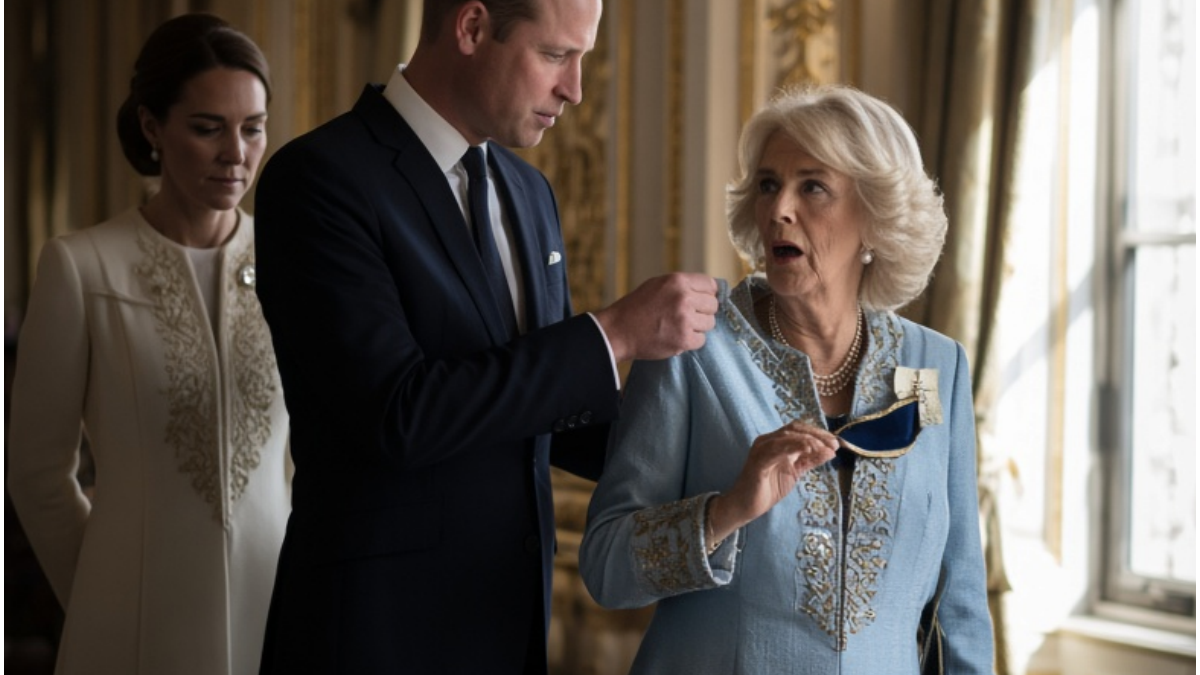
The monarchy will be shifting in a slightly different direction. I think it’s safe to say that changes.
It lasted less than a minute. Yet, everyone inside the room understood that something irreversible had happened.
Catherine stood silently while a ceremonial place prepared for her was reassigned. Her expression composed even as the humiliation unfolded before senior royals and invited guests.
William did not intervene publicly. He barely moved. But 4 minutes after leaving the reception, the prince made a decision that struck directly at Camila’s royal standing and ensured the insult would not end where it began.
Camila had ordered Catherine’s ceremonial position moved from beside William to a secondary place farther down the receiving arrangement.
The reception formed part of preparations for coronation commemorations. Events marking the anniversary of the king’s crowning.
Catherine understood what the change signaled. Standing beside the future king was not merely about proximity.
It represented continuity, rank, and the shape of the monarchy after Charles. She stepped aside anyway, refusing to turn tension into spectacle.
William watched her finish the engagement with composure, and that restraint cut deeper than outrage.
When he quietly asked whether she wanted to leave, Catherine told him the guests should never feel the strain inside the family.
The prince nodded, but something in him had already hardened. Her silence had protected the room.
He was no longer willing to let that silence protect the person who had humiliated her.
The corridor changed everything. William stopped walking so suddenly that Catherine moved several steps ahead before noticing he was gone.
He looked back toward the closed reception doors, then summoned an aid and demanded the coronation planning file.
Inside it sat the sovereigns commemorative insignia, a ceremonial object presented during the anniversary service to symbolize royal authority and continuity.
Camila had been assigned the presentation reinforcing her senior position beside Charles. William made the alteration immediately.
He removed the Queen Consort from the presentation and transferred the responsibility to Catherine, the Princess of Wales.
No angry speech followed. The future king simply changed the program and sent it forward.
Camila received the amended document while still dressed from the reception. She read Catherine’s name once, then again.
Her face tightened. William had not challenged her privately. He had answered through the structure she had tried to control.
And one danger now towered above everything else. Charles, the king would have to decide whether to protect his wife or defend the woman destined to stand beside Britain’s next monarch.
Before he could choose, however, the palace had to confront the deeper truth. This had never really been about one chair.
Behind the ceremonial language were three people carrying very different fears. Catherine feared becoming the cause of another royal fracture.
Camila feared watching decades of hard one acceptance disappear as the monarchy turned toward a younger generation.
And William feared something more personal. That silence would teach the palace it could diminish his wife without consequence.
The battle unfolding around them was therefore not simply about rank. It was about memory, marriage, survival, and who would define the crown’s next chapter.
William had watched Catherine endure years of scrutiny without turning every wound into a public crisis.
As Princess of Wales, the title given to the wife of the heir to the throne, she carried not only status but the expectation of representing the monarchy’s future with discipline.
The prince admired that restraint, but now he feared it had become something others relied upon.
Every time she remained quiet, another insult could disappear behind palace doors. Catherine understood his anger, yet she feared where it could lead.
Later that evening, she removed her earrings slowly while William stood nearby, still unable to let go of what had happened.
She told him retaliation would only make the humiliation larger. Then came the sentence that stopped him cold.
I can survive being moved. He looked at her and answered, “You shouldn’t have to keep proving that.”
For him, this was no longer about one ceremony. It was about protecting a pattern from becoming permanent.
Camila carried a different wound. Her position as queen consort, the wife of the reigning king with ceremonial status, but no independent sovereign power, represented decades spent moving from rejection toward acceptance.
She had fought to become part of the institution, and Catherine’s rising prominence felt like evidence that the palace was already looking beyond her.
Williams decision, therefore, struck her as more than punishment. She saw it as a warning that her era could be shortened before she was ready.
Charles felt the pressure almost immediately. The king received word that the amended anniversary program had already been circulated among senior planning staff, meaning Williams change was no longer a private instruction that could quietly disappear.
Reversing it would require a direct counter order, and that would expose the disagreement to everyone involved in the ceremony.
One senior aid then reminded Charles of the detail that made everything worse. Weeks earlier, he had formally delegated control of the anniversary arrangements to William.
The future king had not exceeded his authority. He had used the authority his father had already given him.
That revelation changed the question completely. William had not acted impulsively. Something earlier had convinced him that Catherine’s humiliation was part of a pattern.
To understand why he finally drew the line. The story had to return to the evening when she first realized the slight was no accident.
3 weeks earlier, the warning had already been delivered, but almost nobody recognized it. At a private Windsor dinner, Catherine arrived expecting an ordinary family evening and discovered that her ceremonial precedence had been altered on handwritten place cards before the guests entered.
She said nothing. William noticed everything. And when Camila later offered an explanation that sounded harmless to everyone else, one sentence transformed an awkward dinner into the moment the prince would eventually remember as the beginning of the end.
William spotted the change almost immediately. Catherine’s place card had been moved from directly beside him to a position beyond several of Camila’s visiting relatives, even though the seating chart had been approved that morning.
Ceremonial precedence means the formal order in which royals are placed according to rank and role.
And inside the monarchy, those details carry meaning. The prince picked up the card, studied it for several seconds, then looked across the table toward the queen.
Camila met his stare without hesitation. She told him the arrangement had been adjusted to make the evening feel less formal, as though the move were nothing more than a small social convenience.
William did not answer immediately. Catherine quietly touched his arm and asked him to leave it alone.
She wanted peace, not another scene, and she refused to let a family dinner become a public contest over who mattered more.
William respected her request, but the silence burned. Throughout the meal, he watched Catherine speak warmly with guests, smile at the right moments, and behave as though nothing had happened.
Yet, every person around the table could see exactly where she had been placed.
The prince knew that rank inside the royal household was communicated as much through positioning as through titles.
A seat could send a message without anyone saying a word. The truth arrived after dinner.
A household aid approached William privately and told him the alteration had not come from protocol staff.
The instruction had been issued directly from Camila’s office less than an hour before the guests arrived.
He asked the aid one question. Had this happened before? The answer changed everything. The aid produced two earlier program revisions involving Catherine’s entrance order and ceremonial positioning.
A program revision is simply an official change to the running order of a royal event.
But together, those documents suggested something far more deliberate. William took them to Catherine that night.
Catherine read both pages and did not become angry. She became quiet. She told him she would not compete for importance inside her own family.
That sadness convinced the prince the burden had already gone too far. William made one promise.
If another public alteration happened, he would stop treating it as coincidence and answer through the same machinery being used against her.
3 weeks later, Catherine was moved again. And this time, he did not stay silent.
The confrontation did not happen before courters, advisers, or cameras. It happened behind a closed door with no one available to soften a sentence once it had been spoken.
Camila entered expecting an explanation for the altered coronation program. William was already waiting. Neither sat down, and within minutes, a disagreement over Catherine’s humiliation became something much more dangerous.
A direct argument about authority, respect, and whether the future monarch believed the current queen had crossed a boundary.
Camila placed the revised anniversary program on the table between them and asked whether William had personally authorized her removal.
An anniversary program is the official running order that assigns roles during a royal commemorative ceremony.
So changing one name can carry far more weight than it appears. The prince looked at her without hesitation.
Yes, one word, no apology, no attempt to soften what he had done. Camila’s anger sharpened immediately.
She accused him of turning an official ceremony into punishment for a private disagreement. William answered that the disagreement had stopped being private the moment Catherine was humiliated before invited guests.
The queen insisted ceremonial arrangements changed constantly for practical reasons and told him he was assigning hostile motives where none existed.
He listened, but he did not move. William then mentioned the Windsor dinner. Camila’s expression changed.
The prince told her he knew Catherine’s place card had been moved after a direct instruction from her office and he knew about the two earlier program amendments involving his wife’s entrances and ceremonial positioning.
A program amendment is an official alteration to how a royal event will unfold.
And to William, three separate changes no longer looked accidental. They looked like a pattern.
Camila understood at once that this confrontation was bigger than she had expected. She told him he was diminishing the queen simply to elevate Catherine.
That accusation finally broke his restraint. William answered that his wife’s dignity did not require anyone else’s humiliation, but neither would he allow Catherine to be diminished so another person could prove their importance.
Camila refused to surrender the argument. She reminded him that Charles could reverse the entire decision with a single instruction.
The king remained the reigning monarch and his authority outranked every delegated responsibility William currently held.
For the first time, the prince almost smiled. William told her Charles was perfectly free to reverse it publicly if that was what he wished.
The room went quiet. Camila realized what he had done. He had not simply challenged her.
He had forced his father to choose. And once the dispute reached Charles, the question was no longer who had been offended.
It was who actually possessed the power to make William back down. Charles could have ended the crisis with one instruction.
Restore Camila’s ceremonial role. Cancel Williams amendment. Return everyone to their original positions. But when the king finally opened the program file, the solution that looked simple from outside became almost impossible inside the room.
His son’s authority was legitimate. His wife’s anger was real. Catherine had refused to complain.
And every available choice threatened to humiliate one member of the family while revealing exactly where royal power was drifting.
Charles read the amendment alone at his desk and stopped when he reached Catherine’s name beside the presentation of the commemorative insignia.
He removed his glasses and set them down without speaking. The anniversary service was meant to emphasize continuity between the current reign and the next, which was why the king had delegated substantial control to William weeks earlier.
Delegated authority simply meant Charles had formally allowed his son to make key planning decisions on his behalf.
Now that decision had become a trap of his own making. William had not rebelled.
That was the problem. The prince had acted inside the authority already given to him, which meant Charles could reverse the change only by openly taking that power back.
Doing so would not look like routine correction. It would expose a father overruling his heir in order to restore his wife’s place after Catherine had been publicly diminished.
Camila confronted her husband before the afternoon was over. She asked him to restore the duty, warning that allowing the amendment to stand would make her look weak before the entire household.
Charles understood the fear beneath her anger. Her ceremonial position had taken years to secure, and one public removal could feel like the beginning of something larger.
Still, the king could not ignore why William had acted. Charles asked her one question.
“Did you move, Catherine?” Camila paused. Then she began explaining practical arrangements, family guests, and why the seating had been changed.
The monarch listened carefully, but the hesitation had already unsettled him. He had wanted a simple denial.
He did not receive one. Catherine gave him something even harder to process. Later that evening, Charles met her privately, expecting anger or at least a request for support.
Instead, she told him she wished the entire matter had never become a battle. The princess did not ask him to punish Camila.
She did not even ask him to defend William. Her restraint left the king more troubled than accusation would have.
A private secretary then delivered the final warning. Both versions of the ceremonial program were already circulating among palace staff.
Whatever Charles decided, people would know whose instruction had prevailed. By nightfall, the king finally chose, he did not call Camila firSt. He sent a message directly to William.
And that message contained no apology, no explanation, only a decision that would change the mood inside the palace before morning.
The new program arrived without drama, no confrontation, no ceremonial announcement, just a cream folder carried into Camila’s room shortly after breakfaSt. Yet the meaning was brutal in its simplicity.
William’s amendment remained untouched. Catherine’s name stood where hers had been. Charles had declined to reverse his son’s order.
For Camila, the loss was greater than one coronation duty. It was the first unmistakable proof that the king’s protection had limits and that the future reign had already begun exerting gravity.
Camila opened the folder alone and found the decision exactly where she feared it would be.
Catherine would present the sovereigns commemorative insignia, the ceremonial object used during the anniversary service to represent royal authority and continuity.
The queen traced the revised line with one finger, closed the cover, then remained seated long after the aid had left.
She had expected William to push back. She had not expected Charles to let the change survive.
Camila’s hurt quickly turned toward her husband. She believed the symbols attached to her role mattered because they confirmed her place beside the reigning monarch after years of public resistance.
Losing one duty might seem small outside the palace, but inside it, ceremonial responsibilities told people who stood where and who carried authority.
She asked Charles why he had allowed William’s decision to remain. Charles did not hide from the question.
The king told her that restoring the duty now would send the wrong message.
Catherine had already been publicly diminished, and reversing William’s response could make it appear that the crown had chosen to defend that humiliation.
More importantly, he refused to let the monarchy become a permanent contest between two women whose positions should never have been treated as rivals.
Camila asked the question she had been holding back. Did he believe she had deliberately humiliated Catherine?
Charles paused before answering. He told her intention mattered less now than the pattern everyone around them could see.
That answer wounded her more than a direct accusation. The queen wanted reassurance. Instead, she heard doubt.
Catherine reacted very differently when William told her the program would stand. She showed no satisfaction.
The princess immediately told him she did not want Camila publicly disgraced on her behalf.
William assured her there would be no announcement, no explanation, and no attempt to turn the change into a spectacle.
The ceremony itself would carry the meaning. Yet Catherine’s discomfort stayed with him. William had acted because he believed silence had gone too far.
But now he faced another possibility. Perhaps defending his wife had created a wound she had never asked him to inflict.
That doubt led directly to the most important conversation of the crisis, one held without aids, programs, or titles between husband and wife.
William had won the institutional argument. Yet Catherine refused to let him mistake victory for resolution.
Late that evening, with the doors closed and no staff between them, she finally told him what the humiliation had actually felt like.
Not anger, not embarrassment, sadness. She hated knowing that a family already carrying decades of public wounds could once again be reduced to rival women, competing courts, and symbolic revenge.
Then she made one request that forced William to reconsider exactly what kind of future king he wanted to become.
Catherine asked him to sit beside her and leave the papers alone. She understood why he had acted, but she did not want her dignity defended by destroying somebody else’s.
The princess admitted that being moved at the reception had hurt, not because she needed a particular chair, but because she knew William had seen everything and was forcing himself to remain still.
For her, that moment had exposed something deeper than rank. It had shown how easily family tension could become public symbolism.
William finally admitted what the silence had done to him. The prince said standing there without reacting had felt like abandoning her.
Catherine answered that his restraint had protected her in public. What mattered was what he chose once they were alone.
She reminded him that strength inside the monarchy could not simply mean answering humiliation with greater humiliation.
Catherine then made her requeSt. She wanted the anniversary duty to remain reassigned because reversing it now would suggest the original insult had been acceptable, but she did not want Camila stripped of anything else.
The queen consort had already lost one ceremonial responsibility, and turning that single decision into a wider campaign would transform a boundary into revenge.
William listened carefully because he knew his wife was not defending Camila’s pride. She was defending the kind of reign they might one day lead.
William reached for the amended program resting nearby. A ceremonial program is the official schedule showing who performs each role during a royal event, and attached to it was a proposed review of Camila’s other responsibilities.
The prince drew a firm line through that proposal, closed the folder, and placed the pen down.
Catherine did not smile. She simply looked at him, and he understood. The decision had changed.
Camila would not regain the anniversary duty, but neither would she face a deliberate campaign of removal.
Catherine would no longer be publicly diminished, and William would not become the kind of man who answered every wound by creating another.
Yet, their private compromise was already slipping beyond their control. By sunrise, one changed line in that program would reach the press, and suddenly the entire country would be looking directly at what had happened behind palace doors.
The public did not need a palace statement to understand what had changed.
The final ceremonial program appeared firSt. Then came the headlines and finally one image that distilled the entire crisis into a single moment.
Catherine stood beside William during the anniversary rehearsal while Camila watched several steps away.
Nobody argued. Nobody looked toward the cameras. But across Britain, the photograph was interpreted the same way.
The future king had drawn a line and the future queen was now standing firmly inside it.
William saw the morning newspaper before breakfast and immediately understood how far the story had traveled.
Across the front page were the words, “William draws the line printed beside the rehearsal photograph showing Catherine in the ceremonial position previously assigned to Camila.”
A ceremonial position is the formal place given to a royal during an official event.
And because those placements reflect rank and responsibility, the image carried a message far beyond simple choreography.
The prince had intended to establish a boundary quietly. Instead, the entire country was reading it as a declaration.
Catherine felt the pressure even faster. A national morning broadcaster described the program change as the clearest public assertion yet of the Wales household’s future authority.
She disliked the phrase immediately. The princess worried that the story was turning her into the winner of a contest she had never wanted.
She instructed staff not to brief reporters with triumphant language and insisted that no one described Camila’s removal as punishment.
Camila noticed that restraint. For the first time since losing the duty, the queen began to understand that Catherine had not demanded humiliation in return.
She had actually stopped William from expanding the consequences. That realization did not erase the anger, but it changed its shape.
The woman she had begun to view as a rival had refused to treat the moment as victory.
Charles moved quickly to contain the damage. The king approved a short palace statement, saying only that ceremonial responsibilities had been assigned by the anniversary committee, the group coordinating the service and deciding who would perform each formal duty.
He offered no explanation and defended no individual. By saying less, the monarch allowed Williams decision to stand without turning the family dispute into an official war.
Outside Buckingham Palace, people gathered near the gates while copies of the program spread online.
Some praised the prince for defending Catherine. Others argued the conflict should never have escaped the family.
But debate no longer mattered. The ceremony was now unavoidable. Catherine would perform the duty, Camila would watch, William would stand beside his wife, and Charles would witness the result of the decision he had refused to overturn.
When the anniversary service finally began, the only question left was what each of them would do when the defining moment arrived.
There was no final explosion, no public apology, no dramatic departure. Instead, the crisis ended in the most royal way possible.
Through a gesture almost painfully controlled, Catherine stepped forward to perform the duty William had reassigned to her.
Camila remained in place and watched. Charles said nothing, and when the moment was finished, the four people at the center of the dispute understood that something far more significant than a ceremonial object had changed hands.
A boundary had become permanent. Catherine received the sovereigns commemorative insignia and carried out the presentation without hesitation.
The insignia was a ceremonial object used during the anniversary service to represent royal authority and continuity, which meant the responsibility carried meaning far beyond the brief act itself.
William watched his wife complete the duty without triumph. The anger that had driven him after the reception was gone.
In its place was certainty. He had drawn the line, and now Catherine stood where he believed she had always deserved to stand.
Camila remained composed throughout the moment. When Catherine returned to her place, the queen gave her a small, deliberate nod.
Catherine answered with the same restraint. It was not an apology, and neither woman pretended the wounds had disappeared, but the gesture made one thing clear.
The conflict would not be allowed to grow into a permanent war. Charles waited until the service ended before approaching William.
The king placed a hand on his son’s shoulder and told him that protecting the future of the crown sometimes required restraint after strength.
The prince understood exactly what his father meant. Charles had allowed the decision to stand, but William had also chosen not to turn one act of humiliation into a campaign against Camila.
Catherine rejected any suggestion that she had won. The princess had never wanted victory over another woman.
She wanted the freedom to serve without being expected to absorb deliberate humiliation, simply to preserve an artificial appearance of unity.
William kept his promise as well. No additional responsibilities were removed from Camila. The future king established a boundary, not a purge.
Camila was left with an uncomfortable truth. Her position remained respected, but it could no longer be strengthened by diminishing the whale’s household.
Charles had accepted that reality. Catherine had claimed her place without demanding revenge. William had shown how he intended to protect it.
The chair had been moved in seconds. The consequences lasted far longer because on that day the monarchy learned that Catherine’s silence was not surrender and William made certain nobody inside the palace would ever mistake it for surrender again.








