WHERE CAN I GO… WHEN NO ONE NEEDS ME —THE LITTLE GIRL’S WORDS BROUGHT THE BILLIONAIRE TO TEARS
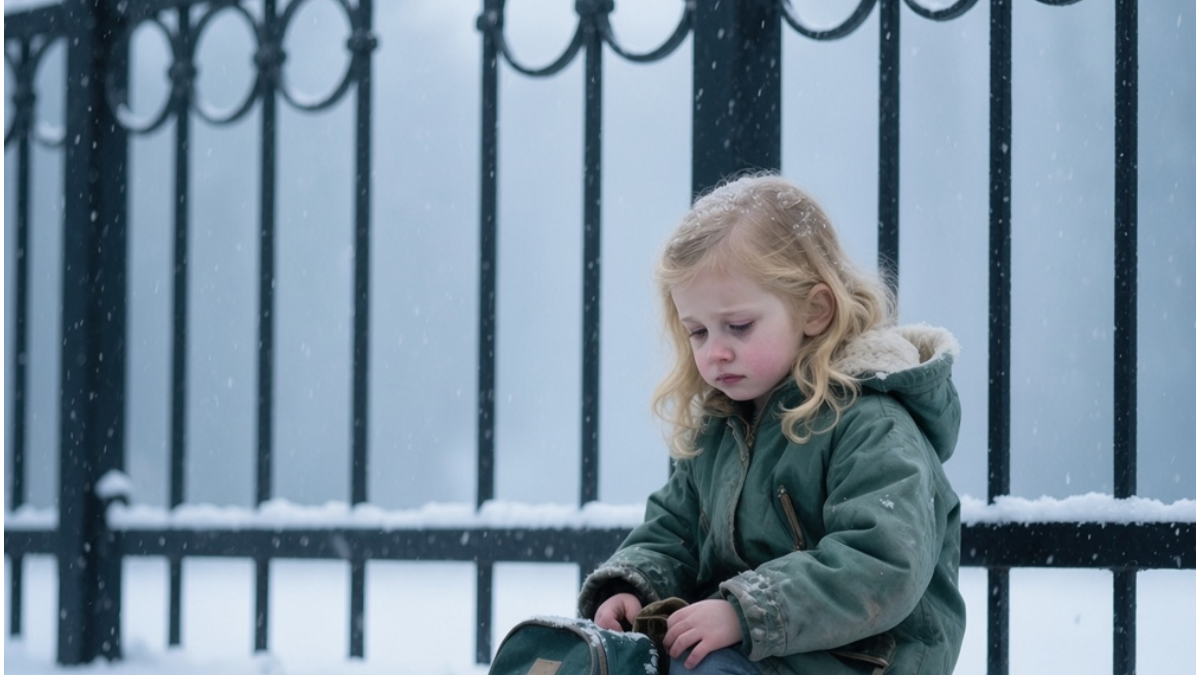
A 6-year-old girl sat on cold concrete hugging a torn blue backpack and whispered a question no child should ever ask.
“If nobody wants me, where do kids like me belong?” One man heard her. What he chose next shattered power, money, and changed two lives forever.
The automatic glass doors of Bellevue Galleria slid open and shut with a tired hiss, as if the building itself were breathing.
Cold rain drifted sideways, thin and sharp, tapping against polished stone and expensive shoes. People hurried past with shopping bags swinging from their wrists, eyes fixed forward, already thinking about dinner traffic and warmth.
Right there between the glowing entrance and a dented metal trash can, sat a 6-year-old girl on a narrow strip of concrete.
Her name was Mila Heart. She was small for her age, knees pulled tightly to her chest, arms wrapped around a faded blue backpack that looked almost too big for her body.
The straps were frayed. The zipper stuck halfway. She hugged it like a life jacket in deep water.
Her shoes were thin, the rubber peeling at the toes, damp from old rain that never quite dried.
Every time the doors opened, a wave of warm air brushed her cheeks. Every time they closed, the cold rushed back in, harder, meaner.
Mila didn’t cry. She had learned not to. Crying made adults angry. Crying made people look at you like you were a problem.
She watched the floor instead, gray concrete darkened by footprints. A security guard glanced at her frowning.
A woman stepped around her without slowing down. A man muttered under his breath, annoyed that a child was sitting where children didn’t belong.
Mila squeezed the backpack tighter. Then, in a voice so soft it almost vanished into the wind, she asked the question she had been carrying longer than anyone knew.
“If nobody wants me,” her throat tightened. “Where do kids like me belong?” The words fell onto the concrete and stayed there.
Behind her, the doors hissed again. A shadow stopped moving. Someone had heard her. The security guard approached with a practiced sigh, the kind that came from long shifts and too many small probleMs. He didn’t look angry.
He looked tired. “Hey, kid,” he said, tapping the radio clip to his shoulder. “You can’t sit here.
You’re blocking the entrance.” Mila flinched, not backward, not away, just inward. Her shoulders curled, her chin dropped, and she hugged the backpack so tight the fabric creaked.
She didn’t argue. She never argued. Arguing made things worse. “I’ll move,” she whispered, even though her legs felt weak, even though standing suddenly felt like too much.
She scooted sideways instead, inch by inch, trying to shrink herself into a smaller problem.
The guard sighed again and reached down, not rough, but not gentle either, to help her up.
“Come on,” he said. “You can’t stay here.” A car horn blared across the street.
“Hold on.” The voice was calm, low, unmistakably certain. The guard straightened, surprised as a man stepped off the curb without looking at traffic.
A black sedan waited behind him, its rear door open, driver frozen in mid-motion. The man wore a dark wool coat, rain beating on the shoulders.
He moved with the kind of confidence that didn’t need volume. Gideon Vale, 38, CEO.
“She’s not hurting anyone,” Gideon said, eyes never leaving the girl on the ground. The guard hesitated, recognizing the coat, the posture, the authority that didn’t need a badge.
He stepped back, muttering something about rules. Gideon ignored him. He crossed the last few steps and stopped in front of Mila.
From here, she looked even smaller. Her fingers were red from the cold. Her lashes clumped together with rain.
But it was her eyes that stopped him, dark, watchful, far too old for 6 years.
He crouched down slowly, keeping space between them. “Hey,” he said gently. “It’s cold out here.”
Mila looked at his shoes, then his hands, then carefully his face. “If nobody wants me,” she said again, steadier this time.
“Where do kids like me belong?” Gideon opened his mouth. Nothing came out. Gideon Vale had answered questions worth billions of dollars without blinking.
He had stood in front of cameras and talked about strategy, growth, responsibility. He had memorized lines about community and family and future-proof investments.
There was always an answer, always a script. But crouched on wet concrete in front of a 6-year-old girl hugging a worn-out backpack like it was her only address in the world, there was nothing.
He swallowed. Mila didn’t lean toward him or away from him. She just waited. Children who have been disappointed too many times learn how to wait like that.
Quiet, still, expecting nothing. Behind them, the glass doors slid open and shut. Shoppers flowed around the scene, slowing for half a second before moving on.
No one wanted to be part of it. Gideon noticed the thin soles of her shoes, the way the backpack straps had rubbed red marks into her shoulders, the way she kept her knees tucked, guarding herself from a world that had already pushed too hard.
His driver called his name from across the street. Gideon didn’t turn. Instead, he reached up and shrugged off his coat.
Mila stiffened. “It’s okay,” he said softly. “I’m not taking anything.” He draped the coat around her shoulders, slow, careful.
It swallowed her small frame, hanging past her hands like a blanket. She didn’t resiSt. She only blinked up at him, confused by warmth that didn’t come with a condition.
“Do you have someone inside?” Gideon asked. Mila shook her head. “Someone you can call?
Another shake? Smaller?” The wind cut through the entrance again. Gideon felt it hit his spine and felt something shift inside his cheSt. “Come on,” he said, extending his hand, not grabbing, just offering.
“At least come inside for a minute.” Mila stared at his fingers for a long time.
Then, barely touching him, she placed her cold fingertips against the tips of his. For the first time that day, Gideon Vale stayed exactly where he was supposed to be.
The moment they stepped inside Bellevue Galleria, the temperature changed so suddenly that Mila gasped.
Warm air rushed over her face, carrying the smells of cinnamon, coffee, and new fabric.
Bright lights bounced off polished floors. Music floated from hidden speakers, cheerful and careless. It was the kind of place adults came to forget the cold existed.
Mila froze just past the doors. Her body stiffened as if warmth itself were a trick.
She tightened her grip on the blue backpack, the coat Gideon had placed around her slipping off one shoulder until he gently adjusted it back in place.
She didn’t thank him. Gratitude felt dangerous. Gratitude made people expect things. Families passed by, children tugging at hands, parents scolding gently, laughing, promising snacks or toys later.
Mila watched them like she was studying a language she didn’t speak. Every child seemed to know where they were going.
She stayed close to Gideon, not touching him, but orbiting him, careful to keep him in sight.
When a group of teenagers rushed past, laughing loudly, Mila flinched and stepped closer without realizing it.
Gideon noticed. He slowed his pace, matching hers, letting the space between them stay safe and open.
He didn’t point. He didn’t pull. He simply stayed. They passed a massive poster mounted above a real estate kiosk.
A smiling family stood in front of a white house, arms around each other. Big, bold words floated above them.
Security, future, belonging. Mila stopped. Her eyes locked onto the poster. She stared at it for a long time, head tilted slightly, like she was trying to solve a puzzle.
Gideon followed her gaze and felt a familiar, uncomfortable twist in his cheSt. “How come,” Mila asked quietly, still looking at the picture, “they all know where to stand?”
Gideon opened his mouth, then closed it again. They continued walking until the smell of warm bread pulled Mila’s attention toward a small cafe tucked into the corner of the mall.
She inhaled deeply, chest rising, then immediately looked down, embarrassed by the sound her stomach made.
Gideon stopped at the counter. “Warm milk,” he said. “And a butter roll.” The cashier smiled and added a cookie, sliding it toward Mila.
Mila stepped back instantly, eyes darting, shoulders rising. “I can’t,” she whispered. “I don’t have It’s okay,” Gideon said gently, holding the cashier’s gaze so Mila didn’t have to.
“It’s a gift.” Mila stared at the cookie like it might disappear if she touched it.
Slowly, carefully, she reached out with both hands and took it, fingers trembling. They sat at a small table near the window.
Mila didn’t eat right away. She broke off a tiny piece no bigger than a crumb and tasted it like she was checking for danger.
Only then did she take another bite. Halfway through, she stopped, looked around, then pressed the rest of the cookie into her backpack and zipped it shut, saving it just in case warmth didn’t laSt. Gideon looked away before she could see the sting in his eyes.
From the corner of the cafe, the security guard watched them. He pretended to adjust his radio, pretended to scan the crowd, but his eyes kept drifting back to the small girl in the oversized coat.
To him, she was still a question mark, a potential problem, a liability waiting to happen.
Mila felt his stare before she saw it. Her shoulders hunched. She turned her body slightly, angling the backpack between herself and the room as if it were armor.
Her foot bounced once under the table, then stilled when she noticed Gideon watching her, not the guard.
You don’t have to eat fast, Gideon said quietly. No one’s taking it. Mila nodded, though her fingers still hovered protectively over the zipper.
The guard approached. “Sir,” he said, polite but firm, “mall policy requires that unattended minors she’s with me.”
Gideon interrupted calmly. The guard hesitated. “Are you her?” “I’m responsible for her right now.”
Something in Gideon’s voice closed the conversation. The guard nodded stiffly and stepped back, but he didn’t leave.
He stayed within sight. Mila’s gaze followed him until he disappeared behind a pillar. “They always watch,” she whispered.
“Who?” Gideon asked. “Grown-ups,” she said, “when they think I might break something.” Gideon leaned back in his chair slowly.
“You’re not breaking anything.” Mila considered that, eyes narrowing slightly as if testing the idea for cracks.
The cafe buzzed with quiet life, cups clinking, machines steaming, conversations overlapping. But Mila sat like a small island, separate from it all.
When she finished the butter roll, she wiped her fingers carefully on the inside of the coat sleeve, then folded her hands in her lap.
Gideon noticed how controlled she was, how careful. Six years old and already managing herself like an adult afraid of consequences.
“Do you live close by?” He asked gently. Mila shook her head. “Do you have somewhere warm to go tonight?”
She didn’t answer. Instead, she hugged the backpack tighter and lowered her chin until it nearly touched the zipper.
The message was clear. Questions like that led to places she didn’t want to go.
The guard reappeared, this time speaking quietly into his radio. Gideon caught a few words, “unaccompanied, possible abandonment.”
He felt the shift instantly. This wasn’t just about warmth anymore, or food. This was a line, and if he stepped back now, the system would step in, cold, efficient, impersonal.
He had seen those systems work beautifully on paper and fail completely in real life.
Mila glanced up at him, eyes searching his face for signs of retreat. “Are you leaving?”
She asked, barely audible. Gideon didn’t answer right away. He stood. “No,” he said, “I’m staying.”
And in that moment, without realizing it, he chose a direction he wouldn’t be able to walk back from.
The hours passed differently after that. Time stretched, then slowed, then stalled entirely. The mall grew quieter as evening settled in.
Stores pulled down metal gates with rattling finality. Families drifted out into the rain, their laughter fading into echoes.
Mila grew heavy with sleep. She sat upright in her chair, head tilting forward, then snapping back as if she didn’t trust reSt. Eventually, exhaustion won.
Her breathing softened uneven, and she curled slightly around the backpack, arms locked tight. The warm milk sat untouched, long since lukewarm.
Gideon remained across from her, unmoving. He spoke with the cafe manager, with mall security, with a woman from customer services who kept saying the same thing in different words.
“No one’s reported a missing child, not tonight. Not yet.” Each answer landed heavier than the laSt. At 9:47 p.m., a social worker arrived.
Her name was Nora Kendrick, and she had kind eyes that had seen too much.
She knelt beside Mila carefully, not touching her, letting her presence settle before she spoke.
“Hi, sweetheart,” Nora said softly. Mila startled awake. Her body jerked, fingers locking around the backpack straps so hard her knuckles went white.
A small sound escaped her throat, not a scream, not a cry, just fear, raw and old.
Gideon stood instantly. “It’s okay,” he said, lowering his voice, lowering his body. “You’re safe.”
Mila’s eyes found his. She breathed once, then again. Nora watched the exchange closely. “She trusts you,” Nora said quietly to Gideon as they stepped aside.
“That matters.” They tried again, slower, gentler. When Nora asked if anyone was looking for her, Mila shook her head.
When asked who she lived with, she whispered, “The lady and the man.” “And your mom?”
Nora asked. Mila’s lips pressed together. Her eyes dropped. Gideon felt the answer before it came.
“She’s not there,” Mila said finally. No one claimed her. No phone rang. At 10:12 p.m., Nora made the call.
“We’ll take her to the shelter,” she said, “just for tonight.” Mila looked between them, panic flickering.
She reached out and grabbed the hem of Gideon’s coat, gripping it like a lifeline.
“Please,” she whispered, “don’t go.” Gideon knelt, heart pounding. “You can ride with me,” he said, looking to Nora.
“I’ll follow you there. I just want her to feel safe.” Nora hesitated, then nodded.
As they walked toward the exit, rain streaked the glass doors again. Mila held her backpack against her chest, and for the first time since he’d met her, Gideon realized the truth with terrifying clarity.
If he let go now, no one else would catch her. The rain had thickened by the time they reached the car.
It drummed against the roof in uneven patterns, streaking the city lights into long, trembling lines across the windshield.
Gideon opened the rear door slowly, giving Mila space. She hesitated, eyes flicking between the seat, the street, and him, measuring risk the way children who have run before always do.
“It’s warm,” he said softly. “You can sit right here.” Mila climbed in without a word, pulling the backpack onto her lap and wrapping both arms around it.
The seatbelt crossed her chest awkwardly. Gideon adjusted it, careful to ask with his eyes before touching.
She nodded once. The heater hummed to life. Mila flinched at the sound, then relaxed as warmth filled the space.
Her shoulders lowered by a fraction. She stared out the window, watching the rain race itself down the glass.
Nora’s car pulled out ahead of them. Gideon followed at a steady distance, not too close, not too far, exactly how he sensed Mila needed him to be.
At every red light, she leaned forward slightly, peering through the gap between the seats to make sure he was still there.
In the rearview mirror, Gideon caught her eyes on him. She didn’t smile. She didn’t speak.
She just watched. “Do you like music?” He asked gently, keeping his voice low. Mila shrugged.
He turned the radio on just enough to soften the silence, instrumental, no lyrics, nothing that demanded attention.
Her head tilted, listening, then settled back against the seat. After a few minutes, she whispered, “You didn’t leave.”
Gideon’s grip tightened on the wheel. “No,” he said, “I said I wouldn’t.” The city thinned as they drove, buildings giving way to quieter streets.
The shelter came into view, a modest building attached to a community center, windows glowing softly against the rain.
Paper stars were taped to the glass, uneven and colorful. Mila pressed her face to the window.
“It smells different,” she said. “What does it smell like?” Gideon asked. She thought. “Like soap and food.”
The car stopped. Nora stepped out, holding an umbrella. Gideon opened Mila’s door and held his coat over her head as she climbed down.
She stayed close, her shoulder brushing his arm, not accidental. Inside, the air was warm and calm.
Down the hallway, small beds lined the walls. Children slept curled under blankets, stuffed animals tucked beneath chins.
Mila stopped. She stared at them, confused. “They’re sleeping,” she whispered, “without holding anything.” Gideon knelt beside her.
“You “You have to do anything tonight.” He said, “Just breathe.” She nodded clutching the backpack tighter and took her first step inside.
The intake room was small and round painted in soft colors meant to soothe. A low table sat in the center with two chairs and a shelf of coloring books no one expected to be used that late.
Mila sat stiffly feet dangling above the floor the backpack still anchored in her lap.
Nora crouched nearby clipboard resting against her knee. “Sweetheart.” She said gently, “Can you tell me your name?”
Mila hesitated. Her fingers traced the seam of the backpack slow and repetitive. “Mila.” She whispered.
“And your last name?” Another pause. Longer this time. “Hart.” The word landed quietly but Gideon felt it echo somewhere deep in his cheSt. He didn’t know why.
Not yet. Nora wrote it down. “How old are you Mila? Six?” She said quick and certain.
Age was safe. Numbers were safe. “Do you know where your mom is?” Nora asked.
Mila’s gaze dropped to her shoes. “She was sick.” She murmured. “Then she went away.”
Nora didn’t push. She never pushed. Gideon shifted closer not crowding just present. Mila glanced at him then back at Nora.
“Who did you live with?” Nora asked. “The lady.” Mila said. “And her friend.” “Were they kind to you?”
Mila shrugged then shook her head the movement barely visible. “They said I was extra.”
Gideon felt his jaw tighten. Nora closed her pen for a moment. “You did the right thing coming here.”
She said. Mila looked up sharply. “I didn’t come here.” She corrected. “I ran. Then the mall was there.”
Her eyes flicked to Gideon. “And then he was there.” Nora followed her gaze and understood more than Mila had said.
They brought a small blanket soft fleece with tiny stars. Mila accepted it but still kept the backpack pressed to her cheSt. When guided to a chair in the corner she sat upright fighting sleep like it was an enemy.
Her head dipped once twice. Finally exhaustion won. She slept sitting up cheek resting against the backpack breathing shallow and uneven.
Gideon stayed. He spoke quietly with staff with Nora with anyone who asked questions. Some thought she was abandoned.
Some thought she was loSt. No one had answers. Past midnight the hallway lights dimmed.
Nora approached Gideon voice low. “She keeps checking for you in her sleep.” He nodded eyes fixed on the small figure curled in the chair.
“I’ll be here.” He said. And for the first time in years he meant it without reservation.
They moved Mila to a small room just after midnight. The bed was child-sized covered with a clean blanket printed with moons and stars.
A nightlight glowed faintly in the corner casting soft shadows on the walls. Mila stopped at the doorway.
Her fingers tightened on the backpack straps knuckles whitening. Her eyes scanned the room quickly bed window door cataloging exits dangers possibilities.
“It’s okay.” Nora said. “I’ll be right outside.” Gideon knelt beside Mila. “You don’t have to sleep.”
He told her. “You can just reSt.” She nodded but her feet didn’t move. “Will you come back?”
She asked him voice barely holding together. “Yes.” He said immediately. “I’ll be back in the morning.”
She studied his face searching for cracks in the promise. Then she climbed onto the bed curling onto her side without letting go of the backpack.
Gideon pulled the blanket up to her shoulders. He didn’t touch the backpack. He didn’t tell her to let it go.
That mattered more than words. When he stepped into the hallway Nora waited. “Children don’t attach this fast unless they’ve been alone for a long time.”
She said quietly. Gideon didn’t answer. He stood there for hours leaning against the wall across from Mila’s door.
Volunteers passed him with surprised glances. A man in a tailored coat didn’t belong here.
Yet he had never felt more exactly where he should be. Inside the room Mila stirred every so often whimpering softly fingers tightening around the strap as if someone in her dreams was trying to take it away.
Each time Gideon shifted closer to the door until her breathing settled again. Near dawn the rain finally stopped.
When Gideon left to shower and change he paused at the exit and looked back down the hallway.
Behind one of those doors a six-year-old girl slept with her whole world zipped inside a blue backpack.
And for reasons he didn’t yet understand walking away felt wrong in a way he could no longer ignore.
Because somewhere between the mall doors and this quiet hallway Gideon Vale had crossed a line.
He wasn’t just helping a child. He was becoming the place she was afraid didn’t exiSt. Morning arrived quietly at the shelter.
No alarMs. No rush. Just the soft sounds of footsteps in the hallway bowls clinking in the kitchen and the low hum of the heater pushing warmth into corners that had known too much cold.
Mila woke before anyone came to get her. She lay still on the small bed eyes open counting breaths the way she had learned to do when mornings felt dangerous.
Her backpack rested against her chest strap looped tightly around her wriSt. For a moment she didn’t remember where she was.
Then the unfamiliar ceiling came into focus and her stomach tightened. She sat up quickly.
The door was still closed. The nightlight still glowed. No one had moved her while she slept.
That mattered. A counselor knocked gently and peeked in. “Good morning Mila.” Mila nodded careful not to speak yet.
Words sometimes changed things. In the common room children gathered around low tables. Pajamas didn’t match.
Hair stuck up in soft stubborn angles. Some kids laughed. Others stared into bowls of cereal like the answers might float to the surface.
Mila chose a chair near the wall. She placed her backpack on her lap before sitting down one hand always touching it.
A small cup of apple juice sat in front of her. She lifted it took one careful sip then set it back down untouched.
She watched the door. At 8:17 a.m. Gideon Vale walked in. He wasn’t carrying a briefcase.
He wasn’t on his phone. In his hands was a small paper bag. Mila’s posture changed instantly.
Her shoulders lifted. Her eyes sharpened. Not excitement recognition. He crossed the room slowly and crouched beside her.
“Morning.” He said softly. She nodded once. Inside the bag was a warm blueberry muffin.
Steam curled into the air. Mila stared at it unsure. “It’s just for you.” Gideon said.
“You don’t have to share. You don’t have to hurry.” She broke off a tiny piece and tasted it then another.
Halfway through she stopped folded the rest carefully into the bag and tucked it into her backpack saving it.
Gideon didn’t comment. He just sat there. Nora approached with a thin folder tucked under her arm.
“We’re starting intake paperwork today.” She said quietly. “There are things we need to ask.”
Mila’s fingers tightened on the strap. Gideon looked at her. “I’ll stay.” And for the first time that morning Mila let herself breathe.
They moved to a small office with a round table and chairs that were slightly too big for Mila’s feet to reach the floor.
Nora spoke gently using simple words. “We just want to understand where you came from Mila.
That helps us keep you safe.” Mila nodded eyes down. “Who did you live with before the mall?”
Nora asked. “The lady.” Mila said. “Darla. And anyone else?” “The man.” She added. “Rex.”
“Did you feel safe there?” Mila didn’t answer right away. Her fingers twisted the backpack strap until the fabric creaked.
Her breathing grew shallow. Gideon stayed still letting her decide. Finally she whispered “No.” The word hung in the air.
Nora nodded slowly. “Thank you for telling us.” “Why did you leave?” Nora asked. Mila swallowed hard.
Her voice came out broken unsure. “Darla wanted my bag. She pulled it. She said I didn’t need it.
She said Mila’s lip trembled. “I was extra.” “Extra kids don’t get to keep things.”
Gideon felt something go cold inside him. Nora wrote quietly her jaw tight. “You did the right thing running.”
Nora said. “You kept yourself safe.” Mila shook her head. “I didn’t know where to go.”
“But you found somewhere.” Gideon said gently. Mila looked at him surprised by the certainty in his voice.
After Mila was guided to the playroom Nora stayed behind with Gideon. “She’s been through neglect.”
Nora said. “Possibly worse.” “We’ll know more after we visit the address.” Gideon nodded. What about family?
Nora opened the folder. Her mother’s name was Elena Hart. She passed away last year.
Medical complications. Gideon’s chest tightened. There’s one more thing, Nora said. An emergency contact was listed years ago.
It’s incomplete. She turned the page. The last name was clear. Vail. Gideon stared at it, his heartbeat stalling.
Could be coincidence, Nora said carefully. But the mother worked part-time in logistics. There was a company-sponsored aid program listed.
A memory surfaced too sharp to ignore. A meeting. A proposal. A woman with tired eyes asking for help.
I need to see where she lived, Gideon said. Nora nodded. We’ll go this afternoon.
In the playroom, Mila sat alone tracing circles on her backpack with a dull pencil.
When Gideon approached, she looked up. “Are you leaving?” She asked. He shook his head.
Not today. She nodded and went back to drawing. But this time the circles didn’t shake as much.
They drove to the apartment just after noon. The building sat between a shuttered laundromat and an auto shop with a flickering neon sign.
Paint peeled from the railings. Trash bins overflowed near the entrance. The place felt tired like it had been forgotten slowly.
Mila stopped at the bottom of the stairs. Her knees locked. “You don’t go in alone,” Gideon said immediately, kneeling beside her.
“I’m right here.” She nodded not because she understood, but because she needed to believe him.
The door opened to Darla’s apartment. Darla filled the doorway, arms crossed, irritation flashing across her face when she saw Mila.
So she scoffed. “The little runaway’s back.” Rex appeared behind her half-awake, annoyed. “What is this now?”
Nora stepped forward calm and firm, explaining the visit. Darla rolled her eyes. “She ate, she slept.
What more do you people want?” “She’s six,” Gideon said quietly. “That’s what we want.”
Darla snapped her fingers. “Come here. Enough drama.” Mila shrank backward, instantly pressing against Gideon’s leg, clutching her backpack.
“She’s not returning,” Nora said sharply. “This is an assessment.” Rex muttered, “She’s extra. Always crying.
Always clinging to that stupid bag.” The word hit Mila like a slap. Gideon stepped forward.
“Did you ever try to take her belongings?” Darla scoffed. “That thing I was cleaning.
She throws fits over nothing.” “It’s mine.” Mila whispered, voice shaking but firm. The case worker made notes, each answer painting the picture darker.
Finally, Nora closed the folder. “Mila will remain in protective custody.” Darla’s face twisted. “What about the stipend?
That was it.” In the elevator, Mila whispered, “I don’t want to go back.” Gideon knelt, hands resting on either side of her backpack.
“You won’t.” She leaned forward, resting her forehead briefly against his arm. A small moment.
A permanent one. As the doors opened, Gideon knew this was no longer about helping.
It was about choosing. And he had already done that. The apartment where Elena Hart had lived sat on the edge of the city, squeezed between a boarded-up laundromat and a tire shop that never quite turned its lights off.
It was the kind of place people passed without seeing. Gideon stood at the stairwell with Nora beside him.
Mila wasn’t there. Nora had insisted it was better that way. Some rooms were too heavy for a six-year-old heart.
The stair rail was sticky with old paint. Each step groaned like it remembered footsteps that no longer came.
On the third floor, Nora unlocked the door with a key the building manager had kept after Elena stopped answering calls.
The door opened slowly. The apartment was empty but not clean. Not abandoned, exactly. It felt paused.
As if someone had meant to come back but never did. A thin mattress lay on the floor near the window.
No bed frame. Just folded blankets stacked neatly at the corner edges, aligned with care that felt almost apologetic.
A chipped mug sat on the counter beside an unplugged kettle. One broken lamp leaned against the wall, its cord wrapped carefully as if Elena had planned to fix it one day.
The air smelled faintly of dust and something sweeter beneath it, laundry soap. Gideon took a few steps in and stopped.
On the wall above the mattress, taped carefully with yellowed tape, was a child’s drawing.
Two figures holding hands. One tall. One small. Next to the smaller figure was a rectangle with straps.
A backpack. Drawn in blue crayon. Gideon’s throat tightened. “We think Mila drew that,” Nora said quietly.
Gideon nodded though his chest felt like it had caved inward. He tried to imagine Elena here, young, exhausted, sitting on the floor after a double shift.
Mila curled beside her with crayons scattered across thin carpet. A mother trying to make something gentle inside a world that kept demanding more than she had.
Nora opened a small cabinet. Inside were the last things the landlord had boxed up, an old winter coat, a pair of worn gloves, and a stack of papers bundled with a rubber band.
Medical bills, pay stubs, letters stamped with words like past due and final notice. Near the bottom was an envelope.
Worn. Creased. Handwritten. Nora handed it to Gideon. “This is a copy.” “The building manager found it taped inside a drawer.”
Gideon held the envelope like it might break apart in his hands. The handwriting wavered, uneven, written by someone too tired to steady her grip but too desperate not to try.
He unfolded the letter and began to read. Gideon read the letter once. Then again.
And again, slower each time. Elena wrote about long shifts and short sleep. About holding Mila at night when the heater broke.
About sewing her daughter’s coat back together with thread she reused until it frayed. She wrote about trying.
Calling numbers that never answered. Filling out forms that asked for proof she couldn’t afford to give.
Standing in offices where people spoke kindly but never followed through. Then the letter changed.
She mentioned a company aid program. A foundation brochure with Gideon Vail’s name printed at the top.
She wrote about believing it might help. About calling the hotline. About waiting for a callback that never came.
Gideon felt every word land like a slow, crushing weight. He remembered the meeting. A proposal buried between budget forecasts.
A recommendation to scale back assistance for part-time logistics workers. He had skimmed it. Approved the cut.
Moved on. Elena wrote about getting sick. About hospital visits she couldn’t afford to miss work for.
About trying to hide how bad it was from Mila. About teaching her daughter to keep the backpack close because sometimes the only safe place is what you carry yourself.
The last lines were written darker, pressed harder into the page. “If anything happens to me, please help my daughter.
Please don’t let her be sent back to people who don’t want her. I believe someone named Gideon Vail can help her.
If not him, then whoever reads this, please. Please don’t let her be forgotten.” Gideon lowered the paper.
The room was silent except for the faint hum of traffic outside. He covered his mouth with his hand, breath shaking, eyes burning.
For years he had told himself that he made rational decisions. Necessary ones. Decisions that protected stability.
But here it was. The coSt. Not numbers. A six-year-old girl clutching a backpack because her mother had taught her that nothing else was guaranteed.
“I should have known,” Gideon whispered. Nora spoke gently. “You couldn’t have known it was her.”
“But I knew it was someone,” Gideon said. “I chose not to look.” He folded the letter carefully as if showing it respect might somehow reach back through time.
He placed it back into the envelope and held it against his cheSt. Elena hadn’t written his name because he was powerful.
She wrote it because she was running out of time and believed someone somewhere would finally stop.
Gideon walked back to the drawing on the wall and touched the edge of the paper lightly.
The tall figure. The small one. The backpack. It wasn’t hope. It was instruction. They returned to the shelter just before sunset.
Mila sat on the carpet near the bookshelf, legs folded beneath her backpack, upright in her lap like a sentry.
She wasn’t playing. She never played when she was waiting. When Gideon stepped inside, she looked up instantly.
Her face didn’t light up. It softened. That was enough. He knelt in front of her, heart pounding in a way no boardroom ever had.
Nora stood back, giving them space. “Mila,” Gideon said softly. “I went to see where your mom lived.”
Mila’s fingers tightened on the zipper. “She tried very hard,” he continued. “She loved you more than anything.”
Mila didn’t cry. She just nodded once, eyes fixed on his face. “She left something for you,” Gideon said gently.
“A letter.” “I read a copy.” Mila swallowed. “The real one is in my bag.”
“I know,” he said. “You don’t have to show me.” She stared at the backpack.
Then slowly, carefully, she unzipped it. Inside were the small things she carried everywhere. A plastic spoon, a cracked hair clip, the folded paper bag with half a muffin, and at the very bottom, wrapped in tissue, was the envelope.
She lifted it with both hands and held it out. “For you,” she whispered. Gideon accepted it like something sacred.
He didn’t read it again. He already knew every word. He looked at Mila instead.
“Mila,” he said, voice steady but full, “I want you to stay with me, if you want to.
If you choose to.” Her eyes widened, not with joy. Joy was too dangerous, but with something trembling and fragile.
“Like home?” She asked. “Yes,” Gideon said. “A real one.” Nora stepped closer. “There will be a hearing,” she said gently.
“Questions. Time.” Mila didn’t understand any of that. She only understood one thing. She placed her small hand into Gideon’s.
“I choose you,” she said quietly. And in that moment, quiet, simple, irreversible, Gideon Vale stopped being a man who helped.
He became a man who belonged. The shelter settled into its evening rhythm. Dinner trays were cleared.
Hallway lights dimmed. The sound of cartoons drifted faintly from a common room before being turned off one by one.
Mila sat on the edge of her small backpack beside her, not clutched this time, just close enough to touch.
Gideon sat in a chair near the door. Neither of them spoke for a long while.
Waiting had become a language they both understood. Nora stepped in quietly, closing the door behind her.
“The county board scheduled the hearing,” she said. “Tomorrow morning.” Gideon nodded. He had expected that.
“They’ll ask about your background,” Nora continued. “Your capacity. Your motives.” Mila’s shoulders tightened at the word ask.
Gideon leaned forward so Mila could see his face. “They’re just questions,” he said gently.
“No one’s taking you anywhere tonight.” She nodded, trusting the tone more than the words.
Later, after Mila fell asleep this time, lying down, the backpack resting beside her pillow instead of under her arms, Gideon stepped into the hallway with Nora.
“You know what they’ll say,” Nora warned quietly. “They’ll question why a CEO wants custody of a child he just met.”
“I know,” Gideon replied. “They’ll say it’s impulsive. I know. They’ll say the optics are dangerous.”
Gideon looked back through the doorway at Mila’s small, sleeping form. “What’s dangerous,” he said evenly, “is letting her believe she’s unwanted.”
Nora studied him for a moment, then nodded. “Be ready,” she said. “This won’t stay private.”
She was right. By morning, word had spread. Calls came in before dawn. Assistants, legal counsel, a clipped voicemail from the company’s communications director, asking why his name had appeared on a child welfare docket.
Gideon didn’t return any of them. At 6:45 a.m., Mila stirred. She sat up and looked at him immediately, eyes searching.
“I’m here,” he said, before she could ask. She relaxed back onto the pillow. That was all she needed.
As the sun crept up over the city, Gideon felt the weight settle fully on his shoulders.
This wasn’t charity. This was commitment. And commitment always came with a coSt. The county building smelled like old carpet and coffee.
The hearing room was smaller than Gideon expected. No grand courtroom. Just worn desks arranged in a half circle, a flag in the corner, fluorescent lights that hummed softly overhead.
Mila sat beside him, feet swinging above the floor. Her backpack rested on her lap, unzipped just enough for her fingers to hook inside, touching the envelope.
Whenever someone new entered the room, her grip tightened. Board members shuffled papers. A clerk read names aloud.
When they asked Mila to state her name and age, she answered clearly, “Six.” Her voice was small, but steady.
Questions followed. Why did she leave the house? Did she feel safe returning? Where did she want to stay?
Mila didn’t answer the last one right away. She climbed down from her chair slowly and walked to Gideon.
She placed her hand on his knee, then looked up at the board. “Here,” she said quietly.
“I want to stay here.” The room fell silent. One board member cleared her throat, blinking rapidly.
Another looked down at the letter in the file. They asked Gideon to speak. He didn’t talk about money or resources or reputation.
He talked about stopping, about listening, about a six-year-old who believed she was extra because adults had failed to correct each other’s cruelty.
“I can provide stability,” he said. “But more importantly, I can provide presence.” The chairwoman folded her hands.
“You understand this will change things,” she said. “Publicly. Professionally.” “Yes,” Gideon replied. “And privately.”
After a long pause, the decision was read. Temporary guardianship granted. Path toward permanency approved.
Mila didn’t cheer. She just let out a long breath she’d been holding for a very long time.
Gideon’s house had never felt so quiet. Not empty quiet. Mila stood just inside the doorway, backpack on her shoulders now, not clutched.
The lights glowed softly, automatic, but warm. The air smelled clean. “This is my house,” Gideon said carefully.
“And if you want, it can be yours, too.” Mila took one step in, then another.
He showed her the room prepared earlier that afternoon. A small bed, a blanket with stars, a nightlight shaped like a moon.
She walked to the center of the room and turned in a slow circle. “This is really mine?”
She asked. “Yes,” Gideon said. “For as long as you want.” She placed the backpack on the bed, not beside her, on it.
Then she climbed up, curled beneath the blanket, and rested her hand on the bag like a habit she wasn’t ready to release yet.
Gideon knelt. “I’ll be right down the hall,” he said. She nodded, then hesitated. “You’ll come back in the morning, I will?”
“He said without pause. Every morning.” Her eyes closed. Not tightly. Not fearfully. Just closed.
As Gideon turned off the light and stepped into the hallway, his phone buzzed. A message from the board.
From investors. From people who would soon demand explanations. He silenced it. Because down the hall, a six-year-old girl slept in a bed she didn’t have to give back.
And for the first time in his life, Gideon Vale understood exactly what success was worth.
The world didn’t wait for Gideon Vale to catch his breath. By the second morning, the calls came harder and faster.
His assistant left three voicemails before 9:00 a.m. Legal counsel followed. Then the board. Then investors who had never cared about anything except margins suddenly cared very much about optics.
A headline appeared online before noon. CEO seeks guardianship of abandoned child, questions raised. Gideon read it once, then closed the screen.
Down the hall, Mila sat at the kitchen table in an oversized sweater, feet dangling above the floor, slowly stirring oatmeal she hadn’t asked for, but didn’t refuse.
Her backpack rested against the chair leg, untouched. “Is it bad?” She asked quietly, eyes on the bowl.
Gideon paused. He chose honesty trimmed for six years old. “Some people don’t understand,” he said.
“They’re afraid of things changing.” Mila nodded. “People get mad when things change.” “Yes,” Gideon said.
“They do.” At the emergency board meeting that afternoon, the tension was sharp enough to taste.
Miles Crown leaned back in his chair, fingers steepled. “This is reckless,” he said flatly.
“You’re tying your personal emotions to corporate stability.” Gideon met his gaze. “I’m tying our values to reality.”
Crown scoffed. “There are thousands of kids like her.” Gideon’s voice dropped. “Then maybe it’s time we stopped calling them statistics.”
Silence followed. Gideon laid out his decision clearly. The foundation cuts would be reversed. Employee medical aid reinstated.
Oversight strengthened. Accountability restored. “And if the board disagrees,” he finished, “you can begin the process to replace me.
The room went still. No one spoke. Because for the first time Gideon Vale wasn’t negotiating.
He was standing. That evening rain returned softly tapping against the windows like a question no longer urgent.
Mila sat on the living room floor drawing with colored pencils Gideon had bought on instinct.
She didn’t draw houses or people. She drew circles. Careful ones. Closed ones. Gideon sat nearby pretending to read.
But really watching the way her shoulders rose and fell more easily now. After a long while she stood, walked to the couch and placed the backpack beside him.
“I don’t have to hold it all the time.” She said. It wasn’t a question.
“No.” Gideon replied. “You don’t.” She nodded processing that slowly. Later as he tucked her into bed, she hesitated fingers gripping the blanket.
“Can I still keep it?” She asked. “The bag always.” Gideon said. “Some things don’t need to be given up.”
She smiled then not big, not bright, but real. That night Gideon stood in the doorway longer than necessary listening to her breathe.
Not shallow. Not rushed. Just sleeping. His phone buzzed again. A message from the board chair.
“We’ll review your proposal. No decision tonight.” Gideon set the phone down. Because the decision that mattered had already been made.
Down the hall Mila turned in her sleep murmuring something he couldn’t quite hear. But he didn’t need to.
He knew. She wasn’t guarding the world anymore. She was letting it guard her. Weeks later the question no longer lived in Mila’s mouth the way it used to.
It lingered sometimes in the way she checked doorways or saved half her snack without thinking.
But it no longer ruled her. On a clear afternoon Gideon found her in the backyard sitting in the grass with the backpack open beside her.
Inside were crayons, a book, the folded letter from her mother still there, still safe.
She looked up when she noticed him. “Did Mommy know?” She asked suddenly. “Know what?”
Gideon said sitting beside her. “That you would come?” He thought of Elena. Of the letter.
Of the faith written into tired ink. “I think she hoped.” He said honestly. “And sometimes hope is enough.”
Mila considered that. Then she leaned sideways resting her head against his arm. Not clinging.
Just resting. A simple thing. A powerful one. That night as Gideon turned off the light Mila spoke softly from her bed.
“I know where I belong now.” He stopped. “Where?” He asked. She didn’t hesitate. “Here.”
She said. “With you.” Gideon felt the truth of it settle not like a victory, not like relief, but like something finally aligned.
A child does not belong to money or buildings or systeMs. A child belongs where she is chosen.
And in that quiet house under a blanket of stars a six-year-old girl slept without guarding her heart.
Because she no longer needed to ask the question. She had become the answer.








