Viscount Linley Transfers Margaret’s Private Collection to Catherine — Camilla’s Bid Rejected
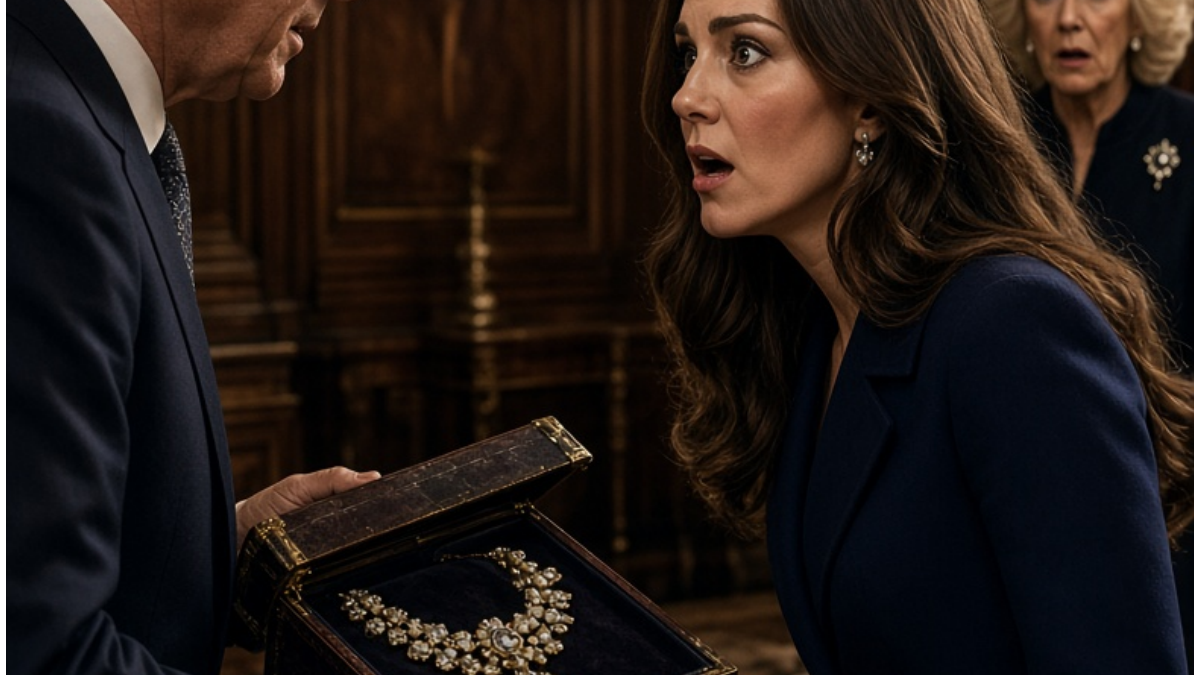
Chapter 1: The Leather Folder
The rain over London fell in a relentless, grey drizzle, slicking the cobbles of the inner courtyards and dulling the ornate stone façades of the palace. Inside the high-ceilinged room, where the air carried the subtle scents of aged mahogany, beeswax, and damp wool, two people sat across a low coffee table. Between them lay a thick leather folder, its surface worn soft by decades of handling, stamped in gold leaf with a cipher that had grown quiet over the years.
David Armstrong-Jones, Viscount Linley, did not release his grip immediately. His hand remained rested upon the dark leather for a full second longer than necessary, as if the physical act of relinquishing ownership demanded a silent moment of pause. Opposite him, Catherine, Princess of Wales, sat poised, watching his expression rather than the document. She made no eager move to pull the folder toward herself. She understood the weight of the moment.
“It is all here,” Linley said softly, his voice low against the backdrop of rain hitting the windowpanes. “The formal authorization. The full inventory. Every letter, every presentation piece, every private photograph, and every piece of jewelry my mother kept set apart from the Crown’s ceremonial vaults.”
“David,” Catherine began, her tone gentle yet firm, “you know I never sought this.”
“I know,” Linley replied, the faint shadow of a smile touching his eyes. “And that, Catherine, is precisely why you are the only person who can have it.”
The transfer was not an official royal ceremony. There were no photographers, no press releases drafted for immediate broadcast, and no liveried aides waiting to march the items down public corridors. It was a private agreement—a family member deciding where his mother’s personal history belonged.
For months, the question of Princess Margaret’s private estate had hung like a delicate thread over the household. Unlike the Crown Jewels or the state archives—held in trust for the nation and the sovereign’s official duties—Margaret’s private collection was a world entirely its own. It held personal correspondence, rare presentation gifts from world leaders given to her as a woman rather than a state official, private diaries, and intimate keepsakes from her youth at Royal Lodge and Clarence House. It was a repository of private human life, distinct from institutional display.
When Linley finally slid the leather folder across the table, Catherine placed her fingers lightly on its cover. She felt the heavy atmosphere in the room—a quiet acknowledgment that accepting these items meant taking guardianship of another woman’s vulnerabilities, triumphs, and private wounds.
“History can be carried without being claimed,” Linley murmured, repeating a principle he had held since his mother’s passing.
Catherine looked him in the eye and answered quietly, “Nothing intensely personal will ever be used publicly without deep respect for the family behind it.”
Linley nodded once, his demeanor softening. The tension that had hovered over his shoulders for months finally began to dissipate, even as both of them knew that across the hallway, in the formal reception suites, the reaction to this quiet signature would be far colder.
Chapter 2: The Silent Refusal
In the apartments of the Queen Consort, the atmosphere was defined by a stark, crisp silence. Camilla sat at her desk, a fountain pen resting beside a neatly typed memorandum from the Royal Archives. Beside it lay the formal notification sent by Linley’s legal representatives.
She read the final paragraph twice, her eyes lingering on the decisive phrasing. Slowly, she lowered the page onto the blotter.
“Is there no reservation?” she asked, her voice calm, measured, yet undercut by an unmistakably sharp edge. “No provision for ceremonial inclusion?”
The senior private secretary standing near the door gave a subtle, regretful bow of his head. “Viscount Linley’s determination was absolute, Your Majesty. The transfer to the Princess of Wales covers the private holdings in their entirety, with specific conditions regarding stewardship and public display.”
Camilla’s request had not been haphazard. Weeks earlier, her office had identified specific pieces from Princess Margaret’s archive—notably rare presentation jewels and public correspondence linked to post-war royal tours—arguing that they naturally belonged within the broader umbrella of the Queen’s ceremonial sphere. The argument presented by her advisers was one of institutional logic: Margaret had been a key figure of the royal family’s public history, and integrating her items into current public displays would reinforce the continuity of the monarchy.
Yet Linley’s rejection had been as precise as her request. He had refused to let his mother’s personal life be absorbed into state iconography. To him, Margaret was not raw material for palace branding or institutional continuity; she was his mother.
Camilla leaned back in her high-backed chair, looking toward the window. The rejection was a painful, lingering wound—not because of the physical objects themselves, but because of what the choice signified. In the subtle language of the royal court, where influence is measured in proximity and trust, Linley had been asked who should carry his mother’s memory into the future. He had bypassed the Queen Consort and chosen the Princess of Wales.
The silence in her study grew heavy. The refusal placed Catherine at the absolute center of a legacy Camilla had hoped to shape, raising uncomfortable questions within the palace walls about authority, trust, and the boundaries between personal heritage and public duty.
Chapter 3: The Weight of Confidence
Later that evening, after the formal dinners had concluded and the sprawling corridors of the palace had quieted down, Catherine sat in her personal sitting room. The leather folder lay open on the side table. She held a single, hand-written summary page in her hands, her eyes tracing the list of items now under her care.
When Prince William entered the room, he found her sitting quietly in the soft light of a single floor lamp, staring at the papers. She folded the letter once, paused, then unfolded it again.
“You look as though you’ve been handed a complex brief,” William said softly, sitting on the armchair opposite her.
“I feel honored,” Catherine admitted, looking up, “and deeply uncomfortable at the exact same time.”
“Because of Camilla?” William asked.
“Because of what it looks like,” she replied, her brows knitting slightly. “She asked for part of this collection for official exhibitions. Now it sits here, in my care. I never wanted this to look like a competition, William. I never sought a victory over anyone.”
William listened carefully, his expression thoughtful. He knew how scrupulously Catherine avoided palace politics, how deliberate she was in respecting hierarchy and avoiding any appearance of self-aggrandizement.
“David didn’t choose you because of a competition,” William said gently. “Your restraint is precisely why he trusts you. You’ve always treated inherited pieces as items of history to be preserved, never as badges of personal status. He knows you won’t turn his mother’s life into a public spectacle.”
“Restraint or not,” Catherine whispered, looking down at the elegant handwriting on the document, “possession creates perception. And perception in this family is everything.”
Meanwhile, in the King’s private quarters, Camilla spoke candidly with Charles.
“It isn’t about losing access to a few jewels or letters, Charles,” she said, her voice tight as she walked near the fireplace. “It is the realization that David did not view me as a natural guardian for his family’s history. It suggests a verdict.”
Charles stood by the hearth, holding a cup of tea, caught in the painful middle ground between his duty as a husband and his respect for his family’s private boundaries. He understood the sharp sting of her rejection, but he also recognized the delicate legal and personal realities. Margaret’s private estate was not his to command, and forcing a nephew to yield his mother’s possessions would turn a delicate personal matter into an act of royal overreach.
Chapter 4: The Fracture Point
To understand why Linley had made such an unyielding decision, one had to look back several months—to a seemingly routine meeting that had permanently altered his view of the collection’s future.
It had begun in late spring during the planning phases for a high-profile palace exhibition intended to celebrate generations of royal women. The concept, devised by senior curatorial staff and supported by Camilla’s office, aimed to use private items alongside official crown artifacts to illustrate how personal character shaped public service.
Palace planners had approached Linley for temporary loans from Margaret’s estate. Initially, the request appeared standard. But as the meetings progressed, the tone shifted.
During a key planning session in a ground-floor conference room, Camilla’s team had presented display mock-ups. One proposal stood out: they requested that an intimate, handwritten note written by Princess Margaret on her wedding day be reclassified for ceremonial display. The intention was to place the note at the center of a glass case dedicated to “Continuity under the Monarchy,” framing Margaret’s personal words as a thematic bridge to the present reign.
Linley had sat silently as the curators presented the board. He looked at the mock-up, saw his mother’s private handwriting enlarged on a display draft, and felt a quiet, profound resistance taking shape.
“This note,” Linley had said, his voice dropping into a quiet, cold register, “was written by my mother for her family. It was not written for palace branding.”
Camilla, present at the meeting, had tried to soften the tension. “David, the intention is purely one of respect and continuity. It shows the human heart within the institution.”
Linley had removed his glasses, folded them carefully, and placed them on top of the display folder. “When you turn a private letter into an emblem of institutional continuity, you stop seeing the person who wrote it. She becomes material to be arranged.”
He slid the mock-up back across the table and ended the discussion without granting approval.
When Catherine had heard of the disagreement days later, she had purposefully refused to take sides or offer unsolicited advice. When Linley brought the topic up during a casual encounter at Windsor, Catherine had simply told him, “The items belong to your family’s judgment. No one outside your family should tell you what your mother’s memories ought to mean.”
That answer lingered with Linley. It demonstrated a rare quality in the court: the ability to step back, to respect boundaries, and to resist the temptation to mold history for present gains. Shortly after, Linley instructed his legal team to review the long-term stewardship of every private asset under his control. The path to the handover had been set.
Chapter 5: The Confrontation
Despite the legal documents being finalized, the tension between the two senior women could not remain confined to formal correspondence forever. The unavoidable face-to-face encounter finally occurred weeks later in a private drawing room overlooking the gardens.
There were no aides present, no legal advisors, and no private secretaries waiting with briefing notes. It was a meeting requested directly by Camilla—a conversation that stripped away institutional protocol to confront the human emotion beneath.
Camilla sat in a high-backed armchair, watching Linley enter. He bowed his head respectfully, but his posture remained resolute.
“I did not ask you here to argue over legalities, David,” Camilla said directly as he sat down opposite her. “The papers are signed. The transfer is done. But I deserve to understand why.”
“It was never a decision meant to cause harm, Ma’am,” Linley replied quietly.
“When you choose Catherine over the Queen Consort, it becomes public, whether you intend it or not,” Camilla said, leaning forward slightly. “It makes the refusal feel like a explicit verdict on my character—as though I could not be trusted with your mother’s memory.”
Linley listened without interrupting, his face calm. “My concern was never about character or punishment,” he explained. “My fear was that under official stewardship, my mother’s possessions would slowly morph into symbols of office. They would become tools for public narrative rather than remaining what they truly are—remnants of a private, often complicated life.”
He looked at her steadily before adding, “When Catherine and I spoke, she suggested that several of the most intimate pieces should never be displayed publicly at all. She asked that they remain preserved solely for my mother’s direct descendants. She did not see the collection as a prize or a platform. That restraint gave me peace of mind.”
Camilla absorbed his words in silence. The realization was bitter: her active attempt to incorporate the items into a broader story of royal duty had worked against her, while Catherine’s deliberate lack of ambition for the collection had established complete trust.
“Was there ever a moment,” Camilla asked, her voice dropping, “when you intended to say yes to my request?”
Linley looked down at his hands for a quiet second, then met her gaze. “Yes,” he said softly. “Until the exhibition meeting. When I saw how easily private memory could be transformed into institutional storytelling, I knew I had to draw a line.”
The silence that followed was absolute. No sharp arguments followed. The truth had been stated plainly, leaving both of them aware that while the legal matter was settled, the emotional landscape had permanently shifted.
Chapter 6: The King’s Line
The ultimate test of the transfer’s stability rested with King Charles III. As monarch, his influence was vast, yet as a husband and uncle, his position was deeply delicate.
In his private study, Charles read through the detailed legal briefing submitted by the Duchy and palace legal counsel. The document made the legal status unequivocal: Princess Margaret’s private collection constituted personal estate property, not Crown assets. Any direct royal intervention to alter the stewardship agreement would represent an improper exercise of sovereign pressure over a private family inheritance.
Camilla entered the study as he finished reading. She stood near the edge of the large wooden desk, watching him close the red leather folder.
“Is there truly no scope for guidance?” she asked, her tone controlled yet laden with heavy expectation. “A private word to David?”
Charles took off his reading glasses and set them beside the file. He looked up at his wife with genuine affection and regret, but his voice carried the immovable weight of his office.
“David is Margaret’s son,” Charles said quietly. “Those objects hold memories that belong to his childhood and his family. If I were to use my position as King to pressure him into altering a private decision, I would be turning personal family grief into an act of state coercion.”
“It leaves me in a position that feels deeply diminished,” Camilla said quietly.
“It leaves a private inheritance where it belongs—in private hands,” Charles replied gently. “I will not overturn his choice.”
To ensure the decision did not fuel ongoing court rivalries, Charles approved an official internal clarification. The note explicitly recorded that Catherine’s acceptance of the collection created no new formal royal privileges, titles, or official rank. It was defined strictly as a personal stewardship agreement.
With that single gesture, the last administrative route was closed. The line had been drawn by the King himself, ensuring that personal inheritance remained protected from state authority.
Chapter 7: The Physical Transfer
Days later, the theoretical agreement materialized into physical action. In the climate-controlled storage vaults beneath the palace, specialized art handlers began the painstaking process of packing and moving the collection.
Heavy wooden cases lined with acid-free tissue paper were opened and carefully packed. Detailed inventory ledgers were signed off line by line: item 104, a set of personal leather-bound journals; item 212, a diamond presentation brooch gifted during an overseas visit; item 305, the handwritten wedding day note.
Linley personally oversaw the packing of the most sensitive boxes. Attached to the container holding the handwritten wedding note was a strict, written stipulation: Not for public display or institutional promotional use without explicit written consent from the estate.
Catherine received the first shipment at her residence without fanfare. There were no grand unveilings. She instructed her staff that the cases were to be placed in secure archives, organized meticulously, and kept entirely out of public view.
In her private rooms, Camilla received the final formal notification confirming that the first stage of the physical transfer was complete. She read the paper once, folded it along its crisp seam, and laid it face down upon her desk. When her secretary asked if she wished to archive the correspondence, she simply shook her head. Sitting alone after the door closed, she absorbed the quiet finality of the physical move. The papers were no longer mere legal arguments; the boxes had moved, and the decision was officially permanent.
Chapter 8: An Unofficial Truce
Knowing that leaving the situation in unresolved silence would foster long-term resentment, Catherine chose to act. The legal transfer was complete, but the personal relationship between the two senior royal women required careful handling.
She requested a private meeting with Camilla in a small, quiet sitting room situated far from the main administrative offices. No aides accompanied them.
When Camilla arrived, Catherine stood to greet her, her posture respectful and unhurried.
“Thank you for meeting me,” Catherine said softly as they sat down. “I wanted to speak with you directly, without memos or palace interpretation.”
“The collection is yours, Catherine,” Camilla said, her tone guarded. “There is little left to negotiate.”
“I didn’t ask to see you to negotiate,” Catherine replied, moving her chair slightly closer. “And I am not here to boast about a legal outcome. I know how painful this decision felt to you, and I want to assure you that I will never use this collection as a point of leverage or victory.”
Camilla looked at her, searching her face. “It felt like a public judgment,” Camilla admitted candidly. “It suggested that I cared only for institutional presentation, while you cared for memory.”
“David’s choice was about his own feelings regarding his mother,” Catherine explained gently. “It was not a judgment on your service or your role.”
Catherine then made a thoughtful, unexpected offer. “When the time comes that certain historical pieces from the collection are considered for public, commemorative displays years down the line, I will consult with you. We will look at them together, while fully respecting every boundary David set. And his mother’s handwritten wedding note will remain strictly private. It will never be displayed as a symbol, a trophy, or a subject of public narrative.”
Camilla was quiet for a long moment. The offer did not undo the past rejection, but it dismantled the sharp edge of hostility. It transformed what could have been a permanent rift into a managed, respectful understanding.
“Thank you, Catherine,” Camilla said with a brief, genuine nod. The atmosphere in the room visibly thawed, replaced by a quiet, practical truce.
Chapter 9: The Public Framing
Despite the private reconciliation, the story could not remain entirely hidden from the outside world forever. When news of the legal stewardship transfer finally leaked to the press, media outlets seized upon the narrative with intense fervor.
Within hours, headlines across major national broadsheets and international news networks framed the event in dramatic, high-stakes terms. The nuance of private estate law and family trust was immediately compressed into a public narrative of royal rivalry.
Palace communications issued a controlled, understated statement:
“Selected personal items from the private estate of the late Princess Margaret have been placed into long-term stewardship under the Princess of Wales, in full agreement with Viscount Linley. The arrangement focuses strictly on historic preservation and family continuity.”
The carefully chosen wording deliberate avoided any triumphant tone, stressing preservation and private agreement. Yet newspaper front pages paired old archival photographs of Princess Margaret alongside recent portraits of Catherine, running bold headlines highlighting the transfer of legacy while highlighting the refusal of the Queen Consort’s request in prominent sidebars.
Outside Buckingham Palace, crowds gathered near newsstands, holding up papers and discussing the symbolism. Commentators on evening broadcasts debated the deeper meaning: Who was chosen to hold the family’s memory? What did it say about the shifting dynamics within the modern court?
Inside the palace, both women watched the public reaction unfold. Catherine felt uncomfortable with praise that framed her as a “winner” in a court dispute, knowing how fragile the internal peace was. Camilla, meanwhile, bore the public scrutiny with practiced composure, relying on the private understanding she had reached with Catherine to weather the media storm.
Chapter 10: The Custodian
Weeks after the news had crested and faded from the daily headlines, quiet returned to the palace archives.
Linley visited Catherine one last time to review the final completed inventory. Together, they walked through the secure archival room where the collection was housed in customized, protective cases.
He stopped before a small table where an archival case lay. Inside, visible through a protective sleeve, was his mother’s handwritten wedding day note—stored privately, untouched by exhibition lights, safe from public commentary.
“It remains exactly as promised,” Catherine said quietly, standing beside him. “It will not leave this case unless your family asks for it.”
Linley closed the lid of the archival box gently, placing his palm flat against the smooth surface for a brief moment, much like he had done with the leather folder weeks prior.
“This is why I chose you, Catherine,” he said softly, looking at her with quiet gratitude. “You understand that some things are precious simply because they are private.”
In the end, no titles had changed hands, no constitutional roles had been altered, and no public battles had been fought in the open. Yet a fundamental truth about the royal family had been affirmed. Legacy is not something to be seized through rank or claimed through institutional demand; it is something granted through quiet trust.
Catherine remained the custodian of a private past, carrying its weight with quiet restraint. Camilla continued her public duties with steadfast dignity, backed by the King’s firm boundaries. And Princess Margaret’s private story remained protected—not as a public display for an institution, but as a cherished personal memory, preserved safely for generations to come.








