TWO POOR GIRLS ASKED, “CAN WE PAY LATER” — A BILLIONAIRE BEHIND THEM DID THIS…
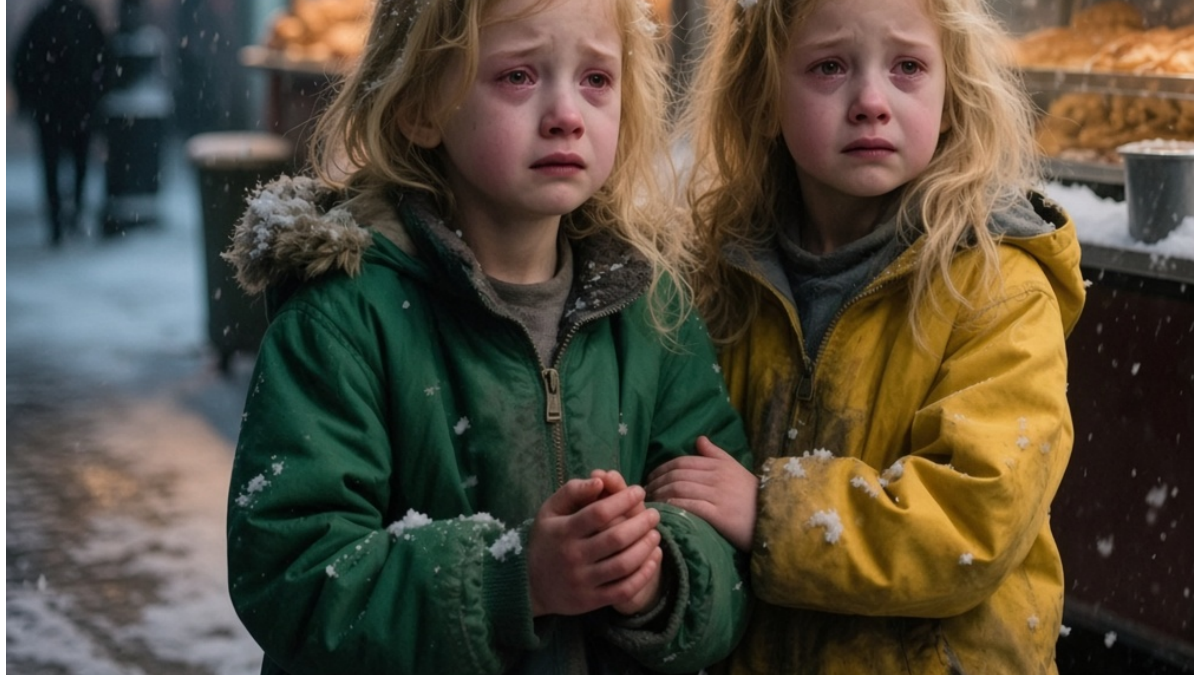
Two small twin girls stood at a street hotdog cart and whispered, “Can we pay later?”
Their mother was sick. The vendor said no. A wealthy stranger paid and should have walked away.
Instead, one quiet choice pulled four lives together, proving that sometimes staying changes everything. The hotdog cart sat on the corner of Harbor Street, steam rising softly into the cold morning air.
The smell of grilled onions drifted between passing coats and hurried footsteps. It was a normal weekday, busy, loud, indifferent.
Two little girls stood side by side at the counter. They were twins. Same height, same dark hair pulled into loose uneven ponytails, same careful way of holding their hands together as if reminding themselves not to step out of line.
They looked no older than seven. Mila was the first to speak. Her voice was polite, practiced.
“Excuse me, sir. Can we have two hotdogs?” The vendor smiled automatically and turned to the grill.
“Sure thing. That’ll be $6.” “Will be six?” The girls froze. Nora swallowed. Mila glanced down at her shoes, then back up.
She leaned forward slightly, lowering her voice not out of shame but caution, like someone asking a fragile question.
“Can we pay later?” The vendor paused, tongs hovering in midair. “Our mom’s not feeling well today.”
Mila added quickly. “She stayed home.” The words landed softly. No crying, no begging, just a simple statement offered with the hope that honesty might be enough.
Behind them, a man in a dark coat shifted his weight. Rowan Pierce had stopped only to grab breakfast before another meeting.
He stood out without trying, tall, composed, distant. His watch alone cost more than the cart.
He hadn’t been listening. Not until those words. “Pay later.” The vendor sighed, not unkindly but firm.
“I’m sorry, girls. I can’t do that. Rules are rules.” Mila nodded immediately. “We understand.”
She took Nora’s hand and stepped back, already preparing to leave. Rowan felt something tighten in his chest.
Not because they were hungry, but because they hadn’t argued. Rowan watched the twins step aside, making space for the next customer, as if they’d never been there at all.
As if wanting food had been a mistake they were careful not to repeat. He could have stayed silent.
He could have paid and walked away like he always did with efficiency, distance, control.
That was his skill. That was his armor. But something about the way the girls stood still holding hands, still waiting, refused to let him move.
“How much?” Rowan asked. The vendor looked up. “Six dollars.” Rowan reached into his wallet and placed a 20 on the counter.
“Three hotdogs,” he said calmly. “Two for them, one for me.” The girls turned at the sound of his voice.
Their eyes were wide but not startled, curious, measuring. Children who had learned to read adults carefully.
“This is for you.” Rowan said gently, nodding toward the counter. Mila’s mouth opened and then closed.
Nora squeezed her hand harder. “We can pay you back,” Nora said quickly. “When mom feels better.”
Rowan shook his head once, slow, certain, no need. The vendor handed over the food.
The steam fogged the air between them. “Thank you, sir,” Mila said. Not loud, not dramatic, just real.
Rowan stepped back, giving them space. He didn’t touch their shoulders, didn’t kneel, didn’t smile too much.
“Eat while it’s warm,” he said. “That’s all.” The girls nodded and moved to the nearby bench.
They unwrapped the paper carefully like it mattered. Rowan took his hotdog and turned to leave.
But as he walked away, he heard it. Nora whispered, barely audible, “It smells really good.”
Rowan stopped for half a second. Then he kept walking. Yet the words followed him through the traffic noise, through the morning light, settling somewhere he hadn’t felt in a long time.
Rowan walked three blocks before realizing he hadn’t taken a single bite. The city moved around him, cars honking, people laughing into phones, construction noise echoing between buildings.
Life uninterrupted. But his mind stayed on a wooden bench behind him. Two hotdogs, two small hands, no questions asked.
He reached the corner and stopped. For reasons he couldn’t name, he turned back. The twins were still there, sitting neatly, eating slowly, not rushing, not wasting a bite.
They weren’t but they weren’t sad either. They were focused. Rowan approached the cart again, careful to stay on the other side of the counter.
He pulled out a simple business card. No logo, no title, just a name and a phone number.
“Sir,” he said quietly to the vendor, “if their mom ever comes by, give her this.
Only if she asks.” The vendor glanced at the card, then at Rowan. He nodded once.
Rowan hesitated, then added, “Please don’t make a scene about it.” He stepped back. Mila noticed him then.
She gave a small wave, unsure if it was allowed. Rowan lifted his hand in return.
A brief acknowledgement. Nothing more. He walked away again, this time without stopping. Back in his hotel suite, the silence felt louder than usual.
The view was perfect. The city stretched endlessly beneath him. Yet all he could see were two girls standing too straight for their age.
“Can we pay later?” It wasn’t the hunger that stayed with him. It was the responsibility in their voices, the trust they offered to a stranger, the way they accepted no without breaking.
Rowan set his untouched breakfast down on the counter. For the first time in years, he wondered if walking away had ever really meant leaving anything behind.
Elena Hart arrived at the hotdog cart just after noon, her work badge still clipped to her jacket.
The lunch crowd had thinned. The steam was weaker now, the street quieter. She didn’t come for herself.
“Did two girls come by earlier?” She asked the vendor. “Twins.” The man nodded. “Yeah.
Sweet kids.” He hesitated, then slid a small white card across the metal counter. “A guy asked me to give this to you.
Only if you wanted it.” Elena’s eyes dropped to the card. Rowan Pierce, Harbor Light Hotel.
No title, no explanation. Her jaw tightened. She didn’t ask questions. She didn’t thank the vendor.
She simply folded the card once and slipped it into her pocket like something sharp.
At home, the apartment smelled faintly of detergent and reheated soup. Mila and Nora sat at the small table drawing quietly.
“Did you eat?” Elena asked. “Yes,” Mila said. “Hotdogs,” Nora added quickly. “A man paid.
We didn’t ask him to.” Elena froze. Her mind filled the gaps instantly, assumptions she’d learned to make to survive.
Rich men didn’t help. Not without wanting something. Attention, gratitude, control. She knelt in front of her daughters, steadying her voice.
“You did nothing wrong,” she said firmly. “But you don’t owe anyone anything. Understand?” The girls nodded.
That night, Elena stood alone in the kitchen. She took the card out again. Harbor Light Hotel, downtown, glass, money.
She almost threw it away. Instead, she tucked it into a drawer. Not hope, not trust, just caution saved for emergencies.
Rowan didn’t go looking for the twins. That mattered to him. He walked the city instead, without an agenda, without security, without the usual distance.
He noticed things he had ignored for years, the rhythm of foot traffic, the quiet pride in small shops, the way neighborhoods changed block by block.
Late afternoon, he passed a public library. Two girls sat on the steps, legs swinging, notebooks open.
Mila and Nora. They weren’t alone. An older woman sat nearby watching the entrance. A guardian.
Safe. Public. Rowan slowed. He stopped several steps away. Not close enough to intrude, not far enough to disappear.
“Hi,” he said, keeping his hands visible. “You don’t have to talk to me.” The twins looked up.
Nora recognized him first. “You’re the hotdog man.” Rowan smiled slightly. “Guilty.” Mila tilted her head.
“Mom says we shouldn’t talk to strangers.” “She’s right.” Rowan said immediately. “I won’t keep you.”
That answer surprised them. “I just wanted to say,” he continued, “you did nothing wrong showing up hungry.
Adults are supposed to notice.” Mila considered that. “Thank you,” she said, careful and polite.
At that moment, Elena’s voice cut through the air. “Mila. Nora.” She approached fast, eyes sharp body tense.
She positioned herself between Rowan and the girls without touching them. “What do you want?”
She asked. Rowan didn’t argue, didn’t explain too much, didn’t step closer. “I’m sorry,” he said.
“I should have asked permission. I won’t cross lines.” Elena studied him waiting for defensiveness, for offense, for ego.
None came. “If you want me gone,” Rowan added, “I’ll go and I won’t come back.”
Silence stretched. “Good,” Elena said finally, “because my children are not a lesson or a story.”
“I understand,” Rowan replied. And he left. No drama, no speech, just a man proving that respect could exist even when kindness was refused.
Two mornings later, Elena opened her apartment door and stopped short. A paper grocery bags sat neatly against the wall.
No logo, no delivery slip taped on top, just a small envelope. She looked down the hallway, empty.
Inside the bag were basics, bread, soup, fruit, milk, nothing expensive, nothing excessive, tucked carefully between them school notebooks, pencils, a pack of crayons.
The envelope held a single line handwritten. No pressure, no obligation, only if it helps.
No signature. Elena’s first instinct was anger. Her second was exhaustion. She carried the bag inside slowly as if it might disappear if she moved too fast.
Mila noticed the crayons immediately. “Mom.” Elena swallowed. Someone was kind. That night after the girls slept, Elena sat at the table alone.
The apartment was quiet except for the hum of the refrigerator. She took the card out of the drawer.
Harbor Light Hotel. Across the city Rowan sat by his window, the skyline reflected in untouched glass.
He hadn’t checked his phone all evening. He didn’t know if the bag had been accepted or thrown away.
And for the first time he understood something important. Real kindness didn’t demand proof. It waited.
Elena told herself it was just exhaustion. She had worked a double shift, stood too long, slept too little.
The ache behind her eyes came and went dull and manageable. Nothing dramatic, nothing worth worrying the girls.
“Mom, you’re quiet,” Nora said over dinner. “I’m just tired,” Elena replied forcing a smile.
Grown-up tired. Mila watched her carefully. She always did. The next morning, Elena moved slower.
She sat longer at the table, one hand pressed against her temple listening to the kettle instead of turning it off.
The girls didn’t panic. They had learned something important early in life when something feels wrong, you don’t guess, you ask.
Mila picked up the phone and dialed their neighbor, Mrs. Klein, just like their mother had taught them.
“Can you come over?” Mila said calmly. “Our mom doesn’t feel good.” Within minutes, Mrs. Klein arrived.
She spoke softly, asked simple questions, checked Elena’s temperature. “No rush, no fear. She needs to see a doctor,” the woman said gently.
“Nothing scary, just to be safe.” Elena tried to protest, but her voice came out thinner than she wanted.
While Mrs. Klein arranged a ride, Nora noticed something on the fridge, a small card held by a magnet.
“Is this the hotel man?” She asked quietly. Elena hesitated. She thought of the groceries, the note, the way kindness had waited without demanding entry.
“Yes,” she admitted. “But that doesn’t mean I know,” Mila said. “We only call if you say.”
Elena closed her eyes for a moment. Then she nodded. “Okay,” she whispered. “You can ask.”
Not because she trusted easily, but because sometimes strength meant choosing support. Rowan was in the hotel lobby when the front desk called his name.
“There’s a woman on the line,” the clerk said, “a neighbor. She says it’s about the family from Harbor Street.”
Rowan didn’t run. He didn’t dramatize. He asked questions. “Is the mother safe? Are there other adults present?
Do they need transportation or medical advice?” Everything done correctly. By the time Rowan arrived at the clinic, Elena was already inside being evaluated.
Mrs. Klein sat with the girls in the waiting area. Rowan stopped several steps away.
“I won’t come closer unless it’s okay,” he said. Mrs. Klein studied him, then nodded.
“They’ve been asking if you’d come.” Mila saw him first. “You came,” she said not surprised, just relieved.
“I said I would help if asked,” Rowan replied. “That’s all.” They waited together. Rowan sat on the far edge of the chair, hands folded presence steady but contained.
No promises, no touching, no stepping into roles that weren’t his. A nurse appeared. “Miss Hart will be fine,” she said kindly.
“She’s dehydrated and overworked. We’re keeping her a few hours.” The girls exhaled. Rowan didn’t smile.
He just stayed. Hours later, Elena emerged paler but clearer. She saw Rowan and stiffened instinctively.
Then she stopped. “You didn’t have to come,” she said. “No,” Rowan answered softly. “But I chose to.”
Elena studied him not as a threat, not as a savior, as a man who respected doors and waited for them to open.
They sat in silence while the girls colored at a low table. Elena broke it first.
“I don’t accept help easily,” she said. Not defensive, just honest. “I don’t offer it carelessly,” Rowan replied.
That earned him a look, brief, sharp, thoughtful. “You don’t owe us anything,” she said.
“I know, and I don’t want my children to think that kindness comes with strings,” Rowan finished.
“I wouldn’t want that either.” Elena’s shoulders lowered just a fraction. She glanced at Mila and Nora bent over their drawings close together, safe.
“I thought you were another rich man trying to feel useful,” she admitted. Rowan didn’t flinch.
“That’s a fair assumption. Why aren’t you?” He took a moment before answering. “Because I know what it’s like to have everything,” he said.
“And still be missing something important.” Elena nodded slowly. Not agreement, understanding. When it was time to leave, Rowan stood.
“I won’t show up uninvited again,” he said. “If you want distance, you’ll have it.”
“And if I don’t?” Elena asked quietly. Rowan met her eyes. “Then I’ll stay within whatever boundaries you set.”
That night as Rowan walked back toward the hotel, he felt lighter than he had in years.
Not because he’d helped, but because for the first time someone had seen him and not turned away.
Rowan didn’t come the next day or the day after. That was intentional. Elena noticed anyway.
She noticed because help that waits is louder than help that insists. Life returned to its careful rhythm, work, school, dinner, sleep.
Elena felt better though the exhaustion lingered like a shadow that hadn’t fully let go.
Mila and Nora resumed their routines, homework at the table, quiet laughter in the evenings.
On Friday there was a knock. Elena opened the door slowly. Rowan stood in the hallway, hands empty.
“I said I wouldn’t come uninvited,” he said. “Mrs. Klein told me you asked her to pass along a message.”
Elena hesitated, then stepped aside. “Five minutes.” Inside, Rowan remained standing. He didn’t explore, didn’t comment on the apartment.
He waited. “I need to be clear,” Elena said. “My kids come first, always. They should,” Rowan replied.
“And whatever this is,” she continued, “it’s temporary. I don’t want them depending on you.”
Rowan nodded once. “Then we agree.” That caught her off guard. “I can help in specific ways,” he added.
“Food deliveries through a service, transportation if another adult is present. Nothing that replaces you.”
Elena studied him carefully. “You’re very precise,” she said. “I’ve learned precision keeps people safe,” Rowan answered.
From the kitchen doorway, Mila watched quietly. “Mom,” she asked. Elena turned. “Yes, can Mr. Rowan stay for dinner?”
Silence fell. Rowan immediately shook his head. “Only if your mom says yes.” Elena looked at her daughters, hopeful not desperate, curious not attached.
“Dinner,” she said finally. “One time.” Rowan exhaled softly. Not relief, gratitude. Dinner was simple, soup warmed on the stove, bread cut into uneven slices, four mismatched bowls on the table.
Rowan offered to help. Elena handed him a spoon and pointed to the pot without ceremony.
“Stir,” she said. He did. The The talked about school projects, about a spelling test, about a bird they’d seen on the way home.
Rowan listened more than he spoke. When he did speak, it was careful, appropriate, light.
After dinner, Mila cleared plates. Nora wiped the table with exaggerated seriousness. Elena watched it all quietly.
This was not dependence. This was normal. That realization unsettled her more than anger ever had.
Later, as the girls brushed their teeth, Elena spoke in a low voice. They don’t need another parent.
“I’m not trying to be one,” Rowan said gently. “Then what are you?” Rowan considered the question.
“Someone who shows up,” he said. “And leaves when asked.” Elena nodded slowly. When it was time for Rowan to go, Nora hugged him without warning, brief, instinctive, and then she stepped back.
“Thank you for dinner,” she said politely. Rowan crouched to her eye level. “Thank you for sharing your table.”
Mila held the door open. “You can come back,” she said, then quickly added, “if Mom says so.”
Rowan smiled. “That’s exactly right.” As he walked down the stairs, something unfamiliar settled in his chest.
Not excitement, responsibility. Weeks passed. Rowan’s visits became infrequent, predictable, respectful. Saturdays, afternoons, always announced, always optional.
Elena regained her strength, but not her margin. Bills stacked quietly. Time slipped through her fingers.
One afternoon, Rowan arrived with a thin folder. “I won’t stay long,” he said. “And you can say no.”
He placed the folder on the table and stepped back. “There’s an opening at the Harbor Light Hotel,” he explained.
“Laundry administration, fixed hours, health insurance. HR makes the decision, not me.” Elena didn’t touch the folder.
“You own the hotel,” she said flatly. “I’m an investor,” Rowan corrected. “I don’t hire.
I won’t interfere.” She crossed her arMs. “People will talk.” “They always do,” Rowan said.
“This wouldn’t change that.” Silence stretched. Mila and Nora sat on the floor drawing. “If I say no,” Elena asked, “does anything change?”
Rowan shook his head. “Nothing.” “And if I say yes, then you get stability,” he replied.
“On your terMs.” Elena finally opened the folder, read, calculated. Her voice was steady when she spoke.
“I’ll apply,” she said, “but I earn this.” Rowan smiled, not wide, not triumphant. “That’s the only way it works.”
That night, Elena tucked her daughters into bed with lighter shoulders. In a hotel room across the city, Rowan lay awake longer than usual.
For the first time, he wasn’t wondering what he would lose by staying. He was wondering what might grow if he did.
Elena got the call on a Tuesday morning, halfway through folding laundry at the hotel.
Human Resources, neutral tone, clear words. They wanted her to start Monday. She ended the call and stood still, one hand resting on the edge of the cart.
The machines hummed around her, steady and indifferent. For a moment, she did nothing, just breathed, as if afraid the news might disappear if she moved too fast.
Getting better, she realized, had weight. It wasn’t just relief. It was responsibility. It meant planning weeks instead of days.
It meant trusting a future that had never been kind to her. That evening, she told the girls at the kitchen table.
“I got the job,” she said simply. Nora gasped. Mila smiled, quiet but radiant. “Does that mean you’ll be home earlier?”
Mila asked. Elena nodded. “Most days.” The girls exchanged a look, one of those wordless conversations adults never quite understood.
That Saturday, Rowan came by as planned. He noticed the change immediately. Elena moved differently, straighter, less guarded.
“You got it,” he said. “Yes,” she replied. “And I want to be clear. I’m grateful.
But this doesn’t make us dependent.” Rowan inclined his head. “It makes you employed.” They shared a brief smile.
Over the next weeks, routines shifted. Elena left for work at dawn and returned before dinner.
Mila and Nora did homework at the table while Elena cooked simple meals, but warm ones eaten together.
Rowan stayed on the edges of that routine. He stopped bringing groceries. He didn’t offer rides unless asked.
He showed up on Saturdays, and sometimes not at all. That restraint mattered. One evening, as Elena washed dishes, Mila lingered beside her.
“Mom,” she said, careful, “is Mr. Rowan lonely?” Elena paused, water running over her hands.
“I think,” she said slowly, “he’s learning not to be.” That night, Elena lay awake thinking about how far they’d come.
Not because someone had rescued them, but because someone had helped without taking control. Across the city, Rowan sat by his window, the skyline dimmer than usual.
He hadn’t checked his phone. He hadn’t planned the next visit. For the first time, he wasn’t afraid of becoming unnecessary.
The invitation came from Mila. A handwritten note, folded unevenly, handed to Rowan on a Saturday afternoon.
“Mom says we can invite one person to my school showcase. Would you like to come?”
Rowan read it twice. “Only if your mom is comfortable,” he said. Mila nodded. “She said it’s okay.”
The school auditorium smelled of paper and pencil shavings. Parents filled the seats, whispering and adjusting coats.
Rowan sat near the aisle, leaving an empty seat between himself and Elena, by instinct, not instruction.
The twins performed a short presentation together. Nothing dramatic. Just confidence, teamwork, laughter when they forgot a line and recovered together.
Rowan clapped quietly, deeply moved. Elena noticed. Afterward, outside, under the fading light, Elena spoke.
“They were proud,” she said. “That matters.” “It does,” Rowan agreed. They walked a few steps in silence.
“I need to say something,” Elena continued. “And it might sound ungrateful.” Rowan stopped. “Then say it anyway.”
“You’ve helped us,” she said. “But I don’t want the girls to think stability comes from one person outside this family.”
Rowan listened without interrupting. “So I need more space,” Elena finished. “Not distance, just balance.”
Rowan nodded, slowly, fully. “Thank you for telling me,” he said. “I’ll adjust.” And he did.
Weeks passed with fewer visits. Rowan focused on work again, but differently now. He delegated more.
He left meetings early. He stopped measuring success only in outcomes. On Sundays, he sometimes walked past the hot dog cart where it had all begun.
He never stopped. He didn’t need to. One afternoon, Elena found a small envelope in her mailbox.
Inside was a note. “If the girls ever need school supplies or tutoring resources, the community center on Harbor Street has prograMs. No need to involve me.”
No signature. Elena smiled, not because of the help, but because of the respect. That night, Mila asked, “Is Mr. Rowan mad?”
“No,” Elena said. “He’s doing something harder. What? He’s trusting us to be okay.” Autumn arrived quietly.
Leaves gathered along sidewalks. Mornings cooled. The city softened. Elena moved the girls into a small two-bedroom apartment closer to their school.
Nothing fancy, clean, bright, earned. Moving day was busy, but calm. Boxes, laughter, a borrowed truck driven by a coworker.
Rowan came only at the end, tools in hand, fixing a loose hinge, tightening a shelf.
When he finished, he packed up without ceremony. “I should go,” he said. Elena walked him to the door.
“You didn’t have to come,” she said. “I know,” Rowan replied. “I wanted to.” She hesitated, then spoke.
“You can come by sometimes.” “Sundays? Breakfast?” Rowan looked surprised, but not overwhelmed. “Sometimes,” he echoed.
“I like that.” Sunday mornings became a ritual. Bread from the bakery, coffee in mismatched mugs.
The twins sprawled on the rug telling stories. Elena relaxed into the chair, no longer watching the clock.
Rowan never stayed too late, never brought extravagant gifts. He stayed present, and then he left.
One Sunday, as the twins chased leaves in the park, Elena sat beside Rowan on a bench.
“I was wrong about you,” she said quietly. Rowan shook his head. “You were careful.
That’s not wrong.” She watched her daughters laughing. “They’re kids again,” she said. “That’s all I ever wanted.”
Rowan nodded. “Me, too.” That night, back in his hotel room, Rowan stood by the window one last time.
The city lights were still beautiful, but they no longer felt like a destination. He thought of a small apartment filled with noise and warmth.
Of a family that hadn’t needed saving, only space to heal. Rowan Pierce, who had built his life upward, finally understood something simple.
Home wasn’t a place you owned. It was a place that let you stay and trusted you to leave.
The first real crack didn’t happen in a dramatic moment. It happened in a hallway.
Elena was walking out of the Harbor Light Hotel’s employee entrance after her shift, hair tied back hands, smelling faintly of detergent and lemon cleaner.
She liked the feeling of leaving work before the sun fully disappeared. It made the day feel survivable.
A coworker waved. “See you Monday.” Elena waved back, already thinking about dinner, about spelling words, about whether Nora would insist on cutting sandwiches into stars again.
Then she heard it. Two guests near the lobby speaking in the lazy confidence of people who never worried about rent.
“That guy Pierce.” “He’s been doing some kind of feel-good thing.” One said sipping coffee like it was punctuation.
“Single mom, twin girls.” “I heard it’s his new charity obsession.” The other laughed softly.
“It’s always a project with those types.” Elena’s steps slowed. She wasn’t angry at the guests.
She didn’t even know them. But the words hit her like a cold splash. Project.
Obsession. Charity. She kept walking shoulders stiff. The old Elena would have swallowed it. Pretended it didn’t matter.
Pride was her armor. But she was tired of armor. That evening, Rowan arrived for Sunday breakfast as promised bread in a paper bag, cinnamon scent trailing behind him.
Mila and Nora ran to the door, then stopped remembering the rules. “Shoes off.” Mila reminded him seriously.
Rowan complied with exaggerated care. “Yes, ma’am.” Nora giggled. Mila didn’t. Elena watched from the kitchen.
She poured coffee, the mug trembling only slightly in her hand. Rowan noticed because Rowan noticed everything that mattered now.
“You okay?” He asked when the girls were distracted by the bag. Elena smiled with her mouth, not her eyes.
“Fine.” Rowan didn’t push. He had learned that forcing feelings out of Elena was like pulling on a locked door, you only damaged the frame.
Breakfast started gently. The twins argued about whether dolphins or whales were smarter. Rowan played referee.
Elena nodded at the right moments, laughed once in the right place. But her mind stayed in that hotel hallway.
When the girls went to their room to fetch a drawing they wanted to show him, Elena finally spoke.
“People are talking.” She said, voice flat. Rowan’s posture changed small but immediate. “About what?”
“About you.” Elena said. “About us.” Rowan inhaled. “I’m sorry.” Elena’s eyes narrowed. “Are you?”
He didn’t answer quickly. He didn’t say the wrong thing. He said the true thing.
“I’m sorry they’re talking.” Rowan said. “I’m sorry it touches you.” “I can’t control every mouth in the city, Elena.”
“But I can control me.” Elena set her mug down harder than necessary. “Then tell me.”
She said. “What am I to you?” “What are my daughters to you?” The words weren’t loud, but they were sharp.
Rowan didn’t flinch. “You’re a person I respect.” He said quietly. “And your daughters are two kids I care about.”
Elena shook her head once. “That’s not an answer.” Rowan leaned forward careful like approaching something fragile.
“You want to know if this is a story I’m collecting?” He said. “A good deed for my conscience?”
Elena didn’t speak, but her silence said yes. Rowan’s voice lowered. “If that’s what it is, you should shut the door on me today.”
“You’d be right.” Elena stared at him searching for performance. She found none. “So why do you keep showing up?”
She demanded. Rowan’s throat moved as he swallowed. “Because I’m learning something I should have learned a long time ago.”
He said. “That love isn’t proven by grand gestures.” “It’s proven by consistency.” “By respecting the word no.”
“By not making myself the center.” Elena’s eyes flickered toward the hallway where the girls were whispering and giggling.
Rowan followed her glance. “And I know.” He continued that I’m not their father.” “I’m not trying to be.”
“I’m not trying to replace anyone.” Elena’s voice cracked just slightly. “Then what are you doing here?”
Rowan stood up, not to tower over her, but to give the question the respective space.
“I’m here because your girls made me want to be a better man.” He said.
“And because you let me learn how to stay without taking.” The room went quiet.
Mila and Nora reappeared with a drawing, three stick figures holding hands. One was taller.
One had a bun. Two were small with twin ponytails. Nora pointed. “This is us.”
Mila pointed to the tall one. “And this is Mr. Rowan.” Rowan smiled, but Elena couldn’t.
She looked at the drawing like it was a mirror she hadn’t agreed to stand in front of.
That night after Rowan left early at Elena’s request, calmly, respectfully, Elena sat alone on the couch with the drawing in her lap.
Her fear wasn’t that Rowan would hurt them. Her fear was worse. Her fear was that they would love him.
And he would leave. Rowan didn’t show up the next Sunday. Not because Elena asked him not to.
Because Rowan finally understood that sometimes the most responsible act of love is distance chosen, not abandoned.
He sent one message. Simple. Clean. “I heard you.” “I’m here if you want me.”
“If you need space, I’ll respect it. No follow-up, no are you okay, no guilt bait.”
Elena read it twice and didn’t reply. Days passed. The apartment felt quieter even with the twins filling it with their usual noise.
Mila was the first to ask. “Did Mr. Rowan do something wrong?” She said softly while coloring.
Elena’s chest tightened. “No.” She said. “He didn’t.” “Then why isn’t he coming?” Nora asked trying to sound casual but missing the mark.
Kids always missed the mark when they were pretending not to care. Elena sat down between them, folding her hands like she was holding something fragile.
“Because sometimes grown-ups need time to think.” She said carefully. “And because I asked for space.”
Mila’s eyebrows pulled together. “Do you not like him?” Elena exhaled slowly. “I like that he’s kind.”
She admitted. “But liking someone isn’t the same as trusting them with your heart.” Nora blinked.
“What’s a heart trust?” Elena almost smiled. Almost. “It means.” She said letting someone matter.
The twins absorbed that in the way children do, quietly, seriously, like a new rule of gravity.
That Friday afternoon, Elena got an unexpected call from the school counselor. “Nothing alarming.” The counselor said warmly.
“We’re doing a community day.” “Parents can bring a friend or family member to volunteer.”
Elena’s throat tightened again in a new place. Mila and Nora had signed up. They wanted Elena there.
And then in bright marker, they had written another name under extra adult. Rowan Pierce.
Elena hung up and sat in silence. Later, she didn’t scold them. She didn’t shame them.
She didn’t say don’t write his name. She simply asked, “Why did you write that?”
Mila answered first, always the careful one. “Because he helps.” Nora added, “Because he stays.”
Elena’s eyes stung. The word stays was a weapon and a wish all at once.
That night, Elena opened the drawer and pulled out Rowan’s original card, worn at the edges now, like something she had kept through storMs. She stared at it.
Then she did something that surprised even her. She called. Rowan answered on the second ring, voice low, controlled, like he was afraid of sounding too eager.
“Elena.” “I’m not calling to apologize.” She said immediately, defensive by habit. “I didn’t ask you to.”
Rowan replied. Silence. Elena swallowed. “The girls wrote your name for a school volunteer day.”
Rowan didn’t speak for a beat. Then gently, “Do you want me to come?” Elena’s fingers tightened around the phone.
“I don’t know what I want.” She admitted. “I only know what I’m afraid of.”
Rowan’s voice softened further. “Tell me.” “I’m afraid they’ll depend on you.” Elena said the words finally out.
“And then you’ll disappear.” Rowan exhaled slow. “I can’t promise the future.” He said. “I won’t lie to you.”
“But I can promise something real.” Elena’s chest tightened. “What I can promise I won’t disappear without words,” Rowan said.
“I can promise I won’t punish you with silence. I can promise that if I ever need to step away, I’ll tell you like an adult, and I’ll make sure the girls understand it isn’t their fault.”
Elena’s eyes filled not with helplessness, but with relief so unfamiliar it almost hurt. That wasn’t a fairy tale promise.
That was a responsible one. And for Elena, that was everything. “You can come,” she said quietly.
“To the school day.” Just that. Rowan’s answer was immediate, steady. “Thank you. I’ll follow your lead.”
When Elena hung up, she didn’t feel saved. She felt respected. And that respect made room for something dangerous.
Hope. The school gym was loud with folding chairs and cheerful posters. Parents carried boxes of snacks.
Volunteers wore paper name tags with crooked handwriting. Rowan arrived dressed down jeans, plain sweater, no watch that screamed money.
He stood at the entrance like someone asking permission to breathe. Elena spotted him. Their eyes met across the noise.
Rowan didn’t wave. He waited. Elena nodded once. That was the invitation. Mila and Nora spotted him next and ran over, then stopped short remembering the rules Elena had taught them.
They walked instead, fast but controlled. Rowan crouched so he wasn’t towering. “Hi,” he said.
“Thank you for inviting me.” Mila held out a clipboard like it was sacred. “We’re in charge of the book table,” Nora added, “and the snack station.”
Rowan smiled. “Then I’m your assistant.” For the next hour, he followed their instructions like they were CEOs.
He stacked books neatly, handed out juice boxes, listened to Mila explain the difference between fiction and non-fiction as if she were delivering a speech to Congress.
Elena watched from across the gym, heart tight. Not because Rowan was doing anything wrong, because he was doing everything right.
When another parent asked casually, “Are those your kids?” Rowan didn’t hesitate. “No,” he said.
“They’re Elena’s. I’m just here to help today.” No claiming, no stealing language. Elena’s shoulders loosened.
After the event as families filtered out, Mila and Nora tugged on Elena’s sleeves. “Mom,” Mila said carefully, “can we go get hot dogs?”
Nora’s eyes lit up. From the cart, Elena froze. Hot dogs weren’t just food anymore.
They were a beginning. A memory that could either become a warm story or a wound.
Rowan watched Elena’s face and didn’t speak. He gave her the space to decide. Elena exhaled.
“Okay,” she said, “but we walk.” The hot dog cart stood on the same corner, steam curling up like a quiet ghost of that first morning.
The vendor recognized them and smiled. Rowan stayed slightly behind letting Elena order. “Four hot dogs,” Elena said, then hesitated, pride rising like a reflex.
“I’ll pay.” Rowan didn’t argue. He simply stepped back. Elena paid. She handed the girls their food.
They sat on the bench, legs swinging, laughing about the gym event. Rowan sat at the far end of the bench, not pressed into them, not separating them, present but not invading.
Elena watched her daughters eat without fear in their eyes. Then she looked at Rowan.
“I need to say something,” she murmured. Rowan turned attentive but careful. “Okay.” Elena’s voice shook slightly.
“I don’t want my daughters to grow up thinking they have to handle everything alone.”
Rowan’s gaze softened, but he didn’t interrupt. “And I don’t want them to believe kindness is always a trick,” Elena continued, “because that would make them smaller, harder, like me.”
Rowan’s voice was quiet. “You’re not hard. You’re protective.” Elena swallowed. “Sometimes protection becomes a cage.”
The wind moved through the street lifting a scrap of paper near their feet. The city hummed.
Life kept going. Elena looked back at her daughters, two small faces sticky with ketchup, laughing at something only twins understood.
Then she faced Rowan again. “I can’t offer you a perfect place in our lives,” she said.
“I can’t promise I’ll always be easy. I can’t promise I’ll trust fast.” Rowan nodded.
“I wouldn’t want fake trust.” But Elena said, voice steadier now, “I can offer you something real.”
Rowan waited as if afraid to reach for it. Elena’s eyes shone. “You can be family adjacent.”
Nora piped up immediately, mouthful. “What’s that?” Mila answered like a professor. “It means he’s family, but Mom doesn’t want to say it too loud yet.”
Rowan laughed once, soft, surprised, almost broken by emotion. Elena shook her head, but the corner of her mouth lifted.
“Exactly.” Rowan looked at the girls, then back at Elena. “I accept,” he said simply.
“On your terMs.” Elena nodded. It wasn’t a fairy tale ending. It was something better.
A choice made in daylight on a public street with hot dogs in paper wrappers and a bench that held four people close enough to feel warmth, far enough to keep everyone safe.
For the first time, Elena didn’t feel like she was bracing for loss. For the first time, Rowan didn’t feel like he was borrowing a life.
They were building one quietly, responsibly, together. Life didn’t transform overnight. That was the first sign it was real.
Weeks passed, then months. The apartment filled slowly, not with expensive things, but with ordinary proof of living.
Shoes by the door. Homework taped to the fridge. A calendar with grocery days circled in pen.
Rowan became a rhythm, not an event. Some Sundays he came. Some Sundays he didn’t.
When he missed one, he sent a message, not an apology, just information. “Won’t make it today.
Thinking of you.” And that was enough. Elena noticed something changing inside herself. She stopped listening for footsteps in the hallway after the girls went to sleep.
She stopped rehearsing worst-case scenarios before opening her bank app. Stability, she learned, didn’t arrive with fireworks.
It arrived quietly like breath returning after panic. One afternoon, Mila came home upset. A classmate had asked why she didn’t have a dad.
Elena froze, the old fear rising. “What did you say?” She asked gently. Mila shrugged.
“I said I have a mom, and a sister, and a Mr. Rowan.” Elena waited for the ache.
It didn’t come. “What did they say?” She asked. “They said that was weird,” Mila replied.
Then she smiled. “But Nora said weird isn’t bad.” That night, Elena told Rowan, “I hope that didn’t cross a line,” she said.
Rowan shook his head. “Kids name the world as they see it. We don’t need to rush to label it.”
Elena nodded, grateful. Later, Rowan helped Mila with math while Nora read aloud dramatically from a library book.
Elena watched from the kitchen doorway, arms folded, not guarding, just observing. She realized something quietly monumental.
She wasn’t afraid of losing him anymore. Not because she trusted forever, but because she trusted herself to handle change.
And that meant she had finally stopped surviving and started living. It was a year later when they returned to the hot dog cart.
Not intentionally, not symbolically, just because it was there. Autumn again. The same corner. The same steam curling into the air like a memory that hadn’t finished speaking.
The vendor recognized them immediately. “Well, look at you,” he said smiling. “You’re taller.” Nora puffed up proudly.
“I grew an inch,” Mila corrected her. “Half an inch.” Rowan stayed back letting Elena step forward.
“Four hot dogs,” Elena said easily, no hesitation this time. She paid. The vendor handed over the food, then leaned closer.
“Good to see you,” he said quietly. “You look a lighter.” Elena smiled. “I feel it.”
They sat on the bench, same place, different people. The girls ate fast, ketchup everywhere, laughing about school gossip and playground politics.
Rowan watched them with a soft focus like someone memorizing a scene they never wanted to forget.
Elena noticed. “You okay?” She asked. Rowan nodded. “I was just thinking, if I had walked away that day.”
Elena followed his gaze to the cart. “You didn’t,” she said. “No,” Rowan agreed. “But you could have closed the door later.”
Elena shrugged. “I almost did.” They shared a look, honest, unguarded. “I’m glad you didn’t,” Rowan said.
“So am I,” Elena replied. Mila wiped her hands and looked between them. “Are you guys talking about boring adult stuff?
Yes, Elena said immediately. Rowan added, “Extremely boring.” Nora giggled. Good. The city moved around them, people passing, traffic humming, life indifferent and alive.
Nothing cinematic happened. And that was the point. Because healing, Elena realized, didn’t need a soundtrack.
It needed consistency. Rowan no longer lived at the Harbor Light Hotel. Not because he had to leave, but because he wanted to arrive somewhere else.
He moved into a modest apartment closer to Elena and the girls. Not next door, not too far.
Close enough to matter, far enough to respect space. He didn’t announce it. Elena found out by accident.
“You moved?” She asked, surprised. Rowan nodded. “Felt right.” That night, after the girls went to bed, they sat on the couch.
No agenda, no weight. “You know,” Elena said quietly, “this isn’t what I thought help looked like.”
Rowan smiled faintly. “Me neither. I thought help was someone fixing things,” she continued. “Instead, you just stayed long enough for me to fix them myself.”
Rowan’s voice was steady. “That was always the plan.” Elena looked at him, then really looked.
“Thank you,” she said. Not heavy, not desperate. Just true. Rowan nodded. He didn’t deflect it.
He didn’t minimize it. He accepted it. Sunday mornings remained sacred. Bread, coffee, stories, sometimes arguments, sometimes silence.
Life unpolished and real. One morning, Mila asked a question she’d been holding for a while.
“Mr. Rowan,” she said carefully, “are you going to stay? Like, forever?” The room stilled.
Elena held her breath. Rowan thought before answering. “I don’t know what forever looks like,” he said gently.
“But I know what today looks like.” “And today?” Nora asked. Rowan smiled. “Today, I’m here.”
That was enough. Elena realized something then, something she hadn’t dared name before. Love wasn’t someone promising never to leave.
Love was someone showing up again and again, without ownership, without fear, without disappearing. The camera pulls back.
A small apartment. Light in the windows. Two girls laughing. A woman finally at ease.
A man no longer alone. The hot dog cart down the street closes for the night.
The steam fades, but the warmth remains. Did this story leave a lasting impression on you?








