They Laughed at the Ex-SEAL Dad—Then the Billionaire’s Daughter Said, “Play Our Song.” Mom Froze
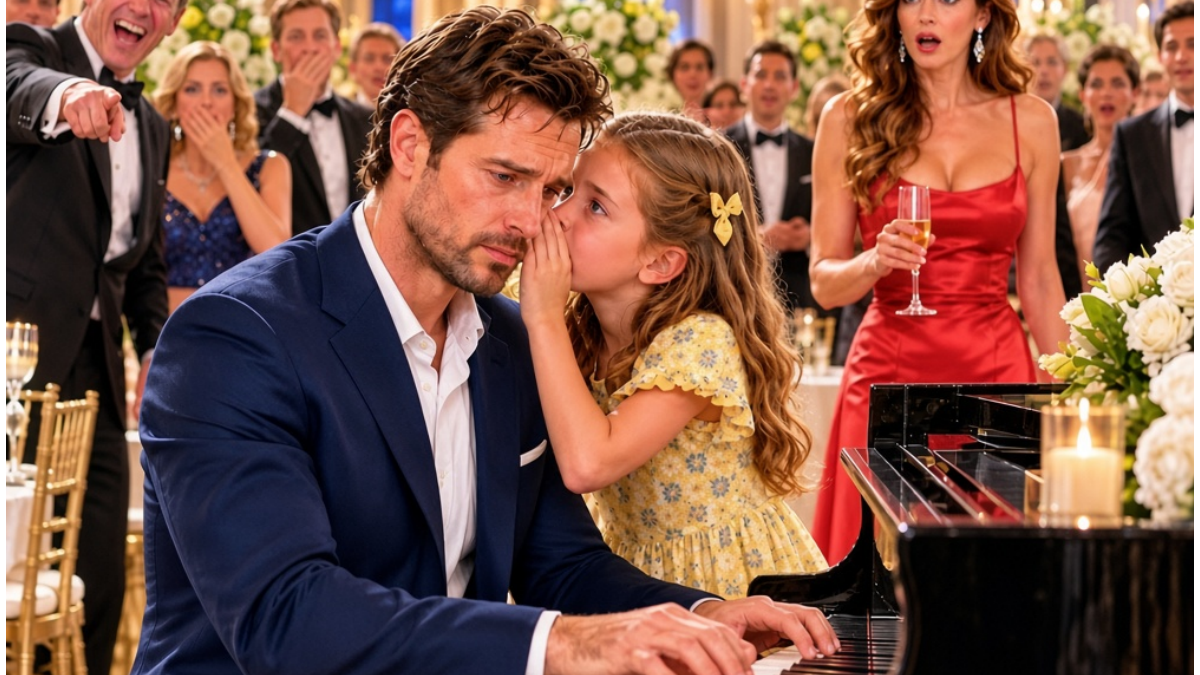
The laughter began the moment the man walked into the ballroom. It wasn’t the nervous kind of laughter people used when they were uncomfortable.
It was loud, careless laughter, the kind that made everyone nearby turn their heads. Standing beneath the enormous crystal windows of the luxury hotel was a man who looked completely out of place among tailored suits, designer dresses, and champagne towers.
His dark hair was slightly messy, his old charcoal jacket had clearly seen better days, and his worn shoes had dust along the edges.
But the strangest part was that he wasn’t embarrassed. He simply stood beside the grand piano with his hands in his pockets, watching the room with the quiet patience of someone who had already survived things far worse than humiliation.
Nobody in that room knew that the exhausted single father they were laughing at had once walked into places where bullets flew and walked back out carrying people who couldn’t save themselves.
And nobody knew that within the next few minutes, one little girl would cross an entire ballroom, take his hand, and say something that would make her billionaire mother freeze in shock.
The man was named Gideon Vale, a 38-year-old single father who had spent the last several years trying to build an ordinary life after leaving the Navy SEALs.
He never talked about his military years unless absolutely necessary. To most people, he was simply a quiet father who worked several jobs to keep a roof over the head of his 9-year-old son, Milo.
Gideon repaired instruments at a small music shop during the mornings, delivered groceries in the afternoons, and played piano at restaurants whenever someone needed a last-minute musician.
His life was far from glamorous, but he was grateful for it. He had learned that peace could be more valuable than money, and that hearing his son laugh at the breakfast table could mean more than every medal he had once earned.
That afternoon, Gideon had been hired to play piano at a private charity luncheon hosted by one of the wealthiest families in the city.
He almost turned the job down because he didn’t own a proper tuxedo, but the payment would cover Milo’s school expenses for several months.
So, he borrowed a dark jacket from a friend, polished his old shoes, and arrived early.
The ballroom was flooded with warm daylight pouring through enormous windows overlooking the city. White flowers covered the tables, musicians were preparing their instruments, and wealthy guests moved from one conversation to another while photographers captured every important smile.
Gideon had barely placed his sheet music on the piano when a group of businessmen noticed him.
One of them looked at his jacket, then at his shoes, and laughed. Another whispered something that made the others chuckle.
Gideon heard every word, but he pretended not to. He had learned long ago that reacting to every insult only gave the person who delivered it control over you.
So, he sat down and quietly tested the piano keys. Across the ballroom, Serafina Laurent, the billionaire founder of Laurent Global, watched the scene with an expression that was difficult to read.
She was 36, elegant, intelligent, and accustomed to controlling every detail around her. Her company had made her one of the city’s most influential businesswomen, but her greatest treasure was standing beside her.
Her daughter, Eloen, was 9 years old, a bright little girl with long golden brown hair and a yellow ribbon clipped near her ear.
Elowen rarely spoke in large gatherings. After losing her father at a young age, she had become increasingly withdrawn, and Serafina had spent years trying to help her daughter feel safe again.
Serafina noticed Elowen staring toward the piano. She assumed the child was simply interested in the music, but Elowen wasn’t watching the instrument.
She was watching Gideon. Gideon began playing softly while the guests continued talking around him.
His fingers moved across the keys with remarkable confidence. The melody was gentle, warm, almost nostalgic.
A few people stopped talking. Even those who had laughed at him moments earlier looked toward the piano.
But Gideon wasn’t playing to impress them. He was playing because music had become one of the few ways he knew how to communicate feelings he couldn’t put into words.
Elowen slowly walked away from her mother. Serafina immediately noticed and followed her with her eyes.
Her daughter moved through the crowd until she reached the piano. Gideon looked up and gave her a small, reassuring smile.
He didn’t ask why she was there. He simply continued playing. Then Elowen placed one small hand on the edge of the piano.
For several seconds, she watched his fingers. Something about the melody seemed to unlock a memory inside her.
She whispered that she knew that song. Gideon looked at her carefully. Elowen told him it was their song.
The room seemed to become strangely quiet. Serafina stopped walking. Her face changed instantly. She knew that song.
Years earlier, before her daughter’s father had died, there had been one particular piano melody that he used to play for Elowen every afternoon.
It was a simple melody he had written himself, something he called their little secret.
After his death, Eloise refused to hear it. She had pushed away every pianist, every music teacher, and even her mother’s attempts to play the recording.
Serafina had eventually stopped asking. Yet now her daughter was standing beside a stranger’s piano saying that this was their song.
Gideon didn’t understand the significance. He only knew that the little girl’s eyes had filled with tears.
Then Eloise climbed onto the small bench beside him. The guests began whispering. One of the businessmen who had laughed earlier snickered that the poor musician was probably trying to impress the billionaire’s daughter.
Another suggested that Gideon had planned the entire thing. A few people laughed again. Gideon heard them.
This time, he looked toward the crowd. There was no anger in his eyes. There was something much quieter.
Disappointment. He had spent years protecting people who never knew his name, and now he was being mocked simply because his clothes weren’t expensive enough.
Eloise looked at him and asked him to keep playing. So he did. The melody continued, and something unexpected happened.
Eloise began singing softly. Her voice was shaky at first, but the words came naturally.
Gideon’s hands slowed for a moment because the melody she was singing wasn’t the same version he knew.
It was an arrangement he had learned years ago from an old military friend. A song that Gideon had once played for wounded soldiers during long nights overseas.
A song that his former commander had taught him because it reminded the men of home.
Gideon’s expression changed. He suddenly realized why Eloise recognized it. The melody had been passed from one person to another through a chain of memories, grief, and love.
Serafina walked closer. She asked where he had learned the song. Gideon explained that years earlier, while serving overseas, he had played it for a fellow SEAL named Nathaniel Laurent.
Serafina froze. Nathaniel had been her husband. For a moment, nobody moved. Gideon finally understood who she was.
He had never known the billionaire widow’s connection to the man he had served beside.
Nathaniel had died during a rescue operation years earlier, and Gideon had been there. He remembered the night vividly, though he rarely allowed himself to revisit it.
Nathaniel had been badly injured, but before the final evacuation, he had asked Gideon to promise that if anything happened to him, someone would keep his daughter hearing the melody he loved.
Gideon had promised. But after returning home, he had never found the family. He had tried once, but circumstances separated them, and eventually Gideon’s own life collapsed under grief and exhaustion.
Serafina stared at him as tears slowly filled her eyes. She asked whether Gideon had known Nathaniel personally.
He nodded. Then he told her that Nathaniel had spoken about Eloen constantly. He had carried a tiny photograph of his daughter inside his uniform.
Gideon remembered the photograph because Nathaniel had shown it to him during one of their final nights together.
In the picture, Eloen was only a toddler, sitting on her father’s shoulders and laughing at the camera.
Serafina covered her mouth. For years she had believed that her husband’s final days were filled only with fear and chaos.
She had never known that, somewhere far from home, he had been talking about his little girl.
Gideon quietly told her that Nathaniel hadn’t been afraid when he spoke about his family.
He had been worried that Eloise might grow up believing that he had forgotten her.
Serafina couldn’t hold back her tears. The ballroom, which had been filled with laughter only minutes earlier, had become completely silent.
Then one of the men who had mocked Gideon earlier tried to dismiss the entire situation as an emotional coincidence.
He made another cruel remark about Gideon’s appearance, suggesting that anyone could wear an old jacket and invent a heroic story.
Before Gideon could respond, Serafina turned toward him. She calmly asked whether he knew what the insignia on Gideon’s old watch represented.
The man didn’t. Serafina did. Gideon wore the watch because Nathaniel had given it to him.
The laughter disappeared completely. A retired military guest at the table recognized the insignia and quietly stood.
He understood immediately what Gideon had been part of. Another guest searched Gideon’s name online and realized that the quiet pianist had once received commendations for rescuing wounded personnel under fire.
Gideon looked uncomfortable with the attention. He didn’t want applause. He didn’t want recognition. He simply wanted to finish the song.
So, he turned back toward the piano. Eloise remained beside him. This time, when Gideon played, Serafina sat down nearby and listened.
For the first time in years, her daughter smiled while hearing her father’s melody. When the song ended, there was no dramatic applause at first.
There was silence. The kind of silence that comes when people don’t know what to say because something inside them has shifted.
Then Eloan hugged Gideon. She hugged him tightly without embarrassment or hesitation. Gideon closed his eyes.
He had lost many things in his life. Friends, time, a marriage that never happened, the simple childhood years he had imagined for Milo.
But in that moment, standing beside a little girl who had unknowingly brought an old promise back to life, he felt something he hadn’t felt in years.
Peace. Serafina walked toward him. She apologized for what had happened, not because she had laughed, but because she had allowed a room full of people to decide Gideon’s worth based on his clothes.
Gideon gently shook his head. He told her that people often laugh at what they don’t understand.
Then Milo came running into the ballroom. Gideon had arranged for a neighbor to bring him after school because he didn’t want to miss the chance to see his father perform.
Milo ran straight toward Gideon and proudly announced that he had told everyone at school his dad could play any song in the world.
Gideon laughed. It was the first genuine laugh Serafina had heard from him. Eloan looked at Milo and smiled.
Then something beautiful happened. She asked Milo if he wanted to learn their song. Milo looked at his father.
Gideon looked at Serafina. Serafina nodded. And the four of them gathered around the piano while daylight poured through the windows.
Gideon showed the children the first few notes. Milo pressed one key. Eloan pressed another.
The melody was imperfect, uneven, and sometimes painfully slow. But nobody cared. Because the song wasn’t about perfection.
It was about remembering. It was about fathers who loved their children even when they were far away.
It was about soldiers who carried photographs of home in dangerous places. It was about widows who spent years believing they had lost every piece of someone they loved.
And it was about a little girl who had finally found a way to hear her father’s love again.
Months later, Gideon’s life looked completely different. Serafina offered him a position managing a foundation that provided music and scholarships for children of military families.
Gideon accepted, but only after making sure the program would serve families who couldn’t afford expensive schools.
He continued playing piano, and every Friday afternoon, he taught children music in a bright community center filled with sunlight.
Milo became Eloin’s closest friend. And every Friday, before the children left, Gideon played one particular melody.
Their song. Not because the past could be changed. It couldn’t. But because sometimes healing doesn’t mean forgetting what hurt you.
Sometimes healing means finding a way to carry the memory without allowing the pain to control the rest of your life.
One afternoon, nearly a year after the charity luncheon, Gideon was playing the song when Eloin quietly walked into the room.
She didn’t say anything. She simply sat beside him on the piano bench. Serafina stood in the doorway watching them.
For a moment, she remembered the woman she had been before that first meeting, wealthy, guarded, exhausted, and terrified that happiness would always disappear the moment she trusted it.
Then she looked at her daughter. Eloin was smiling. Gideon was smiling. And sunlight covered the piano keys.
Serafina finally understood something she had spent years searching for. Her husband had not left only a memory behind.
He had left a song. And that song had somehow found its way into the hands of the one man who had promised to protect his memory.








