They Forbade the Poor Stable Girl From Riding His Prize Stallion—But the Horse Chose Only Her
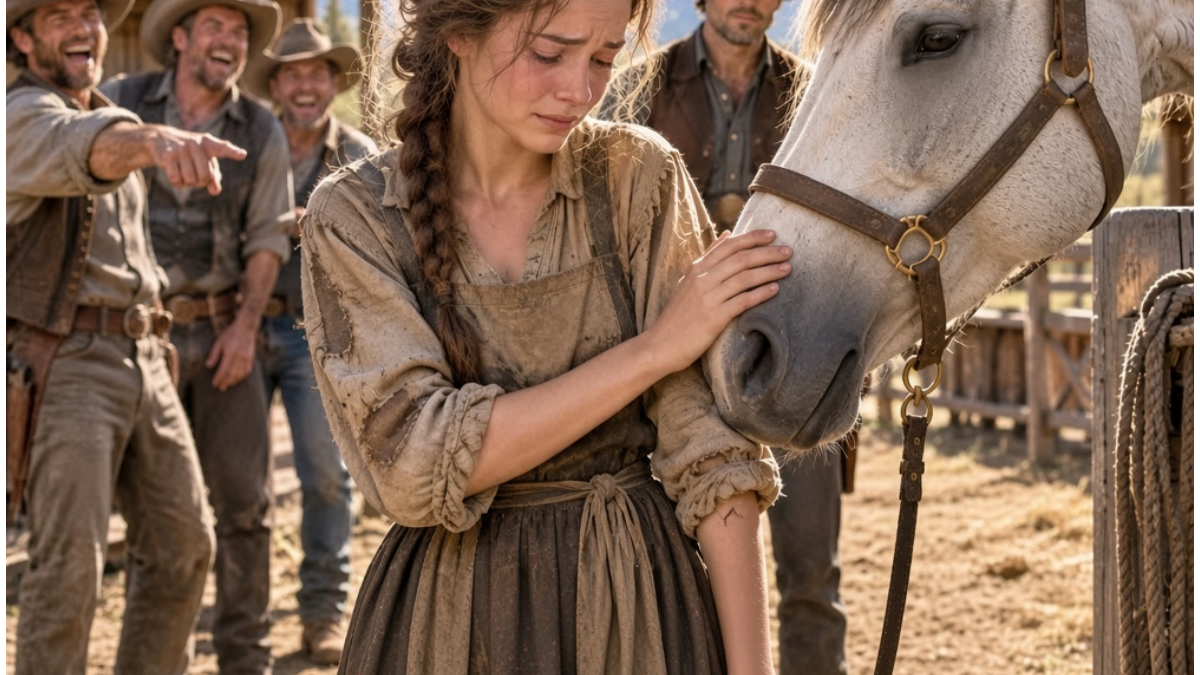
Gideon Pike had worked 30 years on ranches where men settled questions with fists or firearms, and he had learned one thing about authority.
The moment you let someone beneath you tell you what to do, you had already loSt. So when he found Norah Keen standing inside Sovereign’s enclosure at 5 in the morning, a woman who had been on this ranch for less than a week, a woman whose coat had more patches than original fabric, he didn’t bother with words.
He grabbed the enclosure gate and slammed it open hard enough to rattle the poSt. “Get out,” he said, “Right now, or I will drag you out.”
The stallion’s ears went flat. Norah didn’t move. And that was when Gideon realized he was looking at something he hadn’t seen in 30 years of working ranches.
Not defiance, not stupidity, something that unsettled him far more. She wasn’t afraid of any of it.
Not the horse, not him. Not losing the job.
The walk was 6 milesi. Norah had done longer for less. She’d left before sunrise, so the last two miles would be in proper morning light because she’d learned from experience that arriving somewhere looking like you’d traveled in the dark did not help first impressions.
A woman showing up to ask for stable work already had two things working against her before she said a single word.
Showing up dusty and disoriented made it three. She carried her bed roll on her left shoulder and her single bag on her right, and she did not switch them because she’d also learned that arriving with visible exhaustion with hunched shoulders or a dragging step telegraphed something she couldn’t afford to telegraph, that she needed this particular job, that she had no other reasonable option.
Both things were true. Neither thing needed to be announced. The road curved east about a mile out, and she got her first look at Ror Ranch in the early light.
The long fencing lines, the outbuildings arranged with the kind of deliberate planning that said, “Money and time.”
The main house sitting back from the workyards, with the slight elevation of something that knew what it was.
The stable was large and recent, and the corrals running alongside it were well-maintained in a way that casual ranches weren’t.
The posts weren’t leaning. The gates were hung properly. Norah noticed those things the way other women might notice curtains or a set table.
She had been around working ranches long enough to read them like a sentence. This one said, “We take this seriously here.”
She adjusted the bed roll and kept walking. The foreman was already in the yard when she came through the main entrance, and he looked at her the way she’d expected, which was to say, “With a kind of automatic downgrading, not hostile, worse.”
The look that men like that gave when they were already composing their refusal before you’d said anything because you were obviously in the wrong place and the kindest thing was to tell you quickly and let you move on.
He was somewhere in his late 40s, broad through the chest with the weathered coloring of someone who’d spent most of his life outside and the posture of someone who’d spent most of it in charge of other people.
Ranch isn’t hiring for household help, he said. I’m not looking for household work. Norah set her bag down, not dropping it, setting it, so it didn’t raise a cloud of dust and looked at him directly.
I heard you were short on stable hands. Where’d you hear that? Farley’s supply store.
The man loading feed said two of your hands left in the spring. Gideon studied her for a moment.
Stable work is heavy work. Water hauling, feed carrying, manure removal. It’s not a domestic position.
I know what stable work is. You worked stables before. It wasn’t quite a question.
It was the tone someone uses when they already expect the answer to be no and they’re giving you a graceful way to reframe your experience before you get embarrassed.
Since I was 11, Norah said, “My father worked remount horses. I worked beside him until I was 18.”
“Your father? He died 6 years ago. Something shifted in Gideon’s face. Not softness, more like recalibration.”
He looked at her bag, then back at her face. I can’t offer a bunk house for a woman.
We’ve got a small room behind the last stable used to be for equipment storage.
It’s not I don’t need it to be comfortable, Norah said. I need it to be dry.
Gideon was quiet for a moment. A man emerged from the stables far end, leading a gray geling with a rope halter, and immediately Norah could see the problem.
The horse was pulling hard to the right, and the man, young, maybe 22, with the confident impatience of someone who’d handled horses his whole life, and had stopped paying close attention, kept correcting him with pressure instead of pausing to understand why the horse was doing it.
The geling didn’t look frightened. He looked pained. Norah’s mouth was open before she’d made a deliberate decision to speak.
“The left side,” she said. “He’s avoiding something on the left.” The young man looked up, surprised, and Gideon’s expression closed slightly.
She’d stepped past the conversation they were having, and into some that wasn’t hers yet, and she knew it, but she also knew what she was seeing.
“The stone is probably under the shoe,” she said. “Front left, maybe the right front.
He’s been compensating.” The young man, Daniel, she’d learned later, glanced at Gideon. Then, more out of curiosity than agreement, he ran a hand down the geling’s left foreged the foot.
There was a river stone wedged between the frog and the inside of the shoe, medium-sized.
The edge had worked itself in deep enough that every step the horse took had been pressing it into soft tissue.
Daniel stared at it for a moment. Then he looked at Nora. She said nothing.
She was watching the geling’s expression change as Daniel worked the stone free. That subtle settling, the ears moving through a series of positions and then going quiet.
The slight shift in weight that meant the body had stopped bracing for pain. I wasn’t hired to show off, Norah said.
I just saw it. She looked back at Gideon. He was watching her with an expression she couldn’t fully read, which was different from how he’d looked at her 30 seconds ago.
And that difference mattered even if she couldn’t name it precisely. One week Gideon said, “I’ll know what you’re worth in a week.”
She learned the ranch’s rhythms inside of two days. The stable held 14 horses on the normal rotation, some working animals, some for the ranch’s breeding program, two that were recovering from minor injuries and needed quiet handling.
The work was what Gideon had promised: water buckets twice a day, stall cleaning, tac maintenance, feed distribution.
Physical without being dangerous, repetitive without being mindless, the kind of work that most pe underestimated because it didn’t look skilled from the outside.
Norah didn’t find it beneath her. She’d done exactly this for longer stretches on worse ranches, and she’d learned to find the particular focus that repetitive physical work allowed, not emptiness exactly, more like a narrowing down to the immediate thing in front of you, which was occasionally a relief.
She kept to herself. She ate with the ranch hands because there was nowhere else to eat, but she ate at the end of the table and didn’t push herself into conversation.
Men on working ranches had their own social architecture, their own established order, and she’d made enough mistakes early in her working life by failing to respect that before she’d earned a place in it.
Daniel watched her with the candid curiosity of someone who hadn’t fully decided what to make of her.
He wasn’t hostile. The stone incident had complicated that for him she suspected. He was in the stage of observed neutrality that that came before people made up their minds.
And she respected it because it was honeSt. Gideon she barely saw after the first morning.
He checked her work. He never said it was good. He also never said it wasn’t.
She understood that as provisional acceptance and treated it accordingly. On the third day, she heard sovereign.
She didn’t know what he was at firSt. She heard the sound from the far end of the stable before she rounded the corner.
A low rhythmic impact that her body recognized as distressed movement before her mind had finished processing it.
A horse moving in a confined space, not out of energy, but out of agitation, the kind of movement that came from prolonged frustration or fear that had no outlet.
She walked toward it. The enclosure at the far end of the main stable was separate from the others, set back slightly, with the solid wooden sides that denoted a high-v value animal who needed either protection or containment or both.
She got to within 20 ft before the stallion moved into a position where she could see him.
He was extraordinary. She’d worked around expensive horses before, breeding stock and remount animals and three-year-olds with the kind of bloodlines that made men speak in careful low voices.
She knew the difference between a well-b bred horse and a genuinely remarkable one. And this animal, deep black, with the muscular architectures that said breeding, not just for appearance, but for capacity, for longevity, for the kind of work that outlasted fashion, was on one end of that scale.
He was also in tremendous distress, not the visible distress of an injured animal, the deeper, more dangerous kind.
The distress of an intelligent creature who had learned that people arrived with intentions he couldn’t predict and hands he couldn’t trust and who had decided the only available response was to make himself impossible to approach.
He’d stopped moving when she appeared at the fence. He was watching her with his full attention, which meant ears positioned, nostrils wide, the faintest trembling in the muscles of his neck that wasn’t visible effort but pure held tension.
Norah didn’t move toward the gate. She stood still. She didn’t make a sound, didn’t reach out her hand, didn’t perform the things she’d seen men perform around nervous animals, the soft noises, the slow approach, the demonstrated harmlessness that sometimes helped and sometimes read as condescension to an animal who’d been fooled by versions of it before.
She just stood there. After a while, Sovereign’s weight shifted. The trembling in his neck eased slightly.
His ears moved from full forward to a position that wasn’t exactly relaxed, but wasn’t maximum alertness either.
She stayed another 5 minutes and then went back to her work. His name is Sovereign, Daniel said that evening without her asking.
He used to be manageable. Not easy, but manageable. 6 months ago, one of the trainers got impatient during a session.
And it doesn’t matter what exactly happened. He hasn’t been right since. Injured M Hollister’s arm bad enough Mack couldn’t work for three weeks.
Kicked through a fence post, Mr. Ror had a vet look at him. Nothing physical.
So, it’s not physical, Norah said. That’s what everyone thinks. What do you think? Daniel was quiet for a moment, turning a piece of wire over in his hands.
I think he’s angry, he said. And I think he knows exactly what he’s doing.
Norah thought about the way the stallion had held himself when she’d appeared at the fence.
Not wild panic, not the random violence of an animal that had snapped. Something more specific than that, more deliberate.
What does Mr. Ror plan to do with him? He’s worth too much to put down.
The breeding contracts alone, Daniel stopped. He keeps saying he’ll find someone. Norah said nothing.
She went back to the equipment room she was sleeping in, which had a cot that was functional and a window that let in enough air, and she thought about what she’d seen in that enclosure.
Not the beauty of it, not the tragedy of it, both of which were real.
The specific quality of how Sovereign had looked at her when she’d stopped moving. It wasn’t recognition.
It wasn’t truSt. It was the beginning of something that might eventually become a question.
She fell asleep calculating how long her wages would need to last before she had enough to send something decent to Will.
She was back at the fence before sunrise the next morning. She didn’t go inside.
She stood at the outside again. Same position, same stillness. Sovereign was in the far corner when she arrived.
He moved to a middle distance after a while watching her. She stayed for 20 minutes and then went to start morning water.
She did the same thing the next day and the day after. Gideon saw her on the second morning and said nothing.
On the third morning, he watched for a moment and then walked away, and she couldn’t tell from his back whether this was a was permission or contempt.
On the sixth day, which was supposed to be her last day of the trial week, she arrived at the fence to find sovereign standing closer to the boards than he’d ever been.
Not at the fence, not performing anything, just positioned closer than before, with the casual manner of an animal who’d made a decision he didn’t particularly want examined.
Norah put her right hand flat against one of the boards. She could feel the wood.
She could not feel the horse. But she stayed with her palm against the fence for the entire 20 minutes.
And when she left, she didn’t look back cuz because looking back was a thing you did when you needed reassurance.
And she was trying to make herself into something that didn’t need it. She was in the middle of the morning feed distribution when she heard the voice behind her, not Gideon’s voice.
Lower with a quality she noticed before she understood what she was noticing. A particular tone of someone who asks questions because they genuinely want answers, not because they’re testing you or establishing authority.
How long has he been moving to the fence when you’re there? She turned. Everett Ror was standing in the stables center aisle, and she had a single moment of rapid assessment before anything else.
40 or so, she’d guessed wrong. He was 35 at moSt. the kind of physical presence that came from actual work rather than the performed ease of men who owned things without understanding them.
He was dressed simply and she registered this immediately as information men who needed people to know what they owned dressed in a way that announced it.
Men who already knew didn’t bother. He was looking at her with the particular attention of someone who’d been watching for longer than she’d realized.
3 days. Norah said, “You’ve been going out there before the rest of the ranch is moving.”
I didn’t think she stopped. She’d been about to say she didn’t think anyone was watching, which was both true and not something she wanted to say to the man whose ranch she was working.
I wasn’t touching him, she said instead. I wasn’t going inside. I know. A pause.
What are you doing out there, then? Norah considered this. She could give him the version that sounded intentional and professional.
The language of horsemanship. The borrowed vocabulary of trainers she’d watched. Or she could tell him the actual truth, which was less impressive and considerably more honeSt. Letting him get used to me being nearby, she said, without anything being required of him.
Everett was quiet for a moment. Gideon says, “Your weekend’s today.” Yes. You haven’t complained about the work.
The work is fair. Something passed through his expression. Not amusement exactly, more like intereSt. Most people find a way to mention that the room come is below what they expected.
It’s dry, Norah said. I said I needed it to be dry. He looked at her with a full directness that she held without flinching because she’d learned long ago that the moment you looked away from wealthy men when they looked at you, they filed you under a category that was very difficult to exit afterward.
I’d like to ask you something, Everett said. All right. What do you think is wrong with him?
She waited a moment before answering because this was the kind of question that deserved an honest answer and honest answers sometimes needed a second to arrive.
I don’t think anything is wrong with him, she said. I think something was done to him and I think he decided the only way to stop it from happening again was to make himself dangerous to approach.
That’s not a physical problem. No, the vet found nothing structural. I didn’t say there was anything structural.
Everett looked at her steadily. Everyone I’ve brought in to work with him has tried to address the behavior by confronting it directly.
Firm handling, boundary setting, gradual pressure. That would make it worse, Norah said. Then she stopped because she was telling the man what would happen on his own ranch with his own horse, and she’d done it without asking permission, and she watched his face to see whether that was going to be a problem.
He didn’t look offended. He looked like he was thinking. Why worse? He said because he’s not behaving that way because he forgot the rules.
Norah said he’s behaving that way because he stopped believing that following the rules protected him.
Pressure confirms what he already believes. Everett was quiet for a long moment. Then he said, “Your week ends today.
I’d like to offer you a second week.” “Same work. Same work. But I want you to spend an hour each morning at that enclosure.”
Norah looked at him. Doing what? Whatever you were doing, Everett said. Nothing. Apparently, she found out later, much later, that he’d been in the stable before she arrived that sixth morning.
That he’d watched her stand at the fence for the full 20 minutes. That he’d watched Sovereign cross to the near side of the enclosure without being called or led or persuaded.
He didn’t tell her any of this at the time. She didn’t learn it until months later after enough had happened between them that he felt comfortable admitting that the moment he’d decided to extend her trial wasn’t the thing she’d said.
It was the thing she hadn’t done. She’d watched the horse settle and she hadn’t reached for him.
She’d stood there with her hand against the boards and then walked away without looking back.
He told her he’d never seen a person resist that particular impulse, the impulse to reach, to confirm, to collect the reassurance of contact with such apparent ease.
Norah had laughed a little when he said that, because it hadn’t been ease at all.
On the morning of the ninth day, she stepped inside the enclosure. Not quickly, not with ceremony.
She left the gate behind her standing open because she unders she had understood from the beginning that the open gate was not a safety measure for her.
It was a communication to the horse. You can leave. Nothing is forcing you to stay.
Sovereign was in his corner. He watched her come in. She walked to a position roughly in the middle of the enclosure, not toward him, not away, and stopped.
She let him look at her. She looked at something to his left rather than directly at him, because direct eye contact with an animal who’d learned to read intention in approach was not neutrality.
It was pressure in a direction. And she didn’t want to press anything. For a long time, nothing happened.
And then something happened. Sovereign took two steps toward her. Not the aggressive repositioning she’d seen him use with others.
Something more tentative than that. The walk of an animal testing a hypothesis. Norah breathed slowly.
He took two more steps. Then he stopped about 4 ft from her left shoulder, and she could feel the presence of him the way you feel heat from a fire without touching it.
And she stayed perfectly still while he decided whatever he was deciding. After a moment, she heard him breathe.
Then she heard him breathe again. Long settling, she didn’t look at him. 15 minutes later, she walked out.
Everett found her that evening. “How was he?” He asked. “Curious,” Norah said. “Not calm.”
“Curious is different from calm.” “What does the difference mean?” “Calm is an absence,” she said.
“Curious is active. He’s thinking about me.” That’s she paused trying to find the right word.
That’s the beginning of something worth working with. Everett nodded slowly. He had his hands in his coat pockets and he was looking at the stable wall and she noticed that he not did not look at her when he was processing information.
He looked somewhere neutral. As if direct attention pulled too many things into the same space at once.
She filed that away without intending to. He injured two of my men before the vet was called.
Everett said. Gideon thinks he needs to be sold before he hurts someone seriously. He might, Norah said honestly.
You don’t think so? I don’t know yet, she looked at him directly. I’ve been inside his enclosure once.
What would you need to know? More mornings, she said. And for everyone else to stay away from that enclosure while I’m trying to find out.
The request was direct, and she knew it was direct, and she knew it was asking for something significant to be given exclusive authority over an extraordinarily expensive animal at her own assessment on the basis of one morning that had produced nothing visible.
Ever looked at her for a moment. I’ll talk to Gideon, he said. That night, Norah lay in the equipment room, listening to the sounds of the stable, the occasional shift of an animal, the distant sound of wind off the range, the various small complaints of a wooden structure at night, and thought about what she’d felt when Sovereign had walked toward her.
Not triumph, not vindication, the particular quality of a thing being offered that hasn’t been offered to anyone in a long time.
She thought about Will, 14 years old and working a harvest job three towns over sending her letters with the careful handwriting of someone who’d taught himself.
She thought about the figures she’d been calculating. Two more months, possibly three. She turned over on the cot.
She thought, “Stay practical. Stay practical and do the work and don’t charge this place like it’s something it isn’t.”
She had told herself versions of this on every ranch she’d worked. She fell asleep before she could notice at this time the instruction came with a particular effort she hadn’t needed before.
On the morning of the 11th day she was standing in Sovereign’s enclosure when she heard the gate crash open behind her.
She had learned by then to go still when Sovereign startled not freeze, not Titan, but the specific stillness that says that says nothing is wrong.
I am not alarmed. There is no danger in this space. So she went still.
Sovereign pulled back hard to the far wall. Gideon was in the gate. He took in the scene with the expression of a man confirming something he’d been suspicious of for days.
A stable worker he hadn’t wanted in an enclosure he’d told her to stay out of.
Alone with an animal that had already put two men in the infirmary. Get out, he said.
His voice had the absolute flatness of authority that doesn’t expect to be debated. Right now, or I will drag you out.
Sovereign’s ears went flat. Norah could feel the quality of the horse’s attention change. Not toward her, toward Gideon, toward the hard sound of that voice and the aggressive entry and the way conflict raised itself in a space that had just for 11 careful days been learning to be something else.
She could feel everything she’d built starting to unravel. She didn’t move. She kept her voice at the particular low level that wasn’t quiet because of fear, but quiet because she was thinking very carefully about every word.
If you come further into this enclosure right now, she said, he will go through that far wall.
Gideon stared at her. I am not telling you what to do, Norah said. I’m telling you what this horse will do.
You can override me. But you’ll want to be clear on the fence’s structural condition before you decide.
Silence. Sovereign was trembling, not with fear exactly, with the coiled, ready quality of an animal deciding.
Gideon stood in the gate for a long moment. Then he stepped back outside, not because she’d convinced him.
His expression said clearly that nothing she’d said had moved him. He stepped back because the horse’s posture had told him something more direct than anything she could say.
And 30 years of ranch work meant he could read that much, even when he wanted to be certain she was wrong.
He pointed at her. When you’re done, he said, “You come find me.” He walked away.
Norah stood in the enclosure for another 10 minutes, speaking quietly into the air, not to the horse specifically, just words at a low level in rhythm.
Gradually, Sovereign’s weight shifted back to something less gathered. His ears moved through several positions and settled into something that wasn’t relaxed, but wasn’t immediate alarm.
When she stepped out, her hands were steady. Her heart was not. She found Gideon at the fence line at the far end of the working corral and she stood beside him and waited while he decided how to begin.
“Mr. Ror told me to give you access to that enclosure.” Gideon said, “He didn’t tell me you were going inside it.
I understood going inside to be part of. What you understood is not the same as what was said.”
He turned to look at her. Not with anger. Exactly. With the particular exhaustion of a man who has been managing a complicated situation for months and has just found it more complicated.
You could have been seriously injured. Yes, that doesn’t bother you. I’m still here, Norah said.
Gideon looked at her for a long moment. I’ve been foreman on this ranch for 11 years.
He said, I have never once had Mr. Ror override my decision on a staffing matter.
Norah said nothing. You understand that? I understand that. I want you to understand exactly what that means for how this works.
My decisions about the men on this ranch, about how the stable operates, about what happens in those corral are mine.
Mr. Ror concerns himself with the business. I understand, Norah said. Do I do? She met his eyes directly.
I’m not trying to change how this ranch runs. Miss Pike, I’m trying to find out whether that horse can be brought back to something workable.
That’s all. Gideon was quiet. In the distance, one of the working horses was moving steadily around a corral, being schooled by a hand she hadn’t spoken to yet.
“I’ll tell you once,” Gideon said finally. “You do not enter that enclosure without my knowledge.
That is not about authority for its own sake. That is because if something happens to you in there, it falls on this ranch.”
“You understand?” “I understand,” Norah said. It wasn’t full agreement, and both of them knew it.
But it was the kind of partial accommodation that allowed the next day to happen.
And Norah had learned long before this ranch that sometimes the most useful thing was simply allowing the next day to arrive.
Everett found out about the confrontation that evening. Gideon had told him, which was what Gideon would do not as complaint exactly, but as information, as the kind of report that allowed a man in authority to stay current on what was happening in his own operation.
Everett had listened and asked two questions and then come looking for her. She was cleaning Tac in the back of the stable when he appeared.
Gideon tells me you were inside the enclosure. He said, “Yes.” He also tells me Sovereign didn’t attack you.
No. Everett looked at her for a moment with that quality. She was beginning to recognize the looking sideways while processing that he did when something was landing differently than he’d expected.
“I should have been clearer about what I was asking you to do,” he said.
Norah stopped what she was doing. It was not the sentence she’d prepared for. I told you to spend time at the enclosure, Everert said.
I didn’t specify outside it because I didn’t think he stopped. I didn’t think through what you’d actually understand that to mean.
I would have told you, Norah said carefully. If I thought you meant the outside specifically.
I know. He was quiet for a moment. What was it like in there with him?
She thought about how to answer this honestly. Quiet, she said. Eventually, he came to you.
He moved toward me. Whether that’s coming to me or investigating something unfamiliar, I don’t know yet.
Everett nodded slowly. Gideon wants to put a clear rule in place, he said. No one inside that enclosure without his knowledge and explicit approval.
That’s reasonable, Norah said. He looked at her. It means asking permission every morning. I understand.
She met his eyes. That’s still worth it. Something in Everett’s expression shifted not much, but she’d become attuned to small movements in him.
The way you become attuned to small movements in horses, a change in weight, a quality of attention sharpening toward something specific.
All right, he said. He started to leave, then stopped. What you said to Gideon about the fence?
I shouldn’t have. No, he said it was right. A pause. How did you know the horse was about to go through it?
Norah thought about this. I didn’t know. She said, I knew what he was capable of.
And I knew that Gideon’s voice and the way he came through that gate would push him toward maximum response.
She looked down at the tack in her hands. I used the certainty to buy some space.
I didn’t have certainty. I had a reading of the situation. Everett was quiet for a long time.
My father used to say that the difference between a good decision and a lucky one was whether you understood why it worked.
He said he said most people couldn’t tell the difference. What do you think? Ever looked at her with an expression she couldn’t quite name.
“I think my father had a talent for being right about things and wrong about people,” he said.
Then he left. Norah sat with the tack in her hands for a moment. She set it down carefully and went to look in on the horses and do not.
She instructed herself firmly, “Start attaching meaning to sentences that don’t need meaning attached to them.”
She was still telling herself this when she fell asleep that night. It was considerably less effective than it had been the night before.
The mornings became a kind of discipline. Norah arrived at Sovereign’s enclosure before the rest of the ranch had finished its first coffee, and she stood inside the gate in the particular way she’d developed over the first two weeks, not performing stillness, actually still, the way a person gets still when they’ve stopped anticipating and started simply existing in a space.
She’d learned the difference between those two things from her father, who’d had a gift for it, that she’d spent years trying to understand.
And finally stopped trying to understand and just practiced until some version of it became her own.
Sovereign had stopped treating her as a threat around day 14. That was not the same as trusting her.
She understood the distinction with complete clarity because she’d seen other people miss it. Handlers who confused the absence of an attack with the presence of a relationship.
Trainers who read a horse’s tolerance as acceptance and pushed forward on the strength of it and then weren’t genuinely surprised when the animal decided the tolerance had a ceiling.
She wasn’t going to make that mistake. What she was doing instead was building a record.
Every morning in that enclosure was one more data point in an argument she was making to the horse without language.
I come here. I don’t take anything. I leave. I come back. I still don’t take anything.
The argument was slow and repetitive and required an enormous amount of restraint because there were mornings when Sovereign would drift within arms reach and something in her would pull toward contact toward the natural human instinct to confirm the progress with a touch and she’d feel that pull and consciously set it aside and go back to being still.
She thought about Will on those mornings. It helped with the patience. On the 18th day, Sovereign lowered his muzzle toward her left hand, not onto it, toward it, the way a question moves before it fully arrives.
Norah held her breath somewhere inside herself while her body stayed exactly where it was, and she waited and sovereign breathed against her knuckles, warm, deliberate, the kind of breath that isn’t accidental, and then moved away.
She stayed in the enclosure for another 10 minutes and didn’t reach for him once.
Walking back to the stable, she had the thought quiet and unannounced, the way the most important thoughts often arrived that she hadn’t told anyone how this felt.
Not Gideon, because Gideon tracked her progress with the weary attention of someone waiting to be proven right about something.
Not Daniel, who’d warmed to her over the weeks in the way of someone who respects competence, but hasn’t fully decided what category to put her in.
And not Everett, who asked after Sovereign every few days in a tone that was professional and careful and contained something else she’d been deliberately not examining.
She had no one to tell. That was not new. It was simply more noticeable on a morning when there was something worth telling.
The first real setback came on a Tuesday in the fourth week, and it came from nothing visible, which was the worst kind.
Norah had been watching Sovereign for patterns, the specific conditions under which he became agitated.
The trigger she could identify and eventually work around. The most consistent one was what Daniel had mentioned, men approaching from his left rear quarter.
She’d observed it enough times from outside the enclosure to be certain [clears throat] something had happened in that direction at some point during the incident that had started all of this.
The horse had had installed it as a warning signal that bypassed everything else he’d learned.
But on that Tuesday, the agitation came without a left rear approach. It came while she was standing 6 ft in front of him in the morning, doing nothing different than she’d done for 3 weeks.
Sovereign’s head went up. His whole body changed, not dramatically, not with the explosive repositioning she’d seen in the early days, but with the specific quality of an animal who has left the present moment and gone somewhere else.
Somewhere were different rules applied. Norah went very still. For a full minute she didn’t move, and neither did he, and the enclosure had the concentrated attention of a space where something was being decided.
Then Sovereign turned away from her and pressed himself against the farboards. She left. She stood outside the enclosure for several minutes and breathed slowly and ran back through everything she could remember about the past hour.
Different quality of light? She didn’t think so. Had anyone walked past at an unusual time?
She hadn’t noticed. Had she moved differently, stewed differently, made a sound? She couldn’t find it.
That was the part that unsettled her most, not the setback itself, but the impossibility of identifying the cause.
You could not address what you couldn’t locate. She went back to her regular work.
She found Daniel near the water troughs later that morning, and she asked him as neutrally as she could whether anything had happened near the stables far end that morning.
He thought about it. Hollister, he said. Mac Hollister. He was walking the perimeter to check the fence posts.
Around 7, maybe 7:15, Norah looked at him. Mac, she said. He was outside the enclosure, wasn’t anywhere near Daniel stopped, and she could see him catching up.
He was on the left side, the outside of the left wall. She hadn’t seen Hollister.
She’d been inside the enclosure facing the wrong direction to see someone moving along the outer wall.
But Sovereign had felt the footsteps, or heard something vibration through the boards, a sound she hadn’t processed, and had gone somewhere inside himself where Norah’s weeks of careful work didn’t reach.
Can you keep Hollister away from that side of the stable in the mornings? Daniel looked at her for a moment, not resentfully.
More with the expression of someone recalibrating something. I can ask him. I’m not trying to manage the ranch, she said.
I just need to know the variables I’m working with. I know, Daniel said. I’ll ask him.
He did. She didn’t hear the conversation. But the next morning, M. Hollister took a different route, and the morning after that, sovereign didn’t leave the present moment.
That was the beginning of Daniel choosing her side of something before Gideon told him which side to choose.
She noticed it and filed it and didn’t make more of it than it was.
Everett began joining her before sunrise. It didn’t start as a pattern. The first time he appeared at the enclosure while she was already inside, and she heard the slight sound of him arriving at the fence, and felt Sovereign notice it, too, and she turned carefully and found him standing outside the gate with his coat collar up against the early morning cold, watching.
She gestured a small motion down at the ground, and he understood it. Stay there.
Be still. He stayed. He was still. After a few minutes, Sovereign acknowledged his presence with a flick of an ear and returned his attention to Norah, which was itself a kind of progress.
The horse was not equating Ever’s presence with danger. He was filing it as background.
When she came out, Everett said, “What was that ear movement? He decided you weren’t interesting enough to be a problem.
I’m not sure whether to be relieved or insulted.” Relieved, she said, “Last month you were a threat.
Now your furniture.” He laughed. It was a real laugh, not the polished version. Not the laugh of a man performing ease, but the slightly surprised sound of someone who has just found something genuinely funny when they weren’t expecting to.
It changed his face, made him look younger and less certain of himself, which paradoxically made her trust him more.
He came back the next morning and the one after that. She began understanding things about him in the way you understand people through shared quiet in pieces without interview.
Through the gradual accumulation of small revealed things. She learned that he arrived at decisions slowly and held them firmly once made.
She learned that he disliked uncertainty not because he needed control, but because uncertainty in his world had historically meant that someone got hurt or lost money, and he’d conflated the two until they felt indistinguishable.
She learned that he was more patient with animals than with people, and that he found this fact about himself mildly troubling.
She told him almost nothing about herself in return. She wasn’t being evasive. Or she was, but not intentionally.
It was more that she’d spent so many years in situations where information about her became a kind of leverage that she’d stopped chanting it reflexively.
The way you stop carrying things in your outside pockets after enough of them go missing.
He learned about her father the way she’d told Gideon practically as context. He learned about Will because she mentioned sending wages and he asked.
He asked good questions. That was something she hadn’t expected. Not questions designed to gather information though she knew the shape of had been asked them her whole working life by employers who wanted to establish thigh dimensions of a thing before deciding how to manage it.
His questions were the other kind. The kind that came from actual curiosity from someone who was paying attention and wanted to understand what they were paying attention to.
One morning, about 3 weeks into the shared before sunrise routine, he asked her why she hadn’t tried to touch sovereign yet.
They were both standing outside the fence by then. She’d begun coming out after her time inside and staying at the fence rather than walking back immediately, and Everett had started arriving early enough to be there when she finished.
I have touched him, she said. He looked at her when he breathed on my hand on the 18th day.
I counted that. Everett was quiet for a moment. That’s not how I’d count it.
I know. That’s why you’re not the one doing this. It came out more directly than she’d intended, and she felt the slight wse of it after the words were already out.
Not because it was wrong, but because of the difference in what they were to each other and the line she’d just crossed over without checking where the line was.
Everett said nothing for a long moment. Then fair. Just that. One word and the specific quality of it.
No offense taken. No reminder of relative position. Just genuine concession made something ease slightly in her chest that she hadn’t known was held tight.
He needs to understand that contact isn’t the beginning of something being required of him.
Norah [clears throat] said more carefully. Every time someone has gotten close to him, it’s led to being handled.
To tack to work to demands. He needs enough experiences of proximity that don’t lead anywhere before proximity stops predicting something.
Everett looked at Sovereign, who was standing in his middle distance position and watching them both with the calm alertness he’d arrived at over the past month.
How long will that take? I don’t know, weeks, more. I don’t know, she said again.
I can’t give you a schedule. I can give you progress. He looked at her.
That’s an uncomfortable answer for someone running a ranch around breeding contracts and seasonal auctions, he said.
I know, but it’s the honest one. Yes. He nodded slowly, looking back at Sovereign.
All right, he said. On the 31st day, she finally put her hand on him.
It happened during the morning session, and it didn’t happen the way she’d imagined it, not some culminating moment of the horse walking over and and dropping his head into her hands.
It happened because Sovereign had been moving around the enclosure in a slow, loose pattern, something he’d begun doing in the past week when his energy was up and he’d passed close to her twice and the third time she simply moved her right hand to the outside of her hip, low and open and still, and he passed through it.
His flank moved under her palm for three steps. Then he was past her and still moving, and nothing had exploded.
She stood with her hand at her side. Her heart was going hard in a way that she didn’t let any part of her face or posture reflect because the horse could read her even when she thought she was hiding something.
And what she was feeling right now was not calm. It was the particular quality of something significant happening.
Something she’d worked toward carefully for over a month, arriving not with drama, but with the matterof fact simplicity of a long-maintained argument being accepted.
She stayed in the enclosure for another 15 minutes. He passed her twice more without the contact.
On the third pass, she didn’t extend her hand, and he moved close anyway, and the space between them was different than it had been.
When she came out, Everett was at the fence. He’d seen it. She could tell from his expression, not the excitement she might have expected, but something something quieter than that, and she understood after a moment that he was keeping his reaction calibrated to hers, reading her for the right register and matching it rather than imposing his own.
That was not a small thing. 31 days, he said. He moved through. I didn’t hold.
I saw. They stood for a moment. What’s next? He asked. I let him do it again.
She said as many times as he needs before I do anything more than let him.
Everett nodded. Then after a pause, I want to show you something. He led her to the stables back room, which served as a kind of working office schedules, contracts, notes on individual animals.
He unrolled a piece of paper on the workt and she found herself looking at Sovereign’s lineage documentation.
He walked her through it. The breeding history, the contracted expectations, the specific value points that t made this horse central to the ranch’s program.
He wasn’t lecturing. He was sharing information. The way a person shares information when they’ve decided the other person has a right to it.
She’d handled valuable animals before, but reading it spelled out like that, the actual dollar figures, the contracted parties, the scope of what this horse meant to the ranch, gave it a different weight.
I’m telling you this, Everett said, because I’ve been making decisions about his training without giving you full context.
You asked me to let you work with him, and I said yes. You should know what that yes was carrying.
She looked at the documents. It doesn’t change anything I’m doing, she said. I know.
He rolled the paper back up. I wanted you to know anyway. On the 38th day, she saddled him.
That wasn’t quite accurate. She put tack on him and then took it off and then put it on again.
And the entire exercise was less about getting him saddled than about rebuilding the association between saddling and ordinary life.
She’d been working toward it for a week, bringing the tack into the enclosure and leaving it in his space, letting him investigate it on his own terms, not reaching for him with it.
Letting the objects become familiar before they became significant. When she finally put the saddle on his back on the 38th day, he turned his head and looked at it.
He didn’t explode. He stood there with a particular expression of an animal who is deciding whether to to decide something.
And Norah stood at his shoulder and kept her hand flat on his neck and breathed deliberately.
And after a minute, he breathed too and dropped his head slightly. And the decision resolved into something that wasn’t acceptance, not yet, but was something in that direction.
She took the saddle off after 3 minutes. She did it again the next day and the day after that for longer.
That week, Gideon walked into the enclosure while she was working and stood near the gate and watched.
He didn’t say say anything. She didn’t say anything. When she came out, he made a sound that wasn’t exactly gougement and wasn’t exactly her approval and then walked away.
She filed that, too. It was Everett’s interference that caused the first real break. She’d been working on Sovereign’s response to movement from his left rear of the original wound, the trigger she’d been approaching slowly for 3 weeks, introducing stimuli from that angle gradually and at enough distance that the horse’s response was manageable.
She’d made real progress. He no longer went to the far wall when she moved.
He startled and regrouped instead, which was fundamentally different. Startling was biology. Regrouping was a decision.
On a Wednesday morning, halfway through the sashin, Everett stepped into the enclosure. He’d been coming to the fence every morning for weeks.
He’d been quiet, stayed back, done everything right. This morning, something had been different in his attention.
She’d felt it before she understood it. The way his stillness had a different quality, more anticipatory, and she’d been about to ask him to step back when she’d gotten absorbed in a moment with Sovereign and forgotten to.
He came through the gate and walked toward her with the unconscious ease of a man on his own land and he was moving from the left and he was moving fast by the standards of that space and Sovereign’s whole body detonated.
Not at Everett at the situation. The stallion spun hard to the right and hit the fence boards with his shoulder.
Not catastrophically, not through them, but hard enough that the impact sound was loud and bad, and the boards held, but Sovereign’s front feet came up, and Norah had maybe 2 seconds to make a decision.
“Get out,” she said. Everett stopped. She’d put herself between him and Sovereign, which was not tactical.
It was instinct, and she could feel the horse behind her gathering himself, and she said again with full force, “Get out of the enclosure.”
Now he got out. Sovereign came down from his rear and hit the ground unsteadily and moved in three tight circles before stopping with his sides heaving.
Norah stayed in the enclosure. She did not go to him immediately. She stood where she was and breathed and let the space reconstitute itself around her presence, and after a long time the horse’s breathing slowed, and he looked at her not with the specific challenge of the early days, but with something exhausted, something that said, “I didn’t want that to happen either.”
When she came out, Everett was standing outside the gate. His face was she didn’t have a word for it.
Not embarrassed exactly, not defensive. He had the expression of a man who’s just done something and understood the full cost of it at approximately the same moment.
I should have asked. He said, “Yes, I’ve been in that space with you for weeks.”
Outside it, she said, “I assumed. I know what you assumed.” She stopped herself from saying the next thing, which was about the specifically damaging quality of assumptions made from positions of ownership, and instead said, “He’s been working on the left rear approach for 3 weeks.
We lost ground today.” Everett looked through the boards at Sovereign, who was in the middle of the enclosure now, not the far wall, which was something at leaSt. “I can fix it,” he said.
“I can fix it,” Norah said. “You leaving the enclosure to me to fix?” He looked at her.
She held his gaze and didn’t soften anything because this was the version of the interaction that mattered.
Not the apology, not the intention, but whether the boundary would be respected going forward or whether she’d be managing it indefinitely.
He said, “All right.” And then after a pause, “Was that in there where you putting yourself between us deliberately?”
“I don’t know,” Norah said honestly. He looked at her for a longer moment than was casual.
She turned and walked back toward the stable. She didn’t see him that evening. The next morning, he was at the fence again, and he stayed outside the gate without being told.
And when she came out, he asked how sovereign was. “Better,” she said. “He’s elastic, not brittle.
That’s the real progress.” “He recovered inside 20 minutes,” Everett nodded. “They stood for a while.
My father built this ranch the way he built everything,” Everett said eventually, not looking at her.
He decided what each piece of it was worth and then applied exactly enough of himself to make it perform and no more.
Animals land. The men who worked for him. He said it the way people say things they’ve carried for a long time without putting down.
He was good at it. He continued everything functioned. Nothing trusted him. Norah was quiet.
He died thinking that was because the world didn’t recognize good management. Everett said that the goal of the thing was its performance, not it.
He stopped. I spent 10 years running this ranch the way he taught me and not understanding why it worked and also wasn’t quite right.
She looked at the fence boards. Sovereign was the first animal I couldn’t manage into performing.
He said that was before you arrived. That was 2 months of watching him get worse and not understanding what I was doing wrong.
You weren’t doing anything wrong. Norah said the problem happened before you got there. I know that now.
But but I kept trying to own my way out of it. Apply enough resource, enough expertise, enough decision.
He made a short sound. He can’t tell the difference between my ownership of him and the man who handled him badly.
From where he stands, it all comes from the same gate. Norah was quiet for a moment.
That’s a useful thing to understand, she said. For the horse, for a lot of things.
He looked at her then sideways with an expression. She was starting to know the one that arrived when something had landed differently than he’d aimed it.
And he was deciding whether to let that sit or address it directly. He let it sit.
That was the morning she realized she was going to have to be careful with herself.
Not about him, about herself, about the specific thing that careful attention from a person in his position did to a person in hers.
And how easily a person could mistake being genuinely seen for something more survivable than it actually was.
She was careful for about a week. Sovereign accepted the saddle without violence on the 44th day.
Not without opinion, he shifted his weight, tested the girth twice with a particular sideways lean that she’d come to recognize as his version of complaint, turned his head, and exhaled at her in a pointed way, but he stood.
Norah walked him in a slow circle with the saddle on. Then she took it off.
When she came out, Everett was at the fence, and she saw his expression before she’d finished closing the gate.
Not the contained professionalism she’d been seeing from him, but something that came through the containment.
Something’s unguarded. She understood that it wasn’t about the horse. Or it wasn’t only about the horse.
She kept walking toward the stable. She heard him fall into step behind her, not chasing, just moving in the same direction, and then beside her when the path was wide enough.
Gideon wants to talk to you, he said. She stopped that tone. Practical, neutral, with just enough preparation in it meant something specific.
What about he has thoughts about putting someone else on sovereign for the initial writing work.
Someone with more effort stopped. His word was experience. Norah stood for a moment. His actual concern, she said carefully, is the credibility of the program in front of buyers.
Having a woman in charge of a breeding stallion worth that kind of money is, she stopped.
It’s not how it’s done. No, Everett agreed. It’s not. What do you want to do about it?
He looked at her directly. I want to tell Gideon that you have authority over sovereigns training until the situation warrants a different assessment.
Norah was quiet for a moment. That’s going to create a problem. She said, “I know.
Not just with Gideon. I know that, too.” He held her gaze. I’m telling you what I want to do.
I’m asking whether you agree it’s the right call. That [snorts] surprised her. She didn’t show it, but it surprised her.
Not the decision, which she’d half expected, but the asking, the treatment of her agreement as something with weight in the decision.
Yes, she said the right call. He nodded once. That afternoon, he told Gideon. She wasn’t there.
She heard about it from Daniel the next morning, who’d been there, and whose account had the careful precision of someone recounting something they’d been thinking about since it happened.
Gideon had objected, not with anger, with the measured reasonable objection of a man who believed he was right and was making the case to someone he’d worked beside for 11 years.
Everett had listened to all of it. Then he said, “She has authority over the stallion’s training.
Disagreement is permitted. Bypassing her is not.” Daniel said Gideon had been quiet for a long time after that.
Then he’d said, “I hope you know what you’re buying.” And walked [clears throat] away.
Norah held that for a while. Not the fact of the decision she’d expected Everett to make it once he’d asked hers whether it was right.
She held the specific word Gideon had used buying. She thought about what that word assumed.
She thought about the difference between being given authority and earning it and whether those were the same thing from the inside, even when they looked identical from the outside.
She went to the enclosure. Sovereign was near the fence when she arrived. She opened the gate and walked in, and he moved toward her without being called, and she stood beside him and put her hand flat against his neck, and felt the warmth there, the live steadiness of him, and thought, “This part, at least I earned entirely.”
But outside that enclosure, on this ranch, in this valley, the authority she’d been given was also the authority of a man’s decision.
She knew what her father would have said about that. She knew what her own history would have said about that.
She stood with her hand on Sovereign’s neck in the autumn light and gave herself the particular honesty she reserved for.
Moments when the alternative was selfdeception. It mattered that Everett Ror had made that decision.
It mattered more than she wanted it to and it would continue to matter until she had something of her own that didn’t require his name behind it.
She filed that. She kept it somewhere she could find it. Then she went back to work.
The first difficult horse came from outside the ranch on a Thursday in October. A rancher named Callaway from the neighboring valley had a 4-year-old mayor with a biting problem serious enough to to have cost two handlers their composure and one of them a finger.
Callaway had heard through the specific channels by which information travels between working ranches which are faster and less formal than anyone admits that Ror’s stable had someone who’d brought Sovereign back from the edge of being put down.
He wrote to Everett asking whether the person might look at his mayor. Everett brought the letter to Norah.
He did not tell her whether he thought she should accept. He put it on the workt in the stables back room and waited while she read it.
And when she looked up, he said, “Your call.” She thought about the mayor for a day.
She thought about what Callaway was actually asking. Not just the mayor’s behavior, but her asmess of it, her reputation attached to the outcome.
She thought about what it meant to take a job on the strength of Ror Ranch’s backing versus taking it on her own.
I’ll look at her, she said. But I want Callaway to understand that I’m the one he’s hiring, not the ranch.
Everett looked at her for a moment. He’ll pay the ranch regardless, then pay me out of it.
At what rate? She named a figure. It was reasonable she’d done the math against what a professional trainer in Denver would charge, adjusted for the territory and the specific problem, not undervaluing herself, not inflating.
Everett said, “Done without a pause that would have suggested he was deciding.” The mayor arrived 2 days later.
She was a good-looking animal with deep set, watchful eyes, and the specific quality of tension around her mouth that Norah had seen before, and horses who’d been handled with more confidence than understanding the permanent braced expression of a creature who’d learned that human hands near its face predicted unpleasantness.
It took Norah four sessions to find the root of it. The mayor had developed a sore under her halter from an ill-fitted PSF attack that hadn’t been caught early enough, and nobody had connected the subsequent biting to the original pain.
By the time the sore healed, the behavior had been punished often enough that it had become structural rather than reactive.
Norah worked with her for 2 weeks. On the last day, Callaway’s ranch hand stood near the mayor’s head while Norah adjusted the halter, and the mayor stood still.
Callaway paid. He also told two other ranchers about it before the month was out.
Norah started keeping a second set of figures alongside the one she kept for Will.
The ranch’s social order shifted around her in small increments that fall. The way water shifts the shape of things it moves over, not dramatically, not with announcement, but in ways that accumulated.
Daniel had become something approaching an ally. Not out of loyalty to her specifically, but out of the practical recognition that she consistently knew what she was doing, which was a currency that mattered to him more than hierarchy.
He’d started asking her questions, real questions, the kind that came from paying attention about reading horse behavior, about the difference between pain responses and learned responses, about why some animals recovered from rough handling and some didn’t.
She answered them directly without condescension, and he absorbed them with the serious attention of someone who intended to use what he learned.
Gideon remained at a careful distance, not hostile. Not openly undermining, he fulfilled Everett’s instruction to the letter.
He did not bypass her on Sovereign’s handling, but he watched her with the focused attention of a man who has decided he’s right about something and is waiting patiently for the evidence to arrive.
She understood this and accepted it because there was nothing else to do with it.
Men like Gideon Loyal, experienced, genuinely competent, didn’t change their assessment because someone asked them to.
They changed it because something they witnessed made the old assessment impossible to maintain. She couldn’t manufacture that.
She could only keep working. What she hadn’t anticipated was Everett’s mother. Margaret Ror had been at the ranch the whole time.
Norah knew this. In the abstract knew the widowed woman lived in the main house and managed its domestic operations with earned her positions with the quiet authorit who’d earned her position through decades of work rather than inheritance.
She’d seen her occasionally from a distance, a trim, upright woman in her mid-50s, with the kind of bearing that comes from having decided early what she thought of herself and seeing no reason to revise it.
But they’d never spoken directly until October gave way to November, and the mornings went cold.
Norah was at the water pump outside the stables east side when Margaret appeared, walking with the deliberate purpose of someone going somewhere specific rather than taking an unplanned route.
She stopped near the pump and looked at Nora with the particular assessment of a woman who is deciding something rather than already decided.
“You’re the woman who handled sovereign,” she said. “Yes, ma’am. My son speaks highly of your work.
Norah said nothing to this because there wasn’t an answer that didn’t come with a coSt. I want you to know, Margaret said, that I don’t have concerns about your work.
I’ve watched what you’ve done with that animal, and I have no disagreement with Everett’s decision to give you authority over it.
She paused. But, Norah said, Margaret looked at her without surprise. She’d apparently expected the directness.
But I also watched my my son come in from the stable every morning for 6 weeks carrying a different quality of attention than he carries into any other part of his day.
She said, “And I’ve spent enough time around people to know what that means.” Norah held herself completely still.
I’m not telling you to leave, Margaret said. I’m not suggesting you’ve done anything inappropriate.
I’m asking you a question. She looked at Norah with clear eyes. If my son marries you, if it goes that direction, how will you ever know which decisions are yours?
He would own this house, this ranch, every horse in those corral, the wages of every man who calls your decisions into question.
How would you know whether the life you were living was yours or a very comfortable version of his?
The question sat in the cold air between them. Norah had not been struck speechless often in her adult life.
She found herself without words now, not because the question was unfair, but because it was precisely the fear she’d been carrying since the first morning she’d understood she was in danger of caring about what happened here.
And hearing it articulated out loud from the mouth of someone with no obvious motive for cruelty made it more real than she’d been allowing it to be.
I don’t have an answer, Norah said finally. I know, Margaret said. That’s why I asked.
She walked away. Norah stood at the pump for a long time after she’d gone.
She hadn’t been counting on success becoming visible. That was the part she hadn’t fully calculated.
The way Sovereign’s recovery drew attention not just to the horse, but to her, and the way that attention from the wider valley came attached to a social arithmetic she’d understood in theory, but hadn’t felt in her daily life until now.
Wealthy neighboring ranchers who’d heard about the stallion came to see him. Some came with professional interest, others with the complicated curiosity of men who’d been told something extraordinary and wanted to assess it against their own expectations.
Several brought their wives. Most of them were fine, politely impressed, professionally courteous. A few were not.
A man named Harrove from the southern end of the valley watched sovereign move through a light working pattern on Faddattle Nora on the ground.
Daniel writing the exercise careful and controlled and then turned to the man beside him and said loudly enough that she was supposed to hear it that it was remarkable what a horse could do when someone hadn’t ruined it with soft handling.
Norah didn’t respond. Everett, who was standing 10 ft away and also heard it, turned toward Harrove with an expression she’d never seen on him before.
Not anger exactly, something colder than anger. Norah’s handling, he said, is why that horse is worth what he’s worth.
You’re welcome to take that assessment or leave it. Harrove smiled the way men smile when they’ve been corrected and intend to make the person who corrected them pay for it later in the social currency of whispered judgments and shifted alliances.
Of course, he said, remarkable work. He left an hour later. Everett found Norah in the stable.
He’ll talk, she said before he could speak. Let him, Everett. She turned to face him because this required directness.
He won’t talk about the horse. He’ll talk about why the horse is being handled by a woman and what that says about how this ranch is run and who you let influence your decisions.
That’s a different kind of damage than being wrong about a horse. I know that.
Then you know that defending me has a coSt. He looked at her steadily. I know.
I made that decision. You made it before the cost was specific. She said that’s different from making it after something passed through his face.
Not irritation, the recognition of an accurate thing. You’re telling me to be careful, he said.
I’m telling you what’s coming. What you do with it is yours to decide. He was quiet for a moment.
What would you have me do? Nothing yet, she said. Just know what you’re walking into.
He looked at her with that particular attention she’d spent months trying not to examine too closely.
I know, he said. I was in it when I gave you authority over him.
I was in it before Hargrove said anything. She turned back to the tack she’d been cleaning.
She heard him stay for a moment, then leave. She worked with her hands and thought about Margaret’s question and Harrove smile and the specific texture of being in a place that was starting to feel like something she wanted to keep, which was precisely the condition she’d been most careful to avoid.
The figures she kept for herself had gotten specific by November. A small ren in in a settlement called Birch Creek, 20 mi northeast, had come to her attention through Daniel, who’d mentioned it in passing with the careful off-handedness of someone who’d thought about whether to mention it.
The owner was moving east and wanted a reliable tenant. The corral wasn’t large, but it had a functional stable and a room attached.
She’d written down the rental figures, then the cost of basic feed for two horses, then the time it would take to build enough paying work to cover both, assuming the Callaway word of mouth continued.
Then se separately what she still needed for Will. She was closer than she’d been since she started.
She was also, for the first time in years, not entirely certain, she wanted the thing the numbers pointed toward.
She hated that uncertainty. She folded the paper back into her coat and went to start the afternoon water.
Everett found the page on a Wednesday. She’d left her coat on the workt in the back’s room, while she took Sovereign through a longer morning session, the coat over a pile of the ranch’s own paperwork, the page of figures sliding loose at some point during the morning.
She came back to find him standing at the table with the paper in his end.
An expression she’d exactly once before, the one he’d had coming out of the enclosure the day he’d made the mistake with Sovereign.
The expression of a man processing something whose full weight had just landed. This is Birch Creek, he said.
It wasn’t a question. Yes. He looked at the figures. She could see him reading them.
Not intruding, but reading. The way you read something that’s been left where you couldn’t miss it.
You’ve been planning to leave, he said. I’ve been planning for independence, she said. That’s different, is it?
Yes. She crossed the room and took the paper from his hand calmly, not not snatching it and folded it back into her coat pocket.
I was never here permanently. I told you that. You said you’d stay through the auction.
That’s still true. He looked at her with an expression she couldn’t fully read, which was unusual because she’d become fairly accurate with him over the months.
What she could read was that this was landing harder than she’d expected it it to.
And the fact that it was landing hard was complicated. Gideon told me you were planning to leave, he said.
Back in September, I came and asked you directly. I remember. You said you’d stay through the auction.
I’m still saying that. He was quiet. Is this about the money? He asked finally.
Because if you need No, she said fast enough that he stopped. Nor it’s not about money.
She held herself steady. It’s about having something that doesn’t belong to someone else. I’m not He stopped.
Started again. I’m not trying to take anything from you. I know that. Then why does it sound like Because the problem isn’t your intention, she said.
The problem is the structure. She looked at him directly because she owed him that.
You own this ranch. You own those horses. You made the decision to give me authority here.
And that means you you also have the ability to take it back. I can do excellent work in a position that someone else controls and still have nothing of my own when it’s over.
That’s not your fault. It’s just how it is. He was quiet for a long time.
So the auction, he said, and then you leave. I gave my word. I’m not asking about your word.
I’m asking he stopped. She waited. He didn’t finish the sentence. And in the space where he didn’t finish it, something became visible that they’d both been carefully not looking at for months.
And the visibility of it was uncomfortable in the specific way of things that can’t be unnamed once named.
Everett, she said. He looked at her. Ask the real question, she said. Or don’t ask it, but one or the other.
A long pause. I don’t know that I’m ready for the answer, he said. That was honeSt. More honest than she’d expected, and it cost her something to hear it, cuz honesty from him had never landed easily.
Then, not yet, she said. And somehow that was also an answer. 2 days later the saddle arrived.
She found it outside her door in the morning. A quality working saddle nearly new.
The leather properly conditioned and the fittings solid. Beside it two coils of good training rope and a set of tools she’d been making do without.
There was no note but she didn’t need one. She stood in the doorway looking at it for a long moment.
Then she went to find Everett. He was at the main corral fence, watching one of the hands work a young geling through its paces.
He turned when he heard her coming, and his expression already carried the slight preparation of a man who suspects an incoming conversation.
“The saddle,” she said. “I thought, I know what you thought.” He turned to face her fully.
“It’s equipment you need. It belongs to your work. It belongs to your work,” she said.
“That’s different. I’m giving it to you. You’re leaving it outside my door with no conversation.
That’s not a gift. That’s a decision you made about my life without asking whether I wanted it.
He was quiet. I have enough money to buy a saddle, she said. Not a saddle this good.
But a saddle, and a saddle I bought myself is mine in a way this one can’t be.
Nor it’s an object, it’s not an object, she held his gaze. Every time someone with more money than me has done something kind, it’s come back around as a reason they had some claim on me.
My aunt after my father died. The Galveastston rancher who hired me at 17 and expected gratitude to look a specific way.
I know you’re not them. I know your intention is good. Her voice stayed level because she needed it to.
But I can’t always see the difference between generosity and the beginning of a debt while I’m in the middle of it.
And the one time I couldn’t see it clearly enough. It cost me something I didn’t get back.
He listened to all of it without interrupting. When she finished, he was quiet for a moment.
“What did it cost you?” He asked. “She hadn’t expected him to ask that.” She looked at the fence line.
“The Galveastston rancher had a wife,” she said. When she found out what kind of gratitude he’d been expecting, she made sure the next six ranches I went to knew I had been let go.
She paused. “I lost 2 years, and I lost the certainty that I could read a situation before it went wrong.”
“He said nothing for a while.” “I’m not him,” he said finally. I know, but the shape of it, the shape of it is the same from the outside, she said.
Wealthy man, poor woman who works for him. Gifts that aren’t quite explained. That’s not about you personally.
That’s about the shape. He looked at the corral for a long moment. What do you want me to do?
He said, not with resentment, with the actual question. Take them back, she said. And the next time you want to do something for me, ask me firSt. He nodded slowly.
Then would you have said yes if I’d asked? She considered this honestly. To the tools probably, she said.
To the saddles? No. Not yet. He looked at her. Not yet. She picked up the saddle and the tools and carried them back to where she’d found them and left them there and didn’t look back.
The argument changed things. Not in the way arguments usually changed things, not with damage or withdrawal.
It changed things the way surgical precision changes a wound. It hurt and it was necessary.
And afterward there was a different kind of air between them. Something that had been under pressure had been allowed to exist plainly.
And the plain existence of it, however uncomfortable, was better than the accumulating weight of it held.
They still worked together. They still had the morning conversations at the fence. But there was a new quality to those conversations, a carefulness that wasn’t distance exactly.
More like people who have decided to be honest with each other and are discovering that honesty requires more of them than they’d budgeted.
He stopped leaving things outside her door. He stopped making decisions about schedule without checking with her firSt. Not formally, not with ceremony, but with the practical courtesy of someone who has decided another person’s input matters before the decision is made rather than after.
She noticed the difference. She didn’t acknowledge it directly because he wasn’t doing it for acknowledgement.
He was doing it because he’d understood something and was adjusting to it. That was more valuable than acknowledgement would have been.
Nathan Cole arrived on a Tuesday in late November. He came with two other men’s associates rather than employees, both of them from the purchasing side of the horse trade, and he carried himself with the easy authority of someone accustomed to being the most important financial presence in a room.
He was in his late 30s, well-dressed for the territory, with a quick professional intelligence that assessed of things rapidly and invisibly, and moved on.
He was pleasant to Everett. He was professionally cordial to Gideon. He looked at the ranch with the practiced eye of someone performing due diligence rather than admiring.
When Sovereign came through the main corral in a measured working session, Daniel riding Norah directing from the ground, Nathan Cole stood at the fence and watched with the focused attention of real money, evaluating a real asset.
His expression was good. The horse moved well. The breeding program had merit. Then he asked who the woman was.
Gideon answered before Everett could. She handles the stallion’s training, Gideon said. His tone was professionally neutral.
Nothing in it explicitly critical. Everything in it carefully positioned. Nathan looked at Everett. She’s responsible for the horse’s conditioning.
He said, “She’s responsible for the horse’s training.” Everett said, “The results are what you’re watching.”
Nathan looked back sack at Sovereign, then at Nora, then at the horse again. His expression didn’t change, which was its own kind of information.
After the session, he asked Everett to walk with him. Norah was at Sovereign’s near side, walking him down from the work when she heard the conversation starting at the far end of the corral.
She wasn’t close enough to hear words. She was close enough to read Everett’s posture, the specific quality of a man receiving something he doesn’t like and deciding how to respond to it.
She focused on the horse. That evening, Everett came to the stable. He’s concerned, Everett said, about Sovereign, about the perception.
He said the buyers he works with won’t take direction from a woman regarding a breeding stallion.
That it creates a management credibility problem. What did you tell him? That the horse’s record speaks for itself.
She waited. He said the horse’s record doesn’t change what buyers believe about who should be managing a horse of that value.
Norah was quiet for a moment. He’s right about what buyers believe. She said he’s right about what some buyers believe.
Everett said. That’s not the same thing. She looked at him directly. What are you going to do about the exhibition schedule?
She watched him, watched the specific quality of stillness that meant he was weighing something and then watched the moment when the weight resolved.
Sovereign goes into the autumn exhibition as planned. He said, “Under your management, that’ll cost you Nathan Cole.”
Possibly, she looked at the stable boards. Everett, she said quietly. Don’t make this decision on my behalf without knowing what it actually costs.
I know what it costs. Cole has how many buyers connected to him? Four. Five ranches in this valley alone?
Six. Then then if he withdraws his business because I won’t replace my trainer with someone whose work he’d trust less for reasons that have nothing to do with the horse.
Everett said with a flat precision she hadn’t heard from him before. Then he withdraws his business.
Silence. The decisions made, he said. She held herself very still. All right, she said.
He started to leave. Everett, he stopped. She looked for the right words and didn’t fully find them.
So, she said what was true. I want you to know I’m aware of what that decision is worth, she said.
Even if I can’t, she stopped. I just want you to know. He held her gaze for a moment.
Then he nodded once and walked out. Stood in the stable for a while after he’d gone and thought about Margaret’s question and thought about the Birch Creek figures in her coat pocket and thought about a man who had just declined significant commercial pressure on the strength of a judgment call about fair treatment.
She thought about the very specific problem of being in debt to someone who genuinely wasn’t trying to put you in debt.
She thought about Will and the corral with its attached room and the figures that were nearly close enough now to mean something.
Then she took a long breath and went to give Sovereign his evening feed, because regardless of anything else, the horse needed to eat, and the day still needed finishing.
Margaret Ror did not repeat herself. That was something Norah had noticed about her in the weeks.
Since their conversation at the pump, the woman’s said a thing once, fully and precisely, and then left it where she’d placed it and trusted it to do its own work.
She didn’t circle back. She didn’t soften or harden what she’d said. She simply waited with the patience of someone who had learned that understanding arrived on its own schedule, regardless of how urgently you needed it.
Norah found herself respecting that, even when she wished the question had never been asked.
She was in middle of Sovereign’s morning work when she saw Everett cross the yard toward the main house with a different quality of stride than he used for ordinary ranch business.
Purposeful and slightly closed off, the way he moved when something required his full attention, she watched him go without comment and went back to the horse and stayed with the work until it was finished.
That evening, she learned from Daniel, who had the ranchand’s particular gift for ambient information, absorbing things without appearing to seek them, that Everett had spent 2 hours with his mother that afternoon.
But the conversation had been quiet, but had lasted longer than their conversations usually did.
She didn’t ask what had been said. She went to her room and sat on the cot with the Birch Creek figures in her hand and looked at them for a while, not calculating, just looking.
The way you look at something you’ve been reaching toward long enough that it has become both the goal and the measure of all other things.
Then she put them away and went to sleep. Everett came to find her 3 days later, not at the fence, not at the stable, he came to the equipment room in the early evening, when the working day was done, knocked on the open door in the specific way of someone who is establishing that this is a conversation, not an order before it begins.
She was sitting on the cot with a letter from Will open in her hand.
Will had written about the harvest job finishing and about a family he was boarding with who’d been kind.
The letter had the careful optimism of a 14-year-old who didn’t want to worry his sister, which worried her considerably.
She folded the letter and set it aside. “My mother talked to you,” Everett said.
It wasn’t a question. “Yes, at the pump back in October.” “Yes.” He stood in the doorway with his hands in his coat pockets and the expression she’d come to know as his thinking through the honest version face.
She told me what she asked you, he said. All right. She said you didn’t have an answer.
I didn’t. Norah looked at him directly. I still don’t. He came inside not far, just enough that he wasn’t standing in the doorway and looked at the room around her.
The cot, the small stove, the single shelf with her few belongings, the worn coat hanging on the hook.
He took it in without pity, which she appreciated, because pity would have been a distance between them that she couldn’t have tolerated.
She was right to ask it, he said. I know she was. It’s the same thing you said to me about the saddle.
He looked at her. The structure rather than the intention. Yes, I’ve been thinking about that.
He was quiet for a moment. I’ve been thinking about the fact that I’ve spent my whole life making decisions for this ranch.
And believing that because my intentions were sound, the decisions were sound. That fairness meant treating people well within a system I controlled, which isn’t.
He stopped. That’s not actually fairness. That’s just being a decent version of the same thing.
Norah held herself still. My father owned everything around him and made everything perform and understood nothing about what any of it actually was.
Everett said, “I’ve been telling myself for 10 years that I’m different from him. I inherited his ranch and his methods and one of his assumptions, and I didn’t know I still had the last one until you handed back the saddle.”
The room was quiet. “What assumption?” She said. “That being responsible for something gives you the right to make its decisions.”
She looked at the wall for a moment. “Everit, I’m not making a speech,” he said.
“I’m not trying to resolve anything tonight. I’m telling you what I’ve been thinking because you’ve been honest with me about what you think and I owe you the same back.
He met her eyes. I love you. I’ve known it for a while and I’ve been waiting until I certainly understood what that meant before I said it because saying it when I didn’t understand it would have been the same kind of damage as the saddle.
The word sat in the room. Norah felt it the way you feel a sudden change in weather.
Not dramatic, not violent, but a shift in the quality of the air around you that changes what everything else means.
She said nothing. You don’t have to started. I know, she said. He waited. I believe you, she said finally.
That’s the problem. He looked at her. If I didn’t believe you, she said it would be simpler.
I could finish out the auction and leave, and that would be the shape of it.
She looked down at her hands. Because I believe you, I have to actually answer your mother’s question.
And I can’t answer it from here. I can’t answer it from inside a situation where you own every piece of the ground I’m standing on.
She looked up. That’s not about you. That’s about what I need to know for myself.
He was quiet for a long time. The auction, he said. I gave my word.
And after she held his gaze. Ask me after, she said. When I’m standing somewhere, I built myself.
Ask me then. He looked at her with the specific expression of a man receiving a painful thing with full honesty rather than deflection.
“All right,” he said. He left. She sat in the room with the letter from Will in the Birch Creek figures, and the specific quality of having said a true thing that you wish circumstances had made unnecessary, and stayed there until the cold made the small stove worth lighting.
Gideon found her the next morning, not at the enclosure, not at the workt at the far water trough, which was where people went when they needed a reason to be somewhere that wasn’t near the center of things.
He had a bucket in his hand as a plausible explanation for his presence, and he didn’t bother deploying it.
I heard from Nathan Cooh’s man yesterday, he said. Cole’s bringing four buyers to the December auction.
He changed his mind. Norah kept working the pump. That’s good news for the ranch.
It would be ordinarily. He set the bucket down. The condition was unstated. Cole’s man didn’t say it directly.
But I’ve been doing this long enough to understand what an unstated condition sounds like.
He looked at her. If you’re running the Stallion’s exhibition, Cole and his buyers won’t be here.
Norah stopped pumping. Everett knows this, she said. Not yet. Cole’s communication came through me because I handle the contracts.
She understood what that meant. Understood that Gideon had come to her first and she needed to figure out exactly why before she decided what to do with the information.
You could have told him directly, she said. I could have. He looked at the trough.
I’ve been foreman here 11 years. I’ve given Everett my honest counsel every one of those years, including when it was counsel he didn’t want.
He paused. I want to give it to you, too, because whatever I think about how you got here, you’ve been straight with me about what you’re doing, and that counts for something.
If you tell Everett to step aside from this, if you give him a reason to replace you for the exhibition without making it his decision, you protect the ranch, you protect the contracts, and you leave here after the auction with a reputation that doesn’t have Cole’s opposition attached to it.
She held herself very still. You’re asking me to make it easier for Everett to replace me.
I’m telling you what the ground looks like, Gideon said. What you do with it is your call.
She thought about what he was actually offering, not cruelty. She’d stopped reading him as cruel months ago.
He was giving her information. He was treating her as someone capable of using it intelligently.
That was its own kind of shift, even if it didn’t feel like one right now.
He won’t replace me, she said. I know. He’ll refuse Cole’s terms and lose the buyers.
Yes. And you think I should prevent that? I think you’re the only one who can, Gideon said.
And I think you know the ranch better than you’d have known it 3 months ago.
She looked at him. If I step aside, she said, I’m doing it to protect something that isn’t mine.
And I’m doing it by making a unilateral decision about Everett’s business the same way he made a unilateral decision about that saddle.
She watched that land on him. That’s not lost on me, he said slowly. Tell him about Cole’s terms, she said.
Tonight, tell him directly and let him make his own decision. Gideon was quiet for a long moment.
“He’ll refuse them,” he said. “Then he’ll refuse them with full information,” Norah said. “That’s different from refusing them because nobody told him the real coSt.” He picked up the bucket.
He didn’t agree with her out loud. He didn’t need to. The fact that he’d come to her at all was a form of agreement she hadn’t expected from him, and she understood it as such and didn’t make more of it than it was.
The conversation between Gideon and Everett happened that night. She knew it had happened because she saw Everett in the yard the following morning and he came directly to her not to the fence not to the stable directly to where she was working with the specific quality of stride that meant something had been decided Cole’s terms he said Gideon told you he told me last night he stopped in front of her I want to know why Gideon came to you first he wanted to give me the option of stepping aside before you knew so you wouldn’t have to make the decision ever was quiet he was protecting ing the ranch.
Norah said that’s his job. What did you tell him? That you needed full information to make a real decision.
He looked at her for a long moment with an expression she couldn’t fully read, which was still unusual because she’d gotten good at reading him.
I’m refusing Cole’s terms, he said. I know you don’t think I should. I think it’s your ranch and your decision, and you’ve made it with all the information available.
That’s exactly what I’d want from you. But she looked at him steadily. But I want you to understand that I’m not asking you to do this.
I’m not. She stopped and found the right version. I’ve spent this whole time trying to earn what I have here independently without it being a favor.
If you refuse Cole because of me, I need that to be your choice about your values, not a gift you’re giving me that I then owe you for.
He held her gaze. It’s not a gift, he said. It’s a standard. The horse’s trainer is the horse’s trainer.
I’m not going to negotiate that downward because a buyer thinks a woman can’t hold the position.
All right, she said. All right, he said. They stood for a moment. When Cole finds out I’m keeping you on, he’ll tell every buyer he knows.
Everett said. Some of them will stay away. I know. I want you to know I understand what I’m walking into.
I know that, too. He nodded once and turned to go. And she watched him and thought about the specific quality of a man who keeps his word when keeping it is expensive and thought about whether she was capable of making the distinction between that and love and decided she wasn’t going to try to make that distinction today.
Sovereign began changing in mid December. It was subtle, almost imperceptibly so. She’d been watching him closely enough for long enough that she noticed things that no one else would have seen as significant.
A slight increase in sweating after lighter work than usual. A hesitation in the transition from walk to trot.
That wasn’t lameness, not the uneven weight distribution of a horse favoring an injury, but something more like reluctance.
The kind of reluctance that came from effort costing more than it should. She stood at his head after the third morning she’d noticed it and looked at him carefully.
His eyes were fine. His coat was fine. He ate normally, drank normally. When she ran her hands down his legs, she felt nothing structural.
No heat, no swelling, no sensitivity to pressure. But the sweating was real, and the hesitation was real.
She went to find Daniel. “Has he been different for you?” She asked. On the ground during handling, Daniel considered it with the honest attention she’d come to rely on.
“Maybe a little quieter,” he said. “I thought he was just settling.” “When you take him through the working pattern, is the left hind does it feel like he’s pushing off normally?”
Daniel thought about it. I’d have to pay attention, he said. I haven’t been looking for something.
Look for it tomorrow, she said. Don’t change anything. Just pay attention. She went back to Sovereign.
She stood with him for a while in the enclosure, not working, just being present with him in the way she’d started with the original patience, the original offer of nothing required.
He dropped his head slightly after a few minutes, and breathed against her sleeve. She thought, “Something is not right with you.”
She also thought, “I can’t prove it.” She watched him move across the enclosure on his own, slowly without any prompt from her.
The left hand moved normally. She couldn’t see anything. She could feel something in the specific way that months of daily close attention to a single animal creates a kind of knowledge that doesn’t have a precise name.
She went to Gideon. “I want to delay Sovereign’s exhibition schedule,” she said. He looked at her.
“The auction is in 3 weeks,” he said. I know. On what basis? He’s not right.
She said something’s off. I can’t tell you what it is yet. Gideon’s expression was the careful neutral of a man who is taking a thing seriously while also recognizing its limitations.
Can’t tell me yet or can’t tell me at all. He said, “Yet she said, I need more time to find it, Nora.”
He said her name directly for one of the first times. I have to tell you plainly, if you ask Everett to pull Sovereign from the exhibition without being able to show me what’s wrong, that’s going to look like the wrong decision.
Not because of you specifically, because Nathan Cole and his buyers are already skeptical of your judgment.
You pull that horse with nothing to show, and you give them the story they’ve been waiting to tell.
She knew this. I know, she said. So, find it. I’m trying to find it.
How long do you need? I don’t know. He looked at her with a complicated expression of a man who has over the course of several months shifted his assessment of a person more significantly than he’d intended to and who finds the experience disorienting.
I’ll give you 2 weeks, he said quietly. We don’t change the public schedule. You have 2 weeks to find something specific.
And if I can’t find something specific, then you bring me what you have and I’ll help you decide what to do with it.
That was more than she’d expected. More than a reasonable reading of their relationship would have predicted.
She held it plainly and said, “Thank you.” He nodded in his way and walked off.
She spent 12 days looking. She tried every approach she had. She varied the work to see whether the hesitation was exercise related or consistent.
She changed the footing to see whether it was surface related. She worked him at different times of day.
She called in the neighboring valley’s veterinarian, not at the ranch’s expense, at her own, because she wasn’t going to put that cost on Everett for something she couldn’t articulate, and had him look sovereign over.
The vet found nothing. Clean legs, clean eyes, normal temperature, no reaction to palpation anywhere she directed him.
He said the horse seemed healthy. He said the sweating could be a number of minor things.
He said he’d come back if she found something more specific. Norah thanked him and paid him and stood with sovereign after he’d left and said very quietly, “Work with me here.”
The horse put his muzzle against her shoulder. She stood there for a while. On the 13th day, she found it.
She wasn’t looking for it directly. She was doing a routine pass with her hands along his hind quarters, the same pass she’d done hundreds of times, and she shifted her pressure slightly differently than usual, and Sovereign’s right moved away from her.
Not dramatically, not the reactive explosion of pain. A very small avoidance. She stopped. She held her breath.
She pressed the same spot very carefully and he moved away again fractionally. With the specific quality of an animal that has learned to manage discomfort rather than react to it.
She pressed further up the leg. Nothing. She pressed the specific spot again. He moved.
She went over him carefully for 20 minutes, mapping the area, understanding the shape of it.
The inflammation was deep, not surface heat. Nothing the vet would have caught on a visual palion buried around an old injury in the soft tissue above the hawk.
The kind of thing that could exist invisibly during light work and become catastrophic under the stress of an exhibition, where the horse would be pushed to perform rather than allowed to self-regulate.
She came out of the enclosure and went directly to find Gideon. He was in the equipment barn.
She walked him to the enclosure and showed him. He stood in the enclosure with his own hands on the spot for a full minute, pressing carefully, watching Sovereign’s response.
Then he stood up and looked at her with an expression she had never seen on his face before.
Not because it was a new emotion, but because she’d never been the one to put it there.
When did you know? He said that something was wrong. 3 weeks ago. Where it was specifically 20 minutes ago.
He was quiet. If he’d run that exhibition, Gideon said, under that kind of sustained effort, she paused.
It might have been fine. Might, or it might have broken down completely. I couldn’t predict which.
He looked at the horse, then back at her. You need to tell Everett tonight, he said.
I know, and you need to understand what telling him means. He looked at her steadily.
He’ll pull the exhibition. Cole and those buyers will see a stallion pulled 3 weeks out with no prior announced problem.
The damage that does to the horse’s breeding reputation. I know, she said. Do you want me?
No, she said. I’ll tell him. She found Everett after dinner. She laid it out directly.
What she’d observed when, the vet call, the mapping, what she’d found that afternoon, and what it meant.
He listened to all of it without interrupting. When she finished, he was quiet for a moment.
Then, are you certain? She looked at him. I’m certain something is wrong, she said.
I’m certain I would not put that horse through an exhibition under the current condition.
I’m not certain what the outcome would be if I did. I cannot give you a guarantee either way.
He held her gaze. If you were me, he said, what would you do? I’m not you.
This is your ranch and your horse and your contracts. I’m asking what you’d do.
She held the question. I would pull him, she said. I would pull him and manage the reputation problem after because if I ran him and he broke down in front of buyers, the reputation problem is 10 times worse.
And because an animal that has trusted me for 5 months, she stopped because it would be the wrong thing to do to him.
Everett nodded slowly. All right, he said, I’ll send word to Nathan Cole in the morning.
He’ll withdraw his buyers. Probably Everett. You gave me your honest assessment, he said. That’s what I asked for.
That’s what I have. He looked at her. I’m not going to run a horse into an exhibition when my trainer tells me she wouldn’t ride him.
That’s a fairly simple decision. It’s not simple, she said. It is for me, he said.
He left. She stood in the stable and thought about the specific and unmerciful complexity of loving someone who kept making it harder to leave.
She went to Sovereign. The horse was quiet in the enclosure, not distressed, not agitated.
He moved toward her when she came in and stood beside her with the settled attention of an animal that had over the course of 5 months decided that her presence was a neutral thing and then something more than neutral and then something it actively sought.
She put her hand on his neck. I don’t know what’s going to happen with the auction, she said.
Not to him specifically into the air in the way you speak when you need the words outside your body.
I know what I found in you today. I know that I’m right about it.
I don’t know what happens after that. She was right. She was certain of that.
But certainty before proof was an exposed position, and she had been in exposed positions before, and she had not always survived them cleanly.
She thought about the morning of the auction in the opening scene she’d lived toward her whole time on this ranch, the saddle on the ground, the rains in her hand, the buyers at the fence, and Everett arriving with four minutes to make a decision that both of them already knew was about more than a horse.
She understood now, standing in the enclosure in the early winter cold, that she’d been building toward that moment since the first day she’d stood at this fence with her palm against the boards.
She didn’t know whether he’d make the right call. She knew what it would mean if he did.
She knew what it would mean if he didn’t. Both of those things kept her standing there in the dark for a long time, with her hand on the horse’s warm neck and the sound of the Colorado winter moving over the stable roof, before she finally made herself go inside.
The morning of the auction arrived cold and clear, the kind of December day that made the mountains look close enough to touch and the air sharp enough to taste.
Norah was in the stable before anyone else. She’d been there since before sunrise, not because she needed to be Sovereign’s morning routine didn’t require it, but because she’d been awake since 4:00, and lying on the cot had stopped being useful.
She moved through the familiar work with the particular focus of someone who is controlling what she can control, because what she cannot control is enormous and very close.
Sovereign was unusually quiet. Not the quiet of distress, the quiet of an animal that has learned to read the emotional weather of the person beside it, and who was registering something he couldn’t name, but could feel.
He stayed near her while she checked his water and his feed closer than necessary with the steady presence of a creature that had decided she was the fixed point in whatever was happening.
She put her hand on his neck. “I know,” she said. She’d found the inflammation three weeks ago, and she’d spent those three weeks doing two things simultaneously.
Managing the condition with careful rest and the specific work she believed would help and waiting to see whether her management was going to be enough.
The vet had come back at Everett’s expense. This time, no argument, no discussion, just the vet arriving and spending an hour with Sovereign and confirming what Norah had found and what she’d been treating.
Deep inflammation, old injury site, would need continued careful management. Could not predict with certainty what full exhibition stress would do.
Everett had sent the cancellation notice to Nathan Cole that same evening. Cole had withdrawn his four buyers.
The remaining buyers, three ranchers from the Northern Valley, who had their own reasons for attending the ROR auction and didn’t need Cole’s endorsement to form an opinion, had confirmed they were still coming.
That was the full picture. Three buyers instead of eight, a pulled stallion, and the specific silence from Cole’s direction that was louder than anything he could have said directly.
The auction itself was proceeding, just not Sovereign’s exhibition. That was the decision Everett had made.
And then the morning of something changed. Norah heard Nathan Cole’s voice before she saw him.
He was in the main yard with Everett, and the conversation was carrying in the cold air in the way conversations carry when the people having them are not trying to be quiet.
She came out of the stable and stopped. Cole had come, after all. He was standing in the yard with two of his buyers behind him, and the specific posture of a man who has decided to make his position visible rather than merely implied.
He was not angry men like Cole rarely performed anger because anger was a vulnerability.
He was doing something more controlled and therefore more dangerous. He was being reasonable. She heard the word compromise.
She heard the word temporary. She heard the phrase just for the exhibition, and she understood with complete clarity what was being proposed before she’d heard the full sentence.
She walked toward them. Everett was standing with his back slightly toward the stable, which meant his face was towards her as she approached, and she saw the moment he saw her the slight change in his expression.
Not guilt exactly, something more complicated. The look of a man who is holding two things at once and hasn’t yet had to put one of them down.
Cole, she said. Both men turned. Cole looked at her with the professional pleasantness of someone who has decided that visible hostility is unnecessary because the situation is already resolved.
Miss Keen, he said, I was just discussing the exhibition with Everett. Given the circumstances, the circumstances, she said, are that the stallion has deep inflammation around an old injury and cannot be run at exhibition stress without significant risk of breakdown.
The vets’s assessment, Cole said, was that breakdown was possible, not certain. That’s correct. Then a limited exhibition light work controlled conditions doesn’t carry the same risk as a full run.
He spread his hands. We’re not asking for anything that would genuinely harm the horse.
We’re asking for a showing that allows my buyers to make an informed assessment. He was reasonable.
He was completely reasonable. Every word was reasonable. She looked at Everett. Everett was looking at her with the expression she’d seen on the day he’d stepped into the enclosure and caused the setback the expression of a man who has done something and understood its cost in the same moment.
Was this decided directly without heat? Not decided, Everett said, being disgusted. Without me, a pause.
Cole arrived this morning. I was was in the stable. She held his gaze. I was 30t away.
The silence had a particular quality. Cole and his buyers were present for it, which was its own kind of problem, but she couldn’t make herself care about that that right now as much as she cared about the specific fact of what had happened and what it meant.
I want to speak with you privately, she said to Everett. Cole started to say something.
It’ll take 5 minutes, she said to Cole, not asking, informing. Everett nodded once, and they walked to the far side of the stable out of earshot.
She waited until they were there, and then she said, “Without preamble, if you run him this morning, I’ll pull the sassels.”
He looked at her. “I’m not threatening you,” she said. “I’m telling you what I’ll do because you deserve to know before you make the decision.”
“I found what’s wrong with that horse. I’ve been managing it for 3 weeks. I know exactly what running him today risks.
If you override that judgment to close a deal with Cole, I cannot stand in that exhibition ring and let people believe I assess this horse is ready to run.
Nor I know what Cole’s buyers are worth to you. I know what refusing them costs.
I’m not asking you to protect me. I’m asking you to tell me honestly whether you believe I’m right about the horse.
He was quiet. Do you? She said. The question sat between them in the cold morning air.
She watched him and waited. He said yes, one word without qualification. Then Cole gets the same answer he got 3 weeks ago, she said.
And he gets it from both of us. He held her gaze for a long moment.
Then they walked back to Nathan Cole together. Everett stood beside her and told Cole that the exhibition was not proceeding.
Not because of Norah’s judgment, because of his. Because he’d seen the vets’s assessment and he’d seen the horse and the decision was his to make and he was making it.
Cole’s business was valued, but the terms of that business did not include running an injured animal to close a contract.
Cole’s face was still with the stillness of a man recalculating. Everett, the three northern buyers are already here, Everett said.
Sovereign’s breeding documentation, his recovery record, and his lineage are complete and available. If that’s sufficient basis for business, I’m glad to have it.
If it requires a physical exhibition today, I can offer that. Cole looked at Nora.
She looked back at him without expression. He looked back at Everett. Then he said, “I’ll see you in the spring.”
And walked away with his two buyers behind him. The loss was immediate and visible and real.
She didn’t minimize it. Everett watched Cole go. Then he turned to her. She placed the reigns in his hand, the gesture she’d prepared for weeks without fully knowing it, giving him back the decision, standing aside from it.
“If you trusted them,” she said, “you could have ridden him.” He held the reinss and looked at her.
I trusted you, he said. She nodded once. “Then I need you to cancel the exhibition.”
He handed the reigns back to Gideon, who had arrived at some point and was standing nearby with the expression of a man who has watched something land and is in the process of reassessing the full weight of it.
“Cancel it,” said Gideon took the reigns. “Yes, sir,” he said, and then quietly, without ceremony, looking at Norah rather than Everett, he said she was right about the horse.
It was three words. It was the most significant thing he’d said to her since she had arrived.
That afternoon, Sovereign favored his right hand. It came on slowly over the course of the afternoon, not catastrophically, not the sudden catastrophic breakdown that her worst case reading had envisioned, but a progressive reluctance that became first a shortened stride and then a visible preference for keeping weight off the leg.
The inflammation had responded to the morning’s handling, to the light management work she’d asked Daniel to do, and the body’s own language had finally surfaced what she’d found with her hands 3 weeks ago.
The vet came back the following day. He spent an hour with Sovereign, pressed the same spot Norah had found, watched the same response, and then stood up and looked at her with the expression of a man making a professional assessment that he finds personally instructive.
Under exhibition stress. He said this would have gone badly. Yes, she said. You found this 3 weeks ago.
The deep location, the surface sign started earlier. He looked at the horse, then at her.
I’ll tell my colleagues about you, he said. If that’s all right. That’s all right, she said.
Word traveled the way it always traveled in working valleys through the specific channels of men and women who knew which information was worth passing along.
Within two weeks, she’d heard from the vet that Nathan Cole had also heard about Sovereign’s condition and what had been found and went.
She heard through Daniel, who heard it from a hand at a neighboring ranch, that Cole had described Everett Ror as a man who protected his horses over his contracts, which in the specific commercial world of Colorado horse breeding carried its own weight.
Whether that weight would bring Kol back in the spring, she didn’t know. She wouldn’t be here in the spring to find out.
Ever came to her the evening after the vets’s visit. He found her outside Sovereign’s enclosure in the early dark, standing in the position.
She’d first stood since 5 months ago outside the fence, her weight settled. Nothing required of anyone.
He stood beside her. For a while they didn’t speak, and the quiet was comfortable rather than strained, which was itself information about where they’d arrived.
“He’ll be all right,” Norah said, with careful management through the winter. “Spring will work if it’s light.
I know you’ll need someone consistent with him. He doesn’t do well with rotating handlers.
I know that, too. She could feel him listening to what was underneath the practical information to the fact that she was preparing him, handing off the knowledge she’d accumulated, closing something out.
When? He asked. After the new year, she said, I want to make sure the inflammation is fully stabilized before I go.
Two more weeks, maybe three. He nodded. I want to tell you something, he said.
Not to change anything. Just so you know, she waited. When Cole came this morning, he said, and started talking about compromise, I was listening to him, and a part of me was calculating.
The buyers, the contracts, the spring season. I was standing in my own yard doing the math on how much it would cost me to hold the line.
He paused. And then I saw you coming out of the stable, and every calculation I’d been doing became irrelevant.
Not because you were angry. You weren’t angry because you were walking toward a situation the same way you walked toward a frightened horse.
Like you’d already decided you weren’t going to pretend something was safe when it wasn’t.
Norah held herself still. That was the moment he said. Not earlier, not any of the other moments that seemed like the moment.
That was when I understood completely that I was not going to be the man who chose the contract.
She turned to look at him. In the low light, his expression was the honest, unguarded version, the one that appeared sometimes in the early mornings at the fence, or during the rare conversation that had gone past the point where either of them was managing anything.
You made the right call, she said. I know. For the horse, she said carefully.
For the horse, he agreed. And then, and for other reasons. She looked back at Sovereign.
Everett, I’m not asking you to stay, he said. I heard what you said. I understand what you need to find out for yourself.
I’m not He stopped. I’m not trying to renegotiate. Then what are you doing telling you the truth?
He said, “Because you’ve done that for me consistently for 5 months, and it seems like the right thing to give back.”
She thought about Margaret’s question, which she still couldn’t answer from here. She thought about the Birch Creek Corral and Will’s careful, optimistic letters, and the specific qualities of specifically of standing somewhere that belong to her.
She thought about all of that and she also thought about the man standing beside her who had told a major buyer no out loud in front of witnesses without being certain the decision was financially survivable.
I believe you, she said that it’s the truth. That’s enough for now, he said.
They stood for a while longer. Sovereign moved to the near side of the enclosure and stood at the fence in the dark and Norah put her hand against the boards and the horse breathed against the wood from the other side.
Then she went inside and wrote Will a letter telling him she was coming. She left on the 9th of January.
The morning was cold and the sky was pale gray with the particular winter light of the high country.
She had her bed roll, her bag, and a third item she hadn’t had when she arrived.
A folded set of professional documentation, Sovereign’s full training record written in her own hand, detailing every session, every setback, every method, every observation from the first day to the laSt. Everett had asked her to write it.
She’d done it because the horse deserved the continuity and because it was the kind of work she took seriously regardless of anything else.
She said goodbye to Daniel in the stable. He shook her hand, which surprised her.
First difficult horse they send you that you can’t figure out yourself. He said, “Write to me.
I owe you.” She said she would. She found Gideon at the fence line where she’d first had the full conversation with him after the confrontation in the enclosure.
He didn’t extend his hand. He said, “There’s a rancher named Aldrich in Birch Creek.
Decent man. He has a young geling that’s been spooking badly since a stable fire last fall.
The horse isn’t dangerous, just frightened.” “Aldrich doesn’t know who to ask.” He reached into his coat and produced a folded paper with Aldrich’s address.
“She took it.” “Thank you,” she said. He looked at her with the expression she’d come to understand as his form of respect, which looked almost identical to his form of neutrality, except for a slight shift in the eyes.
“You did good work here,” he said. It was the most he’d said directly. It was exactly enough.
She turned to go. Everett was at the gate. He was holding her coat, her second coat, the decent one she’d left, hanging in the snaples back room because it was heavier than the one she was wearing, and she hadn’t noticed it in the morning’s packing.
She took it from him. Thank you, she said. He looked at her. Birch Creek is 20 mi, he said.
The road’s solid this time of year. I know. He looked at her for one more moment, the honest unguarded version, not performing anything.
And then he stepped aside from the gate. She walked through it. She didn’t look back because looking back was something she’d taught herself not to do.
But she heard the gate close behind her. Not slam, not swing, just close. And she knew without turning that he was still standing there and that he would stand there until she was out of sight and that when she was gone he would go back to work because that was who he was.
She walked the road toward Birch Creek with the cold air against her face and her bag on her shoulder and Gideon’s note in her coat pocket.
And she thought about Will arriving at the end of the week, and about the corral that needed repair, and about a frightened geling and a decent rancher named Aldrich, who didn’t know who to ask.
She thought about a lot of things. She walked toward them anyway. The Birch Creek Corral had a broken gate, two fence posts that needed replacing, and a roof on the attached stable room that leaked in one corner when the wind came from the northeaSt. Norah knew all of this within the first hour.
She stood in the middle of the corral in the January cold and looked at what she had, which was not much, and felt something she hadn’t felt in years.
Not happiness exactly, not relief, but the specific quality of a problem that belongs entirely to you.
The broken gate was her broken gate. The leaking roof was her problem to solve with her own hands and her own money, and nobody was going to come along and fix it for her out of generosity she’d then have to carry.
She started with the gate. Will arrived 4 days later on the afternoon coach, thinner than she’d imagined, and taller than she remembered, with their father’s eyes and a handshake that had become a man’s handshake somewhere in the two years since she’d seen him laSt. He stood in the corral with his bag at his feet and looked at the place with a careful assessment of someone who had learned not to have expectations.
And then he said, “The fence posts aren’t too bad.” “Two of them need to come out completely,” she said.
“I can do that.” She looked at him for a moment. “I know you can,” she said.
He smiled, which was still a boy’s smile regardless of everything else. And she felt something settle in her chest that had been unsettled for a very long time.
They fixed the fence post that week. The roof took longer, required the help of a man from the settlement named Greer, who charged a fair rate, and did the work cleanly, and didn’t ask unnecessary questions.
By the end of January, Keen Horses had two horses, the Aldrich Geling, who had come to her through Gideon’s note, and who was progressing steadily out of his fire related fear, was the same patient methodology she’d used on Sovereign, and a third on the way from a rancher in the Eastern Valley, who had heard about the Aldrich work, and written her directly.
She hung the sign on a Tuesday in February. Will had cut it from a solid piece of pine, and she had painted the letters herself, keen horses, clean and black, readable from the road.
She stood back and looked at it for a moment, and then went inside because the morning’s work wasn’t going to do itself.
The first letter from Everett arrived in March, not a love letter. A professional communication.
Sovereign was progressing well under the management protocol she’d written. The spring work had begun carefully, and the horse was responding.
There was a difficult mayor that had arrived from the northern valley whose behavior pattern sounded familiar and would she be willing to consult by correspondence.
She wrote back with two pages of specific questions about the mayor’s history and trigger conditions.
He answered within the week. They wrote back and forth for a month and the correspondents had the particular quality of two people who are genuinely focused on a problem and also not fooling each other about the fact that they are glad to be in contact.
The professional information was real and useful. The underneath of it was also real, and neither of them pretended otherwise, and neither of them moved toward it faster than the situation warranted.
She appreciated that more than she would have been able to explain to anyone who hadn’t needed it.
Daniel sent the first difficult horse from Ror Ranch in April not through Everett directly from Daniel, a young stallion with a biting tendency that sounded almost identical to the Callaway mayor from the previous autumn.
Daniel’s accompanying note was three sentences and included the phrase figured you’d find it interesting, which she did.
Others followed through the spring. Word moved the way it had always moved through the specific channels of people who knew which information mattered.
And Keen Horses became a name that appeared in conversations between ranchers. The way reliable names always appeared not with fanfare, just with the accumulated weight of things that consistently worked.
Nathan Cole’s name appeared in April through an indirect route. A rancher named Beichchum who ran breeding stock in the southern valley wrote to ask about a problem there.
In his letter, he mentioned that Cole had spoken highly of Everett Ror’s operation, specifically of the decision to protect a valuable stallion rather than run him on an injured condition, which had apparently circulated as a story about sound judgment in the face of commercial pressure.
Beichchum had heard about Norah from that story. She read the letter twice. Then she wrote back to Beichum about the mayor.
She did not write to Cole. Cole wrote to her in May. His letter was brief and professionally impeccable.
He wanted to inquire about her availability for a consulting arrangement with two horses in his own operation that had presented behavioral problems resistant to standard handling.
He mentioned in a single sentence that his assessment of her capabilities had been revised since the previous autumn’s events.
She sat with the letter for 2 days. Then she wrote back with her rate and her availability and the preliminary questions she asked every new client.
She did not acknowledge the assessment revision. The rate she named was the same rate she charged everyone.
Cole paid it without comment. She thought that was probably the most honest version of how an apology looked between people who were never going to be friends.
Everett arrived in June. She was in the corral working the Aldrich geling through a new pattern when she heard hoof beatats on the road and looked up.
He was riding alone. No ranch hand, no particular announcement of arrival. He pulled up outside the gate and stayed on horseback.
She finished the pattern she was in the middle of because the horse didn’t know why the work had stopped and stopping in the middle of something without reason was information she didn’t want to give him.
And then she handed the lead to Will, who had come out of the stable at the sound of the visitor and assessed the situation with 14year-old accuracies and disappeared back inside without being asked.
She walked to the gate. Everett was sitting on his horse in the afternoon light and he looked.
She searched for the right word and settled on careful, not anxious. The careful of someone who has thought about this particular moment for several months and has decided on honesty rather than performance.
I was in Birch Creek on ranch business, he said. I know you weren’t, she said.
A pause. No, he agreed. I wasn’t. She looked at him on the other side of the gate, the fence between them, the sign above her, the sound of Will moving around inside the stable, and felt the specific quality of a moment that has been a long time arriving.
“The sign looks good,” he said. “Will cut it. How’s he doing?” “Better than both of us put together,” she said.
“He’s patient with the horses, and he doesn’t carry grudges. I don’t know where he got either of those qualities.”
Everett smiled. The real one. They were quiet for a moment. I’ve been thinking about your mother’s question,” Sora said.
He waited. She asked how I’d know which decisions were mine if I married you.
Which life I was living. She held his gaze. I think I can answer it now.
And this is mine, she said. Whatever happens between us, this stays mine. Not because of a legal arrangement or a promise or how the paperwork reads.
Because I know what it took to build it and I what I’ll know what I’ll do to keep it.
Doesn’t go away. He nodded slowly. >> I know. He said, >> “Then ask me,” she said.
He looked at her with the honest, unguarded version of his face. “Would you consider building a life with me?”
He said, knowing that you don’t need to, and that I’m asking because I want to, not because I’m trying to solve anything.
She had been ready for the question. She found she still needed a moment with it.
“What happens to keen horses?” She said. “It stays keen horses.” “Where do we live?”
“We decide together.” She held his eyes. “What happens when we disagree?” She said. Something shifted in his expression, not surprise, more like recognition.
Like a man arriving at a question he’d prepared for and finding it exactly as hard as he’d expected.
Then one of us doesn’t get his way, he said. She pointed at him. You heard that?
I heard it. Say it again without the pronoun. He paused. Then one of us doesn’t get their way, he said.
And we figure out which one. She looked at him for a moment longer. Then she reached for the latch.
The gate swung inward. He rode through. She closed it behind him, not because he owned what lay inside, and not because she needed to establish that he didn’t, but simply because it was her gate, and she closed it when it needed closing.
He dismounted and stood beside his horse, and she stood beside hers, and they were in the same place at last, without the ground, tilting beneath them.
Some things resolve the way hard things resolve, not with a dramatic reversal, but with the slow accumulation of smaller truths that together added up to something livable.
Nathan Cole did business with keen horses for 3 years, professionally and without incident. He never acknowledged that he’d been wrong about Norah’s judgment, but he paid her rate, sent her difficult horses, and referred two ranchers who became long-term clients.
Norah decided that was worth more than an apology she hadn’t asked for. Gideon retired from Ror Ranch 2 years after she left.
He came to Birch Creek once in the fall to drop off a young rider he said needed to learn patience before dominance.
The young man, 19, confident and genuinely talented, spent 6 weeks at Keen Horses and left knowing several things he hadn’t arrived knowing.
Gideon said nothing about this. It was sufficient that he’d done it. Daniel became one of the best horse handlers in the valley.
He wrote to Norah occasionally with specific questions that got more sophisticated over time, which told her everything she needed to know about his progress.
Sovereign recovered fully. He ran in the spring exhibition the following year under Daniel’s writing and Norah’s management.
She came back to Ror Ranch for the 3 weeks of preparation professionally at her established rate, staying in the small guest room of the main house rather than the equipment storage room.
Margaret Ror served her coffee on the second morning without comment, and Norah drank it and said it was good.
And Margaret said she’d been making it the same way for 30 years, and that was the full extent of their reconciliation, which was also sufficient.
The exhibition went well. Sovereign moved through the pattern with the particular quality of a horse who has been given time to heal completely and knows it not wild energy, not performance, but the grounded confidence of an animal who has stopped expecting pain.
Buyers came. Contracts followed. The ROR breeding program found its footing in the years after, not because of one auction or one decision, but because of the accumulated weight of decisions made soundly over time.
We’ll work beside Norah until he was 19 and then went north to apprentice with a remount trainer in Wyoming, which was what he’d always wanted.
And she let him go without making it harder than it needed to be because she understood by then that the point of building something wasn’t to keep everything inside it, but to create a place that people could leave from on their own terMs. Everett came through the gate every time she opened it.
He never arrived unannounced expecting dinner. He paid her rate when she worked his horses.
When they disagreed, which they did, because they were themselves and not idealized versions of themselves, neither of them pretended the disagreement away.
Sometimes she didn’t get her way, sometimes he didn’t. They figured out which one together imperfectly and occasionally with significant friction, and the friction was real and also survivable.
The sign above the gate read, “Keenh horses through all of it.” That was the thing she’d needed to know and eventually knew completely that love, the sustainable kind, didn’t require you to become smaller to fit inside it.
It required you to be large enough to hold another person without filling all the available space and to trust that the available space would hold.
She hadn’t known that in the stable equipment room in December, calculating Birch Creek figures by lamp light.
She’d known it had to be true. She hadn’t known whether she’d find it. In the final image she kept returning to years later when she tried to explain to Will or to a young woman who worked her horses or to herself in the quiet of an early morning what the whole thing had been about.
It was always this Everett at the gate in the June light sitting on his horse on the other side of the fence.
Waiting. Not because he had to, not because he had nowhere else to go, but because he understood, finally, actually understood that the opening of the gate was hers to give.
And she’d given it, and he’d ridden through, and she’d closed it behind him because it was her gate.
And that was what you did with gates when the right person had come through








