The Whole Ballroom Laughed When the Duke Asked the Kitchen Girl to Dance
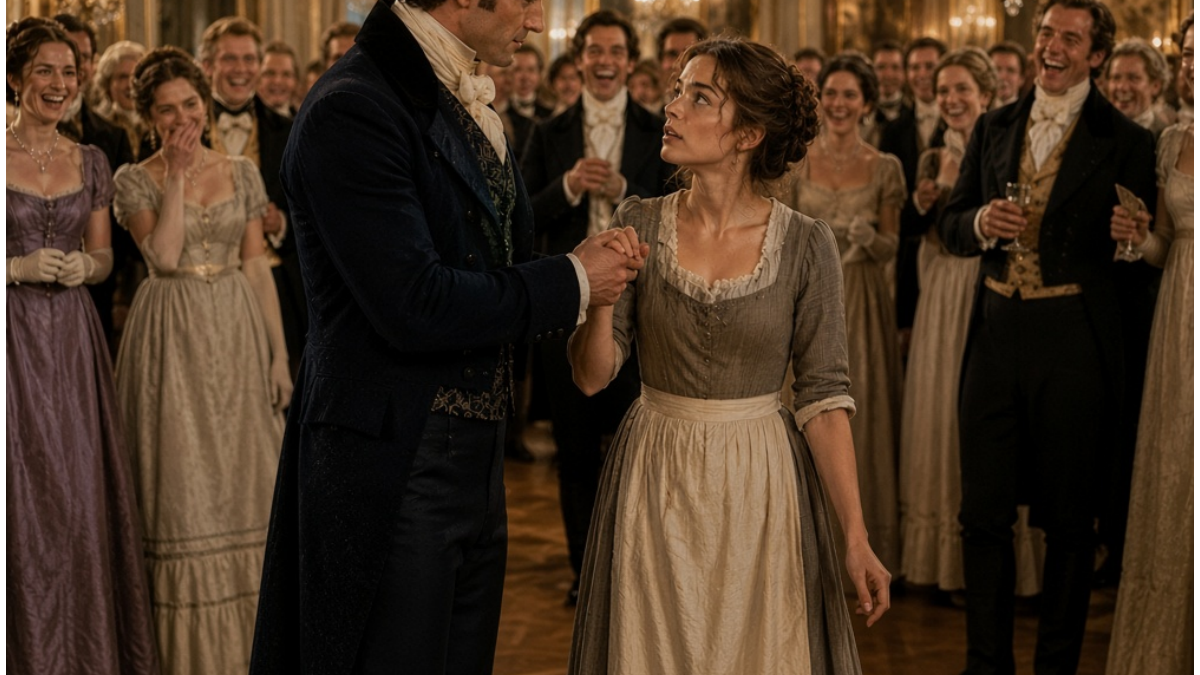
Laughter is the cheapest weapon in the world. It costs nothing to throw. It leaves no bruise a magistrate can see, and it can strip a person bare in front of a hundred witnesses without spilling a single drop of blood.
So, when the Duke of Ravenscar crossed the length of the ballroom and stopped in front of the girl who scrubbed the pots, every soul in that gilded room understood exactly what was about to happen.
He was going to make sport of the kitchen maid. He was going to ask her to dance and then walk away laughing, and she would be ruined by morning.
That was the story they told themselves as they lifted their fans to hide their smiles.
But, the Duke did not laugh. He bowed. And the sound that swept through that glittering room a moment later was not the sound anyone had rehearsed.
To understand how a scullery maid came to be standing in the center of the grandest ballroom in Hertfordshire, you have to understand the girl herself, and you have to go back three years to the winter everything she owned fit inside a single canvas sack.
Her name was Eleanor Merrow. She was two and twenty, though the raw redness of her hands and the careful blankness of her face made strangers guess her older.
She had not always scrubbed pots. Once, she had been the only daughter of Dr. Thomas Merrow, a country physician respected in three parishes, a man who set bones and delivered babies and never once turned away a patient for the crime of being poor.
Eleanor had grown up in a snug stone house with a garden of herbs, a shelf of medical books, and a father who taught her Latin at the kitchen table because he saw no reason a girl’s mind should go hungry.
Then the fever came through the valley. Her father caught it from a family he refused to abandon.
He was dead within a fortnight, and Eleanor learned at 19 that a respected country doctor can leave behind nothing but respect.
There were debts she had never known of. There was a landlord with no patience.
Within a month, the stone house was let to another family. The medical books were sold to a bookseller in town, all but one, a worn herbal in her father’s own hand that she would have starved before parting with, and Eleanor Merrow, who could read three languages and set a broken arm, walked out into the world with four shillings and a canvas sack.
She had one distant connection, a great aunt’s husband’s cousin, or some such thread too thin to bear real weight, a Mrs. Finch who happened to be the housekeeper at a great estate called Ashcombe.
That connection got Eleanor a position in the kitchens, not as a companion, not as a governess, as a scullery maid, the lowest rung of the household, the girl who scoured the pots black with grease and hauled the coal and rose at four to lay the fires while the family slept in feather beds three floors above.
She did not complain. Complaint was a luxury for people with somewhere else to go.
Eleanor had learned the hardest lesson poverty teaches, which is that survival is not about pride.
It is about endurance. So, she endured. She kept her Latin folded away inside her chest like a letter she could not send.
She kept her father’s memory the same way. And she made herself so useful, so quiet, so entirely invisible, that after three years the household had nearly forgotten she was anything other than a pair of chapped hands attached to a mop.
Ashcombe belonged to the Ashford family, and the Ashfords were new money doing a very loud impression of old money.
Sir Reginald Ashford had made his fortune in shipping and spent it buying a name he could not quite wear.
His wife, Lady Prudence, was a woman built entirely of of and whalebone, a woman who measured every human being she met by exactly one question, “What can you do for my daughters?”
And Lady Prudence had two daughters to launch. Cordelia, the elder, was handsome in a hard, glittering way with a laugh she deployed like a card in a game.
Frances, the younger, was softer and duller, content to echo whatever her sister said a half second after she said it.
The entire machinery of Ashworth existed to hurl these two young women into an advantageous marriage.
And in the spring of that year, Lady Prudence set her sights on the single largest prize in the county.
The Duke of Ravenscar had come home. Eleanor first heard the name over a mountain of dirty copper pots.
The upper servants gossiped in the kitchen the way lords gossiped in their clubs, and the Duke was all anyone spoke of for a week.
He was young, they said, not yet five and 30. He had gone to fight on the peninsula as a second son, never meant to inherit, and come home a duke by accident after his elder brother drowned.
He had come home with other things, too. A limp that never fully healed, a long, white scar that pulled at the left side of his jaw, and a temper, they said, black as a coal cellar.
He had shut himself away in his estate at Ravenscar for two years, breeding horses and refusing every invitation society flung at him.
He turned away earls at his gate. He had not danced, some said, since before the war.
“They say he’s half a monster,” the cook, Mrs. Pettigrew, announced with relish, kneading dough as though it had insulted her.
“Face like a butchered hog and a mood to match. No woman in her right mind would have him, dukedom or no.”
“Then it’s fortunate,” Eleanor said quietly, scrubbing at a pot, “that Lady Prudence’s ambitions have never once troubled her right mind.
Mrs. Pettigrew barked out a laugh before she remembered herself and scowled. Eleanor rarely spoke.
When she did, it had a habit of being both true and quietly dangerous and the older servants had learned to enjoy it in small doses.
For Lady Prudence had indeed decided the Duke of Ravenscar would marry one of her daughters.
It did not matter that he had refused every mother in three counties. It did not matter that he loathed society.
Lady Prudence would simply throw a ball so magnificent, so impossible to refuse that even a monster would be dragged into the light.
She would seat Cordelia beside him. She would engineer Francis to be charming. She would spend a fortune she could barely afford and by the end of the night she would have a duke in the family.
The invitation was carried to Ravenscar by a footman in the family’s best livery. Everyone in the kitchen expected it to come back torn in half.
Instead, 3 days later, a single line of reply arrived in a hard black hand.
The Duke of Ravenscar accepts. Lady Prudence, they said, actually shrieked. The house went mad.
For 3 weeks, Ashcombe was turned inside out. Chandeliers were lowered and every crystal washed by hand.
Floors were waxed until they shone like still water. Cartloads of hot house flowers arrived.
An orchestra was hired from London and down in the depths of the house, in the heat and grease and steam, the kitchen staff worked 18-hour days to feed an army of 200 guests.
Eleanor’s hands cracked and bled from the lye. She wrapped them in rags and kept scrubbing.
She thought nothing at all of the Duke of Ravenscar. He was a name from an upstairs world, no more real to her than a king in a storybook.
She had no notion whatsoever that she would meet him, and she certainly had no notion that she would meet him on the very morning of the ball itself, in the cold, gray hour after dawn, entirely by accident.
It happened like this. Eleanor had risen at 4:00, as she always did, and slipped out to the kitchen garden to cut herbs before the household woke.
It was the one part of her day she loved. The garden was quiet and green, and smelled of rosemary.
And for a half hour before the world demanded anything of her, she could stand among the growing things and remember another garden, and a father who had taught her the name of every plant in it.
That morning, as she knelt cutting thyme, she heard something she did not expect, a horse, then the low, controlled curse of a man in pain.
She rose and followed the sound around the garden wall. A tall bay gelding stood at the edge of the paddock, sweated and blowing, clearly ridden hard through the night.
Beside it, gripping the fence rail with a white-knuckled hand, stood a man. He was dressed plainly in a dark riding coat gone gray with road dust, his black hair overlong and wild from the wind.
His face was turned away, but she could see the way he held his left leg, stiff and locked, the weight all wrong, and she recognized the particular gray tint of a man whose pain has outrun his pride.
Eleanor did not know he was a duke. He had no crest, no carriage, no servants.
She took him for a horse trader come early, or perhaps a groom sent ahead of the fine folk.
What she saw was simply a man who was hurting and too stubborn to sit down.
“You’ve been riding all night,” she said. It was not a question. The man turned his head sharply, and Eleanor, who had spent 3 years learning to keep her face blank, kept it blank now, though the scar was worse than the gossip had made it.
A long pale seam ran from his cheekbone to his jaw, pulling the corner of his mouth into a permanent hard line.
His eyes were a startling wintry gray, and right now they were narrowed with the weariness of a man braced for a flinch.
She did not flinch. She had washed and dressed her father’s dead. A scar did not frighten her.
“I came ahead of my party,” the man said at laSt. His voice was low and rough, scraped raw.
“I dislike arriving in a crowd.” “You dislike arriving at all, by the look of you,” Eleanor said.
“Your leg has locked. You’ll do it a lasting injury if you keep standing on it like that.”
She gestured at a low stone bench against the garden wall. “Sit. I’ll fetch something for it.”
The man stared at her. He was, she would later understand, entirely unaccustomed to being ordered about, particularly by a girl in a coarse gray dress with a knife in her hand and dirt on her apron.
Most people, upon seeing his face and hearing his title, either simpered or fled. This one had done neither.
She had simply looked at him, diagnosed him, and told him to sit down. Perhaps it was the exhaustion, perhaps it was the plainness of her.
He sat. Eleanor went to the herb bed and cut what she needed, then to the still room, where she kept a small store of things the household did not know about.
Her father had left her no money, but he had left her knowledge, and in 3 years she had quietly become the person to whom the other servants came with their aches and burns and coughs.
She warmed a cloth, worked in an oil of arnica and comfrey she had made herself, and brought it back to the man on the bench.
“The muscle has seized around the old wound,” she said, kneeling without ceremony and pressing the warm cloth against his rigid thigh through the fabric.
He hissed. “You won’t thank me for the next minute. You’ll thank me for the next hour.
Breathe out.” He breathed out. Under the heat, the locked muscles slowly, grudgingly, began to release.
“You’ve done this before,” he said, watching her hands with a strange intensity. “My father was a physician.
He said pain makes fools of clever men because they will do anything to escape it, except the sensible thing.”
She adjusted the cloth. “He also said the sensible thing is almost always to sit down, keep warm, and let someone competent help you.
Men are remarkably bad at all three.” Something moved at the hard corner of his mouth.
It was not quite a smile. It had clearly been a very long time since his face had done anything resembling a smile, and the muscles seemed to have forgotten how.
But something moved. “Your father sounds a wise man,” he said. “Where is he now?”
“Dead,” Eleanor said simply. “Three years. The fever.” She kept her voice even, the way she always did.
“He caught it from a family he wouldn’t leave. I’ve often thought that was the most foolish and the most decent thing he ever did, and I’ve never been able to decide which mattered more.”
The man was quiet for a moment. “Both,” he said. “They always both matter. That’s what makes it unbearable.”
Eleanor looked up at him then, surprised. It was not the answer of a horse trader.
It was the answer of a man who had watched people die for their decency and never got over it.
For a moment, in the gray light of that cold garden, the two of them simply looked at each other.
A scullery maid with a dead father and a soldier’s grief sitting side by side in the same silence.
Then a bell rang somewhere in the house, sharp and demanding, and Eleanor stood, brisk again.
“Keep it warm through the morning,” she said, gathering her herbs. “Don’t ride again today if you can help it.
And whoever you’ve come to serve, tell them the roads killed you, not the leg.
It’ll be true enough.” She was already walking away. “Good morning.” “Wait,” the man said.
“Your name?” She did not stop. “It won’t be of any use to you,” she called back over her shoulder and disappeared through the garden gate.
Nathaniel Blackwood, ninth Duke of Ravenscar, sat on a stone bench in the cold with a warm cloth against his ruined leg and a strange, unfamiliar loosening somewhere beneath his ribs that had nothing to do with the arnica.
He had come to this house dreading it. He had accepted the invitation only because his steward had bullied him into it, saying a duke who never appeared in public would soon have no county left to rule.
He had planned to endure one evening, choose the least offensive of the Ashford daughters, do his cold duty by his dead brother’s title, and shut himself away again forever.
He had not planned on the girl in the garden. He had not planned on being told to sit down.
He had not planned on being seen plainly and without fear as an ordinary suffering man by someone who had asked nothing of him at all.
He did not learn her name that morning, but he did not forget her face.
That evening, Ashcombe blazed with light. Every window poured gold into the spring dusk. 200 candles burned in the great chandeliers.
Carriages choked the drive for a half mile, disgorging the finest people in three counties, powdered and jeweled and hungry to see whether the monster duke would really come.
The ballroom was a sea of silk and satin, the orchestra tuning, the air thick with perfume and expectation.
Down below, in the roaring furnace of the kitchen, Eleanor worked. She had been on her feet since 4:00 that morning.
She would be on them until well past midnight. Her only glimpse of the great event above would be through the doorway when a footman swung it open to carry up another tray.
A flash of light and music and a world she did not belong to. She thought once of the man in the garden.
She hoped his leg had held. She assumed she would never see him again. Upstairs, at 9:00, the moment arrived.
The butler struck the floor with his staff and announced, in a voice that carried to the rafters, “His Grace, the Duke of Ravenscar.”
The room turned as one. And there, in the doorway, stood a man transformed. Gone was the dust and the wild hair.
He wore severe, immaculate black, his dark hair swept back, every inch of him proclaiming a rank that filled the doorway like a held breath.
The scar was stark in the candlelight. His gray eyes swept the room with the flat, tactical calm of a man reading a battlefield.
He did not smile. He did not bow to the crowd. He simply looked, and 200 people felt themselves being weighed.
Lady Prudence surged forward like a ship under full sail, Cordelia and Frances in tow.
“Your Grace, you honor us beyond words,” she gushed, sinking into a curtsy so deep her whalebone creaked.
“May I present my daughters, Cordelia and Frances.” The duke inclined his head a precise half inch.
Cordelia dipped into a flawless, practiced curtsy, tilting her chin to display her throat to best advantage.
“Your Grace,” she purred, “we had begun to fear you were only a rumor.” “I am frequently a disappointment in person,” the Duke said.
His voice was flat. It was not clear whether he was joking. Cordelia laughed anyway, brilliantly, as though he had said the wittiest thing in England.
The evening began its slow glittering machinery. Lady Prudence deployed her daughters like guns. Cordelia was seated near the Duke at supper.
Frances was made to play the pianoforte, badly, while her mother beamed as though angels sang.
Every eligible young woman in the room orbited him at a careful distance in their pale muslins and their borrowed jewels, each one waiting for her mother’s signal to strike.
Every mother in turn watched him the way a hawk watches a field, calculating, patient, ready.
To the Duke of Ravenscar, it was all achingly familiar, and it made the old shrapnel in his thigh throb worse than the cold ever did.
He had sat through a hundred rooms exactly like this one. He knew the whole cruel little theater of it, the flattery pitched at his title, the practiced laughter, the calculating eyes that skated over his scarred face and came to rest, always on the word Duke, as though the man beneath it were merely the disappointing wrapping around a very large fortune.
The Duke endured it. He answered when spoken to in as few words as possible.
He did not dance. When Lady Prudence contrived to steer Cordelia into his path for the opening set, he bowed and said flatly that his leg no longer permitted such things, and the refusal moved through the room like a small scandal of its own, for everyone present knew the Duke of Ravenscar had not set foot on a dance floor since before the war.
And through all of it, his face remained a locked door, and his gray eyes moved restlessly over the crowd as though searching the glittering room for something it did not contain.
Because it did not contain her. And he had realized somewhere around the second hour that he had been looking for her since the moment he walked in.
He did not fully understand it himself. He only knew that this room full of perfect, powdered, laughing women left him cold as a grave, and that the one person who had made him feel like a living man in two years was somewhere in this house, and he did not even know her name.
The thing that changed everything happened by pure accident an hour before midnight. A footman, hurrying with a tray of champagne through a room grown careless with wine, was jostled by a drunken young lord.
The tray tipped. A cascade of glasses shattered across the polished floor at the very edge of the dancing, a bright, ringing crash, and a spreading lake of champagne and broken crystal directly in the path where the next set would form.
There was a small commotion. The music faltered. And because every upper servant was stretched to breaking that night, and because the butler bellowed down the stairs for anyone, anyone, to come and clear it at once, the person who came up from the kitchens with a pan and a cloth was Elina Merrow.
She had not chosen it. She was simply nearest to the door when the call came.
She came up the servants’ stair, out through a side door, and knelt at the edge of that shining ballroom in her coarse gray dress and her patched apron, her hair escaping its knot, her raw hands reaching for the broken glass, entirely focused on the shards so that no dancer would cut a slippered foot.
She did not look up. She was invisible. That was the whole art of being a servant in such a house.
You did the necessary thing and you did not exist while you did it. But the Duke of Ravenscar was looking directly at her.
He had turned at the crash and he saw, kneeling in the wreckage among the silk and the satin, the girl from the garden, the girl who had told him to sit down, the girl who had seen him.
She was on her knees in front of 200 of the finest people in the county gathering broken glass with her bare bleeding hands and not one of them saw her as anything but a mop with a heartbeat.
Something in the Duke’s chest, something that had been frozen solid for 2 years, cracked straight down the middle.
He set down his glass and he began to walk across the ballroom floor. People noticed at once.
A duke crossing a room is a tide. Everything turns to follow it. Conversations died.
Lady Prudence’s head snapped around. Cordelia rose halfway from her chair, certain, absolutely certain that he was coming for her at last, that the great moment of her life was arriving.
The whole room held its breath and watched the Duke of Ravenscar walk with his uneven, deliberate gait across the polished floor.
He walked straight past Cordelia. He walked past every jeweled and hopeful young woman in the room.
He walked to the edge of the dance floor where a kitchen maid knelt in a pool of champagne with glass in her raw hands and he stopped.
Eleanor felt the shadow fall over her before she understood it. She looked up and there he was, the man from the garden, dressed now in black and silver, wearing a rank she had not known he possessed, looking down at her with those wintry gray eyes.
For one suspended moment neither of them moved. She understood, in a rush of cold clarity, exactly who she had ordered to sit down two mornings ago.
She understood exactly what he was. The Duke extended his hand, not to help her up, lower than that.
Palm open, fingers turned in the unmistakable formal shape of an invitation. “Miss,” he said, in that low, rough voice, loud enough to carry, “will you do me the honor of this dance?”
For half a heartbeat, the ballroom did not comprehend it. Then it did, and it laughed.
It began as a titter behind a fan, and spread like fire through dry grass.
The great and the fine of three counties laughed at the exquisite joke of it.
The terrifying Duke of Ravenscar, the man who had refused every lady in England, stooping to ask the scullery maid to dance.
What a savage, brilliant piece of theater. What a way to insult his social-climbing hostess.
“Of course,” they told one another with their eyes, “of course he does not mean it.
He means to mock. He means to make sport of the maid and the mother both, and it is delicious.
It is the wickedest and best thing anyone has done all season.” Cordelia laughed loudest of all, a bright, cruel peel.
Her humiliation curdling instantly into vicious mirth. Lady Prudence’s face had gone the color of old ash.
And on the floor, kneeling in the champagne, Eleanor felt every eye in that gilded room turn to her, and felt the laughter break over her like filthy water.
She knew this game. She had been the object of cruelty enough times to recognize its shape.
Every instinct three years of survival had taught her, screamed the same thing. This is a trap.
Get up. Flee. Do not give them the satisfaction of your ruin. He is a Duke, and you are a pot scrubber, and this can only end one way.
The hand held out to you is the hand of your destruction. She looked up at his face to find the mockery in it.
There was none. She had spent 3 years reading faces. It was how a servant survived, learning to see the storm before it broke.
And she saw now, past the terrible scar, past the hard set of that ruined mouth, straight into those gray eyes.
And there was no cruelty there at all. There was fear. The man was afraid.
He had just done the single most reckless thing that duke could do in front of the entire county.
Staked his dignity on a scrubbing maid in front of people who would repeat it in every drawing room in England.
And he had done it not to mock her, but because he could not bear, could not physically bear, to watch her kneel in the dirt and be treated as nothing for one moment longer.
He had not walked across that room to ruin her. He had walked across it to lift her out.
And in that single suspended heartbeat, kneeling in the champagne with the laughter breaking over her, Eleanor Merrow understood the choice for exactly what it was.
She could take the safe path. She could lower her eyes, gather her broken glass, and slip away into the invisibility that had kept her alive for 3 years, and the room would have its little laugh, and forget her by morning, and she would be nothing, and she would be safe.
Or she could do the reckless, impossible thing. She could stand. She could take the hand of the one person in that whole gilded room who had looked at her and seen a human being, and she could let 200 people laugh, and she could refuse, utterly, to be made small by any of them.
Her father’s voice came to her then, clear across 3 years and the whole width of death.
When the sensible thing and the brave thing point the same way, Elena, only a coward hesitates.
And so Elena Merrow made a choice that the whole county would talk about for a generation.
She set down her pan of broken glass. She wiped her bleeding hands on her apron, slowly, with dignity, taking her time while 200 people laughed.
And then she placed one raw, cracked hand into the Duke of Ravenscar’s and let him draw her to her feet.
“The honor,” she said, in a voice that did not shake, pitched to carry exactly as far as his had, “is entirely mine, Your Grace.”
The laughter faltered. The Duke of Ravenscar turned to the orchestra. He did not raise his voice.
He did not need to. “A waltz,” he said, and such was the weight of a dukedom that the conductor, pale and scrambling, lifted his baton, and the musicians, who had been laughing with everyone else, put their instruments to their lips and began to play.
He led her to the center of the floor. The other dancers fell back like a parting sea, not out of courtesy, but out of sheer astonishment.
And there, in the middle of that vast, shining room, under the blazing chandeliers, the Duke of Ravenscar placed one hand at the waist of a girl in a gray dress and a patched apron, took her ruined hand in his, and began to dance.
Elena had not danced in 3 years. Before that, she had not danced in a ballroom in her life.
But her father had taught her in the parlor of the stone house, humming the tune himself, because he said a doctor’s daughter would someday need to move through the world with grace, and she might as well learn it from a man who loved her.
Her feet remembered. Her spine remembered. She lifted her chin, and she let the Duke lead her into the turn.
And the terrible, wonderful truth, the thing that killed the laughter stone dead in every mocking throat, was that they were beautiful together.
He was not a graceful man. The war had seen to that. His left leg would never move freely again.
But he moved with a soldier’s absolute economy and a nobleman’s inbred command. And he had clearly, at some point in his broken life, been taught to dance by someone who took it seriously.
And she matched him. She matched the halt in his gait and turned it into a rhythm.
Where his leg failed, her weight was already there to carry the turn. They found each other’s balance in the space of four measures, the way two people find it who are paying complete attention to no one in the world but each other.
He looked down at her. She looked up at him. And around them, the mockery drained out of the room and left behind it something no one there had expected to feel.
Because it is one thing to laugh at a joke. It is another thing entirely to watch two people who are not laughing, who are not performing, who have simply and completely forgotten that anyone else is in the room.
“You knew who I was in that garden,” the Duke murmured, turning her through the light.
“I did not,” Eleanor answered honestly. “I thought you were a groom with a bad leg and worse sense.
I would have said the same things to a king, perhaps more.” The corner of his ruined mouth moved.
“I am aware,” he said, “that is precisely the difficulty. In two years, you are the only living soul who has spoken to me as though I were a man and not a title or a wound.
And I let you walk away without your name. I have thought of very little else since.”
“You crossed a ballroom to ask a kitchen maid to dance,” Eleanor said. “You have made yourself the scandal of the season.
Do you understand what they will say of you? I understand entirely, he said. I find I do not care.
I have spent two years being careful, and being careful has kept me alive and made me miserable.
I would rather be the scandal of one season than a ghost for the rest of my life.
He turned her again. Your name, I will not ask a third time. I will simply keep dancing with you until you tell me, and this waltz will become the longest in the history of England.
And Eleanor Merrow, in the center of the Ashkam ballroom, with 200 of the finest people in three counties, silenced and staring, tilted her head back and laughed.
It was the first true laugh anyone at Ashkam had heard from her in three years.
It rang out bright and clear over the music. Eleanor, she said, Eleanor Merrow, daughter of Dr. Thomas Merrow, who taught me to dance in a parlor and to speak my mind everywhere else, and who would be enormously amused to see where both have brought me.
Eleanor Merrow, the Duke repeated, as though committing it to memory, as though it were a thing of value.
I am Nathaniel. The waltz ended too soon. It always does when two people have forgotten the world exists.
The final note hung in the air, and Nathaniel held her a half second longer than the dance required, his hand at her waist, her ruined hand still resting in his, and neither of them quite willing to be the first to let go.
For a moment, the room was utterly silent. Then, from somewhere near the back, a single pair of hands began, hesitantly, to applaud.
And then, another. And the strange, reluctant truth of what they had all just witnessed forced itself upon them, and a scattering of genuine applause moved through the ballroom.
Because whatever they had come expecting, they had not expected to be moved, and they had been.
But not everyone applauded. Lady Prudence Ashford stood rigid at the edge of the floor, her face a mask of fury so total it had gone beyond expression into something like stone.
Her great triumph, her fortune spent, her daughters displayed, and the prize she had schemed for months to win had crossed her ballroom and put his hands on her scullery maid in front of everyone who mattered.
She had been made ridiculous, and Lady Prudence, like all cruel people, could not survive being made ridiculous.
Someone would have to pay for it. She knew exactly who. The duke bowed over Eleanor’s hand, a full and formal bow, the kind a duke gives a lady.
Then he was drawn away by the tide of guests who now, suddenly, all wished to speak to the man who had done the most talked-about thing of the year.
And Eleanor, released back into invisibility, gathered her pan of broken glass and slipped away toward the servants’ door, her heart pounding, her hands stinging, her mind a storm.
She did not reach the kitchen before Lady Prudence caught her in the passage. “You scheming little gutter rat,” Lady Prudence hissed, seizing Eleanor’s wrist hard enough to bruise, dragging her into an empty anteroom, and slamming the door.
Her face was inches away, mottled and shaking. “You planned this. You threw yourself in his path.
You made a fool of me in my own house, in front of every family in this county.”
“I was clearing broken glass so your guests would not cut their feet,” Eleanor said evenly, though her heart hammered.
“His grace crossed the room of his own will. I did not so much as look up until his shadow fell on me.
If you have been made a fool of, madam, it was not by me.” The truth of it only enraged Lady Prudence further, as truth always did with such women.
“You will be gone from this house by morning.” She spat. “Without a character, without a reference.
Do you understand what that means for a girl like you? It means no other house will take you.
It means the workhouse. It means the streets. I will see you ruined so thoroughly that not even a duke’s passing whim can save you.
He will forget you by Tuesday, and you will be in a gutter by Friday, and I will have the very great pleasure of never thinking of you again.”
She flung Eleanor’s wrist away and swept from the room, leaving her to the cold certainty of it.
For a scullery maid, dismissal without a character was not an inconvenience. It was a sentence.
A servant without a reference could not be hired. Every respectable house would assume the worSt. Lady Prudence held Eleanor’s entire future in her whalebone fist and had just crushed it.
The dance, the waltz, the applause, all of it turned to ash. Eleanor stood alone in the dark anteroom and understood that the single most beautiful thing that had ever happened to her had just cost her everything she had.
She did not cry. She had long ago spent the last of her tears. She simply gathered herself, went back down to the kitchen, finished her work through the long remaining hours of the ball, and at 4:00 in the morning climbed the back stairs to the cold attic she shared with two other maids, and lay awake staring at the rafters, calculating, as she always did, how she might survive the unsurvivable.
She had four shillings. She had a canvas sack. She had, once again, nothing else.
She did not know that 3 miles away, in a bedroom at an inn he had taken rather than accept Lady Prudence’s hospitality, the Duke of Ravenscar was also lying awake, staring at his own ceiling, and that he was not thinking about scandal at all.
He was thinking about a girl who had told him to sit down in a cold garden, and how he was not, under any circumstances, going to let the world grind her back into the dirt.
Morning came gray and thin. Eleanor was summoned to the housekeeper’s room at 7:00. Mrs. Finch, the housekeeper, would not meet her eyes.
She pushed a small handful of coins across the table, Eleanor’s final wages, short by half, and a single sheet of paper.
“Her ladyship’s instructions,” Mrs. Finch said, low and unhappy, “you’re to go this morning. I’m sorry, girl, I truly am.
There’s no reference. Re- She was most particular about the reference.” The old woman’s hands twisted in her apron.
“You were the best worker in this house, and half of us came to you when we ailed, and this is a wickedness, but I’ve my own place to think of, and I can’t cross her.
God help you. Go quickly before she wakes and thinks of something worse.” Eleanor took the coins.
She took the paper, which was a curt notice of dismissal, damning in its silences.
She went up to the cold attic, folded her three dresses and her father’s one surviving book, the herbal she had refused to sell, into the canvas sack, and walked down through the great house one final time, through the kitchen, past Mrs. Pettigrew, who pressed a wrapped loaf and a wedge of cheese into her hands with wet eyes and no words, out the servants’ door into the gray morning.
She walked down the long drive with her sack over her shoulder, past the scarred lawns where the balls marquees were being struck, past the churned mud where 200 carriages had waited.
She did not look back at Ashworth. There was no point. Behind her lay 3 years of labor and a single impossible waltz.
Ahead of her lay a road and a workhouse and a winter she was not at all certain she would survive.
She was perhaps a half mile down the road at the great iron gates when the carriage came.
It came fast up the lane from the direction of the village. A matched pair of blacks at a hard trot.
An unmarked carriage of expensive plainness. It slowed as it neared her. It stopped and the door opened and the Duke of Ravenscar leaned out hatless.
His dark hair wild again. His gray eyes finding her on the road with her canvas sack and her patched cloak.
“She dismissed you.” He said. It was not a question. His jaw was tight. The scar white.
“Without a character, I know Prudence Ashworth’s mind the way I know an enemies. I woke this morning certain of it and I see I was right.”
He looked at the sack over her shoulder, the loaf in her hand and something dangerous moved behind his eyes.
“Get in the carriage, Miss Merrow.” “It is cold and you have been walking and I have a great many things to say to you that cannot be said on a public road.”
Eleanor did not move. 3 years had taught her caution and a Duke offering a dismissed maid a ride in an unmarked carriage was, in the language of the world, an offer with only one meaning.
The Duke saw the thought cross her face and remarkably colored. “Not that.” He said roughly.
“God, not that. I have a chaperone.” He gestured behind him and a stern gray-haired woman of perhaps 60 leaned into view dressed in respectable black with the unmistakable air of a person who did not suffer nonsense.
My aunt, Lady Honoria Blackwood. I collected her from the village this morning for precisely this purpose, so that whatever I have to say to you would be said with unimpeachable propriety and a witness of spotless reputation.
Aunt Honoria, this is Miss Eleanor Mero. “The girl who told my nephew to sit down,” said Lady Honoria, surveying Eleanor with a pair of shrewd dark eyes very like the duke’s.
“He has spoken of nothing else since dawn. I confess, I came chiefly out of curiosity.
Get in, child. You are letting the cold in and you look half frozen. We may all disapprove of each other perfectly well inside a warm carriage.”
And so Eleanor Mero, with nothing left to lose and a growing dangerous suspicion that the world had not entirely finished with her yet, climbed into the carriage of the Duke of Ravenscar.
The door shut, the carriage moved, and Nathaniel Blackwood, facing her across the small warm space with his aunt beside him as chaperone, told her the truth.
“I am not a man of many words,” he began. “The war took most of them and grief took the reSt. So I will be plain and you may think me mad and my aunt may certainly think me mad, but I have discovered I would rather be thought mad and honest than sane and silent.”
He leaned forward, his forearms on his knees, his gray eyes fixed on her face.
“Two mornings ago you found me in a garden in pain, too proud to sit down, and you were the first person in two years to treat me as a man rather than a monster or a prize.
You ordered me about. You mended my leg with your own hands and asked nothing for it, and then you walked away.
And I could not stop thinking of you. And I did not even have your name.”
“Your Grace,” Eleanor began. “Let me finish,” he said, “or I shall lose the courage.
And I did not fight through Spain to be a coward in a carriage.” He drew a breath.
“Last night I watched you kneel in broken glass in front of the whole county while they treated you as furniture.
And I understood two things at once, with perfect clarity. The first is that the entire glittering world of that ballroom is not worth one hour of your company.
The second is that I have spent two years believing I would live and die alone because I could not imagine a woman who would look at this face and this leg and this bitterness and see anything but ruin.
And then I found one. She was scrubbing my host’s floors. And I will not, Miss Merrow, I will not walk away from the one true thing I have found simply because the world has arranged things stupidly.”
The carriage rocked gently. Lady Honoria watched her nephew with an expression Eleanor could not read.
“I know what this is,” Eleanor said carefully, her heart slamming. “You feel guilt. You saw me humiliated and you are a decent man and you wish to repair it.
That is kindness, Your Grace, and I am grateful for it. But you do not know me.
We have exchanged perhaps a hundred words. You cannot build anything real on a hundred words and a single dance.”
“How many words did it take you?” The Duke asked quietly, “to know your father was a good man?”
Eleanor fell silent. “None,” he said. “You knew it in your bones before you could speak.
Some things do not require a great many words. They require the right ones.” He held her gaze.
“I am not offering you charity, Eleanor. I am too selfish for charity. I am offering you a position.
First because you need one and because I am not a fool who ruins a woman’s life to soothe his conscience.
My estate at Ravenscar has been without a proper still room mistress for two years and my tenants have no physician within 20 miles and I have watched you work and I have never in my life seen a pair of hands more competent.
That position is yours regardless of anything else with a wage and a cottage and the freedom to tend whom you please.
That is the honest part, the part my aunt approves of. Lady Honoria inclined her head a fraction.
And the dishonest part? Eleanor asked, barely above a whisper. The duke’s ruined mouth curved.
It was, at last, very nearly a smile. The dishonest part, he said, is that I intend, once you are settled and safe and beholden to me for nothing, to court you properly, slowly, with my aunt glaring at us the entire time.
I intend to bring you tea and pretend it is about the tenants. I intend to find a hundred reasons to visit the still room.
And I intend to discover, over as many months as it takes, whether the thing I felt in that garden and on that dance floor is as real as I believe it to be.
And if it is not, you will lose nothing for the position and the cottage and the wage are yours in either case.
But if it is, his voice, when it came again, was very low. If it is, then someday, Eleanor Merrow, I am going to ask you to be the Duchess of Ravenscar.
Not to save you. You will already be saved. But because I have looked into the whole cold empty future of my life and the only warm thing in any of it is you.
The carriage was silent but for the sound of the wheels. Eleanor Merrow looked at the scarred broken honest man across from her and at the stern old woman beside him who had come out into the cold morning to make sure it was all done properly and she understood that the world which had spent 3 years teaching her to expect nothing had just handed her something.
She did not trust it. Trust was not a thing she had left but she was above all her father’s daughter and her father had taught her that when the sensible thing and the decent thing point to the same way only a coward refuses to follow.
“I will take the position.” She said at last steadily. “The stillroom, the tenants, the wage.”
She lifted her chin. “And I will make you no promises about the rest your grace because I have learned not to make promises about things I cannot yet see.
But I will tell you this. I did not lie to you on the dance floor.
The honor was mine. It remains mine and I find” her voice caught just slightly the first crack in 3 years of careful blankness.
“I find I would very much like to see whether you are right.” Lady Honoria made a small sound that might in a less dignified woman have been a sniff of approval.
“Well,” she said briskly, “that is settled far more sensibly than I feared. Nathaniel, stop staring at the girl as though she has hung the moon.
It is unbecoming and you will frighten the horses. Miss Merrow, you will ride with me and I shall interrogate you thoroughly about your character, your accomplishments, and your intentions toward my nephew and by the time we reach Ravenscar I shall know whether to encourage this lunacy or put a stop to it.
Driver, on.” The carriage rolled on toward the north and Ashkam fell away behind them and Eleanor Merrow left the road to the workhouse and took instead a road she could not yet see the end of.
What Lady Prudence Ashford had intended as Eleanor’s ruin became in the end the making of her.
The story of the ball spread across the county exactly as Lady Prudence had feared, but not in the shape she had hoped.
It did not become the tale of a scheming maid put in her place. It became the tale of a duke who crossed a ballroom to lift a good woman out of the dirt and of the cruel hostess who threw that woman onto the road the very next morning.
Society, which loves nothing so much as a fallen enemy, turned on Lady Prudence with relish.
Invitations dried up. Cordelia’s suitors evaporated. Within a year, the Ashfords, who had spent a fortune to buy a name, found the name unbuyable at any price and retired to a smaller house in a duller county, defeated by nothing more than their own cruelty made public.
Eleanor went north to Ravenscar and the duke, to the astonishment of his aunt and the outright disbelief of his household, kept his word to the letter.
He gave her the still room and the cottage and the wage. He asked nothing of her.
He set her free to tend the tenants who had gone 20 years without care, and she did it so well that within 6 months there was scarcely a family on the estate who did not owe her a mended child or an eased grandmother.
And he courted her exactly as he had promised. Slowly, clumsily, with his aunt glaring the entire time.
He brought her tea and pretended it was about the tenants. He found a hundred reasons to appear in the still room doorway, filling it with his broad shoulders and his ruined face and his complete inability to think of anything to say once he arrived.
He learned, over long months, to laugh again, a rusty and startling sound that Eleanor drew out of him the way she drew poison from a wound, patiently and without flinching.
She learned, over the same long months, to set down the armor she had worn for 3 years, one careful piece at a time, in the presence of a man who had never once given her cause to pick it back up.
There was a night, deep in that first winter, that Nathaniel Blackwood would carry with him for the rest of his life, because it was the night he stopped pretending, even to himself, that what he felt for Eleanor Merrow was anything so small or so safe as gratitude.
It began near midnight with a fist hammering at the door of the great house.
A tenant, a young shepherd named Tom Aldous, stood on the step in the driving sleet with his hat crushed in his hands and terror in his face.
His wife had been 3 days in her childbed, the local midwife had given up and gone home to pray, and the babe would not come, and the woman was fading.
He had not come to the great house for the Duke. He had walked 4 miles through a storm to beg for the stillroom mistress, for Eleanor.
She was already pulling on her cloak before Tom had finished speaking. Nathaniel watched her move, swift and certain, gathering her bag of instruments and her jars, entirely transformed.
The careful, guarded stillness she wore like armor had fallen away completely. In its place was a woman of absolute purpose, her father’s daughter to the marrow, a physician in everything but the title the world had denied her for the crime of being poor and female.
“You cannot go out in this,” Nathaniel said, meaning it, gesturing at the black, howling storm.
Eleanor looked at him as though he had said something in a language she did not speak.
“A woman is dying 4 miles away,” she said simply, “and I know how to keep her from it.
What else is there to say?” And she pushed past him out into the sleet.
He had the carriage brought around and went with her. He did not ask her permission.
He told himself it was because the roads were treacherous and she should not ride out alone with a frantic shepherd at midnight.
The truth, which he did not yet dare to say, was that he could not bear to sit in his warm empty house not knowing whether she was safe.
The Aldus cottage was one room, low and dark and thick with the smell of fear and blood.
Nathaniel, a duke who had commanded men in battle, found himself entirely useless, banished to a corner to keep the fire roaring and the water hot while Eleanor knelt at the heart of the crisis.
He watched her work for 4 hours. He watched her speak to the failing woman in a low, unbroken murmur, calm as still water, her voice never once betraying the fear he could see she surely felt.
He watched her clever hands do things he did not understand and did not wish to.
He watched her turn a child that had been wrongly turned, working with a patience and a nerve that would have broken most surgeons he had known in the army, men with fine coats and Latin diplomas and a tenth of her steadiness.
And near 4:00 in the morning, in the deepest cold of the night, a thin furious wail rose up in that little room.
The child breathed and then, because Eleanor did not stop, because she knew the danger was not past, the mother breathed, too, and steadied and slept, exhausted and alive with her living daughter on her cheSt. Eleanor sat back on her heels and only then did Nathaniel see her hands begin, very slightly, to shake.
All the fear she had held at bay for 4 hours arriving at once now that it was safe to feel it.
Tom Aldus was on his knees weeping, trying to kiss her hands, and she He gently telling him to get up and see to his wife and not to make a fuss.
She was covered in blood to the elbow. Her hair had come entirely undone. She was, Nathaniel thought, looking at her across that mean little room in the guttering firelight, the most magnificent thing he had ever seen in his life, and he had seen the whole of Europe.
They rode home in the gray of the dawn, the storm blown out, the world washed clean and silver.
Eleanor sat across from him in the carriage, drained past speaking, her eyes closed, and Nathaniel could not stop looking at her.
“Prudence Ashford,” he said quietly, “threw you onto a public road without a character. She meant to send you to the workhouse.
She meant you to die in a ditch.” His voice was very low and very hard, “And you can do that.
What I watched you do tonight, there is a woman alive this morning and a child because a girl that the whole of society decided was worth nothing knelt in the dark and refused to let them go.”
He shook his head slowly. “I have spent my life among people who believe their worth is measured by their blood and their fortune.
I watched every one of them laugh at you across a ballroom, and they are not fit to carry your bag, Eleanor, not one of them.
I have never been so ashamed of my own world or so certain of anything as I am at this moment.”
Eleanor opened her eyes. For a long moment she simply looked at him, this scarred and difficult man who had crossed a ballroom for her and asked nothing since, watching her save a stranger’s life in a hovel at 4:00 in the morning and calling it magnificent.
“My father used to say,” she said softly, “that the measure of a person is what they do at 3:00 in the morning when no one of any consequence is watching.
He said that is when you find out who a man truly is. She looked at him steadily.
You came into that cottage, your grace, a duke. You kept the fire and boiled the water and did as I told you all night without one word of complaint.
And you thought no one saw. I saw. Her voice caught, just slightly. I have been finding out who you are for months now, 3:00 in the morning and all, and I am no longer afraid of what I keep discovering.
It was the nearest either of them had yet come to saying the whole of it.
Neither said more. They did not need to. The carriage rolled on through the silver dawn and something that had been forming between them all through the long autumn settled at last into a shape that would not be undone.
It was that same winter deepening into the first raw thaw of spring before he finally asked her.
He did not do it grandly. Grandeur was not in either of them. He found her in the still room on a gray March morning, her sleeves pushed up, her clever hands busy among the drying herbs, and he stood in the doorway as he had stood a hundred times, and this time he did not pretend it was about the tenants.
You have been at Ravenscar a year, he said. I have, Eleanor answered, not turning, though her hands had gone still.
My leg has not seized once since you came, he said. The tenants send you gifts they cannot afford.
My aunt has decided you are the only sensible person on the estate, which is the highest praise she has ever given a living soul, and I his rough voice faltered.
I have run entirely out of reasons to pretend I come to this room for any purpose but to look at you.
Eleanor turned around. I told you once, Nathaniel said, crossing the small warm room to stand before her, near enough that she had to tilt her head back to hold his gaze, exactly as she had in the ballroom, exactly as she had in the garden, that if the thing I felt was real, I would ask you to be my wife, not to save you.
You saved yourself. You have never needed me for that. He reached out, slowly, and took one of her hands, the same raw hand she had once placed in his in front of 200 laughing strangers, gentled now, but no less strong.
I am asking because in 1 year you have turned an empty house into a home and a monster back into a man and a cold future into one I cannot wait to live.
I am asking because I love you, Eleanor Merrow, entirely and without the smallest doubt, and I have loved you since you told me to sit down in a garden and gave me not one thing I asked for and everything I needed.
Marry me, not the duke, me, Nathaniel, the stubborn, scarred, difficult man who is nothing at all without you and knows it.
Eleanor Merrow, daughter of a country doctor, once a scullery maid, looked up at the man she had first met in a cold garden and understood that the world had not, after all, finished handing her things.
Her eyes were bright. For the first time in a very long time, she let them be.
“You are a great fool, Your Grace,” she said softly, her voice not entirely steady.
“I am,” he agreed, “but I am your fool. It is the one accomplishment of my life I am wholly proud of.”
“Then yes,” Eleanor said, and the word broke something open in her chest that had been locked since the day her father died, some final frozen thing that came loose all at once in a flood of warmth.
Yes, Nathaniel, I will marry you. I will mend your leg and manage your tenants and argue with your aunt and love you until we are both old and grim and impossible, and I will never, not once, curtsy as low as those women did, because you never wanted that, and neither did I.
He laughed then, the deep, rusty, startling sound she had taught him, and he pulled her against his chest and held her as though he had been cold for years and only just found the fire.
And Eleanor, wrapping her arms around a duke in a still room that smelled of time and rosemary and the particular green scent of every garden she had ever loved, held him back.
They were married that spring in the small stone church on the Ravenscar estate. Eleanor did not wear white.
She wore deep forest green, a gown the duke had ordered from London against her protests, and she carried a bunch of herbs from her own still room instead of hothouse flowers because she was her father’s daughter and always would be.
There were no 200 guests. There was Lady Honoria, weeping without shame into an enormous handkerchief and pretending it was a chill.
There were the tenants who had walked from every corner of the estate to fill the little church to its walls because the strange, scarred duke and the kind, clever woman who had mended half their families were, whatever London thought, beloved on their own land.
When the vicar pronounced them man and wife, the Duke of Ravenscar did not give his bride a polite and distant kiss.
He gathered Eleanor Merrow against him in front of the whole weeping, cheering church and kissed her the way a drowning man reaches air, and she kissed him back, and somewhere in the churchyard the tenants began to ring the single old bell, and its plain sound carried out over the greening moors of the north.
The news reached Ashcombe eventually, as such news does. It is said that Lady Prudence Ashford, upon reading that the scullery maid she had thrown onto the road without a character was now the Duchess of Ravenscar was confined to her bed with a nervous complaint for the better part of a month.
It is said Cordelia never quite recovered her composure and married in the end a gouty widower twice her age with a house she found too small.
Society, which had laughed at Eleanor on the ballroom floor and then laughed at Lady Prudence for a year afterward, eventually settled into the comfortable pretense that it had always known the kitchen girl was destined for great things and that anyone who had laughed had surely been laughing at someone else.
But none of that mattered at Ravenscar. A full year after the wedding on a warm evening in early summer, the Duke of Ravenscar came in from riding his boundaries and found his Duchess exactly where he expected her in the still room, her sleeves pushed up, arguing with the head gardener about the proper time to cut lavender.
He leaned in the doorway and watched her win the argument as she won all of them and something in his chest that had once been frozen solid sat warm and easy in the evening light.
“You are meant to be a Duchess now,” he said when the gardener had gone, ambling into the room, his gait still uneven but his face no longer gray.
“Duchesses do not, I am reliably informed by my aunt, spend their afternoons up to the elbows in comfrey.”
“This Duchess does,” Eleanor said, not looking up from her work though a smile pulled at her mouth.
“This Duchess has 40 tenants and a husband whose leg still seizes when he is fool enough to ride all night, which he did last Tuesday, and does not imagine you thought I failed to notice.”
She glanced up at him at last and the look that passed between them held three years of survival and one impossible waltz and a whole quiet lifetime still ahead.
“Sit down, Nathaniel. I’ve a poultice ready. You’ll do that leg a lasting injury standing on it like that.”
The Duke of Ravenscar, who turned away Earls at his gates and answered to no living soul, sat down at once.
“You know,” he said, as she knelt to tend his leg with the same competent, careless kindness she had shown a stranger in a cold garden 2 years before, “I have never told you what I thought in that first moment when you looked up at me across the ballroom and I held out my hand and the whole room began to laugh.
You thought you had made a terrible mistake.” Eleanor said, “I saw it in your face.
You were afraid.” “I was terrified,” he admitted, “but not of the mistake. I was afraid you would take the sensible course and run and I would lose you before I had even learned your name.
And then you set down your broken glass and you wiped your hands and you took your time about it while 200 people laughed and you gave me your hand as though you were doing me the greatest honor in England.”
He reached down and touched her hair gently, wonderingly, as though after all this time he still could not quite believe she was real.
“That was the moment, Eleanor, not the garden, not the dance, that moment when you chose to be brave in front of people who wanted you small.
I have loved a great many things about you since, but I fell in love with you when you set down that glass and stood up.”
Eleanor Merrow, Duchess of Ravenscar, pressed the warm poultice to her husband’s ruined leg and said nothing for a moment because some things are too large for words and her father had taught her that the sensible thing, when a good man says a true thing, is to let it stand in the quiet where it belongs.
Then she leaned up and kissed him once, softly, in the green-smelling room and outside the tall windows the moors of the north ran on and on toward the last of the summer light, and neither of them for the rest of their long lives ever once regretted the night the whole ballroom laughed.








