The Shy Secretary Hid Her Tears in the Copy Room—The Mafia Boss Whispered, “Give Me the Names”
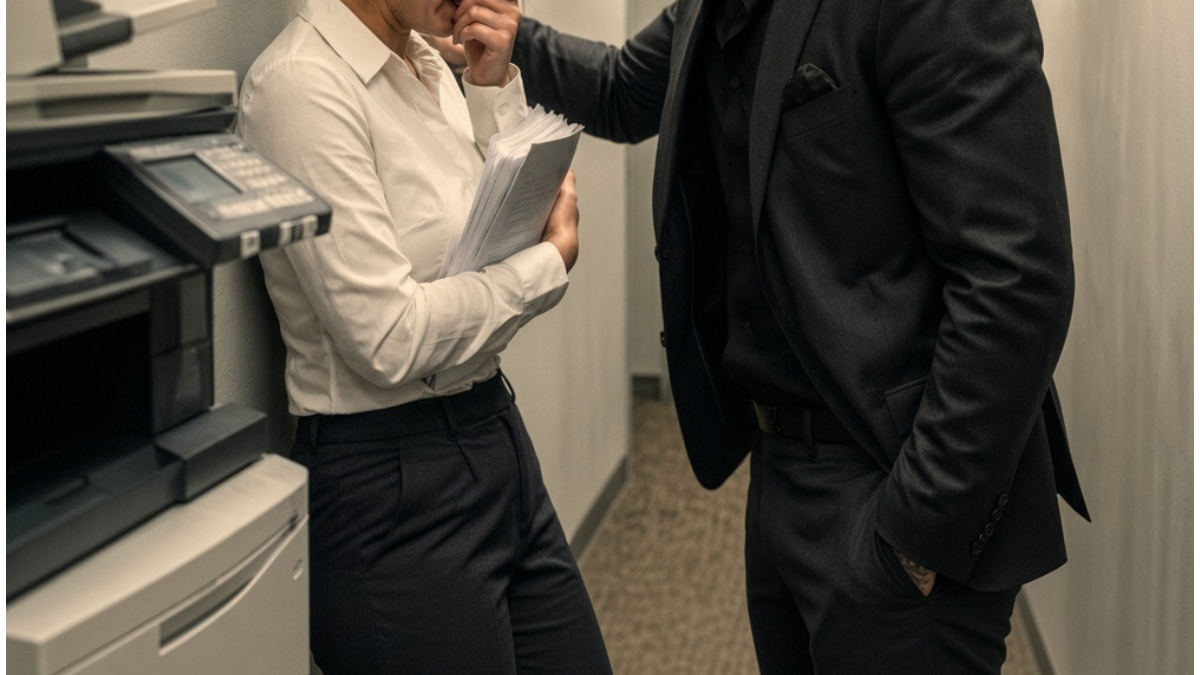
She wasn’t supposed to be there at midnight. Aarava stood in the copy room of Bellavaro Tower, pressing a torn file against her chest like it was the only thing keeping her lungs from collapsing.
The fluorescent light buzzed above her head. Her mascara had already given up. Her hands hadn’t stopped shaking in 40 minutes.
She told herself no one would hear her cry over the machines. Then the door clicked shut behind her and the most dangerous man in the city said quietly like a blade sliding from its sheath, “No more hiding.”
“Tell me who made you cry.” The elevator doors opened at 11:47 p.m. and Allar Voss stepped out onto the 14th floor like a woman trying not to exiSt. She had gotten good at that, not existing.
It was in fact the skill she had refined most precisely over the past 3 years of working at Bellavaro Holdings, a company that occupied six floors of glass and polished steel in the heart of the city.
A company that on paper managed real estate acquisitions, private equity portfolios, and international development contracts, and that in the shadows managed things no annual report would ever name.
All knew some of those shadows, not all of them, just enough to be dangerous to certain people, and not nearly enough to protect herself.
She was 31 years old, medium height, medium build, the kind of woman who wore her hair pinned back so tightly it looked like she was trying to disappear from the neck up.
Her clothes were always pressed, but never memorable. Gray blazers, navy slacks, the uniform of professional invisibility.
She spoke in complete sentences when she had to, and in silence whenever she could manage it, the kind of quiet that made people in meetings look past her and address their remarks to whoever was standing nearest the window.
That was intentional. She had learned very early that being noticed at Bellaro Holdings was not something to want.
The 14th floor was empty at this hour. The administrative staff had gone home around 6:00.
The senior partners, if that was the polite term for men who made decisions about other people’s lives over scotch and encrypted phone calls, had a separate elevator bank and a separate floor and a separate world.
All had spent 3 years in their orbit without ever fully entering it. She answered their calls.
She filed their papers. She rerouted their schedules and summarized their contracts and made problems disappear before they became inconvenient.
And she did all of this with the professional anonymity of furniture. Which was why when she walked off that elevator at 11:47 p.m. with a torn file folder pressed to her chest and tears already cutting tracks down her face, she was absolutely certain no one would see her.
The copy room was at the end of the hall, past the row of assistant workstations and the frosted glass conference room and the dying fern that no one had watered since March.
It was always unlocked. Nobody thought of it as a room where anything important happened.
Just machines, paper, toner smell, the industrial hum of the overhead lights that the facilities team had never quite fixed.
All pushed open the door, let it swing shut behind her, and leaned her back against the wall beside the largest printer.
She pressed her hand over her mouth, held it there. She was not someone who cried easily.
That had been trained out of her somewhere around age 15. Growing up in a household where crying was either ignored or weaponized against you.
She was not sentimental. She did not, as a rule, fall apart. But tonight had broken something in her that she had not known could break.
It had started 3 weeks ago with a discrepancy in a quarterly report, a small one.
$12,000 rerouted through a vendor account that didn’t quite match the approved vendor liSt. She had flagged it as she was trained to do, filed the notation, sent it up the chain.
4 days later, a revised report had landed on her desk. Her notation was gone.
The vendor account had been retroactively approved, and attached to the back of the revised report was a sticky note in handwriting she recognized.
The precise angled script of Vincent Carol, the company’s chief accountant. A man with a face like a compressed fist and eyes that held the specific warmth of a parking garage.
The sticky note said, “Sign the verification.” Midnight Friday. Use the 14th floor printer. Tell no one.
She had not slept since then. She had also not signed anything. Instead, she had done what quiet people do when they’re cornered.
She had watched. She had listened more carefully. She had started noticing small things she had previously filed away as irrelevant.
How Vincent Carol always left the building at odd hours. How Gareth Sims, the head of security, stopped accepting surveillance log requests from it without looping in his own team firSt. How Marcus Healey, the company’s public-f facing attorney, had started taking calls on a burner phone he kept in his jacket pocket rather than his desk.
Three men, three titles, three corners of an operation that, as began to trace it, was carved out of Bellavaro holdings like a tumor that had learned to breathe.
What she had assembled over the past 3 weeks through careful misfiling, careful observation, and one very reckless decision to photograph a document on Vincent Carol’s desk during the 12 minutes he spent in the bathroom after a Thursday meeting was not complete.
It was fragments. It was a torn map without a destination, but it was enough to know that someone was stealing from Matteo Ror.
And Matteo Ror was not the kind of man from whom you stole. She She had never met him.
Not really. She had been in rooms where he was present. Board presentations, a quarterly review 2 years ago, once in an elevator when he had entered on the 10th floor and exited on the 12th without acknowledging her existence.
That last time she had studied him for 22 seconds with the focus of a woman memorizing a threat.
He was tall, broad through the shoulders in the way that suggested he had not inherited ease, but had built it out of something harder.
Dark hair going silver at the temple. Eyes that were a very specific shade of gray, not cold exactly, but calibrated the way certain animals eyes are calibrated, designed for darkness and distance simultaneously.
He wore black like other men wore armor. He moved through rooms the way silence moved.
You didn’t notice it until everything else stopped. She had heard things about him. Everyone had heard things.
The stories circulated through the administrative floors in the careful, quiet way. Dangerous information always circulates, never written down, never repeated to anyone above you, never confirmed, and never denied.
That he had built Belaro Holdings from a loan he had extracted from a man who was no longer in a position to want it back.
That the three men who had tried to take his first property development had individually over the course of an 18-month period lost their businesses, their reputations, and in one case their freedom.
That he was not cruel for pleasure, but that he was absolutely and completely without mercy when he felt he had been cheated.
All believed all of it. She had worked for men like Matteo Ror to read the architecture of that particular kind of power.
It wasn’t theatrical. It didn’t need to be. It simply was the way gravity was.
You didn’t argue with it. You planned around it. Which was exactly why the situation she was standing in right now was so catastrophic.
Because Vincent Carol 3 days ago had made himself very clear. He had come to her workstation at 6:15 in the evening when everyone else had gone.
He had sat in the empty chair beside her desk. Nobody sat in that chair.
It was where people left things they needed to pick up later, and he had placed a manila envelope on her keyboard without looking at her.
“Open it after I leave,” he said. She had. Inside was a photograph of her signing a document.
She remembered the moment. A routine verification form two months ago slid under her hand while she was on the phone and distracted.
She had signed without reading it. She did that sometimes when the pace was relentless and the forms were routine and she trusted the infrastructure around her to be what it claimed to be.
The document she had signed was not routine. She saw that now looking at the photograph.
She had verified a payment to a shell company, $2 million routed through four accounts before landing somewhere she couldn’t trace.
And her signature was at the bottom. The next morning, a second sticky note had appeared on her desk.
No handwriting this time. Printed. Four lines. Sign the Friday report. Trust no one above you.
If you talk, the photo goes to Ror. He will believe it. He always does.
You are already guilty. We’re just deciding whether anyone finds out. So tonight, a Friday, 11:47 p.m. She had come back to the office, not to sign the report.
She wasn’t there yet. Wasn’t that broken, but she had to know what was in it.
She had to understand the full shape of what she had been made a part of before she could figure out whether there was any version of this she survived.
She had printed what she could access. The quarterly verification document, the vendor approval chain, a series of payment authorizations that placed in the right order told a very specific story about where a substantial portion of Bellavaro Holdings liquid assets had been going for the past 8 months.
She had the copies in her hand, partially shredded by her own panicked hands when she had heard footsteps in the hallway 20 minutes ago, and had torn the top sheet before realizing the footsteps belonged to the night cleaning crew.
And now she was standing against the wall of the copy room, hand pressed over her mouth, tears running quietly down her face, staring at the torn pages and trying to figure out what a woman with no allies, no proof clean enough to stand on its own, and a forged signature that made her look like the architect of the whole thing was supposed to do next.
The door clicked shut. She had not heard it open. That was the thing about him that she would think about later in the long hours of reconstruction that followed.
She had not heard the door open, only shut, as if he had been standing outside it long enough that his entry was part of the silence, and only his decision to stay had made a sound.
She turned. Matteo Ror stood with his back to the closed door. He was in a black suit, no tie, collar button open.
His hands were at his sides. He looked at her the way she imagined a doctor looks at an X-ray, not with cruelty, not with softness, but with the complete and undivided attention of someone extracting information.
His eyes moved from her face to the torn papers in her hands and back to her face.
She did not breathe. Your Voss, he said. It was not a question. She said nothing.
Her throat had closed in that specific way it did when fear had been present too long and had calcified into something that felt almost like calm.
Aarvas, third year, administrative senior. You handle contract rooting for the Southeast portfolio. He paused.
You’ve cried on the 14th floor three times in the past 18 months. Always in this room, always after 10 p.m. She stared at him.
I noticed things, he said. It’s a professional hazard. Her voice when it came was barely a voice at all.
I can explain. I know you can. He didn’t move from the door. That’s why I’m here.
The hum of the machines filled the space between them. Somewhere in the building, a ventilation system clicked inside.
The fluorescent light above her head buzzed with its low, chronic flicker that the facilities team had also never fixed.
“Those papers,” he said. “Are they from my files?” She looked down at the torn sheets in her hands.
Her answer was honest because she was too afraid to be anything else. Yes. Did you take them to use them against me?
No. Did someone ask you to? She hesitated one second too long. His jaw tightened just slightly.
The only readable shift in an otherwise completely controlled face. That hesitation, he said, tells me more than the answer would have.
It’s complicated, she said. Her voice cracked on the second word, and she hated herself for it.
It always is. He reached behind him and she flinched. She couldn’t help it. The reflex was faster than her composure.
And he paused, watching her flinch. And something moved through his expression that she could not immediately name.
Not softness, not quite, but something adjacent to it. Something involuntary. He turned the lock on the door.
Not aggressively, deliberately. No one comes in, he said. No one interrupts. You’re going to tell me what you know and I’m going to listen and when you’re done we are going to figure out what happens next.
He looked at the papers again. All of it from the beginning. You won’t believe me.
Try me. There’s a photo, she said. Her hands were shaking again. Of me signing a document.
I didn’t know what it was. It was slipped under my hand and I I signed it and now it looks like I’m the one who who what?
She met his eyes. Who’s been stealing from you? The room went very quiet. Not the comfortable quiet of a place where nothing is happening.
The other kind. The kind that has weight. Matteo looked at her for a long moment.
His face gave away nothing. His eyes gave away less. He was a man who had spent decades in rooms where the wrong expression could change the architecture of a negotiation.
And he had long since mastered the discipline of stillness. But she had been watching people for 3 years.
She had been watching him for 22 seconds in an elevator and 2 years of peripheral observation.
She saw his hands at his sides go very still. Who gave you the document to sign?
He said. Not a question. Barely even a sentence. Just words placed in sequence with the precision of a man who already understood that the answer was going to require something from him.
Allah opened her mouth and then her phone vibrated. She looked down at it. Unknown number.
The text was three words. Don’t say anything. Her blood went cold. She looked back up at Matteo.
He had not moved. His eyes had gone to the phone and back to her face with the speed of someone who missed nothing.
Someone knows I’m here,” she said. Her voice was very small. “Yes,” he said. “They do.”
She looked at him. “Are they watching the cameras?” “The cameras on this floor,” he said, “went offline 11 minutes ago,” he paused.
“That wasn’t me.” The copy machine hummed behind her. The fluorescent light buzzed. Somewhere below them in the body of the building, something that might have been footsteps and might have been the building settling into itself moved through the silence like a current.
Ara looked at the torn papers in her hands. She looked at the locked door.
She looked at the man standing in front of it, a man who could with one phone call make her disappear from every professional record she had ever generated, or who could, with equal ease and one different phone call, make the men who had threatened her understand what it meant to have miscalculated.
She didn’t know yet which one he would choose. She wasn’t sure he did either.
What she knew was that the text on her phone meant someone was watching. Someone who knew she was in this room, someone who had not wanted Matteo Ror to know what she was about to say, which meant that what she was about to say was exactly what needed to be said.
She took a breath. It shook on the way in and steadied barely on the way out.
She looked up at Matteo Ror and she said with the specific clarity of a woman who has run out of options and found at the bottom of that particular emptiness something that felt almost like resolve.
His name is Vincent Carol but he’s not working alone. Mateo said nothing. And one of the other men she said is someone you truSt. The silence after that had a different quality than the silence before it.
Deeper, more specific. The kind of silence that precedes not an ending but a beginning.
The kind that settles over the moment right before a very large thing begins to move.
Mateoor’s eyes did not leave her face. “Keep talking,” he said, and below them, somewhere in the body of the tower, the elevator stopped.
The elevator stopped at 11:58 p.m. heard it before she understood it. A low mechanical groan that traveled up through the building’s bones, followed by nothing.
The kind of nothing that has a texture, the kind that tells you something that was moving has been made to stop.
Matteo heard it, too. She could tell by the way his chin lifted a fraction of an inch, the way a man lifts his chin when he is recalibrating based on new information.
He did not look alarmed. He looked the way a chess player looks when the board shifts into a configuration he has studied before.
“How many names?” He said. “Not loudly. He didn’t need to be loud.” “Three.” Allar’s voice was steadier than her hands.
She pressed the torn papers flat against her thigh, smoothing them without thinking about it.
The way you smooth something when you need your hands to have a purpose. Carol, Sims, Healey.
Something happened in Matteo’s face when she said Gareth SiMs. It wasn’t surprise. It was something worse than surprise.
That’s the particular expression of a man who has just confirmed a suspicion he had hoped would stay a suspicion.
Sims,” he repeated, “the head of I know who Sims is.” His voice was flat and absolute and did not invite her to continue explaining.
He looked at a point somewhere past her left shoulder for exactly 3 seconds. Then he looked back.
How long? 8 months minimum, probably longer. The payment trail I found goes back 8 months, but there are gaps I couldn’t fill.
Older vendor accounts that might connect to earlier transfers. I couldn’t access the archive without She stopped without coming here at midnight and printing things I wasn’t supposed to touch.
He studied her. You’re not protecting yourself with those papers. No, you’re building a case.
She didn’t answer immediately, which was its own answer. That’s not what a guilty person does, he said.
I have a photograph that says otherwise. Show me. She blinked. What? The photograph? The one they used.
Show me. I don’t I only saw it once. Carol had it. He put it back in the envelope before he left.
But you remember it. She remembered every pixel of it. The angle of her own wrist, the pen in her hand, the date stamp in the corner.
Yes. Which document were you signing? I didn’t know at the time. It was a vendor approval.
I I thought it was a vendor approval. It was slid across my desk while I was on a call.
I signed in the margin, which is what I do for routine verifications when she stopped again.
I know how that sounds. It sounds like someone who knew your work habits well enough to exploit them.
His tone was clinical, not unkind, but not warm either. He was processing, not consoling, and she found unexpectedly that she preferred it that way.
Sympathy would have finished her. This she could work with. Healey drafted the document. I think so.
The language in the payment authorization, the specific phrasing in clause 7 matches a contract template that Healey’s team uses for offshore acquisition transfers.
I’m not a lawyer, but I’ve routed enough of his contracts to recognize his structure.
Mateo was quiet for a moment. Behind him, through the locked door, the hallway beyond was still and silent in the way that felt curated.
Too. Still, the building’s normal ambient noise, the distant murmur of the HVAC, the occasional ping of a working elevator, the electronic hum of systems doing what they were built to do, had dropped by several degrees in the last 4 minutes, and she was not imagining it.
“The cameras on this floor went offline 11 minutes ago,” she said, repeating what he had told her.
“You knew that? How did you know that?” He looked at her. There was something in it.
Not quite respect, but close to it. The look you give someone when they ask the right question instead of the comfortable one because I have a secondary monitoring system that doesn’t run through SiMs. She absorbed that.
He doesn’t know about it. He didn’t know about it, Matteo said. Past tense. Tonight, something triggered a manual override on the primary surveillance grid for floors 12 through 16.
Whoever did it used Sims’s administrator credentials. He paused. Sims is currently at a charity dinner at the Hartwell Hotel.
He has been there since 8:00 p.m. and has not left. She stared at him.
So, someone used his credentials without him. Or he gave them to someone before he left, which means someone else is running this tonight.
Yes. The weight of that settled over the room like a drop in temperature. All looked at her phone.
The three-word text was still there on the screen. Don’t say anything. She turned the phone over in her hand and looked at Matteo.
They know I’m talking to you, she said. They knew the moment I came to this floor.
He said it without inflection. I wasn’t supposed to be here either. I was at the parking structure when my secondary system flagged the override.
I came up the service stairs. A pause. I’ve been outside this door for approximately 4 minutes before I came in.
She thought about those four minutes. The copy machine humming, her own breathing, the sound of her crying, which she had thought was covered by the machines.
You heard me. He didn’t answer that directly. I heard enough to know you were alone, and that whatever you were holding was more important than whatever you were feeling.
She turned away from him slightly, not out of anger, but because some things you can only hear if you’re not looking at the person who says them.
She pressed the back of her wrist to her cheekbone and held it there for a second.
Then she turned back. What do we do? She said first those papers, he gestured.
Give them to me. Every instinct she had said no. 3 weeks of operating alone said no.
The photograph of her signature and the three-word text message said absolutely not. She looked at him and he looked back at her and she thought about what it meant to have no remaining options that didn’t require trusting someone.
And she thought about which someone in the building she least wanted to be wrong about.
She held out the torn pages. He took them without looking at them, keeping his eyes on her face, which she understood was intentional.
He was watching her reaction to letting go of them, reading what it cost her.
She kept her face even, or tried to. Her jaw tightened, and she felt it tighten, and she knew he noticed.
He looked at the pages. His eyes moved over them quickly. Too quickly, she thought, and then she adjusted.
No, not too quickly. He was faSt. The kind of fast that comes from years of reading documents under pressure, extracting the relevant bones from a paragraph while the room around you is full of people trying to hide them.
Carol’s routing structure, he said, not to her, but almost to himself. He used the meridian account.
He turned a page, his mouth compressed into a flat line. He used it twice.
What’s the Meridian account? He looked up at her. The compression in his mouth told her the answer was not something he was accustomed to explaining to anyone ever.
He decided to explain it anyway. A dormant subsidiary, clean, never used for anything questionable.
It was meant to be used as a transfer bridge in a legitimate acquisition we’ve been planning for 18 months.
He looked back at the page. If he used it for this, the acquisition is contaminated, she finished.
He looked at her again. This time, the expression was less readable and more direct.
You understand corporate structure. I’ve been routing contracts for 3 years. You learn the architecture.
He held her gaze for a half second longer than necessary. Then he looked back at the pages.
The acquisition deal closes in 9 days. She hadn’t known that, but she understood immediately what it meant.
If the Meridian account is flagged in an investigation, the entire deal unravels. 18 months of work, $47 million.
His voice was even. Dangerously even. The kind of even that is not calm, but is what lives on the other side of calm when a man has enough discipline to keep his fury somewhere below the surface where it can actually be used.
And whoever is on the other side of this acquisition, whoever has been waiting for Bellavaro to bring the Meridian account to the table, gets to walk away clean while we take the regulatory hit.
She felt the shape of it clarify. This isn’t just theft. No, they’re not just taking money.
They’re using the theft to set up the acquisition as a failure so that when the deal falls apart, someone else is positioned to pick up the pieces.
He set the pages down on the printer behind him. Arrival structure, one that’s been waiting for Bellavaro to stumble.
He paused. Carol and Sims and Healey don’t care about the money. Not really. The money is the mechanism.
The goal is the company. The fluorescent light buzzed above them. Aar’s throat felt tight.
They’re selling it. They’re delivering it, Mateo said. There’s a difference. Selling implies they’re getting what it’s worth.
Something moved through his voice. Not anger exactly, the thing that anger becomes when it has been compressed long enough to crystallize.
They’re handing Bellavaro holdings to someone who’s been paying them to create the conditions for a hostile takeover disguised as a collapse.
She thought about the sticky note, the photograph, the three-word text. She thought about 18 months of small impositions, forms slid under her hand, requests delivered in tones that didn’t invite refusal.
The slow accumulation of her own compliance pressed into a shape she had never chosen.
They needed a scapegoat, she said. They needed someone whose signature is on the documents and who has no power to fight back.
Someone quiet, she said. Someone invisible, he said. She felt that land somewhere specific, not painfully.
She was past the point where being correctly identified as invisible could hurt her, but she felt it with the precision of a woman who has spent 3 years carefully cultivating an invisibility that had ultimately been weaponized against her.
The photograph they have, she said, even if I tell you everything right now, even if we lay it all out, they show that photograph and the story becomes about me, my signature, my verification, my compliance.
Yes. So, what changes tonight? What’s different now that I’ve told you? He looked at her steadily.
I believe you. That’s not enough. No, he agreed. It isn’t. He picked up his phone.
Not the one she had seen him use in other contexts. The sleek device that lived in his breast pocket like an instrument.
A different one, older, a secondary device. He pressed two keys and put it to his ear and waited.
She watched him. 3 seconds, 5. It’s me, he said into the phone. I’m on 14.
Primary surveillance is compromised. Floors 12 through 16. I need you in the building in the next 10 minutes.
Use the Clement Street entrance. A pause. I’m not asking. He ended the call. He looked at Aara.
I have someone coming who can pull the unmodified surveillance data from the secondary system.
Everything your cameras recorded before they went offline, the unedited feed, timestamped and intact, will show the truth of your movements in this building going back as far as we need.
She understood the significance. The document I signed, the date and time. The original camera would show who slid it across your desk.
Yes. He paused. If they haven’t already wiped the secondary system, can they access it?
They shouldn’t be able to, but Sims has been running security for 6 years. I’ve underestimated what he knows about my backup architecture.
His jaw tightened again briefly. That won’t happen a second time. The phone in Arara’s hand buzzed again.
She looked down. Unknown number. A different unknown number than the first text. This one said, “Get out of that room now.
Use the northeast stairwell. Level B2. Someone will meet you.” She looked up at Matteo.
He held out his hand without asking. She handed him the phone. He read the text.
His expression didn’t change, but she watched him process it. The small increment of stillness that indicated he was reordering his understanding of the situation.
“They have someone in the building,” he said. “They’re trying to pull me away from you.”
“They’re trying to use you to pull me somewhere they can control.” He handed the phone back.
“Don’t reply. Don’t go.” She wasn’t planning to, but there was a cold thread of fear winding through the steadiness she had constructed because the text meant that whoever was operating tonight knew she was with Matteo.
It meant they were watching in a way that didn’t require the cameras on this floor, which meant they had another set of eyes inside the building.
A person, not a system, watching a floor that the cameras could no longer see.
Someone was in the building right now who had a sighteline on the 14th floor.
There’s someone else here, she said. Not Carol, not Sims or Healey. Someone else. Someone physical in the building who can see this hallway without the cameras.
Matteo looked at the door, then at her. The Clement Street entrance has a service camera that runs on a separate network entirely.
My person will pass it on the way in. He paused. I’ll know if anyone came in before them.
And if they did, he moved toward her. Not fast, not aggressive, just deliberate, and she held her ground with effort because every instinct she had was calibrated to make space for large men who moved toward her with purpose.
He stopped 2 ft away, close enough that she could see the texture of fatigue under his eyes, not the tiredness of a man who needed sleep, but the deeper variety, the kind left by years of operating in a world where trust was a calculation you could never fully afford.
If someone came in before them, he said quietly, then we have a very short window between now and the time they reached this floor.
She looked at him and and I need everything you know. Not the edited version.
Not the version where you protect yourself by keeping the most dangerous parts back. He held her gaze.
All of it right now. Every name, every document, every date, every conversation you’ve had with any of these three men that you haven’t already told me.
She took a breath. Her chest felt compressed. Her hands had gone still, which happened sometimes when fear passed a certain threshold and resolved into something colder and more functional.
She talked. She told him about the first discrepancy 6 weeks ago that she had caught in the quarterly routing summary, not the $12,000 notation she had flagged, but an earlier one, smaller, that she had initially attributed to a data entry error and had quietly corrected herself without reporting it because at the time it had looked like sloppiness rather than intention.
She told him that she had gone back and looked at that earlier correction last week and understood that it had not been sloppiness at all.
It had been a test, someone testing whether the correction would be noticed, whether anyone would flag it, whether the system had a gap at Allar’s level of the routing chain that could be relied upon.
She passed the test by failing it, by quietly fixing the number and saying nothing, which told Carol exactly what he needed to know about the hole in the chain.
Matteo listened without interrupting. He stood still in the way that only people with a great deal of control can stand still, not rigid, but contained.
Every part of him directed at the information coming out of her mouth. She told him about Marcus Healey stopping her in the hallway 3 weeks ago outside the second floor conference room the Monday after she had flagged the $12,000 discrepancy.
He had been warm, unusually warm. He had asked how she was, whether she was handling the pace of the quarter, whether she found the routing work stimulating, or whether she ever felt like she was in the wrong role.
She had given him the careful, neutral answers she gave everyone and walked away with a feeling between her shoulder blades that she recognized now with the precision of hindsight as the feeling of being evaluated.
She told him about Gareth Sims coming to her workstation two days later, not in person, but through one of his security detail, a young man with a flat face and a lanyard she didn’t recognize, who had handed her a sealed envelope and said it was an updated access protocol for document routing and left before she could read it.
The envelope had contained a single page dense with procedural language that she had signed in three places before reading it carefully enough to understand that she had just agreed to a revised confidentiality clause that specifically prohibited her from reporting financial discrepancies through any channel other than the designated internal compliance pathway which as she had subsequently discovered ran directly through Vincent Carol’s office.
Matteo’s stillness shifted quality when she said that became sharper. They closed the reporting channel, he said before they made their big move.
Yes. She met his eyes. They cleared the path. Flag discrepancies had to go through Carol.
Any concern I raised would go straight to the man running the operation. And the confidentiality clause makes it a contractual violation for me to go to anyone else, including you.
She paused. Including law enforcement technically without prior internal escalation which escalates to Carol. She paused again.
I signed it. He looked at her. I know, she said. I know. They prepared this for months at leaSt. His phone rang.
He answered it on the second ring, listened for approximately 8 seconds, said, “How many?”
Listened again, said, “Stay where you are.” And ended the call. He looked at and she looked at him and she already knew from the set of his face that the answer to whatever she was about to ask was worse than what she’d been carrying.
The Clement Street camera, he said. My person checked the service feed on their way in.
He paused. Three men entered the building through the freight bay at 11:40 p.m. 17 minutes before I came to this floor.
She did the arithmetic instantly. They were already inside when the cameras went offline. Yes.
They were already in position. Yes. She thought about the text. Level B2. Someone will meet you.
The basement level, the freight bay, the same entrance three men had used 17 minutes ago.
She thought about what kind of meeting that would have been. They weren’t trying to help me escape, she said.
No. His voice was flat and absolute and left no room for a softer interpretation.
They weren’t. She pressed her lips together. The copy machine hummed behind her. The torn pages sat on the printer where Matteo had placed them.
The fluorescent light buzzed and buzzed and buzzed. “The archive,” she said suddenly. “Your private archive, the one with the unmodified records and the original payment authorizations.
Where is it?” He looked at her carefully. “Why?” “Because the papers I printed tonight are fragments.
They’re suggestive. They’re not proof enough to stand on their own, especially against a forged signature and three men withstanding inside this organization.
She kept her voice level. But if your archive has the original vendor approval chains, the ones before Carol altered them, and the original payment authorizations with the real routing signatures, not the ones I was made to verify, she stopped.
Where is the archive? Floor 21, he said. Private server room. Biometric access. Can you access it remotely from here?
Not through the primary network. The primary network is compromised. Your secondary system. He looked at her for a long moment.
You’re asking me to pull the full archive while three men are moving through this building toward our location.
I’m asking you to pull the one thing that can prove this before someone gets to it firSt. She held his gaze.
Because if they’re this organized, if they’ve been planning this for months and they shut down your cameras and they have people in the building tonight, then they know about the archive and they came prepared to deal with it.
Something shifted in his face. Not fear. She didn’t think his face had a register for fear exactly, but recognition.
The particular expression of a man who has just understood that the window he thought he had is smaller than he calculated.
He was already reaching for his phone when the hallway outside went completely dark. Not dim, not flickering, off.
Every light on the 14th floor, visible through the thin strip of space beneath the copy room door, extinguished as if the building had simply decided to stop pretending.
The only light left was the green glow of the copy machine standby indicator, painting everything the color of old water.
All did not move. Mateo did not move. In the darkness outside the door, something was walking.
She could hear it slow, measured, the deliberate pace of someone who knows the floor plan well enough not to need light, moving through the dead corridor toward the copy room with the specific, unhurried confidence of a person who believes they have already won.
Matteo’s hand closed around her wrist, not hard, precise, a single point of contact in the dark that said, “Do not move.
Do not breathe loud. Do not make this easier for whatever is coming. She didn’t.
The footsteps stopped outside the door. She could hear her own pulse. She could hear his breathing.
Slow, controlled, deeply unwilling to accelerate. She could hear the copy machine’s hum, which suddenly seemed obscenely loud.
A green lit beacon announcing exactly where they were to anyone who cared to look through the gap under the door.
A voice came through the door. Low, male, unhurried. Roran, a pause. We know you’re in there, both of you.
She recognized the voice. She wished she didn’t. Three years of hallway greetings and security briefings, and the particular kind of institutional pleasantness that men in authority deploy toward people they consider unthreatening.
Gareth Sims was not at the Hartwell Hotel, or he had left it. Bring the girl out,” Sim said through the door.
His voice had none of the warmth she remembered. It had the flatness of a man doing something he has already decided about.
“And we can all go home.” Mateo’s hand was still on her wriSt. In the green half dark of the copy room, she looked at his face, and his face was absolutely, completely, terrifyingly calm.
He leaned toward her, mouth close to her ear, voice below a whisper. The drop ceiling above the third printer, he said, access panel.
Maintenance corridor above this floor connects to the server room stairwell. She could feel the warmth of his breath, the controlled steadiness of it.
Can you climb? She looked at the ceiling. She looked at the door. She looked at the torn papers on the printer and thought about the photograph in Carol’s envelope and the three-word text message and the 18 months of systematic, patient, meticulous preparation that three men had invested in making sure that when this moment came, she would have no move left.
She looked at Matteo. “Yes,” she said, and outside the door, Gareth Sims stopped waiting for an answer.
And Gareth Sims stopped waiting and tried the door. The lock held. 1 second, two.
Then came the sound had been dreading without knowing she was dreading it. Not a kick, not a shoulder, but a keycard reader beeping on the other side of the wall.
A single electronic chirp. The sound of administrative access being exercised. The sound of a man who had spent six years building his own set of keys to every room in this building, calling in that investment.
The lock disengaged. Matteo was already moving. He crossed the copy room in three steps, put his shoulder against the door from the inside, and held it.
The handle turned. Pressure applied from the other side. Steady, measured, not panicked. The pressure of someone who was not surprised by resistance and was prepared to outlast it.
The ceiling, Matteo said through his teeth. Now looked up. The drop ceiling was standard commercial tile, 2×4 panels in an aluminum grid, the kind that existed in every office building she had ever worked in, the kind she had never in her life had reason to look at as an exit.
The third printer was the large industrial unit in the back corner, a beast of a machine that came up to her shoulder.
She climbed onto it without letting herself think about it, the metal surface cold and slightly unsteady under her shoes, and reached up and pushed at the ceiling tile above her head.
It moved. Dust came down with it, gritty, dry, the accumulated debris of years of nobody looking up here, and she pressed her forearm over her nose and pushed the tile aside and got her hands on the aluminum frame of the grid above it.
“Go,” Mateo said. The pressure on the door was increasing. She could hear a second voice now in the hallway, lower, exchanging something with Sims and a murmur she couldn’t parse.
She pulled herself up. It was not graceful. Her arms shook with the effort, and her blazer caught on the edge of the grid, and she heard the fabric tear, and she did not stop.
She got her elbows over the frame, then her torso, then swung her right knee up and found purchase on a crossbeam, and dragged herself into the maintenance space above the 14th floor ceiling.
It was dark. Not the managed dark of the room below, but a different quality of darkness, thick, unventilated, smelling of old insulation and electrical conduit.
The space was maybe 2 and 1/2 ft high. She could move on her hands and knees or flat on her stomach and nothing else.
“Mateo,” she said it quietly, looking back down through the opening. “Count to five,” he said from below.
His voice was still controlled. She could hear the strain in his shoulder from the door, the specific compression of a man holding a position with his body while his mind was elsewhere.
Then move toward the northeast corner. The access panel is there. Maintenance stairwell. Go up, not down.
You can’t hold that. Count to five. She counted. On three, she heard him step back from the door.
On four, the door swung open. On five, she heard Sims’s voice enter the room with the easy confidence of a man who expected to find two people cornered.
She moved, hands and knees, fast, not fast enough. The aluminum grid flexing slightly under her weight in a way that made small sounds she couldn’t prevent.
She moved toward the northeast corner by feel and proximity memory, triangulating her position from the room layout below.
Printer bank, wall, HVAC, duct corner. And she did not let herself listen to what was happening in the copy room below her because listening would slow her down and slowing down was not something she could afford.
She found the access panel by running her hand into the frame of it. A hinged metal door set into the maintenance corridor wall the size of a large suitcase.
Her fingers found the latch, cold metal, a simple lever mechanism. She pressed it and the panel opened outward and cool air moved against her face from the other side.
The maintenance stairwell was narrow and unlit and smelled of concrete and pipe ruSt. A single red emergency light at the top of each flight threw everything into the color of a dark room.
She stepped through the panel, found the metal stair rail, and went up. She counted floors by the emergency lights.
15 16 17 The stairwell was not connected to the main building systems in any way she could hear.
No sounds from outside it. No vibrations of elevator shafts or building HVAC, just her own breathing and her own footsteps and the thin metallic sound of the handrail under her palm.
She went up. She did not let herself think about what was happening on floor 14.
She did not let herself think about what Gareth Sims had found when he opened that door.
She thought about the archive, floor 21, biometric access. She thought about what Matteo had said, not through the primary network.
The primary network is compromised. And she thought about the secondary system, the one Sims didn’t know about, the one that had flagged the camera override and sent Matteo to the 14th floor in the first place.
She thought about whether that secondary system had a terminal on floor 21, and whether biometric access meant a hand scanner or a retinal reader or a keypad, and if it was biometric, it needed Matteo and Matteo was not here.
She kept going up. Floor 19, 20, she stopped at 21. The access panel on this level was heavier, steel rather than aluminum, with a keypad mounted to the left of the latch rather than a simple lever.
She stared at the keypad in the red emergency light. Eight digits, a cursor blinking, a small screen reading Bellavaro archive, authorized access only.
She pressed her back against the stairwell wall and looked at the keypad and thought about Matteo’s hands on her wrist in the dark.
She thought about the specific moment he had chosen to tell her about the maintenance corridor rather than any earlier moment.
And she thought about what it meant to tell someone an exit route in the middle of a confrontation you weren’t sure you were going to win.
He had given her the way out firSt. He had held the door so she could go firSt. She pressed her palms flat against the wall behind her and breathed through the understanding of that.
And then she looked at the keypad again and thought about three years of routing contracts and filing documents and quietly memorizing the infrastructure of an organization that had never looked back at her.
She thought about Matteo’s access codes. He would not use an obvious sequence. He was not a man who used obvious anything.
But she had routed his schedule for 3 years. She had cross- referenced his authorization signatures with dozens of documents.
She had on two separate occasions when the system had flagged an expired credential been asked by his personal assistant to log a temporary override code on his behalf.
She had logged both codes because that was her job. She had also because it was her particular and lifelong habit retained them with the precision of a woman who remembered everything that crossed her desk whether or not she thought she would need it.
The first code had expired. She typed the second one. The keypad blinked twice, a pause that lasted long enough to make her certain it had failed.
Then it opened. The archive room was small, climate controlled, and smelled of filtered air and server heat.
Four rack mounted units along the left wall. A single workstation terminal in the center.
Backup power. She could tell by the quality of the lighting. A steady warm LED rather than the red emergency system of the stairwell running on an isolated circuit.
She sat down at the terminal. She did not know exactly what she was looking for.
She knew the general shape of it. Original payment authorizations, pre-alteration vendor approval chains, the unmodified routing signatures that predated Caro’s adjustments.
She knew the time frame, 8 months at minimum, possibly longer. She knew the account names from the pages she had printed.
Meridian, the shell company, two intermediate transfer accounts whose names she had memorized from the fragments.
She started with the search function, typed Meridian, hit enter. 47 results. She started reading.
The first 12 were legitimate. The real acquisition project, preliminary due diligence documents, environmental assessments, legal opinions, everything she expected.
She scrolled past them. The 13th result stopped her cold. It was a payment authorization dated 14 months ago, routed through the Meridian account for an amount that made the 8-mon theft figure she had been working with look like the visible tip of something vastly deeper.
The amount was not $12,000. It was not $2 million. It was 11 million, $400,000.
And the authorization signature at the bottom was not Vincent Kos. She leaned closer to the screen.
The signature was a scanned original, not a digital insertion, but an actual ink signature photographed and uploaded.
She had seen enough authorization signatures over 3 years to read them the way other people read faces.
She knew this signature. She had routed documents bearing the signature for 36 months. She had filed quarterly reports that began with this signature.
She had in the first week of her employment been handed a style guide for document verification that included a reproduction of the signature as the highest level internal authorization in Bellavaro Holdings.
Her mouth went dry. She clicked to the next result. Same signature, different date. 8 months ago, a second transfer from the Meridian account.
6 million 200,000. Next result, 7 months ago, same signature. 3,800,000. She sat back in the chair.
Her hands were in her lap. She was not aware of having put them there.
She was aware of the server room’s climate control pushing cool air against the back of her neck.
She was aware of the terminal screen in front of her, steady and bright and absolutely indifferent to what it was showing her.
The signature on every one of the major transfers, the real transfers, the ones that dwarfed everything she had found on the 14th floor, the ones that constituted not an internal theft operation, but a systematic and sustained dismantling of Bellavaro Holdings liquid foundation over the course of more than a year was not KOS.
It was not Simses. It was not Healy’s. It was Matteo Rors. She sat there in the climate controlled quiet of the archive room and looked at his signature 14 times and felt the specific nauseating lurch of a person whose entire framework of understanding has just been pulled out from beneath them like a tablecloth from under a fully set table.
And she thought with the terrible clarity of someone who has just understood that the person who told them where to run also knew exactly where they would end up.
She thought about the door, the locked door, the four minutes he had spent standing outside before he came in.
The secondary surveillance system that wasn’t Sims’s, the service entrance camera that his person had checked, the way he had known which floor the cameras were offline on before she had told him anything because a man with a secondary monitoring system would know that, yes, but so would the man who ordered the cameras taken offline.
She thought about giving him the torn papers. She thought about his hand on her wrist in the dark.
She thought about every piece of information she had given him in that room. The names, the timeline, the document she had signed, the confidentiality clause, the acquisition deal, the archive, and she thought about how methodically and completely she had handed him the precise map of everything she knew and everything she had and every way she could be found.
She was on floor 21 of his building, locked in his archive, with his signature on the documents that proved the money hadn’t been stolen by his subordinates.
It had been moved by him. The question, the only question that mattered in the 30 seconds she gave herself to sit in the paralysis of this understanding before she forced herself to start moving was why?
Why would Matteo Ror systematically transfer his own company’s liquid assets through a dormant subsidiary into accounts she couldn’t immediately trace?
Why would he frame three of his own senior staff for it? Or allow them to believe they were conducting an operation he didn’t know about while the real operation ran above them?
Why would he need a scapegoat whose signature could be lifted off a routine verification form?
She looked at the screen. 14 authorizations. The earliest one 18 months ago, 18 months.
The same timeline as the acquisition deal. She thought about what Matteo had said. 18 months of work, $47 million.
She thought about what he hadn’t said. She pulled up the acquisition file, the one the Meridian account was supposedly contaminating.
She opened the deal summary and read the parties listed and her breath stopped in the middle of an exhale and stayed stopped for three full seconds.
The acquisition target, the company Bellavaro Holdings was purchasing, was a logistics firm called Veltran Partners.
She knew that name, not from Bellaro’s files, from before. From the two years she had spent before Bellavaro at a smaller financial services firm, the one she had left quietly and without forwarding her professional contacts or putting a reason in the resignation letter, the one she tried not to think about because thinking about it meant thinking about the specific man who had made her last four months there into something she had never found the right word for.
Veltran Partners was owned through a series of holding structures by a man named Daniel CreSt. Daniel Crest, who had been her direct supervisor at the financial services firm.
Daniel Crest, who had spent four months making her professional life a closed room that got smaller by the week.
Daniel Crest, whose name she had never put in a formal complaint because formal complaints required you to believe someone would act on them, and she had not believed it then, and was not sure she believed it now.
She sat in the archive room and looked at the acquisition summary and felt the walls of the situation she was inside rearranged themselves into a configuration she had not anticipated and could not immediately see the edges of.
Matteo Ror was acquiring Daniel Crest’s company. The money moved through the Meridian account. Mateo’s money moved by Matteo’s signature was not theft.
It was preparation. It was the financial architecture of something she didn’t have the complete picture of yet.
Something that required the Meridian account to be loaded before the acquisition closed. Something that would happen in 9 days, which meant Carol and Sims and Healey, the men who had threatened her, who had used her signature, who had locked her into the scapegoat position, were either genuinely running their own parallel operation inside the larger one without understanding what they were inside of, or they had been placed there deliberately by someone who wanted a secondary layer of noise between the real operation and any investigator who got close.
She pressed both hands flat on the desk in front of her, looked at the screen, tried to find the center of what she knew versus what she was inferring versus what she was constructing out of shock and isolation and the specific cognitive distortion of a person who has been in a high adrenaline state for 3 hours in the middle of the night.
The door to the archive room opened. She did not hear it until it had already opened because the climate control system covered the latch sound and because she had been inside her own head in a way that had briefly cost her the external awareness that had kept her functional all night.
Matteo Ror stood in the doorway. He was not breathing hard. He did not have a mark on him.
His suit was intact, his collar still open, his eyes the same calibrated gray that had looked at her in the copy room 2 hours ago.
He looked at her. He looked at the screen. He looked at where her hands were pressed flat on the desk.
The silence lasted 4 seconds. “You found it,” he said. She held very still. “You knew I would.
I hoped you would.” He stepped into the room. Not fast, not aggressive, the same deliberate pace he moved with everywhere.
I also hoped you’d find it before Sims people found you. The stairwell access panel on 16 was forced 10 minutes ago.
They’re coming up. You’re not explaining the signature, she said. Her voice was flat. She had made it flat on purpose, sanding every inflection out of it, because flat was the only thing she could guarantee right now.
No, he agreed. Not yet. That’s not Ara. He said her name the way you say a name when you need someone to stop and actually hear what comes next.
Not as a diminishment, but as a requeSt. There are two men one floor below us right now.
Whatever you think you understand about that, he gestured toward the screen without looking at it.
We discuss it when we’re not standing in a room with one exit. I just found your signature on $1 million that you were supposed to not know about.
I know. You set them up, she said. Carol and Sims and Healey, you let them run their operation inside yours.
You let them threaten me. You let them use my signature. Something shifted in his face, not performance.
A real shift. The kind that moves through a person involuntarily when something hits an actual nerve rather than a calculated one.
I didn’t know about you, he said. Not until 3 weeks ago. You didn’t know they’d I didn’t know they’d pull someone in from the administrative level.
I didn’t know they’d used your signature until my secondary system flagged the altered verification document.
His jaw worked. That wasn’t part of what I expected them to do. What did you expect them to do?
Move the money the way they were moving it. Believe they were stealing from me and lead me to the organization behind them without knowing that’s what they were doing.
He looked at her steadily. They’re not independent operators. All Carol and Sims and Healey are contractors.
Someone hired them to run this operation from inside Belavaro. That someone is who I’ve been building toward for 18 months.
She looked at him. Her chest felt like something was pressing on it from the outside.
Veltran partners, she said. He didn’t react visibly, but she felt the quality of his attention shift, sharpen into something that had a different texture than anything she had felt directed at her in this building.
You know that name, he said. I know the man who owns it. The silence after that was different from every silence that had preceded it.
It was not a strategic silence or an evaluating silence. It was the silence of a situation that has just revealed a dimension neither party anticipated.
Daniel Crest, she said. Matteo looked at her for a long moment. When he spoke, his voice had a quality she hadn’t heard in it before.
Not softer exactly, but less offended. How? I worked for one of his subsidiary firms two years before Bellato.
She held his gaze. She did not elaborate on what those two years had been.
She did not have to. The way she said it with the specific compression of someone who has chosen their words to convey the shape of something without its full weight was enough.
She could tell by the way his eyes changed. I left without explaining why and ended up here.
There aren’t that many firms at this level in this city. I needed to go somewhere Crest had no connection to.
She paused. Belaro was the one place his name never came up. Because he and I have been careful, Matteo said, not to be connected publicly.
She understood the significance of that immediately. He knows you’re coming for him. He’s known for 6 months.
He’s the one who hired Carol and Sims and Healey to run the operation that was supposed to make the acquisition look like a collapse rather than a purchase.
He paused. What he doesn’t know is that I’m the one who moved the money through Meridian.
He thinks his contractors did it. He thinks they’ve been stealing from me, destabilizing my acquisition capacity, setting up a hostile takeover scenario where he can come in after the collapse and absorb Belaro’s assets at pennies on the dollar.
Another pause. He doesn’t know that every dollar they moved is exactly where I want it.
She worked through this. You’ve been feeding him a false picture of your own financial position.
Yes. You use the Meridian account because it’s the one account he’d find if he had someone inside looking.
Yes. And the acquisition closes in 9 days. At which point partner’s own financial structure, Shers, which Crest has been manipulating for the past two years to position himself for the hostile takeover, inverts.
The money he moved into position to absorb my assets, becomes the thing that exposes him.
His voice was even, cold with intention. He spent 2 years building a trap for me.
I’ve spent 18 months building a larger one around it. She looked at the screen at his signature and at the 11,400,000 that had not been stolen but moved not by thieves but by the man who owned the institution they thought they were robbing.
She thought about something, a small thing, a detail. The photograph, she said, Carol has it.
Your secondary system flagged the altered verification document 3 weeks ago. You said you didn’t know they’d pulled someone from the administrative level until then.
She held his gaze. You came to the 14th floor tonight because of the camera override.
Yes, but you spent 4 minutes outside the copy room door before you came in.
He was quiet. 4 minutes, she said. That’s not 4 minutes of hesitation. That’s 4 minutes of listening to someone inside that room and deciding what to do about what you heard.
She felt something solidify in her cheSt. Not anger, something more structural than anger. You came in when you decided I was useful.
The word landed in the room between them like something dropped from a height. He didn’t deny it.
That she registered was the most honest thing he had done all night. “Yes,” he said.
She held that, sat with it. The climate control pushed cool air against the back of her neck.
But,” he said, and his voice had something in it she didn’t expect. A roughness that hadn’t been there before.
The sound of a man saying something he is not prepared to say. “I came in when I heard you stop crying.”
She looked at him. “You were crying,” he said. “And then you stopped. Not because you felt better, because you decided something.”
He looked at her with the full undivided attention she had felt from the beginning.
But something in it had changed. The calibration had shifted, and she thought she understood now that what had looked like evaluation had also from the beginning been something else, something he hadn’t accounted for in his architecture.
I came in because I wanted to know what you decided. The door at the bottom of the maintenance stairwell hit its frame.
They both heard it loud, metal on metal, the sound of someone who is done being patient and has started being a problem.
Matteo looked at the stairwell access panel, still open, still showing the red emergency lighting of the stairs.
He looked at the archive terminal. He looked at Aara. I need you to copy those files, he said.
Everything on that terminal. There’s a drive in the left rack, second slot from the top.
Pull it and plug it into the workstation. If I copy those files, your signature is on them.
Yes. You said the goal is to expose Crest at the closing. If your signature is on the transfers, it’s the last piece, he said.
Crest’s legal team will argue that the transfers prove Bellavaro was the unstable party, that the acquisition is contaminated by internal fraud, that his hostile takeover is a rescue rather than a predation.
He looked at her. Unless someone who has no connection to me or to Crest or to any part of this operation walks into that boardroom in 9 days with the complete file, the real routing chain, the fake theft operation, the Veltran connection, and lays it out in a way that no one in that room can dispute.
She understood what he was asking. She understood it completely in the full dimension of what it meant for her specifically.
The woman with the forged signature. The woman with the confidentiality clause. The woman who had spent three years being invisible and had spent the last 3 weeks being carefully and deliberately made into the kind of visible that destroys people.
You want me to be the one who presents it. She said, “You’re the only one who can.”
He said it without apology, which she appreciated more than she could have explained. You have no standing in this organization that makes you look like a party to any of it.
You have documented evidence that you were coerced. You have a paper trail showing that your signature was obtained under false pretenses.
And you have 3 years of institutional knowledge that no attorney and no investigator is going to be able to challenge because you were the one routing the contracts while all of this was being built around them.
The stairwell below them registered a sound that was footsteps and was getting louder. And if I do this, she said, what happens to your 18-month operation?
It closes as planned. Crest is exposed. Veltran partners is absorbed into Bellavaro under legitimate acquisition terMs. His financial trap inverts.
And Carol and Sims and Healey face what they actually did, which is real. He paused.
They did threaten you. They did use your signature. Those are real crimes regardless of what they were nested inside.
She looked at the drive rack, second slot from the top. She looked at the workstation terminal.
She looked at Matteo Ror, who had locked a door and asked her to trust him and then given her an exit route and then turned out to be the center of an operation that was either the most sophisticated justice mechanism she had ever encountered, or the most elaborate trap, and she still wasn’t completely certain which one it was.
She thought about Daniel CreSt. She thought about his firm. She thought about four months of closed rooMs. She stood up, crossed to the rack, and pulled the drive.
The footsteps in the stairwell reached the floor below them. She plugged the drive into the workstation, and initiated the copy and looked at the progress bar on the screen and did not look at Matteo because she couldn’t afford whatever looking at him right now would do to the composure she was running on.
The copy was 60% complete when the access panel from the stairwell opened behind them.
She turned around. The man who stepped through was not one of Sims’s security detail.
He was not large. He was not physically imposing in any of the ways that her threat calibrated nervous system had been expecting.
He was medium height, wearing a gray suit that she recognized from a photograph she had seen once in a company perspectus.
And he had the specific unhurried look of a man who has just confirmed that he is exactly where he intended to be.
He looked at the archive terminal. He looked at the progress bar. He looked at and when he looked at her, she felt the specific quality of recognition that she had spent 2 years trying to forget.
The look of a man who believes that the presence of a particular woman in a particular room is inherently a fact he owns.
Daniel Crest said, “Hello, Ara.” And the progress bar hit 70% and the progress bar hit 70% and stayed there.
All did not look away from Daniel CreSt. She could feel the drive in the workstation behind her.
The way you feel a wound, not with your eyes, but with your entire nervous system.
A constant peripheral awareness of something that matters more than anything else in the room, and that you cannot look at directly without losing the thing you need more right now, which was the ability to read the man standing 12 ft away from her without letting him read her back.
He had not changed much. That was the first thing she registered, and it surprised her because in her memory, he had been larger.
Not physically, he was the same medium height, the same precise gray suit, the same carefully maintained appearance of a man who wanted to be taken seriously in rooms where the default assumption ran against him.
But in her memory, he had occupied more space. The way certain people do when they have power over you and you are 28 years old and you do not yet understand that the power they have is borrowed from your own silence.
He looks smaller now. She filed that away without celebration because smaller did not mean less dangerous and she knew that.
You look well, he said. His voice had the same quality she remembered. Warm on the surface and something else entirely underneath.
The warmth of a man who uses it the way a fisherman uses bait functionally without sentiment.
He looked at Matteo Ror CreSt. Matteo had not moved from where he stood. He was between Crest and Allara by approximately 4 ft, not close enough to read as protection, which he understood was intentional.
Showing your defensive position to a man like Crest was the same as showing him what you valued, and what you valued was what he would go for firSt. I have to admit, Crest said, his eyes moving around the archive room with the unhurried attention of someone taking inventory.
I expected this to take longer. I thought you’d be in the southeast stairwell by now.
The maintenance corridor was a reasonable play. He looked at the workstation terminal without appearing to look at it.
Is that the archive drive? Nobody answered him. He smiled. It was not an unpleasant smile.
That had always been the thing about Daniel CreSt. The smile was real in the technical sense that the muscles producing it were genuine contractions rather than performed ones, which made it worse rather than better because it meant the pleasantness was native to him, coexisting without friction alongside everything else.
He was “Ela,” he said, and her name in his mouth had the same quality it had always had, a familiarity that implied ownership, a casualness that was the opposite of casual.
I want you to understand something before this gets complicated. Whatever Ror has told you tonight, whatever shape he’s put this in, he’s used you.
You understand that, right? That’s what he does. She said nothing. The files on that drive, Crest continued, have his signature on transfers that constitute fraud under three separate financial statutes.
If you walk out of here with that drive, you’re not a witness. You’re a courier.
You’re carrying evidence of his crime, which makes you complicit,” she said. Her voice was flat and even, and she felt it coming out of her from somewhere lower than her throat, somewhere that had been compressed all night, and had found in the last 10 minutes a different kind of pressure to run on.
“You like that word? You used it on me before.” Something moved through his face.
Not discomfort, recalibration. He was resorting her, updating the file he kept on her and whatever part of his mind managed the people he believed he understood.
She could see him doing it, the slight pause in his affect, the fractional reassessment.
That was a long time ago, he said. 2 years and 4 months. People misread situations.
Don’t. She said it quietly. One word and something in the quality of it. The absolute absence of concession in it made him stop.
She watched him stop. She watched the smile recalibrate again, shifting from warmth to something more professional, more careful.
I’m not doing that with you. Not tonight. Not in this room. Crest looked at Matteo.
How much did you tell her? Enough. Mateo said enough to make her useful. Enough so she could make her own decision.
That’s a generous way to describe using a woman’s past against her to manufacture her cooperation.
And I didn’t know her past, Matteo said. The flatness in his voice had an edge in it now until approximately 40 minutes ago.
Crest’s eyes moved between them. She watched him process this, the genuine spontaneity of her connection to both of them, the unplanned collision of two separate histories in a single room.
She could see him deciding whether it was a complication or an opportunity, and she felt cold watching him make that calculation because she knew from experience how fast he made it and how rarely he landed on complication.
Then it’s a coincidence, Crest said. And coincidences are just patterns that haven’t been explained yet.
He reached into his jacket pocket. Matteo moved. Not dramatically. Not the lunge of a man reacting from fear, the fast economical movement of a man who has already calculated the range and decided on the response before the threat has finished presenting itself.
He covered the distance between himself and Crest in two steps and had his hand around Crest’s wrist before the object in Crest’s pocket had fully cleared the fabric.
It was a phone, just a phone. Crest’s fingers were around a phone. Neither of them moved for a moment.
Matteo’s hand on Crest’s wriSt. Crest looking up at him with the specific expression of a man who has just confirmed something he suspected.
“Careful,” Crest said very quietly. “That’s assault.” “Put the phone on the desk,” Matteo said.
Crest did not immediately comply. He held Matteo’s gaze for 3 seconds with the steady patience of a man who understands leverage and is counting the weight of what he has against what is being applied to his wriSt. Then he placed the phone on the nearest flat surface, not the desk with the workstation, a filing cabinet to his left, and Matteo released him and stepped back.
Behind her, the workstation made a sound, a small electronic completion tone. She turned. The progress bar read 100%.
The transfer was complete. She pulled the drive from the slot, held it in her hand, turned back around.
Both men were looking at her. The weight of the drive was negligible. Smaller than her thumb, lighter than a pen.
She had held heavier things. She had carried heavier things in her chest for 2 years before she even walked into Bellavaro Holdings.
But standing in the archive room at what she estimated was somewhere close to 2 in the morning holding a drive that contained the complete financial architecture of 18 months of Matteo Ror’s operation and two years of Daniel Crest’s counter operation and every piece of evidence that could either save her or finish her depending on how the next nine days unfolded.
The drive felt like something that had mass beyond its physical dimensions, the specific gravity of a decision that cannot be undecided.
Crest looked at the drive. He looked at her hand. He looked at her face.
You won’t make it out of the building. He said, “I have four people in this building right now, Sims’ team, plus two of my own.
The primary exits are covered. The service entrance is covered. Ror’s person who came in through Clement Street.”
He paused. Dealt with. She felt Matteo go still beside her. A different kind of still than before.
Harder. Who? He said, “A man named Reyes. I believe he works for you.” Crest said it without inflection.
“He’s in the parking structure. He’s alive. He’ll have a headache.” A pause. “I’m not here to hurt anyone.
I’m here to contain a situation before it becomes a problem for everyone in this room.”
“That’s considerate,” Mateo said. His voice had gone somewhere below calm, below the register where calm lives.
Something that was calm structural foundation, the thing underneath it that doesn’t require maintenance because it has already decided what it will do regardless of how the surface presents.
You have four people in my building and you’re describing yourself as considerate. I’m describing myself as practical.
Crest turned to directly fully the way he used to turn his attention on her in the firm.
That complete focused deliberate attention that she had once mistaken for regard and had later understood was something closer to targeting.
Give me the drive. Walk away from this. Bellaro’s acquisition collapses. That happens regardless. The Meridian transfers are already documented in ways I can release to regulators tomorrow morning.
But you walk away clean. No photograph, no forge signature in anyone’s hands. A severance payment generous enough that you don’t have to work in this industry again if you’d rather not.
He paused. You’ve been used by everyone in this situation. Allah, I’m the only one offering you a way out of it.
She looked at him for a long moment. She thought about 2 years and 4 months.
She thought about the closed room. She thought about the resignation letter with no reason given and the two years after it of rebuilding professional credibility from a foundation she was not allowed to describe accurately.
She thought about the specific way Daniel Crest offered things. The warmth, the practicality, the framing that positioned him as the reasonable party, regardless of what he had done to make the situation, and the way that framing was itself a form of the thing she was being offered rescue from.
“No,” she said. He blinked just once. “Era, you heard me. The photograph alone is a forged context around a real signature, she said, which is documented now on this drive in the original surveillance records from Matteo’s secondary system and in the confidentiality clause that your contractor Gareth Sims had me sign, which incidentally constitutes coercive contract modification under employment law and voids itself.
She held his gaze. I’ve had 3 weeks to think about this. I’ve thought about it.
Crest looked at her differently now. The recalibration was more significant this time. Not a minor adjustment, but a fundamental reassessment.
She watched him resort her into a new category. And she felt for the first time in 2 years and 4 months.
Something that was almost satisfying about being underestimated by this specific man. Because being underestimated was the thing that had let her think while everyone else was acting.
He looked at Matteo. The drive doesn’t leave this room. You have four people in the building, Matteo said.
I have three independent monitoring systems, a secondary communications network that doesn’t run through anything Sims touched, and 9 years of documented relationships with every regulatory body and law enforcement liaison in this city.
He paused. You came into my building, CreSt. You came to me. I came to close a problem.
You came because your contractors told you the situation was contained and you wanted to be present for the ending.
Matteo’s voice was controlled and absolute and had the quality of something structural, a loadbearing wall making itself known because you like endings.
You like to be in the room. Something passed through Crest’s face quickly, gone before it could be classified, but she had seen it.
The acquisition closes in 9 days, Matteo said. Everything you’ve built around the Meridian account, everything Caro and Sims and Healey did inside my organization, it’s not a weapon anymore.
It’s a record, and the record shows the complete picture, which includes who hired them and why, and what they were positioned to gain.
He paused. Walk out of this building right now. Get your four people and leave.
Because in 9 days, none of what you’ve prepared is going to look the way you built it to look.
And I’d rather that happen in a boardroom than in a criminal proceeding. Crest was quiet.
He stood in the filtered air of the archive room with his gray suit and his practiced calm and looked at the drive in Allar’s hand.
And she watched him run the calculation, all of it, the whole board, the way she imagined he had run it a hundred times over the past 18 months, the acquisition timeline and the meridian account and the contractors and the scapegoat and the hostile takeover position he had spent two years building.
She watched him find the place in the calculation where Aar Voss appeared, not as she had appeared in his original model, the invisible woman, the administrative non- entity, the silent compliance machine who would not fight back because she had been carefully selected for her inability to fight back.
But as she was standing right now in this room with the drive in her hand and three years of institutional knowledge and two years of anger that had never had anywhere to go until tonight, she watched him understand that his model had been wrong.
He picked up his phone from the filing cabinet. Matteo watched him do it and did not move.
Crest looked at the phone, then at the door to the maintenance stairwell. Nine days, he said.
Not to Matteo, to her. Nine days, she said. He left. The access panel swung shut behind him with a soft metallic click that seemed in the silence of the archive room disproportionately small for what it signified.
All did not move for approximately 5 seconds. Then she sat down in the workstation chair because her legs had decided that the period of operating on pure adrenaline and compressed fury was over and they were going to need a moment.
Matteo looked at the door, then at her. You’re all right. It was not quite a question and not quite a statement.
She looked up at him. I have no idea, she said honestly. Something moved through his face that she recognized now.
The involuntary shift, the thing that wasn’t planned. He’ll move faSt. Whatever he has on the regulatory side, he’ll try to release it before we can contextualize it.
How fast? Hours? Maybe less? He looked at the drive in her hand. We need to be out of this building and in front of someone who can begin the legal filing process tonight.
Tonight. Now. He reached down and she took his hand and stood up. And the contact was brief and functional, and she released it immediately, but she felt it as she stood.
The specific steadiness of a hand extended without calculation, or at least without the kind of calculation she had been navigating all night.
They moved out through the access panel down the maintenance stairwell, not toward the 14th floor, but toward the building’s suble.
Arut Mateo navigated from memory in the red emergency lighting with the confidence of a man who had designed the emergency architecture of this building specifically because he understood that buildings need exits that the people trying to close them don’t know about.
She stayed close behind him. The drive was in her blazer pocket, the inside pocket pressed against her sternum where she could feel it with each breath.
Sublevel one, a utility corridor, concrete pipe runs, the smell of water and metal. A steel door at the end of it with a manual bar release, the kind that opens outward into an alley.
Matteo stopped at it and listened for three seconds, then pressed the bar and pushed it open into cold night air and the sound of the city doing what cities do at 2 in the morning, running at low volume, unhurried, indifferent to what was happening inside the glass tower above them.
The alley was empty. She looked both ways along it, then up at the building face, then at Matteo.
Reyes, he said. He had his phone out, the secondary device, the older one. He was typing one-handed and moving.
He’ll meet us at the Clement Street corner if he’s ambulatory. He looked at his phone.
He’s ambulatory. They moved through the alley, fast, but not running. The pace of people who are urgent, but who understand that running draws attention that walking doesn’t.
She matched him stride for stride, her heels striking the alley pavement with a sound she couldn’t prevent.
At the Clement Street corner, a man she had never seen before leaned against the building wall with one hand pressed to his left temple.
He was stocky, somewhere in his 40s, with the particular physical density of a man who had spent a significant portion of his life being hit and had made his peace with it.
He looked at Matteo and said something short in a language she didn’t catch. Matteo replied.
The man Reyes looked at at her blazer which was torn at the shoulder where the ceiling grid had caught it at her face which he imagined looked approximately how she felt.
He looked at Matteo again and said something else and Matteo made a sound that was not quite a laugh but lived in that vicinity.
Brief, dry, the sound of a man acknowledging something with the specific emotional restraint of someone who saves the full response for later.
A car appeared at the end of the block. Dark sedan, no plates she could see from here.
Reyes pushed off the wall and moved toward it. She stopped walking. Mateo noticed immediately.
He turned back. Ara, where are we going? My attorney, not Healey, my actual attorney, personal counsel.
She has a home office. He paused. She knows this is coming. She’s been briefed on the acquisition architecture for 6 months.
She can begin the regulatory filing tonight and have the case package in front of the relevant oversight bodies before Crest can release whatever he has.
She looked at the car at Reyes who had reached it and was opening the rear door at the end of the block where the street was open and the city continued beyond it lit and running.
My name gets cleared, she said. The forged signature, the confidentiality clause, all of it.
Yes. That’s not a favor. That’s not a condition. I’m asking for. It’s a prerequisite.
If I walk to that car, it’s because my name is the first thing the filing addresses before the meridian transfers before the acquisition.
Before CreSt. She looked at him. Me firSt. He held her gaze. Yes. Say it.
Your name is first, he said. No qualification, no addendum. Just those four words delivered with the directness of a man who understood that she had spent three years being an afterthought in this building and that this was the one form of precision he owed her and that she was right to demand it.
She walked to the car. The interior was dark and smelled of leather and the residual cold of air conditioning that had been running for hours.
Reyes took the front. Matteo got in beside her. The door closed. The car moved.
She sat in the dark interior of the moving car and looked at the city passing outside the window and pressed her hand against her chest over the pocket where the drive was and felt her own heartbeat under her palm.
Fast, still fast, not slowing yet. The body’s honest accounting of what the night had been.
Matteo was on the phone, low voice, clipped the efficient language of a man briefing someone who is already prepared and needs only specifics.
She caught fragments. Archive copy complete. Crest present. Departed. Filing priority. Voss. Elara. Documentation of coercion.
Forged verification. Amended confidentiality clause. Then the acquisition sequence. She stopped listening to the details and listened instead to the cadence, the organized forwardmoving rhythm of a man dismantling a 2-year threat in real time.
She thought about Daniel Crest in the archive room. The recalibration in his face when she said no.
The way he had looked at her at the end, not with anger, but with the specific expression of a man who has encountered a variable that his model did not include and is already rebuilding the model in real time.
He would move faSt. Matteo had said hours. She thought it was less. She thought Crest had been on his phone in the alley before they reached the suble.
She thought the regulatory documents he had prepared, whatever shape the Meridian account would take in a formal filing, were probably already in motion and that the 9 days to the acquisition closing had just compressed into something much shorter.
She took the drive out of her pocket and held it in her palm and looked at it.
72 floors of glass and polished steel were receding through the back window. The tower.
She had spent 3 years inside it being invisible. She had spent one night inside it being found and threatened and used and nearly delivered to a basement level by people who had decided she was the dispensable part of a very expensive machine.
She closed her fingers around the drive. The car turned onto the expressway and accelerated and the city opened up around them and she was outside the building for the first time in what felt like a different lifetime.
And the night air on the other side of the window was going past at speed.
And somewhere ahead of them, a woman named Matteo’s attorney was awake in a home office waiting for them with a legal strategy and a filing platform and the institutional standing to begin the thing that needed to begin before the sun came up.
All thought about 9 days. She thought about a boardroom. She thought about what it meant to walk into a room full of people who held power and to place pages on a table one by one.
She had been trained for most of her life to make herself small in rooms like that, to root things, to file things, to be the administrative infrastructure that made other people’s authority function silently, invisibly, so well that no one looked at her long enough to understand what she was actually capable of.
She thought about that. She thought about the copy room, the fluorescent light, the hum of the machines, the torn pages in her hands, and the mascara and the shaking.
She thought about the moment she had stopped crying. The car merged onto the upper expressway, and the city spread itself below them on both sides, lit, running, indifferent, enormous, and Matteo ended his call and sat in the dark beside her without speaking, which she appreciated, because she was not finished with the thing she was doing, which was not falling apart, and which required the kind of silence that doesn’t ask anything of you.
After a long moment, he said quietly, “She’ll have us for 2 hours before dawn.
That’s enough time to I know what needs to happen, she said. He stopped, looked at her.
She did not turn from the window. I know the documents, she said. I know the routing chains, the timeline, the account structures.
I can walk your attorney through everything on this drive and sequence, flag the relevant authorizations, and identify every point where the coercion can be documented from the original record rather than from my testimony alone.
She paused. I’ve been doing this job for 3 years. I know the material better than anyone in that organization who wasn’t actively trying to destroy it.
She paused again. Better than some who were. A silence then. Yes. So when we get there, I lead.
She turned from the window and looked at him directly. Your attorney takes instruction from me on the sequence, not from you.
I know where everything is, and I know what it means, and I know how to present it.
And if this is going to work before Crest gets his filing in motion, the person with the fastest, clearest read on the material needs to be in front.
He looked at her for a moment. In the passing light of the expressway lamps, his face moved in and out of visibility.
Shadow, light, shadow. She held his gaze through both. Agreed, he said. She turned back to the window.
The car moved through the upper expressway at speed, and the city fell away behind them, and the sky ahead was still dark, but had begun, at its eastern edge, to carry the first suggestion of something other than night.
Not light yet, not even close, but the absence of the deepest dark, the faint and preliminary shift of a sky that is beginning to remember what it will become.
She felt it the way you feel a change in pressure. Not with your eyes, but in your cheSt. In the specific place where she had been carrying everything she knew and everything she hadn’t said for 3 weeks and 3 years.
Her phone buzzed. She looked at it. Unknown number different from the ones before. A text message, eight words.
The boardroom 9 days. Don’t be late, Ms. Voss. She read it twice. She looked at Matteo, showed him the screen, his jaw set.
His eyes moved over the words and went still in the way they went still when he was processing something that required him to compress a significant reaction into a very small space.
Crest, she said. Yes, he’s not running. No. She looked at the text again, the formality of it.
Ms. Voss, the specific register of a man who has reassessed you and chosen to acknowledge the reassessment in the only currency he respects.
The language of professional equivalence. He wasn’t running. He was resetting. He was telling her that he had recalculated and that the nine days still existed as a battlefield and that he was choosing to meet her on it rather than retreat from it.
Because Daniel Crest did not retreat from things. He absorbed them and he was already figuring out how to absorb this.
She put the phone in her pocket. She put the drive back in her inside pocket and pressed it against her sternum and felt her own heartbeat again.
Still fast, still running, not slowing yet. 9 days, she said. 9 days, Matteo said.
The car accelerated and the city fell behind them and the dark sky ran ahead and somewhere in the distance, the eastern edge of the world was beginning to remember.
The attorney’s name was Sonia Ren, and she answered the door at 2:43 in the morning in reading glasses and a cardigan that had seen better decades, holding a mug of coffee that she did not offer to share because she had already assessed from the look of them that they needed something stronger than coffee, and that she did not have it.
She was 60some, compact, with closecropped gray hair, and the specific physical stillness of a woman who had spent 40 years in rooms where stillness was currency.
She looked at Aara first, not at Matteo, who was the client, who was the money, who was by every conventional measure the principal party in whatever was about to happen in her home office.
She looked at Aara, at the torn blazer, the ruined mascara, the way was holding herself upright and contained, but with the particular quality of containment that belongs to structures under load.
And she said, “Come in.” And stepped back. And it was the most uncomplicated welcome Allar had received in recent memory.
The home office was a converted study off the main hallway. Floor to ceiling shelves on two walls, a desk with three monitors, a workt running along the third wall with organized stacks of file folders, and a printer that was already warm.
Sonia Ren sat behind the desk. Mateo sat in one of the two chairs facing it.
Ara stood beside the workt and plugged the drive into the laptop. Sonia slid toward her without being asked.
“Walk me through it,” Sonia said to Aara directly. Matteo said nothing. He sat in his chair with his elbows on his knees and his hands loosely clasped, and he said nothing for the next hour and 40 minutes, which was the duration of Allar’s accounting of everything on the drive in sequence.
And she recognized the silence for what it was, not absence, not deference, but the specific discipline of a man who had agreed to a condition and was keeping it.
She walked Sonia Ren through all of it. She started with her own name. She started with the confidentiality clause and the date it was presented to her and the identity of the man who delivered it and the coercive architecture it represented.
The closed reporting channel, the deliberate isolation, the mechanism by which every legitimate avenue for raising concern had been rerouted through the center of the operation she was being pressured to protect.
She laid it out in the language of employment law and contract modification and documented coercion.
And she watched Sonia Ren take notes with the speed and precision of a woman who has been doing this long enough that her hand knows what her mind wants before the sentence is finished.
Then she moved to the forged verification, the document she had signed without reading, the photograph, the sticky notes, the specific methodology by which her signature had been extracted and then weaponized not as a crime of opportunity but as a planned structural element of a larger operation requiring her specific position in the routing chain, her specific work habits, her specific professional invisibility.
Sonia looked up from her notes once during this section, not with sympathy, with the hard specific attention of a woman assembling a legal argument in real time.
The photograph, she said, she Carol has the only copy, the only physical copy I know of.
Aar said, if he shared it digitally, we’ll subpoena his devices. Sonia wrote something. The original verification document, the one you signed, where where is it now?
Carol’s office. Or it was, “If they move things tonight, we file an emergency preservation order at 6:00 a.m. when the courts open.
Nothing gets touched.” She looked at the drive. The archive records show the pre-alteration version.
“Yes, timestamped with the original routing signatures, none of which are mine.” “Good.” Sonia wrote something else.
“Continue,” continued. She moved through the payment trail, the 8 months of documented transfers, then the earlier ones, the 14 authorizations bearing Matteo’s signature.
She paused here, not from reluctance, but because the sequencing mattered. She looked at Sonia.
The transfers with Matteo’s signature, she said. They look like fraud. Taken in isolation, they look like the thing they were designed to look like from Crest’s vantage point.
Internal movement of funds by the principal party that could be characterized as self-deing or asset sheltering ahead of an acquisition.
I need you to understand the context before you see them. Sonia looked at her over the reading glasses.
Then give me the context. All gave her the context. She explained the Meridian account, its legitimate purpose, its history, its untouched status before Matteo had used it deliberately.
She explained the acquisition timeline. She explained the counter operation. The patient 18-month construction of a financial false front designed to give Crest’s contractors exactly the evidence of Bellavaro instability they needed to support a hostile takeover narrative.
While the real asset position remained intact and documented in the archive she was currently unlocking, she explained Daniel Crest not the full explanation, not the personal one.
She gave Sonia the structural explanation, Veltran Partners, the ownership chain, the 2-year positioning for the hostile takeover, the contractors Crest had placed inside Bellavaro.
She gave her the professional picture complete and accurate, and she kept her voice even throughout.
And Sonia Ren wrote everything down and asked three precise follow-up questions and did not once look at Allah with anything other than the focused, evaluative attention of a woman building a case.
When she was done, Sonia set her pen down. She took off her reading glasses and looked at the drive and then at her notes and then at Matteo, who had not spoken.
The filing, Sonia said to him, names Allar Voss as a material witness and victim of documented coercion.
Her name and her cleared status are the first items in the primary submission. Before the acquisition sequence, before the Meridian account, before Crest, she paused.
The three contractors, Carol, Sims, Healey, face separate criminal referral for the coercion, the document falsification, and the unauthorized use of surveillance credentials that proceeds independently of the civil acquisition case.
Yes, Matteo said Crest’s hostile takeover position collapses when the Meridian account is properly contextualized and the acquisition proceeds under clean terms in 9 days, possibly fewer.
Sonia looked at he’ll file something with the regulatory office when the markets open 3 hours from now.
Whatever he has prepared, and he has something prepared, a man like that doesn’t come to a building in the middle of the night without a contingency.
It goes in at 9:00 a.m. We need to be in front of it. How far in front?
Aar asked. Far enough that when his filing lands, the oversight body already has our complete package and the context to read his filing as the last move of a collapsing position rather than the first move of a legitimate complaint.
Sonia put her glasses back on, which means I start drafting at 3:00 a.m. and we file at 6:00 when the emergency submission window opens.
She looked at them both. I’ll need you both available by phone. And I’ll need you, she looked at be prepared to give a formal recorded statement to the oversight investigator probably by noon today.
I’m prepared, ara said. Sonia nodded once, the nod of a woman who had assessed a situation and found it adequate.
She turned to her primary monitor and began to type. Mateo stood. He looked at and tilted his head toward the hallway.
She followed him out. The hallway was dim, a single lamp on a side table, the kind of indirect lighting that exists in homes for the hours between midnight and morning when people are awake but not quite willing to commit to full illumination.
She stood in it and looked at him and he looked at her, and between them was the entirety of the night, the copy room, the ceiling grid, the archive, the car, Daniel Crest’s face in the filtered light.
And neither of them had the particular kind of energy left that performs composure. Reyes is outside, he said.
He can take you somewhere safe to sleep for a few hours. I’m not leaving.
He looked at her. If Crest files at 9:00 and the investigator wants a statement by noon, I need to be within reach.
She held his gaze. I’m not going somewhere and waiting to be called. That’s not She stopped.
I’ve been waiting to be called for 3 years. I’m done with that. He was quiet for a moment.
There’s a guest room. That works. He nodded. Looked at the closed office door behind which Sonia Ren was already drafting.
The sound of her typing rapid and continuous. She’s the best, he said, not to reassure.
Just stating it the way you state a fact you rely on. I know, Ara said.
I could tell in the first 10 minutes. He looked at her. The lamp between them threw his face into partial shadow.
One side lit, one dark, which she thought was probably too neat a metaphor to trust, but which she filed anyway.
“The things I didn’t tell you tonight,” he said. “The things I let you find instead of you needed to know if I’d run,” she said.
“When I found the signature, you needed to know what I’d do with it.” He said nothing, which was confirmation.
“I almost did,” she said. Run. For about 40 seconds, standing in that archive room, I almost took the drive and found another way out and let the whole thing be someone else’s problem.
She looked at the office door. And then I thought about the copy room, about how many times I’d been in that room, not because I wanted to be invisible, but because being invisible was the only way I knew to be safe.
She looked back at him. I’m tired of that being the calculation. He looked at her for a long moment with the full directed attention she had come to recognize as the most native thing about him.
Not the power, not the control, but the specific quality of being looked at by someone who is actually seeing you rather than what you represent in their operational model.
It was, she thought, both less and more comfortable than being invisible. Get some sleep, he said.
A few hours, she said. She went to the guest room. She did not sleep immediately.
She lay on top of the covers in her torn blazer and stared at the ceiling and listened to the sound of Sonia Rens typing through two walls and thought about 9 days and then thought about nothing specific and then somewhere around 4 in the morning slept.
She woke at 7:15 to Sonia knocking on the door and saying with the flat efficiency of a woman who had not slept.
Filing submitted at 6:07. Investigator confirmed receipt. Statement appointment at 11:00, not noon. They moved it up.
You have 4 hours. Sat up. Her blazer was still torn. Her hair had come completely down from its pins during the night.
She looked at her hands in her lap and felt the specific weight of a morning after a night like that.
Not light, not heavy, just real. The ballast of a person who has gone through something and is still standing on the other side of it.
I need a change of clothes. She said there’s a bag outside the door. Sonia said Reyes brought things from somewhere.
I didn’t ask. All looked at the closed door. Okay. Coffee’s in the kitchen. 15 minutes.
Sonia’s footsteps moved back down the hallway. Ara opened the door. There was indeed a bag, a plain department store bag, handles twisted together, containing a blouse that was approximately her size and a blazer that was close enough, both still tagged.
She stood in the hallway holding the bag and thought about Reyes, whom she had exchanged no words with, going to a store that opened at 7:00 a.m. and buying clothes for a woman he didn’t know because someone had decided it was necessary and assigned it to him without discussion.
And she thought about the particular texture of organizations built around this kind of quiet, efficient care that never named itself care.
She dressed. She drank coffee standing in Sonia’s kitchen with Matteo, who had also not slept, who was on his secondary phone with someone in clipped monoyllables, who looked up when she came in and registered the new Blazer with a glance that said nothing and understood everything.
She drank the coffee. She did not look out the kitchen window at the morning.
She looked at the drive, which was on the kitchen counter where she had said it when she came in, and she thought about the statement she was going to give in 4 hours.
The statement appointment was at a financial oversight office downtown, a glass and steel building that was in its own way not unlike Bellavaro Tower, which she noted without irony as Reyes pulled the car up in front of it at 10:45.
The investigator was a woman named Patricia Osawa, mid-40s, with a precise manner and the kind of eyes that had heard a great many things, and had learned to receive all of them with the same quality of attention.
She sat across a conference table from Aara with a recorder and a legal pad and asked her questions in a sequence that told she had already read the filing thoroughly and was now looking for the texture of human experience behind the document structure.
Aar gave her the texture. She gave her everything from the first discrepancy she had quietly corrected through the sticky notes and the photograph and the confidentiality clause through the night in the archive room and Daniel Crest’s voice saying hello like a door closing on something she had thought was behind her.
She gave it an order in detail with the precision of a woman who has been retaining information against the day it would matter and has arrived at that day.
She did not cry. She came close once when she described the moment she had decided not to sign the Friday report.
The specific quality of that decision, the way it had felt not like courage but like a refusal to take the next step in a direction she could already see the end of.
She came close then and she studied and she continued. Patricia Osawi listened without interrupting.
She asked four questions at the end. They were good questions, specific, structural, aimed at the evidentiary joints of the case rather than its emotional surface.
Allah answered all four. At the end of the session, Osawi clicked off the recorder and looked at Allah directly.
I want you to understand, she said, that the filing submitted this morning is comprehensive.
What you’ve given me today strengthens it significantly. A pause. The submission from Veltran Partners legal team arrived at 9:17 a.m. It characterizes the Meridian transfers as evidence of internal asset misappropriation by ROR.
Does it mention my name? AR asked. It does in the context you described. As the individual who verified the fraudulent payments, Osoay held her gaze.
Our assessment based on the archive records and the coercion documentation is that the Veltrans submission is a defensive filing built on an intentionally incomplete picture.
She paused again. It’s not nothing. Crest’s legal team is competent. This is going to take the next several days to process through the oversight mechanism before any acquisition proceeding can 9 days.
Aar said that’s the timeline. Yes, we’ll know before the closing whether the acquisition proceeds under clean terms or whether the Veltran objection holds enough weight to require delay.
Osawi looked at her notes. Miss Voss, the coercion case, the employment law component separate from the acquisition.
That’s yours to pursue independently. The oversight body can refer it to the appropriate employment tribunal, but you would need to decide whether to pursue it.
Ara thought about Vincent Carol sitting in the chair beside her desk, the sealed envelope on her keyboard.
I’m pursuing it, she said. I assumed. Osawi clicked her pen. Is there anything else you need from this office today?
Ara thought about it. Yes, she said. I need the record to show that the first flag on the Meridian discrepancy was raised by me 6 weeks ago before the threatening note, before the photograph.
I noticed it first and I said something and the notation was removed. She held the investigator’s gaze.
I need that in the record. Oh, so I looked at her. It’s in the archive files.
I know it is. I want it in the record as something I did actively, not as something that happened around me.
She paused. Because this is the part of the story where the quiet person in the back of the room noticed the thing everyone else was designed not to notice, and I want that to be legible.
Osawi held her gaze for a moment. Then she wrote something on her legal pad.
It’s noted, she said. The next seven days were not cinematic. They were long, procedural, and exhausting in the specific way that institutional processes are exhausting.
Not dramatic, but grinding. The relentless forward pressure of documentation and legal review and the waiting that lives between the things you have done and the things that have not yet been decided.
Ara gave two more recorded statements. She reviewed four separate document packages that Sonia Ren’s team sent for her verification.
She identified three additional irregularities in the archive records that she had not initially flagged.
Small things, procedural things that turned out to be more significant than they looked when placed in context.
Gareth Sims was arrested on the morning of the third day. All read the notification in the bare functional language of a legal update email and sat with it for a moment, not with satisfaction exactly, with the specific sensation of a piece of weight shifting, not lifted, but redistributed, carried differently.
Vincent Caro retained counsel on the fourth day. The photograph, the one of Aara’s signature on the fraudulent verification, was disclosed as part of the legal discovery process.
In context with the archive records and the pre-alteration documents and the coercion timeline, it looked exactly like what it was, a piece of evidence fabricated by the man holding it and the two men who had directed him.
His attorney’s framing of it as proof of Allar’s complicity lasted approximately one meeting with Patricia Osawi’s office before being set aside.
Marcus Healey on the fifth day did something none of them had predicted. He cooperated voluntarily and ahead of any formal compulsion.
Sonia said when she called to tell Ara that Healey had apparently concluded that the position of the final person to cooperate in an unraveling conspiracy is considerably worse than the position of the first and had made the calculation with the speed of a man who had spent his career understanding legal positioning.
His cooperation added three pieces of documentation to the case that had previously required inference, including a direct written communication from Daniel Crest’s organization detailing the specifics of what Carol, Sims, and Healey were being paid to accomplish.
Aar received this update standing in the kitchen of a hotel room she had been staying in since the second day.
Mateo had arranged it through Reyes without being asked, and she had accepted it because her apartment was in a building whose management company had a contractual relationship with a subsidiary of Veltran Partners, which she had not previously known, and which had felt, when Sonia mentioned it in passing, like one more room of a house she hadn’t known she was living in.
She stood in the hotel kitchen and read Sonia’s update and looked out the window at the city and felt the shape of the seventh day approaching with the specific quality of something that has been moving toward you for a long time and is now close enough to see clearly.
The boardroom was on the 44th floor of a downtown financial building. Neutral ground legally designated for the acquisition closing attended by representatives from both Bellavaro Holdings and Veltran Partners, plus the oversight body’s designated monitor, plus three teams of attorneys, plus two investment bank representatives, plus one woman named Alla Voss, who arrived at 8:45 in the morning in a blazer she had bought herself, and sat in the chair Sonia Ren had arranged for her at the left end of the main table and placed a folder in front of her and waited.
Daniel Crest arrived at 8:57. He came in with two attorneys in a manner that had been carefully constructed to project untroubled confidence.
The gray suit again, the practiced ease, the temperature of a man who intended to be the calmst person in the room.
He sat across the table and three seats down from where was sitting. And he looked at her when he sat, and she looked back at him.
She did not look away firSt. The monitor opened the session at 9:00 a.m. with the procedural language of oversight processes, the nature of the proceeding, the parties present, the recorded status of the session, the relevant filings that had been received and were now before the body.
She had a measured official voice and spoke for 4 minutes without inflection, and then asked whether the parties wish to present opening statements.
Crest’s lead attorney stood. He was a man in his 50s with the silver-haired gravitas of someone who has cultivated authority as a professional instrument.
And he presented the Veltran position with the comprehensive confident fluency of someone who had rehearsed it extensively.
The meridian transfers, the pattern of asset movement, the destabilized acquisition position, the forged, he used the word forged pointedly, verification that bore a Bellavaro employees signature and constituted evidence of internal fraud.
He presented it as the complete picture of a troubled company being offered a responsible acquisition by a more stable party.
He spoke for 11 minutes. When he sat down, Sonia Ren did not stand immediately.
She let the room sit for two seconds in the residue of his presentation. Then she said, “The respondent will offer its presentation through Ms. Aar Voss, who is both a material witness and a designated factual representative for the purpose of this proceeding.”
Aar stood. She had the folder. She had the drive copy distributed already to the monitor and all parties in advance per the filing protocol.
She had 3 years of institutional memory and 7 days of preparation and the specific absolute clarity that comes to a person who has decided completely and without reservation what they are going to do.
She opened the folder. She placed the first page on the table and looked at the room 6 weeks ago.
She said, “I flagged a discrepancy in the quarterly routing summary of Bellavaro Holdings. I flagged it, notated it, and submitted it through the appropriate internal channel.
The notation was removed from the record by the individual who controls that channel, who is named in document one before you.”
She placed her hand on the page. That was the beginning. I’m going to take you through everything that happened after it in sequence, and I’m going to show you the complete picture, which is different from the partial picture you just heard.
She looked at CreSt. He was looking at her with the full calibrated attention she remembered from the archive room.
The recalibration that had begun there had continued through 7 days and had arrived at something she could read more clearly now.
Not defeat, not yet, but the specific expression of a man who has been playing a long game and has encountered an opponent he did not include in his original model and is now experiencing the cumulative consequence of that omission.
She looked away from him. She looked at the monitor, at the investment bankers, at the attorneys on both sides of the table, at the documented record in front of her that was hers to present, and she presented it.
She spoke for 53 minutes. She placed pages on the table one at a time, not dramatically, not with theatrical emphasis, but with the methodical, unhurried pace of a woman who knows the material cold and has enough respect for its weight to let it speak at its own speed.
The original flag, the removed notation, the coercive confidentiality clause, the sticky notes, the photograph and its evidentiary context, the Meridian account in its real sequence, the 14 authorizations and their purpose within the counter operation, the Veltrand ownership chain, the hired contractors, Marcus Healey’s cooperation documentation, the direct communication from Crest’s organization.
Each page landed on the table and became part of a picture that assembled itself in the room with the specific inevitability of something that was always true and is only now becoming visible.
She did not editorialize. She did not characterize. She presented the record and let the record make the argument because the record was unambiguous and she had always understood in 3 years of routing the documents that built and ran a complex organization that the record is the argument and the rest is noise.
When she finished, she sat down. The room was quiet for a moment. The monitor made a note.
Crest’s lead attorney leaned toward Crest and said something at a volume that didn’t carry across the table.
Crest said something back. His face was still controlled, still wearing the architecture of professional composure, but she could see the loadbearing structure behind it under strain.
The specific strain of a position that has just had its foundation documents placed on a table in front of a regulatory monitor in a recorded proceeding.
The monitor asked council if they wished to respond. The lead attorney stood. He spoke for 8 minutes.
His presentation was competent and his framing was professional and it addressed three of the points had made with specific counterarguments that she noted and acknowledged as technically coherent.
But the architecture of his response was defensive, reactive to what she had placed on the table rather than advancing a position of its own.
And she thought, listening to it, that he knew it, too. Because the cadence of a competent attorney defending a position that has lost its foundation sounds different from one advancing a position that is intact.
And she was good enough at listening to tell the difference. The monitor called a 40-minute recess.
Aar sat at the table. She did not go to the side room where Sonia and Mateo’s team had gathered.
She sat where she was and looked at the pages she had placed across the table’s surface over the past 53 minutes.
The assembled documented record of everything that had been done around her and to her and against her, and because of her invisibility, and she thought about nothing in particular.
Matteo sat down in the chair beside her. He had been in the room throughout, but at the far end, positioned as the principal party, managed by his own legal team.
He sat beside her now and looked at the table. Healey’s cooperation document, he said quietly.
The third section. Did you see his notation on the payment authorization? The Crest organization’s counter signature, she said.
Yes. That’s what finishes it. He paused. Not any of the archive records. Not the Meridian account contextualization.
That one counter signature in Healey’s disclosed document connects Crest’s organization directly to the contractors.
He paused. It’s the piece I didn’t have. I didn’t know Healey kept a signed copy.
He kept it because he’s an attorney. She said, “Attorneys keep things that protect them.
He kept it the same way I kept the routing discrepancies, not because he planned to use it, but because holding a record of what someone owes you is the only leverage available to someone who doesn’t have any other kind.
Mateo looked at her. You’re describing yourself. I’m describing anyone who has ever been in a position where the only power they have is knowing something that someone else would prefer stayed unknown.
She looked at the table. It’s not a comfortable power, but it’s real. He was quiet for a moment.
What you said to the room about the flag you raised 6 weeks ago that you wanted it in the record as something you did actively.
Yes, it was noted. He paused. It’s in the monitor’s official summary. I saw it when the documents were distributed.
She absorbed that. She sat with it the way you sit with a small thing that has more weight than its size suggests.
The monitor returned at the end of the recess and resumed the session. The next two hours were procedural.
Questions from the monitor’s office directed at both parties. Clarifications, one significant dispute about the chain of custody of the Healey documents that Sonia Ren dispatched with four sentences and a time-stamped email record.
At 12:47, the monitor called a short break and conferred with her team at the side of the room.
At 1:15, the monitor issued her preliminary finding. It was not final. The full regulatory determination would take several more days and involve a written report.
But the preliminary finding was that the Veltran partner submission did not constitute sufficient grounds to delay the acquisition proceeding.
That the evidence of coercive manipulation of a Bellavaro employees documentation constituted a significant counterweight to the allegations in the Veltran filing.
And that the acquisition could proceed to closing under the terms of the original agreement pending the formal written determination.
Press lead attorney requested a formal objection be entered into the record. It was entered.
The monitor acknowledged it with the flat efficiency of a woman who had expected it.
Ara looked at CreSt. He was looking at his attorney. His face was contained. She did not expect it to crumble.
It wouldn’t. Not here. Not in front of a recorded proceeding because Daniel Crest was many things, but he was not a man who crumbled in public.
He would leave this room and he would be in his own car in 4 minutes and his attorney would begin the process of determining what remained of the position he had spent 2 years building and that process would be long and expensive and she thought ultimately insufficient.
He looked up and met her eyes. She had expected in the second she had imagined this moment over the past 7 days to feel something specific.
Vindication or something that resembled it, the completion of a loop that had been open for 2 years and 4 months.
She had expected the specific satisfaction of a person who has been disbelieved and has proven themselves right.
What she actually felt was quieter than that, less dramatic, more durable. It felt like the sensation of a door closing from the inside by her own hand on a room she was choosing to leave.
She looked away from him. She looked at the window behind the monitor’s chair, which showed the sky above the city, blue and deep and continuous, the kind of sky that exists without reference to what is happening underneath it.
She looked at the pages on the table, the record she had assembled and presented.
She thought about the copy room, the fluorescent light, the hum of the machines, the torn pages in her hands.
She thought about what it had cost to stand in that room that night. Not the professional cost, not the legal exposure, but the deeper coSt. The one that doesn’t show up in documents, the cost of a person who has been invisible deciding in the middle of a night that was designed to break her, to be seen.
The session closed at 2 p.m. The attorneys gathered their materials. The monitors team collected the record.
People moved around the room with the specific purposeful shuffle of a formal proceeding, releasing itself back into the ordinary world.
Ara sat for a moment longer. She sat and looked at the pages on the table, and then she gathered them carefully in the order she had placed them and put them back in the folder.
The folder went into her bag. She sat with the bag on her lap for a moment.
Sonia Ren appeared beside her. Preliminary finding goes to written determination in 4 to 6 days.
We’ll have a final order before the end of the acquisition window. She paused. The employment coercion referral goes to the tribunal next week.
You’ll need to appear, but the documented record is strong, stronger than moSt. Another pause.
Are you all right? It was the same question Matteo had asked her in the archive room with the same ambiguous punctuation that left space for an honest answer.
I will be, said. Sonia nodded. That was enough for her. She left. Matteo was at the door finishing a short exchange with one of the investment bankers who clapped him on the shoulder with the specific enthusiasm of a man for whom the day has gone well in measurable financial terMs. Matteo received the gesture with the contained patience of someone who knows the appropriate response and produces it efficiently.
When the banker left, Matteo looked at her across the emptying room. She walked toward the door.
He held it. They stood in the hallway outside the boardroom while the last of the other parties filed past them toward the elevators.
The hallway was standard commercial. Neutral carpet, recessed lighting, the institutional anonymity of a space designed to be equally inoffensive to everyone who passes through it.
The acquisition closes on schedule. She he said, “I know. Belaro’s position is clean. The meridian account is properly documented.
The formal written determination will confirm the preliminary finding. He paused. The company survives. I know that, too.
He looked at her. What do you need? It was a different question than the one she had been asked all night and all week.
Different from what do you want and different from what should we do and different from the calculations and assessments and legal determinations that had constituted the past 7 days.
It was a simpler question. It was asking about her specifically and nothing else. And she recognized in it the specific register of a man who had been asking adjacent questions all week and had finally arrived at the direct one.
She thought about it honestly. I need a few days, she said, before anything else, before any conversation about what comes next, professionally or otherwise.
A few days that don’t have a proceeding or a filing or a document package attached to them.
All right. And then she said, “I want to talk about what comes next.” He held her gaze.
There’s a position, he said. On the executive floor, it’s been open since I restructured the compliance department 6 months ago.
I didn’t fill it because I couldn’t find someone who understood the material well enough and was, he stopped, chose the word, honest enough to do what the role actually requires.
She looked at him. You’re offering me a job. I’m telling you a position exists.
What you do with that information is your decision. She looked at the hallway at the elevator bank at the end of it.
At the city visible through the glass at the far end of the corridor running its ordinary afternoon business, unhurried, continuous.
I’ll think about it, she said. He nodded. That also was enough. They took the elevator down in silence.
Not the silence of people who have run out of things to say, but the silence of people who have said enough for today.
And understand that the rest has time. The elevator descended 44 floors slow, and she watched the numbers drop and thought about the last number she had watched descend on an elevator, which was the night she had gone to the 14th floor with torn papers and shaking hands and the intention of hiding in the copy room until she figured out what to do.
The elevator opened onto the lobby. She stepped out. The lobby was marble and glass and the sound of the city coming in through the revolving doors.
And she crossed it and pushed through the door and stood on the sidewalk in the afternoon light.
It was a clear day, cold still, but with the kind of cold that has light in it rather than just temperature, the cold of a day that is not trying to take anything from you.
She stood in it and breathed it and felt the specific quality of outside air after a long time in air conditioned rooMs. real, moving, carrying the smell of the city and the faint residue of rain from the night before.
Mateo came out beside her. Reyes was at the curb with the car. They stood on the sidewalk for a moment.
“The copy room,” she said. He looked at her. “I want to go back to it,” she said.
“Not today, but at some point, before I decide anything about what comes next,” she paused.
“I want to go back to it when it’s just a room.” He was quiet for a moment.
“It will be,” he said. She looked at him. In the afternoon light, he looked, for the first time since she had met him in that room, like something closer to a person and further from a position, the silver at his temple more visible, the fatigue under his eyes real and unmanaged, the contained precision of his manner looser, not gone, but resting.
She thought about what it cost to be the kind of person he was, the vigilance of it, the sustained discipline of moving through a world where trust was always also a calculation.
She thought about what it had cost him to stand outside a door for 4 minutes listening to someone cry and then to come in.
And she thought that whatever his reasons were, operational, strategic, the useful coincidence of her knowledge and position, something in those four minutes had also been its own thing separate from use.
She was not ready to name what that thing was. She did not think she needed to be yet.
Take care of Reyes, she said. His head. He’s had worse. Still. Mateo looked at her with the specific expression she had come to understand was his version of something that other people’s faces did more readily.
Something that was not quite a smile, but occupied its general territory. Lived in the same neighborhood.
Still, he agreed. She picked up her bag, looked at the street. I’ll call when I’m ready to talk about the position.
I’ll answer, she walked. Not toward the car, not toward any particular destination she had named to herself.
She walked along the sidewalk in the afternoon light with her bag on her shoulder and the folder under her arm, and the drive in her inside pocket, pressed against her sternum, where she could feel it with each breath.
She walked, and the city moved around her. People going somewhere, the sound of traffic, a food cart, a dog on a leash, the ordinary continuous texture of a world that does not pause for the things that happen inside glass towers in the middle of the night.
She walked three blocks before she stopped. She stood on a corner and looked at the city and breathed in and out, the cold air, the light in it, the smell of the day.
She thought about the copy room, the fluorescent light buzzing, the hum of the machines, the torn pages and the mascara and the shaking.
The moment she had stopped crying, not because she felt better, Mateo had said, but because she had decided something.
She had not known in that moment what she was deciding. She had known only that the alternative to deciding was to go on waiting in a room that would not get larger, and that she was finished with rooms that did not get larger.
She knew now what she had decided. She had decided to be the person who noticed things.
The person in the back of the room who had been routing the infrastructure of other people’s authority for 3 years and who knew with the accumulated precision of 3 years of careful, thorough invisible work, exactly how everything was connected and where the bodies were and what it meant when a number didn’t match.
She had decided that invisibility was not the same as powerlessness, that it had only ever felt that way because no one had told her otherwise, and she had not yet told herself.
She stood on the corner and breathed and let the city go past her. Then she put her bag more firmly on her shoulder.
She looked at the street ahead of her, ordinary, open, going somewhere. She walked. The afternoon light went with her, long and level, stretching her shadow out ahead of her on the sidewalk like something showing her the way.
And the city opened up before her, block after block after block, unfinished and running.
And for the first time in as long as she could remember, she did not feel like she was trying not to exist inside it.
She felt like she was arriving.








