The Seamstress entered the Wrong Carriage – Not Knowing it Belonged to The Most Powerful Duke!
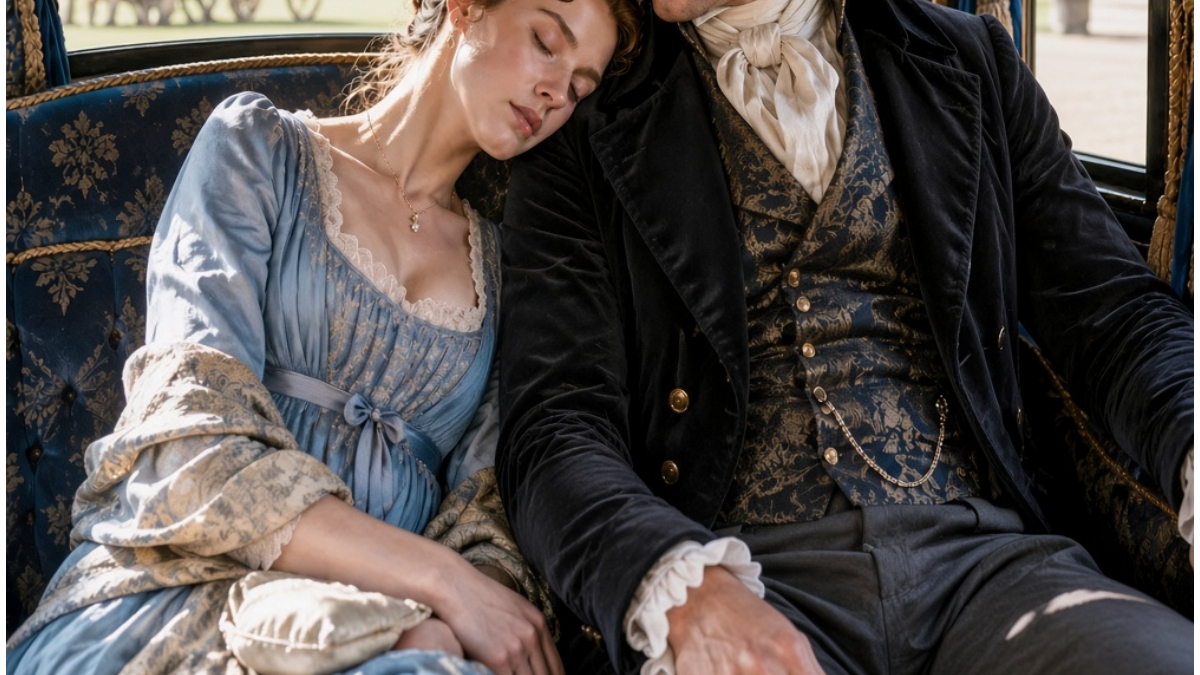
There were two carriages in the yard of the bear at Devises at 20 minutes to the hour on the 8th of October, and it was raining hard enough that nobody was standing about in it, and both of them were black.
One was the Bristol night coach, and it left at 40 minutes 10. The other belonged to the Duke of Rasbury, who had to be at Bristol before the court sat on Thursday morning with £900 to keep his brother out of the sheriff’s ward, and who had told his man not to stop for anything short of a broken wheel.
Esther Vain had four shillings, a box, and a place at Bristol that began on Monday.
She got into the wrong one. She had been in that yard since 9:00 because she had nowhere else to wait.
That was the whole of it and there was nothing dramatic about it. Esther Vain had come out of the Fairhurst’s house at Malbor on the Monday with a box and a character and 6 weeks wages owing that she was never going to see because the family had gone to Naples in the last week of September and the agent had shut the house and had been extremely sorry about everything.
He had been sorry in writing. She had the letter and it said that Mr. Fairhurst’s affairs were in the hands of his London solicitors and that all claims would be settled in due course and Esther Vain had been in service and out of it since she was 15 and knew exactly what in due course was worth.
6 weeks at £14 a year was £112 and thread four shillings and a place at Bristol.
The place was the only good thing that had happened to her in a fortnight, and she had got it by writing nine letters in 4 days, and by knowing a woman at Chippenham, who knew a woman in the trade at Bristol.
Mrs. Dallow of Corn Street wanted a second hand at the sewing, and would take Esther Vain on trial at nine shillings a week, and had said in her letter twice that the girl must be there to begin on the Monday morning.
The Monday was the 13th. It was the eighth. She had four shillings and a box, and the night coach from Devises to Bristol was five shillings inside and three and six on the roof.
She had gone to the office at 8 to take the roof. Full, said the cler.
I shall stand. You will not stand on the roof of a male from here to Bristol on a night like this, my girl.
And if you got up on it, I should have you down. The man was not unkind about it.
There is a Bristol coach at 6:00 in the morning and there will be room on that.
6:00 in the morning gets to Bristol at 2. It does. And I am to be in Corn Street on Monday and I have got four shillings and I cannot pay for a bed here on Thursday and Friday and Saturday, said Esther Vain.
And I have done the arithmetic three times in the last hour, and there is no way round it.
The cler of the bear at Devises looked at her for a moment. Then I am sorry, he said, and I mean it, and there is nothing I can do about any of it.
So she was in that yard at 10 in the rain, standing under the arch with her box, doing the sum for the fourth time, and getting the same answer, which was that she could pay for two nights at Devises, and arrive at Bristol on Sunday with nothing at all, or she could get to Bristol tomorrow, and have four shillings on the Monday morning.
She was in that arch when she heard a man call out that the Bristol was going.
It was raining. It was dark and the yard lamp was under the arch at the other end.
And there were two black carriages standing about 9 ft apart with their lamps lit and men at the heads of both.
And somebody shouted something about Bristol, and somebody else answered it. And Esther Vain picked up her box and went out into the rain and got into the nearer one.
The door was standing open. That was the thing she thought about afterwards more than anything else, that the door was standing open and that a man in a caped coat took her box off her and put it up without a word, and that not one person in that yard said one syllable to her.
She got in. It was pitch dark inside and she sat down on the near side and put her hands in her lap.
And the carriage pulled out of that yard inside about half a minute and turned weSt. She knew inside 2 mi.
It was not the man. She did not know there was a man in that carriage for the first half mile because he was on the far side in the dark and was not moving and had been asleep since devises.
It was the springs. Esther Vain had ridden a great many coaches in a dozen years of going between places, and she knew exactly what a nightmale rides like, and this thing went over the crown of the Bristol Road at about 9 m an hour, and did not do one single thing that a male does.
She put her hand out and touched the seat, and it was velvet. And then a man’s voice about 4 ft away in the dark said, “I beg your pardon.
Have you been in here the whole time? Esther Vain did not scream. She said afterwards that she had been extremely proud of that for about a week and then had stopped because not screaming had not helped her in the smallest degree.
Sir, she said, whose carriage is this? Mine, said the Duke of Rasbury. Nobody said anything for about the length of a mile.
You are going to Bristol, said Esther Vain. I am going to Bristol. Then I have got into the wrong one, she said.
And I am extremely sorry. And if you will have the goodness to stop, I shall get down and walk back.
Madam, it has gone half 10 at night, and it is raining, and we are 2 mi out of devices.
I have walked further than 2 mi in worse than this, and I shall be back at the bear by midnight.
And then what? Said the Duke of Rasbury. Esther Vain sat in the dark and did not answer that.
He knocked on the roof. That was the thing she had not expected and it changed a good deal of what she thought about him afterwards.
He knocked on the roof and the carriage slowed and he put the window down and had about half a minute of conversation with the man on the box in the rain and then put the window up.
Sit still, he said. I am going to tell you where we are and then you are going to tell me what you want and I am not going to do anything at all until you have.
Sir, we are 2 and 1/2 miles from Devises and 1 and 40 from Bristol.
And I have got to be at the guild hall at Bristol before 10 tomorrow morning with a bill for £900 or my brother stays in the sheriff’s ward.
And I have told Kero not to stop for anything short of a broken wheel, and I have paid four sets of horses to be standing out on that road tonight.
So, I can turn round. It will cost me about 40 minutes, and I shall very likely still do it.
And I want that said before anything else, so that you are not sitting there thinking you cannot ask.
But if I turn round, you are at the bear at midnight with a box, and I should like to know what happens to you then before I do it.
Esther Vain sat in a dark carriage on the Bristol Road. If you turn round, she said, I have got four shillings and three nights to find at devises, and I cannot find them, and I lose a place in Corn Street at Bristol that begins on Monday, and that I got by writing nine letters, and I do not get another one this side of Christmas, because it is October, and every house in England took on in September.
>> And if I do not turn round, >> then I am at Bristol at 7 in the morning, and I begin on Monday, said Esther Vain.
And she was quiet for a moment. And I get out of a private carriage at 7:00 in the morning in an inyard at Bristol, she said.
And you know exactly what that is, and so do I. And I have been sitting here for 2 minutes doing the arithmetic, and there is not one thing in it that comes out well.
The Duke of Rasbury did not say anything for about the length of another mile.
Then here is what I can do, he said. And it is not much and I want to say the whole of it and then you shall decide it and not me.
I shall not put you down at the bush. Ko can set you down before we come into the city at the top of Park Street or wherever you say and you may walk in on your own feet in the morning like any other person and there is nobody who will ever know one thing about it.
And your man, she said, Ko has been with me 9 years, and the four sets of horses standing out on the road tonight, and the ollers at four inns between here and Bristol, and whoever is at the bush when you come in at 7 without me, and takes your box.”
Her voice was not unkind, and it was entirely level. Sir, there are about 14 people who are going to see a carriage with your arms on it change horses tonight, and a woman gets into it at Devises and does not get out of it at Bristol.
That is not a secret. That is a story with a hole in the middle of it, and I would a great deal rather be seen getting out at the bush than have 14 men between here and Bristol wondering where I got put down.
Nobody said anything for a moment. You have thought about that faster than I have, said the Duke of Rasbury.
I have had a dozen years of thinking about it faster than the other person, sir, said Esther Vain.
That is the whole of what a woman in my line does between places. They were 40 mi from Bristol, and it was late, and there was nothing whatever to do for 8 hours.
That was the part Esther Vain had not been ready for and never afterwards knew how to describe to anybody, including him.
She had prepared herself in about the first 4 minutes for a great many things, for him to be a fool or drunk or one of the other kind.
And what actually happened was that a man of about 7 and 30 sat on the far side of a dark carriage and talked to her for 8 hours because there was no alternative.
He gave her the whole of it in the first hour. My brother’s name is Frederick and he is 9 and 20 and he is in the sheriff’s ward at Bristol for £900.
And I want to say at the start that he is not a victim of anything and nobody has cheated him.
He lost it at cards over about 4 months. He has been losing money since he was 20 and I have paid it three times and I said in the march that I would not do it again and I meant it when I said it and I have been 8 days finding out that I did not mean it at all.
Why are you going yourself? Said Esther Vain. I beg your pardon. You have got £900 in bills in your coat, sir.
You could have sent it. There is not a duke in England who could not have sent a man to Bristol with a bill and a letter.
The Duke of Rasbury was quiet for a moment. Because if I send a man, he said, then in a fortnight Frederick tells it at a table as a good story that his brother sent Ker down to Bristol with a bill like a man paying a corn account.
And if I go myself and stand in that court, he has got to look at me.
That is the whole of my reasoning. And I have had eight days on it and I am not certain it is worth anything.
It is worth something, said Esther Vain. You have not met him. No sir, but I have got a brother, said Esther Vain, and he is at sea, and he has been at sea since he was 15 because my father would not have him in the house after the second time.
And my father sent a letter instead of going, and I have thought about that letter every year since 1826.
They changed horses at Chippenham at about half midnight and at Marshfield after 2. She slept a little between the two and woke with her neck wrong and found that he had not moved.
And at about 3:00 in the morning, somewhere on the long climb before cold Ashton, with the rain gone and the moon out on wet road, Esther Vain said the thing she had been arranging for an hour.
Sir, I want to say a thing and I want to say it now while it is dark and we are on a hill because I shall not be able to say it at Bristol in daylight.
Then say it. Nothing is going to happen in this carriage tonight, said Esther Vain.
I have known that since about the third mile. You have sat over there since devises, and you have not moved once, and you have not said one word to me that you could not have said in front of a magistrate.
And I am not frightened of you and I have not been for 4 hours and it does not signify.
That is what I once said out loud because you are going to say something kind to me at Bristol in about 4 hours and I would rather you understood before you said it.
I am going to get out of this carriage at 7:00 in the morning at the bush in Bristol, and there will be about 30 people in that yard, and every one of them is going to see a woman in a stuff gown get down out of a private shayes with a coat of arms on the door.
And nothing that happened tonight will make the smallest difference to what that is. Because it is not about what happened.
It is about what it looks like. And it looks like exactly one thing. And there is not a woman in England who does not know precisely how that goes.
The Duke of Rasbury did not say anything for a considerable time. Then let me put you down at the top of Park Street, he said.
We have been over that. We went over it at midnight. I have been thinking about it since, and I have got a better answer than I had.
Ko can set you down at the White Lion at Kingswood at 6:00, and you may come in on the bath coach at 9 like anybody.
And there is nothing whatever in it. And the four sets of horses, said Esain.
Madam, nobody counts the people in a carriage at an inyard at 2 in the morning in the rain.
Somebody always counts, said Esain. She heard him move on the far seat for the first time in 4 hours.
I have not got anything better, he said. I want to say that plainly. I have been sitting here since about midnight going through it and I have got nothing and I am extremely aware that I am in no danger whatever from any part of tonight and that you are and I have not got one single thing to offer you that does not make it worse.
No, said Esain, you have not. And I would rather you said that than went on inventing things.
And I want you to know that it is the first honest sentence anybody has said to me since the 29th of September.
She slept from about 4 until 6. She had not intended to, and she was extremely annoyed about it afterwards, and what woke her was the light and the fact that the carriage had stopped changing and had begun the long run down into the city.
She was on his shoulder. She sat up so fast that she pricricked her neck.
And the Duke of Rasbury, who had been awake since devises and had not moved in 7 hours, said, “It happened at about 4, and I have not the smallest idea what a man is supposed to do about it, and I decided that waking you was worse.”
“Sir, there is nobody in this carriage but the two of us, and I am not going to mention it again, and neither, I imagine, are you,” he said.
And I would rather have said that than have you sit there for the next four miles working out whether I had noticed.
Esther Vain put her hands in her lap and looked out of the window at Bristol coming up in the morning.
4 miles, she said. About 4. Then I shall say the last thing now, said Esther Vain.
And it is not for you and it is for me. And I have been putting it together since the moment I woke up.
I am going to get down out of this carriage at the bush in a quarter of an hour in front of everybody in that yard in daylight.
And I am going to do it as though there is nothing whatever the matter because there is nothing the matter.
And because the only thing I have got left this morning is the way I get out of a carriage.
And you are not going to hand me down. And you are not going to speak to me in that yard.
And you are not going to look at me. You are going to get out first and walk into that inn and go to your brother because you have got until 10:00 and £900 in your coat and I am going to walk to Corn Street.
They came into the yard of the bush at 4 minutes 7 on the morning of Thursday the 9th of October and there were about 30 people in it.
Esther Vain had been counting since the top of the hill. Two coaches loading, a male just in, four oers, a boy with a barrerow, and the yard of a Bristol Inn at 7 in the morning, is a place where a great many people are standing about with nothing whatever to do but watch a carriage come in.
The Duke of Rasbury got out first, exactly as she had told him to. He did not hand her down, and he did not speak to her, and he did not look back.
And she watched him walk across that yard and into the inn with his hat on and a case under his arm.
And she thought, sitting in a stopped carriage with her hands in her lap, that he had done it a great deal better than she had expected, and that it was going to make no difference at all.
Then she got out. Carol put the step down and handed her box after her and said, “Ma’am.”
And Esther Vain stood in the yard of the bush at Bristol in a stuff gown with a box at her feet at 57 in the morning.
She had decided on the hill what she was going to do, and she did it.
She did not hurry. She did not look at anybody, and she did not look at the ground either.
She picked up her box and walked the whole length of that yard at an ordinary pace out under the arch and into Corn Street, and she did not once change her face.
She got about 400 yd and then had to stop and put the box down on the pavement because her hands had gone.
There is a thing about being looked at that Esther Vain had known since she was 19 and had never once been able to explain to anybody who had not had it, which is that you do not feel it at the time.
She had walked out of that yard perfectly steadily. She had been proud of it for about 2 minutes, and then she had put a box down in Corn Street at 10 7 in the morning, and had stood there with her hands shaking for the better part of a quarter of an hour.
And it was not fear, and it was not shame. It was arithmetic. That was the whole of it.
She stood on a pavement in a city she had been in twice, and did the sum she had been doing since 3:00 in the morning, and it came out the same way it had come out on the hill.
And there was nothing wrong with it anywhere. 30 people. Bristol had a 100,000 in it.
And the manua making trade in that city was about four streets. And Mrs. Dallow of Corn Street had been in it 30 years.
She would hear it not on Thursday and very likely not on Friday, and Esther Vain gave it until about Saturday afternoon.
Mrs. Dallow’s shop was at the Wine Street end of Corn Street and had a bow window and four girls at the back.
And Esther Vain went to the side door at 9:00 that morning because it was too early to go to the front.
Mrs. Dallow was about 5 and 50 and looked at her for a moment and said, “You are early.
You are not to begin till Monday. I know it, ma’am. I came up from devises overnight, and I have got nowhere to be until Monday, and I have come to ask whether you know of a lodging that would take me for three nights at a shilling, because I have got four shillings, and I would rather ask you than a stranger.”
That was the truth, and she had decided on it at about a quart 7, and had thought about it all the way down Corn Street, and it was the best thing she did that whole day.
Mrs. Dallow of Corn Street looked at her for a moment longer. “On nightnight from devises,” she said, “On the mail.”
And Esther Vain, standing in a doorway at 9:00 in the morning with four shillings and a box, had about 2 seconds to decide the whole of the rest of her life.
“No, ma’am,” she said. Mrs. Dallow’s face did not change. There were two carriages in the yard at the bear last night in the dark and the rain and I got into the wrong one, said Esther Vain, and it was a private shaes going to Bristol, and it did not stop, and I was in it from 10 at night until 7 this morning with a gentleman I had never seen before in my life.
Nothing whatever happened. He did not come within 4 ft of me in 8 hours.
And he offered twice to turn round and I would not let him because turning round cost me this place and I told him so.
And I got out of that carriage in the yard of the bush at 5 7 this morning in front of about 30 people.
And I have been on this street since a4 7 working out how long it takes to get to Corn Street.
And I have got until about Saturday. So, I have come at 9:00 on Thursday morning to tell you myself, because you are going to hear it from somebody by the weekend, and I would a great deal rather you heard the whole of it from me firSt. Mrs. Dallow stood in that doorway for a considerable time.
“Come in,” she said. She gave her a cup of tea and asked her four questions, and Esther answered all of them.
She asked who the gentleman was, and Esther said that she knew and would not say it, and that she had thought about it in the street for 20 minutes, and had decided that naming him would look like a claim, and that she was not going to make one.
She asked whether he had given her money, and Esther said no. She asked whether anybody in that yard had spoken to her, and Esther said no, not one, and that this had been the worst part of it.
And she asked whether the man on the box would talk. And Esther said that she did not think he would, but that there were four sets of horses standing out on the Bristol Road last night, and that somebody always talks.
Mrs. Dallow put her cup down. You have done the whole of this right, she said.
And I want that said before anything else, and I want you to hear that I mean it.
You have come to me on the Thursday and you have told me the truth without being asked and you have not named him and you have not asked me for anything.
And I have been in this trade 30 years and I have got four girls at that table and about 160 customers in this city and I cannot have you.
Esther Vain sat in that back room and put her cup down carefully. Yes, she said I know.
Do not say it like that. I am not saying it like anything, ma’am. And I am not angry with you, and I am not going to be, said Esther Vain.
I have known since 3:00 this morning. I said it out loud in that carriage on a hill before cold Ashton and the gentleman had nothing to say to it, because there is nothing to say to it, and I have had 4 hours since to get used to it.
Your custom is respectable women in a small city and about half of them are the wives of men who do business in this street.
If I am at that table on Monday and it is round the trade by Friday, then it is not me that goes.
It is your shop over about 2 years quietly and there is nothing you can do about that either.
Mrs. Dallow of Corn Street looked at a woman of six and 20 in her own back room.
I have been sitting here for 4 minutes hoping you would be a fool about it, she said, so that I could be cross with you and get it over.
Yes, ma’am. I have had that done to me before, and I know exactly what it is for.
Then here is what I have got, and it is not much. Mrs. Dallow got up.
There is a slop shop at Redcliffe. Hollix off the back and they take on for the winter and they will take anybody and it is shirt work at seven shillings a week and it is 12 hours and it is not a trade.
It is peace work and if you go there you will not get out of it in a hurry because a woman who has been in a slop shop 6 months cannot get a character out of it for anything better.
And there is a woman at Bath called Mrs. Proser who is a friend of mine and who wants nobody at present and might in the spring and I shall write to her and I shall tell her the truth and not the other thing.
That is the whole of it. I am extremely sorry and there is no more.
Esther Vain stood up and put her bonnet straight. Ma’am, she said, will you take a thing from me that I have got no business saying?
Say it. You have been the only person in this city who has been straight with me, and it has taken you about a quarter of an hour, said Esain, and I shall remember it, and I shall be at Hollix on Monday, and I shall not come here again, and I shall not have you thought badly of by anybody.
And when you write to Mrs. Proser at Bath, will you put in it that I came to you on the Thursday?
Not that I was honeSt. She will not care about that and no employer ever has that I came on the Thursday and not the Saturday and that I did the arithmetic in the street before I came in because that is the only thing I have got to sell now ma’am and it is worth something to somebody and I would rather it were in a letter than in nothing.
The Duke of Rasbury was at the guild hall at 9. The £900 was lodged before 10, and the whole business took about 40 minutes and was extremely dull.
And at a quart 10 on the morning of Thursday, the 9th of October, his brother Frederick came out of the sheriff’s ward at Bristol in the coat he had gone in with, and stood on the pavement blinking.
He had been in there 9 days. Michael, get in the carriage. I am going to say something, and I have been 9 days.
You are going to get in that carriage, said the Duke of Rasbury, and we are going to Raybury, and you may say whatever you have got at about 4:00 this afternoon when I have slept, because I have been awake since Tuesday morning, and I am not fit to talk to anybody.
They got as far as Chippenham. At Chippenham, the Duke of Rasbury woke up in his own carriage at about 2 in the afternoon with his brother sitting opposite him and the first thing he saw was the seat on the near side and he sat looking at it for about a minute.
Carol, he said out of the window. The carriage stopped. “Sir, the woman we brought up from devices last night, did she say anything to you in the yard this morning?”
She said, “Ma’am, I mean, she said thank you, sir.” And she picked her own box up and I offered to carry it and she said no.
Ko shifted on the box. Sir, if I may, she went out of that yard the whole length of it and never looked at one man in it and I have been 9 years driving and I have never seen anything like it and there was about 30 in that yard and every one of them watched her the whole way.
Yes, said the Duke of Rasbury. That is what I have just woken up thinking about.
Frederick Ash, who was 9 and 20 and had been out of the sheriff’s ward for three and a half hours, said, “Who was in the carriage?
A woman got into the wrong one at Devises at 20 to the hour last night.
She was for the Bristol night coach, and it was full, and she was in the yard in the rain, and somebody shouted that the Bristol was going, and she got into mine.”
“And you did not stop. I offered to turn round twice and she would not let me, said the Duke of Rasbury, because turning round cost her a place at Bristol that she got by writing nine letters, and she had four shillings.
Frederick was quiet for a moment, and she got out at the bush, he said at 5 7 in front of about 30 people.
Michael Frederick Ash sat forward. Then she is finished. I know exactly what she is.
No, you do not. And I am going to say this, and you are not going to like it, and I have got a right to say it this morning, if I never have another one.
Frederick’s hands were not steady, and had not been since the pavement. I have been in the ward at Bristol 9 days, and I have thought about a great many things in there, and about four of them were worth anything, and one of them is this.
There were about 40 men in that place, and not one of them was there because of what he did.
They were all there because of what it looked like to somebody with a paper.
I owed £900 and I was a fool and I do not say otherwise. And the man in the next room owed £31 and had been in 14 weeks because his brother-in-law swore to a thing that was near enough true.
And you have just told me that you sat in a carriage for 8 hours with a woman and that nothing happened and that she got out in a yard at 7 in the morning.
And I am telling you that nothing happening does not signify. It never has. It did not for me and it will not for her and she knew it before you did.
The Duke of Rasbury sat in that carriage. She said that at 3:00 this morning on a hill, he said in about those words then she is a great deal cleverer than either of us, said Frederick Ash.
And I want to know what you are going to do about it. There is not one thing I can do about it that does not make it worse.
And I worked that out between Marshfield and Bristol, said the Duke of Rasbury. If I give her money, it is what everybody has already decided.
If I write to whoever employs her, it is worse. If I go to that shop myself, it is a great deal worse than that, and I should have done it by now.
If I had not spent 4 hours in the dark being told by somebody with four shillings exactly how this goes.
Frederick Ash looked out of the window for a moment. “Then find out what happens to her,” he said.
“And do not do anything at all until you know.” “That is what I should like.
And I have got no standing to ask you for anything this morning. And I am asking you anyway because you came to Bristol yourself instead of sending KO with a bill and I have been sitting opposite you for 4 hours working out how to say that I know what that cost you and I have not managed it and I very likely never shall.
So I shall say this instead. Whatever you did for me on Tuesday night when you decided to come, do that.
Not the money, the other thing. The Duke of Rasbury did not go to Bristol.
He sent Kero on the 14th with instructions that Kero afterwards described as the strangest he had ever been given to go to Bristol and find out where a woman named Esther Vain was working and whether she was in a lodging and whether she had eaten and not to speak to her and not to be seen and not to give her one farthing or one word.
Ko came back on the 16th. She is at Hollix, sir. It is a slop shop off the back at Redcliffe and they make shirts and it is seven shillings a week and they work 12 hours and she is at a bench with about 40 women and her lodging two shillings a week at a house in Temple Street sir and she has got a bed in a room with three others.
The Duke of Rasbury stood at the window of his own estate room for a considerable time.
Ko did you see her? I saw her come out at 8 at night on the Wednesday, sir, and I stood across the street, and I did not go near her.
Ko turned his hat over. Sir, I have been 9 years with you, and I shall say a thing now, and you may tell me to hold my tongue.
That is not a place a woman comes out of. I have been about the country all my life, and I know what a slop shop is.
She will be at that bench in 5 years, and in 10. It is not that they will not let her out.
It is that there is nothing to come out with. You cannot get a character out of a slop shop and after about 6 months nobody will look at you for a house because they know where you have been.
How long has she got? Sir, how long before it is too late? Not for the money.
She is eating and she has got a bed before it is too late to be anything else.
Ko thought about it properly which the Duke afterwards said was the thing he valued most about the man.
Christmas he said about Christmas sir any woman can say she has done a few weeks over the winter.
It is when it gets to 3 and 4 months that it stops being a few weeks and starts being what she is.
Hollix was off the back at Redcliffe and it was one long room over a warehouse with four windows down one side and there were about 40 women in it and they made shirts.
Esther Vain began there on Monday the 13th of October at 7 in the morning and it was the 12th week of her life at that bench before anything changed.
The work was not hard in the way she had expected. It was hard in the other way, which is that it was the same 12 hours every day, and there was nothing whatever in it.
A shirt was cut by a man downstairs and came up in a bundle, and you did seams and gussets and button holes, and it went away again.
And you were paid by the dozen, and a fast woman did four and a half dozen in a week, and got seven shillings.
Esther was fast by the second week, and faster by the fourth. What she had not been ready for was her hands.
She had been a sewing woman since she was 15 and had thought she knew what her hands were.
And she found out at Hollix that a mantua maker’s hands and a slop shop hands hands are not the same thing at all.
Because a good gown is 4 days careful work, and a shirt is 50 button holes.
And by the end of the third week, the base of her right thumb was giving her trouble that did not go away at night.
She did not tell anybody. There were about nine women at that bench with worse, and every one of them worked.
The lodging in Temple Street was two shillings, and she shared a room with three.
And one of them was a woman of 40 called Nancy Pole, who had been at Hollix since 1829, and who was the first person in Bristol to be kind to Esther Vain without wanting anything.
Nancy Pole told her the whole thing in the second week in about four sentences sitting on the edge of a bed.
You want to be out by Christmas. I know it. No, you do not know it.
You have been told it. That is different. Nancy Pole was unlacing her boots. I come here in the March of 29 and I was going to be here till the summer.
That is the whole of what I have got to say to you and I have said it to about four girls and none of them heard it and I am not going to say it again.
Esther Vain sat on that bed. What happened in the summer? Nothing happened. That is what happens.
Nancy Pole got the boot off. You get to the June and there is nothing else.
And then you get to the September and you have been here 6 months and there is nobody in Bristol will take a woman out of a slop shop for a house.
And then you are 1 and 30 and you are still fast at the bench and the bench is what you are.
And there is not one thing wicked in it and nobody has done it to me.
It is just that a thing you are in for 2 months is a thing that happened to you and a thing you are in for a year is a thing you are.
She wrote to Mrs. Dallow twice. The first was on the 19th of October to say where she was in case Mrs. Proser at Bath should ask, and she had four lines back saying that the letter had gone to Bath and that Mrs. Proser wanted nobody until the spring and had said so.
The second was on the 24th of November, and it was the hardest letter Esther Vain ever wrote, and she made three attempts at it.
Madam, you told me in October that a woman who has been in a slop shop 6 months cannot get out of it.
I have been at Hollix 6 weeks. I am not asking you for a place and I know you cannot give me one and I have not changed my mind about that and I never shall.
I am asking whether you know of anybody in this city, not a house and not the trade, who wants a woman for anything at all before Christmas.
I would take 15 shillings a week less than I have now if it were anything with a character at the end of it.
Mrs. Dallow answered in 4 days and the letter was two pages and it did not have anything in it and the last four lines were the only ones Esther kept.
I have asked four people and there is nothing before the spring and I am sorry.
I shall go on asking. I want to say that I have thought about the 9th of October a great deal more than you would suppose and that I have not been comfortable about it once.
The Duke of Raybury wrote to her on the 6th of November and put £50 in the letter.
He had been 3 weeks doing nothing on his brother’s advice and had found that he could not do it any longer.
And he sat down in his own estate room on the 5th and wrote four drafts and sent the fourth.
And it was three pages and it was the worst thing he did in the whole of that autumn.
The letter itself was decent. He said that he had had inquiries made and knew where she was working.
He said that he was aware that money from him was a difficulty and that he had thought about it for 3 weeks and could not find a way around it.
He said that the £50 was not a payment and was not compensation and was not to be thought of as anything but a debt that he owed her for a decision he had made at 10 at night on the 8th of October.
And he said that if she would not have it, she might send it back and he would not write again.
Esther Vain read that letter in a room in Temple Street on the 8th of November with three other women in it.
And then she went out and walked to the end of the street and stood there for about a quarter of an hour.
Then she came back and wrote the answer and it took her about 20 minutes because she had done the whole of it in the street.
Sir, I am sending your £50 back and I want to tell you exactly why.
Because you have been honest with me twice and you are owed it. £50 is 2 years of what I earn.
There is not one hour between now and Christmas when I shall not think about that and I want you to know it because I am not sending it back out of pride and I have not got any left.
I am sending it back because of what it is. On the 9th of October about 30 people in an inyard decided a thing about me.
Every single one of them was wrong. And there is not one of them who would not be entirely certain they had been right the moment a woman in a slop shop at Redcliffe came into £50 in November.
You cannot give me money. Not £50 and not five. It is the one thing in the world you have got and it is the one thing that finishes it.
And I think you knew that when you were writing and did it anyway because doing nothing was worse.
I have been at a bench 12 hours a day for 4 weeks and I have thought about this a great deal.
So I shall tell you what I want and it is not money and you cannot give me that either.
I want work in this city from somebody who is not you. That is the whole of it.
Not a house and not a place at Rbury and not a letter from you to anybody.
A letter from you would be worse than the £50 and I should be out of Bristol inside a fortnite.
I want somebody in this city to take me on for what I am and there is nothing you can do about that and I am sorry for it because I can tell from your letter that you would rather there were e vain.
He got that on the 10th and it was he said afterwards the only letter he ever received that he could not answer at all.
He tried four times over about a fortnight and sent none of them. And on the 24th of November, he did the second wrong thing, which was worse than the first because he had been told twice.
He went to Bristol and he went to Mrs. Dallow. He did it properly, which somehow made it worse.
He did not go to the shop. He wrote to her and asked for a quarter of an hour and she gave him one and he sat in a back room in Corn Street on the 25th of November and told a manua maker of 5 and 50 the entire truth about the 9th of October.
Mrs. Dallow heard the whole of it without saying one word. Your grace, she said at the end, may I say something to you extremely plainly because I am five and 50 and I have got a shop and I shall very likely never speak to you again.
Say it. You have come here to tell me that nothing happened in that carriage.
Yes, I knew that on the 9th of October, said Mrs. She told me at 9:00 that morning in this room before she had eaten anything and she told me the whole of it and she would not tell me your name and she has not told me your name since.
I have never for one moment thought there was anything in it. Not one moment and I turned her off anyway and I have not been comfortable since and I should do exactly the same thing again tomorrow morning.
The Duke of Rasbury sat in that back room. Then I do not understand, he said.
No, said Mrs. Dallow. That is why you have come and I do not blame you for it, and it is not your fault.
And I am going to explain it to you, and then I shall ask you to go.
I have got four girls at that table and 160 customers and about a hundred of them are the wives of men in this street.
And every one of those women has got a daughter or a niece or a girl of her own in a house somewhere.
And the whole of what they buy from me is the certainty that nothing in my establishment is ever going to be talked about.
It has got nothing whatever to do with whether it is true. It has got nothing to do with what I believe.
I could stand in my own shop tomorrow and swear on the book that the Duke of Rasbury told me himself that nothing happened.
And every woman in that room would say how good of him, and about half of them would send their custom to Weatheralls in Wine Street by the spring, and they would not be able to tell you why.
That is monstrous. That is a shop, said Mrs. Dallow. He came out of Corn Street at about 4:00 in the afternoon and walked down to the back at Redcliffe which was about half a mile and stood at the end of a court in the dark until the women came out of Hollix at 7.
He saw her come out. He did not go near her and did not speak to her.
And she never knew he had been there. And he stood at the end of that court and watched a woman of six and 20 come out of a door in a stream of about 40 others and turn left towards Temple Street, and he found that he could not do the thing he had come to Bristol to do.
He had come to offer her a place at Rasbury. He had it entirely worked out.
Housekeeper’s room, £30, and a governness’s place with his sister at Malbor in the spring if she wanted it.
And he had been rehearsing it since Chippenham, and he stood in the back at Redcliffe at 7 at night, and understood, about 4 minutes too late to be any use, exactly what she had written to him, on the 8th of November.
He went home the next morning and told Frederick the whole of it. And Frederick Ash, who had been at Rasbury 7 weeks by then, and had not been to Bath or Bristol or a card table in the whole of it, and who was paying back £40 a year out of an income of 200, heard him out, and then said the most useful thing anybody said to Michael Ash that winter.
You have been trying to buy it, he said. Frederick, I have not offered her.
You have offered her £50 and then you have gone to a shopkeeper to buy her character back.
And yesterday you were going to offer her a place in your own house at £30 a year.
And every one of those is money, and the last one is the worst of them, and you cannot see it because you have got a great deal of money, and it is the only tool you have ever had.
Michael Ash stood in his own estate room. Then what is there? There is what she asked you for, said Frederick Ash.
And you have read that letter about 40 times, and you have not once done what it says.
She wants work in Bristol from somebody who is not you. So the question is not what you can give her.
It is who in Bristol would take her and what would make them. And it is not you saying so because you are a duke and everybody in that city knows that a duke will say anything about a woman he has been alone in a carriage with and that is exactly what they will think and they will be right to think it.
Then who? Frederick Ash put his hands in his pockets and looked out of the window for a moment.
Me, he said, you. I was 9 days in the sheriff’s ward at Bristol in October for £900, and about 400 people in that city know it, said Frederick Ash.
There is not a man in the West of England with less character to lose than I have got, and there is not one whose account of a thing costs him more.
If you go about Bristol saying nothing happened in that carriage, you are a duke protecting himself.
If I go about Bristol saying it, a man who came out of the debtor’s ward in October and is paying £40 a year to his brother and everybody knows it, then I am a man with nothing to gain and a great deal to be ashamed of.
Telling a thing that makes my own family look careless and people believe that. Not because I am honest, because it costs me something and they can see it costing me.
The Duke of Rasbury looked at his brother. That is the first piece of thinking you have done in 9 years, he said.
Yes, said Frederick Ash. I have noticed it is extremely tiring and I do not recommend it.
He went to Bristol on the 2nd of December and he was there until the end of January.
He took a room at a house in Denmark Street at 9 shillings a week and he paid it himself out of what was left of 200 a year after 40 went to Rasbury.
And he told his brother that if one penny of Raspberry money came into that city, he would come home.
And what he did for 8 weeks was talk. That was all. Frederick Ash was 9 and 20 and had been a talker since he was 15, and it was the only accomplishment he had ever had, and he went into Bristol in December and used it.
He went to the coffee room at the bush four times a week, and he sat where he could be seen.
He got himself known to the yard porter and to two of the oslers and to a man called Vickery who kept the white heart and knew everybody in that city.
And he told the story about 70 times in 8 weeks and he never once told it as a defense.
He told it as a thing that had happened to his brother’s carriage on the night his brother came down to get him out of the ward, which put himself at the middle of it every single time, and which meant that every man who heard it heard first that Frederick Ash had been in the sheriff’s ward at Bristol for £900 at cards.
He would begin with the ward, said Vickery of the Whiteart, years afterwards. Every time he would say, “I was in the ward at Bristol in October, 9 days for £900 at cards, and I have got no business telling anybody anything.”
And then he would tell it. And I have kept a house in this city for 20 years, and I have never once heard a man do that.
And I did not believe a word of it for about a fortnight. And then I did.
By the middle of January, it had gone round. Not everywhere, and not to everybody.
And it never entirely did. Esther Vain said for the rest of her life that there were women in Bristol who thought the other thing until they died and that this was simply how it went.
But it went round the trade. That was the thing that mattered and it took Frederick 8 weeks to do it.
And he did it by working out at about the third week that the people who needed to hear it were not the gentlemen at the bush at all.
They were the women in four streets. So he stopped going to the coffee room and started going to shops.
He bought gloves he did not want at Weatheralls in Wine Street. He had a coat made at a Taylor’s in Broad Street and stood in it for an hour.
He went into a linen drapers on Corn Street four times in a fortnight and was extremely charming to a woman of about 60 who ran the counter and he told her the whole of it on the fourth visit beginning with the ward exactly as he did everywhere.
And on the 22nd of January 1835, Mrs. Dallow of Corn Street came into Hollik’s slop shop at Redcliffe at 7 in the evening and stood at the bottom of the stairs while 40 women came down.
Esther Vain came down those stairs about 9th or 10th out of 40 and did not see her until she was at the bottom.
She stopped. Nancy Pole behind her walked into her and said something. Miss Vain said Mrs. Dallow.
Mom, I have been standing here since a4 7 and I have watched about 30 women come down and I did not know you said Mrs. Dallow.
That is the first thing I have got to say to you and I shall say it here at the bottom of these stairs and not in a warm room.
I looked at you twice and went past you and I have known your face since October.
Esther Vain stood on the bottom step in the middle of 40 women going home.
Ma’am, I have been at a bench 12 hours. I am aware of what you have been doing.
I am telling you what it looks like at 14 weeks, and I am telling you at the bottom of the stairs because I want you to hear it before I say anything else.
Mrs. Dallow of Corn Street put her hands into her muff. I have got a place, she said, secondhand at the sewing at 9 shillings a week, beginning on Monday the 2nd of February, and it is the same place I offered you in September, and it has been standing empty since the new year, because I could not get anybody worth having.
And before you say one word, I am going to tell you the whole of how it has come about because you told me the truth on the 9th of October at 9:00 in the morning before you had eaten anything.
And I am not going to hand you a place in the street without telling you what is behind it.
Ma’am, there is a young man called Ash who has been in this city since the 2nd of December, said Mrs. Dallow, and he is the brother of the gentleman who was in that carriage, and he has been telling the whole of the 9th of October to anybody in Bristol who would stand still for it for 8 weeks.
And he begins every single time by saying that he was nine days in the sheriff’s ward in October for £900 at cards.
He came into my shop on the 9th of January and asked for a pair of gloves for a sister he has not got.
And he stood at my counter for 40 minutes and told me the whole of it.
And I told him that I had heard it in October from the woman herself and that it had not made the smallest difference then and did not now.
And he said, and I have thought about this for a fortnight. No, madam, it made no difference in October because it was only her.
It is a different thing when it is 400 people. Esther Vain stood at the bottom of those stairs.
And is it? She said. Yes, said Mrs. Dallow. That is what I have got to tell you, and I do not much like it, and it is the truth.
It has gone round the trade since about the middle of January. Not everywhere and not to everybody.
And there are women in this city who will think the other thing until they are dead.
And I am not going to stand in the back at Redcliffe and tell you that it is finished because it is not and it will not be.
But it has gone about far enough that I can have you at that table on the 2nd of February, and I could not have on the 10th of October.
And the only difference between those two dates is that a young fool with nothing left to lose has spent eight weeks going round this city telling people something he had no earthly reason to tell them.
Esther Vain took the place. She took it standing in the back at Redcliffe at 7 at night with 40 women going past her and she said yes in about four words.
And then she went back up those stairs and worked her fortnight out at Hollix because she would not leave without giving notice.
Nancy Pole helped her carry her box down on the 31st of January. You will write, said Nancy Pole on the pavement.
I shall write every fortnight. You will write for about 4 months and then you will not.
And I shall not mind it. And I do not want you promising me things on a pavement.
Nancy Pole put the box down. Now listen, I have got one thing to say to you and I have been 3 days on it.
You are going into Corn Street on Monday and you are going to be extremely careful for about 2 years and that is right and you should be.
And then there is going to come a day, it will be about 37 when you have got a place and a character and nobody thinks about October anymore.
And on that day there will be a girl at that table who has got something the matter and cannot say it.
And you will know exactly what she has got the matter because you had it.
And it will cost you something to say. So say it. Esther Vain wrote to the Duke of Rasbury on the 2nd of February 1835 and it was the first letter she had sent him since the 8th of November.
Sir, I began at Mrs. Dallas in Corn Street this morning at 9 shillings a week.
I have got a bed at a house in Small Street at three shillings and I am the only person in the room.
I want to say four things and then I shall not write again unless you answer.
And if you do not answer, I shall understand it perfectly and I shall not think one thing the worse of you.
The first is that I know what your brother has been doing in this city since December, and I know he has paid for the whole of it himself out of 200 a year because Mrs. Dallow told me at the bottom of a staircase, and I have found out the rest since.
The second is that you did not do it. You wanted to and you could have paid for it in about a week and it would have been worth nothing and instead you let your brother do it on nine shillings a week in a lodging in Denmark Street for 8 weeks and I do not know what that cost you and I have thought about it a great deal.
The third is that I was at a bench at Hollix for 15 weeks and 4 days and I want to put the number in a letter once so that it is somewhere.
And the fourth is that on the 9th of October, I told you in a carriage that there was nothing you could do.
And I was right. And it was the truest thing I have ever said to anybody.
And I have been proved right in every particular. And you did it anyway. Sideways through somebody else at somebody else’s cost over 4 months.
I do not know what to call that. And I have been trying since January.
It is not charity because it did not come from you. And it was not a favor because I never asked for it.
And it is not a debt paid because you did not owe me anything on the 8th of October.
You offered twice to turn round and I would not let you. E vain. He answered on the 6th and it was four lines.
Madam, I do not know what to call it either. I have been four months on it, and the nearest I have got is that I could not sleep, and Frederick could not sit still, and that between us we did something that neither of us could have done alone, and that neither of us has any business being thanked for it.
I should like to write to you. I shall not do it unless you say so, and I shall not ask twice.
W She said so. They wrote for a year and 2 months. That was the whole of 1835 and the beginning of 1836, and there was nothing in it that anybody could have made a story out of.
He wrote about the estate and about Frederick, who paid £40 in the March, and 40 more in the September, and was still at Rasbury, and had begun, to everybody’s astonishment, to be useful about the tenants.
She wrote about Corn Street and about a difficult customer and about Nancy Pole who wrote to her four times in the first 6 months and then twice more and then not at all exactly as she had said she would.
He did not come to Bristol. That was deliberate, and he said so in the March of 1835 in about two lines, that he was not going to come into that city while she was 6 weeks into a place, and that he was aware this was the only useful thing he had thought of in 6 months, and that he intended to go on doing it for as long as it took.
He came in the June of 1836. By then she had been at Mrs. Dallows a year and 4 months and was first hand at the sewing at 14 shillings and had a room to herself in small street and had been asked twice to move to Weatheralls in Wine Street and had said no both times.
He wrote firSt. He asked whether he might call at Corn Street on a Thursday in the middle of the day in the shop in front of everybody and buy something.
Esther Vain read that letter twice and then went and put it in front of Mrs. Dallow at the cutting table.
Mrs. Dallow of Corn Street read it and put it down and looked at her over her spectacles.
He is asking my leave, she said. He is asking yours, ma’am. And he has not asked mine.
And I have been sitting on that for about a quarter of an hour. He has asked yours.
That is the whole of the letter, girl, and it has taken you a quarter of an hour because you are looking for the trick in it, and there is not one.
Mrs. Dallow took her spectacles off. He is asking whether he may come into a shop on a Thursday in daylight and be seen in this street where the whole of it happened.
He has been 4 months not sleeping and a year not writing to you and another year writing to you about drainage.
And now he wants to come and stand at my counter in the middle of the day where 160 women can see him and be looked at.
And I shall tell you what that is worth because I have been in this street 31 years and you have been in it 16 months.
A thing that is done in the dark is a thing there is a story about.
A thing that is done at noon on a Thursday in a shop window is a thing there is nothing to say about at all.
Esther Vain stood at that cutting table. You want me to let him come? I want nothing of the kind and it is not my business.
And I have got four girls to think of,” said Mrs. Dallow. “I am telling you what it would mean, because you asked me by putting the letter in front of me, and because I turned you off in this room on the 9th of October, 1834, and I have thought about it every month since.
Now go and answer it, and do not come back to this table until you have.”
He came on Thursday the 16th of June 1836 at 12 in the middle of the day.
The shop was full. That was accident and not arrangement. And Esther afterwards thought it was the best thing that happened because there were about nine women in Mrs. Dallows front room when the Duke of Rasbury came in off Corn Street and took his hat off.
He bought a length of gray silk for his sister at Malbor and it took about a quarter of an hour and Mrs. Dallow served him herself and Esther Vain came out from the back at the point where he asked to see something else because that was the arrangement and she had agreed to it standing at a cutting table.
There were nine women in that shop and every one of them knew exactly who he was.
Nobody said anything. There was a very slight change in the room, a sort of settling, the way a room goes when everybody in it decides at once to look at something else.
And one woman near the window turned round quite openly and watched the whole thing.
And what happened was that the Duke of Rasbury said, “Miss Vain and Esther Vain said, “Your grace,” and the two of them talked for about 4 minutes at a counter in the middle of the day about the weight of a silk.
That was all. He put his hat back on and went out into Corn Street, and Esther Vain went back to the cutting table, and that was the whole of the 16th of June.
It went round Bristol in a week, and there was nothing whatever in it to tell.
That was the entire point of it, and it was Mrs. Dallows and not his, and Esther Vain understood the whole of it about 4 days later, when a customer she had never spoken to said something perfectly pleasant to her about the weather.
He came in July and in August and in October, always to the shop, always on a Thursday, always in the middle of the day, and always he bought something, and always it took about a quarter of an hour.
And by the third time, nobody in Corn Street turned round at all. And in the November, he asked whether she would walk on College Green on a Sunday afternoon with Mrs. Dallow, and she said yes.
And Mrs. Dow, who was 6 and 50 and had not walked anywhere on a Sunday in 9 years, came with them four times between the November and the February, and complained about her feet on every one of them.
He asked her on Sunday the 12th of March, 1837, on College Green, with Mrs. Dallow, about 40 yards behind them, pretending to look at the cathedral.
He did it badly. Esther said so at the time and for the next 30 years I have had 2 years and 5 months to get this into a shape and I have arranged it about 400 times and none of them survives being here.
Then do not arrange it. I have got 12,000 a year and a house with about 40 rooms in it, said the Duke of Rasbury.
And I want to say the whole of what that means before I say anything else.
Because you told me in a carriage on the 8th of October that money was the one thing I had got and the one thing that finished it.
And you were entirely right. And I have not forgotten one word of it. If you marry me, every single person in this city will decide that they were right about the 9th of October 1834.
Not all of them and not out loud, but a great many. And it will be said for about 10 years and some of it will get back to you and I have not got one thing to do about that.
I have been 2 years and 5 months looking for something and there is nothing and I am asking you anyway and I am aware of exactly what I am asking you to carry.
Esther Vain stood on college green. Sir, she said I am firsthand at the sewing at Mrs. Dallows in Corn Street at 18 shillings a week.
I have got a room of my own in small street and £41 in the savings bank and a character from a woman who has been in that street one and 30 years.
And I have got that because a man who came out of a debtor’s ward went round this city for eight weeks on nine shillings a week telling people something that made his own family look careless.
And because a manua maker of six and 50 stood at the bottom of a staircase at Redcliffe in January and did not know my face.
So I know exactly what it cost to get me here and I know exactly what it will cost to leave.
And I want you to understand that I have done the arithmetic because I have been doing the arithmetic since 3:00 in the morning on the 9th of October 1834 and it is the only thing I have ever been any good at.
And and I am going to marry you, said Esther Vain, and I am going to give Mrs. Dallow 6 months notice and work every day of it.
And I am going to be talked about in this city for 10 years exactly as you say.
And I want one thing, and it is not a settlement, and it is not a condition, and you may say no to it, and I shall marry you anyway.
Ask it. There is a girl at Hollik Slop at Redcliffe who came in last October, said Esther Vain.
Her name is Sarah Peach and she is 19 and she was turned off from a house at Kesam in the summer for something that was not her doing and she has been at that bench 4 months and she has got until about Christmas.
I have been going down there on a Sunday since the February. Nancy Pole told me to in 35 and I did not do it for 2 years and I have been ashamed of that since.
I want a place for her. Not in your house and not at Corn Street because Mrs. Dallow cannot take her and I know precisely why and I am not going to ask her to.
I want a place in this city with somebody who is not you and not me.
And I have got no idea how to get one. And I have been at it since the February and I have just worked out standing on this grass that I am asking you for exactly the thing I told you in a carriage that you could not give anybody.
The Duke of Rasbury stood on College Green in March. Then I shall not give it, he said.
I shall send for Frederick. Esther Vain began to laugh and could not stop for some time, and 40 yards away, Mrs. Dallow of Corn Street turned round to see what the noise was and then turned back to the cathedral and did not say anything about it to either of them, then or ever.








