The Poor Woman Was Abandoned at a Trading Post—Then a Rich Cowboy Rode Back for Her
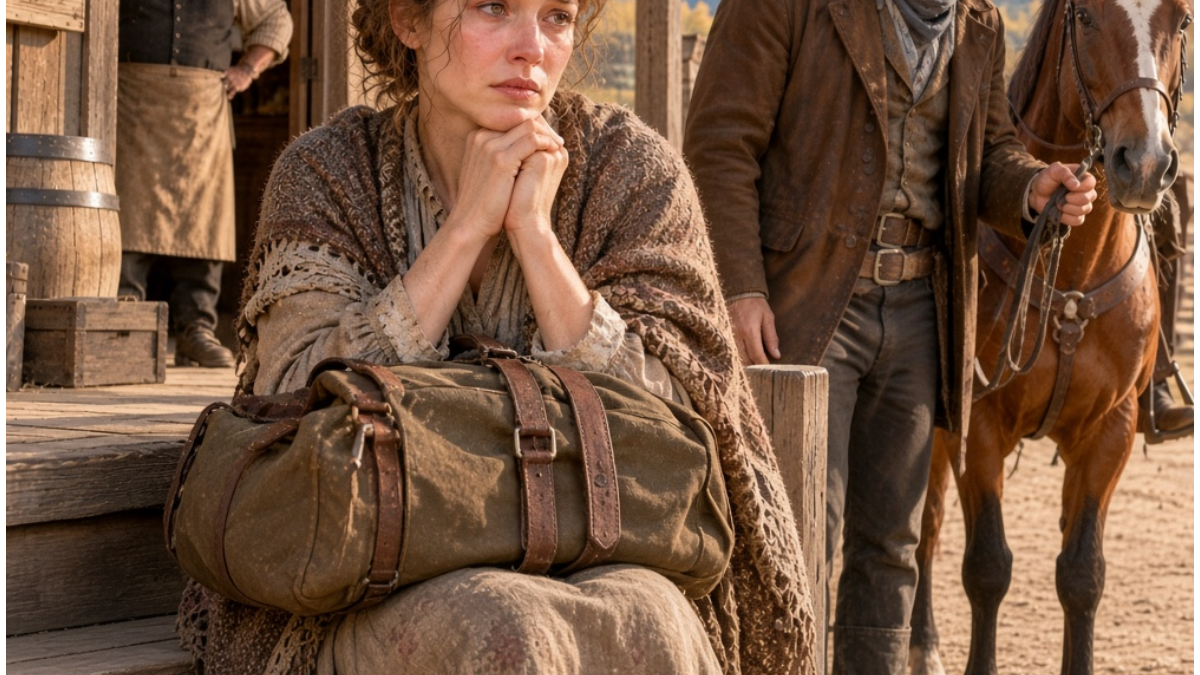
Rufus Ganet didn’t wait for the dust to settle. The wagon carrying Lydia Hartwell’s family had barely crested the Wyoming ridge when he stepped off the trading post porch and smiled at her the way a man smiles when he’s already done the math.
“I got a shed out back,” he said real warm. “Wouldn’t cost you a thing,” he said it slowly, like it was charity.
Lydia understood exactly what it would coSt. Her own family had left her here deliberately.
One carpet bag, $5, 50 miles from the nearest town. And within 20 minutes, a stranger had already calculated the price of her desperation.
She had nowhere to go. No one coming for her until hoofbeat sounded from the western trail.
The thread had been the whole reason she went inside.
Her aunt Meredith had complained about it for two days, running a loose hem on her traveling skirt that kept catching her heel and met stumble and made her stumble and made her irritable in that particular compressed way she had, where her irritability became everyone else’s fault.
So, when the wagon had pulled up outside Ganet’s trading post, and her aunt’s new husband, Franklin Royce, had said they’d stop for half an hour, Lydia had climbed down and gone straight into the store to find thread in the right color before anyone could give her a reason not to.
She had been inside perhaps 18 minutes. She knew this because she had been watching the clock on Ganet’s wall while waiting for him to find the correct spool in his storage boxes.
He kept the brown thread in a box that also contained fishing line and candle wax and three things she couldn’t identify.
And he rooted through it with the unhurried patience of a man who understood that you had nowhere else to buy thread for the next 50 mi and therefore saw no reason to hurry.
18 minutes. Then she paid 4 cents. She folded the thread into her skirt pocket and pushed through the front door into the September afternoon.
The wagon was gone. She stood on the porch for several seconds processing this information in the flat spended way the mind processes things it refuses to accept yet.
She looked left. She looked right. She looked at the empty space in the yard where Franklin Royce’s bay horses had been standing and where the wagon wheels had pressed two shallow ruts into the dry earth.
Then she looked down. Her carpet bag sat beside the porch steps in the dirt.
Someone set it there neatly, deliberately. The clasp was even fastened, as though whoever left it had taken the time to make sure nothing would spill out.
Lydia’s mouth went dry. She stepped off the porch and walked to the bag and crouched beside it and opened the clasp and looked inside, both her dresses, her mother’s Bible, her sewing needles in their cloth roll, her coin purse with its remaining $54.
She counted. She was wrong earlier. $5.18, not 14. Her hands were trembling slightly, which was why she’d miscounted.
They had taken nothing. They had simply taken themselves. She stayed crouched beside the bag for what felt like a long time, but was probably less than a minute.
The sun was still high enough to be useful. The nearest settlement, Cedar Ridge, according to the map, Franklin had been consulting the past 3 days, was roughly 50 mi to the eaSt. She did not own a horse.
She did not own a weapon. She had no way to know if any other travelers would pass this post today or tomorrow or the day after.
She stood up. She picked up the bag. She carried it back to the porch and set it beside the door and sat down on the steps and tried to think clearly.
She was still thinking when Ganet came outside. He had a cup of something in one hand, and he leaned against the doorframe and looked at her with an expression that was not unkind on the surface, but had something calculating underneath it, like a man examining livestock at a fair.
He was perhaps 50, gone thick in the middle, with a reddish beard that hadn’t been fully trimmed in some months.
He had been moderately pleasant inside the store. He was slightly less pleasant now. “Family gone?”
He said. “Yes, figured they might.” He sipped from his cup. Seen it happen before.
Man gets a new wife or a new husband as the case may be. And there’s always one person in the party who’s more trouble than they’re worth keeping.
No offense. Lydia said nothing. I got a shed out back. Ganet said real clean.
Got a cot in it. Warm enough. You’d be comfortable. He paused. Wouldn’t cost you a thing.
He said the last part slowly. Lydia had grown up in houses where no one ever did anything for free, and she had learned early how to read the full sentence underneath the words a person actually said.
“What Ganet was saying was, “I have assessed your situation and determined what it’s worth.”
“What he meant was, “You are in a position where you cannot afford to refuse.”
“Thank you,” Lydia said. “I’ll stay on the porch.” Ganet looked at her for a moment, then shrugged and went back inside.
Lydia exhaled. She looked down the road in both directions. East toward Cedar Ridge and its 50 mi of nothing.
West toward wherever her family had come from, and the life that had apparently concluded without ceremony this afternoon.
The sun was already beginning its slow tilt toward the mountains. She opened her coin purse and counted the money again.
$518. If she was careful, very careful, she could perhaps last a week buying modest meals.
The question was whether a week at Ganet’s post trading post was survivable in the way she was beginning to understand it would not be.
She was working through this calculation for the third time when she heard the writers.
There were two of them coming from the west and they were loud before they arrived.
One of them was singing something that wasn’t quite a song, more like the remains of a song after sufficient whiskey, and they pulled their horses up outside the post with the particular confidence of men who are used to being the most interesting thing in any given location.
[clears throat] Ganet came back out to meet them. There was a change in him immediately, an alertness, a hosting energy he hadn’t bothered with for Lydia.
“Simmons,” he said, nodding at the taller one. “Ganet.” The man called Simmons swung off his horse and looked around the yard.
His eyes landed on Lydia with the same flat assessment as a man checking the weather.
“Who’s this?” “Stranded,” Ganet said pleasantly. “Family moved on without her.” Simmons looked at Lydia with an interest that made her want to stand up and go inside and lock a door.
Except there was no door she could lock from the inside, and even if there was, it was Ganet’s door.
“That right,” Simmons said. Not a question. Real unfortunate situation,” Ganet agreed. And something in his voice had shifted into something cooperative, like two men who had done business before arriving at a shared understanding.
Lydia stood up. She did not know exactly what she was going to do. She had $5.18 and no horse, and the sun was moving.
What she knew was that sitting down in the presence of these two men and this man who was talking about her like she was a circumstance rather than a person was the one thing she could not do.
So she stood and then hoofbeats sounded from the western trail. A single horse coming at a steady trot, not hurried but purposeful.
The rider came into view around the curve of the post’s yard. A man 30s or close to it, dusty from a long ride, wearing a plain canvas coat and a hat that had seen considerable weather.
He had a rifle in the saddle scabbard and a pistol at his hip. But so did everyone out here.
So that told her nothing useful. What told her something useful was the way he looked at the scene in front of him.
He didn’t look at Ganet firSt. He didn’t look at Simmons. He looked at Lydia at the carpet bag at her feet and the way she was standing and then he looked at Ganet and then at Simmons and something behind his eyes went very quiet and still.
The way things go quiet and still before they become deliberate. He brought his horse to a stop and swung down in one economical motion.
Afternoon, he said to no one in particular. Ganet’s posture shifted slightly. Not afraid exactly, but reccalibrated.
Shaw, he said. The same nod he’d given Simmons, but with something underneath it that was different.
Something closer to acknowledgement than, “Welcome.” The man named Shaw tied his horse to the post rail and walked toward the store, and he would have passed Lydia without addressing her if he hadn’t stopped.
He looked at her for a moment. Then he said, “Miss, did you choose to stay here?”
The question was so precise and so unexpected that for a second Lydia couldn’t answer it.
Not because she didn’t know the answer, but because no one had asked her a question like that.
Not today. Not in a long time. No, she said something in his face settled.
Then maybe we ought to change that. He said it quietly, not dramatically. And then he walked past her into the store without waiting for Simmons or Ganet to respond to it, like it was simply the next logical thing.
Simmons looked at Ganet. Ganet looked at Simmons. Neither of them said anything. Lydia sat back down on the porch steps.
Her heart was knocking against her ribs. He was inside for perhaps 10 minutes. She could hear conversation, but not words.
Then the man named Shaw came back out carrying a small sack of supplies and stopped in front of her.
Cedar Ridge is a day and a half east under normal conditions, he said. I know a woman there who runs a boarding house.
Agnes Bellamy. She’s honest and she doesn’t put up with nonsense. She can probably find you work.
He paused. I can take you there. Lydia looked at him. He [clears throat] was not a bad-looking man, but that was not the relevant point.
The relevant point was that she was weighing two categories of danger against each other, and one of them was familiar, and the other was not.
I don’t know you, she said. Bennett Shaw, he said. I trade here a few times a year.
Have for about 6 years. He glanced toward the door. You can ask Ganet whether I’ve ever caused trouble.
He’ll tell you the same thing, whether he likes it or not. She looked at Ganet, who was still leaning against the post’s exterior wall, watching this exchange with an expression that had gone sour and resigned.
“He’s never caused trouble,” Ganet said, with the flatness of a man confirming something he would rather not confirm.
“Lydia looked back at Shaw. He was waiting, not impatiently. Just waiting in the manner of someone who understood she needed time and wasn’t going to make that awkward.
There’s no guarantee you’re safer than him, she said, meaning Ganet. No, Shaw agreed. There isn’t.
That was the honest answer. A different man might have tried to persuade her, might have listed his own virtues, or reassured her with promises he couldn’t back up.
Shaw simply agreed with her assessment of her own situation, and somehow that was the thing that tipped it.
“I have a trunk inside,” Lydia said. I can’t carry it easily. Shaw nodded. I’ll store it here until you can arrange to collect it.
She watched him go back inside. Through the open door, she could hear him negotiating with Ganet.
6 months of storage flat fee. And then she heard him say, “Write it down and sign it.”
In a tone that was not raised, but was absolutely not optional. There was a pause.
Then the sound of Ganet writing something. Shaw came back out with a piece of paper folded in his coat pocket.
He handed it to Lydia. Storage receipt, his signature, date, what’s in the trunk and the agreed fee.
He looked at her. Keep that. Lydia unfolded it and read it carefully. It was exactly what he described.
She folded it again and put it in her coin purse where it wouldn’t get loSt. “All right,” she said.
They left before the light changed. She rode behind him on his horse with the carpet bag across her lap.
And the first 10 minutes were the most uncomfortable 10 minutes she had experienced in a day that had contained considerable competition for that distinction.
She was sitting behind a stranger on a horse in the Wyoming territory with everything she owned in a bag and four cents of thread she’d bought to fix her aunt’s hem.
She did not cry. She had learned young that crying was something you did after the immediate danger had passed, not during it, because tears interfered with clear thinking, and clear thinking was the only resource she had that no one could take from her.
Shaw didn’t try to make conversation. He watched the trail. Occasionally, he looked at things in the middle distance with a focused attention that she gradually recognized as professional rather than anxious.
He was checking the land the way someone checks land they know and are responsible for knowing.
After about an hour he said your family. Do you want to talk about it or not?
Not. She said. All right. That was the end of that subject. The sun continued its tilt.
The landscape opened up into that particular Wyoming scale that could feel either magnificent or terrifying depending on what you needed it to be.
And right now it felt mostly terrifying to Lydia because vast spaces meant vast distances from any help.
They stopped at a creek shortly before dark. Shaw dismounted first and held the horse while Lydia climbed down, which she managed less gracefully than she would have liked, and then he unsaddled the horse and let it drink while he built a fire.
He had all of this clearly done before. The movements were automatic, unhurried, and when the fire was established, he laid out two bed rolls.
He put hers on the far side of the fire from the trail. He kept his rifle beside himself on the trailside.
The arrangement was clear enough that he didn’t need to explain it, and he didn’t.
They ate from his supplies, dried beef and hard biscuits and coffee that was better than she expected.
And the first silence was difficult, and the second silence was less difficult. And by the third silence, Lydia realized she was not afraid of him.
She wasn’t entirely sure why that was, and she didn’t entirely trust it, but it was the information she had.
“How far out are we?” She asked. “Made good time. Maybe 12 mi. Tomorrow’s the long day.”
He added a piece of wood to the fire without looking up. “We’ll hit the apprentice road around midm morning.
Easier going after that.” Lydia nodded. She had been watching him since they left the trading poSt. The way you watch someone when you’re trying to figure out what they actually are.
And what she had determined so far was he didn’t talk much. He didn’t perform much.
And he had not once made her feel like someone who owed him anything. Most men who helped women in difficult situations did so with a particular energy underneath it.
An expectation, a ledger being kept, and Shaw didn’t seem to have that. Or he was very good at hiding it.
Why did you stop? She asked. He looked up from the fire. At the trading post, she said, you didn’t have to.
Shaw was quiet for a moment. He turned his coffee cup in his hands, a gesture she would come to recognize later as something he did when he was deciding how honest to be about something.
You know what the worst part of it is? He said finally when something bad happens to someone and people find out about it later.
It’s always the same question. Was there someone nearby who could have helped? And the answer is usually yes.
There usually was. Lydia waited. I had a brother, he said, younger than me by 4 years.
He went out on a cattle drive when he was 19. Got thrown from his horse in rough country, broke something in his leg, couldn’t remount.
The outfit was spread out and moving, and by the time they realized he’d fallen behind, they couldn’t find him in the dark.
The fire cracked and settled. They found him 2 days later. There were tracks near where he’d been two sets of horse tracks from travelers who’d passed through that canyon.
He paused. They hadn’t stopped. Lydia looked at the fire. “I’m sorry,” she said. It was a long time ago.
He said it the way people say things that are true but not the whole truth.
But I decided something then. If I was ever in a position to be one of the people who stopped, I would stop.
The night made its sounds around them. Something moved in the creek brush and was still.
Lydia said, “That’s a good reason. It’s the only one I’ve got.” She thought about that.
It was not a rescue out of gallantry or attraction or heroism. It was a man who had once not been able to stop something and had decided that when stopping was available, he was going to take it, that she could understand.
She had her own version of it, her own list of things she’d watched happen that she hadn’t been in a position to prevent, and the way those things sat in you, and changed what you were willing to tolerate afterward.
I can sew, she said. It came out slightly abrupt, not the way she’d meant it.
Shaw looked at her. I mean, I’m not helpless, she said. I can work. I’m not asking you to take care of me.
I’m asking to be taken to a place where I can take care of myself.
Something in his expression shifted very slightly. Not amusement exactly, something quieter than that. I know, he said.
You don’t though. You don’t know anything about me. I know you turn down Ganet’s shed, he said.
I know you read the storage receipt before you put it away instead of just taking my word for it.
I know you haven’t cried once in the 2 hours since we left, and that’s not because you’re not upset.
He looked back at the fire. I know enough. Lydia did not know what to do with that, so she said nothing.
She lay back on her bed roll and looked at the sky, which was doing what Wyoming sky did at night.
That particular extravagance of stars that felt almost aggressive, like the dark was compensating for something.
She was filthy from the trail. She had thread in her pocket for her aunt’s hem that she would never deliver.
Her trunk was in a storage shed with a signed receipt that was now her primary financial instrument, and she was lying on one side of a campfire from a stranger named Bennett Shaw, who had stopped because he’d made a promise to his dead brother.
She thought, “I may survive this.” It was a modest thought. It was not the same as everything’s going to be fine.
It was not even the same as this man is trustworthy. It was simply the first thought that felt true since she had walked out of that store and found the yard empty.
I may survive this. She held on to it carefully, the way you hold on to something small and valuable when you can’t afford to lose it.
Across the fire, Shaw shifted his rifle slightly and looked once down the dark trail and once up at the sky and then settled himself against his saddle, and if he was awake or asleep, she couldn’t tell from her side of the fire, and that was probably the point.
She slept in pieces, short, shallow passages in and out, and each time she surfaced, she could see the fire had been fed.
By him or by the night, she wasn’t sure, but the fire was there. By the time the sky began to lighten in the east, with that cold gray halflight that preceded real dawn, Lydia had been awake for 20 minutes watching it happen, and had made a list in her head.
She needed work. She needed a room with a door that locked from the inside.
She needed to write down everything she remembered about her trunks contents in case Ganet tried something later.
She needed to find out if Cedar Ridge had a seamstress or an alteration shop and whether there was any work in it.
She needed to not owe Bennett Shaw more than the ride she was already taking.
That last one was the hardest to manage because the ride was already substantial and she was already aware of it.
Shaw was up before she finished her liSt. He moved quietly. The way men move when they’ve spent time in places where noise has consequences.
He had water on for coffee and the horse sorted and the bed rolls rolled up before the light was enough to properly read by.
He handed her coffee without asking if she wanted it. She drank it without thanking him more than once because she’d noticed the previous evening that excessive gratitude seemed to make him uncomfortable.
He accepted it once and dismissed it twice, which was useful information about what kind of person he was.
“How’s your leg?” He asked. She blinked. Fine. Why? You were favoring your left side when you got off the horse yesterday.
She had been. She’d twisted her ankle slightly mounting up in a hurry back at the poSt. She had not mentioned it because it was not relevant to anything and she didn’t want him to have a reason to slow down.
It’s fine, she said. He looked at her for a moment, then nodded and did not push it.
Another useful piece of information. They broke camp quickly. The light was coming up clean and cold.
The kind of September morning in Wyoming that felt like the world had been recently laundered and left out to dry.
Lydia climbed up behind Shaw more smoothly than she’d managed the first time. She’d figured out the weight distribution, and they headed east onto the apprentice road.
The road was better. The horse found a rhythm. Lydia’s ankle achd distantly, and she ignored it.
Somewhere around the middle of the morning, Shaw said, “What kind of sewing?” “Everything,” she said.
“Cloting primarily. I worked for a dress maker in Ohio for 2 years. Before that, I did peacework, repairs, alterations.
I’m faster on alterations than most women I’ve worked with. She paused. That’s not bragging.
It’s just the accurate thing to say. You don’t have to explain why you said something true.
She thought about that. Most people make you explain it. Most people are worried you’re trying to impress them.
Are you worried about that? No. She didn’t ask why not. The conversation had a comfortable length, and she didn’t want to push past it.
They passed two other travelers on the road that morning, a farm family heading west with a loaded wagon and a lone rider who looked them over and kept moving.
Shaw acknowledged both with a nod and nothing more. He didn’t explain who Lydia was, and he didn’t volunteer information about himself, and she appreciated that.
Cedar Ridge came into view in the late afternoon. It was a working town rather than a pretty one.
The kind of place organized around practical necessity rather than aspiration with a main street containing a general store, a livery, a land office, a physician’s office, a church, and three or four establishments that were probably saloons depending on which side of the street you were looking from.
But it had a telegraph office. It had what appeared to be a proper dress makaker shop with a paper sign in the window.
It had the scale and permanence of a place that intended to survive. Lydia felt something ease slightly in her cheSt. Shaw stopped the horse in front of a two-story building set slightly back from the main street with a painted sign that read Cedar Ridge House a Bellamy prop and a porch that had recently been swept.
He dismounted and held the horse while Lydia climbed down. Her ankle protested on landing, but not badly.
Shaw looked at the house, then at Lydia. Agnes Bellamy is direct, he said. She’ll tell you exactly what she charges and what she expects, and she won’t pretty it up.
That’s a good thing. I like direct, Lydia said. I know. He reached into his coat and pulled out a second, smaller folded paper and held it out to her.
That’s the name and location of Ganet’s post, the date of your storage, and the receipt number in case you lose the original.
Lydia looked at him. He had copied the information. Sometime yesterday evening. She supposed when she thought he was sitting quietly, he had copied the essential information from the storage receipt onto a second piece of paper in case she lost the firSt. She took it.
She did not know what exactly to say about that, so she said, “Thank you for the ride.
Glad I could stop,” he said, and then simply, “Good luck, Miss Hartwell.” He remounted, touched his hatbrim, and rode back down the street.
Lydia stood in front of Cedar Ridge House with her carpet bag and watched him go for a moment.
Then she turned toward the door, straightened her shoulders, and knocked. There were approximately 50 mi of territory between where she’d started the morning and where she was now, and not one of them had been given to her.
She had ridden them. That distinction mattered. The door opened. A woman in her mid-50s with iron gray hair and a face that had clearly decided long ago not to waste.
Expressions looked her over with a thorough efficiency that would have been insulting from anyone else.
“Bennett Shaw send you,” she said. “He brought me,” Lydia said. “I came on my own judgment.”
Agnes Bellamy looked at her for another second. Then she stepped back from the door.
“Come in then,” she said. “I’ll show you the room. If you’re working for your board, we start at 6.”
Lydia stepped inside. The door swung shut behind her, and for the first time since she had walked out of a trading post store with 4 cents worth of thread, and found her entire life changed in the space of a yard.
She was somewhere she had chosen to be. It wasn’t everything, but it was a beginning, and beginnings, she had learned, were the things you had to make yourself.
The room was at the back of the second floor, and it was small enough that three steps took you from the door to the window.
But it had a bed with a real mattress and a wash stand and a hook on the wall for hanging clothes and a rag rug on the floor that someone had made by hand with mismatched wool.
And the door had a lock, not a complicated one, a simple iron bolt that slid into a catch, the kind that could be opened from the outside with the right key, but from the inside required nothing but your own hand.
Agnes Bellamy had shown her the room without ceremony. The way you show someone a room when you expect them to assess it practically rather than sentimentally and had pointed out the wash stand and the hook and the bolt on the door and then crossed her arms and said, “Kitchen work starts at 5:45.
I pay your board and 30 cents a week until I see what you’re worth and then we renegotiate.
You’re late twice. I dock you. You’re late a third time we have a different conversation.”
She’d looked Lydia over once more. You look like you can do the work. Whether you will is something I find out in the morning.
I will, Lydia said. Agnes nodded as though this were the expected response and not a particularly meaningful one, and left.
Lydia closed the door. She slid the bolt. She stood there with her hand on the bolt for a moment longer than was necessary, just feeling the metal under her palm and the solidity of the catch, holding the specific sensation of a barrier between herself and everything outside it that she controlled entirely.
Then she sat down on the edge of the bed and pressed both hands flat against her knees and cried for approximately 4 minutes which was all she permitted herself.
It was not a dramatic crying. It was the kind of crying that has been compressed and delayed past its natural deadline and comes out as a physical event rather than an emotional one her body clearing something that had accumulated beyond its capacity.
Her aunt’s face, the empty yard, the bag in the dirt. The careful way someone had fastened the clasp before leaving it.
4 minutes. Then she stopped, washed her face at the wash stand with cold water from the pitcher, and made an inventory of everything she had.
Two dresses, her mother’s Bible, sewing needles in their cloth roll, two spools of thread, one brown and one black, a thimble, her coin purse with $518, a storage receipt for her trunk, a copy of that receipt, the 4 cents worth of thread she had bought for her aunt’s hem that she would never use for that purpose.
She laid everything out on the bed and looked at it. This was what 24 years of living had produced.
It fit on a single mattress with room left over. She put it all back in the bag and hung the bag on the hook and lay down in her clothes because she was too tired to undress and the mattress was the softest surface she had slept on in 3 weeks of travel and she was asleep before she finished the thought she’d started.
She was in the kitchen at 5:35. Agnes came in at 5:40 and looked at the fire Lydia had already built up.
The water already heating, the table already wiped down from the previous evening and said nothing, which Lydia understood correctly as approval.
The work was not easy and was not meant to be. Agnes ran a tight house break fast for 8 to 12 guests, depending on the week, laundry twice weekly, floors swept and mopped [clears throat] on a schedule.
Agnes kept in her head and expected everyone else to absorb through proximity. Lydia cooked and carried and scrubbed with the focused efficiency of someone who had learned early that usefulness was the only currency she reliably owned.
By the end of the second day, her hands were red and her back achd in a specific way that meant she had been doing something repeatedly with a muscle that needed to remember how to do it.
She did not complain about this to anyone. On the fourth day, one of the guests, a merchant, passing through with two teamersters, came down to breakfast with a shirt that had a torn cuff, the kind of tear that happens when a button catches on something and takes a half inch of fabric with it.
He looked at it with the resigned expression of a man who had been carrying a ruined shirt for 2 weeks because he hadn’t passed anywhere worth stopping.
Lydia looked at it and [clears throat] said, “I can fix that. Take me 20 minutes.”
The merchant looked at her. What do you charge? She had not thought about this yet.
She thought about it now quickly, calculating what a new shirt cost versus what a repair was worth versus what she needed.
5 cents, she said. The merchant said, “Fair enough.” And the teamsters immediately produced three items that needed attention.
And by the end of the morning, Lydia had earned 23 additional cents and a promise from the merchant to tell the next traveler he met that Cedar Ridge House had a seamstress.
She told Agnes. Agnes looked at her with that same assessing expression. “You want to do that on your own time?
It’s your own business,” she said. “I’d charge you nothing for the table space. Might bring more guests through.”
“Then what else can you do?” “Everything a needle can do,” Lydia said. Agnes seemed to file this away somewhere practical and moved on.
Within 2 weeks, Lydia had established a pattern. “Morns belonged to the house 5:30 to noon, hard and reliable.
Afternoons were hers, and she used them at the table in the kitchen corner with whatever work had accumulated, torn seams, missing buttons, a glove that needed its stitching redone, a woman’s dress that required taking in at the waiSt. Cedar Ridge had a dress maker’s shop on the main street, but the dress maker a misses.
Harrove, thin and precise dealt in new garments, and had no particular patience for repairs.
The town’s working population had clothing that constantly needed fixing, and no one whose particular business it was to fix it.
Lydia’s particular business was now to fix it. She kept a small notebook and wrote down every job and every scent.
By the end of her third week at Cedar Ridge House, she had earned enough to cover two weeks of her board on top of Agnes’s wages, and she had started a second column in the notebook for savings.
The number in the savings column was not large, but it existed, which was the point.
It was during the third week that she met Charlotte Wyn. Charlotte came to the boarding house to visit a cousin who was staying while her husband finished paperwork on a land claim and she arrived the way she did everything at a slight forward angle as if she was moving faster than the world required and had simply decided not to slow down.
She was 29, married 2 years to a cattleand named Preston Wyn, who worked a ranch 12 m out, and she came into Cedar Ridge twice a month for supplies and news.
And what she called the particular relief of talking to women who aren’t also working cattle.
She sat down next to Lydia’s sewing corner without being invited and said, “Is that a double stitch hem on that skirt?”
“Yes,” Lydia said. “My mother did those. Takes twice as long. They last three times as long.”
Charlotte nodded thoughtfully. “I’m Charlotte Win. I come in twice a month, and I know everything worth knowing about Cedar Ridge, which isn’t much, but it’s accurate.”
Lydia looked up from the hem. Lydia Hartwell. I’ve been here 3 weeks. I know.
Charlotte said Bennett Shaw brought you in. Lydia kept her expression neutral. He gave me a ride.
He came in last week for supplies, Charlotte said. And her voice was carefully not doing anything in particular.
The voice of a person relaying information without editorializing. Didn’t buy much. I wouldn’t know about that.
Charlotte smiled. No, I suppose not. She looked at the skirt hem. You do alterations?
Yes, I have a riding skirt that the hem is dragging. It needs about 2 in taken up.
Bring it next time you’re in town. I’ll bring it day after tomorrow, Charlotte said.
I’ll probably be back. She was, and so began the kind of friendship that forms quickly between practical women who recognize in each other a similar orientation toward reality, a willingness to say what is actually true without dressing it up, and an equal willingness to leave certain things alone without requiring them to be examined out loud.
Charlotte told Lydia which merchants were honest, and which cut their flower with chalk duSt. She told her that Dr. Felix Arden was the town physician and was good at his job and charged people what he thought they could afford rather than what the work was worth, which made him popular and occasionally unable to pay his own bills.
She told her which of the saloons tolerated women passing through their front room, and which emphatically did not.
In return, Lydia altered Charlotte’s riding skirt and charged her 40 cents, which Charlotte paid without negotiating.
“You should charge more,” Charlotte said. I’m still establishing what the market will pay, Lydia said.
Charlotte looked at her with a kind of delighted respect. Where did you learn to think like that?
Necessity, Lydia said, which was the truest answer. It was on a Thursday afternoon in mid-occtober 3 weeks and 2 days after she’d arrived in Cedar Ridge, though she hadn’t been counting specifically that the sound of a horse stopping in front of Cedar Ridge house made Agnes look up from the bread she was shaping and say nothing, which Lydia had come to recognize as Agnes saying something.
She was at her sewing table and she did not look up. The front door opened.
Agnes went out to the entry. There were voices again as as level and informative and a man’s voice that Lydia recognized without wanting to examine the fact that she recognized it.
And then footsteps and Bennett Shaw appeared in the kitchen doorway. He looked the same as he had at the trading poSt. Coat trail dust hat in his hand because Agnes ran the kind of house where you took your hat off at the door.
Miss Hartwell, he said. Mr. Shaw, she said. Agnes came back in, looked at both of them with the comprehensive assessment of a woman who had been observing human behavior for 55 years and had stopped pretending she didn’t notice things, and began punching down the bread dough with somewhat more emphasis than the dough required.
“I was in town for supplies,” Shaw said. “Anngus,” Lydia said. “Did he bring anything in?”
Agnes looked up. A long pause. “A box of nails,” she said. “And some coffee.”
Shaw had the grace to look slightly exposed by this. He moved to the chair on the other side of Lydia’s sewing table, not sitting, just standing near it, and looked at the work she had spread out, which was a man’s coat with a split seam along the left shoulder.
You found work, he said. I told you I would. I know. I’m not surprised, he paused.
Are you safe here? Agnes treating you well? Anyone in town causing you trouble? Lydia set down her needle and looked at him directly.
Are you asking? Because you feel responsible for me, she said. Or because you’re asking.
Shaw seemed to consider this question with genuine seriousness rather than treating it as a rhetorical accusation.
Both, he said finally. I’d be lying if I said the first part wasn’t in there.
But it’s not the whole thing. Lydia looked at him for a moment. I’m safe, she said.
Agnes is fair. No one has caused me trouble. She picked up her needle. You can tell your conscience you checked.
All right, he said. He stayed for another 20 minutes on the pretext of having coffee, which Agnes produced with the efficiency of someone who had decided that providing it was easier than making a point about it.
And he and Lydia talked about, of all things, the weather, and whether the pass east of town would be navigable by November, and whether the price of Calico had gone up since summer.
Then he left. Lydia went back to the split seam and worked in silence. After a while, Agnes said from the direction of the stove.
He’s been to town twice since he brought you here. Has he? Lydia said. Cedar Ridge isn’t exactly on the way to anywhere Bennett Shaw needs to go.
Lydia kept her eyes on the scene. He mentioned he trades here regularly. He does, Agnes said about four times a year.
Another pause. This is his third visit in 3 weeks. Lydia said nothing. Agnes went back to her bread and did not belabor the point, which was one of the things Lydia had come to appreciate most about her.
He came back the following Thursday. The excuse that week was that he’d ordered a saddle repair from the leather shop 2 weeks ago and was checking whether it was done.
The leather shop, as Charlotte informed Lydia the next time she came in, typically took 10 days on saddle repairs, so the timing of that particular visit required some creative accounting.
Lydia did not say this to Shaw. She found it mildly amusing, which was unexpected.
She was not a woman who was easily amused by men doing predictable things. But there was something about the specificity of these particular terrible excuses that was almost endearing in its transparency.
He was not trying to be charming. He was trying to be present without admitting he wanted to be present.
Because admitting it would require him to say something about why. And saying something about why was a conversation with consequences he apparently hadn’t decided to have yet.
She understood the architecture of that kind of avoidance. She had done it herself, though for different reasons.
The conversation on the second Thursday was better than the firSt. He asked about the sewing work, not in a polite question way, but in a genuinely curious way, the kind of questioning that follows up on the previous answer rather than simply waiting for it to be over.
She told him about the double stitch hem, about what cattle hands most commonly destroyed, about the difference between work that paid well and work that was worth doing.
He listened, not politely, actually listened in the specific way that means you’re building a picture rather than just waiting for your turn.
What do you want to do with it eventually? He asked. A shop, she said without having planned to say it, she’d told Charlotte.
But that was Charlotte. A proper one. Alterations and dress making. Not working from a kitchen corner.
She paused. That’s a long way off. Why? Because it costs money I don’t have yet.
How much? She named the figure she’d calculated. The rent on a proper space, the equipment, the initial stock of materials, the operating months before word spread enough to sustain it.
It was a specific figure because she’d done the arithmetic three times and arrived at the same number each time.
Shaw nodded slowly, not with pity, with the expression of someone evaluating a plan. That’s doable, he said.
Eventually, she agreed. Sooner than you think, maybe. Cedar Ridge is growing. A proper alteration shop would do well here.
I know, Lydia said. I’ve looked at the gap. >> Something shifted in his expression.
Something she’d start to recognize later as the specific look he got when she said something that matched what he was already thinking.
Not surprise, more like confirmation. What kind of cattle work do you do? She asked.
It was the first time she’d asked him directly about his himself, and she was curious whether he’d say anything of substance or deflect.
Outside Cedar Ridge, he said, Wind River Country mostly. I’m out there most of the summer and early fall.
A big outfit. A brief pause. Not dramatic, just slightly longer than necessary. Decent sized, he said.
Are you a foreman? Another pause shorter this time, but she noticed it. Something like that.
He said she accepted this at face value because she had no reason not to.
A well- paid ranch foreman with enough mobility to make unnecessary supply runs into town.
It fit what she’d observed. He had money to spend without appearing to think about spending it, but not the ostentation of a man with excess wealth.
He made his own camp coffee. He mended his own tac. His boots were well-made but worn, a senior ranch hand, a foreman, someone who’d worked his way up to authority over other men’s cattle.
She filed it and moved on. What she didn’t know, what she had no mechanism to know since she had arrived in Cedar Ridge knowing nothing and no one except Agnes, who volunteered information on her own schedule, was that Cedar Ridge had approximately 400 full-time residents and that virtually all of them knew exactly who Bennett Shaw was.
The Thursdays continued, “He found a different reason each week. A harness repair, a conversation with the land office, a friend in town he needed to see.
The friend in town varied weekly different name, different pretext, and Lydia had begun keeping a private running tally of these friends in town in the back of her notebook just for her own amusement with brief notations like harness repair.
Second time this month and grain prices dubious. She did not show this notebook to Charlotte, who would have found it vastly entertaining and would have told Preston, who would have told approximately everyone on the ranch.
And Lydia was not interested in her private amusement becoming public information. But she was aware in the way she was aware of most things that had practical implications that she had started noticing when Thursday arrived.
Not in a way she’d have described to anyone. Not even in a way she fully examined herself.
Just in the way that the week had developed a shape. The heavier days at the front, the workload settling into rhythm by midweek and then Thursday with its particular texture which sometimes included Bennett Shaw and sometimes didn’t.
And the days when it didn’t were slightly flatter in a way she declined to analyze.
That was the dangerous part and she knew it. She had spent years learning not to build herself around someone else’s presence because building yourself around a presence meant that the absence of that presence could dismantle you, and she had been dismantled enough times to have developed a structural opinion on the matter.
So she noted at the Thursday awareness the slight flatness of his absent days with the same disciplined acknowledgement she gave to anything else that could compromise her position, filed it under things to be careful about, and went back to work.
It was Charlotte who finally said something. They were sitting in the kitchen on a Wednesday evening with Charlotte’s latest alteration, a blouse that needed a collar replaced after a button had been torn off with some violence.
And Charlotte was talking about Preston’s most recent opinion on the territorial land office, which was long and specific.
And then she paused mid-sentence and said, “Bennett Shaw came by the wind ranch last Sunday.
Lydia kept her eyes on the collar. Oh, he and Preston have known each other a long time.
He came to check on the north fence line. Apparently, Charlotte’s voice was doing that careful, not quite neutral thing again.
Preston mentioned you. What did he say? He said Bennett had asked whether the woman at Agnes’ boarding house had settled in.
All right. A pause. Preston thought that was interesting because Preston said Bennett had asked him the same question 2 weeks earlier.
Lydia refolded the collar and lined up the pins. Preston thinks it’s funny. Charlotte continued.
I told him it wasn’t funny. It was practical. A man can ask after someone’s welfare without it meaning.
She stopped. Started again differently. You could find worse. Charlotte, I’m not suggesting anything. I’m only saying.
I know what you’re only saying. Charlotte picked up her coffee and drank it and said nothing for a moment.
Then he’s decent. That’s actually rare enough to be worth noting. He is decent, Lydia agreed, because it was true, and she’d have been dishonest to say otherwise.
That doesn’t mean she stopped herself. I’ve been here 5 weeks. I have $43 and some sense saved against a goal that requires considerably more than that.
I have work I need to do. She picked up the collar and checked the first pin.
I don’t have the luxury of thinking about anything that might interrupt that. Charlotte was quiet for a long moment.
He stopped because he chose to, she said eventually. Meaning the trading post, meaning the night on the road, meaning Cedar Ridge.
He hasn’t tried to turn that into a debt. No, Lydia said. He hasn’t. Some men would have.
I know. That’s also worth noting. Lydia looked up from the collar. Charlotte was watching her with an expression that was sympathetic in the specific way of a woman who has already worked through something you’re still in the middle of working through and has decided to patient about it rather than condescending.
I notice things, Lydia said carefully. I’m not made of stone. But noticing and acting on what I notice are two different things, and right now I can’t afford the second one.
Charlotte nodded. Fair enough. She drank her coffee. I’ll just keep not saying anything. Then I appreciate that.
I’m very good at not saying things, Charlotte said in the tone of someone who was not very good at not saying things, but was genuinely trying.
The fifth Thursday of October was overcast, with a cold coming down from the mountains that everyone in town was acknowledging as the first real teeth of the season.
Shaw came in with his hat dusted with the first light snow of the year, and his excuse that week was that he’d been checking on cattle movement toward the lower grazing land and was passing through anyway.
Lydia said, “You passed through last week.” “I move a lot of cattle,” he said, which was apparently true in ways she hadn’t understood yet.
They had coffee at Agnes’ kitchen table, and this time Agnes sat at the table, too, which she had started doing on these Thursday afternoons with an unembarrassed visibility that Lydia had mixed feelings about.
But Agnes’s presence also made the conversation something different, less careful, more ordinary, and ordinary was a texture Lydia valued.
Shaw asked about the notebook. She’d had it open at the table when he came in, reviewing her numbers, and she’d closed it when he sat down, and he’d noticed her closing it.
Business accounts, she said. “Can I ask what you’re tracking?” “Income and expenses in a savings column,” she paused.
“And a list of your excuses for coming to town.” There was a silence. Then Shaw said very carefully, “How long is that list?”
“This is week five,” Lydia said. “I have several categories. The harness repair category is particularly well represented.”
She kept her face neutral, but her eyes were doing the thing they did when she was privately amused.
A slight intensification, something happening behind them that didn’t fully make it to her expression.
Shaw looked at his coffee cup. Agnes at the far end of the table was extremely occupied with something near the window.
“The harness repair was legitimate,” Shaw said. The first time I know, Lydia said, “I put a small star next to that one.”
He looked up at her then, and she saw it. The thing she’d seen occasionally in her observations of him over 5 weeks.
The thing she’d filed carefully and hadn’t examined. He was looking at her. The way you look at something you hadn’t expected to find and are not sure yet what to do about.
It lasted only a second. Then he shook his head slightly and drank his coffee and they moved on to a conversation about whether Cedar Ridge would get the text telegraph extension before spring or whether the territorial committee would stall it until fall.
And Lydia contributed what Charlotte had told her about the land office situation, and Shaw knew considerably more about it than she expected a ranch foreman to know.
She noted that, too, without filing it anywhere specific yet. He left before dark with the snow still coming down lightly.
At the door, he put his hat back on and looked out at the street, and for a moment he seemed like he was going to say something that was different from the kind of thing he usually said.
“He didn’t.” “See you,” he said, and rode out into the early dark. Lydia stood at the window and watched until the shape of his horse was not distinguishable from the other shapes in the street.
Then she went back to her table and opened her notebook and made a new entry under Thursday below the tally of excuses in her careful precise handwriting.
She wrote, he laughed almoSt. She looked at that for a moment. Then she turned to the savings column and added the week’s earnings and watched the number grow by 40 cents.
And the number growing by 40 cents was a concrete thing with a concrete meaning and a concrete direction.
And she needed that. She needed the number more than she needed to think about a man who could not quite find a real reason to come to town but kept coming anyway.
She needed the number because the number was hers. And everything it pointed toward was hers.
And the day she’d arrived in Cedar Ridge with her carpet bag and $5.18, she had made herself one essential promise that the next life she built would belong to her before it belonged to anyone else.
She closed the notebook. She put it in her bag, and somewhere 12 mi out of Cedar Ridge, on a road that ran through land he owned in quantities she had not begun to imagine, a man named Bennett Shaw rode home in the first snow of winter, and thought about a woman who kept kept track of his lies in a notebook, and had told him about it with entirely level eyes.
He had told her he worked cattle. He did work cattle. That part was true.
What he hadn’t said was that the cattle and the land they grazed and the hands who moved them and the ranch house they returned to and two additional grazing leases and a not insignificant balance at the Cedar Ridge Savings and Land Bank.
All of that was his. He’d meant to correct the misunderstanding. He’d had five Thursdays to do it.
Each time something stopped him, not cowardice exactly. He’d spent enough of his life in difficult situations to know the difference between fear and judgment.
And this felt closer to judgment. The judgment that what was happening in that kitchen on those Thursday afternoons where a woman talked to him like a person rather than an institution was something he hadn’t had before and was not sure how to keep if he changed the terMs. Everyone in Cedar Ridge knew who he was.
Everyone adjusted accordingly. They agreed with his opinion slightly too readily. They accepted his company as a form of social elevation.
They were kind and careful and always faintly aware of what his friendship might be worth.
Lydia Hartwell had told him his harness repair excuse was legitimate the first time. One time he rode through the snow and tried to identify the exact moment when that had become important enough to complicate everything.
He couldn’t find the moment which meant it had been happening the whole time accumulating in the spaces between the conversations about weather and business arithmetic and dressm shops.
And he had not corrected the misunderstanding because he was not sure he was ready for the moment it corrected itself.
That moment was coming regardless. He knew that. He just wasn’t ready to choose it yet.
November arrived the way it always does in Wyoming, not as a gradual transition, but as a decision, hard and immediate, with temperatures that dropped 12° in a single night, and stayed there.
Lydia added a second wool skirt to her daily rotation and started banking the kitchen fire higher before bed.
And Agnes said nothing about the extra wood because Agnes was practical about warmth in the way she was practical about everything else.
It was necessary, so it happened. The work had not slowed. If anything, it had grown.
Word had moved the way word moves in small towns, which is to say efficiently and without Lydia’s explicit participation.
And she now had a small regular clientele, three ranchwives who came in monthly, a school teacher who needed hem work done on a budget, and a rotating population of traveling men who arrived at Cedar Ridge House with clothing in various states of dissolution.
The $43 in her savings column had become 61, then 78. She was beginning to feel the shape of the number she was building toward, not as a distant abstraction, but as something with actual edges.
It was in the first week of November, on a Sunday after the morning service at the town church, that Bennett Shaw asked permission to court her.
He had been attending services at the Cedar Ridge Church on Sundays for the past 3 weeks, which Charlotte had mentioned to Lydia with the specific casualness of someone dropping a stone into water and watching the rings.
He lives 12 mi out, Lydia had said. 12 and a half, Charlotte said pleasantly.
He’s been making that ride every Sunday for 3 weeks. In November, Lydia had not said anything further about it, but she had started sitting slightly closer to the aisle.
The Sunday it happened was cold and clear, one of those Wyoming winter days where the sky is an almost aggressive blue, and the air has a quality to it, like something recently decided.
After the service, Lydia came down the church steps, and Bennett Shaw was at the bottom of them with his hat in his hands and a look on his face that she recognized as the expression of a man who has rehearsed something and is now wondering if what he rehearsed was the right thing.
Miss Hartwell, he said, I’d like to ask you something. She stopped on the second step, which put them at eye level, which she suspected was accidental on his part, but was useful.
All right, she said. I’ve been coming to town more than I have any practical reason to, he said.
You know that. I know that. Agnes definitely knows that. He paused. I’d like to stop pretending otherwise if that’s agreeable to you.
Lydia looked at him. The cold was making his ears red in a way she found unexpectedly human.
Behind her, she could hear other congregants coming down the steps and politely taking longer roots around them.
“What [clears throat] exactly are you asking?” She said. “Whether you’d permit me to court you,” he said.
Properly, openly, and what does that mean to you practically? He seemed to appreciate the question.
Walks, coffee, conversations that don’t require me to invent saddle repairs. He paused. Nothing that costs you anything you’re not willing to spend.
She looked at him for another moment. There was a part of her, the part that had spent two months cataloging his excuses in her notebook and noticing the shape of Thursdays that had already made a preliminary decision.
There was another part, the part that had learned not to build herself around someone else’s presence, that was examining the implications.
I’m not going to stop working, she said. I’m not asking you to. My savings are mine.
My plans are mine. I know. If either of those things changes, I’ll say so, and I’ll expect to be heard.
I’d expect nothing less. She came down the last step. They were level now. All right, she said.
You can court me. Something crossed his face. Relief, she thought, or something close enough to it that the distinction didn’t much matter.
And he nodded, and they walked to Agnes’s kitchen for coffee, and the courtship was officially underway.
It was modest, as he described, walks after church on Sundays when the weather permitted.
Coffee at Agnes’s table, now without the pretense of supply runs. Occasionally an errand in town that happened to coincide with Lydia’s afternoon free time, the winter fair in late November, a visit to the bookshop on the far end of Main Street that turned into an hour of conversation about a history of the Oregon Trail that they both handled and neither bought.
He brought her things sometimes, but not expensive things. When one of her sewing scissors developed a hinge problem, the blades angling slightly wrong, so the cut was never quite clean.
She mentioned it in passing and thought nothing more of it. The following Thursday, the scissors appeared on her sewing table, hinge repaired, blades aligned perfectly.
He’d taken them to the blacksmith in town and had the work done without announcing he was going to do it.
She turned them over in her hands. “How much was the repair?” She asked. “Two cents,” he said, which she knew was probably a lie, but was the kind of lie that understood what it was covering.
“I’ll add it to your bill,” she said. “What bill?” “The one I haven’t started yet, but might.”
He almost smiled. He had this near smile, the right corner of his mouth moving fractionally, something happening in his eyes that she had mapped over weeks of observation, and had begun to consider one of his more honest expressions, because it came when something surprised him into momentary amusement before he decided whether to show it.
She liked the near smile, she kept that opinion to herself. Charlotte, who kept nothing to herself but was at least transparent about the fact that she was not keeping it to herself, said in early December.
You’re different on Sundays. I’m the same, Lydia said. You hum, Charlotte said not loud.
But you hum when you’re working on Sundays. Lydia looked up from the hem she was doing.
I do not. Agnes noticed it too. Agnes would not have said anything. Agnes mentioned it to me, Charlotte said specifically, because she knows I would say something, which was her way of saying something without saying it.
Lydia put down the hem. She looked at the wall for a moment, then at her hands, then back at Charlotte with the expression of someone acknowledging the thing they’d been not acknowledging.
I know, she said. I know I need to be careful. I’m not saying be careful.
I’m saying you’re happy. Those aren’t mutually exclusive. No, Charlotte agreed. They’re not. She looked at her steadily.
He looks at you like he’s trying to memorize something. Has he said Has he indicated where this is going?
We’ve been courting for 4 weeks. I know how long you’ve been courting. No, Lydia said.
He hasn’t indicated and I haven’t asked cuz I’m not. She stopped. Because I’m not there yet.
I’m not ready to think about where it’s going. Charlotte nodded, accepting this with the grace of a woman who knew the limits of useful conversation.
What Lydia didn’t say, what she sat with alone at night in her locked room when the house was quiet and the savings column in her notebook was accurate and accounted for was that the problem wasn’t Bennett Shaw.
The problem was what she felt when he was near her and what she felt when he wasn’t.
And the fact that these two feelings together comprised something she had no reliable system for managing.
She had systems for most things. She did not have a system for this. She was working on it.
The invitation to double spur came in the second week of December, delivered by Bennett on a Sunday after church with what she was learning to read as his particular form of casualness.
The kind of casual that was not actually casual, but was making an effort. I’d like you to see where I work, he said.
You and Agnes both. Sunday dinner, if you’re willing. Agnes accepted before Lydia could assess the invitation properly, which Agnes did deliberately, and which Lydia understood was its own form of opinion.
She’s been wanting to see the place,” Agnes explained later, which was not exactly an explanation.
They went the following Sunday. The drive out took the better part of an hour in Agnes’s borrowed wagon Bennett riding alongside, and the December morning was bright and cold, the kind of cold that made everything sharpedged and definite.
Lydia had worn her better dress and her good coat, and had told herself this was simply practical, because meeting a man’s employer deserved appropriate presentation, and she had dressed accordingly.
The first indication came at the gate. It was a proper gatewood and iron with a crossbar above reading double spur, and the road beyond it was graded and maintained in a way that private roads only are when someone has both the means and the reason to maintain them.
The second indication was the fencing, miles of it running in clean lines across the frozen ground proper four-wire fencing, not the rough split rail that most homestead operations used.
She could see cattle in the near distance, a large dark cluster of them, more than she’d have expected.
The third indication was the bunk houses, plural. The fourth was the barns, also plural large ones.
Lydia sat in the wagon and watched these things accumulate in her peripheral vision and felt a very specific sensation.
Not quite alarm, not quite confusion, more like the sensation of a mathematical error being slowly exposed, where you see the result doesn’t match what you expected, but you haven’t yet located where the calculation went wrong.
They came over a low rise and the main house came into view. It was not a working foreman’s house.
It was not a senior ranchand’s house. It was a ranch house in the proper sense large, built to last, built by someone who had the money to build it right, and the intention to be there for decades.
A long porch, a stone chimney that could accommodate serious heating, real glass windows that caught the winter light.
Lydia looked at it. She looked at Bennett riding alongside the wagon. She looked back at the house.
Agnes, beside her on the wagon seat, said nothing. Several men were visible around the property in the yard, coming out of the barns, moving between buildings with the routine efficiency of a wellorganized workforce.
One of them, broad-shouldered and 40something, came across the yard toward them as they pulled up, and he had the look of a man accustomed to being the person who managed things in someone’s absence.
“Boss,” he said, looking at Bennett. “North’s already been moved.” Buckley handled it this morning.
Lydia’s hands folded in her lap did not move. “Boss!” She watched Bennett respond to the foreman.
“His name was Jonah,” she gathered with the practiced efficiency of a man who had been answering to that title for long enough that it had stopped requiring any particular adjustment.
He asked two questions about the herd, got his answers, nodded. Then he turned to Lydia and Agnes with the expression of a man who had perhaps been anticipating this moment and had underestimated its weight.
Let’s go in, he said. Dinner was good. Agnes managed the social mechanics of it with the competence she brought to everything, and an older woman named Martha, who ran the ranch house kitchen, found each other’s wavelength within 20 minutes, and the food was ready.
And the table was set, and the conversation moved. Bennett’s uncle Nathaniel was there, a lean man in his 60s, with sharp eyes, in a manner that was civil without being warm.
And he looked at Lydia the way a man looks at something he has already formed a preliminary opinion about and is deciding whether to revise.
She was courteous to Nathaniel. She tasted nothing she ate. The meal was 2 hours of her sitting across the table from a man she had understood to be a ranch foreman and looking at the evidence that this was not what he was and waiting with the patience of someone who had spent a great deal of her life waiting for other people’s deceptions to fully reveal themselves for the dinner to end.
She asked no questions at the table. She excused herself once to help Martha carry dishes to the kitchen, and Martha was straightforward and kind, and told her unprompted that Bennett had run the double spur for 9 years since his uncle had stepped back, and that the double spur was the largest single cattle operation in the county.
She said it without any apparent awareness that this information might be news, because to Martha, it was not news.
It was simply a fact about the world everyone knew. Lydia thanked her and carried the dishes back and sat down at the table and completed the meal.
The drive back to Cedar Ridge was mostly quiet. Agnes occupied herself with the rains.
The light was going cold and blue in the way it does in Wyoming in December, that particular long-shadowed quality of late afternoon before actual dark.
Bennett rode beside the wagon for the first part of the journey. He was not talking much, which was not unusual for him.
But there was a quality to this silence that was different awareness than it awaiting the silence of someone who knows a conversation is coming and is working out where it starts.
About 3 mi from town, Lydia said, “Stop the wagon, Agnes.” Agnes stopped the wagon.
Lydia climbed down. She walked to Bennett’s horse and stood there. He looked down at her with an expression she’d never seen on him before, which she identified after a moment as the expression of a man who is genuinely unsure what’s about to happen and is not used to being unsure.
You own it, she said. Not a question. Yes, he said. The cattle, the land, the ranch house, the barns.
The men, yes. How much of the county? A pause. A meaningful portion. How much of the Cedar Ridge Savings and Land Bank’s deposits?
Another pause longer. I’m not sure of the exact current figure, estimate. He met her eyes.
Probably around 15% of total holdings, give or take. Lydia absorbed this. She had grown up in houses where money was a source of anxiety and sometimes violence, where its absence was a constant pressure, and its presence in other people’s lives was something you observed from outside and understood primarily as the thing that separated people who had options from people who didn’t.
She had spent the last 3 months in Cedar Ridge building, scent by scent, toward the first real money she had ever owned.
Bennett Shaw had more money in his bank account than she could earn in 20 years, and he had let her sit across from him at a kitchen table for 2 months, talking about her sewing shop plans with the 53 cents she was going to spend on equipment.
And he had not said a word. You knew I didn’t know, she said. Yes.
When from the beginning. He met her eyes steadily. He had the quality, she thought distantly, of someone who was not going to lie his way out of this, which was something, though she wasn’t sure yet how much.
The first day you asked if I was a foreman. I said something like it.
I knew that wasn’t what you were asking. Why? The question hung there. He turned his hat brim in his hands, both hands now, not one, which was new.
Because you talk to me like a person, he said, not like what people usually talk to when they’re talking to me.
He looked out at the road ahead, then back at her. Everyone in Cedar Ridge knows who I am.
They’ve known for years. There’s a particular way people adjust when they know. The things they say, the opinions they revise, the things they want.
He paused. You didn’t do any of that. I didn’t know how long I could keep that.
So, you kept it without asking me whether I wanted to be kept in it.
He was quiet. You purchased that experience, Lydia said. And she heard her own voice not raised, not breaking.
The particular controlled steadiness of someone who has decided to say something precisely because it is uncomfortable.
The experience of being treated like an ordinary person. You purchased it with information I didn’t have.
Something in his face changed. Not defensively, more like recognition. The particular recognition of someone who has been handed back an accurate account of their own behavior and cannot find a flaw in the accounting.
Yes, he said. That’s right. I spent two months telling you about my plans. Her voice was still level, my shop, my savings, the number I’m working toward, and all of that.
Every bit of it. You knew that what I was describing was something you could solve with what you have in your coat pocket on any given Tuesday.
I never thought of it as I know you didn’t. She looked at him directly.
That’s part of the problem. He didn’t say anything. She looked at the road behind the wagon, at the tracks it had made in the frozen ground coming out from Double Spur, at the thin line of smoke that was still just visible on the horizon from one of the ranch chimneys.
I need distance, she said. I need to think about what these months were with accurate information instead of what I had.
Something shifted in his face, not argument, closer to comprehension, the kind of comprehension that comes with a cost attached.
All right, he said. I’m not asking your permission. I know, I said. All right.
A pause. I’m not going to follow you into town and explain myself every day until you change your mind.
Good. I’ll wait. I’m not asking you to wait either. He looked at her. I know, he said again, but I’m going to.
She got back in the wagon. Agnes clicked to the horse and they moved forward.
Lydia did not look back. She looked at the road ahead and let the miles pass and listened to the wagon creek on the frozen ground and did the things she had learned to do when something had to be processed.
She made a list, not on paper, in her head. What she actually knew, Bennett Shaw had money, more money than she’d understood.
He had known she didn’t know and had not corrected it. What she did not know whether the two months of conversations had been real or a careful performance by a man who was used to people performing around him and had decided to engineer the opposite for his own satisfaction.
What she needed to determine which of those two things was the truth. What she felt angry not at the money.
She’d have said the same to Charlotte, to Agnes, to anyone who asked. The money wasn’t the offense.
The offense was the calculation. The decision made and sustained across weeks to manage what she knew while she believed they were building something that stood on equal ground.
Her entire life Lydia had been at anformational disadvantage to the people who held power over her circumstances.
Her parents’ deaths, her aunt’s household, the trading post, every situation where someone else knew more about what was happening than she did.
And that gap in information had shaped what happened to her. And here was a man who had looked at that particular history without knowing it, but he’d seen enough and had decided that his own desire to be treated normally was worth one moreformational gap at her expense.
She was aware somewhere under the anger that it was more complicated than that. She was aware that his reasons were not predatory.
She was aware that she understood the loneliness he was describing. The specific loneliness of being surrounded by people who related to what you had rather than who you were and that it was real and that what she’d given him those two months had been genuinely rare.
She was also aware that none of that changed what he’d decided. You didn’t get to take something from a person’s autonomy and then explain that you had a good reason and expect the explaining to close the account.
See Ridge was visible in the distance when Agnes said quietly and without preamble I knew.
Lydia looked at her. Everyone knows who Bennett Shaw is, Agnes said. Her voice was level, not apologetic, just informational.
I assumed you knew. I didn’t. I understand that now. Agnes kept her eyes on the road.
I should have said something earlier. I didn’t because she paused. Because what was happening was good.
I didn’t want to interrupt it. She glanced at Lydia. That was my mistake, not his.
Or both. I’m not excusing him. You’re not unexcusing him either, Lydia said, but without sharpness.
No, Agnes agreed. I’m not. They pulled up to Cedar Ridge house, and Lydia climbed down and went inside and went upstairs to her room and slid the bolt and sat on the edge of her bed.
She did not cry this time. The crying that needed doing was a different category from what she felt now.
This was not grief. It was something colder and more structural, a recalculation. She opened her notebook.
She looked at the list of Bennett’s town excuses in the back pages, the one she’d been keeping with the small stars next to the legitimate ones.
She looked at the savings column. She looked at the current total, $8743. She turned to a clean page and wrote at the top what I actually need.
And then she wrote the list, the shop, the equipment, the materials, the operating fund, the number that had always been the number.
The number that had not changed. Regardless of what she had learned this afternoon, the shop was still possible.
The timeline was still her timeline. The plans were still her plans. None of that had changed.
What had changed was the question of whether while she was building those plans, she had also been building something else, something that she had believed was on equal footing, and had now discovered was not.
She stayed in her room for the rest of the evening. When Agnes knocked at 7 with soup and cornbread on a tray and set it outside the door without saying anything, Lydia opened the door and carried it in and ate it at her wash stand because the bed was the only other horizontal surface and she didn’t want soup in her bed.
The bread was good. Agnes made good bread. She ate it and looked at her notebook and looked at the bolt on her door and thought about a man who had 12 and 1/2 miles of frozen road between himself and whatever he was doing with the evening.
She thought about the way he’d said all right. Not arguing, not explaining, just all right.
And then the second thing, which was that he was going to wait, which she hadn’t asked for, which he’d said anyway, which told her something.
She wasn’t sure yet what it told her. She needed time and accurate information and the freedom to work it through on her own schedule without a 12 1/2 mile away man making decisions about waiting that she hadn’t requested.
She closed the notebook. She did not look at the pages with his excuses again.
She put out the lamp and lay in the dark and looked at the ceiling of her 8×10 room in Agnes Bellamy’s boarding house with her $87 and her plans and her anger and the two copies of a storage receipt from a trading post 4 months ago.
And she thought about something he’d said once early on at the campfire on the first night.
Sometimes stopping is the only part a man gets to choose. She had understood that to be about his brother.
She still understood it to be about his brother, but she was beginning to think it was also about other things, about the specific discipline of knowing what you could do and choosing what you would do, and the fact that those were not always the same, that having the power to act was not the same as being right to use it.
She had not resolved anything by mourning. But she had looked at it honestly, which was the first necessary step, and she had not let anyone else manage the looking.
That at least was entirely hers. Three days passed before Bennett came to town. Lydia knew because she counted them without intending to.
The way you count things that try and convince yourself you’re not counting. She had not changed her schedule.
She was in the kitchen at 5:35. She did her housework and her sewing work and her savings arithmetic.
And she took her Sunday walk alone without explanation to anyone. And she talked to Charlotte.
When Charlotte came in that wednesday and said said everything Charlotte needed to hear about where things stood and nothing Charlotte didn’t strictly need and Charlotte to her credit listened and asked two practical questions and didn’t add a third.
On the third day, Bennett rode into town in the mid-after afternoon, which was not a Thursday and was not a supply run, and he came directly to Cedar Ridge House and knocked at the front door instead of coming around to the kitchen entrance, which was the entrance people who knew Agnes used that small change front door, not kitchen told Lydia something about the nature of what he’d come to say.
Agnes showed him to the front parlor, which was for guests, not for kitchen table conversations, and came to find Lydia at her sewing corner.
“Front parlor,” Agnes said, and her face was doing nothing in particular. Lydia sat down her work and went.
He was standing by the window when she came in, not sitting, which was consistent with the front door energy.
He had his hat in his hands. The parlor was a room Agnes kept for proper occasions, a seti and two chairs arranged around a fireplace that was currently lit against the December cold, and the formality of it was slightly absurd given that they had spent months at a kitchen table.
But neither of them commented on that. I’ve been thinking about what you said, Bennett began.
I assumed, Lydia said. She sat in one of the chairs. He remained standing. What did you arrive at?
That you were right. About which part? Most of it. He looked at the window, then back at her.
I told myself what I was doing was harmless. That I liked being talked to plainly, and I wasn’t hurting anyone by not volunteering information you hadn’t asked for.
A pause. But you didn’t have the same information I had when you were deciding whether to trust me.
That’s not That doesn’t sit even. No, she said it doesn’t. I can’t go back and correct it.
I know you can’t, but I’d like to find a way forward if that’s something you’re willing to consider.
He held her gaze. I’m not asking you to forgive it on a schedule. I’m asking whether there’s a path.
Lydia looked at him carefully. She had spent 3 days with this question, with the full version of it, which was not simply whether he was a decent man who’d made a self-s serving decision, but whether what had happened between them in 2 months of kitchen table Thursdays was real, or was a structure built on incomplete materials that couldn’t support weight.
She had not resolved it cleanly, but she had resolved it enough. There’s a path, she said.
I don’t know where it goes yet, but I’m willing to look at it. Something left his face that had been in it since he walked in.
Not quite tension. Something heavier than that. The particular weight of someone who has been carrying the possibility of an answer they don’t want and has just been told the answer is different.
All right, he said. Sit down, she said. You’re making me tired standing there. He sat.
It was not the same as before. She would not have said it felt easy or restored.
The way things sometimes feel after an honest conversation. It felt more like a building site where the foundation has been examined and found to need reinforcement before anything is built on top of it.
But it was functional. It was honeSt. And functional honesty was something she had always valued above comfortable performance.
They talked for an hour, not about the courtship or the ranch or what it all meant.
They talked about the winter, the weather predictions from the older hands in town, the concern about the mountain passes.
Weather doctor Ardan had enough supply of the medicines that got harder to source once the roads went bad.
Bennett knew things about winter supply chains in the territory that she found genuinely useful.
She told him about two of her clients who were ranchwives in outlying properties and were worried about fabric supply for the spring.
By the time he left, they had not repaired anything formally, but they had talked like themselves.
That was a beginning. What came next was not a beginning. Bennett came back the following week with a proposal that he had clearly prepared and clearly believed was a solution, and which demonstrated, in a way that was almost instructive in its completeness, that he had understood some of what she’d told him, but had not yet understood the part that mattered moSt. He sat at the kitchen table kitchen table again, which was progress, and told her that Double Spur needed someone to reorganize the ranch household accounts.
The current system, he explained, had accumulated over years of different people managing different pieces of it, and no one had ever sat down and made it coherent.
It was a real problem. Not an invented one supply purchases were tracked in three different ledgers, payroll in a fourth, and the pantry inventory was maintained in a system that his housekeeper Martha had developed entirely in her own notation that no one else could fully interpret.
The job, he said, would pay $4 a week. Lydia looked at him. $4 a week was more than double what she earned between Agnes’ wages and her sewing work combined.
More than that, it was the kind of wage that would collapse her savings timeline from 2 years to 8 months.
It would change everything about what her shop looked like on the other side of it.
She understood within approximately 4 seconds of hearing the number exactly what this was. No, she said.
Bennett had apparently expected more preamble before reaching this point. I haven’t finished. I know you haven’t.
I’m saying no before you finish because the finish isn’t going to change it, Lydia.
He set his hands flat on the table. You are capable of doing this work.
I’m not inventing a capability you don’t have. I know I’m capable. That’s not the question.
Then what is? She looked at him steadily. Would you pay $4 a week to someone you weren’t courting?
He opened his mouth. He closed it. She waited. The wage is competitive for someone with your skill level, he said, which was not an answer, and both of them knew it.
That’s not what I asked. He looked at the table, then at her. His jaw was set in the particular way of someone who knows they’ve walked into something they should have anticipated and is trying to find the exit that doesn’t require them to admit the whole architecture was wrong.
The job is real, he said. The problem is real. I believe you, she said.
That’s not the question either. Silence. Would you pay $4 a week to a woman you weren’t courting?
She said with no history between you who came in off the street and asked for work.
Another silence, longer. Probably two and a half, he said finally with the flatness of a man accepting a verdict.
There it is, she said. She said it without triumph because this was not a victory.
It was just the thing that was true finally being said out loud between them.
The $150 is because you want to help me, she said. I know that. I know why.
You saw me with a carpet bag and $5 and you want to even that out.
And your version of evening it out is a wage that functions as help dressed up as work.
She paused. I needed you once. I will always be grateful you stopped. But I cannot spend the rest of my life wondering whether every good thing I have came because you felt sorry for the woman beside that trading poSt. The fire ticked in the stove.
Agnes somewhere in the back of the house was moving with the deliberate quietness of someone who is making noise to indicate she is not listening.
Bennett was looking at her with an expression she had not seen on him before.
It was not the recognition from the wagon road where he’d heard an accurate account of his behavior.
This was something different, something that went further in that arrived somewhere behind his eyes and settled there with the particular weight of a thing that has been understood for the first time in its proper dimension.
He said nothing for a long moment. Then I’ll withdraw the offer. Thank you. I still have the actual problem.
I know that’s yours to solve. He nodded. He did not argue. He picked up his hat and he stood up and for a moment he just stood at the table with his hat in his hands looking at her.
Not with the wounded look of a man who has been refused, but with something more honest than that, a look that understood what had just been said between them and was carrying the full weight of it rather than trying to reframe it.
I’m sorry, he said. Not for the job offer, for all of it. The part where I was managing what you knew.
I know you are, she said. He left. Lydia sat at the table for a while.
After that, Agnes came back into the kitchen after a few minutes and poured herself coffee and sat down and said, “That was hard to watch.”
“Was it hard to watch because he was wrong or because I was?” Agnes considered.
Both of you were right about different things at the same time, she said. “That’s the hardest kind of conversation.”
“Yes,” Lydia said. She did not ask Agnes’ opinion further, and Agnes did not offer it.
January in Cedar Ridge was the month that separated people who had prepared from people who hadn’t.
And that year, it came in harder than usual. A week of temperatures that dropped below zero and a blizzard out of the Northwest that closed the mountain roads for 8 days and left the territory operating on what was already stocked rather than what could be shipped in.
Dr. Ardan ran out of two medicines. The general store on Main Street rationed flour.
The telegraph line to the east went down on the fifth day and stayed down for a week.
It was Charlotte who first mentioned the trouble at Double Spur. She came in on a Wednesday in the second week of January when the roads had just reopened enough for a careful driver.
And she came in fast and with the particular compression of someone who has been carrying information and is finally in a position to deliver it.
Preston says it’s bad out there. She told Lydia, shedding her coat in the kitchen doorway.
Not the stock. The stock is fine. They’d planned for the weather, but their bookkeeper’s been sick for two weeks with the lung fever, bedridden, and three supply shipments got delayed in the storms, and nobody knows what’s what.
The grain accounts don’t match the supply receipts. There’s a payroll discrepancy from November that nobody can trace.
Martha’s pantry system is Charlotte paused. Apparently, nobody except Martha can read it, and Martha’s been nursing the bookkeeper.
Lydia kept her hands on the work in front of her. Who handles the accounts when the bookkeeper is down?
She asked. Apparently, nobody handles them in a way that produces coherent results, Charlotte said.
Jonah handles the work schedules and the herd management. Nathaniel handles the larger financial decisions, but the day-to-day household in supply accounting that just sits there going wrong.
How wrong? Charlotte looked at her with the expression of someone who has been working up to a question for three sentences.
Preston says, “Bennett hasn’t been sleeping. He’s been going through the ledgers himself, and he understands cattle, but the domestic accounting isn’t.
It’s not how he thinks. Lydia was quiet for a moment. She turned a seam over in her hands and looked at the stitching.
“How long until the bookkeeper is back on his feet?” She asked. “Dr. Ardan says, “Two more weeks minimum.
Maybe three.” Lydia set down the seam. She looked at the window. Outside, Cedar Ridge was iron gray and cold.
The street half frozen, a horse tied outside the land office, looking extremely unhappy about its circumstances.
She turned to Agnes. Agnes was at the stove and had been at the stove for the past 10 minutes with her back to the conversation, managing the soup with entirely more attention than soup that was already simmering required.
Agnes, Lydia said, if I went out to double spur for 2 or 3 weeks to sort their accounts, could you manage the morning work without me?
Agnes turned around. She looked at Lydia with the flat comprehensive assessment that she had turned on Lydia the first day at the front door of Cedar Ridge house.
The assessment that didn’t dress anything up. We managed before you arrived. Agnes said we’d manage.
I’d want to come back to the room after. It’ll be here. Lydia nodded. I’ll need to see what the actual problem is before I can say what fixing it takes.
She said more to herself than to Charlotte or Agnes. And I’ll need to name my own terms before I go in.
Charlotte sat very still in the manner of a woman who has learned that if you make no sudden movements, the thing you have been hoping for will continue to unfold.
She rode out to Double Spur 2 days later, not in a wagon, not escorted.
She hired a horse from the Cedar Ridge livery, a transaction that used money she had earned herself, and recorded in the appropriate column.
And she rode the 12 1/2 m on a road that had been cleared enough to be passable, but was still cold and hard packed and had the quality of a road that was tolerating you rather than welcoming you.
Jonah saw her coming and came out to meet her in the yard with the expression of a man who has been in a difficult situation long enough to have stopped caring where help came from.
Miss Hartwell, he said, is Mr. Shaw available? I’ll get him. She waited in the yard.
The double spur was different in January than it had been at that Sunday dinner in December working rather than presentational.
The snow trampled into paths between the buildings, a hand mending harness near the barn door.
The sounds of a large operation running despite the cold. It was, she thought, a more honest version of the place.
Bennett came out of the ranch house and stopped on the porch when he saw her.
He came down the steps. She had planned what she wanted to say and had said it in her head twice on the ride out.
And she said it now without preamble because preamble would have made it something it wasn’t.
I’d like to look at the account, she said. All of them, the supply ledgers, the payroll, whatever system Martha uses for the pantry.
I’ll tell you what the actual problem is and what fixing it requires. He looked at her.
Before I agree to anything, she continued, I need to examine the problem myself and determine whether it’s something I can fix in a reasonable time.
If it is, I’ll tell you what I’ll charge for the work and how long I’ll need and the conditions.
What conditions? I don’t know yet. Depends what I find. She met his eyes. If you want to tell me where the ledgers are, I’ll start today.
Bennett stepped to one side and gestured toward the door. She went up the steps.
He followed. The ledger room, such as it was, turned out to be a corner of the ranch house’s back office, a room that smelled of leather and cold, and the particular dustiness of papers that had been accumulating without being filed properly.
There were four ledgers on the desk and two more on a side shelf and a tin box that turned out to contain approximately 8 months of supply receipts that had never been entered anywhere.
Lydia sat down. She opened the first ledger. She looked at it for approximately 90 seconds.
She looked at the second ledger. She looked at the tin box. She looked at Nathaniel Shaw, who had appeared in the doorway at some point during this examination with the expression of a man watching something he hadn’t decided how to categorize.
The grain account and the supply account are being kept on two different fiscal calendars, she said.
The grain account runs September to AuguSt. The supply account runs January to December. Nobody has been reconciling them against each other at the overlap, which means four months of every year are effectively double counter missing depending on which ledger you’re looking at.
She turned a page. The payroll discrepancy from November is here. Suman recorded a partial month for two of the hands who came on late in October and the entry is missing its date notation.
So it looks like an error when it’s actually just incomplete. She looked at the tin box.
These receipts need to be entered, and I’ll need 2 to three days to do it properly.
Nathaniel came fully into the room. He was looking at the ledgers, then at her, with a focus that was different from the civil but distant manner she’d encountered at the December dinner.
He had the expression of someone reassessing a preliminary judgment. 2 to 3 days, he said, to clear the backlog.
Probably another three or four to redesign the system so it doesn’t drift back into this shape.
She looked at Bennett, who was standing near the window. I’ll charge $1.50 a day.
Sundays are my own time regardless of where the work is. If the problem turns out to be larger than I can assess today, I’ll tell you before I extend the timeline.
A silence. That’s fair, Bennett said. I’m not asking whether it’s fair. I’m telling you what I charge.
His mouth moved slightly, the near smile fractional. I know, he said. I was agreeing.
Nathaniel looked between them with the sharp eyes of a man who had not survived 61 years in the cattle business without developing an accurate sense of what he was observing.
He said nothing. Lydia turned back to the ledgers. I’ll need a clean sheet of paper, she said.
And the Martha pantry notation system. Can someone bring me whatever she uses to record it?
I’ll need an hour with her tonight if she’s available so she can explain the notation.
I’m not going to guess at her system. I’m going to learn it. Jonah, who had appeared behind Nathaniel at some point, made a sound that might have been a laugh suppressed into a cough.
“I’ll get the paper,” he said, and went. She worked for six days the first week, taking Sunday as agreed, and the work was real in the way she’d known it would be, not simple, not glamorous, the particular labor of finding the logic in someone else’s chaos, and installing order that would survive contact with the people who’d be using it after she left.
Martha turned out to be practical and precise in her own system. It simply used notation that no one else had been taught, and an hour with her translated most of it into something standardized.
Martha was pleased in her contained way to have her system validated rather than replaced.
The grain discrepancy took most of the second day. The supply account took the third.
By the end of the third day, the four-month overlap problem was resolved, and the figures reconciled back 18 months, which was further than Bennett had asked her to go, but which she could see was necessary for the system to be coherent going forward.
She slept in the ranch house guest room each night. The door had a lock.
She used it not because she was afraid, but because it was hers to use.
She ate with the household at meal times Bennett and Nathaniel and occasionally Jonah when the day’s work brought him to the table.
These meals were not like the December Sunday dinner. They were working meals, brief, practical, with conversation that ran to weather and stock and the territorial news that came in on the telegraph when the line was running.
Lydia contributed what she knew. She did not perform. Nathaniel watched her the way he had from the beginning.
The sharp assessing watch of a man forming a judgment he wasn’t ready to deliver.
On the fourth evening, he asked her about the payroll system she’d recommended. She explained it.
He asked a follow-up question that was specific and not easy. She answered it specifically.
He was quiet for a moment and then he said that would save about 6 days of reconciliation work at year end eight.
She said if Jonah’s and a month headcounts go into the same ledger. Nathaniel looked at Bennett.
Bennett was looking at his plate with the expression of someone who is being careful not to have an expression.
Ate, Nathaniel said, and went back to his food. The following afternoon, Nathaniel came into the office while she was working.
He stood for a moment, then took the chair across the desk from her, which was not his usual position in relation to her.
He was usually standing at the edge of things, observing. You knew what the job offer was, he said.
Not a question. She looked up from the ledger. Yes. And you refused it? Yes.
Why? He said, “Because if it had been a legitimate wage for legitimate work, it would have been a good opportunity.
It wasn’t a legitimate wage for legitimate work.” She said, “It was a legitimate wage for a fabricated position.
What’s the difference?” She looked at him steadily. The difference is whether I’m here because I’m useful or here because he can afford to make me comfortable.
Nathaniel was quiet for a moment. His face was doing the thing she imagined it did when he was processing information that required him to update something.
A slight compression, a recalibration behind the sharp eyes. “I thought you were after the ranch,” he said, not accusatory.
Plainly, “I know you did,” she said equally plain. “I was wrong.” “Yes,” he looked at the ledgers on the desk.
At the notation system she’d developed on three sheets of clean paper that were now clipped to the inside cover of the main supply ledger at the row of resolved entries running in her clear precise hand across the pages that had been chaos 8 days ago.
What are you after? He asked. She considered the question because it deserved an actual answer.
A dress making and alteration shop, she said, on Cedar Ridg’s main street eventually, with enough operating reserve to survive a slow season without depending on anyone.
Nathaniel looked at her. That’s it, he said. That’s the immediate plan, she said. After that, I don’t know.
I haven’t gotten that far yet. He was quiet again. [clears throat] Then he said, you’re good at this.
Meaning the accounts, meaning the work, meaning the room she was sitting in with the solved problem laid out in front of her.
I know, she said, not bragging, the accurate thing to say. He almost smiled. It was a different near smile from Bennett’s dryer, more reluctant, but it was in the same family.
I’ll let you work, he said, and stood and went. That evening after dinner, when Nathaniel had gone out to the barn to talk with Jonah about something to do with the north pasture, and it was just the two of them at the table over the last of the coffee, Bennett said, “He asked you something this afternoon.”
“Yes, [clears throat] you don’t have to tell me what.” “I know.” She looked at her cup.
“He thought I was after the ranch.” A pause. I know he did, Bennett said.
“Did you think so?” He met her eyes. “No.” “How did you know?” He turned his cup in his hands, both hands, the gesture she’d cataloged.
Because you turned down the job, and because of the way you’d talked about your plans for the past 2 months before I managed to ruin everything with mine, he paused.
A woman after the ranch doesn’t talk about her sewing shop savings with that kind of attention.
She talks about the ranch. Lydia thought about that. He seems somewhat less convinced I’m a threat than he was, she said.
He saw you tell me no on the job offer. I don’t think he expected that.
And now Bennett looked at her. The lamp between them was burning steadily, throwing its small warm circle across the table.
And outside the Wyoming winter was doing what it always did, enormous and indifferent and permanent.
And in here it was just two people at a table with coffee, and the accumulated weight of months of things said and things not said, and the particular complicated relief of having most of it finally in the open.
Now he thinks I may have found someone who cares less about the ranch than I do,” Bennett said, which to Nathaniel is approximately the highest compliment available.
Lydia looked at him for a long moment. “I don’t care about it at all,” she said, “in the sense that it’s yours, not mine.
I know. But I care about the problem it had,” she said, “because the problem was interesting, and the solution was mine to find.”
The near smile came fuller this time. The right corner and then the left. Something arriving in his eyes that she had not quite seen in full before.
Something that was not relief or assessment or any of the things his face usually did.
It was something more open than that. Something that had decided to stop being careful about being seen.
Yes, he said. I know that, too. She picked up her cup. He picked up his outside.
The wind moved across the double spur the way it had been moving across it for a hundred years before either of them existed.
And the fire in the stove worked against the cold, and the solved ledgers sat in the back office waiting for whoever would use them next.
She would be done by the end of the week. She would go back to Cedar Ridge with what she’d earned calculated at 150 a day, six working days, which was $9, which she would enter in the savings column in her notebook.
And she would return to Agnes’s kitchen and her sewing corner and the life she was building with the spe spe spe spe spe spe spe spe spe spe spe spe spe spe spe spe spe spe spe spe spe spe spe spe spe spe spe spe spe spe spe spe spe spe spe spe spe spe spe spe specificity of someone who has learned not to leave the building to anyone else.
But she would go back having been here as herself, not as the woman from the trading post, not as the woman Bennett Shaw had stopped for.
As the woman who had walked in, looked at a problem, named her price, and solved it on her own terMs. The distinction was everything.
Bennett paid her on the last day of January. $9 in coin counted out on the desk in the back office where she had spent the better part of six working days untangling what had needed untangling.
He did not round up. He did not add a dollar for the trouble of the cold ride out.
He paid her exactly $1.50 per working day for six working days. And he placed the coins on the desk without ceremony and did not watch her count them.
She counted them anyway because she counted everything and the count was correct. The notation guide is clipped inside the front cover of the main supply ledger, she said, pulling on her coat.
Whoever takes over from here should read it before they touch anything. Martha’s system is in the second notebook.
I’ve cross- referenced it to the supply account, so it reconciles automatically at the end of each month.
I’ll tell the bookkeeper when he’s back on his feet. There’s also a note on top of the grain ledger about the fiscal calendar discrepancy.
I’ve fixed the overlap going back 18 months, but the new system runs September to August throughout.
Same as the grain account. Don’t let anyone change that without reconciling f firSt. All right.
She picked up her bag. He walked her out to the yard where her hired horse was waiting, saddled and ready.
Jonah, having seen to it without being asked, which she appreciated. The morning was pale and cold, the sky low, with the particular flatness of a sky that is considering more weather.
She checked the cinch herself a habit from the trading post journey that she had never dropped, and when it was right, she put her foot in the stirrup and mounted.
She looked down at Bennett. He had his hands in his coat pockets, and he was looking up at her with the expression she had been cataloging for months.
The one that had evolved over time from assessment to something harder to name something that occupied more of his face than he usually let things occupy.
Thank you for the work, she said. Thank you for taking it. She touched the horse’s side and rode out through the double spur gate onto the road back to Cedar Ridge.
And this time she did not look back. And this time it was different from the December wagon ride in that she was not holding anything painful.
She was simply going where she was going, which was her own direction on her own horse with $9 added to a savings column that was beginning to feel like the outline of something real.
The winter finished slowly, the way Wyoming winters do, not so much ending as withdrawing, degree by reluctant degree, with false warmth, and returned cold and mud that froze overnight and thawed by noon and made the roads a daily negotiation.
February was harder than January in certain ways. March was better. April came in with a quality that felt like the season had finally committed.
Lydia’s savings column in late March read $112 and some. She had looked at that number on a Tuesday evening and sat with it for a long time, not celebrating exactly, but acknowledging the way you acknowledge a thing you’ve been working toward when it arrives, which is quietly, because the working was the whole point, and the arrival is not an ending, but a reference mark.
$112 was not the shop yet, but it was the shape of the shop becoming visible on the horizon.
She had been thinking about the space on Cedar Ridg’s main street that had been empty since the previous autumn when the former harness shop moved to a larger location two doors down.
It was not large 12 ft wide, 20 deep, but it had a front window that got morning light and a back room that could be a workroom and a store room divided by a curtain.
She had walked past it approximately twice a week since October and had done the arithmetic on the rent each time.
She was not ready yet, but she was closer than she had been, and closer had its own texture.
It was Charlotte who told her about the Aldrich offer. She came in on a Wednesday in the first week of April with the alteration she’d brought, and also with a particular forward angled energy that meant she was carrying information and had been waiting to deliver it.
“There’s a woman staying at the Whitmore Hotel,” she said barely through the kitchen door.
“Elderly, very well-dressed. Her name is Mrs. Aldrich. She’s traveling east going back to Philadelphia apparently after spending the winter at her son’s ranch outside Laram.
Charlotte set her bundle on the table. She came into the general store yesterday asking whether anyone in town was looking for travel work.
Lydia set down her scissors. What kind of travel work? Paid companion. 6 months the trip east and then household management work in Philadelphia once she’s home.
She apparently had a companion who backed out at the last minute. Charlotte looked at her directly.
The salary she quoted at the general store Preston’s cousin was there and told Preston and Preston told me is more than you’re making now, considerably more.
Lydia looked at her hands. She’s at the Whitmore until Friday, Charlotte said. After that, she moves on toward the pass before it gets difficult again.
Two days. Lydia looked at the window. The April light was doing what April light does.
That specific optimism of early spring that is still cold but has decided to be bright about it.
She knew what the offer was. She had done the arithmetic without meaning to within approximately 30 seconds of Charlotte finishing the sentence.
6 months at a substantial salary plus excellent references out of Philadelphia that would be worth real money in the longer run.
Enough to not only complete her savings goal, but significantly exceed it. Enough to open the shop properly rather than just barely.
The shop in Cedar Ridge, 12 feet wide, 20 deep with the front window that got morning light.
She thought about it for the rest of the day. She [snorts] thought about it that evening and the following morning running the numbers in the not and putting the numbers in the notebook the notebook away and thinking about it without numbers, which was a different kind of thinking.
She went to see Bennett on Thursday afternoon. He was in town. She had known he would be, not because he’d told her, but because he came to town on Thursday, still with better excuses now, but still Thursday.
And she found him outside the land office talking with a man she didn’t know about something territorial, and she waited until the conversation ended, and then she told him about Mrs. Aldrich.
He listened. He did not change expression during the listening which she had learned to read as the expression of someone who is working hard to receive information without reacting to it >> before they finished receiving it.
When she finished, he was quiet for a moment. What do you want to do?
He said, I haven’t decided yet. I’m telling you firSt. He looked at the street for a moment, then at her.
Why first? She thought about how to say it accurately. Because your answer to what I do with it matters to me.
And I need to know what your answer is before I make the decision, not after.
Something shifted in his face. He understood what she was saying. She could see that he understood, which was that she was not asking for his opinion on whether to go.
She was telling him that he was someone whose response to a situation, this significant was information she factored into her own decisions.
That was not a small thing. They both knew it was not a small thing.
Take it if it’s what you want, he said. She waited. I mean that he said not as a test, not as the thing I’m supposed to say.
He met her eyes. If going east for 6 months gives you what you’ve been working toward, then go.
The money is real. The references would be real. Those things don’t stop mattering because he paused.
Because I would rather you stay. You’re not going to offer me a competing reason to stay.
No. No convenient proposal, no sudden land, nothing that gives me a material reason to make the decision you’d prefer.
He looked at her steadily. No. She held his gaze for a moment. The April wind moved down the Cedar Ridge main street and did what wind does indifferent, useful, neither helping nor hindering.
“All right,” she said. She had not decided yet, but she had the information she needed to decide, and the information was this.
A man who could have stacked the table in his favor had declined to. A man who had money enough to make her comfortable and enough history between them to justify using it had looked at the situation and decided that her actual freedom to choose was worth more than his preferred outcome.
She knew what that meant. She had been watching for it for months. She went home and sat at her table and opened her notebook to a clean page and wrote two columns east in here and filled them in honestly and looked at them and sat with what the looking produced which was not a clean answer but was something more honest than she’d started with.
She made her decision 3 days later after Mrs. Aldrich had already moved on toward the pass and the decision was entirely her own because there was nothing left to decide againSt. She was staying in Cedar Ridge, not because of Bennett.
Exactly. Or not only because of Bennett. She was staying because when she had written the two columns and looked at them, the east column had contained better money and useful references and the structural security of a plan that had already been completed, and none of it had felt like hers.
The here column had contained her shop, still in progress, still requiring more time. The front window that got morning light, Agnes’s kitchen, Charlotte’s Wednesday visits.
Doctor Ardan, who charged people what he thought they could afford, the territory she had been learning for 8 months, that she now knew better than most people who had grown up here, and a man named Bennett Shaw, who had not tried to be the reason she stayed.
She would deal with that last part in its own time. First, there was the trunk.
She had been thinking about the trunk for weeks, and the spring roads finally made it possible.
The storage receipt was still in her coin purse where it had lived since October.
She had transferred it from coin purse to coin purse through four months of daily use with the care of someone who understood what a document was worth.
Ganet’s post was a day and a half eaSt. The roads were passable. The trunk contained things that were hers, including her better fabrics and her good scissors and her mother’s prayer book, and three other items she had been doing without for 8 months and wanted back.
She discussed it with Agnes, who said nothing was stopping her. She discussed it with Charlotte, who offered Preston for the journey, and whose offer Lydia politely declined for the same reasons she had been declining versions of that kind of help for months.
She went to the livery on a Monday morning in late April and bought a horse, not hired bought, a reliable Dunmare, steady in temperament, who the livery man said had done the Eastern Roads twice and was not afraid of much.
Lydia paid $42, which was money she had earned, and the mayor’s name was apparently Bess, which Lydia thought was unimaginative, but kept because the horse had already learned it.
She arranged the first portion of the journey with two families heading east, who were glad of the company, and they carried her as far as the apprentice road fork, which was 18 mi from the trading poSt. There they turned north.
She turned eaSt. The last 18 mi she rode alone. The land out here was the same land it had been in September, which was to say vast and indifferent and operating entirely on its ozen scale without concern for the humans passing through it.
Lydia had found that she minded this less now than she had then. In September the scale had felt like a threat.
Now it felt like something more neutral, just the way this particular piece of the world was arranged, accommodating neither hostility nor comfort, simply present.
She was a mile from the trading post when she saw the rider coming from the south from the direction of the lower grazing land.
A single rider on a familiar horse moving at a steady trot and then slowing as the distance between them closed.
She recognized the horse first, then the rider, then the hat, and she pulled best to a stop and sat on the road and waited.
Bennett pulled up alongside her. He looked at her at the mayor, at the road behind and ahead of her, grazing camp check, he said.
South Range. She looked at him. I saw your horse from the ridge. He said, “I recognize Bess.”
“Hansen sold her to you Monday,” she said. He nodded. They sat on the road and looked at the trading post visible in the middle distance.
The low brown buildings, the fencing, the yard that had been the whole world on a September afternoon 8 months ago.
“I’m not here to escort you,” he said. “I know you don’t need one. I know that, too.”
He looked at the poSt. “I’ll stay back if you’d prefer.” She considered this. The offer was genuine.
She could see in him the particular careful stillness of someone who has learned not to act before being asked and who is offering genuinely rather than as a performance of offering.
You can come, she said. You made him sign a receipt the first time. It might be useful if he decides to argue about the charges.
He might. He probably will, she said. He’s that kind of man. They rode the last mile side by side.
The trading postyard was the same and not the same. The same buildings, the same smell of livestock and cured leather and wood smoke, but different in the way that familiar places are different when you return to them with different eyes.
Lydia looked at the porch steps where she had sat with $5.18 and felt the particular disorientation of a person encountering physical evidence of who they used to be.
Ganet came out. He looked at Lydia, at Bennett, at the mayor beneath Lydia, which was new information that produced a visible recalculation in his expression.
Miss Hartwell, he said with a careful courtesy he had not deployed the first time.
Mr. Ganet. She pulled out her coin purse. She found the storage receipt still clean, still legible, the original in her handwriting from the copy Bennett had made.
She held it up. I’m here for my trunk. Storage through March per the receipt.
That’s 6 months at the agreed rate. She named the figure. It was exactly what the receipt specified.
Ganet looked at the receipt. He looked at Bennett. He looked at the receipt again.
There’s been some trouble keeping things organized over winter, he started. Might be there’s some additional charges for the receipt specifies the rate and the duration, Lydia said.
I have the original and a copy, both signed by you with a date. She looked at him with the level attention of someone who has already calculated this conversation and knows where it ends.
I’ll pay what the receipt says. I won’t pay more. A silence. Ganet looked at Bennett, who had not moved or spoken or done anything except exist on a horse at Lydia’s left side in a manner that was neither threatening nor uninvolved.
Ganet looked back at Lydia. He went inside and brought the trunk. It was intact somewhat dusty, latched the way she’d left it.
She checked the contents from the top, the fabrics, the good scissors, her mother’s prayer book, three other items all present.
She closed it. She paid Ganet the amount specified on the receipt, counted to the scent, and took her receipt back and put it in her coin purse.
“Thank you,” she said, with the courtesy you extend to a transaction that has concluded correctly.
Ganet said nothing. She and Bennett loaded the trunk across Bess’s back with the rope Lydia had brought for exactly this purpose, and they rode out of the trading posty yard onto the eastern road, and then turned west toward Cedar Ridge.
The afternoon was long and still, and the light was the particular gold of Wyoming in late April, slanted and warm and without the harsh edge of summer.
They rode for a while without talking, and the silence had the quality that silences have.
When two people are comfortable enough in each other’s presence, that the silence doesn’t require filling.
After about a mile, Bennett said, “You managed him well.” “I had a signed receipt,” she said.
“That was you 8 months ago. You would have thought of it. Maybe.” She looked at the road ahead.
But you did it before I had to think of it, which is different. He said nothing for a moment.
I was proud of you back there, he said. For what it’s worth. She thought about how to receive that.
It was not the pride of someone evaluating her performance. It was the pride of someone who had been present for the whole arc of a thing and was acknowledging the full distance between the beginning and now.
It’s worth something, she said. The road stretched west toward Cedar Ridge, toward Agnes’s kitchen and the sewing corner, and the notebook with its savings column, and the empty shop on the main street with the front window that got morning light.
They rode until the light went amber, and the first buildings of Cedar Ridge came into view in the distance, and neither of them had said what was coming next.
Not tonight, not yet, because neither of them needed to. It was coming. They both knew it was coming.
And that knowledge sitting between them on the late April road with the trunk strapped to Lydia’s own horse behind her own saddle was something she had not felt before in quite this form.
Not the anxious weight of possibility, not the guarded accounting of someone who cannot afford to be wrong, but something quieter and more solid than either of those things.
The feeling of something genuinely chosen. Both of them still moving toward it. Both of them at the same pace.
They rode into Cedar Ridge as the last light was leaving the sky, and Bennett helped her carry the trunk inside without being asked and without making it a moment, which was the way she preferred it useful rather than ceremonial.
Agnes looked at the trunk and then at both of them and said, “Suppers on the stove, and that was the entirety of the homecoming.”
May came in warm and decided. Lydia went to see the space on the main street.
She had been past it perhaps 60 times in 8 months, and she had always been looking at it from the outside from the position of someone calculating what it would take to get through the door.
Now she stopped at the door itself and tried the handle, and the handle was locked, and she went to find the man whose name was the sign in the window, which turned out to be a mister.
Caswell, who operated the land office and managed three properties on the side. Caswell was a practical man, and their conversation was practical.
He named a monthly rent. She named what she would pay. They arrived after 20 minutes of the specific negotiation that happens between two people who both understand the market and neither of whom is pretending otherwise at a number that was $3 a month less than Caswell’s opening position and 75 cents more than Lydia’s.
She paid the first month and took the key. She stood in the empty space for a while after Caswell left.
12 ft wide, 20 deep. The front window throwing a rectangle of May afternoon onto the bare floor.
The back room behind its curtain rod. The curtain itself long gone, but the rod still there, which was useful.
The smell of old wood and dust, and the particular emptiness of a space that has been waiting.
She turned around slowly. She thought, “This is a solvable problem.” Then she went back to Agnes’s kitchen and made a list of everything she needed.
The work of setting up the shop took 3 weeks. She bought a proper cutting table secondhand from a woman in town who was moving to Laram.
She bought a dress maker’s form. She bought a second sewing machine used well-maintained from a widow east of town who had stopped taking in work and had it brought in on a borrowed wagon.
She made the curtain for the back [clears throat] room herself from fabric she’d been carrying in her trunk for 8 months.
Charlotte came on opening day and brought ranchwives from 12 mi out who had been waiting for exactly this.
Agnes came at noon with a pie, which she presented without sentiment and without fanfare.
And Lydia thanked her and put the pie on the workroom shelf and ate a slice between clients.
She had four clients on opening day. She had nine by the end of the first week.
At the end of June, her shop ledger, a proper ledger, not a notebook showed enough to cover the rent and her board at Agnes’, and $30 clear.
She looked at that number with the same quiet acknowledgement she had given every number in the series, which was, “This is what I said I would do, and I did it.”
Bennett came to the shop on a Tuesday. He knocked, which was correct. It was a business, and she told him to come in.
And he came in with his hat in his hands and looked at the cutting table and the sewing machine and the dress maker’s form with a bolt of pale blue wool pinned around it.
And his expression was the one she had cataloged as the near smile, but it was fuller than that now.
You did it, he said. I said I would. I know. I didn’t doubt it.
He looked at the front window at the way the light came through it in the morning.
It suits you. She was standing at the cutting table with a length of dark cotton she was measuring and she set down her scissors and looked at him.
He was not performing the visit. He had come to see something that mattered to him and was seeing it.
And the straightforwardness of that was something she had learned over the course of nearly a year to read as one of his most honest qualities.
“You have something to say,” she said. He looked at her. “You’ve had something to say for 3 weeks,” she said.
Since the road back from the trading poSt. I’ve been waiting to see when you’d say it.
A silence. I’ve been trying to find the right time, he said. There isn’t one, she said.
There’s just a time. He set his hat on the edge of her cutting table, which he’d never done before.
Put something down instead of holding it and looked at her steadily with the open expression she had first seen at the lamplit table in January.
The one that had decided to stop being careful about being seen. I love you, he said.
I’ve wanted to ask you to marry me for months. I didn’t because there was always something that made the question unfair.
The ranch, the money, the job offer I shouldn’t have made. The fact that you were still building what you needed to build.
He paused. I don’t think it’s unfair anymore. Lydia set down the fabric entirely. I’m not asking because you need a home, he said.
You have a business. You have savings. You have work you’re good at and a place where it matters.
He met her eyes. I’m asking because when I imagine the rest of my life, you’re in it.
Not as someone I rescued, as someone I want to be with. Another pause. And because you can say, “No, I know that.
I want you to know I know that.” She looked at him for a long moment.
She thought about the September road and the campfire and the way he had laid the bed rolls on opposite sides of the fire without having to be asked.
She thought about the storage receipt, the copy he’d made without telling her. She thought about the job offer he’d made badly and the way he’d withdrawn it when she named what it was.
She thought about the lamplit table and the solved ledgers and the April road back from the trading poSt. She thought about every version of the question that had uh existed before this one.
The versions that had contained the ranch, the money, the solving of her problems, and the difference between those and the one standing in front of her now.
She thought about her shop, 12 ft wide, 20 deep with a front window that got morning light, which was open and doing business, and hers.
“Would you still want me if I kept the shop?” She said. “Yes, my own money, my own account.”
“Yes, if I disagreed with you.” Something moved in his face. “You already do. I’m asking for the rest of our lives.”
“Then yes,” he said. “Especially then.” She looked at him once more steadily, as she had always looked at things she was deciding.
And then she said yes. He stayed very still for a moment as though he needed a second to absorb the word rather than only wait for it.
Then something in him relaxed. Not dramatically. Just the quality of a man setting down a weight he had been carrying carefully for a long time.
Yes, he said back, not as a question. Yes, she confirmed. They were married in the first week of May the following spring at the Cedar Ridge church in a ceremony that Agnes attended in her good dress and Charlotte attended in the altered riding skirt and Nathaniel attended with his sharp eyes and the particular expression of a man who has updated a significant preliminary judgment and is not entirely displeased with what replaced it.
Jonah and Preston Wind stood near the back and Jonah was overheard telling Preston in what he believed was a quiet voice that he had known something was happening.
The first Thursday, Bennett had ridden to town on the pretext of a harness repair.
Preston said, “What gave it away?” Jonah said the harness was fine. Lydia kept her shop.
She hired a girl named Rose in the fall 17, quick with a needle, recently arrived in Cedar Ridge with her family from Kansas, and Rose learned the double stitch hem in a week, and became opinionated about fabric suppliers within in a month, which Lydia considered both qualities to her credit.
She managed double spurs domestic accounts twice a year at the seasonal transitions when the supply orders were largest at the rate of $1.50 a day which had never changed.
Bennett paid without comment every time. She had moved into the double spur ranch house in the spring into rooms she had arranged herself and the carpet bag had moved with her had sat for a year on a shelf in the wardrobe alongside the proper traveling case Bennett had offered her once and she had declined and which he had eventually stopped offering.
The bag was battered in the way of things that have been genuinely used. The clasp still worked.
She had never replaced it with anything better because there had never been a reason to.
The first child came the following spring, a boy they named Thomas, who arrived with strong opinions about sleeping schedules, and an early talent for making his displeasure known from several rooms away, which Bennett bore with the patient expression of a man who has managed difficult cattle, and understands that some temperaments are simply the temperament they are.
The second came two years after, a girl who they named Clara. The third, another girl, younger by 3 years, they named Francis.
And Francis was the one. Francis walked early, talked early, had her father’s observational stillness, and her mother’s precision and a curiosity about everything that found its expression in an early and intense relationship with the Cedar Ridge Lending Library, which had been established in Lydia’s first year in town, and had been adding books steadily ever since.
Francis discovered at age six that Lydia’s carpet bag was an ideal size for library books.
It held four or five if they were slim. Francis loaded it with the focused efficiency of a person who has identified the right tool for a problem and intends to use it fully.
And she carried it on her arm from the library to the wagon and from the wagon to the house and from the house to wherever she was currently reading, which changed three times a day.
Lydia did not tell Francis to stop using it. She watched Francis carry it the way she watched most things that mattered quietly, from a position that did not require her to make the watching obvious.
There was an afternoon in late September almost, exactly 4 years to the month, from the trading post road, when Bennett and Lydia were coming back from town in the wagon with all three children, the road gold lit and familiar, the double spur gate visible ahead.
Francis had the carpet bag on her lap loaded with three library books, and a fourth she had acquired through negotiation with Thomas, who had checked it out, but lost interest after the first chapter, and who had been persuaded to transfer it in exchange for Francis’s dessert at supper.
Bennett brought the wagon through the gate. He looked at the bag on Francis’s lap, at the battered clasp, and the worn leather corners, and the small person carrying it with complete matter-of-fact possession.
And then he looked at Lydia. She was already looking at him. He reached over not to take the bag Francis had it, and Francis’s grip on things she considered currently hers was firm.
He reached over and put his hand on Lydia’s hand, which was resting on the wagon seat, and she led him, not because she needed steadying, because the gesture was not about need.
It was about the particular satisfaction of two people who have arrived somewhere together after arriving separately, who have both made the full distance at their own pace by their own means, and who understand that choosing to continue together is different from having no other option.
Lydia looked at the carpet bag, the same battered bag that had sat in the trading post dirt on a September afternoon with everything she owned inside it, placed there deliberately by people who had decided she cost too much to keep.
Now it was carrying library books on a child’s lap because someone who loved books had found the right-sized bag and decided to use it.
The object hadn’t changed. What had changed was what it meant to carry it. What had changed was that it had ended up in hands that held it because they wanted to, not because they had to.
She thought that was probably the truest thing she knew about the past 4 years.
That the difference between those two things, paving to and wanting to, was the entire distance between who she had been and who she was now, and that the distance had been entirely worth traveling.
The wagon pulled up to the double spur house. Francis jumped down with the bag.
Thomas and Clara were already arguing about something that would resolve itself within 10 minutes, as their arguments always did, at a volume that suggested urgency and covered a disagreement about almost nothing.
Bennett climbed down and reached up for Lydia. She took his hand, not because the climb down required it, but because the hand was there, and she had learned slowly and entirely on her own schedule the difference between accepting help and surrendering to it, she stepped down.
Francis was already on the porch, the carpet bag bumping against her legs, impatient for the door.
“Mama,” she called back. “Can I read before supper?” “One chapter,” Lydia said. “What if it’s a short chapter?”
One chapter. Francis made a sound of compressed negotiation and went inside. Lydia stood in the yard with the late September light on her and her husband beside her, and the double spurs stretched out around her in all its particular enormousness, and none of it felt like a rescue.
It felt like a life she had built, piece by piece, with her own hands in the place she had chosen to build it.
That was the whole point. That had always been the whole








