The Poor Laundress Was Thrown Off a Rich Cowboy’s Ranch—Until Her Hidden Box Changed Their Lives
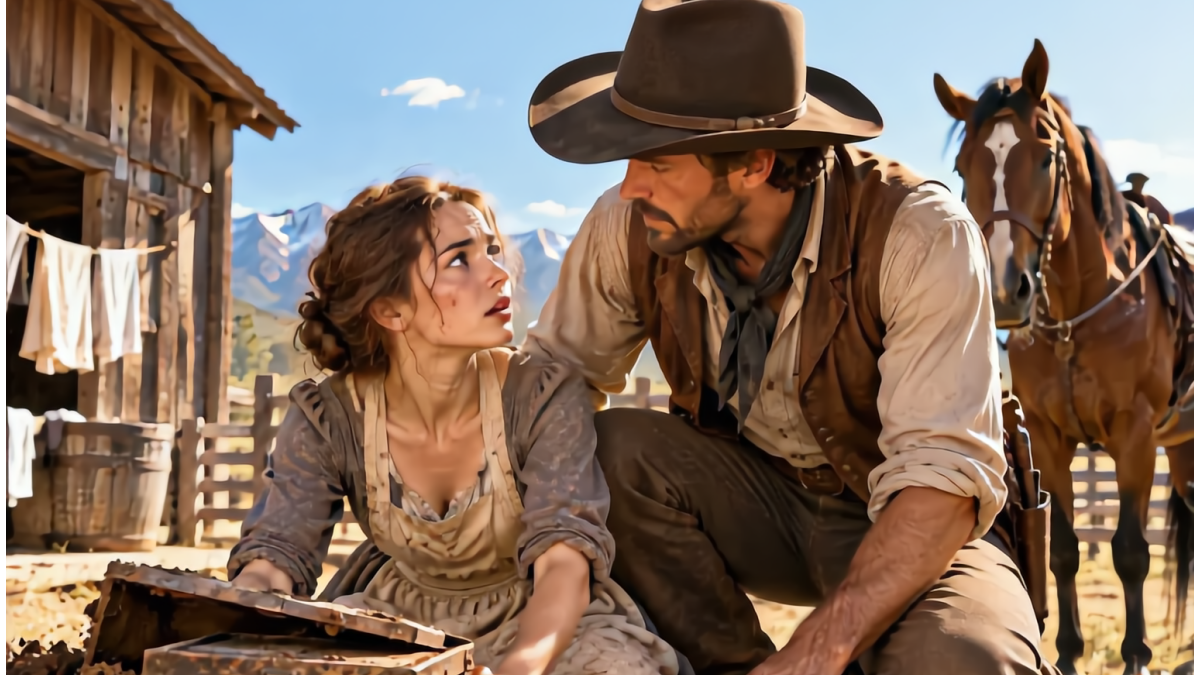
Harlon Voss grabbed the woman by her collar and dragged her out of the dirt like she was livestock that had wandered onto the wrong pasture.
“You got 10 seconds to explain yourself before I have you thrown off this land in pieces,” he said loud enough that three ranch hands stopped what they were doing and turned to watch.
“Norbellamy didn’t beg. She didn’t cry. She just looked at the tin box half buried in the Wyoming clay, the one she’d ridden 11 mi in cracked boots to find, and she said very quietly, “Take your hands off me.”
Harlon laughed. That was when Wade Callahan rode in from the South Ridge and saw what was happening behind his own wash house.
That was how Wyoming announced itself in the summer of 1,887. Not with thunder, not with lightning, but with a wall of brown air that moved across the flats like something alive and deliberate, swallowing fence posts and cottonwood trees until you couldn’t tell where the land ended and the sky began.
Wade Callahan had been watching it build since noon. He’d ridden the south ridge after checking the main stock pond, which had dropped another 4 in overnight.
4 in. He’d walked the bank and measured the waterline against a post he’d hammered there three weeks ago.
And the numbers made his jaw tighten in a way that had nothing to do with anger and everything to do with the specific dread that comes from watching something you cannot control move in a direction you cannot afford.
His cattle needed water. Thousands of them spread across 42,000 acres of Callahan land. Each animal drinking between 30 and 40 gallons a day when the heat climbed past 90.
The creek that fed the south pasture had already gone to mud. The upper tributary that branched off near the old Harker claim was barely a trickle.
And now the primary pond, the one his father had spent two summers excavating and reinforcing was dropping faster than any drought alone should explain.
Wade didn’t have a word for what that feeling was. Standing there measuring water that shouldn’t have been disappearing that faSt. It wasn’t fear exactly.
It was closer to standing in a room where you smell smoke but can’t find the fire.
He was riding back toward the main yard, thinking about Harlland’s suggestion that morning closed the downstream releases.
Redirect everything north to the herd when he heard the shouting. He heard Harland firSt. Harlland’s voice carried the way a man’s does when he’s decided he doesn’t need to modulate himself for polite company.
It was loud and hard and came from the direction of the old wash house, which nobody had used in at least 6 years since WDE’s mother passed, and the household reduced itself to practical necessities rather than sentiment.
Then he rounded the fence line and saw her. She was on her knees in the clay behind the wash house, and Harlon had one hand wrapped around the back of her collar like he was restraining a dog.
She wasn’t a large woman, 20some, he’d guess. Fine, boned, and angular in the way of someone who didn’t miss meals on purpose.
Her dress was dark cotton, patched at one elbow with a slightly different fabric, and her hands, where they gripped the handle of a broken horseshoe she’d been using to dig, were red and chapped in the specific way that came from laundry work, soap hands.
His mother had called it that. Three of his hands had drifted over from the fence work and were standing in a loose cluster, watching with the particular look of men who aren’t sure whether they’re witnessing something that requires them to act or something they’ll be telling at supper.
Wade pulled up on the reinss Harlon. Harlon looked up, found her digging at the back of the wash house.
Says she had reason to be here. I told her there ain’t a reason in the world that puts a stranger on Callahan land with a shovel.
It’s a horseshoe, the woman said. I don’t care if it’s a butter knife. Haron WDE’s voice didn’t rise.
It didn’t need to. Let her stand. Haron released his grip. The woman straightened herself with the careful, deliberate movements of someone who had just been handled roughly and was not going to show anyone how much it stung.
Wade swung down from the horse. The dust wall was maybe 20 minutes out now.
He could feel the temperature dropping slightly ahead of it, that strange cool breath that preceded a wall of grit.
“What’s your name?” She looked at him directly. Most people who came onto Callahan Land by accident or desperation had a particular way of looking at him slightly angled, slightly down.
The body language of someone acknowledging the distance between their situation and his. This woman did not do that.
She looked at him the same way she might look at anybody. Nora Bellamy. You’re from the Pike Settlement.
I live there. Yes, that’s 11 miles from here. I’m aware of the distance. I walked part of it.
WDE looked at the disturbed earth behind the wash house. A hole about a foot deep, maybe 18 in wide.
She’d been at it a while. What are you digging for? Something my mother told me was here.
Your mother, Adah Bellamy. She worked on this ranch before I was born. She washed for your family.
Norah paused. She died two winters ago. Before she passed, she told me that if the settlement spring ever started failing without natural cause, I should come to this exact location and retrieve what she’d left.
Wade looked at her for a moment. He looked at the hole. Then he looked at the wall of brown moving toward them from the south.
Harlon, get the hands inside. Wade, get them inside. Harlland’s jaw set, but he moved.
The hands followed, casting looks back over their shoulders. WDE crouched at the edge of the hole.
She’d hit something he could see the dull corner of metal half exposed in the clay.
“Keep going,” he said. Norah looked at him like she wasn’t sure what he meant.
“The storm’s going to be here in 15 minutes,” Wade said. “If there’s something down there, dig it out before we lose the light.”
She dug. He held the loose clay back with his hands, and they worked together without speaking until the box came free, a tin cash box, the kind his father had used for small expenses.
About the length of a man’s forearm and roughly the width of two hands side by side.
It had been wrapped in oil cloth before burial, which had preserved it through however many years it had been sitting there, maybe 20, maybe more.
Rusted at the edges, the clasp was stiff, and scratched into the lid in uneven lettering, not engraved.
Scratched like someone had used a nail or a pin, were two initials. RC Robert Callahan, his father’s name, Wade went very still.
The first gust of the wall hit them, throwing grit sideways against the wash house boards.
Norah pulled the box against her chest with both arMs. “Open it,” she said. Wade looked at her she hadn’t asked, she told him.
“Let’s get inside firSt. Open it here. In front of me. There’s a wall of dirt about to.
I’m not moving until you open it in front of me.” Her voice didn’t shake, but it had a quality in it that he recognized not fear, but the rigid composure of someone who had learned that if they relax their grip on a situation for even a moment, it would be taken from them.
I found it. I carried it out of the ground with my hands. You don’t touch the clasp until I’m watching.
Wade stared at her. Then he said, “Come inside.” She followed him into the wash house with the box held against her body the entire way.
The wash house had been closed up long enough that it smelled like cedar and dust and absence.
There were still hooks on one wall where his mother had hung washing bags. Stone spasin in the corner was bone dry.
Wade found an old lantern on a shelf with enough oil left to light, and he got it going while the storm hammered at the walls with the sound of a thousand handfuls of thrown sand.
Norah set the box on the stone basin and stood directly in front of it.
She watched his hands. Wade worked the clasp, which was rusted but not locked, and lifted the lid.
There were papers inside, folded, yellowed, carefully placed, several pages, a map on rough paper that had been refolded so many times the creases were nearly worn through, and beneath those, a small leather-bound notebook of the kind a ranch foreman might use for daily records.
WDE reached for the first folded page, Norah’s hand landed on top of his. Not grabbing, just present.
Read it out loud, she said. Everything. He could have pointed out that this was his father’s property on his land, in his wash house, and that her hand on top of his constat an ongoing series of decisions that most women in her position would not make around a man of his standing.
He didn’t point any of that out. He read it out loud. The first pages were water measurements, dates, and numbers recorded in a neat small hand that was not his father’s.
The dates went back to 1,869 and continued through 1,871. Springflow measured at three points, one upstream, one midpoint, one at the outlet, consistent, regular, detailed.
The handwriting was careful and educated, the work of someone who understood what they were recording.
At the bottom of the third page, a notation AB verified against RC Ledger, June 14, 1,871A B.
Ada Bellamy. The map showed the spring system, not just the Callahan portion, the full system, including a branch that ran southeast toward what was now the Pike Settlement.
The branch was labeled with measurements and a note, shared outlet, original grant, and then the notebook.
Wade opened it to the first marked page. It was his father’s handwriting. He would have known it anywhere.
The heavy slightly backward slant, the way capital letters pushed harder than the reSt. Summer dry season.
Diversion gate at the upper fort closed to protect main channel capacity. Ada has copied the prior year’s records and insists the shared grant requires maintenance.
I told her the grant is historical, not binding under current title. She says she will keep the records.
I told her to do what she muSt. Wade turned the page. Ada left employment today, took her copies.
I didn’t stop her, let her have them. The grant question can be addressed through proper channels later.
There is no later that is the right time for this. He stopped reading. The wind hit the wash house hard enough to shutter the door on its hinges.
Norah was watching his face. “Your mother worked here,” Wade said slowly. “She copied these records.”
“Your father’s records,” he corrected himself. “My father’s records.” She copied them because she was afraid the original would be altered or loSt. Norah said, “She told me she didn’t steal anything.
She told me she kept them because your father promised to address the shared grant and then he didn’t.
And then he died and the spring kept working well enough that nobody noticed the diversion gate was still closed.”
She paused until now. Wade looked down at the map at the branch of the spring he had never seen in his life.
He knew this land. He had ridden it since he was 6 years old. He had never in 33 years seen a secondary channel running southeast toward the settlement because it had been closed before he was old enough to remember it.
There’s a diversion gate, he said. According to everything in that box, yes, built when your father built the main system.
It was supposed to be operated jointly. Callahan Ranch controlling the upper gate, the settlement community controlling the lower proportional flow to both during dry seasons.
Norah’s voice was steady. She had clearly thought about how to say this. Someone closed it and filled the channel.
The channel you’re saying exists. The channel that’s on your father’s map. Yes. Wade looked at the map again.
Then he looked at the notebook. Then he looked at Nora Bellamy standing in his wash house in the middle of a dust storm with her chapped hands folded in front of her and her chin level and her eyes telling him absolutely nothing about whether she expected him to believe her.
You rode 11 mi on a broken saddle. He’d seen the shape of it when he first approached in this heat.
To retrieve documents that accused my ranch of stealing water from your settlement. I didn’t say steal, Norah said.
I said someone closed a gate. And yes, I rode here because families I grew up with are going to lose their wells in 10 days if the water level doesn’t recover.
And because my mother kept these records for 20 years, waiting for someone to need them.
A pause. She didn’t think it would be me. The storm was full around them now, the light outside the small high window reduced to a moving brown merc.
Wade sat down on the edge of the stone basin. He’d been told by approximately everyone in his adult life that he was a fair man.
His father had used that word. His mother had used it. Harlon had used it as a compliment for decades.
He’d believed it because he’d never done anything he thought was obviously wrong. But fair was a word that meant different things depending on where you were standing when you said it.
He looked at the map. He looked at the block channel running toward the settlement.
I’m going to ride to the location on this map tomorrow, he said. Norah saidn nothing.
I want you with me, Wade added. Because you’ve read these documents and I haven’t.
And I’m not going to spend 2 hours riding the wrong creek bed. Still nothing.
That’s not an offer I make lightly, he said. I’m asking you to come back to a ranch you have no reason to truSt. Norah looked at him for a long moment.
I’ll be at your east fence line at sunrise, she said. Don’t be late. Then she picked up the tin box, the one containing his father’s handwriting and his father’s initials and his father’s promise that had gone unfulfilled for 16 years, and she held it out to him.
He took it. She walked to the wash house door, waited for a slight break in the gust, and stepped out into the brown air without looking back.
Haron was in the main room when Wade came in, sitting at the table with a cup of coffee, and the look of a man who had been waiting.
She gone? Yes. What was in the box? Wade set it on the table. Haron looked at the initials scratched into the lid.
Something moved through his expression there and gone. Too quick to name. My father’s water records, Wade said.
And an old map. He opened the box and laid the pages out. There’s a secondary channel on here I’ve never seen.
Running southeaSt. Harlon said nothing. “Have you ever seen a channel running southeast from the upper Spring Fork?”
“Can’t say I have,” Harlon said. “My father mentions a diversion gate in his notebook.
Closed during a dry season in 1,871 and apparently never reopened. That was before my time.
It wasn’t.” Harlon had started working for Robert Callahan in 1868. Wade looked at him.
Harlon met his eyes steadily, the practiced steadiness of a man who had spent decades managing information as carefully as he managed cattle.
That woman came from the settlement, Harlon said. 11 mi to dig up old papers and bring them to you personally.
You understand what that is? What is it? It’s a setup, Wade. Settlement families have been looking for legal leverage against Callahan water rights for 20 years.
This woman shows up with a box she says her mother buried with your father’s name on it and you’re going to take her word for it.
I’m going to look at a creek bed, Wade said. That’s all. You go looking with her.
Word gets back to the settlement. Words gets back to everyone that the Callahans are entertaining water complaints from homesteaders.
You know what happens to a man standing when people think he’ll fold under pressure?
Wade started toward the back hallway. She’s not going to stop at one request, Harlon said to his back.
Give that woman an inch and she’ll have a lawyer in here by autumn. WDE stopped at the hallway door.
He didn’t turn around. My cattle are losing 4 in of pond water a day in a drought that doesn’t explain those numbers, he said.
Either someone siphoning my water illegally, or there’s a natural explanation I haven’t found yet.
Either way, I need to understand the system better than I do. A pause. A woman just handed me a map my father made that shows me a part of that system I’ve never seen.
I’m going to look at it. He went to bed. He did not sleep well.
Norah was at the east fence line before sunrise. She’d brought Jonah. Wade hadn’t expected the boy 15, maybe lean and watchful with Norah’s same quality of not performing anything for an audience.
He had a satchel over one shoulder and was carrying it with the careful attention of someone who’d been trusted with something breakable.
My brother Jonah, Norah said. He knows the settlement side of the creek beds better than I do.
WDE looked at the boy. Jonah looked back. I’m not here to cause trouble, he said.
I just know where the dry channels are. All right, Wade said. They rode. The morning was still, the air after the storm having scrubbed itself clean and cool in the way it sometimes did in Wyoming, as if the land was capable of apology.
Jonah rode a settlement horse that was older than it should have been for this kind of work.
And Norah rode the same saddle he’d noticed the day before, the one with the wire repair at the right stirrup leather.
He’d thought about leaving a saddle for her. He’d decided against it and wasn’t entirely sure why.
Possibly because Harlland’s voice was still in the back of his head, telling him she was running a scheme.
Possibly because some quieter instinct told him that offering her something before she’d asked for it would insult her in a way he couldn’t quite articulate.
They followed the map. The upper spring fork was easy to find. He knew it well.
Had watered horses there for years. The map showed the fork splitting, one branch running northwest toward his main channel and the other branching southeast, but the southeast branch showed as open water on the map.
On the ground. It was a dry depression filled with rock and scrub. Not naturally dry, deliberately filled.
Wade dismounted and walked the depression. Jonah walked beside him without being asked, pulling rocks aside where they sat too uniform to be natural.
About 200 yd down the line, the stone fill was denser, more deliberate. They cleared the surface and underneath was the edge of timber, old rotted planking over a channel that had been filled with stone from above and allowed to silt in for years.
There, Jonah said. Wade looked at the timber. Then he looked at the map. Then he looked at Norah, who was standing back slightly with the tin box under her arm, watching him.
How long has your settlement spring been declining? He asked. Since May, she said. Gradual through June.
Sharp since the 1st of July. The drought started in late May. Yes, but Miriam Pike had records from the drought of 1,874.
In 74, our spring held all summer. The soil doesn’t explain a failure this sharp.
Unless the water isn’t getting there. Unless the water isn’t getting there, Norah agreed. Wade crouched at the edge of the filled channel.
He’d ridden this ground his entire life. He’d eaten meals within a/4 mile of this spot.
He’d watched his father manage this land. Watched the men who worked it, learned from all of them what it meant to be a good steward of something you’d inherited.
He’d never known this channel existed. That fact sat in him uncomfortably. There should be a gate structure, he said.
The map shows a control point about a/4 mile further southeaSt. Jonah said, “I think I know where it might be.”
They followed the boy. He led them to a stone shelf at the base of a low cutbank, half hidden under years of overgrown bunch grass.
WDE pulled the grass back. Beneath it was work timber, a sill, iron hardware rusted solid.
The remnants of a gate mechanism that had been built with the same construction quality as his father’s main channel works.
It hadn’t rotted. It had been built to last and then buried under enough fill to make it invisible.
Wade looked at the gate for a long time. He thought about his father. The notebook.
There is no later that is the right time for this. When I was growing up, he said to no one in particular.
My father used to say that a man’s character was in what he did when nobody was watching.
Norah didn’t say anything. I always thought that meant doing the right thing in private, Wade said.
I’m now wondering if it also meant something else. He straightened up. He looked at Nora.
I need to understand this system completely before I do anything. That’s going to take time.
I’m not sure I have my pond is dropping and my herd won’t wait on an archaeology project.
He paused. But I can’t close my eyes to this. Norah his jaw shifted slightly.
What does that mean exactly? It means I’m not calling this a drought and riding home.
It means what practically? It means I’m going to find out what happened to this gate.
I’m going to find out who filled it and when. His voice was level. And I’m going to do that without promising you anything I might not be able to keep.
It wasn’t what she wanted to hear. He could see that. She’d ridden 11 mi for a clearer answer, but she nodded once.
Miriam has 10 days, she said. Maybe 12 if they’re careful. I heard you, Wade said.
She held his gaze long enough to make sure he understood that hearing and acting were not the same thing.
Then she put the tin box back under her arm and turned to her brother.
“Come on, Jonah.” The boy followed her. WDE stood at the buried gate of a water channel he’d never known existed, built by his father, closed by someone, and quietly killing the downstream families who had counted on it for nearly two decades.
He stood there for a long time after they were gone. That evening, Harland found him at the main water chart, the large handdrawn map of the Callahan system that had hung in the ranch office since before Wade was born.
WDE had the tin box open on the desk beside it. He was comparing the old map to the current chart.
You went with her, Harland said. I found the channel, Wade said. It’s real. The gate structure is real.
It’s been filled in and buried. Harlon stood very still in the doorway. My father built that gate, Wade said.
And at some point someone decided the shared grant wasn’t going to be honored anymore and filled the channel in.
He looked up at Harlon. The settlement is running out of water partly because that gate has been closed.
The dr the drought the drought doesn’t explain the numbers Harlon. You know it doesn’t.
4 in a day from the main pond while we haven’t had significant flow into it.
That’s not evaporation in cattle consumption. Something’s changing upstream. He tapped the old map. Something that’s been changing a long time.
Harland said nothing. WDE looked at him. My father left a notebook entry, WDE said carefully about closing the gate in 1,871.
He said he’d address the shared grant through proper channels later. Your father was a practical man.
He was. He was also wrong sometimes. WDE looked back at the chart. I want the full water survey records.
Everything in the ranch archive going back to 1,865. I want to understand this system completely.
That’s going to take weeks. Then I’ll start tonight. Harlland’s expression was the particular expression of a man who has built his entire professional identity around a single loyalty and is beginning to feel the ground shift under it.
Not guilt. Exactly. Something harder. The feeling of a man watching a decision he made long ago ripple toward consequences he cannot stop and isn’t sure he wants to.
The settlement women are going to use that woman against you. Harland said. They’ll make you look weak.
Maybe your father would have said this is ranch business. Callahan water on Callahan land.
My father, Wade said quietly, built a shared gate and then closed it and called it drought for 16 years.
He set the old map down. I’d like to think I can do at least a little better than that.
Harlland left without another word. WDE stayed at the desk until past midnight, working through records by lamplight, tracing water measurements backward through years of drought and rain, and the simple arithmetics of a SP system that had always been meant to supply more families than it currently did.
Outside, the Wyoming knight was dry and enormous, and completely indifferent to whatever decisions the men inside the house were making.
The spring was still dropping. The settlement was still running out. And somewhere in a buried channel 200 yd from his main waterline, the evidence of a promise his father had made and never kept was waiting for him to decide what kind of man inherited a wrong he hadn’t committed.
Wade pulled out a clean sheet of paper and started writing. He didn’t know yet what the right answer was, but he was done pretending the question didn’t exiSt. 3 days after finding the buried gate, Norah had developed a routine she hadn’t asked for and wasn’t sure she trusted.
Every morning, she rode eaSt. Every evening, she rode weSt. In between, she spent her hours in the company of a man who owned more land than the entire Pike settlement combined, doing work that felt increasingly like it mattered, and increasingly like it could get her into serious trouble.
The investigation was physical in a way she hadn’t anticipated. She had imagined paperwork, ledgers, the careful cross- refferencing of her mother’s documents against official records.
Instead, Wade had handed her a pair of worn riding gloves on the second morning and said, “We ride the creek beds.”
And that had been the shape of everyday since. They rode channels that hadn’t carried water in years.
They dug at collapsed banks and exposed old timber. They compared Ada’s measured flow numbers against the current reality of dry clay and cracked stone.
And the gap between what her mother had recorded and what actually existed now was not a drought gap.
It was a built gap, a decided gap. The kind of discrepancy you get when someone makes a series of choices over a long period of time and calls each individual choice reasonable.
Norah kept her thoughts about that to herself. Wade kept his to himself, too. This was she was slowly realizing one of the more unusual things about him.
She had expected him to talk. Wealthy men in her experience filled silence with opinions the way poor people filled it with apologies reflexively as a demonstration of ownership.
Wade Callahan rode beside her for hours saying almost nothing. He looked at things carefully.
He wrote measurements in a small notebook he kept in his breast pocket. When he formed a conclusion, he stated it in one sentence and then waited to see if she had a different reading.
Twice she’d had a different reading. Both times he’d listened. Once he’d changed his assessment, once he hadn’t, but he’d told her specifically why, which was different from dismissal.
She didn’t tell him she noticed. She wasn’t sure yet what noticing meant. On the fourth day, they found the second control structure.
This one was upstream from the first closer to the original spring head, positioned at a point where the water could be diverted entirely away from the southeast channel before it even reached the buried gate.
It was newer than the firSt. The timber wasn’t rotted. The iron work, though rusted, had been manufactured within the last decade rather than 30 years ago.
Someone had built an additional control point. Someone had done it recently enough that the wood still held its shape.
Wade stood looking at it for a long time. Norah crouched and examined the iron work.
This wasn’t in my mother’s document, she said. No, Wade said. This was added after she left.
Yes, which means it wasn’t your father’s original system. No, Wade said again. It wasn’t.
Neither of them said what that meant. The implication hung between them with the particular weight of a fact that changes the shape of everything around it.
Ada’s records had documented a closed gate, a failure to honor a shared agreement. This newer structure was something different.
This was active. This was deliberate modification of a system someone knew was supposed to work another way.
WDE wrote the dimensions in his notebook. He noted the iron work style and tried to estimate the construction date.
He sketched the position relative to the spring head. Norah watch watched his hands. She’d spent her life watching what people’s hands did when they thought no one was paying attention.
The way a wealthy employer picked up a garment Norah had washed and ran their thumb along the seam without saying anything, not checking for dirt, just reminding both of them who owned what.
The way Miriam’s hand shook on cold mornings since the arthritis had gotten bad, and how Miriam always tucked them into her apron before anyone else could see.
WDE’s hands, when he worked, were careful and unscentimental. He didn’t touch things to demonstrate ownership.
He touched things to understand them. That was a different kind of man from what she’d prepared herself for.
She was not going to make the mistake of finding that reassuring too quickly. I need to show this to Miriam, she said.
I’ll come. No. The word came out sharp. She softened it slightly. Not yet. The settlement is already watching the fact that I’m spending time here.
If you ride in with me, it becomes about what that means. I need to be able to show her the evidence without the conversation being about you.
WDE looked at her. You understand that, she said. It wasn’t a question. I understand it, he said.
He sounded like a man who didn’t love it, but wasn’t going to pretend it wasn’t true.
Norah took the sketch he’d made of the second structure, folded it carefully, and put it in her coat pocket alongside her mother’s documents.
“Tomorrow morning,” she said. “Tomorrow morning,” he agreed. She rode weSt. She didn’t look back.
She’d learned that looking back gave people information about you. Miriam Pike’s house was the oldest structure in the settlement, a stone and timber building that had been added to three times as the community grew around it.
The woman herself had the quality of the building solid, slightly asymmetrical, built to outlast comfortable expectations.
She was 78 years old. No. Norah corrected herself. 58, though she looked older by a decade, which was what happened when you spent 30 years doing physical labor in Wyoming without adequate resources, suses, and without anyone who was going to carry the weight if you put it down.
Miriam looked at the sketch and the documents without speaking for several minutes. Then she said, “Who built this second structure?
We don’t know yet.” When within the last 10 to 15 years from the condition of the materials, Miriam was quiet again.
Outside her window, three settlement children were carrying water in pales from the communal barrel, which was running lower every day.
She watched them. Your mother kept these for 20 years, she said finally. She knew they’d matter.
She knew they’d matter if someone was willing to use them. Miriam folded the sketch carefully and held it out.
Some people find evidence and bury it twice. Are you sure about this man? I’m not sure of anything, Norah said honestly.
I’m sure he went and looked when I showed him where to look. I’m sure he didn’t try to take the documents.
I’m sure he’s doing actual work instead of paying someone else to make the problem go away.
She paused. Beyond that, I don’t know. Elias says you’re being managed. Elias says that about anyone who doesn’t already agree with him.
Miriam gave her the look she’d been giving Nora since Norah was 12. The look that said, “You’re not wrong, but that’s not the whole answer.”
Elias also has some experience with what happens to people like us when we put our faith in people like him.
I know his father lost his homestead claim to a lawyer working for a cattle company.
He watched it happen over 3 years that all felt reasonable right up until they weren’t.
I know that, too. I’m not saying don’t do what you’re doing, Miriam said. I’m saying know what it costs if you’re wrong.
Norah folded her documents back into the tin box. We have 8 days, Miriam. Maybe nine.
What it costs if I’m wrong is the same thing it costs if I don’t try.
Miriam didn’t argue with that. She was too practical a woman to argue with arithmetic.
Elias found Norah the next morning before she could ride out. He was waiting at the edge of the settlement where the east trail began, sitting his horse with the particular stillness of a man who has rehearsed what he wants to say and isn’t entirely sure if it’ll land the way he intended.
Elias Ror was 29 years old and had been running his small ranch on sheer stubbornness for 6 years since his father’s claim collapsed.
He was not a stupid man. He was not even an unreasonable one most of the time.
He’d been kind to Jonah when Jonah needed kindness. And he’d rebuilt Miriam’s fence line twice without being asked.
But he looked at Wade Callahan the way a man looks at a weather system.
Something powerful. Something’s moving. Something that was going to affect you whether you engaged with it or not.
And the question was only where you stood when it arrived. He’s going to show you enough to make you think he’s different.
Elias said without preamble. And maybe he is different. That doesn’t change what happens when it costs him something real.
Good morning, Elias. I’m serious, Nora. I know you are. She kept her horse moving forward at a walk.
He fell in beside her. You want me to distrust him on principle and stop looking for the source of our water problem, or you want something specific?
I want you to be careful what you tell him. I’ve been careful about everything since I was 8 years old.
You don’t need to remind me to be careful. You’re writing to his ranch every morning.
I’m writing to find the cause of a problem that will make every family in this settlement homeless if I don’t.
And if he’s the cause, then I’ll know that, Norah said. Because I looked. Elias pulled up.
She kept writing. He’s going to offer you something. Elias called after her. Money or work or something that makes staying near him look reasonable.
And you’re going to take it because you need it and then you’re going to owe him.
Norah didn’t answer. She also didn’t tell him he was wrong because she wasn’t entirely sure he was.
The saddle broke that afternoon. Not broke dramatically, didn’t dump her in the middle of a creek bed or anything that would have made a clear story.
The wire repair at the right stirrup leather finally gave out on a rocky descent, and she felt the saddle shift under her, and she pulled up carefully and dismounted and stood in the sun, assessing the situation.
The saddle was not fixable in the field. The leather had cracked at the original weak point, and the wire had been the only thing holding it.
She’d been riding this saddle since her mother died. She’d patched it with everything available, spent an amount of actual money on it that she could not fully account for without feeling ill, and it had given out at the worst possible time on the worst possible ground.
She led her horse the rest of the way to Callahan Ranch on foot. Wade found her half a mile from the main yard.
He took one look at the saddle draped over his fence rail where she’d left it, and he didn’t say anything immediately.
He just looked at her. It’s fixable, Norah said. Not the leather. Possibly the leather.
He didn’t argue. He led her horse into the yard and found a working saddle from the tack room, one of several spares hanging on the wall, and set it on her horse without comment.
Norah stood in the doorway watching him. “I’ll return it when I’m done,” she said.
It’s not alone,” Wade said, adjusting the cinch. “It’s a spare. We have six of them.
I’ll return it when I’m done.” He looked at her over the horse’s back. He had the expression of a man trying to decide whether to push back, and concluding rightly that pushing back would be a waste of energy.
“All right,” he said. That evening she found the old saddle had been replaced, not repaired, replaced, with a working saddle of similar age and design, left in the position where she normally tied her horse.
Nothing new, nothing that looked like a gift, just a functional saddle where a broken one had been.
Norah stood looking at it for a full minute. Then she took it inside and put it back on the spare rack and left the broken one where she’d originally put it.
She rode home on the loner. The next morning, the replacement was back in its position.
She left it there again. On the third morning, there was no replacement. There was only a note tucked into the split of the fence poSt. The spare is in the tack room when you need it.
The broken one is in the bin for parts. I’m not trying to buy anything.
She stood holding the note for a moment. Then she put it in her coat pocket beside her mother’s documents.
She went and got the spare saddle herself. 4 days after finding the second control structure, she explained why to Wade directly.
They’d stopped at the dry creek bed above the old Harker, claimed to eat the midday meal, she’d brought biscuits from the settlement.
He’d brought cold coffee from the ranch house, which was a demonstration of how differently two people could approach the same situation.
They sat on opposite sides of a flat rock, and she told him about Elias.
Not to create sympathy, she wasn’t looking for that, but because he needed to understand the social reality of what she was navigating on the settlement side.
He’s not wrong that you have power. I don’t, she said. He’s wrong that that makes you automatically dangerous.
But I can’t prove the difference without evidence. Evidence of what? That you’re not doing this to find out what I know.
Wade was quiet for a moment. He poured his coffee onto the ground because it had apparently gone cold enough to be unpleasant.
If I were doing this to find out what you knew, he said, “I’d have been considerably more agreeable from the start.
That’s actually not how it works. Being agreeable from the start is exactly what someone would do.”
He looked at her. You’re telling me there’s nothing I can do to prove it.
I’m telling you that the proof is in the pattern, she said. Not in any single action.
Generous men can be generous for specific reasons. He thought about that. Is that something your mother taught you or something you learned the hard way?
Both, Norah said. My mother worked for generous people her whole life. People who paid her fairly and spoke to her kindly and still treated exhaustion like a character flaw.
She looked out over the dry creek bed. She’d come home with her hands shaking from the work.
And tell me what a good family they were. And they were good. And it still wore her out completely.
A pause. Generosity and fairness aren’t the same thing. And fairness and justice aren’t the same thing either.
Wade sat with that. He didn’t tell her she was wrong. He didn’t try to distinguish himself from the people she was describing.
He just sat with it the way someone sits with a truth that has just rearranged a room inside them.
That was neither genuine nor a thought or the best performance she’d ever seen. She was going to act as if it were genuine because the alternative was to stop looking for the water source and she couldn’t afford to do that.
But she was going to keep watching. The stock pond dropped to its lowest recorded level on a Tuesday.
Wade found out at dawn when his head cattle hand, a quiet man named Burn, who had been with the ranch for 12 years, came to the main house with the measurement stick and a face that had already done the arithmetic and didn’t like it.
How long? Wade asked. 7 days at this rate, Burn said. Maybe eight if we reduce grazing movement and cut the north pasture herd back to half rations.
That’s not sustainable past a week. No. What’s Harland say? Burn was quiet for a moment.
The particular quiet of a man who has been employed long enough to understand the political geography of his workplace.
He says we should close the downstream releases and redirect everything into the main pond today.
Wade looked at the measurement stick. The downstream releases were the water that was currently keeping the Pike settlement from running completely dry.
Not all of it the settlement had its own compromised spring, but a portion that Norah had calculated using her mother’s flow records was about 30% of the settlement’s current daily supply.
Closing it today would probably save his cattle. It would leave Miriam Pike’s community without usable water in 6 days instead of 8.
Tell Burn to hold the current configuration. WDE said. That’s not what Harlon recommended. I know what Harlon recommended.
WDE set the measurement stick against the wall. Hold the configuration. Burn left. Harlon arrived 20 minutes later.
He stood in the office doorway with his arms crossed in the way of a man who has decided that the courtesy of knocking has become optional given the circumstances.
You can’t keep sentimentality running the water system. Harlon said, “You’ve got 3,000 head that need to drink.
I’m aware of how many cattle I have. Then act like it. Harlon came fully into the room.
In the years Wade had known him his entire life, essentially he’d seen Harlon operate from a position of unshakable certainty that his judgment was correct and that WDE’s instinct toward fairness was a liability to be managed.
He’d never thought of it in those exact terms until now. That woman has put something in your head about obligation and legacy and whatever else, and it’s going to cost you a ranch.
Your father’s spent his life building. My father spent his life building it partly by closing a channel that fed the downstream settlement.
Wade said, “I found that out recently.” “Your father made hard choices.” “Yes, and now I’m making them, too.”
Wade picked up the morning’s water measurement log. The choice I’m making is to not close the downstream release until I’ve exhausted every other option.
Harlon stared at him. You’re going to lose cattle, Wade. Maybe your father would never.
My father, Wade said with a quiet that was not gentle, is not here, and the decisions he left behind are part of the problem I’m currently trying to fix.
He opened the log and set it on the desk between them. I need you working on identifying the source of the upstream loss, not managing my choices about the settlement.
Can you do that? Harlland’s jaw was set so hard the muscle at the corner of it had gone white.
I can do that, he said. He left. Wade stood in the empty office for a moment, and then he did something he hadn’t done in a long time.
He sat down in his father’s chair, the old wooden one that had been there since before he was born, and he looked at the room the way a stranger might look at it, trying to see what it actually was, rather than what he’d always assumed it was, his father’s chair, his father’s desk, his father’s water charts on the wall, with one channel conspicuously missing.
He sat there until the feeling passed. Then he went to work. That night, near 11:00, Norah arrived at the east fence line carrying nothing.
She’d ridden from the settlement after dark, which he knew because he’d been in the north pasture, checking on a sick animal, and had seen the lantern moving across the flat from the direction of the pike road.
He’d ridden to intercept it and found her. Her face was tight. Miriam’s well dropped below the pump level today, she said.
The communal barrel has 4 days left if they ration it. I know you know my pond numbers.
I know your pond numbers, Nora said. Her voice was controlled, but the control was costing her something.
I know exactly what your situation is. I’m telling you ours. She stopped, took a breath.
I’m not here to ask you to choose us over your cattle. I’m here because I don’t know what else to do, and I needed to ride or I was going to say something to Elias that I can’t take back.
Wade looked at her. He’d been thinking about the downstream releases for 3 hours. He’d done the arithmetic from every angle he could find.
He’d looked at the historical weather patterns, the projected rainfall, the estimated timeline for seasonal recovery.
He’d looked at the numbers the way a man looks at numbers when he already knows what they’re telling him and is to find a reading and is trying to find that says something different.
They kept saying the same thing. He went into the barn. He loaded six barrels onto a flat wagon.
He hitched the two strongest horses in the stable. He came back out. Norah was still on her horse.
She was watching him. I can’t empty the settlement, he said. But I can bridge 4 days.
He climbed onto the wagon. Go back and tell Miriam the water’s coming, Wade. It’s not charity, he said.
It’s buying time until we find the source, which I intend to find before those four days are up.
He drove the wagon north before she could argue with him about it. He spent two hours driving through a night that was dark and still and enormous in the way Wyoming nights were.
The sus clear and deep. It made your sense of distance unreliable. He pulled up at the settlement well before anyone was stirring.
He unloaded the barrels himself into the community sistn, working quietly, not waking anyone. He was nearly done when a lamp came on in Miriam Pike’s window.
He didn’t stop working. The door opened. Miriam came out in her coat and looked at him for a moment.
You could have had one of your men do this, she said. Yes. Why didn’t you?
Wade hefted the last barrel into position. Because it needed doing tonight, he said, “And because I figured if I send men, it’s a transaction.
If I come myself, at least it’s honeSt.” Miriam was quiet for a moment. She looked at the sistern, which was now holding enough water to bridge the settlement for 4 days.
“My husband would have told me not to trust a man who does a good deed in the middle of the night,” she said.
“Smart man he was.” She looked at Wade steadily. “I’m going to tell you what I told Nora.
I’m not saying don’t. I’m saying know what it cost you if you’re being played.
I know what it costs, Wade said. He climbed back onto the wagon. She doesn’t sleep well, Miriam said abruptly.
Wade looked back. Nora, she hasn’t slept well since her mother died. She carries too much and she doesn’t put any of it down because she doesn’t trust that the ground will hold it.
A pause. Don’t make her carry anything else she can’t put down. Wade held the old woman’s eyes for a moment.
I’ll do my best, he said. He drove home through the dark. He didn’t pass Norah on the road.
She had ridden ahead of him back toward the settlement, and he hadn’t seen her past the water barrels being unloaded because she’d stayed back at the edge of the settlement road.
He found out later that she’d sat on her horse in the dark and watched him work the whole time, not saying anything, not announcing herself, just watching a wealthy rancher haul water barrels for a community he had no legal obligation to protect.
Without an audience, without anyone to see him, without anything to gain from the effort, except a 4-day bridge toward a problem that was still mostly unsolved.
Poverty had taught Norah that generosity from powerful men usually arrived with invisible bookkeeping. She was still watching for the bill, but she was watching with something new in her chest now.
Something she didn’t have a comfortable name for, something that felt less like suspicion and more like the specific, slightly terrifying awareness that a person might not be exactly what you prepared yourself for.
She rode home. She slept better than she had in weeks. She didn’t tell anyone that either.
The following afternoon, Elias saw them riding together on the South Creek Road. He’d been coming back from checking his own fence lines, and he came over the rise, and there they were, Norah and Wade Callahan, riding side by side, not close, but not the careful distance of two people who hadn’t spent several days working in the same space.
Their horses were matched in pace. They were talking. Norah was pointing at something on the creek bank, and Wade was watching, where she pointed with the attention of a man who finds what she’s saying interesting.
Elias pulled up on the rise and watched them for a moment. Then he turned his horse around and rode home.
He didn’t say anything to anyone that day. But that evening at Miriam’s house, where three families had gathered to share the community meal and talk about the water situation, he said quietly in the way of a man laying groundwork rather than making an accusation.
Someone should think about what happens when Callahan decides this investigation has gone far enough.
Nobody answered him directly, but several people nodded, and Norah across the table heard it.
She heard it, and she knew exactly what it was. The first stone of a wall being built between her and the community that needed her, placed not out of malice, but out of the very reasonable fear of people who had been burned before by exactly the kind of situation she was currently inside.
She looked at her hands around her coffee cup. Soap ruined, chapped at the knuckles.
The hands of a woman who had never once in her life been rescued by proximity to wealth, and had every reason to know better.
She looked at them for a long time. Then she put her cup down and asked if anyone needed more water.
She already knew the answer. The morning they found the second buried control structures intake valve, Nora laughed.
Not at anything funny. Not at Wade, not at the situation. She laughed because they’d been digging for 40 minutes in the wrong place based on a measurement she’d miscalculated by six feet.
And when Wade finally said, “Try left.” And she moved left and the horseshoe hit metal on the third strike.
The sound of it was so exactly right after so much wrong that her body just released something it had been holding.
WDE looked up at her from where he was crouched on the other side of the excavation.
She stopped laughing immediately. Don’t, he said. Don’t what? Stop on my account. He went back to clearing clay from the valve housing.
It’s the first time you’ve laughed in two weeks. Norah didn’t answer that. She crouched and started clearing the other side, and they worked in silence that felt different from the earlier silence, less careful, more like the silence of two people who had run out of reasons to maintain performance.
The valve was intact. That was the remarkable thing. 16 years of disuse and deliberate burial, and it was still mechanically sound.
The iron housing had held. The gate mechanism was seized with rust, but present. And when Wade poured water from his canteen into the housing to test the seal, it held.
The channel could be reopened. That was the first moment Norah allowed herself to actually believe it might work.
She sat back on her heels in the Wyoming dirt, chapped hands resting on her knees, and let herself feel what it would mean if the water came back.
Miriam’s well, the children with the buckets, the communal barrel they were rationing down to the last inch, the families who had been watching Norah ride east every morning and waiting with the specific patients of people who had no alternative to patience for her to come back with something useful.
We need a survey of the full channel run, Wade said. From this valve all the way to the settlement outlet, if there are other blockages, we need to know before we try opening anything.
How long? Two days, maybe three. We have two days on the emergency water. I know that.
Then we don’t have three. He looked at her across the open valve housing. Two days, he said.
They split the survey. He rode the upper section. She rode the lower with Jonah, and they worked through the afternoon on parallel lines, calling out findings, marking positions.
Jonah had an instinct for reading ground that Norah had never fully appreciated until she watched him work alongside an experienced rancher and hold his own completely.
The boy crouching at soil changes, reading drainage patterns, finding places where the land dipped in ways that suggested buried infrastructure.
Near the end of the afternoon, Jonah found a third blocked section, shallower than the others, about 2 mi from the settlement outlet.
The blockage was recent. The stone fill was loose. Someone had been here inside the last 6 weeks.
Norah stood looking at it. Somebody came back, Jonah said. Yes, while we were looking.
Possibly before we started looking. Possibly after. Norah crouched at the fill. Don’t touch it.
I want Wade to see exactly how it was found. Jonah was quiet for a moment.
He had the quality which he’d always had of thinking carefully before he spoke, as if he were editing something.
Norah, whoever did this, they know this system. They know where the channel runs. They’ve been managing it.
I know that’s not a settler. I know that, too, Norah said. They rode to find Wade.
He came and looked at the fresh blockage without speaking. He crouched. He put his hand on the loose stone fill and moved a few pieces, examining what was underneath.
He looked at the surrounding ground for tool marks, footprints, any evidence of when and how.
Then he stood up and looked at nothing in particular for a long moment. How many men on this ranch know the old channel system?
Norah asked. Including me, maybe three. He paused. Four, if you count the man who built the original diversion.
Your father’s men. Most of them are gone. Retired or moved on. He picked up a piece of the stone fill and turned it in his hand.
It was a flat shaped piece cut stone, not field stone. Someone had brought material to do this, not just gathered what was nearby.
Harlon worked for my father from 68 onward. He’d know this ground as well as anyone alive.
The name sat between them. Norah didn’t push it. The fact that Wade had said it himself meant he’d been thinking it already, and saying it again would only make him defensive of the man rather than cleareyed about him.
“Tomorrow we finished the survey,” she said. “Tomorrow,” he agreed. They rode back toward the ranch in the early evening light.
And for the first time since this had started, nor the first time since it had started, it felt like they were moving toward something.
Instead of just running parallel to a problem, the channel was real. The valve was intact.
The blockages were findable. The water existed. It was being redirected, not gone. She let herself ride without thinking for a few miles.
The Wyoming evening doing what it sometimes did, turning the light gold and slow and generous across the flat.
And she thought about her mother riding the same ground 20 years ago on settlement business, watching the same light, knowing something was wrong, and not having anyone who would listen.
Ada had kept the records for 20 years, waiting for someone to need them. Norah hoped wherever her mother was, she could see this.
The document arrived the following morning. Miriam sent Jonah, with it not Norah, which should have told her something.
Jonah rode into the Callahan yard or sunrise with the expression of a boy who has been handed something heavy and told to carry it carefully, and he found Norah at the tack room and held out a folded paper without saying anything.
It was a county document, an official authorization printed on county stationery dated 14 months ago.
It authorized the upstream maintenance of the Callahan Ranch diversion structure for exclusive livestock use citing drought conditions and property rights under the existing land grant.
At the bottom, a signature Callahan Wade Callahan. Norah read it twice. She read it a third time slowly going word by word looking for a reading that produced a different meaning.
There wasn’t one. The language was unambiguous authorization to maintain the diversion exclusively for Callahan cattle, specifically excluding downstream homestead access signed by the current owner of the ranch 14 months ago.
14 months ago, before the drought deepened, before the settlement wells started failing, before any of this, a decision made in advance and signed.
She folded the paper. She stood in the tack room for a moment with the folded paper in her hand, and she did the thing she always did when she felt something too large.
She named it precisely in her own head without softening it. Betrayal. The specific betrayal of having trusted someone’s actions when their paperwork told a different story.
The specific foolishness of watching a man haul water barrels in the dark and thinking that meant something when the whole time there was a signed authorization in a county office saying exactly what he intended.
She walked to the main house. She knocked on the door. Wade answered it already dressed, coffee in hand, looking like a man starting an ordinary morning.
He saw her face and the coffee cup lowered slightly. “You need to read this,” Norah said.
She held out the paper. He took it. He read it. She watched his face.
This was the thing she’d been watching for since the beginning. The moment when he was caught, when the performance ended, when the real reading of the situation became unavoidable, she’d told herself she was watching for it as a precaution.
She was now aware that wading for it had also meant building toward it. Building toward the moment when she could stop the uncomfortable work of deciding whether to trust him and just have an answer.
His expression did not become guilty. It did not become calculating. It moved through something more complicated recognition.
First, because the signature was his and then confusion because the memory of signing this document was apparently not where it should be.
This is my signature, he said. I didn’t sign this. Norah looked at him. I know what that sounds like, Wade said.
I know exactly how that sentence sounds from where you’re standing. But I did not sign this document.
He held it up. This authorization, I’ve never seen it. The language, the form, none of it.
I’ve never filed anything with the county about the diversion structure because until two weeks ago, I didn’t know the diversion structure existed.
“That’s your signature,” Norah said again. Her voice was very level. “I’m telling you, I didn’t write it.
And I’m telling you, I have watched my entire life as men in your position explain why documents shouldn’t mean what they plainly mean when the consequences arrive.”
The words came out with more force than she’d planned. She didn’t pull them back.
I watched it happen to Elias’s father. I watched it happen to three families who lost their homestead claims to language they couldn’t afford a lawyer to fight.
Every time there was a reasonable explanation every time the document stood. Wade set the paper on the table between them.
He didn’t raise his voice. He didn’t become hard or cold. He looked at her with the specific expression of a man who has just understood that the ground between them is more complicated than he’d calculated and who is deciding whether to fight for it or let it go.
“I need you to believe my character over that paper,” he said. Norah looked at him.
She looked at the document. She looked at him again. “I can’t,” she said.
And she meant both things at once. She couldn’t do it in good conscience, and she couldn’t afford to.
She picked up the document. She walked out. The settlement received her back like a place that had been waiting for its weather to make sense.
Elias said nothing. He didn’t have to the set of his shoulders when she rode in was enough.
Miriam asked no questions until they were alone, and then she asked only one. “What are you going to do?”
“I don’t know yet,” Norah said. “Do you believe him?” Norah was quiet for a long moment.
Outside the window, the water barrels Wade had brought were still in the sistern. The settlement was still drinking water.
A wealthy rancher had hauled in the middle of the night without being asked. The document in her coat pocket had his name on it in his handwriting.
Both things were true. That was the problem. I don’t know, she said finally. And that was the honest answer.
She stayed in the settlement that night and the next day doing laundry work, the actual work she’d been neglecting, the work that paid for provisions, the work that didn’t require her to make any decisions about water rights or wealthy ranchers or the precise nature of her own feelings.
She heated water and scrubbed fabric against a washboard and let her hands do the thing they knew how to do while her mind worked on the thing it couldn’t stop working on.
Wade had continued sending water barrels while she was gone. She found that out from Jonah on the second morning.
Two barrels delivered quietly to the sistern in the early morning hours with no message and no one present to see them received.
Norah stood that information for a while. A man who had been exposed would not keep sending water.
A man running a scheme who had been caught would cut his losses and redirect.
The barrels kept coming. That was either genuine or it was the most expensive and patient long con she’d ever heard of.
She went back to work. Jonah found the form on a Wednesday. He’d been helping an older settlement man named Cass repair the abandoned pump house near the eaSt. Well, not because anyone had asked him to, but because the pump house sat on the edge of the channel survey area, and Jonah had developed the habit of paying attention to any to anything near the channel route.
They’d been pulling up rotted floorboards to assess whether the subfloor was salvageable when Jonah found it.
A Callahan ranch form printed official, the kind used for internal authorizations. He’d seen enough of them in the ranch office over the past two weeks to recognize the header.
This one was tucked between two floorboards, weathered but legible, dating from approximately 8 years ago based on the year printed in the form’s header.
It was a blank authorization form, unused, but the printed language on it was identical to the language on the county document with Wade’s signature.
Identical word for word. The county document had been printed to match this form. Someone had taken an old Callahan Ranch authorization form, retyped the county version to match its language exactly, and added a signature.
Jonah sat on the pump house floor with the old form in his hands, and thought about what that meant for several minutes, working through it the way he worked through everything carefully without rushing toward the satisfying answer.
Then he ran. Norah was at Miriam’s when he arrived, breathing hard from running the quarter mile between the pump house and the main settlement road.
She read the form. She read it three times. Then she looked at her brother, who was watching her with the expression of someone who has just handed over something significant and is waiting to see what gets done with it.
You understand what this means, she said. Someone who had access to old Callahan ranch forms made the county document, Jonah said.
Someone who knew the ranch well enough to know what form language they used internally and well enough to replicate it and who had access to a signature.
Jonah nodded. He was 15 years old and he looked at this moment older than that.
It wasn’t Wade, he said. No, Norah said it wasn’t. She sat with that for a moment.
The complicated feeling of being wrong in a way that was also a relief. Being wrong in a way that meant the man she’d been carefully not trusting had in fact been telling the truth.
And all the things she’d said to him on that morning were still sitting between them unchanged.
She stood up. Tell Miriam I’ll be back, she said. She rode eaSt. She came over the south rise onto Callahan land in the late afternoon and heard them before she saw them.
Two voices coming from the direction of the equipment barn. One was WDs, one she recognized after a moment as Harlon’s the older man’s voice, which normally ran smooth and deliberate, carrying something different today.
An edge, not quite desperation, but something adjacent to it, the quality of a man who has been backed into a corner he built himself.
She pulled up her horse at the edge of the barn’s shadow. She hadn’t meant to eaves drop.
She’d meant to ride straight to the main house and find Wade and tell him what Jonah had found.
But the voices were clear and the words were already happening and she understood within the first 15 seconds that she was hearing something she needed to hear.
Can’t keep pretending this holds together. Wade was saying his voice was tight in a way she hadn’t heard before.
Controlled but barely. The survey found a third blockage. Harlon fresh. Someone has been actively maintaining this diversion.
I need you to tell me what you know. I told you what I know.
You told me what you decided to tell me. That’s a different thing. A long silence.
I did what your father would have done. Harlon said finally. The silence that followed that statement was different from the ones before it.
Tell me exactly what that means. WDE said. Your father closed that channel in 71 because it was a drought year.
And he had cattle that needed water and downstream homesteaders who were going to lose their claims anyway.
He made a business decision. Harlland’s voice had flattened into something that was not quite defensive and not quite confessional.
Something between. The voice of a man reciting a justification so old it had worn smooth.
When the drought eased, he didn’t reopen it because by then the settlers had adapted, and reopening it created a legal acknowledgement of the shared grant.
He told me to leave it alone, so I left it alone. For 16 years, Wade said, he died before he addressed it.
So you maintained it? I maintain the status quo. Yes. A pause. That’s what a good foreman does.
Harlon. And when this drought started and you were spending more time talking to that woman from the settlement than managing your own water situation, I reopened the second gate, the one upstream to make sure the main channel stayed full.
Harlland’s voice didn’t waver because someone had to protect this ranch. Without telling me, “You wouldn’t have let me.”
“That’s correct,” Wade said. “I would not have let you.” His voice was no longer tight.
It had gone to something colder and quieter and more final. And the county document.
Another silence longer. The authorization language is legal under current title. Harlon said you do have the right to maintain that diversion for exclusive livestock use.
The document is legally defensible. That is not what I asked you. Harlon said nothing.
Did you forge my signature on a county authorization? Wade said, “To legitimize a water diversion you reopened without my knowledge, which has been cutting off the downstream settlement from water access during a drought that has been killing their wells.”
The silence this time was the answer. Norah’s horse shifted under her. She held it still.
“I did it for the ranch,” Harlon said. “I did it for your father’s ranch.
I’ve given 30 years to this land, and I was not going to watch you hand it away to settlers.
Cuz Alandress showed you some old papers and you decided that was love. Wade didn’t answer immediately.
When when he spoke, his voice was almost completely level. Pack your things, he said.
You can stay in the bunk house tonight. Tomorrow I want you gone. Wade, I’m not going to reduce you.
I’m not going to involve the county. I’m going to let you leave with whatever dignity is still available to you.
A pause. But you are going to leave. Norah heard footsteps. She moved her horseback from the barn shadow before Harland could see her, and she sat still as he walked past an older man with the stiff, deliberate movements of someone who has just had 30 years of certainty removed from underneath them as walking on what’s left.
He didn’t look up. She waited until she heard the bunk house door close. Then she rode to the barn.
Wade was standing inside with his back to her, both hands flat on a support beam, looking at nothing.
His hat was on the hook by the door where he always put it. Without it, he looked younger.
He looked like a man who had just learned something about someone he loved and was trying to find the shape of the world on the other side of knowing it.
She dismounted. He heard her and turned. He looked at her face and understood from whatever he read there that she’d heard at least part of it.
“How long were you?” “Long enough,” she said. She took the old Callahan form out of her coat pocket.
She held it out to him. He took it. He looked at it. He looked at the printed language.
He looked at her. Jonah found it, she said in the old pump house. It’s the template for the county document.
Whoever made that authorization copied the language from a ranch form. She paused. It was never you.
WDE held the old form for a moment. He set it down on the workbench beside him.
He didn’t say anything immediately, and she waited because she owed him that. I told you I didn’t sign it.
He said you did. You couldn’t believe me. No, she said I couldn’t. She looked at him directly, the same way she looked at him the first day, behind the wash house, not angled, not down, just straight.
I have spent my life in a position where powerful men’s explanations for why document shouldn’t mean what they say were always wrong.
Every time without exception, a pause. I was wrong to apply that pattern to you without investigating further.
I should have investigated firSt. You came back, he said. I came back because Jonah found evidence, not because I decided to trust you.
He looked at her. I want you to know the difference, she said. I’m not going to pretend it was something it wasn’t.
It was, she knew, the least comforting possible version of an apology. It was also the honest one, which was the only kind she knew how to give.
Wade was quiet for a moment. The settlement, he said finally. I need to explain to Miriam, to Elias, to everyone who saw that document and decided that’s going to be harder than it sounds.
Norah said they made up their minds. People who’ve been burned make up their minds faster the second time.
I know that. And Harlon leaving isn’t going to be invisible. There will be talk.
Let there be talk. His jaw was set. I’d rather have it out in the open than managed.
She studied him for a moment. The barn around them was ordinary and worn, hay smell and leather smell, and the specific dusty warmth of a working space, his hat on the hook, his hands, which she’d been watching for weeks, at rest now at his sides.
What are you going to do about the water? She asked practically today. I’m going to find Burn and have him open every downstream release we have, Wade said.
Full flow. Whatever the pond can spare. That could cost you cattle. Yes, you said yourself.
The pond is critical. I know what I said. He picked up his hat. The diversion was reopened without my knowledge.
Correcting it is not charity. It’s fixing something that was done wrong on my land without my authorization.
He put his hat on. Nora, she looked up. I’m sorry it took this long, he said, not performing it, not making it into more than it was, just stating a fact that cost him something.
She nodded once. It was the most she could give him right now, and he took it without asking for more, which was the right response which she noticed.
She always noticed. The settlement’s reaction to Harlland’s admission was not simple. Miriam believed it immediately with the particular speed of a woman who had suspected the shape of it from the beginning, and needed only the confirmation.
She stood in her kitchen with the old ranch form in her hand, and said, “Well, now we know, and that was all.
Elias was different. He listened to everything Norah told him. He looked at the form.
He looked at the county document with the forged signature. He was silent for a long time.
Then he said it was someone on his ranch. That’s still his ranch. He didn’t know.
Norah said that’s his ranch. Elias said again. His foreman, his water system, his family’s original decision to close the channel in the first place.
He looked at her. I’m not saying he forged anything. I’m saying none of this exists without the Callahan name at the center of it.
Norah didn’t argue with him. She couldn’t. He wasn’t wrong. He was looking at the whole picture rather than just the most recent facts, which was either wisdom or stubbornness, depending on where you stood.
Norah had spent 2 weeks close enough to Wade Callahan to see him clearly. Elias had spent 6 years watching from the outside of a fence line that had always had a Callahan name on it.
Both things were true. Both people were right about different parts of the same problem.
That was the most exhausting kind of conflict. There was the kind where nobody was lying and nobody was wrong and the situation was still a complete mess.
She rode home in the dark. She sat at the table in the small house she and Jonah shared, and she looked at her mother’s tin box sitting on the shelf where she’d put it when they came back from the two weeks ago, and she thought about Ada Bellamy riding the same ground with the same problem and the same lack of a clean answer.
Ada had kept the records. Ada had waited. Ada had trusted that one day someone would be in a position to do something with them.
Norah picked up the tin box and held it in both hands. She thought about Wade at the buried gate, crouching, crouching in the dirt, writing measurements in his notebook with the careful attention of someone who found what she was showing him interesting.
She thought about the note tucked in the fence poSt. I’m not trying to buy anything.
She thought about Harlland’s voice because aress showed you some old papers and you decided that was love.
She sat with that word for a moment. Then she put the tin box back on the shelf and went to bed.
She didn’t sleep particularly well, but it was a different kind of sleeplessness than before, less like dread, and more like standing on the edge of a decision she hadn’t fully made yet, watching the ground below to see if it was solid enough to hold her weight.
She was still watching, but she was closer to the edge than she’d been before.
Harlon left on a Thursday morning with a bed roll, two saddle bags, and 30 years of himself packed into the silence he kept while Wade watched from the porch.
He didn’t ask for a reference. He didn’t ask for severance. He walked his horse out of the Callahan yard the same way he’d walked into it in 1,868 straight back, eyes forward, as if the ground he was leaving belonged to him in some way that the deed never captured and that Wade’s decision could not fully revoke.
WDE watched him go. He stood on that porch for a long time after Harland disappeared around the South Bend, and he did not feel what he’d expected to feel.
He had expected anger to settle into something cleaner once the decision was made. Instead, it sat in him complicated and unresolved.
The way grief sits when it arrives mixed with other things with love, with betrayal, with the particular sadness of watching someone you’ve known your whole life, reveal that their version of loyalty was always conditional on you, making the same choices they would have made.
Burn found him still on the porch an hour later. Full downstream releases since last night.
Burn reported pond is down 2 in from the draw, but the flow is holding.
Settlement getting water should be by this morning if the channels clear. I need a full crew on channel inspection today.
I want to know exactly where the blockages are and what it’ll take to clear them properly.
Not patch them, clear them. Burn wrote it down. He was a practical man who had survived six foremen and two ownership transitions by being excellent at his work and indifferent to politics.
Without Harlon, I’ll need to pull from the fence crew. Pull whoever you need. Burn left.
Wade went inside and opened the ranch archive. He’d been avoiding the full records for 3 days, avoiding the specific section that he knew from Harlland’s admission and from the sh from the shape of his father’s notebook entries.
Was going to tell him something didn’t want to have confirmed in writing. He’d been doing the other work first, the practical, immediate, fixable things.
The channel survey, Harlland’s dismissal, the downstream releases, work that had clear steps and visible results.
Now, there was nothing left to do firSt. He found the section from 1,871 to 1,87 1,875, the years immediately following the original diversion.
His father’s handwriting across four years of water management records, crop tallies, cattle numbers, and in between those ordinary entries, a handful of references that were now impossible to read the way.
He’d always read everything his father left behind as evidence of a good man making hard decisions.
Settlement spring levels declining. Ada reports families asking questions. Have advised her this is drought pattern.
Parker claim abandoned. Two families relocated eaSt. Channel question no longer pressing. Ada has left employment.
Took her copies. I expect she may present them at some point. We’ll address through proper channels if necessary.
There it was. We’ll address through proper channels if necessary. Not if warranted. Not if it’s the right thing.
If necessary. Meaning if the threat materialized. Meaning the promise was always conditional on whether the people downstream became inconvenient enough to force the issue.
They hadn’t become inconvenient enough. They’d just become poor enough to leave. Wade closed the archive.
He sat in the chair, his father’s chair, the old wooden one, and he looked at his hands on the desk.
His father’s hands had looked like his. Same width across the palm, same thickness at the knuckle.
People used to say Wade had his father’s hands, as if that were a compliment, as if what a man built with his hands was the measure of him.
Robert Callahan had built a great deal with those hands. He’d built this ranch from difficult land through decades of work.
And he’d also protected it through a decision that transferred hardship onto families who were already struggling and then let the years bury the evidence until it became landscape.
The ranch he believed his father built entirely through discipline and courage was also protected by a choice that cost other people something they never got back.
Wade had known abstractly that inherited wealth was complicated. He’d just never had to look at the specific transaction before.
It was different when you could read the dates. Norah came that afternoon. She came alone without Jonah, and she came to the front door instead of the yard, which was different from every other time she’d arrived at Callahan Ranch.
She knocked. He answered it. She looked at him and said, “Can I come in?”
He stepped back. She came into the front room, the formal room that he used primarily for county business, and that she’d never been inside.
And she stood in the middle of it with her coat still on and looked at him with the particular expression she used when she’d decided to say something difficult and was making sure she was going to say it right.
“I found the rest of your father’s records,” Wade said before she could start. She stopped.
“Not the records we already had.” “The management records from 71 through 75.” He went to the table where he’d left them open.
The entries about Ada, about the settlement families relocating, about his decision to let the channel question sit.
He looked at Nora. He knew exactly what he was doing. He didn’t close the gate by accident and forget to reopen it.
He closed it, watched the consequences arrive downstream, decided the consequences weren’t going to become his problem, and filed it under drought.
Norah was quiet for a moment. “How long have you known it was something like that?”
She asked. Since we found the buried gate, Wade said, “I just didn’t want to read it confirmed in his handwriting.”
She came to the table and looked at the open pages. She read the entries without touching them.
Standing with her hands in her coat pockets, he watched her face go through several things recognition because the pattern was familiar to her in a way it would never be unfamiliar and something harder to name, something that looked like it caused her to feel.
He gave her access to the records, Norah said. Your father, he let my mother copy them.
Yes, he didn’t have to do that. No, he knew she’d keep them. He basically told her to.
I think, Wade said slowly that he couldn’t entirely make himself into the kind of man who would deny it completely.
He just also couldn’t make himself into the kind who would fix it. He paused.
He found a middle position that let him keep his conscience at a tolerable distance.
Norah looked at the entry. We’ll address through proper channels if necessary. There’s a version of this story, she said, where I take these records to a county office and make a legal case for the shared grant on behalf of the settlement.
That’s the version where your father’s name gets read out in a county proceeding and the Callahan land title has a formal question mark on it.
WDE looked at her. I know, he said. I want you to know I considered it, she said.
I want you to know it was a real option. I know that, too. And I want you to understand why I’m not doing it.
She picked up Aida’s tin box from the table where he’d set it, turning it in her hands.
Cuz because a legal case takes 2 years minimum, and we need water in 2 days.
Because a county proceeding would tie the water rights up in dispute the entire time it ran, which would mean the settlement gets nothing while lawyers argue.
And because she stopped, looked at the box. Because my mother didn’t keep these records to destroy something.
She kept them to fix something. Those are different intentions and they lead to different actions.
She set the box down. She pulled her coat off and draped it over a chair, which was the first time she’d made herself at home in this house.
And Wade registered that without commenting on it. You need to establish a formal shared water agreement, she said.
Not a gift, not charity from the Callahanshens to the settlement. A legal document that acknowledges the original shared grant and establishes protected downstream access regardless of who owns this ranch in the future.
I know Miriam’s family has been here 30 years. They have the same relationship to this land that you do.
They just don’t have the deed. I know that. And it has to be done in a way that doesn’t present itself as minus as a wealthy man deciding to be generous to the people he’s been inadvertently oppressing.
Wade finished. I know. I’ve been thinking about the language. He went to his desk.
He had a draft on the table that he’d been working on since the night Harland left.
I want you to read it. I want you to tell me where the language is wrong.
She read it. She made four corrections. One of them changed a phrase that said, “Callahan Ranch grants access to acknowledges existing right of access, a difference of eight words that carried 30 years of moral weight.”
He made the correction without argument. That night the weather changed. The change was announced by a shift in the air pressure that both of them felt separately miles apart Nora in the settlement weighed on the south ridge checking cattle and that felt after weeks of dry heat like a physical relief that came before the mind had processed what it meant.
Then the clouds came over the mountains, not summer clouds, the heavy moving kind that carried actual water, the kind that turned Wyoming creeks from nothing to dangerous inside of 40 minutes.
Wade watched them build over the western peaks and felt the first true rain of the season hit his face and thought, “Too much, too fast, wrong time.”
He was already riding for the channel. He understood the problem before he reached the first gate.
The weeks of drought had dried and cracked the old embankment, the one his father had built alongside the original diversion structure.
The earthn wall that redirected flow into the main channel during heavy runoff seasons. Dry soil cracks.
Cracked soil doesn’t hold pressure. And now the system that had been managing barely a trickle was about to receive the first significant rainfall in months.
The blocked sections of the southeast channel weren’t just a drought problem anymore. They were a pressure problem.
Water running into a partially blocked system with a weakened embankment was the same as water running into a partially blocked pipe it built.
And it found the weak point. And the weak point was the old earth dam sitting above the settlement.
If the embankment gave way uncontrolled, the surge would go directly down the collapsed southeast channel, straight through the settlement’s lower ground.
Wade rode hard. He sent Burn back to the ranch to get every hand available, and then rode for the settlement to warn them.
He arrived at the Pike settlement at full gallop in the middle of a rainstorm that had gone from first drops to serious in the time it had taken him to ride 6 miles.
Norah was already outside. She’d felt the pressure change the same way he had. And she’d looked at the sky and done the same arithmetic.
And when he rode in, she was standing at the settlement’s edge with her coat on and Jonah beside her and Miriam’s door opened behind them.
The embankment, she said when he pulled up. “Yes, how bad.” “If the blocked sections hold pressure long enough to find the weak point in the embankment, the surge could reach the slow settlement ground in 20 minutes.”
He looked at Miriam in the doorway. Anyone in the lower houses needs to move to higher ground now.
Miriam turned and started issuing instructions. She’d lived in Wyoming for 30 years, and she understood flashwater the way she understood winter, not as an abstract threat, but as a physical reality you prepared for or dealt with afterward.
Elias came out of his house across the road. He took one look at Wade on a Callahan horse issuing directions in the settlement, and his jaw went tight.
What’s happening? He said, not to Wade. Embankment above the southeast channel. Norah said the storm is going to build pressure in the blocked sections.
We need people on the channel line. Callahan people. All people. Norah said with a clarity that left no room for position.
The water doesn’t care which side of the fence you’re on. Elias. It’s going to go where the ground lets it go.
Elias looked at her. He looked at Wade. What do you need? He said. They arrived at the embankment as two separate groups.
Six Callahan hands from the weSt. a mix of settlement men and Elias from the east, and the tension between them was immediate and physical.
The tension of men who have been on opposite sides of a fence line for years, suddenly occupying the same ground.
Wade stood in the rain between them. “I need two teams,” he said. “One on the embankment wall, sandbags, timber, anything that slows the pressure.
One on the channel if we can clear the third blockage enough to give the water a direction.
The pressure drops and the embankment holds.” He looked at both groups. I don’t care who works with who.
I care that both jobs get done in the next 20 minutes. One of his hands looked at Elias.
Elias looked at the ground. Then Elias said, “I know the channel section. I’ll take that.”
He looked at three settlement men. Come on. They went. The remaining men ranch hands and settlers.
Mixed went to the embankment. Norah was already at the channel with Jonah when Elias arrived, and the two of them worked in parallel for 10 minutes without speaking, which was not comfortable, but was functional, and functional was what the situation required.
The third blockage was the worst, the fresh one, the one that had been placed recently.
The loose stone fill that Jonah had found 6 days ago. Irony of ironies, the fact that it was freshly filled rather than silted in for decades meant the stone moved.
They could clear it. It would take hands and time, and it would take clearing a section long enough and deep enough to give the the surge somewhere to go.
Jonah was the one who saw the interior access point. There was a remnant of the old wooden channel structure at the base of the third blockage, a slle passage, maybe 18 in across, still partially intact beneath the stone fill.
If someone could get into the structure from the upstream end and release the old interior gate, the pressure would equalize through the slle before it ever reached the embankment.
I can fit, Jonah said. No, Norah said. I can fit and you can’t. Nobody else here is smaller than me.
He was already assessing the opening. The gate mechanism is the same as the second one.
I’ve seen it three times. I know how it works. Jonah, I’m not a responsibility you have to carry.
He said. He said it without anger, without drama, just as a plain statement of a thing he’d needed to say for a while.
Let me do this. Norah looked at her brother. She looked at the opening. She looked at the rain, which was heavier now, and the sound coming from upstream, not quite a roar yet, but the building pressure sound.
The water finding its way into a system that wasn’t ready for it. You go in, you release the gate, and you come straight back, she said.
The moment you feel the water moving, you come back. Don’t wait to see if it worked.
Okay, Jonah, I heard you. He went in. Norah crouched at the entrance and watched his lantern move through the old structure.
The rain was hitting the back of her neck around her. Elias and the other men were clearing stone from above, trying to widen the channel enough to take the additional flow.
She could hear Wade’s voice from the direction of the embankment, steady and carrying, directing the sandbag line.
Jonah’s lantern stopped moving. She counted 1 2 3. The sound from upstream changed. Then a grinding mechanical sound from inside the structure.
The gate mechanism seized with rust being forced. She could hear Jonah’s effort in the sounds coming through the old timber.
Metal on metal, stone on stone. Then a sound like something giving way. The water hit, not at the embankment, at the sleuth.
The pressure found the open gate and took it 20 years of drought and blockage and a season of mismanaged diversion.
All converting into a surge of water that moved through the old structure with a sound like a door slamming hard in a large room.
Jonah came back through the opening fast, moving on his hands and knees in the channel water that was rising around him.
And Norah grabbed his arm and pulled him clear, and they both went down in the mud and came back up with water streaming off them.
It worked, Jonah said. I know it worked, Norah said. Are you hurt?
I’m wet. Are you hurt? No, he was grinning. 15 years old and soaking wet and grinning like a person who has just done something that required his whole self and found out his whole self was sufficient.
I’m not hurt. Norah held his arm for another moment. Then she let him go.
On the embankment, the pressure drop was almost immediate. Wade felt it. The particular sensation of a system that has been building toward a failure point and suddenly isn’t anymore.
The tension going out of the water sound the same way. Tension goes out of a rope when the load is redistributed.
He was kneede in mud on the embankment face when it happened, directing two men on a timber brace, and he stopped and listened and then said, “Hold it.
Hold what you have.” The embankment held. The water moved through the slle and into the southeast channel, following the path of least resistance down toward the settlement outlet, the path it had always been meant to follow.
The path it would have followed for 20 years if someone hadn’t filled it in.
The rain continued, the surge continued, but it was managed now, directed, following the structure.
Burn came up beside him. Embankments holding, he said. Waters moving southeaSt. Settlement ground. The lowouses were cleared.
The water’s going to flood the lower field, but nothing structural. Wade nodded. He stood in the rain on his father’s embankment and watched the water find its old channel and thought about the distance between building something and understanding what you’d built.
Harlon appeared. He came from the east side, the settlement side, and he was on foot without horse, his coat soaked through, and he stopped at the edge of the work area, and looked at Wade across the distance between them.
He had come back, not to ask for his job back, not to apologize exactly.
He had come back because this was the system he had spent 30 years managing and his knowledge of it was irreplaceable and whatever else had broken between them.
He had not been able to ride away knowing the embankment might go. Wade looked at him for a moment.
The third blockage slle. Wade said, “Is there a secondary gate at the confluence 30 yards east of the outlet?”
Harland said. His voice was flat professional. The voice of a man setting aside everything else and doing the one thing he was qualified to do.
If you open it, you can direct overflow into the lower field rather than the settlement road.
Show burn. Harlon went to burn. They worked. An hour later, when the worst of the surge had passed, and the embankments was holding, and the southeast channel was was running clear for the first time in two decades, Wade walked the length of the channel outlet to the settlement’s edge.
Norah was there. She was sitting on a stone at the channel bank, soaking wet, watching the water run.
Jonah was next to her, equally wet, eating a biscuit he had apparently managed to keep dry in an inside pocket throughout the entire crisis, which was such a specific Jonah thing to do that WDE almost smiled.
He sat down on the other side of Nora. The three of them sat in the rain watching the channel run.
“Your father built this well,” Norah said finally. “The structure held. He built it to last,” Wade said.
He just didn’t build it for everyone it was supposed to serve. Norah was quiet.
Harland came back, Wade said. I saw him. He knew the secondary gate. He knows this system better than anyone alive, Norah said.
That was always true. It’s still true. She paused. What are you going to do with him?
I don’t know yet. Wade looked at the running water. He genuinely loves this ranch.
That’s not nothing. No, Norah said. It’s not nothing. It’s also not enough on its own.
No, it’s not. He turned a stone over with his boot. He said I was changing because a laress showed me old papers and I decided that was love.
Norah went very still. She did not look at him. He was wrong about the first part, Wade said.
I’m changing because the evidence justified changing. The papers showed me something real. He paused.
He wasn’t entirely wrong about the second part. The rain was easing. The water in the channel ran steady and clean.
Norah looked at it for a long moment. I’m not a solution to anything, she said.
I’m not going to let myself become a solution to the guilt you feel about your father’s choices.
That’s not fair to either of us. I know that. And I’m not finished being uncertain about this.
I know that, too. She looked at him then sideways in the way of someone who is checking something they’ve been thinking about and not saying.
He held her gaze. I’m still watching, she said. I know, he said. I haven’t stopped showing you.
Jonah finished his biscuit and stood up and walked toward the settlement without a word, which was either tactful or completely oblivious, and was probably some of both.
They sat. The water ran past them, finding its old path, going where it had always been meant to go.
Wade had wanted to say something larger. He’d had something in his head since the embankment, something about what he intended to do, about the shared water document, about the decision he’d already made to forfeit the exclusive claim and establish the protected access regardless of what it cost him in legal standing.
He didn’t say any of it because she already knew. She’d read the draft. She’d corrected the language.
She understood the decision better than anyone. What she needed from him right now was not another declaration.
What she needed was for him to keep doing what he’d been doing for the past 2 weeks, showing up, working the problem, not asking her to trust the presentation while the substance was still in question.
He was going to keep showing up. The water ran. The rain slowed to a drizzle.
Neither of them moved. That night, Wade went back to the archive, not to read his father’s records.
He’d read enough of those. He opened a new page and started writing the permanent shared water agreement in final form.
Using the corrected language Norah had given him, acknowledging the original shared grant, establishing protected downstream access, naming the specific families currently in the settlement as right holders, building in protections that would survive any future transfer of Callahan land title.
He wrote until past midnight. When he was done, he read it back once. He thought about his father sitting in this same chair making different decisions.
He thought about Ada Bellamy copying water measurements in a ranch kitchen before he was born, trusting that the records would matter to someone eventually.
He thought about Nora at the channel bank, sitting in the rain, watching the water run, saying, “I’m still watching.”
He signed the document his father had written, “We’ll address through proper channels if necessary.”
Wade had just addressed it, not because it was necessary, because it was right. And that difference, small, quiet, invisible to anyone who wasn’t looking for it, was the only thing he had left to offer a woman who had been watching him carefully enough to see it.
The reservoir wall failed on a Saturday. Not dramatically. Not the way walls fail in stories all at once in a single catastrophic moment.
It failed the way things fail after a long time of being stressed. A slow seep that became a trickle that became by the time Burn found it at first light a steady pour of water moving through a crack in the lower face that no amount of sandbags was going to reverse.
Burn came to the main house and knocked. Wade answered the door already dressed. He’d slept in 2-hour intervals, waking to listen to the rain, and at some point before dawn he’d stopped pretending sleep was going to happen and sat at his desk and waited for morning to bring him whatever it was going to bring.
“How bad?” He said. Losing maybe 10% an hour, Burn said. The cracks spreading. WDE pulled on his coat.
They rode to the reservoir together in the early morning gray, the ground still wet from the storm, the air carrying the particular clean smell that follows hard rain, a smell that would have been pleasant under different circumstances.
The reservoir sat at the northeast end of the main pasture, the largest single water storage on the property, built by his father over two summers, and representing the single most important infrastructure on Callahan Ranch outside the spring system itself.
The crack ran diagonally across the lower face, maybe 8 ft long, and the water moving through it was the color of the earthn wall, brown gray, carrying soil, the wall literally dissolving into the flow.
WDE stood on the bank and looked at it. He’d known when he opened the shared channel the night before that the reservoir wall was compromised.
Harlon had told him the surge can go into the reservoir, but the wall may not hold afterward.
He’d made the calculation in the rain in the dark with the settlement’s lower ground at risk and made the choice that the wall was the acceptable loss.
Standing here in daylight, seeing it was different from knowing it abstractly. How long before it goes completely?
He asked. Day and a half, maybe 2 days. If the crack doesn’t accelerate, Burn said, we can’t patch it while it’s under pressure.
Can we drain it down enough to reduce the pressure before it goes? We’d lose most of what’s left in the reservoir doing it.
How much of the herd can we sustain on spring flow alone if the reservoir empties?
Burn was quiet for a moment doing arithmetic. About 60% of current headcount if we move the south pasture animals to the upper range where the spring access is better.
A pause. The rest I know, Wade said. He stood there a while longer, watching the wall lose itself inch by inch into the flow.
Some somewhere downstream that water was going onto ground where his cattle couldn’t use it.
He could see the practical cost of the decision he’d made the night before laid out in front of him in real numbers animals he’d need to sell early at poor prices, the thinned margins on a year that was already difficult, the postponeed plans and reduced range, and the slow work of rebuilding what the storm had taken.
It was survivable. The ranch would survive, but it was going to be smaller for a while.
He thought about his father building this wall, two summers of work, the pride in it.
He thought about the channel running clear into the settlement for the first time in 20 years.
He turned his horse toward home. “Get the south pasture moving to upper range,” he said to Burn.
“And start selling the animals we can’t sustain. Don’t wait for the market to come to us.”
“Yes, sir,” Burn said. Wade rode home through wet ground and a clear morning sky and a ranch that was intact and diminished and still his.
Harland came to the main house that afternoon. Wade saw him crossing the yard from the window and met him at the door before he could knock.
They stood on the porch, the same porch where Wade had watched him leave 3 days ago and looked at each other with the specific discomfort of men who have said most of the important things already and aren’t sure what’s left.
I heard about the reservoir wall, Harlon said. Yes, I told you the surge could do that.
You did, Wade said, and I made the call. Harlland’s jaw shifted. He looked out over the yard at the barn, the bunk house, the fence lines, all the daily geography of a place he’d spent 30 years.
He looked like a man taking an inventory of something he was in the process of losing and hadn’t fully accepted yet.
“I want to say something,” Harland said, “and I want you to let me finish before you answer.”
Wade waited. I have never once in 30 years done anything I thought was wrong.
Harlon said, “Every decision I made, I made because I believed it was what the ranch needed.
I believed that was enough.” He stopped. I understand now that it wasn’t. That believing something is right and it being right are different things, and I spent so long trusting my own judgment that I stopped checking the difference.
He looked at Wade directly. I’m not asking for my job back. I know that’s not available.
I’m telling you that I understand what I did and why it was wrong, not just that it was wrong.
Why? Wade looked at him. This was not the conversation he’d expected. He’d expected Harland to defend himself or to ask for something or to leave quietly without further account.
This was different. This was a 70-year-old man standing on a porch trying to say something true about himself, which was harder than most other things.
The forged signature, WDE said. That’s the part I keep returning to. I know you could have come to me.
You could have made the argument directly told me you thought closing the downstream releases was necessary and let me decide.
You would have said no. Yes, Wade said. I would have and that was my right.
This is my ranch. He paused. My father’s decisions were wrong, Harlon. You protected them for 30 years because you loved him.
I understand that. But protecting wrong decisions because you love the person who made them is still protecting something wrong.
Harlon said nothing. “You can stay on the property until you find a place,” Wade said.
“Take the time you need. I’ll write you a reference for the work you’ve done because the work was real and good, and it matters separately from the reSt.” He paused.
But I won’t write around what happened. “If you ask me directly, I’ll tell the truth.
I’d expect nothing less,” Harlon said quietly. He went back to the bunk house. WDE stood on the porch for a moment.
Then he went inside and finished the work he’d started the night before. He rode to the settlement three days later with the finalized water agreement in his breast pocket.
He had arranged it through Miriam, who had arranged it with the settlement families a meeting.
Straightforward nose ceremony, just the relevant people and the relevant document and the relevant facts laid out plainly.
Norah was there. Miriam was there. Elias was there, which surprised Wade slightly and probably shouldn’t have.
Elias was there because whatever he thought about Wade Callahan personally, he understood that a binding water agreement was something the settlement needed and that his presence made it harder to dismiss.
Seven other settlement families were represented. Wade stood at Miriam’s table and put the document down and said, “I want to read you the key sections for anyone signs anything because the language matters and I don’t want anyone agreeing to something they haven’t heard clearly.”
He read it. The room was quiet while he did. Not hostile quiet, attentive quiet, the quiet of people listening carefully to something that affected their lives and trying to catch anything that meant a different thing than it seemed to mean.
When he finished, Miriam said, acknowledges existing right of access. Yes, Wade said, not grants.
Acknowledges. The right existed under the original shared grant. I’m not creating it. I’m recognizing it.
Miriam looked at the document. She looked at Nora, who was sitting to her left, and something passed between them, not words, just the recognition of two women who had understood the same thing for a long time, finally seeing it appear on paper.
Who filed the forged authorization with the county? Elias asked. Harlon Voss, my former foreman, Wade said.
He’s accepted responsibility for it. I’ve presented that acceptance to the county office, and the authorization has been withdrawn.
He looked at Elias directly. If you want to pursue legal action against him personally, that’s your right.
I won’t interfere. Elias looked at him for a long moment. What I want, Elias said finally, is for my family to be able to water their horses without wondering if next year’s drought is going to be managed the same way.
That’s what this document is for, Wade said. Another silence. You lost cattle, Elias said.
It wasn’t quite a question. Some Yes, because you opened the channel. Because I opened the channel and the reservoir wall was already compromised from the storm pressure.
Wade didn’t elaborate on the sequence. The facts were the facts. I knew the risk when I made the call.
Elias looked at the table for a moment. Then he looked up. Miriam, where do we sign?
The signing took 20 minutes. Afterward, the room shifted in the way rooms do. When a formal thing becomes an ordinary thing, people stood up.
Conversations broke into pairs. Miriam put coffee on because Miriam put coffee on after everything, whether it was a celebration or a funeral or something in between.
WDE stayed until he’d answered every question anyone had about the document language. There were good questions, detailed, practical, the questions of people who had learned to read fine print because fine print had cost them before.
He answered all of them plainly, and when he didn’t know something, he said he didn’t know and would find out.
Norah moved through the room talking to people separately. She didn’t come to him for most of it, which was right.
This was her community, and her credibility here had taken hits over the past weeks from her association with him, and she needed to be seen operating independently rather than standing at his elbow.
He understood that without having to be told. Near the end of the afternoon, she found him at the edge of the room.
Elias is going to be difficult for another 6 months minimum, she said. I know he’s not wrong to be careful.
I know that, too. WDE looked across the room at the man in question, who was talking to Miriam and pointedly not looking in their direction.
He’s a good neighbor to this community. I’d rather have him skeptical than absent. Norah looked at him sideways.
That’s a mature position, she said. Don’t sound surprised. I’m not surprised. I’m noting it.
He almost smiled. There’s a building on the supply road, he said. About a mile east of the settlement boundary.
Stone construction, sound roof, empty for three years since the previous tenant relocated. It’s on Callahan land, but it’s positioned on the supply road, which means it’s accessible from both directions without crossing the main ranch.
Norah went still. I want to lease it, he said. At a standard rate, not a gift, not a favor, a commercial lease at whatever rate similar buildings rent for in this county.
I’ve checked. He named the figure. It was reasonable. She would know it was reasonable because she knew exactly what reasonable was.
To who? She said to whoever applies. He kept his voice level. I think a laress with experience running a household operation might find it useful for expanding into a supply service.
I think several settlement women might find regular employment valuable. I think a building on the supply road has access to traffic that doesn’t come through settlement or ranch exclusively.
A pause. But that’s not my decision. It’s available. What someone does with it is up to them.
Norah looked at him for a long time. He waited. What’s the lease term? She asked.
Whatever the tenant needs, he said. I’m not in a position to be a difficult landlord at the moment.
The corner of her mouth moved. It wasn’t quite a smile. It was the thing before a smile.
The thing that happened in her face when something landed the right way, and she wasn’t yet ready to let it be visible.
I’ll look at it, she said. That’s all I’m asking, he said. She went back to the room.
He stayed where he was, at the edge of Miriam Pike’s kitchen, holding a coffee cup, watching a room full of people who had been through a hard summer talking to each other in the particular way of people who have come out the other side of something and are still figuring out what they are now.
He thought about his father. He thought about 30 years of water going in one direction.
He thought about the document in his breast pocket. Now signed by everyone it needed to be signed by.
Now real in the way that only paper and signatures can make something real in the world.
A person discovered what he truly owned when keeping it required somebody else to go without.
He’d learned that this summer he was going to spend a long time understanding what to do with the knowing.
Two weeks later Harlon left the property for the last time. He came to the main house before first light, the way he always had, cuz 30 years of habit didn’t evaporate with employment.
Wade was at his desk when he heard the knock. He answered it. Haron had his horse, his bags, and the look of a man who had finished the business of staying and was ready for the business of leaving.
I’m heading to my sister’s place in Colorado, he said. She’s been asking me to come for 5 years.
That’s good, Wade said. The South Channel is going to need resealing before winter. The timber at the second gate housing is showing stress.
I’ll have Burn look at it. Harlon nodded. He looked at the ranchyard one more time.
The barn, the bunk house, the fence lines, all the daily geography of 30 years.
You’re going to lose some of the south herd to the thin season, he said.
But the spring will hold. The system’s sound now that it’s running the way it was meant to.
I know, Wade said. Your father built well, Harlon said. Whatever else he did. He did, Wade said.
Whatever else he did. They stood in the early morning dark for a moment. Two men with 30 years of shared history between them and a clear accounting of what had gone wrong in it.
And neither of them tried to make it into something it wasn’t. I’m sorry, Harlon said, not performing it.
Just stating it the same way a man states a measurement. I know you are, Wade said.
Harlon wrote out. WDE stood on the porch and watched him go the same way he’d watched him go the first time and felt the the same complicated thing grief and anger and the specific loss that comes from watching someone you loved reveal the limit of themselves.
Then he went inside. He had work to do. The ranch was smaller than it had been in AuguSt. It was also, he thought, more honeSt. He was going to have to figure out what to build from that.
Part six, what no one can own alone. The weeks after the storm were not easy, and nobody pretended they were.
Wade sold cattle through September at prices that made burn wsece visibly every time the numbers came in early market thin season.
The particular disadvantage of a seller who needs to move animals before the buyer needs to receive them.
He sold 240 head over 6 weeks, which was not a catastrophic loss by any reasonable measure, but which represented real money and real margin and real plans that were now postponed indefinitely.
He did not complain about it. He did not present it to anyone as a sacrifice.
He worked the numbers in the evening, and in the morning he went out and managed what remained with the same attention he’d always given the ranch, because the animals that were left still needed water and feed and care, regardless of how the summer had gone.
Burn noticed this. He didn’t say anything, which was how Burn showed respect. The settlement noticed, too, though it took them longer and came with more qualification.
The first sign was practical. Three settlement men showed up at the Callahan fence line one morning and asked Burn if there was work available, ranch work, day labor on the reservoir reconstruction.
Burn said he’d ask. Wade said yes. The reconstruction took 2 weeks. Settlement men and ranch hands working the same wall, which started awkward and stayed awkward longer than it should have, and then became something else through the simple mechanism of shared work.
The process by which men who have no particular reason to like each other discover they can at least be useful to to each other, which is a different but not entirely lesser thing.
Elias did not come himself, but he sent his younger brother, which was something. Wade registered it and said nothing.
Norah inspected the building on the supply road on a Tuesday morning in late September, alone without telling Wade she was going.
She rode out before the settlement was fully awake, tied her horse at the supply road post, and walked around the building twice before going inside.
Stone construction, the way he’d said, “Sound roof.” She tested several beams and found one soft spot near the north wall that would need addressing and filed that away.
Good floor space. Two rooms, which was more than she’d expected. A window on the east side that would get morning light.
She stood in the main room for a while. It smelled like abandonment dust and closed air, and the specific staleness of a space that had been waiting for something to happen in it.
She’d been in enough of those spaces to know that the smell went away fast once someone started working inside.
She thought about her mother’s wash house at the settlement, the stone basin, the hooks on the wall, the specific geometry of a laundress’s life, the water, the soap, the heat, the repetitive labor that wore your hands and your back.
While wealthy households treated the result as invisible, she thought about what it would mean to run the same work on her own terms in her own space.
With women, she chose working beside her rather than for her. Not escaping the work, she didn’t have illusions about the work being transformed by ownership.
It was still going to be hot water and heavy fabric and early mornings, but it would be hers.
The distinction she’d learned from her mother’s life was not small. She walked back outside.
She looked at the supply road, which ran east toward the main county route and west back toward the settlement and the ranch beyond it.
Traffic in both directions, access from both sides, a position that didn’t belong exclusively to either world.
That felt right. She rode back to the settlement and found Miriam in the kitchen and said, “I’m going to lease the building on the supply road.”
Miriam put her coffee cup down for laundry work, Norah said. And supply storage if the capacity works out.
I want to offer work to three or four settlement women firSt. You’ve talked to Wade about this.
He made the building available. The terms are standard. That’s not what I asked. Norah looked at her.
Miriam had the expression she used when she was asking about something she already knew part of the answer to and was waiting for the part Norah hadn’t said yet.
It was Norah had always thought the most honest face she’d ever encountered on another person.
Not kind exactly, but real. Which was better? We’ve talked, Norah said. And and I’m still working it out.
Miriam picked her coffee back up. That’s the most honest thing you’ve said about it,” she said.
“Good.” Wade came to the supply road building 3 weeks after Norah had started working in it.
He came because there was a question about the lease payment timing that needed to be settled and because that question was real, if also convenient.
He tied his horse at the post and went to the door and knocked, which was a thing he wouldn’t have thought twice about before this summer, and now thought about very carefully,” Norah answered.
She had soap on her hands and her hair pulled back, and the front of her apron was wet, and behind her two settlement women were working at the long basin he’d had burn install last week.
The building smelled like warm water and lie, and the specific clean smell of just washed fabric, which was not not unpleasant.
It was honeSt. The way good work smells honeSt. Burn said you had a question about the payment schedule.
She said, “I do.” He stated it. She answered it. The question took approximately 90 seconds to resolve.
He stayed for 20 minutes. Not because either of them extended the conversation artificially because once the question was settled, they both stood in the doorway of the building she was running on the road that ran between their two worlds, and neither of them moved toward their horse.
And that was its own kind of answer. The north wall beam, she said finally.
The soft one. I need to know if that’s my responsibility to fix under the lease terms or yours.
Mine, he said. Structural issues pre-existing the lease are Callahan responsibility. I thought so. I wanted it in writing.
I’ll send Burn with the amendment. Thank you. She looked at him. He looked at her.
Behind her. One of the settlement women, a young one, maybe 17, glanced over at them and then looked back at her work with the complete neutrality of a person pretending very hard not to notice something.
I’m coming to the settlement on Saturday, Wade said. Miriam invited me to the harvest gathering.
She didn’t mention that. She probably thought you’d tell me not to come. Norah was quiet for a moment.
Would you have listened? Probably not, he said. The corner of her mouth moved. He knew that movement now.
He’d been watching it for 3 months. He knew what it meant and what came after it, and he waited.
Saturday, she said, “Don’t be late.” He wasn’t late. The harvest gathering was not a celebration exactly given the year.
It was more like a collective exhalation, the settlement’s way of acknowledging that they had come through something difficult, and were against certain reasonable odds still here.
Tables outside Miriam’s house. Food that represented genuine effort and real resources that people shared without ceremony because ceremony required more margin than most of them currently had.
WDE came alone without ranch hands without anything that looked like an entourage. He brought two smoked hams from the Callahan smokehouse, which was a contribution rather than a gesture.
And he left them with Miriam at the door and found a seat at the long table between a settlement man named Gus, who grew corn, and a woman named Clara, who had not spoken a single word to him since the water crisis began.
Clara spoke to him on the third attempt. He found out she’d grown up in Ohio, had opinions about Wyoming winter that were entirely negative, and kept three cats that she referred to by name, with the complete comfort of a woman who had long since stopped caring what anybody thought about her relationship with her cats.
By the end of the meal, she had told him more about cat behavior than he’d known existed as a topic.
He considered this progress. Elias came late later than everyone else, which was a choice that allowed him to survey the landscape before committing to it.
He sat at the far end of the table. He looked at Wade twice during the meal.
Neither look was warm, but neither was hostile, and for Elias Ror in this particular autumn, that was a form of progress.
Wade was going to accept without comment. Norah moved through the gathering the way she always moved through the settlement, purposeful, attending to things, making sure Miriam sat down after an hour of standing, cutting off the conversation that was running too long in one corner before it turned into something that would have to be resolved later.
She was Wade had understood gradually over 3 months of watching her the person who held things together not through force of personality but through the continuous unglamorous work of paying attention and doing the small necessary things before they became large necessary things.
He wondered if she knew how visible that was to everyone around her. He suspected she didn’t or rather that she’d never thought about it in those terMs. She would have said she was just doing what needed doing.
That was the thing about certain people. Near the end of the evening, when the tables were being cleared and the light had gone to the low amber of a September dusk, Norah came and sat beside him.
They’d been doing this incrementally for weeks, sitting near each other, working near each other, existing in the same spaces with less and less of the careful maintenance they’d both been doing in the beginning.
It was not romantic in any dramatic sense. It was quieter than that. It was the natural result of two people who had been watching each other carefully for 3 months and found the watching increasingly hard to stop.
Clara talked to you, Norah said for 2 hours mostly about cats. She’s particular about who she talks to.
I’m honored, I think. Norah looked out over the settlement, the houses, the repaired fence lines, the children running the last of the daylight out of the evening.
The water was running clear into their wells now had been for 6 weeks. The visible daily anxiety of the summer, the watching of levels and the rationing of barrels had eased in the particular way that relief eases quietly, gradually until one day you realized you hadn’t thought about it for a full morning.
My mother was right about the records, Norah said. Yes. She couldn’t have known exactly what they’d be needed for.
She just knew they’d matter. She trusted that the right moment would come. She trusted that the right person would come.
Norris said, “There’s a difference.” Wade looked at her. She was looking at the settlement, not at him, but there was a quality in how she was sitting less defended than usual.
The specific slight relaxation of someone who has finished being braced for something that meant she was saying more than the words said.
“I’m not the right person because I did everything correctly,” he said. “I didn’t. I was slow to see things that should have been obvious, and I was wrong about some of it, and I had advantages that made the whole thing easier than it would have been for anyone without them.
“I know that,” she said. “I’m saying it because I want you to know that I know it.”
She turned and looked at him, then directly, the way she’d been looking at him since the first day, without angle, without performance, just the specific clear attention of a woman who had been watching carefully enough to see what was actually there rather than what she’d been prepared to find.
I know you know it, she said. That’s part of why I’m sitting here. He didn’t say anything.
Neither did she for a moment. Then she said, the building on the supply road, the lease, what about it?
I want to extend it. 5 years. All right. At the same rate. That’s fine.
I need it in writing before the end of the month. I’ll have Burn draw up the amendment.
She nodded. She started to stand. Norah, he said, she stopped. He’d been holding a question for weeks.
Not the dramatic kind. Not the kind that arrived with ceremony and required a particular answer.
The ordinary kind. The kind that was really just a statement with a question mark on it.
The kind that told you more about the person asking than the answer could. Is leaving still possible?
He asked. She understood what he meant. He’d been listening to her since the beginning, so she knew he’d heard her say it.
I choose to remain only if leaving is genuinely possible. Independence wasn’t the absence of connection.
It was the presence of a real choice. Yes, she said. Then is staying something you’d consider?
She looked at him for a long moment. I’m already considering it, she said. I’ve been considering it for 2 months.
I just haven’t finished. Take the time you need, he said. She held his gaze for a moment longer.
Then she went back to the gathering because there were things still needed doing, and she was the person who did them, and that was exactly who she was.
And he watched her go with the full understanding that this was not a woman you waited for passively.
You showed up. You kept showing up. You did the work that demonstrated the thing you were trying to say, and then you trusted her to see it, and she would, because she had been watching more carefully than anyone he’d ever known.
He stayed until the gathering ended. The shared trough opened on the first Saturday of October.
It was a practical structure, not a monument stone basin, iron fittings fed directly from the restored southeast channel, big enough for cattle on one side and horses and household use on the other.
Wade had built it at the channel outlet on the boundary line between Callahan land and the settlement access road in a position that belonged to neither and both.
Miriam came with the settlement families. Burn came with the ranch hands. The children arrived first as children do and established their authority over the proceedings by filling every available bucket before any adult had made a formal comment about the occasion.
Elias came. He didn’t say anything to Wade directly. He stood at the trough with his horse and let the animal drink and at some point he looked across the basin and Wade was on the other side.
And they looked at each other for a moment with the specific acknowledgement of two men who have been on opposite sides of something real and have arrived at a position that isn’t friendship but is functional which in a community like this one on a morning like this one was worth something.
Elias nodded. Wade nodded back. That was enough. Jonah was there, had been there for an hour before anyone else, checking the iron fittings the way a 15-year-old who had crawled through a collapsed slle gate in a rainstorm has earned the right to check fittings.
He’d grown 2 in since July. He’d also developed the habit, which was new, of making his own decisions about where to be and what to do without checking with Norah firSt. And Norah had developed the habit, which was newer, of letting him.
It was costing her something. You could see it in the slight effort it took her to not ask where he was going, but she was doing it, and Jonah was standing straighter, and those two things were connected.
WDE found Norah at the edge of the gathering, watching the trough the same way she’d watched the channel run the night of the storm, the careful, particular attention of someone seeing a thing they’d worked toward finally be real.
He was carrying two empty water buckets. He walked up beside her and stood there for a moment.
Then he held one out. She looked at it. She looked at him once early in the summer.
She would have read a bucket as an offer to help as a wealthy man’s assumption that she needed carrying.
She would have refused it or returned it or found a way to make the gesture cost him something so that she could stay even.
Now she took it not because she needed the help, because she understood finally what he was doing.
He wasn’t offering to carry her bucket. He was offering to carry his own beside hers toward the same water.
That was different. That had always been different. They walked toward the spring together. Two people with two empty buckets moving through a morning that was clear and cool with the first real autumn air of the season.
Behind them the trough filled. The children’s voices carried. Somewhere on the other side of the gathering, Miriam was telling someone something definitive and necessary.
The spring fed both buckets the same way it fed the trough and the channel and the settlement wells in the Callahan stock pond without preference, without accounting, without any interest at all in who was holding the bucket on the receiving end.
It had been doing this since before any of them were born. It would be doing it long after they were gone.
The water belonged to neither of them. The life they were choosing to build carefully, honestly, with full knowledge of what each of them was and wasn’t, that was something else.
That was theirs.








