The Mourning Duke Had Not Smiled In 10 Years Until He Saw A Girl’s Clumsy Walk Fell In Love
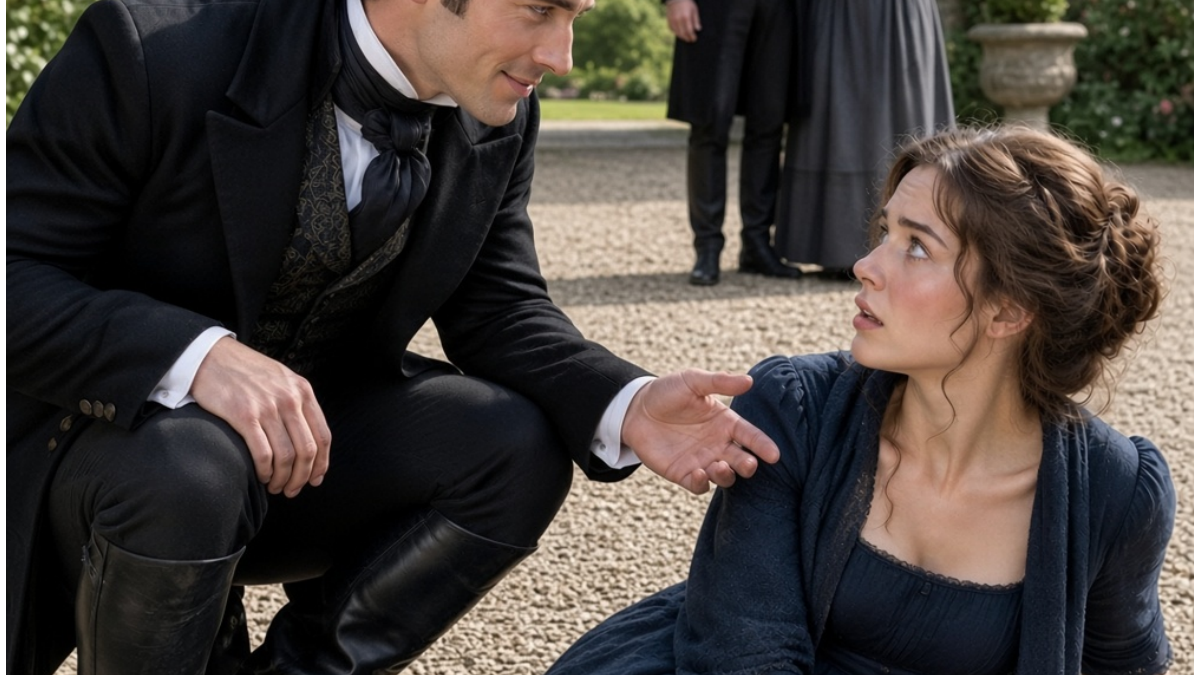
The whole village knew the Duke didn’t smile anymore. They had stopped expecting it. Then a flower dusted baker’s daughter walked across a muddy square and three women nearly fainted at what happened next.
The morning the Duke of Ashkcom smiled, three women fainted. That was not entirely accurate, of course.
Only one woman fainted, Mrs. Pettigrew, the Chandler’s wife, who had a tendency toward dramatics regardless of the occasion.
The other two simply sat down very suddenly on a hay bale and forgot what they had been saying midsentence.
But the effect was the same. The entire market square of Willowmir came to something resembling a halt the way a clock does when the mechanism inside catches on something it was never meant to catch on.
Nobody had seen the Duke of Ashcom smile in 10 years. Not at Christmas. Not at the king’s coronation celebrations.
Not even at the birth of his tenant farmer’s triplets, which had made the whole of Yorkshire laugh for a fortnight.
The Duke had stood at the edge of those celebrations like a tall, beautifully dressed shadow, offering polite nods and measured words, and then disappearing before the music began.
10 years, people had stopped expecting it. Some of the younger village children had genuinely never seen it happen, and had begun to suspect the man was physically incapable of it.
The way certain people are incapable of rolling their tongue or whistling on key. So when it happened quietly, involuntarily over something so small it almost defied explanation, the whole square felt it before they saw it.
Allaric Wentworth, fourth Duke of Ashcom, had come to the harvest charity fair under the thinnest possible pretense.
His estate steward, Mr. Cropton had suggested for the third consecutive year that a ducal appearance at the village fair would do considerable good for tenant morale.
And for the third consecutive year Allaric had very nearly refused. What changed this morning he could not have said.
Perhaps it was the particular quality of the autumn light falling through his bedroom window at 7.
Perhaps it was simply that refusing had grown more exhausting than agreeing. He arrived at 9:00 wearing a dark gray greatcoat with a high collar, a black crevat precisely knotted, and the expression of a man attending his own taxation hearing.
Mr. Crompton walked half a step behind him, as he always did, narrating things did not ask about.
The preserved stall is doing very well this year. Your grace, Mrs. Halloway has entered her dampson jam again.
Won second place at the Harriate Fair last spring, I understand. M and the woolens, if you care to look, are exceptional this season.
Cold winter expected, they say. The farmers are preparing accordingly. M. The square was lively in the way Yorkshire Market squares always were in autumn.
Colorful, loud, faintly smelling of woodsmoke and horse and warm pastry. Stalls lined the cobblestones from the old stone church at one end to the coaching in at the other.
Women in woolen cloaks and sturdy bonnets pressed between the stalls, baskets over their arMs. Children chased one another past the legs of merchants who shouted about their wares with cheerful aggression.
Allaric moved through it as he moved through everything, present in body, somewhere else entirely in mind.
He was studying the display of cured hams without any real interest when the girl with the bread baskets came into his line of sight.
She was not remarkable to look at, not in the way society deemed remarkable. She wore a plain wool dress the color of old mustard, a brown cloak that had been mended at one elbow, and a bonnet that sat slightly crooked on her head, as though she had put it on in a hurry, and decided it was good enough.
She was carrying two large baskets loaded with fresh-baked loaves, one on each arm, moving quickly and purposefully through the crowd in the direction of the far stall.
He would not have noticed her at all, except that she glanced down at precisely the wrong moment.
A wide, muddy patch had spread across the cobblestones near the butter merchant stall, fed by last night’s rain and the general misfortune of a leaking water barrel nearby.
The girl spotted it a half second too late, she pulled her left foot back, shifted her weight to avoid it.
Overcorrected, her right shoulder dipping forward, and then continued on her way with a brief, particular lopsided step that lasted no more than three paces before she writed herself entirely and kept walking.
The bread baskets did not spill. She did not stop. She simply adjusted and continued, her chin lifting very slightly, as though daring anyone to have noticed.
Allaric stopped breathing. The step, that exact motion, the dip of the right shoulder, the overcorrection, the three lopsided paces.
He had seen it 10,000 times in his memory and not once in the waking world since the autumn of 1833.
Eveene had walked that way. Eveene, who had fallen from a horse at 17 and healed imperfectly and never once complained about it.
Eveene, who used to say the crooked step was her body’s way of reminding her to pay attention to where she was going.
Eveene, who had died 11 days before their wedding, something rose in a lar chest that he had no name for.
Not grief, not quite, though. It was built from the same material, and before his mind had any opportunity to weigh it, or restrain it, or bury it the way he had learned to bury everything over a decade of careful practice, the sound came out of him, a soft laugh, barely a sound at all, more like a breath that had forgotten how to be a breath and become something else instead.
But in the particular hush of that particular moment, it was enough. Mr. Croton turned and stared.
The couple beside them turned. The woman at the hamstall looked up and then with the peculiar efficiency of small villages.
The awareness spread outward across the square in ripples, heads turning one after another like a slow, disbelieving wave.
Mrs. Pedigrew sat down on a hay bale. Then she simply toppled sideways, which was when her husband caught her arm, and the word fainted began circulating somewhat generously.
The girl with the bread baskets reached her stall, set down her load, straightened her bonnet, and turned to see why a large portion of the market had gone quiet.
She scanned the square with quick, practical eyes, and found the cluster of staring faces.
Then she found all Alaric. His expression had already closed again. The long habit of 10 years reasserting itself within seconds.
The amusement folding back behind the gray formality that the county had come to accept as simply his face.
But something remained in his eyes that had not been there when he arrived. A loosening, a small involuntary light.
The girls brows drew together with the expression of someone who has just realized they have walked into a room with their skirt tucked into their stocking.
She looked down at herself, found nothing wrong, looked back up. Allaric turned away. He said nothing for the rest of the visit.
He inspected the woolens with the same measured attention he gave to everything and left the square at 11:00 with Mr. Croppton at his elbow, precisely as planned.
But on the drive back to Ashcom Hall, while the carriage moved along the Morland Road and the pale autumn sun sat low and quiet over the heather, he found himself doing something he had not done in years.
He tried to remember exactly what it had looked like, not Evelyn’s step. He had spent 10 years remembering that the girl’s step, the way she had pulled herself back from the mud and continued on with that small, stubborn lift of the chin, as though stumbling was simply information and not something to be ashamed of.
He stared at the moore through the carriage window for a long time. When Ashkcom Hall appeared at the top of the rise, gray and solid against the autumn sky, it looked exactly as it had every other day for a decade.
A great house carefully maintained, a monument to everything he had preserved and nothing he had lived.
He went inside. He did not smile again that day, but something somewhere in the mechanism of him had caught on something it was never meant to catch on, and it did not let go.
Bellamy Bakery, Willre village, Yorkshire. 3 days later, he told himself it was the accounts.
Ashkcom estate had tenants in Willowmir and tenants required periodic inspection of rents repairs and general welfare.
All of which Mr. Croppton handled with perfect competence and had been handling for 11 years without the Duke’s personal involvement.
This detail did not trouble all Alaric as he dressed on Thursday morning called for the carriage and instructed the driver to take him to Willamir by the lower road.
It was the accounts that was all. The bakery occupied a narrow stone building on the quieter end of the high street, wedged between a saddler’s shop and a small lending library, whose window display had not changed since approximately 1829.
A handpainted sign above the door read Bellamy and Sun, bread, pastry, and provisions. Though the lettering on Sun had faded considerably faster than the rest, suggesting the sign had been made with some optimism that had not entirely been rewarded.
A small bell announced his entry. The shop was warm in the way only bakeries are warm.
A deep structural warmth that lived in the walls and the wooden counter, and the smell of the place itself.
Loaves sat cooling on shelves behind the counter. A tray of currant buns occupied the front window.
The whole room smelled of yeast and brown sugar and something faintly spiced that he could not identify.
The girl appeared from the back carrying a cloth wrapped parcel stopped when she saw him and said nothing for a moment with the look of someone rapidly recalibrating their morning.
Up close she was younger than he had estimated. Somewhere near 2 and 20, he thought, with dark eyes that assessed him with uncomfortable directness, and flower across the left side of her jaw that she appeared entirely unaware of.
Your grace, a brief, composed curtsy. No flutter in it. Miss, he realized he did not know her name.
Bellamy. Tamin Bellamy. She set the parcel on the counter. Are you after bread or have you lost something in the village?
The question was not rude. It was simply precise which was somehow worse because he did not have an answer for it that was not embarrassing.
Bread, he said. She looked at him for a moment in the way that people look at something they are not entirely certain is what it appears to be.
We have the farmhouse loaf today and a rye. The rye is better than the rye.
She wrapped it without ceremony, named a price that was exactly what the rye cost and not a penny less, and placed it on the counter he paid it.
And then, because leaving immediately seemed abrupt, and staying required some justification, he nodded at the cooling shelves behind her.
“You baked all of this this morning since 5:00.” She said it the way farmers say it, as simple fact, without any expectation of admiration.
You work alone. My father manages the ovens when his back permits, which is less often than either of us would like.
She leaned on the counter with the ease of someone who owns the ground she stands on, regardless of its square footage.
Your grace didn’t come from Ashcom at this hour for a rye loaf. The directness of it was startling enough that he answered honestly before he considered otherwise.
I saw you at the market fair. I wanted to. He stopped. What did he want to confirm she was a real person and not something his grief had constructed for him out of familiar angles?
I was curious, he finished. Something shifted in her expression. Not softness exactly. More like a door opening an inch to see who had knocked.
Curious about what? The way you walk. The door closed again. I beg your pardon?
He pressed forward. Because stopping now would be worse. You have a particular step when you avoid obstacles.
I’ve only ever seen one other person move that way. He paused. Someone I knew a long time ago.
The explanation landed between them. Tamson studied him with those direct dark eyes, apparently deciding whether this was peculiar, offensive, or simply honeSt. I fell from an apple tree, she said finally.
When I was eight, the ankle healed badly. I don’t notice it anymore. No, he agreed.
You don’t look as though you notice it at all. A pause settled. Outside, a cart horse clattered past the window.
Somewhere in the back room, something shifted on a shelf. “Was it a good memory?”
She asked. “Not gently, not carefully, just straight, the way she seemed to do everything.”
“The person you knew?” The question hit somewhere he was not prepared for. He was quiet for a moment longer than was comfortable.
“Yes,” he said. “It was a good memory.” She nodded as though that was the answer that mattered, and the rest was none of her business.
He picked up the loaf. He should have left then, and he knew it. “The current buns,” he said instead.
“Are those also better than they look?” “For the first time something crossed her face that was almost very nearly a smile.”
“Everything here is better than it looks, your grace.” He stayed another 20 minutes. When he left, the rye loaf was under his arm.
The current buns were in a paper bag, and he had learned that Tams and Bellamy read when the shop was quiet, argued with her father about the price of butter every single Wednesday, and had opinions about Yorkshire weather that she delivered with the confidence of someone who had personally negotiated with it.
He had not thought about Evelyn once. Ashkcom Hall, North Yorkshire, one week later, news in Yorkshire, traveled faster than any male coach.
By the time Alaric returned from his second visit to Willamir, the county had already formed opinions.
This was not unusual. The county formed opinions about the Duke of Ashkcom the way other people formed opinions about weather.
Constantly, confidently, and almost always without adequate information. What was unusual was the particular shape these opinions had taken.
He discovered it at dinner on Friday evening hosted at Ashcom Hall for a small gathering of neighboring families, the Harroves, the Pembres, and Sir Edmund Voss, who ate a great deal and said very little, and was therefore Allaric’s preferred dinner gueSt. The table seated 12.
The candles were lit. The first course arrived. Lady Sabella Hargrove waited until the soup was half finished before she began.
I understand you’ve been visiting Willowmir rather frequently. Aleric, she said his name with the ease of long acquaintance, which she used as a kind of ownership.
Sibella was 41, impeccably dressed, and had been a close friend of the late Lady Fairchild’s family, a connection she referenced often enough that it had long since stopped sounding like grief and started sounding like a deed of property.
“East, it matters,” Allaric said. Of course, she touched her wine glass without lifting it.
The Bellamy Bakery is an estate matter, I suppose. The table’s conversation dimmed slightly in the way that conversations do when something interesting has been introduced, and everyone wants to listen without appearing to listen.
I purchased bread, Aleric said. How remarkably domestic of you. She smiled, the kind of smile that does not involve the eyes.
I only ask because Mrs. Harwick mentioned seeing you there twice in one week. People do notice, you know, particularly given these circumstances.
What circumstances are those? Sella set down her spoon with precise, quiet deliberateness. Only that the girl apparently walks in a way that reminded you of Eveene.
Or so the village seems to believe. A small pause. It’s rather sad if one thinks about it.
The table went fully quiet. Allaric looked at her steadily. Then I’d suggest not thinking about it.
A brief frost settled over the table. Sir Edmund Voose chose this moment to ask for more bread, which broke the tension in the way only a genuinely indifferent appetite can.
The conversation moved on. It always did, but Allaric noticed that it moved the way water moves around a stone.
Redirected, not resolved. After dinner, when the men had separated for port and Sir Edmund had fallen quietly asleep in a chair by the fire, Lord Pembry lowered his voice and said, “Don’t mind, Sibella.
She’s protective of what she considers her territory. She has no territory here,” Alaric said.
Pembry looked at him with the expression of a man who knows better than to argue, but also knows better than to agree.
He sipped his port and said nothing further. Allaric stood at the window afterward, long after the guests had gone, looking out at the dark grounds of Ashcom Hall.
The house was quiet in the particular way large. Underpop populated houses are quiet, not peaceful, but hollow.
Every room filled with furniture and memory, and very little else. He thought about what Sibella had said.
A replacement for Eveene. The words had been dressed politely, but that was the shape of them underneath.
And the more honest part of him, the part he generally kept locked in a room he did not visit, wondered if she was entirely wrong.
He had gone to that bakery because of a walk, a step, a physical echo of a dead woman.
What exactly did he imagine he was doing, he had no answer for it that satisfied him.
What he did not know, because no one told him, and he had no reason to suspect it, was that Sibella’s interest in Tamin Bellamy did not end at the dinner table.
She had sent her lady’s maid to Willowre the following morning under the pretense of purchasing provisions.
The maid returned with two things, a jar of dampson preserves and a thorough account of the Bellamy family’s circumstances.
The father, one Mr. George Bellamy, had inherited the bakery from his own father and run it respectably for 30 years.
No scandal, no debt beyond the ordinary kind. The mother had died when Tamson was 12.
Tamin herself had been briefly engaged at 19 to the son of a local wool merchant.
An engagement that had dissolved quietly without public explanation when the young man’s family relocated to Leeds.
Nothing, in other words, that Sibella could use, not yet. But Sibella Hargrove had not maintained her position in this county for 20 years by waiting for Scandal to arrive fully formed.
She understood with the patience of someone accustomed to playing long games that people always carried something they would rather keep quiet.
The Bellamies were no different. She simply had to find it. Back at Ashkcom Hall, Allaric extinguished his candle at midnight and lay in the dark, staring at the ceiling with the particular wakefulness of a man whose mind has decided without consulting him that it is no longer interested in sleeping.
He was not thinking about Sibella. He was thinking about a girl who argued about butter prices on Wednesdays and read books between customers, and had never once looked at him as though he were anything more complicated than a man who had come in for bread, which was, he realized, extraordinarily rare.
Coastal town of Whitby, North Yorkshire. Several weeks later, the sea had a way of making everything on land feel slightly less permanent.
Allaric had always known this about Whitby. The town clung to its cliffsides with the stubborn practicality of something that had survived long enough to stop worrying about survival.
And the North Sea below it moved with a complete indifference to human schedules, human grief, and human shipping investments, which was precisely why he was here.
Theoretically, his solicitor, Mr. FTH, had written twice about the harbor merchant accounts. Two vessels operating under Ashcom Investment had changed ownership arrangements, and the paperwork required a personal signature that could not be managed by poSt. It was entirely legitimate business.
All had told himself this on the carriage ride from Ashcom, and again while checking into the king’s head in on the high street, and again while unpacking his traveling case on Tuesday evening.
He was thinking about none of it on Wednesday morning when he walked down the harbor steps and saw Tamin Bellamy arguing with a fish merchant.
She was standing at the edge of the lower quayside, a list of some kind in her hand, speaking to a red-faced man in a leather apron with the measured firmness of someone who has made their three times already, and is considering whether a fourth is worth the effort.
Beside her stood an older man, shorter, broad-shouldered, with her same dark eyes and the weathered look of someone who had spent a lifetime near Ovens, who appeared to be leaving the arguing entirely to his daughter.
All Alaric stopped on the harbor steps. She had not seen him. He had therefore a choice.
He kept walking. Miss Bellamy, she turned. The surprise on her face was genuine and unguarded, lasting approximately 2 seconds before composure replaced it.
Your grace. A glance at the harbor around them as though confirming they were both actually in Whitby and this was not some elaborate misunderstanding.
Are you inspecting fisheries now? Chipping investments? He nodded toward the merchant behind her. Trouble?
He’s charging my father shillings above the agreed rate for the December flower delivery on account of what was it?
She turned briefly to the merchant. Harbor storage fees,” the man said, “with the defensive air of someone who has invented something on the spot and is now committed to it.”
“Harbor storage fees,” Tamin repeated, turning back to Allaric with her eyebrows raised slightly, as though presenting evidence.
Allaric looked at the merchant. He did not say anything particular. He simply looked, in the way that dukes occasionally look at people when they want something to stop happening.
The merchant revised the rate in under 30 seconds. Tamson watched this with an expression that was somewhere between appreciation and mild, irritation at how simple it had been.
“Thank you,” she said when the merchant had retreated. “It was nothing. It was four shillings,” she folded her liSt. “Your grace, this is my father, Mr. George Bellamy.”
The older man shook his hand with a firm, honest grip and the straightforward manner of someone who treats all men the same, regardless of their title, which Allaric found immediately agreeable.
They encountered each other again that same afternoon, entirely by accident on the cliff path above the abbey ruins.
Tamson was walking alone. Her father had gone to rest at their lodgings after the harbor negotiations, she explained, which had started 2 hours before the fish merchant business, and had been considerably less resolved.
She walked with her cloak pulled close against the sea wind, her bonnet strings loose, looking out at the gray water below with the expression of someone who does not get to stand still very often, and is making deliberate use of the opportunity.
Allaric fell into step beside her without quite deciding to. They walked for a while without speaking, which was something he noticed.
That silence with her did not require filling. Most people went silent in his company, grew visibly uncomfortable within minutes, and began talking about the weather or his estate or the latest news from London.
Tamson simply walked and looked at the sea, and seemed to find the quiet perfectly adequate.
“Do you ever leave Yorkshire?” He asked eventually. I haven’t yet. She glanced at him sideways.
You say that as though it’s a deficit. I say it as a question, she considered.
My mother wanted to see Edinburgh. She used to describe it like she’d already been there.
The castle, the closes, the way the whole city sits on top of itself. A brief pause.
She never went. So I suppose I’d go there first when the time comes. For her more than me, he said nothing.
The wind moved across the cliff grass. Did you love her very much?” She asked.
Lady Fairchild. The question arrived without warning, the way Tamzin’s questions always did. Not cruy, not carefully, just directly, as though she saw no reason to approach things sideways.
“Yes,” he said. “Is that why you’ve kept everyone at such a careful distance all this time?”
He looked at her. She was watching the sea, not him, which made answering somehow easier.
“I thought it was loyalty,” he said. For a long time, I thought that’s what it was.
And now the abbey ruins stood dark against the pale sky ahead of them. Below the sea shifted and withdrew and shifted again.
Now I’m less certain,” he said quietly. Taming nodded as though that was not an ending, but a beginning.
They kept walking. Ashcom Hall, North Yorkshire. Late autumn, the invitation had come formally, as all things did at Ashkcom Hall.
A tenants celebration held annually in the last week of October when the harvest was in and the accounts were settled and the estate traditionally opened its lower rooms to the families who worked its land.
It was one of the few occasions where the hall’s vast dining room and adjoining gallery were genuinely full, where fires burned in every great and the smell of roasting meat reached the upper corridors.
Tamin came because Mrs. Hartley, the miller’s wife, had insisted on it with a particular insistence of a woman who considers social attendance a moral obligation.
The Bellamsey supplied bread to half the tenant families. They belonged, Mrs. Hartley argued, and Tamson’s father agreed, and so the matter was settled before Tamson had formed a full opinion about it.
She arrived in her best dress, a deep green wool with a cream collar, carefully pressed, and spent the first hour doing what she always did at gatherings, making herself useful.
She helped carry platters, entertained the miller’s youngest children, and talked with the older tenants about the coming winter with the practical ease of someone who has never found small talk.
Small Alaric was present, but occupied. Estate business had a way of expanding to fill every available hour of a tenants’s evening.
A drainage dispute here, a roof repair request there, and she caught only glimpses of him across the crowded room, a nod when their eyes met.
Nothing more. It was during the second hour when the children had been collected by their mothers and the older guests had settled into their conversations with the comfortable permanence of people intending to stay that Tamzin slipped away.
She had not meant to explore. She had been looking for the retiring room and taken a wrong corridor, and by the time she realized it, she was standing in a long gallery that ran the full length of the hall’s east wing, lit by wall sconces that had been turned low for the evening.
The portraits watched her from both sides. Generations of Wentworths lined the walls in heavy guilt frames.
Men in military dress, women in silk and powder, children who stared out from their painted backgrounds with the slightly glazed expressions of people who had been sitting very still for a very long time.
Allaric’s father, his grandfather, a great uncle in Admiral’s uniform, who looked as though he had personally argued with the sea and won.
She walked slowly, reading the small brass plates beneath each frame, until she reached the far end of the gallery.
The portrait there was newer than the others. The paint had not yet acquired the amber tint that age gave to oil, and the frame, though handsome, lacked the elaborate carving of the older pieces.
It had been hung slightly apart from the family portraits, as though someone had placed it with care rather than convention.
A young woman, pale complexion, fair hair, a composed expression that suggested intelligence without advertising it.
She was painted in a rosecolored dress, seated with one hand resting in her lap and her gaze directed somewhere slightly past the painters’s left shoulder.
Not evasively, but thoughtfully, as though she was listening to something the rest of the room could not hear.
Beneath the frame, a brass plate. Lady Eveene Fairchild 1815 1833. Tamin stood very still.
She studied the portrait with the quiet attention she gave to things that mattered. The face was nothing like her own.
She knew that immediately and without vanity. Different coloring, different features, a different kind of beauty altogether.
Whatever resemblance Allaric had imagined at the market fair lived nowhere in this face. Then her eyes moved to the small notations on the mounted card beside the frame.
A brief description added in careful copper plate, the kind that cataloged details for estate records, height, coloring, notable characteristics, one line near the bottom.
Walked with a slight favoring of the right side following an equestrian injury. 1830. Tamin read it twice.
She thought about the market square, the mud patch, the way a Leric had frozen midstep across the cobblestones, with an expression she had not been able to interpret at the time, but could.
Now, standing in this gallery with perfect clarity, name without any difficulty at all. She had not reminded him of a person.
She had reminded him of a wound. Every conversation in the bakery, the cliff path at Whitby, the afternoons that had accumulated between them over the past weeks with a naturalenness she had trusted because it had felt genuine.
She ran it all back through her mind now with the cold, precise eye of someone checking figures that may not add up.
He was kind. She did not doubt that he was intelligent and honest and had never once treated her as anything less than a person worth speaking to.
But she was at the very beginning a reflection. And a reflection, however warm the light that created it, was not the same thing as being seen.
She turned from the portrait and walked back down the gallery the way she had come.
Her footsteps quiet on the stone floor. When she reached the main room, she collected her cloak from the hook by the door, found Mrs. Hartley, and said she had developed a headache.
Mrs. Hartley pressed her hand sympathetically and asked twice if she needed the cart. She did not.
She walked home through the cold October dark without looking back at the hall. Behind her through the lit windows, she could hear the celebration continuing.
Inside, Allaric turned from a conversation with his steward, looked toward the door, and found the space where she had been standing quietly, completely empty.
Willomeir village and surrounding Yorkshire. Winter December arrived in Yorkshire the way it always did without apology.
The moors turned gray and then white. The roads hardened overnight into uneven ridges of frozen mud.
And the village pulled itself inward the way villages do in winter. Doors shut earlier, curtains drawn thicker, the spaces between houses feeling longer and colder than they had in October.
Tamin worked. That was what she did with things she could not resolve. She worked.
The bakery opened at 5 regardless of weather. The ovens needed feeding regardless of mood, and bread required the same attention in December that it required in September.
She found comfort in this. The routine was honeSt. It asked nothing complicated of her.
She declined the first invitation from Ashcom Hall without particular ceremony. A gathering of tenant families for Advent.
A perfectly ordinary occasion. She sent a polite note citing her father’s health, which was partially true.
His back had worsened with the cold, and the bakery genuinely needed her full attention.
The second invitation she declined without explanation at all, which was less polite, but more honeSt. All did not appear at the bakery.
She was not certain whether this relieved her or troubled her, and she distrusted herself enough on the subject to avoid examining it too closely.
Instead, she made bread, argued with the butter supplier, read by candle light after closing, and told herself that clarity was better than comfort, which was true, and also some mornings very difficult to believe.
It was Mrs. Hartley, who told her about the rumors with the reluctant expression of someone delivering news they wish they did not have.
They were standing in the bakery on a Tuesday morning in the second week of December.
The miller’s wife ostensibly purchasing her weekly loaf and actually communicating something she had been building toward since she walked through the door.
“People are talking,” Mrs. Hartley said finally, setting down her coin with a particular deliberateness.
People always talk, Tamson said, about you specifically. A pause. Lady Hargrove has been saying things at the Pembres’s dinner last week, apparently, and at the Voss gathering before that.
She smoothed her gloves unnecessarily. That you’ve been pursuing the Duke’s attention, deliberately, for the advantage of the bakery.
The bread knife in Tamzin’s hand continued its work for a moment before she set it down.
Has she? I thought you should know. Mrs. Hartley’s voice was genuinely sorry. Two families canled their standing orders this week.
The Ashworths and the Caldwells. Their housekeeper toe told mine it was on account of not wishing to associate with I’m sorry, Tamson.
I truly am. After Mrs. Hartley left, Tamson stood behind the counter for a long time without moving.
Her father did not know yet. He would hear it eventually. Villages ensured that. And when he did, it would hurt him in the particular way that injustices hurt people who have spent their whole lives being straightforward in a world that frequently is not.
30 years of honest trade, a reputation built loaf by loaf across three decades. She thought about all.
She thought about the portrait gallery. She thought about how a woman she had never spoken to had apparently been watching her with the patience of someone who had decided on an outcome and was simply waiting for the right moment to arrange it.
Clarity, she reminded herself. She turned back to the ovens. Allaric found out on a Thursday.
It came from an unexpected direction. Young Thomas Cropton, the steward’s nephew, who worked the estate’s northern accounts and had been at the Voss gathering as a junior guest, and had the decency to be bothered enough by what he’d heard to mention it.
He stood in Allaric study, and delivered the account with the careful accuracy of someone repeating words they found distasteful, which Allaric appreciated.
When Thomas left, Allaric sat at his desk for approximately 4 minutes. Then he called for his horse.
He did not go to Willamir. Not immediately. He rode instead to Harrove House, which sat 5 miles east of Ashcom across a stretch of Morland that was currently buried under 6 in of snow.
And he rode it at a pace that suggested he was not particularly concerned about the conditions.
Sibella received him in her drawing room with the composed expression of someone who had considered this possibility and prepared for it.
He did not sit. “Whatever you imagine you’re protecting,” he said without introduction. “I wanted to stop.”
She looked up at him with careful eyes. “I’ve only been honest about what people have observed.
You’ve been dishonest about what you’ve invented.” His voice was quiet, which was worse than if it had been loud.
The Bellamies are tenants of this county and people of good standing, and you have used your position to damage them for no reason beyond your own intereSt. It will stop today.
Sibella’s composure held, but something behind it shifted. You’ll embarrass yourself, she said. Defending a baker’s daughter against I defended far less worthy things for far worse reasons during the years I spent obliging this county’s expectations of me.
He picked up his gloves from the table. I won’t do it anymore. He left before she could answer.
On Sunday at the morning service in Willamir’s parish church, he stood with the tenant families rather than in the reserved family pew.
He spoke with George Bellamy for a quarter of an hour in plain sight of everyone present.
He did not see Tamzin, but the canceled orders came back the following week. Both of them parish church of St. Jude, More Haven Village, Yorkshire Midwinter.
The church had been there since the 14th century and looked at Saint Judes sat at the far end of Mohaven, a smaller village than Willowmir, 3 mi north across the Moore, with a permanent, slightly exhausted expression of a building that has weathered more than its share of Yorkshire winters, and formed no particular opinions about any of them.
Its interior smelled of cold stone and old wood, and the faint residue of decades of tallow candles.
The stained glass in the east window had a crack in the lower left corner that had been there since 1791 and would likely be there in 1891.
Reverend Oswin had been its incumbent for 32 years. He was a small precise man of 67 who cataloged everything.
Sermon notes, parish records, correspondence, accounts, the dimensions of the vegetable garden, the dates on which the swallows arrived each spring.
His vestri contained more ordered paperwork than most solicitors offices, arranged in boxes by decade, labeled in his small exact hand.
He had written to Alaric in November requesting help with a particular project. The organization and transcription of parish records dating back to the 1780s, some of which had suffered water damage during a roof leak the previous winter.
A local historian had expressed interest in the older documents, and Oswin, whose eyesight had deteriorated enough to make close work difficult, needed younger eyes, allaric had agreed.
He was not entirely certain why, except that the work was quiet and required concentration, and concentration had been useful to him lately, as a method of keeping his mind from circling the same territory repeatedly.
He had been coming to St. Judes on Wednesday mornings for 3 weeks. It was the 3rd Wednesday of December when he found it.
He was working through a box labeled 1830 1835, transferring water damaged documents onto fresh paper with a careful hand when his fingers found an envelope that had been slipped between two ledger pages and apparently forgotten there.
The paper had yellowed and the edges had softened with age, but it had been protected enough by the ledgers on either side to remain intact.
It was addressed in a hand he recognized before he had consciously registered recognizing it.
The letters were slightly uneven. She had always pressed her hard on the downstrokes, and the ink had faded to a pale brown, but the hand was unmistakable the way certain things are unmistakable.
Your own name in a mirror, the sound of a particular voice in a crowd for a lyric if he should need it.
He sat very still for a moment. Outside the wind pushed against the old church walls with a low, steady persistence, he opened it.
The letter was two pages. She had written it in October of 1833, 6 weeks before her death, before the fever that had arrived without warning, and moved with a speed that no physician in the county had been equipped to slow.
She could not have known when she wrote it that the precaution would be needed so soon.
She had written it anyway. He read it once quickly, the way you read something when you are not certain you are ready for it, but cannot stop yourself.
Then he sat with it in his hands for a long time. She had written about the autumn light.
She had written about the garden at her family’s house in Suffukk and about a particular piece of music she wanted played at their wedding and about the color she had finally decided on for the upstairs sitting room at Ashkcom Hall.
And then toward the end of the second page she had written this. I know you know what you will do if something happens to me before I am your wife and you are my husband.
You will make a monument of it. You will be faithful to the grief the way other men are faithful to a cause.
Because you have always confused endurance with love. I am asking you now while I am here and well and can say it plainly.
Do not do that. Whatever happiness finds you after me, take it. Not for my sake, not to honor what we had.
Simply because you deserve to be alive in the way I know you are capable of being alive.
And grief, however true, is not the same thing as living. Be happy, you stubborn man.
I am asking you sincerely. He folded the letter carefully along its original creases. He placed it on the vest table.
He looked at the cracked east window for a very long time. 10 years. He had spent 10 years believing that loyalty to Eveene meant preserving the wound she had left.
That moving forward was a kind of betrayal. That the grief was the last remaining evidence of how much she had mattered.
And releasing it meant releasing her. She had known he would do exactly that. She had known it well enough to write him a letter about it 6 weeks before she died.
The understanding of what he had wasted settled over him with a weight that was neither sharp nor sudden.
It was the slow, heavy recognition of someone who has been carrying something in the wrong direction for a very long time and has only now looked up and taken account of where they are.
He was 41 years old. He had spent a quarter of his life grieving a woman who had explicitly in writing asked him not to.
Reverend Oswin appeared in the Vestri doorway at 11 with two cups of tea, looked at a Laric’s face, and set both cups on the table without saying anything.
He sat in the opposite chair, folded his hands, and waited with the patience of someone who has been in the presence of human grief long enough to know that some things do not require commentary.
After a while, Allaric picked up his tea. “She knew me very well,” he said quietly.
Oswin nodded. “The good ones usually do.” “Hargrove house, Durham.” Late winter, the Hargrove Winter Ball was the kind of event that the county’s social calendar organized itself around.
It had run annually for 23 years, surviving two wars, one particularly bad harvest, and the death of Lord Hargrove Senior, after which Sibella had simply assumed sole responsibility for it, without anyone formally asking her to, and without anyone formally objecting.
The ballroom at Harof House held 200 guests comfortably, and had held 240 on one memorable occasion in 1839.
The chandeliers were genuine Venetian glass. The orchestra came from York. The supper was the kind that people described to those who had not attended with a detail that bordered on unkind.
Invitations were considered in certain circles a form of currency. Tamson had not expected one.
It arrived on a Wednesday morning in a cream envelope with the Harrove seal pressed in red wax addressed in a formal copper plate hand to Miss T.
Bellamy and Mr. G. Bellamy as though they attended such events regularly, as though their presence at the grandest ball of the Durham season was a perfectly unremarkable expectation.
Her father held the envelope for a long time after she read it aloud. “That’s unusual,” he said finally.
“Yes,” Tamson agreed. “Are you going?” She looked at the invitation again. Something about the timing of it.
Arriving so soon after the canceled orders had been quietly reinstated after Allaric’s very visible appearance in the tenant pew at Sunday service felt less like a social courtesy and more like a chess move on a board.
She had not agreed to sit at. I think she said slowly that someone wants me there.
Her father considered this. Is that a reason to go or a reason not to?
She set the envelope on the counter. I haven’t decided yet, she went. She told herself it was because her father wanted her to, which was partially true.
She told herself it was because declining would appear cowardly, which was also partially true.
She did not examine the remaining portion of her reasoning too closely. She wore her mother’s garnets and a gown she had altered herself from a deep blue silk bought at the Harriut market two years prior and never used.
It fit well. She knew it fit well. She was not going to Harrove House to be impressive, but she saw no reason to arrive otherwise.
The ballroom was everything she had expected and slightly more. Light fractured through the Venetian chandeliers across 200 guests in their finest dress.
The orchestra was already into its second set, and the air carried the competing scents of beeswax, expensive perfume, and roasting meat from the supper rooms beyond.
Tamson stayed close to her father for the first hour they ate. They were introduced to several people who were perfectly civil and one who wasn’t.
And Tamson smiled at the one who wasn’t with the particular smile she reserved for people who needed to believe they had not rattled her.
She saw Allaric across the room at 9. He was speaking with Sir Edmund Voss who was eating something and Lord Pembrey who was listening to whatever Allaric was saying with the expression of a man being told something he had already suspected.
Allaric looked up found her immediately as though he had known exactly where she was in the room.
She looked away firSt. Sibella moved at 11:00 when the supper had been cleared and the dancing had resumed and the champagne had been in circulation long enough to loosen both conversation and judgment.
She approached Tamson in the company of two other women, Lady Ashworth and a Mrs. Caldwell, whose husband had briefly cancelled the bakery order in December with the smooth practiced ease of someone who has planned the geometry of an encounter in advance.
Miss Bellamy. The warmth in her voice was architectural, constructed entirely for the room. How brave of you to come.
I do admire a certain confidence in one’s circumstances. The two women beside her adjusted their expressions accordingly.
Tamin looked at Sibella with the clear, unhurried attention she gave to things she was assessing.
“Thank you for the invitation,” she said simply. “Of course,” Sibella tilted her head. Though I confess one does wonder at the wisdom of attachments that exist so far outside one’s natural sphere.
For both parties, it can only end in a particular kind of embarrassment, don’t you think?
The room nearby had gone quiet in the way rooms go quiet when they are, paying close attention and pretending not to.
Tamson said nothing. She did not have to. I think, said Alic from directly behind Sibella, that this conversation has reached its conclusion.
Sibella turned. Whatever she had prepared to say reorganized itself rapidly behind her eyes. He was looking at Tamson, not at her.
Miss Bellamy’s character exceeds that of a considerable number of people in this room tonight.
His voice was unhurried and perfectly clear, not loud. The room was simply very quiet.
Her family has served this county honestly for three decades. Any suggestion otherwise reflects the speaker rather than the subject.
A silence that had genuine weight in it. Then he said to Tamson directly and only to her, “I noticed you first because of a memory, a walk across a muddy square and a moment I was unprepared for a pause.
That is where it began. It is not where it is now.” He held her gaze steadily.
I love you because you are Tamin Bellamy. That is the entire truth of it.
200 people heard him say it. Tamin looked at him for a long moment, searching honest the way she looked at everything.
Then something in her face that had been carefully, sensibly held in reserve for months simply let go.
That, she said quietly, is the first time I have entirely believed you. Rosemir Gardens, Ashcom Estate, Yorkshire.
Early Spring came to Yorkshire like an apology. Tentatively at first, a softening in the air on certain mornings, a particular quality of light that had been absent since October, snow drops pushing through the frost hardened ground along the estate’s lower paths, as though testing whether the world had become safe enough to re-enter.
Then, with more conviction, the moors greened, the hedgeros filled. The sky over Ashcom lifted from its flat winter gray into something deeper and less certain.
The kind of blue that makes people stop mid task and look upward without entirely meaning to.
Ashcom Hall itself seemed to notice. The windows had been opened for the first time since autumn.
The heavier curtains had come down. Mrs. Plum, the housekeeper, had undertaken a cleaning of the east wing with the focused energy of a woman who had been waiting for permission to disturb the dust for several months, and the whole house smelled differently, aired out, lighter, less like a place where time had been stored carefully, and more like a place where people actually lived.
The garden fate had been allaric’s idea. This surprised Mr. Cropton considerably. In 11 years of service, the steward had suggested the fate four times and been declined four times with the same measured courtesy.
This year, Allaric had proposed it himself. In February, before the snow had fully retreated, with the practical decisiveness of a man who has made up his mind about something, and is simply managing the logistics, it was to be a charitable occasion, proceeds toward the repair of St. Jude’s roof, which had been leaking intermittently since the previous winter, and which Reverend Oswin had been too quietly dignified to make a fuss about.
The tenant families were invited. The village was invited. The neighboring gentry received cards, most of which were accepted with the elacrity of people who had been curious about Ashcom Hall’s interior atmosphere since the winter ball, and were hoping the spring air would make things clearer.
Tamson came with her father. She wore a pale gray dress with a white collar, and her hair was dressed more carefully than she usually bothered with, and she arrived at the garden gate at 11:00 with the straightforward composure of someone who has decided to stop being cautious about something, and is now simply getting on with it.
The gardens were full. Long tables had been set across the lower lawn, dressed in white linen, waited at the corners against the light spring wind.
Children ran along the gravel path between the box hedges. The tenants gathered in comfortable clusters with the ease of people on familiar ground, and somewhere near the rose arbor, a quartet played something that reached the far end of the garden only in snatches carried by the wind.
Rosemir garden itself occupied the estate’s south-facing slope. Terrace, old, planted in the formal style of an earlier century, but softened now by decades of imperfect maintenance into something less rigid and more lovely.
The roses were not yet in bloom, only the first tight buds showing at the tips of the canes, but the wisteria along the stone walls had broken into early purple, and the whole space smelled of earth and green things waking up.
Allaric found her near the upper terrace, standing at the stone ballastrade and looking out over the lower gardens with the quiet attention she gave to things she was genuinely interested in.
It’s beautiful, she said before he had spoken. My grandmother planted most of it. He stood beside her.
She said formal gardens were for people who were frightened of wildness. So she planted formal beds and then let them do as they pleased.
Tamin smiled at that. They stood for a moment in the easy quiet that had always existed between them, more comfortable now than it had ever been, the residue of winter’s difficulties having burned away somewhere between February and March, and left something cleaner behind.
I want to tell you something about this garden, Eric said. She turned. His expression had the particular quality of a man who has rehearsed something and then decided to abandon the rehearsed version entirely.
I proposed to Eveene here 22 years ago at the end of this terrace. He said it without drama, the way he now said most things about her plainly without the careful packaging of grief.
She said yes immediately and then told me the ring was slightly too large and I ought to have checked beforehand.
Tamin’s mouth curved. She sounds practical. She was considerably more than I was. He looked at the garden.
I brought you here deliberately, not to revisit that. I want this place to mean something else now.
Something that belongs to the present rather than the paSt. He turned to face her fully.
I spent 10 years maintaining a grief that Eveene herself in writing asked me not to maintain.
I wasted a great deal of time being faithful to an idea of loss rather than faithful to the actual business of living.
His voice was steady and direct without performance. You did not let me confuse you for a memory.
You walked away when it would have been easier to stay, which is the most honest thing anyone has done for me in more years than I care to count.
Tamin watched him with her clear, unhurried eyes, Tamzen Bellamy. He reached into his coat and produced a ring, plain gold, a single deep red stone, nothing extravagant, and held it with the unceremonious straightforwardness of a man who has decided the occasion needs.
Honesty more than theater. Will you marry me? Not a flourish, not a performance, just the question offered plainly, like bread across bakery counter.
She looked at the ring for a moment. Then she looked at him at the face that had spent a decade closed and had been opening gradually and with some difficulty, like the wisteria along these old stone walls.
“Yes,” she said. “Obviously, yes,” he laughed. A real one, full and unguarded, the kind that had been missing from Ashcom Hall for a decade, and the sound of it carried down across the terraces toward the crowded lower lawn, where several people looked up and smiled without knowing why.
Tamson took the ring. It fit exactly. She noticed this and said nothing about it.
Below them, the fate continued in the warm spring afternoon. George Bellamy was laughing at something Mr. Croton had said.
Reverend Oswin was drinking tea with the focused satisfaction of a man whose church roof was about to be repaired.
The children were still running along the gravel paths. The quartet played on. Allaric looked at the garden at the wisteria and the early budding roses and the long terrace lawns full of living unquiet entirely impermanent human happiness and felt for the first time in more than 10 years that Ashcom Hall was not a monument to anything at all.
It was simply home. And standing beside him straightening the ring on her finger with the practical attention of someone already deciding whether it required resizing was the woman who had made it that not by resembling someone else by being entirely stubbornly wonderfully herself.
Off.








