The Moment a Royal Guard Refused Camilla’s Command to Remove Catherine’s Portrait | Best Royal Story
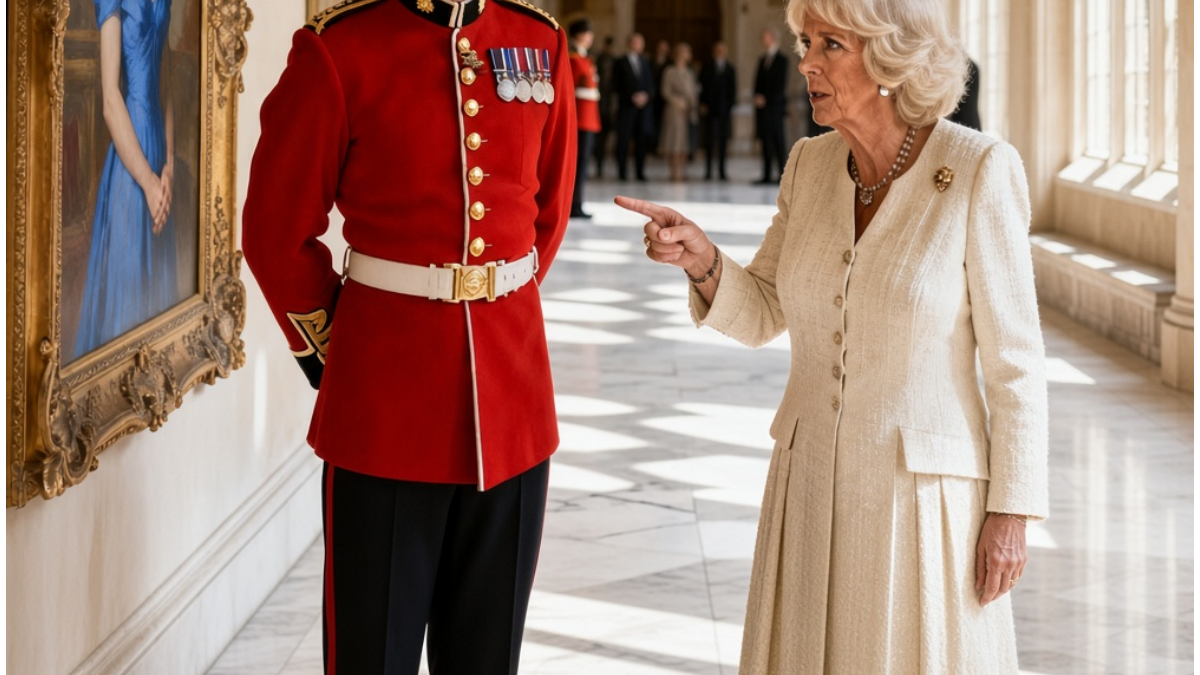
The silence in the corridor was the kind that made hearts race. It was early morning at Windsor Castle, the kind of morning where fog still clung to the windows and the staff moved quietly through hallways lined with centuries of history.
But on this particular day, something was different, something that would test the loyalty of one man in a way no royal protocol could prepare him for.
Sergeant James Thornton had served the royal family for 17 years. His uniform was always pressed, his posture always perfect.
He was the kind of guard who believed in duty above all else, the kind who never questioned orders.
Until today, he stood at attention outside the East Gallery where portraits of royal family members hung in gilded frames.
The morning light filtered through tall windows, casting long shadows across marble floors. Everything seemed normal, peaceful even.
Then he heard footsteps. They were deliberate, purposeful. The click of heels echoed through the corridor, growing louder with each second.
Sergeant Thornton didn’t move. He kept his eyes forward, his hands clasped behind his back.
That’s what guards do. They remain still. They remain silent. But when the figure rounded the corner, his jaw tightened just slightly.
It was Queen Camila. She walked with authority, flanked by two palace officials. Her expression was unreadable, but there was something in her eyes, something Thornton had seen before in people who had made up their minds about something difficult.
Camila stopped just a few feet from him. She didn’t acknowledge him at firSt. Instead, her gaze moved past him, settling on something behind his shoulder.
Thornon knew exactly what she was looking at. The portrait, it hung there on the wall, illuminated by a shaft of morning light.
Princess Catherine. The painting captured her in a moment of grace, wearing a deep blue gown, her smile warm and genuine.
It had been commissioned just two years earlier when things were different. When the family dynamics were different.
Sergeant Thornton. Camila’s voice cut through the silence. Your Majesty, he bowed his head slightly.
Still at attention. I need you to remove that portrait. Her words were calm but firm.
Not a request, a command. For the first time in 17 years, Sergeant Thornton felt his loyalty split in two directions.
The officials behind Camila shifted uncomfortably. They knew what this portrait represented. They knew why it hung here.
And they knew that removing it would send a message that would ripple through the entire palace.
Thornton’s mind raced. He thought of his oath, his duty to serve the crown, but he also thought of the day that portrait was hung.
He remembered Princess Catherine standing right here in this very spot, laughing with the artist, making everyone feel at ease.
He remembered the grace she showed to every person who worked in these halls. “Your Majesty,” he began, his voice steady despite the storm inside him.
“I’m afraid I cannot do that.” The air seemed to freeze. Camila’s eyes widened just barely.
The officials behind her exchanged glances. In the history of the royal guard, refusing a direct order from the queen was unheard of.
It was grounds for immediate dismissal, perhaps worse. But Thornon stood firm. What happened next would become the most talked about moment in palace history.
A moment that would reveal depths of loyalty, tradition, and courage that no one expected from a man whose job was simply to stand and guard.
Camila took one step closer to him, her voice dropping lower. Sergeant, I don’t think you understand what I’m asking.
With respect, your majesty, I understand perfectly. The tension in that corridor could have shattered glass.
One of the officials stepped forward, his face flushed. Sergeant Thornon, you’re speaking to her majesty, the queen.
This is insubordination. Thornton didn’t look at the official. His eyes remained fixed straight ahead, though he could feel Camila’s gaze burning into him.
I mean, no disrespect, Thornton said carefully. But this portrait was placed here under direct orders from his majesty, King Charles.
Only he has the authority to have it removed. It was true. Everyone in the room knew it.
The portrait had been hung by the king’s command. A gesture of solidarity during a difficult time for Catherine.
To remove it without his knowledge would be to undermine him. Camila’s expression shifted. Something flickered across her face.
“Was it frustration, embarrassment, or perhaps something deeper? Something that looked almost like pain.” “The king is away,” she said quietly.
He won’t return until next week, and perhaps this matter should wait until his return, your majesty.”
The second official, an older woman with silver hair, whispered something into Camila’s ear. The queen’s jaw clenched.
For a moment, it seemed like she might turn and walk away. But she didn’t.
“You’ve served this family for how long, Sergeant?” Camila asked. “17 years, ma’am.” “17 years.
And in all that time, have you ever refused an order? No, ma’am. Then why now?
Her voice carried genuine confusion, maybe even hurt. Why this portrait? Why her? The question hung in the air like smoke.
Thornton took a breath. This was the moment. He could back down, apologize, follow orders, and keep his position, his pension, his reputation, or he could speak the truth that was burning in his cheSt. Because removing it would be wrong.
Your majesty. The words fell like stones. The officials looked horrified. This wasn’t just refusal now.
This was judgment. A guard was passing judgment on the queen’s decision, but Camila didn’t explode in anger.
She didn’t shout or threaten. Instead, she did something unexpected. She looked at the portrait again.
Really looked at it, and her shoulders sagged just slightly. You think I want to do this?
Her voice was barely above a whisper. “You think this is easy for me?” For the first time, Thornton saw past the crown and the title.
He saw a woman caught in an impossible situation. “A woman trying to establish her place in a family that had never fully accepted her.
A woman fighting battles he couldn’t fully understand. “I believe you’re in a difficult position, ma’am,” he said, his tone softer now.
“But so is the princess. And that portrait represents something important to the people who work here.
It represents kindness. Camila’s head turned sharply. Kindness? Yes, ma’am. Princess Catherine has never walked past a staff member without acknowledging them.
She knows our names. Our children’s names. When my daughter was sick last year, she sent flowers to the hospital.
He paused. That portrait isn’t just paint and canvas. It’s a reminder of what this family can be.
The older official tried to interrupt. Sergeant, that’s quite enough. No. Camila raised her hand.
Let him finish. Thornon swallowed hard. He had gone this far. There was no turning back.
Now the staff talk. Ma’am, they see things. They know about the tensions, the disagreements, the press coverage, and they’re watching to see what happens next.
If this portrait comes down without the king’s approval, it sends a message. A message that kindness and grace can be erased when they become inconvenient.
Silence. The kind of silence that feels like the world has stopped spinning. Camila stared at him for what felt like an eternity.
Her eyes were glistening though, whether from anger or tears. Thornton couldn’t tell. Have a lot of courage, Sergeant, she finally said.
Or a lot of foolishness. I haven’t decided which. She turned to leave, her officials scrambling to follow.
But before she rounded the corner, she stopped. Without looking back, she spoke one more time.
The portrait stays for now. Then she was gone. Thornton remained at his post, his heart pounding so hard he thought it might burst through his uniform.
His hands were shaking. He had just defied the queen. He had spoken truths that could cost him everything.
But the portrait still hung on the wall as the morning light grew stronger. Illuminating Catherine’s painted smile.
Thornton wondered what would happen when the king returned. Would he be praised for his loyalty or punished for his insulence?
He didn’t know. But what he did know was that word of this confrontation would spread through the palace like wildfire.
And by nightfall, everyone would be talking about the guard who said no. By noon, the entire palace staff knew what had happened.
Kitchen workers whispered about it over lunch preparation. Housekeepers paused in hallways to discuss it in hushed tones.
Even the groundskeepers working outside in the cold had heard the story. A royal guard had refused a direct order from the queen herself for Sergeant Thornton.
The hours that followed were the longest of his life. He remained at his post as protocol demanded, but he could feel the eyes on him.
Staff members walking past would glance at him with expressions he couldn’t quite read. Some looked worried, others looked impressed.
A few even nodded slightly as they passed, a gesture of silent support. But support wouldn’t protect him from the consequences.
At 2:00, commanding officer arrived. Colonel Davies was a stern man with silver hair and a face that rarely showed emotion.
He had served the royal family even longer than Thornton. He knew every rule, every protocol, every line that should never be crossed.
Sergeant Davies said, his voice clipped and professional. A word. They stepped into a nearby anti room.
The door closed with a heavy click. For a moment, neither man spoke. Thornton stood at attention, waiting for the reprimand he knew was coming.
I heard about this morning, Davies began. I heard what you did. Yes, sir. You understand the position you’ve put yourself in?
The position you’ve put this entire guard unit in? I do, sir. Davey circled him slowly the way he had done during training exercises years ago.
Then perhaps you can explain to me why a decorated sergeant with 17 years of exemplary service would suddenly decide to throw it all away.
E. Thornton kept his eyes forward. I didn’t believe I was throwing anything away, sir.
I believed I was upholding my duty. Your duty is to obey orders from the royal family.
Duty is to serve the crown, sir. And that portrait was placed by his majesty, the king, to remove it at someone else’s requeSt. Even the queens would undermine his authority.
Davyy stopped pacing. He stepped in front of Thornon, studying his face. For several long seconds, he said nothing.
Then, surprisingly, his expressions softened. You know what the hardest part about this job is, Sergeant?
Davies asked quietly. “It’s knowing when to follow the rules and when to follow your conscience.
Most days they’re the same thing. But on the days they’re not,” he trailed off.
“Am I being relieved of duty, sir?” Davey sighed. “That’s not my decision to make.
But I will tell you this. What you did this morning took more courage than standing guard for 17 years.
Whether it was the right kind of courage or the foolish kind, we’ll have to wait and see.”
He turned toward the door, then paused. The princess is returning to the palace tomorrow.
She’s been informed of the incident. Thornton’s stomach dropped. She knows. Word travels fast, Sergeant.
Especially when it involves her. After Davies left, Thornton returned to his poSt. But his mind was racing.
Catherine knew. What must she think? Did she feel embarrassed that a guard had caused such controversy over her portrait?
Did she wish he had just followed orders and avoided the drama? He didn’t have to wait long for answers.
The next morning, just after dawn, a car arrived at the palace gates. Thornton wasn’t stationed at the entrance, but he heard about it from another guard.
Princess Catherine had arrived earlier than expected, and she had asked to speak with him.
His heart hammered as he was escorted to a private sitting room. He had never been in this part of the palace before.
The furniture was elegant but comfortable. Photographs lined the mantle. Fresh flowers, satin crystal vases, and there, standing by the window, was Catherine.
She turned as he entered. She was dressed simply in a cream sweater and dark trousers.
Her hair was pulled back. Without the formal gowns and tiaras, she looked younger. More human, Sergeant Thornton, she said softly.
Thank you for coming, he bowed. Your royal highness, please sit. She gestured to a chair.
I prefer to stand, ma’am, if that’s acceptable. Small smile crossed her face. Of course.
For a moment, she just looked at him. Her eyes were kind but searching as if trying to understand something.
I heard what happened yesterday, she finally said. “What you did?” “Yes, ma’am. Do you know why I wanted to meet with you?”
Thornon hesitated. “I imagine you might have concerns about the controversy, ma’am.” Catherine shook her head slowly.
She walked closer to him and he could see tears glistening in her eyes. No, sergeant.
I wanted to meet you so I could say thank you. The words hit him like a wave.
Stood up for something you believed was right, even when it would have been easier to look away.
Even when it could cost you your career. Her voice wavered slightly. Do you have any idea how rare that is?
Thornton didn’t know what to say. He had expected reprimand or dismissal, not gratitude. The portrait means more to me than you might realize, Catherine continued.
It was commissioned during a time when I felt very alone in this family. When I wondered if I truly belonged, the king insisted on it being placed in that corridor where everyone could see it.
He said it was important that people remember who I am beyond the headlines and the rumors as she wiped a tear from her cheek.
And now you’ve reminded me why that matters. Asterisk asterisk Catherine walked back to the window, her silhouette framed by the morning light.
I need to tell you something, Sergeant. Something that will help you understand what really happened yesterday.
She took a deep breath. Queen Camila didn’t ask you to remove that portrait out of spite or jealousy.
She asked because she’s hurting too. Thornon remains silent, listening. The press has been brutal to her lately, Catherine continued.
Every article compares us. Every photograph analyzes our relationship. They create narratives of rivalry that don’t exist, or at least didn’t exist until the media convinced everyone they should.
She turned back to face him. 3 weeks ago, there was a charity event. Both of us attended.
The headlines the next day weren’t about the cause we were supporting or the money we raised.
They were about which of us wore the better dress, which of us smiled more, which of us the public loved more.
Her voice grew heavy. It’s exhausting for both of us. Thornton began to understand. The portrait wasn’t just a painting.
It had become a symbol in a battle neither woman wanted to fight. “Camila came to me last month,” Catherine said.
She was in tears. She told me she feels like she’s fighting for respect in a family that will never fully accept her.
She said every time she walks through the palace, she sees reminders of Diana, of me, of the women who the public adores, while she remains the outsider.
I didn’t know, ma’am. How could you? We’re trained to smile through pain, to never let anyone see the cracks.
Catherine’s eyes met his. She asked me if I would consider having the portrait move to a less prominent location.
She said it wasn’t about removing me, but about creating space where she didn’t feel like she was being compared every single day.
What did you tell her? I told her I understood. I told her I would think about it.
Catherine’s voice dropped to almost a whisper. But I also told her that moving the portrait wouldn’t change what the real problem is.
The problem isn’t the painting. It’s the people who want us to be enemies. Thornton absorbed this information.
The situation was far more complex than he had realized. So when she came to you yesterday, Catherine continued, she wasn’t acting as a cruel stepmother or a jealous queen.
She was a woman at the end of her rope trying to take control of the one thing she thought she could change.
But she gave the order without the king’s approval. Yes, and that was wrong. I’m not excusing that.
Catherine folded her arMs. But I also understand the desperation that drove it. Have you ever felt so powerless that you made a choice you knew wasn’t right simply because you needed to feel like you had some control?
Thornon thought of his own life, moments of weakness, times when pressure had pushed him to the edge of his principles.
I have, ma’am, then you understand. Catherine moved closer. What you did yesterday was brave, but it also made things more complicated because now the staff are choosing sides.
Now there’s talk of loyalty to me versus loyalty to her. And that’s exactly what we’ve been trying to avoid.
The weight of his actions suddenly felt heavier. He had thought he was defending what was right.
But had he actually made things worse. I’m sorry, ma’am. I never intended. Don’t apologize.
Catherine interrupted firmly. You acted with integrity. I won’t let anyone punish you for that.
But I need you to understand something. This family is more fragile than it appears.
Every action has consequences that ripple outward. She sat down on the edge of a chair, suddenly looking tired.
The king returns in 5 days, she said. “When he learns what happened, he’ll be forced to make a decision.”
Support your choice to keep the portrait, which will be seen as choosing me over Camila, or support Camila’s authority as queen, which means reprimanding you and possibly removing the portrait anyway.
Either way, someone loses. Exactly. Catherine looked up at him. So, I’m asking you something difficult.
I’m asking you to trust me to handle this differently. Thornton felt a chill of uncertainty.
What do you mean, ma’am? I’m going to speak with Camila. Privately, woman towoman, not princess to queen.
And I’m going to propose a solution that neither of us will love, but both of us can live with.
May I ask what solution? Catherine stood, smoothing her sweater. I’m going to offer to have a second portrait commissioned.
One of both of us together. It will hang where mine currently hangs. My solo portrait will move to a different corridor.
Not hidden, but not so prominently displayed that it feels like a statement. Thornon considered this.
Will she accept? I don’t know, but it’s worth trying because the alternative is watching this family tear itself apart over a painting.
She walked to the door, then paused. The staff look up to you, Sergeant. What you did yesterday proved that.
So, I need you to do something else for me. Anything, ma’am? When people ask you about what happened, don’t make Camila the villain.
Tell them the truth. That she’s human. That she made a mistake under pressure. That even queens can struggle with doubt and pain.
It was a generous request, more generous than most would be in her position. I will, ma’am.
Catherine smiled, genuine warmth reaching her eyes. You know, the king told me once that the true measure of the royal guard isn’t how well they follow orders.
It’s how well they understand what they’re really guarding. Not just buildings and paintings, but values, dignity, humanity.
Try to live up to that, ma’am. You do more than try, Sergeant. You embody it.
As she left the room, Thornton stood alone, processing everything he had learned. The situation wasn’t black and white.
It never had been. It was a complicated mess of hurt feelings, public pressure, and two women trying to find their place in an institution that often felt more like a prison than a palace.
And somehow, a simple portrait had become the battleground for all of it. Asterisk asterisk.
The meeting happened that afternoon in Camila’s private study. No officials, no advisers, no press, just two women who had been forced into roles.
Neither had asked for. Sitting across from each other with tea, growing cold between them, Catherine had requested the meeting through a handwritten note.
Camila had accepted, though her response had been brief, formal, uncertain. Now they sat in silence, both waiting for the other to speak firSt. Finally, Camila sat down her teacup.
I suppose you think I owe you an apology. Catherine shook her head. No, I think we owe each other honesty.
Honesty. Camila’s laugh was bitter. Honesty is a luxury in this family, and let’s make it a necessity.
Just for today? Catherine leaned forward. Why did you really want my portrait removed? Camila’s mask of composure cracked.
Her eyes welled with tears. She had been holding back for who knew how long.
Because I’m tired, she whispered. I’m tired of feeling like I don’t belong. I’m tired of walking into rooms and seeing people’s faces fall with disappointment because I’m not Diana.
I’m not you. I’m just Camila, the woman who will never be enough. The rawness of the admission hung in the air.
I see the way the staff look at me. Camila continued. The way they light up when you walk by and go quiet when I appear.
I see the polls showing that the public wishes Charles had married someone else. Anyone else.
And every day I try to prove myself worthy of this position, but it’s never enough.
Catherine felt her own eyes burning. Do you know what I see when I look at you?
Camila shook her head. I see a woman who has survived decades of public hatred and remain standing.
I see someone who loves Charles deeply, even when that love has cost her everything.
I see strength that I’m not sure I possess. You don’t mean that. I do.
Catherine’s voice was firm. You think I’m strong because the public loves me. But that love is conditional.
It’s based on me being perfect, being graceful, never showing anger or pain or exhaustion.
Do you know how suffocating that is? Camila looked up surprised. I can’t have a bad day, Catherine continued.
I can’t snap at someone who deserves it. I can’t cry in public or show frustration or be anything less than the fairy tale they’ve created in their minds.
Because the moment I’m human, the moment I’m flawed, that love will turn to criticism faster than you can imagine.
But at least you have the love to begin with. You have freedom. I’ll never have the freedom to be real, to be imperfect, to not carry the weight of everyone’s projections and expectations.
Catherine reached across the table, her hand hovering near Camila’s. We’re both in cages, Camila.
Just different kinds. For a long moment, Camila stared at Catherine’s extended hand. Then, slowly, she took it.
I didn’t want to hate you, Camila said, tears streaming down her face. Now, I tried so hard not to, but the comparisons, the constant reminders that I’m the second choice.
It wore me down. I know. And I’m sorry for any part I played in that, even unintentionally.
You’ve never done anything wrong. That’s what makes it harder. Camila squeezed Catherine’s hand. You’ve been nothing but gracious to me.
And still, I asked that guard to remove your portrait. I knew it was petty.
I knew it was wrong. But in that moment, I just wanted one space in this palace where I didn’t feel compared.
Catherine nodded slowly. I understand more than you know. They sat in silence for a while, still holding hands across the tea table.
I have a proposal, Catherine finally said. A way forward that might work for both of us.
She explained her idea about the joint portrait. Camila listened, her expression unreadable. You would do that?
Camila asked when Catherine finished. You would share that space with me? I would, but only if you want to.
I won’t force a solution that makes you uncomfortable. Camila stood walking to the window.
She looked out over the palace grounds where tourists were gathered at the gates, taking photos and hoping for a glimpse of royalty.
They’ll still compare us, she said. Even in a portrait together, they’ll analyze who stands taller, who smiles brighter, whose dress is better.
Probably, Catherine admitted. But at least we’ll be showing them something true. That we’re not enemies.
That we can share space without one of us having to disappear. Camila turned back, a small smile forming.
You’re very wise for someone so young. I’ve had good teachers, including you. Me? Camila looked genuinely shocked.
You’ve shown me how to survive when the world wants you to fail. How to keep going when everything feels impossible.
That’s not nothing, Camila. That’s everything. The queen consort walked back to the table, sitting down with a long exhale.
All right, she said. Let’s commission the portrait together. But I have one condition. What’s that?
When Sergeant Thornton’s action is reviewed by the king, I want you to support him fully.
What he did took courage, and I won’t let him be punished because I made a poor decision.
Catherine smiled. Already planned on it. Of course you were. Camila’s own smile widened. That’s the kind of thing that makes people love you and resent me.
Catherine suggested gently. We could reframe it. Not as you being less, but as us being different, both necessary, both valuable.
Camila’s eyes glistened again, but this time with something that looked like hope. I’d like to try that, she whispered.
They talked for another hour about things that had nothing to do with portraits or protocols, about their fears and hopes, about the impossible weight of representing an institution while trying to remain human underneath it all.
When Catherine finally left, she felt lighter than she had in months. The problem wasn’t solved.
The public would still compare them. The press would still create drama, but at least now they would face it together instead of alone and in a palace filled with tradition and formality.
That small act of genuine connection felt revolutionary. Asterisk 5 days later, King Charles returned to Windsor Castle.
He had been briefed about the incident before his plane even landed. His private secretary had prepared a full report complete with statements from witnesses and recommendations for disciplinary action.
The king read it all in silence during the flight home. When he arrived, he called for an immediate meeting.
Sergeant Thornton was summoned to the throne room. The formal space felt suffocating. High ceilings, ancient tapestries, the weight of centuries pressing down from every corner.
Thornton entered in full dress uniform, his heart pounding, but his steps steady. King Charles stood near a window, his back to the door.
He didn’t turn when Thornton entered. “Your Majesty,” Thornon said, bowing deeply. “Sergeant Thornton.” The king’s voice was neutral, impossible to read.
“I’ve been hearing quite a lot about you.” “Yes, sir.” Charles finally turned. His face was serious, but not angry.
If anything, he looked tired. “Tell me something, Sergeant. In your 17 years of service, what would you say is the most important lesson you’ve learned?”
The question caught Thornon off guard. “Sir, humor me,” Thornton thought carefully. “That loyalty isn’t just following orders, sir.
It’s understanding what those orders are meant to protect.” Charles nodded slowly. “And what were you protecting when you refused my wife’s command?”
“Your authority, sir, and the dignity of Princess Catherine. Noble reasons.” The king walked closer.
Also insubordinate reasons. Yes, sir. Do you regret it? Thornton met the king’s eyes directly.
No, sir. For a moment, Charles’s stern expression held. Then, unexpectedly, it softened into something almost like a smile.
Good, because if you had said yes, I would have been disappointed. He gestured to a chair.
Sit, please. This conversation is off the record. Thornton sat though every instinct told him to remain at attention.
My wife came to me 2 days ago, Charles began. She told me everything. What she asked you to do, why she asked it and what happened afterward.
He paused. She also told me that she was wrong. Sir, I don’t think Let me finish.
The king’s tone was gentle but firm. Camila is a proud woman. Admitting fault doesn’t come easily to her, but she did it.
Not just to me, but to Princess Catherine as well. Do you know why? No, sir.
Because you showed her that integrity matters more than convenience. That standing up for what’s right, even at personal cost, is the foundation of true loyalty.
Charles sat down across from him. “You reminded all of us what service actually means.”
Thornon felt emotion tightening his throat. “The portrait will remain,” Charles continued. “But it will soon have company.
Catherine and Camila have commissioned a joint portrait to hang beside it. A symbol of unity instead of division.
That’s wonderful, sir. It is, though it never would have happened if you had simply followed orders.
The king leaned back. You created a crisis, Sergeant, but you also created an opportunity.
You forced two women who were circling each other wearily to actually sit down and talk.
To be honest, to be human with each other, he stood and Thornton quickly rose as well.
I’m not going to punish you, Charles said. But I am going to promote you.
You’re being reassigned as head of personal security for the Princess of Wales. She specifically requested you.
Thornton’s eyes widened. Sir, I don’t know what to say. Say yes and continue being the kind of man who knows when to follow rules and when to follow conscience.
Charles extended his hand. Thornton shook it, overwhelmed. One more thing, the king added. The staff have been talking about you, calling you a hero.
I want you to set them straight, sir. Tell them you’re not a hero. You’re simply a man who did what he thought was right.
Heroes are rare, but good people making difficult choices. That’s something everyone can aspire to, and that’s far more valuable.
As Thornon left the throne room, he felt like he was floating. His career wasn’t over.
It was beginning again. The direction he never could have imagined. Word of the king’s decision spread through the palace within hours.
The staff who had worried for him celebrated quietly. Those who had doubted him had to reassess, and everyone who worked within those ancient walls understood that something had shifted.
3 weeks later, the new portrait was unveiled. Catherine and Camila stood side by side in the painting, both in elegant gowns, both smiling.
It wasn’t a forced unity. Looking closely, you could see genuine warmth between them. The artist had captured something real.
The portrait was hung exactly where Catherine’s solo portrait had been, and Catherine’s original was moved to the family wing, where it could be appreciated without the weight of public scrutiny.
Sergeant Thornton attended the unveiling ceremony, now in his new uniform, as head of personal security.
He stood at attention as the two women posed for photographs together. Laughing at something one of them said.
Catherine caught his eye and gave him a small nod. A silent thank you. Camila saw the exchange and smiled as well.
Later that evening, as the palace settled into nighttime quiet, Thornton walked through the east gallery on his rounds.
He paused in front of the new portrait, studying it in the dim light. A young maid stopped beside him, also looking at the painting.
“It’s beautiful, isn’t it?” She said softly. “Yes,” Thornon agreed. “My mom says you’re the reason they’re not fighting anymore.
That you stood up to the queen and changed everything.” Thornon shook his head. “No, I just refused to take down a painting.
They did the hard work themselves. They chose to talk, to listen, to find common ground.
Still, the maid insisted, “You started it. You showed everyone that doing the right thing matters, even when it’s scary.”
She walked away, leaving Thornton alone with the portrait. He thought about everything that had happened.
The fear he’d felt refusing Camila’s order, the weight of uncertainty in the days that followed, the unexpected grace of Catherine’s response, and Camila’s eventual humility.
None of it had been easy. But all of it had been worth it because sometimes the most important thing a person can do is simply stand firm when everything inside them wants to bend.
To protect what matters, even when the cost seems too high. To believe that integrity and compassion can coexist with duty.
As he continued his rounds through the silent palace. Sergeant James Thornon understood something he hadn’t before.
He wasn’t guarding buildings or paintings or even people. He was guarding hope. The hope that even in institutions built on tradition and hierarchy, human kindness could still win, that people could change, that enemies could become allies, that a single moment of courage could ripple outward and change everything.
And in the portrait behind him, two women smiled together, not because they had to, but because they had chosen to.








