The Maid’s Toddler Walked Into the Duke’s Meeting With a Tiny Suitcase—Then She Called Him Papa
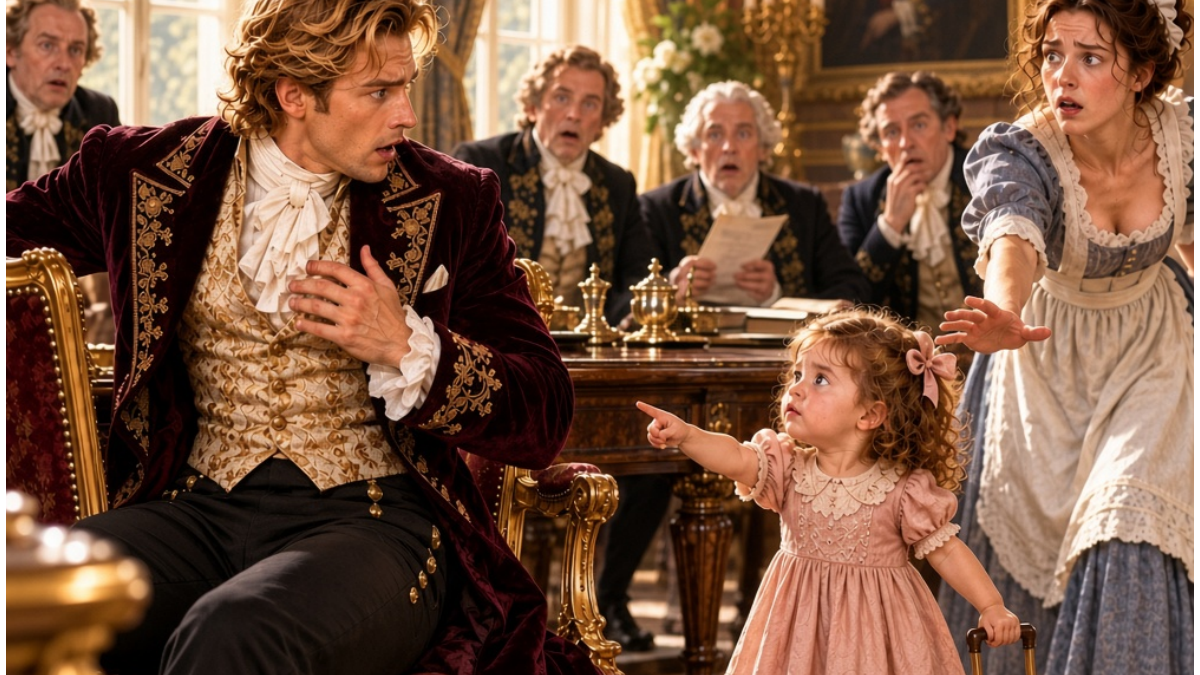
The door opened while the Duke of Thornwick was saying canal leases. Then he stopped.
A toddler walked in dragging a tiny blue suitcase. The suitcase was upside down. A stocking hung from the latch.
She wore one boot. She walked to the middle of the carpet and looked up at the Duke.
Papa, she said, “We go now.” Six men turned to look at the Duke. The Duke looked at the child.
No one spoke. Only the suitcase still swayed gently in her hand. Everard Thornwick was famous for not moving.
He had a tall, spare build, dark hair, pale gray eyes, and a face the London papers called forbidding when they wanted to be polite.
Servants said he could silence a staircase by glancing at it. Tenants said he remembered every rent, every roof tile, and every widow’s son by name.
Society said he would rather marry a weather vein than attend another season. At that moment, he looked at the toddler as if she had entered the meeting carrying cannon.
I beg your pardon, he said. Nell frowned. Papa, the word landed again. Harder this time.
Mina reached the carpet and dropped into a curtsy so quickly her knee struck the floor.
Your grace forgive me. She escaped Mrs. Flit in the laundry passage. I will take her out at once.
Nell clutched the suitcase handle. No. Papa sad. Papa K. Six grave men stared at the Duke.
The Duke stared at the child. Mina wished the floor would open, but only if it swallowed her neatly and spare the carpets.
Everard set down the canal map. Miss called her, he said. Mina’s stomach fell. He knew her name.
That made everything worse. Dukes who knew a maid’s name could dismiss her with frightening accuracy.
Yes, your grace. Is this child yours? Yes, your grace. Does she often assign fathers in business meetings?
Lord Sedwick coughed into his fiSt. Mina’s cheeks burned. No, your grace. She has a very active imagination.
Nell turned and scowlled at Mina. Not imagination. It is imagination. Mina said more desperately than wisely.
No, Button said. Every eye in the room moved to the suitcase. Everard’s brow shifted by the smallest amount.
Button. Nell nodded. Button knows. Mina closed her eyes. Button was not a person. Button was a stuffed rabbit with one ear, three repairs, and an opinion on every living soul.
Mina had invented him during hard nights when Nell missed people she was too young to name.
Button had become nurse, judge, bishop, and occasionally horse. He had never before been a genealogologiSt. Button is cloth, Mus said.
Nell looked wounded. Button is friend. The Duke’s mouth twitched. It was tiny, nearly invisible.
But Mina saw it. So did every man at the table because a ducal mouth twitching was apparently a public event.
Where is button now? Everard asked. Now open the upside down suitcase. Everything fell out.
A night dress, two wooden spoons, one sock, a hair ribbon, three chestnuts, a small shoe that was not the one she wore, a crust of bread wrapped in handkerchief and button.
The rabbit landed face down on a canal map. Lord Sedwick said, “Good heavens.” Nell picked up Button and held him toward Everard.
He says, “Papa.” Everard looked at the rabbit with solemn attention. Does he? Yes. Is Button often correct?
Always. Mina should have stopped this. She should have scooped Nell up, gathered the scattered disgrace, and retreated before her wages, reputation, and future were folded into the same suitcase.
But Everard Thornwick, the cold duke, was listening to her daughter as if a toddler’s nonsense deserved the same legal weight as a signed contract.
That paralyzed Mina more thoroughly than anger would have. The solicitor recovered firSt. your grace.
Perhaps we should withdraw. No, Everard said. The word was quiet. Everyone stayed. He turned back to Nell.
Why must I go? Nell leaned close, lowering her voice with theatrical secrecy. Bad lady coming.
Mina’s blood went cold. Not because the child said it. Because that morning before dawn, someone had slid a folded note under the servants hall door.
Leave Thornwick before the Duke learns what the child is. Mina had burned it in the kitchen stove before anyone saw.
She had told herself it was cruelty, not danger. Great houses made people cruel when gossip had nowhere else to sit.
But Nell had found her crying in the laundry closet. Mina had said only a bad lady wrote an ugly thing.
Children remembered the wrong words at the worst time. “There is no bad lady,” Mina said quickly.
Nell patted Button’s head. “Bad lady.” The Duke looked from Nell to Mina. His gaze was not suspicious.
That frightened her more. Miss Calder, he said, take a chair. Your grace, I am a maid.
I’m aware. Maids do not sit in meetings. Toddlers do not usually enter them with luggage.
Lord Sedwick made another cough-like sound. Everard glanced at him. Lord Sedwick became silent furniture.
Mina did not sit. I should take Nell back. Nell climbed into the chair beside the Duke.
She used the canal map as a ladder. The solicitor made a strangled noise. Nell, Mina said.
Papa chair, Nell replied. That is the Duke’s chair. Papa Duke. The room went dead quiet again.
Everard looked down at the child sitting beside him with one boot and a stuffed rabbit.
His hand rested on the arm of the chair. A signate ring shown there. The Thornwick crest cut in dark stone.
Nell reached out and touched the ring. Then she touched a brass button on Everard’s waist coat.
Same, she announced. It was not the same. Not truly, but both bore a thorn branch and small bird.
Mina saw it and wish she had not. The brass button had belonged to Nell’s tiny coat, the one Mina had found with her daughter as a baby.
She had kept it sewn inside Nell’s old blanket because it was the only clue to where the child had come from.
Mina had never told anyone. Nell had apparently found it because of course she had.
Children could not find both boots before breakfast, but they could locate secrets sealed under three stitches.
Everard’s face changed. It did not soften. It sharpened. Miss Calder, he said, “Where did your daughter get that button?”
Mina’s throat closed from her blanket. Your grace. And where did the blanket come from?
Every man in the room leaned without appearing to lean. Mina looked at the child.
Nell was now feeding a chestnut to Button. Mina had promised herself never to tell this story inside a room built for judgments.
She had promised it during winters when wages ran thin. She had promised it when other servants counted backward from Nell’s age.
She had promised it when she smiled through whispers and refused to say the child had been left in a basket behind a coaching in during a storm.
She had chosen love over explanation. But the button in the Duke’s ring looked back at her like a door opening.
I found Nell, Mina said. Lord Cedric shifted. Found Everard did not look away from her.
Where? At the old north posting house near Brier Cut. 3 years ago I was working in the kitchen.
There was a storm. Someone left a basket under the stair. Nell stopped feeding button.
Mina’s voice shook. So she steadied it with facts. There was a blanket, that button, and a note that said only her name.
Eleanor. She was feverish. The inkeeper wanted to send for the parish. I took her.
You adopted her? Everard asked. I became her mother, Mina said. No one corrected her.
Perhaps they heard the warning in it. The Duke’s eyes lowered to Nell. Eleanor, he said softly.
Nell looked up for the first time since entering the room. She became shy. She pressed button under her chin.
Now, she whispered. Nowell, Everard repeated. Something moved in his face. Then something old and wounded and carefully locked.
Mina saw it. So did the solicitor. Mr. Proud reached for the spectacles he did not wear.
Your grace, he murmured. The date. I know the date. Everard said. Lord Sedwick sat straighter.
Surely you do not think. I think nothing aloud yet. But this is impossible. Nell lifted button.
Not possible. Everard looked at her. Impossible. That a useful correction. She nodded as if pleased by his progress.
Mina could not breathe properly. Your grace, she said. Whatever this looks like, I did not bring her here for money, favor, or trouble.
I did not know she would come. I never meant. I believe you. The answer came too quickly.
It stole the rest of her speech. Everard rose. He was not a man who moved abruptly.
Yet everyone flinched. Gentlemen, this meeting is suspended. Lord Sedwick found his voice. Everard, you cannot suspend an estate matter because a servant’s child has made a charming mistake.
I could suspend an estate matter because a child arrived with a Thornwick crest and a threat may be involved.
A threat? Everard looked at Mina. She lowered her eyes. Too late. Miss Calder, he said.
What happened this morning? Nothing. Your grace. Nell betrayed her at once. Mama burned bad letter.
Mina closed her eyes. Everard’s voice cooled. What letter? It was nonsense. Nonsense rarely needs burning.
Some nonsense deserves fire again. That mouth twitch. This time no one dared notice. Tell me, Everard said.
Mina looked at the door. Two foot men stood beyond it, frozen with curiosity. The whole house would know by lunchon.
By dinner, the village would know. By Monday, London would hear that a maid’s toddler had invaded a ducal council and claimed its master’s papa.
The child had one boot on. Of course, that detail would survive longeSt. Mina lifted her chin.
The letter said, “I should leave before you learn where the child is.” The Duke went very still.
Lord Sedwick whispered, “Good Lord.” Everard’s voice stayed calm. “Mr. Proud, close the doors. No one leaves the house until I understand who sent that warning.
“Your grace,” Mina said sharply. The room turned to her. She regretted the sharpness, but not the words.
“My daughter is frightened enough. Do not make her a prisoner. Everard met her eyes.
For one second, Dukemade stood on either side of the table covered in leases, maps, spilled chestnuts, and a stuffed rabbit with one ear.
Then he inclined his head. You are right. No one questions her without you. Mina blinked.
Nell looked between them. Papa sorry. Everard considered this with grave attention. Papa is learning.
Lord Sedwick’s face turned purple. Nell smiled. Mina’s heart made a foolish painful motion. That was the true beginning.
Not the suitcase. Not the creSt. Not even the word Papa. It was the moment a duke allowed a maid’s child to correct him in front of six men and decided his dignity could survive the lesson.
The house did not survive lunchon. By noon, Thornwick house buzzed like a hive kicked by a bishop.
The maids whispered in linen closets. The footmen carried empty trays to hear fuller rumors.
The housekeeper, Mrs. Brindle, developed a headache directly behind her left eyebrow. The cook threatened to lock the kitchen if one more person asked whether the child looked ducal around the chin.
Nell sat at the servant’s table eating bread and jam with the intense calm of a person who had altered several inheritances before breakfaSt. Button lay beside her plate.
Mina stood behind her unable to sit. Eat, Mrs. Brindle said. I cannot then hold bread and look less doomed.
Mina picked up bread. Her hands shook. Mrs. Brindle noticed. She noticed everything except her own fondness for people.
His grace will not throw you into the road. She said, “You do not know that.
I know his grace. If he meant to throw you into the road, he would first repair it so the act could be done responsibly.”
Mina laughed once despite terror. Now looked up. “Papa fix road?” “No,” Mina said. “Papa Fak’s mama.”
The table quieted. Mina knelt beside her daughter. I’m not broken, love. Nell touched me in his cheek with sticky fingers.
Mama sad, only worried. Button says, “Papa, help.” Button says many things. Button smart. Button packs spoons in your suitcase.
Nell’s eyes widened with admiration. Soup. Mrs. Brindle muttered. Practical child. The summons came after lunchon.
Not to the servants hall. Not to the housekeeper’s office. To the blue morning room.
That was worse. Rooms had ranks. Mina had learned them as quickly as she learned which stairs creaked and which ladies blamed dust for bad tempers.
The blue morning room was for delicate visitors, quiet apologies, and news that required good china.
Mina carried Nell because the child had found her missing boot and now refused to wear either.
Shoes are prison, Nell explained. Shoes are protection. No. Everard was waiting by the mantle.
So were Mr. Proud, Mrs. brindle and an elderly woman Mina had never seen before.
The woman wore black silk, carried a silver-headed cane, and had eyes sharp enough to peel apples.
Everard bowed slightly to Mina, not to the housekeeper. To Mina? She nearly forgot to curtsy.
“Miss called her,” he said. “This is Lady Octavia Thornwick, my great aunt.” Lady Octavia looked at Nell.
Now looked back. Neither blinked. Well, Lady Octavia said she has the thornwick stare. Mina tightened her hold.
Nell whispered, “Old lady fierce.” Lady Octavia’s mouth moved. The old lady hears. Nell hit her face in Mina’s shoulder.
Everard turned slightly toward the window. It was the action of a man hiding a smile from family history.
“My aunt knew my late sister best,” he said. “Mina’s grip shifted.” Your sister, Lady Oretta Thornwick, Mr. Proud said gently.
His grace’s younger sister. She died three years ago. 3 years. Mina felt the room tilt.
Lady Octavia tapped her cane once. Not died. Disappeared in winter. Delivered dead by paper and buried with no body by fools who enjoy paperwork.
Mr. Proud looked pained. My lady did not my lady be proud. You accepted a morning ring and a physician’s note.
I called, both suspicious at the time. Everard’s face hardened. We found her cloak in the river.
Cloaks float away from living idiots as well as dead ones. Nell lifted her head.
Lady said, “Idiot.” “Yes,” Lady Octavia said. It is a family word. Mina’s thoughts scattered and returned in pieces.
A dead sister, a missing woman, a baby left by a road, a thornwick button, a letter warning her away.
Are you saying no? Maybe your niece. Mina asked. Everard did not soften the answer.
Yes. The word struck differently than papa. Niece meant blood. Niece meant claim. Niece meant Mina might lose the child she had carried through fevers, hunger, laundry steam, and every cruel question servants knew how to ask without speaking plainly.
Nell felt Mina’s arms tighten. “Mama.” Mina forced herself to loosen. “I am here.” Everard saw the fear.
“I will not take her from you,” he said. Mina’s eyes burned. “You cannot know that.
I can know what I will not do. You are a duke. Men around you may decide things.
Then I will be useful and prevent them.” Lady Octavia snorted. At last, a purpose for dukes.
Nell turned to Everard. Papa Uncle. Everard crouched slowly and with care. The movement startled everyone.
Nell stared at him from Mina’s arMs. “I may be your uncle,” he said. “I’m not certain yet.”
Button said, “Papa.” Button may have been speaking in hope. “No, Papa.” Everard’s throat moved.
Mina should have corrected Nell. She had corrected Nell all morning, but the Duke’s face stopped her.
It held a loneliness too old for one word and too new to hide. Nell, Mina said softly.
His grace is being kind. No. Nell wriggled down from Mina’s arms and toddled across the rug.
Papa said, “Nay.” She placed Button on Everard’s knee. Everard looked at the rabbit. Is this a legal appointment?
Nell nodded. Very well. He lifted Button with the seriousness of a man accepting military command.
I will guard him. Lady Octavia leaned toward Mina. If he drops that rabbit, I disinherit him.
Mina blinked. Can you? No, but I say it often. It improves his posture. For the first time all day, Mina smiled without meaning to.
Everard saw. His gaze caught there. Not in a way that made her feel inspected.
In a way that made her feel found. That was dangerous, too. Mr. Proud cleared his throat.
We need facts. Miss Calder. Forgive the questions. They are for the child’s protection. Asked, “What day did you find her?”
Mina answered, “What was written on the note?” “Only Elanor.” “Did anyone see the basket before you?”
“The stable boy, Jim.” He ran for me because the baby was crying. “Where is he now?
Gone to see, I think.” Lady Octavius said, “Naturally.” Witnesses always choose oceans. What else was in a basket?
A blanket, the button, a small silver rattle. I sold the rattle for medicine when Nell had fever.
Mr. Proud’s pen paused. Mina did not apologize. Everard said, “You used it for her?”
“Yes.” “Then it served its purpose.” Her throat tightened. Lady Octavia looked at Everard, then at Mina, then at the child, ordering Button to sit properly on the Duke’s knee.
“There may have been a nurse,” Lady Octavia said. Everard’s face turned. “Aretta’s nurse?” “Not hers.
The child’s your sister wrote to me 6 weeks before vanishing. She said she had made a foolish marriage, a brave mistake, and an enemy.
She was carrying a child. She refused to name the husband an ink. She trusted one woman, a companion named Selby.
Mr. Proud sat straighter. Miss Selby died. Did she? Lady Octavia asked. Everard closed his eyes briefly.
When he opened them, guilt had joined shock. You never told me this letter existed.
You were 28, furious and surrounded by men telling you grief was not evidence. I told you enough to make you search.
You searched the river. I searched everywhere. Not everywhere, Lady Octavia said. The words were cruel because they were true.
Mina almost felt sorry for him. Then she remembered she might lose Nell and gathered herself.
What happens now? She asked. Everard stood. Button remained in his hand. Nell pointed. Careful.
He adjusted his grip at once. Now he said, “We find who threatened you, who left Nell, and what happened to my sister.
Until then, you and Nell remain under my protection.” Mina stiffened. “Under your protection can become under your control very quickly.”
Mr. Proud stared at her. Mrs. Brindle inhaled. Lady Octavia smiled like a knife being polished.
Everard accepted the blow. “Then we write the terms plainly,” he said. TerMs. You remain employed if you wish, where you stop working and receive wages still because this investigation concerns your daughter.
You keep your room. Nel sleeps where you decide. No one questions her without you present.
No one calls her anything but your daughter unless you permit it. If any person in this house insult your claim, they answer to me first and Lady Octavius second.
Second, Lady Octavius said first in spirit, Everart replied. Better. Mina stared at him. He looked almost uncomfortable.
Will that do? She had worked since she was 12. No one had ever asked whether protection would do.
Protection usually arrived as a locked door or a man’s hand at her elbow. It is a beginning, she said.
Then we begin. Nell clapped. Begin. Button fell from Everard’s hand. Everyone froze. The Duke caught the rabbit one inch above the carpet.
Nell gasped in admiration. Papa faSt. Lady Octavia tapped her cane. He may live. The first problem was not blood.
It was bedtime. Nell had never slept anywhere, but in the small attic room she shared with Mina behind the linen press.
Thornwick house suddenly discovered that this was intolerable. Mrs. Brindle offered the nursery. Lady Octavia ordered the nursery aired, scrubbed, warmed, and inspected for ghosts.
Everard sent up a rocking chair from storage, then a smaller chair, then three picture books, then a wooden horse whose painted eye unnerved everyone.
Nell refused all of it. “No,” she said from the attic bed. Mrs. Brindle looked defeated.
“The nursery has curtains with ducks.” No ducks. A fireplace. No fire. A fine bed.
Mama bed. Mina sat beside her. Love. The nursery is warmer. No. Everard stood in the doorway because he had followed the third rejected chair upstairs and then become trapped by the human force of toddler refusal.
Perhaps, he said, the nursery can wait. Mrs. Brindle whispered, “Your grace, this room is not suitable.
It has held them for 3 years. That does not make it suitable. No, Mina said before she could stop herself.
It makes it ours. Everard looked at her. The attic room was small, sloped, and plain.
The bed was narrow. The wash stand had a cracked basin. Mina had sewn a curtain from discarded muslin.
Nell’s drawings were tucked into the frame of the looking glass. Button spare ear never attached because Nell liked him damaged lay on a shelf.
Everard took in every detail. Mina hated that he saw it. She also hated that he did not look disgusted.
May I enter? He asked. The question startled her. It is your house. It is your room.
Mrs. Brindle suddenly became very interested in the hallway wall. Mina nodded. Everard stepped inside.
He was too tall for the ceiling. He ducked near the beam which improved Nell’s mood at once.
“Papa, too big,” she said. “A common architectural problem.” He sat carefully on the stool.
The stool protested. Mina reached for the wall. The Duke froze. “Am I in danger?”
“The stool is. Should I stand? If you do, you will hit the beam. A difficult room.
It has trained us well.” Nell giggled. Everard looked pleased enough to forgive the furniture.
He held out the smallest picture book. Would you like this here? Nell took it.
Duck. No ducks. She opened it. Horse. Safer. Mina sat on the bed while Nell turned pages.
Everard remained on the stool, knees awkward, shoulders bent, looking like a ducal heron folded into a cupboard.
The site did something unfortunate to Mina’s heart. He had not ordered her to the nursery.
He had not insisted that comfort must look expensive. He had come into the inconvenient room and made himself inconvenient too.
Nell leaned against Mina’s side. Papa story. Everard’s eyes flicked to Mina. She should have said no.
One page. Mina said. Everard looked down at the book. The horse went over the hill.
Nell frowned. Voice wrong. My apologies. Horse voice. Everard stared at the page. Mrs. Brindle made a sound from the doorway and fled.
Mina covered her mouth. The Duke drew a slow breath. Then he read in a voice grave enough for Parliament and entirely wrong for a horse.
The horse went over the hill. Nel sighed. Bad horse. Yes, Mina said helplessly. Very bad horse.
Everard looked at her over the book. He was smiling, not the polite twitch from a meeting.
A real smile, quiet, rare, and a little astonished at itself. Mina looked away firSt. That night, Nell slept in the attic room.
The nursery remained empty, but Everard ordered the attic chimney repaired by morning, the cracked basin replaced, and the beam padded with felt after striking his head on it while saying good night.
The whole servant’s hall knew by breakfaSt. His grace hid his head in your room, a laundry maid asked.
Mina buttered toast for now, on a beam, for love, for architecture. Mrs. Brindle appeared behind the maid like justice in Blackwool.
Back to work. The maid vanished. Mrs. Brindle set a small pot of strawberry jam before Nell.
Nell looked suspicious. Why? Because you ate breakfaSt. Good girl. Hungry girl. Nell accepted this and began feeding button jam.
Mina rescued the rabbit too late. The second problem was gossip. By afternoon, a London paper sent a man to the village in.
By evening, a neighbor’s carriage rolled up the drive with Lady Persure inside, smelling of curiosity and lavender.
By the next morning, three notes arrived asking if his grace had discovered an air in the linen cupboard.
Everard read the third note at breakfast and tore in half. Lady Octavia buttered toaSt. Wasteful that one had a decent hand.
They’re speaking of a child. Society is always braver on paper. Mina stood by the cyborg because she was still assigned a breakfast service though no one seemed to know whether she should pour coffee or be hidden from coffee.
Everard noticed Miss Calder sit. Mina nearly dropped the pot. I am serving not this table.
Lord Sedwick who had returned because relatives always returned when scandal set out tea choked on kidney pie.
Everard he said you cannot see a maid at breakfaSt. Nell entered from the hall dragging the blue suitcase.
Mama sit. Everyone looked at the suitcase. Everard put down his torn note. Why is the suitcase here?
Going. Mina’s heart lurched. Going where? Bad people outside. We go with papa. Everard stood.
The room changed at once. Who said there were bad people outside? Nell hugged button.
Window man. Mina crossed the room and knelt. What window man? In trees. Everard moved to the bellpole.
Ward Sedwick rose. Now really, children in vent. Everard’s voice cut through him. Sit down.
Ward Sedwick sat. The footmen searched the east lawn and found boot marks beneath the breakfast room window.
They also found a torn scrap of paper caught on a rose thorn. The paper bore one line.
Not his, not hers. Mine. Mina read it once. Her hands went cold. Everard took the scrap from her before Nell could see.
“Proud,” he said. “The solicitor appeared within 10 minutes, hair wind blown and collar crooked.
He had apparently run from the estate office.” “There may be a claimant,” he said after reading it.
“Tell Mina asked, or to what Nell represents.” Everard stood by the window. Aretta’s husband, Lady Octavia’s eyes narrowed.
“If the foolish marriage was real, if he lives,” Proud said. Mina held Nell on her lap.
The child had finally agreed to wear shoes, but only on the wrong feet. If he is her father, Mina said, “Can he take her?”
No one answered fast enough. Mina stood. No. Everard turned. Mina. It was the first time he used her given name.
She heard it. So did everyone. She did not care. No, she said again. A note in a window does not make a father.
Blood does not know who woke when she cried or held her through fever or taught her not to bite soap.
Now looked up. So bad. Very bad. Mina said. Everard stepped closer then stopped before crowding her.
No one removes her today. Today is a small word. Then we make tomorrow larger.
Lady Octavia struck her cane on the floor. Good. At last someone speaks like a person.
Lord Sedwick muttered. This is madness. Nel pointed at him. Bad uncle. Lord Sedwick recoiled.
Everard looked at the child. Not uncle. Bad chair. Closer. Lady Octavia laughed so sharply.
The footmen spilled coffee. The laugh helped. Only a little, but it reminded Mina that fear was not the only sound in the room.
Everard took control after that. Not of Mina, of the house. He posted men at the gates.
He sent for the magistrate. He ordered every servant treated kindly and questioned clearly because frightened people lied badly and bullied people lied better.
He wrote to the old north posting house, to the parish near Brier Cut, and to the clerk who had registered Orretta’s supposed death.
He also moved his meetings from the library to the small school room next to the nursery because Nell cried if he disappeared behind the council doors.
This produced scenes Thornwick House had never imagined. The Duke received a drainage report while Nell lined chestnuts on his desk.
He discussed tenon rears while buttons sat on his shoulder. He signed a letter to the magistrate with purple jam on one cuff because Nell had declared him hungry and fed him toast by force.
“Lord Sedit considered this a collapse of civilization.” “Mina considered justice.” “Your grace,” she said on the third day.
“You may tell her no.” Everard looked at the chestnut tower beside his inkstand. I have when this morning she offered button my seal and I refused.
Where’s your seal? Everard open a drawer. Button sat inside wearing the seal ribbon. Mina pressed her lips together.
You have been defeated. Strategically delayed by a toddler. She has superior supply lines. Nell looked up from the rug.
Button Duke. Everard shut the drawer gently. Not yet. Mina laughed. He looked at her.
There was again that stillness as if her laugh had entered a room before she did.
Mina turned back to the mending basket. Do not encourage her. I thought I was obeying.
That is worse. The school room became a strange little country. Mina mended, sorted Nell’s clothes, and answer questions from Mr. Proud.
Everard worked at the desk and pretended not to watch how Mina knew every sound Nell made.
Nell built villages from chestnuts, buttons, and folded leases. Lady Octavia came and went like a black silk weather system.
The household relaxed by inches. Then the first witness arrived. Jim, the former stable boy from the posting house, had not gone to sea after all.
He had gone to a frier in Milkstead, grown 6 in, and acquired a mustache too ambitious for his face.
He stood in a Thornwick servant’s hall, twisting his cap. Mina recognized him at once.
Jim, he brightened. Miss Mina, I knew you’d remember. You took the baby even when Master Bell said she’d bring trouble.
She brought trouble with excellent timing. Everard said from behind her. Jim nearly swallowed his cap.
Your grace. Everard did not waste time. Tell us about the night. Jim looked at Mina.
She nodded. Storm fit to drown crows. Je said a lady came in after midnight.
Hood low. She had a baby under her cloak and blood on one sleeve. Mina gripped the back of a chair.
Alive? Everard asked. The lady? Yes, your grace. Shaking though, she asked if her red-haired kitchen girl still worked there.
Mina frowned. Me? I suppose. Master Bell said no questions. Then a carriage came up the road and the lady near lost her senses.
She put the basket under the back stair and told me to fetch the kind girl from the kitchen.
Not the parish, not the master, the kind girl. Everard looked at Mina. Why me?
She whispered. Jim shook his head. Don’t know. But she said the child’s mother trusted kindness more than names.
Lady Octavia seated in the corner closed her eyes. Everard’s voice changed. Did you see the lady’s face?
Not clear. Was she Lady Betta? No, you’re Grace. I saw Lady Oettto once when she came through with you years before.
This was an older woman, brown hair going gray. Selby, Lady Octavia said, “What happened after?”
Mr. Proud asked. I fetch Miss Mina. When we came back, the woman was gone.
Master Bell said she’d left by the North Lane. Next morning, a man came asking after a woman and child.
Fine coat, muddy boots, tempered like a kicked hornet. Everard’s hands closed. Name? He called himself Mr. Veil.
Lord Sedwick went pale. Mina saw. So did Everard. Sedwick. Everard said many men are named Veil.
Do not insult the room. Lady Octavia leaned on her cane. You know him. Lord Sedwick Rose.
I knew of him. A fortune hunter. Area fancied him. We all knew it would end badly.
You told me she had no attachment. Everard said. Because she was already dead by then.
Because you wish her dead by then. Lady Octavia snapped. Lord Sedwick’s face darkened. How dare you?
Easily. I am old. Mina pulled Nell closer. Nell had been playing near the hearth, but now she watched the adults with wide eyes.
Everard noticed and lowered his voice. No more here. Lord Sedwick gave a brittle laugh, afraid the child will learn the world is ugly.
Mina stood. She already learned that. She also learned who makes it uglier. He stared at her as if a chair had spoken.
Everard looked at Mina with something fierce and bright. Then he turned to his cousin.
You will remain at Thornwick tonight. Am I under guard? You are under hospitality. That sounds worse.
It can be. Lady Octavius stood. I shall enjoy dinner. Nobody else looked as if they would.
Dinner was a battlefield arranged with soup. Mina should not have been there. Everyone knew it.
Everard placed her on his right anyway with Nell between her and Lady Octavia because Nell had announced that soup tasted better near old fierce ladies.
Lord Sedwick sat opposite radiating offense. Mr. Proud sat with papers tucked into his coat and indigestion in his eyes.
Mrs. Brindle oversaw service as if commanding troops. The soup arrived. Nell dipped a spoon, tasted it, and frowned.
Rome. Every adult froze. Mino whispered. Nell manners. No, wrong soup. The cook visible through the service door looked ready to resign from life.
Everard leaned toward Nell. What is wrong with it? Papa soup has leaves. Parsley? No.
Mama soup better. Lord Sedwick muttered. A culinary tribunal by infant. Nell pointed her spoon.
Bad chair talks. Lady Octavia set down her spoon. I adore this child. Mina wanted to sink under the table and also laugh until she cried.
Everard signaled quietly to remove Nell’s soup and bring plain broth. The adjustment took 2 minutes.
No one mocked it because the Duke’s face suggested mockery would be served cold and legally.
Halfway through the meal, Lord Sedwick made his move. Miss Calder, you must be overwhelmed.
Mina looked at him often. A woman in your position cannot understand the burdens attached to bloodlines and estates.
No. Everard’s hand still near his glass. Mina continued. I understand laundry. Bloodlines and estates seem to produce a great deal of it.
Lady Octavia coughed. Everard looked down. Lord Sedwick flushed. You are impertinent. Usually after being insulted.
I was expressing concern. That is what people call it when they wish cruelty had gloves.
Nell whispered. Mama wins. Everard answered. Yes. Lord Sedwick stood. This is intolerable. You may sit.
Everard said or you may leave the table and be questioned by proud of the yellow parlor.
On what authority mine? You have become absurd over a maid and a foundling. The words struck the table.
Foundling. Mina went cold. Nell looked at her confused by the way the room changed before she understood the insult.
Everard rose. He did not shout. He did not need to. You will apologize to my guest and to her daughter.
Lord Sedwick stared. Guest? Yes. She is a servant. She is Nell’s mother. Not by blood.
Mina pushed back her chair. Everard’s eyes did not leave his cousin. Say that again.
And you leave Thornwick tonight without carriage lamps. Lady Octavia murmured. I recommend saying it.
I enjoy lamps. Mr. Proud whispered. My lady, please. Lord Cedric’s mouth worked. I apologize, he said at laSt. Nel looked at Mina.
Bad chair. Sorry. Bad chair is trying. Mina said. Everard almost smiled. The dinner did not improve after that, but became shorter.
Mina took Nell upstairs herself. On the second floor landing, Everard caught up with them.
Mina. She stopped. No was half asleep against her shoulder, buttons squeezed between them. Thank you, Everard said.
The words were unexpected. For what? Not letting him make you smaller. Mina looked at the sleeping child.
I have had practice. That is not comfort. No. He reached toward Nell’s fallen ribbon, then stopped.
May I? Mina nodded. He tucked the ribbon gently under Nell’s arm so would not drag.
His hand did not touch Mina. Somehow the care in that restraint touched her more.
I should have stopped him sooner, he said. You stopped him after he hurt you.
Words bruised less when named. Everard’s gaze lifted to hers. Who named yours before? The question was too close.
Mina shifted Nell higher. No one with a title. Mina, good night. Your grace. He let her go.
But the next morning, a new notice appeared in the servant’s hall and the front vestibule.
It was written in Everart’s hand. Eleanor Calder remains under her mother’s care and my protection.
Any person who questions Miss Calder’s motherhood, insults the child, or repeats speculation to outsiders will leave my service or my table.
Curiosity is not loyalty. Mrs. Brindle read it twice. Then she looked at Mina. Well, the housekeeper said, “That should reduce foolishness by half, only half.
We must remain realistic.” The notice did not stop gossip outside Thornwick. It changed its flavor.
Now, the village asked whether the Duke meant to adopt the child, marry the maid, uncover a murder, or all three before Miklmus.
The butcher favored murder. The vicer’s wife favored adoption. The blacksmith’s sister favored marriage and claimed she had known from the way Everard looked at Mina during church, though Mina had not attended church with him once.
The London papers invented freely. One headline called Mina a mysterious nursery beauty. Mrs. Brindle read aloud and then stared at Mina’s inkstained apron.
Beauty, yes. Nursery, perhaps. Mysterious? No. You are very clear when annoyed. Mina took the paper.
They say I bewitched him. Did you, Mrs. Brindle? I asked for household planning. Mina threw the paper into the stove.
The investigation moves slower than gossip. The old posting house had changed hands. Master Bell had died.
The parish register had a suspicious tear on the winter page. Mr. Vale had vanished like smoke with boots.
Ladya’s supposed death certificate bore a doctor’s name no one could trace. Every fact led to a locked door, and every locked door smelled faintly of Lord Sedwick.
Everard grew colder each day. Not with Mina, never with Nell, but with everyone else.
He became the Duke newspapers feared, all clipped words and hard eyes. He worked late, ate little, and spent long hours with Proud behind closed doors.
Nell noticed firSt. She always did. One afternoon, she marched into the library with her blue suitcase and set it beside Everard’s desk.
Papa bad, she said. Everard looked up from a stack of letters. Am I face bad?
Mina hurried in behind her. Nil. No. Papa face like old soup. Everard blinked. Proud looked down at his papers with desperate concentration.
Mina pressed her fingers to her mouth. Old soup. Everard repeated. Nell nodded. Throw away.
Everard leaned back. Miss Calder, is that medical advice? Probably emotional advice. Mina said from button.
From soup, apparently. Nell opened the suitcase and removed three chestnuts, a sock, and a wooden cup.
Tea party. I am working. No. Everard looked at Mina. She lifted both hands. Do not look at me.
I have never defeated her. Proud closed his portfolio. Your grace. I believe I recall an urgent appointment elsewhere.
Coward, Everard said with relief. The solicitor fled. Nell placed the wooden cup on the desk, then gave Button the place of honor on the bladder.
Everard accepted a chestnut as if it were tea. Mina stood by the shelves and watched the Duke of Thornwick drink imaginary tea with a child who might be his niece, and certainly had conquered him.
Something in his face eased. Nell saw it and nodded. Better. Am I no longer old soup?
New soup. Progress. Mina laughed. Everard turned his head. He did not hide what the sound did to him now.
That was the problem. He had stopped hiding enough that she could not pretend not to see it.
Nell busied herself feeding but in a chestnut. Everard spoke quietly. Are you frightened of me?
Mina’s laugh faded. No. Of this house sometimes. Of what I might ask. She met his eyes.
Yes. He accepted it with a small nod. Then I will not ask yet. That is kind.
It is not kindness. Is strategy. I would like an answer that belongs to you.
Not to gratitude, panic, or scandal. Mina looked at the child on the carpet. You think like that badly, but I try.
You should not say things that make me trust you more. I will attempt to become less persuasive.
You will fail. Likely now interrupted by placing Button in Everard’s lap. Baby, she announced.
Everard looked alarmed. Is he? Yes. Hold. He held Button carefully. Mina could not breathe for a moment.
The stuffed rabbit looked ridiculous in his large hands. Everard looked ridiculous holding it. Yet the care was real, and Mina had learned to distrust care that existed only in grand gestures.
This care held a torn rabbit as if dignity had never mattered. That evening, Mina found a letter under her attic door.
Not threatening, worse, begging, “Miss Calder, if you love the child, leave Thornwick before proof arrives.
The Duke will not be able to protect you from a law. Blood takes blood.
Mothers without papers lose.” This time, Mina did not burn it. She carried it straight to Everard.
He read it once, then again, his face became the coldest thing in the room.
Where was it? Under my door. Who knew you would be in the attic? Everyone, no.
Who knew you would be alone? The question slid under her skin. Everard rang for Mrs. Brindle.
Then he rang for the butler, proud, and Lady Octavia. He did not ring for Lord Sedwick because Lord Sedwick had left that morning to visit a neighbor.
Convenient, Lady Octavia said when told. Too convenient, Proud replied. Nell slept in Mina’s arms through the meeting, flushed and heavy.
Everard kept looking at the child. The law, Mina said. Is the letter right? Proud looked miserable.
If Lady Aretta was Nell’s mother, and if a lawful father appears, he may petition for custody.
Mina’s arms tightened. Everard said he may petition. He will not win. Your grace, proud said gently.
Rank helps but law is not affection. Then we bring affection into law. That is not how courts work.
Then courts are underdeveloped. Lady Octavia tapped the letter. This is not only about custody.
It wants Miss Calder to run. Why? Mina looked down at Nell’s sleeping face. Because if I run, I look guilty.
Everard’s eyes lifted to hers. And Nell is easier to take. No one spoke. The house seemed to listen around them.
Mina swallowed hard. I will not run. Everard looked at her as if she had just handed him a sword.
Good, he said. But I need more than your word. Ask if a lawful father appears.
I need standing something written. Something that says I am not a nurse who can be dismissed.
Proud straightened. A guardianship petition. Everard turned to him. Do it. It will be challenged.
Then write it strongly. It requires witnesses to her care. Mrs. Brindle folded her arMs. You will have them.
Lady Octavia smiled and one elderly menace. It may require revealing every detail of Miss Calder’s circumstances.
Proud warned. Her wages, her room, her lack of blood connection. Mina’s cheeks burned. Everard’s voice softened.
Mina. She looked at Nell. Write it. That was how Thornwick House began preparing. Not for a wedding, not for a dinner, not for mourning, but for a maid to claim her child-in-law.
It was not romantic. It was ink, paper, testimony, fear, and people learning to speak plainly.
Mrs. Brindle wrote that Mina had worked while carrying Nell on her hip when no one else would watch a sick child.
The cook wrote that Mina had gone without meat to buy milk. A laundry maid admitted she had once called Nell a burden and had never done so again after Mina looked at her.
The vicer wrote that Mina had asked for baptism, not charity. Everard wrote nothing at firSt. He tried.
Mina found in him the library with 12 ruined sheets and a face like weather before thunder.
Is the ink misbehaving? She asked. The language is What are you trying to say?
That you are her mother? That is short. Not for court. She crossed the room.
Nell was asleep upstairs. The house was quiet. The library smelled of paper, coal, and Everard’s bergamont soap.
Mina stood beside the desk. May I? He handed her the top sheet. It began with formal titles, dates, and phrases that bowed until they fell over.
Mina read three lines. This sounds like you asking permission from a cupboard. Everard, lean back.
A fair description of law. Try speaking to a person. Which person? The one deciding whether my child is mine?
His expression changed. He took a new sheet. For a while, he wrote in silence.
Mina should have left. She stayed. At last, he read aloud. I have seen Miss Mina called her afraid, exhausted, insulted, and placed under a scrutiny she never sought.
In each condition, her first thought has been Elellanor. The child reaches for her before comfort, before food, before explanation.
If motherhood is measured by who teaches a child trust, then Miss Calder has more claim than any blood that arrives 3 years late.
Mina looked at the floor. She cannot speak. Everard set down the pen. Too much.
No, not legal enough. I do not know, Mina. If I look at you, I will cry.
He was silent. Then he stood and walked to the shelves, giving her the privacy of his turn back.
That undid her more than if he had tried to hold her. She wiped her cheeks quickly.
You may turn around. He did. Thank you, she said. It is only truth. People keep saying only before things that have saved me.
Everard’s face shifted. He came one step closer then stopped. May I ask one thing?
You said you would not. Not that. Then ask. When Nell called me papa, did it offend you?
Mina considered lying. She did not. At first, yes. He nodded though it hurt him.
Not because of you, she said. Because people have tried to make me less her mother since I took her.
Pitying looks, clever hints, questions about when I would give her to someone better. Papa sounded like another hand reaching.
And now Mina looked at the ruined sheets on the desk. Now I think perhaps she saw a space before either of us did.
Everard’s breath changed. A space not instead of me beside us. He remained very still.
Mina, do not ask tonight. No. But his eyes did ask, and for the first time, her heart answered without fear.
The claimant arrived on a Tuesday in bright sun, which offended Mina. Villains should arrive in storMs. It was untidy of them to use pleasant weather.
His name was Rafe Veil. He was handsome in a ruined way with fair hair, a charming mouth, and eyes that counted exits.
He wore black not for mourning, but because it made him look literary and dangerous.
Lord Sedwick arrived with him, claiming coincidence so badly that even Nell frowned. Veil bowed to Everard in the entrance hall.
Your grace, I have come for my daughter. Nell stood behind Mina, clutching her skirt.
Everard did not move. Have you Eleanor Vale, born of my lawful marriage to Lady Oretta Thornwick?
Mina felt the words like a door slamming. Vale turned his smile on her. And you must be the servant who kept her.
I am grateful. Mina had imagined this moment many times since the first threat. In every imagining, she was terrified.
She had not expected Fury to stand up firSt. “I am her mother,” she said.
Veil smile gentled in sentiment perhaps. Everard took one step forward. Mina touched his sleeve.
He stopped. That small obedience gave her courage. In fever, Mina said in hunger, in nightmares, in first words, in scraped knees, in soap biting, in every morning she woke and knew she was safe.
Veil’s eyes hardened, though his smile stayed. Touching but not legal. Proud step from the side room.
That remains to be determined. Lady Octavia appeared at the stair cane in hand. Rafe Veil still alive.
How disappointing. Veil smile faltered. Lady Octavia. No. No. I refuse to have my name spoken in your voice.
Nell whispered. Old lady fierce. Always. Lady Octavia said. Vil looked at Nell. His expression softened into something practiced.
Elellanor. I am your father. Nell hid further behind Mina. No, you do not remember me.
No, but blood knows blood. Nell considered this, then pointed at Everard. Papa. The Hulk stopped breathing for the third time in a week.
Veil’s gaze snapped to Everard. Lord Sedwick made a sound under his breath. Everard’s face did not change, but Mina saw the feeling hit him.
Veil laughed softly. How convenient. Mina lifted Nell into her arMs. Do not mock her.
I mock the arrangement. A duke, a maid, a misplaced child. Thornwick always did enjoy melodrama.
Everard spoke at laSt. You will meet in the yellow parlor with my solicitor, Lady Octavia, the magistrate, and Miss Calder.
You will present proof of marriage, birth, and your conduct since abandoning the child. Abandoning?
Vale’s voice sharpened. She was in a basket under an in stare to save her life.
From whom? Vale looked at Lord Sedwick too quickly. Everard saw. So did Mina. The yellow parlor meeting lasted two hours.
Vale had papers. Of course he had papers. Men like him always found papers when affection failed.
He produced a marriage certificate from Scotland. A letter in Lady Atta’s hand. And a small portrait of her holding an infant wrapped in the same blanket Mina had kept.
The portrait made Lady Octavia turn away. It made Everard go pale. Mina looked at the painted baby and knew Nell was a reddest child.
That truth did not hurt as she expected. It settled. She had loved Nell without needing blood.
Blood arriving late could not empty three years from her arMs. Veil told his story smoothly.
He and had married for love. Her family disapproved. Sedick had threatened them. They fled.
Oretta fell ill after childbirth. Miss Selby helped them escape pursuit. In confusion, the child was hidden for safety.
When he returned, she was gone. He had searched for years. It was beautiful. It was also false in its bones.
Mina knew because Nell did not move toward him once. Children could be shy. They could be confused.
But Nell’s whole body rejected him. Everard listened without interruption. Then Proud asked the first question.
If you search for years, why did you not approach Thornwick? Veil lowered his eyes.
I fear blame. Lady Octavia snorted. Proud continued. How did you learn the child was here?
Rumor. Before or after the threatening notes? Vale smiled. Is not? That was not my question.
His smile thinned. Mina sat with Nell on her lap. Nell played with a ribbon and refused to look at Veil.
Everard watched the child more than the man. At last, Veil turned to Mina. Miss Calder, I understand your attachment.
I will allow you to remain as nurse. Mina’s hand stilled. Everard’s face became terrifying.
But Mina answered firSt. No. Think carefully. It is generous. No. You would deny Eleanor her father out of selfishness.
I would deny any stranger the right to rename love as employment. They’ll lean back.
You speak boldly for a servant. She speaks boldly for a mother. Everard said. The magistrate.
A round man named Mr. Hob shifted in his chair. This is difficult. Blood claims are serious.
Lady Octavia struck her cane. So is leaving infants under stairs. Veil’s mask slipped. “You old,” he stopped.
“Too late,” Nel flinched. Mina felt it. So did Everard. “Meeting adjourned,” he said. Mr. Hobb protested.
“Your grace, we have not settled. No, we have revealed enough for one afternoon.” Vale stood.
You cannot hide my daughter. Nell burst into tears. That ended diplomacy. Mina carried her out.
Everard followed them to the school room but stopped at the door. May I come in?
He asked. Nell sobbed into Mina’s neck. Mina nodded. Everard entered and sat on the floor.
Not the chair. The floor. He sat awkwardly, long legs folded, dignity placed somewhere behind him.
Nell pee. Pop a floor. Yes. What? I thought the floor looked underrepresented. Her saw became a hiccup.
Mina sat in the rocking chair, holding her close. Everard picked up Button from the rug.
Button, he said solemnly. Your legal opinion is required. Nell sniffed. Button says bad man go.
A sound opinion. Papa may go. Everard’s eyes lifted to Mina. I will try. Nell frowned.
No try. Do. I will do everything I can. She considered that. And mama stay.
Everard’s voice softened. Yes. Mama stays. Mina shut her eyes. The words entered her like warmth after rain.
When Nell slept at last, Everard remained on the floor because moving might wake her.
Mina sat in the rocker with the child’s weight heavy and hot against her. “You should get up,” she whispered.
“I’m afraid my legs have joined the carpet.” She smiled despite herself. Your grace, do you need rescuing?
Desperately, I cannot move. Then I shall perish honorably. On a schoolroom rug, history is cruel.
His dry voice steadied her. After a while, he spoke again. We need orret his truth.
Veil has papers. Papers lie when frightened men hold pens. And if the law gives ne to him, Everard’s face changed.
It will not. That is not an answer. No, I need truth, not comfort. He looked at her for a long moment.
If Hob rules wrongly, I will appeal. If appeal fails, I will use every lawful pressure I possess.
If law still fails, I will follow Nell as closely as law allows and make Veil regret every unkind breath.
Mina swallowed. And me, you will never be abandoned by this house. That is not the same as keeping her.
No, there truth again. Hard and clean. Mino looked at the sleeping child. Thank you for not lying.
I considered it. I know. I dislike the shape of it. Good. He shifted and winced.
Your legs gone. I am sorry. I regret nothing except the carpet pattern. Mina laughed softly.
Nell stirred but did not wake. Everard smiled to the sound, then looked away as if giving it privacy.
That was when Mina knew her danger had become something deeper than scandal. She did not love him because he protected her.
She loved him because he kept making room for her strength beside his. The answer to Oretta’s truth came from Button, not because the rabbit spoke, though Nell insisted otherwise.
It came because Button’s torn ear finally fell off. Mina found Nell crying over the injury the next morning and took the rabbit to the sewing basket.
She admitted that rabbit so often she knew it seems like roads. But the old ear had been sewn long before Nell owned him.
The thread did not match Mina’s repairs. When she opened the seam, a folded scrap of oil cloth slid out.
Mina stared. Nell stopped crying. Button secret. Mina carried the oil cloth to Everard with hands that trembled.
Inside was a letter. The ink had faded but held. Everard read it aloud because Mina asked him to.
His voice shook only once. My daughter is Eleanor Thornwick. Veil. If this reaches Thornwick, know that Rafe sold my jewels, struck Selby, and means to use the child for leverage.
I am ill and watched. Selby will carry Nell away if she can. Trust the woman who keeps the child warm over any man who comes with papers.
Everr, forgive me. I’m married for poetry and found hunger. Do not let my child pay for it.
The letter was signed to Reetta. For a long moment, the room was silent. Lady Octavia sat down without being invited.
Proud removed his spectacles and wiped them. Everard held the letter as if it weighed more than stone.
Mina thought he might break. Nell tugged his coat. Papa sad. Everard crouched and pulled her gently into his arMs. Mina stopped breathing.
Nell allowed it. Not stiffly, not politely. She curled one hand into his coat and rested her cheek against his shoulder.
Everard closed his eyes. “Yes,” he whispered. “Papa is sad. No one corrected the word.”
Mina turned away to wipe her face. Lady Octavia did not. “Good,” the old woman said fiercely.
“Now destroy him.” The hearing was held in Thornwick’s old justice room because Mr. Hobb decided moving everyone to town would turn Scandal into theater.
He was right. It became theater anyway, but at least Thornwick controlled the chairs. Veil arrived confident.
Lord Sedwick arrived pale. Mina arrived with Nell on her hip, button repaired but lopsided, and Everard walking beside her rather than ahead.
That detail traveled through the room like candle flame. Proud presented the letter. Veil called it false.
Proud presented Lady Oetta’s known hand. Veil called it Grief’s invention. Then Lady Octavia rose.
I gave a reda that rabbit, she said. Veil blinked. What button? A ridiculous name, but she was six.
I had the rabbit made with a pocket in the ear because she hid sweets badly.
Only Area knew it existed after childhood. Only someone she trusted would place a letter there.
The room shifted. Proud then called Jim, the former stable boy. Jem identified Vale as the man who came searching after the basket was left.
Vale claimed concern. Proud produced the threatening notes. Vale denied them. Then Everard stood. Lord Sedwick, he said, “Tell the room why you recognized Rafe Vale before he introduced himself.”
Sedick’s mouth opened. No sound came. Everard continued, “Tell the room why you lied to me about my sister’s attachment, why you discouraged every search beyond the river, and why you received two payments from Veil within the month of Oretta’s disappearance.”
Mina had not known that last part. Neither had Veil from the fury on his face.
Sedwick collapsed in stages. He did not confess nobly. He defended, explained, blamed youth, debts, family honor, and Oretta’s stubbornness.
The shape emerged ugly and clear. He had helped Vale hide the marriage to avoid scandal.
Then helped declare Oretta dead when Vale said she was too ill to return and the child had not survived.
Later, when rumors placed Nella Thornwick, Sedwick had warned Vale, hoping to control the damage.
“I never meant harm to the child,” Sedwick said. Mina stood. Everart did not stop her.
“You meant convenience,” she said. “Children are harmed by that every day.” Mr. Hobb looked at Nell, then at Mina, then at the letter.
The ruling did not come as a dramatic thunderclap. It came as careful words on paper.
Eleanor remained in Mina Calder’s care as primary guardian. Duke Everard Thornwick was recognized as her nearest maternal kin and joint protector by petition.
Rafe Vale was denied custody, pending criminal inquiry into abandonment, coercion, and threats. Lord Sedwick was removed from all estate confidence.
Mina heard none of it after the first sentence. Eleanor remained. Her knees weakened. Everard’s hand appeared near her elbow, not touching.
“May I?” He whispered. She nodded. He steadied her. Nell clapped because everyone else looked too serious.
“Mama stay,” she said. Mina knelt and gathered her close. Mama stays. Nell looked over Mina’s shoulder at Everard.
Papa stay. Everard’s face changed. He looked at Mina, not the magistrate. Not the room, not the law.
If Mama allows. Mina laughed and cried at once. Mama will consider it. Nell frowned.
Now, Lady Octavius said the child has excellent timing. Everard offered Mina his hand when the room began to empty.
Not his arm, his hand. She took it. They walked out together behind Nell, who dragged the blue suitcase because she had declared the meeting finished and everyone going home.
The suitcase bumped down each step. Thump, thump, thump. Each sound felt like a verdict leaving the house.
That evening, Thornwick did not host a celebration dinner. Mina could not have endured one.
Instead, Mrs. Brindle sent supper to the schoolroom. Cook sent soup for legal recovery. Lady Octavius sent champagne, then sent a note saying not to give it to the toddler, which everyone had already understood except possibly Nell.
Nell fell asleep early, one hand on button and one foot outside the blanket. Mina stood at the schoolroom window.
Everard entered softly. Proud is sending papers to London, he said. And veil held at the inn under guard until the magistrate moves him.
Sedwick gone from Thornwick. Mina turned. That must hurt. Yes, he was family. So was Aretta.
The quiet after that held grief, anger, and something like peace with sharp edges. Everard crossed the small table and set down the blue suitcase.
Mina frowned. Where did you find that? In the hall, packed again. With what? He opened it.
Inside lay button spare ear, three chestnuts, one of Everard’s gloves, Mina’s apron ribbon, and a biscuit.
Mina pressed a hand to her mouth. She is either running away or founding a household with my glove.
Dowry perhaps. Everard looked at the suitcase for a long moment. When she entered my meeting with this, I thought my life had been interrupted.
It was no. It began turning. Mina’s heart became very loud. He closed the suitcase and faced her.
I promise not to ask until your answer belonged to you. I remember. Does it?
She looked at Nell, sleeping on the small couch, safe for tonight and for tomorrow.
She looked at the room where law had not taken love away. She looked at the man who had power enough to command but had learned again and again to ask.
Yes, Mina said. Everard went still. Then may I ask? Yes. He did not kneel.
Somehow that was right. Kneeling would have made theater of life that had already had too many witnesses.
He stood before her bear performance. Mina called her. Will you marry me? Not to secure Nell because she is already yours.
Not to silence Scandal because Scandal deserves no such gift. I ask because I love you.
I love your courage, your temper, your tenderness, your refusal to let rank bully truth, and the way you have made this house human without asking permission.
Mina’s eyes filled. That was too many compliments. I edited several. Good. Is that your answer?
No. Uh, my answer is yes. He shut his eyes for a moment. The cold Duke looked almost unmade by joy.
Then Nell spoke from the couch without opening her eyes. Papa kiss mama. Mina laughed through tears.
Everard looked at the child. Is she awake? No. Mina said she is issuing orders in her sleep.
Efficient. Mina stepped closer. Do you obey in this matter gladly. The kiss was soft, careful, and utterly unlike scandal.
It did not claim her. It met her. Everard’s hand lifted to her cheek, then paused until she leaned into it.
Mina felt that pause everywhere. When they parted, Nell sighed in her sleep. Good papa.
Everard rested his forehead against Mina’s for one brief second. High praise. Do not become proud.
Too late. They married 6 weeks later in the village church. Not because society demanded speed, but because Nell demanded flowers and Lady Octavia threatened to wear black unless stopped by lace.
Mina walked down the aisle holding Nell’s hand. Everard waited at the front with button in his coat pocket because Nell had appointed the rabbit witness.
Mrs. Brindle cried into a handkerchief and denied it. Proud cried openly and called it legal relief.
Lady Octavia told the vicer to speak clearly because the bride had survived enough mumbling from men.
The papers called it astonishing. The servants called inevitable. Nell called it mama papa day and refused every correction.
After the wedding breakfast, Everard found Mina in the blue morning room, the room where fear had first been named.
She stood beside the table looking at the tiny suitcase. It had been cleaned, mended, and set there by Nell as decoration.
Thinking of escape, Everard asked, “Always wise to know where luggage is. Should I worry?
Only if you become foolish. Then you will take the suitcase.” “No, I will pack yours.”
He smiled and came to stand beside her. Through the open door, Nell’s voice rang from the hall.
Papa button lost shoe. Everard looked at Mina. Rabbits were shoes. Apparently, today I am unprepared for fatherhood.
You have been unprepared since the meeting. And yet, she took his hand. And yet you stayed.
They went into the hall together. Nell stood by the staircase with button, one shoe of her own missing, and the blue suitcase open at her feet.
Inside lay a glove, a ribbon, a biscuit, and a folded canal map she had stolen from the meeting room.
Everard picked up the map. This is an important estate document. Nell nodded. Family. Mina looked at the suitcase and understood.
It no longer meant leaving. It meant taking what mattered. Everard folded the map and placed it back with solemn care.
“Very well,” he said. “Family.” Nell held up her arMs. He lifted her. She patted his cheek.
“Papa carries suitcase.” Everard looked at Mina over the child’s curls. “Always,” he said. Mina picked up the tiny blue suitcase herself.
“We can share it,” she said. Together they walked down the hall of Thornwick House, past the meeting room where leases, pride, and quiet loneliness had once ruled undisturbed.
Behind them, buttons repaired, ears stuck out of the suitcase latch like a brave little flag.
This time, the suitcase was right side up. Marriage did not make Thornwick house quieter.
Mina had not expected it to. A house that had accepted one toddler, one repaired rabbit, one sharp tonged great ant, and one Duke learning family in public was unlikely to become calm because a vicer said a few words over rings.
Still, the shape of the noise changed. Before, whispers chased Mina down corridors. After doors opened before she knocked, footmen who had once pretended not to see her now bowed too deeply and nearly walked in a furniture.
The laundry maids asked whether they should call her your grace. Mrs. called her or please do not make us guess.
Mina, she told them. Mrs. Brindle appeared behind her. In private, Mina in private, the maids repeated.
Your grace in front of visitors, Mrs. Brindle said. Mina looked at her. You enjoy this order is my only vice.
That is not true. It is my only one. I admit before lunchon. Nell adjusted fasteSt. She moved through Thornwick house with Button under one arm and the conviction that every adult now belong to her schedule.
She brought Everard imaginary tea during his state meetings. She demanded that Lady Octavia inspect worms in the garden.
She told Mr. Proud that his papers needed pictures. She informed Lord Sedick’s empty chair that it was still bad and should think about kindness.
The chair improved by absence. Everard improved by practice. He had been a careful man before Mina, careful with money, words, land, temper, and grief.
He had kept his heart in rooms no child could enter. Now the doors stood open too often, and his dignity kept tripping over wooden blocks.
One morning, Mina found him in the nursery wearing a paper crown. Nell stood on a stool before him, holding a hairbrush like a royal scepter.
“Your grace,” Mina said. “Should I ask?” Everard looked at her with perfect composure. I have been promoted.
To what? Now answer proudly. Buttons horse. Mina leaned against the doorway. A high office.
Apparently hereditary. Everard said. Can you refuse? I tried. The negotiations failed. Nell placed a brush against his shoulder.
Horse quiet. Everard bowed his head. Mina turned away before laughter ruined the ceremony. These moments would have been easy to dismiss as sweetness.
They were not. They were a pair. Everard needed to learn that love could be ridiculous without becoming unsafe.
Mina needed to learn that being cherished did not mean being folded away. Nell needed the least instruction of all.
She had known from the beginning that a family could fit into a blue suitcase if people stopped arguing with the obvious.
The law took longer to learn. Rafe Vale’s trial stretched through letters, depositions, and delays.
He denied everything he could and embroidered the reSt. Sedwick wrote three pleading notes to Everard.
All of which Lady Octavia read first and graded in the margins. Too much self-pity, she wrote on one.
Poor sentence structure, she wrote on another. On the third, she wrote only no. Everard sent no reply.
Mina asked him once if that hurt. They were in the library after dinner. Nell slept upstairs.
Rain tapped the glass. The blue suitcase sat beneath the desk because Nell had decided important papers needed luggage.
Yes, Everard said. Mina waited. He did not pretend otherwise now. That was one of the first promises their marriage kept.
Sedwick was weak. He said he was vain. He was frightened of scandal and death, but he also taught me chess after my father died.
He carried Oretta on his shoulders when she was small. I keep wanting him to be only one thing.
People rarely help us by being simple. No. Do you miss him? I miss the man I thought he was.
Mina took his hand. That is still a kind of mourning. Everard turned her fingers in his.
You are kind to a fault. No, I am practical. Unmorned things leak. He smiled faintly.
Mrs. Brindle said nearly the same thing about a pantry roof. Mrs. Brindle and I are often right.
I have noticed. He lifted her hand and kissed her knuckles. The gesture still startled her, not because it was grand, but because it was quiet.
Everard did not kiss her hand to display possession. He did it as if gratitude had nowhere else to go.
Mina let herself enjoy it. That, too, was practice. The guardianship papers became final in early winter.
Proud arrived with them just as Nell was trying to teach Button how to sneeze.
The solicitor carried the document in a leather folder and wore the expression of a man who had slept badly for 6 weeks and was proud of every hour loSt. “It is done,” he said.
Mina took the papers. The words were formal and dry. They named Eleanor Calder Thornwick.
They named Mina as mother by lawful guardianship and adoption of care. They named Everard as guardian, uncle by blood, and father by petition of household and intent.
Father by intent, Mina read. Everard’s voice changed. Yes. Nell climbed onto the chair beside him.
Papa, he looked at the document, then at the child. Yes, Papa. Nell frowned. Papa already.
Proud removed his spectacles and wiped his eyes. The law enjoys arriving late. Lady Octavia, who had been pretending to examine the fire, said, “At least it arrived before tea.”
Mean and Nell and held the paper where Nell could touch it. This says no one could take you from mama.
Nell touched the seal. Good. And it says his grace is your guardian. Papa Nell corrected.
Papa Mus said. Everard looked away. Lady Octavius saw and loudly demanded cake. That evening, Thornwick House celebrated with no guests beyond the household.
Cook made enormous pie. Mrs. Brindle allowed the footmen to drink one glass of cider each and watch them as if measuring sin.
Proud was given a chair of honor because Nell said lawyers were tired. Lady Octavia brought a gift wrapped in black ribbon because she claimed cheerful ribbon lacked discipline.
Inside was a new coat for button blue with tiny brass buttons. Nell screamed with delight.
A fierce maid coat. Lady Octavia closed her eyes. I paid a seamstress. May. Very well.
I made it by threatening coin. Everard put Button’s old loose ear in a small wooden box and gave it to Mina.
She stared at him. What is this? A family archive. It is a rabbit ear.
A very important rabbit ear. Mina opened the box again. The ear lay on a scrap of velvet.
Absurd and dear. She began laughing. Then she began crying. Everard looked alarmed. Was that wrong?
No. It looked foolish. After Proud’s legal triumph. It is perfect. A rabbit ear. The rabbit ear saved her.
So did you. Mina shut the box gently. So did we all. Eventually. He understood the eventually.
He always did. Later, when the house slept, Mina carried the little box to the blue morning room.
Everard followed with a candle. The tiny suitcase still sat on the table there, repaired and polished, but not made too fine.
Mina had refused silver corners. No like the scratches here. Mina said. She placed the box inside.
Everard added the first threatening note sealed in paper. Mina looked at him. Why keep that?
So we remember what fears sounded like when it tried to sound sensible. She nodded and added the guardianship ribbon proud had tied around the papers.
Everard added the torn headline about the mysterious nursery beauty. Mina laughed. That deserves fire.
It deserves evidence. Our daughter should know newspapers have always been silly. Our daughter. He looked at her.
Yes. Mina said it again because some words deserved repetition when they healed more than they hurt.
Our daughter. Everard. Closed the suitcase. Shall we lock it? No. No. No. Open the story.
She may open the suitcase. That is risky. Family is he smiled. You have become philosophical.
I’m married to Duke. It was either that or screaming. Did you consider both? Daily.
He laughed quietly and drew her into his arMs. Mina rested her cheek against his waist coat.
Beyond the windows, the winter garden lay dark. Inside, Thornwick house breed around them. It no longer felt like a machine built to preserve rank.
It felt like an enormous, difficult creature learning warmth. There were still hard days. Mina would not later pretend otherwise.
Marriage did not erase the years when she counted coins in candlelight. Rank did not stop strangers from wondering whether a maid belonged in a duchess’s seat.
Love did not make Everard cheerful in the mornings or Mina patient with foolish visitors.
Sometimes she snapped. Sometimes he retreated into silence. Sometimes Nell woke from dreams crying that the bad man had come with papers.
On those nights, Everard carried the blue suitcase into the nursery and opened it on the rug.
Together, they named everything inside. Button’s old ear, the safe paper, mama’s ribbon, Papa’s glove, the silly headline, the first canal map, proof, not a blood, but of staying.
Nell would touch each thing, breathe slower, and finally ask for the bad horse story.
Everard’s horse voice remained terrible. Mina suspected he kept it terrible because Nell laughed harder that way.
Spring came soft and wet. The canal leases were finally signed. The timber prices remained alarming.
Thornwick’s tenants discovered the new duchess inspected cottage roofs with the eye of a woman who had once slept under leaks.
Lord Sedwick left England for a climate where fewer people knew exactly what he had done.
Vale’s case moved toward trial and Mina learned that justice like toddlers took too long to put on shoes.
One bright morning, Everard returned from the village with mud on his boots and triumph in his eyes.
What have you done? Mina asked at once. A school. That is a large answer, a small one at firSt. for village children and servants children, reading sums, letters, useful law, and how to identify ridiculous legal threats.
That last subject is personal, deeply. Mina looked at him across the breakfast room. Nell was under the table teaching Button to be a magistrate.
Lady Octavia was reading a scandal sheet upside down because she said it improved the pros.
What? Mina asked. Everard understood the question beneath the question because you read the first threat and thought burning it was your only choice.
Mina’s throat tightened and because a girl who knows what a paper can do is harder to frighten with one.
Lady Octavia lowered the paper. Acceptable. Nell crawled out from under the table. I go school.
Yes. Everard said button. Naturally. Papa. I believe I am too old. Nell patted his knee.
Try. Mina covered her smile with her cup. The school opened in the old west wing, which had once housed in used portraits and furniture too ugly to display.
Mina chose the first books. Proud offered lessons and signatures. Mrs. Brindle taught household accounts with terrifying clarity.
Everard taught geography and was interrupted by Nell every time a map lacked enough ducks.
The first day ended with chalk on Everard’s sleeve, ink on Mina’s cheek, and button and rolled as an advanced student.
As they walked home, Nell ran ahead with a blue suitcase bumping against her knee.
She packed again, Everard said. Of course. Do you know what is inside? No. Should we worry?
Always. Nell stopped at the meeting room door, the very room where she had first interrupted the Duke’s Canal leases and rearranged his life.
The door stood open. Sunlight lay across the table. No grave men sat there now.
Only a stack of school slates, a forgotten biscuit, and one wooden spoon from Nell’s earliest packing.
Nell placed the suitcase on the carpet. She opened it. Inside were three small books, button, a ribbon, and a paper crown.
Meeting, she announced. Everard looked at Mina. Are we summoned? Apparently. They sat at the table.
Nell climbed into the chair between them, arranged button before her, and opened a book upside down.
I say,” she began. Everard leaned forward with grave attention. “Yes.” Nell looked at Mina, then at Everard, then at the suitcase.
“We stay.” It was not a question. It was a decree. Mina felt Everard’s hand find hers under the table.
“Yes,” Mina said. “We stay.” Everard’s thumb moved over her knuckles. The motion carries, he said.
Nell banged the wooden spoon on the table. Done. The sound echoed through the meeting room.
Once that room had held men deciding estates, while a lonely duke sat untouched at its head.
Then a barefoot child with one boot and a suitcase had marched in and named the truth before anyone else dared see it.
Now the room held books, crumbs, laughter, and a family that had been chosen loudly enough to disturb the whole house.
Mina looked at the tiny blue suitcase resting right side up in a square of sun.
It no longer looked like an escape. It looked like a rival. That evening, the meeting room remained open.
No one ordered it closed. No one restored it to grave silence. Mrs. Brindle sent in a tray of sandwiches because serious reform, she said, always made people hungry.
Proud left a slate covered in letters for Nell. Lady Octavia left a black ribbon tied around one handle of the suitcase and claimed it improved the object’s moral character.
Nell approved. Suitcase fierce, she said. Like Lady Octavia? Everard asked. Nell considered this with great care.
Smaller. Lady Octavia passing the doorway said, “Accurate.” Mina sat in the chair that had once been Everard’s alone.
Nell climbed in her lap, heavy with supper and victory. Everard sat beside them, not at the head of the table, but near enough that Nell could place button on his knee without stretching.
The old arrangement of the room had vanished without anyone moving much furniture. That pleased Mina.
Power she was learning did not always need to be smashed. Sometimes it needed a child to drag a suitcase through it, a maid to refuse shame, and a duke to discover that chairs could be shared without the ceiling falling.
“Ever unfolded the canal map Nell had packed.” “This document is badly creased,” he said.
“Family creased,” Nell replied. “Allegal category I had not considered.” Mina smiled. Mr. Proud will need another folder.
Proud has suffered enough. No lawyer has. Everard looked at her with admiration. You grow more dookal by the hour.
Do not insult me. He laughed. Nell leaned back against Mina’s heart. Mama happy? Mina looked down.
The questions still surprised her. For years, she had measured life by safety first, wages second, and happiness only if there was time after washing.
Now the child in her arms asked as if happiness were a household matter like clean sheets or warm soup.
Yes, Mina said. Mama is happy. Nell looked at Everard. Papa happy. Very Button happy.
Everard lifted the rabbit and examined his stitched face. Button is reserved but optimistic. Nell nodded as if that sounded right.
Outside the house settled into evening. Servants crossed the hall without whispering. Somewhere below, Cook shouted at a pan.
Lady Octavia demanded stronger tea. Proud sneezed over legal dust in the library. The ordinary sounds of Thornwick House rose around them, no longer polished enough to hide the lives inside it.
Mina rested one hand on the suitcase. The leather was worn under her palm. It had carried a night dress, spoons, chestnuts, fear, proof, and every small brave thing a child thought worth saving.
It had walked into a room of men and made them answer to love. Everard covered Mina’s hand with his.
He did not speak. He did not need to. Nell yawned, tucked button under her chin, and closed her eyes as if meetings had always ended this way.
Mina looked at the map, the books, the crumbs, the paper crown, and the Duke holding her hand over the suitcase that had started everything.
For once, nobody was leaving.








