The Mafia Boss Found the Maid’s Toddler Asleep on His Chest—Then He Did Something Unthinkable
There was one door inside the Duca estate that armed men refused to touch. It stood at the end of the second floor east corridor, tall and dark, carved from oak, so old the grain looked black beneath the polish.
Security guards passed it without looking directly at it. Housekeepers cleaned the hallway, but stopped several feet short, as if dust itself knew better than to cross the threshold.
3 years earlier, a junior member of Aleandro Duca’s staff had misplaced a ring of maintenance keys somewhere near that corridor.
The keys were recovered before sunset. The man was gone by morning. No one ever learned whether any of those keys could actually open the door.
No one asked. In Chicago, there were questions that could cost a person more than an answer was worth.
And Aleandro Duca had built an empire by making sure everyone understood the difference. Men who controlled shipping routes, gambling rooms, protection rackets, and entire neighborhoods lowered their voices when his name came up.
Rivals studied his moods the way sailors watched weather. Police knew where he lived and rarely found a reason to visit.
His estate on the north side stood behind iron gates, stone walls, cameras, armed patrols, and enough money to make privacy feel like another form of law.
Yet the most guarded place in Aleandro’s world was not a vault, an armory, or a room filled with ledgers.
It was the office behind that oak door. And on a cold afternoon in October, the first person to walk into it in 3 years was not a detective, a traitor, or a man with a gun.
It was a three-year-old girl carrying a picture book and following a white cat. The room had once belonged to a different version of Aleandro.
Before grief hardened his face and stripped the warmth from his voice, he had spent late afternoons there with his younger sister, Maria.
She would sit sideways in the leather chair across from his desk, complain about his coffee, steal whatever pastry had been brought in with it, and tell him things nobody else in the organization would have dared say.
She called him dramatic when he was angry. She laughed when he tried to intimidate her.
When she became pregnant, she brought ultrasound pictures into that office and placed them directly on top of a folder containing numbers that could have ruined three men.
Aleandro had stared at the grainy image for so long, Maria accused him of being afraid of a baby that weighed less than a grapefruit.
He had already started buying things for the child. Though he pretended every package appearing at Maria’s apartment had been ordered by someone else.
Then 8 months into the pregnancy, Maria was involved in a car accident on her way to a hospital appointment.
Aleandro received the call while sitting behind that same desk. Doctors tried to save both mother and child.
They saved neither. By midnight, Maria was dead. The baby girl Aleandro had never met was dead, and something inside him had sealed itself almost as completely as the office door he locked the following morning.
He never entered again. He moved his work to colder rooms where memory had no furniture.
Nobody cleaned the office. Nobody opened the curtains. Nobody said Maria’s name unless Alessandro said it first, which meant nobody said it at all.
Sophia Morty had worked in the estate for nearly 2 years and had never once tested that rule.
She understood enough about grief to recognize when silence was not peace but survival. Her own husband had died in a construction accident when their daughter Emma was 6 months old.
Sophia remembered the phone call, the hospital, the paperwork, the unbearable practical details that arrived before she had even understood she was a widow.
She had not been able to lock a room and disappear from life. Rent still came due.
Bottles still had to be washed. A baby still woke hungry at 3:00 in the morning.
Sophia learned to cry without making noise and to calculate grocery money while standing in funeral clothes.
By the time she came to work for the Ducas, she had become very good at moving through other people’s homes without leaving evidence of her own troubles behind.
She was reliable, quiet, and careful. Most importantly, she never brought Emma to the estate.
Children made noise. Children asked questions. Children touched things adults had learned to fear. But at 7:00 that morning, Emma’s preschool called to say a pipe had burst overnight and flooded three classrooMs. The building would remain closed until emergency repairs were completed.
Sophia’s mother lived 4 hours away. The neighbor who occasionally watched Emma was out of town.
Sophia had already missed two shifts that year when Emma had been sick. And although nobody had threatened her job, people in Sophia’s position did not wait for threats before understanding risk.
She stood in her apartment kitchen with the phone in her hand, watching Emma eat cereal and pajamas and realized there was no good choice available.
There was only the choice least likely to destroy next month’s rent. By 8:30, Emma was sitting in a small servant’s break room at the rear of the estate, wearing soft gray clothes, and holding a backpack stuffed with coloring books, crackers, a water bottle, two puzzles, and the picture book she demanded every night before bed.
Sophia had arranged everything as carefully as she could. Rosa, an older housekeeper who had raised four children of her own, agreed to check on Emma whenever her duties brought her downstairs.
Sophia placed snacks within reach, showed Emma where the bathroom was and crouched until they were eye to eye.
She gave her three rules. Stay inside the room unless Mama or Rosa comes for you.
Do not shout, “Run, or explore. And if somehow you ever find yourself upstairs, never go near the big dark door at the end of the east hallway.”
Emma listened with the grave concentration children sometimes adopt when they realize an adult is genuinely frightened.
“Is there a monster?” She whispered. Sophia almost smiled, but the nod in her stomach stopped her.
“No monsters, just a room that does not belong to us.” Emma considered this, then nodded.
“I can be very quiet.” Sophia kissed her forehead. “Today, I need you to be the quietest girl in Chicago.”
For the first several hours, Emma came surprisingly close. She colored flowers blue, a horse purple, and a sun green because when Rosa asked, she explained that yellow suns were boring.
She ate crackers one at a time. She turned the pages of her books carefully.
Each time Sophia checked on her, Emma was exactly where she had been told to remain.
By lunchtime, Sophia began to believe the impossible plan might actually work. Then, Fantasma appeared.
The Duca estate had several cats wandering through its halls and gardens, descendants of animals Maria had adopted years before.
But Fantasma was different. She was pure white with one blue eye and one green, and moved through the house so silently that staff members sometimes noticed her only after she had been sitting beside them for several minutes.
Maria had named her. After the accident, Fantasma became one of the few living things Allesandro never ordered removed from spaces that reminded him of his sister.
That afternoon, the cat pushed through the breakroom door while Emma was concentrating on coloring a butterfly.
Emma froze, delighted. Fantasma jumped onto the edge of the table, inspected the crayons, then looked directly at the child.
“Hi,” Emma whispered. The cat turned, walked into the hallway, and stopped. Emma stayed in her chair.
Fantasma looked back. Emma remembered the first rule. She picked up the purple crayon again.
The cat gave one soft meow. Mama said, “I have to stay.” Fantasma sat down as if prepared to negotiate.
Emma lasted perhaps 10 seconds. She slid from the chair, taking her picture book with her because leaving it behind somehow felt more disobedient and followed the cat into the corridor.
Fantasma did not wander randomly. She moved with the confidence of something that had lived in the house longer than many employees, turning past the laundry rooms and toward a narrow service staircase hidden behind a panled door.
Emma paused at the bottom. You’re not supposed to go upstairs either, she informed the cat.
Fantasma climbed. At almost the same moment, Alessandro Duca was doing something no one in the house knew he had done.
He was inside Maria’s old office. He had been awake for close to 2 days because a shipment had disappeared.
Two men were blaming each other, and someone in his organization had made the dangerous mistake of assuming exhaustion would make Aleandro less observant.
It had done the opposite. By early afternoon, the problem was contained. The liar had been identified, and Alessandro found himself walking the second floor without any clear memory of deciding where he was going.
He stopped outside the oak door with his hand on the old brass handle. For 3 years, he had told himself the room was closed because there was no reason to enter it.
Standing there, he understood the lie. He had stayed away because the memory waiting behind the door frightened him more than any living enemy ever had.
He unlocked it. The air inside smelled faintly of leather, dust, and the lavender Maria used to wear.
Nothing had moved. Her favorite coffee cup still sat on one shelf. A framed photograph of the two of them remained face down where Aleandro had knocked it over the night of the accident and never returned to set it upright.
He lasted less than a minute before sitting on the leather sofa beneath the tall windows.
He intended only to close his eyes. Exhaustion took him before he could change his mind.
Fantasma led Emma along the upper corridor beneath portraits of dead ducas who looked to the child as though none of them had ever been allowed dessert.
She kept one hand against the wall and followed the flash of white tail ahead of her.
Then the cat stopped. Emma stopped too. In front of them stood the door her mother had described.
Tall, dark. At the end of the east hallway, Emma’s stomach tightened. She knew immediately that this was the place she had promised not to approach.
“No,” she told Fantasma. The cat placed one paw against the door. It moved inward.
Aleandro, exhausted and distracted, had closed it without turning the lock. The opening was only a few inches wide, but it was enough.
Fantasma disappeared through it. Emma stared at the gap. Somewhere downstairs, a cart rolled across tile.
Farther away, a man spoke into a radio. Nothing terrible happened. No monster came out.
The cat did not return. Emma took one cautious step forward, then another, reached out with both hands and pushed.
The office was not frightening. That surprised her. It was quiet and dusty, but afternoon light slipped around the heavy curtains, turning floating specks in the air gold.
Books covered two walls. Papers sat untouched on a large desk. Framed photographs faced in different directions as though the room had stopped in the middle of a conversation.
Fantasma jumped onto the sofa beneath the window. Only then did Emma see the man sleeping there.
He was dressed in black. One arm rested across his eyes. Even unconscious. There was something severe about him, something that would have made most adults retreat before he ever spoke.
Emma did not know who Aleandro Duca was. She did not know men cross streets to avoid him, or that people twice Sophia’s age answered, “Yes, sir.”
Before he finished giving an order. She knew only that the room felt cold, and the sleeping man had no blanket.
On a chair nearby, one had been folded neatly years ago and left untouched. Emma set her book on the carpet, dragged the blanket down with both hands, and carried it toward the sofa.
She spread it over Aleandro as carefully as Sophia covered her at night, pulling one corner higher over his shoulder.
Fantasma watched without objection. Satisfied, Emma sat cross-legged on the floor, opened her book, and began whispering the story she knew almost by heart about a lonely dragon everyone feared because nobody had ever asked why he was angry.
She reached the part where the dragon discovered a little girl hiding in his cave.
When Alessandro’s breathing changed, his arm lowered slowly from his eyes. For several seconds, he remained perfectly still, staring at the small child sitting on the floor of a room no one had entered in 3 years.
Emma looked up, saw that he was awake, and smiled. “Hi,” she whispered. “I gave you a blanket because you looked cold.”
Allessandro did not answer. His eyes moved from the blanket over his chest to the book in her lap.
Then to Fantasma, curled comfortably at his feet. He had faced guns without flinching. He had buried his sister without crying where anyone could see.
But now, in the one room he had built his entire life around, avoiding. Aleandro Duca had absolutely no idea what to do with a three-year-old girl who looked at him as though there was nothing in the world to fear.
Aleandro remained motionless beneath the blanket, studying the child as if she were an unfamiliar object someone had deliberately placed in his path.
Every instinct that had kept him alive for decades told him to identify the breach first and deal with the explanation later.
A child did not simply appear inside the most restricted room in his home. Someone had failed.
A door had been left unsecured. Security had missed a movement through the upper floor.
There would be names, reports, consequences. His hand almost moved toward the phone on the side table, but Emma was still smiling at him, completely unaware that half the household would have panicked if they could see where she was sitting.
“Who are you?” He asked. His voice came out rough from sleep. Emma closed her book over one finger to keep her place.
Emma, she waited, apparently expecting him to provide the same courtesy. Alessandro stared at her.
Alessandro. She repeated it carefully and got close enough that he decided not to correct her.
Then she looked at the blanket. You were sleeping without one. I noticed. Mama says people get cold when they sleep.
Aleandro glanced toward the chair where the blanket had been folded for years. Maria had bought it during the winter before her death because she complained that he kept the office cold enough to store meat.
He had forgotten it existed. Now it lay across his chest because a stranger’s child had decided he needed it.
He should have felt violated. Instead, what unsettled him was the complete absence of calculation in Emma’s face.
Adults approached Alisandre because they feared him, needed him, owed him, or wanted something from him.
Emma had covered him because she believed sleeping people should be warm. That was all.
She tilted her head and studied him with the concentration of a child looking at an animal she had never seen before.
“Are you very sad?” The question landed so cleanly that for a moment, Alisandro thought he had misunderstood her.
“What sad?” Emma pointed to her own chest as though indicating where sadness lived. “You look very sad.”
Nobody had asked him that in 3 years. People asked whether he was angry. They asked whether a problem had been handled, whether he approved, whether someone should be called, paid, threatened, or removed.
His mother sometimes watched him with questions in her eyes, but even she had stopped putting them into words.
Sadness was not a category anyone applied to Alisandro Duca anymore. Grief had hardened into reputation long ago.
Yet, Emma waited for an answer as though there were nothing dangerous about expecting one.
Aleandro could have dismissed the question. He could have told her she was mistaken instead.
Perhaps because he was too tired to rebuild all his defenses at once, he said.
Yes. Emma nodded solemnly. Mama gets sad, too. Something in his expression must have changed because she continued.
Sometimes she cries when she thinks I’m sleeping. I don’t tell her I hear because then she might stop and maybe crying is something she needs.
Allesandre looked away. That was not the sort of sentence he expected from someone whose shoes had tiny yellow stars on them.
How old are you? Three. That explained some things and none of them. Emma opened her book again.
Do you want the rest? The dragon gets nicer later. Alessandro should have told her to leave.
Instead, he heard himself ask, “Why is the dragon mean?” Emma considered the question seriously.
He thinks everybody is going to take his cave. Alisandre looked around the office he had kept sealed from the world.
“I see.” Emma smiled, pleased that he was following, and resumed the story. Downstairs, Sophia knew Emma was missing before she saw the empty chair.
She had been carrying folded linens toward the West Rooms when a sensation tightened across her chest so suddenly that she stopped walking.
Mothers learned the difference between ordinary worry and the cold, irrational certainty that something had shifted.
She set the linens down and hurried toward the servants’s breakroom. The door stood wider than she had left it.
The coloring book remained on the table. One purple crayon had rolled onto the floor.
Emma’s water bottle and crackers were untouched. Her backpack was there, but the story book was gone.
Emma. Sophia checked the bathroom, then the laundry room, then the kitchen corridor, keeping her voice low because panic had not yet defeated caution.
It took less than 2 minutes for caution to lose. Emma. Rosa emerged from the pantry and saw Sophia’s face.
What happened? She’s gone. Rosa immediately joined the search. They checked the rear hall, linen storage, the small courtyard, and every room a child could reasonably have wandered into.
Nothing. Sophia’s mind began generating possibilities faster than she could reject them. A door outside, a staircase, a security guard seeing an unauthorized child, a frightened Emma hiding because she believed she had done something wrong.
Sophia was about to abandon discretion and call security when Rosa stopped beside the service stairs.
The white cat. Sophia looked at her. What? I saw Fantasma downstairs earlier. She went toward this staircase.
Rosa hesitated. You know how children are with animals. Sophia’s gaze moved upward. The service stairs led to the second floor.
Her stomach dropped. She had told Emma about the forbidden door because she thought fear would keep her away from it.
Now she understood the flaw, telling a three-year-old that one door mattered more than every other door in the house had also made it unforgettable.
Sophia climbed fast, one hand gripping the railing. She reached the upper corridor and immediately saw what should not have been possible.
The oak door stood open. Only several inches but open. For one second, her body refused to move.
She knew enough about Alisandre’s history to understand what that room represented. She knew the staff treated the doorway almost like a grave, and somewhere beyond it, faint but unmistakable, she heard Emma’s voice describing a dragon who had accidentally burned his own breakfaSt. Sophia crossed the hallway and pushed the door wider.
The sight inside was so absurd that fear briefly gave way to disbelief. Emma sat on the carpet with her book open across her knees.
Fantasma was curled at one end of the sofa. Aleandro Duka was sitting upright at the other end with Maria’s old blanket still across his lap, listening while Emma explained that the dragon’s main problem was that nobody had taught him how to make toaSt. Aleandro looked up firSt. The softness Sophia glimpsed on his face disappeared almost immediately.
His eyes sharpened and the man everyone feared returned in a single breath. Emma followed his gaze.
Mama. She sounded delighted. As if Sophia had arrived for a scheduled visit, Sophia stepped into the office and forced herself not to grab her daughter and run.
Mr. Duca, I am sorry. Aleandro said nothing. The silence was worse than anger. Sophia moved closer to Emma.
Her preschool closed unexpectedly. A pipe burSt. I had no child care and I made the decision to bring her here.
That was my decision, not hers. Alessandro’s gaze stayed on Sophia. You brought a child into my house without permission.
Yes. You hid her downstairs. Yes. And she ended up here. Sophia swallowed. Yes. Emma raised one small hand.
Fantasma brought me. Sophia closed her eyes for half a second. Emma, please. She did.
Alisandro looked toward the cat who showed no interest in accepting responsibility. Sophia took another breath.
I told her not to wander and specifically told her not to come near this room.
I should have found another solution. I did not. If there are consequences, they belong to me.
Her voice shook, but she did not lower her eyes. Please do not frighten her for something I caused.
Something almost imperceptible shifted in Aleandro’s expression. Most people apologized to him by making themselves smaller.
Sophia was terrified. He could see that plainly, but she had stepped between him and the child anyway.
Emma stood and took Sophia’s hand. He didn’t scare me. She looked back at Aleandro.
He’s my new friend. Sophia’s fingers tightened around her daughters. Aleandro went completely still. Friend.
The word sounded ridiculous in that room. Men who had known him 20 years did not use it easily.
Emma had known him perhaps 20 minutes and had apparently settled the matter without consultation.
Emma, Sophia whispered. Mr. Duca is not your Alessandro. Emma corrected. Alessandro’s mouth almost betrayed him.
Sophia caught the movement and looked at him as if unsure whether she had imagined it.
She bent to collect Emma’s book, ready to leave before whatever mercy had protected them expired.
“We will go. This will not happen again.” “Wait!” Aleandro’s voice stopped her. Sophia straightened slowly.
Emma looked hopeful. Alessandro removed the blanket from his lap and folded it once, buying himself time to understand what he was about to say.
He had spent 3 years making sure no one entered this room. A child had broken every rule attached to it, touched Maria’s blanket, filled the silence with a ridiculous story about a dragon, and asked him a question nobody else dared ask.
He should have wanted the room empty again. Instead, the thought of the door closing behind Emma produced a sensation unpleasantly close to disappointment.
Emma solved the problem before he had to. “Can I come tomorrow?” She asked. Sophia answered immediately.
“No, sweetheart.” Alisandre looked at Sophia. Tomorrow 3:00. She stared at him. Excuse me, she can come back for 1 hour.
Mr. Dooka, I don’t think that is a good idea. It might have been the first time a housekeeper had told Alisandre Duca that one of his ideas was bad inside his own home.
His eyes narrowed slightly, but Sophia continued before courage deserted her. She is three. She does not understand who you are, and I cannot allow her to become part of something I do not understand.
Emma looked between them, sensing disagreement. Aleandro could have ended the discussion with an order.
The old instinct rose immediately. My house, my decision. He nearly spoke the words, then stopped.
Sophia was not challenging his authority for sport. She was protecting her daughter. The distinction mattered.
“What do you think you need to understand?” He asked. Sophia glanced at Emma. “Why?”
Alisandro said nothing. “Why do you want her to come back?” Sophia pressed. Yesterday she did not exist to you.
Today she walked into a room no one is supposed to enter. And instead of firing me, you are asking me to bring her back.
I need to know why. Allesandro looked at Emma. She was hugging her book to her chest now, her expression unusually quiet.
He could not tell Sophia the truth because he barely understood it himself. He could not explain why Emma’s voice had made the room feel less dead.
Why being asked if he was sad had hurt more than a threat ever could.
Or why the idea of hearing the rest of that foolish story tomorrow had already lodged itself somewhere beneath his ribs.
So he chose the only answer he could give without pretending certainty he did not possess because I want to hear how the story ends.
Sophia studied him for several seconds. Whatever she saw did not remove her caution, but it changed its shape.
She finally nodded once. 1 hour I bring her. I pick her up. If she wants to stop coming, she stops.
Alessandro was not accustomed to terms being presented to him. Strangely, he found he respected them.
Agreed. Emma’s face brightened. And I can bring another book after this one. Allesandre looked at her.
One problem at a time. That means yes. Before he could argue, Emma took Sophia’s hand and headed toward the door.
At the threshold, she turned back. Don’t lose the blanket. Then she disappeared into the hallway.
Sophia followed, giving Allesandro one last uncertain glance before closing the door behind them. For the first time since waking, the office became completely silent.
Aleandro remained where he was, staring at the place on the carpet where Emma had been sitting.
He had believed for 3 years that silence was the only thing this room could safely contain.
Now, with the child gone, he discovered something far more disturbing. He missed the sound of her voice.
At 3:00 the next afternoon, Sophia stood outside the oak door with Emma beside her and wondered whether she had made a serious mistake by returning.
Emma had spent most of the morning asking how long until 3, then asking again 5 minutes later as though time might change its mind under pressure.
She wore a yellow sweater, carried a different picture book beneath one arm, and held a folded drawing in her free hand.
Sophia had considered calling in sick. She had considered telling Alisandro that Emma had changed her mind.
She had even considered taking the loss of a day’s pay and simply keeping her daughter home, but she had given her word, and more importantly, Emma wanted to come.
That did not erase Sophia’s unease. Alisandra Duca might have behaved gently with a child once.
A single afternoon did not make him safe. Sophia lifted her hand to knock, but before her knuckles touched the wood, the door opened.
Aleandro stood on the other side in a dark shirt with the sleeves rolled to his forearMs. He looked past Sophia and directly at Emma.
You’re late. Sophia glanced at the clock in the hall. It is exactly 3. Aleandro checked his watch.
Emma smiled. Maybe your clock is nervous. For half a second, Sophia thought she saw amusement in his eyes, but it disappeared quickly.
Emma stepped forward, then stopped and looked back at her mother. Yesterday, she had forgotten every warning she had been given.
Today, she remembered that permission mattered. Sophia appreciated that more than Emma could know. 1 hour, she said.
Aleandro nodded. Sophia did not move. He looked at her. You can stay. She had expected him to tell her to leave.
I thought you wanted only Emma. I said she could come back. I did not say you were forbidden from being here.
Sophia studied him, unsure whether this was courtesy or calculation. I’ll stay nearby. As you wish.
Emma entered the office as if returning to a library she already considered partly hers.
Fantasma was stretched in a square of sunlight near the window. The curtains, Sophia noticed immediately, were open wider than yesterday.
Dust still covered the untouched shelves, but the room no longer seemed sealed away from the day.
Emma sat in the same place on the carpet, opened her book, and announced, “This one is about a star that gets loSt.” Alisandro returned to his desk.
Sophia remained just outside the doorway with a basket of folded linen she had brought as an excuse to occupy herself.
The door stayed open for the first 10 minutes. Aleandro appeared determined to prove that Emma’s presence had no effect on him.
He reviewed documents, signed two pages, made one brief phone call, and never looked up.
Emma read anyway. She could not actually read every word, but she knew enough of the story to fill the gaps confidently, inventing sentences when necessary.
At one point, she held up an illustration of a night sky. This is where the star thinks nobody can see her.
Aleandro made a small sound that could have meant anything. Emma lowered the book. You have to look or it doesn’t count.
His pen stopped. Sophia nearly intervened, but Aleandro slowly raised his eyes. Emma turned the page toward him.
See? He looked at the picture for several seconds. I see. Good. She resumed. 20 minutes later, she stopped again.
Do you have cookies? Alessandro stared at her. Why would I have cookies? Grown-ups keep snacks in drawers.
Who told you that? Mama. Sophia closed her eyes in the hallway. Aleandro glanced toward the open door and knew she was there.
Your mother has damaged my reputation. Emma considered that, then returned to the story. The next day, when she arrived, there was a small package of butter cookies in the bottom drawer of Aleandro’s desk.
He did not offer them. Emma discovered them while searching for a pencil. You got cookies.
They were already there. Yesterday you said you didn’t have any. Alessandro looked at the document in front of him.
Then perhaps they appeared overnight. Emma glanced at Fantasma. Magic. Apparently Sophia watching from the doorway understood exactly what had happened and chose not to expose him.
The hour became a pattern before anyone formally agreed that it was one. Emma came at 3 when preschool remained closed, then continued coming after it reopened because Aleandro quietly rearranged her visits around Sophia’s schedule.
Sophia insisted the visits could not interfere with school, so some days Emma arrived later and some days not at all.
Aleandro never complained, but on the first afternoon, Emma could not come. He checked the clock at 3:12, 3:19, and 3:34 before realizing what he was doing.
The following morning, he moved a meeting that had been scheduled for 3. The next day, his lieutenant stared at the calendar.
“You have something more important?” Alisandre looked up slowly. “Do you need to know what it is?”
The lieutenant decided immediately that he did not. Emma, meanwhile, began leaving traces of herself around the office.
A drawing of Fantasma with enormous green wings appeared beneath a paper weight. A purple crayon rolled under the sofa and remained there until Alisandro found it during a late night meeting.
A tiny paper crown was placed on one of Maria’s old books because Emma said every room needed a king, then changed her mind and put it on the cat instead.
Aleandro never encouraged any of it. He also never removed anything. The staff noticed smaller changes before Sophia did.
The curtains were opened each morning. The office door stayed unlocked during the afternoon. Someone ordered a child-sized chair, although Aleandro claimed it had been sent by mistake.
Rosa saw him carrying a box of colored pencils down the corridor and nearly walked into a wall.
The most shocking change came when one of the security guards heard laughter through the office door and instinctively looked around for the source before realizing it had come from Aleandro.
Still, Sophia did not confuse change with truSt. Every afternoon, she stayed close. Sometimes she sat just outside the office repairing linens or reviewing bills on her phone.
Sometimes Alisandre left the door open without being asked. He never requested time alone with Emma, and that mattered to Sophia.
So did the fact that when Emma became tired or restless, he did not demand that she stay.
He allowed her to climb onto the sofa, wander to the bookshelves, ask questions that would have irritated most adults, and occasionally abandoned the story entirely to explain something urgent about preschool.
Sophia watched all of it with an unease that slowly became more complicated. She had expected power to look impatient around a child.
Allesandre was not patient in the soft, practiced way of a teacher. He was awkward, sometimes blunt, and clearly confused by rules everyone else learned through ordinary family life.
But he listened. Emma noticed. Children always did. One afternoon, she arrived with a drawing folded into quarters and placed it carefully on his desk.
Aleandro opened it. Three figures stood beneath an enormous yellow sun. One had brown curls.
One had long dark hair. The third was very tall and dressed entirely in black.
Fantasma floated above them because Emma had apparently decided gravity did not apply to cats.
Aleandro studied the picture. “Who is that?” He asked, pointing to the tall figure despite already knowing.
Emma looked offended. You? Why am I twice the size of everyone? Because you’re very big.
That is not how perspective works. Emma shrugged. It’s my picture. Alisandro had no answer to that.
He placed the drawing beside his desk lamp and left it there. A few days later, the conversation changed without warning.
Emma was halfway through a story about a girl sailing across the moon when she stopped reading and looked at Aleandro.
Do you have a little girl? He was standing at the window with a cup of coffee.
Sophia, sorting folded towels just beyond the doorway, went still. Aleandro did not turn around immediately.
No. Did you ever? No. Emma waited. Children sometimes sensed the shape of missing answers even when they did not understand them.
Do you want one? Alisandre looked toward her. Then the question was not malicious. It was not even especially meaningful to Emma.
She was simply curious. But the room tightened around him. His eyes drifted toward a photograph on the shelf, one he had finally turned upright two nights earlier.
Maria stood in a summer dress with one hand resting over her pregnant stomach, laughing at something outside the frame.
Emma followed his gaze. Who is she? Aleandro could have redirected her. 3 weeks earlier, he would have.
Instead, he sat down his coffee. My sister, where is she? Sophia stepped into the doorway, ready to stop the conversation if Allesandre wanted.
He saw her and understood that she was offering him an exit. He did not take it.
She died. Emma’s face changed immediately. Not fear, recognition. Like my papa. Yes. She looked at the photograph again.
Was there a baby? Aleandro’s throat tightened. There was going to be. Emma waited. He forced the rest out.
My niece died too before she was born. The silence that followed was different from the silence that had lived in the office for 3 years.
It was not empty. It was listening. Emma climbed to her feet and walked toward the desk.
She was so small that her chin barely reached its edge. I don’t remember my papa’s voice, she said.
Sophia looked down, suddenly unable to move. Emma continued, speaking to Aleandro, but not looking at him.
Mama does. Aleandros eyes shifted to Sophia. The sentence revealed more than Emma knew. Alessandro had spent years trapped beneath memories he could not escape.
Emma lived with a different kind of loss, one defined by things she could never remember at all.
Sophia had once told Rosa that this was the part of widowhood nobody prepared her for, watching her daughter grow up, asking questions about a man whose face she recognized only from photographs.
Emma put one hand on the edge of Allesandre’s desk. Sometimes Mama tells me stories about him, so I know.
Allesandre looked at Maria’s photograph. That sounds like a good idea. You can tell me stories about your sister, too.
His jaw tightened. Emma did not reach for a profound answer because she did not know she was supposed to.
She simply walked around the desk and rested her small hand over his for a moment.
Then maybe you won’t forget things. Aleandro stared at her fingers against his. He could remember too much.
Maria laughing with her mouth full. Maria stealing his chair. Maria rolling her eyes when he sent a driver because she wanted to take her own car.
Maria’s name on his phone the day she died. The hospital corridor, the doctor who would not meet his eyes.
He had treated every memory as a weapon turned inward, and because of that, he had stopped speaking about her entirely.
Emma seemed to believe memories could also be stories one person carried for another. He looked toward Sophia again.
Her eyes were wet, but she did not interfere. Maybe, he said quietly. Emma returned to the carpet, reopened her book, and continued with the moon voyage as though she had not just rearranged something inside the room.
When the hour ended, Sophia came to collect her. Emma packed her book and drawing supplies, gave Fantasma a solemn farewell, and headed into the hall.
Aleandro remained behind his desk. Sophia paused at the doorway. For several seconds, neither spoke.
“Thank you,” he finally said. She frowned slightly. “For what?” For not stopping her. Sophia looked back at Emma waiting down the corridor.
She wasn’t trying to hurt you. Most people don’t need to be trying. Sophia understood the weight beneath the words, but she did not ask him to explain.
She likes you. Aleandro’s expression became guarded. She likes everyone. No, she talks to everyone.
That is different. Then Sophia left before he could answer. The following afternoon, Emma arrived carrying the first dragon book again.
Alessandro looked at the familiar cover. We already finished that one. I know. Then why are we reading it again?
Emma settled onto the carpet. Because you missed some parts. Allesandro opened his mouth to object, then closed it.
She began from the beginning. He tried to work, but after less than a page, he found himself listening.
When Emma reached the end of the hour and started gathering her things. Aleandro glanced at the stack of books beside her.
For the first time, he did not wait for her to ask about tomorrow. What are we reading next?
Emma looked up. Her smile came slowly, as if she understood something he had not meant to admit.
I’ll pick a good one. After she left, Aleandro remained in the office with the door open, listening to her footsteps fade down the hallway.
3 years earlier, he had locked this room because he believed keeping everyone out was the only way to preserve what remained of Maria.
Now, a child had begun leaving crayons, crumbs, drawings, questions, and laughter among the things he had refused to touch.
And for the first time, Alisandra wondered whether preserving a memory and living inside it were not the same thing at all.
Sophia began to understand that the most dangerous thing about Alisandra Duca was not that he frightened her.
Fear was simple. Fear created rules, distance, and a reason to leave before the ground shifted beneath her feet.
What unsettled her now was that every afternoon made him slightly more difficult to fear in the uncomplicated way she preferred.
She saw the man the city whispered about, but she also saw the man who had begun keeping a sharpened box of colored pencils beside contracts worth more than Sophia would earn in a lifetime.
She saw him dismiss armed men from the office because Emma was halfway through a story and did not like being interrupted.
She saw him quietly replace the loose leg on the child-sized chair after Emma complained that it wobbled.
None of those things erased what he was capable of. Sophia refused to make that mistake.
Kindness toward one little girl did not absolve a man of everything that came before it, and tenderness inside a private room did not necessarily mean safety outside it.
She reminded herself of that whenever she caught herself watching him too long. Rosa noticed before Sophia admitted there was anything to notice.
One morning, they were changing linens in an upstairs guest room when Rosa glanced toward the east hallway and said, “You spend a lot of time near that office now.”
Sophia kept folding. Emma spends a lot of time there. That is not what I said.
Sophia looked at her. Rosa was nearly 60 and had survived enough employers, husbands, relatives, and bad decisions to recognize denial in several languages.
“Nothing is happening,” Sophia said. “Good.” Rosa smoothed the corner of the bedspread. “Then keep it that way until you know what kind of thing it would be if it did,” Sophia frowned.
“You think he would hurt us?” Rosa took her time answering. “I think powerful men confuse wanting something with having a right to it.
I also think Mr. Duca has been kinder since your daughter walked into that room than I have seen him in years.
Both can be true. Sophia looked toward the doorway. He has never crossed a line with Emma.
I know. He has never crossed one with me. I know that, too. Rosa finally met her eyes.
I am not warning you because I think he is a monster. Monsters are easy.
I am warning you because men can be gentle in one moment and dangerous in another.
And sometimes the difference is whether the world has told them no. The words stayed with Sophia for the rest of the day.
She watched Allesandre more carefully that afternoon, not for hidden cruelty, but for the subtler habits of a man accustomed to obedience.
She noticed how often others moved before he finished speaking, how frequently decisions became facts the moment he voiced them, how rarely anyone required him to explain himself.
With Emma, however, none of those rules worked. Emma did not care about his authority.
If she wanted the blue pencil and he handed her green, she handed it back.
If he claimed not to be listening, she asked him what had just happened in the story.
If she disliked an answer, she told him so. Aleandro never punished the defiance because Emma did not know it was defiance.
Sophia wondered whether that was part of why he needed these afternoons. Emma was perhaps the only person in his life who had never learned to become smaller around him.
A week later, Emma arrived exhausted after what Sophia described as a catastrophic preschool dispute involving fingerpaint, a missing mitten, and one boy who apparently believed ownership was a flexible concept.
She insisted she was not tired and proved it by yawning through the first page of her book.
Aleandro raised an eyebrow. Compelling performance. “I’m awake,” Emma muttered. 5 minutes later, she was stretched across one end of the sofa, still holding the book against her cheSt. Alessandro took it before it slid to the floor.
He expected her to wake when he moved, but instead Emma shifted toward him and rested her head against his forearm.
He froze. Sophia had gone downstairs to finish inventory and returned 20 minutes later, expecting to find reading time underway.
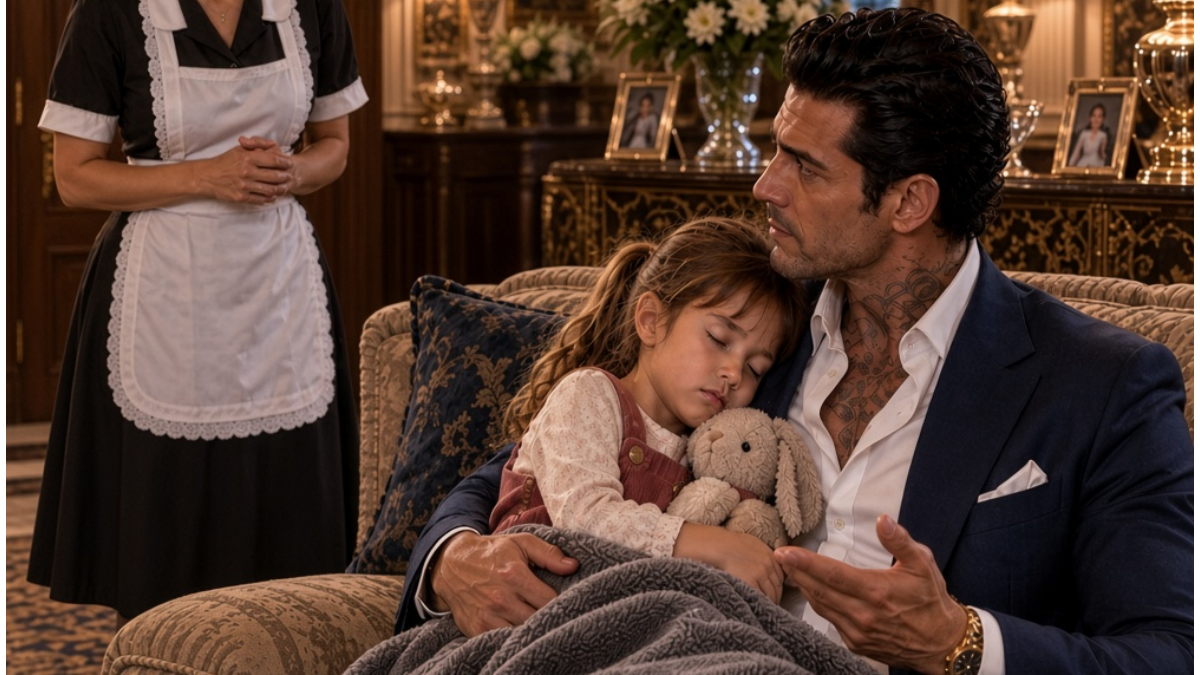
She stopped at the door. Emma was asleep on the sofa, one cheek pressed against Alisandro’s arm, Fantasma curled against her legs.
Alessandra sat rigid beside them, his free hand suspended awkwardly over the back of the sofa as though he had been trapped in a negotiation whose terms he did not understand.
He looked at Sophia with the expression of a man requesting tactical assistance without wanting to admit it.
She fell asleep. He whispered. Sophia covered her mouth, but not quickly enough. A laugh escaped.
Aleandro stared at her. Is something amusing? The sight of one of the most feared men in Chicago being held hostage by a sleeping preschooler destroyed whatever restraint Sophia had left.
She lowered her voice. You look terrified. I am not terrified. You have not moved a muscle.
Because she is asleep, children survive movement. What if she wakes? Sophia folded her arMs. Then I imagine she will continue being 4T away from you and extremely dangerous.
Allesandre gave her a flat look. Sophia smiled despite herself. It was the first time she had laughed freely in his presence, and the change in the room was immediate.
Aleandro had seen Sophia smile at Emma many times. He had seen polite smiles offered to staff and the careful expression she used when speaking to him.
This was different. It reached her eyes. For one disorienting second, he forgot what he had been about to say.
Sophia stepped closer and gently lifted Emma’s head. Alessandro slid his arm free, flexing his hand as circulation returned.
Sophia gathered her daughter into her arms, but Emma was heavier in sleep than she looked awake.
Without asking, Allesandro stood. Sophia instinctively tightened her hold. He stopped. The hesitation mattered. “May I?”
He asked. Sophia looked at him, then at Emma. Rose’s warning moved through her mind.
“Men accustomed to power had to learn that wanting was not permission.” Allessandre was waiting.
Sophia nodded. “She wakes if you hold her too high.” He took Emma carefully. One arm beneath her knees, the other supporting her shoulders.
Emma stirred, mumbled something about stars, then settled against his cheSt. Aleandro looked down at her with such naked surprise that Sophia had to look away.
Together, they carried her to a small sitting room near the servantss quarters, where Sophia had arranged a temporary bed for evenings that ran late.
Alessandro placed Emma down with the concentration of someone handling something priceless and breakable. Fantasma had followed them and immediately jumped onto the chair beside the bed.
Sophia pulled a blanket over Emma. When she turned, Allesandre was still there. Neither seemed quite ready to leave.
They returned upstairs almost by accident. The office felt larger without Emma’s voice filling it.
Sophia stood near the shelves while Alessandro poured coffee and after a moment lifted the second cup in silent question.
She almost refused out of habit. Then she nodded. He handed it to her without comment.
They sat on opposite sides of the room, not employer and employee exactly, but not anything else either.
For several minutes, the only sound came from the old clock on the mantle. Allesandro broke the silence firSt. You said your husband died when Emma was 6 months old.
Sophia looked into her coffee. Yes. He waited rather than asking the next question immediately.
And because he waited, she answered the one he had not spoken. Construction accident. A support failed.
He was working three floors up. Aleandro’s jaw tightened. Was anyone responsible? Everyone was responsible until lawyers became involved.
Then apparently no one was. There was no bitterness in her tone, which somehow made the sentence heavier.
His name was Daniel. He left for work that morning complaining that I had burned the toaSt. By lunchtime, I was filling out forms at a hospital.
Aleandro stared at the floor. I’m sorry. Sophia nodded. She had heard those words thousands of times.
From him, they sounded less automatic. The worst part came later. He looked at her.
After the funeral, people stopped knowing what to say. Then they stopped coming. Bills kept coming.
She gave a small tired smile. Bills are remarkably insensitive to bereiement. Allesandro said nothing.
Sophia continued because now that the door had opened, stopping felt artificial. I did not get to decide whether I wanted to get out of bed.
Emma needed bottles. She got fevers. She grew out of clothes every few months. The landlord did not care that I was grieving.
The grocery store did not accept tragedy as payment. I used to envy people who could disappear after losing someone.
Alessandro heard no accusation in the words, but he felt one anyway. People like me.
Sophia raised her eyes. Yes. He absorbed that without defense. I locked a room. You locked much more than a room.
He almost smiled but did not. Sophia took another sip. You had enough money and enough people around you to make grief private.
I didn’t. I had to carry mine onto buses, into job interviews, through daycare pickup.
I learned how to cry while washing dishes because that was the only time Emma could not see my face.
Aleandro looked toward Maria’s photograph. I thought if I stayed angry, I would not have to feel anything else.
Did it work? For a while, and after that, he was quiet. It became easier than stopping.
Sophia understood. There was no need to tell him grief never disappeared. He already knew.
Their versions of loss were different, but the exhaustion beneath them was familiar. Alessandro had built a fortress around pain.
Sophia had carried hers through ordinary life until it became invisible to everyone except her daughter.
“Emma told me she hears you cry,” he said softly. Sophia closed her eyes. “Of course she did.
She said she doesn’tt tell you because she thinks you might stop.” Sophia let out a breath that was half laugh, half defeat.
That child has absolutely no respect for confidential information. At that moment, Fantasma walked into the office, jumped onto the desk, and sat directly between them with the solemn expression of a judge.
Sophia looked at the cat. There, that is the real head of security. She goes into every room, hears every secret, and answers no questions.
Alessandro glanced at Fantasma, then at Sophia. A sound escaped him before he could prevent it.
It was not the restrained breath of amusement Sophia had heard before. It was a genuine laugh, low and surprised, as though even Aleandro had forgotten what it sounded like.
Sophia stared. He stopped almost immediately. What? Nothing. You’re looking at me. I have never heard you laugh.
Then clearly, you have not been around me enough. The sentence came out before he considered it.
Their eyes met. Something changed in the air, subtle, but undeniable. Sophia sat down her cup.
Allesandre looked away firSt. A small voice broke the moment. Mama. They turned. Emma stood in the doorway with her hair flattened on one side from sleep, dragging the blanket behind her.
Fantasma immediately jumped from the desk as though leaving a meeting before anyone could assign her responsibility.
Sophia stood. What are you doing awake? Emma rubbed one eye. You weren’t there. I was upstairs.
I’m sorry. Emma looked from Sophia to Alessandro, then to the two coffee cups. Were you talking without me?
Adults occasionally manage it,” Allesandro said. Emma seemed unconvinced. She walked into the room and climbed onto the sofa.
Sophia sat beside her and began smoothing her hair. Emma leaned against her mother, still watching Allesandro.
“You eat dinner alone?” She asked him. Aleandro paused. “Usually.” “Why?” “Because that is how I eat dinner.”
Emma frowned, dissatisfied by an answer that explained nothing. Then she looked up at Sophia.
Why don’t you eat dinner with Aleandro? Sophia’s hand stopped in Emma’s hair. Across the room, Allesandro became very still.
Emma looked between them, waiting with complete innocence for one of the adults to explain something neither of them was ready to name.
Emma’s question followed them into the hallway, through the rest of Sophia’s shift, and all the way to the moment Allesandro found himself standing in the smaller dining room that evening, wondering why he had ordered three places set instead of one.
He had eaten alone for years without thinking of it as loneliness. Meals were simply another obligation between meetings, phone calls, and problems that required decisions.
Sometimes his mother joined him on Sundays. Occasionally, one of his men ate across from him while they discussed business.
But dinner as an event, something people gathered for because they wanted one another’s company, had become foreign to him long before Maria died.
Emma had apparently decided this was unacceptable. Sophia had tried to take her home after work, but Emma had reminded her with alarming precision that nobody had answered the question about dinner.
Alisandro could have ignored the entire matter. Instead, he heard himself say, “You can stay tonight.”
Sophia looked at him as if he had just proposed moving the estate to another country.
“For dinner,” he clarified. “I understood.” “Your expression suggested otherwise.” Sophia glanced down at Emma, who was pretending not to listen while clearly listening to every word.
One dinner. Aleandro nodded. One dinner. She looked back at him. And tomorrow I am still your employee.
The distinction landed harder than he expected. I did not say you weren’t. Good. I don’t want Emma thinking one pleasant evening changes everything.
Alessandro understood the warning beneath the sentence. Sophia would not let gratitude become debt, and she would not allow comfort to quietly rewrite the terms of her life.
Then nothing changes unless you decide it does. She studied him for a moment, as if testing whether he meant it.
“All right,” Emma immediately announced that she was starving, which Allesandro suspected had been true only since the adults agreed.
The first 10 minutes of dinner made Allesandro reconsider every decision that had led to it.
Emma asked why the table had so many forks, then why one fork was smaller than another, then why anyone needed a separate fork for salad when the larger fork clearly worked.
Sophia apologized twice before Aleandro told her to stop apologizing for questions he had no answer to.
Emma decided this was permission to continue. She wanted to know why the room was called a small dining room when it was larger than their apartment kitchen and living room combined.
She asked whether Allesandro had ever gotten lost in his own house. She asked why the ceiling needed paintings when nobody could look at them while eating without dropping food.
By the time Soup arrived, Sophia was fighting a smile, and Aleandro had abandoned any attempt to preserve the atmosphere his staff had prepared.
Something about the disorder was oddly relieving. He noticed Sophia’s posture change slowly as the meal continued.
At first, she sat straight back, careful with every movement, calling him Mr. Duca despite Emma correcting her twice.
Then Emma spilled water. Alessandro handed her a napkin without reacting, and some invisible tension left Sophia’s shoulders.
They talked about preschool, about a teacher Emma adored, about a bird that visited the window of Sophia’s apartment every morning.
When Aleandro asked whether the building was far from the school, Sophia answered automatically and then grew cautious.
He knew that look now. It meant she thought a question might have consequences she had not agreed to.
I’m not investigating you, he said. You have people for that. If I were investigating you, I would not need to ask.
Sophia stared at him. Allesandre realized too late that the reassurance had failed. That was meant to make you less concerned.
It did not. Emma, busy arranging peas by size, missed the exchange. Allesandre leaned back.
Then tell me what you are concerned about. Sophia hesitated before answering that you are becoming important to her faster than either of us understands.
He did not expect the directness. Is that a problem? It can be. Her eyes moved toward Emma.
Children attach themselves to people who show up. They don’t understand complicated lives, dangerous work, or adults who might decide something was temporary after they’ve already made it permanent in a child’s mind.
Alisandre looked at Emma. She was whispering something to Fantasma beneath the table and slipping the cat a piece of chicken.
She clearly believed nobody noticed. I have no intention of disappearing. Intentions change. Mine generally don’t.
Everyone thinks that until life changes them. He heard Daniel in the sentence without her needing to say the name.
Sophia lowered her voice. I am not asking you to promise anything. I’m asking you not to promise what you cannot know.
Alessandro nodded slowly. It was not the answer power usually offered. Power promised certainty because people expected it.
Sophia was asking for honesty instead. Then I won’t. She looked at him surprised by how simply he gave ground.
Thank you. Something passed between them then. Quieter than attraction and more dangerous because it was built on understanding.
Over the following days, dinner happened again without anyone officially deciding it would. Then breakfast happened once when Sophia’s shift began early, and Emma arrived before preschool.
Coffee appeared beside Sophia before she asked. Emma’s reading hour stretched into occasional conversations after she became absorbed in coloring or fell asleep on the sofa.
Allesandro learned that Sophia kept a small notebook in her purse where she tracked every expense down to the dollar.
He noticed her checking it one afternoon while Emma drew at his desk. “Is something wrong?”
Sophia closed the notebook. No, you have been looking at the same page for 5 minutes.
That does not mean something is wrong. It usually does, she sighed. My landlord raised the rent.
Aleandrore’s response came too quickly. I’ll take care of it. Sophia looked at him. No, he thought she had misunderstood.
I am not suggesting a loan. I know. Then why know? Because my rent is my responsibility.
You work in my house. Your daughter spends half her afternoons here. If the difference is insignificant to me and significant to you, refusing help makes no sense.
Sophia closed the notebook carefully. It makes sense to me. Alisandre waited. She continued, choosing her words with care.
I have spent years making sure Emma and I can survive without depending on whether someone likes us, loves us, feels sorry for us, or changes their mind.
If you pay my rent because you can, then what happens the first time I tell you something you don’t want to hear?
His face hardened slightly. You think I would punish you financially? I think power creates debts even when the person offering it does not mean to.
He said nothing. Sophia took a breath. I know you are trying to help, but I need my daughter to see that kindness is not ownership, and safety is not something she has to earn by pleasing a powerful man.
Aleandro’s first instinct was irritation. Not because she was wrong, but because nobody had spoken to him this way in years.
His second instinct was to solve the problem anyway. Then he remembered what Rosa had unknowingly warned Sophia about, though he had never heard the conversation.
The difference between wanting to give something and having the right to impose it. What if I increase your salary?
He asked. Sophia almost smiled. For what work? You have taken on additional responsibilities such as he glanced toward Emma.
Negotiating with dragons. Sophia’s mouth twitched, but she held the line. If my job changes, we can discuss my salary.
If it doesn’t, you don’t get to invent a promotion because you dislike my rent.”
Alesandro stared at her for several seconds, then gave a reluctant nod. “Fine, fine.” He returned to his papers.
Sophia reopened her notebook. Neither mentioned that the conversation had changed something between them more than money ever could.
Aleandro had offered protection the only way he understood it. Sophia had refused without humiliating him.
He had listened. That mattered to both of them. Their connection grew through moments too ordinary to announce themselves as important.
Sophia learned Aleandro took his coffee black until late afternoon when exhaustion made him add sugar and deny doing so.
Allesandro learned Sophia hummed under her breath when she was concentrating and stopped the instant she realized anyone could hear.
They disagreed about whether Emma should be allowed another cookie before dinner, and Aleandro discovered that having an empire did not give him jurisdiction over preschool nutrition.
Sophia began calling him Alisandro when they were alone, though she still used Mr. Duca in front of most staff.
One evening, he walked her and Emma to the servant’s entrance and rested his hand lightly at the center of Sophia’s back as she stepped around a patch of ice.
The touch lasted less than a second, but Sophia felt it halfway to home. Aleandro stood at the door longer than necessary after their car left.
Neither spoke of it the next day. Emma, however, had apparently reached conclusions of her own.
She was sitting on the office carpet during reading hour when she closed her book without warning.
Why don’t you have a wife? Aleandro looked up from his desk. Sophia, seated near the window with a cup of coffee, nearly choked.
Emma, what? That is personal. Emma turned back to Alisandro. Do you do I what?
Have a wife? No. Why? Aleandro glanced at Sophia as if she might extract him from the conversation.
Her expression suggested he deserved whatever happened next. It is complicated. Emma sighed. Adults say that when they don’t want to explain things.
Sometimes things are complicated. Mama doesn’t have a husband either. Sophia closed her eyes. Emma, she doesn’t.
Aleandro’s mouth threatened a smile. Emma continued, following logic visible only to herself. Mama makes good pancakes.
You like pancakes? Yes. And you have too many rooMs. Allesandre looked around. I was not aware that was a marital qualification.
Emma ignored him. Mama worries about money. You worry about everything else. You both drink coffee and you’re lonely.
The smile disappeared from Sophia’s face. Alessandrore’s eyes settled on Emma. What makes you think I’m lonely?
You always ate dinner by yourself before us. Children could be merciless without intending cruelty.
Emma looked at Sophia. Mama gets lonely, too, but she says being lonely is better than being with somebody mean.
Sophia stared at the floor. Aleandro absorbed the sentence slowly. Emma brightened as if she had solved the final piece.
“So you could marry Mama, but only if you’re not mean.” “That is enough matchmaking for today,” Sophia said, standing.
Emma frowned. “What’s matchmaking?” Allessandre leaned back in his chair, rescuing Sophia for once. “A profession you are too young to enter.”
Emma seemed satisfied with that answer and reopened her book. Sophia could not bring herself to look at Aleandro for several minutes.
There are moments in a story when nothing explodes, nobody runs, and no secret is revealed.
Yet everything quietly moves into a different place. If you have ever believed one small act of kindness could change the direction of a life, stay with this one a little longer.
That evening, after Sophia and Emma left, Allesandro remained in the office thinking less about Emma’s ridiculous marriage proposal than he wanted to admit.
He did not imagine a wedding. He did not permit himself anything that far ahead.
He imagined breakfast, Sophia arguing with him over coffee, Emma leaving books everywhere, someone asking when he would be home instead of where he would be meeting his men.
The images disturbed him because they did not feel impossible anymore. They felt desirable. He was still sitting with that realization when Luca, one of his senior security men, appeared in the doorway.
The expression on Luca’s face erased the warmth from the room immediately. There’s something you need to see.
Aleandro rose. In the security office downstairs, Luca pulled up footage from a camera covering the servants’s entrance.
A dark sedan appeared across the street shortly before Sophia had left with Emma 2 days earlier.
Another angle showed the same vehicle the following afternoon. Today, it had returned again. Allesandre watched the footage twice.
Plate. We’re running it. Driver couldn’t get a clean face. Aleandro leaned closer to the screen.
The sedan had not parked where visitors waited or where someone would stop by accident.
It sat where the driver could watch people leaving the estate without approaching the gate.
How long each time? Between 20 and 40 minutes. Aleandro’s expression changed so completely that Luca stopped speaking.
The man who listened to stories at 3:00 disappeared. What remained was the Allesandro Chicago understood.
Find out who owns it. Luca nodded, already working on it. Alessandro looked again at the frozen frame, showing Sophia holding Emma’s hand as they walked toward their car, completely unaware of the sedan across the street.
And Luca, “Yes.” Alisandrore’s voice dropped. Until we know what this is, they are never outside alone.
Luca followed his gaze to the screen and understood immediately that the rules of the house had changed.
Aleandro had spent 3 years believing grief was dangerous because it proved how much he had already loSt. He was about to discover something worse.
Caring about people again meant giving the world away to hurt him. The sedan belonged on paper to a shell company that had been dissolved eight months earlier, which told Aleandro two things immediately.
Whoever was watching Sophia and Emma had expected someone to check, and whoever had arranged it was not an amateur.
By midnight, Luca had traced the registration through three layers of ownership to a name Aleandro already knew.
Marco Santos had never been important enough to command Alessandro’s full attention. He operated along the edges of larger organizations, buying information, arranging introductions, trading favors between men who preferred not to be seen speaking directly.
He was ambitious in the way mediocre men often were, mistaking patience for intelligence and secrecy for power.
6 months earlier, Aleandro had blocked one of Marco’s attempts to move into a profitable territory near the river.
There had been no war, only a warning delivered through intermediaries and obeyed without argument.
Alessandro had assumed the matter settled. Now he sat in the security office watching grainy footage of the sedan across from his gate and understood that Marco had found a different kind of territory to teSt. How long has he known about them?
Aleandro asked. Luca stood behind him with a folder of preliminary reports. We don’t know yet.
Find out. We already have people on Santos. Aleandro turned. Not people who think I want a business report.
I want every place he has been, every person he has paid, every call he has made through someone else.
I want to know whether he learned about Sophia because she works here or because someone told him Emma matters to me.
Luca hesitated. Do they matter to you? The room became still. Luca had worked for Alisandre long enough to know the risk of asking a question like that, but he also knew security could not be built around an answer nobody was willing to say aloud.
Allesandre looked back at the screen. Sophia was frozen in the image with one hand around Emma’s, her head turned slightly toward her daughter as they walked enough that this conversation never leaves this room.
Luca nodded. Aleandro ordered additional surveillance around Sophia’s apartment, Emma’s preschool, and every route between them, but he gave one instruction that would become his first mistake.
Sophia was not to be told yet. He justified the decision easily. There was no confirmed threat.
Telling her would frighten her unnecessarily. If Marco was only watching, Alisandro could remove the problem before Sophia ever knew one existed.
It sounded reasonable because control often sounded reasonable when Aleandro was the one exercising it.
He did not consider that protecting someone without their knowledge also meant making choices about their life without their consent.
For 4 days, nothing happened that could be called an attack. That was almost worse.
The sedan disappeared, but different vehicles began appearing near places Sophia went regularly. A man in a baseball cap spent 40 minutes across from Emma’s preschool and left without entering any building.
Another asked the superintendent at Sophia’s apartment complex whether a woman named Sophia Morty still lived on the third floor, claiming he had an old delivery for her.
The superintendent thought nothing of it until one of Aleandro’s men questioned him later. At the park on Saturday, Emma ran toward the swings while Sophia sat on a bench 10 yards away and one of the plain closed guards Alessandro had assigned without Sophia’s knowledge watched from near the entrance.
Nothing unusual happened until Emma came running back, breathless and irritated because another child had taken the red swing.
Sophia opened her water bottle and handed it to her. Emma drank, then looked over Sophia’s shoulder.
The man from yesterday is here. Sophia turned. What man? Emma pointed toward a figure near the fence, but whoever she meant was already walking away.
He knows my name. Sophia’s entire body went cold. What did you say? Emma looked confused by the sudden change in her mother’s voice.
He said, “Hi, Emma. Yesterday by school,” Sophia stood so quickly the bottle fell from her lap.
She scanned the park. “Parents, strollers, dogs, children, two teenagers on bicycles, an elderly man reading a newspaper.
No obvious threat.” She grabbed Emma’s hand. “We’re leaving.” The plane closed guard saw the movement and followed at a distance, sending a message to Luca as he walked.
By the time Sophia reached her apartment, Allesandro knew. By the time she finished locking the door, two men were stationed outside the building.
She knew none of this. She only knew that someone she had never met appeared to know her daughter’s name.
Monday morning, Sophia arrived at the estate with Emma, an attention Aleandro noticed before she removed her coat.
He almost told her then he should have. Instead, he asked whether everything was all right.
Someone spoke to Emma near school, Sophia said. Alessandro felt anger rise but kept his face controlled.
What did they say? Only her name, apparently. Did she recognize him? She says she saw him again at the park.
Sophia watched his reaction closely. Why are you not surprised? Alessandro’s answer came a fraction too late.
I am. Sophia said nothing, but distrust entered the silence between them. That afternoon, she left Emma in the office for reading hour and went downstairs to collect paperwork from the staff room.
On her way back, she noticed a man near the side entrance pretending to study his phone.
She had seen him the previous morning outside her apartment. At first, she thought coincidence.
Then he looked up, recognized her, and immediately turned away. Sophia changed direction, followed him through the corridor, and caught up before he reached the security wing.
Excuse me. The man stopped. Ma’am, who are you? Security here? Yes. Then why were you outside my apartment yesterday?
His eyes flicked toward the office door ahead and that tiny hesitation told Sophia everything she needed to know.
Mr. Dooka asked you to follow me. I think you should speak with Mr. Duca.
Sophia did not thank him. She walked straight upstairs. Emma was sitting on the floor reading a story about a rabbit determined to fly.
Allesandre was pretending to read documents. Sophia entered, crossed the room, and said, “We need to talk.”
Alesandre looked at her face and knew immediately what had happened. He asked Emma to take Fantasma into the small sitting room next door and choose another book.
Emma complained that the rabbit had almost reached the important part, but Alisandro promised they would continue in a few minutes.
When the connecting door closed, Sophia turned on him. “How long, Sophia? How long have your men been following us?”
Alisandre stood. They are not following you. They are protecting you. Do not change the word because you prefer how it sounds.
Her voice remained low because Emma was nearby, but the restraint made her anger sharper.
How long? Several days. Sophia stared at him. You knew. I knew someone had been watching the estate.
And you said nothing. I did not have enough information. A stranger knew my daughter’s name, which is exactly why security was there.
Security I did not know existed. Aleandro’s jaw tightened. Would knowing have made you safer?
It would have made me part of the decision. The answer stopped him. Sophia stepped closer.
You do not get to decide that I am too frightened to hear the truth.
You do not get to put men outside my home around my child and then call it protection as though that means I should be grateful.
I was trying to prevent you from panicking over something I could handle there. Sophia pointed between them.
That is the problem. You still think I can handle it means nobody else gets a voice.
Allesandro felt the old reflex rise, the desire to end the argument simply because he could.
Then he remembered every conversation in which Sophia had insisted that safety without choice was only another kind of dependence.
He forced himself to answer differently. You’re right. Sophia had prepared herself for resistance so completely that the words seemed to disorient her.
Allesandre opened the desk drawer and removed a thin folder. You should have known from the beginning.
He showed her everything. The sedan, the shell company, Marco Santos, the man near the preschool, the questions at her apartment building, the photographs his team had collected from surveillance of Marco’s associates.
Sophia listened without interrupting until Alessandro placed the final image on the desk. Emma leaving preschool with Sophia, taken from across the street.
Her face went pale. He is doing this because of you. It was not an accusation so much as a fact she needed to hear spoken.
Alessandro did not hide from it. Yes, because he thinks we matter to you. Yes.
Sophia looked toward the closed door where Emma’s voice could be heard faintly explaining something to Fantasma.
Then I’m taking her to my mother. Aleandro responded immediately. No. Sophia turned. You just admitted I should be part of the decision and I am telling you the route to your mother’s house would be predictable.
If Marco knows where you live and where Emma goes to school, I’m assume he knows you have family.
4 hours on the highway gives him more opportunities. Not fewer. Then we take another route.
No route is safe if he is already watching for you. So what is your solution?
We stay here indefinitely for now. In a fortress full of armed men because my daughter read stories to the wrong person.
Allesandro flinched. Sophia saw it and regretted the cruelty immediately, but fear had sharpened every word.
I am not blaming Emma, he said. I know. Sophia pressed both hands against the desk and tried to steady her breathing.
I need to think like her mother, not like someone who trusts your security because you tell me to.
Alessandro nodded. Then think with all the information. They spent the next hour doing something new, building a plan together.
Sophia listed everyone who knew her routines, from the preschool receptionist to the neighbor who occasionally watched Emma.
Allesandro explained which routes could be monitored, what changes could be made without signaling panic, and which members of his staff he trusted.
Absolutely. Sophia insisted Emma’s teachers be informed that nobody except named adults could collect her.
Aleandro agreed. He wanted Emma withdrawn from preschool immediately. Sophia refused. If the threat becomes immediate, yes, but I will not teach her that fear makes the entire world disappear.
He argued that routine was not worth risk. She countered that isolation created its own damage.
They compromised. Emma would stay at the estate for several days while Alisandre’s people verified whether the school had been compromised.
Then they would reassess. Sophia would move temporarily into a guest suite with Emma. Not because Alessandro ordered it, but because after seeing the photographs, she chose it.
The distinction mattered. When they finished, Aleandro looked at her across the desk. I am sorry.
Sophia’s anger had cooled into exhaustion. For what? For deciding what you could handle. She nodded slowly.
Don’t apologize and do it again. I won’t. She looked at him for a long moment.
That sounds dangerously like a promise. Then hold me to it. That evening, Emma treated the temporary move into the estate like an adventure.
She chose the room with the yellow curtains, arranged her books on a low shelf, and informed Fantasma that she was now allowed to visit, but not sleep on her pillow.
Sophia tried to match her daughter’s calm, though every sound outside the window made her look up.
Allesandro increased patrols without making the house feel like a prison. For the first time, he included Sophia in the security briefings that concerned her.
It was imperfect cooperation, but it was cooperation. Near midnight, Luca came to the office with an envelope held inside a clear evidence sleeve.
This was found in the east corridor. Alessandro stared at it. Inside the house, Luca nodded.
On the table near the service stairs, cameras covering that section went dark for 11 minutes.
Sophia, who had been sitting on the sofa, waiting for an update, stood. Allesandro opened the envelope carefully.
There was no letter, only a photograph. Emma sat on the carpet in Aleandro’s office with a book open in her lap.
Alisandre was visible behind his desk. The angle came from the hallway. Through the partially open door, the image could not have been taken from outside the estate.
Sophia stopped breathing for a second. Aleandro’s face changed into something colder than anger. The sedan, the park, the questions at the apartment building had all belonged to the world beyond his gates.
This was different. Someone had entered the safest place he possessed, reached the second floor, stood within sight of Emma, taken a photograph, and left it where they knew he would find it.
Sophia looked at Allesandro. You said no one would touch us here. His eyes remained fixed on the photograph.
I was wrong. The admission frightened her more than certainty would have. Aleandro had spent his life building a fortress strong enough to keep enemies outside, and grief locked within.
Now somewhere inside that fortress, an enemy had already opened a door. By sunrise, the Duca estate no longer felt like a home pretending to be a fortress.
It felt like a fortress remembering what it had been built for. Gates were sealed.
Deliveries were suspended. Every employee was accounted for twice, then questioned separately. Phones belonging to security staff were collected and checked.
Service entrances were locked from the inside. Men who had worked for Aleandro for 15 years found themselves sitting across from Luca answering where they had been during the 11 minutes the east corridor cameras went dark.
No one complained. They had all seen Alisandro angry before. But this was different. Anger usually moved through him like fire, fast and visible.
This was ice. He did not shout. He did not threaten. He stood in the security room studying maps, access logs, and camera feeds while the photograph of Emma remained face down on the table beside him.
Sophia sat across from Luca during the first briefing because Allesandro had promised there would be no more decisions about her life made in rooms she could not enter.
She listened as Luca explained that whoever had taken the picture either knew the house intimately or had been guided by someone who did.
The east quarter cameras had not failed. They had been disabled from a maintenance panel accessible through a service passage used by heating contractors and senior staff.
Who had access? Sophia asked. Luca glanced at Aleandro before answering. More people than I like.
How many? Staff, security supervisors, maintenance, outside contractors, depending on the week. Alessandro spoke without looking up, then reduced the liSt. Luca already had.
Three permanent employees had used the passage recently, all of them with years of clean history.
Two outside contractors had been admitted during heating repairs. One had signed in under a company Alessandro’s people used regularly.
The problem was that the technician listed on the form had not been the technician the company actually sent.
“Someone substituted a man,” Luca said. “Or someone here allowed a substitution.” Sophia felt the old instinct to take Emma and run, but running had become more frightening than staying because she no longer knew where the threat ended.
Emma was upstairs with Rosa, unaware of the details, and delighted that breakfast had been brought to her room.
Sophia hated the contraSt. Her daughter was arranging strawberries into faces while grown men downstairs discussed how someone had watched her through an office door.
Show me the contractor records, Sophia said. Luca hesitated. Sophia, that is security material. And my daughter is in the photograph.
Allesandre lifted his eyes. Show her. Luca slid the printed logs across the table. Sophia read slowly.
Names, arrival times, signatures, service notes. Most meant nothing to her. Then one entry made her stop.
This one. Aleandro came around the table. What about him? I saw him. Luca leaned closer.
Where? Near the laundry corridor. Maybe a week ago. He asked where the east stairwell was.
Did you tell him? No. I told him contractors normally use the west service stairs.
Sophia closed her eyes, reconstructing the moment. He said the heating panel he needed was on the other side.
Rosa walked past and told him she would find maintenance. Luca asked, “What did he look like?”
Sophia described him as best she could. Medium height, dark cap, work jacket, clean boots, too clean, she realized now for someone who had supposedly spent the morning servicing old radiators.
He seemed wrong, she said. Not dangerous, just not like he belonged where he said he belonged.
Aleandro studied her. Why didn’t you report it? Sophia looked at him. Because people see things that feel slightly wrong everyday.
Most of them are nothing. She was not defensive. The truth unsettled her more than blame would have.
The man had not threatened anyone. He had carried a toolbox, worn the right clothes, and spoken with enough confidence to fit the story everyone expected.
That had been sufficient. Luca pulled the contractor photograph from company records. Sophia shook her head.
That’s not him. The room went quiet. Aleandro looked at Luca. Find the man who was here already starting.
And the person who cleared him through the gate. The search tightened. By late morning, they discovered that the false contractor had entered using a work order created from a legitimate maintenance request, but modified after approval.
Someone with internal credentials had changed the name attached to the job. The credential belonged to a junior security administrator named Tomas Vale, a quiet man who had worked at the estate for almost 4 years and had never once appeared on Aleandro’s list of concerns.
Tomas denied everything. He claimed someone must have stolen his password. Luca believed that was possible until they found two cash deposits spread across separate accounts connected to Tomas’s brother.
Not enough money to transform a life, enough to pay off a gambling debt, Tomas broke before noon.
He had not been loyal to Marco in any meaningful sense. That almost made it worse.
He had not betrayed Alessandro because of ideology, revenge, or ambition. He had been desperate, ashamed, and convinced the favor was small.
All Marco initially wanted was scheduling information. Which entrances were busiest? When Sophia usually left, whether Emma came every day, then Marco asked for a contractor pass.
Tomas told himself the man would only look around. When the east corridor cameras were disabled, Tomas realized the favor had become something else.
But by then, Marco had copies of his messages and proof of the payments. He said, “If I stopped helping, he would send everything to you.”
Tomas whispered during questioning. Alessandro stood across from him, expression unreadable. Years ago, Tomas might already have disappeared before finishing the sentence.
Sophia could see the possibility in Aleandro now, like an old road appearing beneath fresh snow.
He asked only one question. Did you know there was a child in that room?
Tomas started crying. Not at firSt. Alessandro’s hands tightened at his sides. Sophia did not touch him.
She did not ask him for mercy because the moment did not belong to her and Tomas had knowingly placed Emma at risk.
But she watched Alessandro carefully. He ordered Tomas removed from the estate, held under guard, and turned over to people who would extract every detail of Marco’s network without allowing him to leave.
There was menace in the order, but not the blind rage Sophia had feared. Allesandre walked out before Fury could choose for him that mattered.
Later, when they were alone in the office, he stood at the window with both hands braced against the frame.
I should have seen it. Sophia stayed near the desk. You cannot personally know every debt every employee has.
I pay people to know. Then your system failed. He turned. That is supposed to make me feel better.
No, it is supposed to stop you from pretending this happened because you were not controlling enough.
The words struck exactly where she intended. Aleandro’s expression hardened. Someone got within 20 ft of Emma.
And if your answer is to control every person, every hallway, every decision, then Marco gets to change this house without ever entering it again.
Alessandro looked away. Sophia softened her voice. You told me anger made grief easier because anger gave you something to do.
Do not make the same mistake with fear. That afternoon, Fantasma refused to go near the Eastern Service Passage.
It was such a small detail, Sophia almost ignored it. The cat had spent years roaming every corridor in the estate and usually treated closed doors as personal insults.
Now she approached the service junction, stopped several feet away, flattened her ears, and turned back.
Sophia followed. There was a faint smell she could not place at first, sharp beneath the old wood and cleaning polish.
She called Luca rather than opening anything herself. Security searched the passage and found a second device hidden behind a heating grill.
Not a camera this time, but a small wireless transmitter connected to the internal alarm network.
Marco’s man had not merely photographed Emma. He had created a way to monitor when specific doors opened and when sections of the security system changed status.
Lucas swore under his breath. Allesandro arrived minutes later and stared at the device while Fantasma sat at Sophia’s feet as if demanding recognition for services rendered.
“How long?” He asked. “Could have been days,” Luca said. “Maybe longer.” That possibility ended all argument about whether the estate remained secure.
The inner system had to be rebuilt section by section. Until then, Sophia and Emma were moved to a reinforced suite in the central wing with Rosa staying nearby and only three named guards permitted access.
Allesandre wanted to leave immediately and take Marco himself. Sophia knew before he spoke. She saw it in the way he strapped on his watch, in the abrupt instructions he gave Luca, in the old coldness settling over him.
Where are you going? She asked. To end this, your people know where Marco is.
We have a probable location. Then send them. Aleandro looked at her as if the suggestion were impossible.
He came into my home. One of his men came into your home. Because Marco sent him.
And now Marco wants you angry enough to stop thinking. Aleandro stepped closer. You think I should sit here while someone who photographed your daughter is still breathing outside these gates?
Sophia held his gaze. I think Emma is upstairs asking when you are coming back to finish the rabbit story.
The sentence stopped him harder than a command. This is not about a story. No, it is about what you choose when you are afraid.
His face changed. Sophia had never seen him look vulnerable and furious at the same time.
You don’t understand. Then tell me. Allesandre looked toward the hallway, toward the floors above them where Emma was waiting.
When he spoke, his voice was low enough that Sophia had to lean closer. I watched my sister leave this house one morning and assumed I would see her again that evening.
I was wrong. I have spent 3 years remembering every ordinary thing I failed to say because I thought there would be another day.
Now I look at Emma and I know exactly what can be taken from me.
I look at you and know the same thing and I cannot go through that again.
The last sentence barely sounded like him. Sophia’s anger disappeared. You cannot prevent loss by becoming the most dangerous person in every room.
Maybe I can prevent this one. Then do it intelligently. Aleandro closed his eyes for a moment.
Sophia continued. If you leave because Marco told you to be angry, he is making your decisions.
If you stay until this house is secure and let the people you trust do their jobs, you are making them.
He looked at her. And if they fail, then we deal with what comes next together.
A faint crash sounded somewhere in the house before he could answer. Instantly, the estate erupted into controlled motion.
Radios came alive. A warning light flashed on the security panel. Luca’s voice came over the internal line.
Breach alarm. Western service gate. Aleandro reached Sophia at the same moment two guards entered.
Take her upstairs. Sophia did not argue. She ran. The breach lasted less than 4 minutes, but inside the secure room, time lost shape.
Sophia held Emma against her while Rosa locked the secondary door. Emma knew now that something was wrong.
“Is somebody bad outside?” She whispered. Sophia refused to lie. “Someone is trying to scare us.”
“Is Aleandro scared?” Sophia looked at the child. “Yes,” Emma seemed surprised. “He doesn’t look scared.
People look different when they’re scared.” Outside, security intercepted a van that had forced the western service gate after presenting counterfeit delivery credentials.
The driver fled before entering the main grounds. No gunfire, no attacker charging the house.
It was not meant to succeed. It was meant to pull security weSt. At the same time, someone attempted remote access to the alarm system from an external connection linked to the transmitter discovered earlier.
Marco was testing the estate, measuring response, proving he could still reach toward them. Aleandro remained inside.
Every part of the man he had once been demanded that he get into a car and hunt Marco down personally.
Instead, he stayed in the central hall outside Emma’s secured suite while Luca coordinated the pursuit.
When the allcle finally came, Alessandro opened the door. Emma ran to him before Sophia could stop her.
He caught the child against his chest and for several seconds his face was buried in her hair.
Emma wrapped both arms around his neck. Did the bad person leave? Yes. Are you still scared?
Alisandro looked at Sophia over the child’s shoulder. A little. Emma nodded as though this were an acceptable amount.
Later that evening, Luca arrived with the first useful break. They had traced Marco to an industrial property near the river.
But before Allesandro could issue instructions, Luca handed him a phone recovered from the abandoned van.
One message had been left open on the screen. It contained a location and a single sentence meant for Aleandro.
Come alone if you want this finished. Aleandro, read it twice. Sophia watched his face and knew exactly what Marco expected him to do.
The old Aleandro would have gone without hesitation because rage had once been the only language he trusted.
The man standing beside Emma’s half-finish story book now had something more difficult than rage to carry.
He had people waiting for him to come back. Aleandro did not go to the address Marco sent.
That decision surprised Luca almost as much as it surprised Alessandro himself. For years, men had built strategies around one assumption.
If they struck hard enough at something Alessandro considered his, he would eventually come for them personally.
Marco had made the same calculation. The message on the phone was not simply an invitation.
It was a script, and the easiest way to lose was to perform the part someone else had written for him.
Aleandro stood in the security room with the location glowing on a monitor, while Luca laid out what they knew about the abandoned industrial property near the river.
Two entrances, a loading yard, offices on the second floor. Several cameras that had gone offline during the last hour, too obvious.
Sophia listened from the end of the table. Emma was asleep upstairs with Rosa, exhausted by a day she still understood only as adults behaving strangely.
He wants you there, Sophia said. Alessandro looked at her. We established that. No, I mean he needs you there.
Luca turned slightly. Sophia continued. Everything Marco has done has been about making sure you know he can reach us.
The cars, the man at the school, the photograph inside your office, the fake breach tonight.
If killing you were the point, why spend days making you angry first? Aleandro said nothing.
He wants a reaction, she said. Something everyone can see. Maybe he wants you walking into a trap.
Maybe he wants proof that one child can make Alisandra Duca abandon every rule he has.
Either way, going there alone gives him the story he wants. Luca nodded slowly. She’s right.
If Santos has people watching the property, they may care more about who arrives than what happens inside.
Allesandre looked again at the message. Come alone if you want this finished. 3 years earlier, anger would have translated those words into a challenge.
Now they look childish. Then nobody gives him what he wants. Luca’s expression sharpened. We hold.
We close every road around him without making it look closed. Cut his phones. Freeze the accounts we know.
Pick up the men he uses to carry messages before they know the others are gone.
I want him spending the next hour believing I am driving toward him while everything he depends on disappears.
Luca almost smiled. That sounds more familiar. Not entirely. Allesandre looked toward Sophia. Nobody touches him unless there is no other choice.
I want him alive long enough to tell us whether Tomas was the only person inside this house he bought.
Luca nodded and began issuing instructions. Aleandro stayed where he was. Marco’s mistake was believing power existed only in visible violence.
Aleandro had once believed something similar. Over the next 90 minutes, Marco’s world contracted without a gunshot inside the estate and without Alessandro leaving Sophia’s sight.
A driver expected at the river property never arrived because he was intercepted three neighborhoods away.
Two men watching a secondary road discovered that the phones they used for instructions no longer connected to anything useful.
An account Marco kept under another name was flagged before money could be moved. A warehouse he relied on was emptied by men who decided loyalty had become too expensive.
One of his closest associates, realizing Marco had brought a child into a dispute that had once been about territory and money, offered Luca information before anyone threatened him.
The industrial property was not a fortress. It was theater. Marco had arranged men inside, cameras outside, and a vehicle in the rear prepared to move the moment Allesandro entered.
The plan was crude once its purpose was understood. Marco intended to lure Alessandro through the front, create enough confusion to force a violent response, record whatever followed, and use the footage to fracture alliances that depended on Aleandro appearing controlled.
If Aleandro died, Marco gained prestige. If Aleandro survived after slaughtering everyone in sight, Marco gained proof that Sophia and Emma could make him reckless.
Either result benefited him. Neither happened. When Luca’s team finally moved on the building, they entered from the rear after the escape vehicle had already been disabled.
Marco made it less than 20 yards into the loading yard before discovering that every route he believed open had been closed.
Allesandre watched through a secure feed from the estate. Marco was dragged into view, furious, shouting that Alessandro was a coward for not coming himself.
The insult produced no reaction. Sophia stood several feet behind Aleandro and saw the moment he understood what victory actually looked like.
It was not Marco on his knees. It was Aleandro still standing in the room where Emma slept upstairs, refusing to let an enemy decide what kind of man he would become.
“Bring him somewhere secure,” Aleandro told Luca through the line. “Get every name, every payment, every contact.
Then he is finished here. Luca understood that finish did not require a spectacle. Marco would lose the network he had spent years building.
The confidence of anyone who might have worked with him and every useful path back into Aleandro’s world.
His threat would end because the machinery beneath it was dismantled. Not because Alessandro needed to prove rage in public.
Before dawn, Tomas’s information was matched against Marco’s records. There had been no second insider in the permanent household.
The false contractor had used Tomas’s credentials and the transmitter to create the illusion that Marco possessed deeper access than he really did.
The estate had been penetrated once, then psychologically penetrated a hundred times more because fear filled the gaps.
When Luca delivered the final report, Aleandro closed the folder without triumph. So that is it?
Sophia asked. For Marco, “Yes, you sound disappointed. I spent years thinking ending a threat was supposed to feel like something.”
Sophia looked toward the dark windows. Maybe feeling nothing is better than needing it to feel good.
The house slowly relaxed over the next 2 days. Security remained tighter, but doors opened again.
Staff returned to regular schedules. Emma was told that the bad person would not be bothering them anymore, which satisfied her for approximately 30 seconds before she asked whether she could go back to preschool because her class was making paper planets and she had already missed Saturn.
Sophia laughed, then nearly cried from relief when she realized laughter had come firSt. Yet relief did not answer the larger question.
On the third evening, after Emma had gone upstairs with Rosa, Sophia found Allesandro in the office standing beside the sofa where the old blanket lay folded over one arm.
“We cannot stay here forever,” she said. He turned. Months earlier, the statement would have triggered immediate resistance.
“I know.” Sophia had prepared an argument and found herself without one. “You know, you have a home.
Emma has school. You have a life that existed before my problems entered it. Our apartment does not feel especially safe anymore.
Then we find another one if that is what you want. Sophia watched him carefully.
You would let us leave? The question he hurt him, but he did not hide from it.
I would make sure you were protected quietly and with your knowledge this time. But yes, even if you hated it, especially then.
He walked to the desk and rested one hand against its edge. I spent most of my life believing protection meant making sure nobody could take something from me.
The last few weeks have made it painfully clear that people are not things. Sophia stepped closer.
Alessandra continued, “I can change how this house works. I can change who has access to me, what business I allow near my home, how much of my world I carry through that door.
I cannot promise you the past disappears because I want a different future.” “I would not believe you if you did.”
“Good,” his expression softened. Then tell me what you want. Sophia was silent for a long time because no powerful man had ever asked the question in a way that made refusal feel genuinely possible.
I want Emma to go to school without thinking men with guns are normal. I want to work because I choose to work, not because somebody decides I should be grateful for being taken care of.
I want to know that if I disagree with you, I am not risking the roof over my daughter’s head.
And I want She stopped. Allesandre waited. I want whatever this is between us to belong to us, not to the fact that you saved us from someone who came after us because of you.
Alessandro accepted every word. Then that is what it will have to be. Sophia shook her head slightly.
You still do that. Do what? Turn a conversation into a decree. For the first time that evening, he smiled.
I am improving slowly. Very slowly. The smile faded into something more vulnerable. Sophia, if you leave tomorrow, I will still be grateful.
Emma opened that door and I will still be grateful you stayed long enough to tell me when I was wrong.
Her eyes filled, but she did not look away. I don’t want to leave tomorrow.
Aleandro barely breathed. Sophia stepped closer until only a small distance remained between them. I do not love your empire.
I do not love men standing at gates or the way everyone stops talking when you enter a room.
I do not love knowing there are parts of your life I may never be comfortable with.
Allesandre nodded once. I know. But I love the man who bought cookies and lied about it.
I love the man who learned to ask before picking up my daughter. I love the man who sat in this house tonight while every instinct told him to go prove something with violence.
His eyes closed briefly. Sophia’s voice softened. And I think I have been falling in love with the man who will listen to the same dragon story three times because a little girl insists he missed something the first two.
Allesandre looked at her as though every defense he possessed had become irrelevant. “Is that enough?”
He asked. Sophia reached for his hand. It is enough to choose tomorrow. He did not make a promise about forever.
Not yet. He simply lifted her hand and held it. And for once, neither of them needed certainty more than they needed honesty.
Later, after Sophia had gone upstairs, Aleandro remained alone in the office. His gaze fell on the blanket folded across the sofa, the same one Emma had dragged from a chair on the afternoon she walked into a room everyone else feared.
He picked it up and remembered waking beneath it, angry before he understood what had happened, then confused by a child who had looked at him and seen sadness where the rest of the city saw danger.
For 3 years, he had believed the office belonged to Maria because grief had frozen it at the moment of her death.
Now there were colored pencils in one drawer, Emma’s drawings beneath the lamp, a coffee cup Sophia had forgotten beside the window, and a paper crown still crushed beneath a book where Fantasma had knocked it weeks earlier.
None of those things erased Maria. That was the realization that finally loosened something he had guarded more fiercely than any territory.
Loving what came after did not betray what came before. The room did not have to choose between the dead and the living.
Neither did he. Alessandro folded the blanket again and placed it back on the sofa, not as a relic, but as something waiting to be used.
Then he left the office door open when he went upstairs. The weeks after Marco disappeared from their lives were quieter than any of them expected.
Quiet, Sophia discovered, felt different when it was chosen instead of imposed. Emma returned to preschool and resumed the serious business of paper planets, missing mittens, and deciding which children were trustworthy enough to be invited into her imaginary dragon club.
Sophia returned to work, but not in exactly the same way. She and Aleandro sat down with the estate manager and rewrote her position formally, separating her duties from the personal relationship that had grown around them.
Her salary changed only where her responsibilities genuinely changed. Her hours became predictable enough that she no longer had to improvise child care every time the schedule shifted.
Allesandro offered to arrange a better apartment closer to Emma’s school. Sophia agreed to look, but only after insisting the lease would be in her name and the rent would remain hers to pay.
He accepted without argument, which pleased her more than any grand gesture would have. They eventually found a modest two-bedroom apartment on a quiet street with a small balcony where Emma could leave crumbs for birds.
Allesandro hated the locks and replaced them before Sophia could object, but this time he asked firSt. Security remained in the background, discreet and discussed openly.
It was not the normal life Sophia had imagined before meeting him, but it was closer to one than she had believed possible inside his world.
Emma no longer came to the estate every afternoon. Some days she had school activities.
Some days Sophia worked late. Some days they went directly home and ate dinner in their own kitchen while Aleandro remained at the estate staring at the clock around 3 out of habit.
At first he worried the change meant losing the ritual that had pulled him back toward the living.
Then he realized healing was not supposed to trap them inside the room where it began.
Emma still arrived with books, but now she also arrived with stories from school, scraped knees, drawings, complaints about vegetables, and questions that had nothing to do with grief.
The office became one room among many in a house that was slowly learning how to hold ordinary life.
The curtains stayed open. Maria’s photograph remained on the shelf. Emma’s drawings multiplied around it.
Sophia’s coffee cup appeared often enough that Alessandro stopped pretending it had been forgotten. Fantasma continued occupying whichever chair seemed least convenient.
Most importantly, the oak door remained unlocked. One Saturday afternoon, Alessandro walked past the office and heard Emma reading inside.
He paused before entering. She sat cross-legged on the carpet with Fantasma facing her like a skeptical audience of one.
The story was the same dragon book she had carried into the room the first day they met.
Emma had advanced enough in reading that she no longer relied entirely on memory. She sounded out difficult words under her breath, then repeated each sentence with greater confidence once she understood it.
Sophia stood in the doorway on the opposite side, watching without interrupting. Alessandro leaned against the frame beside her.
She still skips the page where the dragon steals the baker’s hat. He whispered. Sophia smiled.
She says it slows down the story. It explains why the baker refuses to help him later.
Take it up with the editor. Emma looked up. I can hear you. Alessandro entered.
Then your concentration needs work. She closed the book over one finger. You missed the beginning.
I know the beginning. You always say that. He sat on the sofa and Emma resumed reading.
Sophia remained by the door for another moment, and the image struck her with unexpected force.
Months earlier, she had stood in almost the same place, convinced she was about to lose her job, terrified of the man lying on that sofa while her daughter read to him.
Now, Alisandro rested one arm along the back cushion, listening with the solemn attention Emma demanded, while Fantasma climbed beside him and immediately took possession of half the blanket.
Nothing about the room had changed enough to explain how completely its meaning had transformed.
The same desk, the same shelves, the same windows, the same photograph of Maria. Yet, the office no longer felt like a tomb.
It felt inhabited. When Emma finished, she announced that the dragon had made better decisions because someone had finally told him being angry all the time was exhausting.
Aleandro raised an eyebrow. That lesson was not in the book. It should be. Sophia laughed.
Allesandre looked at both of them, and for a brief second, an old instinct told him to preserve the moment exactly as it was.
Then he understood that trying to freeze happiness would only repeat what he had done with grief.
Moments did not survive because you locked them in rooMs. They survived because you allowed the next one to arrive.
A few evenings later, Alessandro asked Sophia to walk with him through the garden Maria had planted behind the east wing.
Spring had softened the estate. New leaves covered the trees, and the first white flowers had opened along the stone path.
Emma remained inside with Rosa, finishing a drawing she claimed was a secret despite having already told everyone it involved a dragon, three people, and a wedding cake.
Sophia suspected something before Alisandro spoke, but she did not rescue him from the difficulty.
For once, she let a man accustomed to commanding room search for words. I have been thinking about what you said, he began.
That narrows it down very little about choice. Sophia looked at him. Alessandro stopped near a low stone wall where Maria had once insisted on planting lavender despite being told it would not survive the winter.
Some of it had for most of my life. I thought commitment meant making sure something could not leave.
He gave a quiet, humorless breath. That sounds worse when spoken aloud. Most controlling ideas do.
He nodded. I am not going to tell you I can give you a life without danger.
I cannot tell you I will become a different man in every way. And I will not pretend the choices I made before you disappear because I regret parts of them now.
Sophia listened. But I can tell you I know the difference between protecting you and owning your future.
I know the difference between Emma loving me and me having a right to call myself her father.
And I know I want to spend the rest of whatever life I have becoming someone both of you can choose without fear.
He reached into his coat and removed a small ring box. Sophia’s eyes filled before he opened it.
The ring inside was simple, a single diamond on a white gold band. Alessandro did not kneel immediately.
He looked at her firSt. I am not asking because we survived. Marco, I am not asking because Emma thinks your pancakes qualify you for marriage.
I am asking because when you disagree with me, I become better at listening. When you leave a room, I notice.
When you come back, the place changes. I am asking because I love you. And because for the first time in years, I am not trying to preserve the past or control the future.
I only know I want to build whatever comes next with you. Then he knelt.
Sophia Morty, will you marry me? She let him wait just long enough to remind him that even now the answer belonged to her.
Then she smiled. Yes. The relief on his face was so immediate and unguarded that she laughed through her tears.
Aleandro stood and slipped the ring onto her finger. You enjoyed making me wait. A little cruel.
You’ll survive. He kissed her gently at firSt. the land with the certainty of two people who had spent months learning that tenderness was not the same as weakness.
When they finally returned inside, Emma was waiting on the staircase, supposedly because Rosa had failed completely at keeping a secret.
She spotted the ring before either adult spoke. “You said yes.” Sophia stared at Rosa.
Rosa lifted both hands. “I said nothing.” She interrogated the florist this morning. Emma came down the stairs and stood directly in front of Aleandro.
Her excitement disappeared into sudden seriousness. If you marry mama, are you really going to be my papa?
The question silenced everyone in the hall. Alessandro crouched until they were eye to eye.
He had thought about this moment more than he had admitted to anyone. I would like to be, he said.
Emma studied him, but I already have a papa. You do? Aleandro glanced at Sophia, then back at Emma.
I would never try to take his place. Your father is part of you and your mother will keep telling you about him for as long as you want to hear.
If you choose me, too, then I can be the man who is here now.
I can take you to school, come when you have something important, listen when you’re angry, worry when you’re sick, and read the dragon story even when you insist I miss something again.
Emma considered the terMs. And you have to come to school shows. Yes, even if they’re boring, especially then.
And you can’t tell Mama I can have cookies if she says no. Alessandro hesitated.
Sophia folded her arMs. Careful. He looked back at Emma. Apparently not. Emma nodded satisfied.
Then she wrapped both arms around his neck. Allesandre closed his eyes and held her.
Okay. She whispered against his shoulder. You can be my papa. He could not answer immediately.
When he finally did, his voice was rough. Thank you. Emma pulled back. But you have to promise one thing.
What? Don’t forget the first blanket. Aleandro looked toward the upstairs corridor, toward the office where it still rested on the sofa.
I won’t. Promise. I promise. They married several months later in Maria’s garden beneath strings of warm lights and late summer flowers.
The ceremony was small by Duca standards and enormous by Sophia’s. Aleandrore’s mother cried before Sophia reached the aisle.
Rosa cried while insisting she was not crying. Luca stood near the back in a suit that looked uncomfortable on him and spent the entire ceremony pretending he was only there for security.
Emma served as flower girl and treated the responsibility with military seriousness, pausing twice to redistribute petals she believed had landed unevenly.
Sophia walked toward Alisandro without anyone giving her away because she had decided long ago that she belonged to herself.
When she reached him, Alisandro took her hand and did not look anywhere else. Their vows were simple.
No promises of perfect safety, no claims that love had erased everything painful that came before.
They promised honesty, presence, and the freedom to choose each other again when life became difficult.
Afterward, Emma shouted louder than anyone when they kissed. Late that night, after the guests had gone and the garden lights were beginning to dim, the three of them ended up where the story had begun.
Emma sat on the office carpet with the dragon book open in her lap. Sophia leaned against Alisandre on the sofa.
Fantasma occupied the window ledge, her mismatched eyes half-closed. Emma reached the page she always skipped, and Aleandro stopped her.
The baker’s hat. Emma sighed. Fine. She read it this time. Outside the office, a member of the night staff passed through the east corridor and heard laughter through the open door.
He kept walking. No one avoided that hallway anymore. No one treated the room as a grave.
Alessandro looked toward Maria’s photograph, then at Sophia, then at Emma beneath the warm pool of lamplight, and understood that nothing he loved had been replaced.
His sister remained part of him. Daniel remained part of Sophia and Emma. The people they had lost did not need silence to prove they had mattered.
Love had made room for more love, and grief had finally stopped demanding that the future apologize for arriving.
Emma reached the final line of the story and closed the book. Done. Allesandre looked at her again tomorrow.
She smiled. “Maybe if you’re good.” Sophia laughed. Aleandro pulled them both closer. The oak door remained open behind them, and this time, no one reached back to close it.
What makes a story like this linger is not the power surrounding Alisandro, the guarded estate, or even the danger that eventually enters it.
Those elements make the story larger, but they are not what makes it intimate. What stays is something quieter.
The possibility that a person can become so accustomed to protecting a wound that the protection eventually becomes another kind of prison and that nobody inside it can tell the difference anymore.
That fear is more ordinary than it first appears. Most people will never control an empire or live behind iron gates.
But many understand what it means to build routines around pain. A room goes untouched.
A name stops being spoken. A photograph stays face down. An old habit becomes a rule.
And the rule becomes part of identity. Eventually, the original loss is no longer the only thing shaping the life that remains.
The unsettling question is not whether grief changes people. It does. The harder question is how long someone can live inside that change before believing it is simply who they are.
Allesandro does not begin as a man waiting to be rescued. He believes the colder version of himself is permanent.
That belief matters because it resembles something many people quietly fear. That enough loss can make tenderness feel temporary while numbness begins to feel natural.
And then the story introduces something almost embarrassingly small. A blanket, not a speech, not an intervention, not a dramatic confession.
A child sees a sleeping man and decides he might be cold. That detail stays because it is ordinary enough to feel possible.
Large emotional changes are often described through grand gestures, but real memory tends to attach itself to smaller things.
A cup left out, a chair moved closer, a door left open. The blanket also carries a more difficult idea.
Emma does not know what Alisandra has done, what people think of him, or what history sits inside that room.
She reacts only to what she can see in front of her. A person is sleeping without a blanket.
To her, the solution is obvious. Adults rarely have that luxury. They see reputations, consequences, past behavior, status, danger, and all the reasons compassion may be complicated.
That difference is why her presence feels both comforting and unsettling. Innocence can sometimes notice pain precisely because it has not yet learned all the social instructions telling us when not to mention it.
Adults around Aleandro had adapted to him. They knew which subjects were forbidden and which silences should remain untouched.
Emma had not learned those rules, so she asked the simplest question in the room.
Are you sad? There is something frightening in realizing how rarely people ask that question once someone becomes difficult.
Anger is easier to identify. Distance is easier to respect. Power encourages caution. Over time, behavior can become a disguise that everyone accepts because challenging it feels intrusive or dangerous.
The story lingers because it suggests that beneath some of the hardest surfaces, there may still be a feeling nobody has addressed simply because everyone learned to walk around it.
But the story does not leave that responsibility with Emma alone. Sophia matters because she introduces a different kind of care, one that does not confuse compassion with surrender.
She can understand Aleandro’s grief without allowing that grief to excuse control. She can appreciate his protection while still asking whether protection without choice is truly protection.
That distinction gives the story weight beyond the fantasy of a dangerous man becoming gentle.
It also raises an unresolved question that remains after the final scene. How much can love really change a person?
And how much must that person choose to change themselves? Emma opens the door, but she cannot walk Aleandro through everything waiting beyond it.
Sophia can challenge him, but she cannot make his decisions for him. The most meaningful changes occur when he begins choosing differently, even when his old instincts would be easier.
That matters because stories about healing can become dishonest when love is presented as a cure administered by another person.
Human beings are not medicine for each other. Affection can reveal possibilities, create safety, or provide a reason to reconsider a life, but it cannot erase history.
The story remains compelling because Alessandro’s transformation becomes believable only when kindness stops being something happening to him and becomes something he deliberately practices.
The danger involving Marco sharpens that question without ultimately replacing it. The important choice is not simply whether Aleandro can defeat an enemy.
A man like him has always known how to do that. The meaningful test is whether fear will return him to the same patterns that once defined him.
Violence would be familiar. Control would be familiar. Staying present, listening, and allowing others into the decision are the more difficult acts precisely because they are new.
That is another reason the story stays close to ordinary life. Most people will never face a criminal rival.
But almost everyone eventually faces a moment when an old survival strategy stops working. The habits that once protected us can become the habits damaging the relationships we now want.
Suspicion may once have been useful. Emotional distance may once have been necessary. Control may once have created stability.
None of that guarantees those tools remain healthy forever. The office becomes the clearest expression of that idea.
At first, the closed door seems to preserve memory. In reality, it preserves a moment of devastation.
Nothing inside is allowed to move because movement would mean time has continued. That instinct is deeply human.
We sometimes protect objects, places, or rituals because changing them feels like disloyalty to someone who is gone.
The fear beneath that behavior is simple. If life moves forward, perhaps love will be left behind.
The story quietly rejects that assumption without pretending grief disappears. Maria’s presence does not need to be removed before Sophia and Emma can belong there.
Daniel does not need to be forgotten before Alisandro can become important to Emma. That is one of the more mature ideas beneath the sentimental surface.
New attachment does not require old love to become smaller. Memory and possibility are not competing for the same limited space.
The unresolved part is whether any person can ever know they have found the right balance.
There is no point where grief announces that it has become healthy. There is no clear moment when protection becomes control or when caution becomes isolation.
Those borders are usually recognized afterward. That uncertainty is what makes the story feel less distant than its heightened setting suggests.
The emotional choices underneath the plot happen quietly in ordinary lives everyday. Sophia’s insistence on choice is therefore as important as Emma’s innocence.
Without it, Aleandro could mistake generosity for transformation. A powerful person can provide comfort without learning humility.
He can protect someone while still deciding everything for them. The story becomes more interesting when care is measured not by what he can give, but by whether he can hear the word no and remain present afterward.
That is a much harder test of change. And perhaps the most unsettling fear the story activates is the fear of becoming unreachable without realizing it.
Allesandro knows he is feared. What he does not initially understand is how completely he has trained everyone around him to stop approaching the parts of him that still hurt.
The walls succeed. That is the problem. A defense can work so well that eventually nothing dangerous gets in, but nothing nourishing reaches you either.
The ordinary details are what prevent that idea from becoming abstract. Cookies hidden in a drawer, a child-sized chair, coffee left beside a window, a paper crown abandoned near a book.
None of them would matter to an outsider walking through the room. Yet that is how lives usually change.
Not through one perfect declaration, but through evidence that someone expected to return tomorrow and quietly made space for another person.
That is also why the open door at the end matters more than any promise.
A door can be closed for practical reasons, but in this story, it becomes a habit of mind.
Leaving it open does not mean danger has vanished or grief has ended. It means Aleandro no longer needs isolation to prove that the past mattered.
The room can remain connected to Maria while also allowing voices from the hallway to enter.
There is no final answer to whether people truly become different or simply learn to make better choices more consistently.
Perhaps the distinction matters less than we think. Character may not be one permanent state hidden beneath everything else.
It may be the pattern created by repeated decisions, especially when those decisions become inconvenient.
The story leaves us with a man whose future depends not on one transformation, but on whether he continues choosing differently after the emotional moment has passed.
That is why the story remains after the final page. Beneath the mafia setting, the romance and the danger is a question almost anyone can recognize.
What part of your life have you mistaken for something that must stay closed simply because opening it might hurt.
There is no comforting guarantee about what waits on the other side. Sometimes opening a door brings pain back into the room.
Sometimes it also allows something else to enter. And perhaps that uncertainty is the detail that feels closest to real life.
Healing rarely arrives looking like healing. It may look like disruption, inconvenience, an unwanted question, a changed routine, or someone refusing to obey a rule that no longer serves its original purpose.
Only later does the meaning become visible. The door was not opened because Aleandro was ready.
It was opened before he was ready.








