The Fiancée Threw the Maid Out of the Mansion—Seconds Later, the Mafia Boss Discovered Her Daughter!
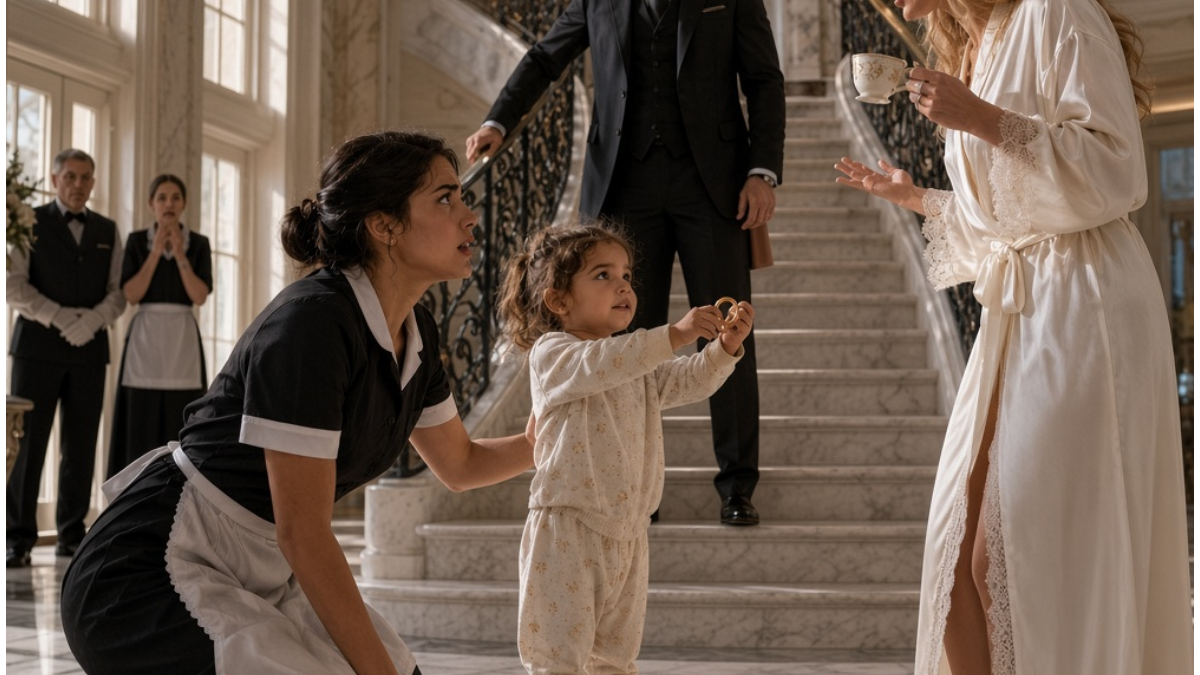
Get out of my house, you and that filthy little brat. Her voice tore through the marble hallway like broken glass.
The three-year-old girl didn’t cry. She didn’t run. She didn’t even blink. She just stood there in her tiny duck socks.
One small hand still clutching a gold button she had found on the floor moments earlier.
The other frozen midair, still reaching up as if offering it to the woman who had just screamed at her.
Her mother, the maid, dropped to her knees so fast her apron tore against the marble.
Four years of silence. Four years of invisible mornings and swallowed pride. And now this, her daughter, standing perfectly still in front of a woman wearing a diamond ring worth more than everything Rosa had ever owned in her life.
Nobody in that hallway moved. Not the butler holding a silver tray that had begun to tremble in his hands.
Not the housekeeper standing in the archway, her mouth slightly open, forgotten mid-sentence. Not the little girl who was still looking up, still holding out that gold button, still waiting for someone, anyone to take it from her hand.
And then from the top of the grand staircase, a single sound. One footstep, then another.
Slow, heavy, deliberate. The kind of footsteps that don’t hurry because they don’t have to.
The kind of footsteps that make an entire house hold its breath. The dawn was coming down.
He had been standing at the top of those stairs longer than anyone realized. He had heard the scream.
He had heard the silence that followed it. And he had seen something from that height that nobody else in the hallway had seen yet.
Something in the little girl’s face. Something in her eyes that made his hand tighten on the banister until his knuckles turned white because Aleandro Moretti had spent four years walking past this child in the hallways of his own estate.
Four years nodding politely at her mother. Four years telling himself the small ache he felt every time he saw those enormous dark eyes was nothing, meant nothing, was nothing but coincidence.
He was about to find out he had been lying to himself for every single one of those four years.
What happened in the next 60 seconds would end an engagement, uncover a three-year secret buried in silence, and rewrite the lives of everyone standing in that hallway forever.
7:00 in the morning. The sky above the Hudson River had not yet decided what color it wanted to be.
Gray at the edges, pale gold at the center, the kind of light that made everything look softer than it really was.
The Moretti estate sat on 12 acres of private land, tucked behind a rot iron gate that stood 14 ft high.
Cameras were hidden in the stone pillars on either side, so small that most guests never noticed them.
A long gravel drive curved through rows of autumn rose bushes, their petals just beginning to brown at the tips.
Cold greystone walls rose four stories high, softened only by ivy that had been allowed to climb in some places and cut back in others.
Two black sedans were parked near the service entrance. A third one, closer to the main door, was polished so carefully that the morning light seemed to slide off its hood like water.
To the outside world, it was the home of a real estate developer. Discreet, expensive, boring in the way that only very wealthy men could afford to be boring.
To the men who whispered in back rooms across five burrows, it was something else entirely.
It was the seat of the Moretti family, and it had been for three generations.
The kitchen entrance was around the back, past the garden, and the small stone fountain that had not run water since October.
That was where Ros Mendes entered every morning at exactly 6:45, the way she had entered for 4 years.
She was 31 years old. Dark hair pulled back so tightly that her forehead looked drawn thin.
Her hands, folded now around the strap of her small canvas bag, were rough at the knuckles and calloused across the pads of her fingers.
Four years of polishing floors that other people walked across without looking down. Four years of scrubbing marble that never really needed scrubbing.
Four years of being invisible in a house full of people who owned things she could not name.
She stepped into the back kitchen and set her bag down on the small wooden chair by the pantry.
This was her world, this tiny corner of the estate with its stainless steel counters and the smell of yesterday’s bread and the soft yellow light from the single window above the sink.
In the corner, folded neatly on the floor was a small quilted blanket. A stuffed rabbit lay on top of it bun.
His ears were slightly bent from too many nights of being held tight. Rosa looked at the blanket.
Lily would come down soon, still in her pajamas, still rubbing sleep from her eyes.
She always did. Rosa turned to the coffee machine and began to measure the grounds.
And as her hands moved, her mind drifted back the way it always did in the quiet moments to a morning four years ago, her first day on the job.
She had walked into the front hallway carrying a mop bucket, and she had seen him crossing the marble floor toward the door.
Just a glimpse, a profile she would have known anywhere. Her hands had shaken so badly that morning, that she had spilled coffee across the counter.
She had cleaned it up before anyone saw. She poured a cup now. Her hands were steady.
Four years of practice, but something in the estate this morning felt different, wrong somehow.
She could not name it. She only felt it in her chest, in the tightness that had not been there yesterday.
Isabella had woken up earlier than usual, two floors above the kitchen in a study that faced east toward the river.
Alessandro Moretti was already awake. He had been awake since 5. Sleep had become a distant relative over the years, the kind that visited only when it felt like it, and left without saying goodbye.
He sat now at a heavy walnut desk that had belonged to his father and to his father’s father before that.
A small brass lamp cast a warm circle of light across the leather bladder, and beside it, a cup of espresso sat untouched, steam rising in a thin ribbon toward the ceiling.
He was 38 years old. His black hair had begun to silver at the temples in the past 2 years, and the lines at the corners of his eyes had deepened into something that could not be explained by age alone.
His jaw was clean shaven. His shoulders were broad beneath the crisp white shirt, and his hands, resting on the desk, were still, very still.
The stillness of a man who had learned decades ago that movement drew attention in the underworld that stretched from the harbors of Brooklyn to the loading docks of New Jersey.
The name Don Moretti was spoken in whispers, never loudly, never carelessly. Men who had crossed him were remembered in the past tense.
Men who had served him well were remembered by name, but he had a rule, a strange one.
Some said a weakness, others said, though never in his hearing. He did not bring the dirty work home.
The estate was a separate country. Inside these walls, the housekeepers were paid on time.
The groundskeeper’s son had his college tuition quietly covered. Mr. Bruno, who had served three generations of Moretus, was addressed by his surname, not his first name.
Out of respect, the men who kept his gates and his files were treated with fairness.
And in return, they gave him something more valuable than loyalty. They gave him silence.
He lifted the espresso cup, drank it slowly, set it down, opened the financial section of the paper that had been placed on his desk at 6.
15 minutes later he stood. His morning walk was ritual. Down the wide corridor of the second floor, past the portraits of men who no longer breathed, down the grand staircase, one hand trailing lightly along the banister, through the front hallway, and then always a slight detour, a quiet turn to the left into the narrow passage that led past the back kitchen.
He never entered. He only slowed. For four years, he had slowed at that same corner.
And for four years, he had told himself he did not know why. There was a child who sat there.
Sometimes, a small girl with dark hair and enormous eyes. She would look up when he passed.
Sometimes she smiled, sometimes she did not. He always found himself nodding at her. And then walking on those eyes.
He had spent four years telling himself they meant nothing. That the ache he felt somewhere beneath his ribs when he saw them was a trick of memory.
His mother had died when he was 12. In a car, on a road outside Naples, on a night his father had never fully explained.
Her eyes had been dark like that, wide like that, kind like that, coincidence. That was all.
He turned the corner this morning, expecting the small blanket, the stuffed rabbit. The little girl bent over a book.
The blanket was empty. The empty blanket was not the beginning of what had gone wrong in this house.
To understand that, one had to go back 6 months to the day the second black car had rolled through the iron gate for the very first time.
That morning had been warmer. The roses had still been red, and a convoy of four polished cars had pulled up the gravel drive, one after the other, carrying trunks and garment bags, and a woman who had never in her life carried her own suitcase.
Her name was Isabella Romano. She was 28 years old, the only daughter of Vincent Romano, the dawn of Chicago.
Her hair was the color of pale wheat in late summer, cut sharp at the jaw.
Her eyes were a green so cold and clear they looked like something pulled from the earth in a place where nothing grew.
And her mouth painted the shade of a dark red wine was set in a small permanent curve that could pass for a smile if one did not look too closely.
She had not come to the Moretti estate for love. 10 years earlier the Moretti and Romano families had begun a quiet war over the shipping routes that ran between New York and the Great Lakes.
The war had never made the newspapers, but it had made widows, 12 of them by some counts, 15 by others.
Now the two families had reached a truce, and the truce required a ring. The engagement had been announced at a private dinner in a townhouse on the Upper East Side.
Two dons had shaken hands. Two families had raised their glasses, and Isabella had been placed in the back of a car and sent eaSt. She had stepped out of that car at the Moretti estate with a small, elegant frown already forming.
Standing at the front door to receive her had been Mr. Bruno, 70 years old, straightbacked, his white hair combed as carefully as it had been the morning he first entered this house 30 years ago.
At the side of Aleandro’s father, he had bowed his head slightly. He had said, “Welcome, Miss Romano.”
She had not answered. She had walked past him. 20 minutes later, moving through the west corridor toward the room that had been prepared for her.
She had passed the back kitchen, and she had seen the small blanket in the corner, the stuffed rabbit, the child sitting cross-legged, her tiny mouth moving silently as she turned a page of a picture book.
Isabella had stopped. Her green eyes had narrowed. What? She had said that Rosa had risen from where she was folding towels.
Her voice had been low. Careful. My daughter, Miss Romano, she stays with me during the day.
Isabella had looked at Lily for one long moment, and then she had said the words that Mr. Bruno would remember for the next six months, a servant’s child living in the Moretti estate.
How very quaint. Then she had walked on. That night, Mr. Bruno had knocked quietly on Aleandro’s study door.
He had spoken softly, respectfully, the way he had always spoken. He had said, “Boss, I do not like the coldness in her.
I have seen women like her before. She is not kind to those who cannot fight back.
Aleandro had thanked him. And then he had left for a meeting at the harbor that had run until 4:00 in the morning.
By the second week, Isabella had begun to plan. 6 months of planning had led to that Tuesday morning in November.
The sky above the Hudson was still the color of old iron when Lily opened her eyes.
She was 3 years old. She did not know what time it was. She only knew that the sparrows outside the tall window were louder than usual, and that the light coming through the curtain was the pale silver kind.
That meant the day was still a secret. Her mother was in the kitchen. Lily could hear the soft clink of a cup being set down.
She could smell the coffee. She slid out from under the small quilted blanket that had been folded into a nest for her by the pantry.
Her feet touched the cold tile, and she reached for her socks, the ones her mother had bought her at the corner store two months ago.
Yellow at the toes with small white ducks stitched around the ankles. She pulled them on carefully, one and then the other, the way her mother had taught her.
Bun was still asleep on the blanket. She patted his ear once and left him there.
The corridor beyond the Kaiden was long and quiet. Lily walked into it in her duck socks, and the world felt like her own.
This was the part of the morning that belonged to nobody yet. The floors were cold under her feet.
The paintings on the walls were bigger than she was. She did not look at them.
She was looking down because down was where interesting things lived. She had almost reached the base of the grand staircase when she saw it.
Something small, something bright. It was resting against the leg of a heavy hallway console, half hidden by the fringe of the runner.
A tiny gold button, round with a small raised pattern on the front, the kind of button that might have been sewn onto the sleeve of a wool coat.
It must have fallen from a jacket the night before when the men had come and gone from the study upstairs.
A small piece of gold forgotten by someone who owned a 100 coats. To Lily, it was the sun made small.
She crouched down, her tiny fingers closing carefully around it. She stood back up, her face open with the pure joy that only very small children can feel.
She turned toward the staircase, the button held tight in her fist, and she was thinking that she wanted to show her mother.
She did not see the woman coming down the stairs until she was already in her path.
Isabella was on the fourth step from the bottom. Her white silk robe caught the pale morning light.
In one hand, she held a delicate porcelain cup, the coffee inside it still steaming.
Her pale hair was loose against her shoulders. She had woken earlier than usual for a reason of her own, and she was not in the mood to be delayed.
She stopped. She looked down. Lily looked up and she did what three-year-olds do when they have found something wonderful and want to share it.
She held the button out with both small hands, offering it up to the tall woman on the stairs, her face open and completely trusting.
“Prett, pretty,” Lily whispered. For one small breath, something moved behind Isabella’s green eyes. Something almost like softness, something that, given a single second more, might have grown into a different morning altogether.
But it did not get that second. She lowered the cup to the polished handrail with a small, sharp click.
Her eyes hardened into stone. Where is your mother?” She said. Around the corner from the kitchen, Rosa froze midstep, apron still bunched in her hand.
The scream had already left Isabella’s mouth. It had already torn through the marble. The button had already fallen.
Rosa was already on her knees on the cold stone. Her arms wrapped around her daughter so tightly that Lily’s small face was pressed against the fabric of her uniform, and from the top of the grand staircase, one footstep had already sounded.
Allesandre came down without hurry. He wore black dark trousers, a charcoal shirt open at the collar, no jacket.
His right hand rested lightly on the banister as he descended, and though his face gave nothing away, the men in the hallway had all worked for him long enough to recognize what they were seeing.
His jaw was set in a way they had seen perhaps three times in the past decade.
Once on the night the docks at Red Hook had burned. Once on the morning Veto had been dragged out in handcuffs.
And once, years before that, when a young accountant had tried to move numbers that were not his to move, they lowered their heads, every one of them.
The old butler with the tray, the two men by the front door, the housekeeper in the archway, the young bodyguard, whose hand had drifted toward his weapon and now hung loose at his side.
Even the air in the hallway seemed to lower its head. Aleandro reached the marble floor.
He walked forward. He did not glance at Isabella as he passed her. He did not slow.
His polished shoes crossed the marble in a straight line toward the small kneeling figures near the base of the console table.
And then he did the thing that no man in that house had ever seen him do.
He lowered himself onto one knee right there on the cold stone in the center of the Moretti hallway.
The dawn of New York knelt in front of a three-year-old girl. A small sound escaped the housekeeper in the archway before she could stop it.
The old butler’s hand tightened on his tray. Aleandrore’s eyes did not leave the child.
He reached out slowly, one large hand extending across the marble to where the small gold button had rolled and come to rest against the leg of the table.
His fingers closed around it. He drew it back and then, without saying a word, he held it out to Lily.
She peeked from her mother’s shoulder. Her cheeks were wet. Her small chest was still rising in the short, catching breaths of a child who has been badly frightened.
But when she saw the button in the palm of the tall man in front of her, she did not flinch.
She reached out, her tiny fingers closed around the button and then around the tip of his thumb, and she looked up at him.
For a long, still moment, the whole room disappeared. There was only her face, her enormous dark eyes, and in them, something that struck him beneath the ribs like a blade being drawn.
He knew he rose to his feet slowly, one hand still holding the button between his fingers before he pressed it gently into the child’s palm.
He turned to Isabella. His voice when it came was quiet. But every soul in that hallway heard it clearly.
Rosa and Lily are not going anywhere. Not tonight. Not ever. Isabella did not move.
Did not breathe. Upstairs, he said. Now, she went, her silk robe whispered against the steps.
He turned to the others. Out. They vanished like smoke. And in the sudden, enormous silence, only three people remained on the marble floor.
The silence in the hallway had a weight to it now, a texture. It pressed against the walls like something with a heartbeat of its own.
Sunlight had begun to climb higher through the tall east window, and long stripes of pale gold spilled across the marble floor.
One of those stripes fell across Rose’s shoulder. Another touched the crown of Lily’s small head.
The child had cried herself into a heavy, sudden sleep against her mother’s chest, exhausted by a fear she did not yet have words for.
Her tiny fist was still closed around the gold button. Rosa did not move. She kept her head bowed, her forehead resting lightly against her daughter’s dark hair.
She could not bring herself to look up. She knew that if she looked up, everything she had built for four years, everything she had held together with silence and folded aprons and swallowed breath would be undone in a single sentence.
Allesandro stood a few feet away. He did not step closer. For a long moment, he only watched her.
His hands were at his sides, motionless. His breathing was slow, controlled, but somewhere beneath the surface of the man who had learned how to hide everything, something had come loose.
When he spoke, his voice was low, rough in a way he had not allowed it to be for many years.
Rosa, look at me. She flinched. She lifted her head slowly. Her eyes were wet, and she had not even known she was crying.
Two thin lines of salt had already reached her chin. She did not wipe them away.
He looked at her and she looked back and then he asked the question that had been living inside his chest for months.
Refusing to sleep, refusing to leave him alone. Why have you never told me she is our daughter?
The air went out of her lungs. She held Lily tighter. Her arms tightened around the small warm body.
As if to shield her from a truth she was about to give away. She opened her mouth.
She wanted to lie. Four years of practice at silence had taught her to lie without moving her face.
But her mouth would not form the words. Four years of holding this in had used up everything she had.
Alessandro spoke again, more gently. She has my mother’s eyes. Rose’s shoulders shook once. She closed her eyes.
I’ve noticed for months, he said. I did not dare believe it, but I know.
She began to cry then. Not the loud kind of crying. Not the kind that draws people from other rooMs. It was the quiet kind.
The kind that lives in the throat of a woman who has kept a secret for so long that it has become part of her breathing.
She whispered and her voice was so small that he had to lean in slightly to hear.
I tried to reach you. I called. I sent messages. Three calls. Seven messages. You never answered.
His face did not change, but something behind his eyes did because in that instant, Aleandro Moretti went very still.
Stiller than the marble beneath his feet. Stiller than the sunlight on his shoulder. Because he had never received a single call.
He had never seen a single message. And there was only one person from that year who had held the keys to his phone.
Rosa did not see the shift. She only heard him say very softly, “Take her to the kitchen.
Stay there. Do not open the door for anyone but me.” Then he turned and he began to walk toward the stairs.
He climbed the stairs one at a time. His hand did not touch the banister now, and as he climbed, his mind slipped backward, past the marble in the morning light, past the six months of Isabella, past the seat at the head of the family, all the way back to a March night four years ago.
He had been 34 years old then. He had not yet been called Dawn. His father, Salvatore Moretti, had still been alive, though the cancer had already begun its slow work through the old man’s lungs.
Alessandro had been consilier, the son who advised, the son who stood at the shoulder of a fading king, the son who was already being measured for a chair he did not yet want to sit in.
Rain had fallen all day that March, the kind of thin, cold Manhattan rain that soaked through wool coats and left dark stripes on stone facades.
The Plaza Hotel had been lit up in gold that evening, a charity gala for a children’s hospital in Queens.
Half of the guest list had been old money. The other half had been men like his father who bought tables at these events not for the children but for the photographs.
Aleandro had been sent in his father’s place. Build the image. Shake the hands. Smile for the camera.
Do not stay too long. He had lasted 40 minutes. He had slipped out of the ballroom through a service door, passed the coat check and into a narrow back corridor that smelled faintly of warm bread and floor polish.
His plan had been to stand there for 10 minutes, breathe, and then return to the crowd wearing a face he could bear.
He had not planned on the woman. She was standing halfway down the corridor with her back against the wall.
27 years old, a caterer’s uniform. Dark hair pulled into a low knot at her neck.
Her arms were folded and her jaw was set in a way that told him before she spoke that she was hiding from someone.
She looked up when she heard his footsteps. Their eyes met. “Sorry,” she said quickly.
I’ll move. No, he said. Stay. I am hiding too. She had almost smiled. Then she had almost not then.
She had decided, and it had been the kind of small, real smile that he had not seen on a woman’s face in years.
He had leaned against the opposite wall. He had told her his name was Alex.
They had talked for 2 hours. She told him about a small flower shop she wanted to open one day, about the color she wanted to paint the front door, about the kind of ribbon she liked.
He listened. He had not listened, really listened to anyone in a very long time.
He had asked her to meet him again. She had said yes. There had been three more nights after that.
A small coffee shop in Brooklyn where she had laughed at something he could no longer remember.
An evening walk along the river. The lights of Manhattan bright across the water. A quiet night in her small apartment where the radiator had knocked all evening and she had made him tea in a chipped blue cup.
Then at 3:00 in the morning on a Tuesday, his phone had rung. His father was in the ambulance.
He had left her apartment while she slept. He had not written a note. He had never gone back.
The rain in that memory faded. The corridor of the plaza faded. The chipped blue cup faded.
He was standing at the door of his study. His hand rested on the handle for a long moment before he turned it.
The room inside was quiet, dim, exactly as he had left it two hours earlier.
The espresso cup on the walnut desk was cold. The financial paper was still folded to the third page.
The morning had not changed the room. The morning had changed everything else. He crossed to the desk and sat down.
He opened the laptop. He did not go to the drawer where the whiskey was.
He did not want it near his hands right now. There was a private archive that only he could access.
A record of every device that had been assigned to him going back 9 years.
Every SIM card, every email account, every backup that his own security team had quietly kept in a server room three floors beneath a warehouse in Long Island City.
He typed in the password. He entered the second one. The screen changed. He set the date range to the spring and summer four years ago.
The numbers scrolled by. Calls placed. Calls received. Messages sent. Messages received. He filtered by unknown numbers.
He filtered by area code. His fingers were steady. But his jaw had begun to ache from how tightly it was set.
Nothing from her. Not one call, not one message, not one voicemail flagged for review.
He knew what that meant because in that particular spring and summer, there had been exactly one person besides himself who had held the keys to every device in his name.
One person who had protected him during the three months when his father was dying, and during the three months after, when the family had teetered on the edge of a war of succession, one person who had stood at his elbow and read his messages before he did, screened his calls, sorted his life into piles of what mattered and what did not.
Veto Columbbo, his father’s oldest man, his father’s right hand for 22 years. The man Alisandro had trusted in those first ragged months because his father had trusted him firSt. Aleandro sat back in the chair.
His mind was moving very fast now and very cold. 6 months after that spring, Veto had been caught selling names and shipping routes to the Bonanos in exchange for a payoff that would have set him up in Florida.
Aleandro had handled it himself. Quietly, cleanly, without a body. He had walked into a federal office on a Sunday afternoon with a folder full of documents and had left Veto to the machinery of the state.
Veto was serving 22 years in a facility upstate. Allesandro had never visited him, had never wanted to.
He had thought that day was the whole of Veto’s betrayal. He had been wrong.
Veto had made a decision in that spring four years ago that a woman from outside the world would end Alessandro’s career before it had properly begun.
That a young caterer with a chipped blue cup could not be allowed near a boy who was about to become dawn.
Three calls, seven messages. None had ever reached him. Aleandro lowered his face into his hands.
His shoulders did not shake, but he stayed there for a long time. Four years, and no way in the world to give them back.
Down in the kitchen, Rosa was folding the same dish towel for the third time.
Lily was asleep on the small blanket in the corner, curled around bun, the gold button placed carefully beneath her tiny pillow.
Rosa had checked on her twice already. She could not sit still. Her hands needed something to do while her mind moved through four years in reverse.
She remembered the morning she had found out. A small pharmacy on Atlantic Avenue, a test she had almost not bought.
The two lines that had appeared before she had even set the box down on the counter.
She had walked home in a light rain. Her hand pressed against her stomach as if to hold something in place.
She had picked up her phone that afternoon. The first call had gone to voicemail.
She had left a short message, careful in case the wrong person heard it. She had said only, “Alex, it’s me.
Please call me back.” The second call, 4 days later, had also gone to voicemail.
The third, two weeks after that, had rung five times and then cut off. Between the calls, she had typed messages.
Seven of them spread over 3 months, some short, one long. She had watched each one deliver.
She had watched each one sit unread for weeks and then one by one go quiet.
By the fourth month she had understood or she had believed that she understood. A man like that had many women.
A caterer with a small apartment and a chipped blue cup was easy to forget.
She had cried once standing over the kitchen sink. Then she had wiped her face and stopped crying because she had a life to build now and no time left to grieve a man who had not chosen her.
She had given birth to a baby girl in a public hospital in Queens. At 3:00 in the morning with no one holding her hand, she had named her Lily because it was the first flower she had ever wanted to sell in the shop she had described to a man named Alex in a corridor at the Plaza Hotel.
3 years later, tired of double shifts, tired of nurseries she could barely afford, she had walked into a housekeeping agency in Midtown, she had signed a paper.
The address on the assignment had read only Moretti Residence, Hudson River. The name had not meant anything to her that day.
Her first morning at the estate. She had been walking through the front hallway with a mop bucket in one hand when a man had crossed the marble floor toward the front door.
Dark suit, silver at the temples, a profile she would have known in any city, in any light in any lifetime.
Her heart had stopped inside her cheSt. He had glanced at her. The way a man in a hurry glances at a face he does not recognize.
He had nodded once politely the way he nodded at every new hire. And he had gone out the door.
That afternoon in the back kitchen, she had heard the other housekeeper whisper the name Don Moretti with a small, careful drop in her voice.
And Rosa had understood, standing there with her hand around a wet cloth, exactly what world she had walked into.
She could have run. She had stayed because she needed the money. Because Lily needed a life, and because a small, unreasonable part of her had wanted, even from the far edge of a marble hallway, to be near him again.
Four years of shadow. And now the light had found her and she did not know if she was ready.
He rose from the desk sometime past 10. The laptop stayed open behind him. The archive was still on the screen.
He walked out of the study and instead of going down the stairs, he turned left down the long east corridor toward the room at the end.
The door to Isabella’s suite was closed. He did not knock. He turned the handle and stepped inside.
She was standing by the tall window that faced the rose garden. Her silk robe had been replaced by a pale gray dress.
Her hair was pinned back now, smooth against her skull. She did not turn when he entered.
She kept her eyes on the browning roses below. For a long moment, neither of them spoke.
Then she said without turning, “So it is true. She is yours.” He did not answer at firSt. He closed the door behind him.
She let out a small sound. It might have been called a laugh, if one did not know what laughter was supposed to sound like.
It was thin and dry and had nothing warm in it at all. I knew, she said.
I did not know until this morning, but I knew. The way you came down those stairs, the way you knelt on that floor.
A man like you does not kneel for a housekeeper’s child. So she turned finally, her green eyes were dry.
So he said nothing. She looked at him and then something behind the careful lines of her face began to give way.
Not tears, something quieter than tears. The kind of collapse that happens when a person has been holding a wall up for too long alone and the wall simply decides that today is the day.
She crossed the room slowly and sat down on the edge of the long velvet chair.
8 months ago, she said, “I flew to Zurich alone. I told my father I was going for a spa week.
There is a small private clinic there. Very discreet, very expensive. Her hands were folded in her lap.
The doctor was Swiss, very kind, very careful with his words. He told me that I have advanced endometriosis, that the chance of my ever carrying a child to term is, in his words, functionally zero.
Allesandro did not move. I did not tell my father. I did not tell my mother.
I did not tell you. She looked up. In our world, Alessandro, a woman who cannot give a dawn an air, is a bad investment.
My family had already signed the paperwork. The alliance was already worth more than I was.
Her voice did not rise. I loved you, she said in my way, not you exactly.
I loved the seat. I loved the name. I loved the idea of being Donna Moretti.
I know how that sounds. I am telling you because there is no reason not to tell you now.
She looked toward the window again. Every time I saw that child in the hallway, I saw the one thing I would never have, and I hated her for it.
I hated her mother for it. I would have hated any woman in this house who had a small girl to hold.
Her jaw tightened. It was not her fault. I know that. I still could not stand to look at her.
Aleandro stood very still by the door. He listened to every word, and she did not say the thing she had done last week.
She did not say that she had already written to her father. He did not sleep that night.
The room she had spoken in stayed with him long after he had walked out of it.
The silence between her sentences had been louder than the sentences themselves. But there was a different kind of silence waiting for him in his own study, and it needed to be filled with something more solid than instinct.
He needed to be certain. Not for himself. He had already known from the second Lily’s eyes had lifted to his in the hallway.
He needed to be certain for her because a child would grow up. A child would ask questions.
A child would one day want to know why the name on the certificate matched the name on the door.
And when that day came, he wanted the answer to be a piece of paper that no one in this world could argue with.
At 2:00 in the morning, he walked down to the back kitchen. Rosa was asleep in the small folding chair by the pantry, her head resting against the wall.
Lily curled against her side beneath the quilted blanket. He did not wake them. On the counter beside the sink lay a small hairbrush he recognized from the shelf near her canvas bag.
He lifted three strands of dark hair from the bristles with a piece of clean paper and folded them carefully.
By 4 in the morning, an envelope had left the estate in the pocket of a driver who was told nothing, addressed to a private laboratory that had served the Moretti family for two generations.
A place where no result ever left the building except through the hands of the man who had ordered it.
Three days followed, three days that moved with the strange thickened weight of days that a man does not so much live through as endure.
He did not attend the meeting at Queens. He did not take the call from the harbor.
He sat at his desk with the door open, and from the window behind him, he watched the garden.
Lily played there each afternoon. Rosa had begun to let her out onto the paved path near the fountain, bundled in a small navy coat that was slightly too big at the shoulders.
He watched her chase a fallen leaf across the stone. He watched her stop and look up once toward his window.
She could not have seen him from that distance, but she smiled. His eyes had gone toward the portrait above the fireplace without his meaning to Elena Moretti, 29 years old in the photograph, painted the year before she died.
Her dark hair pinned to one side, her eyes wide and soft and impossibly steady.
His father had commissioned the painting 6 months after the car had gone off the road outside Naples on a night the old man had spent the rest of his life halfbelieving had been arranged by another family.
The eyes in the portrait were the same eyes he had watched chase a leaf across the fountain path that afternoon.
On the third evening, the message came. He opened it at the desk. He read the single line at the top.
99.99% probability of paternity. He set the phone down, and Alessandro Moretti, who had not wept since the day they had lowered his mother into the ground, put his hand across his eyes and wept quietly in the lamplight.
10 minutes later, he asked Mr. Bruno to bring Rosa upstairs. He handed her the paper without speaking.
He watched her read it. Then he said, “I want to be her father. If she will let me, if you will let me.”
The morning after the paper had been read, Allesandro made the call. He sat at the walnut desk.
His espresso was untouched. His hand was steady. He dialed the number in Chicago that he had not dialed in 6 months.
And when the voice on the other end answered, he did not lift his tone.
Vincent, it is Alessandro. A pause, a polite one. The engagement is over. Your daughter is welcome to stay in this house as a guest for as long as she needs to arrange her return, but there will be no wedding.
There will be no alliance in the form we agreed upon. I will send a formal letter by the end of the week.”
The line went quiet. Vincent Romano did not shout. He did not curse. He said nothing at all.
And that silence traveled through the phone with a temperature colder than any threat Aleandro had ever received in his life.
It lasted seven full seconds. Then Vincent said only, “I see.” And the line went dead.
Aleandro set the phone down on the desk very gently. He knew what the silence had meant.
Isabella did not scream. She did not weep. When Mister Bruno knocked at her door two hours later to tell her quietly that the arrangement had ended.
She looked at him for a long moment and then said in a voice that had no color in it at all.
Send someone up with the boxes. She packed for 3 days. The staff moved around her carefully.
The way one moves around a room where a candle is still burning. She folded her dresses herself.
She wrapped her jewelry in tissue paper. She did not speak to Rosa, and she did not go near the kitchen.
Once in the late afternoon of the second day, she stood at her window and watched Lily crouch by the fountain to poke at a puddle with a stick, and she stayed at that window for nearly an hour without moving.
On the morning of the fourth day, three black cars pulled up the gravel drive to take her home.
Mr. Bruno carried the last of her bags down himself. He was 70 years old, and there were younger men for the task, but he did it.
He set them by the door. Then he stepped back, hands folded, and he waited.
Isabella came down the grand staircase in a long camel coat. Her hair was pinned, her eyes were dry.
She reached the marble floor, and there, standing just to one side of the hallway with bun tucked under her small arm, was Lily.
Isabella stopped. She looked at the child for a long moment. Lily did not move.
She was not afraid. She simply watched. And then Isabella did something that no one who had ever known her had seen her do.
She lowered herself slowly until she was kneeling on the marble floor. She reached into the pocket of her coat and drew out something small, a gold button.
She had found it on the sofa the week before and had kept it without ever asking herself why.
She held it out. Lily reached up with two careful fingers and took it. She turned it in her palm.
Pretty, she whispered. “Yes,” Isabella said. “It is,” she stood. She walked to the door without looking back from the kitchen doorway.
Rosa watched her go, and what rose in her chest was not satisfaction. It was something quieter and deeper and closer to sorrow.
3 weeks passed. They were the quietest 3 weeks the estate had known in longer than anyone could remember.
The gate still opened for the same black cars. The gardener still trimmed the same brown roses, but something inside the walls had softened.
The way a house softens when the person who was quietly poisoning it has finally gone.
Aleandro spent time with Lily. He had never done anything of the kind before. He did not know at first how one did it.
He watched her carefully, the way a man might watch a language he had not yet learned, and slowly he began to speak it.
He bought her a small jar of soap bubbles at a shop near the harbor.
He carried it home in the pocket of his coat. He knelt on the flagstone path near the fountain and showed her how to dip the tiny plastic wand.
When the first bubble left her mouth, wobbly and enormous in the November light. She had laughed the way children laugh when the world surprises them, and something in his chest had turned over.
He read to her at night. He had not read a picture book aloud in 35 years.
He fumbled at firSt. He sat too straight. His voice was too careful. But by the fourth night, Lily had crawled into the crook of his arm and rested her small head against his shoulder, and he had discovered that the voice for reading came on its own, if one simply let it.
He told her about her grandmother. He told her, in small pieces that a woman named Elena had once had eyes exactly like hers.
He told her that Elena had loved yellow roses and had hated cold coffee. He told her that Elena would have loved a granddaughter with duck socks.
Lily listened with her chin resting on Bun’s ear, and she did not understand most of the words, but she understood the way his voice went softer when he said the name.
He spoke with Rosa slowly and carefully. They did not talk about the four years all at once.
They spoke in small pieces on the garden bench in the doorway of the study at the kitchen table after Lily had gone to sleep.
Two people trying to rebuild from the ground up a thing that had broken before either of them had understood what it was.
But the underworld does not sleep for anyone. 900 m away, in a study lined with dark bookshelves and a single green banker’s lamp, Vincent Romano sat with an envelope on the desk in front of him.
His daughter’s handwriting on the front. He had opened it the morning after her convoy had arrived home.
He read it slowly. Then he read it again in her steady, sharp hand. Isabella had written that Alessandro Moretti had a hidden heir, that the mother was one of his own housekeepers, that the child was three years old, that her existence had been the reason the engagement had ended.
In their world, a hidden heir was a weakness, and a weakness was leverage. Vincent set the letter down.
His pride had been publicly cut in half the day the engagement had ended, and every dawn in five cities had heard about it.
He picked up his phone and called four men whose names appeared on no public record.
The plan was drawn in that dark room over the course of a single evening at the Moretti estate on a bench beside the Browning roses.
Allesandro and Rosa were sitting quietly, Lily asleep across both their laps, and neither of them knew what was already moving toward them.
Saturday afternoon, December, the first thin snow of the season had begun to drift down over Manhattan.
Aleandro had said more than once in those three weeks that he did not want them to live inside walls.
A gate is a comfort and a cage at the same time, and he had grown up inside both.
So Rosa had put Lily in her small navy coat and her red mittens, and two men in dark overcoats had walked with them to the black sedan, waiting on the drive.
The park was Rosa’s choice. She had wanted to see the pond. She had wanted Lily to see snow on grass.
They walked along a quiet path near the eastern edge, well away from the busier crowds.
The two bodyguards, Dany and Raphael, moved a few paces behind, watchful, professional, their coats open at the collar so their hands could move freely.
It was the kind of afternoon that made a person forget the world was ever anything but soft.
Lily broke away from Rose’s hand and ran a few yards ahead onto a patch of grass where a small gray squirrel was picking at a fallen acorn.
Her mittens flapped. Bun was clamped under one arm. She laughed. And Rosa, standing there in her thin coat with her breath making a small cloud in the cold air, smiled.
It was the first real smile that had been on her face in weeks. She did not hear the engine at firSt. Only Dany did.
His head turned sharply toward the curved service road that skirted the meadow. A black van moving too fast for the lane.
He was already reaching under his coat. The van stopped. The side door slid open.
Four men in dark ski masks came out at a run. The next seconds were fast and terrible.
Dany fired firSt. Raphael fired second. Two shots came back. Dany went down at the edge of the path.
Raphael took a hit to the thigh and one to the shoulder and he fell hard onto one knee, then onto his side.
Rosa did not think. She ran forward across the frozen grass and threw herself over Lily.
Mama. Lily was screaming. Mama. The men were on them in three strides. A gloved hand closed around Rosa’s collar.
Another around Lily’s coat. Rosa twisted, kicked, kept her arms clamped around her daughter as tightly as she could.
Something hard, the butt of a pistol, struck her at the temple. A hot line of pain, then blood, warm running down into her eye.
She did not let go. They pried her fingers away and lifted Lily first, then dragged Rosa by the arMs. Both were thrown into the back of the van.
The door slammed. The tires spun once on the wet asphalt and then caught somewhere on the grass in the churned patch of snow where the struggle had ended.
A small gold button lay on its side in the cold. The one Isabella had put into Lily’s hand.
It caught the pale winter light for a moment, and then the snow began, very slowly, to fall on top of it.
Raphael dragged himself 6 feet on his elbow to reach the phone that had fallen from his coat.
His breath was already going shallow. He dialed. He said in a voice that could barely form the words, “Boss, they took them.”
Romano’s men uptown in a private dining room in Queens. Aleandro was in the middle of a sentence about Elise.
He rose from his chair very slowly. The phone slid from his fingers to the floor.
The color left his face, and then it was replaced by something else, something the men around the table had seen exactly once years ago on the day Veto had been taken away.
“Gather everyone,” he said. Now, by 8:00 in the evening, the estate had transformed. The study on the second floor no longer looked like a study.
The financial papers had been swept from the walnut desk. In their place lay a map of New York City, unfolded and pinned flat.
Its five burrows spread out under the brass lamp like an open palm. A second map, smaller, showed the Brooklyn waterfront in more detail.
Beside them, three phones lay charging in a row. The espresso cup was gone. 30 men stood in the corridor and along the walls of the study.
The best of them, the ones who did not ask questions when a call came at an unusual hour.
They were dressed in dark coats and heavy boots, and beneath the coats they carried what they always carried when Alessandro told them to gather.
Marco stood at his shoulder, 31 years old, broad-shouldered, the one Alessandro had begun quietly grooming to inherit the rougher work of the family 6 months ago.
His jaw was set. He had already made calls to three garages in Queens, and cars were being prepared.
Mister Bruno stepped into the room. The old butler’s face was the color of paper.
He crossed the room slowly, hands folded in front of him, and stopped at the corner of the desk.
His voice was low and very careful. Boss, he said, “Let us go. You do not need to be the one who Alessandro did not look up from the map.”
“That is my daughter, Bruno.” The old man’s mouth closed. “That is the mother of my daughter.
I will not sit here. Mister Bruno bowed his head once. He stepped back against the wall.
A phone rang. Not the phone on the desk, the private one. The number that only 12 men in the country knew.
Alessandro picked it up on the second ring. He did not speak. He listened. The voice on the other end was calm, older, cold in the particular way that old money and old blood together tend to be.
Vincent Romano did not shout. He did not gloat. He stated his terms with the flatness of a man reading a contract.
Every dock, every warehouse, every restaurant, and every quiet piece of paper that gave the Morettes control of the Manhattan waterfront, signed over by 6:00 in the morning.
In exchange, the woman and the child would be returned to the front gate alive.
Allesandro let a small silence fall. Then he said, “Agreed. Send the paperwork.” Vincent hung up.
Aleandro set the phone down. He turned to Marco. The shoe, he said, “Check it now.”
Marco was already at the laptop. His fingers were faSt. 6 months ago, on the same night Aleandro had received the paternity result, he had asked his security team to place a device the size of a grain of rice inside the sole of a small pair of white sneakers that had been left at the child’s door as a gift.
A precaution, the kind of precaution Adon takes and hopes to never use. The screen lit up.
A single blue dot pulsed slowly on the map of Brooklyn. Red Hook, an abandoned warehouse on a dead street beside the water.
Aleandro looked at the dot for a long moment. Then he crossed the room to a locked drawer in the cabinet behind the desk.
He opened it. He drew out a pistol, his father’s pistol, the one Salvatore had carried for 30 years.
He loaded it slowly, six rounds. He slid it into the holster beneath his coat.
Then he picked up a phone he had never dialed in his life. He dialed the field office of the FBI.
Half past midnight, Red Hook fog lay thick over the East River, curling up over the rusted peers and drifting in low gray ribbons across the empty street.
The warehouse sat at the end of the block. Three stories of soot stained brick.
The windows on the upper floors boarded shut, a single dim bulb burning above a side door that had not been used for legitimate business in 20 years.
Aleandro crossed the last h 100red yards on foot. He wore a heavy black coat with a Kevlar vest beneath it.
His father’s pistol rested in his right hand, the safety already off. Marco moved at his left shoulder.
Six of their best moved in a loose crescent behind them. The rest had circled the building from the far side, closing off the loading bay and the back alley in a slow, silent net.
There was no speech before they went in. Allesandre only lifted his chin once. It was enough.
The side door opened under a shoulder. The night broke open. The first gunshots cracked like breaking glass and echoed off the iron walls in strange hollow rings like church bells struck by mistake at the wrong hour.
Muzzle flashes lit the corridor in white bursts. The air filled with the sharp bite of gunpowder.
Boots slid on wet concrete. Men shouted from behind pallets and machinery. Alisandro moved through it not the way a dawn moves, but the way a father moves, head low, feet fast, his pistol steady in front of him.
Marco cleared the left, Aleandro cleared the right. They took the main hall room by room, a storage bay, a stairwell, a long empty office with the desks pushed against the walls.
At the far end of the ground floor, behind a warped steel door, they found them.
The room was small. A single bare bulb hung from the ceiling. And there she was, Rosa, tied to a wooden chair, wrists bound in front of her, a dark line of dried blood tracking down from her temple across her cheekbone to her jaw.
Her eyes were open. She saw him. Her mouth shaped a word she could not make loud enough to say.
In the far corner, crouched into the smallest shape a child can make. Lily. Her mittens were gone.
Bun was clutched hard against her cheSt. Her face was stre with tears that had already dried.
When she saw him, she did not cry out. She only lifted her arMs. Aleandro began to move toward her.
He had taken three steps when the shadow shifted behind Rose’s chair. A man in a dark gray coat stepped forward into the light.
His face was lined. His hair was white at the temples. The pistol in his hand was already raised and the barrel was pointed at Lily.
Vincent Romano. One more step, Moretti, he said. His voice was very calm. And this ends now.
Alessandro stopped. His own pistol did not lower. Everything in the room seemed to hold its breath at once.
The bulb hummed. Rosa’s ragged breathing was the only other sound. For one long second, time seemed to freeze.
Then Aleandro moved, not toward Vincent, toward the corner. He crossed the space in two strides and dropped to his knees over Lily, wrapping his body around her small shape, tucking her head against his cheSt. The gunshot came.
The bullet took him in the shoulder. Fire tore through the muscle. He did not go down.
He held. Rosa screamed behind Vincent. The far door burst open. Marco. Four men. They came in fast and hard.
Vincent turned. He was too late. Alessandro did not kill Vincent Romano. He could have.
In the seconds after the shot, in the sudden ringing silence with fire still burning through his shoulder, every instinct that had been trained into him since he was 14 years old told him to raise the pistol and finish it.
Every rule of the world he had lived inside for his entire adult life said the same thing.
A man draws on your child. You do not leave that room without ending him.
He did not raise the pistol. He rose from his crouch over Lily, one arm still tucked around her small body, and he crossed the room in three long strides.
Vincent had already begun to turn. Aleandro struck him once across the jaw with the flat side of the pistol.
The old man buckled. Aleandro drove him down to the concrete, twisted the weapon from his hand, and pinned him there with one knee planted hard against his cheSt. Blood from his own shoulder dripped onto Vincent’s cheek.
He leaned close. You wanted a war, Romano. His voice was low, steady, not the voice of a man in pain.
You will get one, but not the kind you expected. And at that exact moment, from the far end of the warehouse, a siren cut through the fog, then another, then a third.
Blue and red light began to strobe against the boarded windows. Boots pounded against the loading bay ramp.
Voices shouted commands in a rhythm the men in this room had heard many times, though never in a room where they themselves were the ones being addressed.
Federal agents came through the main doors in body armor, weapons drawn, orders sharp and clear.
Aleandro had made the call 11 hours earlier from a phone he had never used before.
He had told the voice on the other end where to be and at what time, and he had emailed a folder containing years of quiet documentation on Vincent Romano’s operations, names, dates, bankroots, enough to bury the Chicago family for a generation.
Vincent was pulled up off the concrete in handcuffs. His men, 28 of them still standing in the warehouse, were lined up against the far wall one by one.
Vincent turned his head as he was walked past and began to shout. Threats, names, promises about what he would do to the Moretti family from a prison cell.
The words came out of him horsearo and ragged. Aleandro did not look at him.
He did not turn his head. He was already on his knees again in the corner of the room, gathering Lily into his arMs. She was shaking.
She was not crying. She only pressed her small face into his chest and would not let go.
His good arm closed around her. His bad shoulder was warm and wet, and the dark stain was spreading across the front of his shirt, but he did not seem to notice.
Someone had cut Rose’s wrists free. She stumbled to them across the concrete and dropped to her knees beside him.
She reached out and put her hand against the side of his face. Her palm was warm.
Her fingers were shaking. It was the first tender thing she had done to him in 4 years.
“I could not lose you again,” he whispered. “Either of you.” Paramedics were pushing through the doorway now, calling for space.
A stretcher was set down. Allesandre was helped up onto it. Lily still pressed against him.
Rosa climbed into the ambulance behind them and held his hand the whole way through the fog.
3 weeks in a private hospital room on the Upper East Side. The bullet had passed close to an artery, close enough that the surgeon, an older man who had operated on more relatives than he cared to remember, had come out of the theater and told Rosa quietly that a difference of a/4 in would have made the difference between recovery and a coffin.
Rosa had sat down in the corridor and put her hands over her face and had not spoken for nearly an hour.
Aleandro healed slowly. He was not a good patient. The nurses learned to knock twice before entering.
Marco visited daily, standing at the foot of the bed with quiet updates from the outside world.
Mr. Bruno came each evening at 7 and stayed until Alessandro fell asleep. But it was the afternoons that changed him.
Every day at 3, Rosa came in through the door with Lily on her hip.
Everyday, Lily wriggled down, ran the last few feet to the hospital bed, and climbed up onto the white blanket without asking anyone’s permission.
On the fourth afternoon, she brought bun. She settled the small stuffed rabbit against the pillow beside Alessandro’s head, adjusting his ears with two careful fingers until they lay just so.
Then she looked up at Aleandro, her enormous dark eyes serious, and she said, “Bun will help Papa get better.”
The word landed in the room like a soft weight. It was the first time she had called him that.
Allesandro did not answer. His throat had gone tight and would not open. He only reached his good arm around her small shoulders and drew her gently against his chest, and he held her there for a long time while she chattered quietly to Bun and told the rabbit which parts of the hospital had the best cookies.
Rosa stood in the doorway with tears in her eyes and did not interrupt. On the day he was discharged, Allesandro called for a meeting at the estate.
The long dining room was set with only five chairs. Mr. Bruno at the far end, Marco on his left, three of the family’s regional captains, older men, veterans of the docks and the freight yards.
Aleandro stood at the head of the table with his right arm still bound in a black sling.
He did not sit for 30 years. He said, “This family has done what it needed to do to survive.
I do not apologize for what my father built. I do not apologize for what I built after him, but I am not the man who came down those stairs a month ago.”
He looked at Marco from today. Marco carries the seat, the docks, the freight, the roots, the rooms where the difficult decisions are made.
All of it. I keep only what is legal. The restaurants, the hotels, the buildings on Fifth Avenue that pay their taxes.
Marco rose slowly to his feet. He bowed his head. Boss, he said, “You will always be Dawn to us.”
Aleandro shook his head once. “No, Marco, from today you are Dawn. I am only a father.”
There was a silence around the table that was not sorrow and was not triumph.
It was the silence of men who had heard something rare and understood that they had been present for the closing of a door.
That week, Vincent Romano was sentenced in a federal courtroom to 40 years. The Romano family fractured within a month.
That night, Aleandro slept through the night for the first time in longer than he could remember.
A quiet evening in December. The first real snow of the season was falling outside the tall front windows of the estate, drifting past the glass in slow, patient spirals.
The rose garden below had gone white at the edges. The gate at the end of the drive was closed, and there were no black cars on the gravel, and inside the walls it was the kind of stillness that only comes to a house when it has finally, after many years, been allowed to reSt. The lights were low in the living room.
This was not the cold study where Allesandro had once made calls that could remake a city.
This was the room with the marble fireplace at the far wall, and the fire in it now was small and steady, throwing warm orange light across the rug and the deep leather sofa, and the long shelves of books that no one had opened in years.
Someone had opened them lately. Alessandro sat at one end of the sofa. His sling had come off two weeks earlier.
He was in a soft gray sweater, and there was a book open on his knee that he had been reading slowly, one page at a time, because he was not in a hurry anymore.
Rosa came in with two mugs of cocoa. She was not wearing an apron. She had not worn one in a month.
Her dark hair was down against her shoulders now, and she wore a simple wool cardigan the color of cream.
She set the mugs on the low table and lowered herself onto the sofa beside him.
Her shoulder came to rest lightly against his. Small, quick footsteps sounded from the hallway.
Lily came running in with bun clutched under one arm. She was in a red wool jumper with tiny snowflakes stitched at the cuffs.
She did not stop at the sofa. She did not hesitate. She climbed up onto Aleandro’s lap the way a small girl climbs onto the lap of the person she has always belonged to.
And she settled herself with her back against his chest and bun tucked under her chin.
Then from the small pocket of her jumper, she drew out something round and bright, the gold button.
He had found it himself weeks ago on the frozen grass at the edge of the park after the ambulance had gone.
He had picked it up out of the snow, brushed it clean, and slipped it into the inside pocket of his wallet where it had stayed for three months.
Someone that morning had placed it back into the pocket of a small red jumper.
Lily held it up to him with both tiny hands. “Pretty papa,” she said. He looked down at the button.
He looked down at the enormous dark eyes lifted to his his mother’s eyes looking at him from the face of his daughter.
And then Allesandro Moretti, the man who had once made an entire city hold its breath, wept for the second time in his adult life.
Not from pain, from something far quieter and far larger. Rosa stood at his side with one hand pressed against her mouth.
Outside, the snow kept falling. Here is what this story quietly leaves behind for anyone willing to sit with it.
The greatest power a person will ever hold is not the empire they build, not the room they can silence when they walk into it, not the fear their name inspires in strangers.
The greatest power is a small child who trusts you enough to climb into your lap without asking.
Who lifts up something ordinary and small and calls you by the simplest name in the world.
Papa, Mama, the people we love do not need our fortresses. They only need our attention.
So here is the question to sit with tonight. Who in your own life has been waiting quietly, patiently, without ever saying a word for you to stop and truly see them?
A parent, a child, an old friend whose message has been sitting unanswered on your phone for weeks.
Do not wait as long as Alessandro did. The quiet ones do not stay forever.








