The Duke found twins at his son’s grave — and just three words brought him to his knees
He had buried his son on a Tuesday. He remembered it because the sky had been obscenely blue, the kind of blue that belongs to picnics and country rides, and the laughter of young men who have not yet learned that the world can simply stop.
There had been no fitting storm, no dramatic gray curtain to honor the occasion, just that impossible indifferent blue, and the sound of earth meeting a mahogany lid, and the Duke of Montigue standing so perfectly still that two of his footmen quietly debated in hushed tones behind the U hedge, whether his grace had perhaps ceased to breathe along with his air.
He had not ceased to breathe. He had simply decided that breathing was a mechanical function like winding a clock or signing correspondence and that it required no further emotional investment.
That had been 14 months ago. He still visited the grave every week, not out of sentiment, he told himself, out of duty.
A duke did not abandon his obligations simply because they had become unbearable. He had no way of knowing on this particular gray October morning that duty was about to destroy him entirely.
The churchyard of St. Michaels at Ashworth was not by any objective measure a cheerful place, but it was a quiet one, and quiet was the closest thing the Duke of Montigue had found to peace since the winter his son had fallen from his horse on a frozen road and never woken again.
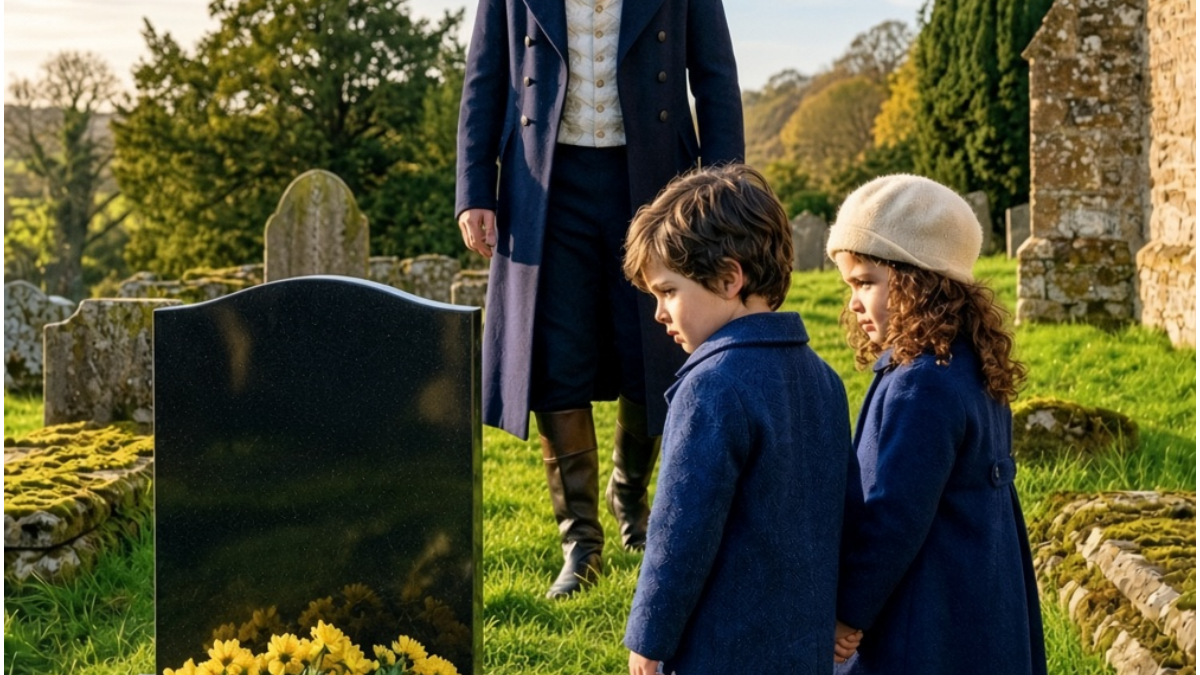
The headstone was black marble, imposing, costly, and utterly unlike the young man it marked.
Edward Montigue, Vic Count Hail, Beloved Son. The beloved son had been 23 years old.
He had laughed too loudly at his own jokes, collected stray dogs with embarrassing enthusiasm, and once written his father a letter, a real letter, with his heart plainly in it, that the Duke had folded away unanswered in the third drawer of his writing desk, where it remained still.
That letter, the Duke reflected as he walked the gravel path, was possibly the greatest of his many failures.
He heard the children before he saw them. A small, clear voice, the voice of someone who had not yet learned that graveyards called for silence, announcing with great authority that this one had a lion on it, and that one had an angel, and that one was very big, and must belong to someone very important.
The voice was shortly joined by a second slightly lower voice which questioned whether the important person had been a giant because the stone was ever so tall.
The Duke of Montigue, who had not spoken to a child in 14 months and had no particular intention of beginning, stopped walking.
They appeared from behind a row of older stones. Two of them, no more than four years of age, bundled into matching blue coats that had seen better seasons.
A girl with dark curls escaping from beneath a wool hat, gesturing grandly at the monuments as though she were conducting a tour.
A boy slightly behind her, more cautious, his hands in his pockets, watching the world with eyes that were The Duke stopped.
The boy’s eyes were the precise gray green of Edward’s eyes, the exact shade, the color the Duke had not seen anywhere in the world for 14 months, and had told himself he did not miss.
He told himself it was coincidence. Plenty of people had gray green eyes. He was being morbid.
He was allowing grief to manufacture resemblances where there were none. Then a young woman stepped into view from behind an overgrown u brushing leaves from her dark cloak and his breath returned to him only slightly.
She was not what one might call classically beautiful in the way society described beauty.
She had no golden curls, no porcelain palar, no studied helplessness. She was perhaps 25, with dark hair tucked sensibly beneath a bonnet that had clearly been chosen for warmth rather than fashion, and she moved with the easy confidence of someone who had long since stopped caring whether she was being observed.
She was not observing him at all. She was entirely focused on the children. Her expression caught somewhere between fond exasperation and the private luminous sort of love that people rarely permit themselves in public.
Oliver, do not climb the stone. It isn’t a ladder. It is someone’s memorial. She said it the way one says a thing for the fourth time.
Wearily without heat, in the tone of someone who knows perfectly well the instruction will not be heeded.
Oliver did not climb the stone. He looked at it very seriously instead, tilting his head in a way that struck the Duke as unsettlingly familiar.
The girl, Iris, he would later learn, though names were still several minutes away, had meanwhile discovered the black marble headstone.
She stood before it with the somnity of a child who has recently been educated on the concept of death and wishes to demonstrate that she has taken the lesson seriously.
He was young. She announced. The numbers say so, Miss Ellie. What does beloved mean?
It means, said Miss Ellie, picking her way between the stones to join the girl, that he was very much loved.
She crouched to the child’s level and looked at the stone. Something moved across her face, a grief she contained quickly and professionally, the way someone who has been grieving for a long time learns to do.
It means someone misses him very much. Oliver had followed his sister. He stood beside her now, looking at the stone with those impossible gray green eyes.
And he said in a tone of absolute seriousness, we could leave him one of our flowers.
We only have two, Iris pointed out. Then we leave him one. It was Iris who set the flower at the base of the stone.
A slightly battered yellow bloom she had clearly been carrying in her pocket, which made it, the Duke thought, perhaps the most valuable thing he had seen placed there in 14 months.
He should have turned and left. He was intruding on a private moment. He was not a man who lingered uninvited in other people’s grief.
But then Iris slipped on the damp grass. It was not a serious fall, a small stumble, a scraped palm, the beginning of a whale that had more outrage than injury in it.
Miss Ellie was beside her immediately, kneeling on the wet ground without a thought for her dress, gathering the girl’s hands in hers and examining the scrape with brisk, calm attention.
“Look at me,” she said. “Just look at me. It’s all right now, sweetheart. It’s all right now.
Then very softly, very simply, she said the thing, “It’s all well now, little one.
It’s all well now.” The Duke of Montigue, 8 ft away, felt the ground disappear from beneath him.
Not metaphorically. He felt his knees genuinely buckle, caught himself against the stone behind him with one hand, his breath coming short, the blood leaving his face with such speed that he was fairly certain he had gone the color of the marble.
It’s all well now. Edward had said it always. Since he was a small boy, whenever someone was hurt, whenever someone was frightened, it’s all well now.
Not it’s all right, which was what everyone said. Not don’t cry or be brave.
Always, always that exact phrase in that exact tone, quiet, certain with a warmth in it that the Duke, God help him, had never managed to teach the boy, and had never been able to explain as anything other than his mother’s influence.
Since his mother had been kind in ways that the Duke was not, he had not heard those words in 14 months, he had not expected to hear them again.
Miss Ellie looked up from the child and saw him. Her expression shifted. Surprise, then assessment, then a careful neutrality that had something cautious behind it.
She got to her feet, one hand still on Iris’s shoulder. I apologize, she said.
We did not mean to intrude. We were just, she stopped. She had noticed. He realized that he was gripping the gravestone behind him, that he was not entirely steady.
He forced himself upright. He was a duke. He did not grip gravestones for support.
He did not fall to pieces in front of governnesses he had never met. “You did not intrude,” he said.
His voice was more controlled than he deserved credit for. “Da, this is a public churchyard.”
She looked at him for a moment, those dark eyes doing something measured and intelligent, and then she looked at the stone behind him, the plain gray one he had been leaning against, unremarkable, bearing an old name he did not know.
And she looked back at him, and she said simply, “I am sorry for your loss.”
She did not know. She thought he was a stranger mourning a stranger. She had no idea that 3 ft to her left was the grave of the boy whose phrase she had just spoken.
She had no idea who he was at all. “Thank you,” said the Duke of Montigue.
Oliver was looking at him with those gray green eyes. “Your coat is very fine,” Oliver said gravely.
“Are you someone important?” The Duke looked at the boy for a long suspended moment.
“I used to think so,” he said. Elellanena Voss had not lived in Ashworth long enough to know all its notable inhabitants, but she knew the Duke of Montigue the moment she saw his portrait in the village lending library 3 days after their encounter in the churchyard.
She had gone there alone, one of the very few hours each week she permitted herself to be alone, which was not self-indulgence but necessity because there is a particular kind of grief that cannot be performed in front of children.
It requires privacy. It requires the ability to stand very still in a public room and look at a portrait and let the full weight of it land without anyone small asking why you are making that face.
Claraara had been 3 years younger. Claraara had been the laughing one, the impulsive one, the one who said yes before she understood the question and sorted out the consequences later with a cheerfulness that Elellanena had spent years pretending to find exasperating and actually found, if she was honest, the single most luminous quality she had ever witnessed in another person.
Claraara had loved Edward with her whole self. Claraara had said in the last letter Ellena received before the end that she had never understood before what people meant when they talked about a life feeling like it had found its correct shape.
That this was what she had been trying to describe. That shape. Eleanor had that letter.
She had every letter. She kept them in a box under her bed and read them when the nights were very long and the children were asleep and the silence had edges.
She had been so busy grieving for the children, for what they had lost before they could know they had it.
A mother who would have been extraordinary, a father who had been trying so hard to be worthy of her, that she had not always allowed herself to grieve for what she had lost, a sister, the specific irreplaceable comfort of someone who has known you since before you knew yourself.
She allowed it now briefly in the lending library with her hand on the shelf and her eyes on the portrait.
Then she put it away. She was very practiced at putting it away and she took the children home.
The portrait was 12 years old and therefore depicted a younger, somewhat less severe version of the man she had met.
But the bones were unmistakable. The set of the jaw, the gray eyes, not gray green, just gray like winter slate, the bearing that managed to convey, even in oils and canvas, that here was a man who expected the world to arrange itself tidily.
She stood in front of it for quite a long time. Then she put the book back on the shelf, took Oliver and Iris by the hand, and walked home in a state of extreme composure that fooled no one except the children, who were, in fairness, four years old and primarily interested in whether there would be apple cake for tea.
Duke Montigue, the father of Edward Montigue, the man whose only son had died on that frozen road while coming home from from Elellanena’s sister’s house, from Claraara’s house, from the house where Claraara had been 8 months with child, where Edward had been spending every evening he could manage without his father’s knowledge, where the two of them had been building a life in secret that they had intended to announce just as soon as they had found the right moment and the right words and the courage to face a man who had spent Edward’s entire life demanding that he become something other than what he was.
Claraara had died delivering the twins 3 weeks later. Oliver and Iris had come into the world at the cost of their mother, and Elellanena had simply stayed.
There was no other word for it. She had looked at those two small, furious, entirely helpless creatures, and she had stayed, the way one stays beside a fire in a storm.
She had not sought out the Duke. She had told herself carefully and consistently for the entirety of the children’s lives, that she was protecting them, that a man who had driven his own son to secrecy was not a man who could be trusted with two illegitimate grandchildren.
That whatever world the Duke offered them would be gilded and cold and nothing like the warm, muddy, slightly disorganized world that she had given them instead.
She told herself these things again now, walking home with a child on each hand.
She told herself that the man in the churchyard, pale, controlled, gripping the gravestone, bore no resemblance to the tyrant she had constructed from Claraara’s careful, loyal, tender letters about a father who simply could not love correctly.
She was very good at telling herself things. She had years of practice. The Duke of Montigue came to the cottage the following Wednesday.
He stood at the gate with the formal self-containment of a man who had spent 40 years building a wall around himself and considered the wall a structural necessity.
And he said, “When Elellanena answered the door, I owe you an apology. I behaved strangely at the churchyard.
I wish to explain.” He stopped. He had seen over her shoulder Oliver in the hallway wearing a wooden sword and a look of profound concentration.
That is the boy from the graveyard. It is, Elellanena said. Her voice was steady inside.
She was not. And his sister. He had seen Iris now too, upside down on the settle, apparently attempting to read a picture book from that orientation.
Yes, she did not move to let him in. She stood in the doorway, and every instinct she had was pulled in two directions.
The instinct to protect, which was four years old and ferocious, and the instinct to be honest, which was older and considerably more inconvenient.
“You live locally,” he said. It was not quite a question. “I do.” “The children are yours.”
The pause was a fraction too long. “They are in my care,” she said, which was true.
Which was entirely precisely true, and said absolutely nothing. The Duke looked at her with those slate gray eyes, and Elellanena had the uncomfortable sensation that he was a man who noticed things, who filed details away with the precision of a cler who suspects the ledger does not balance.
“You are not from Ashworth originally,” he said. No, you came here recently. About a year ago, 14 months ago, in fact, the same month he had buried his son.
Something moved in his face that he controlled immediately. He looked for just a moment like a man doing mathematics that he did not wish to do.
Arriving at an answer he was not prepared for. I see, he said. Was there something else your grace?
She had given him his title deliberately, a reminder, a distance, a door firmly held in position.
He looked at her. He looked past her at Oliver, who had abandoned the wooden sword, and was now watching the stranger at the gate with those careful gray green eyes.
“No,” said the Duke of Montigue. “Nothing else. Good day, Miss Voss,” she said. “Ellanena Voss.”
He nodded. He left. Elellanena closed the door and stood with her back against it for quite some time, listening to her own heartbeat, which had decided that this was an excellent moment to be extremely loud about things.
He came back on Friday. He told himself he was simply passing. Ashworth’s eastern lane did not, in fact, lead anywhere that the Duke of Montigue had any particular reason to pass.
But this was the kind of logic that the brain dispenses with when it has decided it requires something that the heart is not yet permitted to name.
Oliver was in the garden engaged in a deeply serious game that appeared to involve burying small stones and then immediately excavating them which the Duke observed for a moment from the gate before the boy looked up and said with complete composure.
You came back. I was in the neighborhood. Miss Ellie says people who say they were in the neighborhood.
Oliver informed him, are usually not telling the whole truth. The Duke considered this. Miss Ellie, he said, appears to be a very perceptive woman.
She is the cleverest person I know, Oliver said in the tone of someone presenting an established fact.
Do you play chess? I have been known to. I am learning, Oliver said. He paused.
I mostly lose. Everyone mostly loses when they are learning. Did you mostly lose when you were learning?
The Duke thought of a seven-year-old version of himself who had indeed mostly lost, who had thrown a chess piece across the library in a rage at Tenee, who had been told by a father not dissimilar to himself, that Lords did not lose, and that if he could not learn to win, he should not play.
He thought of Edward, whom he had never taught to play at all. Yes, he said.
I’m mostly loSt. Oliver appeared to find this deeply satisfying. Will you show me something?
Miss Ellie shows me every evening, but she is also teaching Iris her letters, and sometimes she forgets to come back to the chess.
Elellanena appeared at the cottage door at this juncture, wearing an expression that suggested she had come out to water herb pots and found an entirely unexpected development in her garden.
She looked at the Duke. She looked at Oliver. She looked at the Duke again.
He knows about chess, Oliver reported. Does he? Said Elellanena. He also mostly lost when he was learning.
Excellent qualifications, she said. And although her voice was carefully, politely neutral, the corner of her mouth did something that it did not have her full permission to do.
Oh, you had better come in then, your grace, since Oliver will simply stand there and look at you until you do.
The cottage was small by the standards the Duke normally inhabited and warm in a way that Montu House had not been in, longer than he wished to calculate.
There were books stacked on every surface and a child’s drawing pinned to the wall next to an engraving of Warikshire that had a small smudged fingerprint on the glass.
And somewhere from the back of the house came the smell of something baking that made him realize with sudden and inconvenient clarity that he had not truly noticed a smell in 14 months.
He was ruthlessly terrible at losing at chess to Oliver. He managed it three times in the next hour, each loss slightly more convincing than the laSt. until Oliver grew suspicious.
“You’re letting me win,” Oliver said. “I would never,” said the Duke. Miss Ellie says that letting someone win is a kindness without respect.
From the chair where she sat pretending to read while entirely not reading, Elellanena said without looking up, “I did say that.”
In that case, the Duke said, “I will stop letting you win.” He moved a bishop check.
Oliver’s expression shifted from suspicion to a grin of absolute delight. “Now show me how you did that.”
Iris appeared from behind Elellanena’s chair, where she had apparently been conducting her own silent investigation of the stranger for the past 20 minutes, and climbed without invitation into the Duke’s lap to observe the board.
“That’s the one that goes sideways,” she announced, pointing at the bishop. “Diagonally,” the Duke said.
He was very still. He could not recall the last time a child had simply climbed onto him.
Edward had done it once a long time ago, and he had he had been uncomfortable.
He had not known what to do with small limbs and complete truSt. He found that he still did not know what to do with it.
But he found also with something that felt painfully close to wonder that he did not mind not knowing.
He stayed for tea. He returned on Monday. This time he brought a book about medieval knights, an illustrated volume from the Montigue House Library, leatherbound with plates detailed enough to keep Oliver occupied for 3 days.
The Duke told himself it was purely a practical consideration. Children needed books. He happened to have books.
This was resource management, not sentiment. He had been telling himself things of this nature for several days now with diminishing conviction.
Oliver received the book with the gravity of a diplomat accepting a treaty. He sat with it on the hearthrug, running one careful finger along the margin of each illustration, asking questions that were each more precise than the laSt. Iris, who had less interest in historical warfare, and more interest in the man who had arrived for the third time in a week, simply climbed onto the chair beside him, and watched his face while he talked, in the way that small children watch the faces of adults they are deciding about.
Elellanena brought tea without being asked and set it beside him and said without inflection.
Oliver has decided you know more about Ajin Court than his book does. I hope you are prepared to be tested.
I know a moderate amount about Ajin Court. The Duke said Oliver will want the immodderate amount.
She sat back with her own cup and that was entirely the tone of the afternoon.
Easy, warm, unremarkable. And to a man who had spent 14 months in a house where every room echoed more deeply strange than anything that had happened to him in years.
He did not intend to stay for tea. It was simply that Oliver asked him a question about nights that required a thorough answer, and by the time the answer was complete, Elellanena had put the kettle on, and it would have been rude to leave before the tea was poured, and then Iris wanted to show him her drawing of a horse, which he dutifully studied and pronounced excellent.
And then somehow it was 5 and the light was going and he had been in this small warm cottage for 3 hours.
At the door leaving he turned and said, “Miss Voss,” there was something he needed to say.
He was not certain what it was. Only that 14 months of perfect silence had been cracked open today by a boy with gray green eyes and a girl who climbed into strangers lapse and that the crack let in something he had no vocabulary for your grace.
She said I should like to. He stopped. He tried again. Oliver has a good mind.
His questions are very precise. Someone has taught him to think. Something softened in her face.
“He came that way, I think, but I have tried not to discourage it.” “You have done well,” he said.
The words came out more quietly than he intended, as though they carried more weight than a simple compliment, and he could not explain why, and was not prepared to examine why.
He walked back to Montigue house in the dark and did not feel for the first time in 14 months entirely alone in it.
Elellanena found the portrait on a Saturday. She had gone to Montigue House to return a book that Oliver had somehow appropriated during their last visit.
They had been to the house twice now at the children’s insistence and if she were honest with herself not entirely against her own wishes and a housemmaid had shown her to the east parlor to wait and the east parlor contained on its southern wall a portrait of Edward Montigue at 21.
Elellanena sat down rather abruptly on the nearest chair. She had known Edward not well.
He had been Claraara’s entirely Claraara’s in the way that certain people belong specifically to certain other people and everyone else is only ever a peripheral character in their story.
But she had sat across from him at Claraara’s dining table. She had seen him make Claraara laugh in the way only he could.
She had watched him look at Claraara’s rounded belly with an expression of such terrified, luminous joy that it made Elellanena feel she was witnessing something private, something she had no right to see.
She had not seen his face in 14 months either. And here it was, impossibly large and impossibly still, above the fireplace.
The gray green eyes, the slightly crooked smile that Oliver had and did not know he had, the set of the shoulders that she had been watching the Duke arrange himself into across three visits without understanding why it felt familiar.
Because it was the same. The same shoulders, the same jaw, the same line of the brow, split, it seemed, between two men, both of whom were now irretrievably entangled with her life in ways she had no idea how to undo.
You knew him. She turned. The Duke stood in the doorway. He was watching her with an expression she had not seen on him before.
Not the controlled blankness he usually wore, but something raw and careful. The face of a man who has followed a trail of evidence to a conclusion and is not certain he has the courage to say it aloud.
Your grace. You knew my son. It was not a question this time. You have known since the churchyard, perhaps before.
You recognized me from a portrait or a description. And you have been He stopped.
You have been managing me. That is not. She stood. She was not going to have this conversation sitting down.
I have been protecting the children from me. The words landed flat without inflection, which made them more damaging than if he had shouted them.
Yes. There was no point in the softened version now. He was a man who noticed things and he had noticed everything and the time for soft versions was over.
From the possibility of you, I did not know you. I knew only what Claraara.
She stopped. The Duke went very still. Claraara, he said that was her name. The mother Claraara Voss, my sister.
Elellanena held her ground. She and Edward, they had been together for over a year.
They kept it quiet because because Edward was afraid of you. Because your love had conditions attached that he could never quite meet.
But she could not say that to him. Not yet. Perhaps not ever because they wished to be certain before they told anyone.
They were going to come to you in the spring. Claraara died 3 weeks after Edward.
The twins were early and and she did not. She stopped because the Duke’s face had done something extraordinary.
He had not crumpled. He was not a man who crumpled, but something had moved behind his eyes.
A tectonic shift, vast and slow and irreversible, and his hand had come up very briefly to press against the mantlepiece.
And Eleanor understood that she was watching a man receive an entirely new dimension of grief on top of a grief he had already barely survived.
He had not only lost his son, he had lost a daughter-in-law he never knew, grandchildren he did not know existed, a life that Edward had been building quietly and hopefully behind the wall that his father had constructed between them.
He knew,” the Duke said. His voice had changed entirely. When he died, he knew about the children.
“Yes, he was going to. He would have told me in the spring,” Elellanena said.
That was the plan. The spring that never came, the conversation that never happened, the letter in the third drawer, unanswered, that now had a dimension the Duke had not understood when he put it there.
I should go, Elellanena said. She was not retreating. She was simply aware that she had just shattered something and that he needed the room to survive the shattering.
“Stay,” said the Duke. It was one word. It was the least elegant thing she had ever heard him say.
It had no title attached, no formality, no careful distance, just a single syllable from a man who had just been handed proof that isolation was a choice he had made badly and had been paying for in ways he was only now beginning to calculate.
Elellanena stayed. He showed her the letter. He did not plan to. He had not shown the letter to anyone.
He was not certain until the moment he crossed to the writing desk and pulled open the third drawer that he had decided to show it to her at all.
But Elellanena Voss had just given him the only thing she could have given him that might make the letter bearable to read, context, evidence, the shape of the person behind the words.
He set it on the table between them without comment. Elellanena read it the way one reads something sacred, carefully, without moving, without looking up.
When she finished, she was quiet for a long moment. Then she said, “He wrote this after Claraara told him about the twins.”
“You know from the third paragraph, he says he understands now what it means to feel responsible for someone utterly.
He didn’t know that before she told him.” She looked up. “He was trying to tell you that he understood you in the only way he had.
He was trying to meet you in the middle.” The Duke looked at the letter.
He had read it perhaps 40 times and understood it. He now saw almost entirely incorrectly.
He had read duty where Edward had written love. He had read obligation where his son had written connection.
He had filed it away unanswered because he had told himself there would be time and because answering it would have required him to crack open something in himself that he had spent 40 years learning to keep sealed.
I did not answer it. He said no. I told myself there would be I thought the next time I saw him I would.
He stopped. The vocabulary for this did not exist in the English of a juke born in the 18th century to a father who had never once said I love you without it being a conditional sentence.
I did not know how to answer it. I know. Elellanena said you cannot know.
Claraara told me about you. She said not cruy. She was not a cruel person but thoroughly.
She wanted me to understand why Edward came to her the way he did. Already formed, already kind, but starved of a certain kind of being known.
She paused. She also told me that Edward never stopped trying. Every letter, every visit, every small act of of connection, she nodded at the page on the table.
Even this, the Duke was silent. He loved you, Elellanena said imperfectly because love between parents and children is always imperfect.
But he did. Claraara was very clear about that. He did not say anything for a long time.
When he spoke, his voice was controlled in the way of a man who has spent decades practicing control precisely for moments when he does not trust himself without it.
Oliver has his eyes, he said. I know. And his the juke stopped started again.
When Oliver tilts his head, when he’s thinking through a problem, Edward did that. Oliver does it constantly.
Elellanena said she was not going to pretend she hadn’t noticed. Iris has his laugh.
I think the one when something has genuinely surprised her before she knows she’s laughing.
The Duke looked at the window. Outside, somewhere in the grounds, a wood pigeon was doing what wood pigeons do, existing with perfect, oblivious contentment.
I have wasted 14 months, he said, not knowing them. You are knowing them now, Elellanena said.
There was a silence after that, not uncomfortable, but full. The kind of silence that two people sit inside when they have said something true and need a moment to let it settle.
Then Elellanena said, “I need to tell you something about the phrase, about what you heard in the churchyard.”
He looked at her. He had not asked. He had been waiting. She understood in the careful way he had learned to wait, not pressing, not demanding, simply making space in case she chose to fill it.
Edward used to say it. She said it’s all well now. He said it to Claraara the night she told him about the twins.
She was frightened. She had not planned for it to be this way, without the marriage first, without the introduction to you.
And she was sitting at her kitchen table, not quite crying. And he sat down across from her and took her hands and said, “It’s all well now.”
Claraara wrote me about it. She wrote me that the way he said it made her believe it completely.
Elellanena paused. She started using it herself with me when I was frightened about something with the children almost from birth.
It became it became hers part of the way she spoke. And you learned it from her.
The Duke said, “I did not even notice I had learned it.” Elellanena said. It was only after she was gone that I realized I was saying it to the children when they were small and frightened of the dark or hurt or loSt. She looked at him.
It was the only piece of her I had that worked the same way she did.
That had the same effect. She stopped. I did not know in the churchyard that I was saying his phrase to you.
I had no idea. She met his eyes steadily. I am glad that I did.
I think I think he would have wanted you to hear it again. Even that way.
Perhaps especially that way. The Duke sat down the letter. He stood and walked to the window.
And he stood there for a long moment with his back to her. And Elellanena let him have it.
The privacy of it, the necessary privacy of a man who has just been given his son back in pieces through the mouth of a woman who kept every letter and learned every phrase and built a life around the people that son left behind.
When he turned around, his face was composed, not the composed of someone who has suppressed something, but the composed of someone who has finally absorbed it.
Thank you, he said, not for the information, for the return of something he had believed was loSt. Claraara would have liked you.
Elellanena said it surprised her saying it, but it was true, and true things had a way of finding their way out.
She liked serious men. She always said they were the most surprised by joy. Something moved across his face.
Not quite a smile, but the precise structural precursor to one. She may have been right about that, he said.
November came to Ashworth in the way that November always does, without permission, and with a particular sort of gray beauty that made the grounds of Montigue House look like a watercol that had run slightly at the edges.
The children spent three afternoons a week at the house. Now, this had not been formally arranged.
It had simply happened the way that things which feel inevitable tend to happen. Gradually, then entirely.
Oliver had claimed the library. He sat at the desk that the Duke’s grandfather had imported from France at enormous expense, doing his letters with a concentration that made the quill look personally offended by his grip.
While the Duke read nearby and made occasional observations about posture that Oliver received with the same solemn attention he gave to everything, Iris had claimed the garden and a great deal of the Duke’s patience, which turned out to be considerably more extensive than anyone, including himself had suspected.
She was currently in a period of asking why about everything without pause or mercy.
And the Duke, who had an answer for most things, and who discovered to his private astonishment that he enjoyed having an interlocutor, who was not performing either deference or competition, answered her faithfully every time, and when he did not know the answer, he said so, which was a habit he had acquired specifically for her.
Elellanena watched all of this with the complex, careful attention of someone who has everything she loves in one place and cannot decide whether that feels like safety or catastrophic exposure.
It was on a Tuesday in mid- November that the almost happened. The children had been taken upstairs by Mrs. Hartley, the housekeeper, who had adopted them with the enthusiasm of a woman who had been hoping for exactly this kind of chaos for 30 years.
And Elellanena had stayed to help return the library to something resembling order. And the Duke had stayed because he had a letter to write and then had not written the letter.
And then it was 7 and the fire had burned low. He was on one side of the fireplace.
She was on the other. They were talking about Oliver’s mathematics which had progressed with a speed that had genuinely surprised them both.
And then somehow they were talking about Edward. She told him something Claraara had written about the way Edward used to hum when he was happy under his breath without knowing he was doing it.
And the Duke said very quietly. He hummed. I had forgotten that. And something in his face opened in a way that it had not opened in any of the weeks she had known him.
Eleanor, who had been carefully, rigorously maintaining a sensible distance for 11 weeks, found that the distance had somehow collapsed while she was attending to other things.
He was close enough that she could see the fire reflected in those slate gray eyes, and she could see that he was not in this moment the Duke of Montigue at all, not the title, not the bearing, not the carefully constructed edifice of a man who needed nothing.
He was simply a person sitting beside a fire who had just had something returned to him that he thought was gone forever and who was looking at her with an expression that made it impossible to pretend that she did not understand what it meant.
Elellanena, he said, not Miss Voss. Elellanena. The first time he had used her given name.
She did not move away. Papa. They both startled. Iris appeared in the doorway in her night gown.
Having apparently executed a successful escape from Mrs. Hartley’s supervision, with Oliver immediately behind her, looking both guilty and loyal in equal measure.
I am not your, the Duke began, and then stopped. Because Iris said it again, “Papa,” in a tone that was not asking for permission, but simply naming a thing that was, in her four-year-old understanding of the world, already settled.
She had decided, apparently in the last two weeks, that this large, serious man, who answered all her questions and had never once told her to be quiet, was filling a particular category, and she had assigned him accordingly.
The Duke looked at Elellanena. Eleanor looked at the Duke. “We should talk about that,” she said.
Her voice was very careful. “Yes,” he said. “We should.” But Iris had crossed the room and climbed into his lap with the complete authority of someone who had already resolved the question.
And Oliver had settled beside Elellanena on the seti and put his head on her shoulder.
And for a moment none of them said anything. And then the moment passed, and with it something that had nearly happened, something that had not disappeared, but had simply agreed to wait a little longer.
But that was not in the end what the evening was remembered for. It was Oliver who made the night remarkable.
He had been quieter than usual during the visit, which was, given his habitual seriousness, a quietness that bordered on total stillness.
Elellanena had noticed. She had attributed it to tiredness. She had been wrong. He waited until the Duke was helping him with his coat in the hallway before he said without preamble and without looking up.
You have the same eyes as me, the Duke went very still. The same color, Oliver clarified.
He was looking at his buttons now with the focused attention of a boy who is saying something important and has decided that eye contact would make it too much.
Miss Ellie says my eyes are gray green. No one else I know has gray green eyes.
A pause. Except you, Oliver, Eleanor said softly. I have been thinking about it, Oliver continued in the tone he used when he had been thinking about something for a long time and had arrived at a conclusion he felt the adults should be informed of.
I have been thinking about why you keep coming back and why you brought the book and why you know about Ajinort and why.
He looked up now finally and his gray green eyes met the juke’s gray eyes directly without flinching.
Why you look at Iris sometimes like you are looking at someone else. The silence in the hallway was absolute.
The Duke crouched down slowly until he was level with the boy. Elellanena watched him do it.
Watched the careful, deliberate way he lowered himself to Oliver’s height. Not in the condescending manner of adults who do not take children seriously, but in the manner of someone who understands that this conversation deserves to be had eye to eye.
You are very observant, the Duke said. Miss Ellie says observation is the beginning of understanding.
Miss Ellie is right. He looked at the boy for a moment. I knew your father a long time ago when he was young.
It was not the whole truth. It was as much truth as Oliver at five could carry.
And I think I think that is perhaps why I keep coming back. Because you remind me of him because being here makes me feel.
He stopped. The vocabulary problem again, the lifelong vocabulary problem. Less alone, he finished. Oliver considered this with great seriousness.
We were alone, too, he said. Before you came. Miss Ellie doesn’t say so, but I could tell.
He picked up his small hat from the hook. I don’t think we should be alone anymore.
I think it is better like this. He looked at the Duke with the matterof fact certainty that small children deploy when they have identified a truth that the adults are still dancing around.
Don’t you? Yes, said the Duke. His voice was entirely steady. His hands at his sides were not.
I do. Oliver nodded satisfied. Good, he said, and walked to take Elellanena’s hand. And that was that.
The whole momentous thing resolved in the direct pragmatic manner of a child who asks only what is true and accepts only what is honest and who had in 2 minutes in a hallway seen more clearly than anyone else in the house what was mire and what needed to happen next.
The solicitor arrived on a Thursday. His name was Mr. Callaway. He was from London and he had a letter from the Duke’s sister, a woman named Lady Constance, who’d heard rumors of the mysterious governness and the suspicious children, and had decided with the confident enthusiasm of someone who’s been waiting 17 years to be right about something, that her brother was being managed by a scheming woman of no family and no fortune, and that the children were almost certainly imposters.
Eleanor, who was not scheming, was a woman of no particular fortune and had a family.
The two small people currently attempting to teach the cook’s cat to sit, was nevertheless aware that Lady Constance’s arrival in the picture changed the mathematics considerably.
She found out from Mrs. Hartley, who told her because she liked Elellanena, and because she had decided in week two that his grace was better with these people around, and she was not going to pretend otherwise.
Elellanena thanked her, walked back to the cottage, sat Oliver and Iris down for an early supper, put them to bed, and then sat at the kitchen table and thought about what the solicitor’s letter meant.
It meant a formal inquiry. It meant paperwork, probably. And questions about Claraara and Edward and what exactly Ellena’s claim over the children was legally speaking.
It meant the Duke caught between a sister who had his ear and a woman who had his grandchildren, deciding where his loyalty sat.
It meant, she thought, the thing she had feared since the churchyard. The Duke came to the cottage at 9 the following morning.
He did not look like a man who had slept. You knew, he said. He was standing in the doorway and his voice was controlled, but it was the kind of control that costs a great deal.
You knew from the beginning exactly who I was. You knew the children were my grandchildren and you said nothing.
I told you, Eleanor said, at the house I told you everything. After 11 months after I had, he stopped.
His jaw was set after I had become attached. After the children had become attached, he looked at her.
Was that calculated? Did you decide that it would be safer to tell me once the ground was prepared?
The accusation was not entirely unfair. She had thought about exactly that. She had made exactly those calculations.
She was not going to lie about it. “Yes,” she said. His expression shifted, not to fury, which she had been braced for, but to something more complicated.
The expression of a man who has been given an honest answer to a question he half hoped would be denied.
“H the children,” he said. “What are they to you? Genuinely, not legally, not on paper.
What are they?” “They are everything,” Eleanor said. Her voice did not waver. “They are the whole of my world.
They have been since the night they were born. I would do anything to keep them safe and I would do anything to keep them loved.
And for 14 months, those two things have required the same solution, which was keeping them with me.
She paused. I’m not sorry for that. I am sorry that it required deceiving you.
Those are not the same apology. He was quiet for a long time. My sister believes you are after my title, he said.
Your sister does not know me. No. Something shifted in his face. I know you.
I have been in the same room with you every week for 3 months. And I have watched you with those children.
And I He stopped. He started again. The wall was doing something it had not done in 40 years.
It was failing him. I know what you are. I know that you have not been calculating anything except their safety.
I know that. He met her eyes. And I am still angry. Both things are true.
I know, she said. What the solicitor’s letter asks, it would require proof. Birth records, documentation of Claraara’s relationship with Edward.
I have everything. Elellanena said, “Every letter, every record. I kept everything because I knew eventually this conversation would happen.”
He looked at her. You were prepared for this from the beginning. I was prepared to fight for them from the beginning.
She said, “If you had been a different man, if you had tried to take them from me or to diminish what we are to each other, I would have fought you with everything I had.”
And now, now, Elellanena said, “I am hoping very much that we are not going to fight each other at all.”
The Duke stood in her doorway for a long moment. Then he said, “My sister is wrong about you.”
Yes, Elellanena agreed. I am going to tell her so. I imagine that will be a difficult conversation.
I have been having difficult conversations lately, he said. I am finding that I prefer them to the silence.
He looked at her. There is something I need to say to you. Not about the children.
About about what has happened between us this autumn, which I have been managing badly because I do not have a great deal of practice managing things of this kind.
Your grace, Monty, he said. The words sounded like a small act of demolition. Edward called me that when he was small before I discouraged it.
He paused. I should like you to call me that. Elellanena looked at him for a moment.
This complicated, damaged, slowly opening man who had spent 40 years constructing a wall and was now piece by piece taking it down with his own hands.
“Then you had better come in, Monty,” she said. “And say what you need to say.”
December arrived with snow. Iris considered it a personal gift and said so at volume.
Oliver considered it a scientific phenomenon and spent three days collecting data on snowflake structure with a magnifying glass that had been placed in his stocking.
A stocking hung for the first time at Montigue House in a room that smelled of pine and beeswax and the particular happiness of children who have no idea that arrangements are being made on their behalf.
Lady Constance came and went. She had not in the end been the catastrophe Elellanena feared, because the Duke of Montigue had met her carriage on the drive, and said seven sentences that Elellanena was not party to, and when Constance came inside, she was tight-lipped and assessing, but she was not crucially cruel.
She watched Oliver for 10 minutes and then said in the tone of someone who has been outar argued by the universe, he has the Montigue brow.
She watched Iris for 5 minutes and said, “And she has no Montigue temperament whatsoever.
Thank God.” She ate three pieces of cake and left. And on her way out, she said to Eleanor, “You will not make him happy in the way he thinks you will.
He is not capable of simple happiness.” She paused, “Aha, he is however capable of real happiness, which is a different and more difficult thing.
I hope you understand the distinction. Then she got into her carriage and was gone.
Elellanena stood on the steps and thought that she did understand. She had understood it, if she were honest, for quite some time.
The documents had been filed. The children’s parentage was established. They were Edward Montigu’s heirs, legitimate in every way that the law could be persuaded to recognize, given the circumstances, which turned out to be more ways than Elellanena had dared hope, and fewer ways than the Duke had wanted, but enough.
Enough for their future to be secured, their place in the world to be certain, their grandfather’s title to mean something to them someday, if they chose to let it.
Elellanena had moved in November into the east wing of Montigue House. This too had not been formally arranged.
It had been Mrs. Hartley’s doing primarily who had simply had Elellanena’s boxes moved from the cottage with an air of having resolved a problem that had been obvious to everyone except the two people most directly involved.
She and the Duke Monty had navigated this with the careful, slightly absurd formality of two people who are very aware of what they feel and have agreed without quite saying so to take the thing at a pace that will not terrify either of them.
There had been evenings by the fire. There had been conversations that started with the children and moved slowly into territory that had nothing to do with the children.
He had told her about his father. She had told him about hers. He had told her that he had not been in love before, not in any way that he had allowed to go anywhere.
And she had told him that she had been once briefly with someone who had not wished to be encumbered with a woman raising two small children.
And they had both said nothing for a moment after that. And in the nothing, something had been firmly established.
There had been on a Tuesday in late November a walk in the walled garden where he had taken her hand and kept it without comment until Oliver appeared around a hedge demanding mediation in a dispute with Iris about whether a sleeping hedgehog was dead or merely resting.
There had been on a Wednesday a look across the dinner table that had lasted slightly too long and been noted by Iris with the unairring radar of a 4-year-old who finds adult confusion deeply entertaining.
There had been a moment last week standing in the library when he had said her name and she had looked up and known exactly what was coming and had been perfectly ready for it.
And then Oliver had knocked an entire inkwell off the desk and the moment had dissolved into the practical chaos of saving 17 pages of the boy’s very earnest geography notes.
December the 23rd was a Sunday. The children were in the kitchen with Mrs. Hartley and Cook engaged in the serious business of making gingerbread in the shape of animals, which was producing an impressive volume of sound for two small people and one patient housekeeper.
Elellanena had stepped into the walled garden for 10 minutes of quiet and the particular pleasure of snow on silence.
The Duke found her there. He was not wearing his coat, which meant he had come directly from the house without stopping for it, which meant he had come quickly, which meant something.
“You’ll freeze,” Elellanena said. “I’ll be brief,” he said. “And then he was not brief at all because he stood beside her for a long moment looking at the snow on the garden wall, and Eleanor had the impression of a man organizing words with the same intensity that Oliver organized chess pieces before a difficult move.
I have been a poor father, he said. I was a distant husband. I have spent the larger part of my adult life believing that love was something that happened at a measured remove and that caring for people meant providing for them materially and letting them alone.
I was wrong. I was wrong about it with my wife. And I was catastrophically wrong about it with Edward.
And I have been He stopped. I have been paying for that wrongness every day for 14 months.
Monty, let me finish. He said, I need to finish. I have been rehearsing this since October and I will lose my nerve if you interrupt me.
Elellanena pressed her lips together. She nodded. The children have they have done something to me that I did not believe was possible anymore.
They have made me someone I did not expect to be again. Someone who is present and warm and not not distant.
He looked at her. And you, Eleanor, you have you came into this with your arms full of two children who were not yours by blood, but were entirely yours by choice.
And you face me at my worst, which is to say closed and suspicious and entirely unprepared to receive anything.
And you were honest with me even when it cost you, even when you knew it might cost you the children.”
He paused. “That is the most courageous thing I have ever witnessed at close range.”
You are going to make me cry,” Elellanena said, which was both true and a tactical misdirect because she was trying very hard not to.
“You may cry after,” he said. “I am almost done.” He reached into his coat, the coat he was not wearing, and then looked down at his empty hands and said, “I have left it inside.”
Left what inside? The ring. He said it with the precise, controlled exasperation of a man who has rehearsed a moment extensively and is watching it diverge from the rehearsal.
It is on the library desk. I was going to, it was my mother’s, and I wish to.
He stopped. He looked at Elellanar, something that might, in a man less armored against it, have been called helpless.
Laughter moved across his face. This is not how I intended this to go. I know, Elellanena said.
She was smiling. She could not stop smiling. Do you know what I have concluded, Monty, in three months of watching you?
I shudder to ask that you are the most thoroughly human person I have met in a very long time, which is remarkable because you work very hard to give the opposite impression.
She looked at him, this man who had come outside without his coat to say something that mattered, who had left the ring on the library desk, who had been catastrophically wrong about love and was trying day by day and chess game by chess game and bedtime story by bedtime story.
To be less wrong, you do not need the ring to ask me if that is what you are trying to do.
He looked at her. Elellanena Voss, he said. Will you marry me? Yes, she said.
Just that. Yes. The same word with which Iris had named him papa. The same clean, unconditional syllable.
And he looked at her as though she had handed him back something he had left on a frozen road 14 months ago and spent every day since then believing he had lost forever.
He took her face in his hands. He was cold. He was quite genuinely freezing, having been in the garden without his coat for 4 minutes.
And she was laughing a little, and he was not laughing, but he was close, which was its own kind of miracle.
He kissed her. It was not the kiss of a man who had rehearsed it.
It was the kiss of a man who had spent a very long time waiting for permission to want something, and who had finally improbably been given it.
It was warm and real and slightly clumsy at the edges, which made it, Ellanena thought, exactly right.
There, kissing Iris’s voice from the garden doorway at a volume that was technically unnecessary given that she was standing 15 ft away, accompanied by the sound of Oliver saying in a tone of resigned dignity, “I told you they were going to.”
Elellanena laughed against his mouth. He pulled back and looked at the two children standing in the doorway.
Iris triumphant. Oliver carefully unsurprised. Both of them dusted with flower in a way that suggested the gingerbread had been adventurous.
She said yes, Iris announced to no one in particular. Apparently to the garden wall, to the snow, to the general universe, I heard, said Oliver, which was the most Edward thing he had ever said, and which hit the Duke somewhere in the chest with the gentle, bearable grief of something that no longer only hurts.
Come here,” said the Duke. He said it quietly, and he opened his arms, and Iris came at a run, as she always did, and Oliver came at a walk as he always did, and Elellanena was pulled into the middle of it.
And for a moment they were just four people in a cold garden being very warm together.
You’re not wearing your coat, Oliver observed. I know. You’ll freeze. He knows, Ellena said.
He was informed. It’s all well now, Iris said, patting his arm with the proprietary affection of a child who has decided months ago that an arrangement is settled.
It’s all well now, Papa. The Duke of Montigue, who had spent 14 months learning how to grieve and the last three months learning slowly, painfully, and with a great deal of assistance from two small people and the woman who loved them, how to come back from grief, pressed his eyes closed for just a moment.
It’s all well now. Edward’s phrase in Edward’s granddaughter’s mouth said to a man who had finally at last earned the right to believe it.
Yes, said the Duke of Montigue, said Monty, and held them all a little closer.
It was, if this story moved you, if you felt the weight of that phrase land exactly where it was meant to, share this with someone who loves a good cry and a good ending.
They married in March. It was a small ceremony by jal standards, which still meant 40 guests.
A church full of early spring flowers, and Oliver in a miniature coat that he wore with the solemn satisfaction of someone who has been promised that today he may carry the rings and intends to execute that duty with distinction.
Iris wore white and had opinions about it. She expressed them repeatedly. Elellanena stood at the altar beside a man who had in 8 months become entirely unrecognizable from the pale rigid figure she had met at the graveside.
Not because he had changed exactly. He was still precise, still demanding, still incapable of entering a room without instinctively assessing whether it was inadequate order.
But there was something alive in him now that had not been alive before. A warmth that was not performed, a patience with mess and noise, and the spectacular chaos of two children in a house not designed for either.
A willingness, hard one, practiced, consciously chosen every single day to be known. When he looked at her at the altar, he did not look like a man performing a duty.
He looked like a man who had been given something he had not known he was capable of wanting and who was grateful in the particular inarticulate way of someone who does not yet have the words but is working on them.
He found them eventually in letters he was better on paper. A family trait it seemed that she kept in the same drawer where he had once kept Edward’s unanswered note.
They were answered letters. Everyone. Oliver stood straight and delivered the rings at precisely the right moment, and then spent the remainder of the ceremony, observing the proceedings with an expression of studied satisfaction.
He was five now. He had recently informed the Duke that he intended to study law or possibly astronomy, or possibly both.
And the Duke had said that both sounded entirely reasonable, and he would see to it that every relevant book was acquired, which had produced, for the first and possibly only time, a spontaneous and entirely unguarded hug from Oliver that the Duke received without flinching and returned without reservation, which Mrs. Hartley, who witnessed it from the second pew, later described as the finest thing she had seen in 30 years of service.
Iris at the reception told anyone who would listen that she had known they would get married since October.
October, Elellanena said, “We barely knew each other in October.” “I knew,” Iris said with the serene certainty of a child who has decided that her narrative is the correct one.
And Papa looked at you the same way Oliver looks at his chest pieces when he thinks no one is watching, like he was thinking very hard about something he really wanted.
The Duke, who was standing close enough to hear this, said nothing. He looked at Elellanena over the top of Iris’s head.
Elellanena looked back at him. They went to the churchyard in April. It was Elellanena who suggested it a week after the wedding on a morning when the grounds were full of early light and the children were in the kind of mood that called for walking.
She said it simply without ceremony. I think we should go together, all of us.
He had known what she meant without being told. He had said yes without hesitation, which was, Ellena thought, one of the many small ways in which he had changed.
The churchyard of St. Michael’s looked entirely different in April. Green where it had been gray, the U hedge still imposing, but softer at the edges.
New flowers on the older stones, left by people who came regularly and quietly the way the Duke had once come alone at dawn in a grief too large and too private to be witnessed.
He did not come alone today. Oliver walked beside him with his hands in his pockets, which was Elellanor had long since concluded inherited.
Iris held Elellanena’s hand and talked without stopping about whether the angel on the old stone was a boy angel or a girl angel and whether angels had a preference about the question.
They stopped before the black marble headstone, Edward Montigue, Vic Count Hail, beloved son. The children were quiet.
Even Iris, who had been briefed with age appropriate honesty about who this person was and how he was connected to them, stood still and looked at the stone with the reverence she reserved for things she did not yet fully understand but recognized as important.
He was our papa, Oliver said, not a question establishing as he always did what was factually true.
Yes, Elellanena said. And your son, Oliver said to the Duke. Yes, said the Duke.
Oliver looked at the stone for a long moment. Then he crouched with the Duke’s own economy of movement, that exact posture, and set something at the base of the stone, a small carved wooden horse, smooth with handling, which Elellanena recognized as the one that had lived on the windowsill of the cottage since Oliver was two.
His most precious thing. The thing he took down and held when he was frightened or sad, though he would never have described it in those terMs. So he knows we came,” Oliver said.
He straightened up. He looked at the stone for another moment. Then he looked at the Duke with those gray green eyes and said in a tone that was entirely his own.
Serious, certain, deeply kind. I think he would be glad you found us. Iris, who had been observing this with great attention, took the yellow flower from her coat pocket.
It had become by now a tradition. She always brought one and set it beside the horse.
Ah, there, she said with satisfaction. Now it looks like someone lives here. Iris, Oliver said.
That is not. I know what I mean, Iris said serenely. She did, Elellanena thought.
She always did. The Duke stood at the grave of his son with his grandchildren on either side and his wife beside him.
And whatever he felt in that moment, the grief that would never entirely leave, and the gratitude that had arrived alongside it like an unexpected companion, and the love that had come back into his life, wearing the faces of two small people who had his son’s eyes and Claraara’s warmth, and something entirely their own, that he was only just beginning to know.
He did not contain it this time. He let Elellanena take his hand. He let the children lean against him.
He let himself stand there in the April light at the grave of the boy he had not known how to love correctly and be broken and mended at the same time, the way that only the very best things can manage.
Later, much later, after the children were in bed, and the house was quiet with the particular quiet of a place that has been full of people and is now contentedly empty, they sat together in the library where so much had happened.
The letter, the almost, the argument, the staying, the fire had burned down to embers.
Outside, the first proper warmth of spring was doing its quiet work on the grounds.
I keep thinking about something. Eleanor said what? That if Iris hadn’t slipped in the churchyard, if she hadn’t fallen and I hadn’t said.
She stopped. He knew what she meant. If she hadn’t said those three words in the exact cadence that his son had used, if he had simply walked on.
If grief had not made him unusually alert to the precise sound of a phrase he had not expected to hear again.
I think, he said slowly, that we would have found each other anyway. Eventually, perhaps differently, he looked at the fire.
Oliver would have come to the churchyard again, or I would have seen them in the village, or Iris would have simply walked up to me on the street and told me I had a fine coat, and could I play chess?
Elellanena laughed. That is almost certainly what would have happened. We were always going to find each other, he said.
I am certain of it now, though I am aware that is not a rational certainty.
He paused. Yeah, Edward would have wanted it. Not this, not planned it. I don’t mean that, but he would have wanted them to be known.
He would have wanted me to know them. He looked at her, and I think he would have liked you enormously.
I think Elellanena said that I would have liked him. They sat with that for a while with the comfortable bittersweet knowledge that some things can be both a loss and a gift.
That grief and love occupy the same space without canceling each other out, and that the people who leave us sometimes in leaving make possible the things we could not have found any other way.
The Duke reached over and took her hand. She leaned against his shoulder. Neither of them said anything for a long time.
There was nothing left to say. Everything had at last been said. They married in March.
The sky was blue. This time it was exactly right.








