The Duke Found the Widow He’d Secretly Loved — Selling her jewelry to pay her debts—and decided…
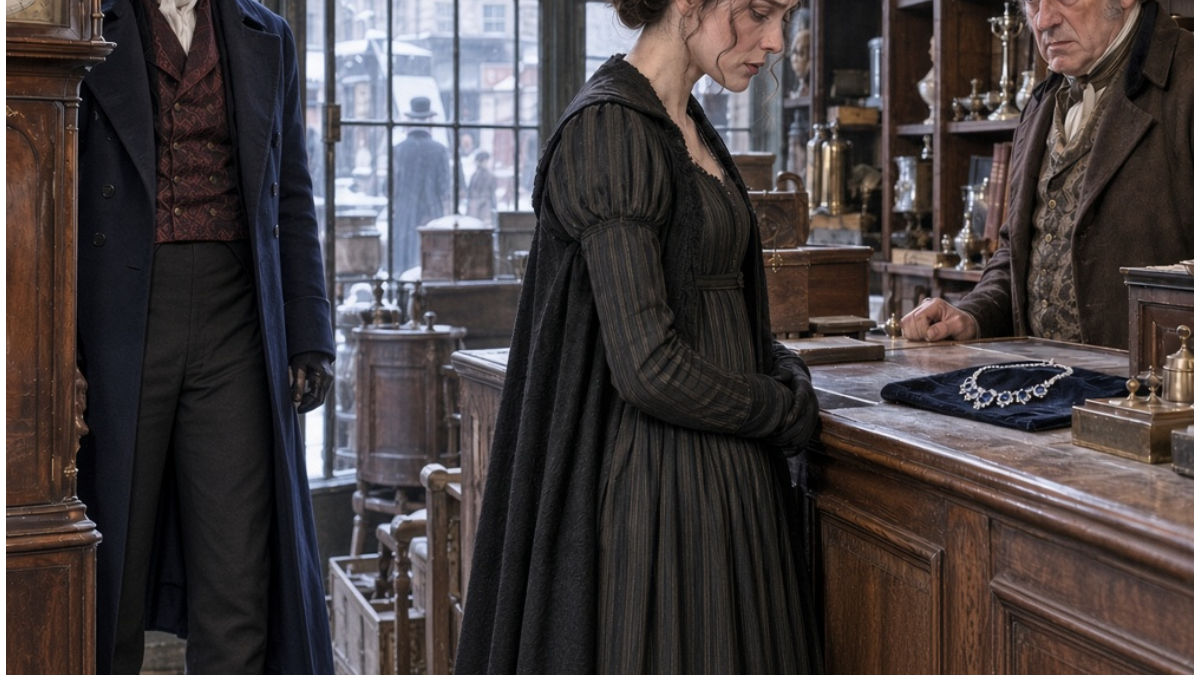
Porn shops in Cheapside smell of desperation and stale gin. They are not places for a duke.
But Romano came looking for a stolen family watch only to find something entirely different.
A woman in a threadbear morning dress sliding a familiar sapphire necklace across the scarred wooden counter.
Beatatrice. The woman he had loved in silence for a decade. The woman who chose another man only to be left a penniless widow bartering her last shred of dignity.
Cheapside in November was less a street and more a wet suffocating cough. The fog hung low, trapping the stench of cold smoke, rotting cabbage and damp wool.
Romano Pendleton, Duke of Wikliffe, stood just inside the doorway of Finch’s antiquities and loans, letting his eyes adjust to the gloom.
He had not come to this miserable corner of London for charity. He had come to retrieve a signate ring his idiot cousin had gambled away to a card shop.
The shop was a graveyard of broken promises. Silver candlesticks, tarnished pocket watches, and cracked porcelain lined the shelves.
Each item representing a sudden eviction, a medical bill, a final descent into ruin. Romano hated places like this.
They stripped away the polite fictions of society and left only the raw, ugly mechanics of survival.
He stepped toward the counter, preparing to demand the ring, when a voice stopped him cold.
20, Mr. Finch, the stones alone are worth 50. It was a quiet voice, huskier than it had been a decade ago, but the cadence was unmistakable.
Romano froze, his chest tightened, a phantom grip around his lungs. He stepped behind a tall grandfather clock, the wood smelling of lemon oil and decay, and looked toward the back of the shop.
She stood at the counter. Beatatrice, she was dressed in morning black, but the fabric was exhausted.
The hem was stiff with street mud. Her police, which might have been fashionable three winters ago, hung loosely on her frame.
She looked terrifyingly small. Romano’s gaze dropped to the counter. Between Beatric’s gloved hands, the left index finger, neatly darned, sat a sapphire and diamond necklace.
Romano recognized it instantly. He had been standing in the corner of her father’s drawing room on her 19th birthday when it was clasped around her neck.
He had watched her laugh, the blue stones catching the candle light just before Thomas Cole had asked her to dance.
Romano had spent that entire evening nursing a glass of punch, swallowing the words he had spent months practicing.
6 months later, she was Mrs. Thomas Cole. Now Thomas was dead. A carriage accident, the society papers had said.
A tragic end to a dashing spirited life. The reality, it seemed, was considerably less romantic.
Finch, a man whose face resembled a bruised thumb, picked up the necklace with a grunt.
He didn’t use a jeweler’s loop. He didn’t need to. He knew desperation when it walked through his door.
£10. Take it or leave it, Mrs. Cole. I’m running a business, not a parish charity.
Beatric’s shoulders flinched. It was a microscopic movement, but Romano saw it. He saw the way her chin trembled before she clamped her jaw shut.
She reached out, her fingers hovering over the sapphires. Please, I have creditors, my landlord.
15. 10. Finch repeated, tossing the necklace back onto the scarred wood. It landed with a dull, heavy clatter.
And that’s me being generous for a widow. Beatrice stared at the necklace. The fight drained out of her, leaving only a hollow, brittle exhaustion.
She nodded once slowly. “Very well.” Finch reached beneath the counter to open his cash box.
Romano didn’t think. For a man who had built a reputation on cold, calculating stoicism, the movement was entirely instinctual.
He stepped out from behind the clock, his heavy great coat sweeping against a pile of rusted fire irons, and walked to the counter.
“Put the box away, Finch!” Beatatrice gasped, spinning around, her eyes, the same sharp hazel that had haunted his sleep for 10 years, went wide.
Her face, previously pale, drained entirely of color. Your grace. Romano didn’t look at her.
He couldn’t. If he looked at the hollows of her cheeks or the dark circles beneath her eyes, he would take Finch by the throat.
He kept his gaze fixed on the porn broker. “Your grace,” Finch stammered, his hands freezing on the brass lid of the cashbox.
He recognized Romano. Most of London’s underbelly knew the Duke of Wikliffe. He owned half the real estate in the East End and had a reputation for evicting criminal tenants with ruthless efficiency.
Romano reached out and picked up the sapphire necklace. The stones were cold. “This is not for sale.”
“Romano,” Beatatrice whispered. Her voice was an agonizing mix of humiliation and pride. She reached out, trying to take the necklace back.
Please, this is none of your concern. He finally turned to look at her. The proximity hit him like a physical blow.
She smelled of rain and cheap soap, a far cry from the rose water she used to wear.
But underneath the poverty, the grief, the sheer crushing weight of her reality, she was still Beatrice, the only woman who had ever made him feel entirely inadequate.
“It is my concern now,” Romano said, his voice flat, betraying none of the chaos in his cheSt. He turned back to Finch.
“You have a ring, gold signet, a badger crest, brought in by a man with more teeth than sense.
3 days ago. Finch swallowed hard. I Yes, your grace. I have it. Bring it.
Finch scrambled to the back room. Beatric stood rigidly beside him. You have no right, she hissed, keeping her voice low.
Her pride was rearing up, a defensive wall crumbling under siege. I need that money.
You don’t understand. I understand that Finch was about to rob you, Romano replied, staring straight ahead.
And now my landlord will throw me into the street tomorrow morning. Are you going to save me from that, too?
Her voice was laced with bitter sarcasm, a defense mechanism to cover her absolute terror.
Romano slipped the necklace into his coat pocket. He turned to her, his gray eyes devoid of pity.
Pity was the last thing she needed. Yes. The rain had intensified into a biting sleet by the time they exited the shop.
Romano’s unmarked black carriage waited at the corner, the horses stamping their hooves impatiently against the cobblestones.
He didn’t offer her his arm. He knew she would refuse it. He simply opened the heavy door and waited.
Beatatrice hesitated on the curb. She looked at the polished crest on the door panel, then down at her ruined boots.
The disparity was stark. She looked like a stray dog being coaxed into a palace.
I can walk. My lodgings are not far. Get in the carriage, Beatrice. It was the first time he had used her given name.
It hung in the damp air between them, heavy with a decade of unspoken history.
She looked up at him, her jaw tight, and finally stepped up into the cab.
Romano followed, closing the door and shutting out the noise of cheapside. He tapped the roof twice, and the carriage lurched forward.
The interior was a cocoon of dark leather and quiet. The silence between them was not peaceful.
It was a loud, demanding thing. Romano sat opposite her, his knees nearly brushing hers in the confined space.
He watched her stare out the window, her posture rigidly upright. She was trying to disappear.
Where are you living? He asked. Spittlefields, she said to the glass, Romano’s jaw locked.
Spittlefields. A district of weavers, criminals, and the desperately poor. Thomas left you with nothing.
Beatrice let out a short, breathy laugh that held no humor. Nothing would have been a luxury.
Thomas left me with debts, mountains of them, tailor, wine merchants, gambling hells. It turns out my husband was a man of vast and varied appetites, none of which he could afford.
She finally turned to face him. There was a fierce defensive fire in her eyes.
Are you satisfied, Romano? Is this what you wanted to see? The great tragic fall of Beatatric Cole?
Don’t be absurd. Then why are you here? Why did you stop me? She pointed at his coat pocket.
That necklace was my rent. It was coal for my fire. You may have preserved my pride in front of a porn broker, but pride does not pay for bread.
Romano reached into his pocket, pulled out the necklace, and set it on the velvet seat beside her.
I will buy it. I don’t want your charity. It isn’t charity. It’s a transaction.
He leaned back, crossing his arms, forcing his body into a relaxed posture he did not feel.
What is the total sum of his debts? She looked away again. You don’t want to know.
Try me. £4,000. She said it quietly, as if speaking the number aloud would summon the creditors to the carriage windows.
4,000. To a man like Romano, it was the cost of a minor estate improvement.
To a widow with no income, it was a one-way ticket to debtor’s prison. Romano felt a surge of cold, violent anger toward Thomas Cole.
He had always known the man was a charming lightweight, a creature of bright smiles and hollow center.
“But to leave his wife to the wolves. The carriage will take us to your lodgings,” Romano said, his voice terrifyingly calm.
“You will pack your things.” Beatatrice blinked, confused. “Pack to go where?” To my townhouse.
You are done living in spittlefields. Are you mad? She sat forward. I cannot live with you.
The scandal alone. You are a widow in mourning, and I am a duke with 20 empty guest rooms in Grovener Square.
Let them talk. Gossip is entirely preferable to starving. I will not be your kept woman, Romano.
The words were harsh, thrown like stones. Romano flinched internally, but his face remained a mask of stone.
I have no intention of making you my mistress. I am offering you a roof, a temporary solution, until we untangle this mess.
The carriage ground to a halt. Romano looked out the window. They were parked in front of a leaning, soot stained boarding house.
The street was narrow, smelling of refuge and wet decay. “Show me,” Romano said. “No.”
He opened the door and stepped out into the sleet. He turned back, offering his hand.
“Show me where you live, Beatatrice, or I will stand out here until you do.”
She glared at him, a magnificent, furious glare that reminded him sharply of the girl she used to be.
But the exhaustion won. She ignored his hand, stepped out of the carriage, and led him inside.
They climbed three flights of narrow, creaking stairs. The air grew colder the higher they went.
She unlocked a flimsy wooden door and pushed it open. Romano stepped inside. The room was no larger than his dressing closet, a narrow cot, a single wooden chair, a wash basin with a cracked pitcher.
But the worst part was the great. It was completely empty, swept clean of even the dust of coal.
The room was freezing. He stood in the center of the miserable space. He felt the anger expanding in his chest, hot and ruinous.
Beatrice stood by the door, her arms wrapped around herself, stripped of the bustling streets, trapped in the physical evidence of her ruin, her defiance finally broke.
She covered her face with her hands, a jagged sobb tearing from her throat. Romano crossed the room in two strides.
He didn’t pull her into his arMs. He didn’t have the right. Instead, he took off his heavy wool great coat and draped it over her trembling shoulders.
“Pack,” he said softly. Romano’s study in Groner Square was a fortress of mahogany, leather, and silence.
A massive fire roared in the hearth, throwing warm golden light across the rows of bound ledgers and legal texts.
Beatric sat in a highbacked leather chair by the fire. She looked entirely out of place, swallowed by Romano’s coat, which she still refused to take off.
A silver tray sat on the table beside her, holding a pot of tea and a plate of untouched sandwiches.
Romano sat behind his massive desk. He had spent the last 2 hours reviewing the haphazard stack of bills and promisory notes she had brought from her room.
It was worse than 4,000. With the predatory interest the money lenders were charging, it was closer to six.
He set the final paper down and rubbed his temples. He could simply pay it.
He could write a draft to his man of business tomorrow morning and Beatatrice would be free.
But he knew her. He knew the stiff- necked, unyielding pride that had kept her from begging her distant relatives for help.
If he paid her debts outright, she would view it as an insurmountable obligation. She would spend the rest of her life trying to scrub floors to pay him back.
She would hate him for it. He needed an excuse, a mechanism that would allow her to accept his protection while keeping her dignity intact.
He looked at her. She was staring into the fire, the flickering light casting sharp shadows over her cheekbones.
She looked hollowed out, waiting for the executioner’s axe. Romano pulled a fresh sheet of heavy vellum toward him.
He dipped his pen in the inkwell. He was about to do something incredibly reckless, entirely logical, and profoundly selfish.
The total is closer to 6,000,” Romano said, breaking the silence. Beatatrice closed her eyes.
Her throat worked as she swallowed. “I see.” They will begin seizing your remaining assets by the end of the week.
Not that there is much left to seize. After that, it is the Marshall. See, you don’t need to explain the law to me, your grace.
She snapped quietly. I am well aware of where I am going. You are not going to prison.
Romano stood up and walked around the desk. He leaned against the edge, looking down at her.
I have a proposition for you. She looked up, wary, suspicious. As you well know, Romano began, his voice taking on the dry, detached tone he used in Parliament.
My uncle passed away 6 months ago. As a result, I am now in possession of not only this dukedom, but the unintental estates in Yorkshire.
I I also inherited his political obligations, his staff, and a society of matchmakers who view me as a piece of unguarded meat.
Beatrice frowned, confused by the pivot. Congratulations. It is a nightmare, Romano said flatly. My houses are mismanaged.
My social obligations are vast and tedious. I need someone to organize my households, host the necessary dinners, and frankly act as a human shield against ambitious mothers.
Beatric’s eyes narrowed. You are asking me to be your housekeeper. I am asking you to be my wife.”
The fire crackled. A log shifted, sending a shower of sparks up the chimney. Beatrice sat perfectly still.
She looked at him as if he had just started speaking Greek. “Excuse me?” “A marriage of convenience,” Romano said smoothly, burying the desperate thudding of his heart beneath a veneer of utter pragmatism.
“A business arrangement. You become the Duchess of Wikliffe. In exchange, I assume your debts, clear Thomas’s name from the ledgers, and provide you with an allowance and a home.
You in return run my estates, host my political allies, and ensure I am never seated next to Lady Higgins’s shrieking daughters at dinner again.
Beatrice stood up. The coat slipped from her shoulders, pooling on the floor. You are mocking me.
I have never been more serious in my life, Romano. This is insane. You could have your pick of any woman in England.
An ays, a beauty. Why on earth would you chain yourself to a bankrupt widow?
Because I have loved you since I was 20 years old, he thought. Because I have measured every w woman I have ever met against a memory of you and they all fell short.
Because watching you suffer is tearing me apart. Because I do not want an ays and I do not want a romantic entanglement.
Romano lied, his voice chillingly steady. I want a partner I know. I want someone intelligent, capable, and practical.
We understand one another, Beatatrice. This is a logical solution to both our probleMs. She stared at him, searching his gray eyes for any sign of a joke, any hint of pity.
She found nothing but a blank, unreadable wall. “You would pay £6,000 just to avoid matchmakers?”
She asked, her voice trembling slightly. I would pay twice that for peace and quiet, Romano replied dryly.
She turned away, pacing a few steps toward the window. Her mind was racing. He could see the gears turning, the desperation waring with her pride.
She had nothing. No family to take her in, no money, no prospects, only a cold room and the looming threat of the Marshall sea.
Separate lives, she said, her back to him. Separate bedrooms, Romano agreed instantly. It was a knife to the gut, but it was necessary to secure her agreement.
You will have complete autonomy over your household and your allowance. I ask only for your public loyalty and your assistance with my obligations.
She stood by the window for a long time, looking out at the dark, sleetcovered square.
Finally, she turned back to him. Her eyes were dry, her chin lifted in that proud, familiar way.
Draft the contract, your grace. Romano exhaled a breath he felt he had been holding for 10 years.
I will have my solicitors draw up the settlements tomorrow morning. He had saved her.
She was safe. She would be his wife. But as he looked at the hard closed expression on Beatric’s face, Romano realized the terrifying truth of his victory.
He had bought her debts and he had bought her hand. But winning the heart she had buried with Thomas Cole.
That was a debt he had no idea how to pay. Grovener Square did not wake up.
It merely transitioned from the quiet hum of privilege to the active administration of it.
Beatrice stood in the center of her new bed chamber, entirely paralyzed by the sheer volume of heat.
The fire in the marble hearth was a roaring, magnificent beast of consumption. Coal was piled high, burning with a steady, expensive crackle.
Two days ago, Beatatrice had spent an hour debating whether to burn a broken chair leg to keep her fingers from going numb.
Now she was sweating. She stepped away from the hearth, feeling a wave of nausea that had nothing to do with the lavish breakfast sitting untouched on a silver tray near the window.
It was guilt, pure, toxic, and suffocating. She was safe, while outside the heavy velvet draperies, the spittlefield slums were still freezing.
The door opened with a soft click. Mrs. Gable, the housekeeper, stepped in. She was a woman of terrifying verticality, dressed in bombazine, so stiff it rustled like dried leaves.
She did not look at Beatatrice with pity, nor with the veiled contempt the servants of Thomas’s creditors had used.
She looked at Beatatrice as an operational variable. The modist is waiting in the yellow drawing room.
Your grace, Mrs. Gable said, her hands folded neatly over her apron. Beatatrice flinched at the title.
They had been married yesterday morning by special license in a cold, echoing church in Mayfair.
Romano had worn a severe black coat. She had worn the same threadbear morning dress she had almost pawned.
It took 14 minutes to bind them together for life. They had ridden back in silence, Romano leaving her at the door to attend a session in the House of Lords.
I don’t need a modist, Mrs. Gable. I have clothes. You have rags, Beatrice. Romano’s voice came from the open doorway.
He stood leaning against the frame, holding a stack of morning poSt. He wore a deep navy morning coat that fit his broad shoulders with infuriating perfection.
His gray eyes swept over her, entirely unreadable, before settling on the frayed cuff of her sleeve.
Mrs. Gable vanished down the corridor with the silent efficiency of a ghoSt. “I am in mourning,” Beatatrice said, lifting her chin.
“I do not require new gowns to sit in an empty house. You are the Duchess of Wikliffe, Romano replied, stepping into the room.
He closed the door behind him. The sudden privacy made the vast bed chamber feel dangerously small.
You will not be sitting in an empty house. We are hosting this Spanish ambassador on Thursday and a contingent of wig politicians on Saturday.
You cannot serve them wearing a dress that looks as though it has been dragged behind a carriage.
Beatrice bristled. The defense mechanisms she had honed over the last year flared to life.
I apologize if my poverty offends your aesthetic sensibilities. Perhaps you should have hired a professional hostess rather than a bankrupt widow.
Romano didn’t rise to the bait. He walked to the window, glancing at the untouched breakfast tray.
You haven’t eaten. I am not hungry. You are starving, but you are too stubborn to admit it.”
He turned to face her, his expression hardening into the pragmatic mask he wore so well.
“Listen to me. This is not charity. We agreed on a business arrangement. A soldier requires a musket.
A cler requires a pen. You, in your capacity, as the head of this household, require a wardrobe.
It is a professional necessity. Do not make this a battle of pride. He called it a uniform.
He stripped the transaction of any intimacy, any hint of indulgence. It was a brilliant tactical maneuver.
Beatatrice stared at him, the fight slowly draining from her shoulders. He was right. If she walked into the drawing room looking like a street beggar, it would reflect poorly on him.
She owed him a smooth operation. She owed him the £6,000 he had dropped onto the money lender’s desks to buy her freedom.
“Very well,” she said quietly. “A working uniform.” “Nothing extraneous.” Romano gave a curt nod.
“Madame Celeste is waiting. Choose whatever you need. Send the bills to my steward.” He turned to leave, his hand on the brass doornob.
Romano, she called out. He stopped. He didn’t look back. His knuckles were white where they gripped the brass.
Thank you. The words tasted like ash, but she forced them out for the fire.
I haven’t been warm in in a very long time. Romano stood frozen for a long, agonizing second.
His broad back was rigid. “The house is always kept warm,” he said softly, his voice devoid of its usual aristocratic bite.
“You will never be cold here, Beatatrice.” He stepped out and closed the door, leaving her alone with the roaring fire and the terrifying realization that her new husband was a man she didn’t understand at all.
Society did not whisper. Society hissed. It was a collective venomous sound that echoed off the gilded ceiling of Lord Harrington’s ballroom.
Beatatrice stood near a towering arrangement of white liies, a crystal flute of champagne warming in her gloved hand.
She was acutely aware of the eyes burning into her back. The sudden, unannounced marriage of the Duke of Wikliffe to the disgraced, destitute widow of Thomas Cole was the only topic of conversation worth having.
She wore deep Wikliffe blue. Madame Celeste had worked a minor miracle in 3 days, producing a gown of heavy, unadorned silk that fell with liquid grace.
It was technically half morning, a severe, elegant cut that left her shoulders bare, but offered no lace, no frills, no apologies.
Around her neck sat the sapphires. Romano had placed the box on her dressing table an hour before they departed.
A duchess must wear her jewels, the accompanying note had read. Not your jewels, her jewels, the role she was playing.
I heard the baiffs were literally dragging her out by the hair when Wikliffe rode up, murmured Lady Kper, standing just loud enough to be heard over the string quartet, hidden behind a painted fan.
He always was eccentric, a male voice replied. Pity he could have had the Tolison girl.
Now he’s saddled with Cole’s leftover debts. They say Thomas died fleeing a card game, you know.
Beatrice took a slow, measured breath. She had focused on the rim of her glass.
She would not run. If she ran, they won. She had survived freezing rooms and the threats of violent men in the East End.
She could survive the viciousness of bored aristocrats. A heavy, warm presence settled at her side.
She didn’t need to look to know it was Romano. He carried an air of absolute immovable authority.
“You look as though you’re planning a murder,” Romano said smoothly, keeping his gaze fixed on the crowded dance floor.
“Just calculating the cost of a carriage ride back to Spittlefields,” Beatatrice muttered. “I think the rats had better manners,” Romano’s mouth twitched.
“It wasn’t quite a smile, but it was close. The rats in Spittlefields are honest about their desire to eat you.
The ones in Mayfair prefer to do it while commenting on your dress. He shifted his stance, subtly angling his broad shoulders to block her from the view of the worst gossips.
It was a protective gesture, entirely instinctual. Beatrice felt a strange, unsettling flutter in her cheSt. Before she could analyze it, Lady Kalper materialized through the crowd, wearing a smile that resembled a cracked blade.
“Your grace,” the matron purred, dipping into a shallow curtsy. And the new duchess, “What a startling surprise your announcement was.
We were all quite shocked. Given the circumstances of poor Mr. Cole’s passing, we assumed you would remain in quiet seclusion.”
Beatric’s grip on her glass tightened until her knuckles achd. The mention of Thomas, the veiled implication that she should be hiding in shame.
Romano did not let Beatatrice answer. He stepped forward, bridging the space, looking down at Lady Kper with a gaze so entirely devoid of warmth it could have frozen the temps.
I am not a man who waits for permission to take what is mine, Lady Kper, Romano said, his voice carrying a dark, resonant edge that sliced through the ambient chatter.
Beatatric’s period of seclusion is over. She is my wife, and I find I have very little patience for anyone who questions my judgment.
The ambient chatter within a 10- ft radius died instantly. Lady Kalpa’s triumphant smile faltered, her painted cheeks draining of color.
Romano was not just a duke. He controlled the leases on half the estates in London, including the land Lady Kalpa’s son currently rented.
Of of course your grace, she stammered, stepping back. I only meant to offer my congratulations.
Your congratulations are noted and dismissed. Romano turned his back on her. A dismissal so absolute it was a social execution.
He held out his arm to Beatrice. I require a breath of air. Walk with me.
Beatrice placed her hand on his sleeve. Beneath the fine wool of his coat, his arm was hard as iron, radiating heat.
He led her out of the ballroom, through a set of French doors, and onto a sweeping stone terrace overlooking a manicured garden.
The night air was freezing, biting through her silk gown in seconds. But she didn’t care.
She let go of his arm and walked to the stone ballastrade, leaning against it, taking a deep, ragged breath of the cold air.
Romano stood beside her, ripping off his gloves. “You didn’t have to do that,” Beatatrice said.
Her voice shaking slightly. The adrenaline of the confrontation was leaving her, replaced by a hollow exhaustion.
They will only talk more now. Let them talk. Romano gripped the stone rail. They are parasites.
They feed on perceived weakness. You give them nothing. Beatrice, do you understand me? Nothing.
She looked at him. In the pale moonlight, the harsh angles of his face were illuminated.
He looked furious. Not at her, but for her. It was a business arrangement, Romano.
She reminded him softly, as much to remind herself as him. You don’t need to defend my honor as if it were a love match.
Romano slowly turned his head to look at her. The silence stretched, heavy and dangerous.
He looked at her mouth, then up to her eyes, and for a fraction of a second the iron vault of his composure cracked.
There was something wild and desperate lurking beneath his gray eyes, a hunger that made her breath catch in her throat.
“You carry my name now,” he said, his voice dropping to a low, rough gravel.
Your honor is my honor. No one insults my wife. Not while I have breath in my lungs.
He stripped off his evening coat and draped it heavily over her bare shoulders, the fabric carrying the scent of cedar and his skin.
Before she could protest, he turned and walked back into the light of the ballroom, leaving her standing in the dark, clutching his coat completely undone.
3 weeks into her tenure as the Duchess of Wikliffe, Beatatrice found the lie. She had taken to her duties with the ruthless efficiency of a woman who needed a distraction.
She She managed the staff of 40 without breaking a sweat, reorganized the chaotic menus, and learned the intricate web of Romano’s political alliances.
She treated the marriage like a highstakes employment contract. If she worked hard enough, if she made his life seamless, she wouldn’t have to think about the terrifying, confusing heat that flared between them every time they were in the same room.
They lived separate lives exactly as promised. Romano left early for Parliament or his clubs.
They dined together in the evenings, separated by 10 ft of polished mahogany, discussing estate yields and guest lists with polite, excruciating formality.
But late at night, the house belonged to her. It was past 1:00 in the morning.
Rain lashed against the tall windows of Romano’s private study. Beatrice sat at his massive desk, a candalabra casting a pool of yellow light over a stack of leatherbound ledgers.
Romano had given her the keys to his man of business’s accounts, instructing her to audit the household expenditures.
She reached for a black ledger at the bottom of the stack. It was unmarked.
She cracked the spine, expecting to find records of wine sellers or stable fees. Instead, she found her own name.
She froze. The page was a meticulous tally of Thomas’s debts. Every gambling chit, every unpaid taylor, every predatory lone shark.
But it wasn’t just a list of payments. Romano’s sharp, aggressive handwriting filled the margins with notes.
Finch, porn broker. Debt paid in full. Lease on cheapside shop purchased. Eviction notice served.
Maddox, money lender, debt paid, reported to magistrate for illegal extortion. Operations ceased. Beatatrice traced the dried ink with a trembling finger.
Romano hadn’t just paid her debts. He had systematically dismantled the men who had threatened her.
He had ruined them. He had wielded his immense wealth and power like a scythe, cutting down anyone who had made her suffer during her year of poverty.
She turned the page. The next entry stopped her heart. It was a date, 10 years ago.
The exact date of her wedding to Thomas Cole. Beneath it was a single line of Romano’s handwriting.
I let her go. Beatrice stared at the words until they blurred. A cold, shocking truth began to seep into her bones.
This wasn’t a marriage of convenience to avoid society matchmakers. He didn’t need a housekeeper.
He didn’t need a hostess. The door to the study clicked open. Beatatrice gasped, slamming the ledger shut.
Romano stood in the doorway. He was not wearing his usual armor of starched crevats and tailored coats.
He wore only a white linen shirt, unbuttoned at the throat and dark trousers. His hair was ruffled, falling over his forehead.
He looked exhausted, rubbing the back of his neck as he stepped into the room.
He stopped when he saw her behind his desk. His eyes dropped instantly to the black ledger under her hands.
The silence in the room became a physical weight, pressing against her cheSt. The rain battered the glass outside.
You should be asleep, Romano said. His voice was guarded, flat. Beatatrice stood up. Her legs felt weak.
She kept her hand flat on the leather cover of the book. I was reviewing the accounts as you asked.
Romano walked slowly toward the desk. The flickering candle light cast long shifting shadows across his face.
That ledger is not part of the household accounts. I know. Her voice shook. She hated that it shook.
Why did you buy Finch’s building, Romano? He stopped on the opposite side of the desk.
The mahogany barrier was the only thing between them. It was a sound real estate investment.
You evicted him. He was running a predatory business. You ruined him. Beatrice pushed, stepping around the edge of the desk.
She needed to see his face clearly. She needed him to stop hiding behind his stoicism.
You ruined Maddox, too. You hunted down every man who held a note on Thomas’s debt.
Romano’s jaw locked. A muscle jumped in his cheek. I secured my investment. I do not leave loose ends.
Beatrice, stop lying to me. Her voice cracked, echoing sharply in the quiet room. Stop treating me like a business transaction.
Romano’s hands slammed down on the desktop. The sudden violence of the movement made her jump.
He leaned over the wood, his eyes blazing with a suppressed fury that finally broke through the surface.
“Do you want to know why?” He demanded, his voice a low, terrifying rasp. “Because I walked into that shop and saw a man who wasn’t fit to shine your boots, treating you like dirt.
Because for 10 years I have watched from the sidelines while Thomas Cole squandered the only thing in this world that mattered.
Because if I hadn’t ruined them, I would have killed them with my bare hands.
Beatrice stepped back, her breath hitching, the raw bleeding truth in his words shattered the last remnants of her defenses.
Romano closed his eyes, his head dropping forward. The anger vanished, leaving only a bone deep weariness.
He pushed off the desk and turned his back to her, running a hand through his hair.
“Go to bed, Beatatrice,” he said softly, the harshness gone. “Leave the ledger.” “Just go to bed,” she looked at his broad back at the rigid tension in his shoulders.
For a decade, she had thought him as a cold, unfeilling aristocrat, a man made of stone.
But he wasn’t stone. He was a man who had loved her in agonizing silence, watching her suffer, building an empire just so he could one day tear down the world to protect her.
She didn’t leave. She took a step forward, then another, until she was standing directly behind him.
She re raised a trembling hand and pressed her palm flat against the center of his back right over his spine.
Romano went perfectly still. He stopped breathing. “You didn’t let me go, Romano,” she whispered to the dark fabric of his shirt.
“I think you just caught me.” The warmth of her palm bled through the fine linen of his shirt.
Romano went entirely rigid, the muscles in his back pulling tort like the rigging of a ship caught in a sudden gale.
He did not turn. He simply stopped breathing. The the only sound in the study was the violent drum of rain against the glass and the quiet, frantic ticking of the mantel clock.
“Don’t,” Romano said. The word was a grally command scraped roar from the back of his throat.
Do not pity me, Beatatrice. I will take your anger. I will take your resentment, but I will not stomach your pity.
It isn’t pity. She didn’t move her hand. Instead, she smoothed her palm upward, feeling the rigid tension knotting his shoulders.
Turn around, Romano. He didn’t move. He stood facing the dark window, an impenetrable fortress of a man slowly fracturing from the inside.
“Turn around,” she repeated, her voice steadying. The fear that had kept her paralyzed for weeks was gone, washed away by the stark, undeniable proof of the ledger.
Slowly, agonizingly, Romano turned. His face was a portrait of defeat. The mask of the untouchable Duke of Wikliffe was gone.
His gray eyes were dark, heavy with a decade of accumulated exhaustion. He looked at her not as a tactical problem to be solved, but as the one variable he could never control, 10 years, Beatrice whispered, the reality of it finally settling into her bones.
You stood in the corner of my father’s drawing rooMs. You watched me marry another man.
You watched me fall into ruin. And you never said a word. What was there to say?
He asked bitterly, stepping away from her touch, putting distance between them. You were completely captivated by Thomas.
He was bright and charming and everything I was not. I was a second son with a grim disposition.
I knew I couldn’t make you happy. He let out a harsh, self-deprecating laugh.
It turns out neither could he. Beatatrice flinched. The truth of it stung, but it was a clean sting.
No, he couldn’t. Romano looked up, his eyes locking onto hers. I did not buy your debts to trap you, Beatrice.
I bought them because the thought of you sitting in a debtor’s cell was tearing me apart.
I proposed this arrangement because I knew your pride would never accept a gift of that magnitude.
You needed to feel you were earning your keep. So you invented a job for me, a uniform, a role to play.
I gave you an out. You gave me a cage, she counted softly, stepping toward him.
a gilded comfortable cage where I was safe from the world but entirely isolated from you.
I am protecting you from what? From the truth, from the fact that you you love me.
The word hung in the air between them, terrifying and absolute. Romano’s jaw clenched tight enough to crack teeth.
He looked away, staring at the embers dying in the hearth. Yes. Why? Because you belong to a ghost, Romano said, his voice dropping to a harsh whisper.
He finally turned his gaze back to her, and the raw devastation in his eyes made her breath catch.
Because you are mourning a man who left you to starve. “And I am arrogant enough to believe I can fix your life.
But I am not foolish enough to believe I can replace him.” Beatrice stood completely still.
The sheer magnitude of his misunderstanding hit her with the force of a physical blow.
He thought she was grieving for Thomas. He thought the hollow, haunted look in her eyes for the past 6 months was the lingering agony of a great romance cut short.
She let out a sound that was half laugh, half sobb. You think I am mourning, Thomas?
She shook her head, a bitter, cynical smile pulling at the corners of her mouth.
Romano. Thomas and I did not share a bed for the last 3 years of our marriage.
Romano froze. What? He had mistresses plural. He had a gambling habit that eclipsed his income within our first year.
Beatatrice closed the distance between them, ignoring his instinct to retreat.
She stopped mere inches from his cheSt. I did not weep weep when they told me his carriage went off the bridge.
I felt relief. And then when the creditors knocked on the door the very next morning, I felt absolute crushing terror.
She reached up, her hands trembling as she grabbed the lapels of his open collar.
She felt the heavy thudding rhythm of his heart against her knuckles. I am not mourning a dead husband, Romano.
I am mourning the decade I wasted trying trying to survive him. I am mourning the girl who was stupid enough to choose a charming smile over a man who would tear down the world to keep her warm.”
Romano stared at her. The air in the room grew thick, electric. He lifted his hands, hesitant as if she were made of spun glass.
He placed his large, warm palms against her waiSt. “Betrice, you are an idiot,” she whispered, her voice cracking.
“A brilliant, ruthless, absolute idiot.” She didn’t wait for him to close the final distance.
She pulled him down by his collar and pressed her mouth to his. The collision was violent.
10 years of suppressed desire, of silent observation, of agonizing restraint snapped in a single second.
Romano’s hands tightened on her waist, bruising and desperate, lifting her entirely off the floor.
He kissed her, not with the polite restraint of a gentleman, but with the starving intensity of a man who had finally been handed the one thing he had been denied.
Beatrice tasted salt and rain and the dark, intoxicating heat of him. She anchored her hands in his hair, pulling him closer, demanding more.
The ledgers, the debts, the contract. It all burned to ash. There was only the solid, immovable reality of his body against hers, anchoring her to the earth.
Romano backed her into the edge of the mahogany desk, scattering the meticulous stacks of household accounts.
He tore his mouth from hers, burying his face in the curve of her neck, his breathing ragged and harsh.
“You are mine,” he murmured against her skin. The words a fierce territorial vow, not a contract, not a business arrangement.
“Mine,” Beatatrice closed her eyes. The lingering ghosts of Spittlefields finally releasing their grip on her soul.
“Yes,” she answered, her hands tracing the broad line of his shoulders. “I am. The shift in Grovena Square was not a public event.
It happened in the quiet, unobserved spaces between the Duke and Duchess. It was the way Romano’s hand rested on the small of Beatric’s back as they descended the stairs.
It was the way she no longer sat at the opposite end of the dining table, but in the chair directly to his right, their knees brushing under the heavy damaskque cloth.
The staff noticed it immediately, the rigid transactional coldness of the house had thawed, replaced by a low humming, dangerous kind of intimacy.
But society is an organism that thrives on instability, and it despises a quiet victory.
Two weeks after the night in the study, Beatatrice hosted a card party. It was a calculated political maneuver designed to secure the loyalty of several key members of Romano’s parliamentary coalition.
The drawing rooms were brilliantly lit. The champagne flowed like water, and Beatatrice moved through the crowd with the effortless, lethal grace of a woman who finally knew exactly who she was.
She wore emerald silk tonight, the White Cliff diamonds heavy at her throat. She was no longer a charity case.
She was power. Romano was cornered near the fireplace by the home secretary, trapped in a debate about grain tariffs.
He caught Beatric’s eye across the room. He didn’t smile. Romano rarely smiled in public, but the fractional dip of his chin and the darkening of his gray eyes sent a rush of heat straight down her spine.
She turned to signal a footman for more wine, only to find her path blocked.
A magnificent recovery, Beatrice. Truly a masterclass in survival. The voice was oily, carrying the faint metallic scent of stale gin beneath a heavy layer of expensive cologne.
Beatrice went rigid. Lord Kavanaaugh. He was a man who moved through London’s underworld and high society with equal ease.
A parasite who fed on the indiscretions of the wealthy. Thomas had spent entirely too much time in his company during the final frantic months of his life.
Beatrice composed her face into a mask of polite indifference. “Lord Kavanaaugh, I was not aware you were on the guest liSt.”
“I am not,” Kavanaaugh replied smoothly, stepping closer. His eyes darted over the diamonds at her neck, lingering with Avarice.
“But a man with my particular portfolio of interests finds doors open to him regardless.
I’ve come to collect. Duchess Beatric’s pulse skipped a beat, but she did not break eye contact.
My husband’s debts have been settled. Every single one. If you have a grievance, you may take it to the Duke’s solicitors in the morning.
Cavanaaugh chuckled. A dry, unpleasant sound. Oh, the Duke has been remarkably thorough. Paid off the tailor, the gambling hells, the money lenders.
Very noble, very expensive. But Thomas owed me something far more valuable than a few hundred of marker debt.
He reached into the breast pocket of his coat and produced a folded piece of parchment.
He didn’t hand it to her. He held it between two fingers just out of her reach.
Thomas was a desperate man at the end, Beatatrice. Desperate men do foolish things. When his credit dried up, he needed collateral for a rather substantial loan.
He provided me with a promisory note guaranteed by his good friend, the late Duke of Wikliffe, Romano’s uncle.
The floor beneath Beatatrice seemed to tilt. That is impossible. The late Duke despised Thomas.
I am aware. Cavanaaugh smiled, showing small, uneven teeth. Which is why the signature on this note is a forgery.
A very clumsy one at that. Executed by your late husband’s own hand, Beatatrice stopped breathing.
The music from the string quartet faded into a dull roar in her ears. Forgery was a capital offense.
Even in death, the scandal of it would be cataclysmic. It would ruin Thomas’s remaining family, drag Beatric’s name back into the mud, and worst of all, humiliate Romano.
The opposition in Parliament would use it to butcher his reputation. The Duke who married a forger’s widow to cover up a crime against his own house.
“What do you want?” She asked, her voice dropping to a dangerous whisper. “£10,000?” Kavanaaugh said simply.
A bargain. Considering the damage this piece of paper could do to your shiny new husband’s political career, you have until tomorrow evening to arrange the draft.
Do not speak to Romano. He is a violent man, and if he attempts to intimidate me, copies of this note will be in the hands of the morning papers before dawn.”
He gave her a mocking, abbreviated bow. “Enjoy your party, Duchess!” Kavanaaugh slipped backward, melting into the crowd of laughing aristocrats.
Beatatrice stood frozen near the velvet curtains. The old familiar panic clawed at her throat.
Hide it. Fix it. Don’t let anyone see the mess. It was the instinct that had kept her alive in Spittlefields.
She could sell the diamonds. She could go to the moneylenders herself. She could protect Romano from the fallout of Thomas’s final unforgivable sin.
She looked across the room. Romano was still speaking with the home secretary. He looked solid, unmovable.
He was a man who commanded the world around him. He had spent £6,000 and risked his own social standing just to pull her out of the cold.
Separate lives, she had demanded on the day they signed the contract. She looked at Kavanaaugh’s retreating back, then at her husband.
The frightened widow of Thomas Cole would have tried to pay the blackmail. She would have lied, schemed, and carried the crushing weight of the secret until it broke her.
But Beatatrice was no longer that woman. She set her champagne flute down on a passing tray with a sharp, definitive click.
She lifted her chin, the emerald silk rustling as she turned her back on the doorway and walked straight across the crowded room toward Romano.
Romano saw her coming before she reached him. He was in the middle of a complex rebuttal regarding maritime trade.
But the moment he caught sight of Beatric’s face, the words died in his throat.
She looked magnificent, but her eyes were entirely devoid of the practiced warmth she had been utilizing all evening.
They were flat, hard, and terrifyingly focused. “Excuse me, gentlemen,” Romano said, cutting off the home secretary mid-sentence.
He stepped away from the fireplace and met her in the center of the room.
“My study,” Beatatrice said softly, stopping in front of him. “Now.” She didn’t wait for his reply.
She bypassed him and walked straight toward the heavy oak doors leading to the private wing.
Romano felt a spike of pure adrenaline hit his bloodstream. He signaled his steward with a sharp motion of his hand to keep the guests occupied and followed his wife out of the drawing room.
The heavy doors of the study closed, shutting out the noise of the party.
“What happened?” Romano demanded, shedding his public persona instantly. He closed the distance between them, his hands hovering over her shoulders, scanning her face for signs of distress.
Are you ill? Did someone insult you? Lord Kavanaaugh is here. Romano’s face went blank.
It was the terrifying absolute stillness of a predator locating a threat. Kavanaaugh is not on the guest liSt. He snuck in.
Beatatrice took a deep breath, refusing to let her hands shake. She would not fall apart.
Not in front of him. He has a promisory note, Romano. Signed by your uncle, guaranteeing a massive debt for Thomas.
Romano frowned. My uncle wouldn’t have given Thomas Cole the steam off his tea, let alone a guarantee.
I know. Thomas forged it. The words hung in the air, heavy and toxic. Romano stared at her.
The geopolitical minations of Parliament vanished from his mind, replaced by cold, calculating violence. He’s blackmailing us, Romano stated, reading the reality of the situation instantly.
How much? £10,000. He threatened to go to the papers tomorrow if I told you.
He said, “It would ruin your career to be associated with a forger’s widow.” Beatatrice looked up at him, her hazel eyes fiercely bright.
“He thought I would panic. He thought I would try to handle it myself to protect you.”
Romano reached out and gripped her shoulders. His fingers were hard, anchoring her. “But you didn’t.
No, I did not.” She squared her jaw. “I am your wife, Romano. We are not a business transaction.
We are a partnership. I will not keep secrets from you. And I will not let a rat like Kavanaaugh threaten what we are building.
A slow dark heat bloomed in Romano’s cheSt. For 10 years he had loved her for her grace and her beauty.
But looking at her now, standing in the fire light, armed with a ruthless, unyielding loyalty to him, he felt something entirely different.
He felt a profound, staggering reverence. She was not a victim to be saved. She was a queen ready for war.
A cruel, razor sharp smile touched the corner of his mouth. £10,000. The man is ambitious.
I’ll give him that. What do we do? Beatrice asked. “We,” Romano repeated, the word tasting like a victory.
“We are going to introduce Lord Kavanaaugh to the realities of a Wickliff’s temper.” He stepped past her and pulled the bell rope violently.
Less than a minute later, the door opened. “Mr. Graves, Romano’s massive, silent head of security, stepped into the room.”
“Graves,” Romano said, his voice entirely devoid of inflection. Locate Lord Kavanaaugh. He is somewhere on the ground floor.
Bring him to the library. Do not let him cause a scene. If he resists, break his nose.
Yes, your grace. Graves vanished. Come, Romano said, offering Beatatrice his arm. Let’s go meet our gueSt. The library was located at the far end of the house.
A cavernous, dimly lit room smelling of old paper and leather. They didn’t have to wait long.
The door opened and Graves dragged Kavanaaugh in by the collar of his coat, hurling him unceremoniously onto the Persian rug.
Kavanaaugh scrambled to his feet, his face flushed with panic and indignation. He looked at Romano, then at Beatrice, his snear faltering.
This is an outrage. I told you not to tell him, “You stupid bitch.” Romano moved with a terrifying liquid speed.
He crossed the room in two strides, grabbed Kavanaaugh by the throat, and slammed him backward against the heavy mahogany bookshelves.
Books tumbled to the floor in a cascade of duSt. “I am going to give you exactly 5 seconds to hand over the forgery,” Romano said, his voice a soft, lethal purr.
He tightened his grip, cutting off Cavanaaugh’s air. If you do not, I will have Graves break both of your legs, throw you into a carriage, and dump you in the tempames.
I own the magistrates, Kavanaaugh. I own the constabularary. You will simply cease to exiSt. Kavanaaugh clawed frantically at Romano’s arm, his face turning an alarming shade of purple.
He nodded, a jerky, desperate motion. Romano loosened his grip just enough. Kavanaaugh gasped for air.
His hands shaking violently as he reached into his pocket and pulled out the folded parchment.
Romano took it. He didn’t even look at the signature. He walked to the roaring fireplace and tossed the parchment into the flames.
They watched in silence as the evidence of Thomas Cole’s final betrayal curled, blackened, and turned to ash.
Romano turned back to the black mailer. Your presence in London has become entirely unacceptable to me.
You will pack your belongings and leave the country by tomorrow evening. If I ever see your face in this city again, I will not bother with the temps.
I will bury you myself. Kavanaaugh didn’t speak. He stumbled past graves and fled the room, the heavy door clicking shut behind him.
Silence fell over the library. Romano stood by the fire, watching the last of the ash float up the chimney.
He felt a sudden, profound exhaustion. The last thread tying Beatatrice to her past had been severed.
The ghost of Thomas Cole was finally dead. He felt her approach before she touched him.
Beatrice slid her arms around his waist from behind, pressing her cheek against the broad, solid expanse of his back.
“It’s over,” she murmured, her voice steady and warm. Romano turned around, wrapping his arms around her, pulling her tightly against his cheSt. He buried his face in her hair, breathing in the scent of her skin.
“You didn’t try to hide it,” he said quietly. The marvel of it still echoing in his mind.
“I told you,” Beatatrice said, leaning back to look up into his eyes. “There was no fear left in her gaze, only a fierce, blinding certainty.
I am not playing a role anymore. I am not your employee, and I am not your charity case.
I am Beatrice Pendleton. I am your wife.” Romano looked down at the woman he had loved for a decade.
The cynical defensive walls they had both built were entirely gone. In their place stood something raw, earned and entirely unbreakable.
He didn’t need to say another word. He lowered his head and kissed her, erasing the last shadows of the past, claiming the future they had fought so bitterly to secure.
The ink on a contract can force two people into a house, but only the courage to face the ghosts of the past together can forge a true marriage.
Romano and Beatric’s journey from a desperate porn shop transaction to an unbreakable, passionate partnership proves that sometimes the most calculating men harbor the most fiercely devoted hearts.








