Sophie Wessex Breaks Silence: “Catherine Saved Me When I Wanted To Quit The Family”
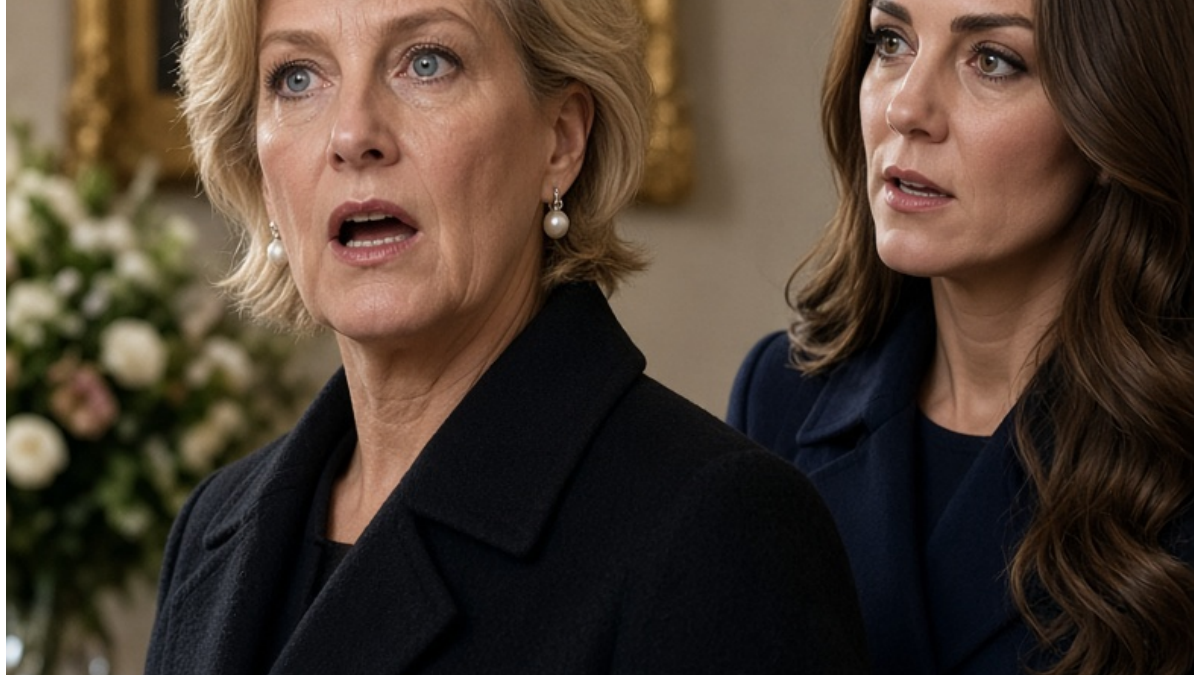
The Unbroken Silence
Chapter 1: The Unsent Letter
The rain over Surrey fell in a soft, relentless mist, wrapping the ancient oaks of Bagshot Park in gray silk. Inside the high-ceilinged library, the only sound was the quiet crackle of dying birch logs in the grate and the rhythmic, deliberate scratching of a fountain pen against thick cream stationery.
Sophie, Duchess of Edinburgh, sat alone at her dark oak writing desk. She wore no jewelry save for her simple gold wedding band, her tailored navy cardigan buttoned closely against the chill. Her posture was erect, forged by decades of strict public discipline. But her eyes, framed by faint lines of exhaustion, held a quiet, distant stillness.
On the blotter before her lay three neatly handwritten pages. The heading at the top was precise: To His Majesty the King.
It was not a letter of grievance, nor was it a frantic outburst born of a single bad day. It was a formal, legally grounded request for a prolonged, indefinite withdrawal from official royal duties. Every sentence had been weighed, edited, and refined until the emotion was stripped away, leaving only a stark, unavoidable conclusion: she could no longer continue.
“I have served the Crown with all the loyalty and strength I possess,” one line read, the ink fresh and dark. “Yet I have come to recognize that when an institution values one’s reliability only on the condition of one’s complete invisibility, duty ceases to be service and becomes self-erasure.”
Sophie set the pen down. Her hand did not shake. She had chosen the exact date for its delivery—Thursday morning, via private courier directly to Buckingham Palace, timed precisely after the King’s return from Sandringham.
The door to the library opened softly. Prince Edward stepped into the room, holding two mugs of tea. He smiled, a tired, warm expression, and walked toward the desk. But as he drew closer, his eyes fell upon the smooth cream pages and the formal salutation.
“Sophie?” he asked, setting the mugs down on a side table. “What is that?”
She did not cover the pages. She did not pull them away. She simply looked up at her husband, her blue eyes clear and hollow.
“It is my request to step back, Edward,” she said, her voice dropping into a quiet register. “Permanently.”
Edward froze. He pulled a leather chair closer to the desk, his face draining of color as he leaned forward to scan the text. “You can’t be serious. Sophie, we have a schedule next month—the overseas tour, the charities—”
“I am not speaking about next month’s schedule,” she interrupted softly, her voice carrying an edge of absolute finality. “I am speaking about my life. I am empty, Edward. There is nothing left inside me to give to a machinery that does not see me.”
For years, Edward had mistaken her quiet discipline for unshakeable resilience. Because she never complained, because she accepted the long travels, the difficult patrons, and the unglamorous engagements without protest, he had assumed she was secure. Now, looking at the letter, he recognized the terrifying truth: her silence had not been strength. It had been a slow, quiet surrender.
Chapter 2: The Parallel Shadows
To understand how a woman regarded as the monarchy’s most dependable anchor reached her breaking point, one had to look at the silent hierarchy that governed life behind palace gates.
Sophie had entered the royal family decades earlier, stepping into a world that demanded instant adaptation without granting constitutional importance. Unlike those in the direct line of succession, she carried immense responsibility without the protective shield of ultimate rank or historical glamour.
Whenever a trade mission was complex, Sophie was dispatched. Whenever an event promised zero media coverage but required steady royal presence, she attended. She became the court’s favorite solution for difficult work. Yet, that very reliability created a dangerous institutional habit: the court took her for granted.
Catherine, Princess of Wales, inhabited a parallel shadow, though cast from a different angle. From the moment she stepped into the spotlight, every gesture, outfit, glance, and absence was dissected by the global press. She was framed as the future of the monarchy, a symbol of modern continuity. But Catherine knew that being elevated as an icon carried its own suffocating price. People admired her flawless composure while ignoring the immense effort required to maintain it.
The two women had not bonded through formal royal gatherings or strategic palace alliances. Their friendship had grown quietly, forged in the margins of long state occasions and crowded receptions.
Months before the letter was written, during a grueling late-night reception at St. James’s Palace, Catherine had watched Sophie standing near an archway. Guests swirled around her, lost in loud conversation, while Sophie smiled her polite, practiced smile. But Catherine caught the subtle tightness around Sophie’s eyes—a look she recognized instantly. It was the look of someone whose spirit was slowly leaving the room.
Catherine had slipped away from her own circle and walked over. She didn’t ask about the schedule, the patrons, or the speech. She simply touched Sophie’s arm and asked softly, “Are you all right?”
Sophie had offered the standard, automatic reply: “Of course, dear. Just a long week.”
“Sophie,” Catherine had said, her voice dropping into a firm, direct tone. “Look at me. Are you all right?”
Sophie had looked into Catherine’s eyes, and for a fraction of a second, the polite shield had faltered. She didn’t speak, but in that shared glance, a lifeline was thrown.
Later that evening, inside the dark interior of her official car, Sophie had taken off her pearl earrings, leaned her head back against the leather seat, and murmured to an aide in the front, “I do not know how much more of myself they expect.”
The remark was recorded in a private log by the aide, who sensed it marked a profound, dangerous shift. It was not a complaint about traffic or tiring hours; it was the quiet realization that she was being consumed by an insatiable institution.
Chapter 3: The Broken Line
The final breaking point arrived not through a major public scandal, but through a small, petty act of palace bureaucracy.
It happened during preparations for a high-profile Commonwealth reception at Buckingham Palace. Sophie had spent three weeks coordinating with visiting diplomats, managing delicate regional sensitivities, and helping Catherine prepare briefings for senior foreign delegates. She had done the unglamorous, heavy lifting behind the scenes to ensure the evening’s success.
Just twenty minutes before the doors were scheduled to open, as the royal family assembled in the private drawing room, a senior court official approached Sophie holding a clipboard.
“Your Royal Highness,” the courtier said, his tone detached and formal. “There has been a slight revision to the procession card for the main entrance.”
He handed her a small, stiff card printed with the formal order of entry. Sophie looked at it. Her name had been moved down the list, placed behind family members who held no working responsibilities for the event. The change physically separated her from Catherine and placed her in the rear shadow of the procession, out of sight of the main broadcasting cameras.
Sophie stared at the card. “Is this correct?” she asked quietly.
“It reflects the updated ceremonial hierarchy for the evening, Ma’am,” the courtier replied smoothly, tapping the paper with his pen. “To avoid any confusion over rank.”
Sophie set the card down with painful care. “Is this what my work is worth when the doors open?” she asked, her voice steady, though her hands were cold.
The official offered a practiced, empty apology about protocol and stepped away. The message was unmistakably clear: Useful in private, reduced in public.
Catherine, noticing the interaction from across the room, walked over immediately. She read the revised card, her jaw tightening. “This is ridiculous,” Catherine whispered angrily. “You organized half these delegations, Sophie. I will speak to the Lord Chamberlain right now.”
“No, Catherine,” Sophie said, touching her arm gently. “Don’t. If you make a scene, the press will turn it into a story about royal women fighting over position. I won’t give them that.”
Catherine saw the profound, wounded exhaustion behind Sophie’s eyes. She watched as Sophie adjusted her tiara, stood tall, and walked into the grand ballroom. Throughout the evening, Sophie performed every duty flawlessly, smiling warmly at guests, introducing foreign envoys, and representing the Crown with impeccable grace.
But when she returned home to Bagshot Park late that night, the performance ended. She walked into her dressing room, unclasped her formal royal order badge, and placed it inside a dark drawer.
“I am done, Edward,” she said quietly as her husband entered. “I will no longer be used privately and diminished publicly.”
The next morning, she sat down at her desk and began writing the letter to the King.
Chapter 4: The Intervention
When Edward realized he could not break through his wife’s resolute despair, he didn’t call the King’s private secretary, nor did he consult palace advisors. He called Catherine directly.
“She is going to send it, Catherine,” Edward said, his voice laced with panic. “She has set a date. She is stepping down.”
Less than two hours later, an unmarked vehicle pulled up to Bagshot Park. Catherine stepped out alone. She wore no official attire—just trousers, a dark wool coat, and boots. She carried no security detail inside the house and permitted no aides to accompany her.
She walked directly into the garden sitting room where Sophie sat.
Sophie looked up, startled. “Catherine? What are you doing here?”
Catherine didn’t offer a polite greeting. She walked across the room, pulled the cream envelope from the side table, set it directly between them on the coffee table, and sat down opposite Sophie.
“Edward called me,” Catherine said simply.
Sophie’s expression hardened. “He shouldn’t have. This is my decision, Catherine. It is private, and it is final.”
Catherine leaned forward, resting her hands on her knees, looking directly into Sophie’s eyes. She didn’t use the language of royal duty, nor did she mention the press, the institution, or the King.
“Do you truly want to leave, Sophie?” Catherine asked, her voice low, intense, and steady. “Or do you just want someone in this family to finally understand what they have done to you?”
The question struck the room like a physical shock.
Sophie stared at her, her lips trembling slightly before she regained control. “I cannot live like this anymore, Catherine,” she whispered, the bitterness spilling out. “I am treated like a convenient substitute. When there is a crisis, I am called. When there is hard work, I am sent. But the moment there is a public procession, I am pushed behind the curtains as if my service counts for nothing. Would anyone even notice if I vanished?”
“I would,” Catherine answered instantly. “And I will make certain they understand why.”
Catherine reached out and placed her hand over Sophie’s. “You think your strength is protecting you, Sophie, but it has become your trap. They take from you because you never scream. They push you aside because you always smile. If you walk away quietly now, they will simply praise your past service and replace you on the schedule. The system won’t change. But if you stay, I will stand with you and force them to change it.”
Sophie looked down at the letter sitting under Catherine’s hand. The tears she had held back for months finally broke, spilling silently down her cheeks.
Catherine didn’t offer empty platitudes. She sat beside her, holding her hand in the quiet room, letting her weep.
“Give me 72 hours,” Catherine said softly before she left that evening. “Do not send the letter. Give me 72 hours to confront the people who did this.”
Sophie looked at the younger woman, sensing a fierce, unyielding resolve that went far beyond palace diplomacy. “72 hours,” Sophie agreed.
Chapter 5: The Confrontation
The following afternoon, an unprecedented emergency meeting was convened in a private conference room at Buckingham Palace.
Seated around the mahogany table were King Charles, Prince William, Prince Edward, and the senior courtier responsible for ceremonial planning.
Catherine entered last. She did not sit in her usual place. She walked straight to the head of the table, placed Sophie’s unsigned withdrawal letter flat on the blotter in front of the King, and stepped back.
Charles looked down at the parchment, recognizing his sister-in-law’s handwriting instantly. He read the first paragraph, his face paling.
“What is this?” Charles asked, his voice raspy.
“That,” Catherine said, her voice echoing clearly in the silent room, “is the direct result of a system that treats loyalty as a commodity and human beings as administrative space.”
The ceremonial courtier shifted uncomfortably in his chair. “Your Royal Highness, regarding the procession cards at the Commonwealth reception, standard precedence was applied—”
“Do not speak to me of precedence!” Catherine interrupted, her tone cutting through the courtier’s bureaucratic defense with ice-cold authority. “You used precedence as a weapon to diminish a woman who spent three weeks fixing your diplomatic failures in private! You shoved her behind the curtains because you assumed she was too polite to protest!”
Edward sat forward, his fists clenched on the table. “My wife was prepared to deliver that letter on Thursday morning. She was ready to walk away forever because this court made her feel disposable.”
Charles lowered his head, placing his hand over his eyes. The King was deeply shaken. He knew that losing Sophie—not to illness or age, but to institutional neglect—would be a catastrophic moral failure for his reign.
“What do you propose, Catherine?” William asked quietly.
“A complete and permanent overhaul of how working royals are consulted, positioned, and respected,” Catherine declared. “No official changes to procession orders or representational duties will ever be made without direct, written consultation with the royal concerned. Furthermore, Sophie’s upcoming international work will be elevated to full principal representative status, reflecting the actual work she performs.”
Charles looked up, his expression solemn. He turned to the ceremonial courtier. “Draft the directives immediately. Every word Catherine has spoken will be instituted as official household policy.”
The courtier bowed nervously and exited.
Charles reached across the table, picking up the cream letter. He looked at Edward and Catherine. “Tell Sophie… tell her I am deeply ashamed. I will write to her personally tonight.”
Chapter 6: The Turning Point
The next morning, a official dispatch arrived at Bagshot Park.
Inside was a handwritten letter from King Charles, expressing profound personal regret for the institutional blind spots that had caused her such pain. Attached to it was a revised program for her upcoming overseas tour—naming her as the Crown’s principal representative for a major humanitarian delegation, carrying full diplomatic weight and direct royal authority.
Sophie sat at her breakfast table, reading the documents.
Edward watched her carefully. “Is it enough?” he asked softly.
Sophie set the King’s letter down. “An apology from Charles is meaningful, Edward,” she said thoughtfully. “But what matters is that the system was forced to see its own cruelty.”
Later that evening, Catherine returned to Bagshot Park.
The two women walked together through the walled gardens as the sun set over the Surrey hills. The air was crisp, carrying the quiet scent of damp earth and late autumn roses.
“You didn’t just stop me from sending a letter, Catherine,” Sophie said softly as they paused near a stone fountain. “You saved me from disappearing.”
Catherine looked at her friend, her expression warm and grounded. “I fought for you because I knew that if I let them consume you, there would be no one left inside those walls who understood what it means to remain human. We protect each other, Sophie. That is our pact from now on.”
Sophie pulled the cream withdrawal letter from her pocket. She didn’t tear it up. Instead, she folded it neatly and placed it inside a small leather archival box.
“Why keep it?” Catherine asked gently.
“Because I never want to forget the moment I realized my worth,” Sophie answered, her voice ringing with clear, quiet strength. “It stays in my desk as a reminder that my loyalty belongs to my integrity, not to an unfeeling machine.”
Chapter 7: The Public Revelation
Three months later, details of the private rift and Catherine’s decisive intervention leaked to senior royal correspondents.
When the story broke across national broadsheets, the public reaction was instant and overwhelming. Far from sparking a scandal, the revelation reframed public understanding of both women. Sophie was praised for her honest vulnerability, while Catherine was lauded as a leader of extraordinary empathy and institutional courage.
During a private family gathering at Windsor Castle shortly after her successful return from her overseas humanitarian mission, Sophie stood before the assembled senior royals.
The room was quiet. She looked at King Charles, at Prince Edward standing beside her, and finally at Catherine.
“I stand here today,” Sophie said, her voice echoing softly against the historic stone walls, “not because I was forced to stay, but because Catherine taught me that true strength lies in demanding that our humanity be respected. Catherine saved me when I wanted to walk away from this family. And in doing so, she reminded all of us why this institution is worth serving.”
Catherine smiled across the room, offering a small, quiet nod of complete solidarity.
The unsent letter remained inside its leather box in Bagshot Park—no longer a symbol of defeat or despair, but a monument to the moment the silence was broken, and a profound, unbreakable bond was forged between two women who chose to save each other.








