“Sir… Why Does Your House Have a Secret Door?” the Little Girl Asked the Mafia Boss — He Froze!
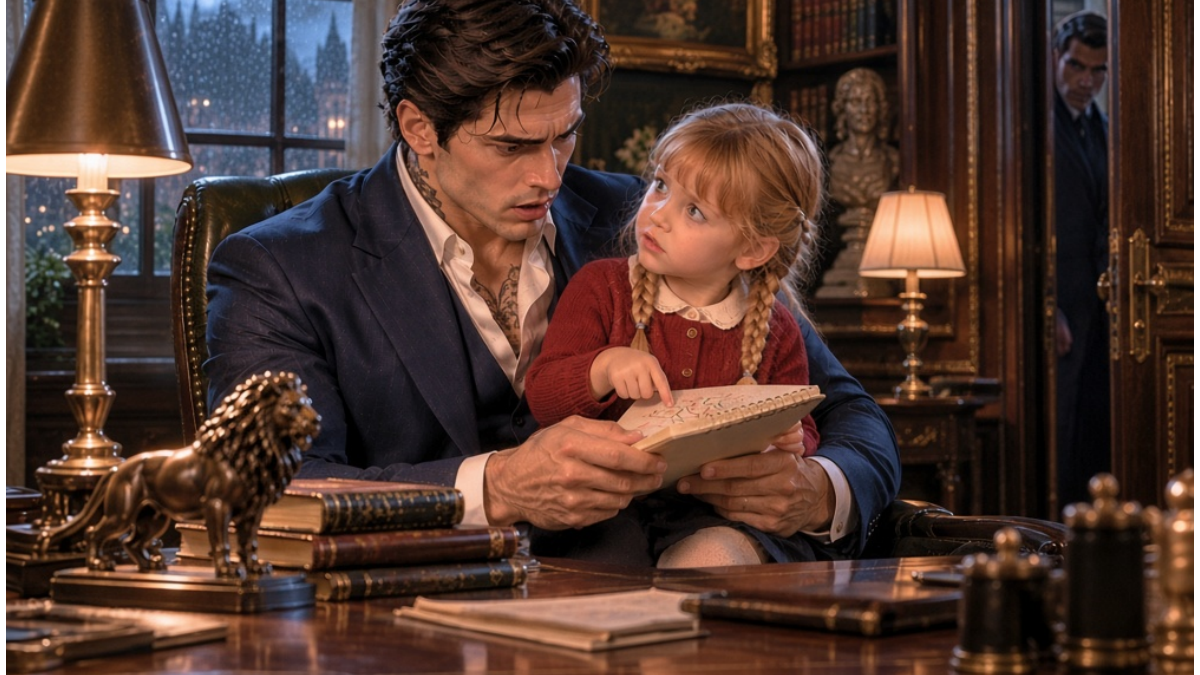
Mr. Lorenzo, why does your house have a secret door? The pen in Lorenzo Moretti’s hand stopped moving.
Late afternoon light bled through the tall study windows, pooling gold across a ledger of shipping manifests.
Bruno Castanza stood at his shoulder. A pencil paused between two fingers. Outside, the garden hedges caught the last hour of a slow October sun.
Inside, the study smelled of leather, old paper, and the faint bergamont of the tea gone cold beside the inkwell.
And in the doorway stood a barefoot 5-year-old girl with a stuffed lion tucked under one arm.
Lorenzo set the pen down carefully. He had not looked a child in the eye since his brother’s funeral 11 years ago.
And he had made a quiet peace with that fact. Yet here she was, Sophie Carter, the housekeeper’s daughter, standing on his hand knotted rug as if she had wandered into her own living room.
There is no secret door, little one, he said. His voice was even, cold, the voice he used for shipping partners, for bankers, for men who came asking favors they would not be granted.
Sophie shook her head, her curls swayed. She looked at him with the calm certainty of a child who has not yet learned that grown men can be wrong.
Yes, there is, she said. The tall man opened it with his lion ring. Bruno’s pencil, moving again, went still.
Which tall man? Lorenzo asked. The one who comes for dinner sometimes. His ring is like Bose’s face.
She lifted the stuffed lion so Lorenzo could see, only shinier and red in the eyes.
The temperature in the study dropped by a degree Lorenzo could not measure, but could feel.
The gold light on the ledger seemed suddenly thinner, as if some invisible curtain had been drawn a quarter of the way across the window.
Bruno did not move. He did not have to. Lorenzo felt the shape of the silence between them and knew what it meant.
Where? Lorenzo said carefully. Did this tall man open a door? Sophie, behind the books.
She pointed toward the west wall of the house, past the study door, past the long corridor in the library.
He pushed one and the whole shelf moved. Then he went down some stairs. For 11 years, Lorenzo had walked the halls of Moretti Hall as if he owned them.
He knew the count of every door, the creek of every stair. His grandfather had built this house.
His father had finished it. He himself had inherited its 30 rooms the week he inherited a chair he was not ready for.
There was no door behind the library shelves. He would have known. He would have known.
Sophie, Bruno said quietly. Does your mother know you came in here? The girl shook her head.
Mommy’s folding the towels. Lorenzo stood. He buttoned his jacket, the motion slow and precise, and rounded the desk without looking at Bruno.
Show me, he said. He did not know what his face looked like in that moment.
He knew only that Sophie Carter did not flinch. She simply nodded as if she had expected the request and reached up.
Her small hand found his. 11 years since any small hand had reached for his.
11 years since anyone in this house had touched him without needing something. Her fingers were warm and slightly sticky and entirely without fear.
She led him toward the corridor. Behind them, Bruno’s watchful eyes followed. Patient, unreadable, the eyes of a man who had already begun counting exits.
The corridor from the study to the library was 42 paces long. Lorenzo had counted them once in the first month after the funerals, when counting anything had been the only way to stay upright.
Sophie’s bare feet made no sound on the runner. Her hand stayed in his. Careful of the step, he said at the place where the floor changed from oak to marble.
She stepped over it without looking down. He was 38 years old. He was unmarried.
He had no children of his own, no engagement, no woman who called the house looking for him.
He controlled the northside operations of one of the last families in Chicago, still willing to call itself honorable in a city that had mostly stopped using the word.
He had inherited all of it, the territory, the ledgers, the enemies, the house on a Tuesday in October 11 years ago when the phone had rung twice within 48 hours.
The first call had told him his father Victoria was dead. The second call had told him his brother Enzo was dead, too.
Ruled a Romano ambush, two funerals in one week, his mother already 3 years gone, buried beside the vegetable garden she had loved, and Lorenzo, 27 years old, the second son, the quiet one who had never expected.
The chair had been left standing in a black suit at the head of a table full of men twice his age.
Uncle Marcus had stepped in. Marcus had put a hand on his shoulder and studied him.
Marcus had spoken to the Capos when Lorenzo could not find the words. Marcus had guided his signature onto the papers that made a 27-year-old the boss of a family he had spent his whole life trying not to inherit.
Cold. They had begun to call him within the year. Cold in negotiation. Cold at funerals.
Cold at his own birthday dinner. He had let them. Cold was easier than explaining what warmth had cost the last two Morettes who had allowed themselves any.
Moretti Hall had 30 rooMs. He walked through six of them. The rest sat behind closed doors, dust- sheetated furniture inside, the way his father had left them.
The kitchen was one of the six. Anna Carter had come to it 6 months ago.
Quiet as a cat, hired through a housekeeping agency Bruno had vetted himself. She poured his coffee at 7:00.
She served his supper at 9:00. She said, “Good evening, Mr. Moretti,” and nothing else.
And Lorenzo had appreciated her for exactly that. Now her daughter was leading him toward a wall he thought he knew.
They reached the library. The room was tall and shadowed, its high shelves rising to a coffered ceiling his grandfather had commissioned in 1941.
2,000 books cataloged once, dusted twice a year, read by no one. Sophie stopped in front of the west wall.
There, she said, pointing. Lorenzo saw only leather spines, rows of them, dark green, ox blood, faded brown, the gold titles rubbed thin by a century of light.
Which one, Sophie? She reached up. Her small arm did not quite make the second shelf.
You have to press the lion book. The one with the face. Lorenzo stepped closer.
He ran his eyes across the spines. Slow, careful, the way he read a room full of men who might be lying.
There, third shelf, seven volumes in, a book bound in ox blood leather, its spine embossed in gold with a small heraldic lion, jaw open, mane flared.
He did not recognize the title. He did not recognize the volume at all. His fingers found the spine.
He pressed. The book shifted under his hand half an inch and something inside the wall answered with a soft mechanical click.
Lorenzo pulled his hand back as if the book had been hot. Sophie looked up at him, waiting.
That’s enough for today, he said quietly. But he already knew. By 9:00, the house was quiet.
Anna had put Sophie to bed in the staff cottage across the courtyard. The kitchen lights were off.
Bruno had retired to the guard office beside the main gate, where the monitors ran their silent black and white loop of every corridor Lorenzo owned.
Lorenzo walked to the east wing alone. The archive room lay at the end of a corridor no one else in the household had a key to.
His father had converted it from a music room the year Enzo was born, filling its walls with steel filing cabinets and its center with a long oak table meant for maps.
Lorenzo unlocked the door, turned on the single green lamp, locked the door again behind him.
The blueprints were on the third shelf of the wall cabinet, rolled inside a leather tube his grandfather had commissioned in 1939.
He unrolled them slowly, waiting the corners with brass paper weights shaped like acorns, and bent over the table.
The library, he traced its walls with the flat of his finger. West wall, the one Sophie had pointed at, 3 ft thick where it met the outside masonry, solid.
His grandfather had marked it in his own careful hand, loadbearing, no cavity. His father had signed the update in 1982.
Unchanged. Every wall of the library measured, traced, checked twice. No door, no cavity, no stairwell.
Lorenzo straightened. The green lamp through his shadow long across the wall behind him. He took out his phone and called Bruno.
Bruno did not ask why. Bruno never asked why. He simply said, “On my way, boss.”
And hung up. 4 minutes later, there was a soft knock. Lorenzo let him in and locked the door again behind him.
One question, Lorenzo said. Bruno waited. When did my uncle last enter this house? Bruno pulled the small leatherbound guard log from his inside jacket pocket.
He carried it with him at all times. It was one of the reasons Lorenzo had kept him alive when he had begun quietly retiring the men who had served his father.
Bruno flipped back three pages. Four. Five. Officially, he said 3 months ago dinner. He arrived at 7:40 in the evening.
He left at 10:15. No entries since. No unofficial ones. Bruno looked up. His face did not change, but something behind his eyes tightened.
None that were logged. Boss, if he came in another way. I did not put him in the book, and nobody else in the crew has a key to the west gate.
Lorenzo nodded once. Marcus’s ring, he said. Describe it. Bruno did not need to think.
Lionheaded signate, gold, ruby eyes, small stones, deep color. Your grandfather gave it to him the year your father died.
There was a story attached. Something about it being a spare from the original set of three.
Vtorio had one. Enzo was meant to receive the third when he turned 40. Enzo never turned 40.
No, boss. Where is Enzo’s ring now? Marcus took possession of it after the funeral.
For safekeeping, Lorenzo did not answer. He simply folded the blueprint back into its tube, tied the ribbon, and returned the tube to the shelf.
Every motion precise, every motion cold. Thank you, Bruno. Go home. Get some sleep. Bruno hesitated at the door.
Boss. Yes. Whatever the child saw, she saw it. She is not old enough to lie about a ring.
I know. Bruno left. Lorenzo turned off the green lamp and stood in the dark for a long moment, listening to the great house breathe around him.
At midnight, he walked back to the library alone, the lion book waited on its shelf.
He stood before it for what felt like a long time, one hand at his side, the other resting flat against the cool spine, and decided whether to open a door that on paper did not exiSt. He pulled the volume.
There was no dramatic sound, only that same soft mechanical click. And then, a heartbeat later, the whisper of oiled machinery hidden inside a wall that had stood untouched, according to every plan he had ever seen.
For 84 years, a three-foot section of the bookshelf slid sideways. It moved smoothly, with the practiced ease of something used often.
The books upon it, genuine, weighted, spines, aged to match their neighbors, moved with it as a single piece.
Behind them opened a narrow black rectangle, no wider than a coffin. A stairwell descended into the dark.
Lorenzo stood at the top of it for a full 10 seconds. He did not draw his weapon.
He did not call Bruno back. He simply reached inside his jacket, unbuttoned the holster’s leather strap so that the pistol would come free without resistance if it needed to, and stepped through.
His shoes made no sound on the stone. Three steps down, a motion sensor caught him.
A single bulb overhead flickered once, twice, then held a hard, unshaded light that turned every shadow along the stairwell into a black knife.
The stairs ended in a small room. It was cold in the way. Rooms without windows are cold.
The walls were plaster, painted a flat working gray. A desk stood against the far wall.
A gunmetal safe crouched beside it. A filing cabinet four drawers deep stood in the corner.
And on the wall above the desk hung a map of Chicago, a real map, the good kind, printed on linen, pinned with red thread that ran between a dozen locations.
Lorenzo recognized on site his father’s shipping routes, his father’s warehouses, his father’s private residences.
He crossed the room. The desk was clean, precise, arranged the way a soldier arranges his kit, a green banker’s lamp, a tin cup of pencils, all sharpened, a leather blott with no marks upon it, and a stack of folders, each labeled with a small typed tab.
The top folder was labeled V M Victoria Moretti. Lorenzo did not sit. He opened it standing inside pages, dozens of them, root diagrams, timestamps, names of drivers, names of restaurants, names of women his father had visited discreetly during the last two years of his life.
Photographs, black and white, taken from long distance with a good lens, and handwritten notes in the margins, neat, methodical, a man’s handwriting, small and slightly right slanted.
The letters formed by a hand that had been trained by nuns. The handwriting was not his father’s.
Lorenzo turned a page, then another, then another. His hands did not shake. His breathing did not change.
Somewhere deep inside his chest, however, a small, clean fire began to burn a fire so old and so familiar that he did not at first recognize it as grief.
Route diagram. October 15th, southbound, Lakeshore Drive. Three vehicles, lead sedan, principal and second sedan, chase car.
Timing 938 to 9:44. October 15th, 11 years ago, the night his father had been killed.
He turned to the last page of the folder. A margin note dated October 12th, 3 days before Victoriao Moretti had bled to death on the wet asphalt of Lakeshore Drive with a Romano bullet everyone had always said Romano buried in the back of his skull.
The handwriting was the same clean right slanted script. Four short lines, a single instruction, route confirmed.
Southbound 9:40 p.m. Send the message. Lorenzo stood in the small gray room and read those four lines twice.
His blood did not run cold. Cold was what he already was. Cold was what he had become the week he had buried his father and his brother and had learned at 27 to answer to the word boss.
His blood in that windowless room simply went still. Dawn came thin and gray through the tall east-facing windows of Moretti Hall.
Lorenzo had not slept. He had climbed the narrow stairwell at 3:00 in the morning, closed the lion book behind him with a soft click.
He had spent 5 minutes making sure was inaudible from the corridor, and returned to his study.
There he had sat without turning on a lamp until the sky beyond the garden began to bleed from black to pewtor.
At 6:40, he stood. He changed his shirt. He rebuttoned his cuffs. He passed a comb once through his hair.
Then he walked down the back stairs to the kitchen with the same measured stride he used every morning.
Because if a man like Lorenzo Moretti began to walk differently on a Wednesday, someone would notice by Thursday.
Anna Carter was already at the counter. She wore the same charcoal apron she wore every morning.
Her dark hair tied back at the nape, the coffee press stood beside the sink, its glass already fogged with heat.
On the long oak table, Sophie sat in her pajamas with a spiral notebook open in front of her.
Her stuffed lion propped against the sugar bowl. “Good morning, Mr. Moretti,” Anna said. Good morning, Anna.
He watched her hands. He did not try to hide that he was watching them.
He simply let his eyes rest on them as she poured the way she gripped the handle.
The way she set the saucer with two fingers. The way she folded the tea towel over her wrist between motions.
Steady. Practiced too practiced. Maybe as if the steadiness itself were a thing she had trained into her body over years.
Anna, he said, sir, how did your daughter come to be in the library alone yesterday?
There was a beat. A single small beat. Her hand on the coffee pot for the shortest fraction of a second went still.
Not a tremor, not a pause anyone else in the room would have noticed. Just a hairline stillness in the wriSt. The kind of body makes when it is deciding very fast which face to wear.
Then she recovered. She poured. She wanders when I’m cleaning. Sir, she’s five. I’ve asked her not to, but you know how they are at that age.
I apologize. It will not happen again. Lorenzo did not press. He simply accepted the cup, wrapped his hand around its warmth, and dipped his head an inch.
“Thank you.” He carried the cup to the table, and sat across from Sophie. She looked up.
Her curls were still tassled from sleep. She held her pencil in her fist, the way children do before the muscles of the hand have learned to write.
“Mr. Lorenzo, look.” She turned the notebook toward him. “Two lions drawn in blue crayon on white paper.
The one on the left had a wide, crooked smile and a shaggy mane and dot eyes that turned upward at the corners.
The one on the right was smaller, narrower, drawn with a harder hand, and someone, a 5-year-old someone, had scribbled a large black X across its face.
“Who’s the bad lion, Sophie?” She answered without hesitation, in the same untroubled voice she had used the day before to say.
There is a secret door, the tall man’s lion, the one on his hand. At the counter, Anna did not turn around, but her shoulders, held all morning at the height Lorenzo had grown used to seeing them, lowered a full quarter of an inch, as if a breath she had been holding for 6 months had at last been allowed to leave her body.
Marcus arrived at 3:15 in the afternoon, unannounced. The intercom at the west gate chimed twice Bruno’s signal for someone we know.
And by the time Lorenzo reached the top of the front stairs, his uncle was already crossing the gravel drive with the long, confident stride of a man who had once been trusted with the keys to this house.
Nephew Marcus climbed the steps two at a time. He was tall, silver at the temples, dressed in the same cashmere overcoat he had worn to Vtorio’s funeral.
He pulled Lorenzo into an embrace before Lorenzo could set his hands. The ring flashed against the dark wool of Lorenzo’s jacket.
Gold, lionheaded. Two small red stones set deep in the sockets of the beast’s eyes.
Lorenzo held the embrace one beat longer than he wanted to. He let his uncle be the first to step back.
Marcus, you should have called. I was driving paSt. I can’t call before I stopped by my own family.
They moved to the parlor. Anna had set out a tray of espresso without being asked.
She was that kind of quiet, that kind of careful. Marcus unbuttoned his coat and dropped it across the arm of the leather chair.
The ring flashed a second time as he lifted the small cup. “I need you to sign off on something,” he said.
“Sign off on what?” “West 26th, the Romano warehouse.” Rossy’s crew intercepted one of our shipments Tuesday night, and by Wednesday morning, half the north side was asking whether the old man’s kid still had teeth.
“We have to answer publicly.” FaSt. Lorenzo lifted his own cup. He watched the black surface of the coffee, still and unrippled.
He had spent the whole night in a windowless gray room, reading his father’s murder written in this man’s handwriting.
He had climbed the stairs at dawn with a fire so old inside his chest, he had almost almost taken the pistol from his desk and walked directly to the phone that would summon Marcus back to Moretti Hall for the last time.
He had not. He did the hardest thing he had ever done in 38 years of life.
He smiled. Give me 2 days, he said. I want to review the intelligence. Marcus laughed.
It came out a beat too sharp. Since when do you need proof, Lorenzo? Since my father taught me not to, Lorenzo answered evenly.
And look what it cost him. Marcus’ smile faltered. Half a second. No longer. The corners of the mouth did not fall.
Exactly. They simply forgot for one heartbeat to hold themselves in place. Then he recovered.
He set the cup back on the saucer. Two days, he said. Not three. Two days.
Marcus nodded slow and turned his face toward the tall garden window. Outside, on the far side of the boxwood hedge, Sophie Carter sat cross-legged on the flagstones.
She was talking in the private murmur of children who are talking to themselves, to the stuffed lion in her lap.
Marcus’ eyes settled on her. They did not move for one full second. Two. Who’s the little one?
A cousin’s kid, Lorenzo said. The lie left his mouth with the easy weight of the truth.
Visiting a few weeks, the mother needed a break. Which cousin? Genevi sighed. You wouldn’t know them.
Marcus nodded. His eyes stayed on the child for one more heartbeat than they should have.
Lorenzo added another knife to the list he was quietly making. Marcus left at 4.
Lorenzo watched the black sedan pull through the west gate from the parlor window. He watched until the tail lights turned onto the county road and vanished.
Then he called Bruno on the interior line and said, “Only no one enters the West Wing tonight.”
Bruno said, “Understood, boss.” And hung up. At 11:30, Lorenzo went back to the library.
He pressed the lion book. The wall opened. The single bulb caught him at the third step and held.
He read until dawn. He began with his father. The file on Victoriao Moretti was 240 pages thick, and every page was the work of a patient man.
The Romano attack had been staged. Lorenzo saw now staged with a professional’s care. Two Romano soldiers had indeed pulled the trigger on Lakeshore Drive that October night.
But someone else had told them where to stand and when, and for how long.
Someone who had known Vtorio’s private schedule down to the minute. Someone who had known that the lead sedan would break left at the intersection and leave the second car exposed for exactly 40 seconds.
Someone inside the house. Lorenzo turned the last page, set the folder down, reached for the next one.
E M Enzo Moretti. His brother’s file was 160 pages. Same architecture, same clean, right slanted handwriting in the margins.
Enzo had been killed 48 hours after Vtorio in what the city had recorded as a retaliation strike gone wrong.
Two Romano shooters again. A parking garage on Well Street. Enzo driving himself unarmed because he had come from a family dinner Marcus had insisted upon at the last minute.
The margin note dated the morning of Enzo’s death. Read simply. Second son will be more manageable.
Confirm. Lorenzo closed the folder. He rested his palms flat on the desk for a full minute before he opened the next one.
The next folder was thicker. It contained photographs, dozens of them. Marcus in parking garages.
Marcus in hotel lobbies. Marcus at a corner booth in a restaurant Lorenzo recognized as one his own crew had swept for wires only last spring.
And in every photograph, seated across from him or standing at his shoulder, the same woman, elegant, late 40s, dark hair pulled back into a low knot, a long cashmere coat, and on her hands, in every single frame, black leather gloves, indoors, outdoors, at a restaurant table, at a hotel bar, always the gloves.
At the bottom of a typed surveillance memo, the typewriter old enough that the E struck a hair higher than the other letters a name.
Adriana Vil Lorenzo said the name aloud once to hear how it sounded in the small gray room.
It sounded like a hinge that had not yet been oiled. He turned to the final folder.
It was thinner than the others. It contained six photographs. Lorenzo himself standing at the front doors of Moretti Hall.
Getting out of the black sedan at Rockos on Taylor Street. Crossing the lobby of the Drake Hotel.
Walking coat open along the north entrance of Union Station. Walking, coat closed, along the same entrance three days later, and the sixth photograph, long lens, high angle, taken through what he recognized on site as the crosshairs of a rifle scope.
A red mark had been drawn over the temple in grease pencil. The pencil was fresh.
The photograph itself was dated Monday, 2 days ago. Lorenzo did not flinch. He had spent 11 years training his face not to flinch, and 11 years was long enough.
He closed the folder. He returned it to its exact place in the stack. He aligned the corners with the edge of the blotter, the way the desk’s owner had aligned them.
He climbed the stairs. He shut the lion book behind him with a soft click that to any ear in the corridor would have sounded like a house settling in the cold.
If Marcus came back tomorrow, nothing must look disturbed. By 7 the next morning, Bruno was in the study.
Lorenzo had called him from the back stairs with two words, Adriana Vale, and hung up before Bruno could answer.
Bruno had understood. Bruno always understood. He had spent the intervening four hours in the small office off the guard station with two clean laptops and a landline that did not route through the house switchboard.
He arrived at Lorenzo’s door with a manila folder under his arm and said it without ceremony on the desk.
Everything I could pull without triggering a flag, he said. Lorenzo opened it. Adriana Vale, 51 years old, managing partner at Veil and Kestrel, a corporate law firm on the 22nd floor of a glass tower on North Laswestern Law School, two ex-husbands, no children, a townhouse in Lincoln Park, a weekend house in the Michigan Dunes.
She represented 11 shipping and freight forwarding firms operating out of the port of Chicago.
Three of them were Moretti fronts. Lorenzo read the names of those three twice. He recognized them.
He had signed the incorporation papers himself 6 years ago from his father’s leather chair.
Two more of Adriana Vale’s clients belong to men who called Antonio Romano godfather. Officially, she was neutral.
She had a professional reputation for it. She was known in certain rooms as the woman who could sit at either end of a table and take a legal retainer from both without either side losing face.
Unofficially, Bruno’s own surveillance, done quietly through a contractor Lorenzo had never met and would never meet.
She had entered a warehouse on Serach Road on every second Thursday of the month for the past 2 years.
Marcus had entered the same warehouse on the same Thursdays. They had never arrived in the same car.
Lorenzo closed the folder. He walked to the window. The morning was cold and bright.
In the garden below, Sophie was chasing Duke, the gardener’s old collie, in wide, loose circles around the boxwood.
She was barefoot again. Her stuffed lion had been abandoned on the flagstones. The dog, ancient and forgiving, allowed himself to be almost caught before lumbering on.
Bruno waited at his shoulder. He did not speak. Then quietly, “Boss, if it’s really him, you can’t trust the crew.
Not one of them. He built half of them himself. Rossi, Gambini, the Tortoici brothers.
He put them in place while you were still learning the ledgers. Any of them could be his.
All of them could be his.” Lorenzo did not turn from the window. Sophie had caught the dog.
She was hugging its neck and laughing. I trust one man in this house, he said.
Bruno waited for a name. Lorenzo did not give one. The silence stretched. It was not a hostile silence.
It was the silence of two men who had stood beside each other in rooms full of dangerous strangers for 11 years without ever being asked to say aloud what they already knew about each other.
Bruno had never asked who had ordered which killing. He had never asked what was in the sealed envelopes he had carried across state lines.
He had never asked why Lorenzo had three years ago quietly retired four capos and given their territories to men Bruno had personally vetted.
Bruno had simply done the work every day for 11 years. He heard Lorenzo now.
He did not need the name. He nodded once at Lorenzo’s back and picked up the file.
I’ll bring you her schedule for the next 30 days. He said restaurants included. Do it from the office at the gate, not from anywhere inside the house.
Yes, boss. He walked to the door, paused with his hand on the knob. Boss.
Yes, I’m sorry. He closed the door behind him. Over the next two days, Lorenzo began to watch Sophie.
Not the way a man watches a child. The way a soldier watches a scout who has come back from a hill no one else has climbed.
He watched her at breakfast when she ate her toast in careful triangles. He watched her in the garden.
When she narrated whole conversations between Bo the lion and a chipmunk under the boxwood.
He watched her at the piano bench in the sun room where Anna sometimes let her sit while she dusted the sideboard.
Sophie could not play. She simply pressed one key at a time and listened to the note die.
She noticed things. She noticed that Bruno kept his left hand in his pocket when he was tired, but his right when he was thinking.
She noticed that the male carrier always rang the bell twice on Mondays and once on Thursdays.
She noticed that Duke the Collie limped a little on his back left leg and she told the gardener about it in a serious murmur and the gardener took the dog to the vet the next afternoon.
She noticed people. At lunch on Thursday, she looked up from her soup and asked very calmly.
Mr. Lorenzo, why does Uncle Marcus’ smile not reach his eyes? Anna at the counter went perfectly still.
Sophie, she said quickly eat your soup. But it doesn’t. When he smiled at you in the parlor, his mouth went up, but his eyes stayed flat like a picture where somebody drew the smile on after.
Sophie and the tall lady in the picture on his phone. Lorenzo’s spoon did not move.
What picture, Sophie? Anna appeared at the table. Sir, I am so sorry. She has an imagination.
What picture, Sophie? Sophie did not look up from the soup. She was five and she had learned already that adults asked the same question twice when they wanted the real answer.
The one in his pocket. When he took his phone out to check the time in the parlor, the picture showed on top.
A lady with black hair in a coat and she had gloves on inside a house.
Lorenzo set the spoon down very gently. Thank you, Sophie. Anna moved her hand to the back of the girl’s chair.
Her knuckles, Lorenzo saw, were white. She wanders, sir, and she she talks. I’ll speak to her, Anna.
Yes, sir. Bring her to my study tonight after supper. Just her. Anna’s mouth opened, then closed.
She hesitated for one long moment. Then she said quietly, “Yes, sir.” At 8:00, the knock came.
Bruno was in the study with Lorenzo, standing at his usual place beside the desk.
Anna stepped in firSt. Sophie followed, holding her mother’s hand with one hand and Bo the lion with the other.
Her hair had been brushed for the occasion. Anna, Lorenzo said, “Wait in the corridor, please.”
Anna’s eyes flicked once to Bruno, then back to Lorenzo. She nodded. She squeezed Sophie’s shoulder and stepped out.
She did not close the door all the way. Lorenzo pushed his chair back. He did not sit at the desk.
He did not stand. Instead, he moved out from behind it, walked around to the front, and slowly, with a care Bruno had never seen him show any human being since he had inherited the chair knelt on the rug.
Down to Sophie’s level. Eye to eye. Bruno in his corner did not breathe. Sophie, Lorenzo said, I want you to tell me everything you saw the day the tall man opened the door.
Every part. Take your time. Sophie considered him. She clutched bow the lion tighter against her cheSt. Then, in a voice smaller than a whisper, she began.
He came at nap time. Mommy was folding sheets. She began in fragments. She was five, and 5-year-olds do not tell stories in the order adults expect.
She started with the curtain, the big blue one in the library, the one that smelled like pepper and old flowers.
She started with the fact that she was supposed to be napping and was not.
She started with B, who had wanted a walk. Lorenzo did not correct her. He simply knelt on the rug at her level and listened.
The way a man listens to a witness, he cannot afford to lose. Bruno stood in his corner and did not move.
Piece by piece, the account came together. 3 months ago, the night Marcus had come for dinner.
Anna had been folding fitted sheets in the upstairs linen room. Sophie was meant to be lying on the trundle bed under the window, resting.
She had heard the front bell. She had heard the voice she had already begun to think of as the tall man, a voice she did not like because it went up too high when it laughed.
“I wanted to see him,” she said. “I wanted to see his ring. Mommy told me once about the rings in the old king’s stories, and I wanted to see if it was true.
You followed him? I followed him down the back stairs. He didn’t hear me because I was in socks.
She had waited in the hallway while Marcus went into the study. When he came out, he had gone the wrong way for the parlor.
He had turned left into the long corridor, and he had walked all the way to the library.
Sophie had hidden behind the big blue curtain. I saw his ring, she said. Up close from the curtain, it was just like Bose’s face, only smaller, and the eyes were red, like a candy.
What did he do, Sophie? He pushed the book. The lion book? She nodded. The one you pushed?
And the shelf moved sideways and he went down some stairs. And I stayed behind the curtain.
How long? A long time. Bo got tired. She held B out as if the lion could confirm this.
Lorenzo took the offered paw between his thumb and forefinger and gave it a small formal shake.
And then he came back up, she said, with something. A green folder, sort of green, dark green, like the leaves after the rain.
What did he do with the folder, Sophie? He went outside through the front door.
She shook her head. The garden door. The one by the roses. There was a car waiting.
Black, big, like a shiny beetle. Was anyone inside? A lady. Describe her. Sophie considered black hair up here.
She pointed to the crown of her own head, then made a small twisting motion with her fingers, pinned like mommy does when she doesn’t want it in the soup.
And her hands, Sophie looked up at him. She had been waiting for this question.
She had known with the certainty of small children who have kept a secret without knowing it was one that this was the important part.
Gloves, she said, black all the way to here. She patted the middle of her forearm.
Inside a car in the summer. It was hot. Did she come inside the house, Sophie?
No. He gave her the folder through the window. She rolled it down and he put it in.
She didn’t say anything. She just drove away. And you? I ran back. Me and Bo, we hid in the linen room until mommy called me for supper.
I never told her. I thought if I told her, she’d say I was making it up.
Grown-ups always say that. Lorenzo did not move for a long moment. Then he understood something.
Marcus had been moving evidence out piece by piece, folder by folder, to a woman in black gloves in a black car.
He had been feeding the archive out into the world where Adriana Vale could file it, quote it, weaponize it, but he had not emptied the room.
He was still using it, which meant there was still time to catch him inside it.
Thursday was 3 days away. Bruno pulled the tail on Adriana Veil himself. He drove an unmarked blue sedan that had never been logged in the Moretti guard book and he wore a wool cap he had not worn since his cousin’s wedding.
He followed her home from the Lasal Street Tower on Monday. He followed her from a lunch on Tuesday.
He followed her from her weekend house back into the city on Wednesday night where she checked into the peninsula for reasons that had nothing to do with sleeping there.
On Thursday afternoon at 3:40, she drove south on the Dan Ryan and turned west on Serach.
The warehouse was a low brick building with no signage, wedged between a scrapyard and an old fabric wholesaler.
Marcus’ black sedan was already parked behind it, hidden from the street. Bruno reported by burner phone from four blocks away.
He’s inside. She just went in. They’re in the back office. Second door from the loading bay.
Documents on the table. I can’t see from here, boss. But she’s carrying a leather portfolio full.
Lorenzo did not order a raid. A raid would tip his hand. A raid would put Marcus in a holding cell where he could call every soldier still loyal to him in the north side and detonate the family from the inside.
A raid would give Adriana Vale 48 hours to shred, wipe, and file for privilege.
Lorenzo did what only a man who had learned to trust no one could do.
He did it himself. He drove out to Serach at 3:00 in the morning Wednesday, the night before the meeting, in a plain gray coat with the collar turned up.
He picked the lock on the fire door with the small kit his father had given him for his 21st birthday.
He stepped into the warehouse without turning on a light. He crossed the concrete floor in silence and found the back office.
He installed the listening device himself. It was the size of a shirt button. He seated it beneath the underside of the conference table with a small strip of adhesive at the exact angle Bruno had told him to use, and he wiped his fingerprints from the wood with a handkerchief he then burned in an ashtray on his way out.
He was gone in 11 minutes. At 3 the following morning, Thursday, 24 hours later, the meeting done, he sat alone in his study with a pair of headphones and a small black recorder.
The first voice was Marcus’ warm passcent. The same voice that had read Lorenzo bedtime stories in this very house when Lorenzo was seven.
The voice that had said, “Your brother is a fine boy. But you are the one who will surprise them, nephew.”
The voice that had studied him at the funeral. The voice that had guided his signature onto the papers.
The voice said, “Once the Romano strike goes wrong, the boy dies in the crossfire.
Then the paperwork you’ve filed is triggered. The empire transfers cleanly. No war lasts more than a week.
A pause. The clink of glass. A poor.” Adriana Veil’s voice cool and unhurried. And the child, the one you mentioned, Marcus, if she saw anything, she’s five.
No one will believe her, but we’ll handle her mother firSt. Cleaner that way. Grief-stricken widow drives off the skyway.
A quiet accident. The daughter goes to a Genevese cousin nobody has ever met. Lorenzo listened to the recording once.
He rewound it. He listened to it a second time. The second time. His hands were perfectly steady.
He set the headphones down. He walked to the desk. He picked up the interior line.
Bruno. Boss. Double the guard on the house. Do it quietly. Rotate the outside detail through the west perimeter tonight.
Understood. And I want two men on Anna Carter and her daughter. All hours silent.
They are not to know. Yes, boss. Not one of them is to know. No, boss.
Lorenzo hung up. He sat down in the dark and did not move for a long time.
Friday morning, Lorenzo did not go to the kitchen. He had two men on Anna and Sophie, now quiet men, one on the courtyard, one in the alley behind the cottage, and neither of them had reported anything but a woman feeding her daughter oatmeal and walking her to a picture book on the sunroom rug.
Anna Carter had done nothing all night except what she did every night. She had put her child to bed.
She had turned off the lamp. She had not made a phone call. He rang Bruno on the interior line at 7:15.
Pull Anna Carter’s employment history. Everything the agency had. Everything the agency did not have.
Names of the placements before us. School records if you can find them. Marriage certificate.
Death certificate for the husband. Do it from the gate office, not from the house.
Yes, boss. The file arrived at 11:00. Bruno delivered it in person and stood as he always did at Lorenzo’s shoulder while Lorenzo read, “Anna Carter, 32 years old, widowed at 29.
Husband Thomas Carter, welder, died in a construction accident on a job site in Cicero.
Insurance settlement modeSt. She had raised Sophie alone since the child was two. Two prior housekeeping placements.
The first with a retired judge on the Gold Coast 3 years glowing letter of reference ended when the judge moved to Arizona.
The second with an elderly widow in Wetka, 18 months. Another glowing letter ended when the widow died.
Both placements clean. Both placements verifiable. Bruno had called both letters of reference himself. Anna had come to the Moretti household through Meridian Domestic Services, a small agency on Michigan Avenue that Bruno used because he had three years ago quietly bought a controlling interest in it through a shell company Marcus had never heard of.
Meridian had received Anna’s application through a referral from a private caretaker service in Evston, a service Bruno had personally vetted 5 years back.
It was clean on paper. It was clean. Lorenzo sat with the file open for a long time.
Then he asked in the voice he used when he was already turning a knife over inside his mind.
Anna’s maiden name. Bruno checked. Carter boss same as her married name. She married a cousin twice removed.
Kept the surname because it was easier. Her father Daniel Carter. What did he do?
Bruno paused a fraction of a second. It was not the pause of a man who did not know.
It was the pause of a man who had sometime between last night and this morning quietly asked the same question of himself.
Private investigator, boss, Chicago, small practice. He was known to some of your father’s contacts.
Informally, never took Moretti work directly. When did he die? 11 years ago, ruled a suicide found in his office.
Single shot. Own service revolver. No note. Date: October 9th. Lorenzo did not answer. October 9th was 6 days before Vtorio had been killed on Lakeshore Drive.
He closed the file. He placed his hands flat on either side of it and stared at the leather blott for a long minute in complete silence.
Anna Carter had not come to Moretti Hall by accident. She had been standing in his kitchen for 6 months.
She had been pouring his coffee with steady hands every morning. She had been putting her 5-year-old daughter to sleep in a cottage across his courtyard.
And her father had been killed 6 days before his father. Same month, same year, same architect.
If Lorenzo’s stomach was reading the pattern right, Bruno stood very still. Boss, do you want me to move on her?
No, boss. No. Lorenzo lifted his eyes. The question that was eating at him was not, “Why is she here?”
The question was, “Why has she not killed me yet?” 6 months in the kitchen.
Every morning, a knife within reach every morning. Coffee within reach every morning. 100 quiet, invisible ways for a woman with her father’s investigative training and 11 years of grief to end the man she believed had ordered her father’s death.
She had not done any of them, which meant she was not sure he had done it, which meant Anna Carter was a fifth player at this table, and she was still deciding whose side he was on.
He waited until evening. Sophie went upstairs at 8, carrying B the lion by one paw.
Anna kissed the crown of her head at the landing and stood there for a moment after the small footsteps had disappeared into the guest bedroom.
Lorenzo had quietly assigned her 3 months ago when the cottage across the courtyard had grown too cold for a child.
At 8:30, the interior line rang in the kitchen. Anna, my study. When you have a moment, right away, sir.
She did not ask why. She never asked why. She took off her apron. She smoothed her hair back at the temples.
She checked her reflection in the darkened window over the sink, not for vanity, Lorenzo thought later, but for composure.
Then she walked the length of the corridor and knocked once at the study door.
“Come in,” she stepped inside. She closed the door behind her without being asked. Lorenzo was seated at the desk.
The green banker’s lamp was on. The rest of the room lay in shadow. On the leather blotter in front of him was a single sheet of paper, a photocopy, slightly gray at the edges of a newspaper clipping 11 years old.
He did not stand. He did not gesture to the chair. He did not accuse.
He did not raise his voice. He simply placed the photocopy in the exact center of the blotter and slid it across the desk toward her.
Anna looked down. She saw it before she read it. She knew the shape of the column, the position of the small dark photograph in the upper right corner, the two words in bold at the top.
She had, Lorenzo suspected, folded a version of this clipping into her wallet at 18 and had carried it through every apartment she had rented since.
Daniel Carter, private investigator, age 52, found an office. Her eyes filled. Her hands did not move.
They stayed at her sides, palms flat against the front of her plain gray dress.
The way a woman’s hand stayed when she had trained her body for years never to reach toward a thing that would betray her.
The silence lasted a long time. Then quietly, I was going to tell you, her voice did not shake.
It was the same voice she used to say, “Good morning, Mister Moretti.” Only slower now, and with the small, careful weight of a truth she had rehearsed a thousand times in the dark.
I just needed to be sure. Lorenzo did not move. Sure of what, Anna? She lifted her eyes.
For six months, she had never looked at him directly. Not once. She had looked at his coffee cup, his cuff, the space just above his shoulder.
Housekeepers were trained not to look their employers in the face. And Anna Carter had been trained twice.
Once by the domestic service, and once, Lorenzo now understood, by whatever her father had taught her about surviving in a room full of dangerous men.
She looked at him now. Her eyes were dark and uned, and her voice, when it came, was steady in a way that told Lorenzo she had been carrying the sentence in her mouth for 182 mornings.
“Sure, you weren’t the man who ordered my father killed.” Lorenzo did not answer. The green lamp hissed faintly in the silence.
He looked at her for what could have been a second or a minute, and in that look was every piece of the puzzle he had assembled since Sophie had first walked barefoot into this room and asked him a question about a door.
He did not deny it. He did not confirm it. He stood slowly, as though rising from a chair required consultation with a body that no longer entirely belonged to him.
He walked to the window. The garden was dark. A single lamp burned in the guard house at the gate.
Somewhere in the house above him, a 5-year-old girl was asleep with her hand curled around the paw of a stuffed lion whose face had 6 months ago been the last piece of evidence her mother had needed before walking into this kitchen.
Lorenzo stood with his back to Anna Carter for a long moment. Then, without turning around, “Tell me,” he said, “why you thought I might be.”
Anna sat down without being told. She took the leather chair opposite the desk, the one Marcus had sat in 3 days earlier.
She folded her hands in her lap, one over the other. And when she began to speak, her voice was so low that Lorenzo, still at the window, still with his back to her, had to lean toward the pain to catch it.
On the desk between them, the green lamp burned. Beside it, the candle Anna had lit without asking a habit.
Lorenzo realized of a woman who had spent 11 years measuring how long she could hold a truth in her mouth before it burned her began its slow, patient descent.
She told him about her father. Daniel Carter had been a small man with a small practice.
He worked out of a two- room office above a barber shop on Ashland Avenue.
He took wire jobs, missing husbands, insurance fraud. He did not take Moretti work. He did not take Romano work.
He had said to Anna once when she was 15. The families don’t hire men like me, sweetheart.
They hire men who can be buried without anyone asking. Then the spring Anna was 18.
Someone had hired him. A client he had refused to name. Anna suspected now that it had been one of Victoriao’s own trusted men, someone inside the Moretti circle who had begun to notice a pattern he could not investigate himself without dying for it.
Daniel had taken the case. He had spent 6 weeks on it. He had come home tired and quiet, and he had begun to lock his office at night in a way he had never bothered to before.
The last thing he had said to Anna over supper on the 7th of October had been six words.
The lion isn’t who they think. 2 days later, he was found in his office.
Own revolver, single shot, no note. Ruled a suicide by 9:00 the next morning. I was 18, Anna said.
Her hands did not move in her lap. I did not have the money for a private autopsy.
I did not have anyone who would take my call. I sat at the funeral and I looked at every face that came through the receiving line and I tried to guess which one of them had done it.
She spent 11 years chasing that sentence. She had gone to nursing school then quit.
She had married Thomas Carter because he was kind and because he had asked her and she had lost him 3 years later to a cable that had snapped on a Cicero job site.
She had raised Sophie. She had waited tables. She had cleaned houses, and through all of it, in every spare hour, she had chased the lion.
She had traced it at last to Marcus’ ring, a ring given to Marcus by Lorenzo’s grandfather the year Victoriao died, a ring worn at every family function since, a ring photographed once in a background frame of a society column Anna had found in a Northwestern Library archive at 2:00 in the morning.
6 months ago, she had presented herself at Meridian Domestic Services with a resume she had spent 3 years assembling.
She had let herself be referred through a caretaker service she had spent another 6 months penetrating.
She had planted her own name so cleanly that even Bruno had not found the seam.
Her goal had been simple. Watch Lorenzo. Watch him from 6 ft away in the quiet of a kitchen for as long as it took.
If he was clean, tell him. If he was dirty, gather enough to send the whole file to a federal contact her father had written into a margin 11 years ago.
Lorenzo at the window did not move. And you brought your daughter into this house?
Anna’s voice did not tremble. I brought her because a live-in housekeeper without a child raises questions, and because I would never have brought her here if I had believed for one single day that you were a man who hurt children.
Silence. The candle guttered once, then steadied. Lorenzo spoke without turning. Your father was right, Anna.
The lion isn’t who we thought. A pause. And your father is the third grave in this file.
He did not send them away. That was the first decision. He made it in the two seconds after he told Anna her father was the third grave in the file.
And he made it against every instinct 11 years of being the boss of the Moretti family had trained into him.
Send the witnesses out. Move the children off the board. Reduce the number of things an enemy could take from you to a number you could count on one hand.
He did not do it. He did the harder thing. He turned from the window.
He crossed the study. He stopped at the leather chair where Anna sat and held out his hand not to take hers only to indicate that she should rise.
Come with me. She stood. She did not ask where. They walked the corridor to the library in silence, the way they had walked it a 100 mornings in reverse when she was carrying his breakfast tray and he was carrying nothing at all.
He locked the library door behind them. He crossed to the west wall. He pressed the lion book.
The shelf whispered open. Anna stood at the top of the stairwell for one full breath before she followed him down.
The single bulb caught them both. The gray room resolved out of the dark. The desk, the safe, the filing cabinet, the wall of maps, the red thread running between a dozen locations she had spent 11 years training herself to recognize.
She did not gasp. She had done her gasping already. Alone in a two- room apartment on Ashlin Avenue when she was 18.
Lorenzo pulled a chair from the corner. He set it beside the desk. Sit. She sat.
He opened the top folder. He turned it toward her. He watched her eyes. V M.
He watched her read the first three pages the way a man watches a mirror with the small still attention of someone who has been carrying a shape in his head for a long time and is seeing at last whether the world has been carrying the same one.
She read Marcus’ handwriting. She read the root diagraMs. She read the margin note dated October 12th.
Route confirmed. Southbound 9:40 p.m. Send the message. She reached the photographs. She saw Adriana Vil in a hotel lobby, in a parking garage, in a corner booth on Taylor Street.
She saw the black gloves. She said nothing. Lorenzo pulled a second folder. He opened it.
He slid it under her hands. A surveillance memo typed on the old machine with the high E dated the second week of September, 11 years ago.
At the bottom in the same clean right slanted hand that had written Victoriao’s death.
Subject D. Carter continues to make inquiries at Ashland and Rosco. Recommend close method personal in office timing.
Within the week, Anna read it once. She read it twice. She placed her palm flat on the page, the first movement her hands had made in 20 minutes, and she left it there for a long moment.
Then she lifted her palm. She did not cry. She had, as she had said upstairs, done her crying already.
She looked at Lorenzo across the desk in the gray light of a windowless room, and she asked him one question in the voice of a woman who had spent 11 years asking it of an empty apartment.
What now? Lorenzo closed the folder. He aligned its corners with the edge of the blotter.
Now, he said, “You and your daughter act as if nothing has changed. You pour my coffee in the morning.
You fold the linens. Sophie draws her lines. You go to bed at 9:00. You do not look at Marcus differently when he next enters this house.
You do not look at me differently either. And you? I do something only I can do.
He did not tell her his plan. He did not tell her he had already begun laying it the moment he had listened to the Serach recording twice.
He told her only this. Trust no one, Anna. Not the day staff. Not the men on the gate.
Not Rossi. Not Gambini. Not the Tortoici brothers. Bruno only. If Bruno tells you to move, you move.
If anyone else tells you anything, you smile the way you smiled at me for 6 months and you say nothing.
Yes. And Anna, yes. If I do not come back from the meeting on Thursday night, you take Sophie and you go to the address I will leave for you inside the Bible on your bedside table.
You do not stop. You do not look back. She nodded once. He closed the folder.
He turned off the bulb. Together, they climbed the stairs. The morning came quiet. Lorenzo came down at 7:00 as he did every morning in a charcoal jacket that had been pressed the night before.
Anna was at the counter as she was every morning. She poured his coffee with the same steady hand she had poured it with for 183 mornings.
Nothing about the kitchen had changed. Everything about it had. He carried his cup to the table.
He sat down across from Sophie. She was already there in her pajamas with her spiral notebook open in front of her.
Bo the lion sat propped against the sugar bowl, watching the proceedings. Her hair had not been brushed.
Her tongue was sticking out slightly at the corner of her mouth the way it did when she was concentrating.
She did not look up. Working hard, little one. M. He sipped his coffee. He watched her draw.
Blue crayon, then black, then a small yellow one for the mane. She had refined her technique over the past week.
The paws were more careful now, the eyes larger and more expressive. Her lions had begun to have personalities.
The kitchen clock ticked. Somewhere at the back of the house, a radiator sighed. Anna at the counter rinsed a saucer under the tap.
Sophie finished. She capped the crayon. She turned the notebook with great seriousness 180° and slid it across the table to Lorenzo.
Two lions. The one on the left had a small hard face and a black X scribbled through it.
The one on the right was tall, taller than the first, with a broad, crooked smile and a shaggy blue mane and dot eyes that turned up at the corners.
This one’s you, Sophie said. She pointed at the tall one, the good one. Lorenzo did not answer for a moment.
He had been called sir for 11 years. He had been called boss by every soldier under his jurisdiction.
He had been called mister, Moretti by every banker and every port official and every man who did not know his father well enough to have earned the right to a first name.
He had not been called anything soft since his mother had died the year he was nine.
He looked at the drawing. He looked at the small blue mane. He looked at the way Sophie had drawn.
The eyes turning up at the corners, a shape she had never once seen on his own face, in which she had nevertheless given to the lion she had labeled him.
Something in his chest cracked open the shape of a small hand. He did not let it reach his face.
Thank you, Sophie. You’re welcome. Now, do you want to color it later? I’ll take it to work with me firSt. She nodded, satisfied.
She turned to a new page and began another. At the counter, Anna stood very still.
She had turned her head halfway when Sophie had spoken. She did not turn the rest of the way.
She did not smile. She did not need to. Her shoulders held for 183 mornings at the height of a woman on watch, lowered another small quarter of an inch.
She did not turn away either. Lorenzo was still holding the drawing when Bruno’s shadow fell across the kitchen doorway.
Bruno did not step in. He simply waited to be seen. Lorenzo lifted his eyes.
Boss Bruno. He took it. Lorenzo did not need to ask who. He did not need to ask what.
When? Thursday 900 in the evening. He has agreed to come to the house in person to authorize the Romano strike.
He is bringing counsel. Counsel. His words. Boss. Counsel. Lorenzo nodded once. Thank you. Bruno withdrew.
Lorenzo looked down at the drawing again. The tall smiling lion. The upward eyes, the blue mane.
He folded the paper along the crease Sophie had already made when she’d flipped the notebook, then folded it once more into a small, careful rectangle no larger than a playing card.
He slipped it into the inside pocket of his jacket, over the left side of his cheSt. A folded piece of paper against a wool coat was the closest thing a man like him would ever come to armor.
He drank the last of his coffee, he stood. Have a good day at work, Mr. Lorenzo.
You too, Sophie. Anna at the counter did not turn, but as he passed her on his way to the corridor, she said very quietly without looking at him.
Thursday. Thursday, he answered. And then he was gone. 3 days Lorenzo spent them building a room inside a room.
Monday night, he took the Lion book off its shelf and disassembled the mechanism behind it with a jeweler screwdriver he had not touched since he was 17.
He replaced the original catch with a new one machined to his specifications by a locksmith in Berwin who had years ago done a favor for Victoriao Moretti and had never forgotten it.
The new catch would open from above exactly once. After that, it would seal and the only key would be in Lorenzo’s pocket.
Tuesday, before dawn, he installed a second lock on the inside of the panel, the kind used on cold storage doors that could only be released from the library side.
A man who descended those stairs after 9 on Thursday night would not climb them again unless Lorenzo, standing at the top, chose to let him.
Wednesday, he wired the small gray room. Four cameras, two microphones, a single flat panel monitor mounted on the wall opposite the desk, where a map of Chicago had hung for 11 years.
The wiring ran up through a conduit his grandfather had cut into the west wall in 1941 for a house telephone that had never been installed.
The signal terminated in Lorenzo’s study in a small black recorder inside the bottom drawer of the desk.
He tested it twice. Both times the picture was clean. He fed Marcus through Bruno’s carefully staged intelligence.
A fake report leaked through a Rossi courier who had been quietly turned 6 months ago and did not know at a false Romano attack window.
West 26th, Thursday night, 10:15, a shipment vulnerable for exactly 20 minutes. The lie was designed to require Marcus’ presence at Moretti Hall to sign off in person.
Lorenzo had specified at nothing in writing that Rossy can leak. Uncle, we do this face to face at the house like the old days.
Marcus had agreed at once. Thursday came. At 8:40 in the evening, Anna took Sophie to the guest bedroom upstairs and locked the door from the inside.
Bruno posted two men in the corridor outside it. Two more moved silently along the west perimeter of the garden.
The rest of the house lay dim and warm as if it were only another quiet Thursday.
Marcus arrived at 9:00. He came through the front door alone, his cashmere coat over one arm, the ring catching the chandelier as he handed the coat to Bruno without looking at him.
He kissed Lorenzo on both cheeks in the parlor. He said, “Nephew, uncle, you called for counsel.
I brought counsel.” Adriana Veil arrived 10 minutes later. On the dot, Bruno announced her at the door.
She stepped into the parlor in a long black wool coat and a pair of black leather gloves that she did not remove even when she accepted Lorenzo’s outstretched hand.
Miss Veil, thank you for coming on short notice. Mr. Moretti, a pleasure at laSt. Her voice was cool, cultured.
It matched the photographs. Lorenzo poured three glasses of Barolo himself. He did not use the decanter.
He handed one to Marcus, one to Adriana, and kept the third. He smiled, a warm smile, an easy smile, the smile of a nephew grateful for his uncle’s council on a difficult night.
The strike order is drafted, he said. It’s waiting in the library. I had it typed up so that Miss Vale could review the language before we send it forward.
It’s on the desk in there beside the reading lamp, a small pause next to the volume with the lion on the spine, which for some reason my father always kept on that shelf.
I never understood why. Marcus’ glass paused, one degree short of his lips. Only one degree.
Then it continued. He drank. Very good, nephew. Efficient. Lorenzo’s phone buzzed in his pocket.
He glanced at it. He glanced up, apologetic. Forgive me. This is a contact from the Romano side.
Rossi says he may be ready to flip on Antonio himself. I have to take it in the study.
5 minutes, no more. Please look the order over. I’ll be right back. He set his glass down.
He walked out. The parlor door closed behind him with a soft, welloiled click. Marcus and Adriana were alone in the library.
Marcus looked at Adriana. Adriana looked at the west wall. Marcus’ ring caught the lamplight a small red flash from the eye of the lion as he reached slowly for the shelf.
The shelf whispered open. Marcus descended firSt. He moved with the practiced ease of a man who had done it a hundred times.
One hand on the stone wall, the other loose at his side, the ring catching a single spark of chandelier light before it vanished into the dark of the stairwell.
Adriana followed. Her heels made a small precise sound on the stone. The panel closed behind them.
It made the same soft click Marcus had heard a hundred nights. He did not register it as different.
It was at the bottom of the stairs. The light came on, but it was not the single dim bulb Marcus had installed 11 years ago.
It was brighter, cleaner. A row of fresh LEDs behind a diffuser strip, casting the small gray room in a light that showed every seam of the plaster.
Every scuff on the desk, every place where Marcus’ own handwriting had bled through 11 years of paper onto the underside of the blotter.
The desk was empty. The safe was open, empty. The filing cabinet stood a jar, empty.
And on the wall where the maps of Chicago had hung pinned with red thread between a dozen warehouses and a dozen private residences, there was now a large flat screen.
The screen was already on. Marcus’s own voice came through the speakers, warm, patient, speaking as clearly as if he stood in the room himself.
Once the Romano strike goes wrong, the boy dies in the crossfire. Then the paperwork you’ve filed is triggered.
The empire transfers cleanly. No war lasts more than a week. Adriana’s voice. Cool. And the child, the one you mentioned, if she saw anything, she’s five.
No one will believe her, but will handle her mother firSt. Cleaner that way. Marcus’ face did not move.
Only his hand did. It went with the reflex of 40 years of muscle memory to the pistol at his hip.
He drew it. He racked the slide. The chamber was empty. The magazine was empty.
Someone had been in the room already tonight. Someone had lifted the weapon from his coat pocket in the parlor as he handed it over Bruno.
Taking the coat with a butler’s downcast eyes and had emptied it and returned it and let him wear it downstairs like a costume prop.
Adriana turned toward the stairs. She climbed three steps, four. She reached the panel above.
She pressed. She pressed again. She ran her gloved hand along the seam. The panel did not slide open.
She did not scream. She did not curse. She simply lowered her hand and stood for one long moment on the fourth step with her back very straight.
The way a woman stands when she has spent 30 years in courtrooms understanding that some doors once closed are closed by design.
She turned. She came back down the stairs. The recording continued. It was long. Four weeks of Thursdays played back in sequence.
One meeting rolling into the next. Marcus and Adriana’s voices weaving the whole shape of 11 Years of Murder into the small gray room they had built to keep it hidden.
Upstairs in the study, Lorenzo sat at his desk with Bruno at his shoulder. The monitor in the bottom drawer showed him the small gray room in perfect black and white.
He watched Marcus lift the empty gun. He watched Adriana test the panel. He watched the two of them turn at last and stand looking at the screen with the still careful attention of animals that have understood the shape of the cage a fraction of a second too late.
He did not open the door. He waited. He let them stay in the room for one full hour.
Bruno did not speak. Bruno did not move. He stood at Lorenzo’s shoulder the way he had stood at Vtorio’s shoulder in an earlier life, and he did not offer a single word.
At 10:30, Lorenzo stood. He took off his jacket. He hung it over the back of the chair.
He unbuttoned his cuff and rolled his sleeves once cleanly to the middle of the forearm.
He did not take a weapon. He walked out of the study, down the corridor, into the library.
He pressed the lion book. The panel slid open. He descended the stairs alone. Marcus stood by the desk, one hand on the empty leather blott, his shoulders squared with the last dignity of a man who had already understood that dignity was the only thing left to him.
Adriana stood beside him, her gloves still on, her eyes on Lorenzo’s face. Lorenzo stopped at the bottom of the stairs.
He did not raise his voice. He did not draw a weapon he was not carrying.
He did not, in fact, show any expression at all, only the particular stillness of a man who had waited 11 years to say a single sentence, and had at last been given the room in which to say it.
“You built this room to bury my father’s name,” he said quietly, evenly, without cruelty.
“I built its walls to bury yours.” Lorenzo did not kill them. That was the second decision.
He made it the moment he stopped at the bottom of the stairs and spoke the sentence he had waited 11 years to speak.
He made it against the whole weight of the room he was standing in against the ghosts of Vtorio and Enzo.
Against the folder that named Daniel Carter, against every quiet code the family had passed down through three generations.
He made it because Sophie Carter had drawn him with upward turning eyes, and he had folded that drawing into the inside pocket of his jacket, and the paper was still there against his ribs.
Bruno drove them out at half midnight. Marcus in the back seat, hands bound, silent for the first time in 56 years.
Adriana beside him, her gloves finally removed at Lorenzo’s request and folded on her lap, her wrists cuffed with the small polite chrome of a federal loan.
The black sedan pulled through the west gate and turned east toward a downtown federal building where a name written in a margin 11 years ago by Daniel Carter had grown in the intervening decade into a deputy United States attorney.
The name was Michael Howerin. He remembered Daniel Carter. He had been waiting for this call for 11 years without knowing he was waiting.
Adriana’s own paper trail, the succession filings, the shell transfers, the trust instruments she had drafted to move the Moretti Empire cleanly into Marcus’ hands the morning after Lorenzo’s death became.
In the following weeks, the paper trail that convicted her, the government did not need a witness.
It had her own signature on every relevant page. Lorenzo brokered a quiet peace with the Romano family.
Old Antonio Romano was 73 that autumn. He met Lorenzo at a small restaurant in Bridgeport.
At a corner table Lorenzo had booked under a name that was not his. Bruno waited in the car.
The two men sat alone. Lorenzo told him the whole truth over a plate of lamb the staged ambush on Lakeshore Drive.
The false Romano shooters. The 11 years of manufactured war that had cost both families sons and warehouses and truSt. Antonio Romano listened without interrupting.
He ate slowly. When the plates were cleared, he wiped his mouth on a linen napkin and set the napkin down.
He extended his hand across the table. For the first time in a decade, a Moretti and a Romano shook hands in public.
Marcus disappeared into a federal witness program that satisfied no one except the letter of the law.
Adriana Vale lost her practice, her license, her passport, and eventually her freedom. Her townhouse in Lincoln Park was sold at auction the following spring.
Her weekend house in the Michigan Dunes went to a buyer whose name nobody in Chicago recognized.
4 days after the transfer, on the terrace behind Moretti Hall, Anna Carter stood beside Lorenzo at the stone rail.
The afternoon was cold and bright. Sophie was chasing a late butterfly across the last of the garden’s yellow flowers, her stuffed lion abandoned on the flagstones, her laugh carrying up to them on the small wind.
Anna spoke without turning her head. Do you regret? She said, not doing it with your own hands.
Lorenzo watched his daughter. No, not his daughter. Not yet. The shape of that word was still forming in his cheSt. Chase a butterfly across a lawn his father had planted.
“My father’s honor doesn’t need my hands dirty,” he said. “It needs his son to be different from the man who killed him.”
Anna did not answer. She reached quietly and placed her hand over his on the terrace rail.
Neither of them spoke. Sophie’s laughter carried across the lawn. For the first time in 11 years, Moretti Hall sounded like a house.
Weeks passed, then months. Winter came. The gardens went white. Sophie learned to skate on the frozen pond at the back of the property, holding Bruno’s gloved hand while Bruno, 60 years old and a grandfather twice over, discovered that he still remembered how.
Spring came. The boxwood hedges filled out. Anna planted tomatoes in the kitchen garden Victoria Moretti had planted 40 years earlier for a wife who had died young.
Sophie no longer called him Mr. Lorenzo. She called him Mr. Lion. It had begun as a joke between them at Christmas.
She had pointed at the drawing he still carried. Folded soft now from a hundred days against his ribs and had said, “That’s you, remember the good one?”
And he had said, “Yes, Mr. Lion, at your service.” And the name had simply refused to leave.
Anna stayed on, not as housekeeper. The title had fallen away without ceremony sometime in November, when she had stopped putting on the charcoal apron in the morning, and Lorenzo had stopped noticing it was missing.
Something the household had not yet named grew in the place where the apron had been.
Lorenzo did not rush it. Neither did she. They had both spent 11 years being rushed by other people’s timets, and they had both quietly decided they were done with that.
The hidden room remained. Lorenzo did not seal it. He did not fill it with concrete.
He did not tell anyone in the family that the house had ever contained it.
He cleaned it out. He repainted the plaster a soft, warm ivory. He had a small oak desk carried down the stairs and set beneath the vent.
He installed a green banker’s lamp on the desk. The same shade of green as the one in the archive room, chosen deliberately on the wall where the maps had once hung and the flat screen after them.
He mounted a single framed photograph. Three men, black and white, Victoria Moreti, Enzo Moretti, and Daniel Carter, side by side in a composite Lorenzo had commissioned from three separate portraits none of them had ever known would be hung together.
Three men who had died for the same sentence. Above the desk, in Lorenzo’s own careful handwriting, matted and framed in plain black, one line, “The lion isn’t who they think.”
He went down to the room once a week. He sat at the desk. He did not read anything.
He simply sat for a quarter of an hour in the quiet company of three men who had earned it.
On a Sunday evening in April, Sophie fell asleep on the study couch. She had been reading or being read to.
More accurately, one of the picture books Anna had bought her at a shop on Well Street.
Bo the lion was tucked under one arm. Her curls were spread against the cushion.
Her small mouth was open, breathing the even breath of a child who had not once in 14 months been afraid of any door in this house.
Anna sat beside her, her own book open in her lap, one hand resting on Sophie’s back.
Lorenzo stood in the doorway. He did not go in. He did not want to break the shape of the moment.
He simply stood, one shoulder against the frame, and watched them the woman who had walked into his kitchen 11 years too late, and just in time, the small girl who had asked the question that had opened every door in his life, and the stuffed lion between them, keeping quiet watch.
In the inside pocket of his jacket, over the left side of his chest, was a folded piece of paper worn soft as cloth.
He kept it there. He would keep it there for the rest of his life.
Some doors stay hidden because they lead to graves. Others stay hidden because they lead to the family a man should have found long ago.
Lorenzo Moretti kept the door, not to hide anything anymore. To remember that the smallest voice in his house had asked the largest question of his life and had, without knowing it, given him back a name he had almost forgotten how to answer to.
Dear friends, thank you for staying with our story until the very end. The tale of Lorenzo, Anna, and little Sophie is more than a story about a hidden door in a great house.
It is a story about the doors we keep closed inside ourselves. The grief we do not speak.
The trust we no longer offer. The softness we lock away because the world has taught us that softness is dangerous.
Lorenzo Moretti spent 11 years believing that being cold was the only way to stay alive.
It took a 5-year-old child barefoot in a study holding a stuffed lion to teach him that being human is the bravest thing a man can do.
The lesson our story leaves us with is a simple one. The truth does not always arrive with sirens and headlines.
Sometimes the truth walks into a room in small footsteps, asking a question no one else has thought to ask.
Sometimes the people who change our lives are the ones we hired to clean our kitchens.
The ones we passed a hundred times without seeing. The ones who were watching us patiently, quietly waiting to see whether we were worth the truth they carried.
And the greatest justice a person can offer the ones they have lost is not revenge.
It is the choice to become the kind of person their memory would have wanted them to be.
Now dear viewer, our story ends here, but the conversation is only beginning. How did this story make you feel?
Did it remind you of someone in your own life? A quiet person who changed everything without asking for credit.
A truth you have been carrying, waiting for the right moment to speak. A door inside yourself you have been afraid to open.








