Single Dad Ex-SEAL Was About to Leave—Then a Female CEO Arrived With Her Daughter on Christmas
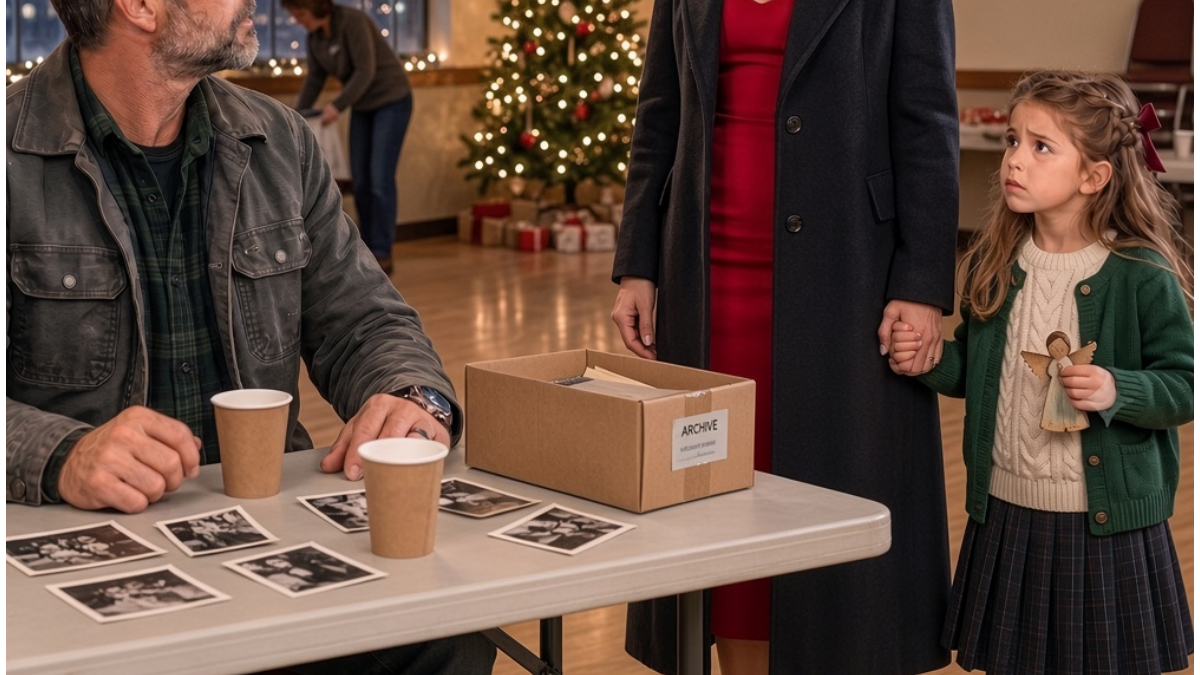
Jack Miller had his hand on his coat when the glass door opened again. The Christmas hall had already gone quiet.
The kind of quiet that came after children had stopped laughing and paper cups of cocoa had gone cold on folding tables.
Half the lights were off. A cardboard sign near the entrance still read Veterans Family Christmas night, though the night itself was supposed to be over.
Jack had stayed late to stack chairs, sweep cookie crumbs from the floor, and avoid the kind of thank you speeches that made his shoulders tighten.
His phone buzzed in his pocket for the third time. His son was waiting for their Christmas video call.
Then the woman stepped inside with a little girl beside her, and the whole room seemed to pause.
She was tall, composed, and dressed in the clean dark coat of someone who was used to walking into rooms where people already knew her name.
Jack did not, not right away. He noticed other things first, the way she scanned the empty hall before speaking.
The way she kept one hand low near her daughter’s shoulder without crowding her. The way the girl held a small wooden angel with both hands, like it might break if the world got too loud.
The event organizer, Marcy, came out from behind a stack of donation boxes and froze for half a second.
Miss Hart, I am so sorry. We thought you could not make it. Evelyn Hart gave a tired but gracious smile.
Even in a nearly empty community hall, she carried the authority of a woman who signed decisions that moved companies and hospitals.
The board call ran long, she said. Grace still wanted to come. Jack kept his coat in his hand and stepped aside, making space near the doorway as naturally as breathing.
He looked like any other tired father in America. White, early 40s, work boots, plain flannel under a faded jacket, a grocery store dinner packed in a paper bag on the chair behind him, but when Grace shifted closer to her mother, Jack turned off the nearest blinking strand of Christmas lights without being asked.
Not quickly, not dramatically, just at the exact moment before the flicker could bother the child again.
Evelyn noticed. So did Grace. “Are we too late?” Evelyn asked. The question was polite, but there was something behind it that money could not fix.
Jack had heard that tone before from parents in hospital corridors, airports, shelters, places where adults were trying not to let children see fear on their faces.
Marci started to explain the event schedule, the closed tables, the volunteers already gone. Jack looked at the wooden angel in Grace’s hands.
Its wings were worn smooth at the edges. A faint carved line marked the base, almost hidden beneath years of small fingers holding it.
Something in Jack’s expression changed and then disappeared. “Not if it matters,” he said. Grace looked up at him then.
Not with recognition, exactly. More like a child hearing the first note of a song she had forgotten she knew.
Evelyn followed her daughter’s gaze to Jack, reassessing him with the careful intelligence of a woman who did not rise to power by missing details.
“My daughter is looking for someone,” she said, “a service member from years ago. She was very young.”
Jack’s phone buzzed again. On the screen, a message preview from his son appeared. “Dad, you still calling?”
Jack turned the phone face down without answering it yet. His jaw tightened once, then eased.
“What does she remember?” He asked. Grace stepped forward just enough for the wooden angel to catch the warm light from the Christmas tree.
“He gave me this,” she said softly. “And he told me not to be scared.”
Jack was very still. Marci reached for an old archive box under the registration table.
Evelyn placed a steadying hand on Grace’s back. And Jack, who had been 1 minute from leaving, set his coat back on the chair.
Marci dragged the archive box onto the registration table, and the cardboard scraped softly over the plastic cloth.
Jack stayed on the far side of the table, close enough to help, far enough not to make the moment feel crowded.
Evelyn noticed that, too. Most men, when they realized who she was, either became too formal or too eager.
Jack became less visible. He moved one empty chair away from Grace’s knees, picked up a fallen candy cane from the floor before anyone stepped on it, and checked his phone only once before sliding it back into his pocket.
The screen lit again with his son’s name, but Jack did not answer in front of the child who was trying to be brave.
He simply typed with one thumb, “10 more minutes, buddy. Important.” Then, he turned the phone over and gave the room his full attention.
To Evelyn, that made him seem like a decent volunteer, maybe a father who understood children.
To the audience, the truth was already clearer. Jack Miller had once been Chief Petty Officer Jack Miller, a former Navy SEAL who had spent years learning how to stay calm when rooms broke apart around him.
He had left that world behind, not because the training vanished, but because his son needed a father who came home, cooked dinner, signed school forms, and kept promises whenever life allowed.
Nothing about him looked heroic now. That was the point. Marci opened a folder of old photographs from foundation events and disaster relief fundraisers.
“The evacuation you mentioned,” she said to Evelyn, “was before our records went digital. Some of the veterans helped with international medical transport after the quake.
We may have names, but not all the faces.” Evelyn nodded, immediately practical. “If there are gaps, my office can fund the archive restoration, scanning, identification, whatever is needed.”
Her voice carried authority without sharpness. She was used to solving problems by moving resources, calling experts, cutting through delay.
But when Grace placed the wooden angel on the table, Evelyn’s hand softened over her daughter’s shoulder.
This problem could not be acquired, rushed, or delegated. Grace had brought them here because memory had left her with only fragments.
Smoke, Christmas lights in a hospital hallway, a man’s voice, a wooden angel pressed into her palm.
Jack looked at the angel for half a second too long. He did not touch it.
“May I ask where she was treated afterward?” He said. Evelyn answered carefully. “A pediatric recovery unit in Virginia.
She was four. I adopted her the following year. She only started asking about the man recently.”
Grace glanced at her mother, then back at Jack. “I remember his sleeve was wet,” she whispered, “and he carried me even though I had glass in my shoe.”
Marci stopped sorting papers. Evelyn drew a slow breath, but she did not interrupt her daughter.
Jack reached for a stack of photo sleeves that had started to slide off the box.
He caught them before they scattered, one hand steadying the whole pile with quiet precision.
No one else had moved yet. Evelyn saw it as quick reflexes. Grace saw his hand and stared.
Jack gave the child a small nod, not a smile, not pity, permission. Keep going if you want.
Grace picked up the angel again. He said, “Slow is smooth.” Like it was a secret.
Jack’s face did not break, but his eyes lowered to the carved base of the angel.
The warm lights above the donation table hummed faintly. Somewhere near the kitchen, a refrigerator kicked on.
Marcy found an envelope labeled Christmas evacuation, unsorted. Evelyn leaned closer, fully engaged now. No assistant, no publicist, no boardroom distance.
Jack should have stepped back. His son was waiting, and the safest thing for an ordinary life was to let old ghosts remain unnamed.
Instead, he reached into the box and slid the first photograph into the light. The first photograph showed nothing useful at firSt. A line of tired people outside a transport plane, boxes of medical supplies, a string of portable Christmas lights taped crookedly to a wall behind them.
Marcy slid it aside and pulled out another. Evelyn stood close enough to study each image, but she did not take over the box or start issuing instructions.
That surprised Jack a little. Powerful people often wanted to force a door open just because they were used to doors obeying.
Evelyn Hart did not force this one. She let Grace hold the angel. She let Marcy handle the records.
She let Jack remain unnamed. If any of these men gave her the carving, Evelyn said, “We need to be careful.
I do not want to turn someone’s service into a performance.” Jack looked at her then, really looked.
“Good,” he said. One word, quiet, but it carried weight. Evelyn caught it. Marcy found a contact sheet of smaller pictures, several faded and badly cropped.
Grace leaned in, trying to search faces that were little more than shadows. The hall was too empty now.
Every small sound made larger by the high ceiling. The shuffle of paper, the buzz of fluorescent bulbs over the kitchen window, the soft tap of the angel against Grace’s coat zipper.
After a minute, Grace’s breathing changed. Not panic, not yet. Just a child’s effort to stay composed while old fear came closer than expected.
Evelyn noticed and lowered herself beside her daughter. “We can stop.” She said. Grace shook her head too faSt. “No.
I want to know.” Jack did not move toward them. He moved around them. He crossed to the Christmas tree and unplugged the blinking strand he had noticed earlier.
Then he turned one folding chair so Grace could sit with her back to the wall instead of the open room.
He did it without announcement, without making her feel managed. “This seat might be easier.”
He said. Grace looked at the chair, then at her mother. Evelyn gave a small nod, letting her choose.
Grace sat. Her shoulders dropped half an inch. That was when Evelyn’s expression changed. Until then, she had understood Jack as a helpful volunteer, perhaps a father with good instincts.
Now she watched him the way she would watch a complicated report when one number did not fit the pattern.
He had not comforted Grace loudly. He had not asked personal questions. He had changed the room.
“You have worked with children after trauma?” Evelyn asked. Jack kept sorting photo sleeves. “Some.
Professionally, not exactly.” It was not evasive in the usual way. It was a boundary.
Evelyn respected boundaries, but she also knew when one protected more than privacy. Marcy lifted another photograph into the light.
“This one has a date on the back. Christmas Eve, post-quake evacuation.” Grace held her breath.
The image showed a hallway somewhere overseas, crowded with stretchers and volunteers in civilian jackets over uniforMs. Near the edge of the frame, a broad-shouldered man was turned away from the camera, carrying a small child wrapped in a blanket.
His face was hidden by motion blur and shadow. Grace stood so suddenly the chair legs clicked against the floor.
Evelyn reached for her hand. Jack’s fingers stopped on the corner of the photograph. For the first time all night, he looked as if he had forgotten to be ordinary.
“That is the blanket,” Grace whispered. “Mom, that is my blanket.” Evelyn stared at the image, then at Jack’s still hand, then back to the child in the photograph.
“Mr. Miller,” she said carefully, “why do I feel like you have seen this before?”
Jack did not answer right away. He only set the photograph down flat, turned it so Grace could see without touching the fragile paper, and said, “Take your time.
Memories come back better when you do not chase them.” Grace looked up at him, and the angel trembled in her hands.
Grace did not touch the photograph. She hovered over it, small fingers curled around the wooden angel until her knuckles paled.
Evelyn saw the change and shifted closer, but she did not snatch the picture away or command her daughter to stop.
She gave Grace the dignity of choosing, even when the choice hurt. “We can put it back in the envelope,” Evelyn said.
“No questions. No pressure.” Grace shook her head, slower this time. “I remember the blanket,” she said.
“It had yellow ducks on it. I hated it because I was too old for ducks.”
Marci pressed one hand to her mouth, not dramatically, just enough to hold back emotion.
Jack stayed at the table with both palms resting lightly on the plastic cloth, as if keeping the whole room steady.
The photograph lay between them. In it, the man carrying the child was only a shape, his face turned away, one sleeve dark with water or something worse.
His shoulders bent around the small bundle like a wall. Evelyn studied that blurred figure, then studied Jack.
His flannel, his worn boots, his tired father’s face, the phone in his pocket that had buzzed again and again, nothing about him matched the kind of person a child would build into a legend.
And yet the room kept giving her small contradictions. He saw stress before it showed.
He changed light and space without asking for praise. He spoke like a man who had learned that calm was not a mood, but a tool.
Grace looked up. Did he know my name? Jack’s answer came carefully. Maybe not at firSt. Evelyn’s eyes narrowed, not with suspicion, but with attention.
That is a very specific answer. Jack did not defend it. He picked up the envelope and checked the handwritten date on the back, giving himself 1 second to breathe.
Marcy found another item tucked behind the contact sheet, a printed program from an old Christmas fundraiser.
It listed partner hospitals, volunteer teams, and a short paragraph about children evacuated after the quake.
No names of service members, no clear faces, only the kind of public language that made real nights sound neat and manageable.
Grace stared at the paragraph, then lowered the angel to the table. I was scared, she said.
Her voice was thin now. I think I cried the whole time. Evelyn knelt beside her at once.
Not the CEO, not the donor, just her mother. “You were 4 years old,” she said.
“You were allowed to be scared.” Grace looked past her mother, straight at Jack. “But he told me brave people get scared, too.”
Jack closed his eyes for half a breath. When he opened them, something in him had changed.
He was not larger, he was not harsher. He simply became more precise, as if every unnecessary movement had been set down.
“Being scared,” he said quietly, “just means your body knows this matters.” Grace went completely still.
The words landed before anyone understood why. Evelyn felt her daughter’s hand tighten around hers.
Marci stopped sorting. The refrigerator hum near the kitchen seemed suddenly loud. Grace whispered, “That is what he said.”
Jack said nothing. The silence was not denial, and it was not confession. It was restraint, held so carefully it almost hurt to watch.
Evelyn rose slowly, keeping one hand on Grace’s shoulder. Her face had changed now. The ordinary first impression could not survive what had just happened.
“Mr. Miller,” she said, voice low, “I need to ask you something plainly. Were you there that night?”
Jack looked at Grace first, not Evelyn, because the answer belonged to the child more than the billionaire.
His phone buzzed again in his pocket, a father’s promise waiting on the other side of the screen.
He did not reach for it. He drew the chair beside Grace a few inches back from the table, giving her space, giving her a way out if the memory became too much.
Then he made his decision. “I will tell you what I can,” he said, “but only as slowly as she needs.”
Jack pulled the chair back and waited until Grace chose whether to sit. She did, slowly, still holding the angel, still watching him as if one wrong word might make the memory vanish again.
Evelyn stayed beside her daughter, but her eyes remained on Jack. He could feel the question in the room, not accusation, not yet certainty, something more delicate.
Hope, trying not to become disappointment. “I served overseas,” Jack said. “That part is true.”
Marcy looked up from the archive box. Evelyn did not interrupt. Grace’s fingers tightened on the angel, but Jack kept his voice level, the way a father might speak beside a hospital bed at midnight.
“There were a lot of children moved that week, a lot of volunteers, a lot of noise.
If I say too much, too fast, your mind may try to fill in what is missing.”
Grace frowned. “So, you do not know if it was you?” Jack could have ended it there.
He could have protected his quiet life with uncertainty. Instead, he reached for the photograph, turned it a few inches, and pointed not at the man’s hidden face, but at the child’s blanket.
“I remember a yellow duck blanket,” he said. “I remember a girl who kept apologizing because she thought crying was making her heavy.”
Grace’s mouth parted. Evelyn’s composure shifted, just enough for Jack to see the mother under the CEO again.
“I said that?” Grace whispered. Jack nodded once. “You did.” The room held still around them.
Jack did not claim the whole story. He did not say the words Evelyn was beginning to expect.
He gave Grace only one piece she could carry. Then he pushed the photograph back toward Marcy.
“Can we see if there is a written list from that night? Transport roster, medical intake sheet, anything with team numbers, it was the first active decision he had made and it changed the energy in the hall.
He was no longer drifting at the edge of the search. He was guiding it carefully with a man’s discipline and a father’s patience.
The plan was simple, match Grace’s memory to the records before naming anyone. Evelyn understood immediately.
“I can help with that.” She said. She took out her phone not to summon a crowd but to call one person.
“My foundation has archived hospital transfer files from our pediatric grants. I can have my assistant check the digital index without sharing Grace’s private information.”
She looked at her daughter. “Only if you want that.” Grace nodded. “I want to know.”
Jack watched Evelyn make the call with quiet efficiency. She did not perform power. She used it like a tool cleanly and with consent.
That mattered to him more than he expected. While Evelyn spoke in a low voice near the doorway, Jack crouched beside the archive box and helped Marcy sort the old envelope by date.
He kept enough distance from Grace to let her breathe. Every few seconds his eyes moved across the room checking the child, the exits, the lights, the emotional temperature.
Evelyn saw it from the doorway. It was not anxiety, it was awareness. When she ended the call, her expression was different again.
“The hospital index has a reference to a Christmas Eve transport.” She said. “But the attached names are incomplete.
My assistant found one note.” Grace stood. “What note?” Evelyn looked from the phone to Jack.
“It says the unidentified child with the duck blanket was handed off by a team member listed only by a call sign.”
Marcy’s hand went still inside the box. Jack looked down at the angel and for the first time his calm seemed to cost him something.
Evelyn read the word from her screen carefully. Harbor. Grace turned the wooden angel over in her hands searching the worn base as if it had suddenly become a map.
Grace turned the angel over but the base was worn smooth by years of being held.
If there had once been more than a faint mark, time had hidden it inside scratches and soft edges.
She rubbed her thumb across the bottom until Evelyn gently covered her hand. “Not too hard.”
Evelyn said. “We do not have to solve it in 1 minute.” Jack looked grateful for that.
He had seen adults turn children’s pain into a race for answers. Evelyn was not doing that.
She was moving carefully now. As if her power had narrowed to one important task.
Keeping Grace steady while the truth came closer. Marci checked the clock above the kitchen window and winced.
“Miss Hart, the foundation live stream is still scheduled. The families online are waiting for your Christmas message.”
“We can cancel it.” Evelyn looked toward the adjacent room where one camera on a tripod faced a small decorated backdrop.
Earlier it had been just another piece of donor business. Now it felt like an intrusion.
“Cancel it.” Evelyn said. Grace shook her head. “No. You promised the kids at the hospital.”
Evelyn hesitated. That was the kind of sentence that could stop a boardroom cold. Grace looked at Jack then at the angel.
“Maybe I can say thank you. Not his name. Just thank you.” Jack’s first instinct was to step back.
He did not belong on camera. He did not belong in stories with soft music and donation links.
But Grace was watching him the way children watched adults when they needed permission to be brave.
So, he gave one small nod. Not encouragement to perform, permission to choose. Evelyn saw it and made her decision.
“Only if you want to.” She told Grace, “and I stand beside you.” They moved into the adjacent room without changing the shape of the night.
It was still the same hall, the same folding chairs, the same half-empty cocoa urn on the side table.
The camera light came on, small and red. Marci counted down with her fingers. Evelyn stood with Grace under a paper garland, composed enough to speak to hundreds of people, tender enough to keep one hand open in case her daughter reached for it.
Jack remained near the back wall, half in shadow, coat still on the chair behind him.
Evelyn began with the usual words, but they sounded different tonight. She thanked the families, the volunteers, the veterans who showed up long after the headlines moved on.
Then Grace stepped forward. For 1 second, her courage vanished. Her eyes found the camera, then the empty chairs, then the old photograph still lying on the registration table in the next room.
Her breathing went shallow. Evelyn turned slightly, ready to end it. Jack did not move toward them.
He simply shifted one chair near the wall, opening Grace’s view to her mother instead of the camera.
His hand lowered once, palm down, slow. A rhythm, not a command. Grace followed it without knowing why.
In the quiet, Jack said three words softly enough that only the front of the room should have heard them.
“Slow is smooth.” Grace inhaled. Evelyn heard the phrase and looked back at him. Marci heard it and stopped breathing for a beat.
Grace lifted the wooden angel. “When I was little,” she said, voice trembling but clear, “someone carried me when I could not walk.
I do not remember his face. I remember his voice. I remember he gave me this so I would have something to hold.
I came here tonight because I wanted to say thank you, even if he never hears it.”
The camera light glowed red. The hall was silent. Jack’s expression changed in a way Evelyn could not name.
Not pride, not surprise, memory. A heavy door opening an inch. Grace finished and Evelyn ended the live stream with grace of her own, promising that the foundation would help preserve stories that families were still trying to find.
For a moment, it felt like enough. The room had shifted. Evelyn knew there was more to Jack Miller than worn boots and quiet volunteer work.
Grace knew the voice from her memory was not gone. Marci knew the word harbor mattered.
But no one yet understood the whole truth. Then Jack picked up his coat. “I need to call my son,” he said gently.
“You have what you need for tonight.” Evelyn turned from the camera. “Do we?” Jack did not answer.
He only stepped toward the hallway, leaving the angel, the photograph, and the unfinished name behind him.
Jack made it halfway down the short hallway before Evelyn caught up with him. She did not call his name loudly.
She was too careful for that now. “Mr. Miller,” she said, and the quietness made him stop more than a shout would have.
He stood under the exit sign with his coat over one arm, his phone in his hand, his son’s missed call glowing on the screen.
For the first time that night, the ordinary life he had been trying to return to looked like a door closing.
Evelyn kept a respectful distance. “You do not owe us your paSt.” she said. “I know that.”
Jack looked down the hall toward the main room where Grace was still holding the angel as Marcy turned off the camera.
“Then let tonight be enough.” “Is it enough for her?” Evelyn asked. It was not a challenge.
It was a mother asking another parent to help her understand the cost of silence.
Jack’s thumb moved over his son’s name but did not press call. Sometimes chasing certainty gives a child more weight to carry.
Evelyn absorbed that. She did not dismiss it and that made it harder for him.
And sometimes not knowing becomes the weight. In the main room Grace looked toward the hallway.
When she saw Jack standing there with his coat, her face changed. Not betrayal exactly.
Something smaller and worse. The look of a child watching an answer walk away before it had finished becoming real.
Jack saw it and went still. Evelyn saw him see it. That was the painful part.
He was not leaving because he did not care. He was leaving because he cared enough to fear getting it wrong.
His phone buzzed again. This time with a video call requeSt. The screen filled with his son’s name and a small cartoon reindeer icon.
Jack closed his eyes for one beat. Fatherhood had made him disciplined in a way war never could.
A mission could be completed. A child had to be chosen again and again even in small moments.
“I promised him.” Jack said. “I know.” Evelyn answered. “Call him.” That surprised him. She gestured toward a quiet corner near the coat rack.
“We will wait.” Jack looked at her and something in his expression softened but only a little.
“If I call and then I leave, you may still have no more than you have now.
Evelyn’s voice lowered. Then I will explain that to Grace myself. I will not make you the villain in a story where there is no villain.
The words landed cleanly because they were true. No one was trying to hurt anyone.
That was why the ache had nowhere easy to go. Jack stepped into the corner and answered the call.
His voice changed when he spoke to his son. It became warmer, lighter, threaded with an apology he did not overplay.
Hey buddy, Merry Christmas. I am sorry I am late. Evelyn looked away to give him privacy, but she could not help hearing small pieces.
Dinner in the fridge, the neighbor checking in, the promise to read one page together when he got home.
Grace heard it, too. The man from her memory was not a statue from the paSt. He was someone’s dad trying to keep a bedtime promise in a half-empty Christmas hall.
When the call ended, Jack remained by the coat rack, phone lowered. The easy path was still there.
He could nod politely, thank them, and disappear into the cold. Evelyn would not stop him.
That was her agency now. Not command, but restraint. Jack returned to the registration table.
“I will not guess,” he said. “I will not turn a child’s memory into my confession.”
Grace’s eyes dropped. The loss in her face made the room feel colder. Then Jack placed two fingers beside the old photograph, not on it.
“But we can check what we already have. The angel, the phrase, the call sign from the hospital note.”
Marcy looked at the archive box, then toward the storage doorway. Until the call sign appeared, she had no reason to think Ray could identify the child in the photographs.
“There may be one person who would know Harbor,” she said carefully. “Ray helped organize these records.
He was a Navy corpsman on some of those medical transports.” Evelyn turned toward the storage doorway.
“Is he still here?” Marci nodded. In the back room, closing inventory. Jack’s jaw tightened, not in fear, but recognition.
The night had reached the one place privacy could no longer protect anyone. Grace held the angel out toward him, face upward.
“Please,” she said. Jack looked at his phone, then at Evelyn, then at the child he had once carried through smoke and broken glass.
He set his coat down again. “Ask Ray,” he said, “but let him answer firSt.” Marci went to the storage doorway and called softly, “Ray, could you come out for a minute?”
The answer came after the scrape of a box being moved. “If this is about the inventory sheets, I swear I labeled them this time.”
Ray stepped into the hall with reading glasses low on his nose and a roll of packing tape around one wriSt. He was older than Jack by at least 20 years, lean, gray-haired, and moving with the careful knees of a man who had spent a lifetime lifting things heavier than he admitted.
Until that moment, he had been part of the room’s background, the retired volunteer who knew where the extra extension cords were kept, and which archive boxes should not be stacked in the damp closet.
Then, he saw Jack. The tape roll slipped slightly down his hand. Jack did not speak.
He only gave the smallest shake of his head, a warning without anger. “Not now.
Not for me.” Ray’s eyes moved from Jack to Evelyn, then to Grace, then to the wooden angel resting base up in the girl’s palMs. “What is this about?”
He asked, but his voice had changed. Evelyn stepped forward, not as a CEO demanding an answer, but as a mother asking for care.
My daughter was evacuated after the quake years ago. The hospital note says she was handed off by someone listed as Harbor.
Marcy said you might know that call sign. Ray’s face went still. Grace held out the angel.
Please, she said, do you know who Harbor was? The old volunteer took the angel as if it were something ceremonial, though it was only a child’s worn Christmas carving.
He turned it toward the light. At first there was nothing. Then his thumb passed over the faint groove at the base, and he stopped.
Not because he discovered it, but because he remembered making room for it in his mind a long time ago.
That mark, Ray said quietly, was not decoration. Evelyn looked at the base. What was it?
Ray glanced once at Jack. A harbor mark. Some of the team used small marks when names could not go on personal iteMs. It helped kids keep track of who gave them what without putting anyone’s full identity on the object.
Grace looked from Ray to Jack. Her voice was barely there. Who was he? Ray’s answer came slowly, with no drama added because the truth did not need help.
Chief Miller was Harbor. The room did not explode. No one gasped loudly. That would have been too small for the moment.
Instead, the silence deepened until every ordinary detail seemed to carry new meaning. Jack’s coat on the chair, the missed calls on his phone, the old photograph under the yellow hall light, the child’s angel between Ray’s hands.
Evelyn turned to Jack, and everything she had observed rearranged itself at once. The way he had changed the lights before Grace asked, the chair angled toward safety, the phrases he knew before anyone told him, the refusal to claim the story too soon, not hesitation, protection.
Grace stared at him with tears bright but unshed. You carried me? Jack’s throat worked once.
He looked at Evelyn first, silently asking permission to answer something that belonged to her daughter’s life.
Evelyn nodded. Her power in that moment was not money or command. It was truSt. Jack crouched so Grace would not have to look up at him.
Yes, he said, for part of the way. Grace held the angel tighter. You gave me this.
You needed both hands to stop shaking, Jack said. I thought holding something might help.
Ray let out a breath that sounded almost like a laugh and almost like grief.
He remembered every kid, he said. Would never say it. But he did. Jack looked down, uncomfortable with even that much praise.
The audience already knew he had been a former SEAL, but now Evelyn and Grace understood what that had meant in human terMs. Not a title, not a myth.
A man trained for impossible rooms who had used that training to make one terrified child feel less alone.
Grace stepped forward and wrapped her arms around his neck. Jack froze for half a second, then carefully placed one hand between her shoulder blades.
Light and steady. The way a father holds something precious without trying to own it.
Evelyn watched with one hand over her mouth, not hiding weakness, only holding back the force of recognition.
Jack could have taken credit from the beginning. He could have let Evelyn’s wealth amplify his name.
He could have become the center of the Christmas story. Instead, he had waited until the truth served Grace.
That was when Evelyn finally saw him clearly. Grace held on for only a few seconds, but the hug seemed to close a circle that had been open for years.
When she stepped back, Jack did not wipe at his eyes or make the moment smaller with a joke.
He simply breathed once, steadying himself the way he had steadied everyone else all night.
Evelyn took the wooden angel from Ray and turned it carefully in her hands. The faint harbor mark was still hard to see unless someone knew where to look.
That made it feel more honest somehow. Not a monument, not a trophy, a small thing carried through time by a child who had needed something to hold.
“You kept this all these years,” Jack said to Grace. She nodded. “I thought if I lost it, I would lose him.”
Jack’s face softened. “You did not lose him.” Evelyn looked at her daughter, then at Jack, then at the archive box still open on the table.
Her decision came quietly, but everyone in the room felt the weight of it. “Marci, tomorrow I want our foundation to start preserving these records properly.
Not for publicity, for families. Scanning, restoration, cross-referencing, whatever the veterans are comfortable with.” She glanced at Ray.
“Consent first, privacy firSt.” Ray nodded, approving before he meant to show it. “That is the right way.”
Evelyn was still the CEO, still the woman who could move resources with one call, but now her power had found the correct size.
It was not trying to buy a private truth. It was protecting the path for other people to find their own.
Marci closed the old envelope with both hands as if it had become heavier. “There are probably more stories in here,” she said.
“Then we handle them carefully,” Evelyn replied. Grace held the angel out to Jack. “Can you sign it?”
Jack looked almost alarmed. “Grace, I do not think Not like famous, she said quickly.
Just so I know. So when I am old, I do not forget your name again.
That undid him more than praise would have. He took a marker from Marcy, turned the angel over, and wrote in small plain letters on the worn base.
Jack Miller. He did not add a rank. He did not add a title. Grace read it twice, then held it against her cheSt. His phone buzzed again, and this time Evelyn stepped back before he could explain.
Call your son, she said. We can wait. Jack gave her a look of gratitude that was brief, but real.
He moved toward the quiet corner by the coat rack and answered. His voice warmed the moment his son appeared on the screen.
He asked about pajamas, leftovers, whether the neighbor’s dog had stolen another cookie from the porch.
Grace watched from beside her mother with a new kind of understanding. The man who had carried her through smoke was also a dad trying to get home before Christmas ended.
When the call was done, Jack returned to find Evelyn pouring cocoa from the half-empty urn into paper cups.
She handed one to Grace, one to Ray, one to Marcy, and finally one to Jack.
It was a simple act, almost ordinary, and maybe that was why it mattered. Thank you, Evelyn said, for then and for tonight.
Jack accepted the cup. I was not trying to disappear from her. I know, Evelyn said.
You were trying not to take more than you had a right to. He looked at her then, surprised by how precisely she understood.
The room had no applause now, no camera light, no ceremony, only folding chairs, old records, cooling cocoa, and a truth finally placed gently where it belonged.
Evelyn did not offer him a reward. She did not ask for his story as if power entitled her to it.
She only said, “If you ever want to help us build the archive the right way, I would listen.”
Jack looked at Grace, at Ray, at the angel marked with his name, and then back at Evelyn.
“Listening first is a good start.” Evelyn smiled, not like a billionaire closing a deal, but like a mother meeting someone she respected.
Outside, Christmas night waited cold and quiet. Jack put on his coat at last, but this time nobody felt abandoned.
Grace knew who had carried her. Evelyn knew who had stood in front of her all night.
And Jack, who had spent years choosing silence, allowed himself to be remembered.








