“Shout at Me Again and I’ll End You!” Poor Waitress Warned the Mafia Boss—His Next Move Shocked
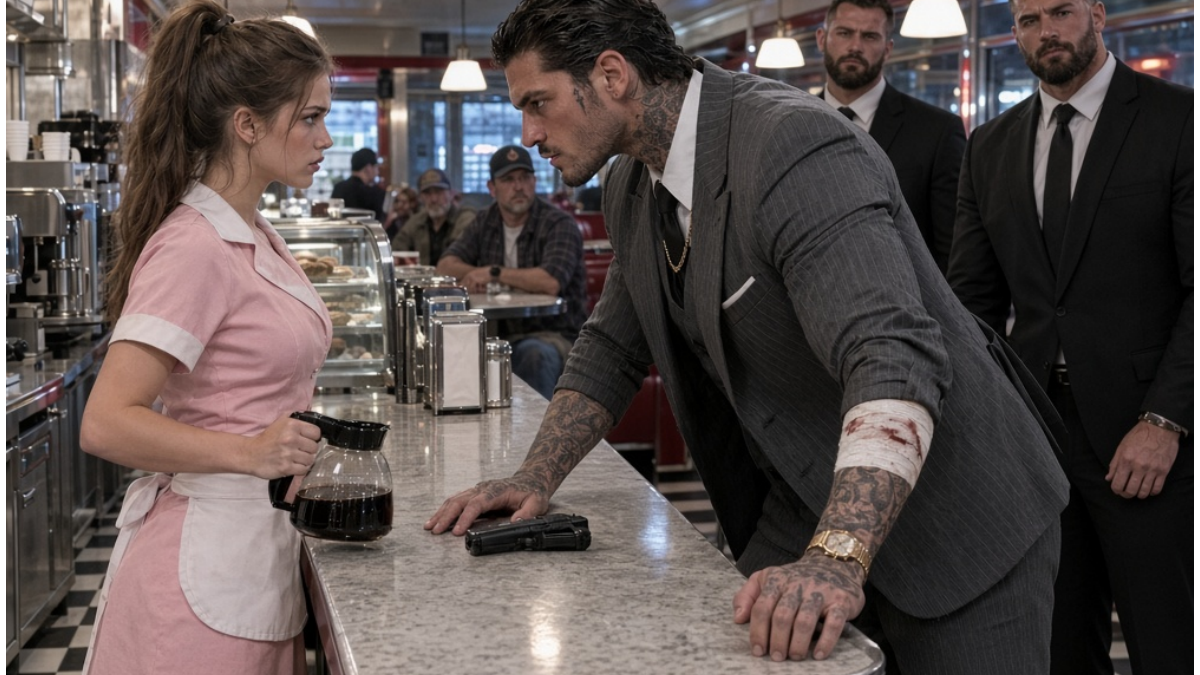
Most people freeze when they look down the barrel of a loaded gun. They cry.
They beg. But when you’ve worked consecutive double shifts at a grease stained diner off Interstate 95, pulling minimum wage just to keep your landlord from changing the locks.
The fear of death gets replaced by something much more dangerous. Absolute exhaustion. So, when the city’s most brutal syndicate boss slammed his bloody fist on my counter and screamed in my face, I didn’t flinch.
I just looked him dead in the eye and told him exactly how his night was going to end.
The clock above the pie case read. It was the kind of hour where the world feels hollowed out, leaving only the stragglers, the drunks, and the people running from things they couldn’t name.
Dora wiped down booth 6 for the third time. The rag smelled of industrial bleach and old lemons.
Her feet throbbed, a dull, rhythmic ache radiating from her cheap non-slip shoes all the way up to her lower back.
Outside, the rain was relentless, turning the neon sign of Rusty’s 24-hour diner into a blurry, bleeding smear of red against the wet asphalt.
She was calculating exactly how many shifts she needed to cover the electric bill when the front door didn’t just open.
It was thrown wide. The brass bell above it choked out a violent chime. A heavy wet gust of wind blew into the diner, bringing with it the metallic tang of copper and the sharp chemical bite of gunpowder.
Three men stepped inside. The atmosphere in this diner shifted instantly. The two truckers hunched over their coffees at the counter, dropped some cash, didn’t wait for change, and shuffled out the side exit.
Dora didn’t move. She just gripped her bleach rag tighter. The man in the center was the reason the room had turned to ice.
Leonardo Costas. Everyone in the city knew the face, even if they pretended they didn’t.
He looked like the kind of man who bought politicians before breakfaSt. Tailored dark suit soaked through at the shoulders.
Dark hair sllicked back by the rain. But it was the left side of his body that caught her attention.
His arm hung uselessly, a spreading stain of dark crimson turning his pristine white shirt into a butcher’s apron.
His two guards, mountains of muscle in cheap leather jackets, were scanning the empty diner, hands resting heavily inside their coats.
Leonardo walked toward the counter, his breathing shallow but controlled. He collapsed onto one of the vinyl stools.
The leather groaned under his weight. He looked at Dora. His eyes were a pale, washed out hazel, completely devoid of warmth.
They were the eyes of a man doing the calculus of violence. Coffee, he grunted.
His voice was gravel scraped raw. Black and get the first aid kit from the back.
Dora stared at him. She looked at the blood steadily dripping from his sleeve onto the spotless checkered lenolium she had mopped 15 minutes ago.
“We don’t have a trauma kit,” Dora said, her voice flat. “This is a diner.
I have off-brand band-aids and burn cream.” Leonardo slammed his right hand onto the formica counter.
The sugar shakers rattled. I didn’t ask for an inventory. Get the kit. Get me a towel and pour the damn coffee before I decide you’re not worth the oxygen in this room.
The silence that followed was suffocating. One of his guards stepped forward, a menacing shadow looming over the pie display.
Dora stood perfectly still. The exhaustion in her bones, the anxiety about her electric bill, the sheer indignity of being spoken to like a dog for 7 years in this grease trap.
It all coalesed into a tight hard knot in her cheSt. The filter between her brain and her mouth dissolved.
She picked up the scalding glass pot of coffee from the burner. She walked over to where he sat.
She didn’t pour it. “Listen to me very carefully,” Dora said. Her voice didn’t shake.
It was barely above a whisper, but it cut through the hum of the refrigerators like broken glass.
I make $725 an hour. I have been on my feet since noon. I just mopped that floor.
If you shout at me again, I will pour this boiling coffee directly into your open wound and I will end you before your gorillas can even clear leather.
Do we understand each other? The larger guard pulled a gun. The sound of the hammer clicking back was deafening.
Dora didn’t blink. She kept her eyes locked on Leonardo, the steaming pot hovering inches from his bleeding arm.
Time stopped. Dora’s pulse was hammering against her ribs like a trapped bird, but her hand remained perfectly steady.
She realized with a strange detached clarity that she might actually die next to a rotating display of stale cherry pies.
The guard took a step closer. The gun aimed squarely at the space between her eyes.
Boss, say the word. Leonardo Costa stared at her. The pain in his pale eyes was momentarily eclipsed by something else.
Disbelief. A muscle feathered in his jaw. The blood continued to patter onto the lenolium.
Drop. Drop. Drop. He didn’t look at his guard. He kept his gaze fixed on Dora, analyzing the dark circles under her eyes, the frayed collar of her pink uniform, the absolute lack of bluff in her posture.
Then Leonardo laughed. It was a harsh scraping sound. It hurt him to do it.
He winced, pressing his good hand against his ribs, but a genuine dark amusement danced in his eyes.
Put it away, Dante. Leonardo rasped. But boss, I said put it away. The amusement vanished, replaced by an authority so heavy it made the air feel thin.
Dante lowered the weapon, holstering it with a sullen click. But his eyes never left Dora.
Leonardo turned back to her. He leaned his head against the napkin dispenser, exhaling a long, shuddering breath.
“You’ve got balls, waitress. It’s Dora,” she said, finally lowering the coffee pot. She set it on the counter with a soft clack.
“And it’s not bravery. I’m just too tired to deal with an attitude.” She turned her back on him, ignoring the quiet gasp of outrage from Dante.
She walked to the back office, kicked open the door, and rummaged through the supply closet.
She grabbed a roll of duct tape, a stack of clean bar towels, and the dusty metal first aid box that had been sitting on the shelf since 1998.
When she returned, Leonardo was gripping the edge of the counter, his knuckles white. The adrenaline was wearing off.
The blood loss was kicking in. Dora slapped the supplies onto the counter. “Jack it off,” she ordered.
Leonardo raised an eyebrow. “Excuse me? You’re bleeding on my floor. If I have to mop it again, I’m charging you for the cleaning supplies.
Jacket off.” With a pained grimace, Leonardo let his good arm slip out of the heavy soaked fabric.
Dante stepped forward to help him ease the ruined left sleeve over the wound. It wasn’t a bullet hole.
It looked like a slash from a knife. Deep, jagged, and ugly, running along his bicep.
Dora poured the black coffee into a thick ceramic mug and pushed it toward him.
Then she opened the first aid kit, bypassed the useless band-aids, and pulled out a bottle of hydrogen peroxide.
“This is going to burn,” she said flatly. I’ve had worse,” Leonardo muttered, taking a swallow of the scalding coffee.
Dora uncapped the bottle and poured it directly over the open gash. Leonardo’s body went rigid.
His breath hissed through his teeth. His hand clamped down on the counter hard enough to crack the formicah, but he didn’t make a sound.
“Told you,” Dora murmured. She worked quickly, her hands surprisingly gentle for someone who had just threatened to maim him.
She pressed a thick wad of bar towels against the wound to stop the bleeding, wrapping it tightly with gauze and finally securing the makeshift bandage with three heavy strips of silver duct tape.
It was ugly. It was unprofessional, but it stopped the blood from hitting her floor.
You should get stitches, Dora said, washing her hands in the sink behind the counter.
Or a tetanus shot. That duct tape was sitting next to rat poison. Leonardo looked at his taped up arm, then up at Dora.
The harsh fluorescent lights cast long, hollow shadows on his face. Stripped of his intimidating jacket, bleeding and pale, he just looked like a tired man.
Why didn’t you run?” He asked quietly. “I have 2 hours left on my shift,” Dora replied, drying her hands.
“If I close the diner, my boss docks my pay. I can’t afford to run.”
Leonardo absorbed this. He reached into his pocket with his good hand, pulled out a thick silver money clip, and peeled off a handful of bills.
He didn’t count them. He just slid them across the counter, pinning them beneath the coffee mug.
For the floor, he said. He stood up. The color hadn’t returned to his face, but the terrifying, untouchable aura of the syndicate boss settled back over his shoulders like a familiar coat.
Dante was instantly at his side, throwing the ruined jacket over Leonardo’s uninjured shoulder. They walked toward the door.
Just as Leonardo grabbed the handle, he paused and looked back. Make sure the coffee is fresh tomorrow night, Dora.
The door shut behind him. The bell chimed. Dora stood alone in the quiet diner.
She walked over to the counter and picked up the mug. Underneath it was a neat stack of $100 bills, five of them.
She looked at the money, then at the blood smear on the counter, and let out a long, exhausted sigh.
She grabbed the bleach rag. Dora didn’t sleep that day. She lay in her cramped studio apartment, listening to the radiator clank and the neighbors television blare through the thin drywall.
The five crisp $100 bills sat on her rickety nightstand. They felt radioactive. Mob money, blood money.
She should throw it away. She should donate it. But when she looked at the final notice from the gas company sitting on her kitchen counter, principles felt like a luxury she couldn’t afford, she folded the bills and stuffed them into the cracked leather of her wallet.
When she clocked in for her graveyard shift that night, the diner felt different. The shadows seemed deeper.
Every time headlights swept across the rain streaked windows, her stomach tightened. She expected retaliation.
Men like Leonardo Costas didn’t just let waitresses threaten them with boiling coffee and walk away.
He had left the money as a joke, maybe, or a down payment on a casket.
By 2 a.m., the dinner rush had faded into the usual quiet hum of the refrigerators.
At 2:15 a.m., the bell chimed. Dora’s hand froze midwipe. Leonardo walked in. He wasn’t bleeding this time.
He wore a dark, perfectly tailored charcoal overcoat. His left arm was held stiffly at his side, hinting at the wound beneath.
But otherwise, he looked immaculate, dangerous, untouchable. He was alone. No Dante, no muscle, just the boss of the city’s underbelly, walking into a greasy spoon in the dead of night.
He didn’t sit in a booth. He walked straight to the counter and sat on the exact same stool he had bled on 24 hours earlier.
Dora swallowed the dry lump in her throat. She walked over, grabbed a rag, and swiped at the invisible dust on the counter in front of him.
“You’re back,” she said. Her voice lacked the fire of the previous night. “It was just tired.
I told you to make sure the coffee was fresh,” Leonardo replied. His pale hazel eyes tracked her movements, calculating and intense.
Dora turned around, grabbed the pot she had just brewed, and poured him a mug.
She set it down in front of him without a word. She didn’t offer a menu.
Leonardo took a slow sip. He didn’t wse at the heat. Dante wanted to burn this place down today.
Dora’s hand paused on the damp rag. She looked up. Is that why you’re here?
To tell me my workplace is combustible? No. Leonardo set the mug down. I told him if he touched a single rusted panel of this hole, I’d break both his legs.
Dora didn’t know what to do with that information. She leaned back against the piecase, crossing her arms over her cheSt. Why?
Because you didn’t flinch, Leonardo said softly. He leaned forward, resting his elbows on the counter.
In my world, everyone flinches. They lie. They scheme. They kiss my ring and hope I don’t see the knives they’re holding behind their backs.
You, he let out a quiet, cynical huff of breath. You told me you’d melt my skin off because I was being an You were being an I was bleeding out, Dora, and I was working a double shift.
We all have our probleMs. For a second, the heavy, dangerous silence returned. Then the corner of Leonardo’s mouth twitched upward.
It was barely a smile, but on a face that was usually carved from marble, it was a massive crack in the foundation.
I need a place, Leonardo said, his voice dropping lower. A place where people don’t ask questions.
A place where my enemies don’t think to look because the coffee tastes like battery acid and the floor smells like bleach.
I need a quiet corner for an hour a night. This is a public diner, Dora said, not a safe house.
I’ll pay for the stool every night, $500. Dora stared at him. $500 a night.
It was more than she made in a week. It was rent. It was groceries.
It was a ticket out of the suffocating debt that was drowning her. But it was a trap.
If someone comes in here looking to put a bullet in you, Dora said, her voice dropping to match his.
I’m not catching a stray for minimum wage. If anyone comes in here looking for me, they won’t make it past the parking lot.
Leonardo assured her. You have my word. A mobster’s word. Dora scoffed, turning away to grab the sugar dispensers that needed refilling.
Forgive me if I don’t write that down in my diary. She expected him to get angry.
Instead, she heard the scrape of the ceramic mug against the counter. I’m not a mobster, Dora.
I’m a businessman who operates in a market that lacks regulation. She snorted loudly. That’s a lot of syllables for a guy who got stabbed in an alley.
She turned back around, a sugar dispenser in each hand. Leonardo was looking at her.
The amusement was gone. In its place was something raw, something that looked remarkably like weariness.
It mirrored the feeling in her own bones. “I’m drowning,” Leonardo said quietly. “It wasn’t a confession for her.
It was a statement of fact to the empty room. My father left me a syndicate, tearing itself apart from the inside.
I haven’t slept more than 3 hours a night in 6 months. I just need a place where no one expects anything from me.”
Dora looked at the ruthless killer sitting at her counter. She saw the tension in his shoulders, the dark bruises of exhaustion under his eyes.
He wasn’t a monster in a movie. He was just a man caught in a machine exactly like she was.
His machine just happened to have a higher body count. She walked over, unscrewed the metal top of the sugar dispenser, and began filling it.
“The coffee is $2,” Dora said, not looking at him. “If you want cherry pie, it’s 350.
If you leave a mess, I’m kicking you out. And if you ever raise your voice at me again, the boiling coffee threat still stands.”
Leonardo watched her work. The tension slowly bled out of his posture. He picked up his mug and took another drink.
“Understood,” he said. “That was how it started. A contract forged over cheap lenolium and bitter coffee.”
Dora didn’t know it then, but letting Leonardo Costas buy that stool was the moment she stopped being a waitress and became the only anchor keeping the most dangerous man in the city from completely losing his mind.
November dragged itself into December, bringing a bitter biting cold that rattled the singlepane windows of Rusty’s 24-hour diner.
The rhythm of the graveyard shift was entirely predictable. Drunks at midnight, long haul truckers at 1, the terrifying, crushing emptiness at 2, and at 2:15, Leonardo Costas.
He never missed a night. Sometimes he stayed for 20 minutes. Sometimes he stayed until the sky bruised purple with the dawn.
The arrangement never changed. He sat at booth 6 if he wanted to spread out his paperwork.
Thick manila folders filled with columns of numbers and property deeds. Or he sat at the counter if he just wanted to stare straight ahead at the spinning pie rack.
Dora kept the coffee hot. Leonardo left $500 under his ceramic mug. At first, she kept the money in a rusted folders can under her sink, convinced he would eventually ask for it back or that the police would kick down her door.
But when her landlord threatened eviction on a Tuesday, Dora took five of those crisp hundreds and bought her peace of mind.
The next week, she bought winter boots that didn’t leak. Then a new radiator for her apartment.
She was being bankrolled by organized crime. And the worst part was how quickly she got used to it.
Poverty was a loud screaming alarm in your head. Leonardo Costas had simply reached over and hit the snooze button.
They didn’t speak much during those first 3 weeks. The silence between them wasn’t uncomfortable.
It was structural. It was the loadbearing wall of their strange arrangement. Leonardo came to the diner specifically to escape the demands of his life.
Dora wasn’t about to ask him about his day, but proximity breeds observation. Dora noticed things.
She noticed that Leonardo favored his left side, a lingering echo of the knife wound she had duct taped.
She noticed that he never sat with his back to the door. She noticed the way his jaw tightened when his phone buzzed.
A heavy, brutal sound against the formica counter and how he would stare at the caller ID for a long, agonizing moment before sending it to voicemail.
He noticed things, too. It happened on a Thursday. A regular, a sour, heavy set man named Hayes, who smelled entirely of stale beer and cheap cigars, had overstayed his welcome in booth three.
Dora walked over to drop his check. “I didn’t ask for this,” Hayes slurred, swatting the little green slip of paper onto the wet floor.
“I want more coffee.” “The machine is off for cleaning, Hayes. It’s 4:00 in the morning.
Time to go home. Dora stooped down to pick up the paper. Hayes reached out and grabbed her wrist, his grip was entirely too tight, his thumb digging into her pulse point.
I said, “I want more coffee, sweetheart. Don’t catch an attitude. You rely on my tips.”
Dora’s blood spiked. She went to rip her arm away, the familiar flare of defensive anger rising in her cheSt. Before she could move, a shadow fell over the booth.
Leonardo was standing there. He hadn’t made a sound. He didn’t look angry. He looked entirely hollowed out, which was somehow infinitely more terrifying.
He reached down and wrapped his large tailored hand around Hayes’s thick wriSt. Leonardo didn’t yell.
He didn’t make a scene. He simply applied pressure. Hayes’s face drained of color. A wet, strangled gasp escaped the drunk man’s lips as the bones in his wrist ground together under Leonardo’s grip.
“Let go of the waitress,” Leonardo whispered. The voice was soft. It sounded like dirt falling on a coffin lid.
Hayes dropped Dora’s arm instantly. He was trembling, staring up at Leonardo with absolute wideeyed terror.
The al alcohol evaporated from his system in a second. “Get up,” Leonardo commanded softly.
“Walk to the door. If you ever touch her again, I will have Dante find out where you sleep, and you will not wake up.
Nod, if you understand.” Hayes nodded frantically. Leonardo released him. The man scrambled out of the booth, practically tripping over his own feet, and bolted out the glass door into the freezing night.
Leonardo stood there for a moment, adjusting his cuffs. Then, then he turned to Dora.
Dora rubbed her wriSt. She looked at him, her heart hammering against her ribs. She didn’t say thank you.
Thank you. Felt too small and entirely the wrong shape for what had just happened.
You didn’t have to do that, she said finally, her voice remarkably steady. I had it.
Leonardo looked at the red marks blossoming on her pale skin. I know you did, but you shouldn’t have to.
He walked back to his stool. Dora watched him go. That was the night the dynamic shifted.
He wasn’t just a patron buying a safe corner anymore. He was paying attention. And God help her, she was paying attention, too.
By January, the diner felt less like a workplace and more like a fortress. They had developed a routine, a quiet, comfortable rhythm that felt completely isolated from the rest of the decaying city.
When Leonardo arrived, Dora knew to pour his coffee exactly 3 minutes after he sat down, giving him time to shed his heavy wool coat and check his messages.
In return, Leonardo started bringing things, small things. A box of high-end Earl Grey tea because he noticed she hated the bitter diner blend.
A space heater that he silently plugged in behind the counter near the register, exactly where the draft was worSt. He never made a big deal out of it.
He just left them there, as factual and unarguable as the weather. Dora found herself anticipating the chime of the door.
She hated herself for it. She was a cynic by trade and by trauma. You didn’t get attached to mob bosses.
You didn’t look forward to the company of a man whose business model relied on extortion and violence.
But the man sitting at her counter wasn’t a headline or a police report. He was just Leonardo.
A man who rubbed his temples when he had a migraine, who preferred cherry pie over Apple, and who listened to her complain about the broken jukebox with genuine, quiet amusement.
The illusion shattered on a Tuesday. It was 3:2 a.m. Leonardo was late. The snow was falling heavily outside, burying the streets in a thick, soundless white.
Dora was wiping down the milkshake machine, her eyes darting to the clock every 40 seconds.
At 3:10, the headlights washed over the diner. But it wasn’t Leonardo’s sleek black sedan.
It was a battered, heavily tinted SUV that hopped the curb and idled aggressively in the snow.
The brass bell shrieked. Two men walked in. They didn’t have the polished, terrifying grace of Leonardo or his right-hand man, Dante.
These men were entirely rough edges. Leather jackets, heavy boots, faces scarred by street fights and bad decisions.
They brought the cold in with them along with a thick, heavy tension that made the hair on Dora’s arms stand up.
“We’re closed,” Dora lied smoothly, tossing her rag onto the counter. “Grill is off.” The taller of the two, a man with a jagged scar cutting through his left eyebrow, grinned.
It was a nasty, predatory thing. Sign outside says 24 hours, sweetheart. The sign lies.
Get out. We ain’t here for the burgers, the second man said. He walked slowly toward the counter, his boots leaving wet, muddy tracks on the lenolum.
He looked around the empty diner. Word on the street is a certain somebody spends a lot of time in this dump.
We’re looking for Leonardo Costas. Dora’s stomach plummeted into her shoes, but her face remained a mask of bored irritation.
Never heard of him? Now either order a coffee to go or hit the bricks before I call the cops.
Scarface laughed. He walked up to the counter, leaning over it, invading her space. He smelled of cheap cologne and chewing tobacco.
You’re a feisty one. Kostas likes him feisty, huh? The boss wants to have a word with him.
We figure we sit here and wait. And if he don’t show, he reached out, grabbing a handful of Dora’s pink uniform shirt.
Maybe we take a souvenir to make sure he gets the message. Dora didn’t panic.
Panic was a luxury. She reached under the counter. Her fingers grazing the heavy iron handle of the ice mallet.
“Let go of me,” Dora said, her voice dropping an octave. “Or what, bitch?” The brass bell didn’t chime this time.
The door was kicked open with such force that the glass spiderwebed inside its frame.
The freezing wind rushed in, and so did Leonardo. He didn’t look like the tired businessman who drank cherry pie and black coffee.
He looked like the devil himself. His overcoat was open, the snow clinging to his shoulders.
His pale hazel eyes were entirely black. He didn’t say a word. He just moved.
Scarface turned, his hand dropping from Dora’s shirt to reach inside his jacket. He never made it.
Leonardo crossed the diner in three massive strides. He grabbed Scarface by the back of the neck and slammed his face directly into the heavy glass pie display.
The glass shattered outward in a concussive boom, raining down on the lenolium in a thousand glittering shards.
The second man yelled, pulling a heavy snub-nosed revolver. Before the man could raise the barrel, Dante materialized from the doorway.
A suppressed shot spit through the diner. And the second man’s knee exploded in a spray of dark red.
He went down screaming, the gun skittering across the floor and knocking into a bar stool.
Scarf face was gurgling, trying to push himself up from the ruined piecase. Leonardo didn’t let him.
With brutal, terrifying efficiency, Leonardo grabbed the man by his collar, dragged him backward, and threw him over the counter.
The man crashed onto the grill station, knocking over a vat of old frier grease.
Leonardo stepped over the counter. He stood over the bleeding, wheezing man. He drew a sleek matte black handgun from his shoulder holster and pressed the barrel directly against the man’s forehead.
Who sent you? Leonardo’s voice was entirely devoid of humanity. It was a machine operating on pure violence.
Screw screw you, Kostas. The man choked out, spitting blood onto the stainless steel. Leonardo didn’t hesitate.
He shifted the gun down 2 in and pulled the trigger. The sound was deafening in the enclosed space.
The bullet tore through the man’s shoulder. He shrieked, thrashing against the metal cabinets. “I won’t ask again,” Leonardo stated flatly, re-iming the weapon at the man’s head.
“Carmine? It was Carmine.” The man sobbed, clutching his shattered shoulder. “He said you were slipping.
Said you were hiding out in a diner like a coward. Leonardo stared down at him for a long, terrible second.
Then he looked up. He looked at Dora. She was standing pressed against the back wall near the swinging door to the kitchen.
Her hands were shaking. She wasn’t holding the ice mallet anymore. She was staring at the blood on her floor, at the shattered glass, and then slowly at the gun in Leonardo’s hand.
For the first time since she met him, Leonardo Costas looked entirely panicked. He lowered the gun.
The terrifying aura of the syndicate boss cracked, fracturing into a thousand pieces as he looked at the fear in her eyes.
Dante,” Leonardo said, his voice entirely breathless. “Get this trash out of here now.” It took Dante exactly 4 minutes to drag the two bleeding men out the back door and throw them into the trunk of a waiting sedan.
4 minutes of agonizing, suffocating silence inside the diner. The cold air howled through the broken front door.
The neon sign outside buzzed and flickered, casting erratic red shadows over the destruction. Blood was smeared across the checkerboard floor.
Crushed cherry pie mixed with shattered glass on the counter. Dora grabbed a broom. Her brain had shortcircuited.
The adrenaline had burned out, leaving behind a cold mechanical numbness. She didn’t know what else to do.
She was a waitress. There was a mess. She had to clean it. She started sweeping the glass into a pile, the bristles making a harsh scraping sound against the lenolium.
Scrape. Scrape. Scrape. Dora, stop. Leonardo was standing on the other side of the counter.
His coat was off. His white shirt was splattered with small rustcoled droplets. His hands, the hands that had just broken a man’s face against a glass case, were trembling.
Dora didn’t stop. She swept harder. I have to clean this up before the morning manager gets here.
The piecase is ruined. That’s $300. He’s going to take it out of my paycheck.
Dora, please put the broom down. The blood,” she rambled, her voice tight and high-pitched.
“Bleach doesn’t always get the blood out. I need industrial ammonia. It sets into the wax if you let it sit.”
Leonardo stepped behind the counter. He closed the distance between them and reached out, gently, grabbing the wooden handle of the broom to stop her frantic sweeping.
She flinched. It was a tiny movement, just a sharp intake of breath and a microscopic pull backward.
But to Leonardo, it looked like a physical blow. He let go of the broom instantly, stepping back, his hands raised in surrender.
The silence rushed back in, heavier than before. “I’m sorry,” Leonardo whispered. The gravel in his voice was completely gone.
He just sounded broken. I swore to you. I gave you my word they wouldn’t cross the parking lot.
I failed you. Dora looked at the broom handle, then slowly looked up at him.
The numbness was receding, replaced by a sudden, overwhelming wave of clarity. “They were going to hurt me,” she said quietly.
I know, Leonardo said, his jaw tight. Carmine put a tracker on one of my cars.
I didn’t catch it until we were three blocks away. When I saw the SUV idling out front, “God, Dora, when I saw him grab you,” he took a shaky breath, running a hand through his hair, completely ruining its sllicked back perfection.
This was a mistake, coming here, bringing my world into yours. It was entirely selfish.
He reached into his pocket and pulled out a thick stack of bills. Thousands of dollars bound in rubber bands.
He set it on the counter next to the cash register. This covers the damages.
The piecase, the door, everything. There’s enough left over to pay your rent for a year.
Quit this job tomorrow. Move to a better neighborhood. He looked at her, his hazel eyes burning with a desperate, self-loathing intensity.
I will make sure Carmine’s crew is dismantled by morning, but you will never see me again.
You’re safe now. He turned to walk away. He was doing exactly what she should want him to do.
He was giving her money. He was leaving. He was removing the danger. But as Dora watched him walk toward the broken door, stepping over the glass, the cynical practical part of her brain completely shut down.
“Leonardo?” He stopped, his hand on the fractured doorframe. He didn’t turn around. “Did you think I was stupid?”
Dora asked, her voice steadying, growing louder over the howling wind outside. Did you think I didn’t know who you were when you bled on my floor 3 months ago?
Did you think I didn’t understand the risk? Leonardo turned his head slightly, looking at her over his shoulder.
Dora dropped the broom. It clattered against the cabinets. She walked around the counter, stepping over the bloody footprints, closing the distance between them until she was standing inches from him.
I’m not some fragile civilian and who needs to be paid off and sent away,” Dora said fiercely, looking up at him.
“I chose to pour the coffee. I chose to take your money. I chose to let you sit at that stool every night.
You don’t get to make my decisions for me just because you feel guilty.” Leonardo turned fully to face her.
The height difference was massive. He loomed over her, a dark, dangerous presence. But Dora didn’t shrink back.
“They put their hands on you, Dora,” Leonardo said, his voice dropping into a dangerous, ragged whisper.
“They touched you because of me.” “If I had been 2 minutes later.” “But you weren’t,” she interrupted.
I am toxic, he warned, stepping closer until she could feel the heat radiating off his body.
Smell the gunpowder and the winter air clinging to him. Everything I touch rots. I came here because this diner was the only clean thing left in my life.
You were the only real thing left and I just painted it in blood. Don’t ask me to stay because if you ask me to stay, I won’t have the strength to leave you again.
Dora looked at his face. She saw the absolute exhaustion, the loneliness, the desperate, violent need to protect her from himself.
She reached up. Her hand bypassed his blood splattered shirt and rested gently against his jaw.
Leonardo inhaled sharply, his eyes fluttering shut at the contact. He leaned into her touch entirely, the brutal mafia boss dissolving into a man who was utterly starved for grace.
“I have bleach,” Dora whispered, her thumb brushing against his cheekbone. “We can clean the floor.
I’m not afraid of you, Leonardo.” He opened his eyes. They were entirely stripped of defenses.
He looked at her not as a waitress and not as a sanctuary, but as the only anchor he had left in the world.
He didn’t say anything else. He moved forward, threading his large, trembling hands into her hair and brought his mouth down on hers.
It wasn’t a gentle kiss. It was desperate. It tasted like cold night air. Adrenaline and inevitability.
Dora grabbed the lapels of his ruined coat, pulling him closer, anchoring him to her as the wind tore through the broken door and the red neon light flickered over the wreckage they were leaving behind.
The kiss broke, but the proximity remained. Leonardo’s forehead rested against Dora’s, his breathing ragged, matching the erratic thud of her own pulse.
Outside, the sirens began to wail, a distant, thin sound cutting through the winter wind.
Someone in the adjacent apartment building had heard the gunshot. Reality was crashing back in, sharp and uncompromising.
“We have to go,” Leonardo said. He didn’t step back, but his tone shifted. The vulnerability snapped shut, replaced instantly by the cold, calculating frequency of a man who survived by always being three steps ahead.
I can’t just leave, Dora said, gesturing blindly toward the ruined piease. The cops. We’ll find a shattered window and some blood.
Leonardo interrupted, grabbing her coat from the peg near the kitchen door. He draped it over her shoulders, pulling the collar tight against her neck.
If you stay, you have to answer questions. You have to explain why Carmine’s enforcers were bleeding on your floor.
You have to go on a police report, which means Carmine finds out exactly who you are.
Dora opened her mouth to argue, but the logic was a brick wall. She looked at her pink uniform dotted with stray flexcks of blood, and then at the $500 Leonardo had left on the counter an hour ago.
She walked over, grabbed the cash, and shoved it into her coat pocket. “Okay,” she said.
They walked out into the freezing night just as the flashing red and blue lights turned onto the far end of the avenue.
Dante was waiting in a sleek unmarked black sedan. The engine purred a low predatory hum.
The rear door was open. Dora climbed in. Leonardo slid in beside her, slamming the door, plunging them into the heavy soundproof luxury of the cabin.
The penthouse boss. Dante asked, glancing in the rear view mirror. His eyes flick to Dora, registering her presence with zero surprise.
“No, Penthouse is compromised if Carmine is tracking the fleet,” Leonardo said, pulling a burner phone from his interior pocket.
Take us to the shipyard office. Call the sweepers. Have them scrub the diner security footage before the cops figure out how to access the server.
Already done, Dante grunted, throwing the car into drive. The ride was a masterclass in silence.
The city blurred past the tinted windows, a bleak landscape of gray slush and orange street lights.
Dora stared at her hands, still clutching her bleachstained rag. She realized with a quiet sort of dread that she had just walked away from the only life she knew.
It was a miserable, exhausting life, but it was hers. Now she was entirely unmed, sitting next to a man who was actively organizing a mob war on a prepaid cell phone.
Leonardo finished typing a message, snapped the phone shut, and looked at her. He reached across the leather seat and gently pulled the damp rag from her white-nuckled grip.
He tossed it onto the floorboard. Then he took her hand in his. His skin was warm.
It was a simple grounding gesture, but it anchored her chaotic thoughts. You’re terrified,” Leonardo stated.
“I just abandoned my job, became an accessory after the fact, and I’m sitting in a car that smells like gunpowder and expensive cologne,” Dora replied, staring straight ahead.
“If I wasn’t terrified, you should be worried.” The corn corner of Leonardo’s mouth twitched.
“The shipyard is heavily guarded. You’ll be safe there while I deal with Carmine. Dora turned to look at him.
Deal with him? How? The amusement vanished. The pale hazel eyes grew entirely cold. He sent men to touch what is mine.
He broke the rules of engagement. By sunrise, Carmine’s operation will no longer exiSt. Dora swallowed hard.
She didn’t ask for clarification. She didn’t want to know the mechanics of how a human being was erased.
20 minutes later, they pulled into a sprawling industrial lot flanked by massive rusted shipping containers.
Armed men in heavy coats patrolled the perimeter. Dante parked near a corrugated metal office building.
Inside, it didn’t look like a mob hideout. It looked like a generic logistics hub.
Fluorescent lights, cheap desks, filing cabinets. Leonardo led her to a private office in the back.
It had a leather couch, a heavy mahogany desk, and a wall of monitors displaying camera feeds from across the city.
“Stay here,” Leonardo commanded gently. “Lock the door. Dante is stationed right outside. There is a gun in the top right drawer of the desk.
The safety is on the left side. Flick it down with your thumb. Point and shoot.
Dora looked at the heavy wooden door, then back at Leonardo. He was pulling his overcoat back on, checking the magazine of his sidearm.
He was leaving. “Don’t do anything stupid,” Dora said, her voice tight. Leonardo paused. He walked over, cuped the back of her neck, and kissed her hard.
It was a promise. “I’ll bring the coffee tomorrow,” he whispered. He walked out. The heavy door clicked shut.
The deadbolt slid into place. Dora was alone in the quiet hum of the office.
She walked over to the desk, pulled open the top right drawer, and stared at the heavy matte black pistol resting on a stack of invoices.
She didn’t touch it. Instead, she walked to the wall of monitors and started to watch.
3 hours passed. The digital clock on the bottom of the security monitors read 6:45 a.m. The sun was beginning to bleed over the industrial horizon, painting the smoggy sky a bruised, sickly purple.
Dora had spent the time pacing. She had analyzed every inch of the office, brewed a pot of terrible, burnt coffee in the corner break area, and stared at the monitors until her eyes burned.
The screen showed empty docks, quiet streets, and the exterior of the corrugated building. Nothing moved.
Then the burner phone on the mahogany desk vibrated violently against the wood. Dora jumped.
She stared at it. Leonardo had left it behind. She picked it up. The screen displayed a single scrambled number.
She hit the green button and held it to her ear. She didn’t speak. Leonardo.
The voice on the other end was breathless, panicked, and layered with the harsh static of wind.
It was Dante. Dora’s blood ran cold. Dante was supposed to be right outside her door.
“It’s Dora,” she said sharply. A heavy beat of silence. Dora, listen to me. Carmine didn’t hunker down.
He pushed. He brought everyone. We walked into a meat grinder at the Southside warehouse.
Where is Leonardo? He’s hit. Dante gasped. The sound of a heavy caliber gunshot cracked in the background, making Dora flinch.
Leg and shoulder. We’re pinned behind the loading bays. Carmine’s men are closing the perimeter.
They jammed the radios. This burner is the only thing catching a signal. Panic, bright and blinding, threatened to overwhelm her.
But the survival instinct that had kept her afloat through 7 years of grinding poverty kicked in.
She compartmentalized the terror. “Where are you exactly?” Dora demanded, her eyes scanning the wall of monitors.
“Southside, bay 4. We can’t move. Dora looked at the screens. Most of them were feeds from the shipyard, but a cluster in the corner was labeled Southside Transit.
She grabbed the mouse on the desk and clicked, expanding the feeds. She saw it.
A massive concrete warehouse. Dozens of dark SUVs blocking the exits. Men with long rifles moving methodically through the rain.
Dante, I have your camera feed,” Dora said, her voice dropping into a dead, flat calm.
“I can see the warehouse.” “Can you see Carmine?” She scanned the screens. She looked for the arrogance.
She looked for the man not holding a gun, the man directing the violence. Camera 4, black SUV, idling near the chainlink fence.
Doris said. There’s a man in a camelhair coat standing behind the open door. He’s smoking.
That’s him. Dante coughed. He’s waiting for them to flush us out. Dora’s eyes darted across the screen.
She analyzed the layout the same way she analyzed a dinner rush. Anticipate the movement.
Find the bottleneck. Dante, listen to me. They have five men sweeping the left flank, moving toward bay four.
But the right side is completely clear. It’s an old drainage trench. If we break right, we lose our cover.
We’re in the open. Not if Carmine is dead, Dora said. The words tasted like ash in her mouth.
I don’t have an angle on him. We’re pinned. Dora stared at the screen. The geography of the lot was burned into her mind.
You don’t need an angle. You need a distraction. Is there a gas man? A generator?
Anything you can hit? There’s a transformer box 50 yard north. If I hit it, the whole block loses power, including the flood lights.
Do it, Dora ordered. When the lights cut, Leonardo breaks right toward the drainage trench.
You lay down covering fire on the left flank. I am calling the sweepers here at the shipyard to extract you.
Dora, do it, Dante. She dropped the phone. She ran to the heavy wooden door, unlocked it, and threw it open.
The hallway was empty. The guards were stationed outside. She sprinted down the hall, burst through the exterior doors, and yelled at the top of her lungs at the captain of the yard detail.
Southside Warehouse, Bay 4, Leonardo is hit. Get every available car there right now. The captain didn’t question her.
He took one look at her face, keyed his radio, and the shipyard erupted into chaotic coordinated motion.
Dora ran back inside, locking the door behind her. She threw herself into the leather chair and stared at the monitor.
The digital clock ticked. On screen, a sudden massive shower of blue sparks erupted on the north side of the lot.
The screen went black for a split second before the camera’s night vision kicked in, bathing the scene in a ghostly green light.
The flood lights were dead. Through the green haze, Dora saw a figure break from the cover of bay 4.
Leonardo, even limping, moving with a heavy dragging gate. He was terrifyingly faSt. He didn’t run away.
He ran parallel to the drainage trench, closing the distance toward the chainlink fence. Carmine’s men panicked in the darkness, turning their fire toward the transformer.
Leonardo reached the fence. He raised his arm. The camera angle was poor, but Dora saw the muzzle flash from Leonardo’s gun.
Three rapid controlled bursts. By the black SUV, the man in the camelhair coat collapsed, folding in on himself like a puppet with cut strings.
The command structure of Carmine’s crew evaporated instantly. Men began falling back, scrambling for their vehicles.
2 minutes later, tires screeched as the shipyard sweepers arrived. A fleet of black cars swarming the lot, securing the perimeter.
Dora exhaled. She hadn’t realized she was holding her breath. Her hands were shaking so violently she had to clench them into fists and press them against the heavy mahogany desk.
She had just helped kill a man. She stared at the green static fil screen watching Dante drag Leonardo toward one of the extraction vehicles.
She felt sick. She felt entirely numb. But underneath the horror buried deep in her chest was a strange, terrible realization.
She didn’t regret it. The private hospital wing didn’t smell like bleach and old lemons.
It smelled like rubbing alcohol, starched linen, and expensive orchids sitting in cut glass voses.
It was a sterile, hushed kind of wealth, completely divorced from the sticky floors and buzzing neon of the world Dora actually knew.
She sat in a heavy leather armchair by the window, her knees pulled to her cheSt. Outside, the snow was falling heavily over the city skyline, burying the violence of the last 3 days under a thick, soundless white sheet.
It had been 72 hours since the Southside warehouse. 72 hours of emergency surgeries, hushed conversations with dangerous men in tailored suits hovering in the corridors, and a total systemic restructuring of the city’s underground.
With Carmine gone, Leonardo’s grip on the syndicate was absolute. The remaining factions had immediately surrendered, terrified of the brutal mechanical efficiency with which their rival had been dismantled.
Dora hadn’t slept. She was wearing a soft gray cashmere sweater, a silent gift Dante had dropped off yesterday, along with a secure phone and a new set of keys to an apartment she hadn’t seen yet.
The cashmere felt foreign against her skin, too soft, too expensive for a girl used to scratchy polyester uniform shirts.
The heavy oak door to the private suite clicked open. A nurse in crisp dark scrubs walked out, offering Dora a polite, terrified nod before hurrying down the hall.
Dora stood up. Her bones achd with a deep, familiar exhaustion, but the anxiety that had been choking her for 3 days finally loosened its grip.
She walked into the room. Leonardo was sitting up in the mechanized bed. The sight of him was jarring.
The untouchable syndicate boss was completely immobilized. His left shoulder was heavily bandaged, pinning his arm to his chest in a complex sling.
His right leg was elevated, wrapped in a thick white cast from ankle to thigh.
He looked pale, bruised, and hollowed out by the narcotics pumping through his IV, but his eyes were clear.
The heavy suffocating weight that had haunted him for months. The paranoia, the constant calculus of survival was gone.
Dora walked over to the small kitchenet in the corner of the VIP suite. She ignored the selection of artisal teas.
Instead, she picked up a thick ceramic mug she had smuggled up from the basement cafeteria.
The coffee in this wing is basically brown water, Dora said. Her voice sounded grally, rough from disuse.
So, I bribed an orderly 20 bucks to let me use the industrial machine by the morg.
It’s black. It’s been sitting on a burner for 4 hours. It will probably erode your stomach lining.
Leonardo turned his head against the pillows. He didn’t look at the mug. He looked at her.
He reached across the stark white sheets with his good hand, waiting. Dora set the mug on the rolling tray table.
She placed her hand in his. His skin was warm, the grip surprisingly strong despite the blood loss.
“Dante told me what you did,” Leonardo said quietly. His thumb stroked the back back of her knuckles.
The monitors beeped in a slow, steady rhythm. He said you were the one who spotted the flank.
You gave the order to hit the transformer. You coordinated the sweepers. I was watching a screen.
Dora dismissed, looking away. She stared at the orchids on the windowsill. She didn’t want to talk about it.
She didn’t want to examine the terrifying ice cold calm that had taken over her body when she ordered a man’s execution.
“You and Dante were the ones catching bullets. You saved my life, Dora.” Leonardo’s voice dropped, demanding her attention.
“You saved Dante’s life. Carmine had us boxed in. 10 more seconds and we were dead.
I protected my investment,” Dora dead panned. She forced herself to look back at him, pasting on a tired, cynical smirk to hide the tremble in her jaw.
“You owe me $500 a night for the rest of your life. I wasn’t about to let Carmine default on my pension.”
Leonardo let out a breath that was half laugh, half wse. It pulled at his stitches and he grimaced, settling deeper into the mattress.
His fingers tightened around hers, anchoring them both. “The diner is gone,” Leonardo said. Dora blinked.
The sudden pivot threw her off balance. “What do you mean gone? The front window was shattered, not the foundation.
The morning manager was going to call a glazier. I bought the building, Leonardo corrected smoothly, ignoring her confusion.
And the abandoned lot next to it. I had Dante’s crew completely gut it yesterday.
Ripped it down to the studs. The morning manager was given a very generous severance package and a strong suggestion to retire to Florida.
Dora stared at him, her mouth slightly open. The image of the rusted neon sign and the greasy checkerboard lenolium flashed in her mind.
You demolished my workplace behind my back. It was a health hazard, Dora. The duct tape was sitting next to the rat poison, remember?
The foundation was rotting. She shook her head in sheer disbelief, pulling her hand away to cross her arms over the soft cashmere.
So, so what exactly am I supposed to do now? Be a kept woman in some high-rise penthouse?
Spend my days going to charity gallas with the other mob wives and pretending I don’t know where the money comes from?
Leonardo’s expression shifted. The amusement vanished, replaced by an intense, burning sincerity. He pushed himself up slightly, fighting the heavy painkillers.
No, he said fiercely. You’re going to design the new restaurant from the ground up.
You pick the hardwood floors. You pick the espresso machines. You hire the staff. You set the wages.
You own it clean and clear. Legitimate business. The deed is already in your name.
He reached out again, catching her wrist, pulling her gently back toward the edge of the bed.
No money laundering, Leonardo promised, his pale hazel eyes locking onto hers. No meetings in the back office.
No blood on the floor. It is entirely yours. Dora searched his face. She looked for the trap.
She looked for the strings attached. But there were none. He meant it. It wasn’t a payoff to keep her quiet.
It was a kingdom built from the ashes of her miserable 7-year grind. He was giving her the one thing she had never had, control.
The heavy, cynical armor she had worn for years finally cracked, falling away in jagged pieces.
“And where are you going to get your coffee at 3:00 in the morning when you’re having a panic attack about your empire?”
She asked softly. I’ll have to rely on the owner to make it for me at home,” Leonardo replied.
Dora looked at the ruthless syndicate boss, bruised and broken in a hospital bed, looking at her like she was the only real thing left in a city built on lies.
She thought about the exhausting, terrifying journey, from pouring cheap diner coffee to orchestrating a mob hit over a radio.
She had crossed a line that could never be uncrossed. But as she looked at Leonardo, she finally accepted the truth.
She didn’t want to go back. Dora leaned down. She bypassed his injured shoulder, resting her hand gently against his jaw, and kissed him.
It was slow, deliberate, and entirely lacking in fear. It tasted like bitter coffee, an absolute certainty.
“If you ever yell at my staff,” Dora whispered against his lips, her voice a fierce, unyielding promise.
“I will still pour boiling coffee on you.” Leonardo smiled, his eyes slipping shut as he leaned into her touch.
I wouldn’t expect anything less. The world outside the hospital window was freezing, violent, and utterly unforgiving.
But inside, under the quiet, steady hum of the medical monitors, they had carved out a brutal, beautiful sanctuary of their own.
From a greased diner to the heights of a criminal empire, Dora didn’t just survive Leonardo’s dangerous world.
She conquered it. She proved that sometimes the most terrifying thing in a room full of mobsters isn’t the guy with the gun.








