She Was Hired to Feed 30 Hands—The Foreman Marched Them to Town, but She Set 30 Plates Every Night
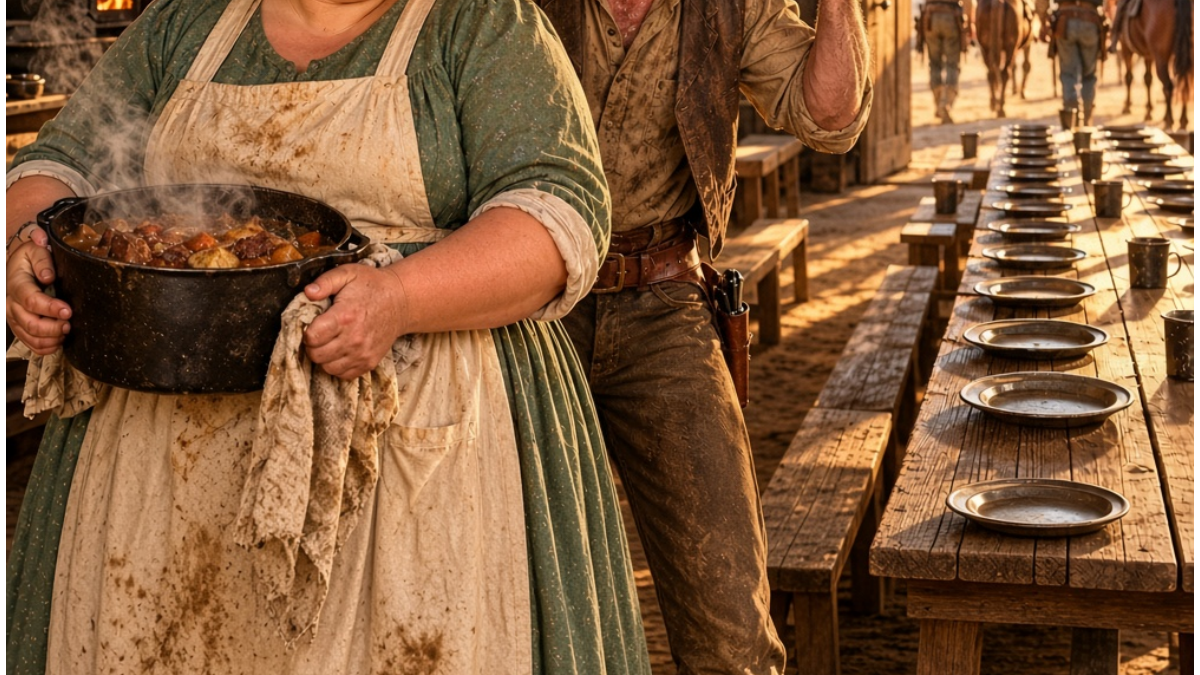
On her first night at the Coburn ranch, Bertha Platt set 30 plates, and the foreman carried her whole pot of stew out past 30 hungry men and poured it into the hog trough.
“Boys,” Buck Thorp said, “we eat in town, and every one of them followed him.”
She stood in the cookhouse door with her apron still hot from the stove and watched them go.
30 men, 30 horses, a line of dust going down the road toward Dryfork, where the lamps were just coming on in the windows of Lester Holler’s saloon.
The hogs were already shoving into the trough. They were eating her beef and her onions, and the good brown gravy she had stood over since noon.
Her pot lay on its side in the mud where he had dropped it, her dead mother’s pot, and a hog had its snout inside it.
At the gate, Buck Thorp turned in his saddle. He saw her looking at the pot, and he laughed and rode on without another glance.
Bertha did not know it yet, but Lester Aller had 30 plates set out, too.
And for every hand, Buck Thorp walked through his door. Aller put silver in the foreman’s hand.
Behind her, on a bench at the long empty table, one man had not moved.
It was the man who had hired her. She went back inside. She did not cry.
The next night, she set 30 plates again. And the night after that, and every night after until the whole ranch understood what those plates meant.
Her first day had begun that same morning when the freight wagon came over the last rise and pulled into the yard with its springs complaining, and Bertha shifted her weight to climb down.
She was a big woman. Big the way a cook stove is big, broad and deep, and built to hold heat.
She had known men would be watching. She had not known how many. They were along the corral rails and on the bunk house steps and in the open door of the barn, 30 of them, more or less, in sweat stained hats and canvas coats.
Some had been saddling. They had stopped. The driver who had hauled her all the way from Rollins set her trunk down in the dirt.
Nobody came to help him. Bertha put one foot on the wheelhub. The wagon groaned.
Somewhere along the corral, a voice said, low and pleased. Lord, look at the size of the new cook.
Somebody laughed. Then another. Her heart was pounding so hard she could feel it in her throat.
Her hands were trembling on the iron rim of the wheel, and she hated them for it.
She was 34 years old, and in 20 years of cooking, she had climbed down off a 100 wagons, into a 100 camps.
It never got easier. She had only got better at pretending. She came down heavily, both boots at once, and a little cloud of yellow dust puffed up around her hem.
A man walked out from the house. He was tall and lean, somewhere past 40 in a brown vest with no coat over it, and he had his hat in his hand.
He had a quiet, tired face. He looked at her the way a man looks at a horse he has already paid for and is not sure about.
“Miss Platt?” “I’m Andrew Coburn.” She nodded. “Mr. Coburn?” He looked past her at the men along the rails.
Then he looked back at her, at all of her, and she watched him do the sum.
30 men, Miss Platt, he said. That’s a lot of cooking for one woman. It was not unkind.
It was worse than unkind. It was honeSt. Bertha straightened her back. “It’s a lot of eating for 30 men, Mr. Coburn,” she said.
“I expect we’ll both be busy.” Something moved at the corner of his mouth. It was almost a smile.
It did not laSt. On the top rail of the corral, a man sat with his boots hooked under the middle rail and a cigarette in the corner of his mouth.
He was lean and hard and brown with a short dark beard going gray at the chin and a face cracked by years of sun.
His hat was stained black at the band. He had not laughed with the others.
He had only watched her as a rancher watches a stray dog come into his yard.
That’s Buck Thorp, Andrew Coburn said. My foreman, he ran this crew for my father for 12 years.
Buck Thorp touched two fingers to his hatbrim. He didn’t get down. Ma’am, he said, and then to the man beside him, loud enough to carry.
Hope she brought her own groceries. The laugh went round the corral again. Andrew Coburn did not turn his head.
He picked up one end of her trunk. “The cook house is this way,” he said.
The cook house was a long log building set between the main house and the bunk house with a stone chimney at one end and a leanto pantry at the other.
Inside it was cold. The big black range had not been lit in weeks. There was dust on the lids and a mouse nest in the wood box.
Down the middle of the room ran a plank table long enough for 30 with a bench on each side.
The last cook quit in AuguSt. Andrew said the men have been eating in town.
In town? Bertha said every night. It’s 5 miles. He set down the trunk. They don’t seem to mind the ride.
Why? He showed her the pantry. She stopped in the doorway of it and did not say anything for a moment.
It was full barrels of flour along the wall. Four of them with their lids nailed down.
A barrel of sugar. Sacks of beans and dried apples and coffee. A side of bacon and two hams hanging from the rafters in cloth.
Tins of lard. Crocs of butter set in the cool of the floor. Through a second door, she could see the meat house and a quarter of beef hanging in the cold.
I stocked it for the winter, Andrew said. 30 men, 6 months. My father always said a full larder keeps a crew.
Your father was right. My father is dead, he said, since April. He said it flatly as if he were telling her where the wood pile was.
So now it’s my larder and my crew. And I don’t know half of what he knew about either.
He stood there a moment longer as if he had more to say. Then he put his hat on.
Supper’s at dark, he said. The man will be in from the south pasture by then and he went out.
Bertha stood alone in the cold room. She let herself breathe. Then she opened her trunk.
On top were her aprons, two of them, and under them her mother’s receipt book with its corners worn round, and under that, wrapped in an old wool shaw, was the pot.
It was black iron, as big around as a wash tub and nearly as deep, with a heavy lid and a bail handle worn smooth and bright, where a hundred hands had lifted it.
It weighed more empty than most pots weighed full. Her mother had carried it across Nebraska behind the Union Pacific grading cruise when Bertha was a girl sleeping under the cook wagon.
Her mother had fed 60 men a night out of that pot in rain and wind and grasshopper years.
And when her mother died two winters ago in a Rollins boarding house, the pot was the only thing she left.
Bertha lifted it out with both arms and set it on the range. It rang a little, iron on iron, like something waking up.
All right, she said to it. Let’s feed them. She lit the fire. She swept out the mouse neSt. She scrubbed the table with li soap and hot water until the planks came up pale.
She carried in wood until the box was full and her shoulders achd. Then she went into the meat house with a knife.
By noon, she had the beef cut into cubes the size of a child’s fiSt. and browning in lard in batches so the pan would hiss and the meat would crust dark instead of stewing gray.
The smell filled the room and went out the open door. She cut onions until her eyes streamed.
She cut carrots and potatoes and a whole head of cabbage. She put it all in the black pot with water and salt and a handful of dried thyme from her own tin and she let it come up slow.
Then biscuits, two batches, because 30 men is 30 men. Last of all, she stirred flour into the drippings and made a gravy you could have stood a spoon in, and the stew went rich and dark and glossy.
Then she unpacked the plates. They were in a crate under the table, packed in straw.
Tin plates, 30 of them. Tin cups, 30. Forks and spoons in a sack. Nobody had unpacked them since the last cook left.
She wiped each one with a clean rag and laid it down. And she counted them under her breath as she went, the way her mother used to count.
1 2 3. All the way down one side and all the way back up the other.
30. The sun came low through the open door and lay gold along the table, and every plate caught it.
Around five, a young man put his head in at the door. He could not have been more than 20 with a thin neck and big red ears and a face that was mostly freckles.
He sniffed long and deep with his eyes shut. Lord, ma’am, he said. What is that?
Beef stew, Bertha said. And biscuits. And there’s dried apple pie if you’re good. His eyes opened wide.
Pie, Lonnie. A voice from the yard. Buck Thorp’s voice. Get away from there. You got a horse to see.
The young man jerked back out of the door like a dog called off a porch.
He gave her one look over his shoulder. It was an apologetic look. Then he was gone.
The men came in from the south pasture as the sun touched the hills. She heard them before she saw them.
Hooves and saddle leather and voices and the corral gate banging. She had the stew ready.
She had the biscuits under a towel. She had the coffee boiling in the big enamel pot and the pies cooling on the sill.
She washed her hands. She tied on her cream apron and dusted her palms with flour from habit.
Then she took up the black pot. It was heavy, full like that. She had to set it on her hip and hold it with both hands, the handles wrapped in a dish towel.
The steam came up hot into her face and smelled of beef and onion and thyme.
She walked it down the length of the table toward the open door where she meant to ring the iron triangle that hung outside.
She did not get there. Buck Thorp came in through the door and stopped right in front of her.
He was not a big man. He did not need to be. He leaned in over her and the pot so close she could smell the tobacco on him and he grinned.
It was not a friendly grin. Behind him out in the gold light, the men were standing by the horses.
They had not unsettled. Supper, Bertha said, such as it is, you’ll want a wash up.
Buck looked down into the pot, then at her face, then very slowly at the rest of her.
Then he jerked his thumb back over his shoulder toward the door, toward the road, toward the town at the end of it.
“No, ma’am,” he said. “We won’t.” And he took the pot out of her hands.
She was so surprised that she let him. He took it by the bail, towel and all, and turned and walked out the door with it.
Bertha went after him. Her feet felt slow and stupid. She got to the door as he walked past the line of men, past the horses, all the way to the fence behind the barn where the hogs were penned.
He tipped it. The stew went into the trough in one long brown pour. Beef and potatoes and cabbage and gravy steaming in the cold air.
The hogs came squealing and shoving. Buck shook the pot to get the last of it out.
Then he dropped it in the mud by the trough and wiped his hands on his pants.
“Boys,” he said, “Suppers in town.” And they went, “All 30.” She watched them swing up into their saddles.
Some looked at the ground. Some looked at her and grinned. The young one with the red ears looked back once and then he looked away.
They rode out of the yard in a long loose string and down the road toward dry fork and the dust they left hung gold in the last of the light.
Bertha stood in the door. Her eyes were wet. Her jaw was set so hard her teeth hurt.
She heard a bench creek behind her. Andrew Coburn was sitting on one of the benches.
He was the only one. He had come in the back way while she was busy.
And he was sitting in the middle of all those empty plates with his hat beside him.
He didn’t look at her. He was looking at the door. You didn’t stop him.
Bertha said, “The men eat where they like, Miss Platt.” His voice was tired. They take their supper on their own time.
I don’t own that. You own the ranch. I own the cattle in the grass.
He turned his hat around once on the table. Buck owns the men. He always has.
She wanted to throw something. She walked out instead all the way across the yard to the hog pen.
And she picked her mother’s pot up out of the mud. There was muck all down the side and in the bail.
She carried it back against her chest and her apron was ruined and she did not care.
Well, she said, “There’s biscuits and I can fry you some salt, pork, and eggs, and there’s pie.”
Andrew looked up at her. For the first time, he saw her as a person and not a sum.
“I’d be grateful,” he said. So she fried him salt pork and three eggs in the big skillet, and she split four biscuits and buttered them.
And she poured his coffee, and she cut him a quarter of the dried apple pie.
He ate it alone at the long table with 29 clean tin plates around him, catching the lamp light.
She sat across from him with her own cup because it seemed wrong to let a man eat in a room that empty by himself.
He ate everything. He ate slowly with his head down. When he got to the pie, he stopped chewing for a moment and shut his eyes.
“My mother made pie like this,” he said. “It’s only dried apples and a little nutmeg.
And the crust is lard, not butter.” “Lard makes it short.” “Short,” he said, as if it were a word in another language.
“Tender. It breaks when you touch it.” He finished the pie. He set his fork down on the tin plate very carefully, like something he didn’t want to wake.
“Mr. Coburn,” Bertha asked. “Why does your foreman care where 30 men eat their supper?”
“He was quiet a long time.” “I don’t know,” he said at laSt. “I’ve been asking myself that since AuguSt.” He put on his hat and thanked her and went out to the house.
She washed his one plate. She scrubbed the hogmuck off her mother’s pot with sand until the iron was black and clean again.
It was near midnight on the 18th of October 1886 when she heard the horses coming back up the road.
The men were singing. It was not good singing. One voice was louder than all the rest, and she knew it was Buck Thorps.
She lay on the narrow cot in the room behind the pantry and listened to them go by in the dark tomorrow.
She thought, I will set 30 plates.
Andrew Coburn came to the cook house at 5 the next morning because he could not sleep and because he smelled coffee.
It was still full dark. The lamp was lit and the range was roaring and Bertha Platt was at the table with her sleeves pushed up past the elbow working a mound of dough as big as a saddle.
She didn’t look surprised to see him. She poured him a cup without asking and set it by his elbow on the bench.
You’re up early, he said. Cooks are always up early. It’s the one thing everybody knows about us.
He sat down and wrapped his hands around the cup. It was good coffee, strong and clean.
He hadn’t had good coffee since his father’s cook quit. Why did he quit? Bertha asked.
The last one. Andrew thought about it. Buck said the old man was drinking. Said the man wouldn’t eat his food.
One morning, he packed up and took the stage. He shrugged. I’d been here 4 months.
I didn’t know the man. I didn’t know any of them. Where were you before?
Denver. I kept books for a freight company. He almost smiled. My father thought that was the saddest thing a Coburn ever did.
He wrote me every Christmas to come home and learn cattle. I never came. Then in April, he fell off a horse he’d been riding for 11 years, and the lawyer rode instead.
Bertha’s hands kept moving in the dough. Push, fold, turn, push, fold, turn. So you came home, she said.
So I came home to a ranch I don’t know how to run and a crew that knows it and a foreman who runs it for you.
He glanced up sharply. She did not raise her eyes. Buck knows this country. He said he knows the water and the grass and every cow by her face.
He brought my father’s herd through the winter of 80 and never lost a man.
I can’t run this place without him. I didn’t say you could. I can’t order grown men where to spend their own money, Miss Platt.
It came out harder than he meant. They get $30 a month and found if they’d rather ride five miles and pay for a supper in town than eat one here for nothing.
That’s their business. Is it? Maybe it’s the cooking, he said, and was sorry the moment he said it.
Bertha stopped kneading. She wiped her hands on her apron and looked at him across the table and her round face was very calm.
They’ve never tasted it, Mr. Coburn. He had nothing to say to that. He drank his coffee.
She slid a plate across to him. Two biscuits split and buttered and a spoonful of her apple butter from a jar in her trunk.
He ate them. He ate them slowly with his eyes on the window where the sky over the barn was turning gray.
When he left, he put a third biscuit in his vest pocket without asking. She saw him do it and said nothing.
That morning, Andrew Coburn stood in the barn door and watched his crew saddle up for the day.
He watched Buck Thorp walked down the line of them, giving orders, and he watched how the men turned when Buck spoke.
They turned the way sunflowers turn. None of them turned like that when Andrew spoke.
He took the biscuit out of his pocket and bit into it. It was still warm.
It was the best thing he had eaten in 6 months. He felt something he did not have a name for.
It sat in his stomach next to the biscuit, huh, cold and heavy, and it didn’t go away all day.
That evening, the 30 plates went out again. She made chicken and dumplings. The dumplings were as light as clouds.
She rang the iron triangle outside the door at sundown, long and loud. The way her mother used to ring it for the grading crews.
Buck Thorp walked the men past the cook house to the horses. He stayed outside this time.
He did not have to come in. He only paused by the wood pile where she could see him from the door and made a noise through his nose.
It was a grunt. A hog’s grunt. The men laughed. A few of them took it up.
They grunted and snorted all the way to their saddles and they rode away to town still doing it.
Bertha rang the triangle again after they were gone. She did it for nobody. She did it so they would hear it down the road.
Andrew ate chicken and dumplings across from her among the empty plates. Neither of them said anything about the grunting.
It went on like that all week. On Wednesday, it was pot roaSt. On Thursday, ham and beans and cornbread.
On Friday, fried steak with milk gravy and a pan of cinnamon rolls. Every night, the 30 plates went down.
Every night, Buck walked the man past her door and away to dry fork. Every night, Andrew Coburn ate alone across from her.
And every night, near midnight, she heard them come singing back. On Saturday morning, she tried something else.
She had made a double pan of cinnamon rolls the night before, and she had held half of them back.
She got up at 4 and set them back in the oven until the sugar ran, and the whole cookhouse smelled of cinnamon and brown butter.
She put them on a big tin tray with a clean cloth over them. Then she carried them over to the bunk house.
There was frost on the corral rails and her breath went up white. Inside the bunk house was dark and close and smelled of wet wool and coffee boiled black on the pot belly stove.
Men were pulling on their boots. They stopped when they saw. Morning. Bertha said, “I had these left over.
Seemed ashamed to waste them. She took off the cloth. For a moment, nobody moved.
The smell went out into that dark room like a lamp being lit. She saw Lonnie, the freckled one, sit up on his bunk.
She saw an older man by the stove, gay-headed and long jawed, turn his head.
She saw a heavy shouldered man near the door. Chad, the one who had called out about her size the first day, lick his lips before he could stop himself.
Then Buck Thorp got up off his bunk. He walked over to her in his sock feet.
He peered at the rolls. He took one, tore it in half, and smelled it.
“Well, now,” he said. “Look at that. The big lady’s trying to buy you boys with sugar.”
He dropped the roll on the floor. Then he put his hand flat under the edge of her tray and flipped it.
The tray went up and over. The rolls went out the door and down the steps into the frozen mud of the yard.
They rolled and bounced and lay there in the dirt with their sugar tops turned down.
“Boys don’t need to eat from the trough,” Buck said loud and easy. “Not when they got money in their pockets.”
“Go on back to your kitchen, Big Bertha. Before you eat the rest of the lard yourself.”
The laugh came up out of that bunk house like water out of a pump.
Bertha stood in the doorway. She felt her face go hot and then cold. Her hands were shaking so badly that she could not bend down to pick up the tray.
So, she did not try. She did not want them to see her try. Not all of them were laughing.
Lonnie was not. The old gay-headed man by the stove was not. He was only looking at her with no expression at all.
Buck leaned in close. His voice dropped so only she could hear it. “You’re wasting his flower, lady,” he said.
“Every night. And he’s going to notice.” Bertha turned and walked back across the yard.
She walked slowly because she wouldn’t run from that man, not ever. When she reached the cookhouse door, she went in and shut it behind her.
And then into the pantry where nobody could see and put her face in her apron and cried until her ribs hurt.
It did not take long. It never did. She had learned a long time ago to do her crying faSt. When she came out, the sun was up.
She took a pan out to the yard and picked up every roll out of the mud one by one.
She gave them to the hogs. She would not let them lie there for Buck Thorp to walk paSt. The gray-headed old man was coming out of the bunk house as she straightened up.
He stopped. He looked at the pan in her hands and then at her face.
He took his hat off, not a word. He only held it against his chest for a moment, the way a man does at a graveside.
Then he put it back on and walked away to the barn. That night she laid all 30 places as always.
Andrew came in at dark and found her at the stove. He had heard about the rolls.
The whole ranch had heard. He lingered on the threshold a long time and she could see him trying to decide what to say.
Sit down, she told him. It’s pork chops. He sat. She had fried the chops in their own fat with sage and a little apple.
And there was gravy and a dish of turnips smashed with butter and black pepper.
He ate half of it before he said a word. “Where did you learn this?”
He asked. “All of it? The stew? The pie? This? From my mother? In the grading camps?”
She sat down across from him with her cup. She cooked for the Union Pacific when they were building west through Nebraska.
60 men, sometimes 80, out of one wagon and that black pot. I was six the first summer.
I slept under the wagon on a buffalo robe and woke up every morning to the smell of her coffee.
60 men, Andrew said. Every night in the rain, in the grasshoppers, once in a prairie fire with the smoke so thick you couldn’t see past the bread basket.
She turned her cup round on the planks. She used to set the plates before the whistle blew.
All of them. Everyone. Even the nights she knew half the crew was down sick or gone to a fight in the next camp.
I asked her why once. I was about 10. What did she say? She said a set plate is a promise.
She said a man who comes in off the grade in the dark and sees his plate waiting for him knows somebody counted him.
Bertha looked down the long table at the 29 empty places. She said, “You set the plate whether he comes or not.
That part is yours. The coming is his.” Andrew was quiet a long moment. “She sounds like a hard woman to argue with,” he said.
“She was bigger than me,” Bertha said. “A good deal bigger. Men used to laugh at her, too.
The first day in every new camp. She smiled a little. By the second day, they were calling her mother.
“That old man,” she said as she refilled his cup. “Gay hair, long jaw, keeps close to the stove.”
“Elroy,” Andrew said. “He’s 63. Oldest man on the place. He rode for my father before Buck ever came.”
He looked up. “Why?” “No reason,” Bertha said. But she remembered that hat against his chest and she kept the memory.
The way you keep a coal alive in the ashes overnight. On Monday afternoon, Buck Thorp came up to the main house and stood in the office door with his hat in his hand, which was how he always stood when he wanted something.
Andrew was at his father’s roll top desk with the tally of the fall shipment spread open.
The numbers had not added up the same way twice. Got a minute, boss? Andrew hated being called boss.
His father had been boss. He put his pen down. Sit down, Buck. Buck did not sit.
He leaned on the door frame and looked around the room at the old saddle on its rack, at the elk head over the stove, at the photograph of Andrew’s father on his gray horse.
He looked at everything but Andrew. The boys asked me to say something. He said about the cook.
What about her? They don’t like her food. Too greasy. Too heavy. Makes them sick in the saddle.
Buck shrugged. I told him, “Give it a week.” Well, it’s been a week. They haven’t eaten a bite of her food, Buck.
Some of them have tasted it anyhow. Lonnie went in the back door on Wednesday.
He shook his head slowly. Puked behind the barn all afternoon. Andrew said nothing. He thought of the dumplings.
Anyhow, Buck said, “She’s burning through your lard like a prairie fire. Cooking for 30 every night and throwing it to the hogs.
And a woman that size, boss, you’ve seen her. She’s eaten half of it herself.”
He smiled a little as though the two of them were sharing a joke. Your daddy never would have hired her.
He’d have taken one look. The photograph of Andrew’s father looked down from the wall.
His father had been a lean hard, sund dark man, a lot like Buck. Andrew had always been the soft one, the bookkeeper, the one who went to Denver.
I’ll think about it, Andrew said. You do that. Buck put his hat on. Just so you know how the boys feel.
When he was gone, Andrew sat very still. He took out the last biscuit he had carried from the cook house that morning and turned it over in his fingers.
Then he put it back in his pocket and didn’t eat it. He half believed Buck.
That was the worst of it. Some part of him had been waiting for someone to say what Buck had said, so that he could stop feeling the way he felt when he sat across from her at that long table.
On Tuesday, Bertha needed yeaSt. She needed lamp oil too and nutmeg and the good black pepper and a bolt of cheap muslin for straining and for flower sacks.
She made a list on the back of an old envelope and took it up to the house.
Andrew was in the yard with a lame horse. He read the list and handed it back.
I’ll drive you, he said. I can drive a wagon, Mr. Coburn. I know you can.
I’ll drive you anyway. So they went to dry fork together in the spring wagon behind two bays on a cold bright afternoon.
The road ran south along the creek between the cottonwoods and the leaves were gold and falling.
The wagon rattled over the ruts. Bertha held her shawl close at her throat. 5 miles, she said somewhere past the second creek crossing.
About that. They ride this every night down and back. 10 miles in the dark after a day in the saddle.
Yes. For a supper they could have had for nothing, a 100 steps from their bunks.
Andrew did not answer. He watched the road between the hor’s ears. Dry Fork was one street of false fronts along the creek, a church at one end and a livery barn at the other.
There was a general store, a blacksmith, a hotel with a porch, and a two-story saloon painted green with a sign across the front.
Others below it in smaller letters, someone had painted suppers 35 cents. The smell came out into the street to meet them.
It was old grease and burned onions and spilled beer, and under it something that had gone off in the heat and never been cleaned up.
Bertha looked at the sign for a long moment. 35 cents, she said. The hotel charges a quarter, Andrew said.
I’ve never understood it. He went into the blacksmiths about the lame horse’s shoe. Bertha went into the general store with her envelope.
When she came out with her parcels, there was a man on the saloon porch.
He was heavy through the middle and bald on top with a gray side whiskers and a clean wide apron tied high over a green veSt. He had a cigar in his fingers.
He was about 55. He studied her across the street with his little bright eyes and she knew at once who he was.
The way you know a snake in the grass before you see its head. You’ll be the Coburn cook, he said.
I will. Lester Aller. He didn’t come down off the porch. He looked her up and down slowly the way Buck Thorp had.
Heard about you. Heard they got a real big one out there. He drew on his cigar.
I don’t worry about you much, ma’am. Men like their supper served by somebody easier on the eye.
Bertha walked on to the wagon. She did not answer him. She put her parcels in the back and climbed up and sat with her hands folded in her lap and her knuckles were wide.
Andrew came back and they started for home. It was later than they meant. The sun was low.
Halfway out of town at the livery corner, Andrew had to stop and wait for a freight wagon to turn.
And that was when Bertha heard the horses. They were coming up the road from the north.
30 riders in a long loose string with Buck Thorp at the front. The Cobburn hands come for their supper.
Andrew pulled the spring wagon over under the cottonwoods by the creek to let them by.
Some of the men saw them. Some touched their hats to the boss. Nobody looked at Bertha.
Buck rode past without turning his head. They went on down the street and tied up in front of Oers and went in.
And the lamps in the green saloon were lit. And through the big front window, Bertha could see a long table and plates.
Andrew clicked to the horses. “Wait,” Bertha said. She did not know why she said it.
She was watching the alley that ran down the side of the saloon to the back.
A lantern had come on back there over a door. Buck Thorp had not gone in with his men.
He had gone round the side. Lester Oler came out the back door with the lantern.
The two men stood close together. Bertha saw Oler count something out of his apron pocket into Buck’s open palm, coin by coin, taking his time.
She could not hear. She could see the coins catch the light. She could see Aller’s mouth moving as if he were counting aloud.
Then Buck closed his hand and put it in his vest pocket and the two men laughed at something and went in.
“What is it?” Andrew said. “Nothing,” Bertha said. “I don’t know. And she did not.
Not yet.” She only knew that she had seen a man paid for something after dark and that the man was the one who had poured her supper in the hog trough.
The listener knows what she did not. 29 hands at the table that night and 10 cents for each plate.
$2.90 in Buck Thorp’s veSt. And not one of those men knew it had been taken out of their own suppers.
They drove home in the dark. It was cold now, and the stars came out hard and white over the hills, and the only sound was the wheels and the horses.
Andrew did not talk. Bertha did not either. She kept seeing those coins. When she came into the cookhouse, the 30 plates were still on the table where she had set them before she left.
The fire was nearly out. The beans she had left warming on the stove had gone thick.
She stirred up the fire and warmed the beans and fed Andrew, and they ate together among the cold, empty plates.
That night, Andrew sat late over his father’s book of accounts at the page where he had written down the cost of the larder.
Flour, beef, bacon, lard. Give it till Christmas, he told himself. If the table was still empty at Christmas, it was never going to fill.
The rest of October went by like that. The cottonwoods dropped their leaves along the creek and the mornings came in white with froSt. Every day Bertha changed nothing but the menu.
Pot roast with brown gravy. Pork and beans baked all day with molasses. Fried chicken on Sunday.
Bread every morning ate loaves at a time. And the smell of it drifted over to the bunk house like a hand on a man’s shoulder.
She saw them smell it. She saw men stop in the yard with their heads up like dogs.
She saw them look at the cookhouse and then look at Buck. Buck saw it too.
One morning he planted himself midyard and said it loud and plain so every man could hear.
Any man eats out of her pot, he said, eats out of the trough and he can draw his time and go eat with the hogs.
Nobody came. And every night the long table was laid for 30. On the last night of October it sleeped.
The men rode home from dry fork in it after midnight and she lay on her cot and heard them come in and heard the ice ticking on the window glass.
Somewhere in the dark of the bunk house a long time after they had gone quiet, a man was coughing.
It was a wet, deep cough. It went on and on. In the morning, the cough was still going.
Bertha heard it from the pump where she was filling her kettles. She heard it through the bunk house wall while the men were saddling.
She heard Buck Thorp’s voice say something short and a door bang. The crew rode out to the north pasture.
The cough stayed behind. She waited until their dust was gone. Then she wiped her hands and walked across the yard and knocked on the bunk house door.
Nobody answered. She pushed it open. It was cold inside. The potbelly stove had gone out.
The room smelled of wet wool and tobacco and something else. Something sour and hot.
The smell of a sick room. On a bottom bunk at the far end under two thin gray blankets lay the young man with the red ears.
Lonnie. He was 20 years old and just then he looked about 12. His face was the color of candle wax except for two red spots high on his cheeks.
His lips were cracked. He was breathing fast and shallow. And every breath had a rattle at the bottom of it like gravel in a pale.
When she put her hand on his forehead, it was so hot she nearly pulled it back.
“Ma’am,” he said. His eyes did not quite find her. “I’m sorry, ma’am. I can’t ride today.
No, Bertha said, I don’t expect you can. Buck said sweated out. Said I’d be fine by supper.
He coughed and the cough bent him in half. And when it was done, there were tears running out of the corners of his eyes.
I’m awful cold, ma’am. Fear went through her then, cold and quick, from her scalp to her knees.
She had seen lung fever before. She had seen it in the grading camps in the wet spring of 72 when it went through the tents like a scythe.
She had seen strong men sweat it out just the way Buck Thorp said, and she had helped her mother sew them into their blankets afterwards.
“Stay there,” she said as if he could do anything else. She ran. She had not run in years.
She ran across the yard with her skirts and her fists and her heart pounding up the house steps and she banged on the office door with the flat of her hand.
Andrew opened it with his pen still in his fingers. “The boy,” she said. “Lonnie, he’s got lung fever.
They left him in a cold bunk house with the stove out.” Andrew’s face changed.
He did not ask a single question. He put down the pen and took his coat off the hook.
Between them, they carried Lonnie across the yard in his blankets. He was all bones and heat.
Bertha took his shoulders and Andrew took his legs, and the young man’s head lulled against her arm, and he kept saying, “I’m sorry.
I’m sorry.” Until she told him to hush. They put him on a cart by the cookhouse wall as close to the range as it would go.
Then Bertha went to work. She built the fire up until the stove lids glowed.
She set the big kettle to boil and made a tent over the cot with two sheets and a broom handle and put the kettle under the edge of it so the steam would roll in and soften his breathing.
She chopped three onions and fried them in lard until they went soft and clear and wrapped them hot in flannel and laid them on his cheSt. The whole cookhouse filled with the smell of onions.
“That stinks, ma’am,” Lonnie said weakly. “It’s meant to.” And then she made the broth.
She went into the meat house for the big shin bones in the neck of the beef.
She split them with the cleaver and roasted them in the oven until they were brown.
And then she put them in her mother’s black pot with cold water and an onion and salt and a handful of her thyme and let them come up slow.
She skimmed it. She let it simmer. By the middle of the afternoon, the broth was the color of dark honey, and the marrow had melted out of the bones into it.
And when she lifted a spoonful, it shone. She sat by the cot and fed it to him a spoonful at a time.
He could not keep much down at firSt. She did not hurry him a spoonful.
Wait another. Wait. She talked to him while she did it. About nothing. About her mother.
About the grading camps. About a mule named Parson who used to steal pies off the tailgate of the cook wagon.
She talked so he would stay awake enough to swallow. At dark. The men came back from the pasture.
She heard them in the yard. She heard Buck Thorp ask where the kid was and somebody answer and Buck laugh.
He appeared on the step and looked in. He took in the steam tent and the onion pus and Lonnie on the cot and Bertha with the spoon in her hand.
“Well, ain’t that sweet,” he said. Truff finally caught one. “He’s sick, Mr. Thorp. He’s soft.”
Buck spat off the step. He’ll be in the saddle in two days or he’ll draw his time.
Boys, mount up. He didn’t wait to see what she would say. He turned on his heel.
She heard them right away. She did not set 30 plates that night. It was the only night she did not.
She had no hands to spare for it. The fever climbed all night. By midnight, Lonnie was talking to people who were not there.
He talked to his mother in Missouri. He talked to a horse. He tried to get up off the cot to go and see about some calves and Bertha had to hold him down by the shoulders and he was so weak and so hot that it frightened her worse than if he had been strong.
She rung out cloths in cold water from the pump and laid them on his forehead and his wrists.
She changed the pus. She kept the kettle steaming. She fed him broth whenever he would take it.
Somewhere after 1 in the morning, the door opened and Andrew Coburn came in out of the dark with his coat collar turned up.
“I couldn’t sleep,” he said. “I saw your lamp. You don’t need to be here.”
“I know.” He took off his coat and hung it on the peg by the door.
“Tell me what to do.” So she told him he hauled water from the pump.
He split wood. He sat on the other side of the cot and held Lonie’s hands when the young man got up to fight the calves again.
He did not say much. He did everything she asked and he did it the first time.
Near three, the fever turned savage. Lonie’s teeth were chattering so hard they clicked and his whole body was trembling under the blankets.
And then all at once he stopped shaking and lay very still and his breathing went shallow and quick like a bird’s.
Bertha’s hands started to shake. She could not help it. She held the cup of broth and the broth shivered in the cup.
He’s not going to die, Andrew said. You don’t know that. No, he said, but you do this like somebody who’s won before.
She looked across the cot at him. His face was gray with tiredness in the lamplight.
His eyes were on her as if she were the one thing in that room that made sense.
He reached over and put his hand around hers, around the cup, and held it steady.
His hand was warm and dry and rough on the palm. They sat like that a long moment, their two hands on one tin cup and the steam going up between them.
Neither of them said anything. Then Lonnie coughed and she took the cup away and bent to him.
Andrew went out for more wood. Outside the cold had come down hard. Andrew stood by the wood pile with the axe in his hands and didn’t swing it.
The bunk house was dark across the yard. 29 men were asleep in there and not one of them had come over to ask after the young man on the cot.
Buck had told them the kid would sweat it out and they had found it easier to believe him.
His father would have known what to do with a sick hand and with Buck.
But his father was dead. Nobody was coming to tell Andrew what to do. There was only this yard and this cold and that lit window and whatever he decided to be.
He split the wood. He split twice as much as she needed. When he carried it in, she looked up from the cot and her face in the lamplight made him forget how cold his hands were.
She could still feel where his hand had been. The second day was the same.
The fever went down with the sun and came back up with the dark. Bertha slept an hour at a time in a chair by the cot.
The men rode out in the morning and rode to town at night and stayed away from her door.
Buck stayed away, too. On the second night, she set the 30 plates again. She did it at dark with Lonnie asleep behind her, moving quietly down the table so the tin would not rattle.
Andrew watched her from the stove. Why? He said, when nobody’s coming. Because I was hired to feed 30 men, she said.
When they come, the plates will be there. And if they never come, she set the last plate.
She squared it with the planks. Then they’ll have to walk past 30 plates every night to not come.
She said, “Let them.” On the third morning, a little before dawn, Bertha woke in her chair with a cick in her neck and the lamp guttering, and the first thing she noticed was the quiet.
The rattle was gone. She came out of the chair so fast she knocked it over.
Lonnie was lying on his side on the cot with his cheek on his hand.
His hair was dark with sweat and stuck to his forehead. The sheets were soaked through.
His breathing was slow and deep and clean. She put her palm on his forehead.
It was cool. She stood there with her hand on his head and began to cry.
She did not do it quickly this time. She let it take as long as it wanted.
Lonnie opened his eyes. “Ma’am,” he said in a thread of a voice. “Is there any bread?”
She laughed out loud. She laughed so hard she had to sit down on the foot of the cot.
There was bread. There was new bread because she had baked at 4 every morning of the fever out of pure stubbornness.
She cut him a slice from the heel of the loaf, the soft, warm middle, and buttered it, and he ate it in little bites like a bird.
And then he asked for another. That night, a little after sundown, the crew rode in off the range and saddled fresh horses for the ride to town.
Bertha set 30 plates. Lonnie got up off his c. He was so weak that he had to hold on to the table as he went, hand overhand, like a man walking a ship’s rail in a storm.
He was wrapped in one of her quilts. He got to the nearest plate and lowered himself onto the bench in front of it and sat there breathing hard with his big red ears sticking out on each side of his thin face.
“Ma’am,” he said, “I believe I’d like my supper now.” She filled his plate. Beef stew with dumplings and a heel of bread and a cup of the good broth on the side.
She set it down. He picked up his spoon. Out in the yard, Buck Thorp was sitting his horse at the head of the string, ready to lead them out.
He could see straight through the lit cookhouse window from where he sat. He could see Lonnie at one of the 30 plates with a spoon in his hand.
Bertha saw Buck’s face. It did not change at all. That frightened her more than if it had.
Then he turned his horse and led them away. Nine days later, when Lonnie could stand a full day in the saddle, Buck put him on night line.
It was the worst job on the ranch in November. A man rode the line camp on the north fence alone all night in whatever weather came and turned back any cattle that drifted toward the brakes.
He took a cold supper in his saddle bag and a slicker and he rode until dawn.
Kids feeling so strong, Buck said to the men in the yard. He can ride nights for a while every night.
Till Christmas. He looked around the circle of faces. Anybody else got an appetite for her cooking?
Speak up. I got plenty of fence. Not a man answered. That was the price then.
Now the whole crew knew it. The first night, Lonnie rode the north line. It was 9° above zero at midnight by the thermometer on the cookhouse porch.
Bertha lay on her cot and looked at the ceiling and thought about that thin neck and those big ears out on the fence in the dark.
At 1 she got up. She put on two pett coats and her wool stockings and her heavy coat and her mother’s old knitted hood.
She filled a stone jug with coffee, black and sweet and scalding and wrapped it in a towel and she put half a loaf and a slab of cold beef in a flower sack.
Then she lit a lantern and went out into the night. It was a mile and a half to the north fence.
She had never walked it in daylight. The cold took hold of her face in the first 50 steps.
The grass was stiff with frost and crackled under her boots. The lantern made a small yellow room around her, and beyond it there was nothing at all, only black, and the wind moving in the dry grass with a sound like whispering.
Twice she heard something off to the side and stopped with her heart in her mouth.
Once it was a cow. The other time she never knew. She was more scared than she would have told anyone.
She was a heavy woman alone in the dark on open range and she could not run.
And she knew it. She kept walking. She found the fence by walking into it.
Then she followed it east, calling his name in a low voice until a horse snorted in the dark and Lonnie’s voice said, shaking with cold.
“Who’s there?” “It’s the trough,” Bertha said. “I brought coffee.” He sat his horse and drank half the jug without stopping.
He ate the bread and the beef with his gloves on. She stood by his stirrup with the lantern and watched him eat, and her feet were numb in her boots.
Buckle skin you if he finds out, ma’am. Lonnie said Buck’s asleep in a warm bunk.
Bertha said, “Let him find out.” She walked back alone. It was after 3 when she got into bed.
She did it again the next night and the night after that, and every night he rode the line.
The second week of November, Andrew learned to need bread. He had not meant to.
He looked in one afternoon to tell her he was riding to the south camp and found her with both arms in the dough trough up to the elbow and she looked up at him with flower on her nose and said, “Wash your hands, Mr. Coburn.
I need another pair.” He washed his hands. She showed him how the heel of the hand push away.
Fold it back quarter turn. Push again. The dough was cool and heavy and alive under his palMs. It stuck to his fingers.
She laughed at him and scraped it off with a knife and dusted his hands with flour.
“You’re strangling it,” she said. “It’s not a steer. Push it like you’re pushing a door open.”
“Easy,” he tried again. “It went better.” She put her hands over the backs of his to show him the rhythm.
Push, fold, turn, and he felt the strength of her hands and the warmth of them and forgot entirely what he was supposed to be doing.
There, she said, “Feel that. It’s getting smooth like a baby’s cheek. That’s how you know.”
He looked at her. She was standing very close with her hands still over his in the dough.
Her face was pink from the stove. There was a strand of brown hair come loose over her ear.
“Bertha,” he said. He had never used her name before. She heard it. He saw her hear it.
She took her hands away and wiped them on her apron. “You’ll want to let that rise now,” she said.
“An hour somewhere warm.” He did not ride to the south camp. He stayed and watched the bread rise.
Andrew stood at the corral fence the next morning and watched Buck Thorp work a green colt slow and quiet with every man on the place lined along the rails to admire him.
His father had loved that about Buck. Andrew thought about the rolls in the mud and the hog noises and Lonnie alone on the north fence every night in the coldest month of the year.
In 12 years, nobody had ever told Buck Thorp no. Andrew did not tell him no, either.
He watched the Colt and said nothing and despised himself a little. Thanksgiving fell on Thursday, the 25th of November.
Bertha roasted two turkeys that Lonnie had shot on the creek and a ham glazed with brown sugar and cloves.
She made cornbread dressing with sage and onions. She made sweet potatoes in a mountain of mashed potatoes with a lake of butter in the middle.
She made cranberry sauce from a tin she had bought in dry fork and hidden at the back of the pantry for a month.
She made four pies, two pumpkin and two mints. She laid the long table for 30.
At each place went a napkin cut from the new muslin and folded into a triangle.
At dark, Buck walked the crew past the cookhouse to the horses. All was having a Thanksgiving supper in town.
There would be a fiddler. Bertha watched them go from the step. She had thought perhaps today.
She had thought perhaps with the turkey smell hanging over the whole yard like a blessing, one or two would break off from that string and come.
None did. Three people ate Thanksgiving supper at a table set for 30. Andrew at the middle, Lonnie early before he rode out to the fence, and Bertha, who sat down for once because Andrew would not start until she did.
They did not say much. There was not much to say, but the turkey was good, and the pie was very good, and Lonnie had three pieces of it and put a fourth in his saddle bag.
He was pulling on his gloves at the door to go when he stopped. He stood there working the fingers in and did not look at her.
Ma’am, he said, can I tell you a thing? You can tell me anything, Lonnie.
Back in October, before I got sick, he glanced at Andrew and backed down at his gloves.
Buck sent me round the back of one night to hold his horse. He was out back with Aller.
I heard him. Bertha set down the dish she was holding. Aller give him money.
Lonnie said I heard him count it. 10 cents for every plate Buck brings in.
He said every plate. Every night. He swallowed. There was 28 of us that night.
Dollarer said $2.80. And Buck said, “Count it again.” And they laughed. The cook house was very quiet.
The fire ticked in the range. The supper’s 35 cents. Lonnie said, “We pay it each of us.
And 10 cents of it goes in Buck’s pocket, ma’am. Every night since August,” he pulled his hat down.
I didn’t know who to tell. I didn’t figure anybody would believe me over Buck.
Then he went out to his horse and rode away to the north fence and the door swung shut behind him.
Bertha sat down very slowly on the bench. She had seen the coins in the lantern light.
Now she knew what they were. She did the sum in her head as she had learned to in the camps where a cook who could not figure did not stay a cook.
30 men, a dime a man, $3 a night, $21 a week, $90 a month, more or less, which was 3 months of a cowhand’s wages.
And it was coming out of those men’s own suppers, a dime at a time.
Every night they rode five miles out and five back in the cold to eat worse food than hers.
That was why he poured out the stew. That was why he threw the rolls.
That was why a sick boy got put on the night line. It was never about her cooking.
Every plate she filled was a dime out of Buck Thorp’s pocket. She looked across the table at Andrew.
He had heard every word. His face was pale. Well, she said, “Now we know why a foreman cares where 30 men eat.”
He was slow to answer. When he did, it was not the answer she expected.
Lonnie is 20 years old, he said slowly. He’s been sick. He’s riding nights in the cold because of Buck, and he’s got every reason to want Buck gone.
He rubbed his face with both hands. Bertha, Buck has been with this outfit 12 years.
My father trusted him with every cow and every dollar on this place. You’ve been here 5 weeks.
She felt it like a slap. You think I’m lying? No. I think Lonnie heard something in the dark behind a saloon.
And I think you want your table filled. He said it gently. That made it worse.
I don’t blame you. God knows I’d want it, too. But I can’t run a man off this ranch on that.
Then ask him, Bertha said. Ask him to his face. He asked him. He found Buck in the saddle shed the next morning alone, rubbing neatsoot oil into a bridal.
Andrew blocked the light from the doorway and set it plain, the way his father would have.
Is all paying you to bring the men to town. Buck laughed. It was a big, easy, delighted laugh, and he set the bridal down to do it properly.
That what the kid told her? Lord boss. He wed his eyes. Aller stands me a drink now and then.
Sure. Bring a saloon. 30 thirsty men every night and he’ll stand you a drink, too.
That’s all it is. He picked the bridal back up. That kid’s been sore at me since I put him on the line.
And she’s been sore since the first night. You see how it is. They got together over that cot.
He rubbed oil into the leather slow and steady. “Your daddy never had to ask me a thing like that,” he said.
“Not once in 12 years.” Andrew went back to the house and stood a long time at the office window.
That evening, he walked over at dark. Bertha was setting the plates. He stood in the doorway and didn’t come in.
He says Aller stands him the odd drink. Andrew said, “I believe him. Let it lie, Bertha.
Please.” She finished setting the plates. Her eyes stayed on the tin. “Your supper’s on the stove,” she said.
He ate it alone down by the stove. She didn’t sit across from him. It was the first night she had not.
Late that night, after the lamps were out, the cookhouse door opened. Bertha was at the range banking the fire for the morning.
She turned around with the poker in her hand. Buck Thorp stood inside the door.
He was not drunk. He shut the door behind him very quietly. Then he walked the long table past the 30 tin plates, running one finger along the edge of the planks as he came.
“Evening,” he said. “Get out of my kitchen, Mr. Thorp.” Your kitchen.” He smiled. “That’s funny.”
He stopped at the end of the table, an arms length away. He picked up the lid of her mother’s pot where it sat on the range and looked at it and set it down again.
Then he leaned over and spat on it. The spit hissed on the hot iron.
“Boss came and asked me a question today,” he said. A foolish question. I didn’t like being asked.
His eyes went over her up and down. The long slow look. Y gets icy this time of year.
Big Bertha real slick out by the pump early in the morning when there’s nobody around.
A woman your size goes down on that ice. She goes down hard. Could break something.
Could lie there a good while before anybody heard. The fire muttered behind her. Her grip on the poker was so tight her fingers achd.
You keep your mouth shut about me and Lester Aller, Buck said. And you’ll be fine.
You keep setting your little plates. Nobody minds that. He turned to go. Nobody’s coming anyway.
He walked out and pulled the door to soft as a cat. Bertha stood there a long time with the poker in her hand.
Her knees were shaking. She did not let herself sit down until she heard the bunk house door shut across the yard.
Then she took a rag and wiped the lid of her mother’s pot and scalded it with boiling water and wiped it again.
On Wednesday, the 1st of December, Buck Thorp saddled up at noon and rode to Dry Fork alone.
Andrew saw him go from the office window. It was the middle of a working day.
The crew was cutting ice on the creek for the stock tanks, and Buck should have been with them.
He had never ridden to town at noon before, not once since Andrew came home.
He came back at dusk in time to lead the men down for supper, and he was in a fine mood.
He whistled while he unsettled. He bought a round for the house at Ols that night, one of the hands said later, which he had never done either.
Andrew wrote the date down on the edge of his blotter without quite knowing why.
The weather turned the next week. Old Elroy saw it first on Tuesday morning, sniffing the air like a hound.
The sky in the northwest had gone a flat yellowish gray, like an old bruise, and the cattle stood bunched in the creek bottom with their tails to the north.
“She’s coming,” Elroy said to nobody in particular. Big one. That night, the crew rode to town.
Anyway, Buck led them. The air was so still, their voices carried back for a mile.
Sometime after midnight, the wind came up. By the time the men got back near two, it was snowing sideways, and she heard them shouting to each other in the yard and a horse screaming somewhere in the dark.
By morning, the world was gone. It was the 8th of December, a Wednesday. Bertha opened the cookhouse door at 5, and the snow came in to her knees.
The bunk house had vanished. It was 40 steps away, and it had vanished. There was only white roaring past, so thick and fast, it seemed to be moving through the door and through her.
The cold was a live thing. It went straight into her chest and stopped her breath.
She shut the door with her shoulder and leaned on it. The road was gone.
The fences were gone. Every man on the Coburn ranch was shut up in that yard with nothing between him and supper but 40 steps of Blizzard and Buck Thorp.
She built up the range. She made coffee. She made biscuits and fried a whole side of bacon and a pan of potatoes with onions.
She made two pots of oatmeal with brown sugar and raisins. She said 30 plates.
Nobody came to breakfaSt. Nobody came at noon. At noon, Andrew fought his way across from the house, bent double with a rope tied around his waist in the other end, tied to his porch post in case he lost the cookhouse in the white.
He came in plastered with snow from hat to boots, and stood in front of the range, steaming like a horse.
Buck says they’ll eat in the bunk house. He said they’ve got coffee and hard attack and a sack of jerky.
He says it’ll blow out by tomorrow. Will it? Andrew looked at the window, which was nothing but white.
Elroy says a week, he said. That first night, the smell of her stew went out through every crack in the cookhouse walls and down the wind across the yard.
Beef and onions and thyme. She had made it on purpose in her mother’s black pot, the same stew she had made that October evening, because she wanted them to know it.
Andrew ate supper there. So did Lonnie, who had come across on Andrew’s rope when the lion camp was out of the question.
28 plates sat empty around them. In the bunk house 40 steps away, 28 men sat around a potbelly stove and gnawed hardtac and chewed jerky and smelled that stew.
On the second night, the stew was beef again, but with dumplings, and the bread was fresh, and there were two dried apple pies cooling on the sill with their crusts gone golden, and their juice bubbled up through the vents in the tops.
At the first dark, while she was ladling out Andrew’s plate, the door opened. Snow blew in, and a man came in with it and stood there on the mat.
It was Elroy. He was bent and white with snow, and his long face was red and raw from the wind.
He shut the door behind him carefully. He took off his hat and knocked the snow off it against his leg.
Then he looked along the 30 plates and at Bertha and at the black pot on the range.
Ma’am, he said, I’m 63 years old. I’ve eaten hard attack in three wars, and I don’t mean to eat it in a fourth.
He hung his hat on the peg. If there’s a plate going, there are 28 plates going, Mr. Elroy, Bertha said.
Just Elroy, ma’am. Sit down, Elroy. He sat. He sat at the plate nearest the door as if he might need to leave by it.
She filled it. He picked up his spoon and took a mouthful of the stew and chewed it and swallowed.
Then he laid his spoon down and closed his eyes for a moment. “Well,” he said.
“Well, now.” That was all he said. He ate two plates of stew and five of her biscuits and a quarter of a pie.
He did not look up once. Halfway through the second plate, the door banged open again hard and let in a white roar and Buck Thorp.
Buck came no further. He filled the doorway with the snow blowing past him and he looked at Elroyy’s back.
Elroy, he said, thought you had more pride. Elroy did not turn round. He buttered a biscuit.
Pride don’t keep a man warm, Buck, he said. Stew does. He took a bite of the biscuit.
Shut the door. You’re letting the heat out. For a moment, Buck stood there. Bertha watched his face.
She watched him look at the old man’s back and at the full plate and at Lonnie across the table and at her.
Then he pulled the door shut so hard that the tin cups rattled on their hooks.
Elroy ate his pie. Before he left, he stopped by the range and studied the black pot.
“That’s a camp pot,” he said. “Railroad, Union Pacific, my mother’s. She fed the grading crews out of it.
Karnney to Cheyenne.” Elroy nodded slowly. “I laid rail on that line in ‘ 67,” he said.
“There was a woman cooked with a pot like that at Julesburg. Big woman fed 60 of us.
Best beans I ever ate in my life. Bertha stood very still. Her name was Hannah.
She said, “Hannah Platt.” Elroy looked at her a long time. “Then he took her hand in both of his rough old hands and shook it once, as men do at a wedding.
I’ll be back tomorrow,” he said. The next morning, Andrew and Bertha strung a rope between the bunk house and the cookhouse.
It was the only way. A man could step off the bunk house porch into that white and walk in circles until he froze 40 steps from a hot stove.
Andrew tied one end to the bunk house porch poSt. Bertha took the coil and walked it out into the storm toward the cookhouse, paying it out behind her with Andrew holding the other end tight so she would not lose her way.
She could see nothing of him. She could see nothing at all. The wind shoved at her like a hand.
Snow went down her collar and up her sleeves and into her eyes. She could only feel the rope go taut and slack and taut again as she walked and know that he was there at the other end of it.
When she reached the cook house, she tied it off to the doorpost with three hitches and tugged on it three times.
After a moment, it came back three times. He came along it hand overhand and fell in through the door behind her, and they stayed there in the warm room, gasping and white from head to foot like two snowmen.
And looked at each other and began to laugh. There, Bertha said, “Now they can find their way if they want to.”
On the third night of the blizzard, they wanted to. They came in twos and threes along the rope.
They came in with snow in their eyebrows and frost in their beards, stamping and blowing.
They hardly glanced at each other. They looked at the floor or at the 30 plates.
Some of them had laughed that first evening. Some had grunted like hogs. Some had watched her rolls go into the mud and laughed at that, too.
She knew every one of their faces. She filled every one of their plates. By full dark, there were 26 men at her table.
Buck Thorp was not one of them. Neither was Chad, the heavy shouldered one who had called out about her size the first morning, nor two others who always rode close to Buck.
The four of them stayed in the bunk house with the last of the jerky and the potbelly stove.
But 26 men sat down at the Coburn table, and the plates were there waiting for them because every night for 7 weeks she had set them.
She fed them. That was all she fed them as the grading crews had been fed with a great deal of noise and no ceremony at all.
Pot roast that fell apart when you looked at it. Beans with salt pork baked all day.
A mountain of mashed potatoes. Brown gravy in the big enamel pitcher. Bread eight loaves still warm and butter and a croc of her apple butter.
Coffee in the big pot. And more coffee and more. She walked up and down behind the benches with the pitcher and filled plates without asking.
When a man’s plate was empty, she filled it again. When he said, “No, ma’am, he couldn’t.”
She filled it again anyway. The room got warm. The windows steamed up. Somebody laughed at something and then somebody else did.
Late in the meal, a big quiet hand with a broken nose set his fork down on his tin plate and looked up at her.
His name was Sheip. She had seen him grinning at her from his horse on the first night.
“Ma’am,” he said, “I apologize for the hog noises. The table got quiet.” “There’s pie,” Bertha said.
He held her eye a moment longer, then he nodded. “Yes, ma’am,” he said. I’d like some pie.
The blizzard blew for 8 days. For 8 days, the whole crew ate at her table, all but four.
She baked every morning and used up a barrel of flour and started on the second.
On the fifth day, she made donuts because it was somebody’s birthday, a sadfaced cowboy from Tennessee who had told nobody.
And when she carried them out with a candle in the top one, he put his face down on his arMs. In the evenings when the dishes were washed, the men stayed.
They had nowhere else to go. Somebody had a mouth organ. Elroy told railroad stories.
Lonnie fell asleep on the bench with his head against the wall and his mouth open.
And nobody woke him. Bertha had not been so tired in her life. She had not been so happy either.
On the sixth night, she was in the pantry doorway with a croc of butter when Andrew came in from the storm.
He had to squeeze past her. The doorway was narrow and she was not. He stopped halfway through.
They were very close. She could smell the snow on his coat and the cold on his skin.
He had a crust of ice in his eyebrows. He looked down at her and she lifted her face to his, and neither of them moved.
Bertha,” he said very low. Out in the long room, a bench scraped and somebody called for more coffee.
She lifted the croc of butter between them like a shield. “Coffee?” She said. “Yes,” Andrew said.
He did not move for another moment. Then he did. That night, Andrew Coburn sat alone at his father’s desk and couldn’t settle.
He had kept books for 11 years, and he knew a turning when he saw one.
A crew that eats at your table rides for your brand, his father used to say.
For 3 months, Buck Thorp had kept his crew away from that table, and Andrew had led him.
He did not sleep much. On the seventh day of the storm, Buck Thorp caught him at the bunk house end of the rope in the lee of the wall, where the wind could not tear the words away.
Buck’s beard was white with froSt. His eyes were red. He had been living on jerky and coffee for a week with Chad and two others while the smell of that cookhouse went past the bunk house walls three times a day.
And it showed in his face. “You’re letting her buy them, boss.” He said, “With your beef, with your flour.
You know that. I’m letting the eat.” Andrew said, “It’s what I pay her for.
It’s what she wants you to think.” Buck leaned in close. Storm ends. Those boys will come back to me.
They always do. A man doesn’t sit at the fat lady’s table any longer than he has to.
And when they come back, they’ll remember who let her make fools of them. Andrew looked at him through the blowing snow.
For a moment, he felt the old pull, the one he had felt since April.
To nod, to agree, to let this hard brown man who looked like his father, tell him how things were.
He did not nod. “Go and eat, Buck,” he said. “There’s a plate for you.
There’s been one every night.” Buck’s face went dark. He turned without a word and went back along the rope into the white.
Andrew stood there a long time after with the snow piling on his hat and his heart going hard in his cheSt. Never before in his life had he not given way to that man.
It had not felt the way he expected. It had felt like standing up in a cold wind and finding that his legs would hold.
On the morning of the eighth day, the wind stopped. It did not die down.
It stopped all at once sometime before dawn, and the silence woke Bertha out of a sound sleep as if somebody had shouted.
She got up and opened the cookhouse door. The world was white and still and blazing under a clear blue sky, and the smoke from the bunk house chimney went straight up.
A thin gray thread as far as she could see. Down past the creek where the town road had been, there was nothing but smooth, unbroken snow.
For a little while longer, she thought it’s mine. She went back inside and laid the table for 30.
Buck, Thorp, and Chad broke the road on Thursday and Friday. They did it with four horses and a heavy sled dragged behind back and forth through the drifts along the creek, packing a track.
It was hard, bitter work. Nobody had asked them to do it. Andrew had not asked them.
Buck did it anyway from first light to last with his face wrapped in a scarf and the frost white on his beard.
On Friday evening, he rode back into the yard and swung down off his horse where every man could hear him.
“Roads opened a dry fork, boys.” He said, “I’s roasting a whole hog for Christmas week.
Beers on the house tomorrow night. He grinned round at them. Been a long cold week of eating out of the trough.
Tomorrow we eat like men. Some of them grinned back. Some glanced at the cookhouse.
Most studied their boots. That night, the whole crew ate at Bertha’s table again. All but the four.
They were quieter than before. They ate as if they were not sure how many more times they would.
Bertha lay awake after the lamps were out. She could not have said why. Near midnight, she thought she heard the pantry door, the little squeal it made on its bottom hinge.
But when she lifted her head and listened, there was only the stove ticking as it cooled.
She told herself it was the cold in the logs. She went back to sleep.
At 4:00 on Saturday morning, she got up and made the biscuits. She made them the way she always made them, the way she had made them since she was 9 years old, standing on a crate beside her mother at the cook wagon.
Flour from the open barrel, lard, a little salt, buttermilk. She did not taste the flour.
Nobody tastes flour. She cut them out with the rim of a tin cup and slid them in to bake.
40 of them on two big pans. They rose. They browned. They looked the way they always looked.
The men came in along the rope at 6, stamping and blowing. They sat down.
She put the pans of biscuits on the table with a croc of butter and a pot of gravy and a platter of fried ham.
A cowboy halfway down the left-hand bench split a biscuit and buttered it and took a big bite.
His face changed. He stopped chewing. His eyes watered. Then he turned his head and spat the whole mouthful out onto the floor.
“God almighty,” he said. “Ma’am, that’s salt.” Another man bit to his. He spat too.
Then another Bertha picked up a biscuit off the pan. She broke it open. It looked the same.
It smelled the same. She put a crumb on her tongue. It was like licking a salt lick.
It burned. Her mouth filled with water and her eyes stung, and she swallowed, and the taste stayed in her throat.
She walked into the pantry. The lid of the open flower barrel was on crooked.
She lifted it off and put her hand down into the flower and brought up a fistful and rubbed it between her fingers.
It was gritty. It was full of hard gray crystals, big as peas. Stock salt from the barn, the coarse kind they put out in blocks for the cattle.
She pried the lids off the other two barrels, the ones that had still been nailed shut when she went to bed.
The nails came out too easily. They had been pulled and set back, both of them.
Down through the flower, as far as her arm would reach, the gray salt crystals were mixed all the way through.
Three barrels of flour, nearly 600 lb. The whole winter’s bread, and the road to dry fork only just broken, and too deep yet for a loaded freight wagon.
She stood in the pantry with her fist full of ruined flour and something happened in her chest that she did not have a word for.
Out in the long room, somebody laughed. She knew the laugh. Buck Thorp was standing in the cookhouse door.
He had not come in along the rope to eat. He had come to see.
He had a biscuit in his hand that he must have lifted off the pan and he was turning it over with his eyebrows up.
The picture of a man surprised. “Well, boys,” he said, “Told you from the start.
Slop.” He tossed the biscuit up and caught it. Salt in the flour. That’s a thing a real cook would notice, I’d think.
Three barrels of the boss’s good flour and she’s gone and ruined the lot. He dropped the biscuit on the floor.
“Don’t know about you boys,” he said. “I’m for allers.” Bertha came out of the pantry.
She looked at Buck. On the floor at her feet by the barrel in the fine white flower dust, there was a scatter of gray salt crystals, and pressed into the dust among them was the half moon print of a boot heel with a nail missing from the middle.
She had seen that heel in the frost by the bunk house steps every morning for 2 months.
She knew. She knew as plainly as she knew her own name. And she knew there was not one thing in the world she could do with it.
A bootprint in the flower duSt. The word of a big woman who had been caught with salt in her biscuits against a man who had run this crew for 12 years.
“You did this,” she said. It came out quiet. Every man in the room heard it.
Buck spread his hands. He looked hurt. He looked around the table at the man as if to say, “You see what I have to put up with me?”
He said, “Lady, I was out breaking your road.” That night, the crew rode to Dry Fork.
Not all of them. Elroy stayed. Lonnie stayed. Shep, who had owned up about the hog noises, stood in the yard a long time by his saddled horse, looking at the cookhouse, and then he got on and rode after the others.
Most of them went. 27 men went down the road behind Buck Thorp to Ol’s Roast Hog and Free Beer.
The snow squeaked under the hoofs. The long loose string went away down the white road in the dusk.
It was October all over again. Only this time she had fed them for eight days firSt. Bertha set 30 plates.
She made supper with no flour at all. She fried potatoes and made a cornmeal mush from the last sack of meal and cooked a ham.
And Elroy and Lonnie and Andrew sat and ate it in the middle of that long table.
And 27 plates shone empty in the lamp light around them. Nobody talked much. On Sunday, Buck Thorp went up to the main house.
He did not wait at the door, hat in hand this time. He came in and sat down in the chair across the desk from Andrew and stretched his boots out toward the stove.
I’ll say it plain, boss, he said. Because your daddy had wanted said plain. Andrew waited.
She’s burned through half your larder feeding hogs and cowboys for nothing. She’s ruined three barrels of flour.
There’s no more till the road’s fit for a freight wagon. And that’s two weeks at leaSt. She’s been telling lies about me to anybody who’ll listen.
She’s got that sick kid lying for her. And the boys have had a bellyful.
He leaned forward. You saw them go last night. That’s the crew telling you. Telling me what?
That it’s her or it’s us. Buck said it without heat like the price of hay.
She goes after Christmas or I go. And when I go, the boys go with me.
Everyone that matters. And you can try to make spring roundup on this place with an old man and a kid and a fat cook.
Andrew stared at him. You do that, he said. To my father’s ranch. Your daddy’s ranch would never have had her on it.
On Monday morning, the 20th of December, Andrew came to the cook house before dawn.
Bertha was at the table working a batch of cornmeal dough because there was nothing else to work.
She knew the moment he came in. She knew by the way he stood there in the door and didn’t take off his coat.
He did not sit down. She didn’t pour him coffee. The stage comes through dry fork on Monday next, he said the 27th, the first one after Christmas.
His voice was very even. It was the voice of a man reading from a page.
I’ll pay you through January and you’re fair to wherever you want to go and I’ll give you a letter that says you’re the finest cook I ever knew.
That’s the truth and I’ll write it. Bertha kept working the dough. “Push, fold, turn.”
“Because of the flower,” she said. “Because Buck will take the crew if you stay,” he swallowed.
“I can’t lose the crew, Bertha. Not in winter. Not with the herd what it is.
I’d lose the ranch by spring. Everything my father built. You know, I didn’t salt that flower.”
“I don’t know anything,” Andrew said. That’s the whole trouble with me. I never do.
She stopped kneading. She looked up at him. She was not going to cry. She had cried her last in the pantry the day of the rolls.
She had decided that and she held to it now with both hands. Thank you for the letter, Mr. Coburn.
I’ll be on the stage. He stood there a moment longer. He looked as if he wanted to say something else.
Then he turned and went out and she heard his boots go down the step and then nothing.
She worked the dough until her arms achd. That night she laid the table for 30.
She set all of them. She laid out the forks and spoons. She put a tin cup at every place and squared each plate with her fingertips just so.
Then she lit the lamps and rang the triangle outside the door long and loud into the cold.
The men were already on their horses for dry fork. Some of them turned in their saddles at the sound.
Andrew Coburn stood at the corner of the main house in the dark where he could see the cookhouse window.
He saw the long table under the lamps. He saw the 30 plates. He saw her walk down the whole length of it once with her hand trailing along the edge of the planks as if she were saying goodbye to it.
He stood there until his feet went numb. He could not make himself go in.
Late that night in the dark, Bertha packed her trunk. It did not take long.
It never had. Two aprons, one of them ruined. Her Sunday dressed, her time tin and her pepper and her nutmeg, her mother’s old cookbook with its corners worn round.
She folded each thing and laid it in the trunk. And when she was done, there was only the pot left, sitting on the range, black and warm.
She stood looking at it. The whole of her life was in that pot. The grading camps in the cook wagon.
Her mother’s hands on the bail. 50 odd yards full of men laughing at her.
And every man of them fed in the end, whether he liked it or not.
She had thought for a little while that this was the place where the pot would stop moving.
During the storm, with 26 men at her table and Andrew Coburn hauling wood beside her, she had let herself think it very hard.
She didn’t wrap the pot in the shawl. Not yet. She had six more nights, and she meant to cook all six.
She took the lamp and went to her cot. She laid down in her clothes and looked at the ceiling.
Her whole body was trembling and she could not have said whether it was grief or rage or only tiredness.
Tomorrow she thought, “I will need flour.” On Tuesday, Bertha went to Dryfork for Flower with her own money.
She took Lonnie and the light sled and one horse. The road Buck had broken was a narrow white trench between walls of snow higher than the horse’s back, and the runners hissed along it, and the cold bit at every inch of skin she had not covered.
“You don’t have to buy a flower, ma’am,” Lonnie said. “You’re leaving Monday.” “I was hired to feed this ranch till the 27th,” Bertha answered.
“I don’t mean to feed it cornmeal mush.” At the store, she bought 200 lb sacks of flour, which was all the storekeeper would sell her.
With the freight still not through, it took most of what she had saved since October.
Lonnie loaded them on the sled. She came out onto the store porch, pulling on her mittens, and there was Lester Oler on the porch of the green saloon across the street in a buffalo coat over his white apron with a cigar.
He saw the flower sacks. He laughed out loud. Heard you had a little trouble with your salt, ma’am.
Bertha said nothing. She went down the steps to the sled. Heard you’re taking the Monday stage, too.
Aller called after her. He was enjoying himself. Buck tells me everything. Buck’s a good friend to this house.
He blew smoke. You know what that man’s worth to me? He’s bringing me 30 for Christmas supper.
30 plates, roast hog, all the trimmings. Best night of my year. She had one foot on the sleder.
She stopped. “30,” she said. “On Christmas.” 30. He promised me. Ol’s little eyes went hard for just a moment.
“And he’d better. I paid him for December in advance on the firSt. Cash on the counter.
Every plate, every night, the whole month.” He jabbed the cigar toward the north toward the Coburn ranch.
And then that blizzard sat on the road for 8 days and I didn’t see one of them and I’d already paid.
So Buck owes me Christmas. He knows it. He seemed to remember who he was talking to.
He shut his mouth. Then he laughed again a little too loud and went inside.
Bertha stood with her foot on the runner. The 1st of December. Buck riding to town alone at noon, coming home whistling around for the house.
He had taken Ol’s money for 31 nights of plates. And then the snow came, and for eight of those nights, the men had eaten at her table instead.
Eight nights of plates Aller had paid for and never got. And now there was Christmas.
And Buck had promised it. Ma’am, Lonnie said, “You all right? Yes, Bertha said slowly.
I believe I am. She climbed onto the sled all the way home through the white trench with the flower sacks behind her and the horse blowing steam.
She did not say a word, but her mind was kneading the thing over and over.
The way her hands worked a batch. Just before they came in sight of the ranch, she said, “Lonnie, can you ride to town on Christmas Eve and back without Buck knowing?”
Lonnie looked at her. His big ears were red with cold. “Ma’am,” he told her, “I rode a fence all night for weeks without Buck knowing you bring me coffee.
I can ride to town.” That same afternoon, old Elroy knocked on the door of the ranch office.
Andrew was at the roll top desk. He was not working. He hadn’t worked since Monday.
He had sat there most of both days with his father’s photograph looking down at him.
Elroy came in and shut the door. He did not sit. He stood turning his hat round and round in his hands.
I got a thing to tell you, Mr. Coburn. He said, “I should have told you Saturday.
I didn’t. I rode for your daddy before Buck Thorp ever saw this valley. And I’m 63.
And if Buck Thorp turns me off in December, I got nowhere in God’s world to go.
His long face worked. That’s why. It ain’t a good reason, but that’s it. Tell me.
Friday night after the boys was asleep, I went out to the privy. There was a light in the cookhouse pantry.
Lantern turned low. Elroy looked at the floor. I went and looked in the little back window.
It was Buck. He had a sack of stock salt from the barn and he had the lids off your flower barrels and he was pouring it in and working it down with the handle of a shovel.
Andrew sat very still. I seen it with my own eyes, Elroy said. He pulled the nails and put them back careful.
Then he swept the floor. Missed a bit by the barrel. He looked up. That woman never salted nothing, Mr. Coburn.
And I let you send her off for it. Andrew stood up. His chair went over behind him.
He walked out of the office without his coat, across the packed snow of the yard, and into the cookhouse.
Bertha stood at the range. She had one of the new flower sacks open on the table, and a bowl of sponge rising by the stove.
She turned round when she heard the door. He stood there in his shirt sleeves in the cold draft.
Elroy saw him, he said. Friday night with the stock salt, she put down her spoon.
I didn’t believe you, Andrew said. About all about any of it. I had the truth sitting across my own table from me every night for 2 months.
And I took his word over yours because he looked like my father and you didn’t.
His voice cracked. I was wrong, Bertha. I’m sorry. I’m so sorry. I’ll fire him tonight.
I’ll run him off the place before supper. She came round the table. She stood in front of him.
No, she said. He stared at her. If you fire him tonight, Bertha said, he’ll ride out of here with half the crew behind him.
They’ll go to town and they’ll tell each other the fat cook got their foreman run off.
And every one of them will believe it. She shook her head. They’ve got to see it with their own eyes.
All of them together or it doesn’t count. See what she told him about. All on the saloon porch.
The money for December paid in advance. The eight nights of the blizzard. The Christmas supper Buck had promised to make it good.
Andrew listened slowly. His face changed. Give me Christmas, Bertha said. That’s all I ask.
Let me cook the Christmas supper. Keep the notice. Don’t say a word to Buck.
Not one. And on Christmas night, stand beside me at that door. He was silent a long time.
Then he reached out and took both her hands in his. They were flowery. He did not care.
I’ll stand beside you, he said, wherever you want me to stand. On Christmas Eve in the afternoon, Bertha sat at the foot of the long table with a pencil and a page torn from the back of her mother’s old cookbook and wrote four lines in her big careful hand.
Mr. Oler, your Christmas plates are set at the Coburn cookhouse. 30 of them on Christmas night at dark.
Buck Thorp will be there to answer for them. Come and count. She did not sign it.
She folded it twice and gave it to Lonnie. He put it in the inside pocket of his coat and buttoned the coat over it.
He saddled his horse and led it out through the rear of the barn behind the haystacks where the bunk house windows could not see and rode away south between the snowbanks.
He was back before the dark. He burst in with snow on his shoulders and a grin that took up his whole face.
“Give it to the barman,” he said. Seen him hand it straight to er read it and went red as a beat, crumpled it up and threw it in the stove.
“Good,” Bertha said. Buck Thorp was waiting for Lonnie in the barn. Bertha did not see it.
Lonnie told her afterwards in pieces while he sat at the table with his hands round a cup of coffee to stop them shaking.
Buck had been leaning in the dark of the horse stalls when Lonnie led his horse in and he had taken the res out of the young man’s hand.
“Where you been, kid?” Buck had asked. “Town. Buying the cook some nutmeg.” Buck had put his hand flat on Lonie’s chest and pushed him back against the stallboards.
Not hard, just enough. Christmas night. Buckhead said, “You ride with the rest of us to Oolers, every man, and you sit where I tell you, and you eat what Lester puts in front of you, and you say thank you, or come the day after Christmas, you draw your time, and you walk to Rollins, and I don’t care if it’s 40 below.”
Then he had let him go. “I didn’t tell him nothing, ma’am,” Lonnie said. “Not about the nose.
I swear it. I know you didn’t. Bertha put a plate of pie in front of him.
Eat that. He ate it. His hands steadied. Whatever happened tomorrow, Buck Thorp would be ready for something.
He only did not know for what. That night she did not sleep at all.
She baked. She baked with the new flour, sweet and clean, and she tasted every bowl of it before it went near a pan.
She made 12 loaves of bread and six dozen rolls and 10 pies. She stuffed two big turkeys that Elroy had brought in and a goose.
She put a ham to soak. She rubbed a whole rib roast of beef with salt and pepper and garlic and set it in the cold of the meat house to wait.
She made a plum pudding and a cloth. Andrew stayed. He did not ask if he could.
He came in after supper and hung his coat on the peg and rolled his sleeves and she put him to work.
He peeled potatoes. He cracked walnuts. He carried wood. Around 2:00 in the morning, she taught him how to crimp a pie crust with his thumb and forefinger.
And his first one was lopsided, and his fifth one was fine. Near 4, she let herself sit for the first time since sundown.
He sat beside her. The cookhouse was warm and full of the smell of baking.
The lamps were low. On the long table, the pies stood in two rows, golden and steaming.
“Are you afraid?” Andrew said. She thought about it honestly. “Yes,” she said. “Aren’t you terrified?”
She laughed. She leaned her head back against the log wall and shut her eyes.
And after a while, without either of them deciding it, her shoulder came to rest against his.
He didn’t move away. They sat like that until the window turned gray. Christmas morning came in clear and bitter, with the sun on the snow so bright it hurt to look at.
By 2 in the afternoon, the smell of the Coburn cookhouse was going out across that white country for a mile in every direction.
Roasting meat and sage and brown butter, cinnamon and cloves from the pies. The bunk house door was shut against the cold, and it made no difference at all.
She set the table at three, 30 plates, as on every night since the 18th of October, and on each one a sprig of green pine that Lonnie had cut down by the creek.
Then she brought out the food. Two turkeys, brown and shining. The goose. A rib roast resting in its juices.
The glazed ham. Mashed potatoes dressing. Gravy in the enamel pitcher. 12 loaves of bread.
10 pies along the window sill. The plum pudding steaming on the back of the range and her mother’s black iron pot full to the brim with beef stew.
The same stew. She had made it last and put it at the heart of the spread where every man who sat down would have to reach past it.
Andrew came in at 4. He had shaved. He had put on a clean white shirt and his father’s black coat and he looked at the table and then at her and was quiet a while.
You look nice, Mr. Coburn. Bertha said, “Andrew,” he said, “Today at leaSt.” Say, “Andrew.”
You look nice, Andrew. The sun went down behind the hills at a/4 to 5 and the snow turned pink and then blue.
In the bunk house, the lamps came on. At dark, the bunk house door opened and Buck Thorp came out and the crew came out behind him.
They were dressed for town. Clean shirts, hair wet down. Some of them had shaved.
They went to the corral where the horses were saddled and waiting and their boots squeaked on the packed snow.
Nobody looked at the cookhouse. Nearly nobody. Bertha saw Shep turn his head once. She saw a few others do it.
Elroy and Lonnie were not with them. They were already standing in the shadow by the door with their hats on.
Bertha picked up her mother’s pot. It was heavy, full like that. She set it on her hip and held it with both hands, the handles wrapped in a dish towel.
The steam came up into her face. She walked it down the long table to the open door and stood there in the light in her green calico dress and her cream apron dusted with flower with the pot of stew against her hip.
Andrew came and stood beside her. Buck Thorp saw them. He stopped halfway to the horses.
He turned round and came back across the yard, taking his time and stopped in front of her close, the way he had on the first night.
He leaned over her and the pot. He grinned. “Merry Christmas, Big Bertha,” he said.
“Last supper, is it?” “Stage comes Monday, I hear.” “Supper’s ready, Mr. Thorp,” Bertha said.
“30 plates.” He looked past her at the long lit table with all the food on it.
For a moment, something moved in his face. Some hunger even he could not help.
Then it was gone. He jerked his thumb back over his shoulder toward the horses, toward the road, toward town.
“Boys,” he said loud. “We eat in town.” The men began to swing up into their saddles, and down the road from dry fork in the blue dusk came a buggy.
It came faSt. The horse was lthered and blowing. The man driving it was standing half up off the seat, whipping the reinss, and before the buggy ever reached the yard, he was shouting, “Thorp!
Buck! Thorp!” Every man in the yard turned in his saddle to look. The buggy slew through the gate and stopped in a spray of snow right beside the corral, and Lester Aller climbed down out of it in his buffalo coat.
He was purple in the face. He had a chalk slate in one hand, the kind they kept behind the bar for running a tab, and he was waving it.
“Thorp,” he said. “What is this?” Buck had gone very still. “Lester,” he said. “What are you doing out here?
We’re just coming.” “Come coming.” Aller laughed and it wasn’t a nice laugh. I got a note last night says my Christmas plates are set at the Coburn cook house.
30 of them. Says come and count. He looked past Buck at the cookhouse door at Bertha in it with the pot at the long lit table behind her.
His face went darker. So I come to count. Lester Buck said his voice had dropped.
Not here. Not here. Where then? Ol’s voice went up. I got a hog roasting since 4 this morning.
I got a fiddler. I got a keg tapped. And I got a note from out here saying my plates are on her table.
He shook the slate at Buck. I paid you, Thorp. I paid you on the first of the month.
Cash on the counter. $93. 30 plates a night. 31 nights. 10 cents a plate.
Same as since AuguSt. and I got seven nights out of it before the snow and seven after.
It was very quiet in the yard. Nobody moved. The horses shifted and blew. The men sat their saddles, all 27 of them, in front of everyone and listened to Lester shout out the foreman’s price.
“10 cents,” somebody said. “On every plate.” It was sheep, the big hand with the broken nose.
He said it slowly like a man reading a sign in a language he is only beginning to learn.
Oler swung round on him. He seemed to see all at once where he was and who was listening.
He opened his mouth and closed it. Say it again, Mr. Shep said. 10 cents for what?
Nothing. Aller said business between me and Thorp. Business. Shep swung down off his horse, his boots crunched in the snow.
“We pay you 35 cents a supper, every man of us. Hotel charges a quarter.”
He looked at Buck. That extra dime was going in your pocket, Buck. Out of ours.
A thin cowboy near the gate began to count on his gloved fingers. His lips moved.
He was a slow counter, and every man there waited for him. Since August, he said finally.
That’s better than a hundred nights, a dime a night, he looked up. That’s more than $10 of mine out of my own supper money.
A third of a month’s wages, Buck. It’s more than that for me, said another.
I never missed a night. And I rode 10 miles in the dark each time, said a third.
To eat Lester’s burnt beef with a hot supper sitting on her table a 100 steps from my bunk.
They were not shouting yet. That was the worst of it. They were only saying it one after another in flat, quiet voices, the way men add up a loss after a hail stom.
Everybody stared at Buck Thorp. Buck laughed. It was the big easy laugh, the one that had worked on Andrew in the saddle shed.
It did not work now. It came out wrong and too loud and stopped too soon.
Lester stands me a drink now and again, he said. That’s all it is, boys.
You know Lester. He’s drunk. Look at him. Drunk. Aller held up the slate. His hands were shaking with rage.
He turned it to the lantern light by the corral gate so they could all see the rows of chalk marks.
And he read it aloud. Jabbing each line with his finger. August, September, October, November.
Every night Thorp brings them in. And every night I mark the plates, and every night I pay him out the back door.
$280. $2.90, $3 even. It’s all here. He glared at Buck. Drink now and again.
You’ve had more than $300 off me since the summer and 93 of it in advance for December.
And I never got the plates. The whole ranch had gone silent. Bertha could hear the stove ticking behind her, 20 steps away.
Lonnie stepped out of the shadow by the cookhouse wall. I heard him, he said.
His voice was high and cracked. In October out back of Allers, when Buck sent me to hold his horse, a dime off each plate each night, I told Miss Platt.
Buck said I was lying. He swallowed. Buck put me on the night line. Elroy stepped out beside him.
The old man’s long face was grim. And I seen Buck at her flower barrels, Elroy said.
Friday before last, with a sack of stock salt out of the barn, pulled the nails and salted every barrel and put the nails back.
He looked round the circle of mounted men. That’s why your biscuits was salt, boys.
That’s why you went back to town. Because Buck needed you back at ers before he got caught short for December.
Every face turned to Buck. He looked round at them all. He searched the man he had led for 12 years.
He looked at Aller and his slate. He looked at Andrew. And at last he looked at Bertha standing in the lit door with her mother’s pot of stew on her hip.
His face twisted. “You,” he said. “You fat.” He came at her. He came fast across the snow with both hands out.
Not for her, but for the pot. She knew it before he got there. He meant to take it out of her hands again.
He meant to carry it to the trough in front of everyone and pour it out one more time, the last time, so that whatever else happened, she would have loSt. Bertha did not step back.
She set her feet and held the pot against her body with both arms, and she felt her heart hammering against the hot iron.
He never reached her. Lonnie hit him first low around the middle like a man throwing a calf.
Elroy caught his arm and then Shep was there and two more behind him and Buck Thorp went down on his back in the snow at Bertha’s feet with four Coburn hands holding him there.
The pot was still on her hip. Not a drop had spilled. Andrew Coburn walked out of the doorway into the yard.
He stood over Buck. He did not raise his voice. There was no call to Buck.
He said, “You’re done. Draw your time. There’s a month’s pay on my desk and you can have it.
Be off Coburn land by morning before the whole crew.” He was looking at the man who had run his father’s ranch.
If you’re on it at Sunup, I’ll have the sheriff out from Rollins and Mr. can tell him all about December.
They let Buck up. He stayed there in the snow with his hat gone and his beard full of it.
He looked round for a friend. He looked at Chad. Chad looked at the ground.
Aller came stamping across the snow. My $93, Thorp. I haven’t got it, Buck said.
His voice was flat. It’s gone. Gone where? Buck did not answer. Every man there knew where.
Poker at Aller’s own back table. Most of it. And Aller knew it, too. Then I’ll have the law on you, Aller said.
I’ll have every cent. Mr. Eer, Andrew said, “You paid a foreman to march my crew off my ranch every night so you could sell them a bad supper at 35 cents.
I wouldn’t be in a hurry to tell the law about it.” He nodded toward the gate.
“Good night.” Oler looked round the yard. He looked at all those hard faces that would never sit at his long table again and he understood it.
He climbed back up into his buggy. He turned it without a word and drove away toward town and nobody watched him go.
Buck Thorp walked alone to the bunk house. The door closed behind him. Then it was only the crew in the snowy yard in the blue dark by their saddled horses and the lit cook house door and Bertha in it with the pot.
Nobody said anything for a long moment. Then Shep pulled his hat off. He walked across the yard to the cookhouse door and stopped before her.
He was a head taller than Bertha. His eyes went to the pot of stew and then to her face.
Ma’am, he said, “Is there still a plate?” “There are 30 plates,” Bertha said. “There always were.”
She stepped aside. He went in and took the bench at the first place with the sprig of pine on his napkin.
Then Elroy went in and sat down at the second. Then Lonnie, and then they came.
They came off their horses and across the snow in twos and threes and in a long ragged line.
The way they had ridden away from her in October. Only this time they were walking toward her.
They took off their hats at the door. They went in one after another, past Bertha and her pot, and they found the places set for them and sat down.
Some of them looked at her as they passed. Some could not. She counted them in under her breath.
Four, 5, 10, 20. Cadet was the laSt. He stood a long time alone out on the packed snow with his hands in his pockets.
A heavysh shouldered man with nowhere left to stand. Then he came too. He stopped in the door.
He could not get out whatever he meant to say. “Sit down, Ched.” Bertha said.
“It’s getting cold.” He sat down. She walked in with the pot and set it down among the platters and looked down the length of the table.
29 hands sat at her table on Christmas night, and Andrew Coburn made 30. Every plate was full.
The only man missing was in the bunk house packing his saddle bags, and the only one standing was the cook, who was going to be too busy to sit down.
Andrew stood at the head of the table and carved. He had never carved a turkey in his life.
Bertha stood at his elbow and told him where the joint was. And he found it, and the men cheered like he had roped a steer.
He carved the turkeys and the goose. He carved the rib roast into thick pink slices.
She went round behind the benches with the pitch of gravy and filled every plate and filled it again.
For the first minute, the room was silent except for knives and forks. Then somebody said with his mouth full, “Lord have mercy.”
And the whole table laughed, and after that it was loud and never got quiet again.
They ate for 2 hours. They ate the stew down to the black iron and scraped it.
They ate every roll and every loaf. They ate nine of the 10 pies and the plum pudding, which Elroy set fire to with a spoonful of Andrew’s father’s brandy while Lonnie beat on the table with his fists.
Near the end, Shep stood up. He did not make a speech. He only stood and took off his hat and held it to his cheSt. And then Elroy stood and did the same.
And then the next man and the next down both benches until 29 Coburn hands were on their feet with their hats against their chests.
Bertha stood at the stove with the empty gravy pitcher in her hands and could not see any of them for a moment because her eyes had filled up.
Andrew Coburn did not go back to his carving place. When the man sat down again, he came round and sat on the end of the bench by the stove beside her where the cook sits.
He sat close enough that their shoulders touched. Nobody said anything about it. Nobody needed to.
Out across the yard, one lamp burned in the bunk house window. Far down the town road, a buggy’s lantern went bobbing away into the dark until it was gone.
It was after 10 when the last pie plate was scraped. The man would not let her wash up alone.
She tried to shoe them out and they would not go. They carried the plates to the tubs in stacks.
They pumped water and heated it. Ched of all people, rolled up his sleeves and washed, and Shep dried.
And Elroy put away slowly, asking her where every single thing went and forgetting by the next one.
Lonnie took the black pot. He carried it to the sink as carefully as if it were a baby.
He scoured it with sand and hot water. He dried it inside and out and rubbed it with a lard rag as she did and set it back on the range where it lived.
“Is that right, ma’am?” He said. “That’s right, Lonnie.” Cadet was the last at the washtub.
He scrubbed the same roasting pan three times over long after it was clean, and she understood that he was waiting for the others to drift off.
When they had, he dried his big red hands on the towel and stood there looking at the floor.
That first morning, he said, “When you come off the wagon, I was the one said about your size.”
I know you were, Chad. I laughed clear to town that night. I laughed a lot of nights.
He turned the towel over in his hands. I ain’t going to say I didn’t.
But I ate your Christmas supper tonight, ma’am. And I’ll be eating your breakfast in the morning, and I won’t laugh again.
Not at you. Not while I’m on this place. It was the most she had ever heard him say.
Then hang up that towel, Bertha said. And go to bed. Breakfast is at 6:00.
He hung it up. At the door, he stopped and touched his hat to her clumsily, the way a boy does in church.
Then he went out. Somebody started the mouth organ. Somebody sang. It was not good singing.
It was loud and happy, and every man was in it. And it went out through the cookhouse walls into the cold, over the snow and up to the one lit window of the bunk house, where a man was packing his saddle bags alone.
Near 11, Bertha slipped out the door to breathe. The cold was clean and sharp.
The stars were out, thousands of them, hard and white over the snow. She stood on the cookhouse step in her apron with her arms folded and let the air cool her face.
The door opened and closed behind her. Andrew came out and stood beside her. He had his father’s black coat on and he took it off and put it around her shoulders without asking.
“You’ll freeze,” he said. “I’ve been standing over a stove since 4 in the morning.
I don’t believe I could freeze if I tried.” They stood a while. Behind them, through the wall, the men were singing about a girl in Texas.
The stage, Andrew said. Monday. Yes. Don’t get on it. He said it fast as though he had held it in all day.
Stay. Stay and cook for this ranch. I’ll pay you anything you like. I’ll pay you double.
Bertha looked out at the snow. Is that the owner asking? She said. Or you?
He did not answer right away. She felt him standing there beside her in the dark, working at it.
A bookkeeper who still did not know how to add up this one thing. “Both,” he said.
“It’s both.” “I’m just not very good at the second one yet.” She pulled his coat a little closer around her.
It smelled of cedar and woods and him. Then the cook will stay, she said, and you can practice the other.
When Elroy came out to look for her a little later, they were still standing on the step.
They were not touching. There was no need. Elroy looked at them and went back in and eased the door closed behind him.
Bertha was up at 4, as always, to light the range. She had the fire going and the coffee on when she saw the lantern moving in the shed across the yard.
She stood at the cookhouse window with her shawl around her shoulders and watched it.
A man was saddling a gray horse by that light. He worked fast and quiet.
He tied a bed roll behind the candle and slung a pair of saddle bags and led the horse out into the snow.
She never knew quite why she went out. She only knew she would not have him ride off in the dark as if nobody had seen him go.
She met him at the gate. The cold was bitter and the stars were still out.
Buck Thorp stopped with the rains in his fist and looked at her across the horse’s neck.
His face was gray in the lantern light. There was a bruise coming up along his jaw where he had hit the snow.
“Come to gloat, Big Bertha,” he said. No, Bertha said, I came to tell you there’s coffee.
He stared at her. There’s been a plate for you every night since October, she said.
You never once sat down to it. That was your choosing. It still is. For a moment, she thought he would say something.
His mouth worked. Then he spat into the snow at her feet very deliberately and swung up into the saddle.
You’ll be gone by spring, he said. Your kind always is. He put his heels to the horse and rode out through the gate and didn’t look back.
She stood there until his lantern was a spark on the north road, and then until it was nothing.
Then she returned to the coffee and the fire. At 5, when Lonnie crossed to the privy, he found the bunk house door standing open, and Buck’s bunk bare to the ropes.
The month’s pay Andrew had left on the office desk was gone, too. Nothing else was touched.
His tracks went out the gate and turned north, away from Dry Fork, toward the railroad at Rollins.
The wind was already filling them in. In the second week of January, the freight driver came through from Rollins with the flower and the news.
A man with a short gray beard and a gray horse had sold the horse at the livery there the day after Christmas and bought a ticket on the westbound train.
He had not said where he was going. He had only said he was done with this territory.
Nobody on the Coburn ranch ever saw Buck Thorp again. Lester Oler lost the Coburn trade that Christmas night and never got it back.
The man would not so much as tie a horse in front of his green saloon.
On Monday the 27th, the stage left dry fork for Rollins without Bertha Plat on it.
That morning at 6, she beat the triangle for breakfaSt. 30 men came. Andrew made Elroy Foreman that same week.
The old man tried to refuse. He said he was too old and too slow and the boys would never mind him.
The boys minded him fine. He never had to shout. He sat down to breakfast at her table every morning at the top of the long bench and gave out the day’s work over his coffee.
And every man heard it because every man was there. January came in with the worst storms anyone in that country had ever seen.
They came one on top of another with hardly a clear day between. The snow drifted 20 ft deep in the draws and the cold went down to 40 below and stayed there.
On the ranches all around, cattle died on their feet by the hundreds. Men lost fingers and toes.
Some lost more. The Coburn crew rode out every morning into it. They rode out full.
They broke ice on the creek and forked hay and pushed the herd down into the shelter of the Cottonwood bottoMs. And they came back at dark to a hot cookhouse and a long table and 30 plates.
There was no fivemile ride to town in the black cold. There was no dime taken out of any man’s supper.
There was a stove and a pot and a woman who filled every plate twice.
They lost cattle. Everybody lost cattle that winter. But the Coburn outfit lost fewer than any other outfit in the valley, and they did not lose a single man.
Late in January, at the height of the storms, 11 riders rode out of the white one evening and stopped in the yard.
They were the crew from the Pritchard place 8 miles down the creek. Their cook had quit in November and gone to Cheyenne, and their foreman had been sending them to Dry Fork for suppers ever since.
And then the storms had shut the road, and they had been living on flour and water, and whatever they could shoot.
One of them had frostbite in both feet. Two could barely sit their horses. Their foreman waited on the step bareheaded with snow to his knees.
He didn’t know how to ask. Bertha did not make him. Elroy, she said. Shep, bring in the spare benches from the barn.
Lonnie, more water on Andrew. There’s a ham in the meat house. She fed 41 men that night at a table built for 30.
They sat shouldertosh shoulder on the benches and on upturned buckets and on the woodbox.
She made the stew stretch with dumplings and the bread stretch with gravy. And she went round with the enamel pitcher until her arm achd and nobody went hungry and nobody went back out into that cold before mourning.
The Pritchard foreman stood at the stove afterwards turning his cup round and round. I heard about you, he said.
Heard Thorp tried to starve you out. He tried. Bertha said, I’d take it kindly, the man said.
If you’d let my boys come up for Sunday dinner till we get a cook, we’ll pay.
You’ll bring a side of beef, Bertha said. And you’ll bring your own plates. That’ll be payment enough.
They came every Sunday until April. The full larder held. Bertha made it hold. She could stretch a side of beef further than any cook in the territory, and she knew a dozen ways to make beans taste like something other than beans.
When the freight could not get through, she baked cornbread. And when the cornmeal ran short, she made dumplings.
And when the dried apples ran out, she made pie out of something she would never tell anyone.
And the man ate it and asked for more. Andrew ate with the crew now.
Every meal he sat among his men on the bench as if he had always sat there.
And he listened more than he talked. And every day he learned a little more of what his father had known.
When he did not know something, he asked. Elroy told him. Lonnie told him once or twice.
Cadet told him. At night, after the dishes, he walked Bertha to the door of her room behind the pantry.
It was 12 steps. He took a long time over them. On a clear, still night near the end of January with the snow squeaking under their boots and the stars thick overhead.
He stopped at the 11th step. “Bertha,” he said. She turned round. The lamp from the cookhouse window was on her face.
That was all. He put one hand very lightly on her cheek as if she might break, and he kissed her.
She was nearly as tall as he was, and he had to bend only a little.
His face was cold, and his mouth was warm. She put her flowery hands on the front of his coat and held on.
When he let her go, they were both out of breath. She laughed softly, and he laughed with her.
I’ve been working on the second part, he said. I noticed. Am I getting any better?
You’ll want to practice? Bertha said, and she slipped inside and shut her door and leaned against it in the dark with her heart going like a drum and could not stop smiling.
One evening in February, Andrew gave her an envelope. It was the letter, the one he had promised on the morning of her notice.
The finest cook I ever knew. He had written it that very morning he told her and kept it in his desk ever since because he could not bring himself either to give it to her or to burn it.
She read it standing by the range. It was a good letter. It said a great deal more than he had ever managed to say out loud.
I don’t need it now, she said. I’m not going anywhere. I know, Andrew said.
I wanted you to have it anyway. She put it between the pages of the old cookbook next to the recipe for dried apple pie, and it stayed there.
One day in February, the freight driver brought a crate from Rollins that nobody on the ranch would explain.
It was addressed to Miss Bertha Platt, Coburn Ranch Cookhouse. Elroy and Sheep carried it in and set it on the long table and then stood back with their hands behind them, looking at the ceiling.
The rest of the crew found something very interesting to do with their coffee. Bertha pried up the lid with the poker.
Inside, packed in straw, were 30 plates, not tin, white china, heavy and plain, with a thin blue line around the rim, the kind the railroad hotels used, 30 of them, and under the straw in a flower sack, 30 white china cups.
She lifted one plate out and held it up to the lamp. We took up a collection, Elroy said at last, since nobody else would.
A dime a man every night since Christmas. Seemed fitting. He cleared his throat. Shep’s idea.
Lonnie wrote the order. The spelling’s his fault. She turned the plate over. On the back, scratched into the glaze with the point of a knife, were two letters.
Sh. She took out another EJ. Another L. Every plate had a man’s mark on the back.
Every one but the laSt. That one was blank. That’s for the boss, Shep said.
He said he’d do his own. Andrew was leaning by the stove with his arms folded, trying not to smile and failing.
Bertha could not speak at all. She stood with the plate against her chest and the men pretended not to see her face, which was kind of them.
And then Lonnie said, “Well, are we going to eat off them or ain’t we?”
And the whole table laughed, and they did. She kept the tin plates, too. She washed them and stacked them on the high shelf by the door, all 30, where she could see them every morning when she lit the fire.
Lonnie started turning up at 4 every morning before his work, to learn to bake.
He was bad at it at firSt. His first loaves came out like bricks. His biscuits could have been used for shot.
Bertha stood beside him at the dough trough in the lamplight and put her hands over his the way she had once put them over Andrews and showed him.
Push, fold, turn. Like opening a door, easy. By February, his bread was good. By March, it was better than good.
He made the Sunday rolls himself, and every man at that table knew it and told him so.
And his big red ears went scarlet. One Sunday in March, he asked her to sit down.
Sit where? Bertha said, “At the table, ma’am. At a plate. I’m cooking supper. The whole of it.”
His ears were already scarlet. You just sit. She laughed at him. Then she saw his face and stopped laughing and untied her apron and sat down on the bench between Elroy and Andrew at one of the 30 watt plates with her hands in her lap.
She did not know what to do with them. She had not sat down to a supper somebody else had cooked since her mother died.
Lonnie served it. Pot roast not quite tender. Potatoes a little lumpy. Gravy a little thin.
Bread perfect. He worked his way along behind the men with that picture as he had watched her do a thousand times and filled her plate first and then filled it again before she had finished.
And when she tried to say no, he filled it anyway. That’s how it’s done, ain’t it?
He said, “That’s how it’s done,” Bertha said. She ate every bite. It was the best supper she had eaten in her life, and she told him so, and she was not lying.
Spring came late that year, and all at once. One morning in the last week of March, a warm wind came up out of the south, and by noon, water was running everywhere.
The drifts sagged and went gray. The creek came up brown and roaring over the ice.
By the first week of April, there was green in the cottonwood bottoms, pale as a whisper, and the meadowarks were back on the fence posts, singing their heads off.
The man shot horses in the yard and got the wagons ready for roundup. The cookhouse door stood open all day and the smell of baking bread drifted down to the corral like it had on her first week when nobody would come.
Now everybody came. In the first week of April, Andrew drove her to Dry Fork in the spring wagon, the same way they had gone in October along the creek under the cottonwoods.
The town looked smaller than she remembered. The mud in the one street was over the hubs.
The green saloon had its front window boarded over, and the painted sign across the front no longer said anything about suppers.
It said beer in fresh white letters that did not quite cover the old ones underneath.
Lester Oler was on the porch in his white apron. He saw the Coburn wagon coming.
He saw who was sitting in it. He went inside and shut the door. Bertha did not say anything.
She did not need to. She sat very straight on the wagon seat with her hands folded in her lap.
And this time, her knuckles were not white at all. At the general store, she bought nutmeg and cinnamon and a new bolt of muslin and a sack of the good white sugar.
Andrew carried it all out to the wagon. Then he went back into the store alone and came out with something small wrapped in brown paper and put it in his coat pocket and would not tell her what it was.
You’ll see, was all he said. It was another week before she saw. On Sunday the 10th of April, 1887, Bertha Platt sat on the cookhouse step, laid on a long, warm afternoon with a bowl of new potatoes in her lap, scraping them for supper.
The sun was low and gold. It slanted in at the doorway and lay along the long plank table inside where she had set 30 white plates an hour before and every plate caught the light.
Andrew Coburn came across the yard from the house. He was bareheaded. He sat down on the step beside her.
For a while, he was quiet. He picked up a potato out of the bowl and a knife and began to scrape it badly.
She let him. “Do you remember?” He said at laSt. “The first thing I ever said to you.”
Bertha kept scraping. “I remember,” she said. He put down the potato. He turned on the step to look at her.
The low sun was on his face, and he looked tired and nervous and younger than she had ever seen him.
30 men, Miss Platt, he said. That’s a lot of cooking for one woman. She looked at him.
I said it because I didn’t think you could do it. Andrew said I was a fool.
You fed them when they wouldn’t come. You fed them when they came. You fed me every night across that empty table when I didn’t deserve a cruSt. He took a breath.
It is too much for one woman. Far too much. So, I thought she ought to have somebody to carry the wood and peel the potatoes and crimp the pies badly for the rest of her life, if she’ll have him.
He took the little brown paper parcel out of his coat pocket and unwrapped it on his knee.
It was a plain gold ring. Then he took her hand. Potato knife and all.
Marry me, Bertha, he said. She did not cry. She had promised herself a long time ago that she would do her crying fast, and she had broken that promise so many times that winter, she thought it could stand being broken once more.
So she let her eyes fill, and she let them spill, and she left them there.
She remembered what she had answered him that first day, climbing down off the wagon into a yard full of men who laughed at her.
“It’s a lot of eating for 30 men, Mr. Coburn, she said. I expect we’ll both be busy.
Then she put her arms around his neck, bowl of potatoes and all. And the potatoes went rolling down the step into the yard, and neither of them cared.
From the corral, where the men had been pretending very hard not to watch, there came a whoop.
Then another. Then Elroyy’s cracked old voice and Lonnie’s high one and Shep and Chad and the whole crew cheering like it was the 4th of July.
Andrew stood up. He pulled her up after him. He was laughing. Bertha wiped her face with her apron.
She looked at the sun nearly down. She looked at the man. Well, she said, “It’s supper time.”
She went in and rang the iron triangle long and loud so they would hear it down at the corral.
In they came off the yard. They hung their hats on the pegs. They found their places at the long table and sat down.
Bertha lifted her mother’s black iron pot off the range, heavy and full, and hoisted it onto her hip.
Andrew went ahead of her with the bread, and she went down one side and back up the other.
Filling plate after plate, counting them under her breath as she had on her first night, until all 30 plates were








