She Sold Cheese on the Road Just to Survive — Then the Wealthy Rancher Made Her a SHOCKING Offer!
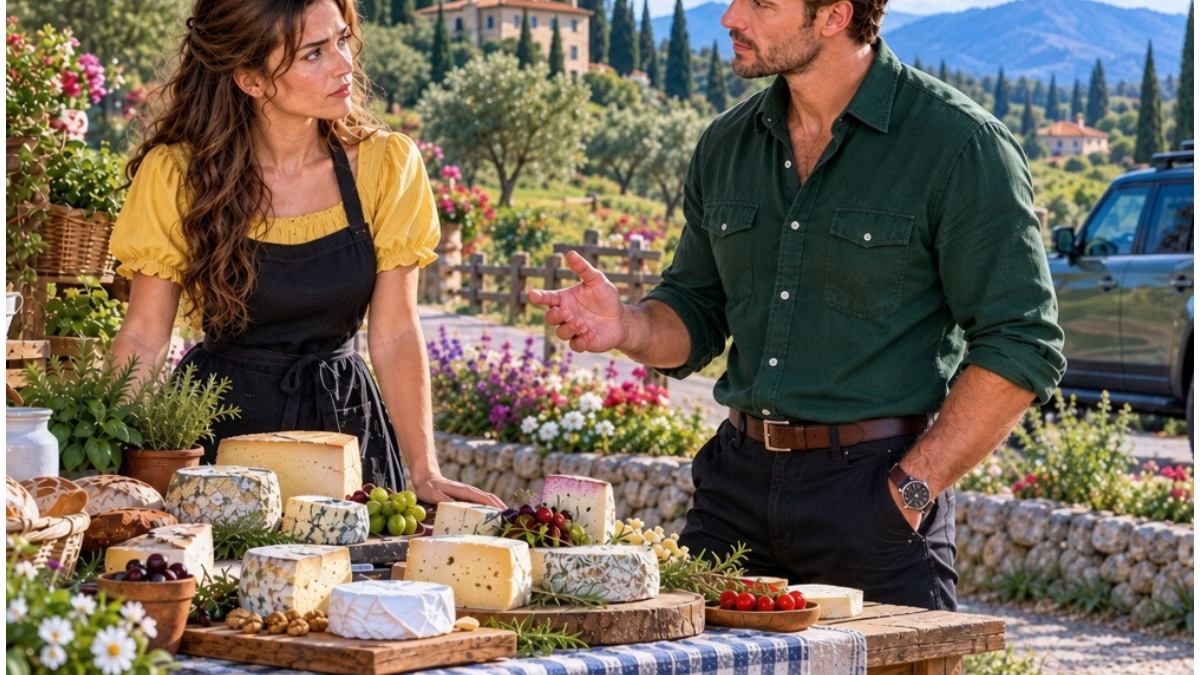
Lauren Hail had learned to measure her life by the rhythm of a two-lane road outside Littitz, Pennsylvania.
In the cool mornings, dairy workers and families stopped firSt. Later came travelers heading toward Lancaster, people who had heard about her cheese from friends, and older customers who had been buying from her for years.
Her roadside stand was modeSt. A wooden canopy, a clean table, insulated boxes, handwritten labels, and a small bell that moved whenever the wind crossed the field.
At 34, Lauren knew every stage of the cheese she sold. She chose the milk carefully, checked temperature by habit, watched the curds by texture, and could tell from the smell when a wheel needed more time.
Her mother had taught her the basics when Lauren was young, but the discipline had become her own.
She produced less than larger shops, yet customers trusted that she would never sell a wheel before it was ready.
That trust mattered because Lauren had once lost nearly everything by chasing growth too quickly.
Years earlier, a distributor promised to place her cheeses in stores across nearby towns. At first, the orders were exciting.
Then payments arrived late. Larger batches were demanded without guarantees, and she was pressured to lower her prices.
She found herself working longer hours while another person decided when she would be paid.
When she finally ended the arrangement, it took months to repair her finances and rebuild relationships with customers she had neglected.
Since then, Lauren preferred a smaller business she could control. One Tuesday morning, a dark pickup stopped near her stand.
The driver was a man in his early 40s named Mason Reed. His shirt sleeves were rolled above his wrists.
His boots were worn, and he carried himself like someone used to farmwork. He asked which cheese had the strongest flavor, listened closely, bought one small wheel, and left without bargaining.
Two days later, he returned and bought two different varieties. The next week, he came again.
Lauren began noticing that Mason watched more than he spoke. He saw how she remembered an elderly customer’s favorite cheese.
How she set aside an order for a local farmer and how she advised a traveling couple to choose something milder instead of simply selling them the most expensive option.
He asked where her milk came from, how many wheels she made in a week, and whether production changed with the season.
When Lauren finally asked whether he worked in agriculture, Mason only said, “I run a farm.”
Later, an old customer told her that Mason owned Reed Valley Farm, one of the larger dairy operations in that part of Lancaster County.
That made his repeated visits harder to explain. A man with his own milk supply did not need to drive to a roadside stand several times a month, merely for cheese.
A few days later, Mason came near closing time. He waited until the last customer drove away, then stood across from Lauren while she packed the remaining wheels into a cooler.
Today, you didn’t come to buy anything. She said, “No.” He looked at the stand, then at her.
I want you to stop selling cheese here. Lauren stared at him, convinced for a moment that she had misunderstood.
What she did not yet know was that the sentence was not an insult. It was the beginning of an offer that would force both of them to face the choices they had spent years trying not to revisit.
Lauren closed the lid of the cooler and rested both hands on it. You spent weeks buying from me so you could tell me where I should work.
Mason’s expression changed immediately. That came out badly. Very badly. He did not rush to defend himself.
Instead, he explained that he was not asking Lauren to stop working. He wanted her to see an old cheesem facility on his farm.
It had been closed for years, but the structure remained. Stainless steel workts, aging shelves, washing stations, storage rooms, and a refrigerated chamber that might still be repairable.
Lauren listened with her arms crossed. Every sentence sounded dangerously familiar. The distributor from her past had also spoken about opportunity, expansion, better equipment, and reaching more customers.
She had learned that a bigger room could still become a smaller life if someone else controlled the decisions.
“So, you want me to work for you?” She asked. “No.” “Then what do you want?”
Mason said he had not decided every detail yet. The building belonged to the farm.
Lauren had the product knowledge, the customer base, and something he considered even more valuable, credibility.
He had watched customers accept her recommendations without hesitation. Some returned on the exact day she promised a particular wheel would be ready.
Others preferred to wait rather than buy elsewhere. People trust you, he said. That is harder to build than a facility.
Lauren was more affected by that observation than she wanted to admit. He had recognized the one thing she valued moSt. Still, she asked the question that mattered.
What do you get? Mason answered honestly. If the dairy reopened and became profitable, Reed Valley Farm would benefit.
It would create a stable outlet for milk, bring life back to an unused building, and possibly grow into a business of its own.
Lauren gave him a small smile. At least you are not pretending this is charity.
I’m not that generous. It was the first time she laughed during the conversation. Mason invited her to visit the farm and inspect the building herself.
No contract, no immediate answer, no promises. Before he left, Lauren asked why such a useful place had been closed for so long.
Mason’s face tightened. The farm went through a difficult period. That is not the whole answer.
No. He looked toward the road before continuing. Part of the answer is inside that building.
The rest is connected to people around here. If you come, I will tell you.
That night, Lauren placed his address beside her account book. Her business was stable. She did not need rescuing.
Yet she also understood that there was a difference between protecting herself and allowing an old betrayal to decide every future opportunity.
Two mornings later, she drove to Reed Valley Farm. Mason waited beside a long pale building set away from the main barns.
The wooden door resisted when he pushed it open. Dust lifted in the light. Lauren stepped inside and stopped.
The place was far larger than she had imagined. There were wide steel counters, milk tanks, drainage lines, racks, separate cleaning areas, and a cold room built for serious production.
Some equipment was clearly beyond repair. Other pieces looked neglected, but usable. Within minutes, Lauren forgot to be impressed and began thinking like a producer.
She opened cabinets, checked pipes, inspected the floor, and asked how much milk the system had once handled.
Mason answered without exaggeration. After nearly an hour, Lauren stood in the center of the room.
“It can be brought back,” she said. Mason nodded. “I think so, too.” Then Lauren noticed the scale of the storage racks.
This place was not built only for milk from your farm. Mason was silent. No, he finally said, it wasn’t.
And in that moment, the opportunity became something larger than a building and two people.
Outside, beneath a maple tree near the old dairy, Mason finally told Lauren what had happened.
Years earlier, Reed Valley Farm had faced a serious financial crisis. Feed costs rose, equipment required expensive repairs, and several parts of the business began losing money.
The cheese facility bought milk, not only from the Reed herd, but also from small farms across the county.
Closing it reduced expenses and helped save the larger farm. On paper, the decision worked.
For several smaller producers, it was devastating. Some found other buyers at lower prices. Others reduced their herds.
A few left dairy farming entirely. Worse, the closure had happened with too little warning.
You knew people were depending on it, Lauren said. Yes. And you still closed. Yes.
Mason did not hide behind excuses. He explained that he had been younger, under pressure, and convinced that responsibility meant protecting the largest number of jobs on his own farm.
He had treated the closure as a business line that could be cut. Only later had he understood how far the consequences traveled.
Lauren appreciated the honesty, but it did not make the past disappear. If we reopen, you will need milk.
I know. And some of the people who could supply it have reasons not to trust you.
I know that, too. Lauren agreed to continue the discussion on one condition. Before either of them spent heavily on renovations, they would speak with former suppliers.
Their first visit was to George Miller, who still kept a small dairy herd with his wife.
He listened to the proposal politely, but his welcome toward Mason was cold. I already have a buyer, George said.
The price is not wonderful, but they show up. Mason offered better terMs. George shook his head.
Price wasn’t the only thing that hurt us before. When one big buyer becomes the center of a small farm’s survival, one decision made in an office can become a crisis.
In somebody else’s kitchen. Lauren understood immediately. His story was the agricultural version of her failed distribution deal.
The second visit went better. Ryan Cole complained about the long drive to his current buyer and low margins.
He asked practical questions about payment schedules, collection days, and minimum volumes. He did not trust Mason completely, but he was willing to consider a change.
The third producer, Caroline Brooks, ran a family farm with her adult son. She barely mentioned the paSt. Instead, she asked what would happen if her production dropped, whether payments would be guaranteed on specific dates, and whether the dairy would commit to buying an agreed minimum amount.
Lauren liked her at once. On the drive back, she told Mason that these questions should shape the new business.
If farmers are expected to commit milk to us, we should commit something to them, too.
Mason hesitated. Fixed obligations reduced flexibility, Lauren noticed. That is the point, she said. If all the flexibility belongs to the larger side, all the risk belongs to the smaller side.
He did not answer right away, but he did not dismiss her. That distinction became the foundation of the partnership.
They drafted simple agreements with clear payment dates, reasonable volume ranges, and notice periods long enough for suppliers to adjust if circumstances changed.
They also agreed that Lauren would control product quality and aging standards while Mason would manage facilities, logistics, and finances.
Major changes in volume or pricing required both of them to agree. Only then did renovation begin.
Workers cleaned the building. Electricians replaced unsafe wiring. Technicians revived part of the cooling system.
Two old machines were removed entirely. Lauren came almost every day. Mason argued about cost sometimes, but he had learned to ask instead of command.
Slowly, the old dairy stopped looking abandoned. And just as slowly, the people rebuilding it began to see one another differently.
The first weeks of production were less romantic than the dream of reopening. On the second day, a pump failed.
A delivery arrived late. One batch had to be discarded after the temperature drifted outside Lauren’s acceptable range.
The larger building gave them more control, but it also demanded stricter routines. Lauren refused to lower her standards simply because mistakes were expensive.
Mason, to his credit, backed her. That mattered. The real breakthrough came when Thomas Avery, an older farmer who had supplied the former dairy for years, appeared without warning.
After the closure, he had been forced to sell part of his herd. Mason knew that history well enough to look uncomfortable the moment he saw him.
Thomas walked through the restored facility slowly. He asked about payment dates, inspected the milk receiving area, and studied Laurens’s production records.
Finally, he said he would return with a small amount of milk each week. Mason thanked him.
Thomas pointed toward Lauren. I’m not coming back because I trust you. I’m coming back because I trust her.
The words landed heavily. Mason did not argue. Later that day, Lauren found him standing alone near the loading door.
“That bothered you?” She said. “It should,” she waited. Mason looked toward the tanks. I spent years thinking that if I fixed the building, paid a fair rate, and wrote better contracts, people would see that things had changed.
“Some will, and some won’t.” “No,” he nodded. I think I finally understand that I don’t get to choose when they forgive me.
That answer changed something in Lauren. Until then, she had respected Mason’s willingness to repair mistakes.
Now, she began to respect his willingness to live with consequences he could not control.
The dairy found its rhythm gradually. Producers delivered manageable amounts. Lauren created a production schedule that protected aging time instead of filling every shelf.
Mason improved delivery routes and found independent grocerers, farmers markets, and small restaurants willing to carry limited quantities.
Lauren still kept her roadside stand open one day each week. Mason called it inefficient.
She called it necessary. At the stand, customers told her what they liked without the politeness people often used with businesses that looked larger.
She heard complaints, noticed changing tastes, and stayed connected to those who had supported her when her operation fit inside a few coolers.
Eventually, Mason stopped arguing. Sometimes he even brought coffee and helped unload boxes. Their conversations also changed.
At first they discussed milk prices, repair bills, delivery times, and inventory. Then they began talking after those subjects were finished.
Mason told Lauren that he had spent much of his adult life trying to prove he could run Reed Valley Farm as well as his father had.
He believed speed and certainty were signs of leadership. Lauren admitted that she had always wanted to travel beyond Pennsylvania, but years of building the business had kept her close to home.
Neither confession was dramatic. That was what made them important. Their closeness developed through ordinary moments.
Mason setting aside lunch because Lauren forgot to eat when busy. Lauren bringing coffee for both of them.
Mason asking before changing equipment placement. Lauren trusting him to negotiate delivery terms without reviewing every sentence.
They still disagreed, but disagreement no longer felt like danger. For Lauren, that was new.
For Mason, it was too, and because neither tried to name what was growing between them, it grew without pressure.
The most serious test came several months after the reopening. A buyer representing several specialty food stores in Philadelphia visited the dairy, tasted the aged cheddar and herb cheese, and asked for a supply agreement, far larger than anything Lauren and Mason had handled.
The numbers were impressive. The contract could cover a large portion of the renovation costs within a relatively short period and allow them to purchase more milk from local farMs. Mason saw momentum.
Lauren saw concentration. During the meeting, she asked about delivery frequency, payment timing, rejected shipments, price adjustments, and penalties.
The buyer answered smoothly and emphasized that his stores expected consistent volume. After he left, Mason was energized.
This could move us forward by years. Lauren folded the proposal and set it on the table.
It is too much. We can hire more help. That is not the only issue.
She explained what accepting the full order would require. More milk commitments, more inventory, faster production, additional employees before the sales history was proven.
Most importantly, one customer would suddenly control a dangerous share of their revenue. Mason argued that every business had to use opportunities when they appeared.
Lauren replied that not every opportunity had to be accepted at full size. The discussion became sharper.
Mason finally said, “We cannot keep operating below capacity because every large order reminds you of what happened years ago.”
Lauren’s face changed. And you cannot call it fear every time someone refuses to grow at your speed.
He knew immediately that he had gone too far. But she continued, “My old distributor started with one large order, then another.
Soon almost everything I made depended on one person, and that person knew it. I am not repeating that.
This is different. You have decision-making power now.” Lauren held his gaze. Then can you accept it when my decision is no?
Mason did not answer fast enough. Lauren left early. She did not threaten to end the partnership, but the silence behind her frightened him more than an argument would have.
That night, Mason opened the financial model again. This time, without trying to prove himself right, he added payroll for new workers.
He calculated extra milk commitments. He moved the buyer’s payment schedule against weekly expenses. Then he asked the question Lauren had been asking from the beginning.
Who carried the risk if the plan failed? The answer was uncomfortable. Not only Reed Valley Farm.
Lauren would carry it. Employees would carry it. Small farms would increase production believing the volume would continue.
If the buyer changed terms or reduced orders, the damage would spread outward, just as it had years before.
The next morning, Mason drove to Lauren’s roadside stand. He waited while she served a customer, then placed several pages on the table.
I changed the proposal. Lauren scanned the figures. Instead of accepting the full order, Mason suggested supplying only a portion.
They would increase output within their existing capacity, review performance after several months, and add volume only if both operations and supplier relationships remained healthy.
You changed your mind, Lauren said. I changed the calculation. She almost smiled. Mason added, “And I changed what I was calculating.”
Lauren took a pen, adjusted two terms, and pushed the pages back. Now I can sleep.
The Philadelphia buyer complained. He threatened to look elsewhere. Lauren did not move. Several days later, he accepted the smaller starting volume.
That decision became more profitable than either of them expected, not because it earned the most money quickly, but because it taught the business how to grow without surrendering its balance.
Over the following months, the old dairy stopped feeling restored and began feeling alive. The shelves were never full merely for appearance.
The production schedule followed demand. Payments to farmers arrived when promised. Some former suppliers returned, others did not, and Mason gradually stopped treating every refusal as a personal defeat.
He began visiting several former suppliers without contracts in his hand. He did not ask them to come back.
He simply acknowledged what had happened. Some accepted his apology. Some remained distant. One man spoke with him for less than a minute.
Mason returned from those visits. Quieter, but not resentful. Lauren told him that an apology was not a transaction.
You don’t get a relationship back because you finally said the right words. I know you say them because they were owed.
That stayed with him. Thomas continued delivering a small quantity of milk. One afternoon he mentioned that payments had arrived on the promised day every single time.
He also said his son was considering expanding their herd slightly. Mason did not treat it as forgiveness.
He treated it as evidence that consistency could build something new even when it could not erase something old.
Lauren was changing too. She remained careful, but she stopped treating every opportunity as a disguised trap.
She delegated part of production. She trained two employees to handle tasks she once insisted on doing herself.
She let Mason negotiate routine deliveries without checking every detail. In return, Mason stopped turning ideas into finished plans before asking her opinion.
Their partnership became stronger because neither needed to prove complete independence. The roadside stand remained open once a week.
It became almost ceremonial. Longtime customers brought friends. Travelers stopped after seeing recommendations online. Lauren still remembered who liked the sharper cheese and who preferred the mild one.
Mason appeared often enough that regular customers began teasing him. “Doesn’t that farm keep you busy?”
One woman asked. “Apparently not enough,” Lauren said before he could answer. Mason laughed and handed her coffee.
Their relationship had moved beyond business long before either admitted it. They spent evenings finishing inventory and then remained in the doorway talking after the work was done.
Mason slowed his walk toward the parking area to stretch conversations. Lauren stopped pretending she had somewhere else to be.
One evening, after the employees had left, Mason found Lauren closing her notebook inside the dairy.
“Anything still wrong?” He asked. “Nothing.” He leaned against the steel counter. “Then I suppose I have no reason to be here.
You have been showing up without reasons for months. That sounds inefficient. Lauren smiled. You are becoming less efficient.
Outside, the fields had turned gold beneath the setting sun. They walked toward their vehicles, neither in a hurry.
Mason did not make a grand declaration. He simply asked whether Lauren would have dinner with him somewhere that did not sell cheese.
She looked at him for a long moment. That depends on what? Whether you plan to calculate the return on investment.
He laughed. No spreadsheets. Then yes, it was small, almost ordinary. Yet for two people who had spent years protecting themselves through control, that quiet agreement meant more than any dramatic promise.
Behind them, the old dairy lights glowed through the windows, illuminating a place that had once represented failure, dependence, and unfinished guilt.
Now it held something else, not a clean beginning, a more honest continuation. The dairy continued growing, but never in the way Mason once imagined growth should look.
There was no sudden expansion and no moment when the past vanished. Progress appeared in quieter forMs. A farmer renewed an agreement.
A customer came through a recommendation. An employee learned enough that Lauren could step away without anxiety.
A payment reached a supplier exactly when promised. The Philadelphia buyer increased orders gradually, but Lauren and Mason never allowed one account to become the center of the business.
When new opportunities arrived, they asked not only what they might earn, but what would have to be risked and who would carry that risk.
That habit protected more than money. It protected truSt. Lauren eventually realized that for years she had confused independence with safety.
After being disappointed once, she built a life in which no one else could easily hurt her work.
That protected her, but it also limited her. Working with Mason taught her that partnership did not have to mean surrender.
Sharing responsibility was not the same as giving away control. Healthy cooperation did not erase her voice.
It required the other person to respect it. Mason learned something harder. For years, he had judged decisions by whether they saved the farm, balanced the books, and kept operations moving.
Those things mattered. But numbers had hidden the human distance between a decision and its consequences.
Closing the old dairy had been financially defensible and still deeply damaging to people who depended on it.
Reopening the building did not cancel that history. Neither did better contracts. Neither did apology.
What changed Mason was accepting that responsibility was not proven by being forgiven. Sometimes it meant telling the truth, repairing what could be repaired, and acting better, even when another person had every right to remain cautious.
That understanding softened something in both of them. Lauren stopped seeing caution as the only proof of wisdom.
Mason stopped seeing speed as the only proof of courage. They discovered that maturity often lived between extremes.
Trust was not blind faith, but it was not permanent suspicion either. Forgiveness was not pretending a wound had never happened, but it was not always refusing every future possibility.
Growth was not simply becoming bigger. Sometimes it meant becoming steady enough to say no when more would cost too much.
The old dairy became proof of that lesson. Mason brought land, resources, and operational experience.
Lauren brought craft, judgment, and relationships built slowly with real people. Farmers brought milk, risk, patience, and the willingness to try again under clearer terMs. None of them could have built the same future alone.
And somewhere between the roadside stand, the restored aging room, the difficult conversations, and the quiet dinners that became more frequent, Lauren and Mason understood something else.
The most meaningful things in life rarely arrive as rescue. They arrive as chances to choose differently.
Not perfectly, not without memory, but with enough honesty to make the next decision better than the laSt.








