“She Said I’m Just a Burden” — A Little Girl Sobs to the Mafia Boss… The Shocking Reason Why!
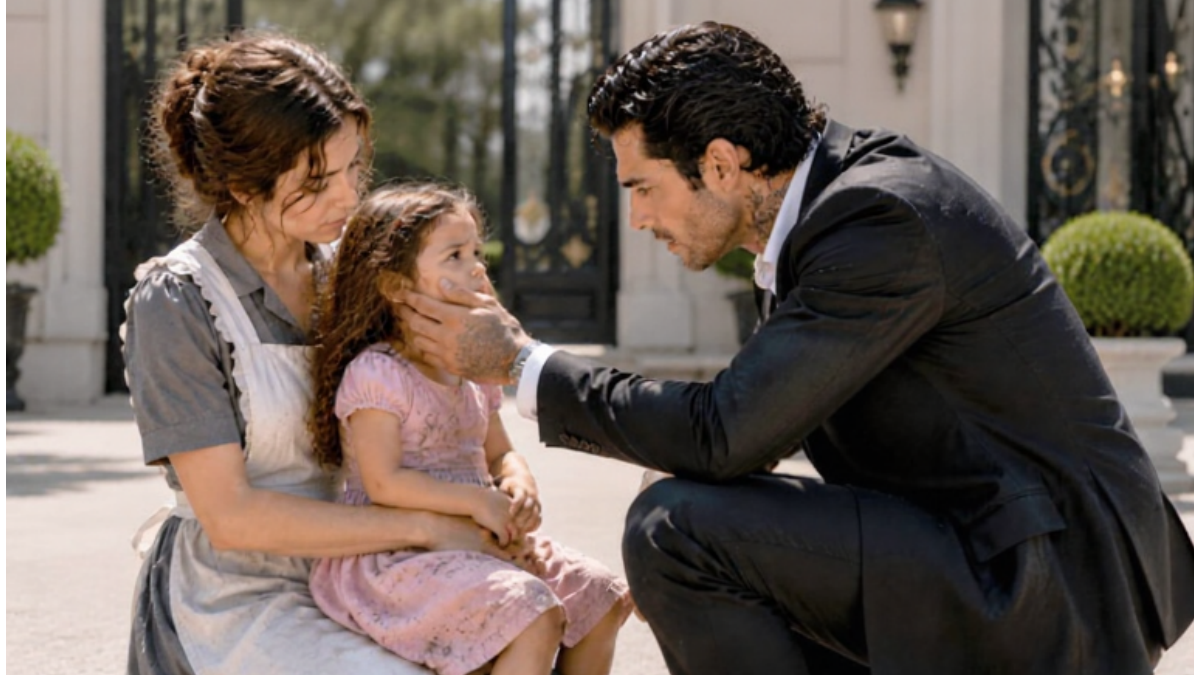
11 days away from home. A deal closed that men in three states had waited 2 years to see closed and a drive out to Weston 2 days early because a six-year-old had asked him on the telephone whether he’d be back before Saturday and he’d wanted to see her face when he came through the door instead of answering her.
But when Raymond Callahan came around the last bend at 10 minutes to 7 on a gray Boston morning, what he found outside his own iron gate stopped the car before he decided to stop it.
His daughter Nora, six years old, sitting on the cold stone in her pajamas with nothing on her feet.
And around her, kneeling on that same stone with both arms locked shut, one of his housemates, Hannah Whitmore, 28, who had been sitting there in the cold for 40 minutes because the child wouldn’t go back inside.
The girl didn’t run to him. That was the part he’d remember later when everything else had come apart.
She stayed exactly where she was and sobbed into the maid’s shoulder. The ragged, hiccuping sob of a child who’d already cried herself empty a long time before anyone came looking for her.
Men in three states had learned not to raise their voices around Raymond Callahan. He was 38, quiet, exact, the kind of man who never had to say a thing twice, and hadn’t needed to raise a hand in years to be understood.
He didn’t shout now either. He took off his coat, put it around his daughter, lifted her, and asked her one question, and the answer that came out of that child was worse than anything he had prepared himself for on the drive up the hill.
Mommy said, “I’m just leftovers.” Behind one of the lit windows of the house he’d bought with the kind of money nobody asks about.
His wife had said those five words at the breakfast table without ever once raising her voice.
Raymon thought it was cruelty. He thought it was exhaustion. He was wrong on both counts, and it would take him 5 months and everything he owned, to find out why.
40 minutes earlier, the house on the hill in Weston had been quiet in the way expensive houses are quiet, which is not peaceful at all, but simply padded.
Every sound swallowed by rugs and drapes, and the kind of glass that costs more than most cars.
Norah Callahan sat at one end of the long breakfast table with her knees pulled up onto the chair, which she wasn’t supposed to do, and a box of crayons she wasn’t supposed to have at the table either, and she worked with the fierce concentration that only very small children can manage, her tongue pressed into the corner of her mouth.
She was drawing a family. Three figures side by side holding hands. A tall one on the left with a black coat.
A little one in the middle with yellow hair because she had yellow hair. And a woman on the right.
And she took her time with the woman, giving her a red dress because red was the prettiest color she owned and a smile that ran nearly the whole width of the face.
Above them she put a sun. Behind them, she put a house with a chimney, even though her house didn’t have a chimney like that, because that was how houses were supposed to look.
Then she slid off the chair and carried the paper the long way around the table, holding it flat with both hands, the way you carry something wet.
Vivien Ashworth Callahan stood at the far window with her back to the room and her phone against her ear.
She was 36 years old and she hadn’t slept properly in 11 days. And she had her free hand pressed flat against the cold glass as if she were holding the window shut against something.
Her voice was low and stripped down to the bone. You said it was handled.
Pause. Don’t tell me it’s routine. Nothing about this is routine. Pause. No, he’s back Thursday.
And if there’s a single piece of paper anywhere with that clinic’s name on it, then everything you built for me comes apart.
Gideon and I go first. Another pause longer. And whatever her brother said on the other end made her close her eyes.
Don’t say my name like that, she said. I’m not one of your employees. Norah stopped at her mother’s elbow and waited.
She was good at waiting. She had learned it the way other children learn a bedtime song, by hearing it every day.
She held the drawing up. Nothing happened. She waited a while longer and then reached out and tugged the sleeve of her mother’s cardigan gently.
The way you’d knock on a door you weren’t sure anyone was behind. Viven turned her wrist away without looking.
Norah waited again, counting in her head the way her teacher had taught her and then tugged a second time.
Mommy, mommy, look. Vivien pressed the phone harder to her ear. Say that again. Norah tugged a third time, both hands on the sleeve now, the paper crumpling a little between her fingers, and her voice came out higher than she meant it to, the way it did when she was trying not to be a bother and failing.
Mommy, I made you. And Vivien turned around. What came out of her didn’t come out loud.
That was the part Ruth Kowalsski would remember afterward, standing frozen in the doorway with a coffee pot going cold in her hand.
It came out flat and fast and finished like something that had been sitting fully formed in a drawer for years waiting for the drawer to be opened.
Don’t Don’t pull on me. Do you know what you are? You’re just leftovers. Somebody else’s leftovers.
The phone was still live in her hand. Nobody moved. Norah looked up at her mother with her mouth slightly open, not crying yet, and her fingers went loose one at a time.
And the drawing slid down through the air and landed face up on the floor between them.
The three figures still holding hands, the sun still shining, the woman in the red dress still smiling, her enormous smile.
Viven’s face changed. Something behind it collapsed inward, and she said, “Nora.” But the child was already gone.
Out through the hall in her bare feet, past Ruth, past the umbrella stand, hauling on the heavy front door with both arms until it gave.
In the kitchen, Hannah Whitmore had a breakfast tray half-loaded, and she heard the door, and she heard nothing after it.
And it was the nothing that made her set the tray down on the counter, so hard that the juice glass tipped and rolled and broke on the tile, and she went after her without stopping to look at it.
Outside the morning was gray and about 40° and the drive was long and Hannah caught up to her at the gate where the child had run out of house to run out of and had simply sat down.
She didn’t ask her what happened. She didn’t tell her it would be all right because she didn’t know that and Hannah had never in her life told that child a thing she didn’t know.
She sat down on the cold stone beside her and put both arms around her and let her be as small as she needed to be.
The child pushed her face into Hannah’s shoulder and stayed there. Time went by. The gate had a keypad 4 ft away with a code Hannah knew perfectly well.
And twice she said they could go in. And twice Norah shook her head without lifting her face, so they stayed.
Hannah’s knees went numb against the stone, and the cold came up through her uniform, and she kept her arms where they were and didn’t move them.
It was 10 minutes to 7 when a pair of headlights swung slow around the bend at the bottom of the road and started up the hill toward them.
Two days early, Ruth Kowalsski met them in the front hall with a blanket already over her arm.
Because Ruth had been running that house for 22 years, and had learned to be holding the thing that would be needed before anyone asked for it, she didn’t look at Raymond, and she didn’t look at his wife’s closed study door.
She held out her arms, and the child went to her, and Ruth carried her up the wide staircase, talking the whole way in that flat, unhurried voice of hers about a bath and dry socks, and whether the good pillow or the other pillow, and she never once asked the girl a single question about what had happened, and that was mercy, though it didn’t look like mercy from the bottom of the stairs.
Raymon stood in the hall until he heard the water start running two floors up.
Then he took off his gloves, laid them on the table by the door, and walked into the room where his wife was waiting.
He closed the door behind him. He didn’t lock it. He didn’t have to. In three states, there were men who had spent whole careers learning to read what Raymond Callahan did with his hands.
And the ones who lasted had all learned the same thing, which was that the moment to be frightened wasn’t when he got loud.
He had never gotten loud. The moment to be frightened was the moment he got careful.
He was careful now. He pulled out a chair and sat down at the end of the table where she kept her correspondence.
And he didn’t offer her the other chair, and she didn’t take it. She stood by the cold fireplace with her arms folded, still in the cardigan, her phone face down on the mantle where she’d said it.
“Ruth’s got her upstairs,” he said. “So you can stop listening for the hall.” Viven said, “This is going to sound worse than it was.”
“I doubt that.” He was quiet for a moment. Outside, past the tall windows, the gardener’s truck came up the service drive and stopped and shut off, and the sound of it made the room seem more silent afterward than before.
“Say it back to me,” Raymond said. “Say what you said to her,” Raymond. You said it to a six-year-old with the whole house listening.
“Say it to me.” She looked at the wall behind him for a long moment, and then she said it in a flatter voice than she’d used the first time, and it sounded even worse coming out slowly.
Raymond took that in without any change in his face at all. Here’s what I know about words, he said.
I’ve spent 20 years listening to men talk when they didn’t mean to. Nobody says a thing like that by accident.
A slip of the tongue is still made out of words a person already had in their head.
You don’t reach for what isn’t in the drawer. He let that sit. So my question isn’t why you said it this morning.
My question is how long you’ve been carrying it around. You don’t know what you’re asking.
Then tell me. I can’t. Can’t. He repeated. And there wasn’t any heat in it, which was worse.
That’s a strange word from a woman who talks to her brother about my house on my phones.
Something moved behind her eyes then, quick, and she got it under control. And Raymond saw both the movement and the control and filed them away and said nothing about either because he had learned a long time ago that the most useful thing you can do with a piece of information is let the other person believe you missed it.
He stood up. He straightened the chair back under the table, which was the closest thing to temper he showed in the entire conversation.
Two things, he said. Norah moves upstairs tonight, the room across from mine. Ruth will handle it, and I don’t want a discussion about it.
Viven’s chin came up. She’s my daughter. The second thing, Raymon said, as though she hadn’t spoken, is that you’re not to be alone with her.
Not in a room, not in a car, not in the yard. If Ruth isn’t there or I’m not there, it doesn’t happen.
You can’t do that. I’ve done it. He was at the door with his hand on the knob when she said his name and he stopped and he didn’t turn around.
And she said the thing that would keep him awake for a good part of the next 5 months.
You don’t understand anything, Raymond. Not one thing. You never have. He waited to see if there was more.
There wasn’t. He went out and closed the door behind him with a click that was quieter than the room deserved.
Down in the kitchen, Hannah Whitmore was on her knees at the tile with a folded towel, picking up glass.
She’d been at it a while. There was a broken juice glass and a spill of orange going sticky under the counter lip, and her hands were steady, and her uniform was still damp through the knees from the stone at the gate.
Ruth came in the far door and stood over her, and watched her work for a moment without offering to help.
“Leave that,” Ruth said. “It’s nearly done.” “I said leave it.” Hannah sat back on her heels.
Ruth was 58 years old, gray, narrow, entirely unscentimental, and she looked down at the younger woman the way a bank looks at a loan.
You sat in the road with the daughter of this house in your arms for 40 minutes, she said.
In front of the gate, in front of him. She wouldn’t go in. That isn’t the point.
And you know it isn’t. Ruth set the coffee pot down. Girls have been let go out of this kitchen for a good deal less than that.
Two weeks ago, I sent one home for calling that child sweetheart in front of the wrong person.
So, you’ll pack tonight quietly and you’ll be ready because when he sends for you tomorrow, it’ll be to end it.
Hannah looked at the towel in her hands. And if he doesn’t, Ruth was already turning away.
Then you’d better start asking yourself why not. He came down at a quart 9 that night, and he came alone, which in that house was itself a kind of announcement.
Hannah heard the study door and then the long hallway and then nothing for a while because the man walked quietly out of habit and by the time she looked up from the sink he was already standing inside the kitchen with his coat off and his sleeves turned back once.
She dried her hands on the towel and stood the way she’d been taught to stand and she waited because Ruth had told her what this was and she’d spent the last 4 hours getting her face ready for it.
Raymond didn’t sit. He looked at the counter and at the row of clean pans and at nothing in particular.
You’ve been here how long? He said 5 months, sir. In March. And what is it you do?
Whatever Mrs. Kowalsski puts me on. Linens mostly. Downstairs floors. The dining room on the nights there’s company.
Not anymore. Hannah kept her eyes on the middle button of his shirt and didn’t let anything move in her face.
No, sir. From tomorrow, you do one thing, Raymond said. You look after my daughter.
She wakes up. You’re there. She eats. You’re there. She goes to school. You put her in the car and you’re the one who picks her up.
Mrs. Kowalsski will move you into the small room on the third floor, so you’re on the same landing.
Hannah’s hands were still holding the towel. She had rehearsed being fired. She hadn’t rehearsed this, and it took her a second longer than it should have to answer.
Yes, sir. One more thing. He said it exactly the way he’d said the rest.
No weight on it at all. You don’t lie to her. Not about small things either.
She’s had enough of that in this house to last her. I haven’t, Hannah said.
I know, said Raymond. Then he took his coat off the back of the chair and walked to the door.
And at the threshold, he stopped with his hand flat against the frame. And he didn’t turn around.
Doyle, he said. The word went through her like cold water. He didn’t wait for an answer.
He didn’t ask a question. He went out into the dark hall and she heard him go up the back stairs unhurried.
One flight and then another. And then the house was quiet again. And Hannah stood in the middle of that enormous kitchen with a dish towel in her hands and no idea at all how long she stood there.
Upstairs later, when the third floor had gone dark and the only sound was the furnace turning over in the basement, she knelt on the floor of the small room and pulled her suitcase out and took from the bottom of it under the folded clothes, a tin box about the size of a book.
It had once held shortbread. There was a Scottish castle stamped on the lid, half rubbed away, she sat with her back against the bed frame, and put the box on her knees and opened it.
There were three things in it. The first was a hospital bracelet. The small kind made of white plastic gone yellow and brittle at the fold.
Sized for a wrist about as big a round as a man’s thumb. The printing had held up better than the plastic.
Baby girl Doyle 412 in the morning 6 lb 1 oz. The second was a photograph 4×6 printed on cheap stock.
It had been taken from a distance and slightly from below through a chainlink fence.
The way a person takes a picture when they don’t want to be seen taking it.
A schoolyard in the late afternoon. Children in coats. One child near the middle, blonde, maybe five, in a red hat, caught midstep with her mouth open in the middle of a word.
The corner of the photograph was creased where a thumb had gone over it a great many times.
The third was a single sheet of copy paper folded in three with two lines typed on it.
The type was slightly gray, the letters uneven at the bottom, the sort of thing that comes out of a machine that has printed too much and been serviced too little.
She had read the two lines maybe a thousand times since the envelope came, and they still landed with the same flat force every time.
She didn’t die. Go and look properly. There was no signature. There had been no return address, no postmark she could make anything of, no anything, just the envelope in her mailbox in South Boston on a Tuesday in October with her name on it.
And her name spelled the way only three or four people left alive still spelled it.
Hannah put the bracelet back in the tin and then the letter, and she held the photograph a while longer.
Down the hall, past the linen closet, was a door she had stood outside more nights than she was willing to count.
Behind it tonight, a child was sleeping on a different floor of a different wing than she’d slept in yesterday.
Because a man had come home 2 days early, and rearranged his house without raising his voice.
Hannah put the photograph away and closed the lid and pushed the tin back under the clothes and sat there in the dark.
Doyle. He’d said it the way you say a thing you’ve known for a while and have decided for reasons of your own not to do anything about yet.
She got up and went to the window. The wing across the courtyard was black except for one set of windows on the second floor, the corner room, and the lamp in it was still burning, and it was still burning an hour later when she finally lay down.
And she had no idea whether that meant she was safe in this house or whether it meant she had already run out of time.
At 2 in the morning, Ruth Kowalsski came up the back stairs with a flashlight she didn’t switch on because she’d walked those stairs for 22 years and could have done it with her eyes shut, and she found Hannah Whitmore standing in the corridor outside the child’s new room with her hand flat on the door and her forehead nearly touching the wood.
Neither of them said anything for a while. Then Ruth said quietly, “Down now.” And turned and went.
And Hannah followed her all the way down to the kitchen where Ruth put the kettle on and set out two cups without asking and sat down at the scrub table and folded her hands.
That’s the third night this week, Ruth said. Fourth. Well, thank you for that at least.
Ruth studied her. You didn’t come here for the wages. I’ve hired 40 girls in this house, and I know the difference between one who needs work and one who’s looking for something.
You’ve been looking since March. Hannah sat down across from her. She was very calm and she stayed very calm and that was somehow harder to watch than crying would have been.
Seven years ago I lived in Providence, she said. My mother had a place on Broad Street, 12 stools and four booths, open 5 in the morning to 2:00 in the afternoon, and I worked it with her from the time I was 13.
Go on. One winter, a man came in with a coat over his arm and blood dried on his shirt cuff and asked if we had a back room.
My mother didn’t ask him anything. She’d been feeding people in that neighborhood for 30 years, and she had rules about what she asked.
He stayed 3 weeks. He slept on a cot in the store room behind the walk-in cooler.
And he came out at night and sat at the counter, and we talked while I cleaned the flattop.
That’s all it was for a long time talking. Ruth’s face didn’t move. How old were you?
21. And he was 31. The kettle started to whistle and Ruth got up and took it off and poured and sat back down.
Finish it. After 3 weeks, he was gone. No note the morning he left, but he’d said he’d send word, and I believed him because he wasn’t a man who talked much, and everything he had said to me up till then had turned out to be true.
She turned her cup a quarter turn on the table. I wrote him. I didn’t know where he was, but I knew a name, and I knew a city, and my mother knew a man who knew where things could be left.
I wrote 11 letters between February and August of that year. I never got one word back.
Not one. And you were carrying by then. I was carrying by March. Ruth said nothing.
My mother was sick that summer and there wasn’t any money. And there was a woman who came around the shelter on Chalkstone Avenue who said there was a fund that paid for girls in my situation.
Doctor, hospital, everything, no charge. I thought that was luck. I was 22 years old and I thought that was luck.
She drank some of the tea and put the cup down. She came at 4:12 in the morning.
I heard her. I want you to understand that part, Mrs. Kowalsski, because everybody always tries to tell me I didn’t.
I was torn up and I’d lost a lot of blood and they had me on my side.
But I heard her cry. It wasn’t a dream. And then they took her out of the room.
And about an hour after that, a doctor came and sat down on the edge of the bed and told me she hadn’t made it.
Did you see her? No. Did they show you anything? A form? Hannah said, “They showed me a form.”
Ruth looked at her hands on the table for a long moment. “That was 6 years ago,” she said.
“So why March?” “Because in October, somebody put an envelope in my mailbox in South Boston,” Hannah said.
“And I’ve spent every day since then trying to find out whether the person who sent it was telling the truth or being cruel.
And you came in here under your mother’s name. Whitmore was hers. Doyle was my father’s.
I didn’t forge anything and I didn’t lie on the application. I used a name that’s legally mine and I answered every question you asked me honestly.
You let me believe you were nobody. Yes, Hannah said. I did that. Ruth got up and rinsed her cup at the sink and stood there with her back turned and the water ran a long time.
Then she shut it off. I’m going to tell you something and I want you to hear all of it.
She said, “I’ve been in this house since before he was married. I carried that child from the car the day she came home, and I have put her to bed roughly 2,000 nights since.
And in 6 years, I have watched her learn things no child that age should have to learn.”
She apologizes for wanting things. Do you know that? She says sorry before she asks for a glass of water.
She writes her name small in the corner of the page so it won’t take up room.
Hannah didn’t answer. So, here is the only thing I’m going to ask of you, Ruth said, turning around.
You may be right. You may be out of your mind. I have no way to tell, and neither, I think.
Do you? But if you’re not certain, then you keep your mouth shut, and you keep your hands to yourself, because there’s nothing in this world cruer you can do to a child like that than give her hope you can’t stand behind.
Anything else, she’ll survive. Not that. Hannah sat with that a while. Then she said, “And if I do become certain,” and Ruth Kowolski, who never in 22 years had answered a question she wasn’t obliged to answer, picked up the flashlight off the table and said, “Then God help every one of us in this house and went out.”
Marcus Hail drove out to Weston the next afternoon with a document box on the passenger seat, and he carried it in himself instead of leaving it in the car, which was how Raymon knew before a word was spoken that his lawyer had found what he’d been sent to find.
Marcus was 59 and had worked for the family since Raymond’s father ran it. And he had a habit of setting things down very precisely on a table, corner, square to corner, the way some men fold a flag.
He put the box on the study table and lifted the lid. This is out of your father’s private files, he said.
Not the office, the house. It took me two days to find it because it wasn’t filed under her name.
It was filed under yours. Show me. Marcus laid out three things under the desk lamp.
A wire transfer authorization dated seven years back in the amount of $200,000 made payable to Hannah Doyle.
A receipt stamped by a bank on Westminster Street in Providence and a half sheet of lined paper torn along the top edge with four words on it in a small forwardleaning hand and a signature underneath.
Don’t come looking for me. Raymon stood over the table and looked at the note for a long moment without touching it.
I read that in a car outside a funeral home. He said somebody handed it to me on a Thursday and told me the money had cleared.
And I read it twice and I put it in my coat and that was the end of it as far as I was concerned.
Marcus took a pair of reading glasses out of his breast pocket and put them on and pulled the lamp lower over the paper.
Come here. Raymond came. Look at the downstroke on the H. Marcus said. Then look at the Y at the end.
Now look at what the pen does between the first name and the last. It stops.
It stops. Marcus agreed. Right there. For about a second and a half, judging by how the ink pulled.
And it stops again before the final letter. People don’t stop inside their own signature.
Raymond, your name is the one thing in the world your hand does without you.
You could sign yours in the dark. Drunk on a moving boat. This one was drawn.
Somebody sat at a table with a real sample in front of them and copied it slow so the shapes would come out right.
And the pauses are where they lifted the pen to check their work. He straightened up and took the glasses off.
That signature was practiced. It wasn’t written. Raymond didn’t say anything for a while. The lamp made a small hot circle on the table and everything outside it went dim.
And the transfer, the transfer is real. The money left the account. But look at the endorsement stamp on the back of the receipt.
That’s a teller’s counter deposit. And the account it went into was opened 11 days earlier and closed 19 days after.
No address on file that survives. She never touched a dollar of it. Somebody opened a door, walked the money through, and shut it.
Marcus put the glasses away. I’d want a proper examiner to say so in writing, but I’ve been reading signatures for 25 years, and I’d bet the firm on it.
Raymond went and stood at the window with his hands in his pockets. Out on the lawn, the light was going.
And down at the bottom of the drive, the gate stood open the way he’d ordered it left since yesterday morning.
Marcus, he said, “How long have you known who she is?” “The girl in the kitchen?”
“Yes.” “About 9 minutes. I saw her in the hall on my way in and I nearly walked into the wall.”
Marcus paused. “How long have you known?” “Since the end of April,” Raymond said. Marcus said, “Nothing at all.
She came into the dining room with a tray on a night we had people.”
Raymond went on and she didn’t look up and I heard Ruth say Whitmore and I thought nothing of it for about 4 days.
Then I pulled the employment file for a different reason and there was a copy of her license in it.
Middle name Doyle. Date of birth I’d have known anywhere. And you did what? I put the file back in the drawer.
Marcus sat down slowly in the chair by the table. Raymond. I told myself I’d deal with it after the Charles Town thing closed.
Then I told myself I’d deal with it after the holidays. Then I stopped telling myself anything and I just walked past her in my own hallway twice a day for 5 months.
He turned around. His face hadn’t changed and his voice hadn’t risen a single degree.
And that was somehow the worst part of it. Here’s what I want you to understand because I’ve had all night with it and I’m not going to say it twice.
I’ve had that note in my possession for 7 years. I never once had it looked at.
I had 30 men on the payroll who could have found that woman inside a week.
And a name and a city and the money to do it with. And I didn’t send one of them, not one.
My father lied to me and he’s dead and I’m not going to stand in this room and hand him the whole bill.
He handed me a piece of paper and I chose to believe it because believing it was easier than driving to Providence.
He looked back down at the four words under the lamp. A man who wants to find somebody finds them.
I didn’t want to. That’s the whole of it. Marcus let a decent amount of silence go by.
Then he said, “What do you want me to do?” And Raymond said, “Get me a laboratory, a real one, and don’t tell anybody in this house what it’s for.”
The call came to the house on Thursday afternoon, and it was not the school office, but the first grade teacher herself, asking whether Mr. Callahan could come in before the end of the week, and saying when Ruth offered to take a message that she’d rather not leave one, Raymond went the next morning.
He parked the car himself at the far end of the lot and walked in through the front doors like any other father.
And he sat down in a chair built for a person half his size in a room with paper leaves taped to the windows.
And he waited while a woman of about 60 finished walking her last two students out to the hallway.
She came back and shut the door and sat down across from him with a manila folder in front of her and she didn’t open it right away.
Thank you for coming in person, she said. Some parents don’t. You said you’d rather not leave a message.
I would rather not have this conversation on a telephone. She put her hand flat on the folder.
I’ve been teaching first grade for 31 years, Mr. Callahan. I want to start by telling you that your daughter is bright.
She reads a year ahead. She’s kind to the other children in a way that you can’t teach.
Raymon nodded once. But, but, the teacher said, and opened the folder. She turned it around and slid it across the little table.
Inside was a stack of drawings, maybe nine or 10 of them, all on the same newsprint paper, all with the same three-word heading printed at the top by the teacher’s hand.
Draw your family. We do this four times a year, she said. September, November, February, April.
Some children draw the dog. Some children draw the television. I keep them because in 31 years, I’ve learned that these tell me more than anything a child will say out loud.
Raymond went through them slowly. The first sheet was from the fall. A tall figure in a black coat, a small figure with yellow hair, and at the far right edge, so close to the margin that part of the shoulder ran off the page, a woman turned around backward.
No face, just the back of a head and the line of a spine. He set it down and picked up the next one.
Same thing, the next same thing. In February, the woman had been moved even further, to the point where only a sliver of her remained on the paper, and in the April sheet, she wasn’t turned away anymore.
She was simply outside the house that had been drawn behind the figures, standing in a small pencile box of her own, and the box had a line through the middle of it.
Raymond looked at that one for a long time. “Every one of them,” he said.
“Everyone since September,” said the teacher. “I want to be fair to you. A child that age draws what’s in front of her mind that morning.
And one picture means nothing. Nine of them mean something. Then she took a single sheet of ruled paper out from underneath the drawings and put it on top.
This was Tuesday. It’s a writing exercise. I ask them to finish the sentence I want.
And then they write as much as they can and I don’t correct the spelling.
The handwriting was enormous and careful. The letters standing up straight like fence posts. Each word spelled the way a six-year-old hears it.
I want to be goodter so they will keep me. Raymond read it once. He didn’t touch the paper.
His face didn’t change at all. And his hands stayed where they were on his knees.
And the only thing that happened in that room was that he stopped for a moment in the way a clock stops.
She wrote that on her own, he said. She wrote it at the table by the window and then she folded it in half so the boy next to her couldn’t see.
The teacher took her glasses off. Mr. Callahan, I need to tell you the next part plainly because I’d rather you heard it from me while we’re sitting in the same room in Massachusetts.
I’m what’s called a mandated reporter. That’s not a choice I make and it isn’t personal.
When a teacher sees a pattern that suggests a child is being emotionally harmed at home, the law requires her to file.
So, I filed. Wednesday morning, a 51A with the Department of Children and Families. Raymon sat with that.
You did it before you called me. I did it before I called you, she agreed.
Because if I’d called you first and you were the problem, I’d have handed you a day’s warning.
And because if you weren’t the problem, then you’d want it filed. And I was fairly sure by yesterday that you weren’t.
She folded her hands. I’ve had this job long enough to know which fathers show up at 8:00 in the morning and which ones send somebody.
What happens now? A screener reads it. If they screen it in, someone from the department comes out to the house.
They’ll talk to her without you in the room and they’ll talk to everyone who works for you and they’ll look at the whole situation.
I can’t tell you how long it takes, and I won’t pretend to. She paused.
I’m not going to ask you what’s going on in that house. It isn’t mine to ask, but I’ll tell you what I’d tell any father.
Whatever it is, she’s afraid of losing. She believes she has to earn her way out of it.
And no six-year-old on this earth can carry that. Raymond stood up. He put the drawings back in the folder square, the way Marcus put things on tables, and he pushed it gently across to her.
“Keep them,” he said. “The originals. I intend to, ma’am. He was at the door when he said it, and he said it without turning fully around.
You were right to file. If it had come the other way, and somebody in a school had looked at those and put them in a drawer, I’d have had something to say about it.
Then he went out and drove back to Weston, and he didn’t go into the house when he got there.
He sat in the car in the drive for a good 20 minutes, looking at the front door, thinking about a child folding a piece of paper in half so nobody would see it.
That night the child wouldn’t go down. She’d been fine at supper and fine in the bath.
And then the lamp went off and something in the room got too big for her.
And by half 9 she’d been up three times, once for water and once for a different blanket and once for no reason she could name.
The fourth time Hannah didn’t take her back to bed straight away. She sat down on the floor with her spine against the side of the mattress which put her at the same height as the child lying on her stomach with her chin on the pillow edge.
And she said, “All right, we’ll just be awake together for a while. That’s allowed.”
Norah considered this. Is it? It’s a rule I just made. I’m allowed to make one a day.
That got a small sound out of her. Not quite a laugh. Outside, the wind moved through the bare trees along the drive, and the old radiator under the window ticked twice and went quiet.
After a while, Norah said, “You can sing if you want.” In the careful way, she asked for everything.
As though she were offering Hannah a favor rather than asking for one, Hannah hadn’t sung it out loud in 6 years.
She hadn’t sung it at all since the last week her mother was alive. When she’d sung it into a hospital room where nobody was awake to hear it, but she started it now, low, barely above the sound of the radiator, in the key her grandmother had used in a kitchen on Broad Street 40 years before either of them was born.
It was an old song and not a famous one. It had come over in somebody’s memory rather than in a book.
And it had been sung in that family for three generations by women who couldn’t read music and didn’t need to.
And somewhere in that handing down a word had gone wrong. Nobody knew when her mother had sung it wrong.
Her grandmother had sung it wrong. Every Doyle who had ever put a child to sleep had come to the third line and put the wrong word in the middle of it.
And the wrong word had a beat too many, so that the line always stumbled slightly, like a step where you expect one and there isn’t one.
Hannah came to the third line and sang it the way her people sang it.
And the child on the pillow laughed. It was a real laugh out loud, delighted, the first one Hannah had heard out of her since the morning at the gate.
You do it wrong, too, Norah said. Hannah’s throat closed. She kept her voice exactly where it had been.
Do I? You do it exactly the same wrong. Everybody else does it the other way.
And how do you do it? Norah sang the third line. She sang it in a small flat voice with her chin still on the pillow.
And she put the wrong word in the wrong place. And she put the extra beat in with it.
And the line stumbled in precisely the same spot it had stumbled in on Broad Street when Hannah was 5 years old.
Then she yawned enormously and said, “Do the rest.” And Hannah did the rest. And by the last verse, the child was gone.
Hannah sat on the floor in the dark. She sat there for a very long time, longer than she had any business sitting there with her hands open on her knees and her back against the mattress and the sound of that one crooked line going around and around inside her like a coin in a dryer.
She did not move. She did not put a name to anything. She just sat.
It was almost 11 when she came out into the corridor and pulled the door to behind her and Vivien Callahan was standing there.
She was in her robe with her arms wrapped around herself and she was the color of the wall behind her.
Hannah stopped. Mrs. Callahan, where did you get that? I’m sorry. The song. Viven’s voice was not loud.
It had gone thin. The way a wire goes thin when you pull it. Where did you get that song?
My grandmother, Hannah said. She sang it to my mother. My mother sang it to me.
And who taught it to you like that with the third line wrong? Nobody taught it to me wrong,” Hannah said.
“That’s how it sung in my family. It’s the only way I’ve ever heard it.”
Viven looked at her for a long moment. Something was happening behind her face that had nothing at all to do with the corridor they were standing in.
She put one hand out and steadied herself against the doorframe of the linen closet, and then she took it away again, as though she’d touched something hot.
“You will not sing that in this house again,” she said. “Do you understand me?
Not that one. Anything else? Not that. Yes, ma’am. Not humming it. Not in the car.
Not in the bath. I understand. And Hannah didn’t argue and didn’t ask and stood there with her hands folded in front of her like a woman waiting to be dismissed because Ruth had told her what happens to girls in that house who argue.
And because some old careful animal instinct in her was saying, “Stand still. Stand still.
Don’t move.” Viven turned to go. She got four steps down the corridor and then she stopped and she said it to the wall in a voice that didn’t seem to be aimed at anyone.
Do you have any idea? She said what it’s like to have listened to that song in your own house every night for 6 years.
Then she went on down the corridor and around the corner and Hannah stood alone outside the child’s door in the dark and did not understand what she had just heard and did not sleep at all that night.
On Monday, the house went to the dentist in Welssley and came back at noon and in the two hours between Ruth sent Hannah up to turn out the small study off the master landing, the one Vivien used for her correspondence because the department was coming out that week, and Ruth intended every room in that house to be beyond comment.
Hannah had cleaned it a dozen times. She knew the desk and the two chairs and the low cabinet under the window with the brass fittings, and she knew that the second drawer of the cabinet had been sticking since February, and that Viven had never once asked anyone to fix it.
She knelt down with a cloth and worked the drawer out the last 2 in, and behind it, wedged flat against the back panel where a hanging file had slipped its rail, was a folder that had been out of sight for years.
She should have put it on the desk and closed the drawer. She opened it.
Inside were 11 or 12 sheets, most of them nothing at all. Insurance correspondence, a policy schedule, a letter from an accountant in Welssley, and then two pages that did not belong with the rest.
The first was a statement of account from a place called Beacon Veil Women’s Clinic in Providence, Rhode Island, addressed to a foundation with a name that meant nothing to her, itemizing a private room, a delivery, and four nights of care, and dated the week Hannah had lain in a bed in that same city with the blood going out of her.
The second was a photocopy of a form she had never seen before in her life.
A consular report of birth abroad with the seal of the American consulate in Zurich on it recording the birth of a female child to Vivian Ashworth Callahan in Switzerland on the same date, two places.
One day, Hannah sat back on her heels on the floor of that little room and read both pages twice more.
And the second time through, her hands had begun to shake so badly she had to set the papers down on the carpet to keep them still.
She didn’t understand what she was looking at. That was the honest truth of it.
She understood only that these two pieces of paper could not both be true, and that they had been sitting 8 in apart in a broken drawer for 6 years, and that somebody had gone to the trouble of putting a woman on two continents at once.
She took her phone out of her apron pocket, and photographed both pages, four shots each, close enough to read the small print.
Then she put them back in the folder in the order she’d found them and worked the folder down behind the drawer where it had been and put the drawer back and finished the room and went downstairs and got through the rest of that day.
And if her hands weren’t quite right, nobody noticed because there was nobody in that house whose job it was to notice her.
What Hannah didn’t think about, not once, not for a second, was the small gray housing screwed into the ceiling molding at the end of the upstairs landing.
Nobody in that house thought about them anymore. They’d been up so long they’d become part of the plaster.
The system was not run out of the house. It had been contracted 6 years earlier along with the alarm panels and the gate keypad and the two cars to a company in Brainree that specialized in residential work for families who preferred not to appear on any list.
And Vivienne had signed the paperwork herself in the spring before the baby came. When Raymond was in Charles Town 4 days a week and somebody had told her it would be one less thing for him to carry.
22 mi away in an office with the blinds down over a lot full of white vans, a man named Silas Vance sat in front of a monitor that afternoon and scrubbed backward through the upstairs landing camera at eight times speed and stopped and went back and watched a maid kneel down at a cabinet and stay there a long while and take a phone out of her apron and hold it flat above something on the floor.
He watched it three times. He didn’t write anything down. He was 34 years old and he had done work for the Ashworth family for 11 of those years.
And he made exactly one telephone call and it lasted under a minute. And then he sat and looked at the frozen frame on the screen for a while longer with his chin on his fist.
Meanwhile, in the study downstairs, Raymond had two paper envelopes on the desk in front of him, each one sealed and initialed across the flap.
Marcus stood on the other side of the desk with his coat still on. The child’s is the hairbrush, Raymond said.
Ruth took it out of the bathroom this morning and put it straight in the sleeve.
The other is off a hairbrush, too. The one in the small room on the third floor.
You want me to run these? I want you to run these, and I want nobody to know they exist.
Marcus picked them up and weighed them in his hand a moment. I’ll use Howerin’s people then.
Outpass Framingham. Fine. We’ve used them for 11 years, Raymond. Every man who’s come onto a crew since your father’s time has had his paper checked through that building.
Half the union files in the Charlestown office came out of there. I know what they do.
I only mean, Marcus said carefully that they know our name. If that’s a problem, tell me now and I’ll find a stranger.
Raymond thought about it for the length of two breaths. And it was the sort of decision he had made a thousand times without ever once being wrong about it.
And he made it the way he made all of them. Quickly and without visible effort.
No, he said. Howerins is fine. They’ve never leaked a page in 11 years. Marcus put the envelopes in his inside pocket and buttoned his coat.
10 days then, maybe 12. 10 days, Raymond said, and turned back to the window.
And neither man in that room had any idea what they had just done. Gideon Ashworth came to dinner on Friday, which he did four or five times a year, and he arrived 10 minutes early, which he always did, and he came up the steps with his coat over his arm and a flat box wrapped in silver paper under it.
He was 41, and he wore his money the way some men wear an old jacket, comfortably and without reference to it, and he had a way of greeting a room that made everyone in it feel they had been the one he’d come to see.
He shook Raymond’s hand with both of his. He kissed his sister on the cheek and told her she looked tired in a voice so warm it sounded like a kindness.
And when the child came down the stairs in her good dress with Hannah two steps behind her, he crouched all the way down to her level in a suit that cost more than a car and held the silver box out on his palms like an offering for a young lady who reads a year ahead, he said.
Norah took it. She thanked him with the small formal thoroughess of a child who has been coached.
And she turned it over once and set it on the hall table, and she did not open it.
Not then, not at dinner, and not afterward. It sat on that table for 2 days before Ruth put it in the closet.
At the table, Gideon talked, and he was very good at it. He talked about a building in Warwick that had gone to the third bidder and about a state senator’s daughter’s wedding.
And he asked Raymond about the Charlestown contracts with the specific interest of a man who has read the file and he never once said anything that could have been repeated back to him.
Then over the plates being cleared, he got onto the clinics. We’re opening the 11th in Cranston in the fall, he said, which I mention only because it’s finally stopped feeling like a business.
Do you know what our volume is now? Something over 9,000 deliveries a year across the group.
9,000. He turned his glass slowly by the stem. People come to us for the worst 3 days of their lives or the best one, and there’s no in between.
And after 12 years of it, I’ve stopped being able to explain to people at parties why I keep doing it, Vivien said.
Gideon, no. Let me finish because I’m serious for once. He smiled at his sister and looked back at Raymond, and his voice dropped into something quieter and rounder.
The register menus for their one sincere remark of the evening. You spend your whole life around contracts and titles and paper, and paper can be redrawn, and a name can be bought, and there’s not a signature in this world that can’t be argued about in a room full of lawyers.
I’ve watched families take each other apart over less. But you sit in a room with a mother and a child and there’s nothing to argue about because blood is the only thing nobody can forge.
Raymond, it’s the only clean thing left. He raised his glass an inch off the cloth.
That’s what I’m selling. When you get down to it, certainty. Raymond looked at him.
He looked at him for a long time. The silence went past the point where a man returns a remark and past the point where it could be covered by somebody reaching for the water.
And Vivienne put her hand flat on the table and then took it off again.
Gideon held the look with perfect ease, still faintly smiling, a man waiting to be agreed with.
Raymond didn’t agree with him. Raymon didn’t say anything at all. He picked up his glass, drank a little, and set it down.
And then he asked whether the Cranston site had come with the parking or whether they’d had to buy the lot separately, and the table started breathing again.
Afterward, there was coffee in the front room, and Nora was taken up to bed, and Hannah came back down the service stair with the child’s cup on a tray.
The hallway that runs from the front room to the coat closet is long, and it turns, and she came around the turn and stopped, because the two of them were standing there.
Gideon had his sister by the elbow, not hard. It looked from 10 ft away, exactly like a brother steadying a woman who’d stood up too fast.
His head was bent toward her and he was talking in a low, unhurrieded voice.
And whatever he was saying, Viven was not looking at him. She was looking at the floor with her jaw set and her eyes wet and furious.
Hannah didn’t move. She could hear the shape of the sentences without the words, and then the corridor’s acoustics turned a corner in her favor for about a second and a half, and she got the end of one.
Gideon said, “If youd like to keep your place in it.” That was all. He let go of his sister’s elbow and patted her arm twice and turned and came down the hallway.
And Hannah had just enough time to step back into the doorway of the small dining room with the tray held level.
He passed within 2 ft of her. He glanced at her the way a man glances at a lamp.
And then he stopped and looked again, and this time he smiled at her pleasantly, the way he had smiled at everyone in that house all evening.
“It’s Hannah, isn’t it?” He said. “Yes, sir.” “My sister mentioned you’d been moved up to my niece.
That’s a good thing for her. She needs somebody steady. He took his coat off the hook without looking at it.
Do you know? I don’t think I caught your last name. Whitmore, sir. Whitmore, Gideon said.
He put his coat over his arm. Whitmore. Well, good night. And he went out through the front door into the cold.
And Hannah stood in the dark dining room doorway with the tray in her hands.
And her heart was going hard enough that she could feel it in her wrists.
And she couldn’t for the life of her have said why. She had every other Sunday.
And on the Sunday after that dinner, she took the commuter rail in and then the bus and walked the last four blocks to the third floor walk up off Dorchester Street that she’d kept on since March, even though she hardly slept in it anymore, because giving it up would have meant admitting she had somewhere else now.
And she wasn’t willing to admit that about a place where she was paid by the week.
The lock turned normally. The door opened on the same brown light through the same yellowed shade and the same smell of cold radiator dust, and everything in the two rooms was where she had left it a fortnite before.
That was the thing about it. Everything was where she had left it. She hung up her coat and put the kettle on out of habit, and then stood in the middle of the front room with her hands at her sides, looking, and she couldn’t have told anyone what she was looking for until she found it.
The tin box was on the shelf above the radiator where it always sat, behind the two paperbacks, with the castle facing out.
It was sitting about an inch to the left of where it belonged. There was a faint ring in the dust on the shelf, a clean circle where the base had been, and the box was no longer quite inside it.
She stood there for a while without touching it. Then she took it down and put it on the table and opened the lid and did not need more than a second.
The photograph was there, face up. The crease across the corner, exactly as she’d left it, the folded sheet of paper was there under it, and the space where the hospital bracelet had been for 6 years, was empty.
And there was nothing else in the box, and there was no note, and there was nothing disturbed anywhere in either room, and the door had not been forced, and the window over the fire escape was locked from the inside the way she’d left it.
Hannah sat down at the table. She was not a woman who frightened easily. She had grown up wiping down a counter at 5 in the morning in a neighborhood where you learn to read a room from the doorway.
And she had buried a mother and a child inside 11 months and gone back to work both times.
And she had walked into a house full of strangers under her own mother’s name and kept her face straight for 5 months.
But she sat at that table for a long time with the kettle screaming behind her before she got up and took it off the ring.
And her legs weren’t quite steady when she did it. She didn’t call anyone. There wasn’t anyone to call.
She put the photograph and the letter into the inside pocket of her coat. And she left the empty tin exactly where the thief had put it back, an inch to the left of its own ring, because some part of her had decided already that she wanted whoever it was to keep believing they were careful.
Then she washed the cup and turned off the lamp and locked a door that had never been unlocked and went and stood on the corner in the wind waiting for the bus with her hands in her coat pockets holding the two things she had left.
On the train back out she watched the towns go by and understood something she had been keeping at arms length since October.
Somebody had put that envelope in her mailbox. Somebody had chosen her and had known where she lived and had known how to spell a name she hadn’t used in seven years.
She had spent every day since then thinking about what the envelope said. She had not spent one single hour thinking about why it had been sent or by whom or what that person had wanted to happen next.
And now that person or another one had been in her rooms and had taken the one object in the world that proved a child had ever been born to her at 4:12 in the morning and had left the picture behind, which meant they weren’t hiding what they’d done.
They wanted her to know they’d been there. She got back to Weston after dark.
The house was quiet, the child asleep since 8. Hannah went up the back stairs without turning on the landing light and stopped outside the bedroom door and put her hand flat against it the way she had a dozen nights before.
And this time something entirely new happened to her and it was worse than the empty tin box.
She thought, “What if I’m wrong?” She had never once let that thought all the way in.
She let it in now and it came in like water. What if there was no plot at all and never had been and a doctor had told the truth in a hospital room six years ago and a stranger with a grudge against these people had simply found a grieving woman and pointed her at a rich man’s front door?
What if a song is only a song and children pick up crooked lines from anybody who sings to them?
What if a form filed at a consulate meant nothing at all except that people with money keep two sets of paper for reasons of their own?
What if she had walked into this house on the strength of two typed lines and a photograph taken through a fence and had spent five months breathing the same air as a little girl and building something out of nothing, and the only real thing in any of it was a child on the other side of that door who had begun in the last 3 weeks to reach for her hand in parking lots.
Ruth had told her, “If you’re not certain, keep your mouth shut because there’s nothing cruer you can do.”
Hannah took her hand off the door. She stood in the dark corridor a while longer, and then she went to her own room and lay down in her clothes, and she thought about the ring in the dust for a long time before she slept.
The envelope came on the 11th day. Marcus brought it out himself, and he brought it unopened, which was his way of saying he’d honored the instruction to the letter, and he put it down on the desk squared to the corner, and then stepped back from it.
“That’s as it came out of the courier bag,” he said. “I haven’t so much as held it up to a window.”
Raymond slid it with a letter opener and took out three stapled pages and read them standing up.
The first page was a chain of custody sheet with two specimen numbers and two dates.
The second page was the one that mattered. It was set out in the flat vocabulary those reports always use.
A column of numbers, a paragraph of method, and then two lines at the bottom printed in bold because whoever designs those forms understands that people read the bottom first.
The probability of paternity comparing specimen 1 to the reference sample provided as the alleged father was greater than 99.99%.
The comparison between specimen one and specimen 2 submitted as an alleged biological mother excluded the relationship.
Not inconclusive. Excluded. Raymond read it a second time from the top. All three pages, including the method paragraph he had no use for.
Then he set the pages down on the desk and turned them around and read the bottom of the second page a third time, standing there with both hands flat on either side of the paper the way a man reads a departure board.
Marcus, I’m here. Say it back to me in English. Marcus put his glasses on and picked up the sheet.
She’s yours, he said. That part’s about as certain as this world allows. The other part says whoever that second brush belongs to isn’t related to the child in any way at all.
Not mother, not aunt, not cousin twice removed. She’s a stranger to her. He set the page down gently.
Raymond, these things are wrong perhaps once in a hundred million. It isn’t a coin toss.
It’s arithmetic. Raymond stood at the desk for a long moment. Outside, the afternoon had gone flat and colorless over the lawn, and somewhere below, a door closed, and a woman’s voice said something to a child on the stairs, and the child laughed.
He listened to that laugh all the way through to the end of it. Then he said, “Get Ruth.
Tell her to keep the girl upstairs for the next half hour.” He sent for Hannah at 4.
She came in still wearing her apron because there hadn’t been time to take it off.
And she stopped just inside the door with her hands folded, and she looked at the three pages lying on the desk and then at him, and she didn’t ask.
“Raymond didn’t sit down, and he didn’t offer her a chair.” “I’ve known since April that your name is Doyle,” he said.
I want you to hear me say that first so you don’t spend tonight wondering how much I knew.
I knew who you were and I let you stay in my house and I let you near my daughter.
And I did that because 7 years ago I did a thing to you that I’ve had to carry since.
And I thought I owed you. That’s the only reason you’ve been under this roof.
Hannah didn’t move. There’s a laboratory report on this desk. He said it was run out of a hairbrush from your room and a hairbrush from hers.
I’ve read it three times so I wouldn’t have to ask you a single question I didn’t already have an answer for.
He turned it a quarter inch toward her. Not enough for her to read from where she stood, only enough to show her it existed.
The child is mine and you are no relation to her at all. He let that stand in the room.
Which means I’ve been telling myself a story since April. Raymond said, “I’ve been telling myself you came here because you’d lost something and that God knows you’d earned the right to look for it.
And what I have on this desk says something else. It says a woman found out where a rich man lives and got herself into his house under a name that wasn’t the one she was born under and worked her way up to the one job in it that puts her in a room alone with a six-year-old and sat outside her door at 2 in the morning four nights out of seven.
His voice never went up, not once, not by a degree. You came here for a child.
She just happened not to be yours. Hannah said nothing. She said nothing for such a long time that Marcus, standing by the window with his back half turned, shifted his weight.
She didn’t reach for the desk, and she didn’t say the word laboratory, and she didn’t say Providence or 412 in the morning, or my mother’s name is legally mine.
She stood with her hands folded in front of her apron, and looked at a point on the desk about 6 in to the left of the report, and let him finish.
Mrs. Kowalsski will walk you out, Raymond said. You’ll have 15 minutes to take what’s yours out of the third floor.
Whatever’s owed, you’ll be paid in full through the end of the month, and I’ll see it goes to whatever address you give her at the door.
That’s the last kindness in this, and you should take it.” Then, finally, she spoke, and her voice came out level and quiet and entirely without argument in it, which was somehow the worst sound in that room all afternoon.
May I say goodbye to her? No. Hannah nodded once slowly, the way you nod when a doctor tells you a thing you already knew.
Then would you tell her something for me? I’m not going to do that either.
All right, she said. She stood there another second and then she turned and walked out and she didn’t look back at the desk or at him and the door closed behind her without any particular sound.
Marcus said after a while, Raymond and Raymond, still standing exactly where he’d been standing said, don’t.
It took her 9 minutes, not 15. She had come into that house with one suitcase, and she left with the same one.
And she carried it down the back stairs herself, and set it on the marble of the front hall, while Ruth went to get the envelope with the wages in it, and that was where the wheels made their small sound on the stone, and that was the sound that woke the child.
Norah came out onto the landing in her night gown, with her hair flat on one side.
She looked down over the rail at the suitcase and at the coat already buttoned, and she did not ask a question because in 6 years, nobody in that house had ever answered one.
And she came down the stairs so fast that Ruth, halfway up from the kitchen passage, couldn’t get to her.
She hit Hannah at knee height and locked both arms around her leg and held on with her face pressed into the wool of the coat.
Hannah stood absolutely still. She could have said a great many things. She could have said, “I’ll come back or I’ll write to you or this isn’t goodbye.”
And any one of them would have been easy and would have cost her nothing in that moment and would have bought the child 10 quiet minutes.
She had a woman’s warning in her ears from a night in the kitchen 2 months before.
And she had a laboratory report she hadn’t been allowed to read, and she had no right left in that house to promise anybody anything.
So she knelt down on the marble which put them face to face and she didn’t touch the child’s shoulders and she said nothing at all.
Norah said, “Are you going away?” “Yes, tonight.” “Yes.” The child’s mouth went and she got it back under control the way she had learned to.
And she said in a very small voice, “Was it because of me?” And Hannah said, “No, it was never anything to do with you, and it never will be.
That’s the truest thing I know. Then, because there was nothing else left that she was permitted to give her, she began to sing very low, barely above a whisper in that big cold hall, the first line and then the second in her grandmother’s key, and the child went quiet against her and listened.
And at the end of the second line, Hannah stopped. She hadn’t planned to stop.
Her voice simply went out from under her. And in the silence, after about two seconds, Norah picked it up and carried the third line on by herself.
She sang it in her small, flat, sleepy voice, the whole line straight through to the end, and she put the wrong word in the middle where it did not belong, and the extra beat went in with it, and the line stumbled in exactly the place it had stumbled in a kitchen on Broad Street in Providence when Hannah was 5 years old, and in the same place it had stumbled for her mother before that, and for her grandmother before that.
She sang it wrong the way three generations of one family had sung it wrong.
Then she yawned and put her forehead against Hannah’s collarbone. On the fourth step of the staircase, Ruth Kowolski stood with the pay envelope in one hand and the other hand over her mouth.
She did not make a sound. She did not come down. She stayed there with her back against the banister post and her eyes shut while a woman in a buttoned coat knelt on the marble and did not weep and did not promise and did not explain and then got up and lifted a suitcase and went out through the front door of that house into the cold.
Ruth put the child back to bed. It took a while. She lay down beside her on top of the blankets with her shoes still on, which she had not done for any child in 22 years of service, and stayed until the breathing evened out.
And then she went and sat on the edge of the bath in the dark for a long time with her hands hanging between her knees.
At 2 in the morning, she came down the front stairs in her house coat, walked the length of the hall, and knocked twice on the study door and went in without waiting to be told, which she had never in 22 years done once.
Raymond was at the desk. The lamp was on, and the three stapled pages were where they had been at 4:00 in the afternoon, and he hadn’t touched them since, and there was a glass at his elbow that hadn’t been drunk from.
He looked up. Mrs. Kowalsski, I’ll say what I came to say and then I’ll go up.
Ruth said, “I’ve never come into this room at night, and I don’t intend to make a habit of it.”
“Sit down. I’d rather stand.” She stood. There’s a song that child sings. She’s sung it since before she could walk.
She used to hum it in the crib with her thumb in her mouth, and I put it down to the radio.
And then when she got words, she got that song’s words. And I put it down to god knows what.
Because children pick things up out of the air. I know the song. You don’t know it the way I do.
I’ve heard it out of her for 6 years. Ruth’s voice did not shake. Tonight in the front hall, that woman started it and got two lines out and stopped.
And your daughter finished the third line for her. And she finished it wrong. Both of them wrong.
The same wrong. The same word in the same place. Raymon sat very still. There’s a way to sing that line that’s on no record and in no book, Ruth said.
Because I looked, sir, I’ve had a telephone and a public library card for 6 years, and I looked.
It’s not a song. It’s a mistake. And a mistake belongs to one family and no other.
That woman got it from her grandmother. She stopped. Then she said the last of it.
And your daughter has known it since before she knew how to say your name.
Marcus Hail got the telephone call at 20 in the morning and was in Weston before 4.
And he didn’t ask why, because in 25 years of working for that family, he had learned that if the man wanted him at that hour, there was a reason, and the reason would keep until he arrived.
He read the chain of custody sheet again at the desk with his coat still on.
Then he read it a third time, and he stopped talking, and Raymond let him stop.
There’s a name on here I want to look at, Marcus said at last. Not the analyst, the intake technician, the one who signs for the envelopes at the counter and logs them in.
Look at it. Then he looked at it for 4 days. It took 4 days because Marcus Hail was thorough in the way old lawyers are thorough, which is slowly and without telephones where he could help it.
And because he did not want one single question asked out loud in a building where anybody’s cousin might work, he drove out to Framingham twice.
He took a woman who had done payroll at Howerins for 11 years to lunch in NIT and let her talk about her knees.
And on the fifth morning, he came back to Weston and put a single sheet of his own handwriting on the desk.
The technician who signed those envelopes in resigned 3 days after our samples went through the counter, he said.
Gave notice on a Tuesday, cleared his desk on a Friday. He’s now employed at a laboratory in Warick, Rhode Island that does contract work for 11 clinics.
He waited a moment. The clinics are Ashworth Health Group. Raymon didn’t say anything. That’s not the part that matters, Marcus said.
That’s the part that looks bad. Here’s the part that matters. He didn’t arrive at Howerins last month.
He didn’t arrive last year. He was hired there four years ago. And he has sat at that counter every working day since.
And for four years, the only remarkable thing about him is that a man on an intake technician’s wages bought a house in Brainree with 22% down.
He put his glasses in his pocket. Nobody planted him after we sent the samples.
Raymond, he was already sitting there. He has been sitting there the whole time. Raymond turned his chair a quarter turn toward the window and looked out at the black lawn.
We’ve used that building for 11 years, he said. Every crewman, every union file, everyone, Marcus said.
And I told you 11 days ago that they’d never leaked a page. That was true.
They never leaked a page in their lives. He tapped the report on the desk once with two fingers.
This isn’t a leak. Understand what I’m telling you because it took me two days to understand it myself.
Nobody in this world falsifies a laboratory report. You can’t. Three people sign it. The numbers have to reconcile.
And any competent examiner would tear it apart inside an hour. That’s the mistake everyone makes about these things.
You don’t change what comes out of the machine. He straightened up. You change what goes into it.
All it takes is one man at a counter with two envelopes and 30 seconds alone with a drawer.
Raymond sat with that for a while. So the child, he said, the child is yours.
That part I’d stake my life on because that part they wanted you to believe.
And men only forge the things they want believed. Marcus put both hands on the back of the chair.
It’s the second envelope I want. Run again. And this time I don’t hand it to a courier and I don’t hand it to a counter.
I carry it myself from the moment it’s sealed until the moment a technician cuts the seal in front of me.
And I stand there while he does it. Do it. There’s a place off Benny Street in Cambridge that does paternity work for the courts.
No connection to us and no connection to them. They’ll turn it in two days if I sit in their waiting room and make a nuisance of myself, which I am well qualified to do.
Ruth had kept the small room on the third floor locked since the night the suitcase went out the door, and she had not let the cleaners into it.
And when Marcus went up with a pair of paper sleeves, she stood in the doorway with her arms folded and watched him work.
There was a hairbrush still on the sill of the dormer window where a woman had left it in the 9 minutes she’d been given.
Marcus lifted it with a pen through the handle, and he did not put it down again until it was sealed.
And then he initialed the flap, and Ruth initialed it under him, which was not required by any procedure on earth, and which he allowed anyway.
He drove it into Cambridge himself that afternoon. He watched the seal cut. He signed the log.
He sat in that waiting room for 2 hours on the first day with a newspaper he never opened and he telephoned twice on the second day.
And at 20 minutes to 7 on Thursday morning, his car came up the drive at Weston with the headlight still on.
Raymond was already in the study. He had been there since 4. Marcus came in and put the envelope down, and this time he didn’t step back from it.
I opened it in the car, he said. You’ll want to know that I broke my own rule about an hour ago in their parking lot and I read it before I got on the turnpike because I’m 60 next year and I couldn’t sit in that car for 20 minutes with it closed.
Raymond picked it up. He read it standing the same way he’d read the other one, all three pages.
And then he set it down flat on the desk and he did not read it again and he did not sit down and he did not put his hand over his eyes.
He simply stood there. The clock on the mantle went on with what it was doing.
Somewhere at the back of the house, a door opened and a kettle began to fill, and outside the window, the sky over the lawn had started to go the color of weak tea.
Marcus counted it later at just under two full minutes. And in 25 years, he had never known the man to be silent that long in his presence.
Then Raymond Callahan lifted his head. Where did she go? He drove himself. He went alone in a car nobody in that neighborhood would look at twice.
And he climbed three flights of stairs off Dorchester Street and stood on a landing with a bare bulb in it and knocked.
It took her a while to open the door. When she did, she had her coat on inside the apartment, which told him something about the heat in the building and something about how long she’d been sitting there, and she looked at him without any expression, whatever, and didn’t move out of the doorway.
I’m not asking to come in, Raymond said. I’ll say it here if you’d rather.
Hannah stepped back from the door. On the table in the front room, there was a white envelope, unsealed, and beside it, a folded half sheet of note paper.
There was money in the envelope, more than a little, banded the way money is banded when it comes out of a drawer rather than a bank.
The note had one line typed on it about how the 8:00 Coach South left every morning, and how a person who had trouble in Boston generally stopped having it once they were out of Massachusetts.
There was no name on it. Raymond read it and put it down. When it was on the table when I got back from the market Tuesday, she said, door locked same as the other time.
Did you take the money? It still counted the way he counted it. He nodded slowly and then he did something he had not done in 7 years, which was to speak to that woman as though there were no house and no wages and no distance between them.
I’m going to say four things, he said, and then I’m going to leave. And whether there’s a fifth is entirely up to you.
One, the report I put in front of you 8 days ago was wrong, and I know how it was made wrong, and I know who paid for it.
Two, I read it three times because I wanted it to be true. It was easier for me if you were a liar.
I want that said out loud between us. Three, there’s a woman in Vermont who I believe knows what happened in Providence, and my car’s downstairs, and it’s a 3-hour drive.
He stopped. Four, I’m not here to apologize. An apology from me is worth nothing, and we both know it.
I’ve come to tell you what I intend to do, and you have every right in this world to tell me no.
Hannah stood by the table for a long moment with her hand resting on the back of a chair.
Say the fourth one again, she said. He said it again. All right, she said.
Get out on the landing while I change my shoes. Dr. Eleanor Brandt lived 9 miles outside Montpelier at the end of a dirt road with a cord of woods stacked under a tarpolin and a car in the yard that hadn’t been started in a month.
She was 63. She had been in treatment since the summer and she said so in the first minute without self-pity the way you’d mentioned the weather.
And she stood aside from the door and said, “I wondered which of you it would be.”
And led them into a front room with a wood stove and three chairs. She’d had four cups set out on the tray.
She noticed Raymond noticing it. I’ve been putting out four cups since October, she said.
It seemed better than putting out none. Hannah sat down across from her and said, “You sent the envelope.”
“I did.” “Why like that? Why two lines and no name?” “Because I’m a coward,” said Dr. Brandt.
“And because I didn’t know whether you’d take it to the police or take it to a newspaper or take it to nobody.
And I wanted it out of my hands more than I wanted it done properly.
She poured for the two of them and not for herself. I’ve had six years of telling myself a story, Miss Doyle.
And the story was that the child had gone to a good house. That’s what I lived on.
And then in September, a woman I used to work with told me something about that house at a lunch I hadn’t wanted to go to.
And I went home and I couldn’t get out of the car. She put the pot down.
Her hands weren’t steady, but her voice was. Would you like me to tell you plainly?
Or would you rather I worked up to it plainly? I signed a certificate of death for a child who was breathing, she said.
That is the whole of it, and there’s no gentler way to arrange those words.
She came at 12 minutes past 4 in the morning, and she cried. And I put my hand on her chest, and she was as well as any baby I delivered in 31 years.
And 40 minutes later, I signed a piece of paper that said otherwise. And I stood in a hallway and watched her carried out of a door that goes to the service lot.
And then I went back into a room and told a girl of 22 that her daughter hadn’t survived.
Nobody said anything. The stove ticked. You’ll want to know what I was paid. Dr. Brandt said nothing.
Not $1, which I mentioned not to make myself look better, but because it’s the fact there’d been a complaint against my license in Rhode Island 2 years before that.
It was nothing. It was a matter of two ampules and bad recordkeeping and it would have gone away.
And there was my son who at that time was 26 years old and in a great deal of trouble in New Hampshire.
And there was a file about him that certain people had and I didn’t. A man explained all of this to me over the telephone in a very reasonable voice.
And then he told me what would be required. I could have called the police that night.
She looked at Hannah steadily. I want you to hear me say that I could have.
I wasn’t held down. I was frightened, and being frightened isn’t the same as being made to do a thing.
Then she got up and came back with a shoe box and set it on the table between them.
In it was a photocopy of a delivery log with a line on it that had never been altered.
And beside it, in a fold of tissue, a small white plastic hospital bracelet, brittle at the fold, printed with a name and a weight and a time.
There were two, Dr. Brandt said. There always are. One goes on the child and one stays with the mother’s chart.
And the chart went where the chart went. But I took that one out of the room in my coat pocket and I have had it in this house for 6 years.
And under the tissue there was a cassette in a sleeve and she put her hand flat on top of it and left it there a moment before she pushed it across.
He telephoned me twice that night. She said the second time I had a recorder running.
I’d like you to hear what a man sounds like when he’s arranging it. Hannah reached out and picked up the bracelet and closed her hand around it and she didn’t thank the woman and she didn’t say that she forgave her and she didn’t say anything at all.
The child had gone to Ruth’s sister’s house in Rockport 30 mi up the coast on Friday afternoon, packed for the weekend, told it was a treat and Ruth had gone with her and had not asked what for.
So, the house in Weston was empty on Saturday morning, except for the two of them.
And Raymond laid four things out on the dining room table in a line, in the order they had happened, because he had thought about the order for 3 hours in the car coming down from Vermont, the delivery log, the bracelet in its fold of tissue, the report out of Cambridge with Marcus Hail’s initials across the seal, and at the end of the line, a small tape player, which he did not switch on.
Vivienne came in at 9 and stopped in the doorway and looked at the table from 10 ft away.
And she understood it all at once, the way you understand a telephone ringing at 3:00 in the morning.
She didn’t ask what any of it was. She crossed the room and sat down in one of the chairs, not at the head, not near him.
And she put both hands flat on the wood in front of her, as though the table might otherwise move.
“How long have you known?” She said. “Since Thursday, properly. Since a Tuesday in the front hall.
In a way I couldn’t have proved. It was the song. It was the song.
Vivienne closed her eyes briefly. I nearly took her out of that house the night I heard it.
She said, “Do you know that?” I stood in the corridor and I very nearly picked her up out of that bed and put her in the car and drove somewhere and then I went to bed instead.
Raymond stood at the end of the table with his hands in his pockets. “I’m not going to ask you questions I already know the answers to,” he said.
I want it in your words once and then I never want to hear it again.
She was quiet for a while. When she started, she started somewhere he wasn’t expecting.
I saw 11 doctors, she said. In four years, Boston, New York, one in London.
The 11th one was a very kind man in an office on Beacon Street, and he took about 7 minutes to tell me what the other 10 had spent four years working around to.
He was decent about it. He put his pen down first. She turned one hand over on the table and looked at the palm.
And 3 weeks after that, my brother telephoned me and said, “I can take care of this.”
Those five words in that order. And I said, “All right. Did you ask him how?”
“No, Vivien.” “No,” she said. “And you can put that in whatever ledger you keep because it’s the only part I’ve never once been able to lie to myself about.”
I didn’t ask him how. I could have asked him how at any point in 9 months.
I never asked because I knew that if I asked he would tell me and then I’d have had to be a person who knew.
She looked up at him for the first time. That’s what I did, Raymond. That’s the whole crime.
I made myself into somebody who didn’t ask. The furnace came on somewhere under the floor.
And when they put her in my arms in the room in Zurich, I was happy.
Viven said, “That’s the part nobody would believe. I was happy for about 11 days.
And then she started sleeping through the night and there was time to think. And I began to notice things I hadn’t asked about.
And by the spring, I had understood roughly a third of it. And by the second year, I had understood all of it.
And by then, there was a 2-year-old in the house who called me mama. Raymon didn’t move.
Say the rest, he said. You know the rest. I want the sentence. Viven put both hands back flat on the table.
Every night for 6 years, she said. That child has sung a song in this house that isn’t mine.
In a voice that isn’t mine, with a mistake in it that belongs to a family that isn’t mine.
I have sat outside that door and listened to another woman’s grandmother coming up through the floor of my own house.
I have looked at that girl’s face every morning of her life and seen you in it and seen her in it.
And not one particle of me anywhere. Her voice didn’t rise. It went thinner and flatter and more exact.
The morning I said it to her, I wasn’t calling her that. She pulled my sleeve three times and I turned around and it came out of me.
And it wasn’t about her at all. It has never once been about her. In this house, Raymond, I am the leftovers.
I’m what’s left over from an arrangement two men made. And everybody in these rooms belongs to somebody except me.
And there it was out on the table with the other four things. Raymon let it stand a while.
Then he said, “That’s the truest thing you’ve ever said to me, and it doesn’t buy you one inch.”
Viven looked at him. “In 6 years,” he said. There was a 15-second window every single day when you could have opened your mouth.
In a car, in a hallway, across a table, 6 years times 365 days is a number of separate occasions on which you chose the other thing.
I’m not counting the one you did wrong. I’m counting the 2,000 you did nothing.
He picked up the small tape player and set it down closer to her still without switching it on.
There’s a recording on this of your brother arranging it. I’ve heard it twice. You’ll hear it once this afternoon.
And then you and I are going to sit down with Marcus and you’re going to decide what kind of woman you intend to be for the rest of your life because that decision is being made this week and not later.
Viven didn’t answer. She reached instead across the table and pulled toward her the thing that had been lying at the far end all along.
Underneath the log, where he had put it face down without saying anything about it, a sheet of newsprint paper, three figures holding hands, a son, a house with a chimney.
She had picked it up off the breakfast room floor herself and had carried it in her handbag for 5 weeks.
Then the telephone rang in the hall. Raymond answered it and it was Marcus. And Marcus didn’t say hello.
Are you sitting down? No. Then don’t. Two things. And they landed inside an hour of each other.
Marcus’ voice was doing something Raymond had not heard it do in 25 years. Your brother-in-law filed a petition this morning in Middle Sex Probate and Family Court.
Emergency guardianship of a minor. He’s asking to take the child out of that house by order of the court.
Raymond said nothing. And the second thing Marcus said, somebody handd delivered a package to a reporter at the Boston Globe at 8:00 this morning.
14 years of you, every file we’ve ever been careful about. I’ve got a call into a man I know over there, and he wouldn’t tell me anything except one sentence.
And the sentence was, “Marcus, it’s all real.” The petition ran to nine pages, and it was, Marcus said, the most professional piece of work he had read in his career.
And he meant it as a warning rather than a compliment. It laid out three things, and it laid them out without a single inmperate word.
That the father was the subject of an ongoing federal investigation into extortion and money laundering, with 14 years of documentation now in the hands of a newspaper.
That the mother of record had, by her own imminent admission, participated in a fraud, and was therefore unfit, and that the child’s only remaining adult relation of good standing, a man with no criminal history.
11 licensed medical facilities, and a chair on two hospital boards, was requesting that a court place her with him on an emergency basis.
It didn’t call anyone a criminal. It simply arranged the facts in a row and let a judge do the arithmetic.
Gideon telephoned that evening. He was as pleasant as he had been at the dinner table.
I want to say two things and then I’ll let you go, he said. The first is that none of this is personal, whatever you may think.
The second is a piece of advice and you may as well have it for nothing.
In your world, when a man takes something from you, you have a conversation with him.
You’ve built a whole life on the reliability of that. But you’re not in your world anymore, Raymond.
Out here, nobody fights. Out here, we file. And my paper is cleaner than yours, and it always will be.
Marcus laid it out at the table at midnight with a legal pad in front of him, and he laid it out honestly, which is the only reason it took so long.
There’s a way to win this, he said. Callahan is bigger than Ashworth and always has been.
6 months, maybe eight. Contracts dry up. The Warick Bank calls a note. Three of his board members resign for reasons nobody can trace.
He’d withdraw the petition inside a year. And and that little girl grows up in a house with a man at the gate for the rest of her life.
And the day she turns 18, somebody hands her a folder and explains what her father did to keep her.
Marcus put his pen down. The other road is that you take yourself apart. And I want to be clear with you because I’ve watched men romanticize this and then discover what it means.
It means you go to prison. It means the company goes. It means everything your father built and everything you built on top of it is gone inside a year and you don’t get any of it back ever.
Raymond looked at the pad for a while. I tried keeping everything once, he said.
It cost me 7 years and a daughter, set the meeting. Grace Linquist was 44 and had been an assistant United States attorney for the District of Massachusetts for 11 years, and she did not stand up when they came in, and she did not touch the folder Marcus put on her desk for the first 20 minutes.
Let me save us both an afternoon, she said. Men in your position come in here twice a year with a suitcase and a story about their conscience.
What they actually want is a smaller number at the end. So before you say another word, understand that I am not moved.
I don’t intend to be moved. And if you’re here to buy something, tell me what you think you’re selling.
11 clinics, Raymond said, falsified obstetric records, a death certificate signed over a living child, a consular report of birth abroad filed at the consulate in Zurich with a sworn statement on it that isn’t true, which I’m told is a federal offense all by itself, and a recording of the man who arranged it, made the night it happened.
He put the second folder down beside the first. And this one is me, 14 years, and I’ve had Mr. Hail index it so you don’t have to guess.
Linkfist opened that one first. She read for a long time. You understand what you’ve just put in front of me.
Yes. You have no idea what you’ll get. I can’t tell you and I won’t pretend to.
That’s for a judge. I’m not asking for a number. Raymon said I have one condition and it isn’t about me.
My daughter’s name doesn’t appear. Not in an indictment. Not in a filing. Not in anything that a reporter can pull off a docket in 15 years when she’s applying to college.
Whatever you have to call her, call her a minor child. Grace Linquist looked at him for a moment longer than she needed to, she said.
I can probably do. Viven came in the following Tuesday with a hard drive in a padded envelope and set it on the table in the conference room without being asked.
Three years, she said. Every call from him. It started as protection. I told myself that for a long time.
She sat down. Yesterday, he telephoned me and told me what I was to say in court.
I was to swear that the maid was a woman who had come into my house to take my child and that I’d been frightened of her for months.
Her hands were perfectly still. He wanted me to do it again, Mr. Hail. The same thing to the same girl.
She signed her agreement on a Thursday and she asked through her attorney for one supervised visit and it was granted and it lasted 11 minutes in a room at a family services office in Waltham with pale walls and a box of toys nobody touched.
Viven didn’t get up when the child came in. She had a piece of newsprint paper on her knees.
I’m not going to ask you to forgive me. She said, “You’re 6 years old, and that isn’t a fair thing to put on you, and grown-ups do it all the time, and it isn’t fair when they do it either.”
Norah stood beside Hannah with one hand in her cardigan and looked at her. I want to tell you one thing, and then you can go, and you never have to see me again if you don’t want to.
Vivien’s voice was steady, which cost her something. That morning at the breakfast table, what I said, not one single word of it, was about you.
Not one. It was about me and it was true about me and I said it in the wrong direction because I’m a coward and there isn’t anything wrong with you and there never was.
She held out the drawing. This is yours. I’ve kept it in my bag since that day.
I shouldn’t have kept it. Norah took it. She looked at it for a moment.
The three figures, the sun, the house with the chimney. Then she nodded once. The small serious nod of a child who has understood something and is not going to say so.
And she turned around and took Hannah’s hand, and she didn’t say goodbye, and she didn’t go to her, and that was all there was.
He met Gideon Ashworth in the lobby lounge of a hotel in Back Bay at 11 in the morning.
Because Marcus had wanted somewhere public and bright, with a great many strangers in it, and because Raymond had wanted somewhere with nothing in it that could be leaned on, he came alone.
He wore a wire the federal agents had put on him in a parking garage 40 minutes earlier, and he had been told twice to keep his hands on the table.
Gideon was already there with coffee for two, and he stood and shook hands, and for 10 minutes he talked about the Cranston site as though the last 3 weeks had been a scheduling difficulty.
Then he sat down his cup and said, “You wanted to say something to me.”
“One thing,” Raymond said. “You had every child in the world to choose from, and you chose the only one on this earth who’d pass a test with my name on it.
That’s the part I keep coming back to. That took planning and it took a certain kind of mind and I want you to know I’ve understood exactly how good you were at it.
Gideon inclined his head half an inch and it was almost gracious. But you forgot one thing.
Raymon said, “You didn’t only choose the child. You chose her mother too, and she spent 6 years looking with nothing at all.
No money, no name, no one. While I had 30 men and a lawyer and a file cabinet, and I sat still.
Between the two of us, which one do you think you should have been afraid of?
Gideon opened his mouth to answer and never did. Three men at three separate tables stood up at the same time, and one of them was a woman with a laptop bag who had been there since 10:00.
There was no shouting and no scene. Gideon Ashworth listened to the words being said to him, set his napkin on the arm of the chair, buttoned his suit jacket out of pure habit, and put his hands out.
A woman at the next table went on reading her newspaper and never looked up.
That same week, in a room on the other side of the river, Hannah signed a complaint to establish parentage in the probate and family court with the Cambridge Laboratory report attached as an exhibit.
And when the clerk gave her the stamped copy, she stood in the corridor and read it twice.
It was the first document in 6 years that had her name and the child’s name on the same page.
Raymond’s sentencing came in the spring. The prosecutor rose and told the court that the defendant’s cooperation had been substantial, had opened 11 facilities to federal audit, and had resulted in charges no other person alive could have supported.
The judge said that a man does not get a medal for cleaning up a thing he built and gave him 26 months.
And Raymond did not appeal. The night before he went in, he crouched down in the front room of a rented house so that he was level with his daughter’s eyes, which was the way he spoke to her.
“Now “I have to go away for 26 months,” he said. “I’m not going to tell you it’s a trip.”
“Because it isn’t.” “Why? Because I did things that were wrong, and grown-ups who do wrong things have to pay for them.
If I taught you that and then ducked it myself, I’d be a liar.” She thought about that.
“Will you come back? I don’t make many promises, he said, but the ones I make have never once been broken.
She went and got a sheet of paper off the table and put it in his hands.
Three figures holding hands, a sun, a house with a chimney, and not one of them turned away.
26 months later, there was a white house four streets up from the harbor in Gloucester with no gate and no keypad and a porch that took the afternoon light.
Nora was 8 and a half. She was sitting on the top step working her way through a ukulele with more enthusiasm than accuracy.
And Hannah was behind her in the doorway with a dish towel. And down at the end of the street, the bus from town pulled in and let one man off with a canvas bag.
She saw him first. She didn’t run right away. She stood up slowly, the way she had stood up once before on a cold morning at a gate, and then she ran.
That evening, the three of them sat out on the porch as it got dark over the water.
And the child sang to herself the way she always did, and she came to the third line and put the wrong word in it, the way her mother did, and her grandmother and her great-g grandandmother before that.
Raymond opened his mouth to correct her. Hannah put her hand over his and left it there.
Don’t, she said. That’s how we sing it. Here is what this story leaves behind.
No one is born to be somebody else’s leftovers. And a child is not a piece of furniture that holds a marriage together or a name in place.
Love isn’t proved by what you buy for a person. It’s proved by whether you show up.
And a man with 30 people at his disposal never found a woman he could have found in a week.
Because wanting to look is the whole of it. Being sorry is where it starts, not where it ends.
And the difference between the two is paid for in years. And the smallest voice in the house, the one that gets talked over at the breakfast table, is very often the one telling the truth.








