She Gave a Lost Stranger a Ride Home—Hours Later, the Duke Knocked on Her Door
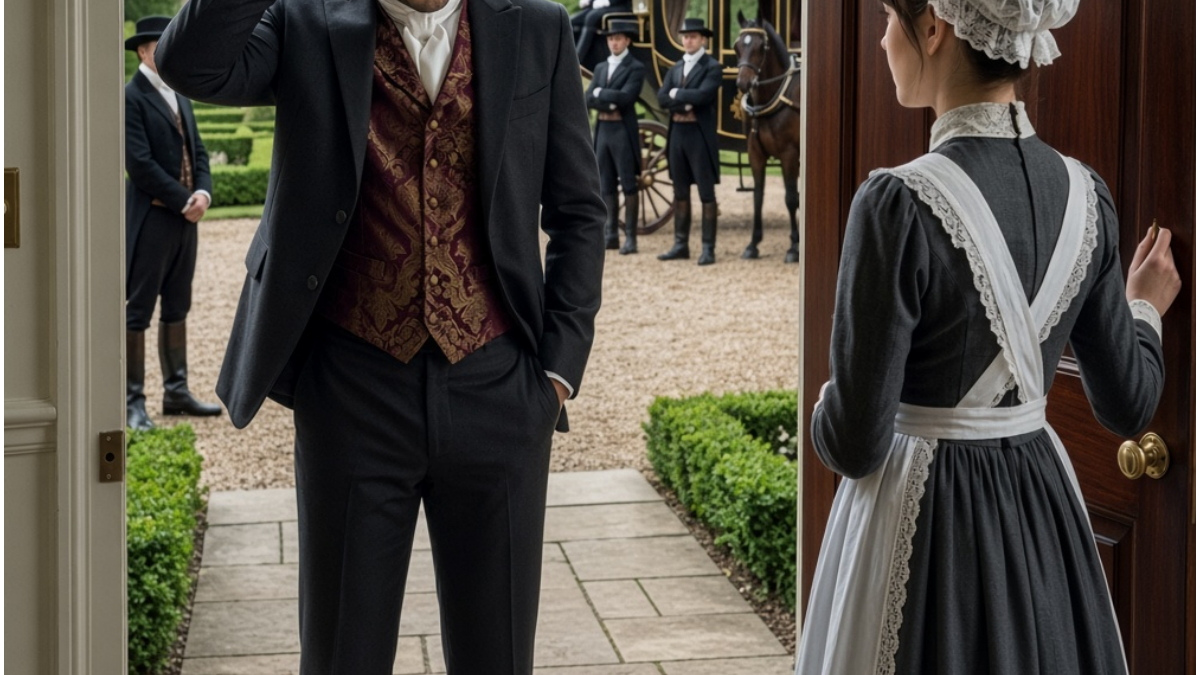
A maid does not get to be a heroine. Society has written the rules with meticulous clarity.
She wakes before the sun. She builds the fires that warm rooms she will never sit in.
She pours the tea for people who will never learn her name. She is furniture with a pulse, useful, invisible, replaceable.
So when Elizabeth Marsh found a stranger bleeding in the ditch on the Anic Road on a Thursday evening in October, she did not think of reward.
She did not think of consequences. She thought, “This man will die in the cold if someone does not put him in the cart.
She did not know he was a duke.” He did not tell her. And by the time he knocked on her doors later, with the full weight of his title and his power and his ruined, exhausted heart pressed against the worn oak of her threshold, it was already too late for both of them to pretend that the cartride had been nothing.
Elizabeth Marsh was 26 years old and had been a maid at Foxorn House for eight of them.
She was neither beautiful in the way the housemaids in penny novels were beautiful, nor plain in the way that invited pity.
She was simply competent. She had the kind of face that people forgot to look at, and the kind of hands that people forgot to thank.
Her hair was dark brown, kept in a practical knot beneath her cap. Her eyes were an unremarkable gray green, quick and watchful, belonging to a woman who absorbed more information in silence than most people gathered in a week of conversation.
She was the sort of woman who noticed when the coal in the parlor great was running low before anyone rang the bell, and who could read the emotional temperature of a room the way a sailor reads the sky.
She knew by the angle of Lady Foxborn’s shoulders at the breakfast table whether the post had contained good news or bad.
She knew things that nobody had told her because nobody bothered to hide things from the furniture.
She had no illusions about her position. She was paid £18 a year. She had a room the size of a generous cupboard at the top of the east wing, and she was permitted one afternoon off per week on Thursdays, which she used to drive the estate’s battered supply cart into the village of Mertton to collect the household provisions.
The road to Merton and back was hers and nobody else’s for 3 hours a week, and that was sufficient.
It was on a Thursday that everything changed. October in North Sumberland does not ask permission before turning savage.
The afternoon had been cold but clear when Elizabeth set out from Foxborne with Bess, the cartor, and a short list of provisions.
By the time she had loaded the sacks of flour and the wrapped cheese, and the two bolts of replacement linen into the cart, the sky had turned the color of a bruise.
By the time she pointed Bess back toward the estate road, the rain was falling in solid, freezing sheets.
Elizabeth pulled her oil skin tighter and leaned into the wind. She was not a woman who complained about weather.
Weather was simply weather. She had driven this road in worse. She was 2 mi north of Mertton, where the road curved sharply around a low stone wall and dipped into a narrow veil.
When the cart’s lantern caught something at the edge of the ditch. A darker shadow against the dark, a shape that did not belong to the expected landscape of stone and heather and rain.
A man pulled back on Bess’s res. The old horse stopped immediately, grateful for the excuse, and stood in the rain with the patient resignation of an animal who had learned not to expect the world to make sense.
The man was lying half in and half out of the ditch. He was face down in the mud, one arm extended, his great coat soaked black with rain.
He was not small. He was, in fact, extraordinarily large. Broad across the shoulders, long in the frame, clearly too tall for the ditch he had collapsed into.
20 yards further up the road, a massive, expensive looking gray horse stood, with its res trailing, and its expression one of profound personal affront.
Elizabeth set the cartbreak. She climbed down into the mud without ceremony, and walked to the man.
She was not afraid. Fear required energy she could not spare. She knelt. She pressed two fingers to the side of his neck.
Strong enough. Fast but strong. He let out a rough guttural sound against the mud.
Not dead then. Sir, said. Her voice was not gentle in the way people effected gentleness to signal that they were good people.
It was efficient and clear, calibrated to be heard over the rain. You need to get up.
You are going to drown in 4 in of water if you do not. A sound came from him, something between a curse and a groan.
He tried to push himself upright, got his arms under him, found that his right leg was not cooperating, and subsided again.
Elizabeth put her shoulder under his arm. She braced her feet in the mud and hauled.
She was stronger than she looked. 8 years of carrying coal scuttles up four flights of stairs had made her shoulders deceptive.
The man came up. He staggered, his full weight pressing against her for a moment, and she took it without remarking upon it.
He was soaking wet and enormous, and smelled of leather and blood and cold rain.
He found his footing with a sharp involuntary hiss of pain and stood. She looked at him.
In the swinging light of the cart’s lantern, she could see the source of the hiss.
A gash along his left temple, not deep enough to be fatal, but bleeding freely down the side of his face into the dark stubble of his jaw.
His eyes, when they finally focused on her, were a striking deep gray. Intelligent eyes, mortified currently by the situation, but intelligent “Horse through you?”
Elspith said it was not a question. “Rock in the road.” His voice was a low, rough baritone, stripped of any pretension by pain and cold.
I did not see it in the dark. Your horse is fine. It is up the road looking extremely annoyed.
She studied the cut on his temple with the calm assessment of someone who had been dealing with household injuries since she was 19.
Can you walk? Yes. Don’t lie to me about that. I cannot carry you into the cart if you collapse again.
A pause, a breath, a reassessment of his own body’s current capabilities. Marginally,” he said, with the particular honesty of a man who has concluded that lying will make his situation worse rather than better.
She helped him to the cart. It was a graceless business involving considerable mud, and one suppressed sound of agony when he lifted his right leg over the sill.
Neither of them remarked on it. She climbed up, gathered Bess’s res, and clicked her tongue.
Bess moved off. The rain hammered the oil skin. The lantern swung. The road unwound before them in the cold light, rutted and treacherous from the day’s weather.
There is a rag in the box under the seat, Elizabeth said. Press it to your head.
It is clean. It is for wiping down the harness, but it will do the job.
The man found the rag. He pressed it to his temple without comment or complaint, which she registered as a point in his favor.
Men who complained about discomfort while being rescued from ditches were exhausting. “Where are you headed?”
She asked. A slight hesitation. Brief, but she noticed it. “North. North is not a destination.
North is a direction. There are four estates on this road.” And then Scotland. Ashmore, he said, I am headed to Ashmore.
Elizabeth kept her eyes on the road ahead. Ashmore. The estate sat 3 mi north of Foxborne, sprawling across the high ground between two rivers, where the moors widened into something vast and slightly biblical.
It had been empty for nearly a year. The new Duke had not yet appeared in residence.
Everyone in the valley knew this, the way rural communities always knew the affairs of their absent aristocracy, with a mixture of quiet resentment and barely concealed fascination.
The house has been shut up, she said. I am aware. Are you staff coming to open it?
Another pause. His gray eyes were on the dark road ahead, watching the ruted path in the lamplight.
Something like that, he said. Elbith did not press. It was not her place to press, and besides, his reasons for traveling this road in the dark and the rain were his own business entirely.
Men who told partial truths did so for partial reasons, and she had learned early in life that the partial truth was often the most honest version available to a person in a situation they had not entirely chosen.
She drove on. The rain did not let up. Bess picked her way through the deepest ruts with the philosophical patience of a very old animal.
The silence between them was not uncomfortable. It was simply the silence of two people with nothing to perform for each other, no social tear to establish, no first impression to manage.
In Ellith’s experience, that silence was rare and valuable, and she said nothing to break it.
“You are not going to ask me a great many questions,” the man said eventually.
He was watching the road. It was an observation delivered without judgment, as if he were noting an unusual weather pattern.
No, most people would. Most people would also have driven past a body in a ditch and told themselves it was not their concern.
He turned his head to look at her properly. She did not return the look.
She was navigating a particularly vicious stretch of road where the drainage had failed and the surface had turned to something resembling cold porridge.
“What is your name?” He asked. “Elizabeth Marsh.” “And what takes you down the anic road at this hour, Miss Marsh?”
“Provisions. I am a maid at Foxborn House.” She guided Bess around a deep rut.
Thursday is my afternoon off. I collect the household provisions on the way back. It saves the estate the cost of sending a separate driver.
You drive the provisions cart yourself in October in the dark. I also enjoy the drive.
A pause in the rain. The rain is significantly less offensive than most of the guests currently staying at Foxborne House.
She kept her eyes forward. One of them rang for me at 3:00 in the morning last night to ask me to reheat a shawl.
The rain has never once asked me to reheat anything. The sound that came from him then was unmistakable.
A short, rough laugh dragged up from his chest, as if it surprised him, as if it had found a way out before he could decide whether to allow it.
He pressed the rag harder to his temple, wincing slightly at the pressure. You should have that cleaned properly when you arrive,” Elizabeth said, returning to practical matters with the ease of a woman who had learned that emotions were fine in theory and logistics were what actually kept people alive.
Head wounds bleed freely and then appear to have stopped when they have not. “Pirits to clean it, not water.
Hot water will open it again.” He looked at her. You speak with authority. I have worked in a house with 14 indoor staff for 8 years.
People cut themselves with some regularity. The parlor maid dropped a mirror last February. Someone has to know what to do about it.
She paused. Also, one of Lady Foxborn’s guests last autumn walked directly into a glass door at considerable speed.
Spirits, not water. The gray eyes held on her for a beat longer than necessary.
Then he turned back to the road ahead. “Spirits,” he said quietly, as if making a note of something.
“Not water.” They drove the last mile in a silence that had become, if possible, even more comfortable than the earlier one.
It pressed gently against the rain and the lamplight and the sound of Bess’s steady hooves, and Elizabeth thought that it was one of the better silences she had occupied in recent memory.
The gates of Ashmore rose out of the dark and the rain like sentinels. Heavy iron set between columns of dark stone topped with carved falcons, their wings spread in permanent declaration.
Beyond the gates, the house was barely visible. A massive shadow against the black sky, but lights were beginning to bloom in the lower windows.
Staff stirring, a household rousing itself. Elizabeth pulled Bess to a halt. This is as far as I take you, she said.
Foxornne is a mile south. I cannot leave Bess standing in this rain any longer than necessary.
He climbed down more smoothly than she expected, though she watched him test his weight with the careful deliberateness of a man taking nothing for granted.
He turned back. The gate lanterns caught the dark cut at his temple, the rain plastered hair, the complete absence of rank or pretension that was exactly how he had looked in the ditch.
I did not ask your name,” Elizabeth said, because she realized she had been so occupied with the immediate logistics of keeping him upright and mobile that the elementary courtesy had simply not occurred to her until now.
He looked at her for a moment, a considered look, the look of a man making a small but deliberate choice.
“Edmund,” he said. Not a title, not a surname, just the name, clean and plain, offered like the harness rag without ceremony.
Edmund, she repeated. She gathered Bess’s res. Put spirits on that cut, Edmund. Good night.
Good night, Miss Marsh. He paused, one hand on the gate. Thank you for not driving paSt. She clicked her tongue at Bess.
The cart moved off into the rain. She did not look back because looking back served no practical purpose, and she was, above all things a practical woman.
The morning at Foxbborne brought the particular species of chaos that only large country houses hosting self-important guests can generate.
Three bellpoles before 7. A crisis about the breakfast ham. Lady Foxbornne in her dressing gown demanding an explanation for the cold fires in the blue drawing room.
Elith was in the middle of explaining that the blue drawing room chimney was blocked and lighting it would fill the room with smoke when the sound of carriage wheels drew everyone to the windows.
It was not a single carriage. It was a procession. Three heavy traveling coaches bearing a crest, followed by two supply wagons stacked with trunks.
The crest on the door of the lead coach was a falcon with wings spread above a Latin motto.
Lady Foxborn appeared at El Smith’s shoulder. She was still in her dressing gown, but her social instincts had overridden the indignity.
Her sharp eyes locked on the falcon crest, and her entire face underwent a transformation.
The irritation evaporated. The social hunger blazed up in its place. “The Duke of Ashmore,” Lady Foxborn breathed.
She gripped the window ledge with both hands. “He has come. He is in residence.
He is our nearest neighbor. She was already mentally seating a dinner table. Already mentally positioning her three unmarried cousins from bath like chess pieces.
Tell me that procession is turning in at our gate. It was not turning in at their gate.
It was continuing north, the wheels crunching steadily on toward the Ashmore road. The falcon crest disappearing between the trees.
“He will call,” Lady Foxorn declared, spinning from the window. “He must call. He is a bachelor.
He is a duke,” she pointed at Elizabeth. “Have the good china polished today. All of it.”
Elizabeth looked at the retreating procession until the last coach vanished. She looked at the falcon crest until it was gone.
Edmund. She turned back to the matter of the blocked chimney and said nothing at all.
Ashmore Hall sat 4 miles north and was delivered to Elmith’s attention the following afternoon by the simple impossible fact of a large man on a gray horse appearing at the servant’s entrance.
She was crossing the kitchenard with a basket of dried herbs when she heard the hooves on the gravel.
She looked up. He had bathed. He had shaved. He wore clean clothes of a cut in quality that required no decoration to announce their coSt. A strip of white linen was pressed against his left temple with surgical precision.
He looked nothing like the man she had pulled from a ditch. He looked exactly like him.
He saw her the moment she saw him. The kitchen yard held the quiet of mid-after afternoon, pale October light lying thin across the wet stone paving.
“Spirits,” Elizabeth said, nodding at the bandage temple. “Not water.” “Spirits,” he confirmed. “Not water.”
He dismounted and led the gray to the wallpoSt. He held out a folded piece of cloth, the harness rag, clean now, pressed flat.
Elizabeth looked at it. In 8 years at Foxbborne House, not one guest, not one visitor, not Lady Fox herself, had ever returned a single thing borrowed from the servant side of the house.
The concept simply did not penetrate. She took the rag. You rode three miles to return a harness cloth.
I also wanted to confirm you arrived back safely. The road was bad. He paused.
And I wanted to tell you something I should have told you last night. She waited.
I am the Duke of Ashmore, he said. Plain as that. No theater, no preamble.
I know, Elizabeth said. Something in his expression shifted. You knew last night. I suspected before we reached your gates, and you said nothing.
Neither did you. She put the rag in her basket. I assumed you had your reasons, your grace.
He looked at her, that re-calibrating look she would come to know well, the slight adjustment of his gaze, as if she continued to present at a slightly different angle than he expected.
Does Lady Foxorn know you drove me home? No, you didn’t tell her. I did not consider it relevant to her morning.
She met his eyes steadily. Is there something else your grace or only the rag?
I require a housekeeper, he said. Ashmore has been without a competent domestic manager for 11 months.
The house is in considerable disrepair. Three staff remain, all of them loyal and elderly and entirely overwhelmed.
I am told you manage most of the domestic operations at Foxborne, including the provision accounts and the maintenance schedules.
Elizabeth kept her face entirely neutral. I am a maid, your grace. You are considerably more than a maid, and I think we are both aware of that.
No flattery in it. A statement of observed fact delivered in the same plain register he had used to say his name.
I am offering you the position of housekeeper at Ashmore. The salary is £60 peranom.
60 three times what she earned. Three times and four more on top. She looked at him in the pale kitchenard light.
She thought about the blocked chimney. She thought about Lady Foxorn’s 3:00 bell. She thought about the guest who had sent back the ham twice.
She thought about the blue drawing room that had needed new glazing for 2 years and which no one had fixed because Lady Foxorn refused to commit the expense.
I will require a full accounting of the current household expenses before I accept. Elith said, “I will not walk into a ledger I have not examined.”
His expression shifted again, something settling into place. The books will be ready tomorrow. Come at 6.
I work until 6, then come at half. Ashmore Hall in daylight was magnificent in its bones and catastrophic in its present condition.
The exterior was dark stone and falcon topped ballastrades built to endure centuries. The interior was another matter.
11 months of minimal occupation had stripped it of warmth and function. The carpets were thick with duSt. Half the chimneys needed sweeping.
The library ceiling was threatening to become the library floor. In the kitchen, the range worked, but the pantry was bare to a degree that approached the philosophical.
The three remaining staff, a butler named Horus who was 68 and moved with the considered pace of a man who had learned that hurrying was rarely faster, a cook named Mrs. Peele, who was 70 and entirely magnificent in the face of limited materials, and a footman named Thomas, who was 24 and eager to the point of overcorrection.
All three looked at when she walked through the service door with the desperate relief of shipwreck survivors citing a sail.
Edmund spread the ledgers across the estate office desk and stood to the side while she read them.
He did not hover. He did not explain. He simply stood with his arms crossed over his chest and watched her work.
And she read each page with the slow, methodical attention she brought to everything that mattered.
She made notations in pencil. Three at first, then five, then nine. Your previous estate manager was incompetent or dishonest, she said, not looking up.
Possibly both. Dishonest, Edmund said. He was dismissed before I inherited the title. The household budget has been catastrophically misallocated.
The silver maintenance line is three times the appropriate figure, and the silver itself has not been touched in months.
The cold account does not reflect actual consumption. Someone was routinely taking the difference. She turned a page.
Mrs. Peele is being paid £28 a year. For a house this size, with her tenure, she should be earning no less than 45.
Adjust it, Edmund said. Elizabeth looked up. Just like that. I’m not accustomed to arguing with someone who has read a legend more carefully in 20 minutes than my solicitor has managed in 8 months.
He uncrossed his arMs. I need the silver situation addressed, the coal account cleaned up, and the library ceiling attended to before it injures someone.
I will need to hire additional staff. Hire them. I will also need a household repair budget that does not require your approval for individual items below a threshold amount.
Routing everything through you will slow every necessary repair considerably. He studied her. Below what threshold?£10 15 12.
A silence. His gray eyes held hers across the desk. Done, he said. She returned to the ledger.
I will require two weeks notice at Foxbborne. I will speak to Lady Foxornne on your behalf.
You will not, Elizabeth said. He blinked. She set the pencil down with precision. If you involve yourself, Lady Foxbornne will understand that you have a personal interest in my departure.
She will make the remaining two weeks extraordinarily difficult. I will give my own notice in the ordinary way and I will come to you in a fortnight.
Edmund looked at her for a long moment. The look of a man consistently encountering a situation a degree more complex and more interesting than he anticipated.
In a fortnight. Then he said, Lady Foxbornne received Elizabeth’s notice at the breakfast table on a Tuesday with the expression of a woman handed a personal insult from a divine source.
She was 48, the widow of a moderately prosperous baronet, possessed of a thin, calculating face, and a talent for cruelty she had learned to dress in the language of maternal concern.
Ashmore, Lady Foxbornne repeated, setting her teacup down with exquisite precision. You are leaving my household to become housekeeper at Ashmore Hall.
Yes, my lady. The Duke of Ashmore’s household. The pale eyes narrowed to something very focused.
And how did this opportunity present itself? His grace required an experienced domestic manager. I was recommended.
Not technically a lie. She had recommended herself. Lady Foxborn studied with the calculating intelligence of a woman who had made a profession of reading situations for her own advantage.
Something moved behind those pale eyes. Some private calculation being run and completed. The Duke of Ashmore, she said slowly, is a bachelor.
He is conspicuously eligible. He is our nearest neighbor. She paused. I intend to write to him today.
Suggest Friday dinner. As you wish, my lady. You will deliver the note on your way north.
It was a test wrapped in a command. Lady Foxborn wished to measure how else navigated the instruction, what her face revealed, whether the neutrality was genuine or performed.
“Of course,” Elizabeth said with total equinimity. She picked up the tray and walked out.
Edmund was in the stable yard when Elizabeth arrived with the note consulting with his farrier.
He was in his shirt sleeves which Elizabeth filed away as not her concern. He took the note, read it in 4 seconds.
She is inviting me to dinner. Yes, Friday. Are you the bait or the messenger in this arrangement?
The bluntness startled her that he saw it so cleanly. I am the messenger, she said.
Lady Foxbornne has three unmarried female cousins visiting from Bath. The intention is that you will find one of them agreeable.
Edmund folded the note and held it out to her. Tell Lady Foxborn I am engaged on Friday.
She will suggest another evening. I am engaged on most evenings. I have a house to restore.
You looked at her with that level direct gaze. I am also already aware of the cousins from Bath.
One of them dispatched a note directly to my estate office 3 days ago. The note contained a watercolor she had painted of the Ashmore gates, which I had not requested and cannot account for.
Elizabeth looked at the folded note in her hand. A laugh pressed hard against the inside of her throat.
She suppressed it completely. What would you like me to tell Lady Foxborn? Tell her I thank her warmly for the invitation and will call on her when the house is in order.
He turned back to the farrier. Also, he said without looking at her. Burn the watercolor.
In the fortnight before Ellsworth formally transferred to Ashmore, she drove north on three separate afternoons under the pretext of household correspondence.
In truth, she was walking the house, talking to Horus and Mrs. Peele and Thomas, and making lists, comprehensive, precise, unscentimental lists.
When she crossed to Ashmore permanently, she did so with the quiet economy of a woman who had already done the work in her head.
She hired a coal merchant from the village who did not water his deliveries. She sourced chimney sweeps and a carpenter whose estimates were honest and engaged two additional maids through the church notice board in Merton.
She sourced Mrs. appeals kitchen provisions from a farm cooperative rather than the Foxborne preferred merchant who had been overcharging both houses for a decade under the assumption that no one would compare his prices with the regional rate.
She reduced the weekly household expenditure by a third in 10 days. Horus brought the revised accounts to Edmund on a Wednesday afternoon with the trembling reverence of a man bearing miraculous news.
Edmund looked at the figures in silence. Then he looked at Horus. Send Mrs. Marsh to the study.
The study at Ashmore was a large room made smaller by accumulated correspondence, rolled maps, and the productive disorder of a man who thought in several directions simultaneously.
Edmund was at the desk when she knocked and entered, still in his riding coat from the morning, collar slightly loosened.
The low afternoon light coming through the tall windows caught the dust that the new maids were still working methodically through, filling the air with a kind of particulate gold.
He looked tired in the specific way of men carrying responsibilities they had not been trained to carry, men who refused to let anyone see them stumble under the weight of it.
He tapped the revised account book. You have cut the supply costs by a third.
The prior merchant was price gouging. It required three conversations and one written comparison of regional market rates to correct.
The library ceiling is repaired. The carpenter finished 2 days ago. I also asked him to assess the east wing window frames while he had his equipment on site.
Two of them are rotting. I have documented it in the report on your desk filed under expenditures above 12.
He found the report in the stack on his left. He read the relevant lines.
Approved, he said, reaching for his pen. Elith cleared her throat. The three alternative quotations are on the following page.
He stopped. He turned the page. He read the alternatives in silence. He initialed the carpenters’s figure, which was the cheapest of the three, and set the pen down.
He was fighting something. She could see it in the controlled set of his jaw.
Not anger, its opposite. How do you take your tea? She said. He looked up.
I beg your pardon. Tea? It is past 4:00. You have been at that desk since before I arrived this morning.
I am going to ask Mrs. Peele to send a tray. She held his gaze.
How do you take it? A pause long enough to suggest that no one had asked him this particular question in quite some time or had asked it without wanting something in return for the asking.
Dark, he said after a moment, no milk, no sugar. Good. She moved toward the door and paused with her hand on the frame.
The window frames in the east wing, she said, they are rotting because the guttering above them has been blocked for some considerable time, and the overflow has been sitting against the stone.
Having the guttering cleared before the first frost will prevent the same problem developing in the west wing.
It is in the same report listed under items I can authorize myself. She walked out before he could respond.
The tray that arrived 10 minutes later held one cup of dark tea steaming in a thin straight ribbon.
No milk, no sugar, a small plate of bread with good butter because had observed Edmund’s lunch tray when it came back to the kitchen and noted without commenting to anyone that he had eaten very little of it.
He sat at the desk and drank the tea and ate the bread. Both were perfect.
He sat for a moment in the quiet of the late afternoon, with the dust still moving slowly in the low light, and he did not pick up his pen for a full 3 minutes.
Lady Foxborn did not accept the situation gracefully. She arrived at Ashmore on a Wednesday morning in November without announcement, which was either extraordinary social confidence or extraordinary social blindness.
Lady Foxborne had always considered it the former. Elbeth reached the entrance hall at the precise moment Lady Foxornne swept inside with the forward momentum of an incoming weather system.
The hall had been polished and cleaned and the smell of old damp replaced by wood smoke and beeswax.
Lady Foxborn’s eyes swept it, registered the restoration, and found else. Something moved behind those pale eyes, cold and calculating.
The house looks remarkably well, Lady Foxornne said, adjusting. Thank you, my lady. His grace is with his steward this morning reviewing the tenant boundary agreements and is not receiving visitors.
If you would like to leave a card, I will ensure he receives it. Lady Foxborn did not wish to leave a card.
She wished to stand in Edmund’s drawing room and be seen. She was, however, sufficiently intelligent to understand that she was being managed by her own former maid, which was a humiliation she was not yet prepared to process in public.
She left a card with the air of a woman making a tactical retreat rather than a concession.
She told Elizabeth, as she left, that the cousins from Bath were staying through the month.
She said at the way one might leave a chest piece on the board as a reminder of available moves.
Edmund appeared in the kitchen passage an hour later, still carrying a survey map. He looked at Elizabeth, who was reviewing the linen inventory of the kitchen table.
Lady Foxborn called, he said, “Yes, you turned her away. You were occupied. I did not wish to interrupt your morning before establishing whether that was your preference.”
He leaned his shoulder against the doorframe. And if my preference is to receive her, then I will show her to the drawing room in future without question.
She looked up from the limon liSt. I simply make no assumptions about what a person wants until they have told me.
He looked at her for a moment. My preference, he said, is not to spend a Friday evening listening to descriptions of northern landscape paintings from three women I have never met.
There are two paintings now. Another arrived by post on Monday. A pause. The perspective on the falcons is somewhat improved from the firSt. Burn it.
I have been burning them in the kitchen range. Mrs. Peele says they make excellent kindling, better than the greenwood from the west orchard.
The sound from him then was a full genuine laugh, short, explosive, entirely unguarded. It struck the kitchen walls and scattered, and Mrs. Peele looked up from her stockp with the expression of a woman who has been waiting a long time for something and has just seen it arrive.
Lady Foxbornne’s patience expired on a Monday in late November. She appeared not at Ashmore, but at the back door of Foxbornne’s kitchen, where else had gone to collect a set of serving platters she had arranged to purchase from the estate surplus.
She was carrying a letter. Her face was arranged in an expression of careful, generous concern.
I felt, Lady Foxbornne said, holding out the sealed envelope, that a character reference was the appropriate thing, given the suddenenness of your departure.
El Smith took it, read it. It was a masterpiece of the genre. Every sentence appeared complimentary on its surface.
Every subordinate clause concealed a blade. She was described as enthusiastic without judgment, thorough without always knowing her place.
The letter concluded by wishing her every success in future endeavors, which in aristocratic correspondence was the equivalent of a door closed and locked from inside.
“I did not ask for a reference,” Elizabeth said. “I thought you might need one, should the Ashmore position not work out as expected.”
Lady Foxbornne’s expression was perfectly calibrated to resemble concern. These arrangements between bachelor employers and young female staff can be so unpredictable.
Elith folded the letter, put it in her pocket. Thank you, my lady, she said.
She walked out. The letter sat in her pocket like a coal. She did not tell Edmund it was not his problem to solve, and she was not a woman who handed her difficulties to other people.
She filed it in the back of the household correspondence drawer beneath the coal receipts, and returned to the supply contracts and the matter of the parlor chair and the dining room runner.
It was Horus who told Edmund 3 days later, “Not from any malice, but from the simple, uncomplicated loyalty of a man who had served the Ashmore family for 40 years, and who had decided in his considered way that his current duke was not in possession of all the relevant information.”
Edmund appeared in the household office at 11:00 on a Tuesday evening. Elizabeth was at the desk reviewing supply contracts by lamplight.
He had come directly from his own study. He had ink on his right hand.
His crevat was open at the collar. His expression was the particular contained fury of a man who had decided not to shout, but found the decision increasingly difficult to honor.
He held out his hand, said nothing, did not need to. Elizabeth looked at him for a moment, then she opened the back of the correspondence drawer and placed Lady Foxorn’s letter in his palm.
He read it. He read it twice. The second reading was slower, quieter, and considerably more dangerous than the firSt. She brought this here herself, he said.
His voice was very level, which meant it was not level at all. Yes. When Monday morning, you did not tell me.
It is not your concern, your grace. He set the letter on the desk. He placed both hands flat on the wood and looked at her across the lamplight.
The shadows made the hard plains of his face harder, but his eyes were not hard.
They were burning with a clear, controlled fury. “You are in my household,” he said.
“When someone attempts to undermine your position in my household, that is directly my concern.”
He let a pause settle. She wrote this because she cannot reach you here, and it enrages her that she cannot.
If you involve yourself, she will interpret it as confirmation of something irregular between us.
It will make things considerably worse. Lady Foxborn, Edmund said, his voice dropping to a register that was somehow more alarming than any raised tone, is a clever, frightened woman who built this letter because she cannot stand that you are beyond her reach.
She is not going to be sending further correspondence to this estate. He picked the letter up.
I have been reviewing the drainage easement that runs across the north boundary of the Foxorn property.
My estate has maintained that easement for 40 years at no cost to her whatsoever.
My solicitor has been asked to review whether it remains practical to continue. Elizabeth stared at him.
The drainage easement, she said. Yes, she will understand immediately. Yes, she will also understand that the next letter she writes to anyone in this house will result in consequences that are considerably more permanent than a disrupted drainage line.
He held the folded letter over the lamp. The paper caught instantly. He held it until the last corner blackened, then dropped the ash into the ink tray.
Good. He straightened. He looked at her and the official fury had settled into something else, something quieter and considerably more difficult to address.
“It is past 11:00,” he said. “The supply contracts need to be reviewed before Thursday’s delivery.”
“They will survive until morning,” Elizabeth. It was the first time he had used her given name without the title of address, and it fell into the quiet office like a stone into still water.
She stood. She collected her papers. She picked up the lamp. She stopped in the doorway.
“Thank you,” she said, two words only, carrying the full weight of everything she had no intention of saying at 11:00 in a household office.
Thank you, Edmund said, for not driving paSt. She understood he did not mean the drainage easement.
December came to Northumberland with its habitual absence of mercy. The first real snow fell in the second week, burying the moors in white, and cutting the estate off from the surrounding world, with a thoroughess that was, in its way a relief.
The cousins from Ba had retreated to Bath. The county could not call if the roads were impassible.
Within the boundaries of Ashmore Hall, for the first time in a year, everything was warm.
The fires burned in every occupied room. Mrs. Peele’s kitchen smelled of bread and brazed mutton.
Horus moved a fraction faster than he had in autumn, which was his version of flourishing.
Thomas had stopped overcorrecting and was merely steadily useful. On a Sunday evening, when the snow was coming down in a determined curtain, Edmund was in the library.
The library was the room Elizabeth had saved for last, which meant it was the room she had thought about moSt. New shelving along the north wall, the ceiling repaired, the carpet cleaned, the fireplace blocked for years, now burning a deep, clean heat.
She brought the tea herself, as she had begun doing in the evenings. She told herself it was efficiency.
Mrs. Peele was tired by 8, and there was no reason to keep her awake for one tray.
She told herself this every evening and believed it a little less each time. Edmund was at the window watching the snow, his hands clasped behind his back, a book tucked under his arm that he had clearly not opened.
He turned at the sound of the tray. Sit down, he said. I should return to the You have managed this house for 6 weeks, he said, and I have not once asked you to sit in the same room with me and drink a cup of tea.
Sit down, Elth. She sat. She poured two cups, handed one to him, kept one for herself.
The fire light stretched across the polished floor between them. They sat in silence. It was the silence of the cart, the same particular quality, the absence of performance between two people who had nothing left to prove to each other and no audience for whom to prove it.
You never told me how you came to be a maid, Edmund said. Not prying, simply direct.
My father was a school master in Darbisher. He died when I was 18. No money, no family.
I had two choices, maid or governness. She looked at her tea. I chose this because a governness is expected to perform belonging in a household she does not belong to.
I preferred to know exactly where I stood. He was watching her in the firelight, with the quality of attention she had long since stopped being able to dismiss as professional intereSt. And did you know exactly where you stood at Foxborne?
Yes, precisely. She looked up. Here it is somewhat less clear. The silence that settled then was weighted with the thing neither of them had yet named.
It had been accumulating in the spaces between their conversations for weeks, building with the quiet inevitability of water finding its level.
I was not raised to inherit, Edmund said, looking at the fire. My brother James was the heir.
He was extraordinarily well suited to it, sociable, politically engaged, entirely at ease in the drawing rooms I find unbearable.
A pause. He died of a fever 18 months ago, very suddenly. In a week, an entire life.
I was in Edinburgh managing a property dispute. I came south to a title and a household that had been systematically stripped by the people I had trusted to maintain it, and a county full of neighbors who expected me to perform a version of aristocracy that James had mastered and I have never understood.
And an estate manager who was stealing from you, Elizabeth said. Yes. And an estate manager who was stealing from me.
He turned to look at her. And then there was the rain. She looked at her cup.
You were not hiding who you were, she said slowly. That first night, you were testing whether it would change anything.
He was very still. Yes. And does it? The title, he said, does not make me a different man than the one who fell in a ditch and was driven home by a woman who spoke about the rain as if it were reasonable company.
But it changes what everyone else sees when they look at me. He paused. You see the same thing you saw that night.
I do not entirely know what to do with that. Elizabeth set her cup down on the tray.
She looked at the fire for a long, quiet moment. She thought about 18 years old and no money and the choice between two kinds of invisibility.
She thought about the satisfaction of a correctly balanced ledger, the specific pleasure of a chimney drawing cleanly for the first time in years.
She thought about a cart road in the rain, and the particular unexpected comfort of a silence shared with a stranger.
Edmund, she said his name plainly, the way he had given it to her. I am your housekeeper.
You are, he agreed, and I find it increasingly difficult to pretend that that is the only relevant thing in this room.
She looked at him, the hard, careful, tired man who had laughed in her kitchen at the watercolors of his own gate, who had burned Lady Foxorn’s letter in the ink tray as if it were the obvious and only possible response.
Who said everything he meant and nothing he didn’t? I am not a romantic proposition, she said.
I am practical and I am capable and those are the things I have always been and I am not going to pretend otherwise to make a situation easier to navigate.
I know he said so am I. He leaned forward his elbows on his knees.
I am not asking for a performance. I am asking whether what I believe is occurring between us is actually occurring.
It was the plainest possible way of saying a very complicated thing. She could have deflected.
She was accomplished at deflecting. She had been deflecting since the world informed her at 18 that her options were narrow and she should be grateful for what she had.
Yes, she said it is actually occurring. Edmund exhaled a long slow breath. He set his cup down.
Then I need to say something and I need to say it plainly because I am not capable of saying it any other way.
He held her gaze. I want to ask you to marry me. I have wanted to for 3 weeks and I have been trying to find a version of the asking that does not sound like an employer making a transaction.
I have not found one. So I am simply going to say it and let you do with it whatever you think is right.
Elizabeth looked at him across the library, across the fire light and the tea tray and the six weeks of ledgers and guttering and burnt watercolors.
You pulled me out of the ditch, she said because she needed a moment and that was the truest thing she could think of.
You pulled me out of the ditch, he corrected. I have been trying to work out the appropriate proportionate response ever since.
She looked at the fire. She thought about the word invisible and how long she had applied it to herself, and how it had never once felt like protection, and had always felt like a wound she had learned not to touch.
She thought about Mrs. Peele’s face when Edmund laughed in the kitchen about Horus crying at the church about a cup of dark tea placed at an elbow on a dark night without a word of performance.
She stood. She walked to the window and looked at the snow coming down soft and absolute covering the moors in something clean.
Then she turned around. I will need to remain as housekeeper until you find an adequate replacement, she said.
I will not leave this household in disorder. Edmund looked at her. The ghost smile was not a ghost anymore.
It reached his eyes and stayed. Of course, he said, “I will draw up a list of candidates.
I expected nothing less. And if we are to do this properly, I am going to require full access to the estate accounts, not only the household, the entire estate.
Your solicitor has clearly not been managing them with any rigor, and someone needs to do it correctly.
He stood up. He crossed the library to where she was standing. He reached out, his hand palm up between them, unhurried, the gesture of a man who had been carrying things alone for a very long time, and had finally, specifically found the right person to share the weight.
She placed her hand in his, his fingers closed. His skin was warm, and the calluses were exactly as she remembered from the night of the cart.
The same hands that had gripped the rag to his temple and accepted a cup of water without performance.
Real. Entirely real. Done. He said they were married in January in the small stone church at the edge of the Ashmore estate on a morning when the sky was a brilliant scoured blue in the aftermath of 3 days of snow.
There were no water cunners. There were no cousins from Bath. Horus stood as a witness and wept with complete, unashamed dignity.
Mrs. Peele did not cry, but made a wedding breakfast of such excellence that she served it herself in the library, because she was not going to trust the handling of the good china to anyone else on this particular morning.
Thomas stood in the cold at the church door with his collar too tight, looking like a man who had just understood something important and was taking it very seriously.
The news reached Lady Foxorn by poSt. She was reported by sources reliable enough to be believed to have taken to her bed for the better part of an afternoon.
By the following morning, she had entirely revised her position and was telling everyone in the county that she had, of course, always recognized Elizabeth Marsh as an exceptional woman and had been quietly instrumental in the match.
Nobody believed her. Everyone was polite enough to pretend they did because that was how the county worked.
And Lady Fox needed somewhere to drain her creditors patience. And a woman with useful social fictions is occasionally more manageable than one without.
The full estate accounts arrived on Elizabeth’s desk on the morning after the wedding. Not the household accounts, the estate accounts.
All of them. Three counties worth stretching back 8 years and smelling of accumulated neglect.
She sat with them for 2 days. She found four significant errors in the first volume alone.
She found two suspicious expenditure lines in the Edinburgh records that suggested the previous solicitor had been helping himself to the travel expense allocation for longer than anyone had noticed.
She found one piece of genuine financial obfiscation buried in the northern tenant records that was in its way almost impressive for its sustained complexity.
She drafted a letter to the solicitor. She attached three alternative courses of action. She initialed the one she considered both proportionate and effective.
Edmund came into the estate office at 4:00. Still in his coat from the morning ride, smelling of cold air and the open moors.
He looked at the papers across the desk. He picked up the letter. He read it in silence, then read it again.
This will end his practice, Edmund said, his voice carrying the particular satisfaction of a man who feels a long outstanding debt is being correctly settled.
No, Elizabeth said, it will compel him to return what he took. His practice will survive, diminished, and considerably more cautious.
He will not take from this estate again. She handed Edmund the initial proposal. This one.
He reached for his pen and initialed it beside hers without turning to the alternative proposals.
She noticed. She turned her face slightly toward the window so he would not see the small private smile.
The drainage easement, she said. Foxorns. He looked up. Restore it quietly. Have your solicitor cite an administrative error in the original review.
He set the pen down. You want me to restore Lady Foxborn’s drainage easement? She is a frightened woman who behaves badly because she has no power over anything that matters to her.
The easement costs us nothing and represents a great deal to her. I am not interested in punishment.
She met his eyes. I am interested in what is useful. Lady Foxbornne owing us a favor is useful.
Lady Foxborn nursing a grievance costs us nothing now and may cost us something eventually.
The arithmetic is clear. Edmund looked at her for a long time. The library fire moved in the hearth behind him.
Outside, the afternoon light was already thinning to that pale, thin January blue that came just before dark.
Else, he said. She looked up from the accounts. You are, he said quietly and with complete seriousness, the most extraordinary person I have ever had the specific good fortune to pull out of a ditch.
You did not pull me out of anything, she said. I pulled you. Yes, he said.
You did. He crossed to the desk. He leaned down and pressed his lips to her temple, careful and deliberate.
The exact pressure of a man who understood what had been given to him, and was not going to treat it as anything less than what it was.
She felt his hand rest briefly on her shoulder, warm and steady. Then he straightened, picked up his coat, and went back to his own work.
She returned to the accounts. They died that evening in the properly furnished dining room at a table set with two covers placed directly beside each other rather than at the formal cavernous distance the tradition mandated, and else decided was a waste of perfectly good proximity.
After dinner, they sat in the library. The fire burned clean and even. The snow outside pressed its white silence against the moors.
Elizabeth had a ledger in her lap. Edmund had a book. He was not reading it because he was watching her instead with the same quality of attention he had brought to everything since a Thursday night on the anic road.
The same look he had given to a woman in an oil skin coat with a cart horse and a harness rag.
And the simple practical conviction that a person bleeding in a ditch in the rain was a person who deserved a ride home.
“You are watching me work again,” Elizabeth said without looking up. “I am reading. You have not turned a page in 25 minutes.”
He turned a page. She allowed herself one small, entirely private smile and returned to the accounts.
The fire burned, the snow held. The clocks in the rooms of Ashmore Hall ticked through the evening with the steady, reliable rhythm of mechanisms finally running as they were meant to.
Outside the moors stretched away in every direction under the dark and the stars, vast and unmanaged, and entirely indifferent to what the county thought of the woman who had given a stranger a ride home in the rain.
She had pulled him out of a ditch, driven him three miles in the dark, told him to use spirits and not water, and thought nothing more of it, because she was practical above all things, and kindness, when it was genuine, required no audience and no reward.
She had not expected him to come back. She had not expected any of it.
The ledgers or the chimney or the kitchen fire or the particular silence of two people with nothing left to perform.
She had not expected after 26 years of being invisible to be seen so completely and so plainly by the one person who had given her his name before he gave her his title.
But there it was. There he was, real and warm and without pretention, reading a book he was not reading.
Across the library they had built together from a room full of dust and neglect.
Practical, she reminded herself. She was practical. She turned the page of the ledger and made a note in pencil.
Outside, the snow kept falling, clean and quiet, covering the old world in something new.








