“She Can’t Give Children,” They Said—Then a Cowboy With 5 Kids Gave Her a Home
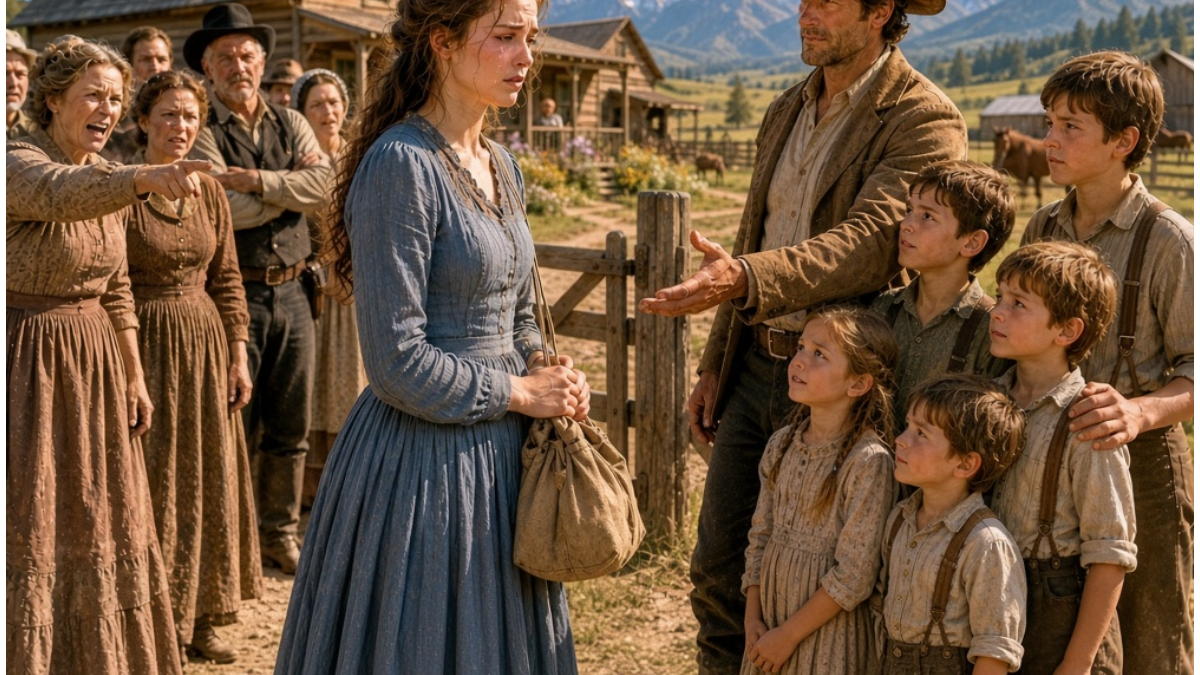
Mabel Harkort planted herself in the center of the Dry Creek General Store and pointed at her niece like she was identifying stolen property.
“This woman,” she announced loud enough that three men loading feed outside stopped to listen, has been living under my roof for 14 months, eating my food, burning my lamp oil, and doing nothing useful for my household.
She cannot give a husband children. She couldn’t keep the one she had. I am formally asking any decent family in this town to take her on as hired help cook, laress, whatever you need, because I will not carry her burden one more winter.
Deline Harkort stood 2 ft away and did not move. She was 26 years old and she had just been publicly auctioned off like a broken piece of furniture her family no longer had room to store.
Nobody volunteered. If this story already has your heart pounding, you are exactly the kind of viewer we make these stories for.
She is just getting started. The morning had begun the way.
Most of Delphine’s mornings began in Dry Creek with the particular silence of a house that didn’t want her in it.
She had risen before the Hardcourt family stirred, built the kitchen fire, put the coffee on, and sliced bread from the loaf she’d baked the night before.
She did these things not because anyone thanked her for them, but because doing them gave her a reason to be standing upright, which some mornings was the only reason she needed.
Her husband, Preston Harkort, had been dead for 11 months. He had died of a fever that swept through the lower valley in the spring.
Not a dramatic death, not the kind people told stories about. He was sick for 9 days and then he was gone.
And what he left behind was a wife who had never managed to give him children, a modest savings that evaporated inside 3 months, and a last name that now belonged to a family who considered her a permanent inconvenience.
Preston’s mother, Mabel, had made her feelings plain from the first week. “You could have tried harder,” Mabel had said.
Standing in the doorway of Delphine’s room two days after the funeral. She meant children.
She always meant children. My son deserved a family. Deline had not answered that. She’d learned early in her marriage that certain conversations were better absorbed than engaged.
The same way you absorb a blow, take it. Stay standing. Keep moving. But that morning in the general store was different.
Mabel had waited until the store held a reasonable audience. Reverend Kates’s wife, two of the Bellamy sisters, old Gerald Fitch, who ran the feed operation and whose opinions spread through Dry Creek faster than weather, and then she had stood up and said what she’d apparently been practicing.
Deline heard every word from 4 ft away. She stood in front of a shelf of canning jars she had come to price and she let Mabel’s voice wash over her.
And she thought about the canning jars because thinking about the canning jars was thinking about the canning jars was something she could hold on to while the rest of the room went sideways.
Half quart, 70 cents a dozen. She would need at least four dozen if the tomatoes came in properly this summer.
Except there wouldn’t be a this summer, would there? Not on Hardcourt land. Well, Mabel said, turning to address the room like she was conducting a town meeting.
Is there anyone here who can use an extra pair of hands? She’s capable enough with kitchen work.
I’ll give her that much, and she’s quiet. Doesn’t cause trouble. She just sits there using resources.
Margaret Bellamy cleared her throat, but said nothing. Gerald Fitch studied the floor. Reverend Kates’s wife, a woman named Dorothia, who had always been privately kind to Delphine, pressed her lips together and looked out the window as though something terribly interesting was happening in the street.
Nobody volunteered. The silence stretched out, and it was the loudest thing Deline had heard since Preston’s funeral, when nobody could think of much to say about him either, because Preston had been a quiet man who worked hard and kept to himself, and hadn’t left much of an impression on the town one way or another.
Delphine set the canning jar back on the shelf very carefully. She turned around. She looked at her aunt by marriage.
This woman who had eaten the bread she baked that morning without comment, and she said quietly and clearly, “You could have told me this at home.”
Mabel’s chin came up, “I’ve been trying to solve this problem at home for 14 months.
You’ve been complaining about it at home for 14 months. That’s not the same thing.”
A small intake of breath from Margaret Bellamy. Gerald Fitch shifted his weight. Don’t you take that tone with me, Mabel said.
I’m not taking a tone. I’m correcting a misstatement. Delphine picked up her basket. And since you’ve made this a public matter, I’ll say publicly that I’ve worked in your kitchen every day since Preston died, kept your accounts in order, mended your family’s clothes, and managed your household while you attended three separate quilting circles a week.
You haven’t been carrying me, Mabel. You’ve been misdescribing the arrangement. The room was very quiet.
Mabel’s face had gone the color of old brick work. You ungrateful. The door opened.
Not dramatically, not with any particular force. It simply opened. The way doors open when someone reaches for a handle and pushes through.
And a man walked into the general store carrying a folded paper in his left hand and the general heir of someone who had several things to accomplish before the day was done and did not intend to let any of them take longer than necessary.
He was tall, not improbably tall, just the kind of tall that takes up space without making a performance of it.
Broad through the shoulders in the way that comes from actual work rather than deliberate cultivation.
His hat was dented on one side in a way that suggested he hadn’t bought a new one in some years and didn’t think he needed to.
There was a weariness in him that sat not on his face, but somewhere behind his eyes, the kind you only recognized if you were carrying something similar yourself.
He stopped just inside the door, taking in the scene the taut silence, the women frozen in their positions, the man studying the floor, Mabel’s brick red face, Deline standing with her basket and her back straight.
He looked at Delphine. Something in his expression shifted almost imperceptibly. Not pity and not judgment, more like recognition.
Harlon Wescott, Gerald Fitch said with the careful relief of a man who needed something to say.
Didn’t expect you in town today. Needed supplies, Harlland said, and information. He glanced at Mabel.
I couldn’t help overhearing. Mabel drew herself up. It’s a private family matter. You announced it in a public store, Harland said without heat.
That makes it not entirely private. He looked at Delphine again, looked at her in a way that was assessing and also somehow respectful, the way you might look at a piece of land you were seriously considering, not possessively, not dismissively, but with actual attention.
You’re the woman she’s talking about. Deline met his gaze. I am. Can I ask you something?
She waited. Can you care for children? Specifically, five of them, ranging from 6 to 13.
The room had gone so quiet that Delphine could hear the coffee pot on the store’s iron stove beginning to bubble.
Mabel made a strangled sound. “Now wait just one.” “I’m not talking to you,” Harlon said, not unkindly.
“Just clearly.” He kept his eyes on Delphine. “I lost my wife 18 months ago.
I’ve got five kids and a cattle operation, and I’ve been managing both for a year and a half and doing a poor job of the part that doesn’t involve cattle.
I need someone capable. I’m not looking to make someone’s life harder than it already is.
I’d pay honest wages, provide a room of your own, and I’d expect nothing from you that isn’t in the job.
Delphine looked at him for a long moment. “You don’t know anything about me,” she said.
“I know you didn’t fold when someone tried to publicly humiliate you.” “That’s more than I know about most people, and it’s more relevant to what I need than half the things I could ask.”
Something moved in Delphine’s chest, not warmth. Exactly. Not yet. But the first tentative loosening of something that had been clenched very tight for a long time.
“What are your children’s names?” She said. He blinked as though that wasn’t the question he’d expected.
Silus. He’s 13. Owen is 10. EMTT is 8. And I’ve got twins, Ruby and Finn.
They’re six. And they know you’re looking for someone? They know I’m looking. They don’t know I found anyone.
A pause. Assuming I have. Delphine set her basket on the counter. I’ll need to think about the terms, she said.
And I’ll want to meet the children before I agree to anything. That’s fair, Harlland said.
Mabel found her voice again. It had gone sharp as broken glass. You cannot be serious, Deline.
You’d go to a strange man’s property. You just offered me to any family in this room willing to take me on as a domestic worker, Deline said, and she was surprised by how level her own voice was.
Mr. Wescott is offering wages in a room of my own. I’m having difficulty understanding your objection.
Mabel opened her mouth, closed it. Deline picked up her basket, turned to Harlon, and said, “When can I meet them?”
Harlland’s wagon was parked two blocks from the general store, and they walked there side by side with the whole of Dry Creek’s daylight curiosity, watching them from windows and doorways without quite committing to being seen.
Deline had four possessions of any significance in Mabel’s house. A small cedar box that had belonged to her mother, a change of clothes she’d made herself, a worn copy of a household management guide that had more practical usefulness than any book she’d ever encountered, and a wool blanket in good condition.
She told Harland she’d be ready to leave within an hour if the conversation with the children went reasonably.
“It won’t go easily,” he said. “I didn’t expect it to. Silas will be civil but watchful.
Owen’s going to say something rude. It’s not personal he does it with everyone. EMTT might not speak at all.
Ruby talks enough for herself and her brother combined, and Finn will probably just stare at you.
Delphine absorbed this. And what will you be doing while I’m meeting them, standing close enough to intervene, and far enough away to let them make their own judgments?
It was a sensible answer. She filed it away. They reached the wagon, and Harlon introduced her briefly to the children in the street.
They had apparently come to town with him and were waiting with the wagon in the manner of children who have been told to wait in a specific place and have mostly complied.
Silas, the 13-year-old, was angular and serious with his father’s eyes, already watching Deline with the careful calculation of someone who had learned to assess new situations quickly.
Owen, beside him, was stalky and had his arms crossed before Delphine had finished extending her hand.
EMTT stood slightly behind his brothers and did not make eye contact. Ruby, one of the twins, was a small girl with bright eyes and an immediately apparent willingness to form an opinion.
Finn, beside her, watched Delphine with an expression of pure solemn evaluation. Hello, Delphine said to all of them at once.
Ruby said immediately. Are you going to try to be our new mother? No, Delphine said.
Ruby frowned. Then what are you going to be? Someone who helps with the work.
We have Papa, Owen said. It came out more aggressive than he probably intended. Maybe not.
I know. Deline said. He asked me to help him so he could spend more time on the cattle.
That’s not replacing anything. That’s just dividing the work. Owen’s arm stayed crossed, but he was thinking she could see it.
What do you know about cattle? Silus asked. Less than your father. Probably less than you.
She paused. I know more about gardens, kitchens, and keeping a household account that actually balances.
Silas looked at his father. Something passed between them that Delphine couldn’t fully read. Haron gave a small, nearly imperceptible nod.
“You can ride,” Silas asked. “Well enough. Can you shoot?” Owen demanded. “If I have to.”
This gave Owen a brief, reluctant pause of reassessment. EMTT said nothing. He was watching Deline’s hands.
She wasn’t sure why. She had ordinary hands, workworn, slightly rough at the knuckles, one small scar on her right palm from a canning accident three years ago.
There was nothing remarkable about them. But EMTT watched them the way some people watch faces.
Ruby tugged Deline’s sleeve. Our mother’s name was Clara. That’s a good name, Deline said.
You’re not supposed to say she was a good person or that you wish you’d known her.
People say that, and it’s not true because they didn’t know her. I wasn’t going to say that, Deline said.
Ruby studied her with those bright, skeptical eyes. What were you going to say? I was going to say that a name tells you something about the people who chose it.
Clara means clear or bright. Whoever named your mother thought she was worth naming something beautiful.
Ruby’s expression did something complicated. Not crying, she didn’t look like a crier, but something shifted in it.
Something that had been braced against receiving anything new. Finn, who still hadn’t spoken, reached over and took Ruby’s hand.
Harlon, standing slightly to the side, cleared his throat. “Well,” he said, addressing his children generally.
“Any immediate objections?” “I have ongoing objections,” Owen said. Noted. “Anyone with immediate objections?” Nobody spoke.
“Then we’ll head back to the ranch,” Harlon said. “Miss Harkort needs to collect her things.”
The collection of her things from Mabel’s house took less time than the walk to retrieve them.
Mabel met her at the door with the expression of someone determined to have the last word and trying to decide which word to choose.
You’re making a mistake, she said. I’ve made mistakes before, Deline said. I can recognize one.
This doesn’t feel like one. That man is a widowerower with five wild children and a cattle ranch 2 hours outside of town.
You will be completely alone out there. I’m completely alone in here, Deline said. And at least out there, someone is paying me for it.
She went past Mabel up the stairs and packed her four things into a canvas bag in under 8 minutes.
At the top of the stairs, she stopped and looked at the small room she’d been living in low ceiling.
One window that faced another house, a bed barely wide enough for one person, a dresser with a warped drawer she’d stopped trying to fix.
She had kept it clean. She had made it as comfortable as it could be made.
She had done everything she knew to do to earn her places in this house.
And it hadn’t been enough because it was never going to be enough. Mabel was not a monster.
That was the complicated thing. Mabel genuinely believed that a woman’s value ran through her ability to produce the next generation.
That Delphine had failed at the primary function of a wife, and that this failure was categorical and permanent.
It wasn’t cruelty so much as a kind of mathematics, a calculus of usefulness that Mabel had absorbed from the world around her and had never thought to question.
Delphine thought about that for just a moment. Then she picked up her bag and walked down the stairs and out the door.
She did not look back. The road to Westcot Ranch ran southeast out of dry creek through grassland that opened up in a way the town itself never quite did.
The mountain sat distant and blew in the late afternoon light. The air had that particular dry sweetness of high country summer grass and sage and something faintly mineral underneath.
Harland drove. The children were arranged in the wagon bed behind them. Ruby talking to Finn in a low voice that Deline could hear but not quite make out.
Owen staring at the middle distance with his arms still crossed, though less certainly than before.
Silas watching the road ahead with an expression that mirrored his father’s without quite achieving his father’s restraint.
EMTT sat at the back edge of the wagon with his feet hanging over the side and looked at the road receding behind them.
Delphine sat beside Harlon on the wagon bench and they were quiet for the first several miles in a way that was not uncomfortable exactly but needed some understanding.
You want to know why I did that? Harlon said finally in the store. Why you stepped in?
I want to know several things about today. Delphine said that’s one of them. He was quiet for a moment.
The horses moved steadily. A hawk crossed overhead and disappeared into the blue. My wife was sick for 6 months before she died.
He said, not quietly sick. Sick in a way that takes everything. The children saw a lot they shouldn’t have seen.
And then she was gone, and there was nothing to show for any of it except five kids who needed someone and a ranch that didn’t stop needing work just because we were all broken.
He paused. I’ve had two women from town come out to the ranch to see if they could manage it.
First one lasted 12 days. She meant well, but she talked to the children like they were smaller than they were, and Silas corrected her twice on household accounts, and she didn’t recover from that.
Second one lasted 9 days. She tried to rearrange the kitchen and remove some of my wife’s things, and Owen pushed over a full bucket of water on her.
Accidentally, he claimed, “Was it accidental?” Jury’s still out. A brief pause that might have been humor.
When I saw your aunt do what she did, stand there in public and offer you up like you were a problem to be solved rather than a person I thought about those two women who came out and couldn’t handle my children’s grief.
And I thought about how that situation in the store would have broken most people and you just didn’t break.
I wasn’t undamaged. Deline said I was just angry enough that I didn’t have room to be broken at the same time.
Harlon looked at her sideways. That might be the most honest thing anyone has said to me in 2 years.
They drove on. Behind them, Ruby’s voice floated up. Papa, is she going to sleep in Mama’s room?
She’s going to sleep in the room at the end of the hall, Harlon said.
The one with the blue curtains. That’s the good room, Owen said suspiciously. It’s the empty room, Harlland said.
Being empty doesn’t make it a good room, Owen. It makes it an empty room that someone might as well use.
Owen considered this with visible reluctance. I’m not calling her anything, he announced. Nobody’s asking you to call her anything, Harlland said.
Good, Owen said. He stared at the back of Delphine’s head for a long moment, and Deline could feel it the way you can feel most things directed at you with sufficient intensity.
Then he looked away. Westcot Ranch revealed itself slowly. First the fencing well-maintained, the post straight, and the wiret, the kind of fencing that told you the man who owned the place took his property seriously.
Then the cattle scattered across a long grass slope to the east, their coats dark against the pale summer grass, a barn that was large and solid looking, built to last, with a hoff door that needed repainting.
A secondary building she couldn’t identify from the road, and then the house itself set back from the road on a slight rise that gave it a view of the valley below.
It was a good house, not a grand house. No one who had built this had been thinking about how it looked from the road.
They’d been thinking about winters and storage and where the kitchen window should face with maximum morning light.
It had the practical beauty of things built to withstand rather than to impress. The front porch had five chairs on it.
Five, not four, not six. Five arranged in a specific way that suggested they had been arranged by children who each had an opinion about where chairs should go.
Delphine looked at those five chairs and felt something tighten in her chest that was not quite sadness and not quite hope and was possibly the precursor to both.
The children were off the wagon before it fully stopped. Ruby ran directly to the porch.
Owen jumped down and headed for the barn with the purposefulness of someone finding somewhere to process complicated feelings.
Silas came around to help with the horses with the quiet competence of a boy who had been doing it long enough that he no longer thought about it.
EMTT climbed down laSt. He stood beside the wagon and looked at Delphine for a long moment.
His face was very still, not cold stillness and coldness were different things, and she was already beginning to understand that EMTT’s stillness came from the same place other people’s loudness came from.
It was how he held self together when things were uncertain. The gardens around back, he said just that.
Then he walked toward the house. Deline looked at Harlon. He’s never told either of the other two women about the garden, Harlon said.
Is that significant? Harlon picked up her bag from the wagon bed. EMTT doesn’t say anything that isn’t significant.
The inside of the house was exactly what she’d expected and entirely different from how she’d imagined it.
The kitchen was large and functional. The shelves well stocked in the way of a family that understood winter.
The iron stove solid and properly seasoned. The main room had a fireplace and four mismatched chairs and a table that had clearly been the site of a thousand meals and several hundred arguments and probably a fair amount of homework.
There were drawings on one wall, children’s drawings tacked up without frames, horses and cows and a house and people with circle heads and stick arms and one drawing that was clearly a woman with long hair, very carefully drawn, more careful than the others.
Nobody had taken it down. Delphine looked at it for a moment and looked away.
Harlland showed her the room at the end of the hall. It had blue curtains as promised.
A bed with a decent mattress, a dresser, a hook on the back of the door, a window that faced eaSt. On the windowsill was a small clay pot with a dried stem in it.
Something had grown there once and died, and nobody had removed the pot. “I can take that,” Harland said, reaching for the pot.
“Leave it,” Deline said. “I’ll sort out what to do with it.” He looked at her.
She wasn’t sure what she saw on his face. Exactly. Relief, maybe. Of the cautious kind, the kind that doesn’t trust itself yet.
Supper’s usually around 6, he said. The children take care of their own morning chores.
I’ve had them on a routine since Clara died. It’s not always pretty, but it mostly gets done.
I’ll start with the kitchen tomorrow, she said. I won’t rearrange anything tonight. She said it deliberately.
He heard what she meant. She knew about the woman who’d rearranged the kitchen. Or at least she’d understood enough from how he’d described her.
“Thank you,” he said quietly. He left her to unpack. She sat on the edge of the bed for a moment in the quiet of a house that was learning her presence the way houses do.
The small adjustments of air and sound when a new person enters a space. From somewhere down the hall, she heard Ruby’s voice and Finn answering in a lower register and then Owen’s sharper tone cutting through and then silence and then Silus saying something in the patient slightly tired way of an oldest child who has spent too long being the most reasonable person in the room.
Delphine took her cedar box out of the canvas bag and set it on the dresser.
She took her change of clothes out and hung them on the hook behind the door.
She took the wool blanket out and folded it at the foot of the bed.
She took the household management guide out and set it on the dresser beside the cedar box.
Then she sat back down on the edge of the bed and looked out the east-facing window at the last of the afternoon light on the mountains.
And she thought about what she knew and what she didn’t know. She knew how to run a household.
She knew how to manage an account book, preserve food, keep a kitchen properly, and make the practical work of a home proceed without drama.
She did not know these children. She did not know this ranch. She did not know this man who had pulled her out of a humiliating situation in a store and driven her 2 hours into the high country based on 40 minutes of acquaintance and the observation that she hadn’t collapsed in public.
It was not a careful situation. Careful situations were for people with options, and options were what she’d been running short on.
She stood up, smoothed her skirt, and went to find the kitchen. Supper that first evening was a precise measurement of exactly how difficult this was going to be.
Delphine had found leftover biscuits from the morning, and a pot of beans on the stove that needed only reheating, and she added some dried herbs from the shelf, and a strip of salt pork, and let it all come together while she sliced the biscuits and set the table.
The children arrived in stages with varying degrees of willingness. Ruby came first, sat immediately, and watched Delphine work with open fascination.
Finn came two steps behind Ruby, as was apparently his natural arrangement. Silas came third, glanced at the stove, and sat down with a brief nod that was the closest thing to a compliment Delphine suspected he was capable of on a first evening.
EMTT appeared in the doorway, looked at the table, and sat at his specific place with the careful precision of someone for whom routine was loadbearing.
Owen was laSt. He stood in the doorway for a visible moment, assessing whether he was going to make a production of this, and then apparently decided not to, or decided to wait for a better moment, and sat down without speaking.
Harlland came in from outside, washed his hands at the basin, and sat at the head of the table.
Delphine brought the pot. It smells different, Owen said. I added thyme and margarm, Deline said.
We don’t usually do that. I know. I should have asked. I’ll ask in the future.
She said it simply without apology or self-deprecation, just as a statement of what she intended to do differently.
Owen stared at his bowl. Ruby tasted hers immediately with the empirical commitment of someone who takes food seriously.
Her face did something that was almost pleasure, quickly controlled. It’s good, Ruby said. It’s different, but it’s good, Ruby, Silas said in a tone that suggested she’d violated some unspoken protocol.
What? It is good. It tastes better. I don’t know why we’re not allowed to say so.
Harlon looked briefly at the ceiling, then at his bowl, then he tasted it. He didn’t say anything, but something in his face settled in a way that suggested he agreed with Ruby’s assessment.
EMTT ate with quiet, concentrated attention, as he seemed to do most things. Owen ate.
He did not comment on the taste, but he finished everything in his bowl, and when he pushed it aside, he looked at the pot on the stove for a moment before deciding, with visible internal effort, not to ask for more.
Deline picked up the pot and set it beside him. He looked at her. She looked back, neutral, unhurried, he served himself more beans.
It was not a victory. It was too small to be a victory. It was just a moment, one of a thousand such moments that make up the real work of living alongside people who haven’t decided yet whether to let you in.
Later, when the table was cleared and the children had gone to their rooms, Harlon sat in the main room with a cup of coffee, and Delphine sat across from him, and they talked through the basic operations of the ranch in the way of people establishing the practical terms of a new arrangement.
She asked questions. He answered them. She took no notes because she didn’t need to, she would remember.
And note-taking felt like it would introduce an unnecessary formality to a conversation that was already formal enough.
The garden, she said. Haron looked up. EMTT mentioned it. He said, “It’s around back.”
“It was Clara’s garden,” Harlon said after a moment. She put a lot of work into it.
First year after she got sick, she couldn’t tend it properly. Second year, she was gone.
I’ve kept the beds turned over and the fence in good repair because the children would notice if I let it go completely, but it’s been two summers without proper care.
It shows. I’d like to look at it tomorrow, he nodded. One more thing, Delphine said.
He waited. I’m not going to try to replace their mother. I’m not going to try to make them forget her or give them a substitute version of her or pretend that I’m stepping into a role that was hers.
That’s not what I’m here for, and it’s not what I’m capable of. I’ll try to keep this house running well enough that you can do your work and the children can do their growing.
And if that turns out to be useful to your family, then we’ll have done what we set out to do.
Harlon was quiet for a moment. The first woman said something similar, he said. But she said it the way people say things they’ve practiced.
You said it like you’d already thought it through and arrived at a conclusion. I had time to think on the wagon.
What else did you think? She looked at him directly. That you’re carrying more than the cattle operation and you’re carrying it quietly.
And the fact that you haven’t let it make you cruel said something about you that your children probably don’t fully understand yet.
Uh because they’re too close to see it. Harlon set his coffee cup down. He looked at it for a long moment.
Clara used to say, he said slowly, that I was the most stubborn man she’d ever known and the most faithful.
She meant both as compliments. I think they are both compliments, Delphine said. He looked at her.
Something in his face was very carefully held together. The way certain things are held together from the inside when external structure isn’t available.
I should let you sleep, he said. You should, she agreed. She took her cup to the kitchen, rinsed it, and went to her room.
She lay on the bed in the dark with the mountains blowing outside her east-facing window and thought about the five chairs on the porch and the drawing of the woman on the wall and the 8-year-old boy who had told her about the garden before anyone else thought to.
She had been discarded that morning, and here she was at the end of the day, lying in a room that was hers, in a house that didn’t hate her, surrounded by a family that hadn’t decided yet what she was.
That was not nothing. That was in fact the most promising situation she’d been in for a very long time.
Outside, something moved in the grass, probably a night animal. Something small crossing from shadow to shadow.
The mountains were dark shapes against a star-heavy sky. Delphine Harkort closed her eyes. Tomorrow she would look at the garden.
She would figure out what it needed. She was very good at figuring out what things needed.
The garden was worse than she’d expected. Not in the way of a garden that had been neglected out of laziness.
There was a difference, and Delphine had learned to read it. A lazy garden had a certain careless sprawl to it.
Weeds growing fat and comfortable in undisturbed soil. This garden had been fought over. She could see where Harlon had turned the beds over, probably more than once, probably in the particular grim determination of a man maintaining something, because abandoning it entirely felt like a second loss he wasn’t prepared to take.
The fence was sound. The bed borders were intact. Someone had kept the worst of the bindweed back.
But two summers without a person who understood it had taken the kind of toll that effort alone couldn’t prevent.
The soil in the main bed had gone tight and gray at the surface. The kind of compaction that happened when ground wasn’t fed and wasn’t worked properly, and the natural life in it slowly gave up and went elsewhere.
Three of the raised sections had drainage problems she could identify just from standing at the edge and looking at the discoloration.
The herb bed along the south fence had mostly survived. Herbs were stubborn and didn’t require much affection to persist, but the vegetable beds were thin, the kind of thin that told her the soil was tired.
She stood there in the early morning light with a cup of coffee going cold in her hand, and looked at it for a long time.
“It’s bad, isn’t it?” She turned. EMTT was standing at the garden gate in his workclo, his dark hair uncomed, watching her with that particular still attention of his.
She hadn’t heard him come out. It’s not bad, she said. It’s tired. What’s the difference?
Bad means something’s broken. Tired means it needs rest and feeding and someone paying attention to it.
Tired can be fixed. She looked back at the beds. This can be fixed. EMTT was quiet for a moment.
Papa tried. I know. And it helped. The bones of this garden are good. The beds are in the right place.
The fence sound. Does the soil under the top layer probably still has life in it?
Your father kept it from becoming bad. Now it needs something different. EMTT came through the gate and stood beside her.
He was not quite as tall as her shoulder. He looked at the beds with the same gravity.
He seemed to apply most things. He noticed again that he was watching her hands the way she held her cup, the way she gestured when she spoke about the soil.
Mama used to talk to it. He said the garden. Not like to a person.
She just said things while she worked, what she was doing and why, like explaining it to herself out loud.
Deline nodded slowly. Some people think better that way. Do you? Sometimes, she said honestly.
He nodded as though this confirmed something he’d already suspected. Then he looked at the south fence at the herb bed that had mostly held on.
The time’s still good. She planted that the first year. It shows. Time’s hard to kill when it’s well established.
She moved toward it, crouched down, rubbed a small leaf between her fingers, and held it out to him.
Smell that. He leaned down and smelled it. Something crossed his face. Not quite pain, not quite comfort, somewhere between the two.
That smells like her kitchen, he said. “Then we’ll make sure it keeps growing,” Delphine said simply.
She stood back up and looked at the whole of the garden again. And in her head, she was already beginning to map it.
What needed immediate attention? What could wait? What was genuinely gone and needed replanting from the beginning?
What might still be alive under the surface if she gave it the right conditions?
I’m going to need help, she said. I can’t restore this alone and keep up with the house.
EMTT looked at her. I’m not asking you right now, she said. I’m telling you what’s true.
If people want to help, I’ll show them what to do, but nobody has to.
He looked back at the garden. “I’ll help,” he said with the quiet certainty of someone who has already been thinking about it for some time and was only waiting for the right invitation.
She went back inside and started breakfaSt. The mornings on Westcot Ranch had their own specific rhythm, and she spent the first 3 days observing it before she changed anything.
This was a decision she made deliberately, not out of passivity, but out of the recognition that walking into an established household and immediately reorganizing it was exactly the kind of error that got buckets of water pushed over on you.
The children woke at different times in a range of about 40 minutes. Ruby was earliest, which surprised Deline, who had expected the talker to sleep longeSt. Ruby was up before 6, dressed with a speed that suggested efficiency over vanity, and downstairs looking for something useful to do with the particular energy of a child who needed occupation the way other people needed air.
Silas was next, then EMTT, then Finn and Owen last, with a reliability that suggested this arrangement had been settled long ago, and everyone had accommodated it.
Harlon was up before any of them. She hadn’t expected that either, though she probably should have.
He was a cattleman. The cattle made their demands on a schedule that didn’t negotiate.
And she heard him moving in the kitchen at 5 every morning, building the fire and putting the coffee on, and then the back door closing as he headed for the barn.
On the first morning, she had come down at 5:30 to find the kitchen fire going and a pot of coffee ready and nobody there.
She’d stood in the empty kitchen for a moment and felt oddly grateful for the fire and then made breakfaSt. On the second morning, she was down at 5:15.
On the third morning, she was down at 5:00, and Harlon was still there, standing at the window with his coffee, and he turned when she came in and looked slightly surprised and then not surprised.
“You don’t have to be up this early,” he said. “I know,” she said. “Where’s the cornmeal?”
He pointed to the correct shelf. She made cornmeal porridge with dried apples and a little brown sugar because it was the kind of thing that stayed warm and children could serve themselves from it in stages, which turned out to be exactly what the morning schedule required.
By the fourth day, she had a reasonably clear picture of the household. The accounts were in better shape than she’d expected.
Harlon was not careless with money, and his recordkeeping, while not elegant, was accurate. The supply list needed detention.
Some things were running low that he probably hadn’t noticed because he was managing too many things at once to track the smaller ones.
The children’s clothes were in varying states. Silas and Owen managed their own reasonably well.
Emmits were clean, but often mended in places that needed remmending. Ruby had somehow acquired three dresses that didn’t fit and two that did, and Finn owned three pairs of trousers that were all too short.
She said nothing about any of this immediately. She watched and noted. What she could not watch without responding to was the way Silas carried the household.
It wasn’t obvious at first because he did it quietly and with the same thoroughess his father brought to the cattle, but she began to see it.
The way he checked on EMTT before bed without appearing to. The way he intercepted Owen’s sharper moments before they escalated.
The way he knew where everything was in the house because he was the one keeping track of where everything was.
He was 13 years old and he was running half this family and nobody had asked him to and he had simply taken it on because it needed doing and he was old enough to do it.
On the fourth evening she found him at the kitchen table after supper with the household account book running a column of figures.
That’s your father’s job, she said, not as a criticism, just as an observation. Silas looked up.
Papa was going to do it after supper. I started it so he could sit down.
She looked at the figures. His addition was precise. The notation was clear. This was not a child who had picked up the book and tried to.
This was a child who had been doing this for a while. When did you start keeping the accounts?
She said a brief pause. After Mama got really sick, Papa was at the hospital a lot.
Someone had to. He said it without drama, without self-pity, without any apparent expectation of acknowledgement, just the plain statement of a person describing their circumstances.
Delphine sat down across from him. You’re going to show me how you’ve been doing it, she said, not because you’re doing it wrong.
Because I need to understand how this household has been running before I change anything.
He looked at her with that careful, watchful expression. That was his default. Most people would just take over.
Most people would, she agreed. He looked at the account book for a moment. Then he pushed it across the table toward her and began to explain.
It took almost an hour. The system he developed was practical and specific to this household.
Which bills were settled by which method, which suppliers had credit arrangements, which costs were seasonal, and which were fixed.
It had the fingerprints of a mind that had learned accounting the way most practical knowledge is learned by needing it and figuring it out.
When he finished, she asked three clarifying questions, and he answered them precisely. You could run this ranch, she said.
He looked at her. I’m 13. I know. I’m saying in 10 years you could run this ranch and probably run it well.
She pushed the account book back toward him. Keep doing it. I’ll manage the kitchen and household supply side.
We can compare notes once a week and make sure nothing falls through. He stared at her for a moment with an expression she couldn’t entirely read.
Then he picked up the account book and said, “Okay.” She went to wash the supper dishes, and behind her she heard him a turn a page and continue with the column of figures.
And she thought that Silus Westcot at 13 was probably more competent than most men she’d known at 30, and that it was both impressive and genuinely sad, and that the best thing she could do for him was take enough weight off his shoulders that he could eventually just be 13.
Owen, meanwhile, had declared a kind of cold war. It was not hostile, exactly. He didn’t do the things that would get him in clear trouble.
He didn’t say rude things to her face, didn’t refuse direct requests, didn’t push any buckets, but he maintained a consistent and studied distance, a careful removal of himself from any situation where acknowledgement of her presence might be construed as acceptance.
He ate what she cooked. He did the chores, she suggested when Harland endorsed them.
He answered direct questions with single words. On the fifth day, she asked him to mend the back fence where two boards had come loose.
A job that required both the strength and the specific mechanical knowhow she’d observed he possessed.
He looked at her. Why me? Because you’re the best at it, she said. This was true.
She had watched him work with tools. He had an instinctive relationship with how things fit together that Silas didn’t share.
And it was the kind of skill that was actually rare and valuable and rarely acknowledged in children who were primarily noticed for their rough edges.
Owen narrowed his eyes slightly, looking for the angle, the manipulation. Just say yes or no, she said.
If you don’t want to, someone else will do it eventually. It just won’t be done as well.
He stared at her for three full seconds. Then he said fine and went and fixed the fence.
Later that afternoon, she heard him explaining to Finn the proper way to set a board without splitting it with the particular patience of someone who has discovered they know something worth knowing.
She did not comment on this. She went back to the kitchen. Ruby was the most straightforward of the five in the way that very direct people are always technically simple, even when they’re actually complicated.
She said what she thought, wanted what she wanted, and had strong opinions on most subjects, including subjects she had only recently encountered.
2 days after Delphine arrived, Ruby came to find her in the garden and announced that she intended to help.
All right, Delphine said, “Don’t tell me what to do firSt.” Ruby said, “Show me what you’re doing and then tell me.”
Delphine considered this. That’s actually the right way to learn most things. Where’d you pick that up, mama?
Ruby said a pause. Ruby watched her carefully to see how she’d handle the mention.
Your mother sounds like she understood how people actually learn things. Deline said. Ruby’s shoulders, which had been slightly raised in anticipation, came down.
She did. She was very, she knew how to explain things, so they made sense.
Papa knows how to do things, but he doesn’t always explain them well. Some people are better at doing, and some are better at explaining.
The best teachers manage both. She managed both, Ruby said, with the particular fierce loyalty of a six-year-old who has identified something important and will defend it.
Absolutely. Then you were lucky to have her for the time you did, Deline said, and meant it plainly without performance.
Ruby looked at her very hard for a moment. Then she picked up the small hand troll and said, “Show me what you’re doing.”
Finn was the most unexpected of them. He said almost nothing. This was apparently his temperament and had been since birth.
According to Ruby, who was his expert on the subject, but he followed. When Deline worked in the garden, Finn appeared within 20 minutes and worked nearby, doing whatever task was adjacent to hers.
When she was in the kitchen, he found small jobs in the kitchen, not underfoot, not demanding attention, just present in the way of an animal that has decided you are trustworthy, but is not prepared to formalize that assessment.
On the sixth day, she was cing apples for drying and he came and sat across the table from her and watched.
After about 10 minutes, he said, “Can I do that?” She handed him a cer and an apple and showed him the motion.
He ced 12 apples in a row systematically without speaking. And then when the bowl was empty, he got up and went back outside.
She looked at the 12 cord apples and felt something she couldn’t quite name. Not exactly affection.
It was too early for the real thing. But the precursor to it, the noticing of a person, the thing about the recipes happened on the eighth day.
She had been working through the kitchen shelves, methodically, not rearranging, just understanding, learning where things were kept, and why, noting what was getting low, what was going bad, what was being kept out of habit rather than use.
In the back of the lowest shelf, behind a row of preserving jars, she found a battered tin box with a lid that didn’t quite close all the way.
Inside were handwritten recipes on folded paper, scraps of card, the backs of envelopes. 20 or 30 of them, maybe more, written in at least two different hands, an older, more careful script, and a newer, quicker one that had the character of a person who wrote fast, because they were usually in the middle of doing something else.
She recognized the second hand from the drawings on the wall, Clara’s hand. She’d looked at those drawings often enough in the past week to know it.
She sat down on the kitchen floor right there and held the tin box and didn’t do anything for a long moment.
This was not hers to sort through. That was the clearest thing she knew. She found Haron at the barn and showed him the box.
He looked at it. Something moved across his face that he controlled quickly, but not completely.
I didn’t know those were in there, he said. I didn’t go looking. I found them while I was learning the shelves.
He held the box for a moment. His hands were very still around it. I’d like to use some of them, Deline said.
If that’s acceptable, not all of them, and not right away. But if there are things the children particularly liked dishes that meant something to this family, I’d like to know about them, and I’d want to ask before I use any of them.
He looked at her. Why ask? Because they’re not mine, she said. They belonged to someone who knew what she was doing and knew these children and put thought into what she made for them.
Using her recipes without acknowledgement would feel taking credit for something I didn’t earn. And it would be a lie the children would notice, even if they didn’t have words for it.
Haron was quiet for a long time. Clara made a bean soup, he said finally, with cornbread.
EMTT’s favorite. She made it every year when the first frost came in. Then when the first frost comes in, Delphine said, “We’ll make it, and we’ll say whose recipe it is.”
He handed the tin box back to her. There are recipes in there she never made more than once.
Experiments. “You can use those however you want.” A pause. “The ones in the older writing were her mother’s.
She wrote them down because she was afraid of forgetting them.” “I’ll keep the whole box,” Deline said.
“And nothing from it goes anywhere without your knowing.” He nodded. He looked like he might say something else and then decided against it and went back to work.
That evening at supper, Deline put the tin box on the kitchen shelf where the children could see it not prominently displayed, not hidden, just there.
Ruby noticed immediately. What’s that? A recipe box that was in the back of the shelf, Deline said.
Your father said it was your mother’s. The table went quiet. Owen looked at the box with an expression she couldn’t entirely read.
Complicated, guarded. The face of someone who wants to react and doesn’t know which reaction to truSt. EMTT looked at it for a long time without speaking.
She had a recipe box, Ruby said. I didn’t know that. It was in the back of the lowest shelf, Delphine said.
Easy to miss. Can we look at it? Ruby asked. After supper, Deline said. If your father says yes.
Harlon at the head of the table cleared his throat. After supper, he confirmed. They ate with a different quality of quiet than usual.
Not the cautious quiet of people managing tension, but something more like the quiet of people sitting with something they needed a moment to hold.
After supper, Harlon opened the tin box on the kitchen table, and the children gathered around it.
Silas recognized one of the recipes immediately, a particular kind of ginger cake, and said, “She made this every Christmas.”
Owen said nothing, but he picked up one of the folded papers and held it and then set it down very carefully, like it was made of something that could break.
EMTT read through three recipes with the thorowness of someone committing them to memory. Ruby asked questions.
Finn traced the handwriting on one page with his finger, not reading it, just touching it.
Haron watched them. He wasn’t composed exactly, but he was holding. It was one of the harder things Deline had witnessed, and she had witnessed some hard things.
She stayed at the edge of it present, quiet, useful for the small practical tasks of clearing the table table around them and putting water on for washing, and gave the family the space to do what they needed to do with those pieces of their mother’s handwriting.
When EMTT looked up from the recipe box and found her watching, she didn’t look away or pretend she hadn’t been.
She was a good cook, Delphine asked him. She was a great cook, Emtt said.
Just that not elaborated because it didn’t need to be. Then I’ve got a lot to learn from this box, Delphina said.
He looked at her for a moment. Then he looked back at the recipes, and something in how he sat changed.
Something fractional and almost invisible, like a door that has been pressed against, swinging very slightly open.
The garden work started in earnest that second week. The first task was the soil, which meant compost, which meant starting a proper pile at the back of the property and collecting kitchen scraps systematically, and explaining to the children why eggshells mattered and what coffee grounds did for tired soil, all in the practical, non-romantic terms that EMTT, in particular, responded to.
He wanted to know mechanisMs. He didn’t want to be told the garden was tired.
He wanted to know what specifically was wrong with the soil and what specifically would fix it.
She showed him. She dug down several inches in the main bed and showed him the layers, the tight, pale top soil, and underneath it the darker, looser earth that still had some life in it.
She showed him the difference in texture between dead soil and living soil. Explained what root roots needed and what they couldn’t find in ground that had been depleted.
“So, it’s not gone,” Emmett said. “There’s still good stuff underneath.” “There’s still good stuff underneath,” she confirmed.
It just needs help getting back to the surface. He considered this with the gravity he brought to most things.
And we do that by feeding it and by breaking up the compaction so air and water can get through again.
And by being patient, you can’t rush soil recovery. How long for this? One season of good care should show improvement.
Two seasons and it’ll be close to what it was. He nodded. Okay. Ruby’s involvement in the garden was different from EMTT’s.
Where EMTT wanted to understand the system, Ruby wanted to participate in the decisions. She had opinions about where things should go and why, and some of her opinions were actually good, which Deline said plainly when they were, and which seemed to surprise Ruby more than anything else.
You think I’m right, Ruby said about the placement of the bean trellis along the east wall.
You’re right that the east wall gets better morning sun and would give the beans a longer growing day.
You’re also right that it’s closer to the water source, which matters when you’re hauling buckets.
Those are both good reasons. Deline moved the steak Ruby had placed. You’re slightly wrong about the spacing beans need more room than you’ve given them here, but the location is correct.
Ruby looked at the repositioned St. Most people just say yes or no. Most people aren’t trying to teach you anything, Deline said.
Just trying to get the garden planted. The stake stayed in its adjusted position. Ruby got a more careful look on her face, the look of someone who has understood that learning is actually being offered here and has decided to take it seriously.
Owen helped with the heavier work turning the beds, hauling compost, fixing the raised bed borders where the wood had warped and needed replacing.
He did these things without conversation, but he did them well, and occasionally Deline heard him correcting Ruby’s digging technique with the same precision he’d used to teach Finn about fence boards.
He was teaching his siblings. She realized had probably been doing it since Clara died.
It was just less visible than Silas’s version because Owen did it sideways without announcing it.
On the Thursday of the second week, EMTT found her early in the morning before anyone else was up, standing at the compost pile, turning it over.
He was holding something, a small cloth pouch drawn closed at the top with a leather cord.
He held it out to her. She took it. It was light and she could feel through the cloth that it contained small hard things seeds.
She understood immediately. The kind that clatter slightly when you move them. Mama saved these, EMTT said before she got really sick.
She said she wanted to plant them in the spring, but then she couldn’t. He paused.
I’ve been keeping them. I didn’t show them to Papa because I didn’t know what he’d say.
Deline looked at the pouch in her hands. Do you know what kind they are?
Beans. The one she liked beSt. She saved seeds from the year before she got sick.
She looked up at him. These are 2 years old. I know. His voice was very steady, but she could hear the thing underneath it.
Are they still good? I don’t know, she said. And then, because he was a child who deserved honesty rather than reassurance.
Seeds can stay viable for a long time if they’ve been kept right. How did you store them?
In my dresser drawer, in the cloth? Cool and dry? Yes. Then there’s a chance, she said.
We won’t know until we plant them. What if they don’t come up? She looked at the pouch for a moment.
She thought about the honest answer and the comforting answer and whether they were the same answer.
Then we’ll have learned that this particular variety needs fresh seeds, and we’ll find where to get them and plant them in her honor.
That would be worth doing, too. She looked at him. But I think they’ll come up.
Seeds kept with care and intention have a way of holding on. EMTT looked at the pouch.
Something in his face was working very hard to hold itself together and mostly succeeding.
She wanted them planted, he said. Then we’ll plant them together, Delphine said. When the bed is ready and the soil is right and the time is correct, well do it properly, the way she would have wanted.
He was quiet for a moment. Then he looked up at her with those still dark eyes.
She would have been careful about it, he said. She didn’t rush things in the garden.
Neither do I, Delphine said. He nodded. He reached out and took the pouch back, closed his fingers around it, and held it against his chest for just a moment.
Then he held it back out to her. “You keep it,” he said, until we’re ready.
She closed her hand around the small cloth pouch, and felt the seeds move inside it, those old careful seeds that a woman she’d never met had saved from her garden in the last healthy year of her life, meaning to plant them in the spring and not being able to.
“I’ll keep it safe,” Delphine said. EMTT looked at her for a long moment with an expression that was the most open she’d seen on him.
Then he turned and went back to the house, and she stood at the compost pile holding a dead woman’s seeds and understood that somewhere in the past 2 weeks, she had stopped being a stranger in this place and become something she didn’t have a clean word for yet.
Not family, not quite, not yet, but something the family had chosen to trust with something precious.
She put the pouch carefully in her apron pocket and went back to turning the compost, and the morning light came up across the vegetable beds, the tired, recoverable, still living beds, and the time along the south fence breathed out its particular smell into the cool air.
And somewhere up at the house, Owen’s voice carried across the yard, telling Ruby she was doing something wrong in the way of a boy who cared enough to correct.
Delphine turned the compost and thought about seeds. About the kind you put in the ground and the kind you put in people and how neither kind announced itself when it was working and how patience was not a gift some people had and others didn’t but a discipline you built by deciding over and over that the thing you were tending was worth the time it needed the soil was tired the family was tired neither one was gone the drought arrived without announcement the way the worst things usually do one week the grass was holding its color pale but manageable the kind of dry that belonged to late summer in high country and didn’t alarm anyone who’d lived through enough of them.
The next week the color was gone, not faded, but bleached. The particular white yellow of ground that has stopped trying.
The creek that ran along the eastern edge of Westcot property dropped 4 in in 10 days and kept dropping.
The morning air, which had carried some coolness even into August, went flat and hot before 7 and stays that way until after dark.
Harlon noticed it the way a man notices something he’s been watching for and hoping not to see.
He said nothing at the supper table the first week, but Deli saw him looking east from the kitchen window in the early mornings, standing with his coffee and not drinking it.
His attention on the grass slopes where the cattle moved slower than usual in the heat.
The hay was the immediate problem. Not enough had been cut in the early summer.
There had been a mechanical issue with the cutting blade that had cost them 2 weeks.
And what had been cut was drying on faster in storage than it should. Harlland had already begun rationing it, which Silas knew about because Silas knew about everything that touched the ranch accounts, and which Deline learned from Silas on the Thursday of the third week of drought.
“How short are we?” She asked him at the kitchen table with the account book between them.
Silas traced a column with his finger. If it doesn’t rain in the next 3 weeks and hay prices hold at what they are now, we’re looking at buying in to carry the cattle through.
That’s expensive. And everybody else in the valley is going to need it, too, so prices won’t hold.
He paused. Papa knows. What’s he planning? I don’t know. He doesn’t say until he knows what he’s doing.
Silas looked at her with his father’s careful eyes. He doesn’t like to say things he can’t back up.
She understood that. She’d watched it in Harland for 3 weeks now. The economy of his communication, the way he didn’t speak problems into existence before he had a plan to address them.
It was not coldness. It was a different kind of care. The garden was suffering, too.
The work she and the children had put into the soil over the past weeks had improved its structure, and the composting had begun to show results in the texture of the upper bed.
But without consistent water, it didn’t matter. She was hauling water from the house pump twice a day, mornings and evenings, and the children helped without complaint.
Even Owen had taken up a bucket without being asked by the second week of the drought, but it was not enough.
She could keep things alive. She could not keep them thriving. The bean seeds were in the ground.
She had planted them on a cool morning in early August, 10 days before the drought settled in, with EMTT beside her and Ruby and Finn watching from the edge of the bed.
They had prepared the soil the way she’d taught them, broken up the compaction, worked in the compost, given it 3 days to settle.
She had shown Emmett how to space them, how deep to set each seed, how to firm the soil down without crushing what was underneath.
They had not come up yet. That was not unusual. Beans needed time, but the drought was a complication she hadn’t planned for, and she found herself going to the bed every morning and crouching down and looking at the soil with a focused attention that had started to feel like something more than gardening.
EMTT checked the bed every morning, too. He didn’t say much about it. He just crouched beside her and looked and then went about his other work.
But she could feel his watching in the same way. She could feel the watching of the whole family on the question of this drought.
All of them holding something, none of them speaking it directly. It was on the 15th day of dry weather that Delphine noticed the strip.
She had been walking the property line on the eastern edge. Following the fence, Harlon needed her to check for a section that Owen had reported as loose.
She was moving along the inside of the fence with her hand trailing it, testing tension at each post, when she noticed that the ground under her feet had changed.
It wasn’t green exactly. Nothing was genuinely green anymore. But it was a different quality of pale, less bleached, more holding.
The grass here was shorter than the surrounding ground, which meant it had probably been cut or grazed more recently.
But underneath the short grass, the soil had a different texture, and when she crouched and pressed her hand flat against it, she felt the faintest coolness that had no business being there in this heat.
She stood up and looked along the strip. It ran roughly parallel to the fence for about 40 yards before veering slightly uphill toward a rise covered in old juniper and scrub oak and years of accumulated deadfall.
The strip was narrow 8 maybe 10 ft across, but it was consistent, and the vegetation along it, while dry, was dry differently than everything else, more like the dry of something that had drawn back rather than the dry of something that had failed.
She stood there in the August heat looking at that strip of ground and felt the particular alertness that comes when something doesn’t add up.
She went back to the house and found Silas. How much do you know about the original layout of this property?
She asked him. He frowned. What do you mean the land itself? Not the current operations.
How it was set up when it was first settled? Not much. Papa would know more.
Or there might be something in the old deed papers. He keeps them in the desk in his room.
Could you ask him about the eastern property line this evening? Specifically, what’s on the rise above the juniper stand?
Silas’s frown deepened. He was trying to work out what she’d seen. “What are you thinking?”
“I’m not thinking anything yet,” she said. “I’m noticing something.” That evening, after supper, she described to Harlon what she’d found.
He listened the way he listened to everything, without interrupting, without the impatient waiting for you to finish.
That characterized most people’s listening. When she was done, he was quiet for a moment.
“That strip runs up toward the old cutter rise,” he said. “What’s on the cutter rise?
Used to be a spring dried up 20 years ago, supposedly before I bought the property.”
He paused. The previous owner said it was gone, told me not to count on it.
“May I look at the deed papers?” He got them from his desk without ceremony, and spread them on the kitchen table.
They were old, the paper soft with age at the folds, the handwriting formal and dense.
He and Deline stood side by side over the papers while the children cleared the supper dishes around them with the instinct respect children developed for moments that look important.
The deed included a property survey from the original settlement. In the margin written in pencil indifferent later handwriting was a notation irrigation channel stone construction cutter springs to main field est,861.
Harland stared at that notation for a long moment. There’s a channel, Delphine said. There was a channel, he said.
If there was one, it would have been buried years ago. Flood, erosion, things get covered or they get overgrown, she said, and buried under sediment and forgotten.
But the channel itself might still be intact if it was stone construction. She pointed to the survey.
This shows it running along exactly the line I walk today, the strip where the ground is behaving differently.
Harlon rubbed the back of his neck with one hand. It was a gesture she had come to recognize it meant he was taking something seriously that he was simultaneously skeptical of even if the channels there.
He said the spring dried up. The previous owner said it dried up. That’s different from it actually being gone.
She paused. Springs don’t usually disappear. They move. They get blocked. An overgrown silted channel would back water up underground.
The ground above the channel stays wetter longer than surrounding ground because water is still moving through it, just not where anyone can see it.
She looked at him. That’s what I felt. Under the surface, he looked at her.
She could see him weighing at the practicality of the gamble against the cost of chasing something that might be nothing.
With the cattle already under stress, and the hay already short, and every available hour already spoken for.
I want to look at the hillside, she said. Just look. I’ll take Silas and EMTT.
They know the property. If I don’t find anything in a day, I’ll drop it.
He looked at her for another moment. Then he looked at the deed notation. Then back at her towing, too, he said.
He’s better at digging. They went the next morning at first light, the four of them, Delphine, Silas, EMTT, and Owen, who had shown up at the barn door with a short-handled pick and his coat, and the expression of someone who has decided to reserve judgment.
Harlon was already out with the cattle. He’d said nothing more about it, which meant he’d decided to let it proceed, which was its own kind of permission.
Silas carried the property survey. EMTT carried a long stick for probing ground. Delphine carried two trowels, and her knowledge of what overgrown stone construction smelled like when you broke through the surface above it, which was specific and particular, and something she’d learned from her own father, who had done land restoration work on an older property before he died, and which she had never expected to use.
The strip of different colored ground led them uphill through the juniper stand, which was denser than it looked from below.
The trees old and thick-limmed. The ground beneath them carpeted in decades of shed needles and accumulated leaf litter from the scrub oak mixed in among them.
The light came through in pieces. It was cool up here in a way the open ground wasn’t, which was another piece of the picture.
Owen used the pick to clear deadfall. He didn’t ask questions. He moved obstacles, which was both his approach to physical problems and she was beginning to understand his approach to most probleMs. Here,” Emmett said.
He’d pushed his stick down into the ground at the base of a large juniper and hit something solid at about 8 in.
Not rock, the sound was different from rock, denser, and flatter. He moved the stick 2 ft along the same line and pushed again.
Same sound, same depth. Delphine knelt and used the trowel. 18 in of matted roots and sediment.
Then stone, flat fitted stone mortared with a clay compound that had dried hard as concrete.
The channel wall was 8 in across. And when they cleared along it for 3 ft, she could see it was continuous, not a stray rock, but construction, deliberate and precise.
The work of people who had known what they were doing and intended it to laSt. “There it is,” Silas said quietly.
Owens stood over her shoulder looking at the exposed stone. He was very still in the way.
Owen was almost never still. “How long is it?” He said. The survey shows it running about 200 yd from the spring to the field junction, Silas said, checking the paper.
But we don’t know how much of that is intact. One way to find out, Owen said.
He picked up his pick and moved 10 yards uphill and started clearing. They worked until midm morning without stopping.
The channel was not continuous. There were three sections where it had collapsed. The stone dropped inward under the weight of accumulated ground above it, but those were the exception.
For most of its length, it was intact, just buried, just waiting. The collapsed sections were repable.
Owen diagnosed each one by looking at it for about 30 seconds and then saying what materials he’d need to fix it with the precision of someone reading a mechanical problem rather than a landscape one.
Deline sat back on her heels at the head of the channel near the hillside and looked at what they’d uncovered and thought about the previous owner telling Harlon the spring was gone.
The spring was not gone. The spring was blocked a rockfall probably 20 or 30 years ago.
Debris accumulating over the opening until the water found another path underground rather than the one that had been built for it.
The channel above the blockage was dry. But the channel below it, the section that ran toward the field was damp inside when she wiped the debris clear.
Not wet, damp. The water was still there. It was still moving. We need your father to see this, she said to Silas.
Silas was already looking at the hillside above the channel head with the expression he used when he was calculating.
He’s not going to believe it without seeing it. I know. That’s why he needs to see it.
They found Harlon at noon coming in from the eastern pasture on horseback, the horse moving slow in the heat.
Delphine waited at the fence line and let him come to her rather than walking out into the field, which was both practical and a deliberate choice she’d learned in 3 weeks that Harlon absorbed information better when he could come to it rather than have it come at him.
She told him what they’d found. He sat on the horse and listened with his hat pushed back and his aesizes on the middle distance in the way of a man constructing a picture in his head from verbal information.
When she finished, he said, “The spring itself, the blockage is near the head of the channel on the upper hillside.
If we clear it and repair the three collapsed sections, the water should flow down the channel the way it was designed to, we wouldn’t be creating new water rights.
We’d be restoring your existing allocation to its original pathway.” “How much labor? 6 days, maybe seven.”
She looked at him directly. “I want to be straight with you. I don’t know if clearing the blockage will be enough to restore full flow.
The spring might not have the volume it had 60 years ago, but even a reduced flow through a functional channel would change the water situation for the garden and the small hayfield.
It wouldn’t solve the full drought problem. It would make it more manageable. Harlon was quiet for a moment.
The horse shifted its weight beneath him. I can’t pull men off the cattle to work on this, he said.
Not in this heat. I’m not asking for men, she said. I’m asking for time.
A week where the children and I work on the channel while you manage the cattle.
You’ve seen what Owen can do with stone. Silas can survey the repair sections. I’ll handle the channel head clearance with EMTT.
He looked at her. That’s a lot of work for a channel that might not deliver.
It is, she agreed. But the channel is there, Haron. The water is already in it.
I could feel the dampness in the stone below the blockage. It’s not a question of whether there’s water.
It’s a question of whether we can get it moving again. The silence stretched out long enough that she was aware of the heat pressing down on both of them, the horse flicking its tail, a hawk riding a thermal somewhere above the juniper stand.
One week, Harlland said, “You find the blockage doesn’t clear by day four. You stop and we figure something else out.”
“Agreed,” she said. He turned the horse back toward the pasture, then stopped. “Delfine,” she waited.
“If this works, he seemed to not quite know how to finish that sentence.” He tried again.
It’s a good piece of thinking. I found a strip of ground that wasn’t behaving like its neighbors, she said.
That’s all. He nodded once and rode on. The work was not graceful, and it was not fast, and nobody pretended otherwise.
The first two days were the worst clearing the overgrowth from the full length of the channel which required moving through the juniper stand systematically and was hot, scratchy, unpleasant work that left everyone with small cuts on their forearms and juniper pitch on their clothes that didn’t wash out.
Owen managed the heaviest clearing with the pick and said very little except when he wanted one of his siblings to move out of his swing radius, which he communicated with a brevity that was not unkind.
Ruby and Finn worked the lower channel sections, clearing sediment from inside the stone bed with shovels that were technically too large for them and which they imaged anyway through the particular stubbornness of children who have decided they are doing something.
Delphine worked the head of the channel with EMTT. The blockage was larger than she’d initially estimated, a consolidated mass of rock, soil, and organic material that had been pressing against the channel mouth for probably 30 years.
Each year adding another layer. They worked from the outside in. Delphine diagnosing the structure and EMTT following her direction with a precision that made her trust him more than some adults she’d worked beside.
“When we clear this side,” she said, indicating a section of consolidated debris. “The pressure on the main block is going to shift.
We need to be ready to move back if it releases suddenly.” “How will we know it’s about to release?”
EMTT asked. “You’ll hear it,” she said. “Or feel it through the ground. Don’t push through anything that starts to vibrate under your feet.
He nodded. He was the best worker she’d been around in a long time. Not because he was strong, because he wasn’t particularly, not yet, but because he listened completely and applied what he heard without asking to be reminded.
On the third day, Owen repaired the first collapsed channel section. He did it by himself, mostly with Silus handing materials and asking questions that Owen answered with the patience of someone who understands a thing well enough to explain it.
He reset the stone, reapplied a clay mortar he’d mixed from material he’d found on the hillside, and packed the repaired section solid.
That’ll hold, he said, looking at it. How do you know? Silas asked. Because I set the stones so they lean into each other.
The pressure from above makes them tighter, not looser. Basic mechanical principle. He looked at Silas.
You going to write that down or just remember it? I’ll remember it, Silas said.
Owen shrugged. Your choice. He moved to the next section. Delphine watched this exchange from 15 ft away and said nothing.
This was Owen. This was who he was when nobody was requiring him to be difficult.
He was useful and he was confident and he was in his angular way genuinely good at teaching.
He just taught the way he did most things, sideways without announcing it. On the evening of the fourth day, she and EMTT were working the blockage head in the last of the light, and she felt it, a vibration, very slight, coming up through the ground under her right knee.
Back, she said. EMTT was moving before the word was fully out. He’d been watching for it the whole 4 days, the way he watched for everything.
They moved back 8 ft and crouched. Nothing happened for about 40 seconds. Then the consolidated mass at the channel mouth settled not dramatically, not with any of the force she’d half expected it just settled, a slow substance, and from inside it came a sound like something exhaling, a long release of pressure, and then the slow movement of water.
Not fast, not a rush, a steady, deliberate emergence of water into a channel that had been waiting for it for 30 years.
EMTT was very still beside her. They watched the water move down the channel slowly at first, filling the lowest points of the bed, then finding its path, then moving with more confidence as the channel remembered its purpose.
“It’s working,” Emmett said. His voice was very quiet. “It’s working,” she said. He looked at her.
His face and the last of the light was doing something she recognized because she’d felt it herself, standing a kit casp scene that was hers for the first time, and understanding that something she’d needed had actually materialized.
Go get your father,” she said. He ran. Harland came with all five children behind him, and he stood at the upper channel section and watched the water moving and said nothing for a long time.
Silas stood beside him with his arms crossed, and his face arranged in the careful expression of a young man who has had too many disappointments to celebrate early.
Owen crouched at the channel wall and examined the flow with the technical interest of someone assessing a structural result.
Ruby grabbed Deline’s arm and didn’t say anything, which was unusual enough to be its own form of communication.
Finn stood quietly, watching. “How much flow?” Harlon asked. “Not what it was originally. Maybe 40% of what the survey describes, but it’s consistent and it’s clear.”
Delphine paused. “The three repaired sections are holding. Owen’s work is solid.” Haron looked at Owen.
Owen, to his visible discomfort, looked at the ground. “Good work,” Haron said. Owen nodded once.
He went back to examining the channel flow. Over the following days, the water moved slowly, then with more consistency.
It found its way down the old stone bed, through the sections Owen had repaired, through the sections that had needed only clearing, and finally out at the lower junction, where the channel met the field border.
The garden was not the immediate beneficiary. The channel outlet was 20 yards from the vegetable beds, but Delphine and Silas worked out a simple system of secondary ditching that brought water from the channel outlet, too.
The garden beds in a way that didn’t require hauling. It was not elegant. It was ditches and redirected flow and a lot of repositioned stones, and it took two more days to set up correctly, and the first attempt flooded the lower herb bed, and she had to retrench and redirect.
Silas watched the flooding with an expression of suppressed alarm. Is that a problem? He asked.
It’s a mistake, she said. I redirected too much flow too faSt. Give me an hour.
She fixed it. The herb bed drained. The water found the correct path. You didn’t panic, Silus said.
I panicked on the inside, she said. The herb bed couldn’t see that. He looked at her for a moment.
Then he laughed. Actually laughed. A short surprise sound. The laugh of a 13-year-old who has remembered temporarily that he is 13 and went back to work.
By the end of the sixth day, the garden had water. Not perfect irrigation. Nothing about it was perfect.
There were low spots that collected too much and high spots that needed supplemental hand watering.
The flow varied with the weather and the upstream conditions in ways she couldn’t fully control.
But the beds were consistently moist for the first time since the drought began, and the soil she and the children had spent weeks improving was now able to use that moisture the way it was supposed to.
The hayfield showed the first signs of recovery 4 days after the water reached it.
Harlon noticed before she did. She learned this when she came out to the field one morning and found him standing at the edge of it, looking at the grass with an expression she’d never seen on him before.
Not relief exactly. More like the feeling that comes when you’ve been waiting for the worst and something else has happened instead.
She came and stood beside him and looked at the grass. It’s not much, she said, because she needed to say it before he did.
It won’t replace what the drought took. You’ll still need to manage the cattle numbers carefully through the rest of the summer.
I know, he said, but it should strengthen enough to cut a second time before autumn, which improves the hay situation.
I know, he said again. He paused. Delphine, she waited. I’ve been running this ranch for 15 years, he said slowly.
I walked that east fence line probably 200 times. I never saw what you saw in 2 weeks.
You were looking at a cattle operation, she said. I was looking at the ground still.
She looked at the grass, the faint green returning at the base of the dry blades, the color of something deciding to try again.
My father did land restoration work, she said. I used to follow him around when I was young.
He said, “Most people look at land and see what it’s doing right now.” He said, “The more useful question is what the land remembers and whether you can help it remember.”
Harlon was quiet for a moment. That’s a good way to put it. He was good at putting things.
She paused. He died when I was 16. Fever. Same as a fever. I’ve been using what he taught me ever since without having anyone to tell it to.
The admission surprised her as much as it probably surprised him. She hadn’t intended to say it.
But the morning was quiet, and Haron was beside her, and the grass was coming back, and something in the accumulation of the last weeks had lowered her guard in ways she hadn’t noticed until just now.
Harlon didn’t respond immediately, which she’d come to understand was not avoidance, but processing. The channel, he said finally.
Owen wants to study how it was built. He asked me last night if there are books on historic irrigation systeMs. There are.
Silas could probably find a catalog through the county extension. She paused. Owen has a good mechanical mind.
Better than good. I know, Harlon said. I haven’t told him that enough. He knows, she said.
He knows the way children always know the things their parents haven’t said yet. He’s just waiting to hear it.
Harlon looked at her. There was something in his face she’d been noticing for the past week.
A consideration, a careful attention that was different from how he looked at problems he was solving.
She had been not looking at it, not because it frightened her, but because she wasn’t sure yet what it meant, and she had too much work to do to examine uncertain things.
She looked at the grass instead. That same evening, long after supper and after the children were in their rooms, she went back to the garden in the early dark to check the water flow in the secondary ditching.
It was something she did every evening small adjustments, a redirected stone here and there, making sure nothing had shifted that would cause flooding overnight.
She was crouching at the lower herb bed with a lantern when she heard the back door open and EMTT’s footsteps on the path.
She recognized his particular walk deliberate, even the walk of someone who thought about where he was placing his feet.
He came and crouched beside her and looked at the water moving steadily through the ditch.
“It’s still going,” he said. “It’s still going,” she confirmed. “He was quiet for a moment.
Then he looked at the far bed, the bean bed, where the seeds his mother had saved were in the ground.
He’d checked it every day, the same as her, with the same focused attention he brought to the channel work.”
Nothing yet, she said before he asked. How long? Could be another week. Could be two.
She paused. The water reaching the bed is new. That changes things. The soil is warmer and moistister than when we planted.
Germination times can be unpredictable when conditions shift. He looked at the bed. I think about her more when I’m out here, he said.
Not sadly, or not only sadly, more like a statement of fact he’d been sitting with for a while and had decided to say out loud.
That seems right, Delphine said. Is it Is it supposed to feel like that? Like the more you do something she loved, the more you think about her.
She sat back and looked at him properly. In the lantern light, his face was very young and very serious.
I think that’s exactly how it’s supposed to work, she said. Doing the things someone loved is one of the ways we keep them present.
Not instead of living alongside it. He was quiet for a while looking at the bean bed.
I used to be afraid to come out here, he said after she died. Because she was always out here and then she wasn’t.
And now he thought about it. Now I want to be out here because it still feels like her.
He paused. And because it feels like something else, too. She waited. It feels like us.
He said he meant the family. He meant the weeks of work. He meant she understood what had been built in this particular stretch of ground over the past weeks by all of them together.
She looked at the bean bed, at the dark soil, at the water running steadily through the ditch beside it.
“That’s what a garden does,” she said. “When you take care of it long enough, it starts to belong to everyone who worked it.”
EMTT nodded slowly. They stayed there a while longer, the two of them, in the quiet of the garden, with the lantern casting its small circle of light and the water running and the mountains dark against the sky beginning to show its first stars.
Then, without either of them noticing exactly when it started, they were both looking at the same spot of ground, a single patch of soil at the near edge of the bean bed, where the surface was slightly raised, slightly disrupted.
The way soil looks when something underneath it is pushing gently toward the light. Delphine held the lantern closer, a thread of green, so new it was almost yellow, barely an inch above the surface, folded on itself the way beans emerge, the two halves of the seed, still visible at the base of the tiny stem.
One of Clara’s seeds, after 2 years in a cloth pouch in a dresser drawer, in the ground barely 3 weeks, had come up.
EMTT made a sound she’d never heard from him before. Not a word, just a sound.
He reached out and touched the ground just beside the seedling, not the seedling itself, just the ground next to it with one careful finger.
Deline said nothing. Some moments don’t need language. Some moments are complete the way they are in the dark in the garden with water running and a seed coming up that was never supposed to make it, and a boy understanding something about persistence and care and the things that survive when someone loves them well enough and long enough.
She set the lantern down between them so they could both see. By the time the bean plants were 4 in tall, the whole ranch knew they were growing.
Not because anyone made an announcement that wasn’t how things worked on Westcot Ranch, where significant developments tended to circulate through observation rather than declaration.
Ruby spotted the second and third seedlings the morning after Deline and EMTT had found the first, and by noon she had told Finn, and Finn had told Silas, and Silas had gone out to look with the careful evaluation he brought to anything that might constitute good news, because Good News had a history of being more complicated than it appeared.
Owen went out last by himself in the late afternoon, when nobody was watching, and crouched beside the bed for several minutes.
He didn’t say anything about it at supper, but that evening he fixed the loose board on the garden gate that had been sticking for 3 weeks without being asked, without mentioning it.
Delphine noticed. She said nothing. The beans kept coming up, not all of them, not the impossible full germination of seeds too old to have earned it, but enough.
14 plants from 30 seeds, which was better than she had quietly allowed herself to hope for when she’d planted them, turning the probability over in the back of her mind.
In the way you turn a worry over, not wanting to commit to an outcome in either direction.
14 plants pushing up through soil that had been restored over weeks of unglamorous work, fed by water that had been underground for 30 years, from seeds that a woman named Clara had saved from her best summer garden, and folded into a cloth pouch with a leather cord, fully intending to plant them herself.
Haron went out to look at them on the morning of the third day of emergence.
Delphine watched him from the kitchen window, not meaning to spy, but finding she couldn’t look away.
He stood at the bean bed for a long time with his coffee in his hand, not drinking it, looking at the row of small green plants in the same way he’d looked at the recovering hayfield with the expression of a man who had been braced for a particular kind of loss, and found that something else had happened instead.
When he came in, he put his cup down and said, “14.” “4,” she confirmed.
He nodded once, like confirming a figure in an account book. Then he went about his morning.
The drought broke in the second week of September, which in the high country meant not a dramatic rain, but a series of brief, serious afternoon storms that came in off the mountains, and left the air smelling of wet sage and the soil darkening at the surface for the first time in 2 months.
The creek came back up. The grass on the eastern slopes, which had been recovering slowly under the influence of the restored channel, strengthened visibly within days of the rain.
It was not a rescue. The season had been hard, and some of the losses were permanent hay that hadn’t gotten cut, a section of the far pasture that had gone beyond recovery for this year, one of the older cows that hadn’t managed the heat and the reduced forage.
These were real costs, the kind that showed up in Silas’s account columns as specific numbers, and which Harlon absorbed with the practiced equinimity of a man who had been running a cattle operation long enough to long enough to understand that equinimity was the only functional response to things you couldn’t change.
But the ranch was in better condition than it would have been without the channel.
This was not a small thing, though nobody said it in those terMs. Silas said it in numbers, the hay yield differential, the reduced cattle loss, the water cost savings.
Owen said it by spending two more weekends on the channel extending and improving the secondary ditching system he designed without being asked and without particular acknowledgement from anyone, which was how Owen preferred to operate.
EMTT said it by tending the bean plants with a consistency that was almost ritualistic, watering them by hand on the days the channel flow wasn’t sufficient, pulling the competing weeds by their roots with a thorowness that left no question about his intentions.
And Harland said it the way Harland said most things indirectly, practically with the economy of a man who spent his words like they had value.
He told Delphine in the second week of September that he’d mentioned the irrigation channel restoration to Ed Brick who ran the neighboring spread to the north and that Ed had expressed considerable intereSt. He’s having the same drought probleMs. Harland said his property butts up against the same ridge system.
He’s wondering if his original deed shows any similar construction. Does he have the deed?
He has it. He can’t read the survey notation. Different handwriting system. Older. I told him you might be able to help.
He paused. I told him he’d have to ask you himself. She looked at him.
I wasn’t going to commit your time without asking, he said. The simplicity of that, the fact that he’d thought to say it, registered in a way she hadn’t expected.
She’d been in households where her time was assumed, allocated without consultation, spent by people who hadn’t considered it a resource requiring permission.
The fact that Harlon had thought to separate the offer from the consent was not a small thing to her, even if it probably seemed obvious to him.
Tell him to come by, she said. Ed Brick came on a Tuesday with his deed and his hat in his hands.
A heavy set man in his 50s with the sunburned neck of someone who spent most of his life outdoors and the slightly uncertain manner of a man unused to asking for help from a woman he didn’t know.
He sat at the kitchen table and she made coffee and they looked at his deed together and she found the notation inside 20 minutes a different system older script but the same essential record a stone line channel springfed running toward the main field built in 1 858 2 years before the cutter channel she said older construction if it’s intact you’re in better shape than we were the older channels were built to wider tolerances Branick looked at her.
He was trying to reconcile what he’d probably heard about her, whatever version of her story had circulated from Dry Creek with the person sitting across the table reading his property deed like it was a familiar language.
Harlland says you spotted this from walking the fence line, he said. The ground was behaving differently than its surroundings, she said.
That’s usually a sign of something underneath. Most people wouldn’t have noticed. Most people aren’t looking for it.
She pushed the deed back toward him. Walk your eastern fence before you do anything else.
Look for the same indicators, a strip where the vegetation color is slightly different from surrounding ground, especially in the dry stretch.
Slightly cooler ground surface if you touch it. Where you find that, start probing. He left with his deed and a look on his face that she recognized the look of a man who has been given a tool he didn’t expect and is trying to work out how to use it.
It was Silas who told her 3 days later that Ed Branick had found his channel.
“He came by when you were in the garden,” Silas said. He told Papa, “He said he found a strip exactly where you said to look.”
“Good,” she said. Silas was watching her with the particular attention he used when he was working something out.
He said he wants to tell people about what you found here, about the channel work and the water restoration.
He can tell whoever he wants. He’s on the agricultural fair committee, Silas said. He said it neutrally, but he was looking at her very carefully.
She understood immediately. The Dry Creek Agricultural Fair was the largest gathering of the season in the valley farmers, ranchers, the whole infrastructure of the region coming together at the end of the harvest period.
It was also, she understood without saying so, the first time she would be in public in Dry Creek since the morning in the general store.
“When is it?” She said. 4 weeks. Silus said papa’s already planning to take some of the cattle for show.
He didn’t say anything about going as a family. You might be waiting to see.
He stopped to see whether I want to go. Silas looked at her straight. Do you?
She thought about it. Not whether she was afraid. That wasn’t quite the right question.
She was not afraid. Exactly. She was aware. Aware that walking back into Dry Creek with the Westcot family would mean some something to the people who had watched Mabel stand in that store and offer her up.
Aware that she could not fully control what that meant or how it landed. “Yes,” she said.
Silas nodded. Something settled in his face. “Okay.” He went back to his accounts without further comment, which was all the approval he ever gave, and which she had learned was considerable.
Harlon raised it at supper pie two nights later in the manner of a man who had been thinking about how to raise something.
The fair is in four weeks, he said to the table generally. I’m planning to take the two show steers.
I thought we might go as a family. He looked at Delphine. If that’s agreeable.
It’s agreeable, she said. I want to show the tomatoes, Ruby said immediately. The big ones from the east bed.
They’re the best ones. We’d need to pick them at exactly the right time. Delphine said.
4 weeks is workable if we hold them right. What about the beans? EMTT said.
The table looked at him. EMTT rarely volunteered statements at the supper table. The beans will be ready, he said to Delphine specifically.
He meant Clara’s beans, the 14 plants had been producing for 2 weeks. The pods coming in steady and deep colored the way a well-tended plant produces when the soil is right and the water is consistent.
I want to bring some. Then we will, Harlland said. Owen had been eating quietly at the end of the table.
He pushed a piece of bread around his plate and said, “Without looking up, people are going to stare.”
Nobody responded immediately at Deline, he said, now looking up. His voice was flat, not cruel, just stating what he considered to be a clear fact.
They’re going to stare and say things. Probably, Deline said. And you still want to go?
Yes. Owen held her gaze for a moment. He had eyes that were harder to read than his father’s and harder to manage than his siblings.
There was something in them that was perpetually assessing, perpetually testing the distance between what people said and what they meant.
“Okay,” he said, and went back to his bread. “Finn beside him, glanced at Deline, and then back at his plate, and made a small sound that in Finn’s particular vocabulary she had come to understand as agreement.”
The four weeks passed with the particular quality of preparation that is simultaneously purposeful and tense.
The tomatoes were tended with a precision Ruby applied to things she cared about, which was to say completely loudly and with strong opinions about who was allowed to touch them.
EMTT harvested the first full picking of beans with care, sorting them by size and color with the method he brought to everything, storing the best ones for the fair and the next in the kitchen.
Silas said almost nothing about the fair specifically, but he spent an evening with the account book that was longer than usual and told told Harlon the following morning that their numbers for the season, while not what they’d projected in the spring, were significantly better than the drought had threatened to make them.
The restored channel had saved them a substantial hay purchase at peak prices, and the second cut yield from the small field had exceeded his earlier estimate.
I’ve written it all down, Silas said, handing his father three pages of figures. Harlon looked at the pages, then at his son.
This is a ranch report, he said. It’s an accounting summary, Silas said, with the slight defensiveness of someone who has invested effort in something and is not sure it will be received.
It’s a ranch report, Harlon said again. It’s what you’d give a bank if you were applying for a credit extension.
It’s Silas. Where did you learn to structure something like this books? Silas said and looking at what the county extension sends.
Harlon sat with the pages for a long moment. When he looked up, something in his face was complicated in the way that things are when you’re proud of someone and grieving at the same time.
Proud because of what they’ve become and grieving for the amount of necessity that made them become it this faSt. You’re going to be managing this ranch someday, Harlland said.
I know, Silas said not arrogantly, just factually the way Silas said most true things.
Good, Harlon said. He folded the pages and put them in his shirt pocket, which was where he kept things he intended to keep.
The morning of the fair, Deline was up at 4:30. She told herself this was practical.
The wagon needed loading. The produce needed packing. The children needed feeding before they left.
All of which was true. The other true thing, which she didn’t say to anyone, was that she hadn’t slept well and had given up on it at 4:00 and come down to the kitchen and made coffee and stood at the window watching the dark outside and thought about the last time she’d stood in Dry Creek with people looking at her.
She wasn’t the same person as that morning. She knew that the problem was that the people in Dry Creek were largely the same people.
Haron came down at 5 and found her at the window with her second cup.
He looked at her for a moment. He didn’t ask if she was all right, which he appreciated because it was a question with a complicated answer, and also because he seemed to already know the answer was both yes and not quite.
We don’t have to go, he said. We’re going, she said. I know. I just want you to know the offer is real.
She looked at him. The kitchen was warm from the stove and it was still dark outside and the house was quiet with the sleeping child quiet.
That was its own particular sound. I know it is, she said. That’s one of the things I’ve figured out about you.
He looked at her for a moment. With that consideration she’d been not examining for weeks.
Then he picked up his own cup and stood beside her at the window, and they watched the sky begin to change in the east, which was all either of them needed to do for the moment.
Dry Creek in Fair Season was a different creature from Dry Creek on an ordinary Thursday.
The main road through town was lined with wagons and horses. The fairground at the eastern edge operated out of a large open field with temporary structures produced tents, animal pens, a section for equipment display, tables where women showed preserved foods and quilts, and the domestic output of a year’s labor.
There were more people than Delphine had seen in one place in a very long time.
The concentrated humanity of an entire valley coming together for the brief period in autumn, when the harvest was done, and before winter made everything harder.
The Westcot wagon drew looks from the moment they entered the fairground road. Not dramatically, nobody stopped what they were doing to point, but heads turned, and the turning heads tracked the wagon, and the tracking had the specific quality of recognition plus calculation that told her the information had already preceded them.
They knew, of course, they knew. Ed Branick had talked. Ed Branick was on the fair committee, and he was a talker, not maliciously, just a man who considered sharing information a social obligation.
The story of the Westcot irrigation channel had apparently been circulating for 3 weeks. Silas, sitting beside Delphine on the wagon bench, felt her notice the looking.
“They were going to look anyway,” he said quietly. “I know,” she said. “Because of what happened in the spring in the store.”
He paused. “I was in town the following week. People were talking about it. Not all of them thought Aunt Mabel was right.
Delphine looked at him. That’s the first time you’ve mentioned that. I didn’t know if you wanted to talk about it.
He paused. Do you? Not particularly, she said. But thank you for saying it. He nodded.
They rode the rest of the way into the fairground without speaking, which was comfortable in the particular way that comfort develops between people who have stopped needing to fill silence.
They set up at the produce tables. Ruby managing the tomato arrangement with the intensity of a general deploying forces.
EMTT placing the beans beside them with his characteristic deliberateness. Finnh handed things when asked and stayed close to EMTT.
Owen had gone with Harland to the animal pens with the show steers, and from across the fairground she could occasionally hear his voice, clear and direct, answering questions from a man she didn’t recognize about the animals condition.
The first 40 minutes were merely observed. People came past the table, looked at the produce, looked at Delphine, formed their private conclusions, and moved on.
Several women she recognized from the Dry Creek Quilting circles came by as a group and slowed but didn’t stop.
Their conversation carrying on just slightly too loud in that way. That means the conversation is performing itself for an audience.
Dorothy Kates, the reverend’s wife, who had been kind in her private way the morning in the store, came by herself and stopped properly at the table and said, “The tomatoes are beautiful.
What variety are those?” “A heritage variety from seeds I sourced in July.” Delphine said, “They do well in dry conditions if the irrigation is right.”
Doraththea looked at her, really looked the look of a woman who is trying to say something that social conventions are making difficult.
I heard what you accomplished with the water situation, she said finally. Ed Brick can’t stop talking about it.
His wife says he found a channel on their property last week. He found it, Delphine said.
He did the work. He found it because you told him where to look. Dorothia paused.
I was sorry about what happened in the spring in the store. I should have said something at the time.
It wouldn’t have changed anything, Delphine said. Not harshly, just accurately. It would have changed something, Doroththa said.
Not the outcome, maybe, but something. She looked at the produce table. You seem settled.
That’s the word. You seem settled. I am, Delphine said, and was surprised to find it was simply true.
Mabel Harkort arrived at 11. Delphine saw her from across the fairground before Mabel saw her the particular upright carriage, the iron gray dress.
The way she moved through a crowd with the absolute certainty of a woman who considers herself to be correct in her fundamental assessments of most situations.
Then Mabel turned and saw the Westcot table and saw Delphine behind it. And for a moment she stopped moving entirely.
Then she came. She didn’t rush. Mabel never rushed. She walked toward the table with the measured pace of someone who has prepared what they’re going to say.
And she stopped in front of it and looked at Deline, and then at the children, and then at the produce, and her face was doing several things at once, none of them entirely legible.
Well, she said, “Mabel,” Delphine said. “You look,” Mabel paused. “You look well.” “I am well,” Delphine said.
A silence. Mabel looked at the table at the tomatoes Ruby had arranged with such fierce care, at the beans EMTT had placed in their careful rose.
Those are very good tomatoes, she said in the tone of a woman offering a concession she had not planned to offer and was not entirely comfortable with.
Ruby tended most of them. Deline said she has her mother’s instinct for it. Ruby, who had been watching Mabel with the bright critical eyes of a child taking thorough inventory, said, “Who are you?”
I’m Deli’s Mabel stopped. She seemed to be working out what word applied. “I’m a relation by marriage.
She’s never mentioned you,” Ruby said. Mabel’s expression shifted. This landed differently than she’d expected.
“No,” she said after a moment. “I don’t suppose she would.” It was at this point that Mabel’s sister-in-law, a woman named Francis, who had been standing two steps back with the look of someone hoping to remain unobserved, decided the situation required her involvement.
Francis was a narrower version of Mabel with sharper angles and less patience for concession.
She stepped forward and looked at the table and at Delphine and said, “It’s nice to see you found something useful to do with yourself.
I imagine keeping house for a widowerower is within your capabilities at leaSt.” The fairground was busy and loud around them.
But at the Westcot produce table, the space had gone quiet in the way it does.
When people nearby are trying to appear to be not listening, Delphine opened her mouth.
Silas said she didn’t keep house. Francis looked at him. He was 13, angular, not quite her height, and he met her gaze with the flat patience of a young man who has been the most competent person in his household for 18 months and is not particularly impressed by social performance.
She restored a 30-year-old irrigation channel. Silas said she repaired the soil in a garden that had been declining for 2 years.
She identified a water source our family didn’t know we had and created a system for using it that saved us significant hay costs during the drought.
That’s what she did. He paused. Keeping house was incidental. Francis stared at him. Also, Ruby said with the relentless momentum of someone who has decided to participate fully, she found Mama’s recipe box.
She uses them the right way. She always says whose they are. Mabel was looking at Ruby with an expression Delphine couldn’t fully categorize.
Owen had appeared at the edge of the table at some point during this. She hadn’t heard him come back from the animal pens, but there he was, standing with his arms at his sides, which was already different from his usual crossed arm position, as though he’d decided this particular situation didn’t require defensive posture.
The channel runs 200 yd, Owen said to Francis, as though continuing a conversation already in progress.
Stone construction from 1,861. I repaired three collapsed sections. The stones interlock, so pressure from above makes them tighter, not looser.
Basic mechanical principle. He looked at her with his hard-to-re eyes. If you want to understand why the ranch came through the drought better than most operations in this valley, that’s the reason.
Francis looked between Owen and Silas and Ruby and Delphine, and appeared to be doing rapid recalculations.
“I’m sure it’s all very impressive,” she said with slightly less conviction than she’d started with.
“It is,” Emmett said. Everybody looked at him. EMTT never initiated in public. He said very little in any context outside the family, and in this specific context, affair crowded with people in front of women who had been part of the machinery of his family’s hurt.
He said very little, even by his own standards. But he was standing straight, and he was looking at Francis with those still dark eyes.
And in his hands he was holding a small cloth bundle, not the original pouch, which he kept in his room now, but a bundle of fresh beans from this year’s harvest, the first picking from Clara’s plants, tied with a strip of cotton.
He’d brought it from the wagon that morning, and hadn’t said why, and she hadn’t asked.
He set it on the table in front of the produce display. “These beans are from seeds my mother saved,” he said.
She meant to plant them herself. She couldn’t. He looked at Delphine. She planted them with me.
We didn’t know if they’d come up. They did. He looked back at Francis. She never asked us to forget our mother, he said.
She taught us how to remember her without making us stop living at the same time.
The fairground kept moving around them, the general noise of animals and people, and the business of autumn.
But at the Westcot table, the silence had a different quality now. The silence of people who have heard something that requires a moment of accommodation.
Francis said nothing. Mabel was looking at EMTT with an expression Delphine had never seen on her face before.
Not softness exactly. Mabel wasn’t built for softness, but something adjacent to recognition. The face of someone understanding something they had previously managed not to understand.
Three men who had been standing at the adjacent table looking at seed displays had clearly been listening.
One of them, a rancher, Delphine didn’t know, weatherbeaten and solid-l lookinging, cleared his throat and said, “Is this the woman who found the Westcot Channel?”
Branock’s been talking about nothing else. “Yes,” Silas said. The rancher looked at Delphine. “I’ve got property on the South Ridge, old deeds, original survey.
Would you be willing to look?” Two more men came over. Then a woman who introduced herself as Martha Gould, who ran a market garden operation near the valley floor and wanted to talk about soil restoration specifically, having watched her own beds decline for 3 years without understanding why.
Francis retreated firSt. Then Mabel, though she paused before she left, and looked at Deline for a moment, with an expression that was not quite an apology, but was possibly the prelude to one.
The look of a woman who has realized that something she was certain about has turned out to be less certain than she thought.
Deline did not follow her with her eyes she had people to talk to. The afternoon ran longer than anyone had planned.
By 3:00, Delphine had looked at four separate property deed surveys at the table. People brought them to her, rolled or folded, with the slightly anxious urgency of people who had understood for the first time that something they owned might have been there all along, waiting to be found.
She read them with the same practical attention she’d given everything else. And she told each person what she saw and what it might mean and what they should look for when they walked their own fence lines.
She was not performing expertise. She was sharing information. There was a difference, and the people she talked to felt it, which was probably why Moore kept coming.
Harlon came back from the animal pens at midafter afternoon and stood at the edge of the table watching the activity there with an expression she couldn’t see directly from her angle.
She was aware of him the way she’d become aware of him in these months a peripheral consciousness like knowing where the fire is in a room without having to look at it directly.
Ruby wedged herself beside him at some point and he put his hand on her shoulder without looking down, the automatic gesture of a father who knows exactly where his children are.
When the crowd around the table finally thinned in the late afternoon, he came and stood beside Deline and said quietly, “You all right?”
“Yes,” she said. “It was a lot. It was fine.” She paused. Silas said something.
I heard. And Owen, I heard that, too. He was quiet for a moment. And EMTT.
They both looked at EMTT, who was now sitting on the wagon step nearby, eating an apple with the composed concentration he brought to everything, apparently entirely unbothered by the afternoon’s events.
He’s never done that before, Harlland said, spoken like that in public about Clara. He knew what he wanted to say, Delphine said.
Harlon looked at her. Something in his face was very careful, the way his face was when he was holding something significant and hadn’t decided what to do with it.
They saw today what my children already knew months ago, he said. What’s that? He looked at her for a long moment.
That this ranch got stronger when you became part of it. The words landed in a specific way, not as flattery, not as performance, but as a statement of what he understood to be factually true, delivered the way Harlon delivered true things, plainly and without elaboration.
She looked at the table where the last of the tomatoes sat in their careful arrangement, and EMTT’s bundle of beans was still there, placed deliberately as a piece of evidence in an argument that had been made and apparently won.
“I was looking at dead ground and tired soil,” she said. I know what it looks like when something still has life in it.
He held her gaze for a moment, longer than was quite practical, and then Ruby appeared between them with a tomato in each hand, and a question about whether they could eat the ones that weren’t perfect enough to show.
And the moment passed the way moments do, swept along by the ordinary current of a family that kept needing things.
But that evening on the wagon ride home in the dark with the children arranged in the back Ruby and Finn already half asleep against each other.
Silas reading by starlight in the particular way of a young man who is read in worse conditions and considers it normal.
Owen sitting awake and quiet at the far corner. EMTT with his chin on his knees looking at the road behind them.
Harlon said without preamble, without looking at her in a voice intended for her specifically and for no one else, “There’s something I’ve been trying to find the right time to say.”
Deline looked at the road ahead. The mountains were black shapes against a sky with too many stars to count, and the wagon moved through the dark with the steady rhythm of horses that knew the way home.
“I know,” she said. He glanced at her. “I’ve been aware of it,” she said.
“I just didn’t know if you were ready to say it.” He was quiet for a moment.
Are you ready to hear it? She thought about the months, the garden, the channel, the recipe box, the five chairs on the porch, EMTT’s seeds coming up, Owen fixing the gate without being asked.
The morning in the kitchen watching the sky change. She thought about what she had come from and what she had found, and how different those two things were, and how none of it had been what she’d expected, and almost all of it had been better.
Not tonight, she said. Tonight is tonight was a lot. I want to hear it when it’s not the end of an already big day.
He absorbed this without protest, which was she had come to understand one of the fundamental things about him he did not push.
He waited with the same patience he brought to the cattle, to the drought, to the slow, hard business of raising children who were broken and healing at the same time.
“All right,” he said. They rode on in the dark, and behind them the children breathed and shifted and slept, and the ranch came closer with every turn of the wheel, and the stars above were exactly the same stars that had been there all her life.
And only now, in this particular dark, on this particular road, did they look like they were in the right arrangement.
He found her in the garden 3 days after the fair. Not because she was hiding there.
She was rarely anywhere else in the early evenings checking the channel flow, adjusting the secondary ditching, doing the small daily maintenance that a restored system requires if it’s going to stay restored.
But there was something in how he came to her there specifically in the garden that felt chosen rather than incidental.
He could have raised it at supper or in the kitchen afterward or on the porch.
He came to the garden. She heard the gate and looked up. He was carrying two cups of coffee.
The sun was going down behind the western ridge, and the light was the particular amber of late autumn, thinner than summer light, more honest, the kind of light that doesn’t flatter anything, but makes everything look exactly like what it is.
He held one cup out to her. She took it. They stood at the edge of the bean bed without speaking for a moment.
The plants were winding down now. The season was ending, the leaves yellowing at the edges, the last pods hanging.
EMTT had already harvested most of them, selecting the best mature pods for seed saving with a method Delphine had shown him, a continuation of what Clara had started.
The plants had given everything they had. They looked like it. You said you wanted to wait, Harlon said.
I did, she said. It’s been 3 days. I know how long it’s been. He looked at the bean plants, then at the channel, where water still moved in the steady, unhurried way of something that has been doing its job for a very long time and has simply been redirected rather than created.
Then at her, I didn’t plan any of this, he said. I want to say that first because I think you should know it.
When I walked into that store in June, I was looking for someone who could manage a household and not break under the weight of five grieving children.
That was the full extent of what I was thinking. I know, she said. What I didn’t plan, he stopped.
Try it again. I watched you this summer. Not in a way I’m entirely comfortable describing, but I watched you figure out this family.
Not by trying to fix it or replace what was missing or pretend the hard parts weren’t hard.
Just by being present and being honest and doing the work in front of you, he paused.
And I realized at some point that I was looking for reasons to be in the same room.
Deline held her coffee cup with both hands. The warmth of it was good in the cool evening air.
I noticed, she said. He looked at her. You didn’t say anything. You weren’t ready to say anything.
It didn’t seem right to get ahead of you. He absorbed this with a small exhale.
That might have been amusement or might have been something else. Clara used to say, “I moved at the speed of someone who believed all important decisions should be made the same way as good bread given enough time and not rushed.”
She wasn’t wrong, Deline said. No, he was quiet for a moment. I’m not going to stand here and tell you I fell in love with you the moment I walked into that store.
I don’t think that’s true, and I don’t think you’d want me to say it if it wasn’t.
I wouldn’t, she confirmed. But somewhere in this summer, between the channel and the garden, and watching you sit on the kitchen floor with a tin box of recipes, deciding what was yours to use and what wasn’t, he stopped.
It happened. And I’ve been trying to find the right way to tell you, which you’ve apparently been aware of for some time, weeks, she said.
That’s embarrassing. It’s not. You’re being careful. She looked at him. I’ve been in a situation where careful wasn’t offered.
I know the difference. He looked at her steadily. Deline, I’m not asking you to be their mother.
They’ve got a mother. She’s in this garden in a dozen different ways, and she’s always going to be, and I don’t want that to change, and neither do they.
He paused. I’m not asking because the ranch needs managing or because five children need a woman in the house.
I’m asking because I want you here, specifically you, specifically here, for reasons that have nothing to do with utility and everything to do with.
He seemed to run out of the particular vocabulary. With wanting to sit on the porch in the evenings with the person I want to sit with, the amber light was going.
The mountains were turning that dark blue they went at the end of day and the first star had appeared above the eastern ridge and the water moved in the channel and somewhere in the house she could hear Ruby’s voice at its usual volume.
She had thought about what she would say when this moment came. She had thought about it carefully, the way she thought about most things, and she had arrived at several different versions of an answer, and none of them had felt complete until right now, standing in the garden with coffee going cold in her hands, and the plants winding down around her.
I came here with four things in a canvas bag, she said. A cedar box, a change of clothes, a book, and a blanket.
That was the full inventory of a life, she paused. What I have now is I can’t inventory it.
There’s too much. And none of it is mine in the way the four things in the bag were mine.
She looked at the garden, then at the channel, then at him. It’s ours. In a way, I didn’t know how to want before because I’d never had it.
Is that a yes? He said, not impatiently, just checking. It’s a yes with a condition, she said.
He waited. I won’t marry you because five children need a mother or because a ranch needs a woman or because I need a situation.
If we do this, it’s because we’ve chosen each other, not the circumstances. Each other, she held his gaze.
I need to know you understand the difference. Delphine, he said, I had a situation.
I hired you for the situation. The situation was handled inside of 3 months. He paused.
I’m asking you now because the situation is handled and I still want you here.
That’s the whole answer to your condition. She’s looked at him for a long moment.
All right, she said. All right. Yes. Or all right. I’m still thinking about it.
All right. Yes, she said. Something crossed his face. Not triumph, not relief, exactly, more the look of a man who has been holding a question at considerable internal cost for some time, and has finally been allowed to set it down.
He reached out and took the coffee cup from her hands, and for a moment he held both cups in one hand, and took her hand in his other, and they stood in the garden in the last of the light, and neither of them said anything, because nothing needed saying in that particular moment.
Then Ruby’s voice from the house rose to a pitch that indicated a dispute with one of her brothers.
And Harlon sighed and Delphine said, “You should go arbitrate.” And he said, “Yes.” And squeezed her hand once before letting it go and went back to the house.
She stood alone in the garden for a few more minutes. She looked at the channel.
She looked at the bean plants. She looked at the house where the light was on in the kitchen and she could see through the window the movement of children and the back of Harlland’s head as he leaned in the doorway and said something that apparently resolved whatever Ruby had been escalating because the pitch of the voices came down.
She thought about the morning in the general store in June. She thought about standing in front of a shelf of canning jars counting the cost per dozen while her aunt conducted her public inventory.
She thought about what she’d believed that morning about what was available to her and what she’d been wrong about and how wrong she’d been and how the wrongness of it wasn’t her fault and also wasn’t something she could have avoided by being a different person.
She could only have avoided it by being somewhere else, which was where she was now.
She’d always been good at finding where water still moved under the surface. She went inside.
The question of telling the children presented itself and resolved itself without being formally organized.
She had expected it to require a conversation, a deliberate sitting down, a careful explanation, an opportunity for responses.
Harlon had apparently expected this, too, because he came to her the following morning with the slightly braced expression of a man preparing to manage a difficult logistics problem.
Silas already knew. This became clear at breakfast when Silas sat down with his account book and said to Deline without looking up from the figures, “The room at the end of the hall is going to be available then.”
He was speaking about her room, the room she’d occupied since June. He said it the way he said practical things as a logistical observation, not a judgment.
She and Harlon looked at each other. “How long have you known?” Harlon said. “Since about a month after she got here,” Silas said.
He looked up briefly. Papa, you started finding reasons to be in the kitchen in the evenings.
You don’t even like being in the kitchen. It was obvious. He looked back at his figures.
I’m glad. The accounts this year are the best they’ve been since Mama got sick, and that’s partly because the operation runs better when you’re not managing everything alone.
Harlon rubbed the back of his neck. Also, Silas added in the same tone. She’s good for you.
You laugh more. This appeared to be both the beginning and end of Silas’s position on the matter.
He turned a page and kept working. Ruby required an actual conversation as anticipated. She came to find Deline in the garden that afternoon with the purposefulness of someone who is prepared for a negotiation.
Silas told me, she said, “I see. I have one question, and I want a real answer, not a careful answer.”
All right, Deline said. Ruby looked at her directly. Are you going to try to be different now because of being married?
Are you going to change how you are with us? Delphine looked at her, this small, fierce girl with her mother’s instincts and her father’s stubbornness and her own particular brand of intelligence that operated at a velocity most adults couldn’t follow.
I’m going to be in the house more officially, she said. The responsibilities will be clearer, but I’m not going to become a different person because the legal situation changes.
I’m still going to tell you when you’re right and when you’re wrong in equal proportion.
I’m still going to ask before I use recipes from the tin box. I’m still going to be the person who shows up in the garden at 5:00 in the morning and probably expects too much from everyone, including myself.
Ruby considered this with the thoroughess she applied to things that mattered. Okay, she said.
That’s it. I had other questions, but that was the important one. She picked up a tel.
Are we doing the herb bed today? The time needs dividing. Yes, Deline said. We’re doing the herb bed.
They divided the time. Owen took three more days. He didn’t come to her. This was expected.
She went to him, or rather she arranged to be where he was, which was in the barn on Saturday morning, working on a section of the channel drawing he’d started making, a detailed record of the systems structure that had begun as practical notation and had evolved into something considerably more technical and careful.
She looked at the drawing over his shoulder. You’re mapping the whole property water system, she said.
Trying to. He said, “There might be a second channel the survey has a notation I haven’t deciphered yet.
If there is, I want to know where it runs before we get another drought.”
She looked at the notation he indicated. It was in the same older script as the original channel notation abbreviated.
Water damaged, barely legible. That’s not a second channel, she said. That’s a note about the channel’s storage capacity.
They built a catch basin somewhere at the head of the system, a reservoir. If it still exists, Owen turned to look at her.
His eyes were fully alert. Where? He said. I’d have to look at the survey geometry.
Probably higher on the cutter rise than we went. He looked at her for a moment.
Then he looked at the drawing, then back at her. Are you staying? He said, not harshly, just directly the way Owen said most things.
Yes, she said. He nodded once. He looked back at the drawing. Then we’ll go up the cutter rise in spring, he said.
When the ground thaws and we can probe properly. Agreed, she said. He went back to the drawing.
She went back to the house. That was apparently Owen’s version of acceptance, the extension of a future plan, the inclusion of her presence in something he intended to do.
It was not a warm conversation. It was also completely genuine, which in Deline’s experience was considerably more valuable than warmth for its own sake.
Finn came to her that evening. He sat down at the kitchen table while she was finishing the supper dishes and put his hands flat on the table and looked at them for a moment and then looked at her.
Are you going to be here for a long time? He said. Yes, she said.
He nodded. He looked at his hands again. EMTT cried last night, he said, not sad crying.
The other kind. She didn’t ask him to explain the distinction. She understood it. How about you?
She said. He thought about it with the seriousness Finn brought to most things that mattered.
I don’t know yet. I think I feel I think it’s like when the beans came up, he paused.
Like you were waiting for something and then it happened and you didn’t know what to do with the feeling of it.
That sounds about right, she said. He nodded once as though this confirmed something. Then he got up and went to find his brother.
EMTT she didn’t need to talk to, not directly, not formally. She found him in the garden the next morning as usual and they worked side by side in the way they’d worked all summer comfortable, mostly quiet commu communicating in the practical language of people who have spent enough hours together in the same work to develop their own shortorthhand.
At one point she was working the nearbed and he was working the far one and he said without looking up you’re going to teach me everything you know about the soil.
Right. That’s not going to change. That’s not going to change. She said. He worked quietly for a moment.
Good. That was all. The wedding was small by by any measure that counted numbers, but it was not small in the ways that mattered.
They married in early November before the first serious snow in the house itself rather than anywhere official, with five children as witnesses and Ed Branick and his wife Doraththa Kates, and two of Harlland’s longtime hands, who had been with the ranch long enough to be considered something adjacent to family.
Delphine wore a dress she’d made herself dark green, practical, not a costume. Harlon wore his good shirt and a jacket that fit him better than he seemed to realize.
Ruby had very strong opinions about where everyone should stand and expressed them with characteristic directness until Silas quietly suggested she might be overcomplicating the spatial arrangement, at which point she re-evaluated and conceded two of her positions.
Owen had fixed the front porch boards the week before. Nobody asked him to. They’d been loose since summer, and he’d fixed them with the same quiet purposefulness with which he did most things he cared about.
EMTT brought a small bunch of dried herb stems from the garden time and a few others, and set them on the table without explanation.
The gesture was so like him that it needed none. Finn stood very close to Harlon during the proceedings, and held his father’s hand, which was both the most and least Finn ever did, and which was exactly enough.
After they ate, Doraththa had brought pies. Ed Branick told the story of finding his channel, embellished considerably from the actual event, and everyone listened with the enjoyment people bring to hearing a story they already know told by someone who loved being the one to tell it.
The fire was going. The room was warm with the warmth of people who chose to be in the same place rather than the warmth of obligation.
At some point in the evening, Delphine was in the kitchen cutting the second pie when Silas appeared beside her with plates.
I’ve been thinking, he said in the manner of someone who had been thinking for some time and was now ready to deliver the conclusion.
All right, she said about the account for next season. If Owen finds the catch basin in spring and if it’s intact, we could potentially triple the irrigated acreage.
That changes the number significantly. He paused. I was going to write a projection, but I wanted to check whether you thought the catch basin was likely to be usable.
She looked at him, 13 years old, holding a stack of plates at a wedding gathering, talking about water infrastructure.
I think there’s a reasonable chance, she said. The stone construction we found was in better condition than I expected after 30 years.
If the catch basin used the same technique, it might have held. So, it’s worth projecting for.
It’s worth projecting for, she said. Use conservative numbers. Assume 60% of the theoretical volume.
Account for clearance and repair time. He nodded, filing this. Then he looked at her with his father’s careful eyes.
You know you’re part of this ranch now. The actual operational decisions. I know, she said.
I’m not going to stop running the accounts just because. Silus. I wouldn’t ask you to.
You’re better at it than I am, and we both know it. She handed him the sliced pie.
Your job is to run the numbers. My job is to understand what the land is doing.
Those are different jobs, and we both need to do ours. He looked at the pie for a moment.
Something in his face did what it did on the rare occasions he let it open slightly, showed the 13-year-old under the competence.
“Okay,” he said. “Good.” He went back to the gathering. She stood in the kitchen for a moment and thought about the first evening she’d stood in this kitchen, figuring out the arrangement of the shelves, not touching anything, building her understanding of a household that wasn’t sure yet whether it wanted her, she thought about the recipe box in the back of the lowest shelf, and EMTT’s cloth pouch, and the strip of differently colored ground along the east fence, and the sound the blocked spring had made when it finally released that long exhale, like something that had been holding its breath for 30 years.
She picked up the pie and went back to her family. The years that followed were not without difficulty, because nothing worth building ever is, and anyone who tells you otherwise is selling something that will fall apart in the first hard season.
The winters were hard in the way of high country winters, the kind that test structures for flaws and find them without mercy.
There were seasons where the cattle losses were higher than planned. Seasons where the garden failed in ways no amount of good soil practice could prevent.
Seasons where money was tight enough that Silas’s account columns required genuine creativity to balance.
Owen Fed fight in the catch basin in the spring following the wedding, largely intact.
And the restoration of it added significant water capacity to the property, but the work took 2 years, not one, and cost more than projected.
And there were months in the middle of it where Harlon looked at the numbers and said nothing for several days, which was how she knew he was worried.
She let him be worried. She didn’t rush him toward false comfort. She worked beside him and kept the household and maintained the garden and talked to him in the evenings about what she’d observed and what she thought.
And when he was ready to think out loud, he did. And they figured things out together in the practical imperfect ongoing way of people who have committed to the same ground.
Silas took increasing responsibility for the cattle operation as he moved through his teenage years with the particular competence of someone who has been preparing for a role most of his life without knowing whether he’d be allowed to have it.
By the time he was 18, Harlon was consulting him as a partner rather than directing him as a son, which was both the right thing and for Haron required a specific kind of letting go that didn’t come easily to men who were used to being the one who knew what to do.
He managed it. Not gracefully, not without friction, not without a few conversations that got louder than anyone intended, but he managed it.
Owen’s absorption with the irrigation system evolved into something that eventually took him to the agricultural college in the county seat for a year of study, then back to Westcot Ranch with a body of knowledge that transformed the property’s water management.
He was not by temperament someone who explained himself frequently or apologized readily, and his manner with people outside the family remained the particular challenge it had always been.
But he was brilliant at what he did, and the ranchers and farmers who eventually came to him for advice on their own water systems, figured out quickly that you accepted Owen’s directness as the cost of access knowledge, and most of them considered it a reasonable bargain.
EMTT became the keeper of the garden in a way that was not simply practical.
He developed over years a relationship with seeds, specifically the science of them, the selection of them, the saving of them from year to year with increasing sophistication.
Clara’s bean variety grew in the Westcot garden every summer, and EMTT crossed them carefully with other varieties over years to strengthen certain qualities, and the resulting beans, which he never formally named, but which neighboring gardeners started calling Westcot beans, for lack of anything better, grew in gardens throughout the valley by the time he was in his 20s.
He never made a ceremony of it. He just grew them and saved them and gave them to anyone who wanted them and continued his mother’s original intention of getting them into the ground every year.
It was Delphine thought the most complete act of love she’d witnessed in the form of agricultural practice.
Ruby became, against nobody’s specific prediction, a teacher not of gardening or homemaking or any of the things she’d learned on the ranch, but of mathematics, which she had apparently been quietly excellent at for years without anyone making the correct connection between her management of the garden spatial arrangements and actual mathematical aptitude.
She taught at the county school for 40 years with the directness and high standards that characterized everything she did and her students divided into those who found her terrifying and those who found her the best teacher they’d ever had with considerable overlap between the two groups.
Finn grew into a man who said less than anyone around him and understood more.
He worked the cattle beside Silas for years, then developed a secondary operation in horses.
Not the breaking and training kind, but the rehabilitation of animals that had been mishandled or injured.
The slow, patient work of rebuilding trust in a creature that had been given reasons not to truSt. He was extraordinarily good at it.
Nobody who knew him as a child found this surprising. And Delphine Deline Westcot now a name she had taken without drama and worn without performance grew older in the way that people grow older when they’re doing work they find meaningful not peacefully not without loss not in the frictionless way of stories that sand down the difficult parts she had a miscarriage in the second year of the marriage early enough that only she and Harlon knew about it and she grieved it privately and practically and moved on without requiring the world to accommodate the grief which was both her strength and occasionally her limitation.
She never had biological children. Eventually, this became a fact the family held the way they held other facts about themselves simply as part of the shape of things, not as a wound or a deficiency.
It was EMTT who said it most directly. Years later when someone at a valley gathering made an ill-considered comment about bloodlines and inheritance.
He had looked at the person and said in his even unhurried way, “My mother had five children there.”
All here he meant Clara. He also meant Deline. He didn’t see a contradiction in meaning both, which was because there wasn’t one.
The community plot had been Harlland’s idea. Initially, a section of the improved lower field made available to neighboring families who wanted to learn the soil restoration methods Deline had applied to the Westcot garden.
It started small, three families using a corner of the field in the third year after the wedding, learning composting and irrigation management and the particular practice of reading ground before you plant it rather than assuming what you think you know.
It grew not in the organized way of institutions, but in the organic way of things that are genuinely useful, one family told another, and another came to look and stayed to work.
And by the time Delphine had been at Westcot Ranch for 15 years, the community plot was a substantial operation with its own informal governance and its own culture of knowledge sharing that she had largely stopped managing because it no longer needed her to manage it.
That was the part she was most proud of. She told Harlon one evening years later on the porch.
Not the channel, not the garden. The fact that the knowledge had moved out of her hands and into other people’s and kept moving.
Harlon was quieter than he’d once been aged that the accumulation of seasons and work and weather, a body that had been doing hard physical labor for 40 years, beginning to negotiate the terms of that labor.
But he was there. He had always been there in the particular way of a man who had decided where he was going to be and was not in the habit of leaving.
He was holding a coffee cup the way he always held it. Two hands looking at the valley below the porch.
Ed Branick told me last week his grandson found a third channel on the property.
He said, “I know.” Martha Gould’s daughter wrote to me. “She wants to know whether I’ll come look at their deeds.
Will you?” Yes, she said. “I have a system now. It goes faster.” He glanced at her.
In the light of the evening, he looked like what? He was older, worked over by time, not diminished by it, but changed.
The particular change of things that have been through enough seasons to have settled into their final shape.
You never stopped, he said. Stopped what? Looking at the ground, really looking like you’re asking at something.
She looked at the valley, the mountains, and the late light. The lower field where the community plot was still going.
The season mostly done now, the beds put to rest for winter. My father taught me that most things that look empty aren’t.
She said they’re just waiting for someone who knows how to look. He was quiet for a moment.
You know what Emmett told me last week? He said, “What?” He said the bean yield this year was the best he’s ever recorded.
30 years of selection, he said. 30 years of saving the strongest seeds and planting them again.
He paused. He said Claraara would have been pleased. Something moved in Delphine’s cheSt. It still did that after all these years.
Clara’s name in the mouth of her children still carried its specific weight. The weight of someone who was genuinely present in this family in all the ways that mattered and genuinely gone in the one way that couldn’t be fixed.
She would have been pleased, Deline said. He also said Harlon stopped. He looked at his coffee cup.
He said she would have been glad it was you. Who came here? The kind of person it was.
Dolphine said nothing for a moment. The evening was doing what evenings did settling, going quiet, the light withdrawing from the valley in its gradual way.
I don’t know what she would have thought, she said. Honestly, I never knew her.
I only know what she left. What she left was enough to understand her, Harlland said.
Yes, Deline said. It was. They sat on the porch as the dark came in, and below in the house there were sounds a door, a voice, the ordinary sounds of a household that still moved and still needed things.
Because families do not stop needing things, and that is not a burden, but the evidence of their continuing.
Near the garden gate, visible in the last of the light, a small wooden sign that Owen had made one winter and installed without comment, stood at the corner of the bean bed.
He had used good wood and a proper chisel, and had taken more care with it than he’d taken with most things, which for Owen meant it was something he’d thought about for a long time before doing.
It said, “Tend what matters.” Delphine had looked at that sign many times over the years, and she had not always known quite what she thought about it, because the truth it contained was simple, and the practice of it was not, and she had made enough mistakes in the practice of it to be cautious about anything that looked like a motto.
But she knew what it meant to her now at this age after all of it.
It meant that worth was not demonstrated in a single season. It meant that exhausted things land.
People families were not finished just because they looked finished. It meant that the most important work was often the work that showed the leaSt. The turning of compost and the clearing of channels and the sitting with a child in the dark while they learned to say something they had been afraid to say.
It meant that the town of Dry Creek had looked at her and seen a woman with nothing left to offer, and they had been working with the wrong definition of offer.
She had never needed to produce something from herself to be of value. She had needed to find what was already there in the soil, in the channel, in the seeds, in these five children who had been grieving and capable and lost and findable and help it become what it was trying to be.
That was the work. It had always been the work. The last light left the valley, and the stars came out above the mountains, and Harlland’s hand found hers on the arm of the chair, the way it had found it for all these years, without ceremony, without announcement, just as the most natural extension of being in the same place.
She held it. The garden was dark, and the channel was running, and somewhere under the winter soil, EMTT’s seeds were resting, waiting for spring, carrying everything they needed in themselves.
They always had.








