She Begged for Work in Rags—The Rich Rancher Asked, “Will You Be the Mother My Girls Need?”
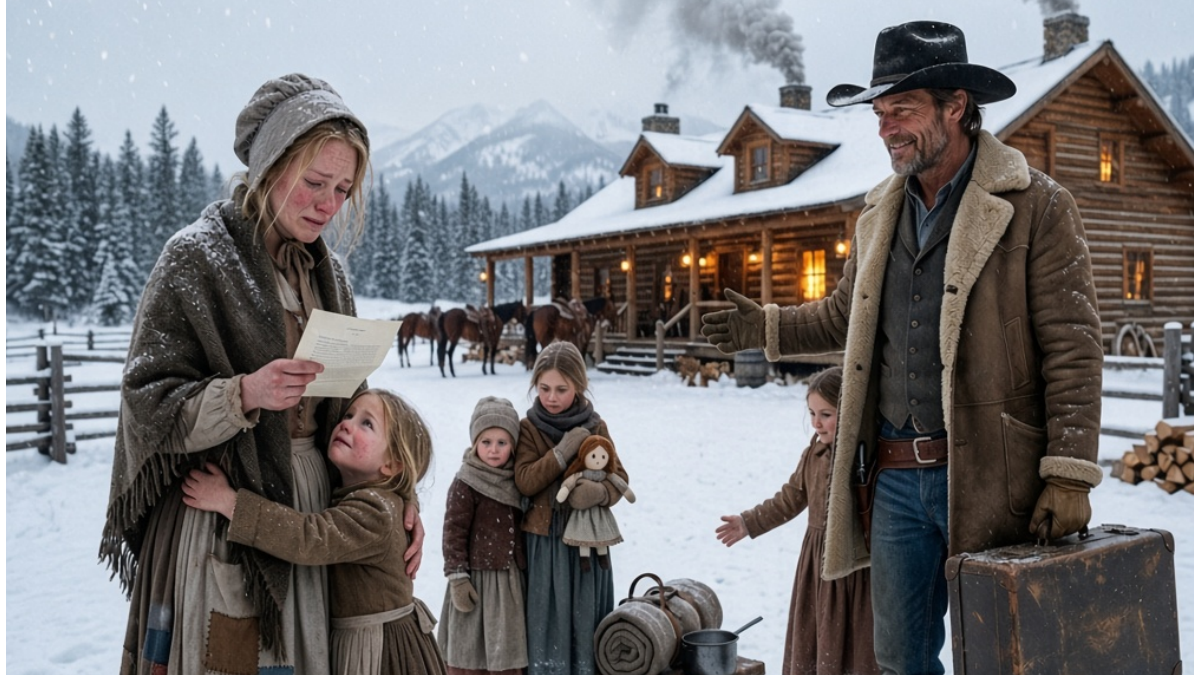
She stood at the iron gates and rags begging for work. But what the wealthy rancher offered changed everything.
Will you be the mother my girls need? Those words would either save her or destroy what little dignity she had left.
This is the story of Lydia Cain, a widow who had nothing, and Grant Mercer, a man who had everything except hope.
Stay until the end to see how one desperate moment transformed into something extraordinary. And comment your city below so I can see how far this story reaches across the world.
The dust rose in angry swirls around Lydia Kane’s worn boots as she stumbled toward the gates of Sterling Ridge Ranch.
Each step felt like dragging chains, chains forged from loss, poverty, and a crushing weight of shame that had become her constant companion.
The Colorado sun beat down mercilessly on this autumn day in 1885, turning the world into shimmering waves of heat that made everything feel like a fever dream.
But this was no dream. This was survival, raw and desperate. Her dress, if it could still be called that, hung from her thin frame in tatters.
Once a respectable brown cotton day dress, it was now a patchwork of tears and stains, the hem caked with the dirt of a 100 miles walked.
Her shawl, threadbear and motheaten, provided neither warmth nor dignity. She clutched it around her shoulders anyway, as if the gesture itself could hold together the pieces of the woman she used to be.
Lydia paused 50 yards from the entrance, her breath coming in ragged gasps. The ranch sprawled before her like a kingdom from another world, a world she no longer belonged to.
The main house stood three stories tall, painted pristine white with forest green shutters that gleamed in the sunlight.
Wraparound porches embraced the structure on two levels, and she could see rocking chairs swaying gently in the breeze, as if ghosts of happiness still lived there.
Beyond the house, she counted at least four barns, their red paint fresh and bold.
Corral stretched in every direction, filled with horses that looked like they’d been brushed by angels.
Cattle dotted the distant hills, hundreds of them, maybe thousands. Water troughs sparkled. Fences stood straight and strong.
Everything about Sterling Ridge Ranch spoke of prosperity, order, and permanence. Everything she no longer possessed.
Lydia’s stomach clenched with hunger. She hadn’t eaten in 2 days, unless you counted the handful of wild berries she’d found yesterday that had left her sick and dizzy.
Her last real meal had been 4 days ago in the town of Prospect, where a kind bakery owner had given her stale bread in exchange for sweeping his storefront.
Before that, she couldn’t remember. The weeks since she’d lost everything had blurred into an endless march of putting one foot in front of the other, sleeping in abandoned wagons and beneath rocky overhangs and trying desperately to outrun the memories that haunted every step.
She had heard about Sterling Ridge Ranch from travelers on the road. They spoke of Grant Mercer, the widowerower who owned it.
A hard man, they said, but fair, rich beyond measure, but broken by the death of his wife 3 years prior.
He had two daughters, they told her, young girls growing up without a mother’s touch.
The ranch was always looking for help, or so the rumors went. But when Lydia had inquired in the last town, asking how to find work at Sterling Ridge, the response had been discouraging.
Mercer don’t hire just anyone. An old-timer had told her, looking her up and down with undisguised pity.
He’s particular. Wants people with references, people he can truSt. You look like he’d trailed off, but Lydia had understood.
She looked like exactly what she was, desperate, homeless, and alone. Still, she had nowhere else to go.
Winter was coming. She could feel it in the morning air and the way the aspens on the mountain sides had already begun turning gold.
She needed shelter. She needed food. She needed to stop running from the ghosts of her past, even if she could never escape them.
Taking a deep breath, Lydia forced her legs to move again. As she drew closer to the gates, she noticed a man standing in the shadow of the entrance, a steward by the looks of his clothing.
He wore clean dungarees and a pressed shirt, a wide-brimmed hat shading his face. “He’d been watching her approach,” she realized, probably for the last 10 minutes.
The thought made her skin crawl with humiliation. “State your business,” the steward called out when she was still 20 ft away.
His voice carried an edge of contempt that made her falter midstep. Lydia cleared her throat, trying to summon moisture into her parched mouth.
“I I’m looking for work, sir. I heard that Sterling Ridge might need help in the house.
The steward laughed, a short, ugly bark of sound. He stepped fully into the sunlight, and Lydia could see he was younger than she’d first thought, perhaps 30, with a narrow face and cold eyes.
Work? You? He looked her up and down with such obvious disdain that Lydia felt her cheeks burn.
Lady, we don’t hire vagrants here. Mr. Mercer runs a respectable operation. What do you think you could possibly offer?
I can clean, sir. I can cook. I can care for children. I’m willing to work hard, harder than anyone.
I just need You just need to move along, the steward interrupted, waving his hand dismissively.
We don’t need your kind here. Dust and desperation. That’s all you are. Sterling Ridge has standards.
The words hit like physical blows. Dust and desperation. Is that what she’d become? Lydia’s vision blurred with tears she refused to let fall.
She’d cried enough in the past months to fill rivers. She wouldn’t give this man the satisfaction of seeing her break.
She was about to turn away to add Sterling Ridge to the long list of places that had rejected her when a different voice cut through the air like a knife through silk.
That’s enough, Patterson. Lydia’s head snapped up. A man had emerged from the house, tall, broad-shouldered, and commanding even from a distance.
He moved with the confident stride of someone who’d never had to question his place in the world.
His boots striking the ground with purpose as he crossed the yard toward the gate.
As he drew closer, Lydia could make out more details. Dark hair touched with gray at the temples, a strong jaw shadowed with stubble, eyes the color of storm clouds.
He wore simple ranchers clothing, dark trousers, a cream colored shirt with the sleeves rolled to his elbows, a leather vest that had seen years of use.
This had to be Grant Mercer. The steward Patterson immediately straightened, his expression shifting from sneering superiority to cautious respect.
“Mr. Mercer, sir, I was just sending this woman on her way. She came looking for work, but clearly she’s not.
I’ll decide what’s clear and what isn’t,” Grant said, his voice low and controlled. He stopped a few feet from Lydia, his gaze sweeping over her with an intensity that made her want to shrink back.
But she held her ground, lifting her chin despite the trembling in her limbs. Up close, she could see the lines of grief etched around his eyes, the hardness in his expression that spoke of a man who’d built walls around himself and didn’t let anyone through.
He was perhaps 40, maybe a year or two older, and handsome in a rough, weathered way, but there was no warmth in his face, no softness.
He looked like a man who’d forgotten how to smile. “You want work?” Grant asked, his voice flat and cold as winter stone.
“Yes, sir,” Lydia managed, proud that her voice didn’t shake. “I’m a hard worker. I have experience with housekeeping, cooking, and caring for children.
I don’t need much, just food and a place to sleep. I’ll work for whatever you think is fair.”
Grant’s eyes narrowed. Experience where. This was the question Lydia had been dreading. How could she explain her past without revealing too much?
How could she make him understand without opening wounds that had barely begun to scar over?
“I kept house for my husband,” she said carefully. “We had a homestead in Kansas.
I cared for our home, our land, and our She couldn’t say it. Couldn’t speak of the baby she’d loSt. I managed everything.”
Had. Grant pressed, catching the past tense immediately. What happened? Lydia’s hands clenched in the folds of her ruined dress.
He died, sir. And the land there were debts. False debts, but I couldn’t prove it.
They took everything. The words felt like pulling teeth, each one painful and bleeding. She watched Grant’s face for any sign of sympathy, but his expression remained stony and unreadable.
So, you’re a widow, he stated, not a question. Alone, penniless. And you came here hoping for charity.
Not charity, Lydia said quickly, finding a spark of fire beneath her exhaustion. Work. I’ll earn my keep.
I don’t expect handouts. Everyone expects something, Grant said. But there was a strange note in his voice now.
Not quite bitter, but close to it. He studied her for a long moment and Lydia had the uncomfortable feeling he was seeing straight through her past the rags and the dirt to the broken woman beneath.
Finally, he spoke again. Patterson tells me you mentioned caring for children. Yes, sir. I have experience.
My daughters, Grant said slowly, as if the words cost him something. Lost their mother 3 years ago.
They’ve had governnesses, housekeepers, and more than their share of well-meaning women trying to fill that void.
None of them lasted. Clara, she’s nine, doesn’t trust easily. And Rosie, she’s only five.
She barely remembers her mother anymore. Lydia heard the pain beneath his words. The carefully controlled grief of a father watching his children grow up without the one thing he couldn’t give them.
Her heart achd in recognition. She knew that kind of loss. She knew what it meant to fail the people you loved moSt. Mr. Mercer, she said softly.
I know I don’t look like much. I know you have no reason to trust me, but I understand loss.
I understand what it means to wake up every day in a world that doesn’t make sense anymore.
And I understand children who’ve been hurt. She swallowed hard. I lost a son, sir.
He was just 2 years old. I couldn’t save him from the fever that took him.
And 6 months later, I couldn’t save my husband from the grief that consumed him.
But if you give me a chance, I swear I’ll do everything in my power to give your daughters the care they need.
The silence that followed felt eternal. Grant’s face had gone completely still, his eyes locked on hers with an intensity that made her heart hammer.
Patterson shifted uncomfortably beside the gate, clearly uncertain whether to intervene. When Grant finally spoke, his voice had changed.
Still hard, still controlled, but with something else beneath it. Something almost like recognition. I don’t do charity, he said.
And I don’t make promises I can’t keep, but I’ll offer you this. You can stay.
No pay, just food and shelter. You’ll work in the house, care for my daughters, and prove you’re worth more than the dust on your shoes.
You fail, you leave. You prove yourself a liar or a thief, you leave. You do anything to hurt my girls.
He let the threat hang unfinished, but the steel in his eyes completed it clearly enough.
I understand, Lydia whispered. One more thing, Grant continued, his gaze never wavering. You earn your place here, Miss Cain.
Every single day. This isn’t a home for you. It’s a proving ground. My daughters need more than a servant.
They need someone who will care for more than herself. Someone who will put them first no matter what.
Can you do that? Lydia thought of her son’s face forever frozen at 2 years old in her memory.
She thought of her husband, of the homestead they’d built together, of everything she’d loSt. And she thought of the emptiness that had consumed her since, the purposeless drift from town to town, the slow death of hope.
“I’ll give them all I have left,” she said, and meant it with every fiber of her being.
Grant studied her for another long moment, then gave a sharp nod. Patterson, open the gate.
The steward looked like he’d swallowed something sour, but he obeyed, swinging the iron gates wide.
Lydia stepped forward on trembling legs, crossing the threshold into Sterling Ridge Ranch. Behind her, the gates swung closed with a final decisive clang.
She didn’t look back. She couldn’t afford to. As Grant turned to lead her toward the house, he glanced back over his shoulder.
You’ll start immediately. Mrs. Fletcher, the head housekeeper, will show you to your quarters and explain your duties.
Breakfast is at 6:00, lunch at noon, dinner at 6:00. You’ll take your meals in the kitchen with the other staff.
Questions? No, sir. Good. And Miss Cain? He stopped walking, forcing her to stop as well.
When she met his eyes, she saw a warning there, clear and unmistakable. My daughters have been through enough.
They don’t need another person walking into their lives and then leaving. If you’re going to run, do it now.
Once they start to trust you, once they start to care, I won’t forgive you for breaking their hearts.
Do you understand? Lydia understood perfectly. This wasn’t just about proving she could clean a house or cook a meal.
This was about proving she could stay, could commit, could become something permanent in a world that had taught these girls that nothing lasted.
“I won’t run,” she said. “I promise you that.” Grant’s expression didn’t soften, but something in his eyes shifted, a barely perceptible easing of the rigid control.
“We’ll see,” he said simply, and continued walking. The main house loomed larger with every step, and Lydia felt the weight of what she’d just agreed to settle over her shoulders.
She was about to enter the lives of two broken little girls and their hardened father.
She would sleep under their roof, eat their food, and try to earn a place in a family that had already learned the hard way not to let anyone in.
As they climbed the steps to the front porch, the door opened, and a stout woman in her 50s emerged, wiping her hands on her apron.
She had gray hair pulled back in a severe bun, sharp eyes, and the nononsense bearing of someone who ran a tight ship.
“Mrs. Fletcher,” Grant said. “This is Miss Cain. She’ll be helping with the girls in the house.
Get her settled.” Mrs. Fletcher’s gaze rad over Lydia with professional assessment, taking in every detail of her appearance.
Lydia braced herself for another dismissal, another round of dust and desperation. Instead, the housekeeper simply nodded.
Follow me, girl. First things firSt. You need a bath, clean clothes, and some food in your belly.
Can’t have you looking like a scarecrow around the children. The unexpected kindness in those practical words nearly undid Lydia’s composure.
She blinked rapidly, willing the tears away. “Thank you,” she whispered. Mrs. Fletcher snorted. “Don’t thank me yet.
You haven’t met Clara and Rosie. Those girls will test you six ways to Sunday.
If you last a week, then you can thank me. As the housekeeper led her into the cool dimness of the house, Lydia caught one last glimpse of Grant Mercer.
He stood on the porch, his broad back to her, hands on his hips as he surveyed his land.
For just a moment she saw past the hardness to the loneliness beneath, a man standing alone in a kingdom that felt empty despite all its wealth.
Then Mrs. Fletcher pulled her deeper into the house, and the moment was gone. The interior of Sterling Ridge was even more impressive than the exterior.
Polished wood floors gleamed beneath Turkish rugs. Photographs and silver frames lined the walls. A beautiful woman with laughing eyes appeared in many of them, always surrounded by the same two girls at various ages.
The late Mrs. Mercer, Lydia realized the ghost that haunted this house. “That’s Margaret,” Mrs. Fletcher said, noticing Lydia’s gaze.
“Di pneumonia three winters ago. Came on faSt. She was laughing at breakfast one day, gone within the week.
Mr. Mercer, she shook her head. Well, he’s not been the same since. None of them have.
They climbed a narrow staircase, the servant’s stairs, Lydia guessed, and emerged on the second floor.
Mrs. Fletcher led her down a plain hallway to a small room at the end.
It was simple but clean. A narrow bed with a patchwork quilt, a wash stand with a chipped basin, a wooden chair, and a small window overlooking the back pastures.
To Lydia, it looked like paradise. “This is yours,” Mrs. Fletcher said. “I’ll have hot water sent up.
There’s soap and a towel in the cabinet. I’ll bring clothes.” “You look about the size Margaret was.”
She caught Lydia’s expression and softened slightly. “Don’t fret about it, girl. The clothes are just sitting in trunks, doing no one any good.
Margaret would have wanted them used. After Mrs. Fletcher left, Lydia sank onto the edge of the bed, her body suddenly too heavy to hold upright.
She was inside. She was safe, at least for tonight. But safety came with a price.
The promise she’d made to Grant Mercer, the vow that she wouldn’t run, that she would be what his daughters needed.
Could she keep that promise? Could she open her heart again, knowing how much it hurt to lose what you loved?
She didn’t have time to find answers. Within minutes, a young maid appeared with buckets of steaming water, followed by Mrs. Fletcher carrying an armload of clothes and a tray of food, bread, cheese, cold chicken, and apple slices.
Eat first, the housekeeper ordered. Then wash. I’ll be back in an hour to take you to the girls.
Alone again, Lydia ate mechanically, barely tasting the food despite her desperate hunger. Her mind kept circling back to Grant Mercer’s words.
You earn your place here, Miss Cain, every single day. She finished the meal, then stripped off her ruined clothes and sank into the tin tub that had been filled with hot water.
The heat stung her cold skin, and she had to bite her lip to keep from crying out.
As she scrubbed away weeks of dirt and despair, she watched the water turn gray, then brown.
When she finally emerged, wrapped in a rough towel, she felt almost human again. The clothes Mrs. Fletcher had brought were simple but well-made.
Two-day dresses in dark blue and gray, a night gown, undergarments, stockings, and a pair of shoes that were only slightly too large.
Lydia dressed in the gray dress, running her hands over the soft cotton with something close to reverence.
She couldn’t remember the last time she’d worn something that wasn’t falling apart. True to her word, Mrs. Fletcher returned exactly 1 hour later.
She gave Lydia an approving nod. Better. Much better. Now come. The girls are in the nursery.
They’ve been told you’re coming. Lydia’s stomach nodded with sudden nerves. This was it. This was the moment that would determine whether she’d truly found sanctuary or just another temporary stopping point before the next rejection.
The nursery was on the second floor in the family wing of the house. As they approached, Lydia could hear voices, a woman’s patient tone, and then a child’s sharp retort.
Mrs. Fletcher knocked once, then pushed open the door. Miss Adelaide, this is Miss Cain.
She’ll be helping with Clara and Rosie from now on. The woman inside Miss Adelaide, presumably the current governness, looked up with barely concealed relief.
She was perhaps 25, pretty but tired, with the frazzled air of someone at the end of their rope.
Two girls sat at a table by the window. The older one, Clara, had her mother’s dark hair and her father’s storm gray eyes set in a face that was trying desperately to be grown up and hard.
The younger one, Rosie, was fair-haired and delicate with huge blue eyes that watched everything with an unsettling intensity.
“Oh, thank goodness,” Miss Adelaide said. “I was just Clara, sit down.” But Clara had already stood, her arms crossed over her chest as she stared at Lydia with undisguised hostility.
“We don’t need another one,” she announced. The last lady said she was going to stay forever, and she left after 2 weeks.
The one before that lasted 5 days. Clara,” Mrs. Fletcher said warningly. “It’s true.” The girl’s voice cracked with emotion she was trying desperately to hide.
“They always leave. We don’t need anyone. Rosie and I are fine by ourselves.” Lydia’s heart twisted.
She recognized that defiance, that desperate attempt to protect yourself by rejecting others before they could reject you.
She’d felt it herself every single day since she’d lost her family. She knelt down slowly, bringing herself to Clare’s eye level.
The girl tensed as if preparing for a lecture or empty promises. “You’re right,” Lydia said quietly.
“People do leave, and I’m sure that hurts terribly. I would never insult you by promising I’ll stay forever because you’re smart enough to know that no one can promise that.”
Clara blinked, clearly thrown off balance by Lydia’s honesty. “But I can promise you this,” Lydia continued.
Every day I’m here, I’ll show up. Everyday I’ll do my beSt. And if I do have to leave someday, it won’t be because you weren’t worth staying for.
Do you understand? Clara’s eyes shimmerred with tears. She was fighting back. You’re just like all the others, she whispered.
You’ll get tired of us and go away. Maybe, Lydia admitted. Or maybe you’ll surprise yourself and decide you like having me around.
Either way, we won’t know unless we try. For a long moment, Clara just stared at her.
Then, almost imperceptibly, her shoulders relaxed a fraction. She didn’t smile, didn’t welcome Lydia with open arms, but she didn’t run away either.
“Fine,” she said finally. “But don’t expect me to call you mother or anything stupid like that.”
“I wouldn’t dream of it,” Lydia said gently. “You already had a mother. No one can replace her.”
Something in Clara’s face crumpled briefly before she rebuilt her walls. She sat back down at the table, picking up a book and pretending to read, though Lydia could see her hands shaking.
Lydia turned her attention to the younger girl, who had been watching the entire exchange in silence.
Rosie hadn’t moved from her chair, but her eyes were enormous, taking in every detail of this new stranger in her world.
“Hello, Rosie,” Lydia said softly, not approaching. “That’s a beautiful doll you have there.” Rosie clutched the doll tighter to her cheSt. a porcelainfaced creation in a blue dress.
“Her name is Emma,” she whispered. “She was Mama’s when Mama was little.” “She’s lucky to have you taking care of her,” Lydia said.
“I can tell you’re very gentle with her.” Rosie considered this, then slowly climbed down from her chair.
She walked to where a stack of books sat on a low shelf and selected one, bringing it back, but stopping several feet from Lydia.
“Can you read?” She asked, her voice barely audible. Yes, I can. Miss Adelaide says her throat hurts.
Can you read to me? It was a test, Lydia realized. A small offering of trust, fragile as spun glass.
I would be honored, she said. She settled into the rocking chair near the window, and after a moment’s hesitation, Rosie climbed into her lap, still clutching Emma the doll.
The weight of the small body against hers hit Lydia like a physical blow so similar to holding her own son and yet so different.
But she forced herself to breathe through the pain, to open the book, to begin reading in a steady voice.
Within minutes, Ros’s head was resting against Lydia’s shoulder, completely relaxed in a way that suggested the child was starved for physical affection.
From across the room, Lydia felt Clara’s eyes on her, watching, assessing, waiting to see if this new woman would be like all the others.
Miss Adelaide excused herself quietly, murmuring something about needing to speak with Mrs. Fletcher. The door clicked shut, leaving Lydia alone with the two girls.
She read for an hour, maybe more, until Rosie fell asleep in her arms, and Clara’s pretense of reading devolved into simply staring out the window.
When Lydia finally closed the book, Clara spoke without looking at her. “Papa said, “You’re here because you need work.
That you don’t have anywhere else to go.” “That’s true,” Lydia admitted. There was no point in lying to this perceptive child.
“So, you might leave if you find something better.” “CL,” Lydia said gently, “I don’t think there is anything better than this.
A warm house, good food, and two smart girls who need someone. That’s more than I could have hoped for.”
Clara finally turned to look at her, those gray eyes so much like her father’s.
Do you have children? Real ones, I mean. The question hit like a knife to the ribs.
Lydia fought to keep her voice steady. I had a son. He died when he was very young.
Oh. Clara’s face softened with understanding beyond her years. That’s why you look sad sometimes, even when you’re smiling.
Out of the mouths of babes. Lydia blinked back tears. “Yes, that’s why.” “I’m sorry your little boy died,” Clara said, and the simple compassion in those words cracked something open in Lydia’s cheSt. “And I’m sorry you lost your mother,” Lydia replied.
“It’s not fair, is it? The way the people we love most can just disappear.”
“No,” Clara whispered. “It’s not fair at all.” They sat in silence for a while, Rosie sleeping peacefully between them.
The afternoon sun slanting through the windows and painting everything gold. It wasn’t acceptance, not yet, but it was something.
A fragile beginning, the first tenuous threat of connection. When Mrs. Fletcher came to fetch her for dinner preparations, Lydia carefully transferred Rosie to her bed, tucking the little girl in with Emma, the doll.
Clara pretended not to watch, but Lydia saw her following every movement. “I’ll see you tomorrow,” Lydia told them softly.
Clara didn’t respond, but as Lydia reached the door, the girl spoke. “Miss Cain?” “Yes, you’re different from the others.
I don’t know if that’s good or bad yet.” Lydia smiled. “I guess we’ll find out together.”
That night, lying in her narrow bed in the small room that was now hers, Lydia stared at the ceiling and thought about the strange turn her life had taken.
This morning, she’d been a woman with nothing, turned away from yet another door. Tonight she had a roof over her head, food in her belly, and the weight of two young lives beginning to rest in her hands.
Grant Mercer’s words echoed in her mind. “You earn your place here, Miss Cain. Every single day, she would earn it,” she vowed silently.
“Not just for the shelter and food, but for something more important, the chance to matter again.
The chance to fill the aching void inside her with purpose. The chance to be needed.”
Outside her window, the ranch settled into darkness. Somewhere in the house, those two girls were sleeping, surrounded by ghosts and grief.
And somewhere, their father was carrying the weight of keeping everything together while slowly crumbling inside.
Lydia closed her eyes and whispered a prayer, the first real prayer she’d managed since losing everything.
Not a prayer for herself, but for them. For Clara with her brittle walls. For Rosie with her desperate need for affection.
For Grant with his lonely burden. And for herself, just one small requeSt. The strength to stay.
The courage not to run when things got hard. The wisdom to know how to help these broken people without breaking herself in the process.
Asleep finally claimed her. Exhausted and tentative, Lydia Cain didn’t know that she was about to face the hardest fight of her life.
She didn’t know about the threats that would come, the poison that would nearly kill her, or the accusations that would almost destroy everything.
But she’d made a promise at those iron gates, and she intended to keep it, no matter what it coSt. The woman who had arrived in rags, begging for work, was about to discover that the rancher’s question, “Will you be the mother my girls need?”
Was both an offer and a challenge that would test every ounce of strength she had left.
And the test was only beginning. Dawn came to Sterling Ridge Ranch like a whisper, pale light creeping across the mountains and spilling into the valleys below.
Lydia woke to unfamiliar sounds, the lowing of cattle in distant pastures, the creek of wagon wheels on hardpacked earth, men’s voices calling to each other as the ranch stirred to life.
For a disoriented moment, she didn’t know where she was. Then memory flooded back. The iron gates, Grant Mercer’s cold challenge, Clara’s suspicious eyes, Rosy’s small weight in her lap.
She sat up, her body aching from yesterday’s long walk, but her mind sharp with purpose.
Through her small window, she could see the sky turning from gray to gold. The clock on her wash stand read 4:30.
Breakfast wasn’t until 6:00, but Lydia had learned long ago that earning your place meant being awake before you were needed.
She dressed quickly in the blue cotton dress, braided her hair, and made her way down the servant stairs.
The house was still mostly silent, though she could hear movement from the kitchen below.
When she entered, she found Mrs. Fletcher already there kneading dough with strong, practiced hands.
The housekeeper looked up in surprise. “You’re up early,” she said, though approval flickered in her eyes.
Couldn’t sleep. “Thought I’d make myself useful,” Lydia replied. “What needs doing?” Mrs. Fletcher studied her for a long moment, then gestured to a pile of potatoes.
“Those need peeling. Coffee needs making, and if you know how to make decent biscuits, there’s flour and butter in the pantry.”
Lydia rolled up her sleeves and got to work. Her hands remembered the rhythms, even though months had passed since she’d had a real kitchen to work in.
Peel, slice, rinse, measure, mix, knead. The simple, repetitive motions were almost meditative, grounding her in this new reality.
As she worked, other staff began trickling in. A young maid named Sarah with freckles and a shy smile.
An older cook’s assistant called Tom, who moved with a limp, and Patterson, the steward from yesterday, who gave Lydia a cold look before taking his coffee outside.
Mrs. Fletcher saw the exchange and made a small disapproving noise in her throat. Don’t mind Patterson,” she said quietly.
“He’s been with Mr. Mercer since the beginning, and he’s protective. Takes his job too seriously sometimes.
Thinks he’s guarding the gates of heaven itself. He called me dust in desperation,” Lydia said, keeping her voice neutral.
“I I heard about that,” Mrs. Fletcher’s mouth tightened. He was out of line. But between you and me, girl, he’s seen a parade of women come through here claiming they wanted to help with those girls.
Some wanted Mr. Mercer’s money. Some wanted his name. Some just like the idea of playing mother without understanding the work it takes.
Not a one of them lasted more than a few weeks. I’m not like them, Lydia said quietly.
We’ll see. But there was less skepticism in Mrs. Fletcher’s tone. Now, actions prove what words can’t.
You show up every day. You do the work. You don’t complain. That’ll speak louder than any promises.
By the time 6:00 arrived, Lydia had helped prepare a breakfast that could feed an army.
Scrambled eggs, bacon, sausages, biscuits with gravy, fried potatoes, and fresh fruit. The dining room table was set for Mr. Mercer and the girls, while the kitchen table accommodated the house staff.
Ranch hands ate in the bunk house, Mrs. Fletcher explained. Lydia was carrying a platter of biscuits to the dining room when she heard footsteps on the stairs.
Light running steps that could only belong to children. She set the platter down just as Rosie came barreling into the room, still in her night gown, her blonde hair a wild tangle.
Miss Cain. The little girl’s face lit up with genuine delight. You’re still here. The words hit Lydia square in the cheSt. Of course, Rosie had expected her to disappear in the night like all the others apparently had.
She knelt down, bringing herself to the child’s level. “Of course I’m still here,” she said gently.
“I told you I’d see you today, didn’t I?” Rosie nodded solemnly, then launched herself forward, wrapping small arms around Lydia’s neck in a fierce hug.
Over the child’s shoulder, Lydia saw Clara standing in the doorway, watching with those two old eyes.
The older girl was already dressed, her hair neatly braided, her expression carefully neutral. Rosie, you’re not even dressed yet, Clara said, her tone mimicking adult exasperation.
Papa will be down any minute. I wanted to see if Miss Cain was real, Rosie said, pulling back from the hug, but keeping one hand firmly wrapped around Lydia’s fingers.
I thought maybe I dreamed her. “Well, I’m quite real,” Lydia assured her, smoothing down the child’s wild hair.
“But your sister’s right. We should get you dressed before breakfaSt. Come on.” She stood, letting Rosie lead her back upstairs.
Clara trailing behind them. In the nursery, Lydia helped Rosie into a simple dress and combed out the tangles in her hair while Clara sat on the bed, ostensibly reading, but clearly watching every interaction.
“Do you know how to do braids?” Rosie asked. “Mama used to make mine fancy with ribbons and everything.
Miss Adelaide just does regular ones.” “I can try,” Lydia said. “Though I have to warn you, I’m out of practice.”
She worked carefully, her fingers remembering skills she’d used on herself a lifetime ago. When she finished, Rosie ran to the mirror and gasped with delight.
“It wasn’t as elaborate as what her mother had probably done, but it was neat and pretty, with a blue ribbon woven through.”
“It’s beautiful,” Rosie breathed. “Can you do mine, too?” The question came from Clara so quietly Lydia almost missed it.
She turned to find the older girl looking at her with something close to hope, though she was trying hard to hide it.
“Of course,” Lydia said, as if it were the most natural request in the world.
Clara sat stiffly at first, but as Lydia’s fingers worked through her dark hair, the girl gradually relaxed.
“Mama had hair like mine,” she said softly. “Everyone says I look just like her.”
“That must be nice,” Lydia said, to carry a piece of her with you. Sometimes, sometimes it makes Papa sad to look at me.
I can tell, even though he tries to hide it. Lydia’s hands paused briefly, her heart aching for this child who carried such heavy knowledge.
“Grief is complicated,” she said carefully. “Your father loves you very much. If he’s sad sometimes, it’s not because of you.
It’s because he misses your mother. Those are two different things.” “I miss her, too,” Clara whispered.
“But I’m forgetting her. Her voice mostly. I try to remember what she sounded like, but it gets harder every year.
Lydia finished the braid and tied it with a ribbon that matched Clara’s green dress.
Then she turned the girl around and looked her straight in the eyes. Your mother lives in more than just memories, Clara.
She lives in the way you take care of your sister, in how smart and strong you are, in every kind thing you do.
Those parts of her will never fade. Clare’s eyes filled with tears, but she blinked them back furiously.
“We should go,” she said, her voice thick. “Papa doesn’t like us to be late for breakfaSt.” Downstairs, Grant Mercer was already seated at the head of the dining table, a newspaper spread before him, and a cup of black coffee at his elbow.
He looked up as they entered, his gaze moving from his daughters to Lydia with an expression she couldn’t quite read.
“Good morning, girls,” he said. “Miss Cain.” Good morning, Papa.” Rosie chirped, climbing into her chair.
“Look at my braid. Miss Cain made it pretty.” Grant’s eyes moved to Rosy’s hair, then to Clara’s, and something flickered across his face.
“Pain maybe, or memory.” “Very nice,” he said quietly. The girls chattered through breakfast while Grant remained largely silent, occasionally interjecting a question about their studies or plans for the day.
Lydia stood near the sideboard, ready to refill plates or fetch anything needed, but she couldn’t help observing the family dynamics.
Grant was present but distant, as if he were watching his daughters through a pane of glass.
The girls directed most of their conversation at each other, only occasionally trying to draw their father in.
It was a family functioning but not thriving, Lydia thought, going through the motions but missing some essential spark.
After breakfast, while the girls worked on their lessons with Miss Adelaide, Lydia threw herself into the work of the house.
She scrubbed floors until her knees achd, washed windows until they sparkled, dusted shelves that already seemed clean.
Mrs. Fletcher watched her with growing approval. “You don’t have to work yourself to death on the first day,” the housekeeper said around midm morning.
“I need to earn my place,” Lydia replied, echoing Grant’s words from yesterday. I But there’s earning your place and there’s burning yourself out.
Pace yourself, girl. This is a marathon, not a sprint. But Lydia couldn’t pace herself.
Some driven need inside her demanded that she prove her worth, that she become indispensable before anyone could decide she wasn’t needed.
She attacked every task with fierce determination, as if scrubbing hard enough could scour away her past failures.
By noon, when she went to help prepare lunch, she was exhausted but satisfied. The downstairs rooms gleamed.
Fresh flowers gathered from the kitchen garden brightened every table. The air smelled of beeswax and lemon oil instead of the mustiness that had lingered in corners.
Grant noticed when he came in for lunch, he paused in the entrance hall, his eyes sweeping over the changes.
“You’ve been busy,” he said, his tone neutral. “Just doing my job, Mr. Mercer,” Lydia replied.
He studied her for a long moment, then nodded once before heading to his study.
It wasn’t much, but Lydia felt a small glow of accomplishment. She was making a difference, however small.
The afternoon brought new challenges. Miss Adelaide knocked on the kitchen door around 2:00, looking harried and apologetic.
“I’m so sorry, Mrs. Fletcher, but I have a terrible headache. I’ve tried to push through, but I simply can’t continue the lessons.
Could someone I can help?” Lydia offered immediately. I can work with the girls on their studies.
Mrs. Fletcher and Miss Adelaide exchanged glances. Can you read? Well, the governness asked. Clara is quite advanced for her age, and she gets frustrated if someone can’t keep up with her.
I can read, Lydia assured her. And I had some schooling myself. I won’t be perfect, but I can manage an afternoon.
Bless you, Miss Adelaide said fervently. They’re working on arithmetic and reading comprehension. The books are all laid out in the schoolroom.
The school room turned out to be a bright, airy space on the second floor, lined with bookshelves and featuring a large chalkboard on one wall.
Clara and Rosie looked up when Lydia entered. Clara with suspicion, Rosie with delight. Where’s Miss Adelaide?
Clara asked. She’s not feeling well, so I’ll be helping you finish your lessons today.
Lydia explained. What are you working on? Arithmetic, Clara said, her tone suggesting this was a teSt. Long division.
It’s very complicated. Lydia came over and looked at the problems written in Clara’s careful hand.
They were indeed complex for a 9-year-old, but nothing Lydia couldn’t handle. These look good, she said, checking Clara’s work.
You made one small error here. See, when you carried the remainder, you forgot to.
I did not, Clara snapped, then looked closer. Her cheeks flushed. Oh, you’re right. It’s an easy mistake, Lydia said gently.
Want to try the next one? For the next two hours, Lydia worked with both girls on their studies.
Rosie needed help with her letters, tracing them carefully while Lydia guided her hand. Clare pushed through increasingly difficult arithmetic problems, occasionally glancing at Lydia as if expecting her to give up and admit she was in over her head.
But Lydia had always been good with numbers, and she found herself genuinely enjoying the challenge of explaining concepts in ways the sharp young mind could grasp.
You’re good at this, Clare admitted grudgingly as they finished. Most of the others couldn’t help with my math.
They just told me to wait for Miss Adelaide. Well, I used to help manage accounts for our homestead, Lydia said.
You have to be good with numbers when you’re trying to make a farm turn a profit.
Did you? Clara asked. Turn a profit? I mean, Lydia’s smile turned sad. Some years, others were harder.
That’s the way of farming. You’re always at the mercy of weather and luck. And now you’re here, Clara said, watching her carefully.
Do you hate it being a servant instead of running your own place? It was a perceptive question, cutting right to something Lydia had been trying not to think about.
I don’t hate it, she said honestly. It’s different, certainly, but there’s dignity in any honest work.
And I’d rather be here helping your family than out there with nowhere to go.
Clara processed this, then nodded slowly. Papa says honest work is nothing to be ashamed of.
He says some people think they’re too good to get their hands dirty, but those are usually the people who’ve never had to work for anything.
Your father sounds like a wise man. He’s sad. Rosie piped up, looking up from her letters.
Papa is always sad now. Do you think he’ll ever be happy again? The question hung in the air, painful and profound.
Lydia crouched down beside the little girl. I think sadness is something we carry with us after we lose someone we love,” she said carefully.
“But that doesn’t mean we can never be happy again. It just means the happiness is different.
It has shadows in it. But shadows prove there’s still light.” “That’s pretty,” Rosie said.
“Did you make that up?” “Just now,” Lydia admitted. Clara was quiet, but Lydia could see her thinking, processing.
These girls were so starved for honest conversations about their grief, for acknowledgement that their world had changed and would never be the same.
Everyone probably tiptoed around it, trying to protect them, when what they really needed was someone who could sit with them in their sadness and not try to fix it.
That evening, after helping Mrs. Fletcher prepare and serve dinner, Lydia was exhausted, but determined to see the day through properly.
She asked if she could help get the girls ready for bed, and Mrs. Fletcher waved her toward the stairs.
Go on. Miss Adelaide is still nursing that headache. The girls could use someone to settle them down.
In the nursery, Lydia found Clara already in her night gown, reading by lamplight, while Rosie played with Emma the doll, having a quiet, elaborate conversation with the porcelain figure.
“Time for bed, little ones,” Lydia said gently. “I’m not little,” Clare protested automatically. But she marked her page and set the book aside.
Rosie, however, looked up with hopeful eyes. “Will you read to us like yesterday?” “If you’d like,” Lydia said.
“Yes.” Rosie scrambled into her bed, clutching Emma. After a moment’s hesitation, Clara climbed into hers as well.
Lydia settled between the two beds with a book of fairy tales and began to read.
Her voice was soft but clear, bringing the stories to life with subtle changes in tone for different characters.
Rosie was entranced, hanging on every word. Even Clara, who’d probably heard these stories a dozen times, seemed drawn in.
When Lydia finished the third tale, Rosie was already half asleep. Clara, however, was still watching her with those thoughtful gray eyes.
“Miss Cain,” the older girl whispered. “Yes, in the stories, the mothers always die or disappear.
Why is that?” Lydia set the book aside, giving the question the weight it deserved.
I don’t know, she admitted. Maybe because the people who wrote these stories understood that sometimes the hardest thing about growing up is learning that we can’t keep everything safe forever.
That loss is part of life. I hate that part of life, Clara said fiercely.
So do I, Lydia agreed. So do I. She was about to stand when Clara spoke again so quietly Lydia almost missed it.
Thank you for not lying to us. For not pretending everything is fine when it’s not.
“You’re welcome,” Lydia whispered back. She was tucking the blankets around Rosie when the door opened and Grant Mercer stepped in.
“He stopped short, clearly not expecting to find her there.” “Mr. Mercer,” Lydia said straightening.
“I was just finishing up. Miss Adelaide still wasn’t feeling well, so I offered to help.”
“Papa,” Rosie said sleepily. Miss Cain read us stories. Three whole stories. Grant’s expression softened as he looked at his younger daughter.
That was kind of her. He moved to Rosy’s bedside, bending to kiss her forehead.
Sweet dreams, little one. Love you, Papa. Rosie murmured, already drifting off. He moved to Clara’s bed next, and Lydia saw the tenderness break through his usual stern exterior.
“Good night, Clara Bear.” “Good night, Papa.” Clara hesitated, then added, “Miss Cain helped me with my arithmetic today.
She’s really smart.” Grant’s eyes flickered to Lydia. Surprise evident. “Is that so? She’s better at math than Miss Adelaide,” Clara continued.
“And she doesn’t treat me like I’m stupid when I make mistakes.” “I’m glad,” Grant said quietly.
He kissed Clara’s forehead as well, then straightened. “Sleep well.” Lydia dimmed the lamp and followed Grant out into the hallway, closing the door softly behind them.
They stood in the quiet corridor, and for a moment, neither spoke. Finally, Grant said, “You’ve made quite an impression on them, both of them.
They’re wonderful girls,” Lydia replied. “You should be very proud.” “I am.” He paused, seeming to struggle with something.
“I know I was harsh yesterday when you first arrived. I want you to understand.
You don’t need to explain, Lydia interrupted gently. You’re protecting your daughters. I would have done the same.
He studied her in the dim light of the hallway. Miss Adelaide says you managed their lessons better than she does.
That Clara actually enjoyed arithmetic for once. Clara’s brilliant. She just needs someone who can keep up with her mind.
It runs faster than most people’s. Something that might have been a smile ghosted across Grant’s face.
Yes, she’s like her mother that way. Margaret could solve problems in her head that would take me pencil and paper to work through.
It was the first time Lydia had heard him speak his late wife’s name without his voice going flat and cold.
Progress, maybe. I should let you rest, Grant said, stepping back. You’ve had a long day.
Mr. Mercer, Lydia called as he turned to go. He looked back. Thank you, she said simply.
For giving me a chance. He held her gaze for a long moment. Prove me right, Miss Cain.
Prove that I didn’t make a mistake. Then he was gone, his boots echoing down the hallway toward his own room.
Lydia made her way back to her small room, her whole body aching with exhaustion.
But as she lay in bed, she felt something she hadn’t experienced in months. Purpose.
She’d gotten through one full day. She’d made progress with the girls. She’d shown Grant Mercer that she could handle the work.
One day down, she thought, “Just need to do it again tomorrow, and the day after that, and the day after that.”
The days began to blur together in a rhythm that was both exhausting and oddly comforting.
Lydia rose before dawn, helped prepare breakfast, worked on the house, supervised the girls lessons, helped with dinner, and got the children ready for bed.
Then she would collapse into her narrow bed, sleep for a few precious hours, and wake to do it all again.
But something was shifting in the household. After a week, even Patterson began to nod at her in grudging acknowledgement.
Sarah, the young maid, started seeking out Lydia’s company during breaks, chattering about her family and asking shy questions about Lydia’s paSt. Mrs. Fletcher began trusting her with more complex tasks, managing the pantry inventory, planning menus, even handling some of the household accounts.
And the girls, the girls were transforming. Rosie attached herself to Lydia like a small, affectionate shadow.
She followed her everywhere, chattering constantly, demanding stories and songs and attention. At first, Lydia worried it was too much, too fast, that the child was getting too attached.
But Mrs. Fletcher told her gently, “That little girl has been hungry for mothering since she was 2 years old.
Let her have what she needs.” Clara remained more guarded, but even she was softening.
She started leaving her books in places where Lydia would find them, a silent invitation to read together.
She asked Lydia’s opinion on her schoolwork, her ideas, her observations about the world. When Lydia praised her genuinely, Clare would flush with pleasure, though she tried to hide it.
Two weeks after Lydia’s arrival, something shifted in Clara during their afternoon lessons. They’d been working on a particularly challenging reading passage, discussing themes and meanings when Clara suddenly set down her pencil and looked at Lydia with unusual intensity.
“You’re not going to leave, are you?” The girl asked abruptly. Lydia chose her words carefully.
“I don’t plan to, Clara. I want to stay.” But you might have to anyway, like if Papa decides he doesn’t want you here anymore, or if something bad happens.
Those things are possible, Lydia admitted. But I’m not planning on going anywhere. This is my home now, as long as your father allows it.
Clara bit her lip, her eyes suspiciously bright. The others said that, too, but they lied.
I’m not lying, Lydia said firmly. Clara, look at me. When the girl did, Lydia continued, “I promise you if I ever have to leave, it won’t be because I want to, and I’ll make sure you know why.
No disappearing in the night. No unexplained goodbyes. Do you believe me?” Clara stared at her for a long moment, then nodded slowly.
“I think I do,” she whispered. Then, in a rush, as if the words had been building for weeks.
“I’m glad you’re here.” Rosie and I both are, even if I don’t always show it.
Lydia’s throat tightened with emotion. I’m glad I’m here, too, sweetheart. It was the first time she’d used an endearment, and Clara didn’t flinch away from it.
Instead, she gave a small, real smile, the first Lydia had seen from her. That night, when Lydia was reading the bedtime story, Rosie interrupted to make an announcement.
“Miss Cain, when we say our prayers, can we say thank you for you?” If you’d like,” Lydia managed, her voice thick.
“We do,” Clara said quietly from her bed. “Right, Rosie.” “Right,” Rosie agreed enthusiastically. After the girls fell asleep, Lydia stayed for a moment, watching them in the soft lamplight.
These broken little souls who’d let her in despite every reason not to. These brave children who’d been hurt so badly, but still had the courage to try again.
She was about to leave when Grant appeared in the doorway again. It had become something of a routine.
He’d come say good night to the girls, and he and Lydia would exchange a few words in the hallway afterward.
Tonight, though, something was different. Grant lingered after saying good night to the girls, his expression troubled.
“Walk with me,” he said quietly. “We need to talk.” Lydia’s stomach clenched with sudden anxiety.
“Was this it? Had she failed some test she didn’t know she was taking? She followed him downstairs and out onto the front porch where the night air was cool and sweet with the scent of late autumn.
Grant stood at the railing looking out over his land. For a long time he didn’t speak.
Finally, he said, “You’ve been here 2 weeks.” “Yes, sir. You’ve exceeded every expectation I had.
The house runs more smoothly. The girls are happier. Truly happy. Not just going through motions.
Even Mrs. Fletcher says you’re the best help she’s had in years. Lydia waited, sensing there was a butt coming.
But, Grant continued, turning to face her, I need to know this is sustainable, that you’re not just running on pure willpower that’s going to burn out.
I’ve seen people work themselves to exhaustion trying to prove something, and it never ends well.
I’m not going to burn out, Lydia said, though she wasn’t entirely sure that was true.
Miss Cain, Lydia, he said, and the use of her first name startled her. I see you.
I see you awake before dawn and up past midnight. I see you pushing yourself harder than anyone should.
I appreciate the dedication, but I need you to pace yourself. My daughters have already lost too much.
I won’t have them lose you because you worked yourself into the ground trying to earn a place you’ve already secured.
The words hit her like a physical blow. I’ve already secured it,” she repeated. Grant nodded.
“You’re not on trial anymore. The room is yours. The position is yours. You’re part of this household.
But that means I need you to take care of yourself so you can keep taking care of them.”
“Understood,” Lydia felt tears prick her eyes. “I just I needed to prove you’ve proven enough,” Grant said firmly.
“Now stop trying to be perfect and just be present. That’s what they need, what we all need.
It was the most he’d spoken to her in one conversation and the most emotion she’d heard in his voice.
They stood in silence for a moment, the night settling around them. “Thank you, Mr. Mercer,” Lydia finally said.
“Grant,” he corrected quietly. “When it’s just us, you can call me Grant.” She nodded, not trusting her voice.
“One more thing,” Grant added, his tone softening further. “Tomorrow is Sunday. We don’t work as much on Sundays, just essential tasks.
I’d like you to take the afternoon for yourself. Go into town if you’d like, or just reSt. You’ve earned it.
What about the girls? They’ll manage for a few hours with Miss Adelaide and me, Grant said dryly.
I’m not completely helpless. That night, Lydia lay in bed, replaying his words. You’re part of this household.
She’d done it. She’d proven herself. She’d found a place to belong. But even as relief washed over her, a small voice in the back of her mind whispered a warning.
Things were going too well. Life had taught her that when everything seemed stable, that’s when the ground beneath your feet was most likely to crack open.
She pushed the thought away, unwilling to let anxiety steal this moment of peace. Tomorrow would come soon enough with whatever challenges it brought.
Tonight she would simply allow herself to feel grateful. Outside her window, Sterling Ridge Ranch slept peacefully under a blanket of stars, unaware that danger was already beginning to circle, that enemies were watching, waiting for the perfect moment to strike.
But for now, in this quiet hour, Lydia Cain had found something she’d thought she’d lost forever.
A home, a purpose, and the fragile, precious hope that maybe, just maybe, she could start building a life again.
The silent battle for belonging was far from over. But tonight at least, she’d won a significant victory.
And in the rooms down the hall, two little girls slept more soundly than they had in years, secure in the knowledge that when they woke up, the woman who’d promised to stay would still be there.
That promise would be tested far more than any of them knew. The following weeks brought a warmth to Sterling Ridge that had nothing to do with the weather.
October gave way to November, and the first real cold began settling into the Colorado valleys.
But inside the ranch house, something was thawing. Lydia watched it happen with a mixture of wonder and cautious hope.
The way Ros’s laughter came more easily now, the way Clara sometimes forgot to guard her smiles, the way even Grant seemed to carry his grief a little less heavily.
On a crisp morning 3 weeks after her arrival, Lydia was in the kitchen garden teaching the girls how to prepare the beds for winter.
The garden had been neglected for years, Mrs. Fletcher had told her sadly ever since Margaret died.
But Lydia had been slowly coaxing it back to life. And now Clara and Rosie knelt beside her in the cold earth, their hands dirty and their cheeks flushed with exertion.
“Why do we have to cover everything if nothing’s growing?” Rosie asked, patting down straw around the base of a dormant rose bush.
“Because the plants are sleeping,” Lydia explained. “And just like you need blankets when you sleep, they need protection from the harsh winter.
Come spring, they’ll wake up stronger because we took care of them now. Like how you take care of us, Rosie said matterofactly, and Lydia’s heart squeezed.
Clare looked up from where she was spreading mulch. Mama used to love this garden.
She had roses everywhere, red ones, pink ones, even yellow ones that smelled like lemons.
We’ll bring them back, Lydia promised. Every single one. This garden will bloom again, Clara.
You’ll see. From the porch, Grant stood watching them, his coffee growing cold in his hand.
He’d been doing that more often lately, pausing in his work to observe these small moments of normaly.
His daughters laughing, their hands dirty from honest work. The sound of a woman’s voice mixing with theirs, gentle and patient, and present.
Patterson approached from the barn, his expression sour as always. Mr. Mercer, there’s a rider coming up the main road.
Looks like Elias Langley. Grant’s jaw tightened. Langley. The name alone was enough to spoil his mourning.
Elias Langley owned the neighboring spread, twice the size of Sterling Ridge, but half as productive.
The man had been trying to buy Grant out for years, making increasingly aggressive offers, each one insulting in its implication that Sterling Ridge was somehow failing.
“What does he want now?” Grant muttered. “Nothing good,” I’d wager, Patterson replied. Man’s got the devil’s own timing, always showing up when it’s least convenient.
Grant sat down his coffee cup and descended the porch steps just as Langley rode through the gates on a glossy black stallion that probably costs more than most men made in a year.
Langley himself was dressed in expensive riding clothes, his silver hair pomated back, his mustache waxed to sharp points.
He smiled as he dismounted, but the expression never reached his eyes. “Grant,” he called out jovially.
Beautiful morning, isn’t it, Langley? Grant replied coolly. What brings you to Sterling Ridge? Can a neighbor drop by for a friendly visit?
Langley’s gaze drifted past Grant to where Lydia and the girls worked in the garden.
His eyes lingered on Lydia, and something calculating flickered across his face. I see you’ve hired new help, pretty thing.
Where’d you find her? Grant’s hands clenched at his sides. “My household staff is none of your concern.”
“Of course, of course,” Langley said smoothly. “I only meant it’s good to see life returning to Sterling Ridge.
The place has been rather melancholy since Margaret passed. God rest her soul.” The false sympathy in his voice made Grant’s blood boil, but he kept his expression neutral.
“State your business, Elias.” Langley’s smile sharpened. Very well. I’ll be direct. I’m prepared to make you another offer for Sterling Ridge.
A generous one. $50,000 for the land, the stock, and all buildings. No. Don’t be hasty, Grant.
Think about it. You could take your girls somewhere easier, somewhere without all these memories.
Start fresh. I hear San Francisco is lovely. The answer is no, Grant repeated, his voice hard as iron.
Sterling Ridge isn’t for sale. Not now, not ever. Langley’s expression darkened briefly before he smoothed it back into false pleasantness.
You’re making a mistake. This land is too much for one man to handle, especially a man distracted by grief and children.
Sell to me now while my offer is fair. Your offer isn’t fair. It’s insulting, Grant said flatly.
Sterling Ridge is worth three times what you’re proposing, and we both know it. This conversation is over.
For just a moment, something ugly showed in Langley’s face. A flash of anger, of determination, of something darker that made Grant’s instincts scream warning.
Then it was gone, replaced by that oily smile. “Have it your way,” Langley said, swinging back onto his horse.
“But remember, Grant, stubbornness is a luxury men in your position can’t afford. When you change your mind, and you will, my offer won’t be as generous.”
He rode off without waiting for a response. His horse’s hooves kicking up dust that hung in the cold air like a threat.
Patterson spat on the ground. “That man’s got plans, Mr. Mercer. Bad ones. I don’t like the way he looked at the place.”
Or at Miss Cain. “Neither do I,” Grant admitted. “Keep an eye out, Patterson. If any of Langley’s men come around asking questions or causing trouble, I want to know immediately.
Yes, sir. But Grant couldn’t shake the unease that had settled over him like a cold fog.
Langley had been persistent before, but there had been something different this time, a certainty in his manner that suggested he knew something Grant didn’t, as if he were already counting Sterling Ridge as his, just waiting for the right moment to take it.
In the garden, Lydia had noticed the visitor, but thought nothing of it until she saw Grant’s face after the man left.
The tension in his shoulders, the way his hands stayed clenched even as he walked back toward the house, it spoke of trouble.
“Girls, why don’t you go wash up for lunch?” She suggested. “I’ll finish here.” Clara looked like she wanted to protest, but something in Lydia’s tone made her nod and take Rosy’s hand.
As soon as they were out of earshot, Lydia approached Grant, who stood staring at the gate as if he could still see Langley’s retreating form.
“Is everything all right?” She asked quietly. Grant glanced at her, seeming to debate how much to share.
Finally, he said, “That was Elias Langley. Owns the property north of here. He’s been trying to buy Sterling Ridge for years, and you don’t want to sell.”
This is my daughter’s inheritance, Grant said, his voice rough with emotion. This is the land Margaret and I built together.
I’ll be damned before I let someone like Langley get his hands on it. Lydia nodded, understanding the fierce protectiveness in his voice.
She knew what it meant to lose everything, to have something precious torn away. Then we’ll make sure he doesn’t, she said simply.
Grant looked at her sharply. We This is my home too now, Lydia said, meeting his gaze steadily.
And those are my girls in there. If someone threatens this place, they threaten all of us.
Something shifted in Grant’s expression. Surprise, perhaps, or gratitude, or something more complicated that neither of them was ready to name.
“Thank you,” he said quietly. The days that followed were deceptively peaceful. Lydia continued her work with the girls, watching Clara master increasingly complex arithmetic, and Rosie slowly sound out her first complete sentences.
In the evenings, she’d sit with them by the fire, telling stories or teaching them songs her own mother had taught her long ago.
Grant began joining them more often, sitting in the leather chair by the hearth with a book in his lap, though Lydia noticed he spent more time watching them than reading.
Tell us about when you were little,” Rosie demanded one night, curled against Lydia’s side on the sofa.
“What do you want to know?” Lydia asked, braiding her fingers through the child’s soft hair.
“Everything. Did you have a mama and papa? Did you have any brothers or sisters?”
Lydia’s smile turned bittersweet. “I had both parents when I was very young, but they died when I was about Clara’s age.
My grandmother raised me after that.” “Were you sad?” Clare asked from her spot on the floor where she was supposedly working on needle point but was clearly listening intently.
Very sad, Lydia admitted. For a long time I thought I’d never be happy again.
But my grandmother was wise. She told me that sadness doesn’t replace happiness. It just lives alongside it.
You can be sad about what you lost and still find joy in what you have.
Grant’s eyes met hers across the room, and something unspoken passed between them. They both understood that particular truth too well.
“I’m glad you’re here now,” Rosie said sleepily. “Even if you were sad before.” “So am I, sweetheart,” Lydia whispered.
“So am I.” That night, after the girls were asleep, Lydia found Grant on the back porch, staring out at the dark shapes of the mountains against the starllet sky.
She almost turned back, not wanting to intrude, but he called out without looking. “Lydia, join me.”
She stepped out into the cold, wrapping her shawl tighter. Grant gestured to the chair beside his, and they sat in companionable silence for a moment.
“Thank you,” Grant said finally, for what you said to them tonight about sadness and happiness living together.
Margaret used to say something similar. She sounds like she was wise. She was. Grant’s voice was soft with memory.
She made everything better just by being in it. When she died, it felt like the sun went out.
I didn’t think, he stopped, his jaw working. I didn’t think any of us would find our way back to light.
But you are, Lydia said gently. Slowly, maybe. But you are. Grant turned to look at her, his expression vulnerable in a way she’d never seen.
Because of you, you brought something back to this house that I thought was gone forever.
Hope, warmth, life. Lydia’s breath caught. Grant, I’m not saying this to make you uncomfortable, he said quickly.
I just I needed you to know what you’ve done for my daughters, for this family.
There aren’t words adequate to thank you. You don’t need to thank me, Lydia said, her voice thick with emotion.
This place, these girls, they saved me as much as I might be helping them.
I have a purpose again, a reason to wake up every morning. That’s worth more than any wages could ever be.
They sat together in the darkness, neither quite willing to break the moment until the cold drove them finally inside.
November deepened into winter’s embrace. The first snow came one morning while the household still slept, blanketing Sterling Ridge in pristine white.
Rosy’s delighted squeals woke everyone, and soon both girls were bundled into coats and mittens, racing outside to make snow angels, while Lydia and Grant watched from the porch.
“Mama used to make snow angels with us,” Clara called out, her voice bright with memory instead of pain.
“She said they were real angels coming to visit.” “Then we’d better make lots of them,” Lydia called back.
So the angels feel welcome. She was about to join the girls when a wave of dizziness hit her so suddenly she had to grab the porch railing.
The world tilted, her vision graying at the edges. “Lydia,” Grant’s hand was on her elbow, steadying her.
“Are you all right?” “I’m fine,” she said automatically, though the dizziness was getting worse.
“Just stood up too faSt.” But it wasn’t just standing up too faSt. She’d been feeling off for days, a persistent queasiness, a bone deep exhaustion that sleep didn’t fix, occasional moments where her heart would race for no apparent reason.
She’d dismissed it as the change in weather, the demands of her work, anything but what her body was trying to tell her.
“You’re pale,” Grant said, his concern deepening. “When’s the last time you ate?” Lydia tried to remember.
She’d been so focused on getting breakfast ready for everyone else that she’d forgotten to eat herself.
Again, “I’ll have something at lunch,” she assured him. “You’ll have something now,” Grant said firmly, steering her back inside.
“Mrs. Fletcher, can you bring Miss Cain some breakfast in the sitting room and some tea?”
“Of course, Mr. Mercer,” Mrs. Fletcher said, her sharp eyes taking in Lydia’s palar with concern.
Grant settled Lydia in a chair by the fire and refused to let her get up until she’d eaten a full plate of eggs, bacon, and toast, plus two cups of tea.
The food helped, pushing back the dizziness and settling her stomach somewhat. But the worried look didn’t leave Grant’s face.
“If you’re not feeling better by tomorrow, I’m sending for the doctor,” he said. “That’s not necessary,” Lydia protested.
“I’m just tired.” “You’re running yourself ragged,” Grant countered. I told you to pace yourself, remember?
I am pacing myself, Lydia.” His voice was gentle but firm. I know you’re trying to prove you belong here, but you already do.
You don’t have to work yourself sick to earn your place. Before Lydia could respond, Clara burst into the room, snowcovered and breathless.
“Miss Cain, come make snow angels with us. Papa, you, too.” The moment of tension broke.
Grant sighed, but stood, offering Lydia his hand. Come on, the girls want angels. We’ll give them angels.
The afternoon dissolved into unexpected joy. Grant and Lydia joined the girls in the snow, making angels and snowmen, and engaging in a snowball fight that left everyone laughing and frozen.
Watching Grant play with his daughters, his face transformed by genuine happiness, Lydia felt something shift in her chest, something warm and terrifying that she wasn’t ready to examine.
That evening, after an early supper, the girls begged for hot chocolate and stories by the fire.
Mrs. Fletcher made her famous cocoa with real cream and a hint of cinnamon, serving it in delicate china cups that had belonged to Margaret.
As darkness fell outside and the fire crackled, Lydia found herself thinking, “This might be what real family felt like.
Not the family you’re born with, but the one you choose or that chooses you.”
She was helping Rosie with her cocoa when the dizziness returned stronger this time. The cup slipped from her hands, shattering on the floor.
“Lydia,” Grant was at her side instantly as she swayed. “I’m sorry,” she mumbled, confused by how the room was spinning.
I don’t know what. Her legs gave out. Grant caught her before she hit the floor, lifting her easily and carrying her to the sofa.
The girls crowded around, their faces white with fear. “Get the doctor!” Grant snapped at Patterson, who’d appeared in the doorway.
“Now, Grant, it’s probably nothing,” Lydia tried to say, but her tongue felt thick and clumsy.
“Just tired.” “This isn’t tired,” Grant said, his voice tight with barely controlled panic. Mrs. Fletcher, what did she eat today?
The housekeeper’s face had gone pale. Same as everyone else at supper. The beef stew.
Did anyone else feel sick? No, sir. Everyone’s fine. Grant’s jaw clenched. Then it was just her portion.
Someone tampered with her food. The accusation hung in the air, terrible and impossible. Mrs. Fletcher looked stricken.
That can’t be Mr. Mercer. I watched that pot like a hawk. No one went near it except me and Sarah.
“Where’s Sarah?” Grant demanded. “I’m here.” The young maid rushed in, her eyes wide with fear.
“What’s wrong with Miss Cain?” Lydia wanted to tell them they were overreacting, that she’d be fine, but her body had other ideas.
Her stomach cramped violently, and she curled onto her side, fighting nausea. Through her swimming vision, she saw Clara crying and Rosie clinging to her father’s leg.
Both girls terrified. Get them out of here, Grant said to Mrs. Fletcher. Take them upstairs now.
No, Clara sobbed. We want to stay with Miss Cain. Please, Papa, Rosie wailed. But Mrs. Fletcher was already hurting them toward the door, murmuring reassurances that Lydia knew the girls didn’t believe, because Lydia didn’t believe them either.
Something was very wrong, and they all knew it. The doctor, when he finally arrived an hour later, was a gruff man in his 60s named Dr. Harrison.
He examined Lydia thoroughly while Grant paced the room like a caged animal, his face a mask of controlled fury and fear.
“It’s poison,” Dr. Harrison announced grimly. “I’d stake my reputation on it. Given the symptoms, nausea, dizziness, rapid heartbeat, I’d say Belladonna, deadly nightshade.”
Grant went absolutely still. Will she survive? If we act quickly, she needs to purge everything in her stomach, then activated charcoal and plenty of fluids.
It’s going to be a rough night, Mr. Mercer. But she’s strong, and she didn’t ingest too much.
If we’re lucky, he left the sentence unfinished, getting to work immediately. The next hours were a nightmare.
Lydia drifted in and out of consciousness, her body racked with spasms as the doctor forced her to expel the poison.
Through it all, Grant stayed at her side, his face drawn with worry, his hand holding hers when the pain got too bad.
“Stay with me,” he whispered during one of her more lucid moments. “Please, Lydia, don’t you dare leave me.
Not you.” The desperation in his voice cut through her delirium. “The girls,” she managed to whisper.
“Need to see them.” “You’ll see them when you’re better,” Grant promised. “They’re safe. Mrs. Fletcher has them.
You just focus on fighting this. Someone did this. Lydia’s mind was clearing slightly, horror replacing the fog.
Someone poisoned me. I know. Grant’s voice was cold fury. And I’m going to find out who.
Dr. Harrison worked through the night. By dawn, Lydia’s fever had broken and her vital signs were stabilizing.
The doctor wiped his brow and nodded to Grant. She’ll make it, but she needs complete rest for the next few days.
No exertion, plenty of liquids, and someone should watch her constantly in case there are complications.
I’ll watch her myself, Grant said. Mr. Mercer, that’s not I said I’ll watch her myself, Grant repeated, his tone brooking no argument.
After the doctor left, Grant moved a chair beside the sofa where Lydia lay, wrapped in blankets and finally sleeping peacefully.
He sat down heavily, his head in his hands, and for the first time in years, Grant Mercer allowed himself to feel the full weight of his fear.
He’d nearly lost her. This woman who’d walked into his life just weeks ago and somehow become essential to it.
This woman who’d brought light back to his daughters, who’d made his house feel like a home again.
Someone had tried to take her away, and the thought filled him with a rage so profound it scared him.
Patterson appeared in the doorway, his expression grim. Found something, Mr. Mercer? You’re not going to like it.
Grant stood carefully, not wanting to wake Lydia. In the hallway, Patterson showed him a small glass vial, empty, but with residue inside.
Found it in the wood pile behind the kitchen. Someone hid it there recently. The wood around it hadn’t been disturbed by weather yet.
Can you trace it? Maybe, but there’s more. Patterson’s face darkened. One of the ranch hands, young, young fellow named Tom Briggs.
He left suddenlike last night, took his wages and cleared out. Mrs. Fletcher says he was the one who brought in the firewood yesterday.
Would have had easy access to the kitchen. Find him, Grant said, his voice deadly quiet.
I don’t care what it takes. Find him and bring him back here. Yes, sir.
But Mr. Mercer, Patterson hesitated. Briggs. He’s not smart enough to plan something like this on his own.
Someone put him up to it. Langley, Grant said, the name tasting like poison on his tongue.
That would be my guess. Man was mighty interested in Miss Cain when he visited, and he’s been sniffing around the ranch hands, asking questions, offering money for information.
Grant’s hands clenched into fists. Get me proof. I want evidence solid enough to bury him.
Consider it done. When Patterson left, Grant returned to his vigil beside Lydia. She stirred as the morning light grew stronger, her eyes fluttering open.
“Grant,” her voice was. “I’m here,” he said immediately, moving closer. “How do you feel?”
“Like I was trampled by horses,” she admitted weakly. “Did someone really poison me?” “Yes,” he couldn’t soften the truth.
“Belladonna, in your stew, Dr. Harrison saved your life.” Tears slipped down Lydia’s cheeks. Why would anyone want to hurt me?
Grant reached out, gently wiping away her tears. Because you’re important to this household, to my daughters, to me.
The admission cost him something. She could see it in his face. Someone wants to destabilize Sterling Ridge, and they saw you as a way to do it.
Langley, Lydia whispered, understanding dawning. Grant nodded. I believe so, but I can’t prove it yet.
I will though. I swear to you, Lydia. Whoever did this will answer for it.
The girls, Lydia said urgently, trying to sit up. They saw me collapse. They must be terrified.
They are, Grant admitted, gently pushing her back down. But Mrs. Fletcher told them you’re going to be fine.
They’ve been asking to see you every 10 minutes. Can they? Please, Grant. They need to see I’m alive.
He hesitated, clearly torn between wanting to protect them and understanding Lydia’s point. Finally, he nodded for a few minutes.
But you need rest, Lydia. Real reSt. Promise me you won’t push yourself. I promise.
When Clara and Rosie were finally allowed in, they rushed to Lydia’s side, crying and hugging her gently, as if afraid she might break.
Lydia held them as best she could, murmuring reassurances, telling them she was fine. She wasn’t going anywhere.
“Someone hurt you,” Clare said, her voice shaking. “Someone mean and horrible.” “But I’m getting better,” Lydia assured her.
“Thanks to your father and the doctor. I’m going to be just fine.” “What if they try again?”
Rosie whispered, her small face twisted with fear. Grant knelt beside the sofa, gathering both his daughters close.
“That won’t happen. I’m going to make absolutely certain of it. No one is going to hurt Miss Cain again.
No one is going to hurt any of us. It was a promise he intended to keep no matter what it took.
Over the following days, as Lydia slowly recovered her strength, Sterling Ridge transformed into a fortress.
Grant doubled the guards, vetted every staff member personally, and made it clear that any stranger on the property would be dealt with immediately.
Patterson’s investigation uncovered that Tom Briggs had indeed been paid by someone matching Langley’s description to cause trouble at Sterling Ridge, though Briggs had apparently fled the territory entirely once he realized he’d nearly committed murder.
Grant wanted to ride straight to Langley’s ranch and beat answers out of the man, but Patterson counseledled patience.
“We need real proof, Mr. Mercer. Right now, it’s just hearsay. We move too soon.
Langley disappears behind his money and lawyers. So Grant waited and watched and seethed with impotent rage.
Meanwhile, Lydia healed under his careful supervision. He insisted on being the one to bring her meals, to check on her progress, to sit with her during the long hours when she was too weak to do much but reSt. “You don’t have to do this,” Lydia protested one afternoon.
“You have a ranch to run.” The ranch can manage without me for a few days, Grant said, setting down a tray with soup and bread.
You’re more important. The words hung between them, loaded with meaning. Neither was quite ready to address.
Lydia looked down at her hands, her cheeks flushing. Grant, I need to tell you something about my paSt. He settled into the chair beside her bed where he’d spent so many hours lately.
I’m listening. And so Lydia told him everything about her husband, about the homestead in Kansas, about the baby boy who died of fever and the grief that had consumed them both after.
About the false debts manufactured by greedy men who wanted their land. About watching everything she’d built get stripped away piece by piece.
About the months of wandering, of slowly losing hope, of arriving at Sterling Ridge as a last desperate gamble.
When she finished, Grant was quiet for a long time. Finally, he said, “I’m sorry for all of it.
No one should have to endure what you went through.” “But it brought me here,” Lydia said softly.
“To this place, to your daughters. Maybe maybe all that loss was preparing me for this.
For them, for you.” Grant’s eyes met hers, and in them Lydia saw her own carefully guarded feelings reflected back.
Fear, hope, longing, and something deeper that neither dared name yet. “Lydia,” Grant said, his voice rough.
“I need you to know.” Whatever he’d been about to say was interrupted by shouting from downstairs.
Both of them tensed. Grant was on his feet instantly, moving to the window. “What is it?”
Lydia asked, trying to sit up despite her weakness. “Riders,” Grant said grimly. A lot of them, and they’re coming from the direction of Langley’s ranch.
The storm Lydia had sensed building was finally about to break, and neither of them was quite ready for what it would bring.
Grant’s hand instinctively went to the rifle mounted above the bedroom door, but the riders weren’t heading for Sterling Ridge.
They thundered past on the main road toward town, dust rising in their wake like a warning.
Still, the sight of so many men moving with such purpose sent ice through Grant’s veins.
Stay here, he told Lydia, already moving toward the door. I need to find out what’s happening.
Grant, wait. But he was already gone, his boots pounding down the stairs. Lydia pushed herself up despite her weakness, moving slowly to the window.
Her body protested every movement, still recovering from the poison that had nearly killed her.
Through the glass, she could see Patterson and several ranch hands gathered near the barn.
Their faces turned toward the road. Whatever those writers meant, it wasn’t good. Downstairs, Grant found Mrs. Fletcher ringing her hands in the kitchen, her usually composed face tight with worry.
Mr. Mercer, one of the stable boys just came from town. There’s talk everywhere. Mr. Langley’s been spreading stories, terrible stories about Miss Cain.
Grant’s blood ran cold. What kind of stories? Mrs. Fletcher wouldn’t meet his eyes. He’s saying she’s a fraud, sir.
A drifter who uses false names to worm her way into wealthy homes, says she’s done it before in Kansas and Missouri, always targeting widowers with property.
He’s got the whole town believing she’s here to steal Sterling Ridge right out from under you.”
The words hit Grant like physical blows. It was brilliant in its cruelty. Langley couldn’t get Sterling Ridge by force or purchase, so he was trying to destroy it from within by turning the community against them, against Lydia.
It’s lies, Grant said, his voice shaking with fury. Every word of it. I know that, sir.
We all do here. But the town. Mrs. Fletcher shook her head. They’re calling for a public hearing at the courthouse tomorrow afternoon.
They want Miss Kaine to answer the charges. Grant slammed his fist on the table, making Mrs. Fletcher jump.
This is Langley’s doing. He tried to kill her, and when that failed, he’s trying to destroy her reputation instead.
“What are we going to do?” Mrs. Fletcher asked, her voice small. “We’re going to fight,” Grant said grimly.
“Get word to everyone who works at Sterling Ridge. Ranch hands, house staff, everyone. Tell them to be ready to testify on Lydia’s behalf tomorrow and find Patterson.
I need him to ride to Kansas, to that town Lydia came from. I want documentation, witnesses, anything that proves who she really is.
That’ll take weeks, Mr. Mercer. The hearing’s tomorrow. Then we’ll buy time, Grant said. Whatever it takes.
He took the stairs two at a time back to Lydia’s room, where he found her dressed and trying to pin up her hair with shaking hands.
She was still pale, dark circles under her eyes, but determination burned in her expression.
“You heard,” Grant said. It wasn’t a question. I heard enough. Lydia’s voice was steady despite her trembling hands.
Langley’s painting me as a con artist, a thief. It’s not true, and everyone who matters knows it.
But the town doesn’t know it, Lydia said, turning to face him. Grant, I can’t let you fight my battles for me.
This is my past, my mess to clean up. You’re part of this family now, Grant said fiercely.
Your battles are our battles. I won’t let Langley destroy you with lies. Lydia’s eyes filled with tears.
What if he wins? What if they believe him? It’ll destroy your reputation, too. The girls, we’ll be fine, Grant interrupted, crossing to her and taking her shoulders gently.
Because we’re going to face this together, all of us. You’re not alone anymore, Lydia.
Do you understand? You’re not alone. She broke then, the fear and exhaustion and poison weakened state all catching up at once.
Grant pulled her into his arms, holding her while she cried against his chest, her body shaking with sobs she’d been holding back for days.
He stroked her hair, murmuring reassurances, and realized with a jolt of recognition that somewhere along the way this had stopped being about duty or gratitude.
He cared for her deeply in ways he hadn’t allowed himself to care for anyone since Margaret died.
The realization terrified him almost as much as the thought of losing her. That evening, the household gathered in the dining room for what felt more like a war council than dinner.
Grant had called everyone together, even the ranch hands who normally ate in the bunk house.
Clare and Rosie sat at the table, their young faces serious as they tried to understand what was happening.
“Tomorrow,” Grant began, his voice carrying authority that silenced the nervous murmuring. “Some people in town are going to say cruel things about Miss Cain.
They’re going to accuse her of being someone she’s not. I want everyone here to understand these are lies being spread by Elias Langley because he wants Sterling Ridge and knows he can’t have it as long as we’re united.
What do we do, Papa? Clara asked, her voice small but steady. We stand together, Grant said simply.
We tell the truth. And we show everyone in that town that Sterling Ridge takes care of its own.
Mrs. Fletcher stood up, her plump face flushed with emotion. I’ve known Miss Cain for going on 2 months now.
I’ve watched her work herself near to death, trying to prove she belongs here. I’ve seen her care for those girls like they were her own blood.
Anyone who thinks she’s some kind of criminal doesn’t know the first thing about her.
“Here, here,” said old Tom, the cook’s assistant, thumping his cane on the floor. Other voices joined in agreement.
Lydia sat at the table, overwhelmed by the show of support. These people barely knew her, yet they were willing to stand beside her against the judgment of the entire town.
It was more than she dared hope for. “Thank you,” she managed to say, her voice thick.
“All of you. I don’t deserve. You deserve every bit of it,” Grant cut in firmly.
“You’ve earned your place here 10 times over.” That night, sleep eluded everyone at Sterling Ridge.
Grant sat in his study until the small hours, going over documents and preparing his defense of Lydia.
Upstairs, Lydia lay awake, staring at the ceiling, her mind replaying every moment of her past, wondering which details Langley had twisted into weapons.
And in the nursery, Clara held Rosie close, both girls afraid of what tomorrow would bring.
Dawn came too quickly. The household moved through breakfast in tense silence, everyone acutely aware that in a few hours they would face the town’s judgment.
Lydia forced herself to eat, knowing she needed strength, but the food tasted like ash in her mouth.
Mrs. Fletcher had laid out Lydia’s best dress, one of Margaret’s that had been altered to fit her.
It was a deep blue wool, simple but elegant, with a high collar and long sleeves, appropriate for facing accusations, Lydia thought, with dark humor.
She dressed carefully, braided her hair into a severe style that made her look older and more respectable, and tried to calm the panic rising in her cheSt. There was a soft knock at her door.
When she opened it, she found both Clara and Rosie standing there dressed in their Sunday beSt. “We’re coming with you,” Clara announced, her chin lifted defiantly.
“Girls, I don’t think,” Lydia began. “We’re coming,” Clare repeated. “You stood by us. Now we stand by you.
Lydia looked past them to find Grant in the hallway, his expression grim but approving.
I tried to tell them to stay home, he said. They wouldn’t hear of it.
Because we’re a family, Rosie said simply. Families stick together. Lydia knelt down, pulling both girls into a fierce hug.
“Thank you,” she whispered. “You brave, wonderful girls.” The ride into town was somber. Grant drove the wagon with Lydia beside him, the girls in the back with Mrs. Fletcher.
Patterson and several ranch hands rode alongside. A protective escort that didn’t go unnoticed as they entered the main street.
The town of Silverleaf was larger than Lydia had realized with a proper main street lined with shops, a church with a white steeple, and a two-story courthouse that dominated the square.
Today, it seemed like the entire population had turned out, lining the streets and filling the courthouse steps.
The murmuring started as soon as the Sterling Ridge wagon appeared. “That’s her,” someone hissed.
The woman Langley was talking about. “Looks innocent enough, doesn’t she? That’s how they operate.”
“Poor Mr. Mercer, taken in by a pretty face.” Grant’s jaw clenched, but he kept his eyes forward, helping Lydia down from the wagon with deliberate care.
Let them see. He wasn’t ashamed that he stood by her completely. Inside the courthouse, the main courtroom was packed.
Every seat was filled with more people standing along the walls. At the front, Judge Cornelius Thorne presided, a stern man in his 60s, with white hair and piercing blue eyes.
To one side sat Elias Langley, looking pleased with himself, flanked by his lawyer and several well-dressed associates.
Lydia felt her courage waver as hundreds of eyes turned to watch her walk down the aisle.
Grant sensed her hesitation and took her arm firmly, lending her his strength. Clara and Rosie walked behind them, their small [clears throat] hands clasped together, their faces pale but determined.
Judge Thorne banged his gavl, calling the room to order. “This is not a formal trial,” he announced, his voice carrying easily.
“This is a public hearing called to address serious allegations made by Mr. Elias Langley regarding Miss Lydia Kaine, currently employed at Sterling Ridge Ranch.
Mr. Langley, present your evidence. Langley stood smoothing his expensive suit. He dressed the part of concerned citizen perfectly, respectable, upstanding, righteous.
Thank you, your honor. I come before this community with a heavy heart, but it’s my duty to expose a fraud in our midSt. He gestured dramatically toward Lydia.
That woman claims to be a widow from Kansas, down on her luck and seeking honest work.
But I have evidence that she’s used multiple names in multiple towns, always targeting wealthy widowers with young children.
In Missouri, she was Lydia Matthews. In Kansas, Lydia Harper. Each time she works her way into the household, gains the family’s trust, and then either steals valuables or manipulates the widowerower into marriage so she can claim his property.
Gasps rippled through the courtroom. Lydia felt the blood drain from her face. The names, those were real.
Lydia Matthews had been her maiden name. Lydia Harper was her married name. But Langley was twisting the truth into something monstrous.
In Sterling Ridge, Langley continued, “She calls herself Lydia Cain. But here’s the truth, your honor.
There’s no record of a Lydia Kain in Kansas. No death certificate for a husband of that name.
No property records. Nothing. Because it’s all a lie designed to prey on Grant Mercer’s grief and his daughter’s need for a mother figure.
That’s not true, Clara shouted, jumping to her feet. Grant tried to gentle her back down, but she shook him off.
Miss Cain never lied to us. She’s been nothing but good and kind. Judge Thorne banged his gavvel.
“Young lady, you’ll get your chance to speak. Sit down.” Clara sat, but her eyes blazed with fury.
Beside her, Rosie had started crying silently, tears streaming down her small face. Langley’s lawyer stood next, a slick man with oil sllicked hair.
Your honor, we have affidavit from former employers in Kansas and Missouri stating that valuables went missing after this woman left their employment.
We have documentation showing she used different names in different locations. The pattern is clear.
May I see these affidavit? Grant stood, his voice cutting through the murmurss. The lawyer handed them over with a smug smile.
Grant read quickly, his expression darkening. “These are forgeries,” he said flatly. “This handwriting. It’s all the same person trying to disguise their writing, and convenient that none of these witnesses are here in person to testify.”
“Are you calling me a liar?” Mercer, Langley demanded. “Yes,” Grant said bluntly. That’s exactly what I’m calling you.
You’ve manufactured this entire case because you want my land and saw Lydia as a way to destabilize my household.
The courtroom erupted in chaos. Judge Thorne pounded his gavvel repeatedly. Order. I will have order.
When the noise finally subsided, the judge looked at Lydia directly. Miss Cain, you’ve heard the allegations.
What do you have to say in your defense? Lydia stood on shaking legs. Every eye in the room was on her, judging, assessing, most already having made up their minds.
She could feel the weight of their suspicion pressing down like a physical force. Your honor, she began, surprised.
Her voice came out steady. Mr. Langley is correct about one thing. I have used different names, but not for the reasons he claiMs. She took a deep breath, gathering courage.
Lydia Matthews was my maiden name. I was born in Illinois and orphaned young. When I married Jacob Harper, I became Lydia Harper.
We had a homestead in Kansas. We had a son named Samuel. Her voice broke on the name, but she pushed forward.
Samuel died of fever when he was 2 years old. 6 months later, my husband died, not of illness, but of grief and despair.
He took his own life. Shocked silence filled the courtroom. Even Langley looked caught off guard by her raw honesty.
After Jacob died, Lydia continued, “Men came claiming we owed debts we’d never incurred. They took everything, the land, the house, every possession we owned.
I tried to fight it, but I had no money for lawyers, no powerful friends to help me.
So I left Kansas with nothing but the clothes on my back.” She looked directly at Langley now, her voice strengthening.
I used my maiden name, Matthews, because I wanted to leave that pain behind, to start fresh.
But in every town, the whispers followed me. The woman whose husband killed himself. The mother who couldn’t save her son.
People looked at me like I was cursed, like tragedy was contagious. So when I came to Colorado, I chose a new name entirely, Cain.
A clean slate. That doesn’t explain the allegations of theft, Langley interjected. Because there was no theft.
Mrs. Fletcher stood up from the back of the courtroom, her voice ringing with indignation.
I’ve managed the Sterling Ridge household for 15 years. Every piece of silver, every valuable, everything is accounted for.
Miss Cain has never touched a thing that wasn’t hers to touch. That’s because she hasn’t had time yet.
Langley shot back. Give her a few more months. You tried to kill her, Grant roared, his control finally snapping.
The courtroom fell deathly silent. You couldn’t buy Sterling Ridge, so you paid someone to poison her.
When that failed, you concocted these lies to destroy her reputation instead. “That’s slander,” Langley’s lawyer said quickly.
“You have no proof. Tom Briggs,” Patterson called out from the back, pushing forward through the crowd.
“One of Langley’s men, who worked briefly at Sterling Ridge. He was the one who put Belelladonna in Miss Cain’s food.
He confessed before he fled the territory, and I have his signed statement right here.”
Patterson thrust a paper toward the judge, who took it and began reading. His expression growing darker with each line.
Langley’s face had gone white, then red. That’s I had nothing to do with the statement specifically names you, Judge Thorne said coldly, looking up from the document.
Briggs claims you paid him $50 to cause trouble at Sterling Ridge. That you told him to make it look like an accident.
He’s lying. A desperate man saying whatever. Why? The question came from Lydia, cutting through Langley’s protests.
She stepped forward, her exhaustion and fear burning away in the face of righteous anger.
Why do you hate me so much? I never did anything to you. I don’t even know you.
Langley’s mask of respectability cracked, revealing the ugly truth beneath. You’re nothing, he spat a nobody from nowhere who thinks she can play at being quality.
Mercer was vulnerable, his household in disarray. It was perfect timing. I could have bought Sterling Ridge for a song within a year.
But then you showed up and started putting things back together, making him strong again, giving him a reason to hold on.
“So you tried to kill her,” Grant said, his voice deadly quiet. “Because she made me strong.”
“I tried to remove an obstacle,” Langley corrected, his arrogance reasserting itself. “If she died, you would have been broken completely.
Sterling Ridge would have fallen apart, and I could have acquired it properly.” The courtroom erupted.
People who’d been judging Lydia moments before now turned their fury on Langley. Judge Thorne pounded his gavvel frantically.
“Mr. Langley,” the judge said when order was finally restored. “You are under arrest for attempted murder and conspiracy.
Sheriff, take him into custody. You can’t do this,” Langley shouted as the sheriff approached with handcuffs.
“I’m a respected member of this community. My lawyers will will have their hands full defending you,” Judge Thorne interrupted coldly.
“As for you, Miss Cain,” he turned to Lydia, and his stern expression softened slightly.
“I apologize on behalf of this community for the suspicion you faced today. It’s clear the allegations against you were fabricated as part of Mr. Langley’s scheme.”
Lydia couldn’t find words. She simply nodded, tears streaming down her face. But it wasn’t over yet.
An old farmer stood up from the middle of the courtroom, his weathered face kind.
Your honor, if I may, I think there’s something else that needs saying. Judge Thorne nodded permission.
The farmer turned to address the crowd. I’ve been watching Sterling Ridge for years, ever since Margaret Mercer passed.
That house went dark. We all saw it. Those little girls growing up sad and scared.
Grant working himself to the bone trying to hold everything together. It was painful to witness.
He looked at Lydia now, his eyes gentle. Then you came along, miss, and slowly, like spring thaw, that ranch came back to life.
I’ve seen those girls laughing again. Seen Grant’s shoulders not quite so heavy. Seen lights in windows that used to stay dark.
He shook his head. We judged you wrong today. Every one of us who listened to Langley’s poison should be ashamed.
That woman’s made Sterling Ridge bloom again, and we nearly destroyed her for it. One by one, people began standing.
First a shopkeeper, then a ranch hand from a neighboring property. Then a woman who’d sold Lydia cloth at the general store weeks ago.
Each offered an apology, an acknowledgement of their hasty judgment. An older woman with kind eyes spoke up.
“My name is Martha Weaver. I knew Margaret Mercer well. We were friends from childhood.”
She looked at Grant. Margaret would have liked Miss Cain. She would have been grateful someone was there to love her daughters and help her husband find his way back to living.
That’s not fraud or manipulation. That’s a gift. Clara could contain herself no longer. She ran to Lydia, throwing her arms around her waiSt. You’re not a bad person, she sobbed.
You’re the best person. Don’t let them say you’re bad. Rosie followed, and then Grant was there, too, surrounding Lydia in the protection of his presence.
He looked out at the assembled towns people, his voice ringing with unmistakable authority. “She isn’t your scandal,” he said clearly.
“She’s my salvation. This woman rebuilt my home, healed my girls, and taught us all to hope again.
If any of you see shame in that, then you’ve forgotten what decency looks like.”
The silence that followed was profound. Then Martha Weaver began to clap slowly at first, then with more vigor.
Others joined in until the courtroom was filled with applause. Not everyone. Some still looked skeptical, some uncomfortable, but enough.
Enough to matter. Judge Thorne banged his gavvel one final time. This hearing is concluded.
Miss Kane’s name is cleared. Mr. Langley will face trial for attempted murder. He looked at Lydia with something approaching respect.
Miss Cain, I hope you can forgive us for this circus. I can,” Lydia said softly.
“Thank you, your honor.” Outside the courthouse, the winter afternoon sun seemed impossibly bright after the darkness of that room.
Lydia stood on the steps, breathing deeply, hardly able to believe it was over. Grant stood beside her, still holding her arm as if afraid she might collapse.
“You were magnificent,” he said quietly. The way you stood up there and told the truth, even when it hurt.
That took more courage than I’ve seen in a long time. I had no choice, Lydia replied.
Living was the only way to fight the lies. Clara and Rosie pressed close on either side and misses.
Fletcher hovered protectively nearby. Patterson and the ranch hands formed a loose circle around them all, their message clear.
Sterling Ridge protected its own. As they walked toward the wagon, a well-dressed woman approached hesitantly.
She was perhaps 40 with grain blonde hair and kind eyes. Mr. Mercer, Miss Cain, I’m Elizabeth Hartford.
I run the school here in town. Grant tensed, but the woman smiled. I wanted to apologize for my silence in there.
I should have spoken up sooner. She looked at Lydia. I’ve heard from other children about your work with Clara and Rosie, how bright they both are, how well educated.
If you ever wanted to teach at our school, we could use someone with your skills.
Lydia blinked in surprise. That’s very kind, but she’s needed at Sterling Ridge, Grant said firmly, but not unkindly.
But we appreciate the offer. Elizabeth nodded understanding. Of course, I just wanted you to know that not everyone believed those terrible lies.
Some of us simply didn’t know how to help until it was almost too late.
As they rode home, the sun beginning to set behind the mountains, an exhausted peace settled over the wagon.
Clara and Rosie had fallen asleep against Mrs. Fletcher, their small faces finally relaxed. Grant handled the rains with steady hands, his profile strong against the golden light.
“Grant,” Lydia said softly. “Hm, what you said in there about me being your salvation, did you mean it?”
Grant was quiet for a long moment. Then he said every word. You came into our lives when we’d forgotten how to live.
You reminded us what it meant to be a family instead of just people sharing a house.
He glanced at her and in his eyes she saw a vulnerability he usually kept hidden.
I don’t know what I would have done if Langley had succeeded. If I’d lost you.
But you didn’t, Lydia said, her hand finding his on the seat between them. I’m here.
I’m not going anywhere. His fingers closed around hers warm and strong. Good, he said simply, because somewhere along the way, Lydia Cain, you stopped being just the woman who cares for my children.
You became essential to all of us. The words hung between them, loaded with meaning neither was quite brave enough to explore fully.
Not yet, but it was a beginning, a bridge being built between two wounded souls learning to trust again.
Behind them, Mrs. Fletcher watched with knowing eyes and a satisfied smile. She’d seen this coming from the first week.
The way Grant looked at Lydia when he thought no one was watching, the way Lydia’s face softened whenever he entered a room.
They were both too stubborn and scared to admit it yet. But love was growing in the spaces between their carefully maintained boundaries.
As Sterling Ridge came into view, its windows glowing with lamplight in the gathering dusk, Lydia felt something settle deep in her cheSt. This was home.
Not because of the building or the land, but because of the people who lived there.
The girls who’d let her into their hearts. The man who’d given her a chance when she had nothing.
The woman who’d arrived at these gates and rags begging for work had finally found what she’d been searching for all along.
Not just shelter or employment, but belonging, purpose, family. And though she didn’t know it yet, the hardest test was behind her.
The accusations had been faced. The poison survived. The town’s judgment weathered. What lay ahead wasn’t threat or danger, but something equally terrifying in its own way.
The possibility of happiness, of love, of allowing herself to hope for more than just survival.
As the wagon rolled through the iron gates that had once seemed so forbidding, Lydia looked back one last time at the road behind them.
The road that led to town, to the courthouse, to the accusations that had nearly destroyed everything.
Then she turned forward toward the house that was now truly her home, and let the gates close behind her with a sense of finality that felt like freedom.
Winter settled over Sterling Ridge with a gentleness that felt like benediction. The snow that had seemed threatening in November now blanketed the ranch in pristine beauty, transforming the landscape into something from a fairy tale.
And inside the white painted house with its green shutters, life bloomed in ways none of them had dared imagined just months before.
The days following the courthouse hearing brought changes both subtle and profound. The town’s people who’d been so quick to judge now went out of their way to demonstrate their support.
Mrs. Hartford stopped by with books for the girl’s education. The general store owner refused payment for supplies, insisting it was the least he could do after that ugliness.
Even the minister called to personally apologize and invite the family to Christmas services. But the most significant change was happening within the walls of Sterling Ridge itself in the careful way Grant and Lydia moved around each other now, aware of something growing between them that neither quite knew how to name.
It was Clara who noticed firSt. With the piercing observation of a 9-year-old who missed nothing.
One morning in mid December, as Lydia was helping her with arithmetic, the girl looked up from her slate and said matterofactly, “Papa smiles more when you’re in the room.”
Lydia’s hand faltered, nearly dropping the chalk, “What?” “Papa,” Clara repeated patiently. “He smiles more when you’re around, and he watches you when he thinks no one’s looking.
The way he used to look at Mama in the old photographs. Like, you’re the most important thing in the world.
Heat flooded Lydia’s cheeks. Clara, that’s not. Your father is simply grateful for the help with the household.
That’s all. That’s not all, Clara said with the confidence of someone stating an obvious fact.
He loves you, and you love him, too. I can tell. Before Lydia could formulate a response, Rosie piped up from where she sat practicing her letters.
Are you going to marry papa? Because if you do, you could be our real mama forever and ever.
Lydia’s heart twisted. Girls, it’s not that simple. Why not? Rosie asked with 5-year-old logic.
You love us. We love you. Papa loves you. That’s how families work. Your father and I haven’t discussed anything like that, Lydia said carefully, trying to keep her voice steady despite the way her pulse was racing.
And even if even if there were feelings involved, there are many complicated reasons why.
Complicated is just another word for scared. Clara interrupted far too wise for her years.
You’re both scared because you lost people you loved. But Miss Cain, you taught me that being brave means doing things even when you’re frightened.
Doesn’t that apply to grown-ups, too? Lydia stared at this remarkable child, struck speechless by the truth in her words.
Before she could respond, Grant’s voice came from the doorway. Clara, Rosie, go help Mrs. Fletcher in the kitchen.
She’s making gingerbread cookies. The girls exchanged knowing glances and scampered out, leaving Lydia alone with Grant.
The silence stretched between them, heavy with unspoken things. Finally, Grant crossed to the window, his back to her.
“I’m sorry,” he said quietly. I’ve been trying to keep them from I know they’ve gotten attached to you and I should have been more careful about managing their expectations.
Managing their expectations about what? Lydia asked, her voice barely above a whisper. Grant turned to face her, and the raw vulnerability in his expression stole her breath.
About us, about the future, about things I have no right to hope for. Grant, let me finish,” he said, his voice roughening with emotion.
“When you came here, I told myself you were just help, someone to care for the girls while I focused on keeping this ranch running.
But somewhere along the way, that changed. You changed everything, Lydia. The way the house feels, the way my daughters laugh, the way I he stopped, struggling for words.
The way I wake up in the morning, and the first thing I think about is whether you’re downstairs yet.
The way I find excuses to be in whatever room you’re in. The way seeing you smile at my daughters makes my chest feel too tight.
Lydia couldn’t breathe. Every word was stripping away the careful defenses she’d built around her heart.
I know it’s too soon, Grant continued, taking a step toward her. I know you came here looking for work and shelter, not some widowerower with his own broken pieces.
But I can’t keep pretending I don’t feel what I feel. That I don’t want what I want.
What do you want?” Lydia whispered. Grant closed the distance between them, his hands coming up to frame her face with a gentleness that made tears spring to her eyes.
“You,” he said simply. “I want you, not as an employee, not as someone who works for me.
I want you as my partner, my equal, the person I build a life with.
I want God, Lydia. I want to give you everything you loSt. A home that’s truly yours, a family, security, love.
I want to wake up beside you every morning and know that you’re choosing to stay.
Not because you have nowhere else to go, but because this is where you want to be.
A sob broke from Lydia’s throat. I’m so scared, she confessed. I’m terrified of losing again, of building something beautiful and watching it get destroyed.
I don’t know if I’m strong enough to survive that a second time. Then we’ll be scared together, Grant said, his thumbs gently wiping away her tears.
And we’ll be strong together, too. I’m not promising nothing will ever hurt us again.
Life doesn’t work that way. But I’m promising I’ll be beside you through whatever comes.
That you’ll never face anything alone again. The girls, Lydia started, already love you more than I could have dreamed possible, Grant finished.
They’re not losing another mother, Lydia. They’re gaining the one they’ve been praying for. Lydia’s resistance crumbled.
She let herself lean into his touch. Let herself believe in the possibility he was offering.
“I love them too,” she whispered. “So much it terrifies me.” “And me?” Grant asked softly.
“Do you love me, Lydia Cain?” She looked up into his storm gray eyes and saw her own fear reflected back along with hope and longing and something that looked remarkably like forever.
Yes, she breathed. God help me. Yes, I think I’ve loved you since the day you stood at those gates and gave me a chance when you had every reason not to.
Grant’s smile was like sunrise breaking over mountains, slow, magnificent, transforming everything it touched. “Then marry me,” he said.
Not because you need shelter or security, though you’ll always have both. Marry me because you want to build something together.
Because you believe in us the way I believe in us. It’s too fast, Lydia protested weakly, even as her heart was saying, yes, yes, yes.
We’ve both had slow before, Grant countered. We know what it’s like to build carefully and still lose everything.
Maybe fast isn’t wrong. Maybe it’s just two people who recognize what they need when they finally find it.
Before Lydia could answer, the sound of feet thundering up the stairs interrupted them. Clare and Rosie burst into the room, their faces al light with excitement and hope.
“Did you ask her?” Rosie demanded, bouncing on her toes. “You were listening at the door,” like Grant said, not sounding particularly upset about it.
“We wanted to hear,” Clara said unapologetically. She turned to Lydia, her young face serious.
“Please say yes, Miss Cain. We need you not just as someone who takes care of us, but as our family, as our mother.
Rosie threw herself at Lydia, wrapping small arms around her waiSt. Please, please say yes.
We’ll be so good and we’ll help with everything, and we’ll never make you sorry.
Lydia looked down at these two remarkable girls who’d let her into their wounded hearts, then up at the man who’d somehow become essential to her very breathing.
Her past was full of loss and pain, but her present her present was full of love and possibility.
“Yes,” she said, the word coming out stronger than she expected. “Yes, I’ll marry you.”
The celebration that erupted was joyous chaos. Rosie shrieked with delight while Clara tried to maintain her composure, but failed spectacularly, laughing and crying at once.
Grant pulled Lydia close, pressing his forehead to hers in a moment of profound gratitude.
“You won’t regret this,” he promised. “I know,” Lydia said, and meant it with every fiber of her being.
The news spread through Sterling Ridge like wildfire. Mrs. Fletcher cried happy tears and immediately began planning the wedding.
Patterson, gruff as always, simply nodded and said, “About time, Mr. Mercer.” Sarah the maid squealled with delight and offered to help make Lydia’s wedding dress.
Even the ranch hands celebrated, breaking out a bottle of whiskey in the bunk house to toast their boss’s good fortune.
When Grant took Lydia into town 2 days later to purchase a ring, they found the community’s attitude had transformed completely from the hostility of the courthouse hearing.
Shopkeepers congratulated them warmly. Women who’d been part of the whispering crowds now stopped to wish them well.
The jeweler, a kind man named Mr. Solomon, brought out his finest pieces. “This one,” Grant said immediately, pointing to a silver band with a small sapphire surrounded by tiny diamonds.
“It matches her eyes.” “It’s too expensive,” Lydia protested, though her heart achd with longing at the ring’s simple beauty.
“Nothing’s too expensive for you,” Grant said firmly. He turned to Mr. Solomon. This is the woman who saved my family, who gave my daughters their hope back, who reminded me that life could be more than just surviving.
Whatever that ring costs, it’s not enough. Mr. Solomon smiled. For Sterling Ridge and for a love story like yours, let’s call it a wedding gift with my compliments.
We couldn’t possibly, Lydia began. You could and you will, the jeweler said gently. My daughter died two years ago in childbirth.
Left behind a husband and three babies who didn’t know how to go on without her.
They’re still struggling. But seeing your family, seeing how love can rebuild what grief destroyed, that gives people like them hope.
So please take the ring. Let it be my contribution to your happiness. Lydia accepted with tears streaming down her face, and Grant slipped the ring onto her finger right there in the shop.
It fit perfectly, as if it had been made for her. The weeks before Christmas passed in a blur of preparation.
Mrs. Fletcher threw herself into wedding planning with the enthusiasm of someone who’d been waiting years for something to celebrate.
The ceremony would be simple, held at Sterling Ridge on Christmas Eve with just family and close friends in attendance.
But first, there were traditions to honor. One evening, Grant pulled Lydia aside after dinner.
Come with me,” he said quietly. “There’s something I need to show you.” He led her upstairs to the master bedroom, his room, which Lydia had cleaned many times, but never truly entered.
Now he opened the door wide and gestured for her to step inside. It was a beautiful space, masculine, but not stark, with a large foroster bed and furniture of rich dark wood.
But what caught Lydia’s attention was the wall of photographs, Margaret, young and lovely and laughing in various moments of life.
I need you to understand something, Grant said, standing behind Lydia and resting his hands gently on her shoulders.
I loved Margaret. She was my first love, my partner, the mother of my children, and part of me will always love her memory.
Lydia’s heart clenched, old insecurities rising. I know I would never expect, but Grant continued, turning her gently to face him.
Loving you doesn’t diminish what I felt for her. Love isn’t finite, Lydia. The heart doesn’t run out.
Margaret would want me to be happy. She’d want our girls to have a mother who loves them.
And she’d like you. I know she would. You’re strong like she was, kind like she was.
And you’ve brought this family back to life the way she’d want. I’m not trying to replace her, Lydia said softly.
I know. You’re not a replacement. You’re something new. Something equally precious but different. Your own person with your own place in this family.
He paused, then added, “I’m going to keep these photographs up. Is that all right?”
Lydia looked at the images of the woman who’d come before her, feeling not jealousy, but a strange kinship.
Margaret had loved these people first, had built the foundation that Lydia was now being invited to continue building upon.
“Of course, it’s all right,” she said. “The girls should never forget their mother, and I I want to honor her memory, too.
She created this family. I’m just blessed enough to be welcomed into it. Grant kissed her then, soft and sweet and full of promise.
When they broke apart, he said, “After we’re married, this becomes our room. I’ll have it redecorated however you want.
New curtains, new furniture, anything that makes you comfortable.” “I don’t need new things,” Lydia said.
“I just need you.” The days leading up to Christmas Eve were a whirlwind of activity.
The house was decorated with evergreen boughs and red ribbons. A enormous tree was cut from the property and set up in the parlor where Clara and Rosie spent hours making paper ornaments.
In the kitchen, Mrs. Fletcher supervised the preparation of enough food to feed an army.
A wedding feast that would double as Christmas dinner. Lydia worked on her dress with Sarah’s help, altering one of Margaret’s most beautiful gowns, a cream silk with delicate lace at the collar and cuffs.
When she tried it on, Sarah gasped. “You look like a princess,” the young maid breathed.
Lydia studied herself in the mirror, hardly recognizing the woman looking back. Just months ago, she’d been in rags, begging at gates.
Now she wore silk and lace and a ring that caught the light like captured stars.
The transformation felt like a dream. Clara appeared in the doorway, having snuck away from her lessons.
“You look beautiful,” she said softly. Like you belong here, like you were always meant to be here.
“Come here, sweetheart,” Lydia said, opening her arMs. Clara came willingly, and Lydia held her close.
“Thank you for letting me into your heart. I know it wasn’t easy to trust again.”
“You made it easy,” Clara said. “You never tried to be mama. You just tried to be yourself, and that was exactly who we needed.”
On Christmas Eve morning, Lydia awoke before dawn, her heart racing with a mixture of excitement and nerves.
This was it, her wedding day, the day she would officially become part of the family she’d come to love so desperately.
Mrs. Fletcher brought her breakfast in bed, a luxury that made Lydia protest until the housekeeper fixed her with a stern look.
You’re the bride. You’ll eat your breakfast in bed, and you’ll take your time getting ready, and you won’t argue with me about it.”
So Lydia ate slowly, savoring each bite, letting herself feel the full weight of this day.
When she finally rose to dress, Sarah and Mrs. Fletcher helped her, fussing over every detail.
The cream silk dress fit perfectly, the alterations invisible. Her hair was swept up in a soft style with small white flowers woven through.
She wore no jewelry except Grant’s ring and a simple silver cross that had belonged to her grandmother.
“Ready?” Mrs. Fletcher asked, her eyes suspiciously bright. “Ready?” Lydia confirmed. The ceremony was to take place in the parlor with the enormous Christmas tree as backdrop.
As Lydia descended the stairs on Patterson’s arm, he’d gruffly offered to escort her, having become an unlikely ally.
She could see the room was packed with people, not just Sterling Ridge staff, but neighbors from surrounding ranches, towns people who’d come to witness this union.
Even Mrs. Hartford and her students singing carols softly. But Lydia only had eyes for three people.
Grant standing tall and handsome in a dark suit, his face transformed by joy. And beside him, Clara and Rosie in matching green velvet dresses, their faces glowing with happiness.
The minister, the same one who’d apologized after the courthouse hearing, stood before them with a Bible.
As Lydia reached Grant’s side, he took her hand, his touch warm and steady. “Dearly beloved,” the minister began, “we are gathered here on this blessed Christmas Eve to witness the union of Grant Mercer and Lydia Cain in holy matrimony.”
The words washed over Lydia like a benediction. When it came time for vows, Grant turned to face her fully, his voice strong and clear.
Lydia, you came to Sterling Ridge when we were all broken. You put us back together with patience and love and a strength I didn’t know one person could possess.
You gave my daughters a mother’s love. You gave me a reason to hope again.
And today, I promise to spend the rest of my life making you as happy as you’ve made us.
I promise to be your partner, your protector, your friend. I promise to honor the past you’ve survived while building the future we’ll create together.
I promise to love you, not just today, but every day that follows, for as long as we both shall live.”
Lydia’s throat was too tight for speaking, but she forced the words out, needing him to hear them.
“Grant, when I arrived at your gates, I had nothing. I was nothing. You saw past the rags and the desperation to the person underneath.
You gave me not just work but purpose. Not just shelter but home. Not just kindness but love.
Today I promise to be worthy of the faith you placed in me. I promise to love your daughters as if they were born of my body and not just my heart.
I promise to stand beside you through whatever comes, good times and hard times, joy and sorrow.
I promise to build a life with you that honors both our pasts while embracing our future.
I promise to love you completely and forever. The rings?” The minister asked. Clara stepped forward solemnly, carrying a small pillow with Grant’s ring, a simple gold band that had been his father’s.
Grant slipped it on Lydia’s finger beside her engagement ring, his hand steady despite the emotion in his eyes.
Lydia placed a matching band on his finger, marveling at how right it looked there.
“By the power vested in me,” the minister said, I now pronounce you husband and wife.
“Grant, you may kiss your bride.” Grant cuped Lydia’s face in his hands, his touch infinitely gentle.
“Mrs. Mercer,” he whispered, and then he kissed her, soft and sweet and full of promise, while the room erupted in applause and cheers.
When they broke apart, Rosie and Clara rushed forward, throwing their arms around both adults in an exuberant hug.
“You’re really our mama now,” Rosie shouted joyfully. “Forever and ever. Forever and ever!” Lydia confirmed, her voice breaking with happy tears.
“The celebration that followed was everything a wedding should be. Tables groaned under the weight of Mrs. Fletcher’s feaSt. Music filled the air as several ranch hands pulled out fiddles and guitars.
Grant and Lydia had their first dance as husband and wife in the parlor, surrounded by well-wishers and the soft glow of Christmas candles.
Later, as evening fell and the party continued, Grant pulled Lydia away to the front porch where they’d shared so many conversations.
The winter stars blazed overhead, cold and brilliant. “Happy?” Grant asked, wrapping his arms around her from behind.
Lydia leaned back against his chest, feeling his warmth, his strength, his love. “Happier than I ever thought possible,” she admitted.
“Sometimes I’m afraid I’ll wake up and this will all have been a beautiful dream.”
“Not a dream,” Grant murmured against her hair. “This is real. You’re real. We’re real.
And we’re going to build something beautiful together, Lydia. Not just for us, but for Clara and Rosie, for the family we’ll continue to create.
I want to start a school, Lydia said suddenly, the idea crystallizing. Here at Sterling Ridge, not just for our girls, but for all the children in the area who need education.
Mrs. Hartford suggested it, and I think I think it’s what I meant to do.
Teach, give back. Grant turned her in his arms to face him. Then we’ll build a schoolhouse right here on the property.
You can teach, and we’ll make sure every child who wants to learn has that opportunity.
You do that, Lydia. Grant said seriously, I’d do anything to see you shine. Your dreams are my dreams now.
Your hopes are my hopes. That’s what partnership means. Behind them, the door opened and Clara poked her head out.
Papa. Mama. Rosie wants to open Christmas presents before bed. Mama. The word struck Lydia like a lightning bolt of pure joy.
Clara had called her mama naturally and easily, as if it had always been that way.
“We’re coming,” Lydia said, her voice thick with emotion. “They went inside together,” Grant’s arm around her waist and joined their daughters, their daughters by the Christmas tree.
As they opened presents and laughed at the girl’s excitement, as the fire crackled and the music played, Lydia felt peace settle over her like a warm blanket.
The woman who’d arrived at Sterling Ridge in rags begging for work had found something far more precious than employment.
She’d found belonging, purpose, love, family. Later that night, as she and Grant stood at the window of their bedroom, their bedroom, watching snow begin to fall softly over the ranch, Grant spoke quietly.
“Do you remember what I asked you that first day at the gates?” “You asked if I could prove I could care for more than myself,” Lydia recalled.
If I could be what your girls needed. I should have asked something different, Grant said, pulling her close.
I should have asked if you’d be brave enough to let us love you back.
If you’d be willing to accept not just giving, but receiving. To let yourself be part of something instead of always standing outside looking in.
I’m I’m here now, Lydia said simply. I’m not standing outside anymore. No, Grant agreed, kissing her temple.
You’re home. Finally completely home. As winter deepened and spring approached, Sterling Ridge flourished in ways that went beyond mere prosperity.
The ranch produced strong calves and healthy crops. The house rang with laughter. And in March, ground was broken on the new schoolhouse that would bear Margaret Mercer’s name, a tribute to the woman who’d come first and the woman who’d come after.
Both of them essential to the family’s story. Lydia taught her first class that autumn with Clara and Rosie sitting proudly in the front row alongside a dozen other children from neighboring ranches.
She taught reading and arithmetic and geography. But more than that, she taught her students about resilience, about how loss doesn’t define you, about how the hardest thing in life is allowing yourself to hope again after you’ve been broken.
On the anniversary of their wedding, Grant found Lydia in the garden she’d restored. Margaret’s roses blooming in glorious profusion, red and pink and yellow, filling the air with perfume.
She was planting new seedlings, her hands dirty, her face serene. “Happy anniversary, Mrs. Mercer,” he said, coming to stand beside her.
“Lydia looked up at him, this man who’d given her everything when she had nothing.
“You came here in rags, asking for work,” Grant said softly, echoing that first day.
And I asked you if you’d be the mother my girls needed. And now,” Lydia asked.
Grant pulled her to her feet, handing her a small wrapped package. Inside was a silver locket.
When she opened it, she found two photographs, one of Clara and Rosie and one of Grant.
“Now,” Grant said, “I’m not asking if you’ll be what we need. I’m thanking you for being more than we ever dare dream of.
You’re not just a mother to my girls, Lydia. You’re my partner, my love, my salvation.
You gave this place a soul. And you gave me a home, Lydia whispered, fastening the locket around her neck.
Not just a house, but a home, a family, a life worth living. They stood together in the garden as the sun set, painting the sky in shades of orange and gold.
Around them, Sterling Ridge hummed with life. Cattle in the distance, voices from the schoolhouse where Clara was helping younger students.
Rosy’s laughter as she played with the ranch dogs. The woman who’d stood trembling at iron gates, broken and desperate, had been transformed not by magic, but by love, by the courage to try again, by the willingness to let people in despite the risk of loss, by choosing hope over fear again and again until hope became her reality.
I love you, Grant said simply. I love you too, Lydia replied. Thank you for seeing me that day.
For looking past the dust in desperation to the person underneath. Thank you for staying, Grant countered.
For fighting, for loving us back. As they walked hand in hand back to the house, their house, their home, Lydia thought about how far she’d traveled.
Not just the physical miles from Kansas to Colorado, but the emotional distance from despair to joy.
She’d lost everything once, and it had nearly destroyed her. But loss had prepared her to appreciate what she’d found here.
She belonged at Sterling Ridge, not as an employee or charity case, but as an equal partner in building something beautiful.
The girls sleeping upstairs were hers to love and protect. The man beside her was hers to cherish.
The land spreading out under the stars was hers to nurture. The beggar at the gate had become the heart of a family and in doing so had finally come home.
That night, as Grant held her close, and Sleep began to claim them both, Lydia whispered into the darkness, “Do you think she’d approve, Margaret?”
Grant was quiet for a moment, then said, “I think she’d be grateful that you loved her daughters, that you didn’t try to erase her, but honored her memory while creating your own place in our lives.
I think she’d call you friend.” “I hope so,” Lydia murmured. “Because I owe her everything.
She built this family. She loved you firSt. She gave Clara and Rosie life. I’m just blessed enough to continue what she started.”
You’re not continuing what she started,” Grant corrected gently. “You’re writing a new chapter, one that belongs to all of us, past and present, memory and hope, all woven together into something beautiful.”
As Lydia drifted into sleep, safe and loved and home at laSt. She thought about that first day, the iron gates, the sneering steward, the desperate fear that this door would close like all the others, and Grant’s question, which had seemed so cold then, but now felt like prophecy.
Will you be the mother my girls need? She’d answered yes, then, not knowing what it would cost or what it would give her.
Now a year later, she could answer with absolute certainty, yes. She was the mother Clara and Rosie needed, and they were the daughters she needed.
And Grant was the partner, the love, the home she’d been searching for all along.
The woman in rags had found her kingdom, not through conquest or manipulation, but through the simple revolutionary act of showing up everyday, of choosing love over fear, of believing, even when belief seemed foolish, that she deserved a place at the table.
Sterling Ridge Ranch slept peacefully under its blanket of stars, secure in the knowledge that what had been broken was now healed.
What had been lost was now found. And what had seemed impossible, that a family shattered by grief could learn to love again, had become the most beautiful truth of all.
The gates that had once seemed so forbidding now stood open in welcome. And the woman who’d arrived as a beggar remained as a queen, not through title or possession, but through the far more powerful claim of love freely given and joyfully returned.
This was where she belonged. This was home. And nothing, not loss or fear or the shadows of the past, could take that away again.
She was Lydia Mercer, wife and mother and teacher and friend. She was essential and beloved and exactly where she was always meant to be.
And that was more than enough. It was everything.








