She Arrived to Marry a Stranger—But Found 7 Orphans Desperate for a Mother’s Love
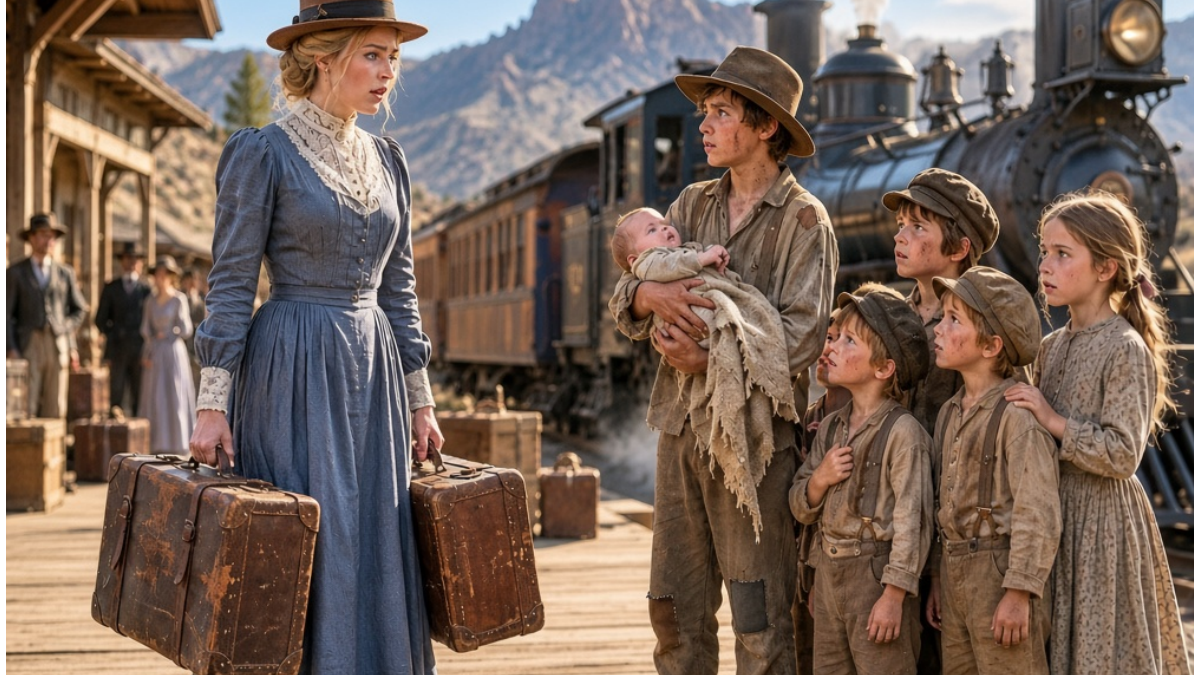
Harlon Pike pulled his horse across the mountain trail and blocked the path with the kind of authority that men like him had spent decades perfecting.
The authority of someone who had never once been told no by anyone who mattered.
“Turn back!” He shouted, his voice swallowed half by the blizzard and half by his own certainty.
“Those children are dead already. You’re just killing the rest of us, trying to prove otherwise.”
The search riders behind him had already turned. Every one of them. Experienced men with frostbitten ears and sensible instincts and families waiting at home.
Marabel stood in snow up to her knees and did not move. She had been in Red Hollow exactly 6 days.
In that time she had been told she was too thin to work a ranch, too frail to survive a Colorado winter, and too foolish to understand how the high country worked.
She had been told these things by men who thought they were being practical rather than cruel, which was somehow worse.
She looked at the scrub pine beside the trail. Blue wool, tied tightly, not snagged, nodded.
Deliberate. They’re alive, she said. Pike’s horse shifted beneath him. Woman, I have been ranching this valley for 22 years.
I know what a blizzard does, too. They left markers. Mara said, “That’s not what lost children do.
That’s what a child does when he’s trying to make sure someone can find him later.
He just wasn’t sure he wanted to be found yet. Pike stared at her like she had spoken in a foreign language.
Then he turned his horse downhill and rode away. If you have ever watched someone make a decision that you knew in your bones in that wordless place where certainty lives was wrong and felt completely powerless to stop it, then you already understand what Marabel felt standing on that mountain.
If you have ever been the person in the room that no one took seriously right up until the moment you were the only one who was right, then this story belongs to you.
6 days before the blizzard, Mara Bell arrived in Red Hollow on the back of a freight wagon, seated between a crate of dried salt pork and a man who smelled powerfully of tarpentine, and hadn’t spoken since the first mountain pass.
She didn’t mind the silence. She had learned to use it. The wagon seat was hard, and the road into Red Hollow was worse.
A switchback descent carved into the mountain’s face by men who clearly believed their horses were more durable than their passengers.
Mara held her carpet bag on her lap and watched the valley appear below them through gaps in the pina scatter of wooden buildings.
A church without its steeple finished a main street wide enough for a cattle drive and muddy enough to swallow a boot.
It wasn’t much. She had seen worse. She had lived in worse. The freight driver pulled up outside the general store, and Mara climbed down before he could decide whether or not to offer his hand.
She had learned that, too, in the years since her husband died and left her with nothing except the farm skills her father had drilled into her and a seamstress kit she’d bought with her last $14.
Get down before someone offers help, you’ll feel obligated to repay.” She stood in the street and took stock of the place.
The wind came from the northwest and smelled like iron and ice. The sky above the western peaks had the particular gray yellow color that Kansas farmers called a warning color.
The color that made her father look at the horizon and go quiet. She estimated 3 weeks, maybe four, before the first serious snow locked the mountain road.
3 weeks to find work. She needed wages or a winter arrangement room and board in exchange for labor.
Something to carry her through until spring opened the pass again. She picked up her bag and started with the largest building on the main street, which turned out to be Pike’s cattle operation office.
A man she would later know as Harlon Pike sat behind a desk built from planks thick enough to survive artillery.
He was the kind of man whose face had been shaped by decades of outdoor work in to something that looked carved rather than grown all hard angles and deliberate expressions.
He looked at Mara for approximately 4 seconds. Seasonal labor. Yes, sir. I can cook, mend, keep accounts.
He was already looking back at his papers. We’ve got to cook. Accounts are handled.
Ranch work. I know cattle, horses, ma’am. He said it pleasantly, which was the least pleasant way it could be said.
I’ve got 30 men who need feeding through a mountain winter. I can’t afford to feed a 31st who can’t pull weight.
Mara stood in that office for another 5 seconds because she had learned that sometimes men reconsidered when you didn’t flinch.
Pike did not reconsider. She picked up her bag and left. The next three stops went similarly with different degrees of kindness in the delivery.
A woman named Mrs. Callaway needed a cook, but looked Mara up and down with the expression of someone calculating risk and said very gently that she didn’t think Mara looked strong enough for the work, and she worried about taking on a responsibility.
A man named Decker, who ran the feed store, said he had a daughter helping him.
A rancher’s wife with four children agreed to let Mara show her sewing ability, examined a mended shirt, admitted the work was good, and then asked how much Mara weighed because her last two girls had both gotten sick during winter, and she couldn’t manage another invalid.
Mara was not an invalid. She was thin in the way that people become after 2 years of drought.
Not fragile, but stripped down. All the surplus burned away until only the essential remained.
She knew what she looked like. She had seen her own reflection. She just hadn’t expected Red Hollow to be so straightforward about using it against her.
By late afternoon, she had had covered the length of Main Street twice and had exactly one offer, 40 cents a week, to mend clothes for the general store’s owner, with a small room above the store thrown in as part of the arrangement.
The room had a window that leaked wind and a stove pipe that came through the floor without quite connecting to anything underneath it.
The cold crept up through the boards at night like something patient and deliberate. She took it.
Pride did not generate body heat. She met Jonah Reed the same afternoon, though she didn’t know his name until the following morning.
She was sitting at the window of the general store’s back room, working by the last of the afternoon light on on a coat with an elbow worn through to nothing when she heard voices outside on the street.
One of them she recognized as pikes. The other was quieter, a lower register, the kind of voice that didn’t use more words than it needed.
She looked out. The second man was standing with a horse, a dark bay with a white sock on the left rear foot.
He was maybe 30some, she guessed, with a particular kind of stillness that belonged to men who had spent years managing animals that outweighed them by half a ton.
He had a way of listening to Pike with his head slightly tilted, like he was sorting through what was being said for the part that actually mattered.
Pike said something. The quiet man replied. Then Pike gestured toward the general store, toward Mara’s window, more or less, and the quiet man looked up.
Mara looked away. She had been staring. She finished the elbow patch without looking out again, but she thought about the exchange she’d witnessed, the way Pike had done most of the talking, and the other man had done most of the thinking.
There were two kinds of men in frontier settlements. The kind who spoke to establish authority, and the kind who spoke because they had something to say.
She had already met Red Hollow’s version of the first kind. The children, she noticed without intending to.
That was the honest truth of it. She wasn’t watching for them. She wasn’t the sort of person who went looking for trouble or complications or additional claims on her attention when she already had barely enough resources to cover her own survival.
But she noticed things. She always had. Her mother had called it a useful habit.
Her first husband had called it exhausting. She had eventually decided her mother was right.
And her husband had meant something about himself, not about her. The first one she saw was the boy.
He appeared at the edge of the market area behind the general store early on her second morning in Red Hollow before most of the town was properly awake.
He was 11 or 12, she guessed, with the kind of economy of movement that didn’t belong to 11year-olds who had who had someone looking after them.
He was carrying three dead rabbits, and he traded them quickly, quietly quietly to a woman setting up stall, accepting flower in return, and not haggling, which told Mara he wanted to complete the transaction and leave before anyone noticed him.
He was gone before the town was fully awake. The second one she saw was the small girl.
She appeared two days later near the back of the dry goods section while Mara was picking up thread for the store owner.
The girl was maybe seven with sharp dark eyes that moved across shelves. The way a person’s eyes moved when they were memorizing prices rather than browsing.
She took two needles in a small length of thread. From different spots, Mara noted, not all from one place, and folded them into her coat pocket.
Mara watched. She did not say anything. The girl looked at her once, the same way an animal looks at a person when it’s deciding whether the stillness is genuine or a trap.
Mara looked back at the thread she’d been examining. The girl left. The third child was the smallest, a boy of maybe four or five, and he appeared near the horse trough outside the livery stable one evening when Mara was walking back from dropping repairs at Mrs. Callaways.
He was cupping water in his hands and drinking with the focused seriousness of someone who had been thirsty for a while.
He looked up when he heard her footsteps. His face went completely blank, not afraid.
Exactly. But closed. A child who had learned that expressions gave things away. Mara stopped walking.
She looked at the sky instead of at him. The way you did with horses that weren’t sure about you yet.
By the time she looked back, he was gone. Most of Red Hollow assumed they were travelers children.
Children belong to someone in a frontier settlement or they didn’t survive long and people tended to assume the former because the alternative was uncomfortable to consider on a Tuesday morning.
Mara turned it over in her mind. Three children. They took rabbit meat, flour, needles, and thread.
They took water from a public trough rather than any private well. They were cautious about being seen, and they never stayed in any one spot long enough to be questioned.
Organized scarcity. She had grown up in it. She knew exactly what it looked like.
The oldest one, the boy with the rabbits, was managing a household, a small one, a difficult one, but managed.
Someone had taught him to trap. He knew how to move through a market without drawing attention.
He took only what three people would need and never enough from a single source to make someone angry enough to follow him.
The girl’s theft told Mara the moSt. She could have taken food. Children who were simply hungry took food.
She took needles and thread which meant clothing was failing either torn or too small or worn through.
And she or someone with her knew how to repair it or was trying to learn.
She had gone specifically for those items in a store full of things a hungry child might want instead.
That was a child with a plan. Mara went to Jonah Reed on the fourth day.
She had learned his name from the store owner who had mentioned him when Mara asked about the freight situation through the mountain pass.
He was a horse rancher. The owner said, “A decent man, a widowerower, kept to himself but reliable when it mattered.”
She found him in the livery stable assessing a horse someone had brought in limping.
The three children who’ve been appearing around town, she said without preamble. You know about them?
He looked up from the horse’s forleg. He had the same quality she’d noticed from the window.
That slight pause before he answered anything, like he wanted to make sure the answer was accurate.
Heard something? He said, “Have you seen them once or twice? Where do you think they came from?”
He straightened and looked at her with the particular expression of a man who was deciding how much to say to a person he didn’t know yet.
There was an abandoned wagon, he said slowly. A few miles north off the main road.
I came across it two weeks back. Mara waited. There was a grave nearby, a woman’s.
Someone had covered it with stones. He paused. The tracks after the grave continued south.
The room went quiet in the way rooms go quiet when a piece of information lands that changes the shape of everything around it.
Mara thought of the boy with the rabbits and how he’d walked away from the market without looking back.
She thought of the girl counting needles like they were currency. She thought of the small boy drinking from the horserough with the concentrated seriousness of someone who had learned that you drank when you had access to water because you might not have access again soon.
They’ve been alone since the grave, she said. Jonah didn’t answer because the answer was obvious and he wasn’t the type to say obvious things out loud.
On her fifth day in Red Hollow, before anyone had properly organized a search, the sky turned, not gradually.
The high country didn’t bother with gradual when it decided to make a point. Mara woke before dawn to the sound the wind made when it was carrying something with it, and she knew be before she crossed to the leaking window what she would see.
The air was white, not snowing yet, not quite, but the air itself was white with what was coming, the particular blankness of a sky that had decided.
She dressed by feel in the dark because the light through the window was wrong, the kind of dim flat gray, that made distances impossible to calculate.
She was already thinking about the children. By midm morning, Pike had organized a search party, eight riders, himself included, with Jonah among them.
Mara asked to join. Pike looked at her the way he’d looked at her from behind his thick planked desk.
That same efficient 4-second assessment. We need riders who can handle the high country, he said.
Not he stopped, which was almost worse than finishing the sentence. I can ride, Mara said.
Well be in country where a fall could mean no one finding you until spring.
Then I’ll be careful. She watched him weigh the social inconvenience of telling her no directly against the practical inconvenience of managing her once the party had started.
He chose the easier option, which was letting her come and believing the conditions would resolve the problem on their own.
She took that as yes. The search deteriorated in stages. The snow began in earnest 2 hours out from Red Hollow, the kind of snow that came in sideways and made you realize you had been naive about what that word meant.
The temperature dropped faSt. Two riders lost sight of the group within the first hour and had to be collected, which cost time and warmth that nobody had to spare.
Pike stopped twice to reorient. The second time, Mara could see by his face that he was not entirely sure where they were on the mountain.
She kept her mouth closed about what she thought of that. The writers spread out across the upper basin, where someone nobody could agree on who had suggested the children might have sheltered.
There was an old structure somewhere in the basin, an abandoned sheep hurting shack. Mara had heard it mentioned at the general store 3 days ago in a conversation not addressed to her.
The snow was above her knees in the drifts. Her horse struggled in it. The light was failing even though it was barely afternoon.
The clouds had taken what remained and weren’t giving it back. Around her. The experienced riders moved with the focused efficiency of people who respected what was happening and were calculating how much longer they could remain in it before the calculation shifted from finding children to surviving the mountain themselves.
Then Pike called the search. He didn’t make a speech about it. He was not a man who made speeches when a simple order accomplished the same thing.
He turned his horse downhill and said they needed to get off the mountain before visibility dropped to nothing.
And the riders around him turned with the automatic obedience of people who trusted his judgment because it had kept them alive before.
Mara didn’t move. She was looking at a scrub pine off the main trail off it by about 20 ft in a place no one would have a reason to go unless they were deliberately looking.
Blue wool tied around a branch at approximately eye level for a seven-year-old. Not snagged, not left behind.
Tied. She thought of the girl in the store counting needles. A child who thought in terms of resources, who understood that small things served multiple purposes, who had the presence of mind to make a marker system rather than just a trail because she’d been thinking about what happened if someone needed to find them later.
There’s a marker, Mara said. Pike had already turned his horse. He half looked back.
It’s wool on a branch. It’s a knot. A child put it there on purpose.
Children wander. They drop things. They don’t tie knots in things they drop accidentally. Her voice was flat.
This was not the kind of argument that benefited from emotion. Someone has been marking the path.
The trail doesn’t go to the basin. It goes to the upper sheep pasture. There’s a line shack above it.
Pike looked at the riders around him who were looking at him. He looked at Mara.
She had seen that look before. She would probably see it again. It was the look of a man doing arithmetic between I don’t want to be responsible for leaving children on a mountain and and I don’t want to take orders from a woman the whole town has already decided can barely take care of herself.
We are out of time to make mistakes up here. He said, “If those children are not in that shack, we could lose riders looking for them.
If they’re there and we turn back, then they were already beyond help before we came.”
He rode downhill. The other riders followed. Mara stood in the snow and felt the particular loneliness of knowing something no one else would believe in time for it to matter.
Jonah Reed had turned with the others. He had gone maybe 40 yards when he stopped.
She heard his horse blow air through its nostrils in the cold. She heard him curse one word, quiet and direct.
The kind of profanity that was mostly a man arguing with himself. He turned the horse around.
“Where’s the shack?” He asked. Above the upper basin, maybe 30 minutes on a clear day.
He looked at the sky, which was not a clear day, not even a clear quarter of an hour.
“Get on,” he said. “I can keep my horse. Your horse has been blowing hard for 20 minutes, and the drifts above the basin will be chest high on her.
Get on.” She left her horse tied where it would have shelter, and got up behind him.
He didn’t say anything about how little she weighed, even though she could see the horse register.
Almost nothing had changed. She appreciated that he didn’t say it. They went uphill. The markers continued.
Blue wool at intervals, always on the uphill side, always at the same height. Mara tracked them from her position behind Jonah and called the turns, and he rode without asking her to explain how she was sure or making her defend her reasoning each time.
She appreciated that also. The snow thickened until the distance between markers felt like faith rather than evidence.
Then one wasn’t there where she expected it. She went cold in a way that had nothing to do with the temperature.
Jonah pulled up without her asking. She climbed down, pulled her coat around her, and moved 10 ft in each direction through the snow.
Her legs were numb below the knee. Her hands inside her gloves had stopped providing useful information about what they were touching.
There, not on the pine she’d expected, on a rock below it, the tree had been too loaded with snow for the branch to be visible.
The wool was tied around a protruding edge of stone. The child had adapted when the original plan didn’t work.
Left, Mara said. Jonah reoriented. 15 minutes later, the line shack materialized out of the white.
It had once been built for sheep herders, spending weeks in the upper basin, which meant it was solid enough.
Stone foundation and timber walls, but small. One room, a stove, a wooden sleeping platform against one wall.
The door was closed. Smoke was coming from the stove pipe. Mara felt something loosen in her chest that had been held tight for hours.
Jonah dismounted and tied the horse to a post that was mostly buried in drift.
He moved toward the door. “Wait,” Mara said. He stopped. “Let me.” She went to the door and knocked.
Not a pounding knock, a deliberate one. Three times evenly. “Silence.” “Eli,” she said. She did not know for certain that was his name, but the boy with the rabbits had been called something by the girl near the store just once at a distance, and that was what she’d caught.
A longer silence. Then a voice high and tight with controlled terror came from just inside the door.
Who told you my name? No one, Mara said. I guessed it. I’ve been watching the three of you for 3 days.
Then you know there are three of us. Yes, then you know you can’t. The voice broke and then composed itself.
An 11-year-old performing composure under conditions that would have undone most adults. You can’t take one without the others.
I won’t let you. Jonah had moved beside her. She could feel him about to say something practical, and she put her hand out without looking at him.
He stopped. I’m not here to take anyone anywhere separate, she said. I’m here because you left trail markers and I followed them.
A pause. Ruth made me leave them,” the voice said. I told her it was stupid.
Ruth was right. Another pause shorter this time. The door opened. He was exactly what she’d expected and nothing like what she’d imagined.
He was 11 years old and he was holding an axe that was at least a third of his body weight in both hands and the axe was raised and his arms were shaking not from fear or not only from fear but from the weight of the thing and probably from cold and exhaustion that had been going on for longer than a child’s body was built to sustain.
Behind him, Mara could see Ruth standing very still with her arms around a small shape that was Toby, who was asleep against her shoulder with the absolute commitment of a 4-year-old who has finally run out of reasons to stay awake.
Eli looked at Mara. Then he looked at Jonah. His eyes stayed on Jonah a moment too long, calculating.
He’s not going to take anyone anywhere either, Mara said. Jonah, to his credit, said nothing.
He just stood there with his hands slightly out from his sides. The posture of someone trying to look as unharmful as possible while standing in a blizzard.
Eli’s arms were still shaking. You should put that down, Mara said. Not because I’m telling you to.
Because it weighs more than you’ve got left and you know it. The axe came down slowly.
Eli’s face didn’t crumple. That was the thing about him. He had organized himself so completely against crumpling that she thought maybe he’d forgotten how.
Mama died. He said it was not an announcement. It was information he was conveying because it was relevant to whatever came next.
I know. Mara said, “I’m sorry.” She said to come to Red Hollow. You did.
You got here. I heard men talking about where they put orphan kids. They said he stopped.
His jaw went rigid. They said separate houses wherever people had room. Mara understood immediately and completely.
He had gotten close enough to rescue to hear what rescue looked like and decided the line shack was safer.
So you stayed up here, she said. We had the stove. I can trap. We were fine.
He said the last word with the particular defiance of someone who has been fine through an act of pure will and knows it.
You were, Mara said. Now you need to come down and I’m going to need you to help me with your brother because he’s too big for Ruth to carry all the way.
And I’m She stopped. I’m going to need help. She watched him look at her.
Really look at her. The way children looked at adults when they were trying to determine whether they were being lied to with good intentions.
You’re not going to separate us. He said, “I can’t promise everything. I can promise I won’t secretly arrange anything.
Every decision that affects the three of you gets said where you can hear it.
That’s what I can give you right now. Ruth’s voice came from behind him. Eli, just his name, but the way she said it meant something that Mara didn’t have the context for yet some entire conversation compressed into one syllable.
Eli looked back at her. Then he lowered the axe completely and set it against the wall.
“Okay,” he said. It was the word of a child who had been making adult decisions for longer than any child should and was possibly for the first time in weeks willing to let someone else hold something for a few minutes.
Mara stepped inside the shack. The descent was brutal in ways she hadn’t fully calculated.
Toby woke confused and immediately began crying in the silent, exhausted way of a child who doesn’t have the energy for noise.
Ruth could not keep her footing in the deeper drifts and kept going down on one knee before she’d catch herself, refusing every time Jonah offered his hand until he stopped offering and simply moved to her downhill side without mentioning it.
Eli carried what he could from the shack, which was more than anyone told him to carry and less than he was capable of.
And he kept close to Mara’s left side with the instinct of something that had decided she was the fix point, but wasn’t going to make that obvious.
Mara had the red freight rope. She had found it on Pike’s abandoned supply sled when the search party turned back.
He’d left it because it wasn’t needed anymore, or so he’d assumed. It was old, ic stiffened, heavy.
She had looped it over her shoulder without thinking too clearly about why, other than that rope was always useful.
Halfway down, when a section of trail disappeared beneath, drifted snow, and she couldn’t be entirely sure where the ground was, Eli stopped.
He looked at the rope. “You’re going to tie us together,” he said. It wasn’t a question, but it had something in it that was afraid to be a question.
I’m going to tie me first, Mara said. She wrapped the rope around her own waist and knotted it.
Then she held out the other end to him. You hold this. You’re not attached to me.
You’re holding the rope. There’s a difference. He looked at the rope in her extended hand.
He took it. Ruth took a section behind him. Jonah took Toby beneath his coat and kept one hand on the rope behind Ruth.
Four figures connected by 40 ft of icecared freight line went down the mountain in a blizzard while every experienced rider in Red Hollow was already back at their fire.
Mara did not know walking through that snow with her legs almost gone and her lungs burning from air that was too cold to breathe comfortably that the rope would still be with her in the spring.
She did not know that it would hang between fence posts she hadn’t built yet in a yard she didn’t own in a life she couldn’t have described from where she was standing.
She knew three things. She knew where the ground was. She knew the direction the lights of Red Hollow lay below the cloud.
And she knew that behind her, an 11-year-old boy was walking with his hand wrapped around a rope rather than gripped around an ax handle for the first time in longer than a child his age should have been gripping anything so heavy.
Red Hollow saw them come in. People opened their doors. Someone came out of the saloon.
The woman from the general store, the one who had worried about taking on an invalid, appeared on her porch and pressed one hand over her mouth.
Jonah’s horse came through the main street with Jonah leading it and Toby asleep inside the man’s coat again.
Ruth walked with her chin, raised in the way of a seven-year-old, who had decided that whatever expression she wore right now would be the one people remembered, so it was going to be the proud one.
Eli walked next to Mara and did not look at anyone. Mara looked straight ahead.
She was too cold to manage anything more complex than forward, but she heard it.
The change in the crowd sound, the murmur that went around the way. Murmurss went around when Red Hollow was revising something it thought it knew.
The woman the valley had spent a week calling too thin to survive. A mountain winter had walked down that mountain with three children attached to a rope.
People would remember the rescue for a long time. Mara would learn very quickly that remembering a rescue and deciding to help with what came after it were two entirely different things.
She stood in the main street of Red Hollow with three children around her, accepted by the blanket, a blanket someone pressed into her hands, and tried to feel the relief of what had just happened.
Instead, she felt the cold in her boots, which had soaked through, and the weight of a problem she had just made entirely and personally hers.
Three children, no arrangement, no roof with her name on it, no food that belonged to any of them, and a winter that had barely started.
The rope hung from her shoulder, heavy and ice stiff, and she didn’t set it down.
She wasn’t sure, looking at Eli’s face in the fire light, spilling from an open door, that she was ready to.
The food ran out on the third day. Not entirely. There was still flour, and there was still a heel of salt pork that Mara had been rationing with the focus of someone who understood arithmetic better than she understood comfort.
But the goodwill ran out faster than the supplies did, and in a frontier settlement in November, goodwill was the more useful currency anyway.
Red Hollow had been generous, the way people were generous after something dramatic happened in a place where dramatic things didn’t happen often.
Blankets arrived. Two women brought soup. A man Mara didn’t know left a small sack of dried beans outside the door of the room above the general store without knocking, which she thought was either unusual kindness or an aversion to being thanked.
The children slept for 18 hours straight. Mara did not sleep. She sat in the chair by the drafty window and listened to the sound of three people breathing in three people in the way people breathe when they were finally warm.
The deep, unguarded breathing of bodies that had spent weeks conserving everything, and she thought about what came next.
What came next arrived before she was ready for it, which was how things that came next generally worked.
Pike appeared at the general store the following morning while Mara was trying to stretch a quarter pound of salt pork into something that could feed four people for two meals.
He didn’t come up to the room. He sent the store owner to ask her to come down, which told her something about how he’d arranged the conversation in his head before it started.
She came down. Pike was standing near the front of the store with two other men she recognized from the search party decker from the feed store and a man named Aldis, who ran a cattle operation north of town.
They had the careful, neutral expressions of men who had rehearsed something and were now waiting to deliver it.
We need to discuss the children, Pike said. Mara waited. The valley has obligations, he said.
Winter obligations. Every household has calculated its resources for the season already. Taking on three additional people is not.
He paused in the practiced way of a man who had decided which words to avoid.
It’s not a simple matter. I’m aware. Mara said, “There are families who might be willing to take one child each if the arrangement was managed correctly.
Toby is young enough that a childless couple might. Eli, Ruth, and Toby are staying together, Mara said.
The three men looked at each other with the particular expression of men who had expected this response and had prepared for it.
Miss Bell, Eldest said with the careful tone of someone being reasonable at someone else.
You are a single woman with a room above a store and 40 cents a week in wages.
You’re describing a situation that doesn’t exist yet. And expecting the valley to wait while you construct it.
I’m not expecting anything from the valley,” Mara said. “I’m telling you what isn’t going to happen.”
Pike’s face did the thing it did. The careful settling into a harder expression like Stone deciding to stay stone.
You don’t have the legal standing to make that determination. “No,” she said. “I don’t.
But Eli is 11 years old and smart enough to understand everything being said in this room right now.
And the last time someone discussed separating those children, he took his brother and sister back up a mountain in a blizzard.
So, you can have the legal conversation, and I’ll have the practical one. The store went quiet.
Decker looked at his boots. Pike looked at Mara with an expression she couldn’t read, which was unusual because she was generally good at reading people.
It wasn’t anger exactly. It was something more like recalibration. A man updating a model he’d built of a situation and finding the new version more complicated than the original.
“You have until the end of the week,” he said. “Finally, find an arrangement that makes practical sense, or the valley committee will make one for you.”
He left. Mara went back upstairs and stood in the doorway of the room where all three children were still technically supposed to be asleep and found Eli sitting up on his blanket with his arms around his knees, looking at her with the expression of a child who had been listening to every word through the floorboards.
How much did you hear? She said enough. Then you know I need to find somewhere for us to go.
His jaw moved. There’s no us. You don’t have to. Eli. She sat down on the floor, which was an uncomfortable choice, but she needed to be at his level for this.
I brought you down that mountain. I put the rope around my waist firSt. That means something or it doesn’t.
I’ve decided it does. He looked at her for a long time. 7-year-old Ruth had woken up, too.
Mara could tell by the quality of her stillness on the other blanket. That child missed nothing, but she kept her eyes closed, which was its own kind of courtesy.
Pike is right that you don’t have the legal whatever, Eli said. Yes. So, what are you going to do?
Find a place to put us, she said, and then make it impossible to undo.
She said it with more confidence than she possessed. But she had found over the years since she had stopped having anyone to lean on.
That confidence was sometimes a decision you made in advance, and hoped your circumstances would eventually catch up to.
The homestead sat at the edge of red hollow settled land like something that had been trying to leave for years and kept being stopped by inertia.
It belonged to a man named Griggs who had gone to Denver in September for medical reasons and left a neighbor a note about the property in case of emergency.
The neighbor, a woman named Clara Hess, who ran a small dairy had been the one to suggest it to Mara quietly while while pressing a wedge of hard cheese into her hand at the market.
“It’s not much,” Clara said. “The roof’s questionable, and the fencing is bad, and the stove in the main room needs someone to coax it, or it won’t draw properly.
But it’s standing, and it’s empty, and Griggs won’t be back until April, if he comes back at all.”
Mara went to look at it that afternoon. It had two rooms, a sleeping loft, a stone fireplace that had been used recently enough to still have ash in it, a small barn with one usable stall, a hand pump that Mara worked six times before water came through, and a back wall on the main room where someone had nailed boards over a section that had started to separate from the foundation.
It smelled like old hay and cold wood and the specific emptiness of a place that had been heated regularly and then suddenly wasn’t.
Jonah Reed was standing behind her. She hadn’t heard him follow her from town, which annoyed her.
“You’ve been following me since the market,” she said without turning. “I was going the same direction.”
“For the last quarter mile across an open field.” “A pause. The roof is going to be a problem,” he said.
“That center beam has been flexing. You can see the light through it on the east side if the snow settles right.
I’m aware the roof is going to be a problem. I could look at it.
Mara turned. He was examining the roof line with the focused expression he applied to horse soundness.
Not performing assessment, actually performing it. She had noticed this about him. He didn’t look at things to appear useful.
He looked at things because he was determining what was actually happening. Why, she said.
He glanced at her. Why? What? Why would you look at it? What’s in it for you?
He was quiet for a moment. Not the defensive quiet of someone stung by the question, but the thoughtful quiet of someone taking it seriously.
Nothing immediate, he said. But the valley tends to work that way. Someone helps someone and somewhere down the line the favor circulates back.
That’s not what I asked. He looked at her steadily. Three children came down a mountain because you followed a piece of wool tied to a branch when every other adult had given up.
That means something to me. He said it the way he said most things plainly without ornamentation, like a fact that didn’t require defending.
Mara turned back to the homestead. She looked at the board covered wall section, the pump, the small barn, the field behind it that would be adequate for a kitchen garden if anyone got to it before April.
I can’t take charity, she said. I know it would have to be trade. I know that, too.
I’m serious. If you fix something, I repair something of equivalent value. Or you tell me what you need done and I do it.
You can sew, he said, among other things. My tack room has been needing someone to repair the harness padding for 6 months.
I keep meaning to get to it, and I never do. It was a real need stated as a real offer, and she recognized the difference between that and pity, wearing the costume of practicality.
She had become very good at recognizing that difference. “Fine,” she said, “the harness padding.”
She went to speak with Clara Hess about the Griggs property that evening. They moved in 4 days later, which was 3 days before Pike’s deadline.
Moving was the wrong word for it. They transferred. Mara carried her carpet bag and her sewing kit.
Ruth carried her mother’s sewing roll pressed to her chest with both arMs. Toby carried a piece of firewood he had found outside the general store and decided was important.
Eli carried everything else, which was not much, and arranged it inside the homestead with the focused seriousness of someone taking inventory.
The stove did need coaxing. Mara spent 40 minutes on it before it drew properly, and the first hour of fire was more smoke than heat, and Ruth sat in the corner nearest the door, with her coat still on, while Toby stood close enough to the stove to make Mara nervous.
“Back two steps,” she said. Toby looked at the stove and then at her. Then he stepped back one step and looked at her again.
“One more.” He stepped back another half step and considered whether that counted. Apparently, he decided it did.
The main room was smaller than it had looked from outside when all four of them were in it with the sewing kit, the carpet bag, Eli’s trapped rabbit from yesterday, the firewood Toby had carried, and two quilts Clara Hess had lent them.
There was not a large amount of room left, but it was warm, or it was beginning to be warm.
And there is a particular quality to warmth that is being made in a space rather than existing in it.
The warmth of a stove that’s been cold and is heating up. That is entirely different from warmth that was simply there when you arrived.
Eli stood in the middle of the room and looked at it the way he looked at things he was trying to decide about.
It’s small, he said. Yes, the wall on the backside has probleMs. I know the roof, Eli.
Mara was unwrapping the sewing kit and didn’t look up. I know all the problems with this house.
I looked at it carefully before I agreed to it. What I need right now is for you to take the axe from the corner there, the one Griggs left, and go split the rest of that wood stack out back into pieces small enough for the stove.
Can you do that? A pause. Yeah, he said. Don’t split toward yourself. Foot back.
I know how to split wood. Then you don’t need me to tell you. Go, he went.
Ruth from her corner opened one eye and looked at Mara. Mara looked back. 12.
She said, meaning she was aware the child was not asleep. He needs something to do, Ruth said.
He gets worse when he doesn’t have something to do. I know. That’s why I gave it to him.
Ruth was quiet for a moment processing this. You figured that out faSt. I’ve been watching the three of you for a week.
You were watching us in the store. Ruth said, “I saw you.” Mara kept her hands moving on the sewing kit.
I saw you take the needles. Ruth went very still. You took from three different spots, Mara said.
Not one. You thought about it before you did it. You were trying not to be noticed, and you almost succeeded.
You’re going to make me give them back. I already replaced them. Don’t take from the store again.
She looked up. Not because it’s wrong to need things when you’re desperate. Because if someone else sees you and makes a problem of it, I’ll have a harder time keeping you here.
Ruth stared at her. Those are my needles in that role you’re carrying, Mara said.
So you already gave them back. Something in Ruth’s face shifted. Not softness exactly. This was a child who had organized herself against softness the same way Eli had organized himself against crumpling as a survival mechanism that had become so habitual she might not have known she was doing it.
But something moved behind her eyes. She didn’t say anything, but she put her coat down and stopped sitting like she might need to leave quickly.
The household took shape the way difficult things took shape, not smoothly, not according to any plan, but through accumulated small decisions that eventually added up to something that resembled structure.
Mara repaired coats for flower. Two coats in the first week, three in the second, and word moved through Red Hollow the way word moved in small places, person to person, and door to door, that the woman in the Griggs place did good work, and her prices were fair.
Ruth sat beside her for the fine stitching, and it became apparent within 3 days that Ruth’s hands were steadier than Mara’s on the small work, the button holes, the collar repairs, the places where you needed patience more than strength.
Mara did not make it a lesson. She just put the fine work in Ruth’s direction and moved to the structural repairs herself.
And after 2 days, Ruth stopped waiting to be asked. Eli’s trapping produced rabbits and once a small deer, which Mara processed efficiently and without waste in the way her father had taught her, and which caused Eli to watch her with a recalibrated expression.
She had noticed that he had decided she was competent in one area, but maintained active.
Uncertainty about others and that this was fair enough and she didn’t try to address it directly.
Toby collected kindling with the evangelical commitment of someone who had been given a purpose and intended to fulfill it completely.
He brought it in armfuls and sorted it by size without being asked. And when he ran out of floor space to sort into, he began lining pieces along the wall in a row that had an organizational logic Mara could not entirely follow, but that Toby clearly could.
Does the size go biggest to smallest or by what goes in the stove first?
She asked him one afternoon. He looked at the row, then at her both, he said, as if this were obvious.
She decided he was right and left the system alone. Jonah appeared on the sixth day with the harness from his tack room folded over his shoulder.
The padding on three sections had worn through to the metal and two buckle connections had cracked.
He left it on the porch without knocking. Mara brought it inside and spent three evenings on it.
The work was not difficult. She had repaired tac before on her family’s farm in Kansas, but it was painstaking, and she was tired by the evenings in a way she didn’t entirely acknowledge to herself.
She repaired everything that needed repairing, and reinforced two sections that were starting to show wear, but hadn’t failed yet, which doubled the useful life of the work, but took an extra half day she hadn’t planned for.
She left it on his gate poSt. He came to the door the next morning.
She had not expected him to come to the door. She opened it and they looked at each other and she recognized the particular slightly wrong-footed quality of a man who had planned what to say and then found the situation slightly different than anticipated.
The padding on the third section, he said the stitching on the under layer was starting to separate.
I reinforced it while I had it. That wasn’t in the agreement. It would have failed by February and then you’d have brought it back and I’d have done it anyway.
I was already there. He looked at her for a moment. I brought lumber, he said.
For the back wall. We agreed on harness padding. We did. The lumber’s extra. I don’t need I’ve got more than I can use and it’ll rot in the barn over winter.
He said it evenly, not pressing, just placing the statement in front of her and leaving it.
She stood in the doorway and felt the familiar internal argument between what she needed and and what accepting it would cost in the currency of obligation.
She had been running that argument since she was 22 years old, and she was tired of it.
Stack it by the barn, she said. I’ll get to the wall when I have a day.
I can I said, I’ll get to it. A beat, right? He said. He stacked it by the barn and did not mention the wall again.
But 3 days later, he appeared at the edge of the property while Eli was outside and Mara watched from the window as he showed Eli something about the wall.
The board overlap the way to check whether the foundation underneath had shifted where to nail so the board held rather than worked loose in freeze thaw cycles.
Eli asked three questions she could not hear. Jonah answered each of them. When Jonah left, Eli came inside and told Mara the wall was a twoperson job and asked whether she wanted to do it on Saturday or whether she needed the daylight hours for sewing.
His tone was the carefully practical tone of an 11-year-old who had decided this was a household management question rather than anything more complicated than that.
Mara said, “Saturday.” They did the wall on Saturday. It took 4 hours and one of the boards went on slightly crooked and Eli accepted Mara’s correction about the angle with the focused attention of someone who wanted to get it right rather than the defensiveness of someone who wanted to have been right the first time.
By the time they finished the back wall held, and the cold draft that had been coming through the lower left corner since they moved in stopped.
That evening, Mara made biscuits from the flour she’d earned that week. And Toby ate two of them and arranged the crumbs on his plate into a shape that Mara could not identify, but that Ruth apparently could because she said that’s supposed to be a horse with the tone of a sibling who has been interpreting her younger brother’s art for long enough that it had become automatic.
“It’s a very good horse,” Mara said. Toby looked at her with complete seriousness. It’s not done,” he said.
“I need more crumbs.” Eli didn’t laugh, but the corner of his mouth did something just briefly that was close enough.
The sack of beans appeared on a Monday. Mara came back from delivering three repaired coats.
To find a sack of dried beans on the kitchen table that had not been there when she left, the door had not been locked.
Blocks on homestead doors in this part of the territory were more of a custom than a function, and the sack was simply sitting there tied with a piece of twine.
No note. She knew immediately whose it was. She picked it up, walked to the barn, found Eli cleaning a rabbit snare, and said, “Where is he?”
Eli looked at the sack. He came by about an hour ago. Left that. Where did he go?
His property, I’d guess. Mara looked at the sack in her hand. Dried beans were not a sentimental gift.
They were extremely useful through a mountain winter, and they required a full growing season to produce and cost actual money at the store.
They were also the kind of thing someone brought when they thought a household was running short and didn’t want so directly.
She walked to Jonah’s property, which was 20 minutes on foot and longer in the current snow conditions, and knocked on his door.
He opened it, looking surprised to see her, which told her he had not expected her to come directly.
He had expected her to accept the beans quietly, and for them both to pretend the transaction hadn’t happened.
She held out the sack. “I can’t take these,” she said. He looked at the sack and then at her.
“They’re beans. I know what they are. You’re feeding four people. I’m managing that.” Mara.
He said her name in the tone of someone choosing not to argue about something obvious.
It’s beans. It’s not a debt. It’s just beans. Everything is a debt if the person giving it expects something back.
I don’t expect anything back. Then it’s charity. Something shifted in his expression. Not anger, but the particular friction of a man who was trying to solve a problem and finding that the problem kept reformulating.
What would you accept? He said, “What do you need actually need? Not what you can invent.”
He was quiet for a moment, and she could see him running through his own calculations, the genuine inventory of a practical man rather than the performed inventory of someone pretending to think.
My account books, he said finally. I’m behind on the winter accounts by 2 months, and I’m not good with numbers.
I lose track of what I’m owed and what I owe, and every spring I end up in disputes that cost me more than the original amounts.
Mara had been keeping accounts since she was 16. Her father had been worse at numbers than he was at farming, which was saying something.
Bring them over, she said. Tonight, if you want, he brought them over. She worked on them for three evenings and organized two months of scattered transactions into a ledger that showed exactly what he was owed, what he owed, and where the discrepancies were.
He sat at the table and watched her work with the expression of a man who was revising his opinion of something in real time, but wasn’t going to announce the revision.
She kept the beans, but she returned them to the table herself when she got back that first evening, and she made a note of the exchange in the account ledger.
She had started keeping for the household beans from Jay. Read value set against bookkeeping service.
2 months. Eli saw the ledger. He didn’t comment on it that night, but 2 days later, he produced a tally of his own.
Scratched on a piece of brown paper. Rabbits trapped. Rough market value. What he estimated the household had received versus what remained owed and a question mark next to three items he didn’t know how to value.
Mara sat down with him and they worked through the question marks together. The conversation lasted an hour and was almost entirely practical.
But somewhere in the middle of it, Eli said without looking up from the paper, my father taught me numbers.
Mara didn’t fill the paws. She let it sit. He died when I was 8.
Eli said fever. Mama kept us going after. She did a good job, Mara said.
Because the evidence for this was sitting around her three children who were difficult and smart and and had kept themselves alive through conditions that would have broken adults.
Eli looked at the ledger. She would have hated this house, he said. The roof, the roof is going to be fine.
Jonah, as she stopped, we’re going to address the roof. When? Before the deep snow.
Eli looked at her. He had the particular look of an 11-year-old who was not going to push further, but who was filing the answer away to check against later.
He did this constantly, she had realized. He held adults to their stated intentions, the way adults were supposed to hold children to theirs, and he did it without drama or accusation, just quiet, ongoing assessment.
She had started being more careful about what she said she would do. By Christmas, the household had a rhythm.
Not a comfortable rhythm. Comfort was still a future aspiration rather than a current condition, but a rhythm.
Mornings had a sequence. Afternoons had a logic. Evenings had a rough geography. Toby near the stove with his wood sorting.
Ruth with fine stitching near the better light of the east window. Eli either working on something external or sitting with the account ledger going over his tally.
Mara at the main table on larger repairs or planning the next exchange. Ruth had stopped sitting like she might need to leave quickly.
Toby had stopped positioning his bed where he could see both siblings before he closed his eyes.
He still checked every night in a routine so established it had become unconscious. A look left, a look right, but he was no longer managing it the way he had in the line shack with the precise, desperate vigilance of a four-year-old who had decided that watching was the only way to prevent disappearance.
Clara Hess brought a small amount of sugar the week before Christmas without being asked to, which Mara accepted and did not try to immediately balance in the ledger because Clara had been generous in a in a way that felt different from obligation.
The way things given between women who understood each other’s situations felt different, and sometimes the ledger had to wait.
Ruth made a small decoration from fabric scraps, a circle shape, with pieces of red and green cloth stitched to it in a rough star pattern.
She hung it above the fireplace without mentioning it, and then went back to her stitching as if as if she hadn’t done it.
Mara looked at it for a long moment without saying anything. Then she said, “You have good instincts for color.”
Ruth’s ears went slightly red. Jonah came for supper on Christmas Eve, which Mara had not quite invited, and he had not quite been invited to, but which had arrived at naturally, the way things arrived at naturally, when two people were in enough proximity over enough time, that the logistics of separation started to require more effort than the logistics of being in the same room.
The supper was rabbit stew because they had rabbit and cornbread because Mara had traded a coat repair for cornmeal that week.
And the sugar Clara had brought became something halfway between a cake and a dense sweet bread that Toby ate an alarming amount of while maintaining the dignified expression of someone who was simply eating a normal amount.
After supper, Jonah stayed, which was also not quite invited and not quite uninvited. Eli went to sleep in the loft.
Ruth fell asleep at the table over her stitching, and Jot lifted her to the sleeping platform with the careful efficiency of someone who had clearly carried children before and knew how not to wake them.
Toby was already asleep in the corner nearest the stove with three pieces of firewood arranged in a semicircle around his blanket for reasons he had not explained, and Mara had stopped asking about.
Jonah sat on the other side of the table from her. They had one lamp between them, and outside the window, the snow was coming down in the slow, patient way it came down when it intended to keep coming.
“Pike is going to make another move,” Jonah said. Mara didn’t look up from the coat she was mending by lamplight.
“I know he’s not wrong that this arrangement is precarious. He’s right about the facts and wrong about the conclusion.”
She pulled a thread tight. “The arrangement is precarious. That doesn’t mean the alternative is better.
He’ll offer you something better. He already offered me better for myself. The children weren’t included.
Jonah was quiet. Better for one person isn’t better, Mara said. It’s just better for one person.
He watched her hands work. Outside the snow continued its patient accumulation. Inside the stove made the specific sound of burning wood that Mara had started to associate with the word enough.
Not plenty, not abundance, but enough. You push away help, Jonah said quietly. Carefully. Specifically, like you’ve got a rule about it.
I do have a rule about it. What’s the rule? She set down the coat.
She looked at him across the lamp. He had a direct quality to his attention that she had noticed from the beginning it at the thing he was thinking about.
He looked at the thing he was thinking about without the social habit most people had of looking slightly past or slightly around.
The rule, she said, is that if someone helps you enough times without you giving back equivalent value, eventually they start thinking they own the decisions.
She picked up the coat again. I’ve seen it happen. I’ve had it happen. I’d rather be cold than have someone else deciding when I’ve warmed up enough.
Jonah was quiet for long enough that she thought he was done with the conversation.
That’s a fair rule, he said. For people who want to own the decisions. She didn’t answer.
I don’t want your decisions, he said. I’ve got enough of my own. The lamp flickered when the wind hit the wall.
The stove popped once. Mara kept her hands moving on the coat and told herself the warmth in her face was from the fire.
“Thank you for carrying Ruth,” she said finally. She weighs about as much as a good saddle blanket.
Still, they stayed at the table for another hour without talking about anything important. And when Jonah left, he paused at the door for a moment, like he was going to say something, and then he decided against it, which she appreciated more than she would have appreciated whatever it was.
Pike’s offer arrived on the 28th of December. He came in person this time, which told her he had decided the situation required a different weight than a message carried by someone else.
He stood in the doorway of the homestead and looked at the household around him, the repair work on the table, the ledger, the sock Toby had lost under a chair, the fabric star above the fireplace with the expression of a man updating his assessment of something and not entirely sure what to do with the updated version.
He looked at Mara, “My sister’s house,” he said. “Helena in the lower valley. She needs someone with household skills.
She’ll provide a room, meals, and $2 a week wages. Mara waited. It’s a fair offer, he said.
Helena is not difficult, and the children would be placed. The young couple at the north end of the settlement, the hearts, they have space and have said they’d consider Toby.
Eli is old enough that one of the cattle operations could Mr. Pike. She said it evenly.
I’m going to stop you there, his jaw tightened. You can’t provide for them through a mountain winter on coat repairs and rabbit.
Not alone, she said. You’re right about that. He looked slightly surprised that she’d agreed with something.
But I’m not alone, she said. I have a household with four working members, a network of exchange agreements, skills this valley needs through winter, and a roof.
What I don’t have is enough exchange volume. She paused. I’d like to propose something to the valley.
He stared at her. A winter exchange network. I provide sewing, mending, accounting. Eli provides trapping and stable work appropriate for his age.
Ruth can assist with fine stitching. Jonah Reed has already indicated he’d provide teaching and occasionally material assistance in exchange for bookkeeping.
I’m proposing that five or six other households formalize similar arrangements through the winter. She had been thinking about this for 2 weeks.
She had the ledger to show the preliminary numbers if he wanted them. It distributes the cost, so no single household carries it.
It provides me enough exchange volume to manage, and it’s reciprocal. Not charity trade. Pike was quiet.
She could see him thinking, not dismissing, thinking. He was a hard man, but not a stupid one.
And she had learned to recognize the difference. The hearts would consider grain for Eli’s stable work, he said slowly.
That’s a starting point. Clara Hess has been saying for 2 months she can’t find anyone to do her mending.
I know I’ve been doing her mending. Something shifted in his expression. AlmoSt. Not quite, but almost the shadow of something that might have been respect if it had a little more room to grow.
I’ll put it to the valley committee, he said. No promises. I’m not asking for promises.
I’m asking for the conversation. He left. Mara stood in the closed doorway and let her breath out slowly.
Her hands were steady. She was cold through the left boot where the sole was separating at the toe, and she had not eaten since morning because the biscuits she’d made had come out smaller than she intended.
And and she’d given three of them to Toby without mentioning she’d done it. She was going to have to stop doing that.
She went to the ledger and she wrote down the conversation with Pike and she wrote down the number of biscuits remaining.
And then she looked at the flower barrel for a moment. The barrel was not empty, but it was not as full as she had been telling herself.
She closed the the ledger and went back to the coat that needed finishing. And she did not allow herself to think about what February looked like from where December was standing.
Because if she thought about February, she would not be able to do the work that made February possible.
And the work was what she had. It was what they had. Outside the window, the snow that had been patient all season continued its patient accumulation.
And somewhere under it, in the frozen ground of a kitchen garden that didn’t exist yet, something that might be spring was waiting, with the same patience that cold things used while they waited for their turn.
January arrived the way January always arrived in the high country without apology and without any interest in what you had planned.
The exchange network Pike had taken to the Valley Committee came back approved in a limited form.
Three households agreed to formal arrangements. Clara Hess signed on for mending against dairy goods.
A rancher named Sutton agreed to Eli’s stable work in exchange for grain at a rate Mara considered fair, and Eli considered slightly insulting, but accepted without saying so.
A widow named Mrs. G, who made soap and could not manage her own account keeping anymore due to her eyesight, agreed to soap against bookkeeping services, which gave Mara something she hadn’t expected to care about as much as she did, the ability to keep the household clean without rationing it.
Pike did not join the network. But he did not actively work against it, but was thought Mercer, which Mara had learned to recognize, as the closest thing to approval she was going to get from him.
The arithmetic of January was brutal in the way arithmetic was brutal when the numbers were real and the margins were narrow.
Mara knew the contents of the flower barrel the way she knew the contents of the sewing kit.
Exactly. Always updated daily. She knew the weight of the salt pork remaining. She knew how many rabbits Eli’s traps had produced in the last week versus the week before and what the difference meant about how the local population was moving under the snow.
She knew all of it and she told herself that knowing was the same as managing.
She was wrong about that. But January was not the month when she found out.
January was the month when she found out about Eli. It started with the biscuits.
She had been making them smaller. She knew she had been making them smaller. She told herself it was because the rationing was correct, and she was eating her share during cooking, a taste here, a taste there, and the portions on the table were accurate.
One afternoon she came in from delivering mending to Clara’s dairy to find Eli at the table alone.
Ruth had taken Toby outside for air during a rare break in the wind, and Eli was sitting with his back to the door in the particular posture of someone who had not heard her come in.
In front of him were four biscuits from the morning, his portion intact. He was putting them in a piece of cloth.
Mara stood in the doorway and did not move. He folded the cloth over the biscuits and tucked the bundle inside his coat.
And then he sat up and turned and found her standing there. And his face went through three expressions in less than a second surprise calculation.
And then the flat controlled surface he used when he had decided what he was not going to reveal.
Those are yours, she said. She kept her voice even with some effort. I’m saving them for later.
You’re saving them for Ruth and Toby. He didn’t answer, which was the same as yes.
Eli. She came inside and set down the she’d picked up from Clara. Another repair job.
Good. They needed it. And she looked at him directly. How long have you been doing this?
Doing what? Keeping back your portions. I eat plenty. How long? He was quiet. 2 weeks, she said.
Three. Still nothing. She sat down across the table from him. The cold was still coming off her coat, and the stove needed another piece of wood, and she didn’t get up to add it because this conversation was more important than the temperature of the room.
“Listen to me,” she said. “Look at me.” He looked at her. “I have been giving you full portions,” she said.
“Every meal.” “Full portions for all four of us. Do you understand what that means?”
“It means you’re bad at math.” He said, “The barrel is. I know what’s in the barrel.
Then you know it’s not going to last to April. I know that too. He stared at her.
Then why are you? Because starving yourself to extend the food supply by 4 days is not a strategy.
She said it’s a feeling dressed up as a strategy. And it teaches your body that it’s the one that has to sacrifice.
Which means the next time there’s a hard choice, your body volunteers again without asking your permission.
Something moved behind his eyes. She watched it move and recognized it and felt the recognition land somewhere low in her chest like a weight being dropped.
Your mother did it, she said. Not a question. His jaw went rigid. I think she kept back her own portions for a long time, Mara said.
And I think you watched her do it. And I think you decided that was what love looked like when there wasn’t enough.
The room was very quiet. Outside she could hear Ruth’s voice and Toby’s wordless reply.
The small sounds of two children existing in the cold air outside the window. She got sick.
Eli said his voice had gone flat the way it went flat when he was managing something too large for his cheSt. She said it was just a cold.
It probably started as a cold. She gave us her food and she said it was just a cold and she he stopped.
Mara waited. She died before we reached Red Hollow. He said we buried her. I covered the stones because Ruth couldn’t lift them.
I know, Mara said. Jonah found the grave. She made me promise to bring them to Red Hollow.
He was looking at the table. I promised. And then I heard those men talking about orphans and I I took them to the shack instead.
I didn’t bring them in like she said. I panicked and I hid them. And then the storm came and I almost He stopped again harder this time.
And Mara could see the effort it cost him. This 11-year-old who had been performing composure for so long it had become structural.
You kept them alive, she said. I disobeyed her. You were scared and you kept them alive.
It’s not the same thing. No, she said it’s not. Both things are true. You were scared and you kept them alive.
Those are two facts that can exist at the same time. He looked up. And the biscuits go back in the tin, she said.
All of them. And at supper you eat your portion. The whole thing. That’s not negotiable.
He didn’t argue, but as she got up to add wood to the stove, she heard him very quietly say something that she almost missed.
You’ve been doing it, too. She stopped with her hand on the wood. The cooking portions, he said.
You say you eat while you cook. You don’t or not enough. His voice was exactly the voice she had used with him.
Controlled, factual, not accusatory, just accurate. Your coat sleeves are loose, and they weren’t loose in November.
She stood there with a piece of firewood in her hand and felt the particular sensation of being understood by an 11-year-old in a way she had been successfully avoiding being understood by adults for weeks.
She put the wood in the stove. We’ll fix it, she said. How? I’ll figure it out.
Then she stopped herself because that was the answer she gave when she meant to handle something alone, which was the answer she was supposed to be moving away from.
“I’ll tell you when I figured it out,” she amended. “And you can tell me if the plan is wrong.”
He looked at her for a long moment. “Okay,” he said. She went to Jonah that evening, not to ask for help.
She told herself she was going to report the state of the exchange network and discuss whether there were additional arrangements to make, which was a true thing and also not the primary reason she was walking 20 minutes through January dark to knock on his door.
He opened it and looked at her and said nothing, which she had come to understand was his version of asking what was wrong.
She came inside. She sat at his table, which was a working table covered in horse equipment and one open ledger and a coffee cup that had been there since morning based on the dried ring beneath it.
And she said, “The flower barrel is going to be short for April.” He sat across from her.
“How short? 3 weeks, maybe four, depending on what Eli’s traps produce through February.” He was quiet.
“I have been managing the portion,” she said poorly. I’ve been giving the children full portions and reducing my own and not calling it rationing because I didn’t want to think of it as a system.
She had not said this to anyone out loud and the act of saying it made something shift in her cheSt. Not relief exactly, but the release of pressure that happens when something you have been carrying alone stops being a secret.
Eli noticed. She said he’d been doing the same thing with his own portions. Jonah absorbed this.
You’ve got a household running on mutual sacrifice and calling it management. He said, “Yes, that’s not I know what it is,” she said.
“I’m telling you because you were going to notice anyway, and I’d rather tell you than be told.”
He looked at her for a moment. “There’s grain in the barn,” he said. “Two bushels I bought against a need that didn’t materialize.”
“It’s been sitting since October. What do you want for it?” “Nothing, Mara Jonah.” She said his name the way he said hers plainly, not as a rebuke, but as a fact.
What do you need that I can give you? He pressed his mouth together. She could see him thinking through the same argument she ran every time.
The cost benefit of offering something to a person who received it as an obligation, and she could see him arrive at the conclusion that the argument was real and mattered to her, and he was not going to dismiss it by pretending generosity was simple.
The accounts through February. He said, “I’ve got three disputes with suppliers I haven’t been able to resolve because my records are incomplete.
If you can work through them and write the correspondence, that’s worth two bushels of grain and then some.
I can do that in a week. Then then it’s not charity. It’s deferred payment.”
She looked at him across the coffee ring table and the lamp and the horse equipment and the open ledger with its incomplete columns and she felt something she had been holding at careful distance for weeks move closer without her permission.
I’ve been thinking about what you said at Christmas. She said I said a number of things about not wanting my decisions that you had enough of your own.
He waited. I’ve been she stopped and started again. The rule I have about help.
I know where it comes from. I know why it’s there. But I’ve been applying it in situations where it doesn’t fit and it’s costing the children more than it’s costing me.
And that’s the opposite of what it was supposed to do. He didn’t say anything.
I’m not asking you to fix anything, she said. I’m telling you that I understand the difference between someone who helps to own the decisions and someone who helps because the thing needs helping.
And I’ve known which one you were for a while. The lamp between them flickered outside the wind moved through the eaves of his barn.
“That’s about the most you’ve said to me that wasn’t about an exchange rate,” he said.
“Don’t make something of it. I’m not making anything of it.” But the corner of his mouth did something that was not quite a smile.
Was not quite not. She picked up the incomplete ledger and started reading columns. She stayed for 2 hours.
She did not expect Ruth to be the one who broke things open. Ruth, who was 7 years old and had her mother’s sharp eyes and a precision with small tasks that Mara had come to rely on without quite meaning to, had been carrying the sewing roll since they came down the mountain.
She carried it everyday. She handled it in the evenings, not opening it, just handling it, her fingers moving over the worn leather with the focused unconsciousness of habit.
Mara had never asked to see inside it. She had decided early that there were things that belonged to the children and mother and that belonging was more important than information.
Whatever was was in that role would come out when when Ruth was ready to show it or it wouldn’t.
And either way, the decision was Ruth’s. It was the second week of February when it came out.
They had been working on a coat together, a large man’s coat that needed both the structural strength of Mara’s hands and the fine patience of Ruth’s.
And they had been sitting together long enough that the silence between them had become the comfortable kind, the kind that doesn’t require filling.
Ruth set down her needle. Can I show you something? She said. Yes, Mara said without asking what it was.
Ruth went to her sleeping area and came back with the roll. She set it on the table between them and Mara waited, while Ruth’s fingers worked the tie slowly, not hesitantly, but with the deliberateness of someone who had made a decision, and was following through before she could unmake it.
Inside were two needles, a length of thread, a pressed flower that had gone brown and papery, and a piece of paper folded into quarters.
Ruth unfolded the paper. It was a map, rough, done in pencil, showing roads Mara didn’t recognize and landmarks written in a woman’s handwriting.
The kind of handwriting that had started clean and become less precise over time. The way handwriting changed when the hand behind it was becoming less reliable.
Below the map in different handwriting, smaller, more careful, as if each word had been worth something, was a note.
Ruth smoothed the paper flat. Mama wrote this when she knew she was sick. Ruth said her voice was even in the way that Eli’s voice went even.
Not absence of feeling, but feeling held at a manageable distance. She made me put it in the roll so I’d always have it.
Mara looked at the paper but did not reach for it. It wasn’t hers to reach for.
She wrote that she was sorry, Ruth said that she didn’t mean to get sick.
That she tried not to. She paused. She said to find Red Hollow before winter.
She said to ask for help when we got there. Another pause, shorter, and she said to keep hold of one another.
Mara was very still. Ruth looked at her. Eli thinks he did the wrong thing by hiding us in the shack.
He’s been thinking that since November. I know, Mara said. But Mama said keep hold of one another.
That’s what he did. He kept hold. Yes, Mara said he did. She also said to ask for help, Ruth said.
He didn’t do that part. No. Ruth looked at the paper for a moment. “Neither did you,” she said in the completely unscentimental tone of a seven-year-old stating a fact.
The thing about Ruth was that she delivered observations the way she delivered stitches precisely without waste aimed at exactly the right spot.
Mara felt the comet land. “No,” she said. “Not well enough.” “Mama didn’t either,” Ruth said.
“She kept the food for us and she said she wasn’t hungry and she died.
She folded the paper back along its creases with careful hands. I think maybe we have a family problem.
Mara looked at this seven-year-old sitting across the table from her with a dead woman’s sewing roll and the matterof fact wisdom of a child who had already suffered the consequences of a lesson she was now trying to pass on.
And she felt something tear loose in her chest that had been holding tight for a long time.
She did not cry. She came close. “Can I read it?” She said just to myself.
Ruth held out the paper. Mara read it. Their mother’s name had been Josephine. Josie.
She had written at the bottom like she knew there might be someone eventually who would want to know that who she was beyond what she had left behind.
Keep hold of one another. It was the last line. Above it were instructions about Red Hollow and about asking for help and about the sewing roll and its contents and what they were worth.
Pragmatic to the end, this woman who had tried to provide even past her ability to provide, but the last line was, “Keep hold of one another.”
Mara folded the paper back the way Ruth had folded it and set it on the roll and slid it back across the table.
“We need to show Eli,” she said. Ruth picked up the roll. “I know. I’ve been She stopped.
I kept waiting for him to stop being angry.” “He’s not angry,” Mara said. “He’s blaming himself.”
Same result, Ruth said with the precision of someone who had been managing both from the outside.
Show him tonight, Mara said. After supper, I’ll give you time alone. Ruth nodded and went back to the coat.
They sewed in silence for a few minutes. Then Ruth said without looking up, “Do you think Mama knew someone would find us?”
Mara thought about a woman pressing a map into a sewing roll with failing hands and writing instructions for three children she was about to leave without asking for that outcome.
She thought about blue wool tied to a scrub pine at eye level for a seven-year-old.
I think she raised children who knew how to leave a trail, she said. Ruth’s hands kept moving, but something in her shoulders settled that had been held up for a long time.
Eli read the note alone. Mara had taken Toby outside on the pretense of inspecting the wood stack, which required no inspection whatsoever, and she and Toby stood in the cold while Toby explained his organizational system to her in the patient detail of someone who had been waiting for someone to ask about it.
She listened to every word and did not look at the window. When she brought Toby back in, Eli was sitting at the table with the note in his hands and Ruth across from him.
Ruth was not saying anything. She was just there, which was sometimes the more important thing.
Eli looked up when Mara came in. His face was different. She could not have explained precisely how, but something in the structure of his expression had changed.
Not softened. That was the wrong word. Settled. Like a wall that had been leaning underweight and was now flush with the ground.
She said to keep hold, he said. Yes, Mara said. She knew we might have to make choices she didn’t plan for.
I think so. He looked at the note again. I still hid them, he said, even after she said to ask for help.
You were 11, Mara said. I’m still 11. And you’re sitting at a table reading that note instead of hiding in a mountain shack.
You got here. Both things are true, Eli. I’m not going to keep saying that and then stop meaning it depending on which thing it is.
Ruth made a small sound that might have been agreement or might have been impatient.
With Ruth, the two were often indistinguishable. Toby climbed onto the bench beside Eli and put his head against Eli’s arm with the absolute confidence of a 4-year-old who had decided proximity was the correct response to any emotion to ul.
Eli sat there with his little brother’s head on his arm and his mother’s note in his hands and the flat January light coming through the window.
He didn’t cry either, but he stopped holding his shoulders at the particular angle he had been holding them since November, that precise bracing angle that said, “I am the structure, and if I give way, everything falls.”
She went to Red Hollow the next morning. She had been thinking about it since the conversation with Jonah, since the biscuits, since watching Eli put the note down with both things true on his face.
And she had been turning it over the way she turned difficult things over, examining it from multiple angles, checking for the place where the logic failed, looking for the exit that would let her not do it.
There wasn’t one. She had already closed every exit. She found Pike at his office.
He was surprised to see her, or as surprised as a man like Pike allowed himself to appear.
He gestured to the chair across his planked desk, and she sat in it. “I need to speak to the Valley Committee,” she said.
“About what?” “A formal proposal. A winter exchange network expanded from the three households who agreed in December.”
“I can present the accounts for what we’ve managed so far, the exchange rates, the outputs.
It works. I can show the numbers.” She had the ledger. She had been carrying it under her arm when she walked into town.
She set it on his desk. He looked at it. I’m also going to need to be honest about the household’s current position, she said.
We’re short on flour for the last stretch of winter. The exchange volume from three households isn’t sufficient.
I’m not here to ask for a handout. I’m here to propose that more households can get value from this arrangement if they join it, and that five or six agreements would make the math work for everyone, including us.”
Pike opened the ledger. She watched him read. He read carefully, which told her something she hadn’t been entirely sure of.
He was capable of updating his model when the evidence was specific enough. He could be moved by numbers, even when he couldn’t be moved by arguments.
The rate you’re charging Sutton for Eli’s stable work, he said. Is that a concern?
It’s lower than what Sutton pays his other hands. Eli is 11. The work he’s been doing according to this isn’t 11year-old work.
Mara did not say anything. I’ll have a word with Sutton. Pike said it was so matterof fact that she almost missed it.
The committee meets Thursday, he said. You can present then. She picked up the ledger.
Thank you. He looked at her across the desk with the expression she was starting to recognize as his version of reccalibration.
A man adjusting his calculation without announcing he was adjusting it. The Mercer children, he said.
That what you’re calling them? That’s what they are. Legally, it’s not settled. Legally is a conversation for spring.
Winter is a different conversation. You’d need a formal arrangement before Griggs comes back in April.
I know. He nodded once, not approval. Acknowledgement. She was learning the difference. She told Jonah about the committee meeting that evening.
He was in his barn with a horse that had been off its feed since the previous week, checking the animals gums with the focused attention he gave to things that were actually worrying him rather than things that were only potentially worrying him.
He listened to her account of the conversation with Pike while his hands continued checking the horse.
When she finished, he said, “You asked for the meeting.” Yes. Not for charity, for an expanded network, for work.
He straightened and looked at her. How did it feel? She considered lying or deflecting, both of which she was capable of.
“Worse than the blizzard,” she said. “And better than I expected. He almost smiled. That’s usually how it goes.
I still hate it. Doesn’t have to feel good to be right.” He turned back to the horse.
Pike respecting the ledger. That’s useful. He respects things he can count. I know. That’s why I kept the records.
You kept them because you’re constitutionally unable to have incomplete information about anything you’re responsible for.
She looked at him. That’s a thing you’ve observed. I’ve been paying attention. He said it simply.
The way he said things without making more of it than it was. She had been paying attention, too.
She had been watching him teach Eli to check a horse’s leg without teaching Eli that he was being taught.
She had been watching him stop at the gate and wait to be waved in.
She had been watching him bring what was needed and ask where to put it.
She had been watching these months the shape of a man who had decided that being near someone did not mean managing them.
The accounts dispute with your supplier. She said, “The three letters I wrote. Resolve two of them.
Waiting on the third. When it comes back, bring it to me and I’ll write a follow-up.
Already planning on it.” They stood in the barn with the horse between them and the cold working in through the boards and the lamp making everything the color of old brass.
And Mara thought about a rope on a mountain and a freight line that had been icy and had connected four people through a white out.
And she thought that this this accumulation of small accurate things, harness padding and grain and letters and ledgers and a horse that needed its gums checked was maybe what connection actually looked like when it was real.
Not a moment, not a declaration, a practice. I said something wrong to you, she said in December about help and control.
I said it right, but I applied it wrong. She kept her eyes on the horse.
You haven’t tried to own my decisions. Not once. I knew that for a while before I said it.
He didn’t answer immediately. I’ve got my own version of the problem, he said. I offer solutions before I ask what someone needs.
It’s faster. I like things solved. I’ve noticed works on horses. Less well on people, less well, she agreed.
The horse blew air through its nose and stamped once, and seemed to decide it had heard enough of this conversation.
Mara reached out automatically and steadied the rope at its halter without thinking about it.
And Jonah reached to do the same thing at the same time, and their hands met on the rope in the barn in January, and neither of them moved for a moment.
She was the one who let go first, but not immediately. The committee met on Thursday.
Mara stood in front of seven men and two women who made up Red Hollow’s winter relief committee and she presented the ledger and she spoke without apology and without performance in the plain declarative way she had when she was certain of her numbers.
She told them what the exchange network had produced in 2 months. She told them what additional volume would do to the household’s projections.
She told them specifically what skills the household could offer and what it needed in return flour, feed, occasional material assistance, nothing else.
She did not tell them about the flower barrel. That was not their business. She told them that three orphan children had a home that was working and that the question was whether Red Hollow wanted to be the kind of community that let something working stop because the paperwork hadn’t caught up with the fact.
She looked at Pike when she said it. He looked back. The committee voted. Five for the expanded network, two against, two abstaining.
The two against were not Pike. She walked out of the committee room into the February cold and stood on the street for a moment.
Her hands were shaking slightly inside her gloves which she had not expected and which she stood there and let happen because the body apparently had its own response to things and did not consult the mine beforehand.
Clara Hess was waiting on the street. She handed Mara a small cloth bag flower by the weight.
Before you say anything, Clara said, “This is the advance on 3 months of mending I’m going to need done before April.”
Mara took the bag. How did you know I was short? She said, “Because I’ve been watching your biscuits get smaller for 2 months,” Clara said.
“Same thing my mother did in the hard years. You learned to recognize the signs.”
She pulled her coat tighter. You’re not the first woman to try to make yourself smaller so everyone else has enough room.
You won’t be the laSt. But you’ve got those children watching you, and children learn everything you don’t mean to teach them.
Mara thought of Eli with the biscuits folded in the cloth. She thought of their mother giving her food away on the road and calling it just a cold.
She thought of Ruth saying, “I think maybe we have a family problem with the precise, unhurrieded accuracy of a 7-year-old who had traced the problem far enough back to find its origin.”
“I know,” Mara said. Clara nodded. The conversation was finished in the way Clara’s conversations finished.
When they were done, they were done. Mara walked back toward the homestead with the flower in her arMs. The cold was the same cold.
The street was the same street. The mountain above the valley was the same mountain with the same line shack somewhere above the treeine where four people had been connected by a rope in November.
But something had shifted. Not fixed. She was cleareyed enough to know nothing was fixed.
The roof still needed work. The winter had six more weeks of whatever it intended to do.
Toby’s winter cough had been worrying her for 4 days. And the legal situation with the children was still a conversation for spring that she was going to have to have with someone who knew what a legal situation for Spring looked like.
But something had shifted. She had stood in a room and said what she needed without calling it something else.
She had let Clara Hess hand her a bag of flour, and she had not immediately converted it into an obligation.
She had said, “I know to the observation that she was making herself smaller and meant it and was already thinking about what tomorrow’s biscuits looked like when she wasn’t adjusting for anything.
She had held onto the rope on the mountain because someone had to and nobody else was going.
It had taken her longer to understand that holding the rope sometimes meant giving the other end to someone else.
She had figured it out now.” She got back to the homestead and Toby was standing on the porch sorting through a pile of small stones he had collected from somewhere with the organizational commitment that characterized all his projects and he looked up when she came through the gate.
“Is it good flour?” He said. She looked at the bag in her arMs. “It’s very good flour,” she said.
He nodded seriously and went back to the stones. She went inside and set the bag on the table and looked at it for a moment.
Then she opened it and measured out the correct amount for a proper batch of biscuits full-sized, the right amount, enough for four people who were all going to eat their complete portions.
And she started the fire in the stove. The flower barrel was not going to be a secret after tonight.
She was going to tell Eli the current count, and they were going to do the February arithmetic together, and she was going to tell him what she had done about it, and what the committee had decided, and what Clara had given her, and why, all of it, said where he could hear it, the way she had promised him the first night.
Outside the window, the February sky was doing what February skies did, holding on, gray and low, not finished yet, but not what it had been in January either.
The stove caught. The cold in the room began slowly to lose ground. The biscuits were full-sized the next morning.
Mara put them on the table without commentary and sat down with the flower barrel count written in the ledger beside her plate.
And when everyone was seated, she turned the ledger to face outward though saw could read the number.
He read it. He looked at her. That’s the real count. She said, “Not what I’ve been telling myself.
It is the real one.” He looked at the number again. She watched him do the arithmetic.
She could see it happening, his eyes going slightly unfocused the way they did when he was calculating.
The small movement at the corner of his mouth. That meant the result was not what he’d hoped.
6 weeks, he said. Seven. If the exchange network stays at current volume, eight if the committee arrangement brings in what I projected.
She picked up her biscuit. The projection is conservative. I built it to hold if two of the five new arrangements fall through.
Ruth was listening. She always listened. She had the quality that certain people had of making themselves acoustically invisible without leaving the room.
So you forgot she was taking in every word until she said something that proved she had been.
“What if all five fall through?” Ruth said. “Then we solve a different problem than the one we’re solving now.”
Mara said, “But I don’t think they’ll all fall through. And I’m not going to plan for the worst case at the cost of the likely case.
That’s how you end up with a plan that’s technically safe and practically paralyzed. Toby ate his entire biscuit in a focused silence that suggested he had opinions about the texture, but was choosing not to share them.
Then he looked at the remaining biscuits on the plate with the expression of someone who understood rationing on an instinctive level and was performing visible restraint.
There are enough, Mara said. He took another one without further deliberation. Eli watched all of this and then looked back at the ledger number and then at Mara.
What do you need me to do differently? Nothing yet, she said. But I want to know what you think about the trapping, about what the basin looks like right now compared to November.
He thought about it seriously, which she appreciated. He didn’t give her a quick answer to seem useful.
He gave her a real answer when he’d actually considered it. The rabbit population east of the creek is down.
I’ve been moving the traps west, but the snow depth over there makes it slower.
He paused. There’s a section above the Hess property where I haven’t tried yet. Clara mentioned something about a drainage that stays above the freeze line.
Ask her about it today when you go for the stable work. Already planning to.
She looked at him across the table. This 11-year-old with the account ledger in front of him and the practical assessment of a grown man and the occasional half second of of something purely young that crossed his face when he didn’t think anyone was watching and she thought about Josie Mercer writing keep hold of one another with a hand that was already failing and she thought that if you could have told that woman what her children had become she might have found it both devastating and entirely unsurprising Jonah came by mid morning to check the roof.
He had mentioned it twice in the previous two weeks, not pressing, not suggesting she wasn’t managing it herself, just noting that the warm spell in January had done something to the east side that he wanted to look at.
She had said she’d get to it. She had not gotten to it because there were only so many hours in a day that a person could spend on things that weren’t immediately on fire, and the roof had not yet been immediately on fire.
He came around the side of the house and looked up without knocking, which was his habit for exterior assessments.
He knocked for interior visits and did not knock for anything structural, which had taken her a month to understand as a system rather than an inconsistency.
She came out to meet him. How bad, she said. He pointed to the east section where the roof line dipped slightly.
From the ground, it looked like a shadow. She had seen it and told herself it was a shadow.
The center beam has been flexing under the load cycle, he said. Freeze thaw. The January warm spell let ice work into the joint and when it froze again, it expanded.
He lowered his arm. It’s not going to fail in normal conditions. A heavy sustained snowfall is a different question.
Mara looked at the dip in the roof line. How heavy, she said. More than what we’ve had so far this winter.
But March can produce that. Late February sometimes. What does it need? A support brace under the beam from below.
It’s one day’s work if you’ve got the lumber. I’ve got the lumber from when you she stopped from the lumber by the barn.
I can help. I know you can. She looked at him. Saturday. Saturday’s fine. She went back inside and wrote Saturday roof brace on the ledger page for the current week under the heading of things she was going to deal with rather than observe.
Toby’s cough got worse on a Wednesday. It had been a background thing for 2 weeks.
The kind of dry, persistent cough that children got in dry, cold air, and that usually resolved itself when the weather shifted.
She had been monitoring it with the part of her attention she kept permanently allocated to monitoring things, checking its character in the mornings when he woke, listening for whether it was moving into his chest or staying in his throat.
Wednesday morning, it had moved. She could hear it in the quality of the sound, the slight rattle underneath that hadn’t been there Tuesday.
She put her hand on his forehead, and he looked up at her with the stoic expression of a 4-year-old who did not want to be sick, because being sick meant being separate from what was happening in the rest of the house.
He had a fever, not severe, but present. She moved him to the sleeping area closest to the stove and adjusted the bedding and made a tea from dried herbs she’d been keeping for respiratory illness her mother’s recipe.
One of the practical inheritances that had nothing to do with sentiment and everything to do with knowing what grew and what it did.
She gave him small amounts of water at regular intervals and kept the stove fed through the morning.
Ruth appeared beside her at one point while she was checking Toby’s temperature again. Is it bad?
Ruth said. Low. So Toby wouldn’t hear. Not yet. If the fever comes down by tonight, it won’t get bad.
If it doesn’t come down, then we get more aggressive about it. She looked at Ruth.
We’ve got what we need here. The herbs are good and the heat’s good, and he’s strong.
He’s been wellfed for 2 months. She said that last part deliberately reminding both of them that the work of the winter had not been for nothing, that there were things you could not prevent and things you could prepare for.
Ruth looked at her brother at the way his small chest rose and fell. He kept waking up in the shack, she said quietly, coughing.
She stopped. He didn’t, Mara said. He’s here. Ruth went and sat beside Toby without being told to.
She picked up her stitching and worked with one eye on him. A seven-year-old keeping watch with the competence of someone someone who had been doing it a long time.
The fever came down by afternoon. Not all the way, not yet, but enough that when Toby asked whether he could come to the table for the wood sorting project he’d been planning, Mara said he could sit at the table wrapped in a blanket for an hour.
And he accepted that condition as fair and spent the hours sorting with the gravity of a craftsman evaluating materials.
By evening he was eating. By morning the cough was looser, which was better than it sounded, the rattle clearing rather than settling in.
Mara noted his temperature in the ledger under the household records column she had started the previous month which had begun as supply tracking and expanded over time to include the kind of information she wanted to be able to look back at not for anyone else for herself because if something happened she wanted to be able to trace it.
Jonah came that afternoon and she told him about the fever and watched him do the same quick internal calculation she’d done severity trajectory current status and then let it go when she said it was coming down.
The Saturday plan still good? He said yes the weather’s holding. He looked at Toby who was back on his blanket near the stove with his wood arrangement restored to full organizational operation.
He looks better than you described. He turned faSt. He’s resilient. She paused. He gets that from his mother, I think.
Jonah looked at her sideways. From what Eli and Ruth have said about her, she said, “Over time, I’ve been putting together a picture.
What does the picture look like?” Mara considered it. A woman who was extremely practical and extremely determined and made one catastrophic mistake that she probably knew she was making while she was making it.
She looked at Toby. I understand her better than I’d like to. Saturday came cold and clear.
The kind of high country winter day that was genuinely beautiful and genuinely dangerous. The air so dry it made the insides of your nostrils ache and the light on the snow so bright it was briefly blinding when you first came out of doors.
Jonah arrived early with the specific lumber, the brace required, already cut to the dimension he’d calculated, because of course he had calculated it before he arrived.
Eli was ready and had been since before. Jonah got there, which Mara knew because she’d heard him moving around in the pre-dawn and had not said anything about it.
Ruth took Toby to Clara Hesses for the morning, which Clara had offered without being asked, which Mara accepted without a week’s worth of internal resistance, which she noted as progress.
The work was harder than one day should have required, and easier than it would have been with fewer people.
Mara was not able to do the part that required sustained upper body strength. She knew this and had known it, and had organized the work around it without making it a conversation.
She did the parts she could do, which included precise measuring, the account of load distribution that determined exactly where the brace needed to go and the lower work of setting the base support against the floor joists.
While Jonah managed the upper joint, Eli did the middle work. He held the beam steady while Jonah positioned the brace, and he did it for longer than Mara would have asked him to hold anything without complaint.
His arms shaking by the end, but his hands not moving from where she’d positioned them.
When the brace was set, Jonah said good and meant it not as encouragement, but as assessment.
Eli lowered his arms and looked at the installed brace and then at the ceiling and then at Mara.
It’s solid, she told him. He nodded. He looked at the work with the expression he used when he was deciding whether something met the standard.
And apparently it did because he went to get the tools without being asked. Later, when the work was done and Jonah was looking at the east side of the roof from the exterior to confirm the brace had done what it was supposed to do, Eli came and stood beside Mara in the main room.
He didn’t take over, Eli said. No, I thought he would. When he brought the lumber already cut, I thought he stopped.
I thought he was going to push us out of it. He doesn’t do that, Mara said.
Eli was quiet for a moment. How did you know? She thought about a man stopping at the gate and waiting to be waved in.
She thought about beans and a ledger and two hours at a table, working through incomplete columns without anyone making it into something more than what it was.
He shows you what he is. She said, “You just have to watch long enough.”
The storm came in the third week of February. Mara had been watching the sky for 2 days with the particular attention she gave to things that were going to require a response regardless of whether she was ready for them.
The signs were the same ones her father had read on the Kansas plains, the yellowing in the northwest quadrant, the way the wind had shifted twice in 12 hours, the behavior of the horses in the Hess barn when she’d been there Friday for mending pickup.
She spent Saturday doing the thing she was now willing to do, which was to tell the people around her what she saw coming and let the preparation be collective rather than solo.
She told Eli the storm indicators. He went to check the trap lines and brought everything in.
She told Jonah when he came by Saturday afternoon. He spent two hours reinforcing the barn door latch and adding a rope guide between the cabin and the barn align strung low that you could follow by feel if visibility dropped, which she had thought of, but had not yet done and was glad to have done now.
She assessed the food situation openly and told Ruth what the numbers were. And Ruth nodded with the expression of a child who had been doing her own assessment and arrived at similar conclusions and was relieved to have it confirmed rather than managed around.
Toby was told at the level of a 4-year-old the weather was going to be difficult for a few days.
They were going to stay inside. He needed to keep his wood arrangement away from the door um because they’d be opening it frequently and he did not want his work disturbed.
He spent an hour reorganizing his wood to protect it from door interference and settled into the project with the focus of someone ensuring the important things were in order before a disruption.
The storm hit Sunday night. It came in the way the mountains sent things when they were serious quickly once the decision had been made with the immediate commitment of something that had been building force for days before deploying it all at once.
The wind off the west peak hit the house like a decision rather than a weather event.
And the snow that came with it was not the patient accumulative snow of November, but the horizontal driving kind that got into every gap and seal, and said clearly that the gap had always been there.
You had just been getting away with it. The stove was the center of everything.
Mara kept it fed through the night and into Monday, calculating the wood supply against the duration estimate, adjusting for the way the cold changed the burn rate.
Eli woke at 3:00 in the morning and appeared beside her without being called, took the assessment of the wood supply by looking at it and went out to bring more in from from the barn before she could tell him to.
He was back in 8 minutes. She counted. The rope guide works, he said. Snow still on his shoulders.
Good. The barn’s holding. The horse is unhappy. The horse is always unhappy about weather.
This is a specific storm unhappiness, different from regular unhappiness. He sat down near the stove and pulled off his wet outer layer with the efficiency of someone who had been doing this long enough that it was automatic.
How long do you think? 3 days, maybe 2 and 1/2 if it moves faster than it looks.
He nodded and stayed up with her for another hour, not talking much, just present.
The way you stayed present during something that required monitoring. She thought about the line shack on the mountain.
She thought about an 11-year-old holding a wood axe that was too heavy for him in a doorway where the alternative was nothing at all.
She thought that this this version of him sitting next to a stove at 3:00 in the morning doing arhythmic about wood supply with the competence of someone who had earned that competence through hard specific experience was better.
Not easy, but better. He went back to sleep around 4:00. She stayed up. Monday was the day the roof announced itself.
She had been hearing it. The sound of sustained load doing what sustained load did when the structure under it had been compromised since the storm’s first full night.
She had been hearing it and telling herself it was within the range of normal, which was a thing she no longer had a right tell herself after the conversation she’d had with herself about telling herself things.
At midm morning Monday, she went to the loft and looked at the brace. The brace was doing its job.
The beam above the brace was doing something it had not been doing on Saturday.
There was a visible deflection, not large, not catastrophic, but measurable and new in the section of the beam east of the brace point.
The brace had stopped the original joint from failing. The load had redistributed and found the next weak point, which was how structural problems worked when they were old, and the fix was new, and the storm was large enough.
She came down from the loft. Eli was at the table with the ledger. Ruth was sewing.
Toby was in his wood arrangement, which had absorbed his entire attention since the storm began.
“I need to go to Jonah’s,” she said. “Three pairs of eyes.” “The roof,” she said, because she’d said she would say things where they could hear them.
“The brace is holding. The beam east of it is not. I need to tell Jonah, and I need to do it now before the weather gets worse.”
Eli was already standing. “You’re staying here.” She said, “You can’t. I have the rope guide.”
She was already getting her outer coat. I need you here. Toby can’t be alone and Ruth can’t manage the stove and to be together if something needs attention.
That’s the math. He looked at her. You know I’m right, she said. He sat back down.
The expression on his face was a thing she recognized because she had worn it herself.
The expression of someone who understands the logic completely and hates it completely and is going to comply because the logic is stronger than the hate.
How long? He said 40 minutes. Less if he comes back with me. She pulled the coat closed.
If I’m not back in an hour and a half, you send Ruth to the Hess property and you stay here with Toby.
I know, he said. She went. The rope guide was the difference between 40 minutes and something much worse.
The storm had not improved since morning. If anything, it had simplified itself down to its essential components, wind and white and cold, that was no longer a temperature, but a condition, the condition of everything outside deciding to be hostile.
She kept her hand on the rope and moved hand over hand the way Jonah had set it up, low enough that the wind went over her more than into her, and she counted her steps because counting was something you could do when visibility was approximately nothing, and direction was approximately faith.
His door was the shape that emerged from white when she had counted what she thought were enough steps and then 30 more.
She knocked. He opened it inside of 10 seconds, which told her he’d been monitoring and had seen or heard her coming through the storm’s noise.
He looked at her. The beam east of the brace, she said. He already had his coat.
The walk back was faster because he knew the rope guide and was bigger than she was, and his presence on the windward side reduced what she was fighting.
They came through the door to find Eli at the table exactly where she’d left him, which told her he had not moved since she left, which told her something about what that hour had cost him.
Jonah went to the loft immediately. He came back down in 3 minutes. Mara looked at his face and read the result without asking.
“We need to clear the load above that section,” he said. From outside and we need to add a secondary brace or move people out of the rooms under the east span which is faster.
Clearing the snow is one person 1 hour dangerous. Moving the secondary brace is two people 2 hours safer.
We do both. Mara said Jonah looked at her. I clear the roof section while you work the brace.
Eli assist you from below. Ruth keeps Toby in the west room. Mara, the roof is I know what the roof is.
I’ve been listening to it all morning. She was already assessing the situation with the part of her mind she trusted moSt. The part that ran on actual information rather than anxiety.
I’m lighter than you. Less load risk on compromised structure. And the clearing work doesn’t require upper body strength.
It requires balance and patience. He was quiet for a moment. She watched him choose between the impulse to take the dangerous task himself and the honest assessment that she was right about the physics.
You go to the edge of that section and you stop, he said. You don’t go over it.
You clear from the safe side only. Agreed. If it moves any movement, any sound you don’t like, you get off.
Agreed. He looked at Eli. You’re with me. Eli stood up. The roof was the most afraid she had been since the mountain.
Not the blizzard in November afraid, which had been cold and urgent and full of motion.
This was the still afraid, the kind that came from being in one careful place, and knowing that one wrong shift of weight would change everything, and having to keep your hands moving and your body steady, and your assessment running regardless.
She worked from the south edge of the compromised section with a flat board to push accumulated snow toward the eve, slow and deliberate, transferring the load incrementally the way you did any job where speed was the enemy.
The wind tried to take her balance twice, and she let it move her slightly rather than fighting it, which was a thing she had learned about wind from years of working in it.
Below her, she could hear Jonah and Eli inside the loft. The sound of timber being worked, instructions exchanged, the particular silence that fell when something was being positioned carefully.
She cleared a third of the load. Then she heard the sound. Not a crack, not a collapse, a different sound, a settling sound, the sound of something that had been holding under tension finally releasing some of it.
She stopped moving. She assessed. The sound did not repeat. The structure was not moving.
She kept going. By the time she got back inside, Jonah had the secondary brace positioned and Eli had his hands on the upper junction point with his jaw set and his arms shaking the same way they’d shaken on Saturday.
And Jonah was driving the lower connection with three strikes that were precise and economical and did what they needed to do.
The brace held. She stood in the main room and dripped snow melt on the floor and felt the particular sensation that came after an hour of sustained controlled fear.
Not relief exactly, more like the body returning to its baseline once it understood the emergency had passed.
Eli came down from the loft. He looked at her. You were on the roof, he said.
Yes. That’s he stopped. He was doing something she recognized as self-editing, taking out the version of the sentence that would have said you shouldn’t have or you could have and replacing it with something more accurate.
Was it bad? It was manageable, she said. You were scared. Yes. She hung up the outer coat.
Both things are true. He absorbed this. The corner of his mouth did the thing again.
Not quite a smile, but the place where a smile would be if he let it get that far.
Jonah came down from the loft. He looked at Mara for a moment with the particular expression she had seen only a few times, the one that meant something was happening in him that was not going to be announced.
Then he looked at Eli. You held that junction point for 11 minutes, he said.
I timed it. That’s longer than most grown men. Eli’s ears went slightly red. He looked at his hands.
Didn’t feel like 11 minutes, he said. It never does. They were trapped for two more days.
The storm did not diminish on its timeline, but on its own, which was the honest truth of storms, and the honest of everything that came from outside it moved when it was finished, not when you needed it to be.
The east room was compromised. The ceiling had come down in the corner. Not the entire ceiling, a section controlled by the work they’d done before it failed completely, but enough to make that corner uninhabitable until the structure was repaired.
Mara moved what could be moved to the west room and the main area and reorganized the household into the remaining space which was tight and required everyone to be deliberate about where they put themselves and their things.
Jonah stayed not as a choice he announced as the practical result of the storm and the conditions and the structural situation which made the homestead a two adult management problem that was better with two adults present.
Mara put him in the loft with Eli, who accepted this arrangement with the dignity of someone who understood the logistics were sound.
Ruth and Toby took the sleeping platform in the west room. Mara slept by the stove.
The two days inside created a different kind of intimacy than emergency did. Emergency was all forward motion and decision.
Being stuck inside with five people in one functional room and a stormf outside was the intimacy of proximity and boredom and small negotiations about space, which was a more honest test of whether people could be around each other than any crisis had ever been.
Jonah and Eli played cards. She had not known Jonah played cards. She had not known Eli did either, except that apparently Eli’s mother had taught him a game she’d learned somewhere that neither Mara nor Jonah recognized with rules Eli explained three times before they understood them, and which Jonah won twice and Eli won once, and the third time ended in a dispute about whether a particular move was legal that neither of them could resolve definitively, and which they agreed to table until better reference material could be found.
Ruth taught Toby to make a simple braid from fabric strips. Toby’s braid was uneven, and he was aware that it was uneven, and he spent an hour correcting it, and arrived at a version that was less uneven, and declared it finished with the satisfaction of someone who had set a standard, and met it.
Mara did accounts at the table, and watched all of this in her peripheral vision, and thought about a woman writing, “Keep hold of one another,” on a piece of paper in a hand that was already failing.
She thought that holding was a strange word for it. Holding implied something static. Clasped hands, fixed grip.
What she was watching was not static. It was ongoing and argumentative and sometimes loud and sometimes completely silent and sometimes funny in ways that nobody pointed out because the humor was apparent to everyone and needed no annotation.
She thought it was a better word for it than she’d initially given it credit for.
The storm cleared on the third morning. The light that came through the east window, the west room, now the room they’d all been living in, was the particular light that came after high country storms, the kind that seemed to have been cleaned by everything that had just happened, sharp and still and honeSt. Jonah was the first one outside.
She heard him moving around the exterior of the house. And then she heard him stop at the east corner, and she heard the quality of the silence that followed, and she went out to stand beside him.
The east corner of the roof had come down. Not the whole section. The section they’d been working to protect, the beam, and the brace, and the cleared snow that had held.
The easternmost corner, a smaller span, had surrendered to the load. The room below it was destroyed.
The external wall of that corner had blown out when the roof came down, and what had been a room that needed repairing was now a pile of timber and snow, and the contents of what had been stored there.
She stood and looked at it. She did the inventory silently. What had been in that corner, two preserved ham hawks from the Sutton Exchange, three finished coat repairs she hadn’t delivered yet.
That was workday’s lost, but the coats could be reconstructed once she had materials. The winter boots she’d been planning to resole when she had time, which she now would not resole because they were under timber.
She did not look at it as a catastrophe. She looked at it as a calculation.
Eli appeared beside her. He looked at the corner for a long moment, and then he said, “The ham hawks were in there.”
“Yes,” he was quiet for a moment. “Everything else we can rebuild or replace.” “Yes, the ham hawks were the thing we couldn’t replace.”
Yes, she said. They were. He thought about this. We have rabbits, he said. And the grain from Sutton covers through April.
Yes. He looked at the corner again. He looked at the part of the house that had held.
2 months ago, I would have thought this was the end of it, he said.
She looked at him. I would have thought this was the part where everything falls apart, he said.
He said it as information, not drama. I would have thought one thing goes wrong and everything else follows.
Does it look that way now? He looked at the whole house. The part that had held, the part that hadn’t, the rope guide still strung between house and barn, the smoke coming from the stove pipe that meant the fire was still going inside.
“No,” he said. “It looks like one corner came down.” She put her hand on his shoulder briefly.
Not a hug. He was not yet a child who accepted hugs without bracing for them, but a hand, a real one, stayed there for a moment before she took it back.
That’s exactly what it is, she said. Pike came by that afternoon. She had not expected him, and she did not pretend she had.
He rode through the gate alone, without the tmen he usually brought when he was making official calls, and he looked at the collapsed corner of the roof with the expression of a man recalculating something he thought he’d already calculated.
He got off his horse. He stood looking at the damage for a while. Then he turned to Mara, who was standing in the doorway.
“I heard the storm hit this property hard,” he said. “Part of the roof came down,” she said.
The occupied sections held. He looked at the rope guide strung between the cabin and the barn.
He looked at the cleared area where the snow had been moved off the compromised section.
He looked at the secondary brace visible through the broken east wall, still standing, still doing what it had been put there to do.
Reed’s work, he said. Reed and Eli and mine, she said. He was quiet for a moment.
I’ll send Aldis over with timber, he said. He owes me a day’s work, and he’s better at this kind of rebuild than moSt.” Mara looked at him.
“What do you want for it?” She said. The question hung in the cold air.
Pike looked at her with the expression she had been watching shift over 4 months from that efficient dismissal at his desk in November to something more complicated that she didn’t have a clean name for.
Not warmth, but something that was no longer the opposite of warmth. I was wrong about you in November.
He said. It came out like a man paying a debt he’d been putting off.
Blunt and complete. She didn’t say anything. Not wrong that the situation was precarious. It was still is in some respects.
He looked at the east corner again, but wrong about the relevant question. He paused.
The relevant question was never whether you could carry it alone. It was whether the thing you were trying to build was worth building.
Mara stood in the doorway in the still cold air with the light from the posttorm sky making everything clean and sharp around them.
“Is it?” She said. He looked at the house, at the rope guide, at the smoke from the stove pipe.
“Send the timber,” she said. He nodded once. He got back on his horse and rode out through the gate.
Jonah appeared from the barn side of the house and stood beside Mara, watching Pike go.
“What was that?” He said. I think that was an apology, she said. Frontier style.
You accepted it. I took the timber, she said. That’s the same thing. Jonah was quiet for a moment.
I’ll help Aldis with the rebuild, he said. I know you will. She went back inside.
The stove was still burning. Ruth was at the table with her fine stitching. Toby was in his reorganized wood arrangement, which had survived the storm entirely intact because he had arranged it on the sheltered side of the west room with the structural forethought of a 4-year-old who had been paying attention to how buildings worked longer than anyone had realized.
Eli came in from the outside with an armful of wood. He set it by the stove and looked at the room, the tight reorganized room, the shared space, the evidence of two days of people managing proximity without falling apart.
And then he looked at Mara. “Are we going to be okay?” He said. It was the first time he had asked that.
Four months of implicit management and ledger arithmetic and the careful practice of not asking things he was afraid to hear the answer to and he was asking now with the roof still open at the east corner and the ham hawks under the rubble and the winter still having 6 weeks left in it.
She thought about what the true answer was. We’re going to have a hard couple of months.
She said the corner needs rebuilding. The food situation is tight but not impossible. There are things I can’t predict and things I can’t prevent.
She looked at him directly. But we are not in the position we would have been in if we’d tried to do this alone.
Any of us alone, we are not in that position. He processed this. So yes, he said.
So yes, she said. He sat down at the table. Ruth slid the ledger toward him without being asked.
He opened it to the current week’s page. Outside the post storm light lay across the snow with the clean honesty of a thing that had been through something and come out the other side of it, not unchanged, but present.
The stove burned steadily. The accounts were incomplete, and the corner was open to the sky, and there were six weeks of winter left that would ask more of all of them before they asked less.
But the rope guide was still strung between the cabin and the barn. And Eli Mercer, 11 years old, was doing arithmetic at a table in a house that was still standing.








