Prince Louis WALKS OUT of Royal Dinner After Camilla Removes Catherine’s Portrait
It it it’s terrible that after 50 years it is behind closed doors and I had no intention.
Now I started to to stop. Now I’m determined to put an end to this term.
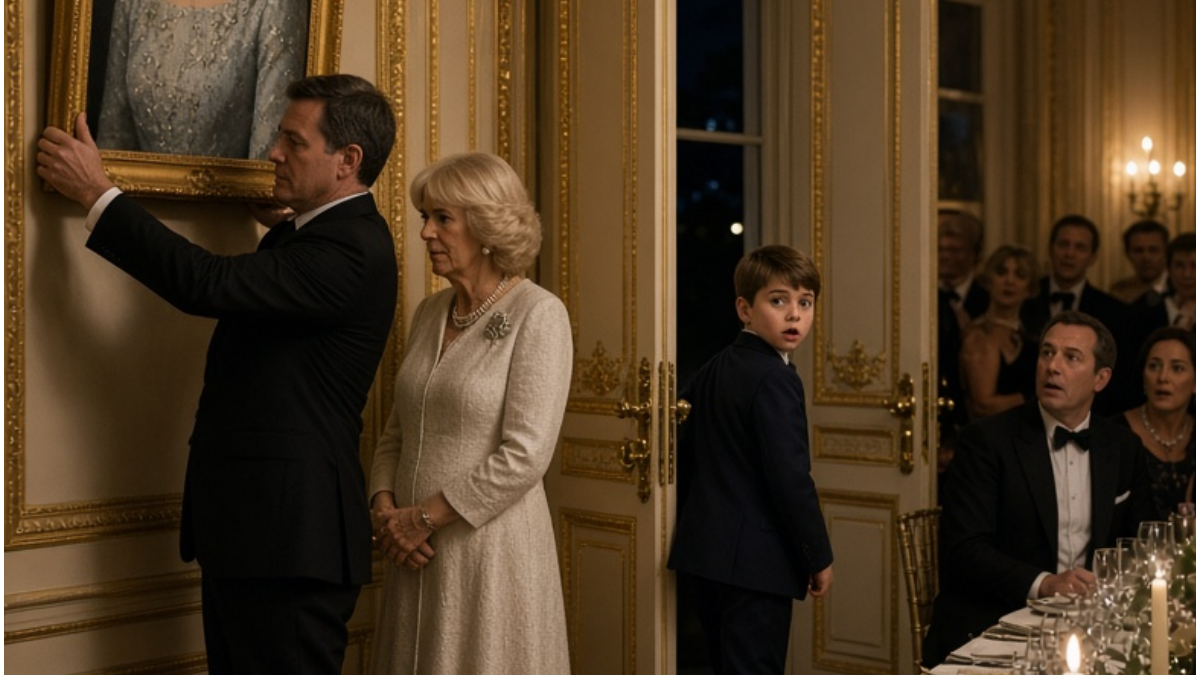
The royal dining room was prepared for ceremony, not rebellion. Candles burned beneath gilded ceilings, and every movement had been rehearsed until Prince Louie looked toward a familiar wall and suddenly stopped.
Catherine’s portrait was gone. Minutes later, the young prince pushed back his chair, refused to remain at the table, and walked out of the royal dinner while Camila sat only yards away.
Windsor Castle had hosted difficult family dinners before, but this one carried different weight. Charles had gathered Camila, William, Catherine, George, Charlotte, Louie, Anne, Edward, and Sophie after weeks of strained palace relations, hoping the evening might restore calm.
A royal dinner is a formal family gathering shaped by rank, protocol, and symbolism.
Meaning, every seat, gesture, and object carried meaning. That was why the missing portrait mattered.
Louie entered beside Catherine and looked toward the place where her image normally hung. He slowed at once.
Then he asked quietly but clearly, “Where is mommy’s picture?” Catherine turned toward him, understanding the danger in that innocent question.
She lowered her voice and told him they could speak later, but the effort to protect him exposed how deeply the moment had cut her.
Across the table, Camila stayed composed. She said the room was being updated. William looked directly at her and did not touch his place setting.
Anne sensed something was wrong before anyone explained it. An aid leaned toward her and confirmed that the portrait had not been taken away for restoration.
Camila had ordered Catherine’s image removed that afternoon before the family arrived. The timing changed everything.
This was no neutral adjustment. It meant the future queen’s image had been deliberately taken down before her children entered the room.
Louie heard enough. He did not cry. He did not shout. He placed his napkin beside his untouched plate, pushed back his chair, and said he did not want dinner there.
Catherine watched her youngest son rise, torn between stopping him and respecting the instinct that had driven him to his feet.
George looked stunned. Charlotte went still. William followed immediately. Anne remained behind long enough to ask the question nobody else wanted to voice.
Who had given Camila the right to erase Catherine from a room used by Catherine’s own children?
Louie may have been the first person to leave the table, but his walk out exposed something far more dangerous.
Every adult in that room already understood why the missing portrait mattered. To the palace, it was a portrait.
To Prince Louie, it was his mother. That difference is what made his reaction impossible to dismiss.
He had no interest in court hierarchy, decorative policy, or the silent competition surrounding Catherine’s position.
He simply saw someone he loved being erased from a family space and reacted with the brutal clarity only a child could bring into a room filled with adults trained to conceal what they felt.
William caught up with Lewis just beyond the dining room where the boy had stopped near a closed drawing room door.
The future king did not call him back. He simply moved closer and waited.
Louie, the youngest child of William and Catherine, had grown up surrounded by royal protocol, the formal rules that govern how members of the monarchy behave in public, but he was still young enough to see the world in painfully simple terMs. George and Charlotte understood composure.
Luis understood hurt. “Why would somebody take Mommy’s picture down when she was coming to dinner?”
He asked. William knelt before answering. Anger was already building inside him, but he refused to turn Camila into a villain in front of his son.
He told Luis only that Catherine had done nothing wrong and that adults sometimes made decisions they later had to correct.
That answer was careful, almost painfully so. The prince knew one careless sentence could place his child directly inside a conflict that had already become too personal.
Catherine arrived moments later and immediately understood that the portrait itself was no longer the deepest wound.
Her son had seen the slight. That was what hurt her moSt. She placed both hands on Louiswis’s shoulders and told him he never had to defend her by making himself unhappy.
Lewis looked at her and answered with an honesty that nearly broke her composure. He said he was not upset because of dinner.
He was upset because everyone had seen what happened and pretended not to notice. Charlotte was asking a different question inside the dining room.
She turned to Anne and wanted to know whether Catherine’s portrait would be returned that night.
The Princess Royal hesitated. That pause told Charlotte more than any explanation could have done.
Anne understood that the removal was not a simple decorating choice, and the older child understood that, too.
George learned the final detail from an Equiry, a royal aid responsible for assisting senior members of the household.
Another portrait had already been chosen for the cleared space. It featured Camila. Suddenly, the empty wall became something far more deliberate.
Not removal, but replacement. George went quiet. Anne did not. William sent Catherine and the children away from the dining room.
Then he turned back alone. The children had reacted in different ways, but the real explanation for that empty wall began weeks earlier with one private exchange Camila never expected Catherine’s family to remember.
The portrait did not become controversial on the night it disappeared. Its fate had been sealed weeks earlier during an encounter so quiet that almost nobody outside the room noticed anything unusual.
There were no raised voices, no slam doors, and no dramatic announcement. Yet one sentence spoken by Catherine during a private planning meeting challenged Camila’s authority more deeply than a public confrontation ever could.
And from that moment onward, the image hanging in the royal dining room became something Camila could no longer ignore.
Catherine had recently taken on a heavier schedule of royal duties, and her growing presence across major engagements had changed how the palace viewed her role.
Her portrait in the dining room became an unofficial sign of that rise. Not a formal decree, but a symbol of where the next generation was heading.
Camila noticed the queen consort had become increasingly sensitive to spaces where Catherine’s image, patronages, and ceremonial position appeared to overshadow her own standing.
3 weeks before the dinner, Camila raised the subject during a private household planning meeting at Windsor.
A household planning meeting is a closed discussion where senior royals and aids coordinate rooms, events, duties, and ceremonial arrangements.
She suggested moving Catherine’s portrait to a secondary corridor. Catherine answered calmly that family portraits should not be rearranged to settle questions of precedence, meaning the order of status and importance within royal life.
The sentence was controlled. The effect was not. Camila closed the folder in front of her and said nothing.
Anne glanced toward Catherine and immediately understood that the exchange had crossed a line neither woman could easily walk back from.
Catherine left believing the issue was finished. William did not. Later, he told her privately that the queen consort had interpreted the remark as a challenge to her authority inside royal residences, not as a simple disagreement over placement.
Charles tried to contain the damage. In a private conversation with William, the king warned that the family could not start turning walls into battlefields.
William pushed back. He believed avoiding a decision only left Catherine vulnerable to repeated symbolic humiliation, while Camila gained more room to test how far she could go.
2 days before the dinner, Camila quietly asked the household art curator whether portraits could be moved under the authority of the presiding royal household without a family vote.
The curator explained that such changes could be made administratively. That answer gave her exactly what she needed.
Hours before the dinner, a direct instruction reached the staff. Catherine’s portrait was to be removed before the family entered, and no explanation was to be offered unless someone asked.
One staff member hesitated before obeying, understanding the order was no longer decorative. What Camila had not expected was that William would discover not only who ordered the removal, but how carefully the timing had been chosen.
By the time he returned to the dining room, he was no longer confronting decor.
He was confronting intent. William did not storm back into the room. That would have been easier.
Instead, he returned quietly, walked past his untouched chair, and stopped directly opposite Camila.
Everyone still seated understood what that silence meant. Anne watched him carefully. Charles stiffened. Camila refused to look away.
Then William asked a single question. Not where Catherine’s portrait had gone, but whether Camila had deliberately ordered its removal, knowing Catherine and her children would see the empty wall that evening.
William already knew enough to make the question dangerous. He had just left Catherine and Lewis outside the dining room, and an aid had confirmed that the removal happened only hours before the family arrived.
Charles sat between two loyalties he could no longer keep separate. His wife on one side, his son and heir on the other.
The heir is the person next in line to the throne, and that made William’s challenge more than a family argument.
It carried the weight of the monarchy’s future. “Did you have Catherine’s portrait removed today?”
William asked. Camila answered that she had approved a change to the room and rejected the idea that it had been intended as an insult.
The prince did not raise his voice. He told her Louise had believed his mother was being deliberately pushed aside.
Camila replied that children should never be involved in household decisions. That sentence sharpened Williams anger instantly.
Anne stepped in before he could answer. She told Camila that Lewis became involved the moment the decision was made where he could see its result.
The Princess Royal, an honorary title traditionally held by the monarch’s eldest daughter, made no attempt to soften the point.
Camila turned toward her and accused the family of treating Catherine as though every room, ceremony, and decision had to revolve around her future position.
Anne did not retreat. William then placed the written room change instruction on the table.
An aid had handed it to him moments earlier, and the wording destroyed any claim that the timing had been accidental.
Catherine’s portrait was to be removed before the Wales family arrived. Charles took the paper and read it twice.
Sophie broke the next silence. She explained that according to a documented household account shared with her earlier that evening, Camila’s own portrait had already been prepared for the same wall.
The trusted confidant’s revelation changed the argument completely. This had not been simple removal.
It had been replacement. Charles set the instruction beside his plate and looked at Camila with disappointment rather than fury.
She seemed more unsettled by that silence than she would have been by shouting. William pushed his chair beneath the table without ever sitting down.
Then Charles spoke. “Nothing else would happen,” he said until he knew who had approved the replacement portrait.
Camila answered quietly. She had the argument had begun as William defending Catherine, but the document on the table shifted the danger toward Charles because the next decision could no longer be postponed or delegated.
For decades, Charles survived royal conflict by absorbing it, delaying it, or allowing protocol to soften its edges.
That strategy could not work now. His youngest grandson had walked out. His heir was refusing dinner.
Catherine had been publicly diminished inside a family residence, and his wife’s instruction was sitting beside his hand in black and white.
Charles was no longer being asked to manage tension between two women. He was being forced to decide whether personal authority could be used to humiliate the future queen.
Charles understood why the wall mattered. In royal life, rooms are never just rooms, and household displays can quietly communicate rank, continuity, and belonging.
A portrait placed prominently during a family occasion can signal who is central to the institution, while removing it can send the opposite message.
The king had the power to reverse the decision immediately, but doing so would mean openly overruling Camila in front of people who had already seen the damage.
Charles finally asked everyone except Anne and Camila to leave. When the room emptied, he took his place at the head of the table, removed his glasses, and asked one question.
Why did the portrait have to be moved before this dinner? Camila answered without hesitation.
She argued that Catherine’s growing symbolic presence was beginning to blur precedence. The formal order that determines status and priority within royal life.
The queen consort insisted that the current queen could not constantly appear secondary to the woman expected to come after her.
Camila’s argument exposed the deeper fear. This was no longer about decoration. She feared becoming irrelevant before her role had even ended.
Charles listened, then told her something she clearly did not want to hear. Diminishing Catherine would never strengthen Camila.
The king admitted that watching Louise leave had changed the way he understood the conflict.
What adults called strategy a child had recognized as cruelty and then spoke. She told Charles based on direct conversations with household staff that evening that several employees had privately objected to the removal because they understood exactly what message it would send.
The Princess Royal added another detail. Camila’s replacement portrait had already been delivered to the corridor before the family arrived.
The plan had never been merely to create an empty space. It was to substitute one woman for another.
Charles stopped delaying. He instructed the household secretary, the senior official who coordinates the monarch’s private administrative decisions that Camila’s portrait was not to be hung.
Catherine’s image was to be restored before midnight. Camila did not argue. She looked toward the doorway through which Lewis had disappeared and understood that Charles had finally drawn a line.
The wall could be restored before dawn, but the family could not be reset as easily because Lewis’s empty chair had already changed how everyone interpreted Camila’s authority.
No formal announcement ended the dinner. It simply disintegrated. One chair remained empty, then another, then another.
William never returned to his place. Catherine stayed upstairs with Louise. George and Charlotte were quietly removed from the gathering.
Anne abandoned dessert without explanation. And as servants began lifting untouched plates from a table prepared for unity, Camila was left facing the most humiliating consequence of her decision.
Nobody needed to declare the evening ruined. Their departures said it for them. Staff immediately understood that normal palace language would not be enough to contain what had happened.
A formal royal dinner is supposed to project order, unity, and continuity, especially when senior family members gather under one roof.
Instead, the schedule had collapsed. More importantly, Charles had personally ordered Catherine’s portrait restored, which meant the dispute could no longer be dismissed as a harmless decorating disagreement.
The king had treated it as a mistake serious enough to reverse before the night ended.
Anne stayed close as two attendants returned the portrait. Shortly before midnight, she watched until it was placed back exactly where it had stood before Camila’s instruction.
The Princess Royal said almost nothing, but her presence carried its own message. She wanted no confusion about whether the order had truly been reversed.
When the attendance finished, Anne remained for another moment, then left without looking back. Catherine found Louise already preparing for bed.
He asked immediately whether her picture was coming back. She told him yes. Then she sat beside him, shaken less by the insult itself than by the fact that her youngest son had felt he needed to defend her.
Louiseie listened carefully as she explained that adults sometimes make hurtful choices, but children should never feel responsible for fixing them.
William joined Catherine soon afterward and made his position clear. He said he was finished accepting gestures that diminished her simply because confrontation made the family uncomfortable.
The future king believed silence had encouraged the problem. Catherine understood his anger, but warned him that protecting her could not become a war their children were forced to carry.
William listened. He did not disagree, but neither did his anger disappear. Camila returned alone to her private rooms later that night.
An aid quietly confirmed that Catherine’s portrait had been rehung. The queen consort dismissed the aid and remained silent.
Charles had reversed her order within hours, and she knew everyone involved would understand what that meant.
Sophie reached the same conclusion in a private conversation with Edward. She told him that Louis’s walkout had achieved what months of careful complaints had failed to do.
Charles had finally seen the conflict through his grandson’s eyes. Meanwhile, household staff began recording who issued the original instruction and when, fearing blame if questions followed.
By morning, William was preparing to speak privately with his father. The family had spent the night reacting to what Luis did.
Now Charles and his son had to decide what the walk out had actually changed.
The most important conversation happened without Camila, Anne, advisers, secretaries or courters in the room.
Charles and William met alone the next morning after a night in which neither man had slept properly.
There was no palace audience, no paperwork between them, and no ceremonial language to hide behind.
For once, they were simply a father and son discussing what had happened to a wife, a mother, and a child, and whether silence had helped create the crisis they were now trying to contain.
William arrived before the formal working day began because he refused to let the portrait incident be softened into a misunderstanding.
The future king knew Catherine’s image had been restored, but the deeper problem remained untouched.
Someone had used a royal space to challenge her place in the family. Charles understood that too.
The king had corrected the immediate insult. Yet correction was not prevention. If nothing changed, the same rivalry could simply return in another form.
William spoke firSt. He told Charles that Lewis’s walk out had frightened him more than the argument itself.
His son had recognized disrespect toward Catherine before the adults were willing to name it openly.
The prince said he did not expect his father to reject Camila or humiliate her in return.
He expected something harder. He wanted Charles to stop allowing Catherine to become the price of keeping peace inside his marriage.
Charles did not defend himself immediately. He admitted that he had often mistaken silence for neutrality, believing that refusing to intervene kept conflict from spreading.
Watching Lewis leave had shattered that belief. The monarch told William that avoiding a decision could become a decision of its own, especially when one person kept absorbing the consequences.
Then Charles gave him the answer he had come for. The king said he had issued a permanent household instruction.
A household instruction is a formal internal order directing how palace staff must handle royal arrangements.
From that point forward, no portrait, room designation, ceremonial placement, or public display involving Catherine or her children could be altered for personal reasons without approval from both the king’s household and the Wales office.
The team responsible for William and Catherine’s official work. Charles added one more detail. Camila had accepted that her portrait would not replace Catherine’s in any space formally associated with the Wales family.
William did not smile. He simply exhaled and told his father that he wanted Lousie to remember his grandfather fixing the problem, not the fight that created it.
Charles reached across the table and rested his hand briefly over William’s wriSt. The gesture said what neither man needed to repeat.
For a moment, the crisis seemed contained. Then, a photograph of Louie leaving the dining corridor reached the public.
Inside the palace, father and son had finally drawn a boundary. Outside it, the country was about to decide what Louis walk out symbolized.
By sunrise, the story was no longer about an empty wall inside Windsor. It was about one image, Prince Louie walking through the corridor beside his father, his face serious, while the royal dinner continued behind closed doors.
The photograph had none of the polish expected from palace occasions. That was exactly why it spread so quickly.
The public did not see a carefully managed institution. They saw a child who appeared unwilling to remain where his mother had been diminished.
Palace Communications moved quickly, hoping to contain the story before it hardened into something larger.
A communications office is the team responsible for shaping official public statements and handling press questions, and its first response was deliberately restrained.
The dinner was described as a private family occasion. The portrait change was treated as an internal household matter, but that explanation began collapsing almost immediately when word spread that Charles had personally ordered Catherine’s portrait restored before the night ended.
The morning papers turned the tension into a national event. One front page carried the photograph beneath the headline, “Lewis leaves the table,” followed by the smaller line, “Portrait dispute ends royal dinner in extraordinary family rupture.”
The image mattered because it reduced an argument about hierarchy to something brutally simple. Luis was not discussing precedence or household authority.
He was a child who believed his mother had been treated unfairly. By midday, people had gathered outside Windsor Castle.
Some carried small printed images of Catherine while broadcasters discussed the restored portrait from beyond the gates.
The debate quickly divided. Some commentators questioned why Lewis had been exposed to such tension at all.
Others focused on the honesty of his reaction. Through all of it, the young prince became the emotional center of a dispute he had never asked to enter.
Catherine watched the coverage privately and became deeply uncomfortable with the language surrounding her son.
She instructed aids not to describe Louisie as heroic or courageous. The Princess of Wales insisted that he was a child, not a symbol to be used against Camila.
Her concern was immediate, defending Catherine must never become Louis public role. Charles then authorized a later family photograph showing Catherine with George, Charlotte, and Lewis.
The king was careful about the meaning. It was not retaliation against Camila. It was a deliberate confirmation that Catherine’s place and the place of her children remained secure.
Camila saw the newspaper front page alone. The queen consort understood that whatever message she had intended by removing the portrait had been completely overtaken by Louis walking away.
The country had already chosen its symbol of the night. But the final meaning of Louiswis’s walk out would be decided not by headlines, rather by what Catherine told her son once the noise finally faded.
Days later, Prince Lewis returned to the same dining room. The candles were gone. The long table was bare.
There were no photographers, no formal clothes, and no gathering waiting to judge his reaction.
Catherine walked beside him toward the wall where the conflict had begun. Her portrait was back exactly where it had stood before.
Louie looked at it, then at his mother, but the real resolution did not come from the restored frame.
It came from what Catherine told him next. Catherine knew the moment had to belong to her son, not the institution.
Charles’s household instruction remained in force, meaning the internal palace order now prevented portraits, ceremonial placements, or family displays involving Catherine and her children from being altered for personal rivalry.
Camila had accepted the reversal and made no attempt to replace the portrait again. That mattered because the conflict was no longer being managed through silence.
A boundary had finally been drawn. Louie looked at the restored portrait and asked the question Catherine had expected.
Had it come back because he walked out? She answered carefully. Adults had corrected a mistake because correcting it was the right thing to do.
He had not caused the decision and he was not responsible for protecting her from palace battles.
His job, she told him, was simply to be her son. The words changed something in him immediately.
Luis did not look victorious. He looked relieved. He asked whether they could have dinner there again someday and Catherine smiled and said yes.
The room that had become a symbol of humiliation suddenly became something simpler again. A place where a family could sit down without asking a child to carry the meaning of every adult decision.
William reinforced that message later. He thanked Louie for being honest about how he felt.
But the future king also told him that courage does not always mean walking away.
Sometimes it means trusting the people who love you to fight the battles that belong to them.
Louie listened. William made sure he understood that Catherine never needed him to become her shield.
Charles then invited the whales family back for a smaller private meal. When Louie entered, the king pointed toward Catherine’s restored portrait and said simply, “It belongs there.”
Camila attended as well, and the queen consort did not challenge the arrangement. Her authority remained, but the limit was unmistakable.
She could not strengthen her place by diminishing Catherine or drawing Catherine’s children into a struggle over status.
The final meaning was simple. Adults had treated the portrait as power, precedence, and territory.
Louie had seen only his mother being erased. That honesty forced the monarchy to confront what everyone else had tried to soften.
The next family dinner ended normally. Louie stayed at the table. Catherine’s portrait remained in place.
No speeches were needed. The silence was different now. There was nowhere else for the conflict to go.
The portrait was restored. Louie returned to the table. Catherine’s place was secured. And the palace finally learned that preserving the crown sometimes begins with refusing to erase the person standing next in its future.








