Poor Woman Took a Six-Week Ranch Job—A Simple Coffee Tin Revealed the Truth That Saved His Ranch
Edwin Pike did not knock. He walked through the door of the Lighthouse kitchen like he owned the floorboards beneath his boots, set a leather wallet on Anna’s workt, and said, “Name your price.”
Anna did not look up from the pot she was stirring. Pike pushed the wallet closer.
“$200. All you do is change a number on a piece of paper. 22 men become 28.
Nobody’s counting heads out here.” Anna set the spoon down. She turned and looked at the wallet, then at the man standing behind it pressed suit, clean hands, the patient expression of someone who had purchased easier people before, and expected no real resistance here.
He thought her poverty was a door. He expected her to open it. Anna picked up the wallet and held it out to him.
“Somebody is counting,” she said. If a woman in a worn coat and three stitched gloves refusing $200 from a powerful man isn’t the kind of story that keeps you up at night, you’re watching the wrong channel.
The morning Anna Reed arrived in Fort Benton, Montana, she had $11.40, one carpet bag that had belonged to her mother, and a coat she’d repaired twice at the cuffs with whatever thread was closest in color to the original.
She was not expecting rescue. She was not expecting anything except a town large enough to have a decent sofish stand beside while she figured out her next 3 weeks.
Fort Benton in late October was not hospitable to people without plans. The river trade had slowed.
The merchant traffic had thinned. The boarding houses were filling with workers who’d come west in the summer and had not quite made enough to go back east for the winter.
Anna had passed three of them on the main street men sitting on porch steps with their hats low and their mouths doing the arithmetic on what they had left.
She recognized that look. She’d been making the same calculations since July. Inside Connley’s general store, it was warmer than the street, but not by enough to matter.
Anna positioned herself near the potbelly stove at the back corner and watched a man in a good coat argue with the store owner about flour.
Not argue exactly, more like insist with the quiet certainty of someone who was used to being heard eventually.
I need 200 lb loaded by noon, the man said. Connelly shook his head. I can give you 150 today.
The rest came in short from the mill. I contracted for 200 and the mill sent me 150.
I can’t sell you flour I don’t have. The man in the good coat didn’t raise his voice.
That was the first thing Anna noticed. He just went still in that particular way that large men sometimes do when they’re deciding whether anger is worth the energy.
He was probably 35. Anna guessed broad through the shoulders. Dark hair worn under a good hat.
Workowned hands that didn’t match the coat. The coat was quality. The hands were honeSt. She watched him decide that anger wasn’t worth it.
“When does the rest arrive?” He asked. “Week, maybe 10 days. That’s too late.” The man turned away from the counter, and his eyes moved across the store, the way a person’s eyes move when they’re running numbers in their head, and none of them are coming out right.
They landed on Anna standing beside the stove. She was used to that kind of look, the brief assessment, the quick social math.
A woman alone, a coat repaired twice. A bag that held everything she owned. Men like this usually looked away again in under two seconds.
He didn’t. You looking for work? He asked. Anna considered this for a moment. Depends [clears throat] on the work.
Cook line camp about 30 mi northeaSt. 6 weeks maybe 7. What happened to your last cook?
Broke his wrist loading a wagon yesterday morning. Can’t grip a pot handle. What’s the rate?
He named a number. It was fair. Not generous, but fair. Anna did not let her face show what she thought of it.
How many men? 22 arrived tonight. Anna looked at the flower situation behind Conny’s counter.
150 instead of 200. 22 men. 6 weeks of winter. That math was already unhappy.
You’re short on flour, she said. The man blinked. I know. If I agree to cook three meals a day for 22 workers, and you’re already 40 lb short on flour coming in.
I need to know the resupply schedule and whether you have a reliable contact at the mill or whether I’m going to spend 6 weeks making biscuits go farther than biscuits are meant to go.
The man looked at her the way people sometimes look at a door they expected to open inward that has just opened outward.
We have a supplier through the company, he said carefully. What company? Barrett Cattle. I’m Will Barrett.
Connelly made a small sound behind his counter that Anna categorized as the sound of a man trying not to react to something.
She had heard of Barrett cattle. Most people in this part of Montana had. It was one of the large operations thousands of acres.
A proper ranch house, a name that got used in local business conversations, the way certain words get used to anchor a sentence.
Will Barrett watched her face to see if the name changed anything. It didn’t, not visibly.
Sleeping arrangements? Anna asked. Private room at the line house. Door locks. Wages paid when?
End of the six weeks. Half at 3 weeks, half at six. Will was quiet for a moment.
That’s not standard. I’m aware of what’s standard, Anna said. I’m telling you what I’ll agree to.
Something shifted in his expression, not irritation. Something more like focus, the way a person looks when they’ve stopped anticipating the conversations now and started actually paying attention to it.
Half at 3 weeks, he said. Half at 6:00. If the camp closes early for any reason, I receive full wages regardless.
That’s a risk for me. The risk of not having a cook tonight is also yours.
Anna paused. And one afternoon free each week when operations allow. Not asking for a holiday.
Just a few hours. Will looked at her for a long moment. One afternoon when it’s possible, he said.
When it’s possible, Anna agreed. She held out her hand. Will shook it. His grip was direct, and he didn’t hold on past what the handshake required.
“We leave in an hour,” he said. “I’ll need to know your full supply inventory before we arrive.
I’ll tell you on the way.” Anna picked up her carpet bag. Will turned toward the flower situation with Connelly.
Anna had already moved toward the back shelves because she’d noticed while standing by the stove that Connelly had an extra 40lb sack of cornmeal stacked behind a crate of rope and cornmeal could bridge a lot of gaps that flour couldn’t cover if you knew what you were doing.
Mr. Barrett, she said. He turned, you should also buy that cornmeal behind the rope crate.
Connelly blinked. Will looked. There it was. How much? Will asked Connelly. $160. Will looked back at Anna with an expression.
And she couldn’t quite read. “Add it to the order,” he said. The wagon ride northeast took most of the afternoon.
Will drove. Anna sat beside him with her carpet bag on her lap for the first 20 minutes until she realized he wasn’t going to say anything about it and moved it to the wagon bed.
He gave her the supply inventory the way she’d asked for it, not begrudgingly, not as if reciting it was beneath him.
He just listed it. Flour, cornmeal, now salt, pork, dried beans, coffee, sugar, baking soda, a small amount of lard, some dried apples, potatoes.
He knew the quantities from memory, which told her either he was meticulous or he’d been over the numbers enough times this week that they duck against his will.
Anna did the math in her head and didn’t say what she arrived at. “Have you done supply accounts before?”
Will asked. “For 4 years at a Missouri boarding house.” And before that, I helped my husband run accounts for a farm supply operation.
Your husband? He died 14 months ago. Will didn’t say he was sorry. He said, “Was it sudden?”
“Yes and no,” Anna said, which was the truest answer and also the one she never usually gave.
He didn’t press it. They drove another mile in silence that wasn’t exactly comfortable and wasn’t exactly uncomfortable, just existing.
“What happened to the boarding house?” Will asked. “It belonged to the owner.” When Matthew died, I found out he’d borrowed against my wages as collateral on a business venture I didn’t know about.
The debt was legitimate. I paid it. She paused. It took almost everything I had.
Will looked at the road. “You paid someone else’s debt,” he said. “Not a question.
Just repeating it to make sure he’d understood. It had my signature on it, as it turned out.
Anna kept her eyes forward. He’d meant to tell me about it. That was the kindest way I could read it afterward.
She could feel Will glancing at her sideways. “You could have challenged it,” he said.
“I could have. It would have cost more in lawyers than I had, and I would have loSt. And the end result would have been the same, except I’d also have made enemies of the creditors.”
She looked at him. I paid it. I left. I came weSt. To do what?
To earn enough money that next time someone attaches a debt to my name, they’ll at least have to ask me firSt. That ended the conversation for a while.
The mountains in the distance were showing their first real snow on the peaks. The grass out here was long gone brown, flattened by early season wind.
The sky was the kind of cold gray that Fort Benton residents called getting serious.
Anna was watching the land and thinking about biscuit ratios when Will said without preamble.
22 men isn’t exact. Could be 20 or 23 depending on who comes in from the South Pasture Crew.
I’ll need to know exact counts at each meal. That’s more trouble than most cooks want.
It’s less trouble than running short halfway through February. Anna said, “If I know exactly how many men I’m feeding at each meal, I can tell you the day we run out of anything on that supply liSt. If I’m guessing, you get a surprise.”
Will thought about this. “How do you want to track it? I’ll work something out,” Anna said.
They arrived at the line camp 40 minutes before the first crew. That was the only time Anna had to see the kitchen before she needed to function in it.
And Will seemed to understand this without her saying it. He showed her the room, a locked door off the main sleeping corridor, a caught a small window, and then he showed her the kitchen and got out of her way.
The kitchen was not terrible, it was not good. The stove was adequate. The workt was solid.
There was a genuine lack of organization that told her the previous cook had been operating on memory and instinct rather than any kind of system.
Anna opened every cabinet, counted everything, made a list in her head. She was rendering lard when Will came back.
Anything you need? He asked from the doorway. Someone to carry the water barrel from the pump and wood split down to a size that fits this stove box, not the larger one.
Will looked at the wood pile visible through the side door. The pieces were cut for a larger stove.
I’ll do it, he said. Thank you. He started on the wood. Anna started on the beans.
She heard him outside the steady rhythm of the axe. The particular sound of a man working without showboating.
He wasn’t splitting fast to impress anyone. He was splitting at a rate that produced good firewood consistently, which was more useful.
20 minutes later, he appeared in the doorway, sweat on his forehead despite the cold, carrying an armload of properly sized wood.
He stacked it beside the stove without being asked and then fetched the water barrel himself.
When he set it down, Anna said without looking up from the cornbread batter. The flour is going to hold about 4 weeks at three meals a day if I’m careful.
The beans can stretch us 2 weeks beyond that if I pair them with cornmeal.
After week five, we’re going to need a resupply or we’re eating potatoes until spring.
We’ll absorb this. I can arrange a resupply at 4 weeks. Put it in writing through your supplier, please.
The last place I worked. Verbal arrangements have a way of being remembered differently by the person who doesn’t need anything.
Will looked at her steadily. I’ll put it in writing, he said. The beans went on.
The cornbread batter went into the cast iron. Anna started on the coffee because 22 men arriving cold in the early evening would think about coffee before they thought about anything else.
The first wagon arrived at 5:40. Jacob Mills came through the door firSt. He was 52, weathered down to something almost geological, the foreman of the camp, and the kind of man who formed an opinion of a new cook in approximately the time it took them to open a cabinet.
He looked at the kitchen. He looked at Anna. He looked at the stove where actual steam was coming from an actual pot of actual food.
Barrett didn’t tell us the new cook was a woman, he said. He may not have thought it was relevant, Anna said.
Mills looked at her for another second. You know what you’re doing in there? I expect you’ll find out in about 20 minutes when supper’s ready.
Mills made a sound in his chest that was not quite approval and not quite the opposite and went to wash his hands.
The rest of the men came in behind him, big, cold, hungry, trail dusty, carrying the noise of men who’d been outside all day.
They filled the main room. Several of them noticed Anna in the kitchen and had the same half-second reccalibration that Mills had, and Anna did not pause what she was doing because of any of it.
Will stood at the far end of the room near the window, not managing the scene, but being present in it.
Anna noticed he positioned himself where he could see the kitchen doorway. She didn’t decide what she thought about that yet.
Supper was ready at 6:00. Not at 6:15, not at 6:30. At 6:00, Jacob Mills sat down, ate three bites of cornbread, and said nothing for a long moment.
“That’s decent,” he said. Finally, Anna accepted this at its full intended value, which was significant.
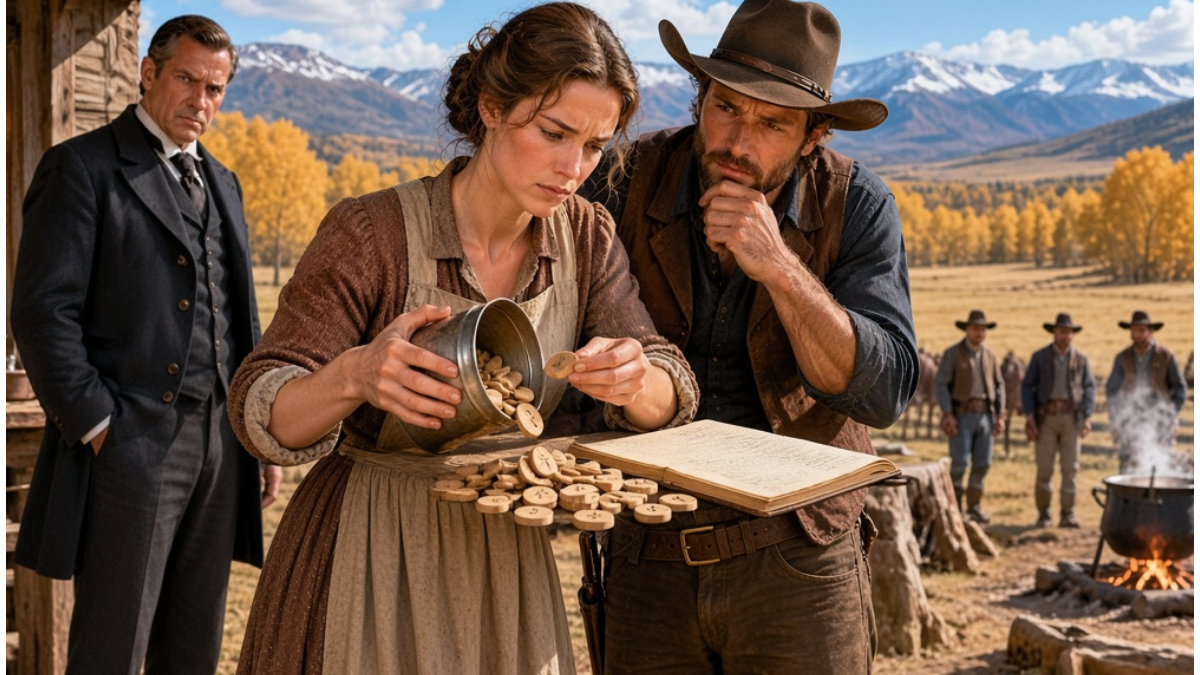
Halfway through the meal, Anna emerged from the kitchen with a small empty tin, an old coffee container she’d found at the back of the cabinet, and 22 small wooden discs she’d cut from scr scrap pieces near the firewood stack during the gap.
First 20 minutes while the beans were heating. She set the tin on the edge of the serving table.
The men looked at it. When you take a meal, Anna said, put one of these in the tin.
Mills frowned. What for? Counting. We’re not in school, one of the younger hands said.
And two or three others laughed. “I know,” Emma said. “In school, they gave you tokens for nothing.
Here you earn one by showing up.” She looked around the table steadily. “I need to know exactly how many men I’m feeding at each meal.”
Not approximately. Exactly. It helps me make sure we don’t run short on supplies before winter’s out.
She paused. It’s a 30-second habit that means nobody here eats cornmeal and prayers in February.
There was silence. Mills picked up a token, held it for a moment, dropped it into the tin, knock.
One by one, the others followed. Some of them, with the slightly theatrical reluctance of men who wanted it known they were cooperating rather than immediately agreeing, which Anna respected.
She wasn’t asking them to enjoy the system. She was asking them to use it.
The last token fell at 618 22. Anna went back to the kitchen and wrote the number in her ledger.
Will had watched the whole thing from the window end of the room. She was aware of that, too.
She found him at the water barrel an hour later cleaning up when she came out to refill the coffee pot.
“Where’d you find scrap wood that fast?” He asked. “Nar the chopping block. There were offcuts.”
“And you cut them into circles. How?” “I didn’t have time for circles,” Anna said.
“They’re squares.” Will looked at her. Something in his expression was trying to do something and not quite succeeding at being neutral.
22 men ate tonight, she said. Your supplier build for how many? Will was quiet for a moment.
I don’t know, he said. Pike handles that. Edwin Pike, the business partner. Yes. What does his count usually say?
Will seemed to consider whether to answer that like it was a personal question. I don’t usually look at the meal count specifically, he said.
The supply orders go through him. Anna said nothing. She refilled the coffee pot and went back inside.
That night, in her locked room, she looked at the number in her ledger, 22, and thought about the 40 lb gap between what Barrett cattle had contracted for and what Conny’s mill had sent.
She did not jump to conclusions. She was not built for conclusions that hadn’t earned themselves yet, but she did write, “Day one, 22 men,” and underlined it.
By the end of the first week, a pattern had established itself that nobody had planned.
Will Barrett was up earlier than anyone except Anna. She did not ask him to be, and he did not announce it.
He simply appeared in the kitchen doorway at 5:00 in the morning every day with the look of a man who had been awake for a while and had decided to be useful rather than lie there about it.
The first morning he’d reached past her to lift a heavy pot off the lower shelf.
“Mr. Barrett,” Anna said. He stopped. “Ask,” she said. He blinked. “What? If you want to help me lift something, ask me firSt.” He stared at her.
“You were going to strain your back,” he said. Possibly, Anna agreed. Ask me. There was a long pause in which several things seemed to happen behind Will Barrett’s eyes.
Can I help you lift that? He said. Anna considered the pot. She was, in fact, going to have to tilt it at an awkward angle to get it on the stove herself.
Yes, she said. Thank you. He lifted it clean and without commentary. Anna went back to the biscuits.
The next morning, Will appeared again, and this time he asked before touching anything. And the morning after that, by the the fourth morning, it was simply how they operated him asking, Anna answering yes or no, depending on whether she needed it, and the kitchen running more efficiently than any kitchen Anna had worked in, because there was a second pair of capable hands that did what they were asked, and stopped when they weren’t.
Jacob Mills noticed. He noticed the way an experienced man notices things sideways, without comment, filing it somewhere.
On the eighth day, Mills sat down beside Anna during a quiet afternoon moment and said, “You’ve done this before.”
“Cooked?” Anna said, “Managed people without managing them.” Anna thought about it. “I suppose Barrett’s not usually in the kitchen.
He’s helpful when he asks.” Anna said, “Mills looked at the middle distance.” “He usually tells people what he needs done.”
“He’s been adapting,” Anna said. She did not elaborate. Mills stood up. “Supply wagons coming day after tomorrow.
Pike usually rides with it to do the count. Anna looked up. What kind of count does he do?
She asked. Worker count for the contract records. Same thing you’ve been doing with your tin.
Does he count in person? Mills shrugged. He checks the foreman’s tally. Asks me how many we’ve got.
I tell him. And what do you tell him? Mills looked at her steadily. Whatever I had that day, which varies some days.
Sure. Anna nodded slowly. When the wagon comes, she said, “I’ll have exact numbers for the past 10 days from my records if anyone needs them.”
Mills was quiet. “Pike won’t ask for them,” he said. “I know,” Anna said. “I’ll have them anyway.”
The supply wagon arrived on day 10. Edwin Pike rode beside it on a gray horse and arrived looking like a man who had spent the journey thinking about how efficient he was.
He was 44, well-dressed for the territory, the kind of man who shook hands with his whole face engaged and then immediately forgot the handshake.
Anna had him categorized within 30 seconds. She was at the stove when he came into the kitchen.
He didn’t knock on the door frame, but he also didn’t walk in, which Anna decided was a point in his favor that she immediately reduced when he said, “You must be Barrett’s new girl.”
“Anna Reed,” she said. “I’m the cook.” Pike smiled. “Of course the cook.” He looked around the kitchen with the expression of a man cataloging assets.
Smells good in here. Thank you. How many mouths are you feeding these days? Must be keeping you busy.
22 at last count, Anna said. 21 yesterday. One man was down with a bad knee.
Pike’s smile didn’t change. Closer to 25 or so, I’d have thought. Big operation. 22.
Anna said, “I count each meal.” Pike looked at her the same way a person looks at a door they expected to open and found locked.
Well, he said, running tight on anything. Lard’s going faster than projected. Beans are holding.
I’ll see what the wagon has. He left. Anna finished what she was doing, and then she went to the doorway and watched Pike cross the yard toward where Will was talking to the wagon driver.
She watched the way Pike touched Will’s arm when he reached him. The comfortable familiarity of two people who had done business for a long time.
Will’s face was easy, unsuspecting. She went back inside. That evening, she counted the tokens, 22.
She wrote it in her ledger. Then she turned back two pages to day one and drew a faint line connecting the numbers.
22 22 21 22 22. Consistent, clear, simple. She closed the ledger. 3 weeks in, Anna received the first half of her wages.
Will brought the money to the kitchen on a Wednesday evening after supper when the main room was mostly empty.
He set it on the workt in a folded envelope. Anna opened it and counted it without apology.
She counted it twice. Will stood near the door with his hat in his hands and said nothing while she did this.
The count was right. Thank you, Anna said. You haven’t missed a meal, Will said.
Not once in 3 weeks. That was the agreement. I know. He paused. The men are eating better than they usually do this time of year.
Mills told me this morning. Anna didn’t know what to do with this, so she put the envelope in her pocket and started wiping down the workt.
I’ve been looking at the supply orders, Will said. She looked up. The large discrepancy you mentioned to Pike, he said carefully.
I looked at what was ordered versus what came in. There are some numbers I can’t reconcile, Anna said.
Nothing. The counts, Will said. They don’t match what you’re tracking. No, Anna said. They don’t.
The kitchen was quiet except for the stove. How long have you been tracking it?
Will asked. Since day one. Something moved through Will’s expression that she couldn’t fully read.
Not anger. Exactly. More like the look of a man who has been bu been building something on a foundation he’s just realized might have a crack in it.
I haven’t said anything to anyone. Anna said it might be a recordeping error. It might be the mill shipping in batches that don’t match the order dates.
I don’t know what it is. I’m just keeping an accurate count on my end.
And on your end, the count is consistently lower than what the orders reflect. Yes, Will was quiet for a long time.
It’s not an error, he said finally. This is a significant problem. I know, Anna said.
Pike has been handling Barrett supply contracts for 11 years. I know he’s my father’s.
Will stopped. He’s been trusted for a long time. Anna looked at him directly. Mr. Barrett, I’m not accusing anyone of anything.
I’m a cook with a coffee tin and some wooden squares. I’m telling you the numbers I have.
What you do with them is your business. Will looked at the tin sitting on the shelf.
The sound it made each night, knock, knock, knock, had become a kind of punctuation to the day that he’d stopped noticing until now when he was suddenly thinking about it very deliberately.
Keep tracking, he said. I intend to, Anna said. He left. Anna stood alone in the kitchen for a while after he’d gone.
She looked at the ledger. She looked at the tin. 22 small wooden squares sat at the bottom of it, worn already at the edges from two dozen hands dropping them in every single day.
She thought about Matthew, about ledgers full of numbers she hadn’t seen until it was too late, about the particular violence of being told the final count after the decisions had already been made without you.”
She picked up the tin and moved it from the shelf to the workt where she could see it from any angle of the kitchen.
That was the arrangement then. Nobody was going to change Anna Reed’s numbers without her in the room.
The cold arrived properly in week four. Not the cold that had been sitting at the edges of things since Anna got there.
The manageable kind. The kind that made your breath visible and your hands stiff in the morning.
This was the other kind. The kind that came down from the mountains in the night and was simply there when you woke up, settled in like it had signed a lease, and expected nobody to argue.
Anna was up before it got fully light, which meant she was up before anyone else, which meant she was the first person to notice that the water in the barrel had a skim of ice on top.
She broke it with the ladle handle and got the stove going, and by the time the ice reformed, she had enough heat in the kitchen to hold it off, but it was a reminder of what was coming.
And Anna noted it the same way. She noted everything in her ledger, not with alarm, just with the understanding that this information would matter later.
Jacob Mills came through at 5:30, saw the steam rising from the pot, and said, “Freeze last night.”
“I noticed.” Anna said, “Going to be like that every night from here on. I’ve extended the bean ration by half a cup per pot.”
Anna said, “Cold mornings, men eat more. We’ll make up the difference on the next supply.”
Mills looked at her. Already worked that out, did you? Last week, Anna said, “When the temperature started dropping at night, Mills poured himself coffee and didn’t say anything else, which was Anna had come to understand his particular form of approval.
He was not an affusive man. He said what was necessary and let what was unnecessary sit unsaid, which Anna found genuinely restful.
She was pulling the first batch of biscuits out of the oven when Will appeared in the doorway.
He’d been doing that every morning. And it still made her slightly aware of herself in a way she hadn’t worked out what to do with.
Not uncomfortable exactly, just present, like she’d been operating at a certain frequency, and someone had adjusted the dial slightly without warning.
He looked at the stove, then at the barrel. “I’ll bring more wood in before breakfast,” he said.
“Thank you.” He didn’t move yet. He stood in the doorway with that particular stillness of his, the one that meant he was thinking about something adjacent to what he was saying.
How much wood do we have stacked? He asked. Enough for 11 days at current burn rate, Anna said.
You should have more cut before the end of the week. Will said, I already asked Hrix to start on it yesterday.
Anna stopped. She turned and looked at him. When did you notice we were going to need it?
She asked. Four days ago, he said. When the temperature started dropping at night, they they looked at each other across the kitchen for a second.
“Then why did you ask me how much we have?” Anna said, “I wanted to see if you’d counted the same way I had.”
She turned back to the biscuits. “I had two more days in my estimate,” she said.
“Because you’re conservative with the burn rate,” Will said. “Because I’ve been wrong before when I assumed things would go the way they were supposed to.”
He didn’t answer that. He went and got the wood. There was a moment around the start of week four where something shifted.
Anna couldn’t have said when exactly it happened. Not a single point, more like a gradual resettling of weight.
The way a house changes when the ground thaws and contracts and something that was slightly off becomes level.
She and Will had been circling each other for 3 weeks in the functional careful way of two people who were very aware of the exact nature of what this was.
Employment contract temporary. And then one Tuesday afternoon, she found a tear in his work coat.
She hadn’t gone looking for it. The coat had been left over the back of a kitchen chair.
Not her chair, just the nearest available surface, and she’d picked it up to move it and felt the seam along the right elbow go in her hand.
Not all the way through, just pulling. Another cold morning and it would go. Anna set the coat over her arm.
She thought about it for a moment. She thought about the fact that it was a good coat, that the rest of it was intact, that the seam was a simple thing that would take her 10 or 12 minutes with a needle and thread.
She thought about the fact that it was not her coat. She mended it anyway because leaving a good coat with a failing seam on purpose seemed like the kind of petty principle she didn’t actually hold.
Will came back into the kitchen an hour later, reached for the coat, and stopped when he saw the seam.
He looked at the stitching. He looked at Anna, who was stirring something on the stove, and had her back to him.
“You mended it,” he said. “The seam was going.” Will turned the coat over in his hands.
The stitching was small and even and matched the original as closely as the available thread allowed.
“What do I owe you?” He asked. Anna paused mid stir. It took 12 minutes, she said.
“That’s not what I asked. It’s what’s relevant.” “I’m paying you for cooking,” Will said.
“Not for repairing my things. I know that. So, what do I owe you for the 12 minutes?
Anna turned around. She looked at him standing there with his coat and his question and his complete seriousness about this.
And she thought about how to say what she wanted to say without it coming out as something it wasn’t.
Nothing. She said 12 minutes is 12 minutes. I had it. 12 minutes still belong to you.
Will said it was a simple sentence, not a grand declaration, just a plain statement of what he believed, delivered in the flat practical tone he used for everything else he meant.
Anna looked at him for a moment. All right, she said. Then at some point, when I need 12 minutes of something from you, I’ll ask for it.
That’s fair, Will said. He put the coat on and went back out. Anna stirred the pot and didn’t examine what she was feeling too carefully because she was fairly sure examining it would not improve her ability to function in this kitchen.
Margaret Barrett arrived on a Friday, which was nobody’s plan. She appeared in the line camp yard just before noon on a ran mare that she rode like she’d been on horses her entire life which she had and she came inside without ceremony and said hello to Jacob Mills in the tone of someone who’d known him for 15 years which was accurate.
Will had not been expecting her. Anna could tell this from the way his face did a quick rearrangement when he saw his sister come through the door.
Not displeasure, more like the expression of a man calculating a new variable he hadn’t built into his morning.
Margaret was 31 and did not look it, or rather she looked exactly it, in a way that was specific and direct, not young in a soft way, but young in the way of someone who had been through something hard and come out on the other side still recognizably herself.
She was a widow, Anna remembered from something Will had mentioned in passing. A couple of years out maybe.
She shook Anna’s hand with both of hers when Will introduced them. “Anna Reed,” she said.
“I’ve been hearing about you. I hope the supply counts are what you’ve been hearing about,” Anna said.
Margaret looked at her brother briefly, among other things. Will made a face that was not quite an expression of anything and excused himself to deal with something outdoors.
Margaret sat down at the kitchen table without asking, which Anna liked immediately. People who ask permission to sit in a kitchen usually wanted something from it.
People who just sat down were generally interested in the conversation. Will says you can manage accounts.
Margaret said, “I can.” He says, “You trained the men to use a token system for meal counts.
They trained themselves once they understood it would keep them from eating cornmeal past February,” Anna said.
Margaret smiled. It was a sharp, clear smile, the kind that meant the person was actually amused rather than performing it.
He also says, “You refused to take a permanent position when he offered it.” Anna looked at her.
He told you that. He tells me most things eventually. Margaret folded her hands on the table.
Don’t be annoyed at him for it. He wasn’t gossiping. He [clears throat] was trying to work out what he thought about it.
What did he decide? He hasn’t yet. Margaret was quiet for a moment. That’s why I came.
I wanted to meet you. Anna stopped what she was doing and looked at Will’s sister directly.
Mrs. Margaret, please. Margaret, Anna said, I’m the cook at this camp. I’m here for 6 weeks under a fixedterm contract.
I have no designs on your family’s property or your brother’s income, and I would appreciate it if we could start from that premise rather than arriving at it after a long time of you deciding whether I’m trustworthy.
Margaret considered this. All right, she said. That’s a reasonable place to start. Thank you.
Now, let me say what I actually came to say. Margaret leaned forward slightly. I’m not here because I think you’re after Will’s money.
I’m here because my brother is the kind of man who, when he wants something, begins providing it before he asks if the other person wants it, too.
He does it with cattle operations. He does it with business partnerships. She paused. He’s probably doing it here without knowing he’s doing it.
Anna was quiet. He’s a good man, Margaret said. He’s just built that way. The thing he has to learn is the difference between solving a problem and solving a person.
I’ve noticed, Anna said. I imagine you have. Margaret looked at the coffee tin on the workt.
Are you going to tell me what those tokens are for? Anna told her. The counting, the daily numbers, the supply discrepancy, the ledger.
Margaret listened without interrupting. When Anna finished, Margaret sat for a moment with the particular stillness of someone reassessing something they’ thought they understood.
Does Will know about all of this? She asked. He knows about the discrepancy. He asked me to keep tracking.
Has he talked to Pike? Not that I know of. Margaret looked at her hands.
Pike has been with Barrett operations since before father started handing things to Will. He’s part of the She stopped.
He’s established. I know. That makes this more complicated than just numbers on paper. I know that, too, Anna said.
That’s why I haven’t said anything beyond what I’ve told Will. It’s his company. I’m the cook.
Margaret looked at her for a long moment. You have a very precise sense of where your authority begins and ends, she said.
I found it useful, Anna said. Margaret nodded slowly. Then she stood and walked to the window and looked out at the yard where Will was visible near the water trough.
His coat turned against the wind. She watched him the way a person watches someone they’re genuinely fond of and genuinely worried about, which was a combination Anna recognized.
Be certain she can afford to tell you no before you ask her for anything.
That was what Margaret said so quietly that Anna almost thought it wasn’t directed at her.
But there was nobody else in the kitchen. I’ll make sure of it, Anna said.
Margaret turned from the window. I know you will, she said. That’s why I’m not worried about you.
She stayed for lunch, ate efficiently, complimented nothing and criticized nothing, and said exactly what she meant about three or four things that had nothing to do with Anna or Will.
When she left, she shook Anna’s hand again. “If [clears throat] you need anything,” Margaret said, “you can write to me directly at the main house.”
She rode back the way she came, and the [clears throat] afternoon settled into something that felt slightly different than it had before, without being visibly altered in any measurable way.
That night, Will sat at the far end of the main table after the men had gone to sleep.
He had a cup of coffee that had gone cold and a piece of paper with numbers on it that he kept looking at and then setting down.
Anna was cleaning up the kitchen. She could see him through the doorway. She brought the coffee pot over without asking and refilled his cup.
Margaret asked you things, he said. Not a question. She did. What did you tell her?
The truth generally. Will wrapped both hands around the cup. I should have warned you she was coming.
She wasn’t what I was expecting, Anna said. What were you expecting? Anna thought about it honestly.
Someone suspicious of me for the wrong reasons. She was suspicious of you instead, which I found refreshing.
Will looked up. She thinks I He stopped. She thinks you solve problems without checking whether the other person wants you to, Anna said.
She wasn’t unkind about it. She seems to think you can learn. We’ll absorb this.
I’m trying, he said quietly with a rofful honesty that Anna found harder to deal with than defensiveness would have been.
She put the coffee pot back on the stove. The numbers for today, she said from the kitchen, going back to neutral ground.
22. Same as yesterday. Pike’s latest supply report said the camp is running at 26 to 28.
Anna paused. “That’s what I thought,” she said carefully. I looked at it after Margaret left.
Cross-referenced against the last two supply orders. Will’s voice was level. The way people’s voices get when they’re keeping them level deliberately.
There’s a consistent gap. Four to six men who aren’t in your count. No. I know.
Every man who eats puts a token in that tin. Anna said, “I’ve had one invalid count in 4 weeks.”
Day nine. A man I thought was eating in the bunk house turned out to have missed the meal entirely.
I corrected the next day. I remember you brought me a note. I brought you a note.
We’ll set the paper down. If the gap is consistent, he said slowly. It’s not an error.
I’m aware of what it would mean if it’s not an error, Anna said. Four years of Barrett supply contracts.
I know. The fire and the stove made a sound. Outside, the wind had picked up and was pressing against the side of the building in a way that reminded everyone inside of how much weather was on the other side of the walls.
“Have you counted back further?” Will asked. Through earlier records. Do you have anything from before you arrived?
I only have what I’ve recorded, Anna said. But I could look at the supply orders against the foreman’s general tallies if someone has them.
I have them, Will said. Not here at the main ranch house. Then you’d have to look at them yourself.
I will. He drank the coffee. I’ll ride out to the main house next week.
Will you tell Pike you’re looking? Will was quiet for a moment. Not yet, he said.
Anna went back to cleaning the kitchen. The coffee tin sat on the workt, 22 tokens at the bottom of it.
She’d stopped finding their weight surprising, but she noticed it every time she moved the tin the specific gravity of things that had been verified.
It was Will who noticed first that the flower was going faster than it should have been.
Not by a lot, not the kind of discrepancy that announced itself, the kind that sat in the numbers quietly until someone looked at them with a particular intention and saw what was there.
He came to her on a Wednesday at week 5 with a calculation on a scrap of paper.
50 lb of flour in 6 days, he said for 22 men. Anna looked at the paper.
She’d been tracking this, too, but she’d been hoping his numbers would tell her something different from hers.
They didn’t. A pound and a half per man per week, she said. That’s high for my baking output.
Could it be spillage? Measurement error. I measure everything that goes into any recipe. I’ve been keeping a running weight.
Will rubbed the back of his neck. “Then where’s it going?” He asked. “I don’t know yet,” she said yet, because it was accurate.
“She didn’t know yet. There were three possible explanations, and none of them were harmless, and one of them was significantly worse than the others.”
She told Will two of the three. “Measurement error on the delivery,” she said. The sack was marked 50, but the actual weight was short.
Or, “Someone’s taking small amounts and it’s not showing up in a single count, but it’s cumulative.”
Will looked at her. And the third option, he said he’d noticed she’d listed two.
Anna looked at him directly. The third option is that the supply records are inflating the flower delivered so that the purchase price reflects more than what’s being sent.
The difference goes somewhere between the mill and the camp, and my actual usage tracks what arrived, not what was buil.
The kitchen was quiet. That would mean, Will said [clears throat] carefully, that the problem isn’t the meal count.
The meal count is just one piece of it. Anna kept her voice steady. If someone is inflating both the worker count and the supply quantities, the amount being skimmed is considerably larger than a few uncounted meals.
Will sat down in the kitchen chair, her kitchen chair, the one nobody else sat in, and he put both forearms on the table, and he looked at the space between them for a long moment.
Anna left him to it. She started measuring out coffee for the morning because she’d learned that Will thought better with something happening around him rather than in complete stillness.
After a while, he said, “How long have you known about the flower?” “I suspected at week three.”
“I wasn’t certain until yesterday.” “Why didn’t you tell me at week three?” “Because suspicion isn’t a number,” Anna said.
“I told you when I had enough data to point in a direction.” Will looked up at her.
There was something in his face that she didn’t examine too carefully because it was the kind of thing you could build a wrong idea out of if you looked at it the wrong way.
I should have been paying more attention to my own operation. He said, “You’re paying attention now.”
Anna said, “Pike has been handling supply chains for 11 years. I trusted the arrangement.
You trusted a person.” Anna said, “That’s not the same as negligence.” The first thing trust requires is that you can’t see through it.
Will was quiet. Then he said something Anna wasn’t expecting. “You could have said nothing, kept track, done your six weeks, taken your wages, and never mentioned any of this.”
I know. It would have been easier. It would have been easier for me in the short term,” Anna said.
“And someone would have kept filing false paperwork against your company until the numbers were large enough to be impossible to explain.”
She picked up the flower tin and moved it to the shelf with the measured morning portion already separated out.
“I’m not interested in what’s easy for me in the short term.” “You’ve said that before,” Will said in different words.
I keep meaning it. He stood up at the door. He stopped without turning around.
Anna,” he said. She waited. “Thank you.” Just that plain. “You’re welcome,” she said. He left.
She sat down in the kitchen chair, her kitchen chair, and breathed out for a moment.
The fire in the stove was settling into its late night rhythm, the kind of low, steady heat that required nothing from her right now.
She thought about Matthew’s debts. She thought about the particular helplessness of discovering that the numbers had been kept from you, not out of malice, but out of a quiet assumption that you didn’t need to know.
She was grateful. She realized in a way she hadn’t expected to be grateful for anything in a long time that this time someone had listened to her count.
The second supply wagon came at the start of week five. Pike did not come with it this time.
He sent a young man named Doyle with a letter of instruction for the driver and a supply manifest for Will.
Doyle was 20, eager, genuinely pleasant, and had clearly not been told to pay attention to anything particular.
Anna watched the unloading from the kitchen window. She counted the sacks. She counted them again.
Then she went to the door. How many sacks of flour on this manifest? She asked the driver, who was a different man than last time.
He looked at the paper. Eight. Eight 50-lb sacks. That’s what it says. Anna counted the sacks that had come off the wagon.
Six. She told the driver. He counted. He came up with 62 and looked at the manifest and then looked at the sachs again in the way of a man who genuinely could not explain the discrepancy and was uncomfortable about it.
I loaded what was on the list, he said. I believe you, Anna said. She took the manifest inside.
She checked it against her ledger. The manifest said 8. Doyle’s covering letter referenced eight.
Her kitchen held six. She put both documents in her ledger and went back to cooking lunch.
When Will came in at noon, she showed him. He read both documents twice. He looked at his face in a careful way when he read the second time, not shocked.
Exactly. More like a man confirming something he’d begun to be afraid of. Six arrived, he said.
Six arrived, Anna said. The manifest says 8. The manifest says 8. We’ll set the papers on the table.
I’m going to the main house, he said. Tomorrow morning. I know, Anna said. I’m going to look at the full records.
Good. He looked at her. Can I take your ledger? He asked. I’ll return it.
I’ll have a copy made and return the original. Anna considered this. No, she said.
Will blinked. I’ll write you a summary, she said. Date by date, count by count, cross-referenced against each supply delivery in the stated manifest numbers.
You can have that, she paused. But the ledger stays here. I’m not going to alter it, Will said.
I know you’re not, Anna said. It still stays here. He looked at her for a long moment.
Then he nodded. How long will the summary take? He asked. I’ll have it for you by supper.
She wrote it that afternoon between batches. Her handwriting was small and precise, and she used both sides of the paper.
When she handed it to Will at the end of the evening meal, he read it standing in the kitchen doorway, turning the page once, reading the second side, turning back.
This is clear, he said. I tried to make it clear, Anna. He lowered the paper.
If this goes where I think it’s going, if there’s a formal investigation of the supply chain, you may be asked to testify about this formally.
I know it could be uncomfortable. Pike has Mr. Barrett, Anna said. He stopped. My numbers are my numbers, she said.
I’ll stand behind them in front of anyone you’d like me to stand behind them in front of.
Will looked at her. For a moment, Anna thought he was going to say something that would require her to respond in a way she wasn’t ready for.
The expression on his face had that quality on the edge of something, like a sentence that had started and realized partway way way through that it needed to stop and wait for a better moment.
He folded the summary paper and put it in his coat pocket. I’ll be back from the main house by Thursday, he said.
The Wednesday count will be in my ledger when you return, Anna said. She went back to cleaning the kitchen.
Will stood in the doorway for another second. Then he left. The tin sat on the workt.
Anna counted the tokens with her eyes without touching them. 22. The same 22 men who’d been eating her cooking for 5 weeks, who’d stopped laughing about the wooden squares sometime around day 8, who now dropped their tokens in with a quiet, unself-conscious habit of men who’ve simply accepted that this is how things work here.
Tomorrow there would be 22 again. And somewhere between here and Fort Benton, an accounting was forming itself out of dates and weights and numbers that had never been allowed to disappear into someone else’s convenience.
Anna turned off the lamp. The fire was enough light to finish by. She’d gotten good these past 5 weeks at making things hold until morning.
Will came back from the main ranch house on a Thursday, as he’d said he would, and he came back different in a way that was not immediately visible, but that Anna recognized by the end of the first hour.
It was the way he held his coffee cup with both hands, like something that required studying.
He didn’t tell her immediately what he’d found. He came in, ate the supper that was waiting, spoke to Filtha South fence line, checked on a hand who’d been nursing a sprained ankle for 3 days, and did all of it with the competent steady presence he always had, except that underneath it something had changed weight.
Anna did not ask. She cleaned up the kitchen and counted the tokens 22 and wrote the number in her ledger.
When she came out to bank the main room fire for the night, Will was the only one still up at the far end of the table with a lamp and papers she didn’t recognize from before.
The main house records, he said without her having asked. She came and stood at the other side of the table.
He spread three pages out. Supply manifests from the previous contract season the winter of 1,887 18 months earlier.
His handwriting was in the margins, cross- referencing with something he’d pulled from the ranch bookkeeper files.
Pike has been handling supply contracts for three operations, Will said. This camp, the south pasture crew, and the main ranch kitchen.
In all three, the stated worker count is consistently higher than the foreman logs. He tapped the margin notation between four and nine men per count.
Variable. Not consistent enough to look like a round error. Variable is strategic, Anna said.
Yes. His voice was flat in the particular way of a man keeping something in a container that is the correct size for the container.
How much does the difference represent over the 1,887 season? Will was quiet for a moment.
If I calculate the inflated counts against the supply billing, he said somewhere between $800 and $1,200, depending on how the supplier split the margin.
Anna said nothing. $800 was more than she had earned in the last four years combined.
That’s one season, Will said. How long has Pike been running these contracts? 11 years.
The fire made a sound. Anna pulled out a chair and sat down. She looked at the papers.
11 years. The number settled into the room like something being set on a floor after a long carry.
He’s smart, she said. He kept the gap small enough that no single season looks impossible.
Variable enough that nobody notices a pattern unless they’re looking across all three operations at once and comparing to actual headcounts, which nobody was doing, Will said, because the headcounts were coming from him.
Until I started putting tokens in a tin. Will looked at her. Until you started putting tokens in a tin, he said.
She waited. My father has co-signed Pike’s supply authorizations for the past 11 years, Will said.
Everyone. He trusted Pike completely. Pike handled everything my father didn’t want to spend time on.
He folded his hands on the table. If this goes to a formal investigation, it reflects on Barrett Ranch’s internal oversight.
It reflects on my father. I know he didn’t know, Will said quickly. He’s not involved.
I’m certain of that. I believe you, Anna said. I also know that being uninvolved and being publicly uninvolved are sometimes different things.
Will rubbed his face with one hand. Yes, he said. What are you going to do?
He was quiet for a long moment. “I’m going to compile everything carefully,” he said.
“Your records, the manifests, the margin notes, the foreman logs from 1,887 enough that when I bring it forward, there’s no room for argument about interpretation.”
He lowered his hand. “I’ll need another 2 weeks. The contract ends in 2 weeks.”
“I know,” he looked at her. “I’m not going to ask you to stay. That’s not what this is.”
“I know that, too,” Anna said. They looked at each other across the lamp and the papers and the particular weight of a thing neither of them had started, but both of them were now carrying.
I’ll give you whatever documentation you need from my ledger before I leave, Anna said.
A full certified copy, dated entries. I’ll sign each page. That’s yes. Thank you. We’ll gather the papers together.
I’m sorry you’re involved in this. Anna looked at him steadily. I’m not, she said.
He stopped gathering. Somebody with more power than me was changing numbers and assuming nobody would bother to count, she said.
I find I prefer being the person who bothered to count. Will looked at her for a moment with an expression that she couldn’t categorize and didn’t try to.
Good night, Mr. Barrett, she said. Good night, Anna. She took her lamp and went to her room.
The lock clicked home in the familiar way it did every night, and she lay on her cot and stared at the ceiling and thought about 11 years of changed numbers, and about the particular courage it took to not change them when you were the only one in the room who knew which number was real.
The week that followed was unremarkable on the surface and entirely unremarkable underneath it, which is to say that nothing large happened, but something was growing in the negative space between what was said and what wasn’t.
Will did not hover. That was one of the things about him that Anna had gradually stopped bracing for.
He didn’t orbit her in the way that men sometimes did when they decided something about a woman and were waiting for her to confirm it.
He came to the kitchen in the mornings when he was going to be useful.
And he wasn’t there when he wasn’t. Mound states, “And the boundary between those two states was his reading of what was needed rather than his own preference to be present.”
Anna had noticed this for weeks without letting herself name it too directly because naming things directly was its own kind of risk.
On Monday evening, she found that someone had quietly replaced the flower sack she’d been stretching since Wednesday.
A full new 50 lb sack sitting on the shelf where the depleted one had been.
She looked at it. She looked at the workt. She looked at the door. The empty sack was gone.
The new one was positioned exactly where it would have been if it had come with a delivery.
There had been no delivery. Anna picked up the flower tin she used for measuring and set it on the workt and left the kitchen.
She found Will at the water pump. The flower, she said. He straightened up. His expression already had the look of a man who knew what the next sentence was going to be.
When did you replace it? Anna asked. Sunday evening. After supper. From where? I rode to the main ranch house Saturday.
Brought some things back. You brought flour back from the ranch house and replaced my supply sack and didn’t tell me.
Your supply was low, Will said. I know it was low, Anna said. I’ve been managing around it.
I know you have. If you replace my supply without recording it, the count for the week is wrong.
I’ll have more flour than my records show, which means when I try to cross reference against Pike’s manifests, the numbers won’t match my actual usage.
Will blinked. He hadn’t thought about that. Anna could see him not having thought about that.
Every pound of supply in this kitchen, she said, has to come from a documented source, Mister Barrett.
If I can’t account for where it came from, then my records have a gap.
And a gap in my records is exactly what Pike needs to say. The count is unreliable.
Will was quiet. I was trying to make sure you had enough, he said. I know.
Anna kept her voice even. I need you to not do that. Even if you’re about to run short, even then.
If I’m going to run short, I need to know it and manage it. If you solve it without telling me, I can’t manage what I don’t know is there.
She paused. You can tell me you have extra supply at the main house. I’ll record it as an advanced delivery and account for it properly.
But it has to go through the ledger. Will looked at the pump handle. All right, he said.
Put the flower through properly. I’ll add an entry backdated to Saturday with a note that it came from ranch stock.
I’ll give you the weight. What was it? 42 lb. I weighed it before I left.
Anna almost said something about the fact that he’d weighed it, which meant he’d thought about documentation and then done it anyway without the documentation.
But she decided that was a lesson he’d already absorbed on his own without her spelling it out.
“Thank you for weighing it,” she said instead. “Thank you for telling me why it mattered,” he said.
She went back to the kitchen. That evening, when the last token fell into the tin knock she wrote in the ledger, day 37, 22 men, flower supply corrected 42 lb, additional ranch stock transfer sat W.
Barrett, and under it, in her own shortand he weighed it. He just needed to learn the order of operations.
Edwin Pike came back to the line camp on a Tuesday. Will was not there.
He had ridden out to the south fence with Mills and two of the hands to deal with a section that had gone down in a windstorm, and he’d said he’d be back by midafternoon.
It was 11:00 in the morning when Pike’s horse came into the yard. Anna heard the horse and looked through the kitchen window and had a particular feeling in her chest that she recognized as the physical experience of adjusting expectations.
She kept cooking. Pike came inside without hurrying, stamped the cold off his boots, looked around the main room, said Barrett around.
To the one hand, who’d stayed behind with a bad ankle and was told no.
He came to the kitchen doorway. Mrs. Reed, he said, busy as ever, Mr. Pike.
How much longer on this contract? 10 days, Anna said. 10 days. He smiled the way he always smiled with complete proficiency.
You’ve done good work out here. The men speak well of you. That’s kind of them.
He came inside without being invited. Anna noted this without turning around. He walked to the workt and looked at the coffee tin.
He looked at the ledger sitting beside it. He did not touch either. You’ve been keeping detailed records, he said.
It’s my job to know what I’m cooking, Anna said. Of course. He moved to the side of the workt where he could see her face.
I was looking over the supply manifests from this season, comparing them against the camp records.
Anna said nothing. There are some discrepancies, Pike said. I wanted to talk to someone familiar with the daily operations.
You’d want to talk to Mr. Barrett, Anna said. Will’s been busy. Pike reached into his coat and removed a leather wallet.
He set it on the workt. Between them and opened it. Inside was money. Folded bills crisp.
The kind of money that had been organized with intention rather than shoved in a pocket.
$200, Pike said. Anna stopped what she was doing. She looked at the wallet. $200.
She had $11.40 when she arrived in Fort Benton. She had been paid half of her wages at the 3-week mark, which was a number that felt like something when she had it, but would run out faster than she liked to think about once the contract ended, and she had to find somewhere to spend the winter.
$200 was a room in town. Winter food, new clothing, months without the specific daily terror of arithmetic.
All you do is adjust the meal count in your final record, Pike said. His voice was easy, the voice of a man who had done this before and found it went more smoothly than people expected.
28 men per day instead of 22. A small adjustment. Nobody’s counting heads out here except you.
Anna looked at the wallet. She looked at it for a long moment, and she let herself feel exactly what it would mean.
That was the honest thing. The thing she owed herself to not pretend the money wasn’t real.
To not perform a refusal that cost her nothing. $200 would change the next 6 months of her life entirely.
She stood in a drafty line camp kitchen in 40° weather with worn out coat cuffs.
And she made herself look at what she was being asked to give that away for.
A false number, six on a page instead of the real one. She thought about Matthew’s creditor sitting across a table from her with a document that bore her signature on something she had never agreed to.
And she thought about the year she spent that had been changed without her. She thought about 22 men who dropped a token in a tin every single day because she had asked them to.
She thought about Will Barrett on his horse at dawn riding toward a main ranch house full of 11 years of falsified records that were about to be examined.
She picked up the wallet. Pike’s expression relaxed by a fraction. Anna held it out to him.
You can’t buy a number that was never true, she said. The relaxation in Pike’s expression disappeared.
What replaced it was not anger, at least not visible anger. It was something harder and quieter, a reassessment, the look of a man who has arrived at a transaction expecting a certain kind of person and found a different kind instead.
He took the wallet back slowly. You’re not doing yourself any favors, he said. I understand that’s your view.
Anna said Barrett’s completion bonus on this contract depends on the final count matching the agreed upon operating scale.
If your numbers come in below projections, that bonus is in question. That’s Mr. Barrett’s arrangement with you, Anna said.
My arrangement with Mr. Barrett is the accurate count. He won’t thank you for costing him money.
Anna looked at Pike directly. If he does, she said, I’ll have learned something useful about him.
Pike looked at her for a long moment. He was calculating something she could see it in the particular stillness behind his eyes.
Think about what you have to lose, he said, and what you have to gain.
I have thought about it, Anna said. He left. She stood in the kitchen for a moment after she heard his horse leave the yard.
She was aware of her own pulse in a way she usually wasn’t. She breathed once deliberately and then she went back to what she’d been doing.
She did not tell anyone, not because she was ashamed of what had happened or uncertain about her decision, because she was the cook at a line camp and Pike was a man with 11 years of connections in the Barrett operation.
And [clears throat] the only thing that would matter in the end was the ledger on her workt and the tin beside it.
She did not need anyone to know she had refused the money. She needed the numbers to stand up.
She went back to cooking lunch. At noon, 22 men ate. 22 tokens fell into the tin.
Knock, knock, knock. The sound was the same as it had always been. Simple, countable, real.
Will returned at 3:00 in the afternoon, later than he’d said, because the south fence had been worse than the initial report.
He came in cold and tired, and with mud on his coat, and he washed up and ate the late plate Anna had left covered on the stove.
And it was only at the end of it that he noticed something in the kitchen.
It was subtle. The workt was in the same place. The tin was in the same place.
The ledger was in the same place. But the tin had been moved. He’d been watching that tin for weeks without being entirely conscious of watching it.
And he knew it usually sat toward the right side of the workt. It was now centered.
He didn’t say anything that night. The next morning, he rode into the small Waypoint settlement 5 mi from the camp where a general store operated out of a converted barn.
He needed a new buckle for a piece of harness, and he went himself rather than send anyone because he wanted an hour alone to think.
The storekeeper was a man named Aldis Crane, who’d been supplying the area for 12 years, and who knew most of the major cattle operations on a firstname basis with their supply clerks.
They were talking about buckle sizes when Crane said. In the conversational way of men who talk a lot and mean some of it, Pike was in here yesterday afternoon.
Will fitted the buckle over the harness strap. What did he need? He asked. Not much.
Just stopped in, asked some general questions. Crane leaned on the counter. He asked me something odd, though, whether I’d heard of any trouble at the Barrett line camp.
Said there might be an issue with one of the employees. We’ll set the harness strap down.
Which employee? He asked. Crane shrugged. Didn’t say specifically. Said something about a temporary cook who was making difficulties about the paperwork.
Will was quiet. When was Pike at the camp? He asked. Would have been the morning from the direction he came in.
Yesterday, like I said, Will paid for the buckle without speaking further. He rode back to camp faster than he’d written out.
He found Anna in the kitchen, which was where she usually was at 10:00 in the morning doing something complicated with a pot of beans and a small amount of the precious remaining lard.
“Pike was here yesterday,” Will said. Anna looked up. “Yes,” she said. “While I was out, yes.
Why didn’t you tell me last night?” Anna set the spoon down. “What did Crane tell you?”
She asked. “That Pike was in his store yesterday afternoon asking about trouble at my camp.
Specifically about a temporary cook making difficulties with paperwork. Anna’s face did not change visibly.
He came while you were at the fence, she said. He offered me money to change the final count in my records.
The kitchen was quiet. Will stood very still. How much? He asked the way he asked it carefully without expression told her he was keeping something inside the container very deliberately.
$200. Will’s jaw moved. $200, he said. It’s a lot of money, Anna said matterofactly.
I know it’s a lot of money. His voice was level in a way that was different from his usual levelness.
What did you say? I said no. You said no. I told him you can’t buy a number.
That was never true. Will looked at her. He looked at the tin on the work table.
He looked at the ledger. He turned around and walked to the end of the kitchen and stood there with his back to her for a moment, his hands on the edge of the shelf beside the window.
And Anna let him have that because she recognized the shape of it, the specific posture of a person who has just received information they need a second to place correctly in their understanding of the world.
When he turned back, his face was composed but not easy. He came to my camp, Will said while I was away, and offered my cook $200 to falsify records.
Yes, that’s not a negotiation, Will said. That’s Pike trying to silence a witness before a problem becomes a formal one.
That occurred to me as well. He knows you’ve been tracking the counts. He’s always known, Anna said.
He saw the tin the first week. Will pressed his hand flat against the shelf.
I should have. He stopped. What? I should have been here. He said it in a way that was not quite anger at himself, but was in the same neighborhood.
Mr. Barrett, Anna said. He looked at her. I handled it. She said, I know you handled it.
That’s not He stopped again. He offered you $200. That would have made your winter considerably easier.
And you said no to protect records for an operation you were hired for 6 weeks.
I said no to protect the records. Anna said the operation isn’t why. Then why?
She looked at him steadily. Because the number is 22, she said. That’s why. It’s just 22.
Will looked at her for a long moment. She could see him trying to locate a way to respond to that, and she could see him not finding one that was adequate.
He picked up the harness buckle he’d set on the workt when he came in and turned it over in his hands.
He’ll come back, he said. Probably. Or he’ll try a different approach. He’ll work out what he thinks I want, Anna said.
And try to offer that instead. It’s how men like that think. There’s always a price, and the problem is just finding it.
What’s your price? Will asked, he asked it simply, without Guile genuinely wanting to understand how she thought about this.
There isn’t one, Anna said. Not for the count. Will set the buckle down. That makes you very difficult to manage, he said.
And there was something underneath the words that wasn’t quite what the words said. And Anna chose not to look at it directly.
I’ve been told, she said. The following 5 days had a different quality. Not tense.
Exactly. Something more like the feeling of weather that hasn’t arrived yet, but that you can feel in the direction of the wind, a pressure, not a storm.
Pike did not return. Will sent a letter to the main ranch house that Anna did not read the content of because it was not addressed to her.
Jacob Millless, who had an uncanny ability to know approximately what was happening without being told specifics, became slightly quieter than usual around meal times and somewhat more present near the kitchen, which Anna recognized as his version of standing guard without making it a production.
She found this touching and did not say so. She and Will found themselves in a kind of rhythm that had no business being as comfortable as it was given the circumstances.
He was up early every morning. He asked before he helped. He didn’t ask questions about the ledger she hadn’t offered answers to.
And she didn’t offer opinions at the business decisions she wasn’t part of. And then on a Thursday evening, 3 days before the contract was set to end, something happened that was both very small and not small at all.
Anna had burned the biscuits. Not all of them, six of them on the left side of the cast iron because she’d been distracted by a noise from the yard that turned out to be a horse getting loose from the rail, and she’d been outside for 90 seconds longer than the biscuits could afford.
She pulled them out and looked at them and said a word that she generally tried not to say in professional settings.
She scraped the burned ones into the discard pale and started again. There was enough batter for another batch.
They would be 20 minutes late. Will came into the kitchen at the point where the second batch was in the oven, and Anna was standing at the stove with the specific posture of someone who was going to stand exactly there until the timer in her head said it was safe to do otherwise.
He looked at the discard pale. He looked at her face. He said nothing. He got the coffee pot and refilled it and put it back on the heat and then stood near the stove, not helping and not talking, but simply being in the room.
The biscuits came out right. Anna took them to the table without comment. The men ate them without knowing they were 20 minutes late because there had been enough of everything else to occupy the first portion of the meal.
Afterward, Will was the last one at the table. It happens, he said. It shouldn’t, Anna said, clearing plates.
You’ve had one batch of burned biscuits in 6 weeks, Will said. That’s not a pattern.
I was distracted. Something was happening in the yard. You went to check. That’s correct prioritization, not negligence.
Anna looked at him. “You’re trying to make me feel better,” she said. “I’m trying to give you an accurate account,” he said.
She looked at him for another second. “Thank you,” she said. “You’re welcome.” She went back to the kitchen with the plates, and Will sat at the table for a while longer, and the fire burned down in the stove, and outside the November wind was pressing against the side of the building with a patient determination of something that had all winter to keep trying.
That night, Will came to the kitchen door late, late enough that the fire was banked and Anna was finishing the last entry in her ledger by the small lamp she used for close work.
She heard the knock. She went to the door. He was standing in the hallway with his hat off and an expression she didn’t immediately know what to do with.
“I heard from a clerk in Fort Benton this afternoon,” he said. Conny’s assistant. He said, “Pike went into the store two days ago asking about you specifically, where you’d come from.
Who knew you in Missouri?” Anna stared at him. “He’s looking for something to use,” Will said.
“A debt, a creditor, something he can,” he stopped. “I want you to know that I’m aware of it and that it doesn’t matter to me what he finds.”
“There isn’t much to find,” Anna said. “My husband’s debts are paid. My name is clear.
I know.” “Then why are you telling me?” “Because it’s about you,” Will said. And you should know.
Anna stood in the doorway with her lamp and looked at him. He was standing there with his hat in his hands and 11 years of someone else’s dishonesty, sitting behind his eyes like a weight he was carrying on behalf of a company his father had built.
And Anna thought with more clarity than she was comfortable with, that this was one of the more decent men she had been in a room with in a long time.
That thought was not useful to her right now. Is there anything you need? Will asked.
Anna looked around the kitchen. The ledger, the tin, the stove, the locked door. She looked at Will.
“Not tonight,” she said. He nodded once. “Good night,” he said. “Good night, mister.” Barrett.
He left. Anna closed the kitchen door and stood in the middle of the room for a moment.
The lamp made a small circle of light around her. Outside the window, the sky was clear and very cold and very full of stars that had absolutely no interest in what she was feeling.
She went back to the ledger. Day 41. 22 men. She wrote the number down.
She looked at it. Then she looked at the tin and the worn wooden squares at the bottom of it.
And she thought about the fact that in 4 days this contract ended. She thought about her carpet bag in the room with the locked door.
She thought about $11 that had become wages that had become something real in her hand that was hers and no one else’s.
She thought about Will Barrett asking if there was anything she needed. And the fact that for the first time in four years the answer was no.
She closed the ledger. She turned off the lamp. She found her way to her room in the dark without difficulty because by now she knew exactly where everything in this place was.
That was the problem. Maybe she’d gotten to know the place too well. The lock clicked shut.
Outside the wind pushed against the walls. Inside 22 wooden squares sat in the bottom of a coffee tin.
And in 4 days, someone was going to try to make them into 28. And Anna already knew exactly what she was going to say about that.
4 days before the contract ended, Will asked her to stay. He did it in the morning, which Anna would later think was either a calculated choice or an accident that revealed something about how he operated.
Mornings were the one time they were consistently alone in the kitchen before anyone else was up.
And mornings were when his conversational instincts were at their most unguarded. He came in same as always.
She handed him the coffee same as always. He looked out the window at the dark yard for a moment and then he said, “I want to offer you permanent work here through spring.
Better wages than the current contract. A room to yourself.” Anna had not been expecting it in that moment, which meant her face did something before she managed to arrange it.
You’d have full authority over the kitchen supply management, Will continued. I’d add a formal accounting role for the cap records.
He turned from the window. You’re better at this than any arrangement I’ve had here before.
She listened to all of it. I appreciate that, she said. It’s a fair offer.
It is. But you’re going to say no, he said. I’m going to say no, Anna agreed.
He set his cup down on the workt. He looked at his hands for a moment, then at her.
Is it because of Pike? He asked. Because of the investigation. I don’t want you to feel like you need to get clear of this before it.
It’s not because of Pike, Anna said. Then why? She thought about how to say it honestly without saying more than she meant to.
Because you asked me the wrong question, she said. Will frowned slightly. I offered you work.
Yes, you offered me work. Anna picked up the flower tin and moved it to its morning position because she needed something to do with her hands.
That’s not what you want to offer me. The kitchen was quiet. No, Will said.
It isn’t. Then don’t offer me the other thing dressed up as employment, Anna said.
I know the difference. He looked at her. He looked at her for long enough that she felt it in a way she hadn’t been permitting herself to feel things since about week three.
When the contract ends, Will said, “What do you need?” “My wages,” Anna said. “The second half.
You’ll have them, and then I need to know what I’m going to do next.”
Which I’ll work out after I have them. Will nodded once. He picked up his coffee.
He went toward the door, and then he stopped. “For what it’s worth,” he said with his back half turned.
I don’t know either what I’m going to do after. He left. Anna stood in the kitchen and breathed out carefully.
The way you breathe after you’ve said something true that you weren’t entirely ready to say.
She got back to work. 2 days before the contract was up, she had the final count for the season.
42 days of records, one for each day of the extended 6-week period. 22 entries that said 22, and one corrected entry from day 9 that said 21 and a note explaining why.
Every number signed, every page dated, a clean, organized, unambiguous account of what had actually happened in this kitchen.
Every single day since Anna Reed arrived, she read through it the night before Pike was expected.
The way you read through something you’ve written, when you know it’s about to be argued, when you know it’s about to argued with not looking for mistakes, because there weren’t any.
But sitting with the record until you know it well enough that no version of it somebody else presents is going to make you doubt what you saw.
42 days, 22 men, 924 [clears throat] meals. Pike’s current manifest for the season said 32 men average, 28 on the low end.
The difference across 6 weeks at the supply and labor rates Barrett Cattle was operating under was somewhere in the range of $3 to $4,000.
Anna closed the ledger. She had known this number for 2 weeks. Knowing it and sitting alone with it the night before the confrontation were different experiences.
She left the ledger on the workt and went to bed, and she slept better than she expected to because she had learned in the past 42 days that the numbers didn’t change while she was sleeping.
Pike arrived at 8:00 in the morning. He didn’t come alone this time. He brought a man named Cutter, who appeared to function as some combination of secretary and physical presence, and who carried a leather satchel that contained paperwork with the quiet self-importance of a man who had been told that paperwork was the important part of his job today.
Will was already at the linehouse table when they came in. He’d been there since 7, which Anna knew because she’d brought him coffee at 7:15, and found him sitting with his hands folded and an expression of settled readiness that she associated with people who had decided something, and were no longer in the process of deciding it.
Jacob Mills was there, too, standing near the far wall rather than sitting, arms crossed.
The quiet presence of a man who had been in enough difficult rooms to know when to stand rather than sit.
Anna stayed in the kitchen doorway. Pike set his hat on the table. His face carried the expression of a man conducting a routine administrative process, which was perhaps the most aggressive thing he could have worn given the circumstances.
Final accounting, he said, pulling papers from the satchel cutter set on the table. Season completion record, worker count, supply utilization, contract terMs. He smoothed the first page flat.
This gets signed today and the completion bonus releases within 30 days. Will said nothing.
Standard process, Pike said. He turned the page so it faced Will. Worker daily average for the season comes in at 28.4.
That’s consistent with the operating scale specified in the contract. Will looked at the paper.
His face was very still. That’s your count. Will said it’s the operational record based on foreman tallies and supply utilization rates.
Mills. Will said, what was your daily headcount this season? Mills looked at Pike for exactly one second.
22. Mills said 21 for one day in the fourth week. 22 otherwise. Pike’s expression didn’t change visibly.
He’d anticipated this. Foreman tallies can miss hands who rotate between crews. Pike said the supply utilization suggests a higher daily count.
The supply utilization, Anna said from the kitchen doorway is itself based on your manifests, which I can account for delivery by delivery against what was actually used in this kitchen.
Everyone looked at her. Pike turned his head. His eyes moved to the workt where the ledger sat and the tin sat.
And the particular small geometry of Anna’s six weeks was arranged the way it had been arranged every day of those 6 weeks.
Mrs. Reed, he said, “Your participation in this accounting isn’t. Her records are part of this accounting.”
Will said. Pike looked at Will. Will, he said, shifting from surnames to given name.
The small move of a man recalibrating to a more intimate approach. The completion bonus on this contract is contingent on the operation meeting its projected scale.
A worker count that comes in significantly under projection triggers a contract review. That review takes months.
The money delays. Barrett Ranch’s relationship with the contracting party gets complicated. He spread his hands on the table.
I’m trying to protect Barrett interests here. You’re trying to protect a false number, Will said.
I’m trying to protect the dining room count for this operation, Will said. For the full 42-day season is recorded daily in ink.
With date and signature, he looked at the tin and physically verified. Pike looked at the tin.
A cook’s tally system, he said, and the way he said it patient, faintly amused, was designed to reduce what the tin was to something improvised and informal, and therefore dismissible.
That’s not an auditable business record. I’d like to see you make that argument to a Fort Benton magistrate, Anna said, while I read the entries out loud.
Cutter looked at Pike. Pike looked at Will. This is not how this process works, Pike said.
And now the patience was developing an edge. The supply contracts have an established methodology.
The foreman tally is a supplement to the operational record, not the primary document. The primary document in this kitchen is the meal count, Anna said, which I kept, which I will certify, which I will read to any person you would like me to read it to.
She walked from the kitchen doorway to the workt. She picked up the tin. She carried it to the table and set it down between Pike’s paperwork and Will’s coffee cup.
“This is the final count for last night’s supper,” she said, which is the last meal covered under this contract.
She turned the tin upside down. 19 wooden squares fell onto the table. Three men were out with a fence situation that had carried over from the day before.
“9 Pike looked at them.” “28,” he said and tapped the paper in front of him.
The statement says 28. The statement is wrong, Anna said. The contract completion requires. The contract completion requires an accurate final count.
Anna said, “That’s what you have in front of you.” Pike turned away from her.
He turned to Will with the full deliberate focus of a man cutting someone out of a conversation by not looking at them.
Will, he said, “The completion bonus on this contract is a substantial sum. Barrett Ranch has operated with this contracting relationship for 7 years.
One season’s anomalous counts don’t they’re not anomalous. Will said I have 42 days of records that say they’re not anomalous.
I have the 1,887 records from the south pasture operation and the main ranch kitchen that suggest this pattern goes back considerably further than one season.
Pike went still. Not the stillness of a man caught off guard. The stillness of a man who had been calculating the odds of this moment and had arrived at it and was now making a final assessment.
“You want to make an accusation,” Pike said, “based on a temporary cook’s tin and a set of margin notes in an old ledger.
I want to make a record,” Will said, “based on documentation.” Your number is 28.
Anna’s number is 19. The final certified count on this contract is what my cook recorded.
Pike looked at Anna. You understand? He said quietly with something that was not quite a threat because it was too calm to be a threat what this costs him.
Yes, Anna said. Is that what you want? What I want, Anna said, has nothing to do with what’s in the tin.
Pike turned back to Will. I’ll withdraw the completion bonus, he said. Barrett Ranch walks away from this contract without the final payment.
That’s your call. It’s not my call alone, Will said. He looked at Anna. Not for permission, not for confirmation.
She understood the look. He was making it clear to everyone in the room, including Pike, that what happened next was not Will Barrett overruling his cook.
He was telling Pike, “This is her record, and I am not going to stand in front of it.
What does the count say?” He asked her. Anna looked at the 19 squares on the table.
She looked at them the way she looked at every number she’d written in the past 6 weeks, without embellishment, without apology.
19, she said. 19,” Will said to Pike. The room was quiet. Then Pike picked up his papers and squared them against the table and returned them to the satchel.
He did it without rushing, which was the kind of composure that belonged to a man who had already begun thinking about the next move rather than processing the current one.
The bonus is forfeited, Pike said. The contract closes without completion payment. I’ll have the paperwork drawn up.
You’ll also, Will said, submit the full Barrett supply accounting for 1,887 to the company auditor, all three operations.
Pike looked at him. That’s a significant request, he said. It’s not a request, Will said.
A long beat. I’ll need time, Pike said. You have until the end of the month, Will said.
Pike put on his hat. He nodded to cutter. He walked toward the door and then he stopped without turning around.
The same way certain men stop when they want the room to feel the weight of what they’re about to say.
I’ve worked for your family for 11 years, he said. I know, Will said. Your father trusted my judgment completely.
I know that, too, Will said. Pike left. The door closed. The 19 wooden squares sat on the table.
Nobody moved for a moment. Jacob Mills exhaled through his nose. He walked to the table, looked at the squares, and then picked up his hat from where it was sitting on the chair beside him.
I’ll be outside, he said, which was Mills’s way of giving people a room. He left.
Cutter had already gone with Pike. Will and Anna were alone in the Linehouse dining room with 19 pieces of worn wood and a table that suddenly seemed very large.
Will looked at the squares. That’s going to cost you money, Anna said. The completion bonus, unspoken between them, the amount she didn’t know exactly, but understood was substantial.
Yes, I’m sorry for that. I’m not, Will said. She looked at him. I mean that, he said, not as as not to make it sound larger than it is.
I just mean it. Anna nodded. He looked at the squares for another moment, and then he picked them up and put them back in the tin, one by one, with a kind of deliberate care that had nothing to do with the physical act and everything to do with something he was doing in his own head.
While his hands were occupied, Anna watched him. The audit of the 1,887 records is going to be complicated.
She said, “For your father?” “Yes.” “Will he understand why you pushed for it?” Will set the last square in the tin eventually?
He said, “You’re certain.” “My father is not a dishonest man,” Will said. He trusted Pike because Pike was efficient and useful, and my father didn’t want to think about supply contracts when he had cattle to manage.
“He looked up. He’ll be angry at first, because it’s embarrassing to have missed something this long, but he’ll understand the difference between missing it and doing it.”
Anna thought that was probably true and also that the period between angry and understanding was going to be difficult for everyone, which she didn’t say because it wasn’t useful to say.
I’ll give you the full certified ledger, she said. I’ll write a sworn statement describing everything I observed from day one.
I’ll include Pike’s bribe offer and the date and amount. Will looked at her. You don’t have to include that, he said.
It’s material to the pattern, Anna said. It’s also going to put your name in a formal document associated with a fraud investigation.
I know, Anna said. That could make things complicated for you. If Pike decides to respond in kind, he’ll look for something in Missouri, Anna said.
He already started, you told me. He won’t find anything useful. Probably not, Will said.
But probably isn’t certain, Mr. Barrett, Anna said. I kept accurate records for 6 weeks.
I refuse a false count this morning. Those facts exist whether or not they’re in a sworn statement.
She paused. What kind of person would I be if the facts only existed when they were comfortable for me?
Will looked at her for a long moment. Then he said, “I don’t know how to answer that.”
“It wasn’t really a question,” Anna said. She went back to the kitchen because there was still a noon meal to prepare regardless of what had happened in the dining room.
The contract ended on a Thursday. The last morning was not dramatic. The men ate breakfaSt. The tokens went in the tin.
The count was 22. Anna wrote it in the ledger for the last time, it signed her name at the bottom of the final page, and closed the book.
She packed her carpet bag. She stripped the cot and left the bedding folded at the end of it.
She looked at the small room with the window and the locked door, and thought briefly, not sentimentally, that she had slept well here, more nights than she expected.
She carried her bag to the main room. The men were milling around in the quiet way of people who are between tasks and aware that something is ending.
A few of them shook her hand. Jacob Mills shook her hand last with both of his and said, you’re a damn fine cook, Mrs. Reed, which was from Mills, approximately equivalent to a standing ovation.
Thank you, Mr. Mills, she said. You’ll be all right, he asked. I’ll be all right.
He nodded once and went outside. Will was waiting near the door. He had two envelopes.
Your wages, he said. Second half. Anna took the envelope. She opened it. She counted it the same way she’d counted the first half methodically without apology because money that was owed to her was money she intended to know exactly.
The count was right. More than right actually. She counted it twice. She looked up.
This is more than the second half rate. She said I added the formal accounting work.
Will said documentation, certified records, the statement that has a value. We didn’t agree to that.
No, I’m adding it now. Anna looked at the money in her hands. She thought about whether to argue.
She thought about the fact that this was a reasonable valuation of work she had genuinely done, not a gift in a different disguise, not Will Barrett trying to press something into her hands that she hadn’t earned.
It was wages. “Thank you,” she said. She put the money into her carpet bag.
Will watched her do it. He watched her buckle the bag closed and pick it up and stand in the middle of his linehouse floor with everything she owned contained in what she was carrying.
She looked at him. He still had the second envelope. The supply documentation I made copies of, he said.
This is the original ledger, your sworn statement, and the manifests. My copies are at the main house.
He held the envelope out. You should have the originals. You might need them for the audit.
You’ll need them more, he said. If Pike tries something, you should have your own originals.
Anna took the second envelope. She stood there for a moment with the carpet bag in one hand and the envelope in the other, and the linehouse door behind Will, and the November light coming through the window that she’d stood at dozens of times doing mental arithmetic about flower and lard, and the number of men who needed feeding before a Montana winter settled in properly.
The carpet bag was heavier than when she’d arrived. Not just the wages. She was aware of that.
Will looked at the bag and then at her face and whatever he saw in it, he didn’t try to fix, which was the right call.
I’d like to say something, he said. Anna waited. Not I’m not going to offer you work again, he said.
I know that’s not what this is. All right. And I’m not going to tell you what you should do next because that’s none of my business unless you ask me.
All right, Anna said again more quietly. Will put his hands in his coat pockets.
It was the first time she’d seen him look genuinely uncertain rather than just thinking the specific uh expression of a man who had come to the edge of something and was deciding whether to step.
I would like to court you, he said. The room was quiet properly if you’re willing.
He said it plainly without theater. Not I’m not going to lay out what I can offer you.
That’s not the point. The point is that I’d like to know you under circumstances where neither of us has an employment contract between us.
Anna looked at the carpet bag in her hand. She thought about what Margaret had said.
Be certain she can afford to tell you no before you ask her for anything.
She was standing in the middle of a room with enough money in her bag to spend the winter somewhere warm and dry.
She had her wages. She had her records. She had her name clear and clean.
She could get on the wagon to Fort Benton and she would be fine in the specific hard-edged way that fine had meant since she sold everything to pay Matthew’s debts.
She could say no, and it would cost her nothing she hadn’t already accounted for.
She looked at Will Barrett. She thought about mornings and asking permission before lifting things.
She thought about a man who weighed the flower before replacing it because he was trying to do it right, even when he got the order wrong.
She thought about 19 wooden squares on a table this morning and a man saying it’s her count when he could have bought himself out of trouble by saying nothing.
She thought about what it would mean to want something for herself rather than against her circumstances.
You’ll have to come to Fort Benton, she said. Will looked at her. I intend to, he said.
I’ll need time to settle, she said. Find rooms, work out what the next months look like.
I know. And if I decide at some point that it isn’t that I don’t want to continue, then you tell me, Will said, and I stop.
Anna looked at him. Yes, she said. All right. He exhaled. He didn’t smile. Not the wide, uncomplicated way of a man who’s gotten what he wanted.
He exhaled, and something in his face settled the way things settle. When attention you’ve been carrying for long enough that you’d stopped noticing, it is finally allowed to put itself down.
The wagon to Fort Benton leaves at noon, he said. I know when the wagon leaves.
I’ll drive you to the waypoint. You don’t have to. I know I don’t have to, Will said.
Ca looked at him. Yes, she said. The ride to the waypoint took 40 minutes.
They spent most of them in the kind of silence that had stopped needing to be filled weeks ago, which was its own information.
The cold was serious now, the kind of cold that had no ambiguity in it.
Anna had her coat buttoned to the collar and her repaired gloves on her hands, and she was warm enough.
Halfway there, Will said. I’m going to have a difficult conversation with my father when I get back.
I know, Anna said. He’s going to have questions about the audit, about Pike, about the timeline and why I didn’t fle it sooner.
What are you going to tell him? Will was quiet for a moment. The truth, he said.
That I wasn’t looking closely enough at my own operation. That someone else was looking and I had enough sense to listen.
Anna looked at the road. He’s going to ask who, she said. Yes. What will you tell him?
The cook at the line camp, Will said. Anna Reed. She said nothing. He’ll want to know more about that eventually, Will said.
I expect so. That’s a conversation I’ll handle on my end, Will said. Anna looked at him sideways.
Mr. Barrett, she said, “If we are going to court, you should probably call me Anna.”
He looked at her. “Anna,” he said. The waypoint appeared in the distance. Three other people were already waiting for the Fort Benton wagon.
A man with a crate of something she couldn’t identify and two women who appeared to be traveling together.
Anna looked at them and felt the strange, slightly disorienting sensation of re-entering a world where she was not the camp cook, but simply a woman with a carpet bag and a name.
Will pulled up to the waypoint. He set the brake and got down and came around to her side.
He reached up. He stopped. “Can I help you down?” He asked. Anna looked at him from the wagon seat.
She thought about 6 weeks of a man learning to stop and ask. She took his hand.
She got down. She picked up her bag from the wagon bed and stood in front of him in the thin November light with the wind moving her coat and her hair and 42 days of honest work in a leather envelope and enough money to decide her own future in a carpet bag.
She’d carried across more failed beginnings than she liked to count. I’ll be in Fort Benton by tonight, she said.
I’ll come in two weeks, Will said. When I’ve dealt with things at the main house.
Two weeks. If that’s too soon, two weeks is fine, she said. He nodded. He was still holding her hand, she realized.
He seemed to realize it at the same moment. He released it. Anna, he said, not a sentence, just her name.
Like he was trying it out in the open air where it sounded different than it had inside.
Will, she said, trying is out too. He looked at her. The wagon from Fort Benton came around the bend in the road.
Anna picked up her bag. She walked to the waypoint and waited with the other travelers, and she did not look back right away.
And when she did, Will was still standing beside his wagon, watching, not pretending to check the horse or look at the road or do anything except be a person who was watching someone he didn’t want to stop watching.
She turned back to the road. The wagon pulled up. The driver took her bag.
She climbed up. Behind her, somewhere in the distance, she was deliberately not looking at.
She heard the sound of a horse turning and the specific rhythm of a man riding back toward, something he had to deal with before he could go anywhere else.
Anna sat in the wagon with her hands folded in her lap and her carpet bag between her feet.
Fort Benton was 30 mi south. She had wages she’d counted herself. She had records with her name on them.
She had 42 days of numbers that were exactly what they said they were. She had said yes.
She looked at her gloves, the ones with three different stitches across the fingers of the right hand, and thought about the fact that she had been repairing things for so long that she’d stopped noticing the stitching.
She just thought of them as gloves. They still worked fine. The wagon moved. The waypoint disappeared behind a bend.
Somewhere in her carpet bag, 19 wooden squares were wrapped inside her ledger with her wages and her future tucked around them.
She hadn’t planned to keep them. She kept them anyway. Fort Benton in November was cold enough to make the river look like it was thinking about giving up.
Anna found two rooms on the second floor of a boarding house on Front Street run by a woman named Mrs. Hol, who was 63, asked no unnecessary questions and charged a fair rate that Anna had negotiated down by $4 a month in exchange for helping with breakfast preparation on weekdays.
The rooms were small and the window in the front one faced the street which meant light in the morning which was the thing Anna had missed most about having a real room.
She set her carpet bag on the floor the first night and sat on the edge of the bed and listened to Fort Benton being itself outside the window.
Horses voices the creek of a wagon on frozen ground and thought about what came next.
What came next was practical which was how she preferred it. She opened a small account at the local bank.
She asked Mrs. Halt about the breakfast arrangement in writing. She went to the general merkantile and priced what it would cost to open a kitchen operation, serving four to six people daily, the kind of boarding kitchen that supplemented [clears throat] a rooming house rather than competing with a restaurant.
The numbers were manageable. She was not waiting for Will Barrett to determine her future.
She was simply organizing things while he dealt with his. He came in 2 weeks as he’d said he would.
He appeared at Mrs. Holt’s door on a Tuesday morning had in hand and Mrs. Holt led him into the front parlor and came to get Anna with the particular expression of a woman who had formed an opinion about the visitor and was withholding it professionally.
Anna came downstairs. Will looked at her the way people look at things they’ve been thinking about and are now verifying against the original.
You look well, he said. I am well, Anna said. Sit down. He sat. She sat across from him.
Mrs. Holt produced coffee and disappeared. How is your father? Anna asked. Will’s jaw moved.
Difficult. He said, I expected that he’s not. He doesn’t blame you. Will said, I want to be clear about that.
He’s angry at the situation. At himself for missing it, at Pike. How difficult was the conversation?
Very. Will looked at his coffee. He kept saying he’d trusted Pike with everything. That Pike had never given him reason to doubt, which is true, as far as he knew.
He paused. The part he’s struggling with is that a temporary cook on a 6-week contract found what he missed over 11 years.
Anna said nothing. I told him it wasn’t about intelligence or diligence, Will said. It was about who had a reason to count carefully.
Pike gave my father no reason to question the numbers. Pike gave you every reason.
How did he take that? He’s thinking about it, Will said. Which, for my father, is the precursor to accepting something.
He looked at her directly. How are the rooms? He asked. Good. I’m starting a small kitchen operation next week.
Breakfast and midday meal for boarding residents. Mrs. Holt’s arrangement and two other houses on the block potentially.
I’ve talked to their landlords. Will looked at her with something that was not surprise exactly, but was in the neighborhood of it.
You’ve been busy, he said. I’ve had two weeks, Anna said. I don’t do well with open time.
I know, he said. And then quieter. I missed that. Watching you organize things. Anna looked at her hands.
“Will,” she said. “I know,” he said. “Too much, a little too much,” he nodded.
He drank his coffee. They sat in Mrs. Holtz parlor for another hour and talked about things that were not weighted the price of cattle in the coming season, the likelihood of a hard winter, the general state of Fort Benton Commerce.
It was the conversation of two people who had agreed to start something and were discovering that starting it from from the outside rather than the inside of a shared work arrangement was different in ways neither of them had fully anticipated.
It was harder in some respects. At the line camp, they’d had tasks between them that kept the conversation grounded.
Here there was just the conversation which had to carry itself. It managed. When Will left, he shook her hand, which Anna found slightly formal given everything.
And then seemed to realize this and said, “Is that” and Anna said, “It’s fine.”
And it was fine, just formal. And they would figure out what the right version of this was as they went.
He came back the following Tuesday and the Tuesday after that. The world that Will moved in began to become visible to Anna gradually.
The way landscapes reveal themselves through fog, not all at once, but in pieces, and the pieces sometimes surprised her.
The Barrett Ranch House was the largest private residence Anna had seen west of St. Louis.
She went once in December at Margaret’s invitation for a Sunday dinner. She wore the best dress she had, which was not extravagant, and she was aware the entire evening of being assessed by the two neighboring ranch families who had also been invited in the way that people assess something they’re not sure is in the right category.
She handled it by being exactly herself, which she had learned was the only strategy that worked long-term, even when it didn’t work short-term.
Charles Barrett was a large man in his late 50s with the particular bearing of someone who had built something and knew it.
He was polite to Anna with the careful precision of a man who had been asked by his son to be polite and was honoring that request without having yet decided it was his preference.
He sat across from her at dinner and asked about Missouri. She told him about Missouri.
He asked about the boarding house work. She told him about the boarding house work.
He asked about the line camp records in a way that was ostensibly casual and absolutely not casual at all.
Anna told him about the line camp records in the same factual, straightforward way she told anyone about the line camp records because they were accurate and she had nothing to hedge about them.
Charles listened. At the end of dinner, he said, “You managed 22 men for 6 weeks in a winter camp.”
“21 for one day,” Anna said. The corner of his mouth moved just slightly. Yes, he said.
I heard about the corrected entry. Margaret from across the table was watching this exchange with the expression of someone watching a chess match where they already know how it ends but find the middle interesting.
That was December. January was harder. Charles Barrett came to Fort Benton on a Wednesday in late January alone and appeared at Mrs. Holt’s boarding house and asked to speak with Anna privately.
Mrs. Holt put him in the parlor and came to get Anna with an expression that had graduated from withheld opinion to quietly alarmed.
Anna went downstairs. Charles had his hat on his knee and an envelope on the side table and the specific posture of a man who had rehearsed something and was now deciding how much of the rehearsal to use.
Mrs. Reed, he said, “Mr. Barrett,” Anna said. She sat down without being asked. “I want to be direct with you,” he said.
“I’d prefer that,” Anna said. He looked at her steadily. My son has serious feelings for you, he said.
I don’t question his judgment in people. In this case, I think you are. He’s told me enough that I believe you’re a capable and honest woman.
Thank you, Anna said and waited. He’s 35 years old, Charles said. Barrett Ranch encompasses 14,000 acres.
When he marries, that marriage becomes part of the legal and social architecture of the operation.
He paused. The families in this territory who have built comparable operations marry within their understanding of each other.
That’s not prejudice. It’s practical. Anna looked at the envelope on the side table. What’s in the envelope?
She asked. Charles looked at her. Enough to establish a respectable business here, he said.
Properly. A real boarding kitchen, not a supplementary operation. Enough for a good start. He said it without cruelty.
That was the thing that made it harder to sit with than if he’d been cruel.
He was being genuinely, practically generous in the way of a man who believed money was a language everyone understood.
I’m not asking you to disappear. I’m asking you to consider what your life looks like in both directions and make a decision while you’re still free to make it without complication.
Anna sat with this for a moment. She sat with it the way she sat with numbers not reacting, just looking at what was actually there.
Mr. Barrett, she said. Do you believe your son is confusing admiration for an employee with something more durable?
Honestly, Charles said, “I don’t know. He’s never done anything like this before.” “Neither have I,” Anna said.
She looked at the envelope. “I’m not going to take the money,” she said. Charles nodded slowly.
He had expected this. “But I want you to understand why,” Anna said. “It’s not pride.
I’m not performing virtue by refusing it. It’s because if I take that money and step back, I will have been bought out of your son’s life and I will know it for the rest of mine.
And if Will ever found out which he would, he would know it, too. And what that would do to his understanding of every relationship in his life is not something I’m willing to be responsible for.
Charles looked at her. And the other reason, Anna said, is that I am not willing to spend my marriage being the woman who had to be tested out.
If your family can’t start from the assumption that I have the same right to be here that anyone else would have in my position, then I cannot marry into it, not because I don’t want will.
I do, she said that plainly without decoration. But I will not trade my dignity for access to someone else’s life.
Not again. The parlor was quiet. You said not again, Charles said. My husband made financial decisions for me without my knowledge.
Anna said, I paid for that. I don’t intend to repeat it in a different form.
Charles Barrett sat with this for a long moment. He looked at the envelope. He picked it up and put it back in his coat.
He stood. You’re going to be difficult, he said. Yes, Anna said. I expect so.
He put on his hat at the door. He paused. My son is also difficult, he said, which appeared to be all he had decided to offer right now, and he left.
Anna sat alone in Mrs. Holt’s parlor. Then she did something she hadn’t done in front of anyone in a very long time.
She pressed both hands flat on her knees and breathed out slowly and let herself feel the full weight of the conversation she’d just had.
Not regret, not triumph, just the weight. Then she went upstairs and wrote Will a letter.
The letter was brief. She told him she’d met with his father. She told him what Charles had offered and what she’d said.
She told him that she was ending the courtship, not because her feelings had changed, but because she refused to spend a marriage being an argument.
His family had already decided to lose gracefully. She told him the problem was not hers to solve.
She sent it on Thursday. Will arrived in Fort Benton on Saturday. He came to Mrs. Holt’s door at 9:00 in the morning.
And Mrs. Holt, who had now formed a very firm opinion about the situation and where it ought to go, put him in the parlor immediately and went to get Anna with a speed that was not entirely consistent with her usual measured pace.
Anna came downstairs. Will was standing rather than sitting. He looked like a man who had ridden hard and hadn’t slept enough and was past the point of pretending he was composed.
“My father came to see you,” he said. “He did. He told me last night after I read your letter.”
Will’s jaw was working. “He offered you money to end this.” “Yes, I didn’t ask him to do that.”
“I know you didn’t,” Anna said. “Sit down. I don’t want to sit down, Will.”
Anna said, he sat down. She sat across from him. “I’m not angry at your father,” she said.
He was doing what he understands. He was trying to protect something he built and he used the tool he has.
He went behind my back. He went to me directly, Anna said, which is actually more honest than going around me.
Will stared at her. You’re defending him, he said. I’m describing him accurately, she said.
There’s a difference. He rubbed his face with both hands. He sat there for a moment with his hands over his face and then he lowered them.
What do you need from me? He asked. I need you to have the conversation with him, Anna said.
Not to defend me. I can defend myself. I need you to tell him what the arrangement is.
That my poverty is not my character and that a Barrett marriage that begins with me having to prove I’m not a fortune hunter is not a marriage I can build a life in.
Will was quiet. And if he won’t hear it, he asked. Then you have a decision to make, Anna said.
And I respect that it’s a hard one. Will looked at her. It’s not a hard one, he said.
Don’t say that until after the conversation, Anna said. Say it after. The conversation between Will and Charles Barrett lasted 3 hours and took place in the Barrett ranch house study, and Anna heard about it secondhand from Margaret, who heard about it through the walls.
Will did not threaten to walk away from the ranch or from his father. He did not make ultimatums about money or inheritance.
He said very simply, and at length that Anna Reed had found what 11 years of trusted management had hidden, had refused a bribe that would have made her winter considerably easier, had submitted certified records to a fraud investigation without being asked, and had turned down his father’s money without drama or negotiation.
He said that he had never in his life met a person whose character was more evident in what they refused than in what they accepted.
He said that he wanted to marry her and that he intended to and that he was asking his father to make peace with that fact on his own timeline, but that the decision was not contingent on it.
Charles had apparently said very little. Margaret told Anna this in a letter that arrived 4 days later and ended with, “He’s never spoken to father like that.
Father has been quiet ever since, which means he’s thinking, and thinking is always better than the other thing.”
The Pike audit concluded in February. Anna received a formal letter from a Fort Benton attorney she’d never met, informing her that her certified records had been submitted as primary documentation in the Barrett supply chain investigation and that her [clears throat] sworn statement regarding the bribe offer had been entered into the official record.
Edwin Pike had resigned his position with Barrett Cattle Company and was under investigation for fraud, extending across multiple contracts and three seasons of operations.
Several suppliers had been identified as co-articipants. The total sum in question exceeded $9,000 across the full period.
Anna read the letter twice. She thought about a coffee tin. About 22 men dropping wooden squares into it every single day because she’d asked them to about the specific sound that truth makes when you put it in a container and let it accumulate.
She folded the letter and put it with her ledger. That evening, Will came for his Tuesday visit and she told him about the letter.
He had already received his own. $9,000, he said. Across 11 years, Anna said, “Small enough each season that nobody looked.
Large enough in total that it changes how your company is going to do business going forward.
My father is will paused. He’s taking it hard. Not the money, the years. He trusted someone for 11 years who didn’t deserve it.”
Anna said that’s its own kind of loss. He asked about you,” Will said. Anna looked at him.
He asked if you’d be willing to come to dinner again, Will said. His words were, “He seemed to be searching for the exact phrasing.
I’d like to try again with fewer assumptions.” Anna considered this. “That’s a reasonable request,” she said.
“That’s almost exactly what I told him you’d say,” Will said. “Don’t predict me,” Anna said.
“I didn’t predict. I estimated a small difference in his voice. I’ve gotten better at the distinction.”
Anna looked at him. Yes, she said, “You have.” Outside, Fort Benton was navigating a February that had decided to be serious about itself.
The window glass had frost at the corners, and the street sounds were muffled by the specific quiet that very cold air produces.
Inside Mrs. Holt’s parlor, the lamp was steady, and the coffee was hot, and two people who had spent 6 weeks learning each other through the practical language of work were finding their way in the slower, more uncertain language of choice.
“I want to say something,” Anna said. Will waited. I’m going to keep the boarding kitchen, she said.
After. I know. I mean permanently. It won’t be a hobby. It’ll be mine. I know that, too.
Will said. You’ve thought about it? I’ve thought about it since you told me you were starting it.
He looked at his hands. I talked to the Barrett land manager last week about a parcel on the south edge of the ranch property, road facing, good access for travelers coming in from the main trail.
He looked at her. If you ever wanted to move the operation out of town, bigger kitchen, more space, your own terms, Anna looked at him.
That’s your land, she said. It would be leased to you, Will said. Legal arrangement, fair rate, your business, your books, your employees.
Anna sat with this. She was looking for the thing that made it a gift dressed as a transaction.
She looked carefully. The way she looked at all numbers, for the place where the accounting didn’t add up to what it claimed, she didn’t find it.
I’d want Margaret to review the lease terms, she said. Margaret suggested it, Will said.
Anna exhaled. Of course she did, she said. They sat for a moment. Will, Anna said.
He looked at her. When is your next visit to the ranch house? Sunday, he said.
Tell your father I’ll come for dinner, she said. And tell him I’ll bring the cornbread.
He can decide what he thinks of me after he’s eaten it. Will looked at her.
For a moment, the expression on his face was the same one she’d seen in Fort Benton in October, standing in Conniey’s store, a man recalibrating, adjusting to something moving in a direction he hadn’t anticipated.
Except this time, the direction was better than expected. He’s going to like the cornbread, Will said.
He doesn’t know that yet, Anna said. Let him find out. Part six. What she chose.
Charles Barrett ate the cornbread. He ate two pieces, which Anna noted without comment, and he asked no questions about the recipe, which told her he was a man who understood that asking how something was made was a different conversation from the one he decided to have tonight.
The dinner was smaller than the December one, just the four of them, Will and Margaret and Charles and Anna, at the long table in the Barrett Ranch House that had been built for more people than were currently sitting at it, a fire in the stone hearth.
Good beef and roasted potatoes, and the cornbread Anna had brought in a cloth wrapped pan and set on the table without ceremony.
Charles had looked at the pan when she arrived. He had looked at her. He said, “Mrs. Reed in a tone that was different from December, in a way that was not large but was real.
She said, “Mr. Barrett,” in the same tone back, they sat down and they ate, and the conversation moved across things that were not the investigation, not the audit, not Pike, not money Margaret steering it with the practiced ease of someone who had been managing the distance between her father’s instincts and the actual world for most of her adult life.
She talked about a cattle operation she’d read about in Colorado. Will talked about the south fence repairs.
Anna talked about a difficulty she’d had sourcing a reliable butter supplier for the boarding kitchen, which led Charles to mention with no particular weight to it that he knew the dairy operation west of Fort Benton personally and that the owner was a reasonable man who responded to direct conversation.
I can give you his name, Charles said. I’d appreciate that, Anna said. He wrote it down after dinner on a slip of paper from his desk and handed it to her without theater.
It was a small thing. It was not a small thing. Margaret caught Anna’s eye across the room and said nothing, which was the correct response.
On the ride back to Fort Benton, Will was quiet for the first several miles.
Then he said, “He’s trying.” “I know,” Anna said. “It’s not easy for him.” “I know that, too.”
She looked at the road. “It doesn’t have to be easy. It just has to be honeSt.” Will looked at her sideways.
“You’re not going to make any of this easy, are you?” He said. “No,” Anna said.
“But I’m going to make it fair,” Will breathed out slowly. “That’s enough,” he said.
The formal outcome of the Pike investigation arrived in March in the form of a letter from the territorial magistrate’s office and a separate communication from the Barrett Company attorney.
Edwin Pike had admitted to fraudulent supply billing across three Barrett operations over nine seasons with a fourth season partially implicated pending review.
The admitted sum was $11,200, a figure that was larger than Anna’s estimate and smaller than Wills.
Two suppliers had been identified as co-articipants and had reached separate agreements with the contracting parties.
Pike was required to repay a structured portion of the sum over 5 years, had forfeited his business licenses in the territory, and faced a period of supervised restriction on operating any supply or contract management business in Montana.
He did not go to prison, which Anna thought about for one afternoon and then put down.
She had not kept her records for the purpose of punishing Edwin Pike. She had kept them because 22 men ate every day, and the number deserved to be what it was.
The consequence that followed was the territo’s business to determine, not hers. What mattered was that Barrett Ranch was now operating its supply chain under a new arrangement with direct oversight.
That Charles Barrett had spent 2 months doing personally what he trusted Pike to do for 11 years, and had told Will, with the specific humility of a man who did not traffic in humility easily, that he understood now why someone with no reason to look too closely might not have.
The investigation closed. Spring came. The lease agreement for the South parcel was drafted in April with Margaret as Anna’s reviewing party.
A fact that caused the Barrett attorney some visible discomfort and caused Margaret visible satisfaction and caused Will to say nothing because he had learned when silence was the correct contribution.
The parcel was road-facing and had an existing structure that had been used as a storage building, which Anna looked at once and said would do, and which Will looked at through her eyes and said he would have the roof repaired before summer.
And Anna said she would manage the interior herself. And they had a brief and entirely reasonable disagreement about whether the east wall needed additional support that was resolved by getting a carpenter to look at it and discovering they were both half right.
The boarding kitchen relocated in May. It was larger than the Fort Benton operation. Six tables, a proper commercial stove that Will acquired at auction in Helena and transported at a cost that Anna recorded in the business ledger and marked as a loan from W Barrett at zero interest, which she intended to repay by the end of the first full operating year and in fact repaid by October.
Mrs. Hol came to the opening day and sat at the best table and said the biscuits were the finest she’d had since her sister’s kitchen in Ohio, which was the highest compliment in Mrs. Holt’s personal system of measurement.
Jacob Mills came too, which Anna had not expected. He rode in from the line camp, ate two plates of beans and cornbread, said still decent Mrs. Reed and rode back.
Anna found this almost unbearably touching and said nothing about it to anyone. Will proposed on an evening in June.
Not at the ranch house, not at the boarding kitchen, not anywhere with an audience.
He came to the parcel on a Tuesday evening when the last customers had gone, and Anna was doing the final accounts for the day, and he sat across the table from her in the empty dining room with the last of the evening light coming through the east window, and he waited until she’d finished the column she was adding before he said anything.
She finished the column. She put the pen down. He said, “I’ve been thinking about how to say this correctly for about 4 months.”
“What did you arrive at?” Anna asked. “That there isn’t a correct version,” he said.
“So, I’m just going to say what’s true.” He looked at her directly. With the same plainness he brought to everything he meant.
I love you. Not the idea of you, not what you can do, not the version of you that’s convenient.
I love the woman who taught me that giving someone everything is worth nothing if they can’t still walk away.
Anna sat with this. You could have said that in fewer words, she said. I know, Will said.
I wanted you to have all of them. She looked at him across the table with the empty dining room around them, and the ledger closed under her hand, and the whole long argument of the past 8 months sitting between them like something that had finally genuinely earned its resolution.
“Yes,” she said. Will exhaled. “That’s it,” he said. “That’s it,” Anna said. He reached across the table.
She put her hand in his. They married in July in Fort Benton at the [clears throat] county courthouse with Margaret and Mrs. Holt as witnesses and Charles Barrett standing to Will’s left with the expression of a man who had finished arguing with himself and arrived at something he could live with.
After the ceremony, Charles shook Anna’s hand. She shook his back. There was no speech between them, no formal declaration.
He was not going to become her father overnight, and she was not going to become his daughter.
And they both understood this and found it acceptable. What they would become over time was something neither of them had a name for yet, which Anna thought was probably more honest than most family arrangements she’d observed.
The legal arrangement that Will had structured with Margaret involved at every stage, which Anna had required, meant that Anna’s business was formally her own, that her personal savings remained separate, and that the partnership provisions for the ranch operations were explicit and reviewed.
Nothing was assumed. Nothing was implied. Every material agreement was on paper with both signatures and a date.
This was not romantic, the way some people meant romantic. It was something better. Anna had learned through Matthew’s debts and four years of rebuilding and 6 weeks in a line camp and the long careful work of choosing someone deliberately that the most loving thing two people could do for each other was refuse to leave anything important dependent on memory and goodwill alone.
Will had learned it from her. The paperwork was the proof that he had. The boarding kitchen ran through the summer and fall and into the next winter with a reliability that surprised people who had expected a woman operating alone on the edge of a cattle ranch to struggle.
It did not struggle. Anna had done the numbers before she started, and she knew what the numbers would support, and the numbers were right, and the business was right.
And by the second winter, it was employing two people full-time and providing meals to the seasonal workers moving through the South Barrett pasture operations as a paid service with a contract and a rate sheet.
Not absorbed, not subsumed, built beside. Years pass the way years do when the shape of your life has finally agreed to hold its form.
Not perfectly, not without difficulty, but with a basic structural integrity that weathers the ordinary damage of ordinary time.
Charles Barrett apologized to Anna in the third year, not in a formal way, not with a speech.
He came to the boarding kitchen on a Tuesday when Will wasn’t there, and he sat down at the table nearest the window and he said, “I judged what I didn’t know.”
And Anna poured him coffee and said, “You stopped.” And that was the whole of it.
He came to Tuesday dinner most weeks after that. He was not easy company. He was stubborn and opinionated and he had inherited views about the right way to run a cattle operation that he held with the conviction of a man who had 30 years of results behind them.
Anna disagreed with him at least twice a month on something. He had started somewhere in the second year to listen to the disagreements rather than waiting for them to finish, which was the most she’d asked for and more than she’d expected.
She found to her own surprise that she liked him. Not uncritically, but genuinely. One evening in the fourth year, Anna was at the boarding kitchen stove when she heard a sound from the storage shelf at the back of the room.
She turned. Her daughter Clara was standing on a stool, reaching for the high shelf with the focused determination of a child who had identified something interesting and was committing to retrieving it.
She was four years old and had Will’s stillness and Anna’s precision, which was a [clears throat] combination that had already produced one incident involving the kitchen accounts and a box of pencils.
Clara got hold of the old black coffee tin. She climbed down from the stool and set the tin on the kitchen table and opened the lid and looked inside.
Anna came around the workt. Inside the tin were 19 worn wooden squares, small and uneven at the edges, smoothed by years of handling.
Anna had carried them from the carpet bag to the Fort Benton rooms to the boarding kitchen and she had not planned planned to keep them and she had kept them anyway and they lived on the high shelf because they were not decorative and not useful and also in some way she had never explained to anyone not something she could put down.
Clara reached in and took one out. She looked at it. She put it back.
Then with great seriousness she took it out again and dropped it back in. Knock.
She looked at her mother again. She said. She dropped another one. Knock. Will came in from the yard with their son on his hip, Thomas, 2 years old, extremely confident about his opinions regarding dinner, and stopped at the sight of Clara standing on a chair at the kitchen table, methodically dropping wooden squares into a tin.
He looked at Anna. Anna looked at him. She thought about a store in Fort Benton and a poorly-dressed woman with $11 and a carpet bag asking a wealthy man about his flower situation.
She thought about 42 mornings and a man learning to ask before he helped. She thought about 19 squares on a table and a number that cost more than it should have cost and was worth exactly what it was.
“What are those?” Clara asked, holding one up. Will set Thomas down and came to the table.
He looked at the square in his daughter’s hand. “Counting pieces,” he said. “What do they count?”
He looked at Anna. Anna picked up a square and turned it over in her fingers.
Worn smooth now, the rough edges long since rounded off by time and handling. It still had the particular weight of something that had done real work.
“They helped your father learn something important,” she said. Clara considered this with the gravity of a 4-year-old evaluating information.
“What did he learn?” She asked. Will looked at Anna. Anna looked at her daughter.
“How to count properly?” She said. Clara accepted this as fully satisfying, which it was.
She dropped the square back into the tin. Knock. Thomas, who had been watching from the floor with great interest, pulled himself up on the table leg and reached for the tin with the absolute conviction of a person who has decided that whatever someone else is doing is the correct thing to be doing.
Will caught him before he got to it. Not yet, he said. He’ll get there, Anna said.
She put the tin back on the shelf. Outside the window the South Barrett pasture stretched toward the hills and beyond it the line camp where the whole thing had started stood in the middle distance staffed now by different men under different management with a supply arrangement that was audited quarterly and matched to the actual headcount within a reasonable margin.
Inside supper was ready. The family sat down at the table in the kitchen Anna had built on land she leased it and the business she owned and the life she had chosen with full knowledge of what she was choosing and the freedom to have chosen otherwise.
That last part was the part that mattered. Not that she was loved, though she was.
Not that she was provided for, though the business was sound. Not that the man across the table from her was decent, though he was that, too.
What mattered was that she had said yes when she could have said no, and the yes had been hers.
Clara dropped the last square into the tin from her memory. Knock. Supper began.








