Poor Girl Cries While Searching For Food In The Trash—But Then A Millionaire Approaches…
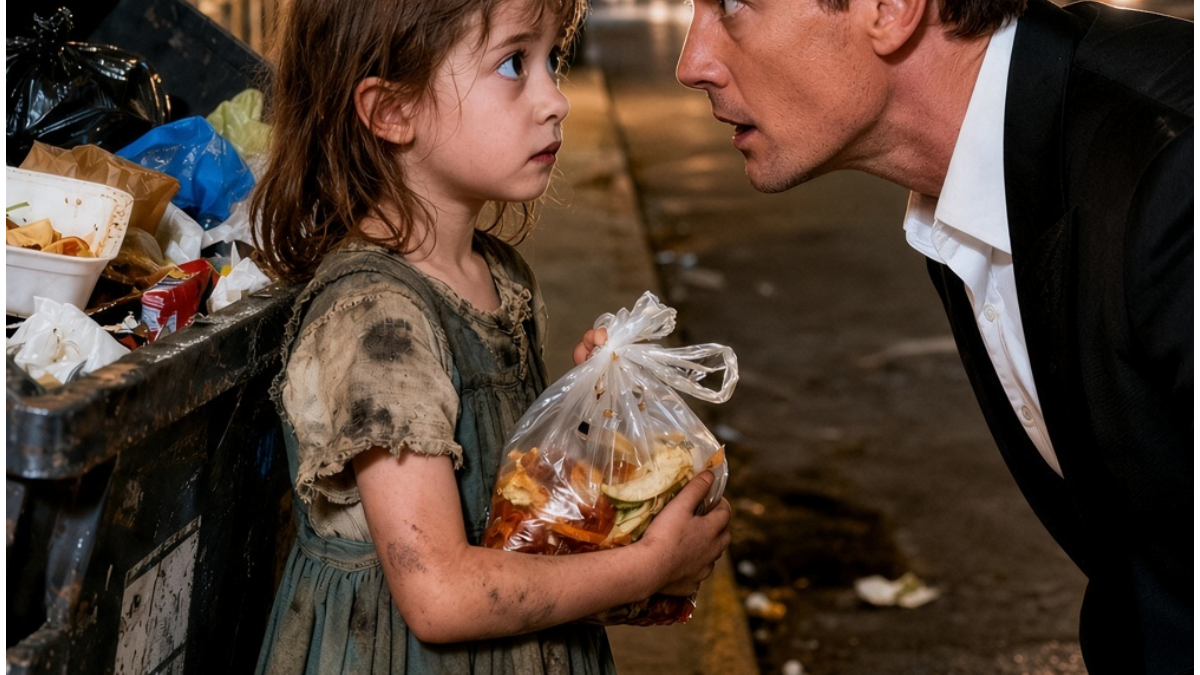
On Children’s Day, a lonely millionaire was walking through the empty square when he heard a quiet sob.
He found a 7-year-old girl searching through the trash for food, her tears dripping onto the cold ground.
When he asked why she was crying, she whispered, “My stomach hurt so much from hunger, sir.”
His heart shattered, but when he asked her name, the answer nearly brought him to his knees.
On that Thanksgiving, as the city glittered with the joy and bustle the holiday brought, Richard watched the world from his penthouse high above, the vibrant colors of the decorations in the square below, the distant echo of children’s laughter.
It all felt like a cruel reminder of a life he didn’t live, a happiness that didn’t belong to him.
To many, that scene was a symbol of innocence and hope. But for Richard it was a searing pain in his chest, a heavy burden of choices and absences.
He felt the weight of a bitter irony. He had built an empire, but the price had been loneliness.
Richard, a man in his early 40s, had thrown himself into an obsessive dedication to his work, building an impressive financial legacy at the cost of a profound emptiness in his soul.
Every successful meeting, every multi-million dollar contract closed was accompanied by a devastating guilt, a constant whisper in his mind, questioning the true value of so much success.
The emotional vulnerability he hid so well behind his facade as a ruthless businessman would surface violently whenever the topic of family arose, leaving him unable to face the open wounds in his own heart.
He felt like a king in his glass castle, untouchable by the outside world, but a prisoner of his own decisions.
His deepest internal conflict was the belief that he had sacrificed the one thing that truly mattered, his family, for the fleeting glow of wealth.
That thought was a thorn in his flesh, the certainty of having forever lost the chance to be a father, to hold the child he once dreamed of in his arMs. 7 years ago, amid bitter and incessant arguments about his unbalanced priorities between work and home, he had divorced his wife.
The wound of their separation was even deeper because she had been pregnant. They had chosen a name for the child if it were a girl, Claraara.
That name now, 7 years later, haunted him every night in dreams and waking hours.
After the divorce, he never heard of the child’s whereabouts again, living with the constant agony of not knowing if he had a daughter somewhere in the world, a part of himself he had abandoned, and who now seemed like a ghost at every childhood celebration.
On that cold Thanksgiving night, unable to find the sleep that had long eluded him, Richard decided that insomnia indoors was a greater punishment than the chill outside.
Wrapped in his expensive overcoat, he went for a walk through the park across from his luxury high-rise.
The city lights shone in the distance, but the park was nearly deserted, silent, except for the rustling of dry leaves.
Loneliness weighed on his broad shoulders, an invisible burden that accompanied his every step. Suddenly, a soft, almost imperceptible sound broke the silence that enveloped him.
A muffled cry. He stopped, his heart giving an unexpected leap, a strange premonition washing over him.
Following the sound, his eyes scanned the park shadows until he found the source of the sad melody.
Curled up near a dumpster, under the faint light of a lampost, was a little girl.
She couldn’t have been more than seven. Her small, pale fingers rummaged through discarded scraps, her tears dripping onto the cold ground as she desperately searched for something to ease the hunger in her stomach.
Richard’s heart clenched. A wave of something that wasn’t just pity, but a strange sense of familiarity hit him squarely.
The image of the child, so small and vulnerable, confronted by the harshness of life, was a painful mirror of his own failings, he approached slowly, careful not to startle her further.
“Hello,” he said gently, his voice from disuse of such soft words. “Do you need some help?”
The child flinched, her frightened, suspicious gaze fixed on him, her large, dark eyes filled with a fear he recognized as the defense of someone who had suffered too much.
She was not used to the kindness of strangers that was evident in every fiber of her small, tense body.
The girl hesitated for a moment, and Richard felt a flicker of hope mixed with pain.
Slowly, she lowered her gaze to the ground, and in a voice so childlike and nearly inaudible that he had to lean in to hear, she explained, “My tummy!
It hurt so bad from being hungry.” The words were a punch to the gut for Richard.
He, who lived surrounded by banquetss and sophisticated meals, was standing before a child who felt physical pain from the absence of food.
The image of the children in the park celebrating with their parents returned with overwhelming force, painting a cruel contrast with the reality before him.
The first minor twist hit him hard, revealing the rawness of the situation. He felt an impulsive need to act.
Come with me. There’s a place nearby where we can get you something to eat.
Would you like that? He held out his hand, hesitant, hoping she would take it.
But the girl shrank back again. No, I can’t. People, they make promises and then they leave or they do bad things.
Her words carried the weight of past experiences, of disappointments no child should ever know.
The second minor twist, her distrust was an obstacle. Richard felt a lump in his throat.
He knelt, trying to match her height to make himself less imposing. I promise I won’t leave and I just want to help you get something to eat.
He tried to convey sincerity. Finally, hunger prevailed. “What’s your name, little one?” He asked.
In a whisper, she answered. “Clara.” The sound of that name struck him like a bolt of lightning, knocking him off his feet.
Claraara. Exactly the name he and his ex-wife had chosen for their daughter years ago.
That name which haunted him every night was now here, spoken by a child he had found on the street rumaging through trash.
The shock was so intense, so overwhelming that he nearly fell to his knees right there in the empty park under the curious and hungry gaze of the little girl.
The third minor twist exploded in his chest, leaving him breathless. Could it be possible?
Could it be her? The truth or the possibility of it was a crushing burden.
He needed air. He needed answers. And the girl, his Claraara, was there waiting. The name Claraara reverberated in Richard’s mind like a distant bell, an echo of a past he had tried in vain to bury under piles of work and financial achievements.
The shock was so intense that the air seemed to thin, and he found himself gripping the nearest lamp post to keep his balance.
His eyes, previously fixed on the void, now scanned the girl’s face with an almost painful intensity.
He searched for familiar features, for a resemblance that could confirm the whirlwind of emotions that assailed him.
Disbelief, hope, and a paralyzing fear that the truth, if confirmed, would utterly destroy him.
This child, 7 years old and marked by a life of deprivation, could be his daughter, the girl he had named in a time that felt like a lifetime ago.
He took a deep breath, trying to control the tremor in his hands and the vertigo that threatened to overcome him.
He couldn’t scare her anymore than she already was. Claraara,” he repeated, his voice, trying to make the name sound casual, though each syllable was a beat against his heart.
“That’s a very beautiful name. Do you want to go now? We can go to a place where you can eat whatever you want without having to search in dumpsters.”
He held out his hand again, this time more confidently, a silent plea in his eyes.
The girl hesitated, her large, dark eyes fixed on his as if trying to read his soul.
Hunger, however, was a powerful force, and finally, with an almost imperceptible nod, she placed her small hand in his.
Her skin was cold and rough, a stark contrast to the softness of his own.
The feeling of that little hand in his, so small and fragile, sent a wave of emotions through him.
Guilt, tenderness, and an overwhelming fear of what he might be about to discover. Together they walked through the illuminated streets.
The girl huddled beside him, her uncertain steps next to Richard’s firm stride. He looked at the luxurious buildings, the expensive cars passing by, and the contrast with the small hand he held was a cruel reminder of the two realities now colliding in his life.
The walk to the 24-hour diner, a discreet place that stayed open all night, felt like an eternity.
Once they arrived, Richard chose a booth in the corner, away from the few other customers still there.
The menu, with its many options, arrived, and he handed it to Claraara. She looked at it without understanding with a hint of shame.
I can’t read all of it, she confessed, her voice low. Richard felt another pang.
Of course she couldn’t. How could she? Living in the conditions she did. Don’t worry, he said gently.
I’ll read it for you. What would you like to eat? There are sandwiches, soup, hot meals.
He read the options, his voice calm and patient. His heart aching. Claraara’s eyes widened.
It was clear that the amount of food and the possibility of choice were something entirely new to her.
She pointed to a simple dish, a beef stew with vegetables. “I want that,” she said, her eyes shining with an almost childlike hope.
When the plate arrived, the girl devoured the food as if she hadn’t eaten in days, and Richard watched in silence, a confused mix of guilt, desperate hope, and fear of facing a truth that could emotionally destroy him.
Every spoonful she brought to her mouth was a vivid reminder of his own abundance and her deprivation.
With every bite, a layer of Claraara’s distrust seemed to melt away, giving way to a touching fragility.
He felt a warmth spread through his chest, something he hadn’t felt in a very long time.
“Do you live near here, Claraara?” He asked, trying not to sound invasive. As she wiped her plate clean with a piece of bread, the girl hesitated, swallowing the last piece before answering, “No, I live far away with my mommy.”
She paused, her eyes fixed on a distant point, as if the memory took her somewhere else.
“Mommy is very sick. She can’t take care of me right anymore.” Her words hit Richard like an electric shock.
A lightning bolt in the quiet diner. Sick. Could his ex-wife be sick? Was it possible?
The first medium twist, unexpected and painful, cast a new layer of complexity over his confusion, turning hope into an even deeper agony.
He felt the ground disappear from under his feet once more. He needed to know.
He needed to do something. Your mommy. What’s wrong with her? Claraara? Richard asked, his voice trying to sound calm.
But the tremor in his hands, hidden under the table, betrayed his growing anxiety. Every word from the girl was a new piece of a painful puzzle he was assembling, and the picture that emerged was of a tragedy he could barely endure.
Claraara shook her head, her eyes lowered, toying with a breadcrumb on her napkin. She coughs a lot, and she’s always tired.
She can’t work anymore, you know. That’s why we had to leave our little house.
The small detail about her mother’s cough and fatigue, combined with the loss of her job and home, tightened around Richard’s heart like a vice.
The second medium twist, crually real, confirmed his worst fears. His ex-wife, the mother of his possible daughter, was sick and destitute.
The chasm between his life of luxury and their reality was brutal, insurmountable. Richard felt a lump in his throat, guilt gnoring at him from the inside.
He, who lived in a world where any financial problem could be solved with a phone call, was facing a situation that money alone didn’t seem capable of fixing.
The complexity of the problem required more than checks. It demanded an emotional involvement he wasn’t sure he was prepared to offer.
He paid the bill, the thought hammering in his mind. He had to help. He had to find out the truth.
But how? He was entering unknown territory, a world his corporate experience had not prepared him for.
“Clara, could you tell me where you and your mom live?” “I’d like to make sure you’re both safe,” he asked, trying to keep his voice steady as they walked back to the deserted park.
“The cold night air couldn’t dissipate the heat of anxiety in his cheSt. The girl hesitated again, her large dark eyes conveying an old distruSt. “It’s far, and mommy doesn’t like strangers around,” she said, her voice almost a whisper.
“That simple, direct sentence was the first significant obstacle to his goal of helping her.”
“How could he help if she didn’t trust him enough to share that vital information?”
Richard knew he couldn’t just offer money. The situation demanded an emotional involvement he wasn’t sure he could endure given the open wounds in his own soul.
The image of Cecilia, sick and living in poverty, was a ghost he needed to exercise.
But the path to doing so was uncertain. He knelt again, trying to establish a deeper connection, a bridge of trust between them.
Claraara, I know you don’t know me well, but I really want to help. Your mom is sick and you need a safe place and food.
No one should have to go through this. If you take me to where you live, I can try to help your mom feel better and I can make sure you always have enough to eat.
He tried to appeal to logic, to her protective instinct for her mother, a strategy he used in negotiations, but which was now charged with genuine emotion.
Claraara pondered, her gaze vacant for a moment, her hunger had been sated, but the worry for her mother was still visible in her eyes.
Finally, she pointed in the opposite direction from where they were, beyond the glow of the city lights toward the darkness that stretched into the outskirts.
We live in a shack over near that hill where there are lots of small houses all packed together.
The girl’s description hit him hard. A shack. A shanty town. He recognized the description from news reports about families in precarious situations, reports he used to ignore.
Immersed in his own corporate world, he felt a chill. The weight of guilt crashed down on him with overwhelming force.
While he was building his empire, she perhaps was fighting for survival. He needed to do something.
But Claraara was still reticent. I don’t know if mommy will like you there,” she said, her voice filled with worry.
She gets angry easily now, and she told me not to talk to strangers. The second obstacle arose.
The girl’s resistance wasn’t just her own distrust, but loyalty and obedience to her mother, whom she perceived to be suffering.
Richard understood he would need time and a delicate approach. He couldn’t just show up at her shack, a stranger laden with money and guilt.
He needed to earn Claraara’s trust first and through her perhaps reach her mother. He looked at the small figure beside him, and a new purpose, more urgent and personal than any business deal began to form in his cheSt. The road would be long and uncertain.
But the image of Claraara and the possibility that she was his daughter propelled him forward.
He didn’t know what awaited him, but he knew he couldn’t back down. The night ended with more questions than answers, but with a new purpose that had long been dormant in his soul.
Richard felt the weight of the promise he’d made to Claraara echo in his cheSt. “Look, Claraara,” he began with a softness he was surprised to possess.
“How about we meet again tomorrow? Same place, same time. I’ll bring you something good to eat, and we can talk more.
You can tell me more about your mommy, and we’ll figure out how to help together.”
Ly. He tried to make a pact, offering a promise in the hope that she would accept.
The girl watched him with those perceptive eyes, almost gauging the sincerity in his words.
“You promise you’ll come?” She asked, her voice nearly inaudible, but filled with a fragile hope Richard wouldn’t dare to break.
“I promise,” Richard replied. And for the first time in a long time, he felt the promise he was making was the most important one of his life.
He watched Claraara walk away into the darkness. His heart in turmoil. The search for the truth had begun, and every step seemed to lead him deeper into a labyrinth of regret and hope.
He knew the journey would be long and painful, but the image of Claraara and the possibility that she was his daughter drove him forward.
The following week was a whirlwind for Richard. He kept his promise, meeting Claraara every night in the same spot in the park, no longer deserted, but quiet in the late hours.
What began as a desperate attempt to uncover the truth, transformed into a routine of care and patience he didn’t know he was capable of offering.
He took her to eat in discreet places, not luxurious, but clean and warm, where she could choose whatever she wanted.
Every meal, every shy smile that appeared on the girl’s face was a small step in building truSt. Richard watched the way she savored each bite, the gratitude in her eyes, and felt his heart so long dormant under the layers of his corporate life slowly awaken.
With each meeting, Claraara’s barriers seemed to lower, and she gradually offered glimpses into the world of deprivation she inhabited.
Claraara, in turn, began to open up. In the first few days, her answers were short and hesitant, as if she feared every word might drive him away.
But with Richard’s gentle persistence, she started to reveal details about her life that shattered his heart into even smaller pieces.
She talked about cold nights without a proper blanket. Huddled next to her mother, trying to stay warm under a thin, torn cover that barely protected her.
She told him about entire days without food, where her stomach hurt so much she could barely play or focus on anything.
The image of his daughter, if she was his, living that brutal and inhumane reality, was a constant torment for Richard, a vivid reminder of his own abundance and her deprivation.
“Mommy cries sometimes,” Claraara confessed one night as they sipped hot chocolate in a modest cafe.
When she thinks I’m not looking, she hides her face in her hands and her shoulders shake a lot.
I pretend I’m asleep, but I see. The description was so vivid that Richard could almost see the scene.
That woman, his ex-wife, alone, sick, and crying in secret, while her young daughter watched, helpless and heartbroken.
Richard’s guilt deepened, corroding him from within with an intensity he had never felt before.
He remembered the vibrant, fulloflife woman he had known, and the image Claraara painted was of a distant shadow consumed by pain and hopelessness.
He tried as delicately as possible to extract more information about Claraara’s mother. But the girl was protective, cautious, as if she feared betraying a deep secret.
Until on a particularly cold night, as Richard wrapped her in a new coat he had bought for her, the girl, in a moment of pure innocence, let slip another piece of the puzzle.
Mommy used to clean offices, you know. She would leave really early and I’d stay with the neighbor, but then she started coughing a lot and couldn’t do it anymore.
It’s been a long time since she stopped working. The third medium twist, office cleaning.
Richard felt a chill run down his spine. His company, like many others in the city, used third-party cleaning services.
Was it possible that his ex-wife had worked at some point in one of his buildings?
The coincidence was disturbing, almost unbelievable, and the air grew thick with the possibility of an even more painful truth.
He had to investigate. But before he could form the next question, Claraara, with a yawn, added something that left him completely breathless.
A whisper that would change everything. Sometimes when mommy is sleeping and coughs a lot, she whispers a name.
It’s a man’s name. I think it’s Daddy. Richard held his breath, his heart racing.
And what’s the name, Claraara? He asked, his voice with anticipation, barely daring to breathe.
The girl thought for a moment, her eyes half closed with sleep and exhaustion. It’s Richard, she says.
Richard, please help me. The fourth twist, no longer medium, but an earthquake in his life, hit him with crushing force.
Richard, his own name. The word echoed in his mind, mingling with his daughter’s cries, the cold nights, the mother’s illness.
There was no more doubt. It couldn’t be a mere coincidence. Claraara was his daughter and his ex-wife, her mother, was sick, struggling in some shack in a shanty town, whispering his name in her despair.
Richard’s body froze. The truth he had so feared and yet desired with all his might, was there, raw and undeniable.
He had to find her. He had to see with his own eyes. The week of nightly meetings had reached its climax, and what came next would be the most painful and redemptive confrontation of his life.
He knew the time for questions was over. It was time to face the answers.
The revelation of the name Richard caused his world to crumble and rebuild itself in a matter of seconds.
The sleepless nights, the corrosive guilt, the desperate search for a daughter he didn’t even know existed.
It all converged in that moment. He looked at Claraara, now sleeping peacefully in his lap after her meal and their talk, and felt an overwhelming wave of love and a regret so profound it felt like it was tearing his soul out.
That little girl, his daughter, was here in his arms, and he had found her amidst the trash on Thanksgiving, an unexpected and painful gift from fate.
The irony of his luxurious life versus her deprivation hit him with the force of a punch.
He took her home, not to his lavish penthouse, but to a discrete hotel he had rented for her and her mother.
Should things go as he hoped, the soft bed and clean sheets were a luxury Claraara had never known, and she nestled into them with a sigh of satisfaction that broke Richard’s heart.
He watched her sleep for a long time. Her childlike features framed by the soft light of the lamp.
From that moment on, his motivation changed drastically. It was no longer a confused mix of guilt and hope.
It was an unwavering determination to repair the past, to care for his daughter, and if possible, for his ex-wife.
The image of Cecilia, sick and calling his name in a delirium, ignited a flame in him that had been extinguished for years.
The next morning, the first major twist hit him like a hurricane. Richard couldn’t wait any longer.
He had to see. He had to know. Claraara, today you’re taking me to your home, he said.
his voice firm but gentle as she ate her breakfaSt. The girl looked at him with apprehension, but something in Richard’s determination, a quiet certainty, convinced her.
Mommy won’t like it, she whispered, her eyes downcast, but he reassured her with a hug.
We’ll go together. I’ll explain everything. And I’m going to help mommy get better. He promised.
And this time, he knew he would keep his word with his very life.
They took a cab, and Claraara guided him through a labyrinth of paved streets that turned into dirt roads leading to the shanty town on the hill she had mentioned.
Each house was more humble than the last, made of makeshift materials, and the scene of poverty and precariousness squeezed Richard’s heart with every passing yard.
Children played barefoot in the dust, and the faces of the women reflected a life of struggle.
Finally, Claraara stopped in front of a simple shack made of wood and sheet metal with a makeshift roof and a small window sealed with plastic.
The air smelled of smoke and damp earth, the scent of a difficult life. This was the home of his daughter and his ex-wife.
He felt the ground give way beneath him. The worn a jar door revealed a dark and small interior lit only by a sliver of light.
“Mommy,” Claraara called out. Her childlike voice echoing in the heavy silence. Richard pushed the door open carefully, and his eyes took a moment to adjust to the dim light.
What he saw made his blood run cold, a visceral shock that hit him headon.
On a thin mattress on the floor, covered by a frayed sheet lay a woman.
She was thin, prematurely aged, with tangled hair and pale, salow skin. Her eyes were closed and her breathing was shallow and ragged, a sound that chilled the soul.
It was her. It was Cecilia, his ex-wife. Richard nearly fell to his knees. This woman, who had once been vibrant and full of life, was unrecognizable, ravaged by poverty and illness.
The reunion was devastating, not just for him, but for the very memory he held of her.
The sight of her there in such deplorable conditions was a silent testament to his failure, to his past choices.
His eyes filled with tears, and a choked sob escaped his lips. Cecilia slowly opened her eyes, and it took a moment for her clouded gaze to focus on Richard.
When their eyes met, a flash of recognition and shock mixed with a deep pain and an old resentment crossed her face.
A mixture of disbelief, anger, and a sorrow Richard had never seen in her eyes before.
“Richard,” she whispered, the name coming out like a lament, almost a groan. Her voice was weak, but the tone contained the entire history they shared.
A story of love, loss, and abandonment. The first major twist reached its peak, exposing the brutal reality of their separate lives.
A stark contrast between what they had been and what they had become. He was there witnessing the tragedy he had in part caused, and the scene was more than he could bear.
He had to act, had to make amends. But how? The mountain of years of resentment and pain seemed insurmountable.
Richard’s name hung in the stuffy air of the shack, laden with decades of memories, heartaches, and unresolved love.
Cecilia tried to sit up, but weakness overcame her, and she groaned in pain, clutching her cheSt. Claraara, sensing the palpable tension, rushed to her mother’s side, holding her hand tightly, her eyes wide with fear and confusion.
Richard, his heart in pieces, knelt beside the mattress, the distance between them now bridged by tragedy.
“Cecilia, what happened to you?” He asked, his voice thick with emotion. His eyes welling with tears he hadn’t dared to shed for years, the sight of her so fragile and sick, was a cruel mirror of his own negligence, his selfish absence.
Cecilia turned her face away, a mix of wounded pride and resentment flashing in her sunken eyes.
What happened? She coughed. A dry, painful hack that made her arch her back. What do you think happened, Richard?
Life happened. The life you chose not to be a part of. The life you left me to live alone with our daughter.
Her words full of bitterness cut him like razors. But he knew he deserved everyone.
He tried to touch her hand, but Cecilia snatched it away abruptly. Don’t touch me.
You have no right to show up now and pretend you care. Her voice, though weak, carried an unshakable resolve, a wall built to protect herself from pain.
It was the first obstacle, her refusal to accept his help, and Richard felt it would be the hardest battle of his life.
As our mommy, why are you mad at Mr. Richard? He helped me. He’s nice.
Claraara intervened, her innocent voice unable to grasp the depth of the drama unfolding before her.
The second obstacle materialized right there in the girl’s confusion. The presence of their daughter, their link of connection and separation was a catalyst for Cecilia’s pain and anger.
She looked at Claraara and her gaze softened slightly, a fierce protectiveness replacing the bitterness.
He’s not your uncle, honey. He’s He’s just an acquaintance you met, and mommy’s not mad.
Mommy just isn’t feeling well. The lie told to protect was now a double-edged sword.
Richard felt a pang. The second major twist revealed itself in those few words. She had never told Claraara who he was.
Why? He watched Cecilia’s expression, the way she clung to that lie, and suddenly the answer came like a lightning bolt, clear and painful.
You did it to protect her, didn’t you? He whispered, understanding dawning on him. You protected her from the shame of having a father who abandoned her.
Cecilia closed her eyes, a single tear tracing a path down her temple. It was a silent confirmation, a nod to his truth.
“I didn’t want her to know that her father that her father chose his work over us,” Cecilia confessed, her voice barely audible, but filled with an ancient pain.
I didn’t want her to live with that shadow. I preferred to raise her alone, even in the worst conditions, than to see her carry the weight of your absence.
She Richard felt a lump form in his throat, guilt suffocating him. He who had been haunted by the possibility of having lost his daughter, now discovered she had been intentionally kept from him, not out of malice, but out of a desperate maternal love and a wounded pride he himself had caused.
She continued, her voice gaining a little more strength, a driven by the need to expose her truth, her life.
I watched your success from a distance, Richard. In the news, in magazines, you at the top of your empire.
While we we struggled for a plate of food, there was resentment, yes, but there was also there was also unresolved love, a foolish hope that one day you would remember us.
Her words were a blow, but also a bridge, a window into the soul he had wounded.
Cecilia had carried the weight of a lie and a lost love, all to protect her daughter.
Richard found himself facing a wall of pain and resentment built by his own hands, but fortified by Cecilia’s sacrifice.
He wanted to break down, to scream, to beg for forgiveness. But the presence of Claraara, confused and frightened, stopped him.
He had to be strong, not for himself, but for them. He had to break down that wall brick by brick.
“I understand, Cecilia,” he said, his voice, his eyes fixed on hers. “But I’m here now, and I’m not leaving.
I’m going to take care of you and Claraara. I’ll do whatever it takes.” The promise was solemn, carrying a weight he was finally ready to bear.
He stood up, but instead of leaving, he picked up a bucket of water from the corner and a rag and began to clean the dust and grime that covered the small shack.
Cecilia watched him in disbelief. “The millionaire, the man she had known in expensive suits, was now there cleaning her dilapidated home.
“What are you doing?” She asked, her voice a mix of anger and a flicker of curiosity.
I’m cleaning up,” Richard replied without looking at her. “This place isn’t worthy of you two, and I need to understand how you ended up here.”
As he cleaned, his business-like mind, accustomed to analyzing data, began to formulate a plan.
Who knew about her situation? Who could have helped before? Nightfell, and Richard remained, a silent guardian in the shack.
The future of his family hanging by a fragile thread of hope and regret. Cecilia’s resistance, Claraara’s confusion, and the mystery of their past struggles were a challenge he was determined to unravel.
Richard spent the night in the shack, sitting on a makeshift chair, his body exhausted, but his mind a whirlwind.
He watched Cecilia and Clara asleep, unable to find rest himself. His soul churning over the day’s events and the pain reflected in the conditions they lived in.
He had committed to staying, to not leaving again, a promise he felt for the first time in a long time.
With every fiber of his being. The next morning, as the shanty town began to wake under a timid sun, he began his quiet investigation.
He couldn’t just arrive and demand answers. He had to be subtle, careful. He knew the web of relationships in communities like this was complex, and distrust of outsiders, especially someone like him, was a natural and justified barrier.
He started by asking the few neighbors he saw nearby, offering discrete help, like a plate of food he had brought from a local bakery, or a small repair to their homes using makeshift tools he had found.
Over time, the people, initially suspicious, began to open up. That’s how he discovered that Cecilia had been a respected figure in the community, known for her strength, her resilience, and her dedication to her daughter.
Many described her as a fighter, a woman who never complained, even in the face of the greatest adversities.
But the illness had weakened her, and with it her ability to provide for Claraara.
Cecilia was always a warrior, said a neighbor, an older woman with tired eyes and calloused hands.
As Richard fixed the fence of her small yard, she worked hard cleaning in several buildings downtown, but the cough got bad, and she couldn’t do it anymore.
She lost one job after another, and we watched her light fade, but she never asked for help.
The information confirmed Claraara’s story and reinforced the urgent need for medical treatment. Richard felt a tightness in his chest hearing about Cecilia’s silent suffering.
Richard also found out that Cecilia had been evicted from several apartments before ending up in the shanty town.
She tried everything to keep her daughter in a decent place, explained another neighbor, a young man helping Richard carry some building materials he had bought for minor repairs on the shack.
But the rents kept going up, and with her being sick with no income, there was no way.
Her savings all went to medicine that didn’t do much, and she had no one to help her.
We just watched her waste away. The subplot of how they arrived at this desperate situation began to unfold, revealing Cecilia’s tireless struggle and the cruelty of circumstances, a gradual and painful slide into extreme poverty.
With each new piece of information, Richard’s heart achd more. He pictured Cecilia alone, battling illness and poverty while trying to protect her daughter with what little strength she had left.
The picture was painful and the guilt weighed even more heavily on his shoulders. He who lived in a world of abundance was now faced with the harsh reality of deprivation, a reality he had in a way helped create.
He also discovered something disturbing. Some neighbors mentioned that from time to time they would see someone who looked like a co-worker of Cecilia’s visiting her in the early stages of her illness before the situation became unsustainable.
It was a young woman who also worked in cleaning, recounted a younger woman with a worried look.
She would bring warm meals in takeout boxes, some fruit, some clothes for Claraara. It seemed like she really liked Cecilia and was worried when she disappeared from work.
Richard filed this information away. Was it possible that someone from his own circle, from his own company, knew about Cecilia’s situation and hadn’t informed him?
The idea that the truth had been so close and he so blind was a blow to his pride.
That same day, he insisted on taking Cecilia to a doctor. She resisted, arguing that she had no money and didn’t want to be a burden.
But Richard, with unusual patience, managed to convince her by appealing to Claraara’s well-being. Don’t worry about the money, Cecilia.
I’ll pay. It’s the least I can do. And you need to take care of yourself for Claraara.
He took her to a private hospital, one of the best in the city, where his staff already knew him and arranged for immediate care.
Cecilia, weak and reluctant, was examined by a doctor Richard had arranged for. While Cecilia was being examined, Claraara sat next to Richard, holding his hand with growing truSt. She still didn’t fully understand the dynamic between the adults, but Richard’s presence, his kindness, and his determination to help her mother were beginning to break down the barriers of her childhood distruSt. She felt safe with him, a feeling that had been rare in her life.
The week progressed and Richard felt he was only scratching the surface of the truth.
Cecilia’s illness was serious but treatable, the doctor confirmed. But healing her soul, earning her forgiveness, and reconnecting with his daughter would be a much greater challenge.
The complexity of the situation and the discovery that he might not have been the only one to neglect Cecilia added new layers to his dilemma.
The seed of truth was planted, and now it needed to sprout, revealing not only Cecilia’s secrets, but also those of his own circle.
The news that Cecilia’s illness was treatable, though serious, brought momentary relief to Richard, but it also intensified the conflict between them.
In the private hospital room, paid for by Richard, a detail Cecilia made sure to point out with a look heavy with resentment.
She still refused to fully accept his help. “I don’t want your money, Richard,” she would whisper, her eyes fixed on the window, avoiding his gaze, as if his very presence burned her soul.
“I won’t be another one of your charity cases to ease your conscience. I made my choice years ago, and you made yours.”
Richard knew that the battle against her pride would be as arduous as the one against her illness, an invisible wall of resentment that seemed unshakable.
Richard, however, did not yield. He sat by her bed for hours, day after day, demanding nothing in return.
He brought food she liked, read to her when fatigue prevented her from reading herself, and talked about Claraara, about the need for a better future for the girl.
“It’s not about me now, Cecilia,” he said one afternoon, his voice calm and firm, but with a gleam of determination in his eyes.
“It’s about Claraara. She needs you healthy. She needs a chance in life that you can’t give her in these conditions.
Don’t deny me this. Don’t deny her.” The mention of Claraara always touched her, and Richard knew it.
It was the only weak point in that wall of resentment, the only crack where hope could seep through.
Claraara, meanwhile, spent her days at the hospital, playing in the hallways with other young patients or sitting by her mother’s side, but always close to Richard.
Her initial distrust gave way to genuine affection. She saw him as the kind uncle who had arrived to bring comfort and hope.
Richard took her for ice cream, bought her coloring books, and told her stories that made her laugh, a sound he realized was the most beautiful melody.
He taught her her first letters. And the sparkle in Claraara’s eyes as she learned was Richard’s greatest reward, a warmth he hadn’t felt in a long time.
He felt fatherhood blossoming in his chest, a love he had ignored for so long and which now filled him completely, transforming him from the inside out.
That week, Richard also began to map out a plan for Claraara’s education. He visited schools, talked with educators, determined to give his daughter the opportunities life had denied her.
Cecilia watched their interaction, a pang of jealousy mixed with reluctant gratitude. She saw the happiness in Claraara’s eyes when she was with Richard, and it began to soften her resistance.
This man, once so distant and focused on his own career, was here, present, in a way she had never imagined, a presence that challenged her own certainties.
At the same time, Richard pressed forward with his investigation. He summoned the cleaning staff who had mentioned knowing Cecilia for a meeting in his office, a formal and imposing setting.
Richard made a point of being direct and empathetic, shedding the image of the unapproachable boss.
I know some of you knew Cecilia, my ex-wife, and were aware of her situation, he began, his eyes fixed on each of them.
The women exchanged nervous glances, some lowering their eyes, afraid of being reprimanded. I’m not here to scold you, but I need to understand why no one came to me, why no one alerted me to her situation.
One of the employees, the older woman he had spoken to in the shanty town named Celia, gathered her courage.
Mr. Richard, we tried to help Cecilia with what we could, but she begged us not to say anything.
She said she didn’t want to bother anyone, especially you, sir. She had a lot of pride.
And also, she said you had abandoned her, and she didn’t want you to know about her situation out of pity.
Another employee, a young woman named Patricia, added, “Yes, sir, and we were also scared of getting involved, of losing our jobs, of causing trouble.”
The confession was a blow to Richard. He saw the pain and fear in the women’s eyes and understood their reasons.
But the truth was, if someone had spoken up, Cecilia wouldn’t have suffered so much.
He realized that the wall of his pride and the perception of his inaccessibility had created an environment where even those who could help didn’t feel comfortable doing so.
It was a reflection of what he had become, and the realization hit him hard, revealing his own blindness.
The fourth week was approaching, and Richard felt he was peeling back layers of a complex truth.
He had found his daughter, his ex-wife, was recovering. But the path to reconciliation and rebuilding was fraught with obstacles, both internal and external.
Cecilia’s resistance, the fear of the employees, and his own past blindness were challenges he had to overcome.
He was preparing for the moment Claraara would discover the full truth about her paternity, a moment he knew would be the most difficult of all, capable of shaking the fragile bridges he was building.
The time bomb was ticking, and the impact of the truth would be inevitable. The revelation of his own employees passivity, while understandable given their fear and Cecilia’s pride, struck Richard like a shock.
He realized that his ivory tower had not only isolated him from the world’s problems, but also from the realities of his own life and the people around him.
The guilt deepened, not just for abandoning Cecilia, but for the self-imposed blindness that had prevented him from seeing the suffering so close to him.
However, this new layer of regret was mixed with a renewed determination. He wouldn’t just provide financial resources, he would commit to being emotionally present, to being the bridge he himself had once burned.
His first victory, getting proper medical treatment for Cecilia, came at the cost of confronting years of accumulated regret, but also with the clarity that his transformation was an imperative, not an option.
In that fourth week, the atmosphere in the hospital and the apartment Richard had arranged for Cecilia and Claraara was a strange mix of healing and latent tension.
Cecilia was improving physically. Her cough had subsided. Color was returning to her face, and her eyes, once dull, now held a glimmer of hope.
However, she still resisted the idea of Richard as an integral part of their lives.
“You can pay for everything, Richard. But you can’t buy back the time we lost,” she would whisper, her voice weak, but carrying the same force of years of resentment.
She still clung to her pride like a shield, fearing the vulnerability of surrendering again to the one who had hurt her so deeply.
Richard, for his part, remained present with a patience he never knew he possessed. He didn’t push, but stayed close, a constant, quiet presence.
He took Claraara to her new school every day, read her stories before bed, and helped her with her first steps in reading and writing.
The light in Claraara’s eyes, as she learned, the way she nestled into his arms, was the balm for his wounded soul.
She no longer called him the kind uncle, but treated him with a fond familiarity that filled Richard’s heart with an indescribable joy, though tinged with the apprehension that the truth still loomed over them.
Richard’s second victory, gaining his daughter’s trust, was happening slowly but genuinely. Claraara sensed he was truly trying to change.
He was no longer just the man who saved her from hunger. He was a man who cared, who made her laugh, who made her feel safe.
She saw the sincere concern in his eyes when he looked at her mother. And it made her feel that perhaps the world wasn’t so scary after all.
However, the truth about Richard’s paternity was still a secret between the adults, a heavy burden they both knew they would have to face.
One day, while Richard and Cecilia were quietly discussing the next steps for Cecilia’s rehabilitation in the now cozier apartment, Claraara was playing in the next room.
The door was a jar, and the muffled voices of the adults reached her ears.
The discussion was about Richard’s plan to invest in a small craft shop for Cecilia so she could regain her financial independence, a way to reclaim her dignity.
Cecilia, her pride still raw, but with a softer voice said, “I appreciate the effort, Richard, but this is too much.
You’ve already done so much for Claraara. I don’t know if I can accept more.”
Richard, sensing her resistance, but determined not to give in, responded with a loving frankness.
Cecilia, please. It’s the least I can do to ensure our daughter has everything she needs.
That our family has a future. I can’t erase the past, but I can try to build a different future.
A future for our Claraara. The words, “Our daughter, our family,” spoken with such emphasis, drifted down the hall and into Claraara’s room.
Claraara stopped playing with her dolls. Her small ears sharpened by curiosity and a childlike intuition caught those phrases.
“Our daughter,” she heard it again. “Our Claraara,” her young mind tried to process it.
“Mr. Richard and Mommy, together, daughter.” Confusion set in. She got up slowly and went to the door, pressing her ear to the crack.
Richard’s voice, now lower, said, “And I will be the father she deserves.” Cecilia, the father I should have been from the beginning.
Claraara’s world shattered. Father, he was her father, and mommy knew, and they had both hidden it from her.
The feeling of being deceived, of being kept in the dark, hit her with overwhelming force.
The promises, the stories, the life she knew, it all turned into one big lie.
Her eyes filled with tears, not of sadness, but of an innocent fury and a deep sense of betrayal.
The girl who once felt security and joy, now felt a profound hurt. She backed away, her face contorted in pain and anger before letting out a muffled sob, the sound echoing in the small apartment, and she felt a desperate need to run away, to get away from those who had deceived her.
Claraara’s muffled sob echoed through the apartment, a sound that pierced Richard and Cecilia’s hearts with the force of a thousand daggers.
They both turned sharply toward the door, and the scene before them was a devastating blow.
Claraara stood there, her eyes brimming with tears, her face pale and contorted in an expression of shock and disbelief.
Her childlike innocence had been brutally torn from her eyes, replaced by a palpable pain and sense of betrayal that was almost a silent scream.
“Dad, mom,” she whispered, her voice broken, the world she knew collapsing around her into a thousand invisible pieces.
Richard felt a chill run down his spine. Guilt suffocating him with an intensity that left him breathless.
He had promised himself he would be careful, that the truth would be revealed with the delicacy his daughter deserved.
But his anger and accumulated pain, his frustration with Cecilia’s resistance had prevailed in their argument, and now his daughter was paying the ultimate price.
Cecilia in turn brought her hands to her mouth, horror etched on her face. She tried to get up from the bed, but weakness held her back, and a groan escaped her lips.
“Clara, my daughter,” she began, her voice choked, a silent plea. But Claraara didn’t wait.
The words had hit her with the force of a hurricane, destroying every bridge Richard had tried to build.
The empty promises of adults, the distrust that had followed her her whole life, it all clicked into place now in a painful, cruel truth.
She felt deceived, not just by the mother who had hidden her father, but by the father himself, who only showed up now when things were bad.
When she and her mother needed help, her innocence, her vulnerability turned into a wounded anger and a profound sense of abandonment.
I don’t need a father who only shows up when it’s convenient for him,” she yelled, her small hands clenched into fists, tears streaming freely down her childlike face, now marked by an adult’s pain.
“And I don’t need a mother who lies to me.” The third and most impactful major twist hit Richard and Cecilia with the force of a tidal wave, tearing down all their remaining defenses.
Claraara’s innocent yet brutally honest words were a mirror to Richard’s past choices, forcing him to confront the reality of his negligence and his distorted priorities.
The rejection from his own daughter expressed with such clarity and profound pain was a more painful blow than any professional failure he had ever faced.
He knelt, trying to reach her, holding out a hand. But Claraara recoiled as if he were a stranger, a monster, someone who had betrayed her irreparably.
“Clara, please listen to me,” Richard pleaded, his voice, thick with the tears now streaming down his face, washing away years of regret.
“I know I was wrong. I’m so sorry. I didn’t know you existed. I swear I I didn’t know your mother was sick.
I would never have abandoned you on purpose. He tried to explain, but the words were insufficient, too fragile to erase the pain in the girl’s eyes to rebuild the trust he had, however unintentionally broken.
Cecilia, sick and in shock from her daughter’s outburst, and Richard’s pain, began to cough violently, her body shaking in spasMs. The argument, the emotional tension hanging in the air, had all exacerbated her already fragile physical condition.
She clutched her chest, struggling to breathe, the air seeming to vanish from her lungs.
“Clara, my daughter,” she murmured, her voice lost in a coughing fit that grew more and more desperate.
“The girl, who moments before had been consumed by rage, froze. Her mother’s choking, her struggle to breathe, was a familiar and terrifying sound, a vivid reminder of the cold nights and the fears she had faced.
Panic filled the apartment. Richard, seeing Cecilia’s condition rapidly deteriorating, forgot the argument, his pain, everything, and rushed to Cecilia’s side, desperately calling the nurses on the intercom he had installed for her comfort.
Cecilia’s life was on the line. And at that moment, everyone’s personal grievances had to be set aside.
Love, despite all the wounds, began to find a way. A fragile glimpse of hope amidst the chaos.
He knew time was running out, and the urgency of the situation demanded immediate unity, pushing aside what divided them.
The apartment living room, which moments before had been the stage for a painful revelation and cries of heartbreak, transformed into a scene of panic and urgency.
Richard, his heart clenched, acted instinctively. He grabbed the phone with trembling hands and dialed the hospital’s emergency number, which was already in his favorites.
His voice, usually controlled and firm, was now laden with desperation as he explained Cecilia’s situation.
She’s having a severe respiratory crisis. Quickly, please come. Claraara, standing frozen at the bedroom door, watched the scene with wide eyes.
The childish fury that had consumed her seconds ago evaporated, replaced by a paralyzing fear as she saw her mother struggling, fighting for every breath.
Claraara’s own wisdom, shaped by years of deprivation and constant worry for her mother, made her realize something fundamental.
Holding on to anger wouldn’t help her sick mother. In that critical moment, the only thing that mattered was Cecilia’s life.
She ran to the bedside, her small fingers gripping her mother’s hand, which was cold and clammy.
“Mommy, stay with me, Mommy,” she pleaded, tears streaming down her face now from fear and not anger.
Richard saw the transition in his daughter, the maturity forced upon her by adversity, and felt a pang of pride mixed with overwhelming pain.
In a few minutes, which felt like an eternity, the emergency medical team, already aware of Cecilia’s condition from the hospital where she was being treated, arrived at the apartment.
They acted quickly, bringing equipment and administering medication. Richard explained the situation in detail, his mind working to ensure everything was done as effectively as possible.
He felt an urgency in every fiber of his being, a determination not to fail again.
Cecilia was stabilized, but still needed to return to the hospital for intensive observation and continued treatment.
On the way to the hospital, Richard and Claraara sat in the car, a heavy silence filling the space.
Claraara, exhausted and frightened, nestled into Richard’s lap. He held her tightly, feeling her small body tremble.
I’m sorry, Claraara,” he whispered, his voice thick with emotion. “I’m sorry for everything, for taking so long, for you finding out like this.”
She didn’t answer immediately, but tightened her hug, a silent sign that in that moment, forgiveness was beginning to bloom, driven by the urgency of saving her mother.
Personal grievances, though not forgotten, were set aside by the need for unity. At the hospital, Cecilia was taken to the ICU.
Richard and Claraara remained in the waiting room, the air thick with uncertainty. It was there, under the cold light of the hallway, that the emotional connection between them deepened in a way no words could have expressed.
They were a unit bound by their concern for Cecilia. Richard spoke of the good memories he had of Claraara’s mother, of her strength, of the love she always showed for her daughter.
He wasn’t trying to justify himself, but to build a bridge of affection and respect for Cecilia.
For Claraara’s sake, “Your mother is an incredible woman, Claraara,” Richard said, wiping a tear from his daughter’s face.
“She protected you and cared for you the best she could, even when she was sick and alone.
She’s a warrior and I I was a fool for not realizing it sooner. Claraara listened, her eyes fixed on his she was still hurt, but the truth spoken with honesty and pain began to make sense.
She saw the genuine remorse in her father’s eyes, and his pain, which now mingled with hers.
The hours dragged on, and the medical team came with an update. Cecilia was stable, but would need time and intensive treatment to fully recover.
Richard listened intently, asking questions, ensuring Cecilia would receive the best possible care. He was no longer the distant businessman.
He was a worried father and a repentant husband, fighting for his family’s life. Claraara, now calmer but still heartsick, looked at Richard.
Dad,” she began, and the sound of the word this time carried not resentment, but a touch of vulnerability.
“Is mommy really going to be okay?” The question was a plea. Richard hugged her again, tighter, with the silent promise that he would do everything to make it so.
Yes, my daughter. She will be, and we will both be here for her together.
He knew the path to Cecilia’s full forgiveness. And Claraara’s complete trust would be long and require even more sacrifices.
But their unity in that moment of crisis was a glimpse of the future he so desperately wanted.
The family, though wounded, was beginning to heal under the pressure of adversity, and love, long dormant, was being reborn with an unexpected strength, transforming pain into an unbreakable bond.
The ICU was a place of hushed whispers and the constant beeping of machines that kept Cecilia connected to life.
The hours dragged on like sand through the fingers of Richard and Claraara, who took turns in the waiting room or sat in front of the glass that separated them from Cecilia.
Richard watched his ex-wife through the transparent barrier, his heart aching with a searing pain.
Every tube, every wire was a cruel reminder of his absence and the consequences of his selfish choices.
The image of the vibrant, fulloflife Cecilia from before their divorce, violently clashed with the fragile figure lying in the bed, and Richard felt he was reliving his own personal hell.
Claraara, now no longer questioned Richard’s presence. The pain and fear for her mother were greater than any resentment.
She would nestle into Richard’s lap, her small body occasionally trembling when the sound of an alarm from the ICU startled her.
He would hold her tight, kissing her hair, silent tears streaming down his face. It was a shared pain, an anticipatory grief that united father and daughter in a way happiness never could have.
“Is she going to wake up, Daddy?” Claraara would ask frequently, her voice choked with worry.
And Richard would always answer with the same conviction. Yes, my daughter. She’s strong. She’ll fight for you.
The promise was more for himself than for her. A mantra to ward off despair.
The days in the hospital were a purgatory for Richard. He slept in an uncomfortable armchair, spent hours in meetings with doctors, ensuring Cecilia had the best treatments.
His company, once his universe, was now a distant thought, managed through quick phone calls and emails, his priorities completely redefined.
He had understood that true success wasn’t in his corporate empire, but in the recovery of the woman he had loved, and in the reconciliation with the daughter he had rediscovered.
Cecilia’s pain was his. Claraara’s anguish was his and he was determined to bear it all, to repair everything.
One morning, as Richard and Claraara were watching Cecilia, a nurse called them. “She’s waking up,” he said with a gentle smile.
Richard’s heart leaped. “He and Claraara rushed to the bedside, their eyes fixed on Cecilia’s figure.
Slowly, her eyes opened, cloudy and confused. She looked at Richard, then at Claraara, and a flicker of recognition crossed her pale face.
Tears welled up in Cecilia’s eyes. A mixture of relief and an old pain. She reached out her hand to Claraara, who held it tightly, tears streaming freely.
“Mommy,” Claraara whispered, her voice filled with love and relief. Cecilia smiled weakly at her daughter, a smile that lit up her face.
Her eyes then turned to Richard, and there, in the gleam of her gaze, he saw not just resentment, but also a new vulnerability, an acceptance.
The wall of pride built over so many years was beginning to crumble. She tried to speak, but her voice came out.
Richard moved closer, taking her other hand. Don’t talk, Cecilia. Save your strength. I’m here.
We’re here. Cecilia’s hand squeezed his weakly, and he felt an electric shock. It was the first sign, the first bridge to forgiveness.
“Clara, you!” Cecilia managed to whisper, her gaze fixed on her daughter. Claraara leaned in, kissing her mother’s forehead.
“I love you, Mommy. I’m so glad you woke up.” Claraara’s simple words were a bomb for Cecilia and for Richard, a confirmation that the girl, despite everything, had moved past her initial anger.
As Cecilia recovered in the following days, Richard was always by her side, telling her about Claraara’s progress in school, but the new apartment, about plans for the future.
He didn’t talk about money, but about presents, about love, about a new family being built.
Cecilia listened and gradually she began to interact, to ask questions, to let herself feel.
One day she looked him in the eyes and in a weak but firm voice said, “Richard, I forgive you for leaving, for taking so long, but I also thank you for coming back, for finding Claraara, for being here now.”
Her words were the emotional resolution Richard had so longed for. He felt a lump in his throat, tears rolling uncontrollably.
I love you, Cecilia. I always have, and I will do everything to make up for lost time.
He knew he couldn’t erase the paSt. But from that moment on, they would have a future.
The final victory, the reconnection of the family was in his hands, a fragile but precious treasure.
Cecilia’s recovery, her forgiveness, and Claraara’s trust were the foundations of a new life. But the path was still uncertain, and the challenge of rebuilding not just a family, but the trust and love between them was a daily teSt. Tomorrow would bring new challenges, but for the first time in a long time, Richard was ready to face them hand in hand with his family.
Cecilia recovered with each passing day, not just physically, but also in spirit. Her face, once pale and marked by illness, now gained a rosy color and a soft glow.
Her eyes, which had for so long carried the shadow of suffering and resentment, began to reflect a longlost serenity.
Richard was always nearby, a constant and discreet presence, but one that Cecilia now accepted with a growing warmth.
Their conversations became longer, deeper, touching not only on the present and Claraara’s future, but also on the past that both united and divided them.
He listened to her with a patience he never imagined he possessed, absorbing every word, every hurt she shared.
It was a healing process for both of them, a release of invisible burdens. I understand, Richard, Cecilia said one afternoon as they had tea in the small hospital garden, Claraara playing happily in the distance with a new pinwheel.
I understand that you also suffered in your own way, that your absence wasn’t just your choice, but also a consequence of what I hid and the pride that stopped me from seeking you out.
It was an acknowledgment of her own part in the pain, a crucial step toward complete forgiveness.
Richard felt a lump in his throat. Those words coming from her were like a balm to his wounded soul.
He held her hand, a simple gesture that carried the weight of years of silence and regret.
“We both made mistakes, Cecilia. But now we have a chance to make things right, to build something new.”
Richard’s second victory, Claraara’s forgiveness, blossomed each day, more vibrant than any spring flower. The girl no longer saw him as the kind uncle who had turned out to be her father, but simply as her dad.
She felt safe, loved, and above all, no longer deceived. His presence was a safe harbor, and the joy she felt at having both parents in her life was palpable in every smile, every laugh.
At her new school, Claraara excelled, her intelligence and vivacity emerging from the shadow of deprivation like a butterfly, finally opening its wings.
The hours Richard dedicated to helping her with her lessons, taking her on weekend outings, and teaching her about the world were the most precious moments of his new life.
He had significantly cut back his work hours, delegating responsibilities with a confidence he once reserved only for himself.
Richard’s empire, which once consumed him, now served a greater purpose, to support his family and allow him the time to live.
The central conflict, the separation and pain caused by Richard’s distorted priorities, was finding its full resolution.
Cecilia, her health restored and a new light in her eyes, began to plan the small craft shop Richard had suggested.
It was a project that filled her with enthusiasm, a way to rebuild her independence and dignity, to reaffirm who she was.
“It’s not charity, Cecilia,” Richard had insisted kindly. It’s an investment in your talent, and it’s a way for you to have something of your own, to not depend on anyone, if that’s what you want, for you to build your own future.”
She had accepted, not without some initial reluctance, but with the certainty that Richard was offering a bridge to a future, not a handout.
The shop would be a symbol of her new life, her strength, and her resilience.
On one of the days Cecilia was heading out to visit a potential location for her shop.
She paused at the apartment door and looked at Richard, who was on the sofa, helping Claraara with a story book about grand adventures.
A genuine warm smile lit up her face, a smile he hadn’t seen in nearly a decade.
Richard,” she called, and he looked up, surprised by the soft tone and the depth in her gaze, a look that mixed affection and a new hope.
Thank you for not giving up on us, for finding us, for being here now, present in every moment.
I I don’t know what we would have done without you.” Her words were the consecration of a journey of forgiveness and the affirmation of a love that, though wounded, had never completely died.
Richard felt an overwhelming emotion rise in his cheSt. It was the first time Cecilia had expressed her gratitude so openly, so personally, so free of resentment or pride.
He stood up and walked to her, taking her hands tenderly. “Never again, Cecilia. I will never be absent from your lives again.
I promise.” He kissed her forehead, a gesture he hadn’t dared to make in a long time.
A kiss of promise and renewed love. Now we are a family, a real one, and we will face everything, whatever comes, together.
Claraara, watching the scene from the sofa, dropped her book and ran to hug them both, feeling the energy of the moment.
“A real family,” she exclaimed with the purest joy imaginable, her voice full of hope.
“The scene was the perfect image of the emotional resolution they all craved. The main conflicts were resolved, the narrative arcs, closing in an embrace.
Richard’s transformation was complete, and the family, though scarred, was stronger than ever. The painful journey had led to a place of peace and unity, a satisfying and realistic outcome.
But as Richard watched his family, a subtle thought, almost a whisper from his former self, troubled him.
He had found his family, yes, and he had learned the value of love. But for this new life to fully flourish, for the shadow of the past to be completely dispelled, he knew there was one last step to take.
A reconciliation that went beyond words and gestures. A step he needed to take not just for Cecilia and Claraara, but for himself, to finally seal his new destiny and embrace the happiness he had at last found.
And this final action he knew would be the most difficult, the most symbolic of all, demanding a courage he was still discovering within himself.
5 weeks after that cold night in the park where Richard found a little girl crying by a dumpster, his life and the lives of Cecilia and Claraara were unrecognizable.
Cecilia, her health restored and her eyes shining with a new vitality, was no longer the shadow of the woman he had found in the shack.
She was on her feet again, full of plans and dreaMs. She no longer lived in the shanty town, but in a cozy apartment near Claraara’s new school, which Richard had arranged.
The home was simple but filled with warmth and joy, a reflection of the family being rebuilt on the foundations of forgiveness and mutual understanding.
The smile on her face was a silent testament to her recovery and the forgiveness she had granted not only to Richard but to herself, freeing herself from the chains of the paSt. Richard had transformed from an emotionally distant workaholic into a present father and a man who had learned that true success isn’t measured in money but in relationships.
He drastically reduced his hours at the office, delegating responsibilities with a newfound trust and spending his afternoons picking Claraara up from school, helping her with homework, and playing in the park.
Board meetings were important, yes, but family dinners, bedtime stories, and Claraara’s tight hugs were irreplaceable, the true treasures of his new existence.
He hadn’t abandoned his company, but he had redefined his place within it, showing that it was possible to be professionally successful without sacrificing personal life, without losing the essence of what made him human.
Richard’s empire, which once consumed him, now served a greater purpose. To support his family and allow him the time and presence to live.
The final victory brought not only the recovery of Cecilia’s health and the stability of the reunited family, but also Richard’s personal transformation.
He was no longer haunted by guilt. Instead, he felt filled with a purpose, a clarity that set him free.
The girl he had found scavenging in the trash turned out to be not just his lost daughter, but also his path back to a life with true meaning.
The journey had been an arc of suffering and recovery, culminating in an emotional resolution that was both satisfying and realistic.
They didn’t erase the past, but they accepted it as part of their story, using it as a foundation to build a stronger future.
To seal this transformation, Richard knew he needed to go beyond his own family. The discovery that employees at his company knew of Cecilia’s situation but hadn’t had the courage to speak up haunted him.
It was a reflection of a culture perhaps that he himself had inadvertently created. On a Monday morning, 5 weeks after his reunion with Claraara, Richard called an extraordinary meeting with all his employees.
His voice, which once commanded respect through authority, now conveyed a humility and sincerity that surprised everyone.
He spoke openly about his ex-wife and daughter, about the pain of his discovery, and about his own blindness.
I failed, he admitted, his voice thick with emotion, but firm. I failed as a husband, as a father, and as a leader.
I created an environment where the suffering of someone so close couldn’t reach me. That needs to change.
Richard announced the creation of the Claraara Hope Fund, a social program with substantial resources from his company designed to support employees and their families in times of hardship, ensuring them access to medical care, housing, and education without bureaucracy or embarrassment.
Furthermore, he established an anonymous communication channel for any employee to report situations of vulnerability with the promise that each case would be treated with the utmost discretion and support.
It was an unexpected turning point for the company, a cultural revolution initiated by its own CEO.
The news was met with applause and tears. It wasn’t just a program. It was the materialization of a new philosophy of a leader who had learned life’s most important lesson.
Cecilia, present in the audience, held Claraara’s hand, who smiled proudly at her father.
She looked at Richard, and her eyes conveyed not just love, but a deep admiration.
He had embraced justice and altruism in a way she had never imagined. That afternoon, as they had coffee in the park where it all began, now under the sun of a spring day, Claraara, who had once cried from hunger, laughed as she chased pigeons.
Cecilia, sitting next to Richard, took his hand. “Thank you, Richard,” she said, her voice soft, a touch of emotion in her eyes.
Not just for everything you’ve done, but for coming back, for insisting, for changing the world, even if it’s just our small world.
Richard squeezed her hand. I should be thanking you, Cecilia, for giving me the chance to be a father.
For teaching me what truly matters, for showing me that real wealth isn’t in what you accumulate, but in what you share, in what you build together.”
He looked at Claraara, running freely, her face lit with joy. She is our Claraara, our dawn, our new beginning.
The story ended there, not with a fairy tale ending, but with a complete resolution and a hopeful tone.
The family had been rebuilt, not through money, but through mutual forgiveness, accepted responsibility and unconditional love.
Richard learned that true wealth was not in his billions, but in the small moments shared, in the unbreakable bonds of a family he had almost loSt. That thanksgiving had changed everything.
Guilt had transformed into purpose, loneliness into connection, and pain into a deep and lasting joy.
Life, with its unexpected twists, had given him a second chance, and Richard embraced it with his entire being.
The girl who was once a symbol of his failure was now the personification of his redemption.
The guiding star that had led him back home. And the future, once uncertain, now looked promising, full of laughter, hugs, and the warmth of a truly found








